
Crypto World
DeFi’s shakeout is a stress test, not a death sentence



DeFi protocol ZeroLend’s decision to shut down after three years in February, citing thin margins, hacks and inactive chains, landed with a tone the market now recognizes. Another reminder that the industry’s early optimism has given way to a far more demanding reality.
Zeroland isn’t alone. Several DeFi protocols and adjacent crypto platforms have wound down in 2025 and early 2026, squeezed by low usage, liquidity collapses, security incidents and token-driven business models that never achieved durable economics. For instance, Polynomial, a DeFi derivatives protocol that processed 27 million transactions, recently paused operations and is prioritizing user fund safety with plans to relaunch under the same team and a refined execution path. The confident mood across crypto has turned cautious.
But that wariness is cyclical, not terminal.
We are in a bear phase. In every asset class, bear markets contract speculative demand, thin liquidity and expose fragile structures. Weak models break, and strong ones consolidate. What we are witnessing in DeFi is not extinction but filtration.
The data shows rotation, not collapse
The slowdown is visible. Total value locked (TVL), long treated as DeFi’s headline metric, has fallen from roughly $167 billion at its October 2025 peak to around $100 billion in early February. That is a sharp drawdown in a short period and reflects a clear cooling of speculative capital.
Yet TVL alone does not define structural health.
Stablecoin market capitalization has continued to expand, recently surpassing $300 billion. Growth may have moderated at the margin, but the broader signal is unmistakable: liquidity is repositioning toward lower-volatility instruments and infrastructure that serves practical utility.
Institutional behavior reinforces that interpretation. Apollo’s investment in Morpho, one of the fastest-growing lending protocols, signals long-term conviction. A trillion-dollar asset manager does not deploy capital into infrastructure it believes is structurally broken. It allocates where it sees efficiency, scalability and staying power. The data suggests capital rotation instead of systemic collapse.
The structural gaps DeFi still must solve
ZeroLend’s closure, however, highlights unresolved weaknesses that define DeFi’s current phase.
Security risk remains systemic. DeFi operates through smart contracts, where code governs capital flows. Audits reduce exposure, but they do not eliminate it. Sophisticated exploits can erase years of accumulated trust in minutes because capital is programmatically accessible. This concentration of financial logic and liquidity makes DeFi uniquely attractive to attackers.
That said, not all protocols are equally fragile. Platforms such as Aave and Morpho have accumulated operating history, multiple audits, deep liquidity, institutional backers and visible teams whose reputations are intertwined with protocol stability. In a sector without harmonized global regulation, reputation functions as a form of soft governance.
Governance itself presents a second tension. Decentralization redistributes power; it does not eliminate concentration. Governance tokens enable community voting, but voting weight can cluster. Large holders can influence collateral parameters, risk models or incentive structures. Users, therefore, bear governance risk alongside market risk. Transparency is high. Stability is still maturing.
Regulation remains the third unresolved variable. Europe’s MiCA framework has introduced clarity for crypto assets broadly, but DeFi remains largely undefined. In the United States, regulatory posture has shifted with political cycles. Proposals to impose KYC-style obligations on decentralized protocols confront a practical question: who performs compliance in an autonomous system governed by code?
There is currently no technological architecture that seamlessly embeds global regulatory compliance into permissionless smart contracts without compromising decentralization. That ambiguity deters conservative capital, yet it has not halted development.
Why DeFi lending remains economically rational
Paradoxically, bear markets may be when DeFi lending is most logical to use.
Long-term crypto holders frequently face a liquidity dilemma. Their wealth is concentrated in digital assets. Selling into weakness crystallizes losses and forfeits upside exposure. Borrowing against collateral preserves participation while unlocking stable liquidity.
DeFi enables that structure with clarity. Users pledge crypto assets and borrow stablecoins at rates that often fall below 5%, depending on asset pair and utilization dynamics. Compared with traditional asset-backed lending, these terms are competitive, and the mechanics are transparent. Collateral ratios are predefined, and liquidation thresholds are automatic, which means there is no discretionary credit committee adjusting terms mid-cycle.
Liquidation risk is real. If collateral values fall sharply, positions are closed algorithmically. But participants understand the parameters in advance. In centralized environments, flexibility may exist, yet discretion can cut both ways. DeFi’s execution is impartial. For sophisticated users, predictability is a feature.
What the shakeout is actually filtering
The current contraction is also clarifying which models are sustainable. Protocols that relied heavily on token emissions to attract mercenary liquidity are struggling as incentives fade. In contrast, platforms with sustainable revenue streams, diversified liquidity pools, institutional integrations and transparent governance structures are consolidating.
The market is distinguishing between subsidy-driven growth and genuine lending demand. Infrastructure-level integrations, including exchange partnerships and institutional backing, are becoming more important than headline yield.
Adoption remains the missing link. For DeFi to move beyond early adopters, two dynamics must evolve simultaneously. I’m talking about broader financial literacy around onchain mechanisms and trusted distribution channels that abstract technical complexity.
Large platforms such as Coinbase and Kraken have begun integrating DeFi functionality into retail-facing environments. When intermediaries distribute DeFi lending products with user-friendly interfaces, they act as bridges between permissionless infrastructure and mainstream users. Retail demand follows comprehension. Institutional distribution follows demand.
Banks once dismissed crypto entirely. Today, many provide structured exposure. The same gradual integration is plausible for collateralized onchain lending.
Consolidation is a necessary phase
Every financial innovation progresses through subsidy, speculation and consolidation. DeFi is now in consolidation.
ZeroLend’s closure is not evidence that DeFi has failed, as some have framed it. It is evidence that DeFi is being compelled to mature. Because at the end of the day, stress tests do not kill durable systems. They reveal them.



The 11 U.S.-listed spot bitcoin exchange-traded funds (ETFs) have now recorded two consecutive months of net inflows in a sign of renewed institutional appetite for the leading cryptocurrency.
But zoom out, and the recovery looks more modest than the monthly headlines suggest.
ETFs have pulled in a total of $3.29 billion in investor funds over the past two months, according to data source SoSoValue. May began on a positive note, with ETFs registering a net inflow of $629 million on Friday.
That has lifted the cumulative net inflows since the launch in January 2024 to $58.72 billion, which is still shy of the record high of $61.19 billion in October. It’s also the month when bitcoin’s spot price hit its lifetime peak of over $126,000.
The gap shows that, though demand has recovered, it has yet to compensate for the outflows between November 2025 and February 2026. The four-month stretch saw investors yank $6.38 billion alongside a sharp slide in bitcoin to nearly $60,000 from over $100,000.
It’s not necessarily a reason for alarm, but a useful reality check on where things stand compared to the peak of October’s bullish sentiment. It tells us that the recovery in ETF flows is real but incomplete. Whether it gains enough momentum remains to be seen in the days ahead.
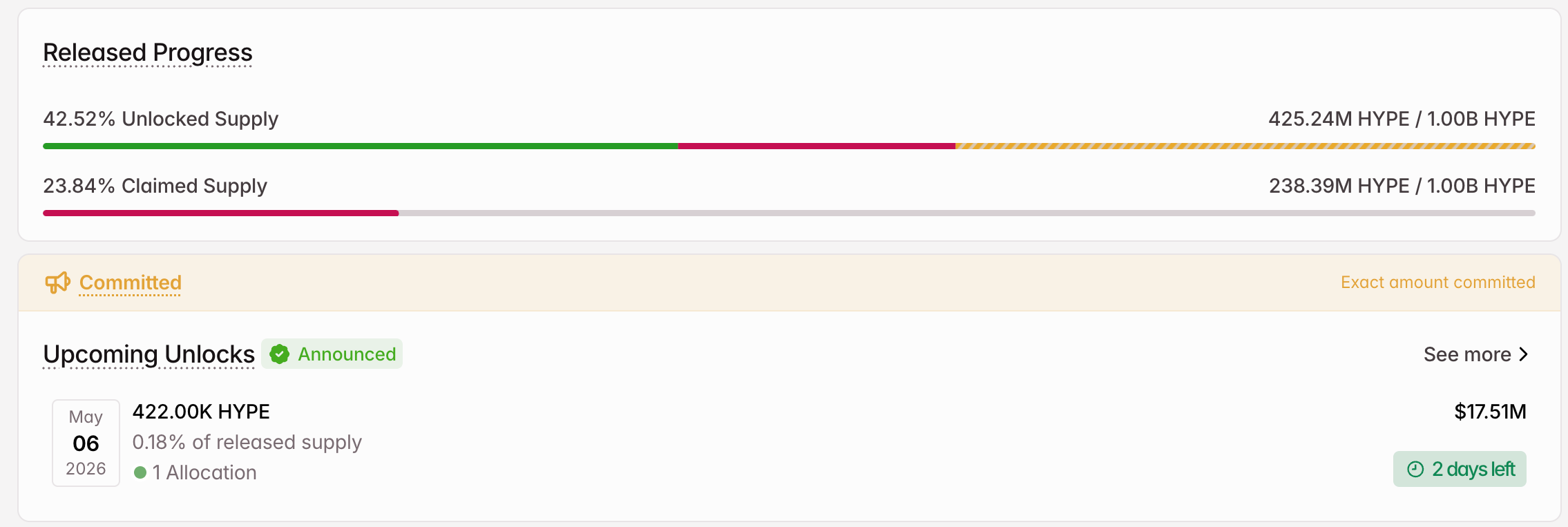
The crypto market will welcome tokens worth around $621.4 million in the first week of May 2025. Major projects, including Hyperliquid (HYPE), Ethena (ENA), and RedStone (RED), will release significant new token supplies.
These unlocks could introduce market volatility and influence short-term price movements. So, here’s a breakdown of what to watch.
1. Hyperliquid (HYPE)
- Unlock Date: May 6
- Number of Tokens to be Unlocked: 422,000 HYPE
- Released Supply: 425.24 million HYPE
- Total Supply: 1 billion HYPE
Hyperliquid is a leading decentralized perpetual futures exchange built on its own Layer-1 blockchain. It offers high-performance trading with low latency, on-chain order books, and sub-second transaction finality.
On May 6, the team will unlock 422,000 HYPE worth $17.5 million. The tokens account for 0.18% of the released supply.

The team has allocated the unlocked supply to core contributors. Tokenomist pointed out that HYPE has historically claimed far fewer tokens than its projected unlock amounts.
2. Ethena (ENA)
- Unlock Date: May 5
- Number of Tokens to be Unlocked: 171.88 million ENA
- Released Supply: 8.09 billion ENA
- Total Supply: 15 billion ENA
Ethena is a synthetic dollar protocol built on Ethereum (ETH). The protocol’s flagship product is USDe, a synthetic dollar stablecoin. Furthermore, ENA is the protocol’s governance token.
The team will release 171.88 million ENA tokens on May 5. The tokens, worth $17.28 million, account for 2.12% of the released supply.

Ethena will award the 93.75 million tokens to core contributors. In addition, the investors will receive 78.13 million ENA.
3. RedStone (RED)
- Unlock Date: May 6
- Number of Tokens to be Unlocked: 40.85 million RED
- Released Supply: 334.94 million RED
- Total Supply: 1 billion RED
RedStone is a modular blockchain oracle protocol that feeds trusted, real-time external data into smart contracts and decentralized finance (DeFi) applications across multiple blockchains.
The team will release 40.85 million tokens on May 6. The tokens are worth $5.54 million. Furthermore, they account for 12.2% of the released supply.

The team will split the unlocked supply four ways. Early backers will get 26.42 million tokens. Core contributors will receive 5.56 million RED.
In addition, the team will allocate 5.54 million altcoins to the ecosystem and data providers. Lastly, it will direct 3.33 million tokens towards protocol development.
In addition to these three, Space and Time (SXT), Opinion (OPN), and BounceBit (BB) will also experience a new supply entering the market in the first week of May.
The post 3 Token Unlocks to Watch in the First Week of May 2026 appeared first on BeInCrypto.

TLDR
- Fundstrat co-founder Tom Lee believes cryptocurrency markets and approximately 50% of equities have completed an unnoticed bear cycle
- Short interest has climbed to depths normally observed at bear market bottoms rather than at cyclical tops
- Real Vision’s Raoul Pal characterizes recent price action as a mid-cycle pullback rather than a terminal phase
- The Crypto Fear and Greed Index dropped to 8, marking its most extended period under 10 in its history
- Cryptocurrency investment products experienced $445 million in redemptions over the past week, with Ethereum absorbing the largest share at $222 million
Tom Lee, who co-founded the investment research company Fundstrat, believes the cryptocurrency sector has already navigated through the majority of its bearish territory. He shared these insights during a conversation on Fundstrat’s research platform.
Lee explained that approximately half of equity markets alongside the entire cryptocurrency space have already completed what he described as an obscured bear market phase. He referenced significant selloffs in software equities and noted that digital assets mirrored these downward movements due to identical liquidity constraints.
He further observed that bearish positioning has swelled to magnitudes typically associated with mid-bear-market conditions rather than standard cyclical peaks. According to Lee, this distinction carries weight because it indicates the bulk of downside pressure has likely already materialized.
Lee noted that investor sentiment deteriorated more rapidly than negative news flow. Market participants adopted defensive postures even as forward-looking economic indicators were finding stability. He interprets this divergence as evidence of a possible inflection point instead of the beginning of deeper losses.
He distinguished between routine cyclical credit tension and systemic financial risk. The recent turbulence in private credit markets, according to Lee, appears more consistent with standard credit cycle dynamics rather than a crisis comparable to 2008. He suggested major banking institutions could actually gain from this transition.
Macroeconomic Indicators Signal Mid-Cycle Position, Not Peak
Raoul Pal, who founded Real Vision, expressed a comparable assessment. He cited global M2 money supply reaching record levels, dollar weakness, and strengthening Institute for Supply Management data.
“The current move does not look like the end of the cycle but a mid-cycle correction,” Pal said in an interview.
Pal also drew attention to the Crypto Fear and Greed Index. The indicator plummeted to 8 and has remained beneath 10 for an unprecedented duration compared to even the 2022 bear market.
He interpreted this extreme fear reading as a potential bottom signal rather than a harbinger of additional declines. The sustained nature of this fearful sentiment, he contended, actually increases the probability of a market bounce.
Investment Fund Flows Paint a Cautious Picture for Now
Despite these optimistic perspectives, actual capital movements remain negative. Cryptocurrency investment vehicles recorded $445 million in redemptions during the previous week.
Ethereum experienced the steepest single outflow totaling $222 million. This represents tangible evidence of continued investor caution.
Lee introduced a forward-looking argument centered on artificial intelligence. He suggested that stablecoin payment systems and blockchain-based settlement infrastructure could emerge as the foundational layer that AI agents utilize at meaningful scale.
This convergence, he maintained, could channel capital back toward Bitcoin and Ethereum once macroeconomic headwinds subside.
Whether a genuine recovery takes hold hinges on the pace of liquidity expansion. It also depends on whether market sentiment continues to trail the actual economic fundamentals.
The latest concrete indicators remain the $445 million in weekly redemptions and the Fear and Greed Index resting at 8 — representing its most extreme and prolonged fear reading in recorded history.



Bitcoin price surged to a four-month high of $80,529 on Monday shortly after United States President Donald Trump revealed “Project Freedom” to help stranded cargo ships affected by the closure of the Strait of Hormuz.
Summary
- Bitcoin climbs to $80,529, breaking $80K resistance after Donald Trump unveils “Project Freedom” amid Strait of Hormuz tensions.
- Rally triggers short squeeze, with over $160M in BTC shorts liquidated and more than $300M wiped across the broader crypto market, per CoinGlass data.
- U.S. spot Bitcoin ETFs log fifth straight week of inflows, while easing risk sentiment lifts equities and pressures safe-haven assets.
According to data from crypto.news, Bitcoin (BTC) price rose nearly 3% breaking past the $80,000 a level that had been serving as stiff resistance. The bellwether has rallied over 20% in the past month.
Bitcoin price jumped today after Trump announced Project Freedom via a Truth Social post on Sunday, an initiative to free stranded cargo ships that were trapped as innocent bystanders in the U.S.-Iran conflict. Notably, the U.S. would guide foreign vessels safely through the restricted waterways so that they could freely get on with their business. The initiative reportedly went into effect today.
Despite the humanitarian framing by the U.S., Iranian officials have warned that any U.S. interference to navigate in the strait would be considered a violation of the fragile ceasefire and could lead to a forceful response.
Besides the project, Trump also said that his representatives were engaged in “very positive” discussions with Iran that could help ease tensions in the Middle East.
“I am fully aware that my Representatives are having very positive discussions with the Country of Iran, and that these discussions could lead to something very positive for all,” said Trump in his May 3 Truth Social post.
As Bitcoin price rallied on the news, it triggered a short squeeze as short traders were caught offguard. Data from CoinGlass shows that over $160 million in Bitcoin short liquidations occurred, which caused over $300 million in short liquidations across the crypto market.
West Texas Intermediate was up 0.6% at $102 per barrel while Brent Crude oil traded at $108, up 0.4%, showing stability as markets await the mission’s outcome.
Safe-haven assets like gold and silver fell slightly lower on the day, while major Asian tech stocks such as the Nikkei 225 and Hang Seng closed higher as investor confidence returned.
Meanwhile, spot Bitcoin exchange-traded funds in the U.S. entered their fifth straight week of net inflows with $153 million added last week. Such institutional inflows often improve retail investors’ perception of the asset’s legitimacy and hence drive further upward momentum.
Looking ahead, one of the next major catalysts for Bitcoin and broader markets is the May 7 initial jobless claims report, which will provide insight into the strength of the labor market and could influence expectations around the Federal Reserve’s interest rate policy.
Disclosure: This article does not represent investment advice. The content and materials featured on this page are for educational purposes only.
Since October 2025, the crypto market has undergone a significant drawdown, with total market capitalization declining and overall activity slowing. Although a modest recovery has emerged in recent weeks, the market remains well below its previous peaks, reflecting subdued momentum.
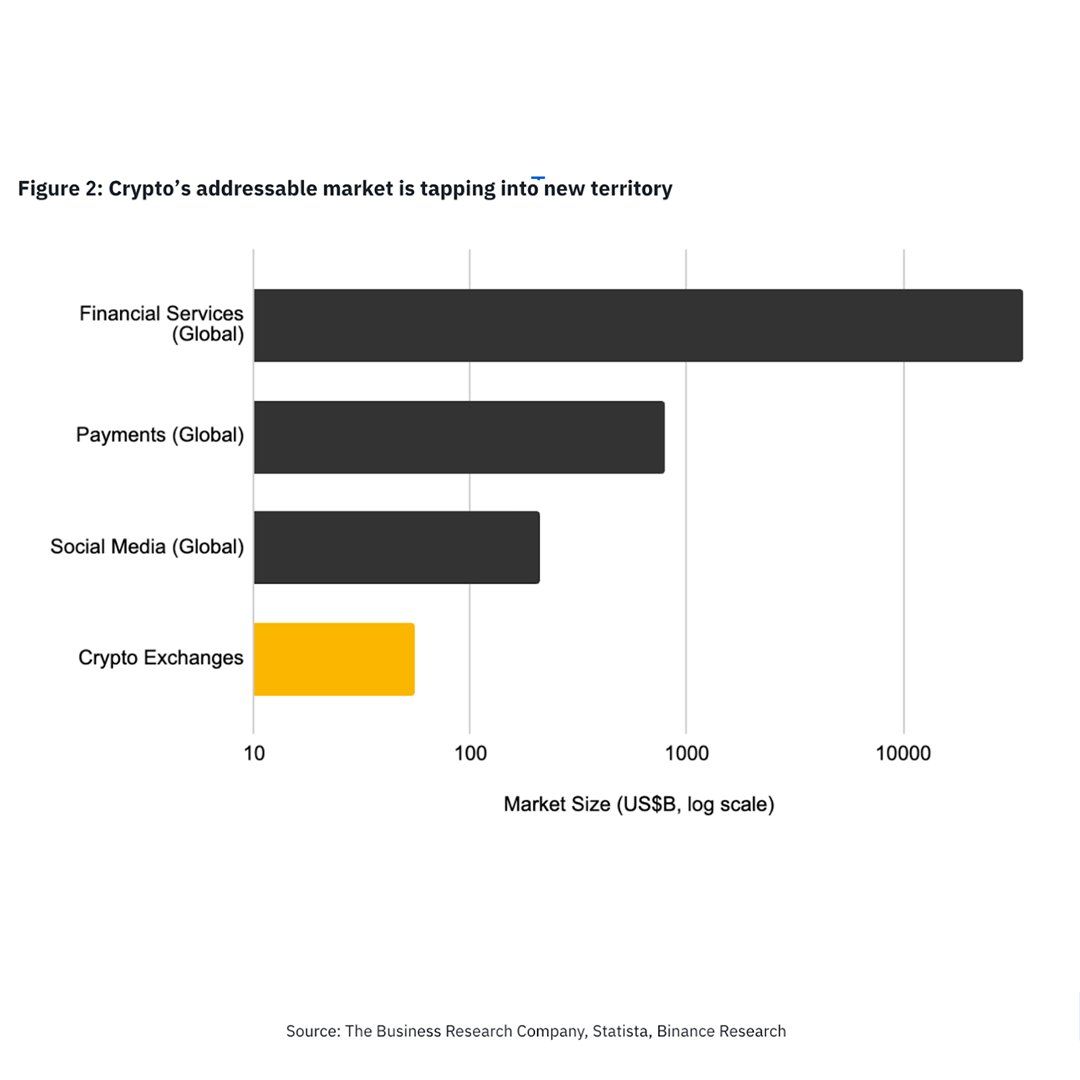
Against this backdrop, Richard Teng outlined the scale of crypto’s potential growth by comparing it to the size of larger traditional markets.
Binance CEO Richard Teng Frames Crypto’s Upside Against $36T in Finance
In a post on X (formerly Twitter), Teng addressed one of the industry’s most persistent questions: How big can crypto actually get? The Binance executive pointed to the total addressable market across sectors where crypto adoption could expand.
Financial services alone represent approximately $36 trillion, while global payments account for around $788 billion. Social media adds another $208 billion opportunity.
By comparison, crypto exchanges today are valued at roughly $55 billion, highlighting the sector’s relatively small footprint. Teng argued that even limited penetration into these markets would still translate into substantial industry expansion.
“The opportunity is expanding rapidly. Even marginal adoption across these sectors could drive transformational growth for crypto,” he said.
Follow us on X to get the latest news as it happens

According to the chart’s figures, crypto exchanges account for roughly 0.15% of the financial services market. Teng did not specify what level of adoption he had in mind.
For illustration, a hypothetical 1% capture across financial services, payments, and social media would imply a $370 billion opportunity. That figure is close to 7 times the current $55 billion crypto exchanges represent today.
Still, the total addressable market is not the same as the serviceable market. Bridging the gap depends on regulation, custody infrastructure, and the institutional trust crypto has yet to fully earn.
Subscribe to our YouTube channel to watch leaders and journalists provide expert insights
The post Binance Co-CEO Richard Teng Lays Out Case for Crypto’s Transformational Growth appeared first on BeInCrypto.
A U.S. court order has placed Arbitrum DAO’s planned use of frozen hack funds under legal restraint.
Summary
- A U.S. court has blocked Arbitrum DAO from moving 30,766 ETH tied to the Kelp DAO exploit after plaintiffs linked the funds to North Korea.
- Lawyers representing terrorism victims have argued the frozen ether can be seized to satisfy over $877 million in unpaid judgments against the DPRK.
According to filings authorized by the U.S. District Court for the Southern District of New York, plaintiffs served a restraining notice on May 1 through Arbitrum’s governance forum, blocking any movement of 30,766 ETH, valued at nearly $71.1 million, that had been frozen by the Arbitrum Security Council after the Kelp DAO exploit.
Lawyers representing the plaintiffs, identified as victims holding unpaid terrorism-related judgments against North Korea, have argued that the seized ether constitutes property in which the DPRK holds an interest. Their claim rests on allegations that the funds were stolen by the Lazarus Group on behalf of Pyongyang, a link previously attributed by LayerZero in its investigation of the breach.
Arbitrum’s intervention traces back to April 20, when its Security Council moved the assets into a controlled wallet after identifying attacker-linked addresses. In an April 21 update, the network said the freeze followed input from law enforcement regarding the exploiter’s identity, adding that the action did not disrupt user activity or applications.
Gerstein Harrow LLP filed the action on behalf of Han Kim and Yong Seok Kim, whose case stems from the killing of Reverend Kim Dong-shik by North Korean agents. A U.S. court awarded roughly $330 million in damages in that case, and the latest filing combines that judgment with two others, Kaplan v. DPRK and Calderon-Cardona v. DPRK, bringing total claims to more than $877 million before interest.
Legal arguments presented by the plaintiffs cite the Foreign Sovereign Immunities Act and the Terrorism Risk Insurance Act, which permit creditors to attach assets tied to state sponsors of terrorism. The filing names both Lazarus Group and APT-38 as instrumentalities of the DPRK.
Governance vote collides with legal claim
Arbitrum DAO had opened a Snapshot vote on April 30 to decide whether the frozen ETH should be transferred to a recovery initiative formed after the exploit. The proposal, authored by Aave Labs with contributions from Kelp DAO, LayerZero, EtherFi, and Compound, seeks to route the funds into a multi-signature wallet managed by ecosystem participants and security firm Certora.
Voting data shows more than 99% support for the plan as of publication time, with a May 7 deadline set for the temperature check. The design limits the wallet’s function to receiving recovered assets and using them to restore backing for rsETH.
Aave Labs has included an indemnification clause in the proposal, offering to cover the Arbitrum Foundation, Offchain Labs, and Security Council members against claims tied to the freeze or release of funds. The extent to which such protections would apply under an active court-ordered restraint remains unresolved.
The dispute unfolds against the backdrop of a $292 million exploit that drained 116,500 rsETH from Kelp DAO’s LayerZero-based bridge on April 18. LayerZero’s analysis pointed to a compromise of RPC nodes and a 1-of-1 verifier setup that allowed a forged cross-chain message to pass validation, while Kelp DAO has maintained that the configuration followed default deployment parameters.
On-chain tracking cited in subsequent reports showed the attacker moving funds through Arbitrum and converting assets into Tron-based USDT, a pattern analysts said was intended to fragment the transaction trail. Estimates cited by Yahoo Finance placed North Korean-linked crypto thefts near $600 million in the first quarter, with the Kelp DAO incident accounting for a significant share.
Arbitrum’s freeze had initially been framed as a step toward recovery, but the court-backed claim has now introduced competing demands over the same pool of assets, leaving the DAO’s next move subject to legal constraint.
Crypto World
Bitcoin (BTC) Surges Past $80,000 Amid Continued ETF Inflows and Geopolitical Uncertainty
Key Highlights
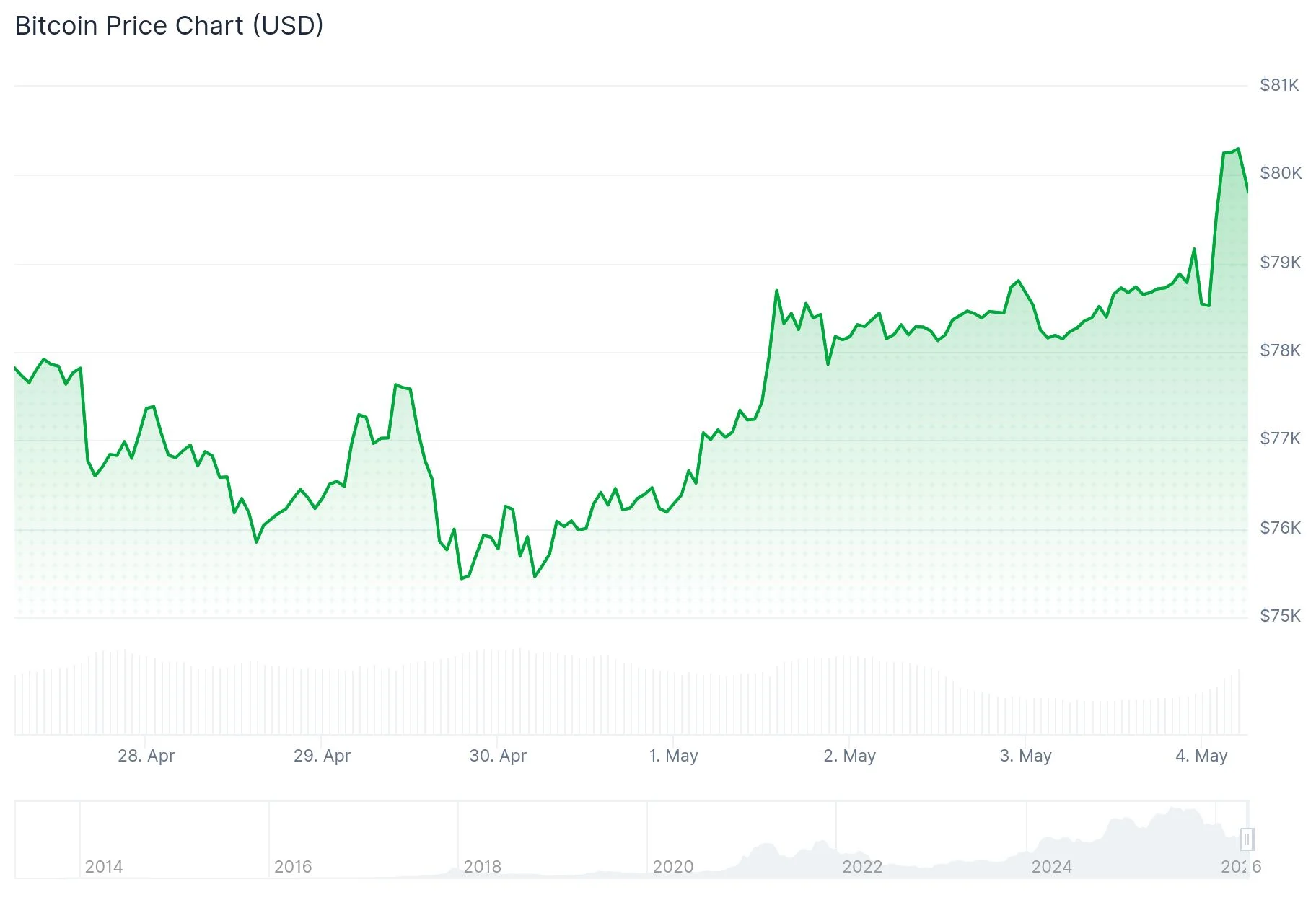
- BTC surged past $80,000 on Sunday evening with a 2.6% gain over 24 hours
- Institutional investors poured $153.87 million into US spot Bitcoin ETFs for the fifth consecutive week
- Geopolitical developments between the US and Iran continue influencing market risk appetite
- Technical analyst Michael van de Poppe identifies $86–88K and $92–94K as critical resistance zones
- Caution persists among some market participants citing potential liquidity traps
The leading cryptocurrency shattered the $80,000 barrier during Sunday’s late trading session, finally breaking through a ceiling that had contained upward movement throughout the weekend. The rally unfolded as market participants monitored developing diplomatic discussions between the United States and Iran alongside consistent institutional accumulation via exchange-traded funds.
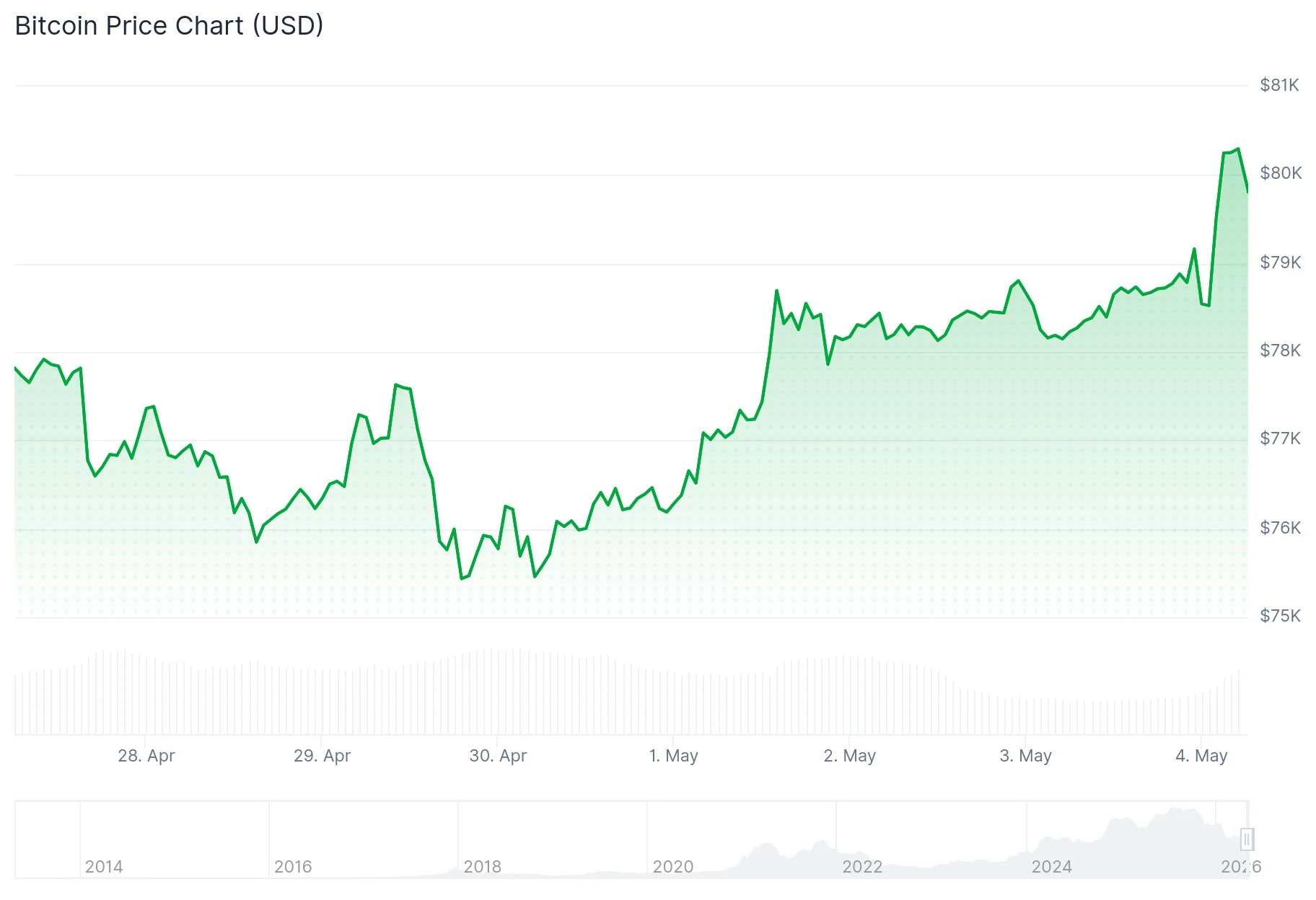
BTC, the flagship digital asset by market capitalization, registered a 2.6% increase across a 24-hour period, reaching $80,150 by 11:40 p.m. ET on Sunday. Meanwhile, Ether posted a stronger 3.6% advance to $2,382, while XRP recorded a modest 2% uptick to $1.41.
According to Nick Ruck, who directs research at LVRG Research, the breakthrough “places near-term momentum firmly as bullish and confirms buyer strength after the earlier pullback.” Dominick John from Zeus Research characterized the movement as a technical short squeeze penetrating what he termed a “major” psychological resistance threshold.
Data from Bitcoin Archive reveals that leveraged short positions exceeding $108 million were forcibly closed within a single hour as BTC maintained its position above $80,000.
Institutional Capital Continues Flowing Into Bitcoin Funds
According to data compiled by SoSoValue, US-based spot Bitcoin exchange-traded funds recorded their fifth straight week of positive net flows, accumulating $153.87 million in fresh capital during the most recent week. Friday’s session alone witnessed approximately $630 million entering these investment vehicles.
Ruck emphasized that the persistent inflows “highlight growing institutional support and confidence in bitcoin as a strategic asset in portfolios.”
Trading expert Michaël van de Poppe shared his perspective on X, highlighting Friday’s substantial ETF activity as a significant indicator. His analysis established $79K as a critical threshold to overcome, followed by initial resistance between $86–88K, with a subsequent target zone of $92–94K should bullish momentum persist.
Market analyst Ted Pillows observed on X that BTC initially breached $79,000 but encountered selling pressure before ultimately securing the level. He suggested that recapturing the $80,000 mark increases the probability of Bitcoin advancing to fill the unfilled CME futures gap positioned at $84,000.
Middle East Geopolitical Developments Under Close Watch
The upward price action coincided with President Trump’s announcement of “Project Freedom” via Truth Social—a program designed to facilitate the safe passage of stranded commercial vessels through the strategically vital Strait of Hormuz. Trump additionally indicated that US negotiators were engaged in “very positive discussions” with Iranian counterparts.
Nevertheless, Iranian representative Ebrahim Azizi issued a statement cautioning that any American intervention in the waterway would constitute a breach of the existing ceasefire agreement. Energy markets responded with Brent crude advancing to $108.49 per barrel.
A weekly close above $78,670 would have represented Bitcoin’s strongest weekly finish since the final days of January. The decisive break above $80,000 pushed that achievement even higher.
Despite the bullish price action, several traders maintained a circumspect outlook. Crypto Tony identified accumulating liquidity beneath current price levels. JDK Analysis characterized the current configuration as “typically bearish,” noting fresh long positions entering at elevated prices while observing potential signs of demand exhaustion.
Market participants are closely monitoring Thursday’s initial jobless claims release, ongoing diplomatic developments between Washington and Tehran, and continued ETF flow data as primary catalysts heading into the upcoming trading week.


Strategy has halted Bitcoin purchases for the week ahead of its first-quarter earnings release and rising scrutiny around its preferred stock dividend.
Summary
- Strategy has paused Bitcoin purchases for the week ahead of its first quarter earnings report, with Michael Saylor confirming no buys in a Sunday update.
- The company last acquired 3,273 BTC for $255 million, taking total holdings to 818,334 BTC valued at roughly $63.7 billion.
- Analysts expect a $18.98 per share loss, while criticism has intensified around STRC’s 11.5% dividend and its long-term sustainability.
According to a Sunday post on X by Michael Saylor, the company signaled “No buys this week,” breaking a pattern where he regularly flags upcoming accumulation.
The decision follows a recent stretch of steady buying. A Form 8-K filing with the U.S. Securities and Exchange Commission shows Strategy acquired 3,273 Bitcoin for about $255 million between April 20 and 26, funded through the sale of 1,451,601 MSTR Class A shares under its at-the-market equity program. Yahoo Finance reported the purchase price averaged $77,906 per coin.
Holdings have reached 818,334 BTC, which Saylor said were acquired for roughly $61.81 billion at an average of $75,537 per bitcoin. At current prices near $78,000, filings and market data place the position’s value at about $63.7 billion, implying an unrealised gain of roughly $1.9 billion.
As reported by crypto.news, Strategy added more than 34,000 BTC for $2.54 billion in a single week last month, which marked one of its largest purchases on record. Across April, four acquisitions totalled well over $3 billion, with earlier deals funded through a mix of MSTR stock sales and issuances of STRC, its perpetual preferred security.
Attention has turned to Strategy’s upcoming earnings report, where analysts expect pressure from accounting treatment tied to Bitcoin. Yahoo Finance data shows Wall Street forecasts a loss of $18.98 per share for the quarter, compared with a $16.49 loss a year earlier, largely due to mark-to-market adjustments on its holdings.
At the same time, scrutiny has intensified around STRC, which offers an 11.5% dividend yield. Peter Schiff repeated his criticism of the structure on Sunday, arguing in a post on X that relying on Bitcoin appreciation above that yield does not resolve what he described as a “ponzi like structure.”
Concerns over sustainability have also been raised by Joseph Parrish, who wrote on April 28 that current cash reserves may not cover two years of STRC dividend payments. Parrish warned that continued stock issuance could become necessary, increasing risk if Bitcoin fails to outperform expectations.
Despite the concerns, data from TipRanks shows a consensus “Strong Buy” rating on Strategy’s Nasdaq-listed shares, even as some investors weigh leverage, payout obligations, and dependence on equity funding.
Strategy still has $26.47 billion in MSTR shares available under its existing issuance program, according to its latest filing, leaving room to continue funding Bitcoin purchases without securing new capital sources.

Disclosure: This article does not represent investment advice. The content and materials featured on this page are for educational purposes only.
Mobile cloud mining expands in 2026 as BM Blockchain attracts beginner interest in BTC and DOGE mining.
Summary
- Mobile-first cloud mining platforms like BM Blockchain simplify Bitcoin mining without hardware or setup complexity.
- The platform offers beginner-friendly crypto mining with guided onboarding and mobile access to mining tools.
- As mining interest grows, BM Blockchain appeals with easy entry, no hardware needs, and streamlined participation.
As more people look up things like what Bitcoin mining is, how to mine Bitcoin, and whether any free cloud mining options still exist in 2026, the mobile-first crypto mining space keeps growing. On Android, iOS, and web dashboards, more users are choosing Bitcoin and Dogecoin cloud mining platforms instead of buying hardware, dealing with heat and power bills, or running dedicated mining rigs.
In real life, “free” usually doesn’t mean mining is forever at zero cost. In 2026, it more often points to free sign-ups, welcome bonuses, trial access, or mobile tools that let people get a feel for mining-related systems before paying for larger plans. That’s why comparison roundups still matter for anyone trying to understand how Bitcoin mining works, how BTC cloud mining platforms actually run, and which services might be easier for beginners.
Below is an original roundup of five platforms that people often mention when talking about the best cloud mining, the best crypto cloud mining options, and beginner-friendly ways to access Bitcoin and Dogecoin mining in 2026.
Top free cloud mining platforms (2026 comparison)
| Platform | Best For | Mobile Access | Entry-Level Feature |
| BM Blockchain | Beginner-friendly platform-based mining access | Mobile-friendly / browser access | Publicly referenced onboarding-related allocations valued at up to $108 |
| StormGain | Users looking for app-based mining activation | Android app | In-app mining activation cycle model |
| ECOS | Contract-style cloud mining access | Android / iOS app | Hosted infrastructure and integrated wallet tools |
| NiceHash | Users monitoring mining operations and hashrate markets | Android / iOS app | Mining marketplace and management interface |
| Binance Pool | Exchange ecosystem users seeking mining-related access | Mobile ecosystem support | Mining-related services integrated within a broader exchange environment |
1. BM Blockchain — Best for users looking for a low-barrier starting point
BM Blockchain can be seen as a beginner-friendly choice for people who want to try Bitcoin cloud mining or Dogecoin mining through a platform, instead of buying and running their own mining hardware. Based on publicly available industry information, BM Blockchain is described as focusing on letting users take part in infrastructure, access computing power, and get a more guided onboarding experience if they’d rather not deal with hardware setup themselves.
For those searching for things like how to mine Bitcoin or how to start mining Bitcoin without building a rig, this kind of platform setup may sound appealing because it removes a lot of the usual technical friction. Instead of setting up and tuning equipment, users can look through the platform’s tools, compare different ways to participate, and get started through a mobile-friendly experience.
Industry disclosures also mention welcome allocations during onboarding valued at up to $108, framed as participation incentives rather than any promised financial result. Interested investors who are comparing cloud mining apps or looking up the best cloud mining options, that kind of easier, low-effort onboarding could make BM Blockchain stand out as a place to begin.
BM Blockchain 2026 illustrative participation snapshot
| Model | Entry Amount | Term | Illustrative Daily Estimate | Illustrative End-of-Term Estimate |
| Starter Plan | $200 | 1 Day | $7.00 | $207.00 |
| A15 Compute | $1,200 | 2 Days | $43.20 | $1,286.40 |
| A2 Cluster | $3,600 | 3 Days | $136.80 | $4,010.40 |
| GPU Node | $8,000 | 2 Days | $344.00 | $8,688.00 |
| Hyd Compute | $16,800 | 3 Days | $924.00 | $19,572.00 |
Stable returns and a clear timeline: This is a truly hands-free way to earn Bitcoin daily.
BM Blockchain states that actual returns may vary depending on platform conditions, applicable terms, fees, operational assumptions, timelines, and broader market factors.
View the full contract and claim $108 worth of free hashrate!

2. StormGain — Best for a Bitcoin miner app experience
StormGain often comes up when people search for terms like best Bitcoin miner app, bitcoin miner app, or bitcoin mining apps, mainly because it offers a mobile-first way to access mining. Beginners in particular talk about it when they want an app that works through simple activation instead of dealing with a more technical contract-style dashboard.
A big reason StormGain shows up so much in beginner conversations is convenience. When someone is asking how to mine Bitcoin on a phone or is looking for a crypto mining experience on mobile, an app-based interface usually feels easier to approach than more traditional mining services.
3. ECOS — Best for structured contract-based cloud mining
ECOS often shows up in cloud mining roundups because it gives users a more structured setup, with hosted mining contracts and centralized tools to manage their accounts. Compared to lighter apps that focus more on quick activation, ECOS tends to suit people who want something more organized and a clearer, contract-style way of presenting the service.
For anyone looking into bitcoin cloud mining, BTC cloud mining, or how to start crypto mining, this approach can feel closer to getting longer-term access to mining infrastructure than just using a casual app.
4. NiceHash — Best for users interested in mining marketplace tools
NiceHash usually comes up less as a typical “free mining app” and more as a marketplace for mining power, along with a platform to manage day-to-day mining operations. That’s why it tends to appeal to people who want to see things like hashrate prices, use account tools, and track mining activity, instead of relying on a simple sign-up bonus approach.
For people looking up what miners are in blockchain, or trying to get a clearer picture of how mining marketplaces work, NiceHash is still one of the better-known names in this space.
5. Binance Pool — Best for exchange-integrated mining access
Binance Pool gets attention mainly because it links mining services with the wider Binance exchange ecosystem. For users who already use Binance regularly, this all-in-one setup can feel easier than running mining through a separate platform.
Looking at different cryptocurrency cloud mining services? People often see Binance Pool as a solid choice when it matters to have everything connected in one ecosystem, not just the mining access on its own.
Why Bitcoin and Dogecoin cloud mining continues to attract attention
Bitcoin is still the best-known digital asset by market value, and Dogecoin continues to get a lot of attention from everyday buyers. Put together, they show two very visible, but very different, corners of the digital asset market.
Many people who look up how to mine cryptocurrency, how to mine Dogecoin, or how long it takes to mine Dogecoin usually aren’t trying to run a large mining setup. More often, they’re looking for an easier way to get started so they can understand what it means to mine Bitcoin, how cloud-style options work, and whether a mobile-friendly service makes more sense for them than buying and managing their own hardware.
That’s part of why mobile crypto mining and browser-based tools are still getting more attention in 2026.
How to choose the right cloud mining platform
Every platform works a bit differently, and “free” doesn’t always mean the same thing everywhere. In real use, people should compare:
- Wwhat “free” actually means on the platform
- Whether the service is app-based, browser-based, or contract-based
- How clearly the participation model is explained
- Whether fees, estimates, and withdrawal rules are disclosed
- Whether the platform is designed for beginners or more advanced users
A practical way to do this is to begin on a platform with a lower entry barrier, get familiar with the participation rules, and try out the user experience first, then gradually increase the allocation.
Frequently asked questions
What is Bitcoin mining?
Bitcoin mining is basically how transactions get checked and then recorded on the blockchain, using computing power. In the past, that usually meant having dedicated mining machines, but a lot of people now start by looking into Bitcoin cloud mining platforms instead of buying and running hardware themselves.
How does Bitcoin mining work?
Bitcoin mining works by using computing power to confirm transactions on the network and help keep the blockchain secure. With cloud mining, people generally use remote services and rented infrastructure rather than owning and running the machines directly.
How can I mine Bitcoin as a beginner?
For those who are new, the easiest starting point is often an app or a platform that walks them through it. Many people who search for how to mine Bitcoin or how to start mining Bitcoin begin with cloud dashboards, instead of jumping straight into ASIC hardware.
What is cryptocurrency mining?
Cryptocurrency mining usually means using computing power to help process blockchain transactions and keep the network running safely. People searching for what cryptocurrency mining is or what cryptocurrency mining is are often trying to understand the difference between mining with their own hardware and joining through a cloud-based option.
What is the best Bitcoin miner app in 2026?
There isn’t one best choice that fits everyone. People looking for the best bitcoin miner app often compare things like how easy it is to use, how clear the terms are, how transparent it feels, and whether it’s mainly for activation, monitoring, or actually connecting users to a broader mining marketplace.
Can crypto be mined on a laptop or phone?
Most of the time, doing serious mining directly on a laptop or phone isn’t really practical anymore. That said, some people use cloud mining apps, crypto mining phone tools, or mobile-friendly dashboards that let them join or manage mining without making the device do the heavy work.
How to mine Dogecoin in 2026?
For those who are asking how to mine Dogecoin, it usually comes down to two routes: mine directly with the right hardware, or join through a cloud platform that offers access tied to Dogecoin. The cloud approach is often easier for beginners since they don’t have to deal with hardware setup.
How long does it take to mine Dogecoin?
That depends on how a person is mining, how much computing power is involved, and which platform or setup they’re using. So, searches like how long to mine Dogecoin and dogecoin cloud mining earnings can lead to very different expectations, depending on whether someone means solo mining, pooled mining, or a platform-based setup.
What does “cloud mining free” really mean?
Most of the time, it means free sign-up, a welcome bonus, a trial period, or limited-time activation — not endless mining with zero cost. It’s worth checking how each platform explains what “free” includes.
Conclusion
The mining scene in 2026 isn’t dominated by just one kind of product anymore. People can now choose from infrastructure-focused services, mobile-first onboarding platforms, mining marketplaces, and ecosystems tied to exchanges.
For those who are looking up things like what Bitcoin mining is, how to mine Bitcoin, the best cloud mining options, or how to mine Dogecoin, a good place to begin is usually a platform that clearly explains how someone can get access and makes it easier to start without having to own hardware. Publicly mentioned onboarding offers, like the $108 welcome incentive linked to BM Blockchain, also show how some platforms are trying to make it simpler for first-time users to get started.
As usual, it’s worth comparing the terms across platforms, understanding what each one actually means by “free,” and checking the participation rules before jumping in.
Disclosure: This content is provided by a third party. Neither crypto.news nor the author of this article endorses any product mentioned on this page. Users should conduct their own research before taking any action related to the company.

VANCOUVER, CANADA – APRIL 28: Gianni Infantino, FIFA President, presents Vittorio Montagliani, FIFA Vice-President and President of the Confederation of North, Central America and Caribbean Association Football (CONCACAF), with a gift during FIFA Council Meeting No. 36 at Fairmont Pacific Rim hotel on April 28, 2026 in Vancouver, Canada. (Photo by Verity Griffin – FIFA/FIFA via Getty Images)
Verity Griffin – Fifa | Fifa | Getty Images
FIFA has increased payments to teams competing in the 2026 World Cup, raising the total distribution to $871 million, making it the most lucrative edition on record.
But the increased financial distributions, announced last Wednesday at the 36th FIFA Council meeting in Vancouver, Canada, come as the governing body faces criticism over ticket pricing and its commercial partnerships.
Under the new financial distribution structure, participating associations at the 2026 World Cup — set to be held across the U.S., Mexico, and Canada from 11 June — will each receive an additional $2 million, across:
That brings the minimum payout for each team to at least $12.5 million upon qualification, with additional prize money tied to performance in the tournament.
These payments are meant to defray some of the costs associated with qualifying and preparing for the quadrennial sporting tournament, including travel, training facilities and staff remuneration and are expected to be particularly meaningful to teams outside of the sport’s traditional powerhouses, according to Ricardo Fort, founder of sport consultancy Fort Consulting.
“This incremental contribution to the national football associations reinforces FIFA’s role in redistributing the commercial success of the tournament back into the global football ecosystem,” Fort said.

The 2026 edition of the World Cup is set to be the largest-ever, expanding to 48 teams, up from 32 in 2022. Four national teams — Cape Verde, Curacao, Jordan, and Uzbekistan — are set to make their debuts at this year’s edition.
FIFA said more than $16 million has also been set aside to cover the costs of participating delegations and team ticketing allocations, bringing the total pool set aside for participating teams to $871 million.
Football’s governing body previously announced a more than 50% increase in the tournament’s prize pool in December.
In December, the FIFA Council approved a “record-breaking” prize pool of $727 million at the 2026 edition of the tournament, a 65% increase from the $440 million allocated to teams in the 2022 World Cup in Qatar.
Ticket pricing concerns
Despite the higher payouts at this year’s tournament, fans have expressed gripes over ticket pricing and the sources of FIFA’s revenue.
Under FIFA’s new “dynamic” pricing system, ticket prices fluctuate on demand. Some fans have reported that ticket prices have risen by more than tenfold from the 2022 tournament.
A CNBC review of ticket prices revealed prices ranging from $380 for a Category 2 ticket for a group stage match between Curaçao and Côte d’Ivoire in Philadelphia, to $4,105 for Category 1 tickets to a game between the U.S. and Paraguay at the Los Angeles Stadium.
On FIFA’s official ticket resale platform, some listings have reached extreme levels, with one such resale ticket for the final listed at $11.5 million. While FIFA does not control the prices of resale tickets, a 15% fee on the value of each transaction is collected.
A FIFA spokesperson told CNBC that the organization was “focused on ensuring fair access to our game for existing but also prospective fans, and offered group stage tickets starting at $60.”
These lower-cost tickets, however, were allocated “specifically to supporters of qualified teams, with the selection and distribution process managed individually by the Participating Member Associations .”
The spokesperson added that the variable pricing system “aligns with industry trends across various sports and entertainment sectors,” and ensures a “fair market value for events.”

Despite outrage over ticket prices, demand for tickets at this year’s World Cup ostensibly remains high.
FIFA President Gianni Infantino previously told CNBC that the organization has received around 508 million requests for the seven million tickets on offer across the tournament’s 104 matches.
If true, in-person viewership at this year’s World Cup would dwarf attendance at the 2022 tournament in Qatar, which drew more than 3.4 million spectators across all 64 matches.
“Ticket pricing is always a sensitive topic for mega-events of this scale,” Fort said. “There will always be segments of fans who feel priced out, especially for premium matches.”
Still, he said FIFA’s pricing strategy “has worked in the American market,” given the high demand.
Fans appear to have paid little attention to FIFA’s other controversies, including a sponsorship deal with Saudi Arabia’s Aramco and the awarding of the FIFA Peace Prize to U.S. President Donald Trump.
“Historically, what we’ve seen is that fan engagement with the tournament itself remains incredibly resilient. Once the competition starts, the focus shifts very quickly to the football,” said Fort.
FIFA’s finances have also grown alongside the tournament. In 2025, the governing body’s revenues totaled $2.66 billion, with television broadcasting rights accounting for a large portion, followed by marketing rights.
Its total assets rose to $9.48 billion, up 54% from the year before. Total reserves, however, fell to nearly $2.7 billion, down by 8% year over year as total liabilities more than doubled in 2025.
Officially a not-for-profit, FIFA’s investments are funneled to infrastructure across its 211 member nations, as well as the organization of tournaments such as the World Cup and Club World Cup, according to the Association’s 2027-2030 budget.

Former Anthony Joshua trainer Robert Garcia predicts Tyson Fury fight: “Out cold”

Kenwood MultiPro Go review: this food processor is excellent for its price and size

What is hantavirus as three dead on Atlantic cruise ship after outbreak

Manchester United reach agreement with Casemiro over contract clause amid transfer speculation

US brings back mandatory military draft registration

Steven Gerrard disagrees with Gary Neville over ‘shock’ Chelsea and Arsenal claim | Football


-

 Tech7 days ago
Register Renaming | Hackaday
-

 Politics6 days ago
Drax board avoid their own AGM, accused of greenwashing & environmental racism
-

 Fashion5 days ago
Kylie Jenner’s KHY Enters a New Era with ‘Born in LA’
-

 Tech7 days ago
Why Blue Badges Disappeared From Toyota Hybrids
-

 Tech6 days ago
Images of Samsung’s rumored smart glasses have leaked
-

 NewsBeat13 hours ago
Channel 5 – All Creatures Great and Small series 7 new post
-
 Tech3 days ago
Trump’s 25% EU auto tariff breaches Turnberry Agreement that also covers semiconductors and digital trade
-

 Business5 days ago
Most Commercial Energy Audits Miss the Real Losses
-

 Business7 days ago
(VIDEO) Charlize Theron Climbs Times Square Billboard to Promote New Netflix Thriller ‘Apex’
-

 Crypto World6 days ago
CFTC’s AI will review U.S. crypto registration applications, chairman tells CoinDesk
-
 Sports3 days ago
Paul Scholes issues Marcus Rashford reality check as agreement emerges over Man United star
-

 Business5 days ago
Barclay Brothers Avoid Bankruptcy: HSBC Drops High Court Petitions After IVA Deal
-
 Entertainment7 days ago
Alicia Keys Calls Out Music Industry ‘Boys Club’
-
 Business4 days ago
Tesla Officially Registers Elon Musk’s Stock: What Investors Need to Know
-

 Tech6 days ago
Get Ready for More Brain-Scanning Consumer Gadgets
-
Crypto World6 days ago
Robinhood Phishing Scam Exploits Gmail Dot Feature to Bypass Security
-

 Crypto World6 days ago
Gmail Dot Trick Underpins Robinhood Phishing, Sending Real-Looking Emails
-

 Entertainment6 days ago
Sister Wives: Janelle Posts New Scary Warning
-

 Business3 days ago
Two Powerball Tickets Split $143 Million Jackpot in Indiana and Kansas
-

 Business6 days ago
Superdry co-founder accused of raping woman
You must be logged in to post a comment Login