

Crypto World
Democrats Push Back On Clarity Act Over Weak Ethics Provisions

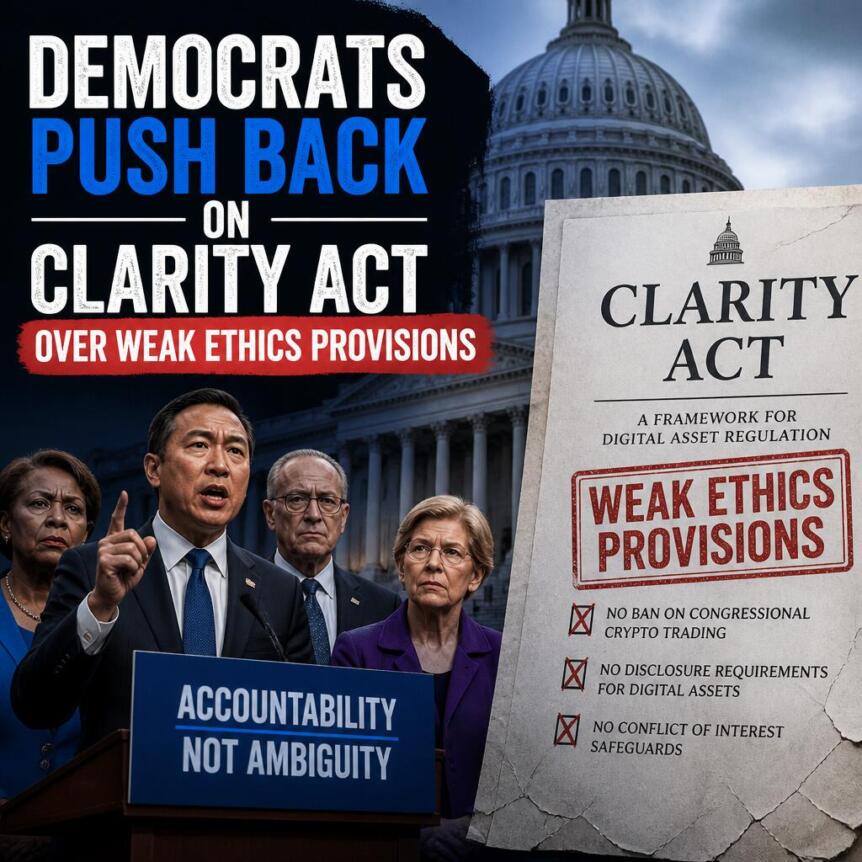
Democratic lawmakers are pushing back against the latest draft of the CLARITY Act over its ethics provisions. The lawmakers believe the provisions do not adequately address President Trump’s crypto interests.
Lawmakers have signalled support for the legislation if stronger provisions are included. However, the bill has found support in the crypto industry, with Coinbase and Ripple backing it.
Democratic Lawmakers Push Back Against Clarity Act Draft
Republican lawmakers released the latest draft of the CLARITY Act on Wednesday (July 22), with several prominent figures from the crypto industry supporting the measure. However, the legislation quickly faced fierce pushback from Democratic lawmakers over weak ethics provisions. The lawmakers argued that the provisions were inadequate to address President Trump’s crypto links. Senator Angela Alsobrooks said the current draft fell short and asked for key provisions to be strengthened, stating, “The Republican-proposed text of the CLARITY Act as it currently stands falls short. Key provisions including those addressing ethics for elected officials, consumer protection, illicit finance, conflicts of interest and market integrity must be strengthened.”
President Trump and his family remain involved in the crypto industry, with interests including a popular memecoin and World Liberty Financial, a decentralized protocol that operates a borrowing-and-lending platform. According to financial disclosures, President Trump received millions tied to WLF.
Incomplete Enforcement Mechanism
The 616-page draft prohibits public officials and their spouses from sponsoring and issuing digital assets. However, it does not prohibit extended family members. The draft also includes a clause stating the restrictions expire in January 2029 and tasks the Justice Department with enforcing the provisions. Senator Ruben Gallego supported the bill in the committee but has ruled out backing it in the Senate unless the ethics language is changed. Besides Alsobrooks and Gallego, Senate Democrats Catherine Cortez Masto and Cory Booker have also opposed the bill in its current form.
Senator Elizabeth Warren took to X, criticizing the bill and stating, “The new draft of the Senate GOP crypto bill does nothing to stop President Trump from making his next $1.4 billion from crypto. It’ll supercharge Trump’s crypto corruption. This bill should be dead on arrival.”
Amanda Fischer, Chief Operating Officer and policy director for Better Markets and former chief of staff for Gary Gensler, believes the draft does not change much for President Trump and his entanglement with crypto.
“The bottom line: Doesn’t change much at all about Trump’s existing crypto grift. No divestment required. Maybe stops new crypto grifts, but it’s up to his personal attorney [Acting U.S. Attorney General] Todd Blanche to enforce. Amnesty kicks in as soon as the new POTUS is inaugurated.”
Support From The Crypto Industry
Unsurprisingly, prominent individuals from the crypto industry threw their weight behind the legislation. Supporters were happy the bill retained software developer protections and added that the legislation would ensure regulatory clarity and elevate the US’ role in the digital asset industry. Ji Hun Kim, CEO of the Crypto Council for Innovation, urged for bipartisan support to get the bill across the line, and Solana Policy Institute CEO Miller Whitehouse-Levine called on Congress to “seize the moment.”
The strongest support for the bill came from Coinbase and Ripple. Coinbase CEO Brian Armstrong said the lack of a clear regulatory framework had hurt the industry, allowing major incidents like the FTX collapse to hurt consumers. Stuart Alderoty, Chief Legal Officer at Ripple, said the bill gives law enforcement agencies the teeth to go after bad actors, while CEO Brad Garlinghouse stated the bill does not have to be perfect to pass.
Supporters of the legislation are urging Congress to vote on the bill before its August recess. However, this depends on whether Democrats and Republicans can agree to a timely compromise.
Disclaimer: This article is provided for informational purposes only. It is not offered or intended to be used as legal, tax, investment, financial, or other advice.



The XRP Ledger crossed 1.4 million AI-agent transactions this week, and Ripple joined Visa, Mastercard, and Google at the table writing the standard behind them. The milestone is real. So is the arithmetic underneath it: at a fifth of a cent per transaction, the entire agentic economy on XRPL has generated about $280 in fees, and the chain it is chasing has a hundred-times head start.
Summary
- The XRP Ledger has processed more than 1.4 million transactions initiated by AI agents, a milestone announced by RippleX’s head of engineering as Ripple ships developer tooling for autonomous payments in XRP and RLUSD.
- The infrastructure behind it is x402, an open protocol reviving HTTP’s dormant “402 Payment Required” code: a service quotes a price, an agent’s wallet signs and pays, the content or compute delivers, no account, card, or human in the loop.
- Ripple joined the Linux Foundation’s new x402 Foundation as one of 40 premier members alongside AWS, Google, Visa, Mastercard, Stripe, Circle, and Coinbase, and was named a launch partner for Mastercard’s agent-payments network.
- The audit matters as much as the milestone: at XRPL’s fixed $0.0002 fee, 1.4 million agent transactions represent roughly $280 in total network fees, while Coinbase’s Base has processed 119 million x402 payments and Solana about 35 million, overwhelmingly settled in USDC.
- The strategic question is the oldest one in the ecosystem wearing its newest costume: even if machine payments become enormous and XRPL wins a share, agents will transact in stablecoins, and what that does for the XRP token is exactly as unresolved as ever.
Every technology cycle produces a moment when a real trend and a modest number get announced in the same sentence, and the reader’s job is to hold both without letting either erase the other. The XRP Ledger delivered this cycle’s cleanest example this week. The trend: autonomous AI agents, software that requests a service, receives a price, and pays for it with no human in the loop, are now transacting on public blockchains at meaningful frequency, under an open standard that Amazon, Google, Visa, and Mastercard have just formed a foundation to govern. The number: the XRP Ledger’s share of that future crossed 1.4 million transactions, which, at the ledger’s fixed fee of roughly two-hundredths of a cent, works out to about $280 in total fees, on a network whose leading competitor has processed over a hundred million of the same payments with a year’s head start. Ripple’s engineering leadership frames the moment with a cloud-computing analogy, early days, obvious potential, standards still forming, and the analogy is fair, which is precisely why the honest piece about this milestone is neither the press release nor the dunk. It is the audit: what is actually being built, what the numbers actually measure, and what, if all of it works, actually accrues to whom.
The machinery: what x402 actually is
The protocol at the center of the story is elegant enough to explain in a paragraph, and its elegance is why the giants showed up.
When the web’s founders drafted HTTP in the 1990s, they reserved status code 402, Payment Required, for a payments layer the internet never built. Every online payment since has been a workaround: accounts, cards, subscriptions, API keys, invoices, all of them designed for humans with wallets and none of them usable by software that wants to buy one API call’s worth of data right now. x402, developed at Coinbase and contributed this month to a new Linux Foundation body, finally implements the dormant code. A service receiving a request from an unpaid client responds with 402 and a machine-readable quote: the price, the accepted asset, the receiving address. The requesting agent’s wallet signs and broadcasts the payment on a supported blockchain; the service verifies settlement and delivers. No account creation, no card on file, no human approval, no minimum viable subscription. Payment becomes a header, and commerce becomes something two pieces of software conclude in seconds.
The governance followed the code. The x402 Foundation launched on July 14 under the Linux Foundation with roughly 40 premier members, a list that reads like the payments establishment buying insurance on its own disruption: AWS, Google, Visa, Mastercard, Stripe, Circle, Coinbase, and, as of this month, Ripple. Membership is the context for everything Ripple has shipped around it: the XRPL AI Starter Kit released in June, packaging wallet integration, documentation servers, and payment tutorials for agent developers; the XRPL AI Hub launched by Ripple-backed t54.ai; support for agent payments in both XRP and the RLUSD stablecoin; and a slot among the thirty-plus launch partners of Mastercard’s own agent-payments network. The XRPL’s technical pitch for the workload is coherent: deterministic finality in three to five seconds, fees fixed at fractions of a cent, native escrow and multisignature support, and a built-in exchange, properties that suit high-frequency machine payments better than they ever suited the retail speculation the ledger mostly hosts. RippleX’s head of engineering, J. Ayo Akinyele, announced the million-transaction crossing with the early-cloud framing: “The potential was obvious, but the tooling and standards were still coming together.” As positioning, it is exactly right. As measurement, it invites the next section.
The audit: what 1.4 million transactions weighs
Take the milestone apart with the ledger’s own arithmetic, because the exercise clarifies what is and is not being claimed.
XRPL transaction fees are fixed near $0.0002. One million four hundred thousand agentic transactions therefore generated on the order of $280 in total network fees, a number that is not a gotcha but a measurement: it says the agentic activity on XRPL to date is, economically, a rounding error, and that transaction count on a chain where transactions cost nothing is a metric that measures enthusiasm and testing at least as much as commerce. At two-hundredths of a cent, a single developer’s integration test suite, a hackathon weekend, or an agent pinging a demo API in a loop produces six-figure transaction counts for the price of a coffee. Some unknowable share of the 1.4 million is exactly that, which the more careful voices in the ecosystem, including t54’s own framing of the milestone as showing capability, implicitly concede. The honest description is that XRPL has proven the pipes work, not that anything economically significant flows through them yet.
The comparative table sharpens the same point. Coinbase’s Base network has processed more than 119 million x402 payments; Solana roughly 35 million; both had approximately a year’s head start, and both settle the overwhelming majority of that volume in USDC. Even the leader’s economics remain tiny, industry tallies put cumulative settled x402 volume in the tens of millions of dollars, an average well under a dollar per payment, which confirms the category is micropayments in fact as well as theory. But the ordering matters: XRPL’s 1.4 million against Base’s 119 million is a roughly hundred-fold gap in the category XRPL is now marketing as a strategic fit, and gaps of that shape, in developer-network businesses, historically widen rather than close, because agent frameworks integrate the chains where the other agents already are. The XRP ecosystem has run this race before, shipping credible infrastructure into a category with an entrenched leader and discovering that technical fitness does not conjure developer gravity; the EVM sidechain’s first year, which this publication audited at $25,741 in total value locked, is the cautionary precedent nobody at the milestone party mentions.
And beneath both numbers sits the question this ecosystem can never quite escape, because it is the question: who earns what if this works? Agents transacting under x402 optimize for stable settlement, which is why USDC dominates the category everywhere it exists, and on XRPL the natural settlement asset is RLUSD, whose reserve income accrues to Ripple the company. The XRP token’s role in the flow is gas, priced at two-hundredths of a cent by design, and collateral-adjacent plumbing, which means the milestone’s implicit promise, more agent activity equals more value through XRP, runs directly into the fee math above: a billion agentic transactions a year, a seven-hundred-fold increase from today’s total, would generate roughly $200,000 in annual XRP fee burn. The value-accrual gap between network success and token performance, the gap this publication has documented across payments, custody, and DeFi, arrives in the AI era fully intact. Machine commerce may be enormous. XRPL may even win a real share. The token’s claim on that outcome remains what it has always been: a thesis in search of a mechanism.
The case that the position is still right
Having weighed the milestone honestly, weigh the strategy the same way, because the audit cuts against the hype without cutting against the play.
Standards tables are cheap options on large futures. Ripple’s premier membership costs it engineering attention and puts XRP and RLUSD inside the specification process of a payment standard that AWS, Google, Visa, and Mastercard consider worth governing, which is not a marketing decision on their part; the agent-payments category is the rare crypto use case that the traditional payments industry believes in enough to pre-organize around. If machine-to-machine commerce becomes a fraction of what its backers project, the chains and assets wired into the standard from the beginning inherit distribution no retrofit can buy, and the Mastercard launch-partner slot is exactly that wiring. The early-cloud analogy earns its keep here: AWS’s revenue in 2008 was a rounding error too, and the companies that dismissed it on contemporary arithmetic were measuring the wrong thing.
The technical fit argument is also better than the ecosystem’s average claim of this genre. Agent payments genuinely want what XRPL genuinely has: deterministic sub-five-second finality, fees that never spike, native escrow for conditional payments, and an architecture that has processed payments, only payments, for a decade without an outage that mattered. The chains currently leading the category are general-purpose platforms on which payments compete with everything else for blockspace; a specialized settlement layer is a coherent bet on how the category matures, particularly for the enterprise and financial-institution agents Ripple’s distribution actually reaches, as opposed to the consumer-crypto agents Base inherits from Coinbase. And RLUSD’s presence in the standard is unambiguously valuable for Ripple’s stablecoin strategy, whatever it does for the token: every x402 flow RLUSD settles is float, and float is the business.
The bear case concedes all of this and returns to the ledger’s oldest pattern: infrastructure fitness without developer gravity, milestones denominated in counts rather than dollars, and value accruing to the company faster than to the asset. Both cases are live. The difference between them will not be argued into resolution; it will be measured, which is what the final section is for.
The stablecoin sitting in the middle
One participant in this story holds a materially different position from all the others, and the analysis owes it a section: RLUSD, which enters the agent-payments race with none of XRP’s value-accrual problem and all of Ripple’s distribution behind it.
The economics of a stablecoin in machine commerce are the economics every issuer already understands, at higher frequency. Each RLUSD that settles agent payments is float, reserves earning treasury yield for the issuer, and agentic flows have a property consumer flows lack: balances that never sleep. A human cardholder’s stablecoins sit idle between purchases; an agent’s working balance turns over continuously, but the aggregate float across a fleet of funded agents is persistent, programmatic, and grows with the category mechanically. If machine payments become a fraction of what the foundation’s membership implies, the stablecoins wired into the standard become the category’s silent tax collectors, and the fight for that position is already visible in the data: USDC’s dominance of Base and Solana x402 volume is Circle collecting the early category almost uncontested. RLUSD’s presence in the XRPL implementation, and in whatever flows the Mastercard partnership eventually routes, is Ripple’s bid for a share, and it is a better bid than the transaction counts suggest, because the enterprise agents Ripple’s institutional relationships reach will care about exactly the things RLUSD was chartered to offer: a regulated issuer, bank-grade reserves, and a compliance posture that a corporate treasury can sign off on.
Which sharpens, not softens, the token question this piece keeps returning to. The clearer RLUSD’s path in agent payments becomes, the more precisely the ecosystem’s value routing resolves: the category’s fees go to nearly nothing by design, the float goes to Ripple, and the XRP token’s participation is the $0.0002 toll. There is one construction under which the token does capture something, XRP as the bridge and liquidity asset when agents transact across currencies, using the ledger’s native exchange, which is the on-ledger version of the company’s oldest thesis, and it carries the oldest caveat: it requires agents to hold and route through a volatile asset when a stable one is available, a behavior no current x402 flow exhibits anywhere. Watching whether it ever emerges, in the cross-currency settlement data the ledger makes public, is the cleanest token-relevant observable this whole story offers. Absent it, the honest summary of the agent era for the two assets is uncomfortable and simple: the milestone is XRPL’s, the business is RLUSD’s, and the token is, once again, the venue, not the beneficiary.
What to watch
Settled volume, not transaction count. The category’s honest metric is dollars settled through x402 flows on XRPL, a number nobody currently headlines precisely because it is small. When it appears, in t54’s reporting, foundation dashboards, or Ripple’s disclosures, it converts this story from enthusiasm-measurement to commerce-measurement. Until it appears, transaction counts should be read as what they are.
The settlement-asset split. Watch what share of XRPL agentic payments settle in RLUSD versus XRP, and what share of cross-chain x402 volume RLUSD captures against USDC’s incumbency. The first ratio prices the token’s role in its own ecosystem’s newest story; the second prices Ripple’s stablecoin against the category leader on neutral ground.
A commercial workload with a name. The milestone that would actually move this story is one identifiable production deployment, an enterprise paying real money for real services through XRPL agent rails, versus the anonymous aggregate counts. Mastercard’s network going live with Ripple in the loop is the likeliest venue. One named workload outweighs the next ten million test transactions.
The gap’s direction. Base at 119 million and growing; XRPL at 1.4 million and growing. The ratio between their growth rates over the next two quarters answers the developer-gravity question empirically, and it is the same question the EVM sidechain’s first year answered badly. Watch whether this category rhymes.
The 402 status code waited thirty years for the internet to need it, which is a useful reminder that infrastructure stories run on timelines that make any single milestone nearly meaningless. The XRP Ledger’s 1.4 million agent transactions prove the machinery works and prove nothing about who wins, the $280 in fees prices today’s reality without pricing the future, and the foundation seat is a rational option on an outcome no one can yet measure. The audit’s conclusion is not that the story is false. It is that the story is, so far, exactly $280 large, and that everyone quoting the transaction count owes the fee line alongside it.
Disclaimer: This article is for information and educational purposes only and does not constitute financial or investment advice. It describes early-stage technology adoption whose metrics are incomplete and fast-changing, and comparisons rely on figures reported by third parties. Nothing here is a recommendation to buy, sell, or hold any asset. Always do your own research. Information is accurate as of July 23, 2026.
Frequently Asked Questions
What is x402?
An open payment protocol that implements HTTP’s long-dormant 402 “Payment Required” status code. When software requests a paid service, the server responds with a machine-readable quote, price, accepted asset, receiving address; the requester’s wallet signs and sends payment on a supported blockchain, and the service delivers upon settlement. It was developed at Coinbase and contributed to the Linux Foundation’s x402 Foundation, launched July 14 with about 40 premier members including AWS, Google, Visa, Mastercard, Stripe, Circle, and Ripple.
What did the XRP Ledger milestone actually announce?
That more than 1 million transactions initiated by AI agents have been processed on the XRPL, a figure now around 1.4 million, announced by RippleX engineering head J. Ayo Akinyele alongside the XRPL AI Starter Kit, tooling that connects agents to wallets, payments, escrow, and documentation, with support for paying in XRP and RLUSD. Ripple also joined the x402 Foundation and was named a launch partner for Mastercard’s agent-payments network.
Why does the article emphasize $280 in fees?
Because XRPL fees are fixed near $0.0002 per transaction, so 1.4 million agent transactions generated roughly $280 in total network fees. The figure measures the economic weight of the activity: at fees that low, transaction counts capture developer testing and experimentation as much as commerce, so the count alone cannot distinguish a working economy from a working demo. Settled dollar volume, not yet headlined anywhere, is the metric that would.
How does XRPL’s position compare to other chains?
It trails badly on volume and leads on specialization claims. Coinbase’s Base network has processed over 119 million x402 payments and Solana roughly 35 million, both with about a year’s head start and settlement dominated by USDC. XRPL’s counterargument is technical fit, deterministic 3-5 second finality, fixed fees, native escrow, a payments-only track record, and institutional distribution through Ripple and the Mastercard partnership.
Do AI agents pay in XRP or RLUSD?
Both are supported, and the split is the story’s key open ratio. Category-wide, agents overwhelmingly settle in stablecoins because they optimize for stable pricing, which favors RLUSD on XRPL, whose reserve income accrues to Ripple the company. XRP functions primarily as network gas at fractions of a cent. This is why network success and XRP token value remain distinct questions, the ecosystem’s long-standing value-accrual gap in its newest setting.
Is the agent-payments category itself real?
Early but credible. Cumulative settled x402 volume across all chains remains in the tens of millions of dollars, tiny by payments standards, but the institutional pre-organization is unusual: the world’s largest cloud, card, and payments companies formed a governance foundation before the market matured, and Mastercard is building a dedicated agent-payments network. The category’s backers are exactly the incumbents who usually arrive late.
What would validate XRPL’s bet here?
Named commercial workloads and dollar volume. One identifiable production deployment paying real money through XRPL agent rails, plausibly via Mastercard’s network, would outweigh millions of anonymous test transactions. Sustained growth in RLUSD-settled x402 volume, and any narrowing of the transaction-count gap against Base, would show developer gravity forming, the ingredient the ecosystem’s prior infrastructure bets most conspicuously lacked.
What should XRP holders take from the milestone?
That the infrastructure story is real, early, and, so far, economically small, and that its success would not automatically flow to the token. The rational reading treats the foundation seat and Mastercard partnership as cheap options on a large future, the transaction milestone as proof of capability rather than adoption, and the RLUSD-versus-XRP settlement split as the number that decides who benefits if the future arrives. This is educational analysis, not investment advice.


The language that decides crypto’s biggest bill finally exists: a ban on federal officials issuing digital assets, enforced only by the Justice Department, with penalties of $250,000 a day, and a sunset clause dated to the next president’s inauguration. Here is what the text actually does, what it carefully does not, and the vote math it has to survive this week.
Summary
- Senate Republicans released updated CLARITY Act text on Wednesday containing the long-awaited ethics provision: a ban on the president, vice president, members of Congress, and senior federal officials issuing or sponsoring digital assets while in office.
- President Trump personally signed off on the language Monday after months of deadlock, with the White House calling it the most comprehensive ethics provision in history and penalties reaching $250,000 per day.
- The design choices are the story: the ban covers issuing new assets, not holding or profiting from existing ones; enforcement belongs solely to the Justice Department, with state attorneys general expressly barred; and the entire provision sunsets on January 20, 2029, the next president’s inauguration day.
- The two Democrats whose committee votes carried the bill, Senators Alsobrooks and Gallego, oppose the released version, centering their objection on DOJ-only enforcement by a department the president’s former personal lawyer has been picked to run.
- The floor math is unchanged and unforgiving: roughly seven Democratic crossovers needed for 60 votes, a cloture motion required within days, and the August recess closing the window on the most consequential crypto bill Congress has produced.
For a year, the decisive section of the most important crypto legislation in American history did not exist. The CLARITY Act’s market-structure machinery, its asset taxonomy, its DeFi shield, its agency handoffs, was drafted, merged, and printed, while the ten or so pages that would determine whether any of it becomes law, the ethics language governing officials who profit from the industry they regulate, remained a blank space that negotiators talked around. On Wednesday the blank space filled in. Senate Republicans released updated bill text containing the provision President Trump personally accepted two days earlier, and the crypto industry, which has spent months insisting the ethics fight was a sideshow, can now read the main event. The provision bans federal officials, the president included, from issuing digital assets while in office, on penalty of up to $250,000 per day, enforced by the Department of Justice. It is, exactly as the White House advertises, the most comprehensive crypto ethics restriction ever written into American legislation. It is also a document whose three central design choices, what it covers, who enforces it, and when it dies, each preserve what the provision appears to surrender, and the senators whose votes it was written to win noticed all three before the ink dried. What follows is the close read: the text, the trade, and the arithmetic it must survive in the next several days.
What the provision actually says
The released language, provided by lead sponsor Senator Cynthia Lummis, does four things, and precision about each matters more than usual, because the gaps between them are where the politics live.
First, the ban. Federal officials, the president, vice president, and members of Congress among them, are prohibited from issuing or sponsoring cryptocurrencies and other digital assets while in office. The verb is the provision’s load-bearing wall: issuing. An official may not launch a token, sponsor a coin, or put their name to a new digital asset offering during their tenure. The prohibition is real, and its most obvious application is retrospective in spirit: the TRUMP memecoin, launched days before the second inauguration, and World Liberty Financial’s token issuances are exactly the genre of activity the ban describes, and under this language, no sitting official could repeat them.
Second, the enforcement architecture. The Justice Department, through the attorney general, is the provision’s sole enforcer, empowered to act against officials and, notably, against crypto exchanges for violations. State attorneys general, the enforcement channel Democrats spent months demanding, are expressly excluded. This was, according to reporting on the White House’s industry briefing, the administration’s firm line: ethics rules for federal officials, the argument runs, are federal business, enforced through the federal channel, uniformly, everywhere.
Third, the penalties: up to $250,000 per day of violation, a figure designed to read as severe and to compound quickly against any sustained breach.
And fourth, the clause that will be quoted longest: the provision sunsets on January 20, 2029, inauguration day for the next president. The White House fact sheet frames the date with remarkable candor, describing the restriction as a standard President Trump chose to hold himself to, not one Congress imposed on him. The most comprehensive ethics provision in history, by its own terms, applies to precisely one presidency and expires the morning that presidency ends.
What it carefully does not say
Read the provision against the conduct that motivated it and the scope decisions come into focus, because the fit between the two is deliberate and partial.
The Office of Government Ethics disclosure released July 1 showed the president earned roughly $1.4 billion in crypto-related income in 2025, including approximately $580 million connected to World Liberty Financial, the family venture behind the WLFI token and USD1 stablecoin, with Reuters tallying the family’s crypto-linked wealth gain since the return to office above $2 billion. That income stream is the fact pattern Democrats have spent a year describing as disqualifying, Senator Warren’s phrase was brazen financial corruption, and it is worth stating plainly what the new provision does to it: nothing. The ban covers issuing new assets, not holding existing ones, not earning from ventures already launched, not the licensing income from a memecoin already trading, not the float income of a stablecoin already circulating. Every disclosed dollar of the $1.4 billion would have been earned identically under this provision, because the ventures that generate it predate the ban that would now apply. The provision forecloses the sequel while blessing the original, which is either a reasonable prospective compromise or the entire tell, depending on which caucus is reading.
The enforcement design has the same double character. Assigning federal ethics enforcement to the Justice Department is, in one light, simply constitutional hygiene: DOJ enforces federal law against federal officials, as it always has. In the other light, it assigns the policing of the president’s conduct to a department whose leadership the president selects, and the abstraction has a name attached this month: Todd Blanche, the president’s former personal defense lawyer, is his pick to run the department that would hold the sole key to this provision. Democrats’ counter-demand for state attorneys general was never really about federalism; it was about placing enforcement somewhere the restricted party cannot reach, and many state AGs have spent two years litigating against this administration. The White House’s uniform-standard argument and the Democrats’ captured-enforcer argument are both coherent. They are also irreconcilable, which is why this single design choice, more than the ban’s scope or the sunset’s date, is where the released text met its opposition.
And the sunset completes the pattern. A restriction that expires on January 20, 2029, inauguration day for the next president, binds no future president, creates no permanent norm, and, its critics note, converts what was demanded as a structural reform into a personal undertaking with a termination date. The generous reading is legislative realism: sunsets are how contested provisions pass, and a 2029 expiry simply hands the question to the next Congress with a precedent on the books. The ungenerous reading writes itself.
The reception, counted in votes
The provision’s purpose was arithmetic: convert enough of the seven-to-nine needed Democratic crossovers to reach sixty. Its first day produced the opposite motion.
Senators Angela Alsobrooks and Ruben Gallego, the only two Democrats who voted the bill out of committee and therefore the crossover coalition’s indispensable foundation, both announced they oppose the released version. Their stated objection is not the ban’s scope or the sunset; it is the enforcement monopoly. Alsobrooks, who had earlier characterized the emerging deal as an offer too unserious to support, said directly she cannot back legislation with the Justice Department as sole ethics enforcer, and pressed the state-AG demand the released text expressly forecloses. Losing the two committee Democrats on day one means the provision, as written, has so far subtracted from the coalition it was drafted to complete.
Around that core, the map is more textured than the headlines. The three-senator opposition bloc, Murphy, Merkley, Van Hollen, that organized against the merged draft remains opposed, with Warren adjacent. Senator Cortez Masto’s separate objection, that the bill’s Section 604 developer protections would impair illicit-finance enforcement, was not addressed by the revision at all, her office confirmed, meaning the ethics text resolved none of her price. But seven Democrats generally considered pro-crypto issued a joint statement that criticized the current text while conspicuously declining to rule out a deal, which is the signature of a caucus negotiating, not walling. And the administration is running the pressure campaign accordingly: an official’s on-record framing that Democrats who block the bill after the president bent over backward were never serious, Treasury Secretary Bessent’s declaration that Congress stands at the one-yard line, and an industry mobilization pointed at the same handful of offices. The blame architecture for failure is being constructed in parallel with the negotiation for success, which tells you the White House prices both outcomes as live.
Beneath the positioning sits the physics no statement changes. Sixty votes for cloture, twice, against 52 Republican seats after Senator Graham’s death, minus the expected Hawley and Paul defections, with Senator McConnell’s availability uncertain. The bill has sat eligible on the calendar since June 1; a cloture motion must be filed within days for two full Rule XXII sequences to fit before the recess in early August; and every day spent negotiating enforcement language is a day subtracted from a window that was already too small for error. The provision arrived with perhaps a week to convert its critics, and its first 24 hours converted none.
The negotiation’s fossil record
The released text is the sixth known attempt at this provision, and its predecessors explain both why the current design looks the way it does and where the remaining give might be, because each failed version marks a boundary somebody refused to cross.
The maximal Democratic version came first: divestment-grade restrictions barring senior officials and their families from owning or profiting from digital-asset ventures the government regulates, the framework behind Senator Warren’s public demands and the standing bills Democrats introduced through 2025. It never advanced, because it would have required the president’s ventures to unwind, which was always the one outcome the White House would kill the bill to avoid. Senator Van Hollen carried a narrower amendment into the Banking Committee markup in May, and it failed 13 to 11 along party lines, the cleanest recorded measurement of where the committee’s majority stood: no ethics language at all, if the majority chose. Then came the White House’s early counter-doctrine, articulated by crypto adviser Patrick Witt, that any restriction must apply uniformly to all officials rather than targeting the president or his family, a principle that sounds procedural and functions substantively, since uniform prospective rules are precisely the kind that leave existing presidential ventures untouched. A subsequent compromise attempt reportedly built around state attorneys general as enforcers collapsed when Democrats judged the surrounding package inadequate, which is the fossil that matters most now: the state-AG mechanism was, at one point, on the table with the administration’s participation, before it hardened into the red line the current text draws against it.
Read as a sequence, the record shows the negotiation ratcheting in one direction. Divestment gave way to conduct rules; conduct rules narrowed to issuance; enforcement migrated from independent channels toward the department the president staffs; and permanence gave way to a sunset dated to his departure. Each step was the price of keeping the White House at the table, and the final text is what remains after every element the administration found genuinely costly was traded away. That history is the strongest version of the Democratic objection, stronger than any single design critique: the provision is not a compromise between two positions, it is the residue of one position’s serial retreat, and senators asked to bless it are being asked to certify the retreat as sufficient. It is also, simultaneously, the strongest version of the Republican rejoinder: five failed versions prove the alternative to this text was never a stronger text, only no text, and the fossil record of a negotiation is not a menu from which the minority may now reorder. Both arguments will be made on the floor this week, about the same six documents, and the seven senators who decide the outcome have read them all.
The honest reading, both ways
Strip the spin from both camps and two true descriptions of this document coexist, which is precisely why the next week is genuinely uncertain.
The provision is a real concession. No prior Congress has enacted any statutory restriction on a president’s digital-asset conduct; this text would create the first, with the sitting president’s signature, criminalizing the exact behavior, official-sponsored token launches, that defined the current administration’s crypto entanglement. The issuing ban forecloses the next TRUMP coin, the next family stablecoin launch, the next official-adjacent token offering, for this White House and this Congress, under penalties that compound daily. Prospective-only application, federal enforcement, and sunset clauses are not scandals; they are the standard grammar of contested legislation, and Democrats demanding more were always going to be told that the perfect provision attached to a dead bill protects no one. On this reading, the deal is the achievable maximum, and the crossover Democrats’ real choice is this text plus the entire market-structure framework, or nothing plus a talking point.
The provision is also a carefully bounded one. Its scope exempts every existing revenue stream that motivated it; its enforcer answers to its principal subject; its lifespan matches his term. Each boundary was a choice, each choice was the White House’s, and the pattern of the three, together with a fact sheet that openly describes the restriction as self-imposed rather than congressionally required, supports the Democratic suspicion that the document’s function is narrative, a provision comprehensive enough to campaign on and porous enough to cost nothing. On this reading, the state-AG demand is not a detail; it is the only element that would give the text an enforcer outside the subject’s appointment power, which is why it was the one element refused.
Both readings survive contact with the text. The Senate will effectively choose between them by Friday, because the calendar has converted an interpretive question into a scheduling one. Watch three things in sequence: whether the enforcement language moves, since a hybrid mechanism, DOJ primary with any independent backstop, is the visible landing zone between Alsobrooks’s stated floor and the White House’s stated ceiling; whether a cloture motion gets filed, the only signal that leadership’s private count reached sixty; and whether the seven-Democrat statement hardens or softens as the pressure campaign lands. The blank space at the center of American crypto legislation is filled. What remains blank, for a few more days, is whether the words in it were written to pass a bill or to explain why one failed.
Disclaimer: This article is for information and educational purposes only and does not constitute financial, investment, or legal advice. It describes draft legislation and a fast-moving negotiation whose text, schedule, and outcome can change at any time. Nothing here predicts any legislative result. Always do your own research. Information is accurate as of July 23, 2026.
Frequently Asked Questions
What does the new ethics provision actually prohibit?
It bans federal officials, including the president, vice president, and members of Congress, from issuing or sponsoring cryptocurrencies or other digital assets while in office, with violations subject to penalties of up to $250,000 per day. The prohibition targets new token launches and sponsorships of the kind exemplified by official-adjacent memecoin and venture-token issuances, and enforcement can reach both officials and crypto exchanges involved in violations.
Does it affect President Trump’s existing crypto income?
No. The ban covers issuing new assets, not holding or earning from existing ventures. The roughly $1.4 billion in 2025 crypto-related income shown in the July 1 ethics disclosure, including approximately $580 million connected to World Liberty Financial, derives from ventures launched before the provision would take effect, and those income streams, memecoin licensing and stablecoin operations included, continue unaffected under the released text.
Who enforces it, and why is that controversial?
The Justice Department alone, with state attorneys general expressly barred from enforcement. Democrats object that this assigns policing of the president’s conduct to a department whose leadership he selects, sharpened by the fact that Todd Blanche, the president’s former personal defense lawyer, is his pick to run it. The White House argues federal ethics rules require uniform federal enforcement. This single dispute is the stated reason the two committee Democrats oppose the released version.
What is the sunset clause?
The entire provision expires on January 20, 2029, the next president’s inauguration day. The White House fact sheet describes the restriction as a standard Trump chose to hold himself to rather than one Congress imposed, meaning the ban binds only the current presidency and creates no permanent rule. Supporters call sunsets standard legislative compromise; critics call this one the provision’s clearest tell.
Why do Senators Alsobrooks and Gallego matter so much?
They were the only Democrats to vote the bill out of committee, making them the foundation of any crossover coalition. The bill needs roughly seven Democratic votes to reach the 60-vote cloture threshold, and a path to seven that does not run through the two most supportive Democrats is difficult to construct. Both announced opposition to the released version over the DOJ-only enforcement design, meaning the provision initially subtracted from the coalition it was meant to complete.
Could the bill still pass before the recess?
Mechanically yes, barely. A cloture motion would need to be filed within days, since the bill requires two full 60-vote cloture sequences under Senate Rule XXII, each consuming most of a working week, before the recess in early August. Seven pro-crypto Democrats issued a statement criticizing the text without ruling out a deal, and a compromise on enforcement, such as a hybrid mechanism with an independent backstop, is the visible landing zone if one exists.
What happens to the provision if the bill fails?
It dies with the bill, and likely the whole framework slips substantially. Analysts and Senator Lummis have warned that missing this window could shelve market-structure legislation for years, with the current Congress expiring in January 2027. The ethics precedent, the first statutory crypto restriction on a president, would remain an unenacted draft, available to future negotiations but binding no one.
What should crypto market participants take from this?
That the bill’s fate now turns on one design dispute, enforcement, and one calendar, this week’s. The market-structure provisions the industry actually wants, asset classification, the ETP grandfather clause, the DeFi shield, are hostage to the ethics resolution, and prediction markets pricing passage below a coin flip are pricing exactly this standoff. Watch for a filed cloture motion as the definitive signal, and treat all rhetoric before it as negotiation. This is educational analysis, not investment or legal advice.
BitMEX’s decision to shut down is reigniting debate about how mature the crypto derivatives market has become—and whether the industry’s next chapter will be defined by consolidation. Once a dominant venue for Bitcoin perpetuals and other leveraged products, the exchange is now being cited by analysts as a case study in how mid-sized centralized platforms struggle as liquidity concentrates and regulatory burdens rise.
While BitMEX helped popularize perpetual swaps that later became a baseline feature of digital asset derivatives trading, its momentum weakened as early as 2021. CryptoQuant data cited in earlier reporting shows BitMEX’s daily Bitcoin futures volume fell starting around May 2021 and never returned to its 2020 daily peak, which ranged between $1 billion and $5 billion.
Key takeaways
- BitMEX will end trading on Sept. 23 following a strategic review by its parent company, HDR Global Trading.
- CryptoQuant data indicates BitMEX’s daily Bitcoin futures volume declined from around May 2021 and did not rebound to 2020 levels.
- Cointelegraph’s reporting highlights growing concentration of liquidity among the largest exchanges, reducing viable scale for smaller and mid-tier venues.
- The shutdown comes as regulated competitors increasingly offer perpetual-style products in major jurisdictions, including the US and UK.
From derivatives pioneer to market shrinkage
BitMEX was founded in 2014 by Arthur Hayes, Ben Delo, and Samuel Reed and became closely associated with offshore perpetual derivatives at a time when comparable products were scarce through regulated channels. But the exchange’s decline has been visible in both trading dynamics and market-share rankings.
Cointelegraph previously noted that BitMEX’s utility token, BMEX, triggered a sharp sell-off after the shutdown plan was announced. The token fell by more than 90% as traders reacted to the prospect of reduced utility and a shrinking platform footprint.
Meanwhile, market-share snapshots from CoinGecko suggest BitMEX’s position weakened over time. CoinGecko ranked BitMEX ninth among derivatives exchanges in August 2023, with a 0.9% share of trading volume. By 2025, CoinGecko’s research indicated BitMEX was no longer listed among the firm’s top 10 perpetual exchanges.
Those changes are happening even as the broader perpetual market expanded. CoinGecko’s annual reporting cited in the coverage states that aggregate annual perpetual trading volume across leading platforms rose 47.4% to a record $86.2 trillion.
Why consolidation pressure is intensifying
Legal and restructuring adviser Roshan Dharia, speaking to Cointelegraph, argued that BitMEX’s closure reflects pressures concentrated on mid-sized centralized exchanges rather than a short-lived downturn. In his view, liquidity has increasingly clustered among the largest players, leaving smaller venues with slimmer margins and limited pathways to scale.
The top five platforms now control an estimated 80% of global spot volume, leaving mid-tier and regional exchanges with shrinking margins and no viable path to scale… The headwinds are structural, not cyclical.
Dharia’s framing matters for traders and builders because market structure influences liquidity quality, execution costs, and product resilience. When trading activity consolidates, smaller exchanges may struggle to attract enough depth—particularly in highly competitive perpetual markets where traders prioritize low spreads and reliable order books.
In parallel, compliance costs continue to rise. While the coverage does not quantify those costs, the broader argument is that regulatory obligations can become increasingly difficult to absorb for firms that lack the balance-sheet scale of industry leaders.
Regulated venues move closer to “perpetual” reality
A key backdrop to BitMEX’s decline is that regulated competitors have expanded access to perpetual-style products. BitMEX rose by delivering derivatives offshore years before licensed venues offered comparable functionality. Today, that gap appears to be narrowing as major platforms operate under US and UK frameworks.
In the United States, Cointelegraph coverage referenced developments involving the Commodity Futures Trading Commission. Coinbase launched perpetual-style futures on a CFTC-regulated exchange in May after receiving no-action relief from the regulator. The CFTC also approved Bitcoin perpetual futures for Kalshi. In June, Kraken followed with CFTC-regulated perpetual futures for eligible US traders via its recently acquired Bitnomial exchange.
The shift is not limited to the US. The same reporting notes that Coinbase obtained a UK investment services license, which it framed as a step toward expanding its derivatives business ahead of the country’s new crypto regulatory regime.
For market participants, this matters because regulatory pathways can affect institutional adoption, custody and compliance workflows, and the ease with which traditional finance players can interact with crypto markets. As regulated venues offer similar exposure formats, some traders may prefer locations where compliance processes are clearer.
What happens to users and liquidity when an exchange shuts
BitMEX’s end date—trading scheduled to stop on Sept. 23—puts a timetable around a process that can affect open positions, hedging workflows, and the availability of familiar liquidity venues. The coverage does not detail specific settlement mechanics for outstanding positions, but the shutdown itself highlights operational risk that leveraged-trading users implicitly assume when choosing venues.
The broader lesson is that derivatives markets are especially sensitive to venue continuity. Liquidity concentration already changes how quickly traders can enter or exit positions; a sudden withdrawal of a longstanding venue can add friction, particularly in niche contracts or where traders have built execution habits around a specific platform.
Looking ahead, traders and investors should watch whether liquidity meaningfully migrates to regulated competitors or remains fragmented across remaining venues, and how quickly order-book depth adjusts for the most common perpetual instruments. In parallel, industry participants will be watching for further consolidation signals—especially from exchanges that face similar scale and compliance challenges.
Pi Network price has fallen to $0.090 after its Protocol v25 launch triggered profit-taking, erased much of last week’s 39% rally, and returned sentiment to fear.
Summary
- Pi Network price has retreated to $0.090 after sellers rejected the rally above $0.10.
- Futures open interest has fallen to $9.6 million as traders reduce leveraged exposure.
- A break below $0.0895 could expose support at $0.085 and $0.080.
According to data from crypto.news, Pi Network (PI) price briefly reached $0.102 on July 20 after rebounding from its July 14 record low near $0.0704. Buyers failed to hold the token above $0.10, however, and the subsequent retreat left late entrants exposed as traders unwound positions accumulated before the network upgrade.
Protocol v25 went live on July 22 with BN254 cryptography and Poseidon hashing, which give developers new tools for privacy-preserving smart contracts and zero-knowledge applications. The Pi Core Team described the update as primarily focused on “improving network stability and reliability,” but the launch produced no immediate increase in application usage or demand for PI.
Supply pressure has added another obstacle. PiScan data previously showed about 127.5 million PI scheduled for release over 30 days, or an average of 4.25 million tokens each day. Miners who received tokens over several years can sell migrated balances, leaving every recovery dependent on enough demand to absorb the additional circulating supply.
Protocol v25 has turned into a sell-the-news event
Derivatives traders have reduced exposure since the rally stalled. According to CoinAnk data, PI futures open interest has dropped to roughly $9.6 million from a recent peak of $12.1 million. The decline shows that positions are being closed rather than replaced with fresh leveraged bets.
Open interest had risen from $9.11 million to $10.73 million during the first stage of the rebound, according to an earlier crypto.news report. It remained far below the $28 million recorded at the start of June and the $35 million reached during May’s rally, leaving PI without the derivatives participation needed for a leverage-led breakout.
Institutional demand has also remained scarce. PI lacks the spot exchange-traded products, corporate treasury purchases and deep derivatives markets available to larger cryptocurrencies. Pi Network Ventures announced a $100 million ecosystem fund in May 2025, but a crypto.news review found only one publicly disclosed investment of an unspecified size, limiting its measurable effect on token demand.
Macroeconomic conditions have meanwhile turned hostile for speculative altcoins. Brent crude climbed to $98 per barrel on July 23 as Middle East tensions expanded into the Red Sea, while traders raised the probability of a 25-basis-point Federal Reserve hike in July to 35% from 12% a week earlier. Odds of a September increase reached 55%, according to CME FedWatch data.
Technology shares added to the pressure after Alphabet’s higher capital-spending plans worried investors and Tesla reported negative quarterly free cash flow for the first time in more than two years. Commenting on the earnings, eToro global market strategist Lale Akoner noted:
“Alphabet is beginning to show that connection. Tesla still needs to prove that its ambitious projects can move from technological promise to commercial returns.”
Nasdaq 100 futures fell 0.28% before Thursday’s open, while two-year Treasury yields reached a 17-month high. Higher yields raise the cost of holding assets without cash flows and can draw liquidity away from small-cap tokens whose demand comes mainly from retail speculation.
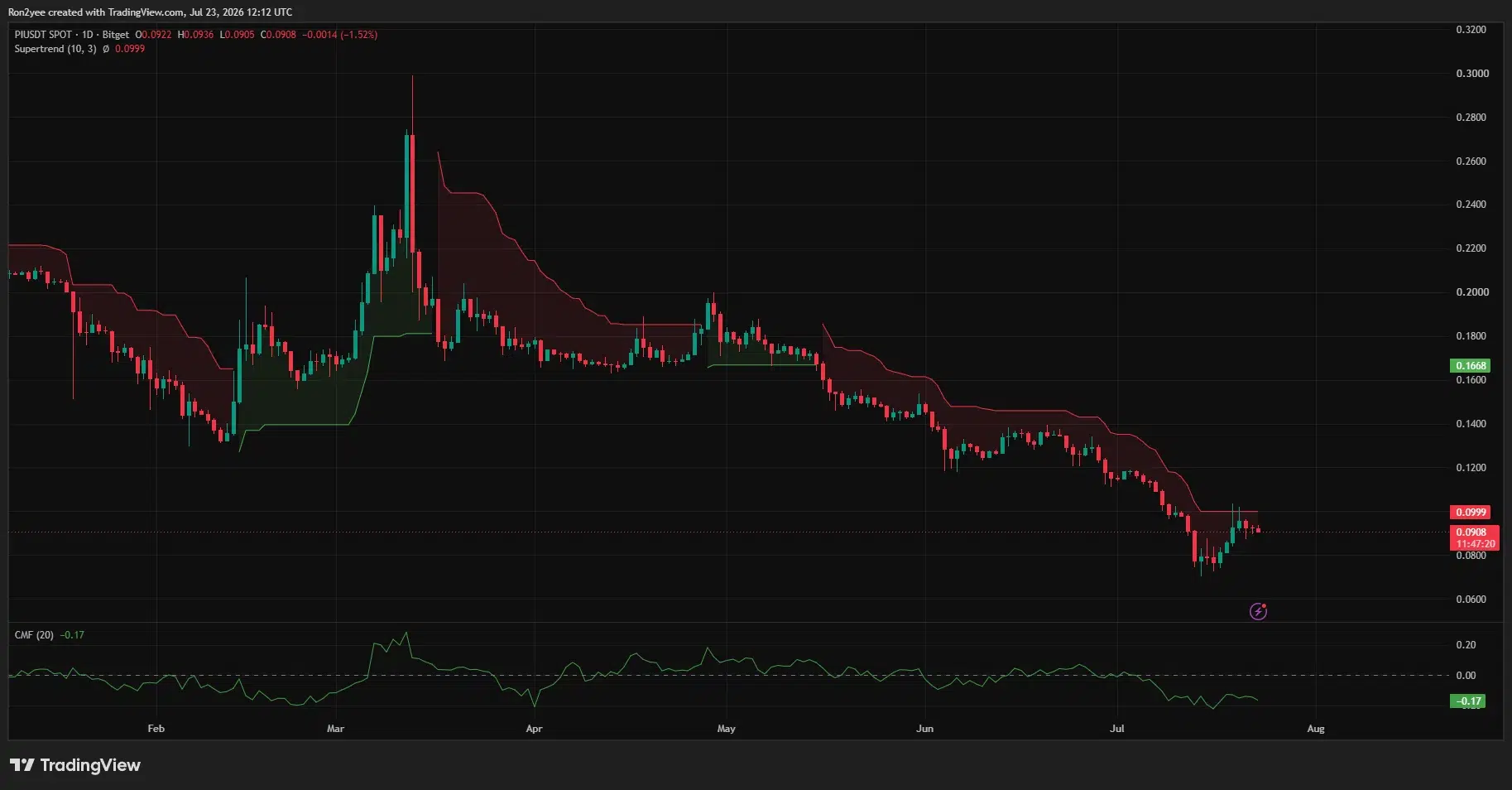
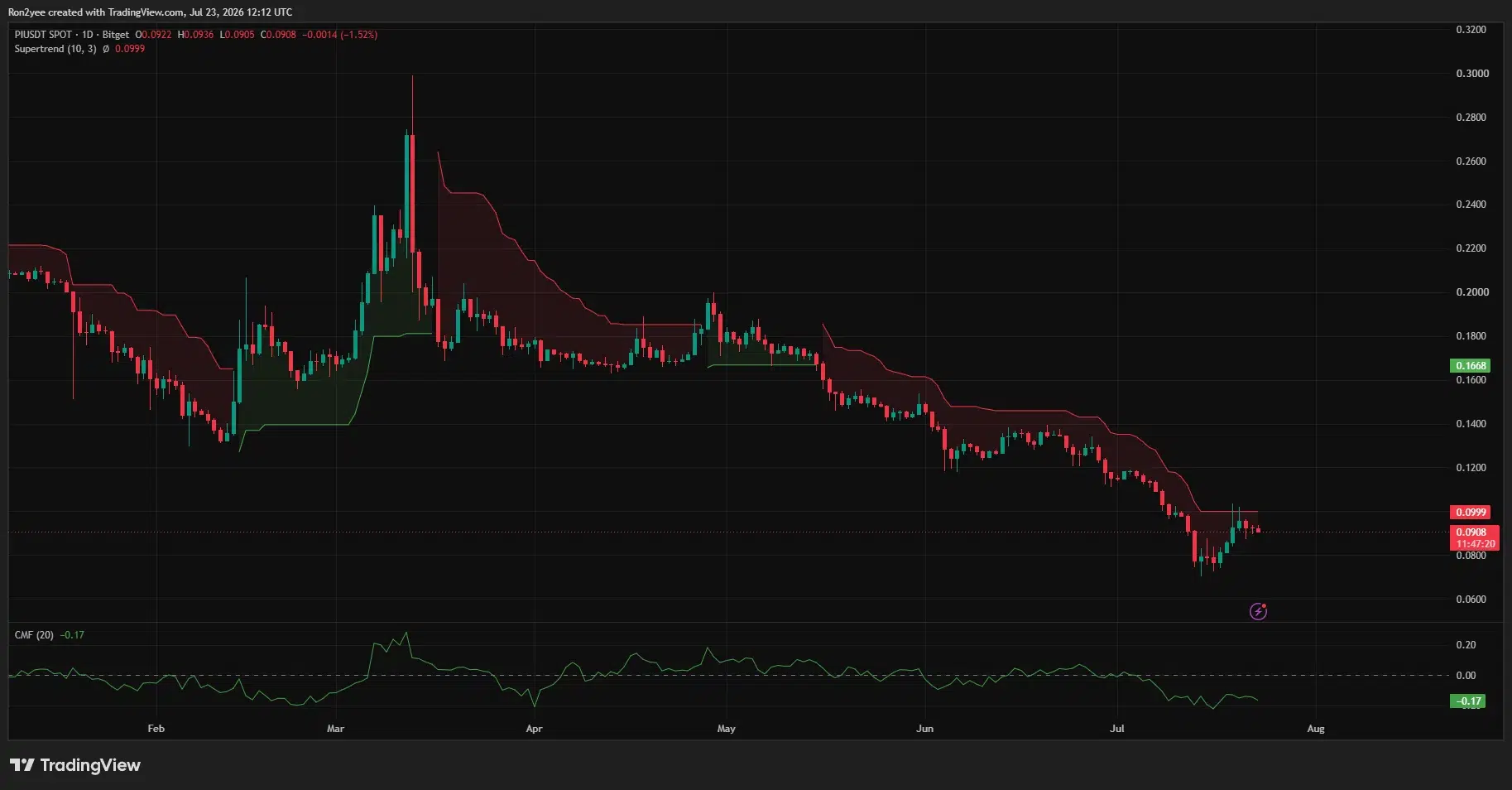
PI’s daily chart has kept the long-term downtrend intact. Price remains below the Supertrend barrier at $0.0999, and the indicator will retain its bearish reading unless buyers reclaim that level on a daily closing basis. Chaikin Money Flow stands at minus 0.17, showing that selling volume has exceeded buying volume during the latest sessions.
The 4-hour chart has formed a descending triangle after PI’s rejection above $0.10. Lower highs have compressed price against horizontal support at $0.0895, while the pattern’s upper boundary now crosses the $0.092–$0.093 area. A close above that boundary would weaken the setup and give buyers another chance to challenge $0.10.
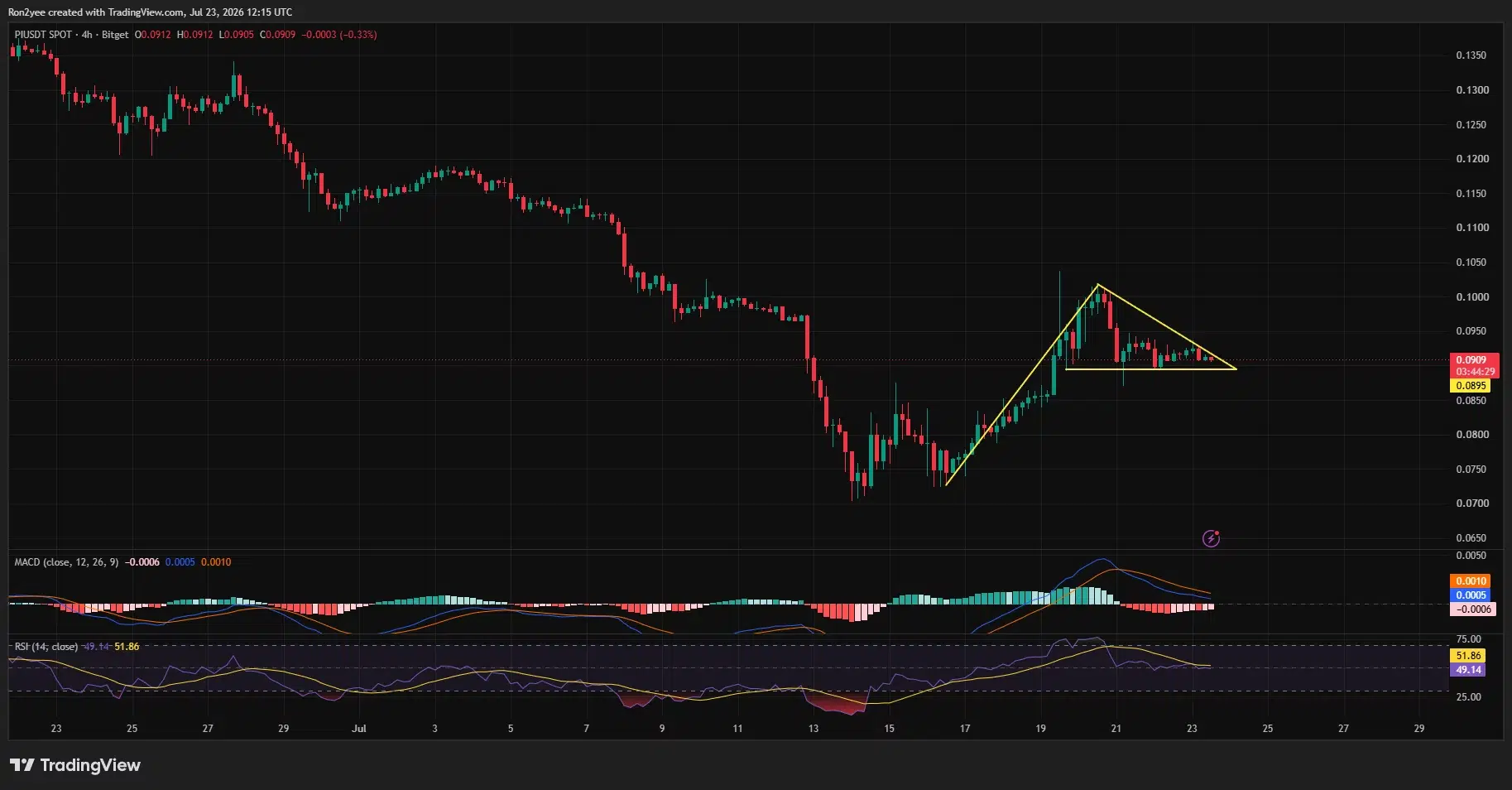
Momentum has also deteriorated. The 4-hour RSI has slipped to 49.14 and fallen below its moving average at 51.86. MACD has completed a bearish crossover, with the MACD line at 0.0005 beneath the signal line at 0.0010 and the histogram at minus 0.0006.
A break below $0.0895 would expose deeper losses
PI’s primary downside trigger sits at the triangle floor near $0.0895. A confirmed 4-hour close below that level would complete the bearish pattern and expose $0.085, followed by the July consolidation zone between $0.080 and $0.075. The record low near $0.0704 would become the final major support if selling accelerates.
A renewed oil surge, another rise in Treasury yields, or a hawkish Federal Reserve decision could deepen the risk-off move. Continuous token releases would add asset-specific pressure, particularly if open interest and spot volume continue to decline after the upgrade.
The bearish case would lose force if PI closes above $0.10, converts the Supertrend into support and attracts rising spot volume alongside higher open interest. Until those conditions appear, Protocol v25 remains a technical improvement whose market impact has not yet offset token dilution or the long-term downtrend.
Disclosure: This article does not represent investment advice. The content and materials featured on this page are for educational purposes only.


RedotPay’s RLUSD card lets 8 million users spend against their XRP without selling it: pledge coins at 50% loan-to-value, borrow in Ripple’s stablecoin, swipe anywhere Visa works. It is being sold as convenience. It is, mechanically, collateralized leverage on a token that fell 60% in a year, and the difference matters.
Summary
- RedotPay, a stablecoin payments fintech with more than 8 million users across 100-plus countries and roughly $12 billion in annualized volume, launched an XRP Ledger-powered card that combines XRP-backed credit, Ripple’s RLUSD stablecoin, and Visa’s network.
- The mechanics are a loan, not a payment: users pledge XRP as collateral at a 50% loan-to-value ratio, receive a credit line settled in RLUSD on the XRPL, and spend at any Visa merchant, keeping their XRP exposure intact.
- The pitch, spending without selling, is genuine and genuinely double-edged: it preserves upside and defers taxable disposals, and it converts holders into leveraged borrowers against one of the cycle’s worst-performing major assets.
- The launch is a real distribution event for RLUSD, routing consumer settlement through the XRP Ledger itself, and it arrives on the strength of a real trend: RedotPay reports stablecoin card volume up 80% this year and 250% year over year.
- The unpublished numbers are the ones that decide the product: borrowing costs, liquidation thresholds, and what happens to pledged collateral in the next 40% drawdown. The card’s true test is not adoption. It is the first liquidation cycle.
The most successful trick in consumer finance is making a loan feel like something else. The credit card made borrowing feel like paying; the mortgage refinance made it feel like unlocking; buy-now-pay-later made it feel like nothing at all. This week the trick arrived for XRP holders, wearing Ripple’s stablecoin and Visa’s logo. RedotPay, a Hong Kong-grown stablecoin payments company that has quietly assembled more than 8 million users across a hundred countries, launched what it calls the RLUSD card: pledge your XRP as collateral, receive a credit line at half its value, spend that credit, settled in RLUSD on the XRP Ledger, anywhere on earth Visa is accepted. The marketing frame, spend without selling your XRP, is accurate, appealing, and incomplete, because the product it describes has an older and less romantic name. It is a securities-backed line of credit, the margin loan of the wealth-management world, ported to a volatile digital asset and distributed to a retail base of eight million. That porting is a genuine milestone for stablecoin payments, a genuine distribution win for RLUSD and the XRPL, and a genuine risk transfer whose terms nobody outside RedotPay has yet seen. All three things are true at once, and this piece takes them in order.
What the card actually is
Start with the mechanics, because every claim about the product, for and against, lives inside them.
A RedotPay user with XRP does not load the card by selling coins. They pledge the XRP as collateral into RedotPay’s system, and against that pledge the platform extends a credit line at a 50% loan-to-value ratio: a thousand dollars of XRP unlocks five hundred dollars of spending power. The credit is denominated and settled in RLUSD, Ripple’s dollar stablecoin, with settlement executed on the XRP Ledger before the money reaches the Visa rails, where it spends like any card balance at any merchant. The user’s XRP position remains theirs, still exposed to every tick of the price, while the borrowed RLUSD buys groceries. When they repay, the collateral releases; while they borrow, it is encumbered.
Strip the branding and the structure is instantly recognizable from traditional finance: this is a securities-backed lending product, the same architecture private banks use when a client borrows against a stock portfolio instead of selling it. The appeal there and here is identical and real. The holder keeps upside exposure. No taxable disposal occurs at the moment of borrowing, since a loan is not a sale, which for long-term XRP holders sitting on complicated cost bases is a material feature, not a gimmick. And liquidity arrives instantly, at swipe speed, rather than through the sell-withdraw-wait cycle that still makes exiting crypto positions clumsy in much of the world.
RedotPay is a credible vehicle for the port. The company’s platform numbers, 8 million-plus users, 100-plus countries, roughly $12 billion in annualized payment volume, describe its whole stablecoin card business rather than this product, a distinction worth keeping crisp, but the underlying trend is corroborated and steep: the company reports stablecoin-powered card transaction volume up 80% since January and 250% year over year, and it has an existing Ripple relationship through African remittance corridors plus a May rollout of direct XRP payment features. The RLUSD card is not a startup’s cold launch. It is a proven distribution machine adding a leverage product to its shelf, which is exactly why the product deserves the scrutiny its marketing does not invite.
The half the marketing carries
The bull case for the card is worth making properly, because it is more substantial than launch-week boosterism suggests, and it rests on three distinct legs.
The first is the stablecoin-payments wave, which is real and measurable. Card products that settle in stablecoins have moved from crypto curiosity to functioning consumer infrastructure, particularly in the markets RedotPay concentrates on, where local banking friction makes a dollar-denominated spending instrument valuable in itself. An 80% year-to-date volume increase on a large existing base is not narrative; it is throughput, and every analysis of the sector points the same direction. A card that lets crypto holders join that throughput without liquidating their positions extends the product category along its natural axis.
The second leg is what the launch does for RLUSD and the XRP Ledger, and here the significance runs deeper than one fintech’s product shelf. RLUSD’s short life has been dominated by institutional settings, exchange collateral, treasury products, cross-border settlement, and its circulation has notably concentrated on Ethereum rather than the XRP Ledger it was nominally built to showcase. The RedotPay card is the first mass-market consumer product that routes RLUSD settlement through the XRPL itself, every credit draw an on-ledger transaction, which makes it a distribution event for the home chain in precisely the dimension, ordinary payment volume, where the ledger’s activity metrics have chronically underdelivered. If the card scales, it manufactures the daily, boring, non-speculative XRPL transaction flow that a decade of partnership announcements promised and rarely produced.
The third leg is the honest version of the consumer argument. For a holder who would otherwise sell XRP to fund spending, borrowing at 50% LTV is not obviously the riskier choice; it is a portfolio decision with a respectable pedigree, and the tax-deferral mechanics are the same ones wealthy households have used against equity portfolios for generations. Democratizing an instrument the private-banking class already enjoys is, on its face, exactly what crypto claimed it came to do. The case against the card is not that borrowing against assets is illegitimate. It is about what happens when the asset is this one, the borrower is retail, and the terms are unpublished, which is where the second half begins.
The half it does not
Now run the same mechanics forward through a drawdown, because the product’s defining events will not happen at launch. They will happen at liquidation.
A 50% loan-to-value line against XRP is a bet, embedded in a payment card, that XRP will not fall far enough to impair the collateral, and the recent record of that bet is the uncomfortable part: the token has fallen more than 60% from its 2025 high and traded at fifteen-month lows this month. A user who pledges coins at $1.14 and borrows to the limit has no buffer question until the price falls, and then has only questions the launch coverage does not answer. At what threshold does RedotPay demand more collateral or repayment? At what threshold does it liquidate, selling the pledged XRP into a falling market to close the line? What notice does a user in one of a hundred countries get, on what timeline, in what language of what agreement? None of this is disclosed in the launch materials, and none of it is exotic pessimism; it is the operating manual of every collateralized lending product ever built, and the crypto industry has run this exact experiment before at scale.
The lesson of the 2022 lending collapses was not that crypto-backed loans cannot work; it was that retail borrowers systematically underestimate liquidation mechanics until the first cascade executes them, and that products marketed as spend without selling are experienced, in the drawdown, as sold without asking.
The structural critique goes one layer deeper. A margin loan against a portfolio is typically one instrument inside a diversified balance sheet, extended by a lender whose terms are regulated, disclosed, and court-tested for a century. This product concentrates instead of diversifying: the collateral is a single volatile asset, the borrower base is by construction the token’s most committed holders, and the leverage is being introduced near cycle lows in sentiment, when the marketing pitch, do not sell here, keep your upside, lands hardest on precisely the users least able to absorb a liquidation. There is also a reflexivity worth naming for the asset itself: if the card scales, a meaningful stock of XRP becomes pledged collateral with mechanical sell triggers below the market, which is a new, price-insensitive seller waiting inside every future drawdown, the same structure that turned miner loans and DeFi collateral into accelerants in prior cycles. Individually rational borrowing, aggregated, becomes a market feature.
And the unknowns are not neutral. Borrowing costs are unpublished; whether pledged XRP is rehypothecated, lent onward, or held bankruptcy-remote is unpublished; the custody arrangement behind the collateral is unpublished. These may all resolve benignly, and RedotPay’s operating history earns it the presumption of competence. But a leverage product for eight million retail users, on a drawdown-prone asset, whose core risk terms are absent from its launch communications, has earned exactly one sentence of verdict: the card’s success metric is not sign-ups, and everyone will learn its real design the first month the collateral falls 40%.
The precedent shelf
The card did not invent its category, and its neighbors on the shelf are the fastest way to calibrate both the opportunity and the risk, because each ran a version of this experiment and left a legible result.
The closest structural relative is the crypto-backed loan book of the last cycle, and its lesson is precise, not general. Celsius, BlockFi, and their cohort did not fail because lending against crypto is impossible; they failed at the treasury layer, rehypothecating collateral, mismatching duration, running invisible leverage on the lender’s own balance sheet, while their retail borrowers discovered that liquidation clauses they had never read executed automatically in the March and June 2022 cascades. The two failure surfaces are separable, and the RedotPay product should be examined on each independently: what the borrower signs, which will surface quickly, and what happens to pledged XRP inside the company, which will not. The industry’s post-2022 vocabulary, segregated collateral, no-rehypothecation attestations, proof of reserves, exists precisely because the second surface stayed dark until it ruptured, and a launch that leads with adoption numbers while omitting collateral treatment has, knowingly or not, reproduced the sequencing of the last cycle’s marketing.
The happier precedent is the securities-backed lending business this product is modeled on, roughly a $150 billion book at the major US wirehouses, run for decades with unremarkable loss rates. Its stability rests on three legs worth naming because each is currently absent here: conservative advance rates against diversified, comparatively low-volatility collateral; regulated disclosure of every material term; and margin machinery tested through multiple market cycles with borrowers who mostly have other assets. Single-asset collateral at 50% LTV on an instrument that routinely moves 10% in a week, sold to a retail base whose crypto position may be their principal asset, is the same architecture at triple the stress with none of the disclosure. That does not doom it. It means the product’s safety is an empirical question the traditional version never had to ask, and the first drawdown will answer it in public.
And the nearest crypto-native success, the exchange-issued collateral cards and stablecoin debit products that RedotPay itself sells, offers the final calibration: those work, at scale, precisely because they carry no leverage, which is the feature this launch adds. The category’s entire history compresses into one sentence the marketing will never use: crypto payment cards succeed in proportion to how little borrowing they contain, and this is the most borrowing one has ever contained.
What to watch
Credit issuance volume, when it publishes. The company has indicated reporting on credit volumes will follow. Watch the ratio of pledged collateral to platform XRP balances: a niche convenience product and a system-relevant leverage layer look identical at launch and completely different at scale.
The terms, as users surface them. Interest rates, margin-call thresholds, liquidation procedures, and rehypothecation language will emerge from user agreements even if never press-released. The gap between the marketing and the margin schedule is the product’s honest description, and it will be visible within weeks.
The first drawdown. XRP at fifteen-month lows means the collateral question is not hypothetical for long in either direction. A 30-40% decline from pledge prices is the product’s first real audit: orderly margin management, or the familiar cascade. Every future XRP-collateral product, and competitors will copy this one if it scales, inherits whatever precedent this launch sets.
RLUSD’s chain split. Each card settlement is XRPL-side RLUSD volume. Watch whether the stablecoin’s circulation begins migrating from Ethereum toward its home ledger; if it does, this unglamorous consumer product will have done more for the XRPL’s activity metrics than any institutional announcement this year, which would be its own quiet verdict on where adoption actually comes from.
The card is a genuine innovation, a genuine RLUSD milestone, and a genuine margin loan, and the industry’s habit of celebrating the first two while ignoring the third is how every crypto credit cycle has started. Eight million users are about to learn, in the product’s own language, whether spend without selling survives its first encounter with sell without asking. The answer will arrive with the next drawdown, on schedule, as it always does.
A closing note on the geography, because where this product launches shapes what it becomes. RedotPay’s hundred countries are not a uniform market; the platform’s center of gravity runs through Southeast Asia, the Gulf, Africa, and Latin America, regions where the card’s stablecoin core solves problems a US or EU user does not have: unstable local currencies, thin card penetration, expensive remittance corridors, and banking systems that make holding dollars hard. In those markets the RLUSD card’s leverage feature rides on top of a genuinely useful dollar-spending instrument, which will flatter its adoption numbers and complicate their interpretation, since sign-ups driven by the stablecoin utility will be counted as validation of the credit product.
The regulatory map matters in the same way: crypto-collateralized consumer credit occupies wildly different legal positions across those hundred jurisdictions, from regulated lending to unlicensed gray zones, and a product distributed at this breadth will inevitably become a test case somewhere, most plausibly in whichever market first combines mass adoption with a drawdown-driven liquidation wave and an ombudsman. The US, notably, is where products like this face the sharpest scrutiny and where RedotPay’s footprint is lightest, meaning the card will scale, and its risks will surface, largely outside the regulatory perimeter American observers instinctively assume. That is not an accident of the launch. It is the strategy, and it is the same strategy every offshore crypto credit product has run: grow where the rules are unwritten, and let the first crisis write them.
Disclaimer: This article is for information and educational purposes only and does not constitute financial, investment, tax, or legal advice. Product terms described reflect launch communications and may change or be incomplete; borrowing against volatile assets carries liquidation risk up to loss of collateral. Always do your own research. Information is accurate as of July 23, 2026.
Frequently Asked Questions
What is the RedotPay RLUSD card?
A Visa-network payment card launched by RedotPay, a stablecoin payments fintech serving more than 8 million users in over 100 countries. Users pledge XRP as collateral at a 50% loan-to-value ratio to unlock a credit line, which is settled in Ripple’s RLUSD stablecoin on the XRP Ledger and spendable at any Visa merchant, allowing holders to access liquidity without selling their XRP.
How is this different from a normal crypto debit card?
A debit card sells or converts your crypto at the point of purchase; you spend the asset itself. This card lends against your crypto: your XRP stays yours, remains exposed to price moves, and serves as collateral for borrowed RLUSD. Mechanically it is a collateralized credit line, the crypto equivalent of a securities-backed loan, with the corresponding benefits, retained upside, no taxable disposal at borrowing, and the corresponding risks, margin calls and liquidation.
What does the 50% loan-to-value ratio mean in practice?
You can borrow up to half the market value of the XRP you pledge: $1,000 of XRP supports up to $500 of credit. The ratio is the lender’s buffer against price declines. If XRP falls substantially, the loan can approach the collateral’s value, triggering demands for repayment or additional collateral, and ultimately liquidation of the pledged XRP. The specific thresholds and procedures were not disclosed in launch materials.
Is spending without selling really tax-advantaged?
Generally, borrowing against an asset is not a disposal, so drawing the credit line does not itself crystallize capital gains the way selling XRP would, a genuine feature for long-term holders, subject to local tax law. The offset is borrowing cost: interest on the credit line, whose rate RedotPay has not published, plus liquidation risk. Whether deferral beats disposal depends on those terms and the token’s subsequent path. This is not tax advice.
Why does this matter for RLUSD and the XRP Ledger?
Distribution. RLUSD’s circulation has concentrated in institutional venues and largely on Ethereum, while this card routes consumer settlement through the XRP Ledger itself, every credit draw an on-ledger RLUSD transaction. At scale, it would generate the routine, non-speculative XRPL payment volume the ecosystem has long promised, and shift RLUSD activity toward its home chain, making the card a meaningful test of where the stablecoin’s real usage develops.
What are the main risks for users?
Liquidation is the central one: a significant XRP price decline can force sale of pledged collateral, potentially near market lows, converting a spend-without-selling product into an involuntary sale. Undisclosed terms compound it: borrowing costs, margin thresholds, notice procedures, and whether collateral is rehypothecated are not public. Standard platform risks, custody, jurisdiction, counterparty, apply as with any centralized fintech holding user assets.
Could this product affect the XRP market itself?
At scale, yes. Widely pledged collateral with mechanical liquidation triggers creates a price-insensitive seller beneath the market: drawdowns that breach margin thresholds force sales that deepen the drawdown. Similar structures, miner loans, DeFi collateral, amplified prior cycles. Whether this card reaches system-relevant size depends on issuance volumes the company has yet to report, which is why those numbers are the ones to watch.
Should XRP holders use it?
That is an individual financial decision this article does not make. The honest framing: it is a leverage product with real convenience and tax-deferral features and real, partially undisclosed risks, appropriate in the way margin borrowing is appropriate, for users who understand liquidation mechanics, borrow well below limits, and can repay without selling collateral in a drawdown. Anyone for whom those conditions do not hold is the product’s risk case, not its customer. Always do your own research.


Robinhood reports Q2 earnings on July 29, covering a quarter that ended June 30. Robinhood Chain launched July 1. The company’s biggest strategic bet contributed exactly zero to the numbers being reported, which makes Wednesday’s call something rarer than a results event: a live interrogation of three weeks of casino data, with retail shareholders holding the microphone.
Summary
- Robinhood reports second-quarter results after the close on July 29, with consensus at roughly $0.41 per share on about $1.27 billion in revenue and options markets pricing a 12.6% post-earnings move, well above the 9% average.
- The quarter ended June 30; Robinhood Chain launched July 1. The company’s defining strategic project contributed nothing to the period being reported, making the call a disclosure event about three weeks of post-quarter data rather than a results event.
- That data is awkward: roughly $13 million in tokenized stocks against a single memecoin that touched $156 million, daily chain fees near $198,000 inflated by a 90-day gas subsidy, and a security-incident string capped by the SCATMAN account hijack.
- The Q1 template looms over everything: crypto revenue fell 47% to $134 million, broke the quarter, and triggered a 13% selloff, while event-contract revenue surged 320% to $147 million, quietly passing crypto as a transaction line.
- The structural dates matter more than the print: the chain’s gas subsidy expires around the end of September, a $121 million HOOD unlock adds supply, and the shareholder Q&A platform guarantees the chain questions get asked on the record.
Earnings calls are usually about the past, which is why Robinhood’s on July 29 is worth more attention than its consensus estimates suggest: it is structurally incapable of being about the past. The second quarter the company will report ended on June 30. Robinhood Chain, the Ethereum layer-2 that chairman Vlad Tenev has framed as the company’s bridge to tokenized finance, went live on July 1, one day into the next quarter. Every number in the release, revenue, crypto take rates, event-contract volumes, describes a company that did not yet have its blockchain, while every question that matters on the call describes the three weeks in which it did: weeks that produced a top-five DEX by volume, a $156 million cat-themed memecoin named after the company’s original working name, roughly $13 million in the tokenized stocks the chain was ostensibly built for, and a hijacked SpaceX account rug-pulling a token on Robinhood’s own rails. Management will present the quarter it had. The market, the analysts, and, through Robinhood’s upvoted shareholder Q&A, its own retail base will interrogate the quarter it is having. That gap, between the reported period and the reportable story, is the cleanest lens on Wednesday’s event, and this piece maps both sides of it: the print the consensus is pricing, and the chain accounting nobody has seen yet.
The print: what Q2’s actual numbers must answer
Start with the quarter that will legally be the subject, because its shape is inherited from a first quarter that ended badly and instructively.
Q1, reported April 28, was a miss with a diagnosis. Total revenue of $1.07 billion grew 15% but landed below the $1.13-1.17 billion analysts expected, net income rose 3% to $346 million, or $0.38 per share, and the stock fell 13% the next day, because one line broke the quarter: cryptocurrency transaction revenue collapsed 47% year over year to $134 million, from $252 million, on crypto volumes down 48% to $24 billion, the third consecutive quarter of declining transaction revenue, which the company attributed plainly to falling crypto asset prices. The same release contained the offsetting story that has since become the bull case’s center of gravity: other transaction revenue, primarily event contracts, surged 320% to $147 million on a record 8.8 billion contracts traded. Read those two lines together and a structural fact emerges that the coverage has been slow to absorb: prediction markets already out-earn crypto trading at Robinhood. The company’s future-of-finance revenue engine, for now, is not tokens. It is contracts on outcomes, the product category currently being litigated across a dozen states in the war this publication mapped last week.
Q2’s consensus builds on that base: roughly $0.41 per share, down about 2% year over year, on revenue near $1.27 billion, up 28%, with the mix expected to rhyme with Q1, strong equities and options (management said April volumes tracked toward the highest month of the year, with CFO Shiv Verma noting “Q2 is off to a good start in April”), continued event-contract momentum through a World Cup June in which the category’s platforms printed record volumes, and a crypto line that KeyBanc’s upgraded-but-clear-eyed preview expects to stay subdued into the second half. The options market prices a 12.6% move against a 9% four-quarter average, which is the derivatives desk’s way of saying this print carries more scenario risk than usual. The analyst posture into it is constructive and repriced upward, KeyBanc to $125, Needham to $123 with its financial-super-app framing, and both raises cite a variable no spreadsheet contains: the CLARITY Act, whose Senate endgame is running this exact week, and whose passage would reprice the regulatory footing of every crypto revenue line Robinhood reports.
The absence: what the chain’s zero contribution means
Now the structural oddity, because it defines the event.
Robinhood Chain launched its public mainnet on July 1, which means the quarter under report contains not one day, dollar, or transaction of the company’s most-discussed initiative. That is not a triviality of the calendar; it changes the epistemics of the call. In a normal quarter, management’s claims are disciplined by the reported numbers sitting beside them. On Wednesday, everything said about the chain will be forward-looking commentary on post-period data that the company curates, selectively, in whatever frame it chooses, and the frames available range widely, because the three weeks in question produced numbers that support any narrative. Bullish selection: top-five DEX status within a fortnight, $3.1 billion in weekly DEX volume at peak, roughly $300 million in TVL, 3.6 million daily transactions, 65,000-plus holders of tokenized stocks, $300 million in stablecoins parked on the network, day-one integrations with Uniswap, Morpho, and Chainlink, and a Bernstein note calling the debut strong. Bearish selection, from the identical dataset: tokenized real-world assets, the chain’s stated purpose, at roughly $13 million, about 4% of activity, against a single memecoin, CASHCAT, that touched $156 million, twelve times all tokenized assets combined; transaction counts inflated by a 90-day gas-fee subsidy that makes every comparison flattering; chain fees around $198,000 a day, real but rounding-error revenue for a $101 billion company; a launchpad boom that generated an estimated $12 million in fees before going dark over token quality; and the SCATMAN incident, in which hijacked SpaceX and Starlink accounts rug-pulled a memecoin on Robinhood’s rails eleven days into the chain’s life.
The interrogation layer makes the selective-framing game harder than usual, and this is the underappreciated mechanic of Wednesday’s call. Robinhood runs its earnings Q&A partly through an upvoted shareholder-question platform, which means the chain questions do not depend on sell-side politeness; the retail base that watched CASHCAT trade twelve times the stock-token float will put its questions on the record by volume of upvotes, and management has committed to answering a selection of the most-upvoted live. Add the professional layer, where the first analyst question about chain unit economics, sequencer revenue, subsidy cost, custody of the $300 million in parked stablecoins, forces the company to either disclose a new reporting line or conspicuously decline to, and the call becomes what this piece named it at the top: not a results event but a disclosure event, the first time Robinhood must describe its chain in the register of accountability rather than launch marketing.
What to listen for, specifically: whether the chain gets its own metrics in the release or deck, which would signal permanent reporting; any number attached to Stock Token adoption beyond the on-chain estimates everyone has been reading off Dune; the treatment of the gas subsidy, cost line now, pricing power question later; and any guidance about what happens at day 90, because the subsidy that has been inflating the chain’s activity since July 1 expires around the end of September, at which point Robinhood Chain’s organic demand gets its first honest measurement, one quarter before it appears in reported results for the first time.
The stakes: two readings of the same launch
The earnings frame sharpens the strategic question the launch coverage blurred, so state both readings the way Wednesday’s participants will.
The optionality reading, which is Bernstein’s and the raised price targets’: the chain is cheap, early, and structurally aligned with everything working at Robinhood. The memecoin froth is what permissionless launches look like, the $300 million in parked stablecoins and the Morpho lending base are stickier than DEX volume, the tokenized-equity product has 65,000 real holders three weeks in, and the company holds a fresh $2.2 billion zero-coupon convertible war chest raised in June, capital available precisely for bets like this. On this reading, Q2’s numbers, carried by options, equities, and the event-contract engine, buy the chain all the time it needs, CLARITY’s potential passage de-risks the entire crypto stack, and the correct analyst posture is to price the chain as a free option on tokenization while the core business compounds. The 12.6% implied move, in this frame, is upside convexity.
The distraction reading, which the Q1 tape supports: Robinhood’s crypto revenue has fallen for three consecutive quarters, the line that broke Q1 remains broken, and the company’s response was to launch infrastructure whose first month monetized the exact activity, memecoin speculation, that its CEO publicly disparaged the week before embracing.
The chain’s honest economics to date are $198,000 a day in subsidized fees against a $13 million RWA book, the regulatory proposition, a licensed brokerage extending compliant rails into DeFi, took a visible hit when the SCATMAN rug ran through it, and the $121 million HOOD unlock adds supply into whatever the print delivers. On this reading, Wednesday risks a specific failure mode: a fine quarter overshadowed by the first public accounting of a launch whose numbers, honestly presented, describe a casino with a stock-token kiosk in the lobby, and the implied move is downside convexity with a marketing problem attached.
Both readings will survive Wednesday, because three weeks of subsidized data cannot settle them. What Wednesday does settle is the disclosure regime: whether the chain becomes a measured, reported, guided-upon business line or stays a narrative asset described in prepared remarks. Companies choose that fork exactly once, at the first earnings event after launch, and the choice tells you how management privately scores the first month. A new reporting line says the numbers can bear weight. Adjectives say they cannot yet.
The prediction-market pivot hiding in plain sight
One structural story inside these numbers deserves its own treatment before the watchlist, because it reframes what kind of company is actually reporting on Wednesday, and it connects this print to the biggest regulatory fight in American consumer finance.
The line that grew 320% in Q1, other transaction revenue at $147 million, is mostly event contracts, and its crossing above crypto revenue was not a fluke of one weak crypto quarter; it is the visible edge of a deliberate reallocation. Robinhood entered prediction markets through its Kalshi partnership, built the category into a headline product, launched its own Rothera exchange in the second quarter, and rode a June in which the World Cup drove the category to records across every venue, Kalshi alone clearing $31 billion in monthly volume. For Q2, the reasonable expectation is that event contracts extend their lead over crypto as a transaction line, and possibly begin closing on options, which would make Robinhood, measured by revenue mix, one of the largest regulated betting-adjacent businesses in the United States, inside a brokerage wrapper, without most of its shareholders having consciously repriced it as such.
The regulatory exposure travels with the revenue. Event contracts are the product at the center of the twelve-state federalism war this publication mapped last week, the cease-and-desist orders, the tribal litigation at the Ninth Circuit, the CFTC suing states on the platforms’ behalf, and Robinhood sits in the same legal architecture as Kalshi and Polymarket: CFTC-registered instruments that state gaming regulators call unlicensed betting. Every dollar of the fastest-growing line on Wednesday’s release is contested revenue in at least a dozen jurisdictions, a fact no earnings preview prices and no prepared remark will volunteer. The sports-heavy composition of category volume makes the exposure seasonal too: football season begins in September, the category’s biggest quarter, with the legal map still unsettled and the NFL’s own posture toward event contracts hardening.
Put the pivot beside the chain and the company’s actual strategic position clarifies. Robinhood is running two simultaneous bets on post-crypto transaction revenue: prediction markets, which already generate nine figures a quarter and carry live litigation risk, and tokenized assets, which generate approximately nothing yet and carry a launch-month casino reputation. The first bet funds the patience the second requires. Wednesday’s call will be scored on the chain questions, because the chain is the story, but the number that decides whether Robinhood’s next four quarters compound is the event-contract line, and the risk that actually threatens it sits in courtrooms this publication’s readers already know by docket. The chain missed the quarter by a day. The prediction-market war is in it on every page.
What to watch
The disclosure fork itself. Chain metrics in the release or deck, any Stock Token adoption figure sourced from the company rather than Dune, and any sequencer-revenue or subsidy-cost line. This is the event’s real binary, more informative than the EPS beat or miss.
The crypto line against the Q1 template. A fourth consecutive transaction-revenue decline, or crypto revenue near the $134 million floor, re-runs April’s selloff mechanics into a market pricing a 12.6% move, with the HOOD unlock supplying the sell-side flow. Stabilization plus event-contract momentum flips the same setup bullish.
The September 29 subsidy cliff. Any management commentary on post-subsidy pricing is guidance on the chain’s first honest quarter, Q3’s, which will be the first to contain the chain at all. The gap between subsidized July activity and October’s organic demand is where the launch’s truth lives, and Wednesday is management’s only chance to pre-frame it.
The CLARITY shadow. The Senate’s endgame runs the same week as this print. Passage before or near the call hands management a regulatory tailwind to reframe every crypto question; failure leaves the crypto line’s three-quarter decline standing alone. Robinhood’s earnings and crypto’s biggest bill sharing a news cycle is either the launch story’s best luck or its worst timing, and nobody controls which.
The quarter Robinhood reports on Wednesday will be a reasonable one, carried by the businesses that were never the story. The quarter it will be asked about started one day too late to appear in it, and exists, for now, only as three weeks of numbers that flatter and indict the chain in equal measure. That asymmetry, results without the story, story without results, is rare enough in public markets to be worth naming, and it resolves on a schedule: the subsidy expires in September, the chain enters the reported numbers in October, and Wednesday is the last earnings call on which Robinhood’s blockchain remains, in the accounting sense, imaginary. The company gets one more quarter of describing it. After that, it gets measured.
Disclaimer: This article is for information and educational purposes only and does not constitute financial or investment advice. It discusses a scheduled earnings event whose results, disclosures, and market reaction are unknown, and figures cited for post-quarter chain activity come from third-party trackers subject to revision. Nothing here is a recommendation to buy, sell, or hold any security or asset. Always do your own research. Information is accurate as of July 23, 2026.
Frequently Asked Questions
When does Robinhood report Q2 2026 earnings?
After market close on Wednesday, July 29, with a video call at 2:00 PM PT / 5:00 PM ET hosted by Chairman and CEO Vlad Tenev and CFO Shiv Verma. The company also runs an upvoted shareholder Q&A through Say Technologies, with management answering a selection of the most-upvoted questions live, a mechanism that makes retail-submitted questions about Robinhood Chain likely to be addressed on the record.
What are analysts expecting from the quarter?
Consensus sits near $0.41 in earnings per share, down about 2% year over year, on revenue around $1.27 billion, up roughly 28%. Options markets price an implied post-earnings move of about 12.6%, above the 9% average of the past four quarters. Analyst targets rose into the print, with KeyBanc at $125 and Needham at $123, both citing broad metric strength and potential regulatory support from the CLARITY Act.
Why does the article say the chain missed the quarter?
Because of the calendar: the second quarter ended June 30 and Robinhood Chain’s public mainnet launched July 1. The reported financials therefore contain no chain activity at all, while the earnings call arrives after three heavily covered weeks of post-quarter chain data, making the event a forward-looking disclosure exercise about numbers outside the reported period.
What has Robinhood Chain actually produced since launch?
A genuinely mixed dataset: top-five DEX volume rankings with about $3.1 billion in a peak week, roughly $300 million in total value locked, 3.6 million daily transactions, and 65,000-plus tokenized-stock holders, against roughly $13 million in total tokenized real-world assets, a $156 million peak market cap for the CASHCAT memecoin alone, chain fees near $198,000 a day inflated by a 90-day gas subsidy, and the SCATMAN account-hijack rug pull on its rails.
What happened in Q1 that frames this report?
Revenue of $1.07 billion missed estimates because crypto transaction revenue fell 47% year over year to $134 million on volumes down 48%, the third straight quarterly decline in transaction revenue, and the stock fell 13% the next day. The same release showed event-contract revenue up 320% to $147 million, meaning prediction markets surpassed crypto as a transaction-revenue line, a structural shift in what actually drives Robinhood’s growth.
What is the significance of the gas subsidy expiring?
Robinhood subsidized chain gas fees for the first 90 days from the July 1 launch, inflating activity metrics and making comparisons with other networks unreliable. The subsidy lapses around late September, just before the chain’s first fully reported quarter, so post-subsidy activity in October will provide the first honest measure of organic demand. Any management commentary on post-subsidy pricing effectively serves as guidance for that test.
How does the CLARITY Act affect this earnings event?
The Senate’s decisive window on the crypto market-structure bill overlaps this exact week. Passage would strengthen the regulatory footing of Robinhood’s crypto revenue and its chain strategy, a tailwind analysts already cite, while failure would leave the three-quarter crypto revenue decline without an offsetting narrative. The coincidence of timing means macro-legislative news could swamp the print itself in either direction.
What should investors watch beyond the headline numbers?
Whether the chain receives its own disclosed metrics, the first signal it is becoming a reported business line instead of a narrative; the crypto revenue line against Q1’s $134 million; any company-sourced Stock Token adoption figures; commentary on sequencer economics and the subsidy cost; and the $121 million HOOD token unlock adding potential supply around the event. This is educational analysis, not investment advice.
Alphabet has disclosed a $94.1 billion stake in Elon Musk’s SpaceX more than a decade after Google joined a $1 billion funding round for the rocket company.
Summary
- Alphabet disclosed a $94.1 billion SpaceX stake, equal to roughly 6% of the company.
- Google first backed SpaceX through a $1 billion funding round with Fidelity in 2015.
- SpaceX shares remain below their $135 IPO price, trimming Alphabet’s paper gains.
Alphabet’s second-quarter 10-Q filing showed that the Google parent owns roughly 6% of the newly listed company, providing the clearest public measure of an investment it previously valued using private-market estimates.
The disclosure splits the holding into about $80 billion of shares under short-term sale restrictions and another $14.1 billion subject to longer restrictions through the third quarter of 2027.
Google began building its position in January 2015, when it joined Fidelity Investments in a $1 billion financing round for SpaceX. The two investors received a combined stake of just under 10%, while the funding supported work on space transportation, reusable rockets and satellite manufacturing.
At the time, the deal valued SpaceX at about $12 billion. Reports placed Google’s contribution between $500 million and $900 million, with estimates suggesting that the company initially controlled about 7.5% of SpaceX. Its ownership percentage later fell as the rocket maker issued additional shares during subsequent fundraising rounds.
Although that dilution reduced Google’s share of the company, SpaceX’s rising valuation pushed the dollar value of the holding much higher. SpaceX used later financing to expand its Starlink satellite network, develop the Starship launch system and increase its reusable-rocket operations.
A major change came in February 2026, when SpaceX acquired Musk’s artificial intelligence company xAI. crypto.news reported earlier that the transaction valued SpaceX at $1 trillion and xAI at $250 billion, creating a combined business worth $1.25 trillion before the stock-market listing.
Under the deal’s structure, xAI became a wholly owned SpaceX subsidiary while retaining some legal separation from the parent company. The arrangement allowed investors to defer capital-gains taxes and reduced the risk that xAI’s debts or legal disputes would directly affect SpaceX.
SpaceX lockups restrict Alphabet’s exit
SpaceX priced its initial public offering at $135 per share before trading began on Nasdaq under the SPCX ticker on June 12. The company sold about 555.6 million shares and targeted roughly $75 billion in proceeds, giving it an initial valuation of around $1.75 trillion, according to its amended offering documents.
Alphabet and other early shareholders could not immediately sell most of their holdings after the debut. The restrictions disclosed in Alphabet’s quarterly filing leave the company exposed to changes in SPCX’s market price until the relevant lockup periods expire.
The listing nevertheless allowed Alphabet to replace conservative private-company estimates with a value based on publicly traded shares. Before the IPO, reports placed Alphabet’s effective ownership near 5% after years of financing rounds and adjustments linked to the xAI transaction. Its latest filing puts the stake closer to 6%.
Alphabet also recorded $98 billion in other income during the second quarter, which the company attributed mainly to unrealized gains on equity investments. While Alphabet did not identify how much came from each holding, the company owns stakes in SpaceX, Anthropic and Databricks.
Its Anthropic investment has also increased sharply in value. Anthropic announced in May that it had raised $65 billion at a $965 billion post-money valuation, while previous filings placed Google’s ownership of the AI company at about 14%. Any contribution from Anthropic or Databricks means the entire $98 billion gain cannot be assigned to SpaceX alone.
SPCX decline trims the paper windfall
SpaceX’s public-market performance has weakened since its June listing. SPCX fell to $112.88 on July 23, placing the stock about 16% below its $135 IPO price despite Tesla’s second-quarter results and another planned Starship launch attempt.
The decline followed a sharp post-listing rally that carried SpaceX shares above $225. Based on the July 23 market price, the company’s valuation had dropped to roughly $1.52 trillion. Alphabet’s disclosed holding therefore remains subject to further paper gains or losses while its shares stay locked.
Musk’s other publicly traded company added another source of investor attention. Tesla reported that it kept its 11,509 Bitcoin reserve unchanged during the second quarter while recording a $112 million after-tax loss on digital assets. At a Bitcoin price near $65,840 after Tesla’s earnings release, the reserve was worth about $758 million.
For Alphabet, however, the SpaceX filing has placed a firm public figure on one of its longest-held private investments. A position built through the 2015 financing round is now worth $94.1 billion on paper, even after SPCX erased its early post-IPO gains.
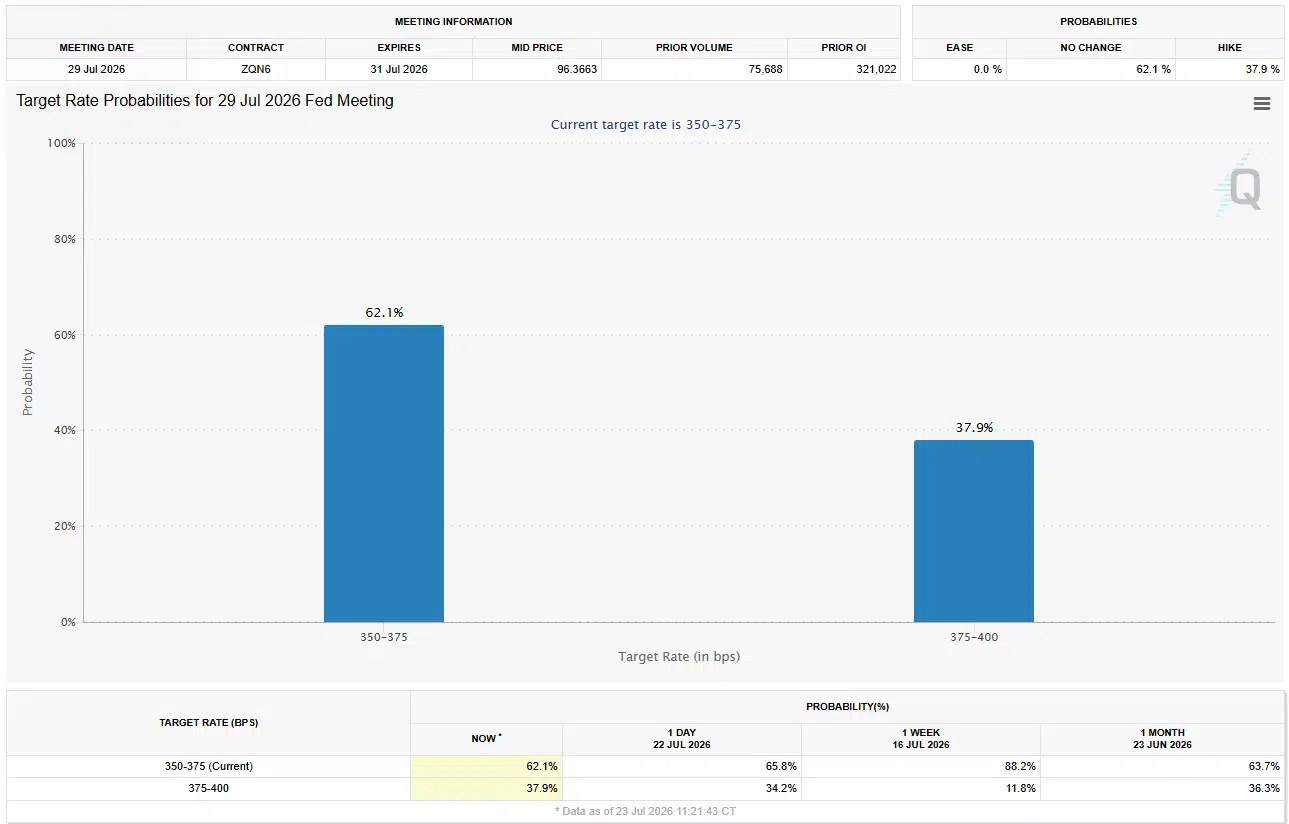
Economist Peter Schiff has warned that Brent crude’s surge above $100 could reverse June’s 0.4% monthly CPI decline and produce a sharp US inflation rebound in July.
Summary
- Peter Schiff warns oil’s rebound above $100 could drive July inflation sharply higher.
- Brent surged as Houthi attacks and restricted shipping intensified global supply concerns.
- Markets price a 37.6% chance of a Fed rate hike in July.
Peter Schiff linked the risk to oil’s rapid recovery after energy costs helped pull headline inflation below forecasts in June. In a post on X, Schiff noted that crude had already climbed about 30% in July and returned above $90 per barrel when he issued the warning.
“Investors celebrated the June CPI, as a 30% fall in the price of oil led to a larger-than-expected decline. But so far in July, the price of oil is already up 30%, back above $90 per barrel.”
At the time, Schiff estimated that a move to $100 before the end of July would represent a 43% increase from oil’s recent low. Brent crossed that level hours later as attacks on Saudi tankers created another threat to energy shipments from the Middle East.
“If the price hits $100 by month-end, that will be a 43% rise. July CPI could be a doozy!” Schiff added.
Answering a user who asked whether the increase would produce only a temporary supply shock, Schiff argued that June’s improvement depended heavily on cheaper oil. In his view, an even larger July increase could reverse much of that contribution rather than create a new source of inflation.
Oil’s reversal threatens to lift July inflation
June data from the US Bureau of Labor Statistics showed that headline CPI fell 0.4% from May, compared with the 0.1% decline economists polled by Reuters had expected. Annual inflation slowed to 3.5% from 4.2%, also beating the consensus estimate of 3.8%.
Energy prices supplied much of that relief. According to the BLS, the energy index dropped 5.7% during June, its steepest monthly fall since April 2020, while gasoline costs fell 9.7%. Core CPI, which excludes food and energy, was unchanged for the month and rose 2.6% from a year earlier.
Despite June’s monthly fall, the BLS reported that energy prices remained 15.7% higher than a year earlier. Gasoline increased 26.7% over the same period, leaving household costs exposed to another rise if crude prices remain elevated through the rest of July.
Fresh supply concerns have since changed the oil market’s direction. Brent climbed about 7% to $100.71 on Thursday, its highest level in nearly two months, while US West Texas Intermediate moved above $90 for the first time since June.
Oil prices rose following a Houthi attack on two Saudi tankers in the Red Sea and a declared blockade of Saudi-linked shipments through the Bab el-Mandeb Strait. The threat has become more serious because Saudi exporters have relied more heavily on that route while tanker traffic through the Strait of Hormuz remains severely restricted.
According to Reuters, Iranian oil exports have also fallen from as much as 2 million barrels per day to almost zero during the conflict. Goldman Sachs analysts told the news agency that Brent could exceed $120 if disruptions persist, although that forecast depends on the duration and scale of the supply losses.
Diplomatic efforts have yet to restore stable shipping conditions. The US Secretary of State Marco Rubio maintained Washington’s willingness to negotiate but accused Iran of failing to show that it was prepared to reach an agreement. Continued US strikes and Iranian military activity have kept traders focused on possible damage to oil infrastructure and transport routes.
Fed traders still favor a July hold
Higher energy prices have also complicated expectations for the Federal Reserve’s July 28–29 meeting. Fed officials have treated oil as an important influence on headline inflation, while several policymakers have argued that one cooler CPI report is insufficient to establish a lasting downward trend.
Fed Governor Christopher Waller said after the June inflation release that he would need to see “several months” of softer data before becoming confident that inflation was moving back toward the central bank’s 2% target.
Futures traders still favored no change at the July meeting as of July 23. Market pricing showed a 62.1% probability that the Fed would keep its target range at 3.50%–3.75%, while assigning a 37.9% chance to a quarter-point increase, according to data derived from the CME FedWatch Tool.
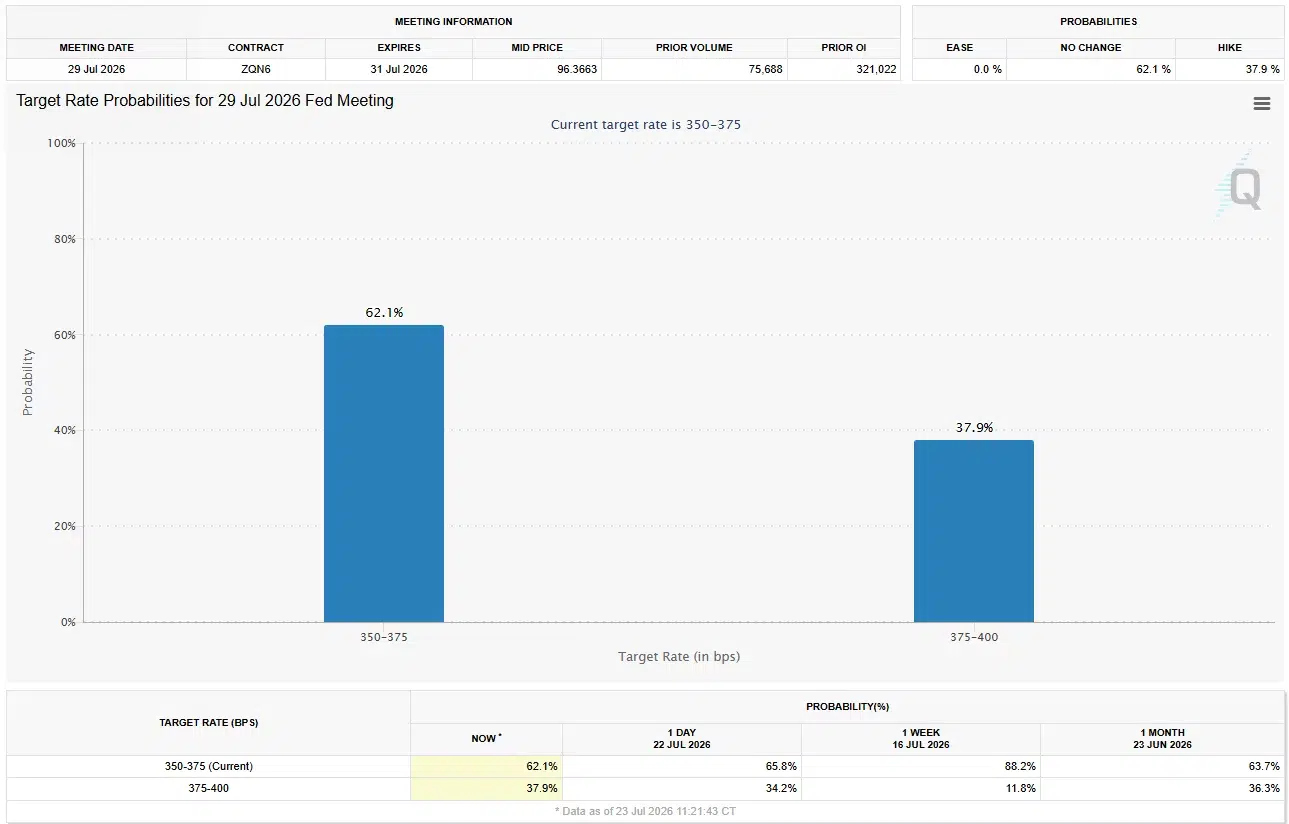
The probability of a July hike has risen sharply since the inflation report. On July 14, traders initially placed only a 10% chance on an increase after June CPI came in below forecasts.
July inflation data will not arrive before the Fed meeting, as the BLS has scheduled the report for Aug. 12. Policymakers will therefore make their decision without knowing the full effect of oil’s rebound, while Schiff’s warning points to energy prices as a potential obstacle to extending June’s inflation progress.
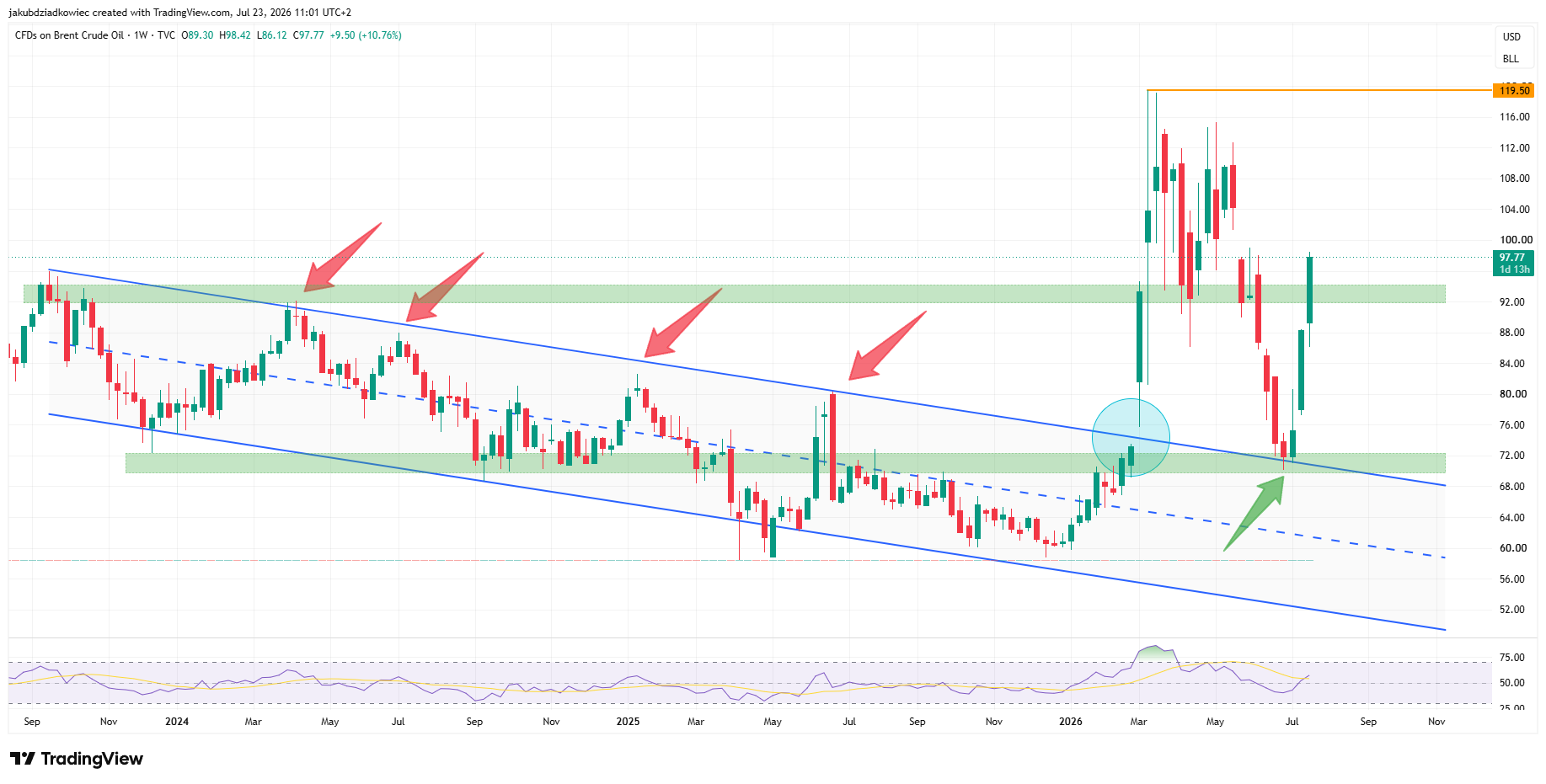
The Brent crude oil price climbed to a six-week high near $96 on Thursday after Iran-backed Houthi forces struck two Saudi tankers in the Red Sea. The attacks pose a second threat to global supply beyond the Strait of Hormuz.
Brent has gained more than 10% this week after a 17.35% surge last week. The charts show price pressing against the $100 mark, where a key Fibonacci level meets strong psychological resistance.
Red Sea Attacks Open a Second Supply Front
Brent rose 1.8% to $95.70 on Thursday, its fifth consecutive daily gain, according to Trading Economics data. The benchmark has climbed almost 30% over the past month and 38% year over year.
The rally gained pace after Houthi militants hit two Saudi tankers with missiles and drones on Wednesday. These were the first direct tanker strikes in the Red Sea during the current conflict. The group also declared a maritime embargo on Saudi-linked shipping, and three crude carriers bound for Asia reversed course.
The route matters because Bab el-Mandeb handled about 5.4 million barrels of oil per day in the first quarter, per US Energy Information Administration figures. A blockade would force vessels around southern Africa, lifting freight and insurance costs.
Meanwhile, US forces struck Iranian targets for a 12th consecutive day. President Donald Trump warned that Washington would hit Iranian infrastructure if Tehran attacked ships in Hormuz.
Iran threatened retaliation against US-linked energy assets, and both sides played down ceasefire prospects.
Supply stress also spread beyond the Middle East. The Caspian Pipeline Consortium halted intake from Kazakhstan after drone attacks near its Black Sea terminal.
In contrast, the lone bearish signal came from the EIA, which reported a surprise 1.4 million barrel build in US crude stocks.
Weekly Chart Shows a Breakout Above the $92 Resistance
The weekly chart favors the bulls. Brent has added 10.76% so far this week, extending the 17.35% advance from the week before. More importantly, price broke above the $92 zone, which had rejected it several times since 2023.
Earlier this month, a sharp correction from the war-driven highs found support at $72. That horizontal level coincided with the upper band of a descending parallel channel. The same channel line capped price through most of 2024 and 2025, so former resistance now acts as support.

The weekly Relative Strength Index (RSI) is turning bullish but remains in neutral territory just above 50. Therefore, momentum still has room before reaching overbought conditions. As long as Brent holds above $92, that zone is likely to serve as the new support.
Brent Crude Oil Price Prediction Rests on the $100 Test
The daily chart tells a similar story. Brent bounced sharply from $70.14 and quickly reclaimed the 0.382 Fibonacci retracement at $89. It then cleared the $92 zone and the 0.5 Fibonacci level at $94.82.
The decisive test now sits at the 0.618 Fibonacci retracement at $100.64. This level coincides with a previous support and resistance region and the psychological $100 mark. Historically, such confluences produce strong reactions on the first approach.

A daily close above $100.64 could open the way to the swing high at $119.50. That would represent a move of roughly 19% from the breakout level. On the downside, $94.82 provides the first support, with the $92 zone below it. A drop back under $92 would invalidate the bullish outlook.
The daily RSI has just crossed into bullish territory and is continuing to rise, with no bearish divergence yet. However, the fundamental driver remains binary.
A broader blockade could push Brent above $100, feeding inflationary pressure and weighing on crypto markets. A lasting truce, in contrast, could unwind the war premium.
Brent either clears the $100.64 barrier and targets $119.50, or stalls at the Fibonacci wall and retests $92.
The post Brent Crude Oil Price Could Surge to $100 After Iran’s Red Sea Attack appeared first on BeInCrypto.
Ondo Finance has secured FINRA authorizations covering tokenized NMS stocks, exchange-traded funds, mutual funds, index funds and IPO securities for U.S. investors.
Summary
- Oasis Pro secured FINRA permissions for tokenized stocks, funds and IPO securities in the U.S.
- The framework supports stablecoin settlement and access through brokers, advisers and retirement accounts.
- ONDO faces resistance near $0.42 while holding above all four major moving averages.
Ondo Finance announced on July 23 that its SEC-registered broker-dealer subsidiary, Oasis Pro Markets, had received the permissions needed to launch regulated tokenized securities services under SEC and FINRA oversight.
According to the company, the authorizations cover over-the-counter retail transactions, underwritten primary offerings, private placements and other securities activities. Oasis Pro Markets can also operate a venue where U.S. issuers conduct primary offerings and eligible retail and institutional investors trade the resulting assets in secondary markets.
The approved framework supports settlement in fiat currencies or selected stablecoins, including transfers made directly between blockchain wallets, Ondo said. Supported products include National Market System equities, ETFs, mutual funds, index funds and securities issued through initial public offerings.
Oasis Pro Markets may also use omnibus account structures, allowing broker-dealers and registered investment advisers to connect their existing systems. Ondo said the arrangement could give institutional clients, retail investors and retirement accounts access through their current financial providers, reducing the need to open accounts on a separate platform.
The company cautioned that FINRA membership and SEC registration do not guarantee compliance with every rule. Neither regulator has recommended the products, approved them as investments or verified Ondo’s announcement, according to the disclaimer accompanying the release.
Authorization opens regulated U.S. distribution
Completed in October 2025, Ondo’s acquisition of Oasis Pro brought an SEC-registered broker-dealer, alternative trading system and transfer agent into the group. Oasis Pro Markets has been a FINRA member since 2020 and previously received authorization to settle digital securities using fiat, USDC and DAI, according to Ondo’s acquisition announcement.
Through Oasis Pro TA, the group can manage capitalization tables onchain while administering shareholder rights and transfers. Ondo said the transfer-agent unit also supports movement of collateral across asset types, giving the company regulated infrastructure for both issuing and servicing tokenized securities.
Earlier in July, Ondo introduced tokenized versions of BlackRock’s iShares Core S&P 500 ETF and Micron shares in partnership with Broadridge. Under the structure described by Ondo, the underlying securities remain within the established U.S. custody system while corresponding tokens are issued on Ethereum and held by regulated custodians.
The model follows a third-party custodial structure discussed by the SEC in January 2026. Ondo said each token is backed one-for-one by the underlying shares and carries the same shareholder rights and protections, including voting rights handled through Broadridge.
Before this U.S. rollout, Ondo Stocks mainly served eligible investors outside the country. The platform’s current terms still state that its existing Ondo Stocks tokens cannot be offered to U.S. persons unless they are registered or qualify for an exemption, meaning the new authorizations provide infrastructure for compliant U.S. services rather than automatically removing every product restriction.
Ondo reported in early 2026 that its tokenized products had exceeded $2.5 billion in total value locked, citing RWA.xyz and DefiLlama. At the time, the company said Ondo Stocks had generated more than $7 billion in cumulative trading volume across over 200 tokenized stocks, while its tokenized Treasury products accounted for about $2 billion in value.
Regulatory uncertainty had previously limited Ondo’s U.S. plans. In December 2025, the company reported that the SEC had closed a confidential, multi-year investigation without filing charges, although the closure did not amount to formal approval of Ondo’s products.
ONDO price faces resistance at $0.42
Ondo (ONDO) price traded near $0.40 at the time of analysis after falling roughly 3% over 24 hours, while its 7-day performance remained positive. Its market cap stood near $1.94 billion, based on a circulating supply of about 4.9 billion tokens, with daily volume above $130 million.
On the supplied Binance daily chart, ONDO rose as high as $0.4162 before retreating to about $0.398. The rejection places initial resistance between $0.416 and $0.42, where sellers interrupted the latest advance.
Despite the pullback, the chart shows ONDO trading above its four displayed moving averages. The 20-day average stands near $0.343, followed by the 50-day at $0.3465, the 100-day at $0.3409 and the 200-day at $0.3156.
Aroon readings also favor the recent advance, with Aroon Up at 92.86% compared with Aroon Down at 35.71%. Based on the chart, a daily close above $0.42 would clear the latest swing high, while failure to hold $0.38 could expose the moving-average cluster between $0.341 and $0.347.
Disclosure: This article does not represent investment advice. The content and materials featured on this page are for educational purposes only.

Irish IT and consulting platform Tekenable to create 30 new jobs

Games Inbox: Is the EA Sports FC 27 Ultimate Plus Edition worth it?

Freddie Mac says 30-year fixed mortgage rate reaches 11-month high


-

 Fashion6 days ago
Weekend Open Thread – Corporette.com
-

 Politics6 days ago
The House | The City of London can help the new chancellor deliver growth in every postcode
-

 Crypto World6 days ago
Ripple Payments Joins MiCA With 14 Firms, Does It Mean Anything For XRP?
-
 Crypto World7 days ago
Two July Windows Left: The CLARITY Act’s Senate Fight and What Failure Means
-

 Politics4 days ago
Democrats look to World Cup watch parties to register thousands of voters
-

 Crypto World6 days ago
Ripple wins EU-wide access as ESMA adds it to MiCA register
-

 Crypto World3 days ago
Grayscale Files For Worldcoin ETF, WLD Registers Sharp Rise
-

 NewsBeat4 days ago
Unregistered fitter used Gas Safe logo on business flyers
-

 Tech3 days ago
Sail Virtually Aboard The “Itanic” With IA-64 Emulator
-
 Tech3 days ago
Turtle Beach Command Series KB7 review: a nifty screen-equipped gaming keyboard
-

 NewsBeat7 days ago
Registration is now open for March for Men with Kev 2026
-

 News Videos4 days ago
Big Money Is Entering XRP
-
 Business2 days ago
New Jersey voter registration controversy explained: How 6,600 noncitizens got on the rolls, and what happens next
-

 News Videos7 days ago
Money | Class 12 Economics | CBSE Board Exam 2026-27
-

 Business7 days ago
Banco Bilbao Vizcaya Argentaria, S.A. (BBVA) Discusses Global Macro Environment and Economic Outlook for Core Markets Transcript
-

 Crypto World6 days ago
Kaspersky exposes OkoBot’s 20-module crypto wallet attack
-
 Entertainment2 days ago
Johnny Depp’s R-Rated Gothic Cult Classic Gets New Release Ahead of Sydney Sweeney Remake
-

 Business6 days ago
Airlines warn Sunshine Protection Act could disrupt flight scheduling
-

 NewsBeat6 days ago
Durham County Council to send out electoral registration emails
-

 Crypto World6 days ago
MiCA Licensing Faces Delays as ESMA Adds 14 CASPs to Register
You must be logged in to post a comment Login