

Crypto World
DEXE crashes over 90% as Ceffu transfers raise DWF Labs questions



DEXE has lost 96.8% in 11 days after falling from a record high near $49.43 to $1.56, while large Ceffu transfers to Binance have prompted questions about a possible DWF Labs connection.
Summary
- DEXE plunged 96.8% in 11 days after reaching a record $49.43.
- Ceffu transferred 797,917 DEXE to Binance through six transactions beginning July 13.
- Ai Yi traced possible DWF Labs links but found no proof of involvement.
On-chain analyst Ai Yi reported that DEXE (DEXE) reached an all-time high of $49.432 on July 12 before its decline began the following day. The steepest move came on July 21, when the token dropped as much as 88% from $46.93 to $5.648 within one trading day, according to the analyst’s timeline.
During an examination of large on-chain flows, Ai Yi found that most transfers came from centralized exchange hot wallets. Ceffu was the only entity outside exchanges that moved more than $1 million worth of DEXE, making its activity stand out from the other transactions reviewed by the analyst.
Since July 13, the crypto custody platform has transferred 797,917.24 DEXE to Binance across six transactions, Ai Yi reported. Those tokens were worth a combined $6.15 million when the on-chain transfers took place, although their value would have been much higher before the collapse.
Ceffu’s mirrored positions may explain the delayed transfers
Ai Yi’s analysis focused on Ceffu’s MirrorX service, which allows institutional clients to trade on exchanges while keeping their assets in custody. Under the system described by the analyst, DEXE deposited with Ceffu can create a matching position on an exchange, while the corresponding on-chain transfer is settled later.
Because trading can occur before the tokens visibly move on-chain, Ai Yi argued that the six transfers may not show when the associated positions were first used. If the 797,917 DEXE had been positioned for trading before the price started falling on July 13, the analyst estimated that they would have carried an effective value of about $39.44 million.
Ai Yi presented this sequence as a possible explanation rather than proof that the tokens were sold before their on-chain settlement. The analyst’s post did not identify the owner of the assets, establish that all 797,917 DEXE had been sold, or provide direct evidence connecting the transfers to the initial price decline.
Questions over the source of the custodial balance also remain unresolved. After reviewing public project information, Ai Yi found no evidence that the DEXE team had placed tokens with Ceffu. According to the analyst, much of the project-linked supply appeared to remain in the decentralized autonomous organization’s treasury and contracts covering team-related lockups.
Falcon connections put DWF Labs under scrutiny
Searching DEXE’s official partner list for another possible route to Ceffu, Ai Yi pointed to Falcon Finance. The analyst noted that Falcon had supported DEXE as collateral on its platform and that Ceffu was among the institutions used for Falcon’s asset custody.
Ai Yi also identified links between Falcon Finance and DWF Labs, while DWF Labs appeared separately on DEXE’s partner list. Based on those public connections, the analyst suggested that the Ceffu-held tokens could have involved DWF Labs, Falcon, the project team, or another market maker.
No evidence provided in Ai Yi’s post proves that DWF Labs, Falcon Finance, Ceffu, or the DEXE team caused the crash. The analyst described the conclusion as an early assessment based on on-chain movements and a process of tracing public links, leaving open other explanations for the transfers.
Neither the transfer data nor the cited partnerships establish who controlled the DEXE positions represented through MirrorX. Ai Yi also did not rule out possible involvement by the project or other market makers, but the post offered no conclusive finding about the party responsible for selling.
DEXE’s collapse follows two other steep token sell-offs reported by crypto.news in recent weeks. On July 3, LAB fell more than 60% from a June 27 high near $20 to an intraday low of $7.50 as concerns about insider holdings, token transparency and derivatives liquidations drove panic selling.
Crypto.news reported that the LAB decline followed community scrutiny of allegations from on-chain investigator ZachXBT, who had claimed insiders controlled more than 95% of its supply. ZachXBT also raised concerns about private over-the-counter agreements, changing vesting schedules and insider-wallet movements, although those public allegations have not been established in court and the LAB team has disputed or not accepted many of them publicly.
Humanity Protocol’s H token suffered another sharp collapse on June 9, losing more than 80% after attackers drained wallets linked to the project. Unlike the unanswered questions surrounding DEXE’s transfers, the Humanity Protocol team confirmed that attackers had compromised a private key belonging to a Humanity Foundation member.
Humanity Protocol operates an identity network built on a zero-knowledge Ethereum Virtual Machine and uses palm biometrics with zero-knowledge proofs to verify unique users. The project says its design allows identity checks without placing users’ complete personal information inside large centralized databases.


Once again, Litecoin has become an area of focus as the crypto nears a crucial technical resistance level that will dictate whether it moves on a fresh trend direction. For months, Litecoin has been consolidating inside a descending channel, but recently, the crypto has started signaling growing strength amid continued support from buyers at key levels.
While the breakout is yet to be confirmed, positive developments in terms of price structure, derivatives positioning, and increasing buying activity have shifted the market’s interest to the prospect of a breakout move.
Descending Channel Set for a Tough Test
As per technical analysis provided by ZAYK Charts, Litecoin faces a critical test against the upper boundary of the well-established descending channel that has been constraining price moves upwards for many months. Sellers repeatedly defended resistance during the course of the correction and created lower highs and lows along the way.
In recent weeks, though, the market structure has improved. The buyers managed to defend the support level of the descending channel in June and since then formed a pattern of higher swing lows. Instead of making sharp retracements after rallies, Litecoin trades close to resistance, indicating increasing buying pressure.
This sort of price action is frequently indicative of improving market sentiment, although most technical analysts would consider a daily close above resistance to be necessary to confirm a breakout. Should that be seen, the measured move from the descending channel is estimated at around 31% upside. Chart projections do not guarantee anything about future performance but give technical targets based on the completed price action patterns.
Price Action Stays Positive
As of writing, Litecoin is currently priced at about $47.10, marking a 1.39% price gain in the current trading session. The session kicked off near the $46.40 level, where buyers formed a consolidation area, then slowly moved prices above the psychologically important level of $47.00.
The momentum continued to build throughout the session and allowed Litecoin to touch an intraday high near the $47.55 level. After some profit-taking took place, buyers still managed to hold on to the $47 mark, which allowed prices to move sideways between about $47.10 and $47.30, without much selling pressure.
A slow upward movement is perceived as better compared to a quick spike, as it could indicate real buying interest rather than speculation momentum.
However, there is one crucial element that is missing from the equation so far. Daily trading volume fell by about 12.8% to around $187.46 million, suggesting that there is not enough participation in the rally from the whole market yet.
Liquidations Point to a Healthy Market
In addition to the price movement, Litecoin’s derivative market also shows some positive signs. The recent liquidation figures indicate that excess leverage has gradually been stripped away from the market after two major corrections.
The biggest surge of long liquidations was recorded at the end of January and beginning of February, where leveraged positions incurred losses of around $10.86 million. This led to a further decline of prices due to traders being squeezed out of their positions.
The other liquidation instance was observed in late May to early June, during which the price of Litecoin moved down from around $49 to about $42-$43 range. After the correction, the volume of liquidations began to normalize, implying that most of the speculative leverage had been stripped away.
The short-side liquidations have been relatively low during the same period, indicating that the bull traders had mostly covered themselves in the market’s forced changes.
Reduced liquidation activity makes the market a healthier one as the price changes will not be driven by excess leverage but market demand.
Breakout Confirmation Remains The Critical Indicator
The Litecoin technical picture continues to show signs of improvement, with buyers defending important levels of support amid continued resistance from the long-term descending resistance. As the technicals continue to favor buyers, with reduced risks of leverage, the emphasis has been on confirmation of the breakout.
However, despite the positive technicals mentioned above, there has not yet been an outright daily close above the channel resistance. Until that happens, that will be the important resistance for the moment. If buyers succeed in breaking that level with conviction, it would signal a move towards more bullish levels for Litecoin.
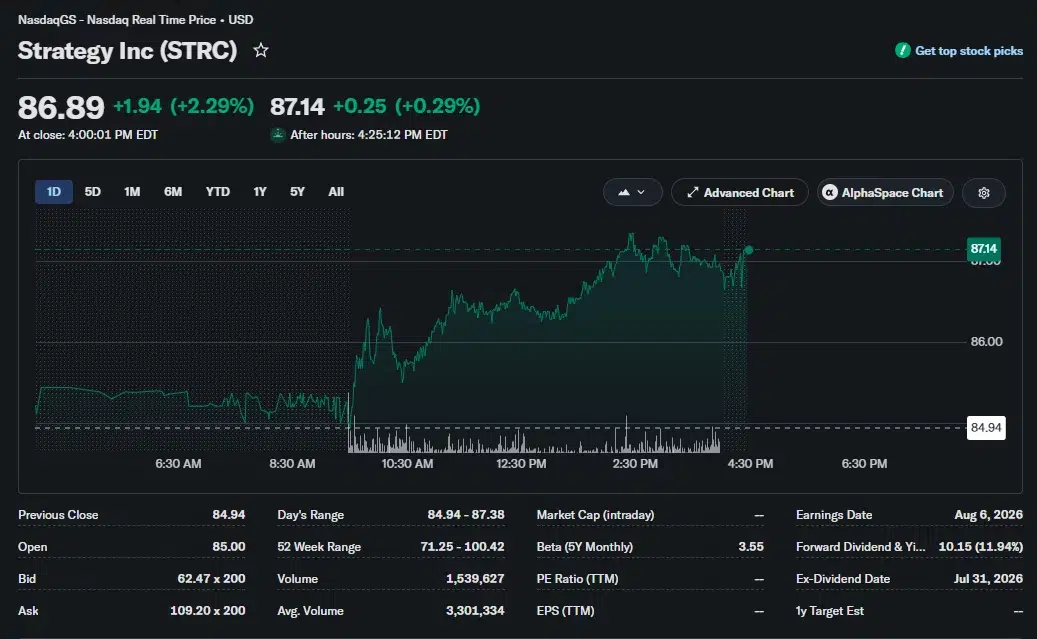
Strategy’s STRC preferred stock has become the largest holding in three major U.S. preferred stock ETFs, which collectively own $756 million of the security even as its price remains about 13% below its $100 par value.
Summary
- STRC has become the largest holding in three major preferred stock ETFs with $756 million invested.
- Institutional holdings have risen 105% as retail ownership fell from 78% to 71%.
- Strategy plans to issue more STRC and buy Bitcoin once the stock returns to $100.
Michael Saylor, Strategy’s co-founder and executive chairman, disclosed that STRC now leads the portfolios of BlackRock’s iShares Preferred and Income Securities ETF (PFF), Virtus InfraCap’s U.S. Preferred Stock ETF (PFFA), and VanEck’s Preferred Securities ex Financials ETF (PFXF). In a July 24 X post, Saylor described the placements as evidence that Strategy’s “digital credit” products are entering institutional portfolios.
The three funds give investors indirect exposure to STRC alongside preferred securities issued by established U.S. companies. According to Saylor’s figures, their combined STRC position has reached $756 million, making the security the largest individual holding in each portfolio.
Although ETF demand has increased, STRC closed at $86.89 on July 24, gaining 2.29% during the session before rising to $87.14 in after-hours trading, according to market data shown by Yahoo Finance. Its closing price left the stock 13.11% below the $100 level Strategy designed it to track.
Trading below par has become an important constraint for Strategy because the company uses STRC sales to raise money for Bitcoin purchases. Strategy can issue additional preferred shares near or above $100 and direct the proceeds into Bitcoin, but selling new stock at a large discount would secure less capital per share and weaken the economics of the transaction.
ETF demand has lifted institutional ownership
Strategy CEO Phong Le reported that the average STRC position held by institutions climbed 105% to $3.5 million between March and July. Over the same period, retail investors’ share of ownership fell from 78% to 71%, according to figures Le published on X.
“The institutions are coming,” Le wrote.
His figures correct reports describing the increase in average institutional holdings as 10%. Le’s post placed the increase at 105%, indicating that the average position more than doubled during the four-month period.
Institutional participation does not prove that every buyer expects either STRC or Bitcoin to rise, according to Bitcoin critic Peter Schiff. Responding to Le, Schiff argued that retail investors may have sold their positions at a loss while professional investors entered trades designed to profit from differences between Strategy’s securities.
Schiff suggested that some funds could have purchased STRC while shorting Strategy’s common stock, MSTR, as a spread trade. Other buyers may have paired long STRC positions with short Bitcoin exposure, he added.
“None of those trades are bullish bets,” Schiff wrote in his response.
Strategy currently pays STRC holders a 12% annual dividend in cash through two payments each month. The company’s STRC information page states that management adjusts the dividend rate monthly to encourage the stock to trade around its $100 par value and reduce price volatility.
The preferred stock’s high payout has not yet closed the discount. STRC’s 52-week range spans $71.25 to $100.42, while its July 24 closing price remained closer to the lower end of that range than to par.
The $100 level controls Strategy’s Bitcoin funding
Le has directly linked further STRC issuance and Bitcoin purchases to a recovery in the preferred stock. During a July interview, the Strategy CEO said the company would resume issuing more STRC once it returned to par.
“We’ll continue to build that. And yeah, when Stretch gets back to par, we’ll issue more. We’ll buy more Bitcoin,” Le said.
Under this funding model, a return to $100 would allow Strategy to sell new STRC shares on more favorable terms and use the proceeds to add Bitcoin. Until the discount closes, Le’s comments indicate that the company has less incentive to expand the program.
Strategy has already demonstrated how pressure on its preferred securities can affect its Bitcoin treasury. A July 6 filing showed that the company sold 3,588 BTC for $216 million to fund dividends on its digital-credit securities and maintain liquidity. Following the sale, Saylor reported that Strategy held 843,775 BTC and had increased its U.S. dollar reserves to $2.55 billion.
Also on July 6, Binance Stocks added STRC for spot trading, according to the exchange’s announcement reported by crypto.news. The listing followed the introduction of STRC-linked perpetual futures and gave Binance users another route to trade the preferred security.
Binance stated that fully paid securities lending would become available after stock transactions had settled completely. While the listing added another distribution channel for STRC, the stock’s continued discount shows that ETF accumulation and additional trading access have not yet restored the $100 level needed to restart Strategy’s preferred-share-funded Bitcoin purchases.


Singapore-based Bitcoin mining pool Poolin and two of its US affiliates filed for Chapter 11 bankruptcy in a New Jersey court on Wednesday.
Poolin’s court filing shows that the mining pool operator has estimated liabilities of $100 million to $500 million, assets of $1 million to $10 million and 10,001 to 25,000 creditors.
Poolin and its affiliates are also seeking court approval to sell two West Texas mining sites to Thor CALAP LLC under a proposed $52 million stalking-horse bid. This includes $37 million for the Tarbush assets, including assumed liabilities, and $15 million for the Pyote site, including the power rights, equipment and all other assets tied to the mining facilities.
The proposed sale would be subject to a court-supervised auction, with a bid deadline of Sept. 8 under the proposed bidding procedures.
Poolin was once the world’s largest Bitcoin mining pool in 2019. It now ranks as the 17th largest mining pool operator by hashrate, with a 0.2% market share, according to Hashrate Index.
Related: Hobby-level miner bags $200K solo BTC block with budget Bitaxe rig
Bitcoin miners increasingly turn to restructuring and AI
Bitcoin mining operations are facing growing financial constraints due to rising electricity costs, forcing some operations to shut down while others are seeking new revenue sources.
In February, NFN8 Group and two of its affiliates filed for Chapter 11 bankruptcy in the Western District of Texas.
Other miners have sought to diversify into AI infrastructure. In November 2025, Bitfarms initiated a complete wind-down of its Bitcoin mining operations to pivot to AI and high-performance computing data centers.
On Monday, Bitcoin mining companies Hut 8 and IREN announced major AI infrastructure deals. Hut 8 announced a 15-year, $9.8 billion lease for its AI data center campus and IREN disclosed $2.8 billion in cloud services contracts with AI developers. Earlier in July, MARA Holdings announced plans to acquire a Texas site with up to 2 gigawatts of capacity to expand its AI and digital infrastructure business.
Wealth management company Bernstein said that deals with third-party providers, such as Bitcoin miners, will be necessary for AI companies seeking to address the computing power limits of AI data centers.
Magazine: Bitcoin nearing late stages of bear market: Jamie Coutts, Real Vision
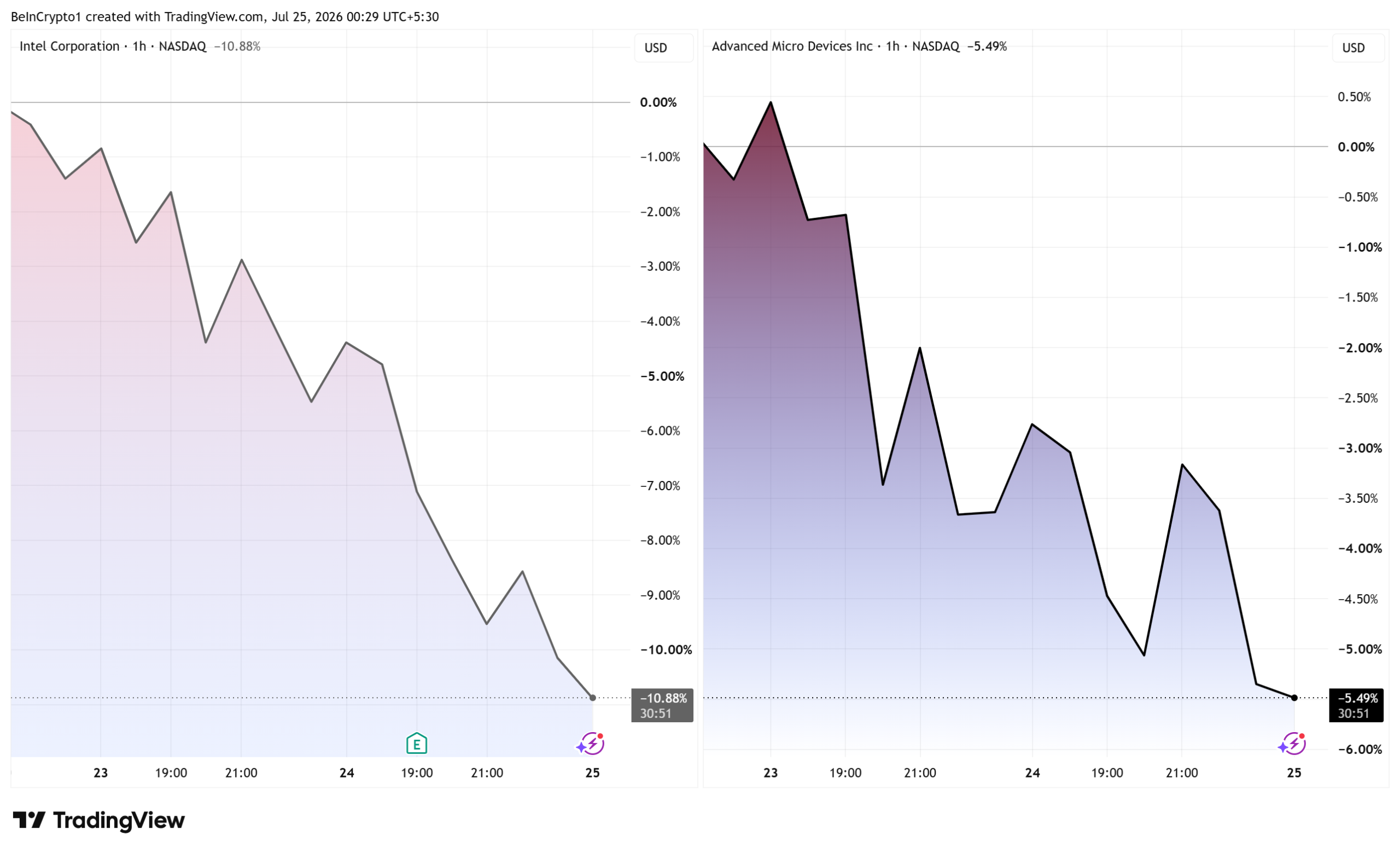
Intel beat revenue forecasts by $1.7 billion and posted its best growth in over fifteen years. The stock fell 11% anyway.
AMD had good news of its own and fell 5.5% too. When both drop at once, the cause is usually money leaving the sector.

Intel Stock Fell Through Its Own Earnings Beat
Intel reported revenue of $16.1 billion, up 25%. Analysts had expected $14.42 billion. Its data center and AI unit grew 59% to $6.3 billion. Adjusted earnings hit 42 cents a share.
Our Q2 results represent our strongest revenue growth in more than fifteen years…,” said Lip-Bu Tan, Intel chief executive, in the earnings release.
Finance chief Dave Zinsner went further, promising more spending on factory equipment and materials. Then the selling started. Intel has dropped 10.88% since the results landed.
Its RSI, a momentum gauge, sits at 29.07. Readings that low point to heavy selling.
AMD Fell Too, on Opposite News
AMD had momentum going in. It had just pledged 2 gigawatts of chips to an Anthropic supply deal, backed by a $5 billion investment.AMD still lost 5.49%. Its RSI sits at 40.99.

The whole sector was already weak. The SOXX chip fund trades about 15.7% below its June high. Scott Rubner, head of equity derivatives strategy at Citadel Securities, called it a rare chip signal.
The Inverse Cramer Effect Does Not Scale
Cramer posted “Intel’s the one” after the results. The inverse-Cramer allusion followed.
The research says the opposite. A Management Science study found his picks jump 2.4% overnight on average. Those gains then fade over the following months. The effect is strongest in small stocks that are hard to trade.
Size is the catch. That average move was worth $77.1 million. Intel lost 10.88%.
Cramer had also dumped tech before earnings. He turned cautious on the whole market that morning.
“I’m struggling to have reasons to buy, and I certainly have a lot of reasons to sell,” Jim Cramer said.
He blamed oil, interest rates, and the Middle East. Not chips. The 10-year Treasury yield hit its highest level since January.

Monday’s open will settle it.
The post Intel Beat Earnings by $1.7 Billion and Fell 11% as Cramer Turned Bullish appeared first on BeInCrypto.
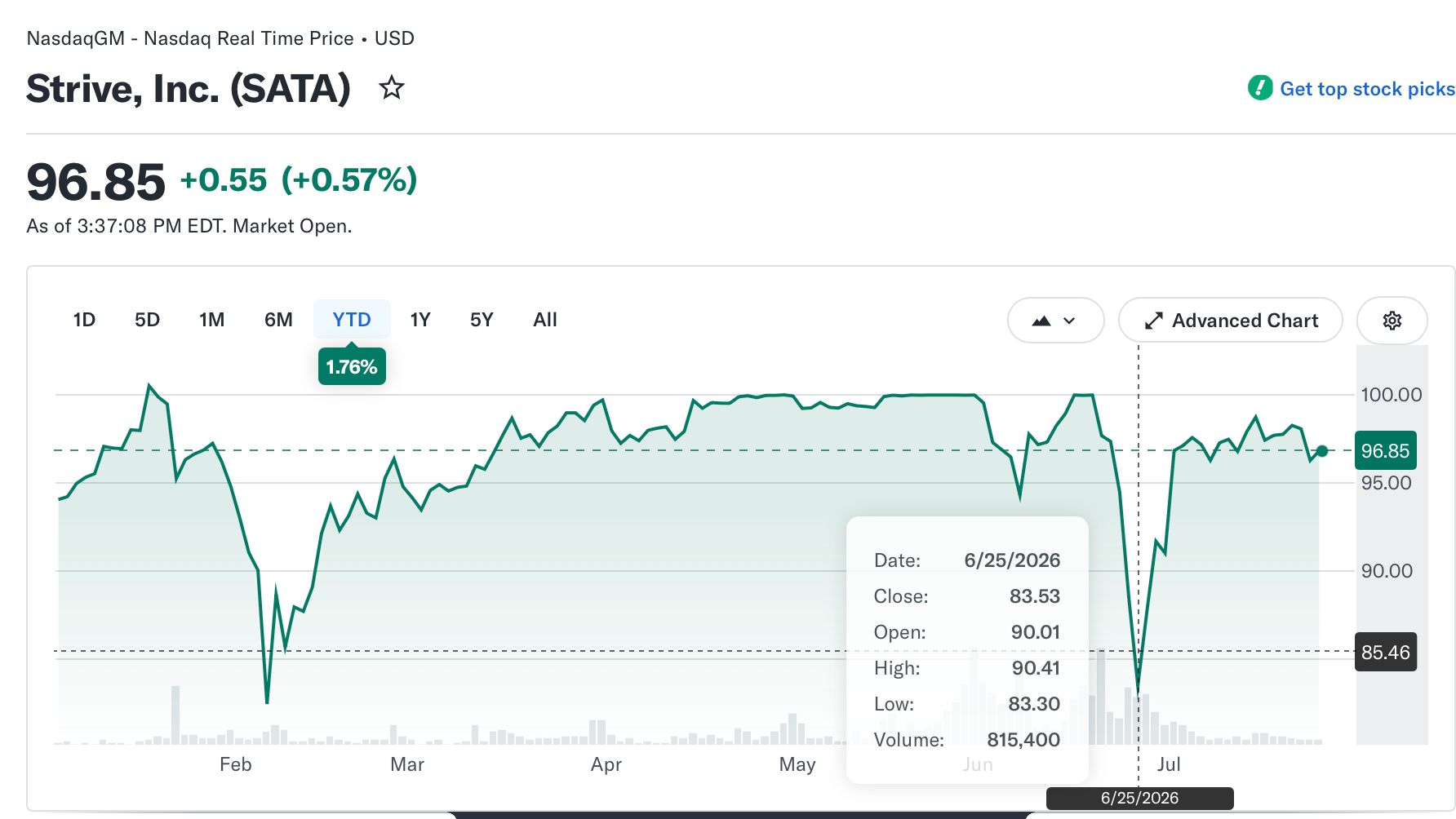
Strive’s SATA preferred shares have rebounded from a June low of $83.30 to about $97, recovering most of the selloff and moving back within roughly 3% of their $100 par value, according to Yahoo Finance data.
Strive introduced SATA in November 2025 as part of its strategy to finance the expansion of its Bitcoin treasury through preferred equity. The variable-rate perpetual preferred stock is intended to trade near its $100 par value by adjusting its dividend rate, allowing Strive to raise capital for its Bitcoin (BTC) treasury without issuing additional common shares.
SATA is one of a growing number of preferred-share products tied to Bitcoin treasury strategies, an emerging segment that companies such as Strategy describe as “digital credit.”
Strategy’s STRC, launched in 2025 with a similar objective of maintaining a $100 share price through a variable dividend, also fell sharply during the late-June selloff before recovering, though it continues to trade below par at around $87.
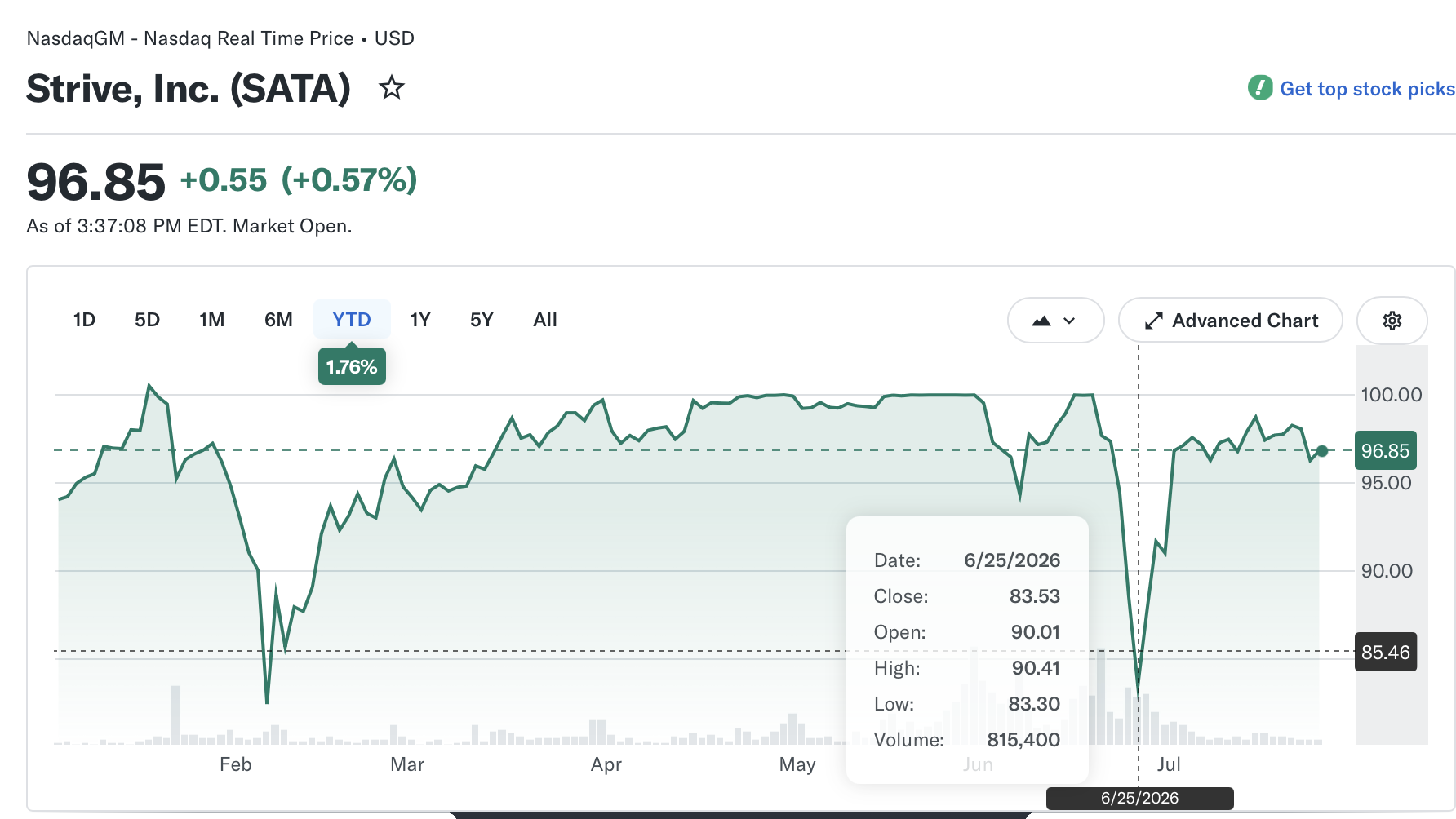
SATA year-to-date price chart. Source: Yahoo Finance
While Strategy remains the world’s largest public corporate Bitcoin holder with 843,775 BTC, Strive has climbed to seventh place with 19,921 BTC, according to BitcoinTreasuries.NET.
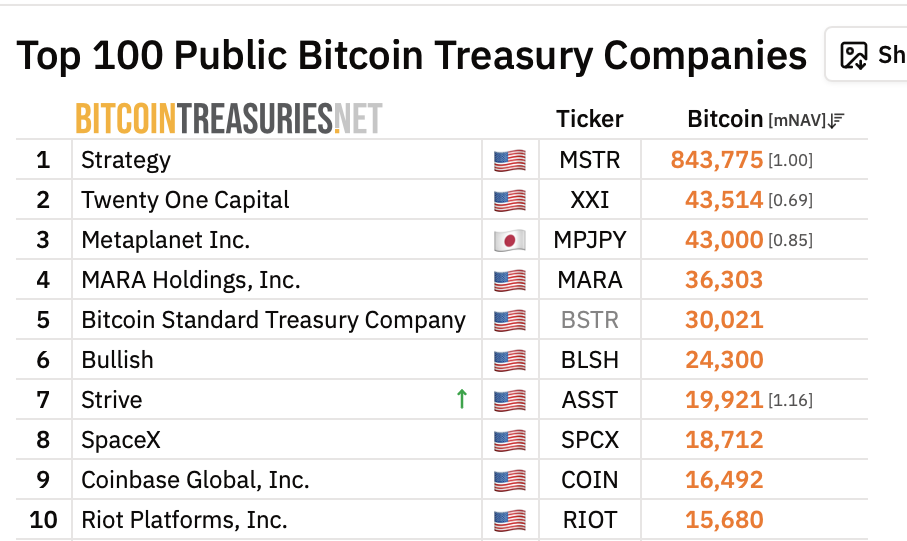
Top 10 Bitcoin treasury companies. Source: BitcoinTreasuries.NET
Related: Strategy raises $263.5M through MSTR sales, holds 843,775 Bitcoin
SATA recovery could help lift Strategy’s STRC, says Mow
Jan3 founder and CEO Samson Mow told Cointelegraph that recent adjustments by Bitcoin treasury companies are beginning to restore confidence in preferred-share products, supporting his view that Bitcoin has already found its bottom.
“I think every action that Strategy has undertaken to strengthen their balance sheet and encourage STRC to go back to par is also working,” Mow said, adding:
But everything sort of works in tandem. I think as SATA returns to par, you’re going to see STRC return to par too, because people say, ‘OK, this model’s not broken.’ Everyone is capitalized for three or more years of dividend payments… there was no reason to panic all along.
Mow said the improving performance of preferred-share products is part of a broader shift in the Bitcoin treasury sector, where companies have continued refining their capital-raising strategies.
He pointed to Lyn Alden’s Orange Juice treasury company, which launched on July 15 with plans to operate a Bitcoin treasury, as another example of firms entering the market with different approaches and a lower Bitcoin cost basis.

Samson Mow interview with Cointelegraph. Source: Cointelegraph
Magazine: A quantum roadmap would push Bitcoin much higher: Charles Edwards


Ripple, a blockchain-focused fintech company, has launched Ripple Mint, a platform that gives institutions new ways to access, mint, redeem and manage its US dollar-pegged stablecoin, Ripple USD (RLUSD).
The company announced Ripple Mint on Thursday, describing it as a unified platform that lets institutions manage RLUSD through a web interface or direct application programming interface (API) integrations.
“Ripple Mint is built to give institutions flexible access to digital dollars through the workflows that fit their needs,” Ripple said, adding that the platform is designed to support both manual operations and automated integrations as institutions adopt stablecoins for payments, trading and treasury activities.
RLUSD launched in December 2024 with a focus on institutional use, although the stablecoin has also gained traction among retail users. The token has grown into one of the larger US dollar-based stablecoins by market capitalization, reaching the top 10 less than one year after launch.
The token reached its all-time high market capitalization on June 1, 2026, when it surpassed $1.8 billion, according to CoinGecko. Around the Ripple Mint launch, RLUSD’s market cap briefly rose from about $1.54 billion to $1.64 billion before settling near $1.59 billion.
At the time of publication, RLUSD ranked as the ninth-largest USD-pegged stablecoin by market capitalization.
Related: Kakao taps Circle to explore won stablecoin payment infrastructure

The US House of Representatives has passed the Stop Insider Trading Act, a bill aimed at preventing members of Congress and their immediate families from buying publicly traded stocks. The measure cleared the House on Wednesday by a vote of 232–198 and now heads to the Senate for consideration.
Sponsoring Republican Representative Bryan Steil said the legislation is designed to stop lawmakers from profiting from potential insider information and to set penalties for violations. The bill would next be reviewed by the Senate, where key critics argue it still leaves room for conflicts of interest.
Key takeaways
- The House approved the Stop Insider Trading Act in a 232–198 vote, moving the proposal to the Senate.
- Under the bill, Congress members and their spouses and dependent children would be barred from purchasing publicly traded stocks.
- Penalties described by the bill sponsor include a $2,000 fine or 10% of the transaction, plus disgorgement of profits.
- Democratic lawmakers have criticized the bill for allowing members to keep and sell stocks already owned, arguing it does not fully solve the underlying conflict risk.
- Separate from the insider-trading effort, Steil is also linked to legislation addressing prediction market trading by public officials.
House passage and the bill’s penalty structure
According to the House vote results, the legislation advanced on Wednesday after the chamber approved Steil’s bill HB 7008, according to the official Congress.gov record. Steil, speaking on the House floor, framed the measure as a first for the current House on the specific issue and emphasized enforcement.
In describing how violations would be punished, Steil highlighted a penalty that includes a fine of $2,000 or 10% of the transaction, along with disgorgement of profits. He also stated that violators would forfeit gains if they failed to comply with the legislation’s requirements.
The bill’s practical aim is to reduce the possibility that lawmakers could benefit from non-public information gained through their roles. That intention is central to why supporters see the act as a meaningful guardrail against insider trading.
Criticism over “loopholes” and stock ownership rules
Even as the bill cleared the House, criticism emerged quickly from Democrats who argue it does not go far enough to eliminate conflict-of-interest concerns.
Representative and Senate critic Senator Elizabeth Warren said on Thursday that the legislation contains major loopholes because lawmakers could still own and sell stocks. Warren’s concern is that allowing ongoing ownership and sale—rather than an outright ban—may not sufficiently address the risk that creates incentives around insider information.
Steil responded to part of that critique by describing a compliance mechanism for members who already hold stocks. He said the bill would require a seven days’ notice before selling assets that lawmakers already own, arguing the notice requirement would deter trading driven by private information.
It remains to be seen how the Senate will treat these competing positions. In practice, the question will likely be whether the seven-day notice and penalties are viewed as adequate deterrence or whether senators will push for a stricter model—such as extending the restrictions beyond purchases to broader ownership rules.
What’s next in the Senate
After House passage, the Stop Insider Trading Act was received in the Senate for consideration on Thursday. The outcome in the upper chamber may hinge on whether enough senators support the bill’s narrower scope—aimed at members of Congress rather than other senior federal officials.
As described in the source, Steil’s measure is limited to restricting investments for members of Congress and does not cover the president or vice president and their families. That distinction matters for how this proposal fits into a broader debate about public official ethics and whether restrictions should be uniform across top executive and legislative roles.
In contrast, the source notes that a separate Senate proposal—associated with the Digital Asset Market Clarity Act—has included restrictions reaching public officials more broadly, including language that would bar certain officials from issuing or sponsoring tokens until 2029. While that crypto-market structure bill is distinct from the stock-trading measure, it illustrates how ethics and market-related restrictions are being considered across different legislative packages.
Link to prediction market trading legislation
The House action on insider stock trading arrives after Steil sponsored another related effort focused on prediction markets. The source reports that Steil previously backed the Stop Lawmakers from Predicting Act, introduced in June to prevent certain public officials, their spouses, and children from “wagering on public policy issues and political outcomes.”
That proposal drew attention amid real-world incidents highlighted in earlier coverage. The source points to an alleged episode involving a soldier who reportedly placed more than $400,000 betting on Venezuela President Nicolás Maduro on Polymarket, as well as reports that a teleprompter operator for former President Donald Trump allegedly made more than $100,000 betting on Kalshi event contracts connected to words and phrases in speeches.
While these examples are not about Congress members trading on stocks, they reflect the same underlying theme: lawmakers and political insiders face special scrutiny when bets can appear tied to information advantage or influence. In that context, the prediction markets proposal mirrors the stock bill’s penalty framing, including a $2,000 fee or 10% of the value of prohibited bets on the relevant platforms.
Investors and builders in crypto markets may see this as part of a wider regulatory pattern: legislators are increasingly testing whether restrictions should reach political actors using financial rails that operate outside traditional stock exchanges, even when the mechanism is “betting” rather than buying equities.
As the Stop Insider Trading Act moves through the Senate, the key uncertainty is whether senators will accept the bill’s approach—bans on new purchases with notice requirements for existing holdings—or push for stricter rules that would go further on ownership and trading.


The US House of Representatives has passed a bill that would ostensibly prohibit members of Congress, their spouses and dependent children from purchasing publicly traded stocks.
In a 232-198 vote in the House on Wednesday, lawmakers approved the Stop Insider Trading Act, sending the bill to the Senate for consideration. Representative Bryan Steil, the Wisconsin lawmaker who sponsored the bill, said that the legislation “ensures no lawmaker can profit off of insider information” and “institutes strict penalties for any violation.”
“We have not had a bill on the House floor on this topic with this opportunity before,” said Steil from the House floor on Wednesday, describing the penalties:
“A fine equal to $2,000 or 10% of the transaction, as well as a disgorgement of profits. Violators would be forfeiting any gain realized if they failed to comply with this legislation.”
Some Democrats are saying that the bill does not go far enough to address potential conflicts of interest, because it allows lawmakers to keep and sell stocks they already own. According to Steil, the bill would require members of Congress to provide seven days’ notice before selling stocks if they already hold assets, creating a deterrent for insider trading.
Related: Only KYC can stop insider trading on prediction markets, Messari says
“[The] bill has major loopholes,” said Senator Elizabeth Warren on Thursday. “Lawmakers can continue owning and selling stocks — so it won’t solve the problem. Not gonna fly in the Senate. Members of Congress should not own, buy, or sell stocks.”
The Stop Insider Trading Act was received in the US Senate for consideration on Thursday after passage in the House.
Unlike the proposed text for the Digital Asset Market Clarity Act, a cryptocurrency market structure bill under consideration in the Senate, Steil’s bill was limited to restricting investments for members of Congress and not the president or vice president and their families. Under CLARITY’s proposed text, all US public officials could be barred from issuing or sponsoring tokens until 2029.
Prediction markets bill also under consideration
House approval of the Stop Insider Trading Act followed Steil’s sponsorship of a similar bill targeting members of Congress trading on prediction market platforms like Kalshi and Polymarket. The Wisconsin lawmaker introduced the Stop Lawmakers from Predicting Act in June to prevent certain public officials, their spouses and children from “wagering on public policy issues and political outcomes.”
Prediction markets drew attention from the public after an incident involving a soldier who allegedly made more than $400,000 betting on Venezuela President Nicolás Maduro, who was removed by US forces in January. Donald Trump’s teleprompter operator also reportedly made more than $100,000 betting on Kalshi event contracts tied to words and phrases in the president’s speeches.
Like the stock trading bill, the prediction markets legislation proposed that violators pay a $2,000 fee or 10% of the value of the prohibited bets on the platforms.
Magazine: Why Wall Street values some crypto firms for AI power, not just crypto

World Foundation, the nonprofit behind the World protocol, has raised an initial $52.5 million by selling locked WLD tokens to strategic investors, with Pantera Capital leading the round. The fundraising—announced on Friday and shared with Cointelegraph—adds fresh capital to World’s push to scale World ID, its biometric-based system for helping platforms verify whether an online user is a real person.
According to the announcement, the WLD tokens sold in the round are subject to a 12-month lockup. Other participants reportedly include Bain Capital Crypto, Eightco Holdings, Selini Capital, and Susquehanna Crypto, alongside additional investors.
Key takeaways
- $52.5 million raised through a sale of locked WLD tokens, with Pantera Capital leading.
- The sold tokens come with a 12-month lockup, limiting immediate liquidity from the strategic investors.
- World Foundation says new funding will go toward expanding World ID, its biometric credential system for distinguishing humans from AI agents.
- World ID relies on users completing biometric verification at a World Orb device to generate a digital credential.
- The broader market context reflects intensified investor focus on AI infrastructure and agent-era tooling, including security and verification solutions.
Locked token sale funds World ID expansion
World Foundation’s fundraising centers on WLD, the token ecosystem associated with the World protocol. In its announcement, the organization said the initial $52.5 million proceeds from the locked token sale will be used to expand World ID—a system meant to verify online identities in an era where synthetic content and automated agents are becoming more prevalent.
World describes World ID as a credential that can be issued after users complete biometric verification at a hardware point called a World Orb. Once verified, users receive a digital credential intended to help services determine that the account engaging with them is tied to a real person rather than an automated agent.
The stated motivation is practical: the nonprofit argues that demand for verification infrastructure is rising as AI-generated content and autonomous agents increase. Instead of trying to detect bots purely through behavior, the approach aims to anchor identity claims to a biometric verification step completed through the World Orb workflow.
Why verification matters as AI agents proliferate
World’s fundraising lands amid a broader shift in crypto and adjacent investment toward AI-related infrastructure and agent-first applications. That shift has been visible across multiple recent deals highlighted in Cointelegraph coverage.
For example, brokerage infrastructure provider Alpaca raised $135 million in equity financing earlier this month and reportedly secured access to up to $300 million in debt financing. The company said the funding would support infrastructure for AI-powered financial applications—an indication that agent-driven workflows are moving from experimentation toward more robust system-building.
Similarly, Cointelegraph previously reported that Coinbase introduced tools enabling businesses to accept USDC payments from autonomous AI agents. That update was framed in the context of AI-generated activity growing on its Base developer ecosystem, including a claim that AI-generated traffic exceeded human traffic on its Base developer documentation for the first time last month.
In this environment, identity and trust layers become more than a niche tooling problem. As more commerce, messaging, and platform interactions become automatable, the ability to verify whether an interaction represents a human user becomes increasingly relevant to everything from onboarding to fraud prevention to resource allocation.
Regulatory sensitivity remains part of the World ID story
World’s identity approach is not without controversy. The organization was originally conceived by Sam Altman, Max Novendstern, and Alex Blania, with World protocol efforts later drawing regulatory scrutiny in multiple jurisdictions over its biometric identity verification system.
While the current fundraising announcement focuses on scaling World ID, the mention of regulatory pressure underscores a critical uncertainty investors and builders should consider: biometric verification often intersects with privacy expectations, data protection requirements, and consent frameworks that can vary widely by jurisdiction. That reality can influence rollout speed, compliance costs, and the design of how credentials are issued and used.
For market participants, the token lockup may offer some near-term stability, but it does not resolve the core question of how World ID will navigate legal and regulatory constraints as it expands.
AI investment momentum extends to security and frontier tech
The investment climate around AI is also showing up in broader funding patterns, including cybersecurity. Cointelegraph notes that capital is increasingly flowing into AI-adjacent security efforts, with one example being AegisAI, a cybersecurity startup that raised $36 million in Series A funding to expand AI-powered email security. The company said the financing is intended to improve defenses against more sophisticated AI-generated phishing attacks.
Meanwhile, large crypto investment vehicles have been repositioning toward AI and frontier technologies. According to Cointelegraph reporting, Paradigm raised a $1.2 billion fund in July to invest across crypto, artificial intelligence, robotics, and other frontier technologies. Framework Ventures also reportedly closed a $400 million fund in June with a mandate spanning crypto, AI, robotics, and energy.
Taken together, these moves suggest a sector-wide bet: in an agent-driven future, infrastructure, trust, and security will be treated as interconnected components rather than separate silos. World ID’s biometric verification pitch fits into this larger landscape as one possible “human verification” layer for systems confronting rising automation.
Looking ahead, the key question for readers is how quickly World Foundation can scale World ID beyond its initial verification workflow while maintaining compliance in the jurisdictions that have already scrutinized biometric identity verification. With AI agents becoming more common—and platforms increasingly adapting payment and interaction tools for them—investors and builders should watch for concrete adoption milestones for World ID and any updates on regulatory posture as World expands.

The company announced the launch of a new platform, dubbed ‘Ripple Mint,’ that gives institutional customers a single way to access, mint, redeem, and manage RLUSD.
It said the main objective is to make digital dollars easier to access, integrate, and operate at scale as stablecoins become more deeply embedded in trading, payments, and treasury operations.
Pushing RLUSD’s Institutional Reach
According to the official blog post, Ripple Mint expands RLUSD access beyond traditional platform-based workflows by allowing institutions to manage the stablecoin either through a user interface or through programmatic integrations.
With Ripple Mint, institutions can mint and redeem RLUSD directly from the issuer, bridge the stablecoin across supported blockchains, monitor funds throughout the full transaction lifecycle, and integrate RLUSD operations into their own internal systems and workflows.
The rollout will not affect existing customers of the stablecoin, who will now be able to use the platform for both manual operations and automated integrations. The company has also introduced new APIs and webhook notifications that allow customers to automate RLUSD workflows, query transaction status throughout the minting and redemption process, access account balances programmatically, and receive real-time updates on important events such as fiat receipt, mint processing, on-chain settlement, and payout completion.
Alongside the launch of Ripple Mint, Ripple also made a strategic investment in Notabene, a company focused on regulated on-chain transaction infrastructure.
The two companies said they will work together to grow enterprise stablecoin payments by integrating RLUSD into Notabene Flow, the firm’s B2B stablecoin payments platform. The focus will also be on exploring how trusted payment authorization can complement Ripple Payments.
The partnership combines Ripple’s enterprise payments ecosystem and RLUSD with Notabene’s institutional network, which reportedly spans more than 2,300 connected institutions across over 100 jurisdictions, serves more than 280 customers, and facilitates more than $2 trillion in annualized transaction volume.
Expansion
Ripple’s RLUSD has continued to expand its presence since launching and now has a market capitalization of nearly $1.6 billion. Last August, Ripple partnered with Japan’s SBI Holdings to distribute the stablecoin in the country through SBI VC Trade starting in the first quarter of 2026.
In March 2026, the company joined the Monetary Authority of Singapore’s BLOOM initiative with Unloq to test RLUSD and the XRP Ledger for programmable cross-border trade settlement.
A month later, OKX listed the stablecoin to expand its global access, liquidity, and trading utility. More recently, it was also included in Mastercard’s expanded stablecoin settlement program.
The post Ripple Doubles Down on RLUSD With Mint Launch and Notabene Investment appeared first on CryptoPotato.

Paramount agrees to delay Warner Bros. merger til 2027 amid antitrust lawsuit

Litecoin Breakout Setup Forming on Strong Momentum Above Crucial Resistance
Teddy Atlas picks a winner in Errol Spence vs Tim Tszyu: “I know what I’m getting from him”


-

 Politics6 days ago
The House | The City of London can help the new chancellor deliver growth in every postcode
-

 Crypto World6 days ago
Ripple Payments Joins MiCA With 14 Firms, Does It Mean Anything For XRP?
-

 Fashion4 hours ago
Weekend Open Thread: Brooks Brothers
-

 Politics5 days ago
Democrats look to World Cup watch parties to register thousands of voters
-

 Crypto World7 days ago
Ripple wins EU-wide access as ESMA adds it to MiCA register
-

 Crypto World4 days ago
Grayscale Files For Worldcoin ETF, WLD Registers Sharp Rise
-

 Tech4 days ago
Sail Virtually Aboard The “Itanic” With IA-64 Emulator
-

 NewsBeat4 days ago
Unregistered fitter used Gas Safe logo on business flyers
-
 Tech4 days ago
Turtle Beach Command Series KB7 review: a nifty screen-equipped gaming keyboard
-

 News Videos5 days ago
Big Money Is Entering XRP
-
 Business3 days ago
New Jersey voter registration controversy explained: How 6,600 noncitizens got on the rolls, and what happens next
-

 Crypto World6 days ago
Kaspersky exposes OkoBot’s 20-module crypto wallet attack
-
 Entertainment3 days ago
Johnny Depp’s R-Rated Gothic Cult Classic Gets New Release Ahead of Sydney Sweeney Remake
-

 NewsBeat7 days ago
Durham County Council to send out electoral registration emails
-

 Crypto World2 days ago
Ethics, other provisions in crypto Clarity Act to be further discussed
-

 Crypto World7 days ago
MiCA Licensing Faces Delays as ESMA Adds 14 CASPs to Register
-
 NewsBeat4 days ago
Shanghai science forum photos show China’s AI and robotics advances in rivalry with US
-

 Crypto World6 days ago
Chip Stocks Enter Bear Market After Moonshot Ai Unveils Kimi K3 Model
-

 Tech4 days ago
Watch Flock Safety CEO Garrett Langley discuss the future of surveillance at TechCrunch Disrupt 2026
-

 Tech5 days ago
Subway Sandwich Computers Get a Second Life as Gaming Machines
You must be logged in to post a comment Login