Connect with us
DAPA Banner
DAPA Coin
DAPA
COIN PAYMENT ASSET
PRIVACY · BLOCKDAG · HOMOMORPHIC ENCRYPTION · RUST
ElGamal Encrypted MINE DAPA
🚫 GENESIS SOLD OUT
DAPAPAY COMING

NewsBeat

ANDREW NEIL: I’m told Trump’s physical and mental health are in visible decline – and there’s ever more talk about a ground invasion. 150 days on, he has no good options left in Iran debacle

Published

on

Donald Trump is said to be 'in decline' both physically and mentally, and he is reportedly so frustrated with the war in Iran that he has entered 'revenge mode'

It’s now five months since President Trump launched his war on Iran in cahoots with Israel.

He has precious little to show for it – bar growing frustration at the Tehran regime’s resilience; the despair of America’s allies in the Gulf region and elsewhere; a teetering global economy; rising petrol prices at US forecourts; and personal approval ratings plummeting faster than US munitions are being depleted.

When US and Israeli air strikes began their bombardment of Iran at the end of February, Trump claimed it would all be over in a matter of weeks. The Iranian regime would be humbled, perhaps even deposed. Its missile and drone arsenals would be destroyed, its ability to develop nuclear weapons crippled for a generation, perhaps for ever.

Monday will mark 150 days since February 27, when Donald Trump gave the order to proceed with Operation Epic Fury. Since then, none of those ambitions has materialised. The regime is certainly battered and bruised. But it is still standing – more hardline than ever.

Advertisement

Iran’s military resources have been degraded. But it is still capable of raining down missiles and drones on American military bases and US allies in the region.

Tehran’s ability to develop nuclear weapons has suffered serious setbacks. But it still has the capability to start all over again should it be so minded.

No progress has been made, on the battlefield or in ceasefire talks, to ensure Iran renounces its nuclear ambitions, supposedly the fundamental reason for starting the war in the first place.

Now Iran has something perhaps even more precious than the Bomb, something it did not possess before war broke out: a stranglehold on the Strait of Hormuz, the global economy’s most crucial chokepoint, through which so much oil, gas, fertiliser and other essential commodities used to flow before hostilities broke out. Tehran’s refusal to give up control of this vital waterway is the main reason all peace efforts to date have floundered.

Advertisement

Donald Trump is said to be ‘in decline’ both physically and mentally, and he is reportedly so frustrated with the war in Iran that he has entered ‘revenge mode’

The war isn’t just consuming Trump’s presidency. It’s taking its toll on the President himself. During a recent meeting in the Oval Office, he ranted against Iran’s leaders, calling them ‘scumbags’ and ‘lunatics’ in an expletive-ridden diatribe. There is growing concern for his physical health and mental stability.

‘Donald is deteriorating before our very eyes,’ I was told in Washington this week by a close confidant who sees him regularly. ‘His physical and mental health is in decline. Those around him don’t know what to do about it. It can only get worse. He’s 80 – and it’s showing.’

Advertisement

But it’s not just age – or the decline in cognitive capabilities that can afflict those entering their ninth decade. Trump is lashing out at all and sundry in frustration at the lack of any good options now facing him.

The hardliners in Tehran are now so cocky they even rebuffed a secret US attempt to get the peace process back on track this week.

So the White House is dialling up the rhetoric – Trump is said to be in ‘revenge mode’ – and the President himself sounds ever more bellicose, saying on Thursday that he was ‘close’ to deciding on a ‘massive attack’.

Even senior aides in the White House don’t know what this would mean. The number of influential voices in Washington who think even ramped-up air strikes –as I write, we’ve just had the 14th consecutive night of renewed US attacks on Iran – will cow Iran into submission are now passing few. In truth, nobody around Trump really knows what to do next – or what he will do.

Advertisement

This week two new intelligence reports landed on their desks to add to their despair – which was further increased by their fear that the President has given them scant attention. Their contents were certainly unlikely to improve his mood.

The first, based on analysis from various US intelligence agencies and drawn together by the CIA, concluded that the Iranian regime would not be cajoled into rejoining peace talks by ramping up US air strikes. The US, it said, had underestimated Iran’s ‘staying power’ – that hitting Iran harder was unlikely to make it more ‘compliant’.

The risk now was ‘indefinite limbo’ between peace and war. In other words a stalemate, yet another low-level ‘forever war’ which Trump was elected to avoid.

Or more bluntly, in the terminology used during the Vietnam War almost 50 years ago, a quagmire.

Advertisement

The second intelligence report, involving US and Israeli intelligence, was even more depressing. Drawing on extensive satellite imagery, it revealed that Iran was rebuilding its devastated missile and drone bases far more quickly than either the US or Israel had anticipated.

Missile arsenals were being reconstituted inside mountains. Bridges, ports and military production facilities were being repaired with speed. Even the northern supply lines through which Russia channelled aid to Iran – and which Israel thought it had disrupted – had been ‘restored’. Iran, Israeli intelligence reported, had shown an ‘impressive ability to reconstitute its military capabilities.’

Iran rebuilt its missile bases more quickly than the US or Israel had anticipated. (Pictured: A missile being launched towards US targets in Jordan, Kuwait and Bahrain)

Iran rebuilt its missile bases more quickly than the US or Israel had anticipated. (Pictured: A missile being launched towards US targets in Jordan, Kuwait and Bahrain)

Although there has been talk from Washington about seizing Iranian territory, no conceivable US deployment could suppress Iran for long, says Andrew Neil

Although there has been talk from Washington about seizing Iranian territory, no conceivable US deployment could suppress Iran for long, says Andrew Neil

Advertisement

The sound of war drums is once again emanating from the White House. The media is being briefed on the renewed ‘surge’ of US forces to the Gulf. There are already 17 US warships in the region, including two aircraft carrier strike groups and a marine corps expeditionary group.

They are being joined by more fighter jets and special forces. Bombers stationed at US bases in America and Britain are back on high alert. Even 150 medics have been rushed to a base in Germany which deals with Middle East casualties. All told, including US bases in the region, deployments for the launch of the war back in February plus the latest top-ups, America now has more than 50,000 troops in the region.

But for what purpose? This week in America I listened to several influential figures close to Trump mull over the options. The assumption was that some sort of ground incursion was inevitable. That is certainly the new vibe coming out of Washington.

They talked of seizing Iranian territory on the northern shores of the Gulf to wrest control of the Strait of Hormuz from Tehran. They raised the prospect, again, of invading Kharg Island, from which Iran dispatches most of its oil exports.

Advertisement

There was, thankfully, no talk of a full-scale attack along the lines of the invasion of Iraq in 2003. Iran is four times bigger than Iraq, with a much larger population, a disciplined, well-armed 190,000- strong guard bolstering the regime and terrain tailor- made for guerrilla war. No conceivable US deployment could suppress Iran for long.

But there was, much more worryingly, talk of using tactical nuclear weapons to ‘send a message’ to Tehran and ‘concentrate its mind’ on peace. This took me aback.

‘Do that,’ I snapped ‘and you destroy America’s reputation and standing for the rest of the century. You’ve also paved the way for President Putin to do the same in Ukraine.’

I was met with silence. There is much desperate talk in Trump circles these days. As it happens, I do not believe Trump will resort to nuclear weapons. I’m not even sure he will embark on a major ‘boots on the ground’ escalation, even if that is the growing consensus in Washington. US forces could certainly take Kharg Island. But then what? They’d be sitting ducks for Iranian missile and drone attacks.

Advertisement

Occupying the north side of the Strait of Hormuz would be a far bigger task, requiring more troops than America is currently assembling in the region. The topography lends itself to Iranian guerrilla attacks. Ships transiting the Strait would still be vulnerable to missile and drone attacks launched from further inland.

US forces might then be enticed to go after these sites. That’s how you get suckered into a morass. It’s striking that current US reinforcements to the region do not include a big increase in troop numbers, which a major land attack would require. That’s one reason I remain sceptical of a major ground incursion. The other is US domestic politics.

It took six years for the Vietnam war to become as unpopular as Trump’s war on Iran has become in under six months. Vietnam hit a net approval rating of minus 30 per cent after six years and a mounting death toll with no end in sight. Trump’s war already has the same negative approval rating – and that’s without a monstrous bodybag count.

So far only 18 US military personnel have lost their lives in the current war. Each one, of course, a personal and family tragedy. Even so, it is already the most unpopular war since US polling began. It benefits from not a scintilla of bipartisan support. It has a net approval rating of minus 84 per cent among registered Democratic voters and minus 52 per cent among independents.

Advertisement

Surprisingly, it still enjoys a 72 per cent approval rating among Maga Republicans, despite their contempt for ‘forever wars’. But over half are only ‘somewhat’ supportive rather than ‘strongly’. I would expect that tepid support to evaporate if pictures of bodybags started to dominate broadcast news.

The war has already taken its toll on Trump’s popularity. Almost two-thirds of voters disapprove of his handling of the war, with only a third approving. More than

Trump¿s war on Iran is at risk of defining his presidency, like the Vietnam war defined President Lyndon Johnson¿s, our columnist warns. (Pictured: Johnson with President Nguyen Van Thieu)

Trump’s war on Iran is at risk of defining his presidency, like the Vietnam war defined President Lyndon Johnson’s, our columnist warns. (Pictured: Johnson with President Nguyen Van Thieu)

60 per cent don’t expect any truce he makes with Iran to hold. Almost 80 per cent want him to end the war now. Trump’s overall job approval rating is now under 40 per cent and falling. Iran has proved to be a major drag on his standing. His approval rating on perhaps the most important political metric of all – his handling of the economy – is under water at below 30 per cent.

Advertisement

Much of that reflects the fact petrol prices at the pump are now over $4 a gallon again, which especially hurts Americans now that the summer driving season is underway. Petrol prices dropped when the ceasefire was agreed and it looked like the Strait of Hormuz was open again for business. Now they could be heading for $5 or more – a prospect that terrifies Republican Party managers in the run up to early November’s mid-term congressional elections, when Trump’s control of the House and Senate is at stake.

The resumption of hostilities has effectively closed the Strait of Hormuz. Shipping there has all but halted since July 15. So oil prices have started to soar again.

The benchmark price of Brent crude oil hit $100 a barrel on Thursday. It’s likely to go even higher. This week, urged on by their Iranian paymasters, Houthi rebels in the Yemen hit two Saudi tankers loaded with crude and oil products in the Red Sea.

The Saudis have been piping oil to Yanbu, a port on the Red Sea, to bypass the Strait of Hormuz. If this escape route is now in jeopardy then oil prices will spike much further.

Advertisement

In fact, it is not the price of crude that is the real worry. It is the price of the products refined from it – diesel, petrol, jet fuel. All three are already spiking. Jet fuel, for example, at around $150 a barrel in Europe and America, is now almost twice what it was before this misbegotten war began.

The global economy is now on the brink of a major energy squeeze. It has been staved off to date because major economies such as America, China, Japan and South Korea drew on their strategic oil reserves.

Ways round the Strait of Hormuz (like that pipeline to Yanbu) were used. China cut its crude oil imports by almost two-fifths. All these buffers have now been exhausted.

Nor is the problem just Trump’s Iranian adventure. That has reduced the supply of refined products by around 3million barrels per day (b/d) from the Gulf, on which Europe depends for diesel and jet fuel. On top of that Ukrainian drones have taken out another 2million b/d of Russian refining capacity while China has cut back on its export of refined products, perhaps by another 3million b/d to conserve its own supplies.

Advertisement

It amounts to a triple whammy for the global economy, a perfect storm – and a harbinger of severe shortages of vital refined products to come, which is as yet only vaguely understood.

If, as is the talk in Washington, Trump starts to bomb Iranian power plants and civilian infrastructure – and Tehran inevitably retaliates by hitting the pipelines, ports and even desalination plants of the Gulf States (which depend entirely on these plants for water) – then the word ‘morass’ will not do justice to what’s in store for us during the second half of this year.

I end where I started: Trump has no good options. If he tries to slink away from the mess he’s created, all the vainglorious rhetoric he can muster will not hide the fact that he has presided over the greatest humiliation of America in modern times. But if he doubles down and recklessly raises the stakes with a major military escalation, he risks merely making matters worse – for him, for his party, for America, for the Gulf, for the global economy, for us.

Trump’s war on Iran is now at risk of defining his presidency just as the Vietnam war defined Lyndon Johnson’s all those years ago. It is not a legacy any president should wish to emulate. But, through a mixture of stupidity and bravado, Trump looks like doing exactly that. We will all be the poorer for it.

Advertisement

Source link

Continue Reading
Click to comment

You must be logged in to post a comment Login

Leave a Reply

NewsBeat

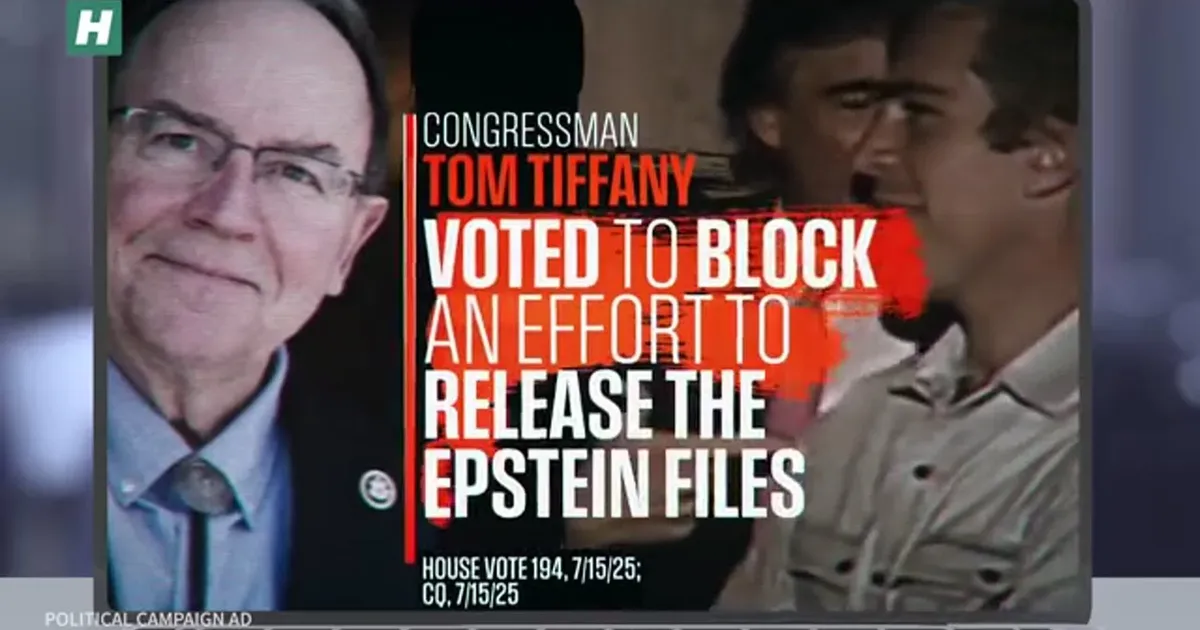
Epstein Haunts Midterm Republicans

Published

on

Epstein Haunts Midterm Republicans

!function(n){if(!window.cnx){window.cnx={},window.cnx.cmd=[];var t=n.createElement(‘iframe’);t.display=’none’,t.onload=function(){var n=t.contentWindow.document,c=n.createElement(‘script’);c.src=”//cd.connatix.com/connatix.player.js”,c.setAttribute(‘async’,’1′),c.setAttribute(‘type’,’text/javascript’),n.body.appendChild(c)},n.head.appendChild(t)}}(document);(new Image()).src=”https://capi.connatix.com/tr/si?token=19654b65-409c-4b38-90db-80cbdea02cf4″;cnx.cmd.push(function(){cnx({“playerId”:”19654b65-409c-4b38-90db-80cbdea02cf4″,”mediaId”:”c0fc4e20-ec28-4dcf-bc0c-fccd622aa03d”}).render(“6a63c6b8e4b0c9b5d774a454”);});

Source link

Continue Reading

NewsBeat

Warning signs that supermarket fish is not actually fresh

Published

on

Warning signs that supermarket fish is not actually fresh

Brits eat around 167 million portions of fish and chips a year, and that is not counting the other dishes people use fish for when they are at home.

However, you do not want to be wasting money on fish that is not fresh, especially if it is an expensive type of fish.

While you can find some great fish in the supermarkets and at fishmongers, sometimes it might not be as fresh as it looks, but there are ways to check before.

There is an easy way to check if supermarket fish is fresh. (Image: Getty)

How to spot if fish is not fresh while in the supermarket

You might think it is normal for fish to have a strong smell in the supermarket, but a seafood expert says the best quality fish should only have a mild scent.

Advertisement

Julian Klenda from Marine Lobster Now said: “Never assume fish is fresh simply because the colour looks right or the packaging is intact.

“If you are buying from a fish counter, ask to smell it.

“Fresh fish should smell mild and clean, perhaps slightly like the sea, but it should not hit you with a strong fishy, sour, or ammonia-like odour.

“That familiar ‘fishy’ smell is not something shoppers should expect from genuinely fresh fish.

Advertisement

“If the smell makes you pull away, trust that reaction and choose something else.”

As fish gets worse, it will develop an increasingly strong and unpleasant smell but will still look fine on the outside.

If you can smell sourness, rancid notes, or an ammonia-like smell, you should avoid buying the fish.

You should check the fish is properly sealed and within its use-by date.

Advertisement

You can also check the condition of the packaging and look closely at the fish for any excess liquid, discolouration, or if it is drying out.

Julian added: “Smell is the fastest check when you have access to the fish, but it should not be the only one.

“Fresh fillets should generally look moist and have firm flesh rather than appearing dry, dull, or mushy.

“If you are buying a whole fish, look for clear, bright eyes and red gills rather than cloudy eyes or brownish gills.

Advertisement

“For shellfish meat such as lobster, scallops, or prawns, look for a clear, pearl-like appearance and little to no odour.

“Any combination of a strong smell, unusual colour, and soft texture should be treated as a warning.”

Will you be using this trick to check fish next time you go shopping? Let us know in the comments.

Advertisement

Source link

Continue Reading

NewsBeat

European wildfires threatening Madrid and French resorts surge ‘out of control’ as hundreds of thousands are forced from homes including British holidaymakers

Published

on

Beachgoers rest on the shore of Lake Lacanau, southwestern France, on July 24, 2026, as clouds of smoke rise into the sky from the Gironde wildfire

European wildfires threatening Madrid and French resorts have become impossible to control in some areas as hundreds of thousands, including British holidaymakers, are forced from their homes. 

Large forest fires have become ‘out of control’ in southwestern France and central Spain today, sparking an evacuation of an estimated 200,000 people from their homes. 

The fire in Madrid is said to put at risk a NASA and ESA communications complex, one of three comprising a network studying deep space.

About 141,000 people fled their homes in Gironde and Landes in France, while 60,000 were forced to evacuate their houses in Spain, the countries’ respective Interior ministries confirmed. 

Advertisement

Dozens of firefighters have been injured but no deaths have been reported in either country, authorities have said. 

Meanwhile, the Madrid regional government’s emergency management chief, Carlos Novillo, said the blaze near the Spanish capital was ‘at its peak’ and was beyond capacity for firefighters to tame. 

The inferno is currently making its way towards the municipalities of Fresnedillas de la Oliva and Robledo de Chavela, just several dozen kilometres from the outskirts of the city. 

‘It is not possible to attack the fire in that area, so defensive measures are being taken,’ Mr Novillo told the BBC

Advertisement

Exactly 25,000 people have been evacuated from the region, while 20,000 more have been placed in lockdown, Madrid officials have said. 

An alert message had been issued to those in Aldea del Fresno, a town west of Madrid, ordering them to leave, emergency services said. It is the first time such a measure has been taken due to a wildfire. 

Beachgoers rest on the shore of Lake Lacanau, southwestern France, on July 24, 2026, as clouds of smoke rise into the sky from the Gironde wildfire

Advertisement

Plumes of smoke near the NASA and ESA communications complex in Robledo de Chavela, near Madrid

Firefighters battle a wildfire in Cebreros area, near Avila, 80km west of Madrid on July 24, 2026

Firefighters battle a wildfire in Cebreros area, near Avila, 80km west of Madrid on July 24, 2026

A firefighter helicopter dumps water on a wildfire in Cebreros area, near Avila, 80km west of Madrid on July 24, 2026

A firefighter helicopter dumps water on a wildfire in Cebreros area, near Avila, 80km west of Madrid on July 24, 2026

A person runs as the fire spreads in the mountains of Navaluenga, Avila, on July 23, 2026

A person runs as the fire spreads in the mountains of Navaluenga, Avila, on July 23, 2026

Advertisement
David Gonzalez who owns a Martial Arts gym for young people try to extinguish a fire outside his home in Avila

David Gonzalez who owns a Martial Arts gym for young people try to extinguish a fire outside his home in Avila 

Firefighters battle a wildfire in the Cebreros region as several wildfires have burnt out of control

Firefighters battle a wildfire in the Cebreros region as several wildfires have burnt out of control

The last time Spain declared the same level of emergency alert was during a massive nationwide power blackout last year.  

Meanwhile, tens of thousands have fled from a millionaire’s holiday paradise in France with British tourists caught up in an ‘apocalyptic’ wildfire. 

Advertisement

Mass evacuations have been taking place throughout the day – including by boat – from Cap Ferret in southwestern France, where wildfires have burnt through thousands of hectares of forest and destroyed luxury villas.

Spain’s government has declared a national emergency amid the wildfires for the first time as the inferno in Madrid and the nearby province of Avila sparked mass evacuations. 

Two major blazes near Madrid combined into one single inferno, which quickly burned through 11.5 square miles of land by Friday afternoon. 

A fire in Avila, less than two hours north-west of Madrid, tore through 34 square miles, causing 1,500 people to flee. 

Advertisement

It comes as the fires are being fanned by a heatwave with temperatures expected to hit highs of 39C (102F) in parts of Spain. 

Spain’s Civil Guard has arrested one man and is investigating another for allegedly having used heavy machinery in an area where it was prohibited for fire risk. 

Regional President Isabel Díaz Ayuso branded the fires as the worst in Madrid’s history.

Meanwhile, Francisco Martin, the central government representative for the region of Madrid, said more evacuations could be on the horizon. 

Advertisement
A couple sit on the beach of Moutchic in Lacanau, southwestern France, on July 24, 2026

A couple sit on the beach of Moutchic in Lacanau, southwestern France, on July 24, 2026

Residents watch the flames on hill crests as firefighters battle a wildfire in the Cebreros area, near Avila, Madrid

Residents watch the flames on hill crests as firefighters battle a wildfire in the Cebreros area, near Avila, Madrid

A firefighter sprays water on a scorched field, surrounded by burnt trees, following a wildfire in Cotignac, southeastern France

A firefighter sprays water on a scorched field, surrounded by burnt trees, following a wildfire in Cotignac, southeastern France

A firefighter suffers an open fracture after a gas cylinder explodes as the Saumos forest fire reaches a house on the outskirts of Lege-Cap-Ferret, Gironde, Nouvelle-Aquitaine, France, on July 23

A firefighter suffers an open fracture after a gas cylinder explodes as the Saumos forest fire reaches a house on the outskirts of Lege-Cap-Ferret, Gironde, Nouvelle-Aquitaine, France, on July 23

Advertisement
Wildfires advance near the Le Proge region, western France, on Thursday

Wildfires advance near the Le Proge region, western France, on Thursday 

He said the priority was now to protect the town of San Lorenzo, the home of the Escorial, Philip II’s 16th-century royal palace and monastery. 

Francisco Martínez, the mayor of Burgohondo whose residents were evacuated, said: ‘In my 60 years I have never seen something like this in my village, I have never seen fire of these dimensions.

Footage taken by Spanish broadcasters showed residents retreating as sky-high flames with plumes of smoke barrelled through the woods and scrublands. 

Advertisement

High winds and hilly terrain complicated efforts by firefighters, who combated the blazes with fire engines and bulldozers.

‘All around the town was smoke and fire, I was scared. Everything was fire and smoke, people were nervous,’ Joaquin Espinosa, 33, said. 

He and his neighbours were evacuated from the village of Chapineria, located less than an hour away from Madrid.

It comes as Spain has had the worst fires on record for both the regions of Castilla-La Mancha as well as Madrid in just one week. 

Advertisement

Firefighters were still battling Spain’s second biggest ever fire in Castilla-La Mancha province over the last week. 

Thirteen people were also killed in a fire in southern Spain earlier this month, the deadliest fire in recent memory for Spain.

On Friday morning, Spanish Prime Minister Pedro Sanchez said ‘Spain and neighbouring countries’ were experiencing a ‘dramatic situation’ due to the massive fires that spread simultaneously across western Europe

‘The forest fires are ravaging thousands of hectares and affecting numerous towns and villages,’ the Spanish leader wrote on X on Friday.  He also urged Spaniards to ‘follow the instructions’ of officials. 

Advertisement

‘Climate change is what kills, what destroys our villages and our natural and cultural heritage,’ civil protection chief Virginia Barcones told Spanish radio.

She warned some fires become so intense that, despite the deployment of aircraft and ground crews, firefighters stand ‘no chance’.

Ms Barcones said conditions at the Guadalajara blaze were improving but that strong winds and extreme heat remained a danger.

Eighteen firefighting units with specialist troops were working to contain the blaze near the city of Toledo, close to another wildfire that forced the evacuation of several villages on Wednesday.

Advertisement

Meanwhile, in southwestern France, distressed tourists are anxiously fleeing the beloved getaway either on boats or by the only road linking the area with the mainland.

An estimated 92,000 people have been evacuated from their homes, while in southwestern France further evacuations of around 67,000 residents further south were ordered after a separate wildfire broke out.  

Pictured: The remains of a property in Lege-Cap-Ferret after a fire tore through the outskirts of the French commune

Pictured: The remains of a property in Lege-Cap-Ferret after a fire tore through the outskirts of the French commune

A fast-moving wildfire reaches the outskirts of Lege-Cap-Ferret after worsening weather conditions fuel its rapid spread

A fast-moving wildfire reaches the outskirts of Lege-Cap-Ferret after worsening weather conditions fuel its rapid spread

Advertisement

‘It’s quite impressive and even frightening,’ said Laurent Moretti, an Ares town resident. ‘An evacuation on this scale has never happened before. All we really hope is that the firefighters can quickly get it under control.’

More than 20,000 people had already been evacuated from towns and vacation resorts on Thursday. The new evacuations were carried out by road, with boat shuttles provided for people who could not travel by their own means.

Local authorities in the Gironde department said 53 homes and a campsite have been engulfed by the flames, adding that 42 firefighters were injured.

Around 1,500 people who fled the peninsula arrived by sea in the city of Arcachon, some aboard small water taxis and others on larger boats.

Advertisement

Ross Fitzsimmons and his wife Natasha from Hampton, south-west London were forced to leave their holiday villa in the village of Claouey on Thursday, when forest fires surged towards them.

Mr Fitzsimmons, 70, who runs a bespoke framing business, arrived last Saturday with his wife and their two children, and had originally planned to stay for a week but instead, was forced to drive to Bordeaux.

‘It’s absolutely heartbreaking because the whole Cap Ferret peninsula is such a special place, the smell of the pine, the pristine beaches,’ he said. 

‘The pretty villages by the bay, but to see the forests being destroyed by a wildfire 19 times larger than Richmond Park is devastating.

Advertisement

‘The region is nicknamed the Hamptons of France but it doesn’t do it justice, as it’s far less pretentious and much more beautiful.’

Mr Fitzsimmons described how he could see the blaze around 12 miles away on Wednesday night from his local beach.

‘At that point we weren’t concerned all that much because we were here in 2022, and they had wildfires then. [They] had dug trenches and built fire breaks to help contain future outbreaks,’ he said.

‘But by the following morning, smoke had replaced the clouds and ash was falling from the sky as we ate breakfast. We were getting increasingly nervous.

Advertisement

‘It was clear that the fire was spreading and that we probably needed to move fast as there’s only one main road in and out of the peninsula, which was obviously going to close if the fire got worse.’

As the family was anxiously packing, they heard an official on a megaphone ‘driving around the village’, warning people to evacuate. 

‘We got out about 4pm yesterday in our hire cars and the whole village was deserted. All the shops were closed and there was hardly a soul around. We’d hired bikes but the hire shop was shut so we left them chained up outside,’ Mr Fitzsimmons said.

‘There were gendarmes and other emergency workers lining much of the road out of the peninsula, it was eerie.’

Advertisement

The fires, which began on Tuesday in Saumos, Gironde, have burned for days, with 10,000 hectares (almost 25,000 acres) of land being consumed by the flames. 

A 90-minute drive from Bordeaux, the string of fishing villages is a popular destination for Paris’s elite, often compared to the Hamptons in America.

French residents have described the inferno ravaging parts of the country as ‘mega-fire’ and ‘apocalyptic’.

French President Emmanuel Macron has requested urgent help from the European Union as the country’s growing battle against wildfires intensifies. 

Advertisement

‘It breaks my heart. Because it’s such a pleasant place to live, seeing it go up in smoke is truly sad,’ said family caregiver Corinne Paillaube.

‘It’s totally apocalyptic,’ said Ambre Dubos, from the nearby Landes region.

Aircraft from Croatia, Portugal, the Czech Republic and Slovakia are on their way to assist in the emergency, which the local prefect has described as an 'XXL fire'

People are being told to leave via the main D106 road towards Bordeaux while vessels were being made available for others between 7am and 10am local time (6am BST and 9am BST) from four piers

The Cap Ferret peninsula has a year-round population of just under 8,000 but that can swell by ten times in peak summer season

The Cap Ferret peninsula has a year-round population of just under 8,000 but that can swell by ten times in peak summer season

Advertisement
People in Lege-Cap-Ferret watch as flames tear through a forest

People in Lege-Cap-Ferret watch as flames tear through a forest 

Luxury homes are erupting in flames as desperate tourists flee down a single road off the 'French Hamptons' peninsula amid gigantic wildfires

Luxury homes are erupting in flames as desperate tourists flee down a single road off the ‘French Hamptons’ peninsula amid gigantic wildfires

A bulldozer works to make a firewall as firefighters battle a wildfire in Cebreros area, near Avila, west of Madrid

A bulldozer works to make a firewall as firefighters battle a wildfire in Cebreros area, near Avila, west of Madrid 

‘France has requested the activation of the European Union’s civil protection mechanism. 

Advertisement

‘We will soon be able to count on reinforcements from two Croatian Canadair aircraft, two Portuguese Air Tractor planes, as well as two heavy Black Hawk helicopters from the Czech Republic and Slovakia,’ wrote Mr Macron on X on Friday.

Further down the Atlantic coast, around the town of Biscarrosse in France’s Landes region, another major blaze that began on Thursday afternoon has triggered the evacuations of more than 23,000 people. 

Sophie Brocas, the prefect for the Nouvelle Aquitaine region, ordered the ‘final phase’ of the peninsula evacuation early on Friday morning.

People are being told to leave via the main D106 road towards Bordeaux while vessels were being made available for others between 7am and 10am local time (6am BST and 9am BST) from four piers. 

Advertisement

Aircraft from Croatia, Portugal, the Czech Republic and Slovakia are on their way to assist in the emergency, which the local prefect has described as an ‘XXL fire’.

Meanwhile, thousands of emergency workers in Italy battled scores of fires in Sicily and in the Calabria region, where a local official said arsonists had started fires by tying rags soaked in flammable liquid to the tails of stray cats to spread the flames.

Along with the stray cats, investigators found candles and delayed ignition devices.

Domenico Costarella, of Calabria’s civil protection agency, said: ‘These animals were released into the fields, running around and spreading the fire.’

Advertisement

EU crisis management commissioner Hadja Lahbib said Thursday that the bloc was providing three water-bombing planes to France. 

Source link

Continue Reading

NewsBeat

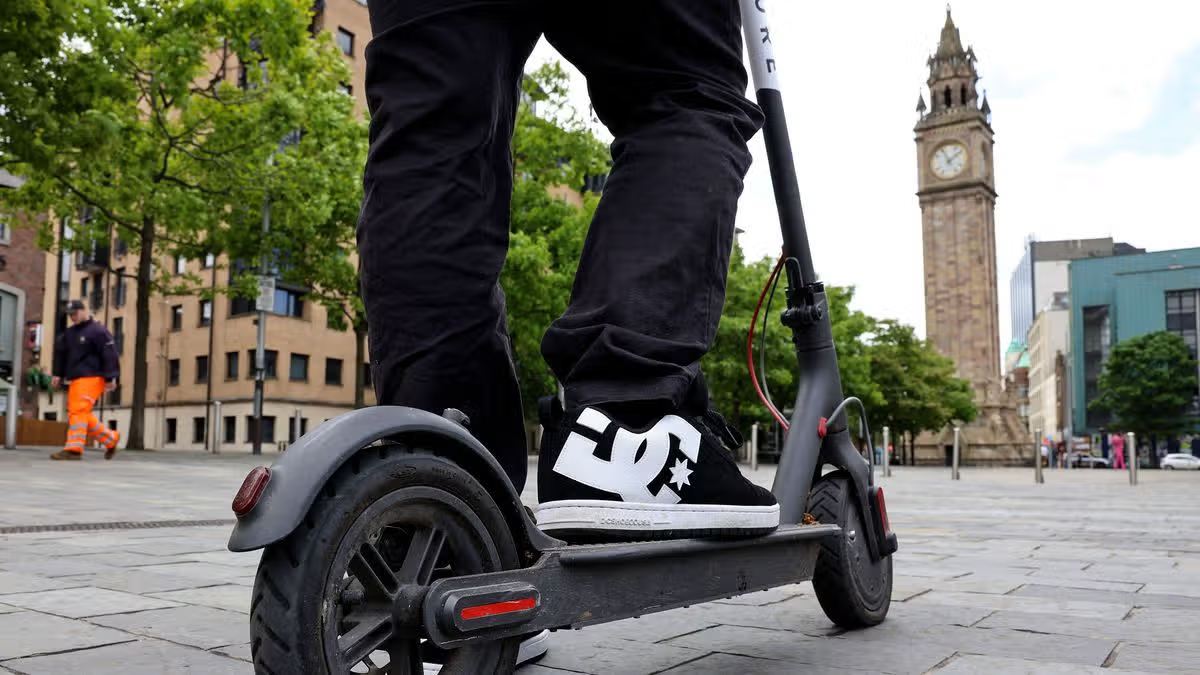
‘E-scooters and scramblers were a nuisance but are now a public safety crisis’

Published

on

Belfast Live

In an 18 month period 77 children under the age of 16 were treated at a Belfast hospital for e-scooter injuries

An MP is calling for urgent action on the illegal use of scramblers, e-bikes, and e-scooters stating what was once a nuisance has now escalated into a public safety crisis.

Advertisement

Sinn Féin MP Chris Hazzard has written to Justice Minister Naomi Long demanding urgent action on the illegal and anti-social use of such vehicles.

He was responding to the recent Children’s Health Ireland report which revealed that there have been 1,130 emergency department attendances linked to e-scooter injuries between January 2021 and August 2025, alongside a 50% rise in children admitted with traumatic brain injuries in the last year alone.

Locally, 77 children under the age of 16 were treated at the Royal Belfast Hospital for Sick Children over an 18-month period between June 2024 and January 2026. As well as this, 59 serious ambulance call-outs were recorded in relation to such injuries over two years.

The South Down MP said: “What started as a simple nuisance is now a critical public safety crisis, and it needs to be treated like one.

Advertisement

“I’m hearing it directly from people right across South Down – parents who won’t let their kids play outside, older residents afraid to walk their own streets, and communities feeling terrorised in their own neighbourhoods. That is completely unacceptable.

“We have laws that simply aren’t being enforced, and that enforcement gap has allowed the situation to spiral out of control. These high-powered machines are being driven recklessly through housing estates and public parks.

“In the worst cases, they are being used by gangs to intimidate residents, distribute drugs, and openly evade the police. Working-class communities, in particular, have borne the brunt of this.

“I have written to the Justice Minister demanding a dedicated joint taskforce between the Department of Justice, the PSNI, and local Policing and Community Safety Partnerships (PCSPs). Furthermore, I am calling for police officers to be given clear legal authority, specialised training, and modern technology – including drone support – to safely seize these vehicles and take them off our streets.

Advertisement

“Communities deserve to feel safe where they live, and no one should have to think twice before stepping onto a footpath.”

Under the current law, e-scooters and most other small off-road motorised vehicles should never be used on public land anywhere in Northern Ireland. This means they cannot legally be used on public roads, in public parks or on pavements.

It is legal to own, buy, or sell an e-scooter however, they can only be used on private land and only if the landowner gives their permission.

Other lightweight vehicles such as scrambler bikes and quad bikes are also restricted to off-road use on privately-owned land.

Advertisement

Police can issue cautions, fines, report users to the PPS, and confiscate e-scooters being used in public places.

For all the latest news, visit the Belfast Live homepage here and sign up to our daily newsletter here.

Source link

Advertisement
Continue Reading

NewsBeat

Man dies after becoming unwell after police called to incident in Grangemouth

Published

on

Daily Record

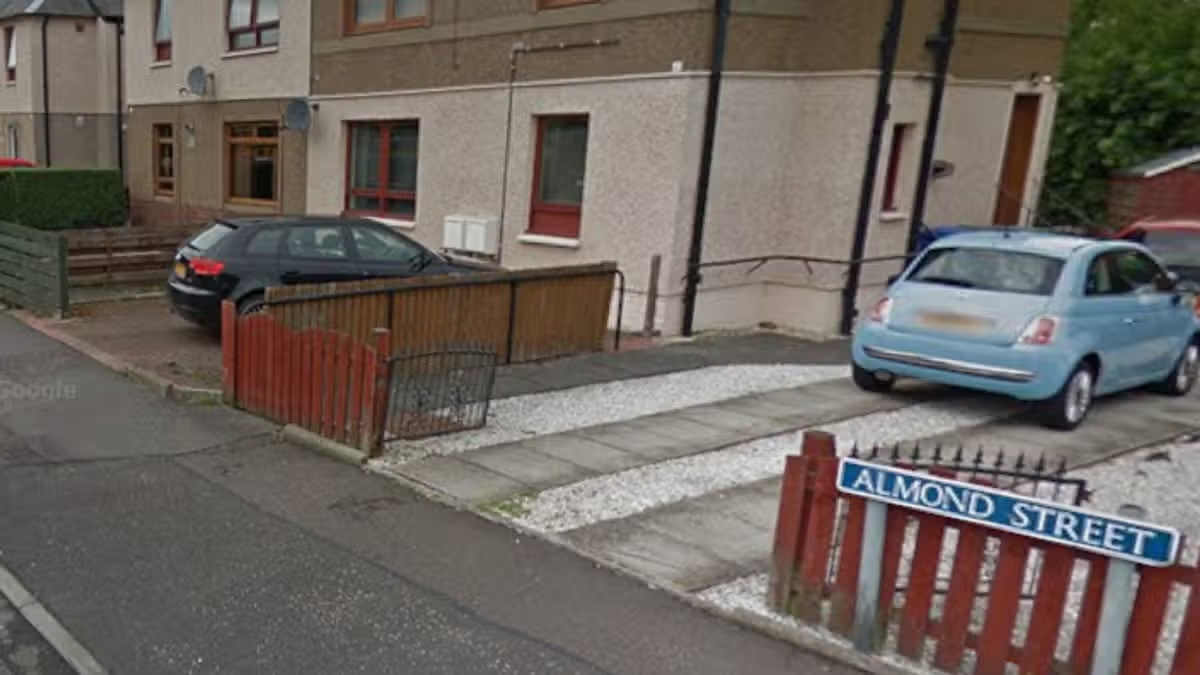
Emergency services were called to Almond Street after reports of concern for a man, who later died. A report will be submitted to the Procurator Fiscal.

A man has died after becoming unwell following an incident on a street in Grangemouth.

Advertisement

Emergency services were called to Almond Street at around 7.45pm on Thursday after reports of concern for a man.

Police Scotland said officers attended and engaged with the man before he became unwell.

He died a short time later.

The circumstances surrounding the death have not been disclosed.

Advertisement

A Police Scotland spokesperson said: “Police received reports of concern for a man in the Almond Street area of Grangemouth around 7.45pm on Thursday, 23 July, 2026.

“Officers attended and engaged with the man.

“The man subsequently became unwell, however died a short time later.

“A report will be submitted to the Procurator Fiscal.”

Advertisement

Get more Daily Record exclusives by signing up for free to Google’s preferred sources. Click HERE.

Source link

Continue Reading

NewsBeat

Lisa’s overwhelmed with fear in Coronation Street as Carla supports jailed Sarah | Soaps

Published

on

Lisa's overwhelmed with fear in Coronation Street as Carla supports jailed Sarah | Soaps
Lisa is less than thrilled about Carla’s new prison buddy. (Picture: ITV)

During every visit to Coronation Street, somebody has the worst week of their lives. This week, it’s Sarah Platt (Tina O’Brien), and next week’s not looking good for DS Lisa Connor-Swain (Vicky Myers), the woman who just arrested her for murder.

To think that Swarla were just getting back on track.

After Lisa was very nearly tricked into turning her back on her beloved Carla Connor-Swain (Alison King) by her bunny-boiling ex Becky Swain (Amy Cudden), the most shipped couple on the Cobbles finally got their happily ever after…

… then someone was bumped off on the day they got married.

Advertisement

Having the body of a murder victim turn up spitting distance away from your wedding venue does kill the vibe somewhat, even if the victim in question is domestic abuser and all round wrong’un, Theo Silverton (James Cartwright).

Ask Metro


Use AI to go deeper into the stories you care about – powered by Metro and trusted publications.

Advertisement

This kicked off a street-wide murder investigation which saw Lisa, with the aid of her less-than-upstanding fellow officer DC Kit Green (Jacob Roberts), haul six suspects in for questioning.

Coronation Street. Week 18. Eps 11844-11848. Sat 25th April-Fri 1st May 2026
Villainous Theo was killed during Carla and Lisa’s wedding. (Picture: ITV)

The investigation hit its fair share of dead ends, including the wrongful arrest of Summer Spellman (Harriet Bibby), not to mention Kit’s determination to put Gary Windass (Mikey North) behind bars for the crime – which we’re all sure has totally nothing to do with the fact that Gary was getting awfully cosy with Sarah Platt (Tina O’Brien).

Who is, by the way, the real murderer.

Whodunnit? She done it. (Picture: ITV)

That, as it turns out, explains all the hushed conversations between Gary and Sarah recently. Because she called him on the night of the murder, begging her bad-boy ex boyfriend to help dispose of the body.

Gary Windass hugging Sarah Platt in Coronation Street
Sarah killed Theo, and Gary helped her get away with it. (Picture: ITV)

But despite Kit’s best efforts to cover up Sarah’s involvement by trying to frame Gary, soap justice comes for us all and the Coronation Street legend was arrested by none other than Lisa herself.

Sarah Platt being arrested by DS Lisa Connor-Swain in Coronation Street
Lisa finally got her woman – Sarah. (Picture: ITV)

Which would all be fine and dandy, except Lisa’s head isn’t exactly a hundred percent on the job right now. And for good reason.

Lisa’s daughter, Betsy Swain (Sydney Martin) has recently suffered a major stroke that left her unable to speak clearly when it was revealed that she had experimented with consensual strangulation during sex with her boyfriend Dylan Wilson (Liam McCheyne). Furious, Lisa blamed Dylan for her little girl’s condition and reported him to the police.

Ryan Connor, Carla and Lisa Connor-Swain sat around Betsy Swain lying in a hospital bed
Lisa’s been devastated by what happened to Betsy. (Picture: ITV)

Needless to say, Lisa’s not in a forgiving mood right now.

We see this first hand in tonight’s episode of Coronation Street, when Sarah’s desperate insistence that she didn’t mean to kill Theo and didn’t involve Gary fall on deaf ears.

Advertisement

This is only reinforced later when Kit listens to a voicemail from Lisa, advising him to think very carefully about protecting Sarah. Gulp.

Given that Lisa’s family troubles seemed to have turned her into a slightly more scary Mancunian version of Judge Dredd, it’s probably not going to go down well when her wife decides to visit the woman she’s just sent down.

In next week’s trip to the Cobbles, Carla informs Lisa that she’s going to visit Sarah later, she’s not coping very well and her boy Harry is really struggling without her.  Lisa’s left troubled.

Will Lisa let Carla’s visit to Sarah go ahead?

Advertisement

Source link

Advertisement
Continue Reading

NewsBeat

Andy Burnham rules out snap election on first day as UK Prime Minister at Number 10 North

Published

on

Daily Record

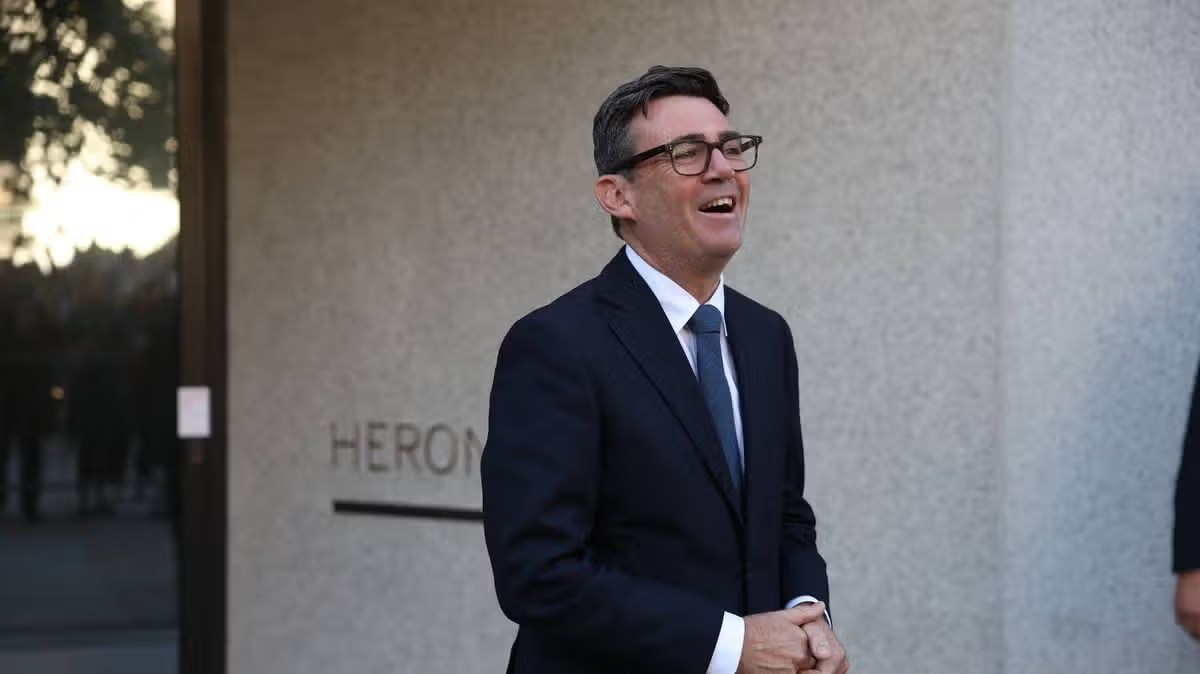
Andy Burnham has ruled out calling a snap election after becoming Britain’s seventh Prime Minister in a decade.

In an exclusive interview with the Manchester Evening News, Mr Burnham said he would stick to Labour’s 2024 manifesto. Holding a general election now, he added, would ‘postpone that essential work’.

He spoke after his first day at Number 10 North in Manchester city centre, and his first week as the leader of the UK.

The government HQ is at Heron House, in the same building as the intelligence agency GCHQ. Asked if he was going to call a general election, Mr Burnham said: “No I’m not. I don’t think that is right.

Advertisement

“We live in a parliamentary democracy. There was a manifesto in 2024. I’m sticking to that manifesto. I’m bringing forward my version but it is still within that manifesto. I just think that we need to focus on making the country work.

“That is the biggest priority right now. A general election would postpone that essential work. I’m also trying to do politics differently, as I did when I was mayor of Greater Manchester.”

Though he’s relishing his new role as PM, Mr Burnham says he misses being Greater Manchester mayor. Asked what he missed, he said: “All of it. All the elements of it, and you could probably tell that. It was lovely being back in the city today, I’ve not been back for a while. People were just great, as ever.”

After spending the day with colleagues at Heron House, Mr Burnham stepped outside for a moment to massive cheers. Waving to the crowd, he called out: “I love you Manchester!” before returning inside.

Mr Burnham is set on splitting his time between 10 Downing Street in London and its northern equivalent in Manchester. While some have said this will cost more, Mr Burnham insisted it will save money.

He added: “We all spend so much money going to London all the time, and that’s the way it’s always been. We all have to buy train tickets. We all have to go down to London. Now I can come and meet people from across the country in Manchester, it saves a lot of expense.

Advertisement

“Is it a gimmick? Well, the fact that I was there today with the Chancellor, the cabinet secretary, the First Secretary of State, the Transport Secretary – a large part of the government was there in Manchester with me today.

“And the fact of us being there, taking decisions there, just means that we’re rebalancing power in the country aren’t we? And the benefits that will fall to Manchester are massive. But it’s about No 10 North taking power out of Whitehall and putting it into all parts of the country. That’s its job.”

Mr Burnham said it was also about letting other areas of the country ‘go on the devolution journey that Manchester has been on’. The main priority of the northern HQ is to ‘rebalance power in Britain’, he said, adding: “People should not underestimate the scale of what we’re doing.”

Advertisement

After becoming leader, Mr Burnham said the days of Whitehall resisting devolution were ‘over for good’. “The good news is that the civil service is really strongly buying it,” added. “I think they realised that what we’ve been doing hasn’t been working as a country. We’re not where we should be.”

He said there was a ‘new generation of civil servants’ who believe power and investment need to be ‘fairly distributed’.

“Otherwise we end up where we are, which is a country that doesn’t feel contented,” he said. “People feel alienated, don’t they, frompolitics?”

The PM said voters felt decisions were made far from them and ‘they don’t think those decisions are made with the north inmind’.

Advertisement

He added: “I understand the cynicism, don’t get me wrong. I’m not going to say I don’t. But I hope to show people that it’s misplaced, that this brings some real benefits.”

Mr Burnham has made a series of policy announcements – mostly aimed at tackling the cost of living crisis – including capping bus fares; cutting business rates on pubs and music venues; and cutting VAT on domestic electricity bills.

Some, like the £2 bus fare, are costed. The detail around others is less clear. Mr Burnham said the scrapping of the digital ID scheme – estimated to be in the region of £1.8m over three years – would ‘help pay for new priorities’.

Mr Burnham has also pledged to end rough sleeping, which will cost £340m over five years. He vowed to eradicate it when he became mayor of the Greater Manchester. There were initially improvements, but data shows rough sleeping in the region is rising again.

How will he do something nationwide when he could not achieve that in the region?

“Well it’s a good question and a fair one,” he said. “And what I would say to that is, obviously, a Bed Every Night scheme still runs and rough sleeping is significantly down on where it was when I came in as mayor.

“But what I discovered was that we couldn’t do what I wanted to do when we were the only area doing what we were doing.”Mr Burnham also said that this meant people were travelling to Greater Manchester as it was the only region offering this support.

Advertisement

“All areas have to do it together,” he added. The Prime Minister also met with regional mayors at Heron House on Friday, telling them No 10 North was ‘at [their] service’ during a National Economic Council meeting.

Labour mayors Tracy Brabin and Steve Rotheram, as well as Reform UK’s Andrea Jenkyns were present.

After the meeting, Mr Rotheram told the Manchester Evening News all regional mayors at the table were ‘in union’, adding: “Over the next few weeks you’re going to get a better understanding of why we are so confident that this can deliver growth now.”

Asked for his response, Mr Burnham said: “Yeah, it was very positive. They felt that what we’re doing was the right thing and could actually help them do their jobs – that was very much the spirit of the meeting.

Advertisement

“The public would have found it refreshing if they could have sat there and heard it.”

A week is a lifetime in politics, as the old adage goes, and it certainly feels like a lifetime already for Mr Burnham.

“I love the job,” he insisted. He admitted the top role is ‘relentless in terms of the waves of things that come at you’.

Advertisement

He added: You can’t ever prepare for it because you can’t ever know what it’s like until you do it, but… I’m getting used to it very quickly because you have to. So I’m in at the deep end, but I’ve started swimming and I’ve enjoyed it so far.”

He said while the job is ‘challenging’ in many ways, making a difference to people’s lives was also ‘rewarding’. Next month, Mr Burnham will be doing a ‘listening tour’ of the UK to win over voters.

Asked about details, he said they had yet to be finalised, but it would include visiting all parts of the UK. Mr Burnham has twice bid for the Labour leadership – in 2010 and 2015 – and lost out.

Finally, this year, it was third time lucky for the new Makerfield MP. Does he feel it was worth the wait?

Advertisement

“It was worth it because I’m better now as a politician than I would have been,” he said. “Manchester made me. My time in Manchester… it gave me the ability to really find what I’m about and, you know, be confident in that and, you know, connect with people.

His time as mayor of Greater Manchester – from 2017 to 2026 – made him ‘stronger than I would have been,’ he said before adding: “It’s thanks to Manchester.”

Source link

Advertisement
Continue Reading

NewsBeat

A sweary boss might make you work harder (or want to quit)

Published

on

A sweary boss might make you work harder (or want to quit)

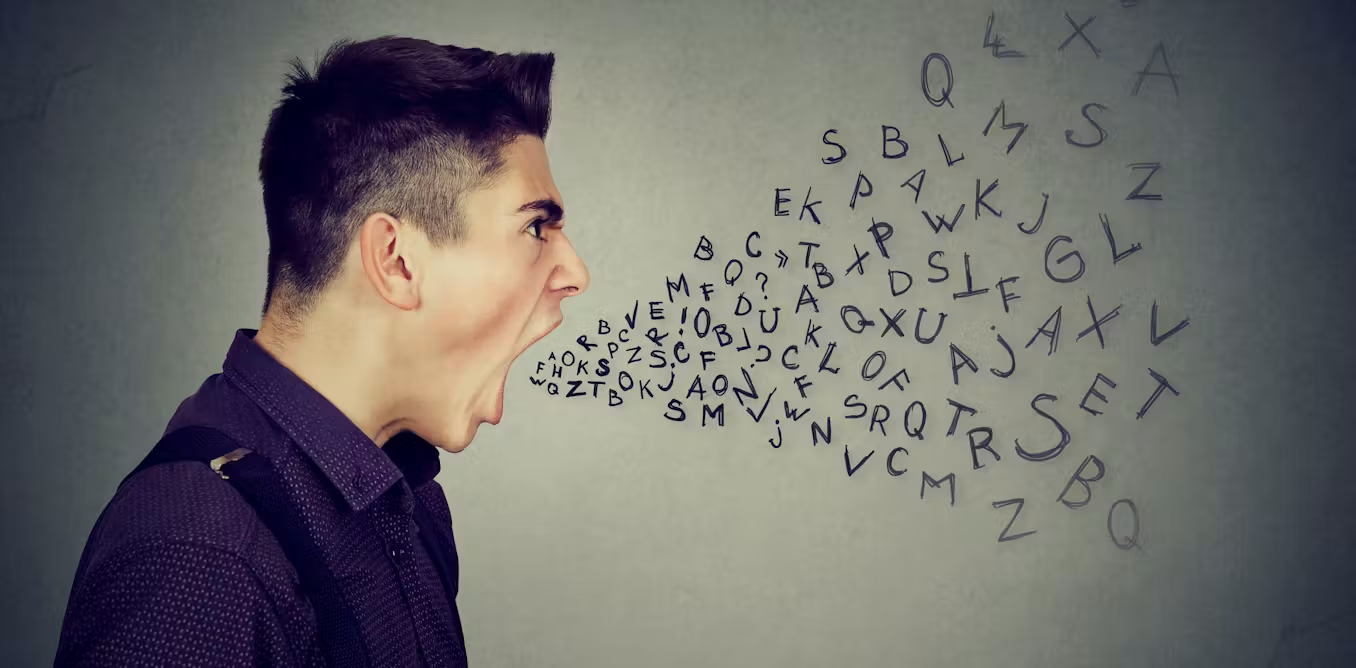
Some people love to swear. In the workplace, some of those people might be in charge.

You may have worked with one (or be one) yourself. The team leader who likes to pepper a pep talk with spicy language, or the manager who uses swear words to express themselves in the clearest possible terms.

How colleagues respond to colourful language varies. Some might enjoy it, while others are unbothered. It can also be considered a sign of poor leadership, unprofessional – and simply unnecessary.

Our research suggests people’s reactions to a sweary boss depend not only on what is being said, but also on who is listening and where they live.

Advertisement

We found that there is not a single “correct” way for leaders to communicate. But overall, employees were less satisfied with supervisors who frequently used profanity.

So if you’re wondering whether filling meetings with swear words is a good management strategy, it’s probably safer to avoid them.

But some people in our study of 5,660 employees in 19 countries reacted in exactly the opposite way. Those who considered themselves to have more psychopathic and machiavellian personality traits – so with lower levels of empathy – reported greater satisfaction with their leader as profanity increased.

Psychopathy and machiavellianism both involve a certain level of emotional detachment and a willingness to disregard social norms, including the norm that bosses shouldn’t swear. For these people, a boss who swears may come across as more genuine and confident, unconstrained by unnecessary rules.

Advertisement

Employees with stronger narcissistic traits (characterised by a sense of entitlement and a need for admiration) were surprisingly indifferent. Swearing neither impressed nor offended them very much. Their feelings of satisfaction towards their bosses barely changed.

But personality turned out to be only half of the story. The country people lived in also mattered. In societies with higher levels of income equality, such as Sweden and Austria, personality differences were more visible. This meant that the same manager using the same kind of bad language could be viewed as approachable by one employee and unprofessional by another.

In countries with lower levels of equality, however, such as South Africa and Mexico, these personality differences almost disappeared. Regardless of their individual characteristics, employees generally reacted negatively to leader profanity.

Swearing is caring

Why might this be? Research on economic inequality suggests that in more unequal societies, people become more attuned to status and rank. Workplace hierarchies carry greater weight, so a leader’s swearing is less likely to be read as friendliness or authenticity and more likely to be seen as a display of dominance. In these places, the social context appears to override individual personality differences.

Advertisement

Hryshchyshen Serhii/Shutterstock

The practical message for leaders is refreshingly simple. Communication is never just about the words we choose. The same sentence can inspire one employee, offend another and leave a third completely unmoved.

This also explains why leadership advice often sounds contradictory. One expert encourages leaders to “be authentic”. Another recommends maintaining professionalism at all times. In reality, both can be right, but this depends on the people involved and the cultural environment.

So, should leaders stop swearing altogether? Not necessarily. But they should recognise that effective leadership isn’t about finding one communication style that works for everyone.

It’s about understanding your audience. Knowing your team is just as important as choosing the right (or wrong) words.

Advertisement

Source link

Continue Reading

NewsBeat

What repeated blows to the head in sport may mean for dementia risk

Published

on

What repeated blows to the head in sport may mean for dementia risk

There is now widespread evidence that years of heading, tackling and collisions in football and rugby could increase the risk of dementia and other neurological diseases.

The latest – preliminary research presented at the Alzheimer’s Association International Conference in July 2026 – examined 142 former professional footballers aged 30 to 60, and 56 people of a similar age who had no history of contact sports or repeated head impacts.

The two groups performed similarly on objective cognitive tests, which measure abilities such as memory, attention and decision-making. The middle-aged retired footballers self-reported having worse mood, higher levels of anxiety and poorer cognition.

MRI brain scans were available for 124 of the former players and 40 non-players. On average, the footballers had less grey matter in several regions involved in memory, attention, decision-making and emotional regulation. Grey matter is brain tissue containing many of the nerve cells that process information.

Advertisement

These findings deserve attention, although they do not show that football caused the differences or that all players will develop dementia. The results are preliminary, have not yet undergone full peer review, and come from a study conducted at one point in time. Researchers will need to follow the participants for years to establish whether their symptoms or brain changes progress.


À lire aussi :
Sport-induced traumatic brain injury: families reveal the ‘hell’ of living with the condition


In 2020, I worked in a team which compared questionnaire responses from 468 retired male professional footballers with those from 619 men in the general population as controls. Of these, 326 of the former players and 395 of the controls also completed telephone-based cognitive dementia screening tests.

The former footballers were generally healthier, which could have protected them against dementia. Overall, they reported less diabetes, lower blood pressure and cholesterol, and less smoking and diagnosed depression – although they had experienced substantially more concussions and serious head injuries.

Advertisement

Average performance was similar on some cognitive tests. But on others, including tests of verbal fluency and everyday functioning, the former players scored less well. After differences such as age, education, hearing loss and health conditions were taken into account, former players had around twice the odds of falling below established dementia screening cut-offs on tests of verbal memory and verbal fluency.

A screening cut-off is a threshold used to identify people who may have cognitive difficulties. Falling below it does not confirm dementia, but indicates that further clinical assessment may be needed.

Former players were also more likely to report that a doctor had diagnosed dementia or another neurodegenerative disease, a condition involving the progressive damage or loss of nerve cells.

This study was cross-sectional: it captured participants at one point in time. It can show an association between a professional football career and poorer results on some measures, but cannot prove the cause.

Advertisement

Heading the ball is one possible contributor to the increased dementia risk. In a separate analysis of 459 retired footballers, those who recalled heading the ball more than 15 times during a typical match or training session had more than three times the adjusted odds of cognitive impairment, compared with those reporting five or fewer headers.


À lire aussi :
The ‘unsexy’, low-tech fix that will reduce brain injuries in sport


The finding should not be treated as proof that 15 headers are safe and 16 are dangerous. Players were estimating exposure from careers that had often ended decades earlier, and the study grouped their answers into broad categories. More precise, long-term measurement is needed, including following these retired players over time.

Large studies of former professional footballers in Scotland and Sweden substantiate our findings. Both found higher rates of dementia or other neurodegenerative diseases among outfield players, while goalkeepers did not show the same clear increase. Defenders, who generally head the ball more often, had the highest risk in the Scottish research. We found similar trends in our study.

Advertisement

Heading is only part of the picture. Footballers can also sustain concussion through head-to-head contact, falls and collisions with other players or goalposts. Concussion is a brain injury caused by a blow or force that disrupts brain function, but which does not necessarily lead to loss of consciousness.

In our study of retired professional footballers, concussion accompanied by memory loss was independently associated with greater odds of dementia risk.

Research on former elite rugby players has raised similar concerns about the long-term effects of repeated blows to the head. Separate research at Loughborough University used instrumented mouth-guards to measure head acceleration during matches and found that greater exposure was associated with more symptoms of low mood, anger, fatigue and anxiety in young elite players.

Advertisement

Mood symptoms require support in their own right, but depression or anxiety in a former player cannot be treated as evidence of brain damage. While both have been found to be risk factors for dementia, mid- and later-life depression has a complex relationship with dementia in later life. Long-term follow-up is needed to determine what the findings mean.

Current Football Association guidance for the professional game recommends no more than ten higher-force headers during a training week. These include headers from long passes, crosses, corners and free kicks.

FA concussion guidance also says that any player suspected of concussion should be removed immediately, should not return to playing that day, and should receive appropriate medical assessment. Recovery should involve a gradual return to normal activity and then football, guided by symptoms and professional advice.

Football brings substantial physical, social, health and psychological benefits. The evidence does not justify panic – but it does justify reducing avoidable head impacts, managing concussion properly, and monitoring players throughout and after their careers.

Advertisement

Source link

Continue Reading

NewsBeat

Commonwealth Games 2026: Gabriel Langton injury overshadows gymnastics silver

Published

on

Anti-doping test kit

A sickening injury to England’s Gabriel Langton overshadowed his team’s silver medal in the men’s team gymnastics final at the Commonwealth Games in Glasgow.

The 19-year-old, from the City of Birmingham Gymnastics Club, needed lengthy treatment on the mat after a horrible fall in the final rotation of the evening at The Arena.

Langton fell head first to the floor after missing his catch on the horizontal metal bar, three metres in the air, leading to a lengthy delay to the action as he was tended to by up to a dozen medical staff.

He was eventually led away on a trolley after being moved on to a stretcher with his head and neck braced and left to huge applause from the packed crowd who had spent much of the previous 10 minutes in hushed silence.

Advertisement

Langton was seen to be conscious and moving his legs and arms before leaving the arena floor, while team officials later said he was moving and speaking to doctors.

When competition resumed, his England team-mates were unable to overhaul their deficit to Canada who claimed their first gold medal in the event in 20 years, having finished second to England at the past two games.

Langton, a late call-up to Team England in the place of the injured six-time Olympic medallist Max Whitlock, was unable to join his teammates on the podium as England collected their silver medals.

Team-mate Luke Whitehouse, who was first on to the apparatus after the competition restarted and posted a relatively low score of 11.700, said: “When something like that happens, you’ve just got to forget about it and reset. I just had to focus on my routine one skill at a time.”

Advertisement

Whitehouse added: “From what we’ve heard, he’s doing OK. Gymnastics is such a dangerous sport and things like this remind us of that. It’s one of those things you have to put out of your mind.”

Felix Dolci, who helped Canada to gold and led qualifying for the all-around competition said: “It’s terrible but it goes to show that gymnastics is a very very difficult and complicated sport. It’s dangerous you know sometimes.

“All our thoughts go to Gabriel and the team. Pushing through this is definitely not easy, (England) stayed focussed, they stayed in the zone, a huge shout out to them because that’s not an easy one.

“For any gymnast that was on the field of play, seeing this not only is difficult, but something you never want to see. It goes to show how hard the sport is.”

Advertisement

Hamish Carter from Team Scotland – who narrowly missed out on a bronze medal to Australia in the final rotation – said: “I didn’t actually see what happened. I’m just so happy that he’s alright and, having experienced that, anything could have happened.

“We’ve walked away with no medal but I’m thinking of Gabe in this moment.”

Source link

Advertisement
Continue Reading

Trending

Copyright © 2025