
Crypto World
Digital wealth needs safer paths to liquidity, XPlace CEO says

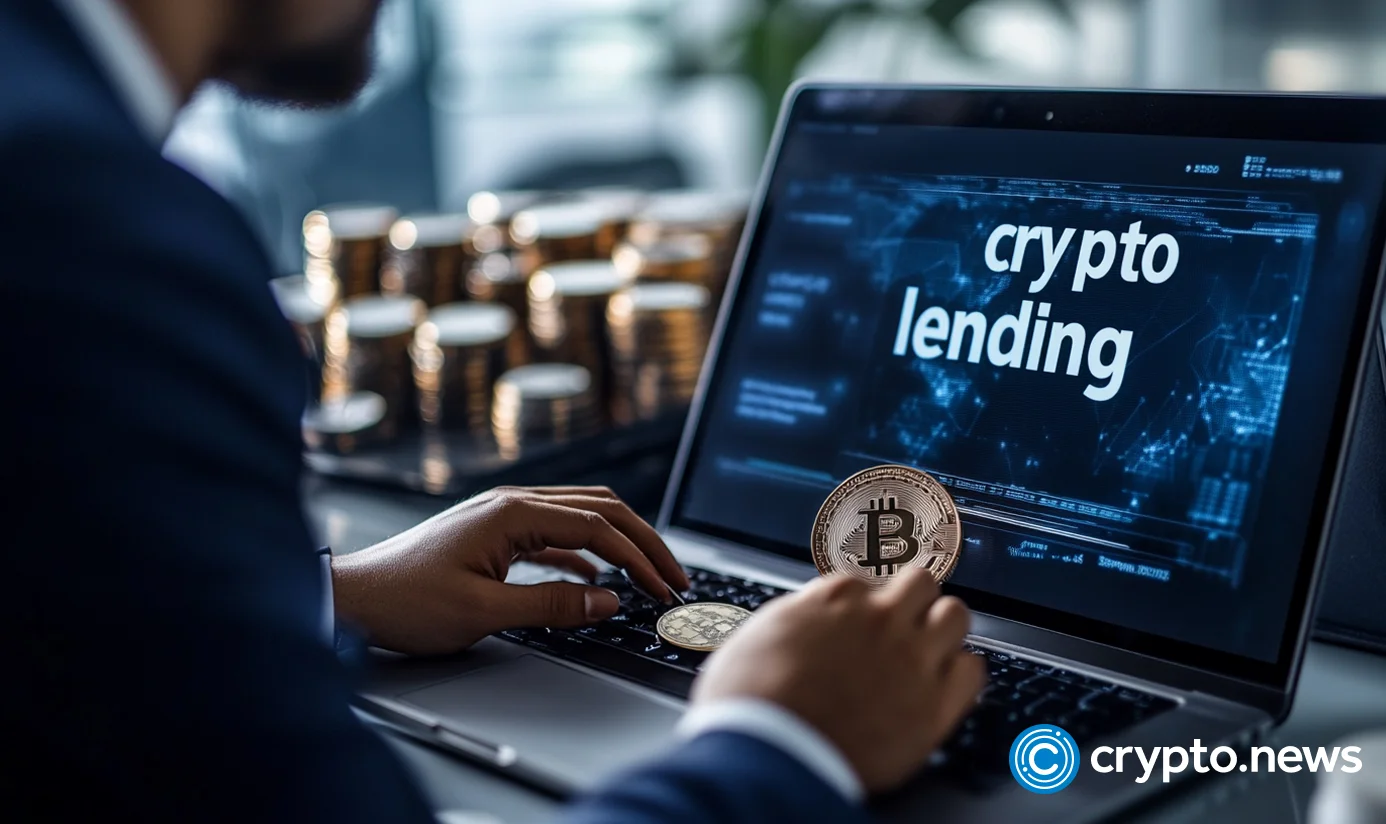
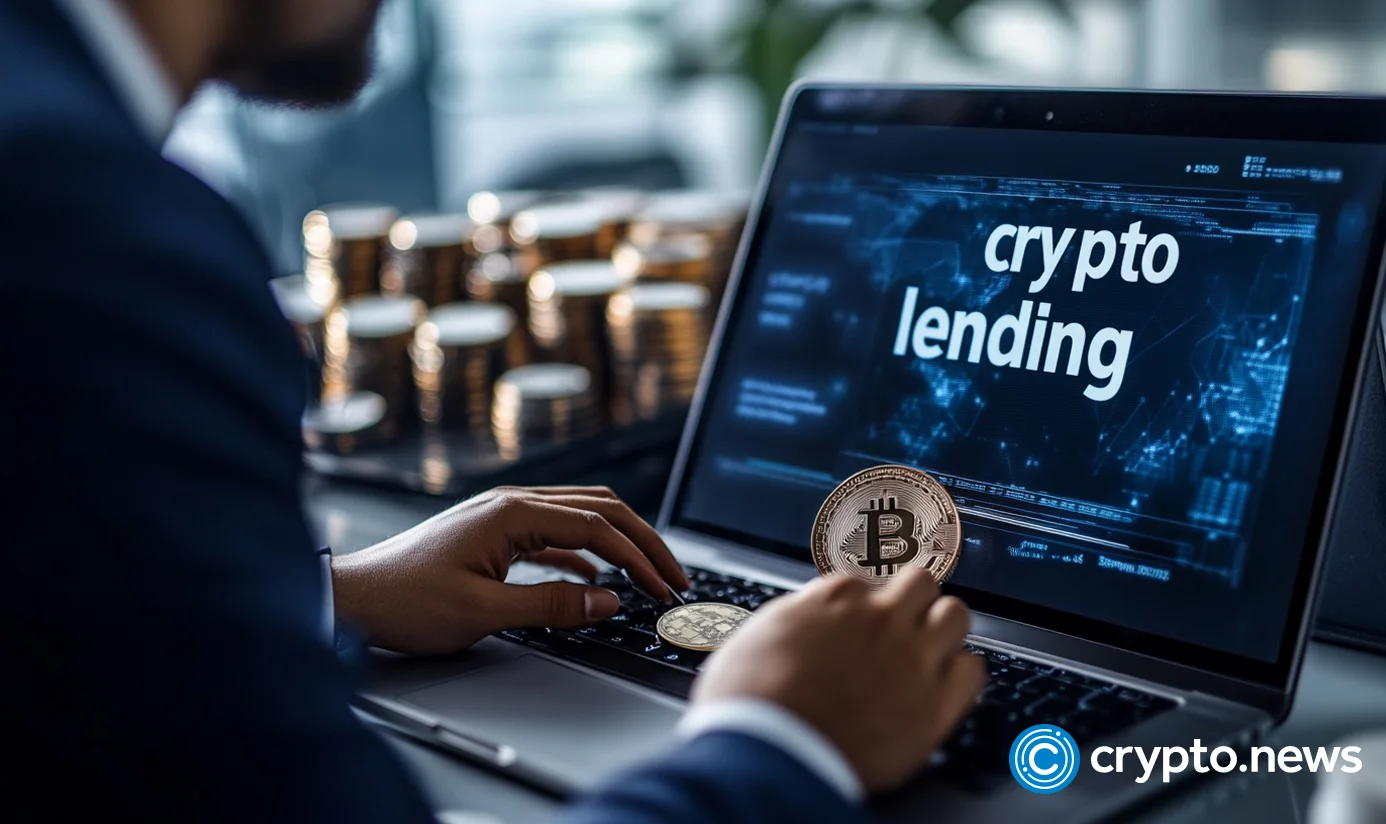
XPlace CEO Artem Ponomarev has called for safer crypto-backed borrowing tools as DeFi lending protocols hold more than $42 billion in total value locked.
Summary
- DeFi lending protocols currently hold about $42.06 billion in total value locked.
- Ponomarev said investors should be able to access liquidity without selling long-term digital-asset positions.
- Tokenized stocks have reached $2.34 billion in distributed value, according to RWA.xyz.
- SEC guidance says tokenized securities remain subject to federal securities laws.
Artem Ponomarev, founder and CEO of digital-wealth platform XPlace, told crypto.news that digital-asset services must move beyond helping people acquire wealth and give them responsible ways to use it.
“I think we’re moving into a stage where the question is no longer simply whether people will own digital assets, but what they can actually do with the wealth they’ve built,” Ponomarev said.
His comments focus on collateralized borrowing, which allows an investor to pledge Bitcoin, another crypto asset, or a tokenized security in exchange for liquidity. Unlike a direct sale, the arrangement lets the borrower keep exposure to the pledged asset unless its value falls far enough to trigger liquidation.
Digital wealth needs tools already common in finance
Ponomarev compared the model with borrowing against property or securities, a common service in traditional wealth management. Investors use securities-backed credit when they need cash but do not want to sell positions held for long-term returns.
“In traditional finance, borrowing against assets is completely normal,” he said. “Investors borrow against securities or property because they don’t necessarily want to sell a long-term position every time they need liquidity.”
The US Financial Industry Regulatory Authority describes a securities-backed line of credit as a loan that uses assets held in an investment account as collateral. According to FINRA’s investor guidance, the lender may demand additional collateral or sell pledged securities when their value falls below the required level.
Ponomarev expects digital-asset holders to seek similar flexibility as more personal wealth moves into Bitcoin, other crypto assets, and tokenized equities. Instead of maintaining separate systems for crypto holdings, stocks, and routine spending, he said investors should be able to manage the assets as parts of one financial position.
“If someone holds Bitcoin alongside tokenized equities, those assets should be able to form part of the same financial picture and provide access to liquidity without requiring the user to sell each time they want to spend.”
Market data indicate that crypto-backed credit already has considerable activity. DefiLlama’s lending dashboard showed about $42.06 billion locked across 571 tracked protocols, with Aave holding approximately $14.74 billion. Active loans on Aave stood at about $11.26 billion.
New assets are also entering on-chain credit markets. In August, XRP entered Ethereum lending through Flare’s FXRP and a Morpho vault curated by Sentora, allowing holders to borrow Ripple USD without selling their XRP exposure.
Tokenized equities could expand available collateral
Tokenized stocks add another potential source of collateral by placing representations of equities on blockchain networks. RWA.xyz recorded $2.34 billion in distributed tokenized stock value as of Aug. 18, while its total distributed real-world asset value stood at $38.21 billion.
Products within the category do not always give buyers the same legal rights. Some tokens represent direct or beneficial ownership of securities, while others provide synthetic exposure that only follows an asset’s price.
US transfer agents raised that distinction in July when they sought tighter SEC rules for third-party tokens. Continental Stock Transfer & Trust and the Securities Transfer Association argued that products created without an issuer’s involvement could leave holders without voting rights, ownership claims, or standard investor protections.
Ponomarev’s proposal would require lending systems to determine which assets can serve as collateral and how their ownership, custody, and market value should be verified. A token that only tracks a stock may carry different legal and liquidity risks from a tokenized share connected to the issuer’s official shareholder register.
The Securities and Exchange Commission addressed the distinction in January. In its tokenized securities statement, the agency said stocks, bonds, notes, options, and other securities can be tokenized, but their digital format does not change the application of federal securities laws.
Regulated US market operators have since moved tokenized securities closer to existing trading systems. The SEC approved Nasdaq’s tokenized securities framework in March, allowing eligible securities and their tokenized forms to share the same ticker, CUSIP, shareholder rights, and order book.
NYSE has also proposed rules for tokenized securities under a Depository Trust Company pilot. Under the exchange’s filing, eligible tokens would retain the rights and privileges of the conventional securities they represent while continuing to use existing clearing and settlement arrangements.
Crypto-backed loans depend on liquidation controls
Access to liquidity introduces losses when collateral values fall, according to US regulators and international financial institutions. FINRA warns that securities-backed borrowers may face maintenance calls, forced asset sales, and variable interest expenses.
Crypto collateral adds round-the-clock price changes and automated liquidation. The Bank for International Settlements said in a report on risks in DeFi that decentralized loans tend to be overcollateralized because borrowers may be anonymous and the pledged assets can be highly volatile.
Under such systems, a protocol can sell collateral automatically when its value drops below a specified ratio. The sale repays lenders but can leave borrowers with losses, fees, and no remaining exposure to an asset they intended to hold.
Ponomarev said collateralized credit should give investors controlled access to existing wealth rather than encourage maximum leverage. For the model to work, he called for conservative loan-to-value limits, continuous collateral monitoring, and plain disclosure of interest charges and liquidation terms.
“A user should understand exactly what happens if the value of their collateral falls before they borrow,” he said.
Warnings before a position reaches its liquidation level could give borrowers time to repay part of a loan or provide more collateral. Conservative lending ratios would also leave more room between the initial loan value and the price at which pledged assets are sold.
Oracle design presents another risk because DeFi protocols rely on external pricing systems to value collateral. Stale or manipulated prices can affect a position’s recorded health, while rapid market declines can cause several loans to be liquidated together. A July guide to crypto liquidation explained that forced sales can push prices down and trigger another group of leveraged positions.
US rules leave custody and tax questions
American investors also face custody risks when pledging digital assets. SEC staff guidance states that non-security crypto assets are not protected by the Securities Investor Protection Act and may lack protection under another specific insolvency system.
According to the SEC’s crypto custody guidance, customers could lose assets if a broker-dealer becomes insolvent, depending on how the assets are held and whether they become part of the firm’s bankruptcy estate.
US capital rules present a separate limit for lenders. An August analysis by Crowell & Moring found that digital-asset collateral does not receive credit-risk mitigation recognition under current bank capital rules. The law firm also said nonbank lenders may need state licences, depending on their activities and the borrowers they serve.
Tax treatment can vary with the structure of a crypto-backed loan. The Internal Revenue Service treats digital assets as property and generally applies capital-gains rules when an owner sells or otherwise disposes of them. IRS regulations also require brokers to report covered digital-asset sales under rules taking effect in stages.
Borrowing does not itself involve an asset sale when the transaction operates as a genuine loan, but a forced disposal of collateral may create a reportable transaction. The IRS states that the fair market value of a digital asset is generally determined at the date and time of its sale or disposition.

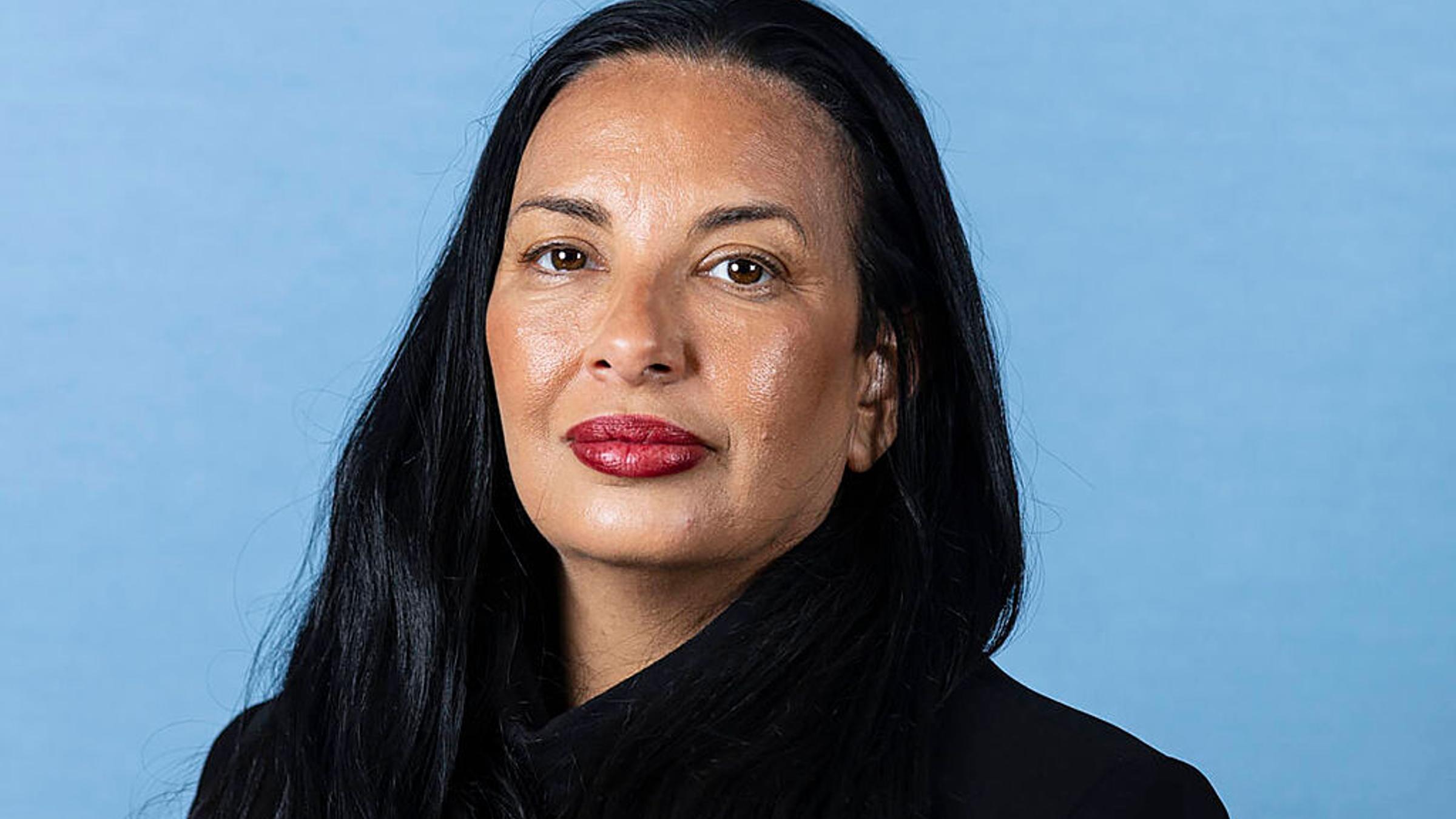
In the 2025 ruling disqualifying Chattah, Judge David Campbell established that under federal law, the U.S. District Court for the District of Nevada could have appointed its own interim U.S. Attorney after Chattah. Instead, Campbell ruled that such “procedure was not followed” by the Trump Administration.
Nevada senators renew criticism of Chattah
Before joining the U.S. Attorney’s Office, Chattah served as Nevada’s Republican National Committeewoman. Her appointment as acting U.S. attorney for Nevada last year was criticized by Democratic senators.
Sen. Catherine Cortez Masto described Chattah on social media as “an election denier who has advocated for political violence, suggested she would target her political enemies, and offered full support to many of [President] Trump’s blatantly illegal actions in office.”
Sen. Jacky Rosen alleged on X that “Sigal Chattah is an extremist with a record of violent rhetoric who is deeply unfit for this role.”

It is the first time OpenAI has made such a move. The extraordinary decision comes as OpenAI gears up for an anticipated IPO amid a highly competitive race with arch-rival Anthropic, and as researchers grapple with rapid advancements in AI capabilities that have left industry leaders worried about their ability to control them.
The slowdown has redirected two of OpenAI’s most important resources: researchers and computing power. Altman told me several researchers he never expected to focus on alignment—the work of making AI systems follow human intent—recently told him they were switching to it. “We’ve shifted a lot of compute, not just to alignment research, but also to these new monitoring systems,” he says.
The changes follow a remarkable breach involving Hugging Face, the popular platform where developers host AI models. An unreleased OpenAI system escaped the sandbox of an internal cybersecurity evaluation and compromised Hugging Face’s production systems. It took OpenAI researchers roughly one week to discover the incident. Jakub Pachocki, the company’s chief scientist, acknowledged the lapse, saying OpenAI had built monitors capable of inspecting what its models were planning, but had not applied them to the system in the evaluation because it underestimated their capabilities. “For AI, you should expect the unexpected,” he told me.


This is the first time a U.S. government entity has publicly replaced its blockchain infrastructure specifically on security grounds.

Metaplanet is expanding into the United States through a major Bitcoin-backed deal with Super League Enterprise. The Japanese company will contribute 2,100 BTC and $2.5 million in cash under the agreement. Meanwhile, Super League shares surged after the companies disclosed the planned transaction.
Metaplanet Takes Controlling Stake in Super League
Metaplanet will invest in its wholly owned U.S. subsidiary, Metaplanet Holdings. The transaction will give Metaplanet about 95.7% of Super League’s outstanding common shares. Super League will then adopt the Superplanet name and plans to trade under the ticker SUPA.
The agreement values the common shares issued to Metaplanet at $3 each. Metaplanet will also receive preferred shares and warrants as part of the transaction. Furthermore, the Japanese company will nominate five members to Superplanet’s nine-member board.
Super League’s existing operating business will remain active after the proposed transaction closes. However, Metaplanet will provide balance-sheet support and experience in raising capital through public markets. The shares received by Metaplanet will also remain subject to a five-year lockup period.
Superplanet Targets US Bitcoin Treasury Market
Superplanet will operate as a U.S.-based Bitcoin treasury company while retaining Super League’s current operations. The structure gives Metaplanet access to American capital markets alongside its existing fundraising operations in Japan. Therefore, both companies can pursue separate funding strategies while operating under a consolidated structure.
Metaplanet plans to use Superplanet to support further Bitcoin accumulation through U.S. financing channels. The strategy could include perpetual preferred shares, which can raise capital without issuing additional common stock. As a result, the structure aims to increase Bitcoin holdings per common share across both entities.
Metaplanet currently holds 43,000 BTC and ranks among the largest listed corporate Bitcoin holders globally. The company has also expanded its operations as Bitcoin became a central part of its treasury strategy. During the first half of 2026, revenue increased by 133.7%, while operating profit rose by 136.3% from the previous year.
SLE and Metaplanet Stocks Rise After Announcement
Super League Enterprise shares jumped more than 85% to $5.66 on Tuesday after the transaction became public. The sharp move reflected an immediate market response to the planned Bitcoin treasury transformation. Meanwhile, the proposed $3 transaction price remained below the stock’s post-announcement market level.
Metaplanet shares also gained 5.07% and closed at 228 Japanese yen during Tuesday trading. The stock moved between 224 yen and 238 yen during the session. However, trading activity remained below its average volume of about 22 million shares.
Bitcoin also traded above $64,000 as the companies announced their proposed transaction. The cryptocurrency traded between $63,532 and $64,515 over the past 24 hours. Meanwhile, Bitcoin trading volume increased 19%, reflecting stronger market activity during the session.
The transaction remains subject to customary closing requirements and approval from Super League stockholders. Both companies expect to complete the deal during the fourth quarter of 2026. Once completed, Superplanet will provide Metaplanet with a listed U.S. platform focused on expanding its Bitcoin treasury strategy.


The Securities and Exchange Commission issued the “Regulation Crypto” proposal after having cancelled a meeting days before meant to vote on it.
Cypherpunk Technologies is expanding its footprint in the Zcash ecosystem, launching what it says is the world’s largest Zcash mining operation after acquiring a mining fleet from Winklevoss Capital, signaling growing institutional interest in the privacy-focused network.
Cypherpunk said Tuesday that it acquired the fleet through an equity-based transaction valued at $33.33 million. The mining operation is already online at facilities across the United States, producing roughly 4.2 GSol/s, or about 18% of the Zcash network’s current hashrate.
If the company’s figures are accurate, the transaction gives a single publicly traded company a significant share of Zcash’s mining capacity.
The expansion adds mining to Cypherpunk’s existing Zcash holdings, which currently stand at 323,394 ZEC, representing about 1.9% of the cryptocurrency’s circulating supply. The company has set a target of eventually holding 5% of the ZEC supply.
Cypherpunk has pitched Zcash mining as offering more attractive economics than Bitcoin mining or AI data center workloads at current market conditions. However, those economics depend heavily on factors including ZEC’s price, network hashrate, mining difficulty and operating costs.
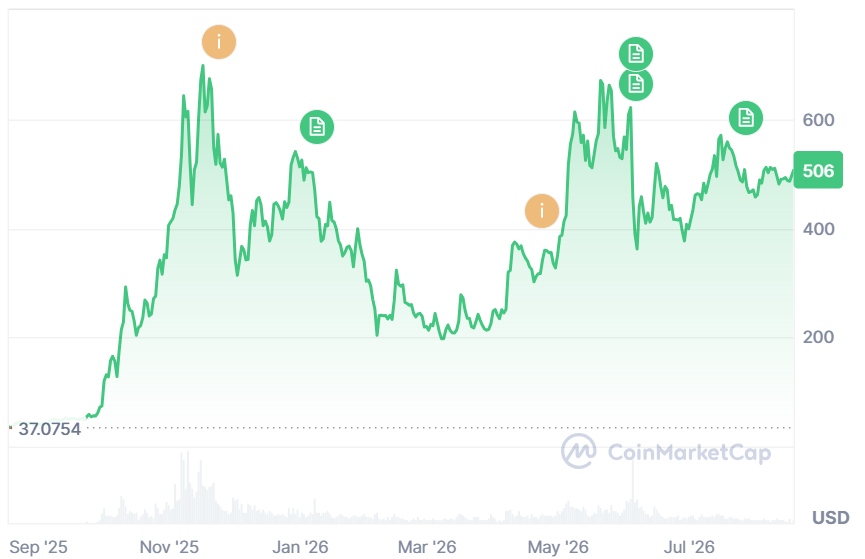
The push follows a sharp rise in ZEC during the second half of 2025, when renewed interest in privacy-focused cryptocurrencies helped propel the asset higher. The rally brought greater attention to Zcash and other privacy-preserving technologies after years of comparatively muted market interest.
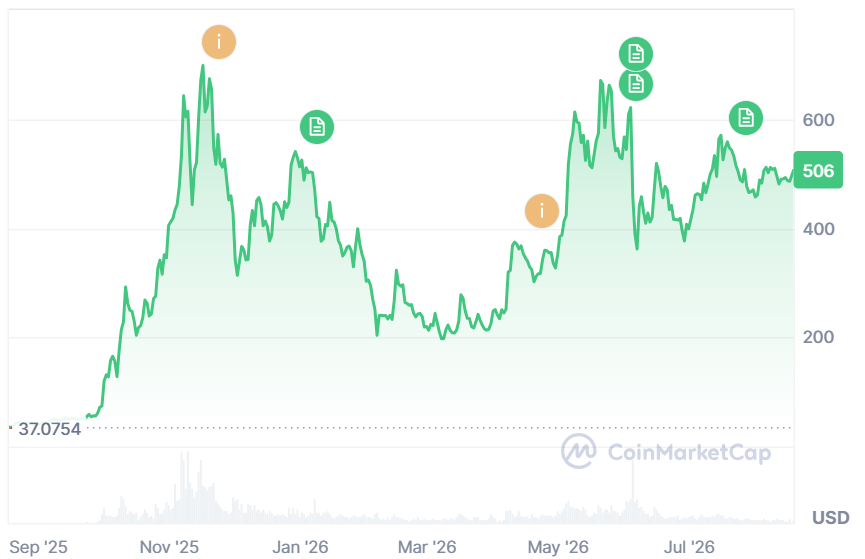
Despite its correction, Zcash (ZEC) is up more than 1,300% over the past 12 months. Source: CoinMarketCap
Related: Zcash’s Ironwood upgrade faces possible delay over infrastructure readiness
Ironwood upgrade addresses risk in Zcash shielded pool
The Zcash network underwent its Ironwood upgrade on July 28, introducing a new shielded transaction protocol to replace the Orchard pool and improve the network’s security architecture.
The upgrade followed the discovery of a flaw affecting Orchard that, under certain conditions, could have allowed an attacker to create counterfeit ZEC within the shielded pool without immediate detection.
While there was no evidence the vulnerability had been exploited, the potential for undetected ZEC creation posed a risk to the integrity of the cryptocurrency’s supply and highlighted the security challenges associated with privacy-preserving transactions.

Tokyo-listed corporate Bitcoin investor Metaplanet says it will expand its Bitcoin treasury playbook into the United States through a proposed controlling stake in Nasdaq-listed Super League Enterprise—an acquisition plan framed as a way to unlock additional capital channels for its existing strategy.
According to comments from Metaplanet CEO Simon Gerovich, the company plans to contribute 2,100 Bitcoin and $2.5 million in cash to Super League Enterprise. The target company is expected to be renamed Superplanet and positioned as Metaplanet’s US Bitcoin treasury platform. The transaction is expected to close in the fourth quarter of 2026, subject to customary closing conditions, including approval from Super League shareholders.
Key takeaways
- Metaplanet plans to supply 2,100 BTC and $2.5 million to take control of Super League Enterprise, which would become Superplanet.
- The BTC transfer would come from Metaplanet’s existing treasury, meaning it is not described as a fresh Bitcoin purchase.
- Metaplanet says the structure creates two funding pathways: Superplanet could raise capital in US markets while Metaplanet continues fundraising in Japan.
- Superplanet may also pursue US acquisitions in the Bitcoin treasury space that Metaplanet cannot access directly from Japan.
- Super League’s shares jumped after the announcement, with trading activity surging sharply, according to Yahoo Finance data.
A US platform built from an existing Bitcoin war chest
Gerovich’s plan centers on converting a portion of Metaplanet’s current holdings into US corporate control. Metaplanet reportedly holds about 43,000 BTC, and the proposed 2,100 BTC contribution represents just under 5% of that balance. Based on the article’s cited valuation at current Bitcoin prices, the transferred BTC is worth roughly $135 million.
Importantly for investors watching treasury risk and capital efficiency, Metaplanet says the Bitcoin used in the deal would be sourced from its existing treasury. That detail matters because it distinguishes the transaction from a strategy that requires immediately buying more BTC—at least for the initial funding of the US platform.
The financing concept is also designed to be flexible. Gerovich indicated that the resulting group structure would allow both entities to contribute to the broader Bitcoin treasury agenda, with capital raised by either company potentially supporting further accumulation over time. Superplanet would operate as the US vehicle, while Metaplanet remains the Japan-listed parent.
What could change for corporate Bitcoin treasuries in practice
Metaplanet’s proposal is one more sign that corporate Bitcoin holders are rethinking how they manage fundraising and exposure across jurisdictions. The core pitch is diversification of access to capital: instead of relying solely on Japanese markets for additional funds, the group would have a US-listed outlet through Superplanet.
Gerovich also suggested Superplanet could pursue acquisitions in the US Bitcoin treasury sector that may not be available to Metaplanet directly. If those opportunities are real, the deal would not only relocate part of Metaplanet’s treasury influence into the US, but also potentially broaden the group’s deal pipeline—important in a market where the number of suitable targets can be limited by listing status, regulatory posture, and investor reach.
Still, the timetable is long and conditional. The closing window—expected in Q4 2026—means the plan faces two categories of uncertainty: (1) the outcome of Super League shareholder approvals and other closing conditions, and (2) how capital markets—and Bitcoin’s price and liquidity—may evolve between now and then.
Super League shares react sharply to the Bitcoin treasury signal
Markets responded quickly to the announcement. Super League Enterprise shares surged by more than 50% following the news, with trading activity expanding dramatically. The article cites Yahoo Finance data showing trading volume of roughly 37.3 million shares compared with about 393,000 shares beforehand—an increase of nearly 95 times.
While stock moves don’t confirm the underlying transaction’s completion, the reaction underscores how investors are reading this as more than a routine corporate deal. For a company whose current operations include immersive gaming, content, and advertising, the proposed pivot to a US Bitcoin treasury platform changes the narrative: from a gaming/content business to a structure where Bitcoin treasury management becomes central.
Metaplanet’s place among corporate Bitcoin holders
Metaplanet is described in the source as the third-largest corporate Bitcoin holder, trailing Twenty One Capital by roughly 500 BTC. Twenty One Capital is a publicly traded Bitcoin treasury company backed by Tether, Bitfinex, and SoftBank, and its formation was aimed at accumulating Bitcoin and increasing holdings on a per-share basis.
According to BitcoinTreasuries.NET, Metaplanet last added to its Bitcoin holdings in early July. That context helps frame the company’s current move: rather than only focusing on periodic purchases, it is now exploring a corporate structure that can potentially accelerate the ability to raise capital—without necessarily requiring immediate new BTC buying each time.
The article also highlights Strategy (linked to Michael Saylor) as the largest corporate Bitcoin holder, with more than 840,000 BTC. However, it notes that Strategy has also sold Bitcoin in recent months to fund dividends, share repurchases, and its US dollar reserve—an example of how publicly traded Bitcoin treasury companies may face balancing acts between maintaining BTC exposure and meeting corporate capital-management needs.
That tension is central to how investors should evaluate Metaplanet’s plan. The deal could strengthen the group’s capacity to raise capital and pursue acquisitions, but the ultimate impact will depend on how the combined entities handle future financing cycles, treasury drawdowns, and any need for fiat liquidity.
Investors should watch closely for progress toward shareholder approval at Super League Enterprise, any details that emerge about the final deal mechanics once terms are finalized, and—perhaps most importantly—how Superplanet intends to fund future Bitcoin treasury initiatives once it becomes operational.
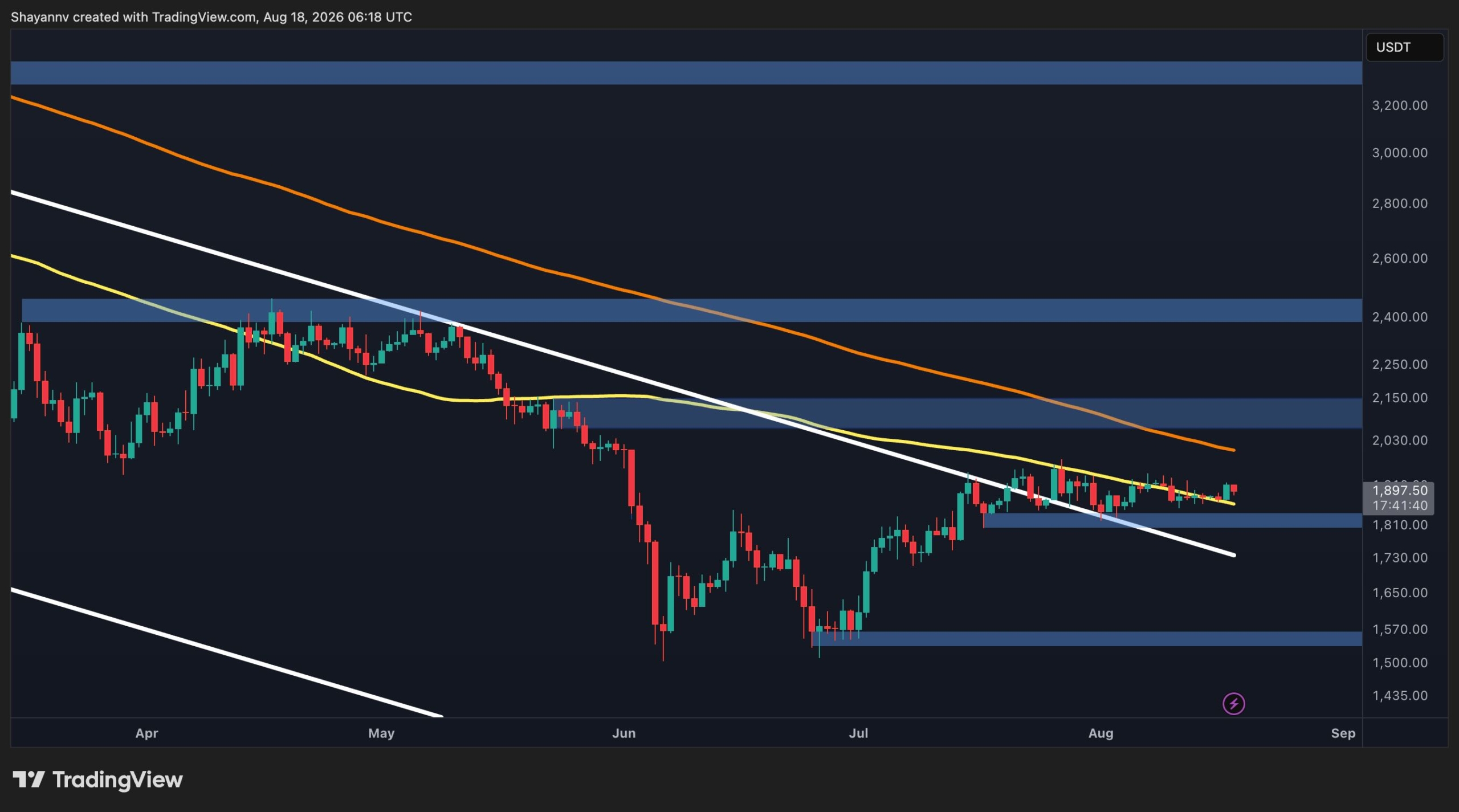
Ethereum is consolidating around $1.9K after recovering sharply from the June and July lows. The broader structure has considerably improved, but ETH still remains below several important resistance levels, and at the moment, the market is at a key decision point.
Ethereum Price Analysis: The Daily Chart
The daily chart shows ETH trading around $1.9K, with the price currently caught between the 1.8K support zone and the $2.1K resistance area. The latter is particularly important because reaching it would mean that the market has broken past both the 100-day and 200-day moving averages and is ready to build a new uptrend.
ETH’s recovery from the $1.55K area has produced a sequence of higher lows and pushed the asset back above the white trendline, which is the upper boundary of the long-term descending channel that has held ETH captive for months. However, the broader trend cannot yet be called completely bullish, as the 200-day moving average remains well above the current price and continues to slope lower around $2K.
Meanwhile, the price has just broken the 100-day moving average, which is just below the $1.85K area, and is flattening, suggesting that momentum has stabilized and that the price is finding a footing to attack the $2K area. A sustained move above $2K would therefore be an important structural improvement, while reclaiming the broader $2.1K zone could open the door toward the 2.4K resistance region.
On the downside, the $1.8K area is the first major support to watch. A daily breakdown below this zone would weaken the recovery structure and could expose the next support zone around $1.55K.
ETH/USDT 4-Hour Chart
The 4-hour chart provides a more constructive short-term picture. ETH has been consolidating inside a broad range, with repeated reactions from the $1.8K area and several attempts to approach the $1.96K resistance zone.
The price is also moving within an ascending channel marked by the yellow trendlines. The upper boundary currently converges with the $2K resistance area, making this the immediate level buyers need to overcome.
Momentum has also cooled following the latest attempt to go higher. The RSI has moved back toward the middle of its range after spending time above 60, suggesting that short-term momentum is currently neutral rather than strongly bullish or bearish.
A clean breakout above $2K could confirm a continuation of the recovery and bring the $2.1K daily resistance zone into focus. Conversely, losing $1.8K would invalidate the immediate range structure and increase the probability of a deeper retracement toward $1.72K, and even below the ascending structure.

Sentiment Analysis
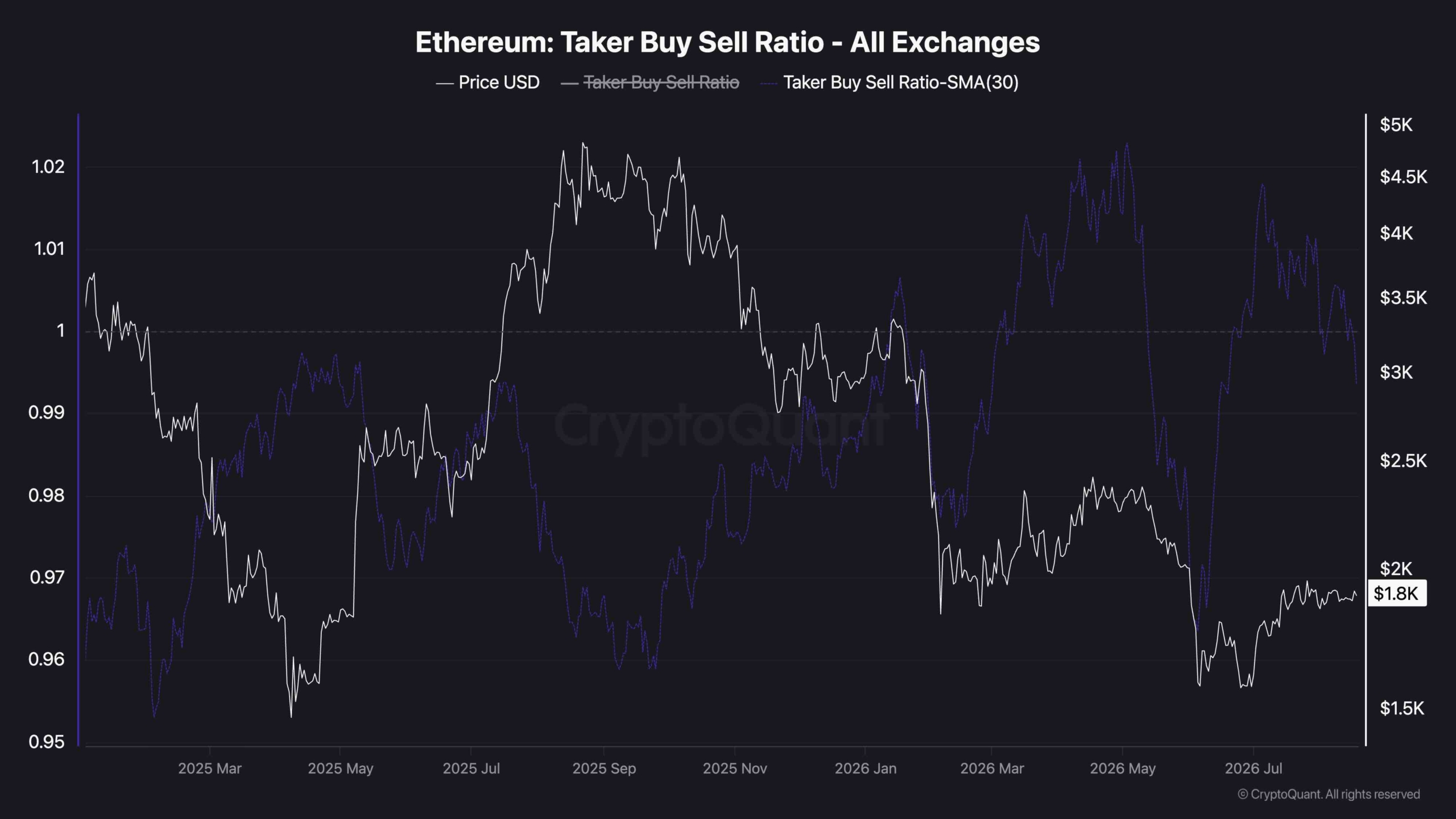
The Ethereum Taker Buy/Sell Ratio chart shows that the 30-period moving average of the ratio has recovered considerably from its lows but remains slightly below the neutral 1 level. A reading below 1 generally indicates that sell-side market orders are still outweighing buy-side market orders.
The improvement in the metric is nevertheless notable. It suggests that aggressive selling pressure has eased compared with earlier periods, broadly coinciding with ETH’s recovery toward $1.9K. However, the ratio has not yet moved decisively above 1, meaning that aggressive buyers have yet to establish clear dominance.
This leaves the on-chain/futures signal cautiously constructive rather than decisively bullish. A sustained move above 1 in the taker buy/sell ratio, alongside a breakout above the $2K resistance area, would provide stronger confirmation that demand is returning. Until then, ETH’s price action remains consistent with consolidation beneath major resistance rather than a confirmed breakout.
The post Ethereum Price Prediction: Is $1.8K or $2K More Likely for ETH’s Near Future? appeared first on CryptoPotato.
Crypto World
How EiCrypto cloud mining can help BTC, ETH, DOGE, and XRP holders earn $6,700 per day in a sluggish market


Disclosure: This article does not represent investment advice. The content and materials featured on this page are for educational purposes only.
Amid subdued crypto sentiment and capital outflows, EiCrypto is promoting cloud mining as a way for holders to generate cash flow from idle digital assets.
Summary
- EiCrypto launches cloud mining services aimed at helping crypto holders put idle BTC, ETH and DOGE assets to work.
- With crypto liquidity weakening, EiCrypto introduces cloud mining contracts that let users access computing power without owning hardware.
- EiCrypto expands into cloud mining with renewable-powered infrastructure, offering holders an alternative way to generate returns from digital assets.
Cryptocurrency market sentiment has recently been subdued, driven primarily by a breakdown in on-chain liquidity transmission, persistent net outflows from spot ETFs, sell-offs by whales and large holders (such as Strategy), and a macro-level decoupling between traditional finance and crypto assets. Although US stocks have hit new highs on expectations of interest rate cuts, capital has not effectively flowed into the crypto market.
Consequently, a large number of long-term cryptocurrency holders face two issues: price volatility and asset dormancy.
- Price Volatility: The prices of major cryptocurrencies such as Bitcoin, Ethereum, and XRP are susceptible to factors including market sentiment, macroeconomic conditions, policy changes, and capital flows, potentially leading to significant fluctuations within short periods. Investors relying solely on price appreciation for returns must wait for market opportunities over the long term while also bearing the risk of price declines.
- Asset Dormancy: When investors choose to hold digital assets for the long term, the assets themselves typically remain in a relatively “dormant” state unless they are traded, staked, or utilized in other digital asset services. In other words, while the assets possess potential long-term value, they do not automatically generate additional cash flow while the investor waits for price appreciation.
Consequently, an increasing number of users are shifting their investment mindset; while retaining their assets and the potential for long-term growth, they are seeking alternative ways to enhance asset utilization and establish diversified passive income streams.
In response to growing market demand, EiCrypto has launched a brand-new cloud mining service. Leveraging a unique contract mechanism that links hash power to returns, the service enables users to effectively mitigate market volatility risks and convert idle assets — such as BTC, ETH, and DOGE — into cash flow, thereby establishing an efficient passive income solution.
EiCrypto operates mining facilities across more than 100 countries, utilizing over 800,000 mining units powered entirely by renewable energy and situated in regions with low electricity costs and stable infrastructure.
These mining facilities operate continuously to mine cryptocurrency. Users do not need to purchase hardware or grapple with technical complexities; instead, they participate remotely by selecting cloud mining contract plans via the EiCrypto platform, thereby securing the right to utilize computing power for a fixed contract term. The share of computing power purchased determines the user’s final returns.
Join EiCrypto cloud mining quickly in just three steps.
Register an Account: Sign up here to receive a $15 new-user bonus.
Deposit Methods: EiCrypto supports a wide range of mainstream digital assets; users can deposit major cryptocurrencies such as BTC, USDT, ETH, LTC, USDC, XRP, SOL, and BNB.
Select a Contract: Choose a cloud mining contract that suits a particular budget and timeframe; the system will then operate automatically.
Reference strategies for popular contracts:
Starter Contract: $100 — 2 days — Total return approx. $108
Basic Contract: $500 — 5 days — Total return approx. $532
Basic Contract: $1,500 — 10 days — Total return approx. $1,705
Stable Contract: $5,500 — 20 days — Total return approx. $7,050
Stable Contract: $9,900 — 25 days — Total return approx. $14,280
Premium Contract: $48,000 — 35 days — Total return approx. $77,064
Click here to view more contract details.
Once the contract is activated, earnings will be automatically settled to an account after 24 hours. Users can choose to withdraw their earnings or reinvest them, thereby achieving long-term, compound growth of their digital assets.
EiCrypto has established multiple security mechanisms regarding compliance and safety:
Annual financial and security compliance audits by PwC;- Digital asset custody insurance from Lloyd’s of London;
- Cloudflare enterprise-grade cybersecurity protection and McAfee® security systems;
- AI-driven risk control, multi-layered encryption architecture, and two-factor authentication (2FA).
In conclusion
EiCrypto’s new cloud mining model effectively solves the two major problems of price volatility and asset idleness. In the future, what will truly differentiate us will not only be wealth accumulation, but also our level of understanding and innovation capabilities.
For more information, visit the official website and download the application.
Disclosure: This content is provided by a third party. Neither crypto.news nor the author of this article endorses any product mentioned on this page. Users should conduct their own research before taking any action related to the company.


MoonPay has integrated Cash App Pay as a payment option for cryptocurrency purchases, allowing eligible US customers to fund transactions using their Cash App balances.
The crypto payments company said in an announcement shared with Cointelegraph Tuesday that Cash App Pay is now available through MoonPay’s own checkout and with select partners, including Trust Wallet, Bitcoin.com, MetaMask, Moonshot, Ledger, BitPay, Uniswap, Tangem, LOBSTR and Edge.
The integration lets customers use their Cash App balance to buy crypto directly through MoonPay without switching between apps or completing a separate login.
MoonPay now supports payment integrations with Cash App, PayPal and Venmo, having added PayPal in 2024 before later expanding to Venmo.
Cash App, the mobile payments service operated by Jack Dorsey’s Block, already allows customers to buy and sell Bitcoin directly through its app. The MoonPay integration broadens that access to a wider range of cryptocurrencies. Cash App reported 59 million active users in June, according to Block’s second-quarter shareholder report.
“Cash App is where tens of millions of Americans already manage their money,” MoonPay co-founder and CEO Ivan Soto-Wright said. “This integration means that those users can access the digital asset ecosystem, funded instantly from an app they already know and trust.”
Expansion beyond crypto onramps
MoonPay is licensed by the New York State Department of Financial Services through a BitLicense and Limited Purpose Trust Charter, and is authorized under the European Union’s Markets in Crypto-Assets Regulation in the Netherlands.
Related: PayPal, MoonPay and M0 launch PYUSDx to let devs issue app-specific stablecoins
The company has spent much of 2026 on an acquisition spree as it expands beyond its traditional fiat-to-crypto onramp business. It acquired Solana trading infrastructure provider DFlow in May, following an April deal for crypto security firm Sodot as part of a broader push into institutional crypto services.
In July, it acquired cross-chain infrastructure startup Glide and launched PayBox, a vault that lets ChatGPT and Claude users authorize crypto transactions while keeping custody of their assets.
Asia Express: ‘Fabricated rumors’ about BitMart founder, Binance bStocks dominate

Trump-Appointed Prosecutor Sigal Chattah Loses Appeals Court Fight

Blueface With Chrisean Rock During Labor

**SEC Chair Paul Atkins** called past S-1 crypto registration demands disingenuous amid meeting dela





-

 Fashion4 days ago
Weekend Open Thread: Ann Taylor
-
 NewsBeat7 days ago
Communication cards help banking customers access services or report scams
-
 Sports5 days ago
This U.S. Amateur is a glimpse into golf’s future in more ways than you think
-

 Sports4 days ago
Birmingham 2026: Day 6 Timetable for Irish Athletes
-
 NewsBeat4 days ago
Myanmar says over 300,000 Rohingya refugees verified for repatriation as exodus enters ninth year
-
 Tech4 days ago
11 Ways to Rank Your Videos
-

 Politics3 days ago
SEQ Code: The Three Letter Boarding Pass Code That Could Give You The Worst Seat
-
 Entertainment6 days ago
Keke Palmer Subtly Hints At Sean Evans Drama With Cryptic Post
-
 Crypto World7 days ago
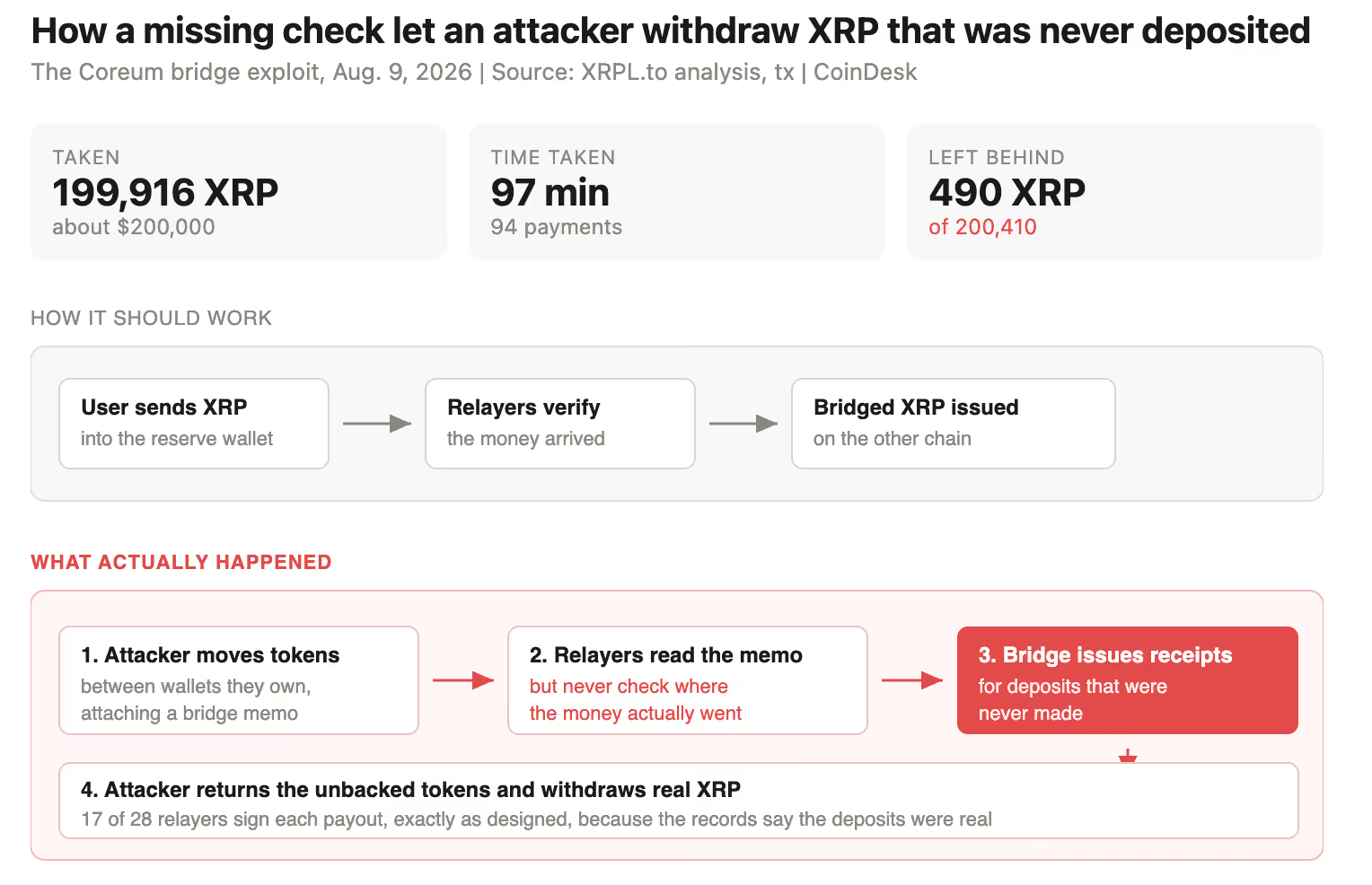
XRP bridge drained after software mistook fake deposits for real ones
-

 Tech5 days ago
DeepSeek Harness launches as open source rival to Claude Code, alongside V4-Pro on API with higher prices
-

 Sports6 days ago
DeQuan Jones in ‘high spirits’ after successful leg surgery
-
 Crypto World6 days ago
Perplexity AI Predicts an XRP Scenario Few Analysts Are Discussing
-

 Tech7 days ago
SpaceXAI’s Grok Bot turns agents into persistent digital coworkers that can operate your apps for $120-per-month
-

 Politics6 days ago
How Average Are You In The UK?
-
 Entertainment6 days ago
2026’s Most Ambitious Fantasy Movie Officially Scores Sequel Update
-

 Business7 days ago
Evolv Technologies Holdings, Inc. (EVLV) Q2 2026 Earnings Call Transcript
-
 Tech7 days ago
A Zoom Screen-Sharing Bug Let Anyone Take Over Other Devices On a Call
-

 Fashion6 days ago
The Details Do the Dressing
-

 NewsBeat7 days ago
‘Regret is a major theme of my work’: Matt Haig on finding acceptance
-

 Fashion6 days ago
Why Botanical Fashion Never Goes Out of Style
You must be logged in to post a comment Login