

Crypto World
DOJ Seeks Forfeiture of $25M in Crypto Tied to Global Scam Networks



The US Department of Justice (DOJ) has filed five civil forfeiture complaints seeking more than $25 million in crypto allegedly tied to international investment, romance and recovery scams targeting victims in Canada and the United States.
On Tuesday, the US Attorney’s Office for the District of Columbia and the US Secret Service’s Washington Field Office said that the assets were recovered through separate investigations by the Cyber Fraud Task Force. Investigators identified several laundering networks and confirmed thousands of victims worldwide who were misled into believing they were making legitimate digital asset investments.
The action highlights the growing scale of crypto-enabled romance and investment scams, which often combine social engineering with fraudulent trading platforms and layered wallet transfers to conceal stolen funds.
The largest complaint seeks about $12.1 million linked to romance schemes that defrauded more than 200 victims, with proceeds routed through intermediary addresses and commingled with other victim funds. Another seeks $10.4 million traced to more than 270 suspected victim transactions, while three smaller cases involved fake investment accounts and a secondary scam offering to recover previously stolen funds.
The DOJ said the launderers were predominantly located in Southeast Asia, with related IP addresses in China, Malaysia and Cambodia.
Crypto romance scams face global enforcement push
The complaints follow a recent Interpol-coordinated operation targeting social engineering scams and financial networks used to launder their proceeds. Operation First Light 2026 involved 97 countries and territories, resulted in 5,811 arrests and the interception of $283 million in illicit assets. Interpol said the operation identified more than 142,000 victims and blocked more than 31,000 bank accounts.
As part of the operation, Thai authorities uncovered a network that allegedly converted romance-scam proceeds into crypto and used cross-chain token swaps to obscure the trail. A wallet associated with one suspected money launderer processed more than $122.5 million in crypto over 10 months.
Related: DOJ moves to dismiss charges against alleged $722M BitClub fraudster: Report
US authorities have also pursued crypto assets linked to similar schemes. In February, federal agents seized over $61 million in USDT stablecoin from addresses allegedly used to launder proceeds from fraudulent investment platforms.
Investigators said scammers first gained trust through romantic relationships, then directed them to fake trading platforms before moving their money through multiple wallets.
Magazine: Inside the ‘fake police raid’ that forced a $1M Bitcoin transfer

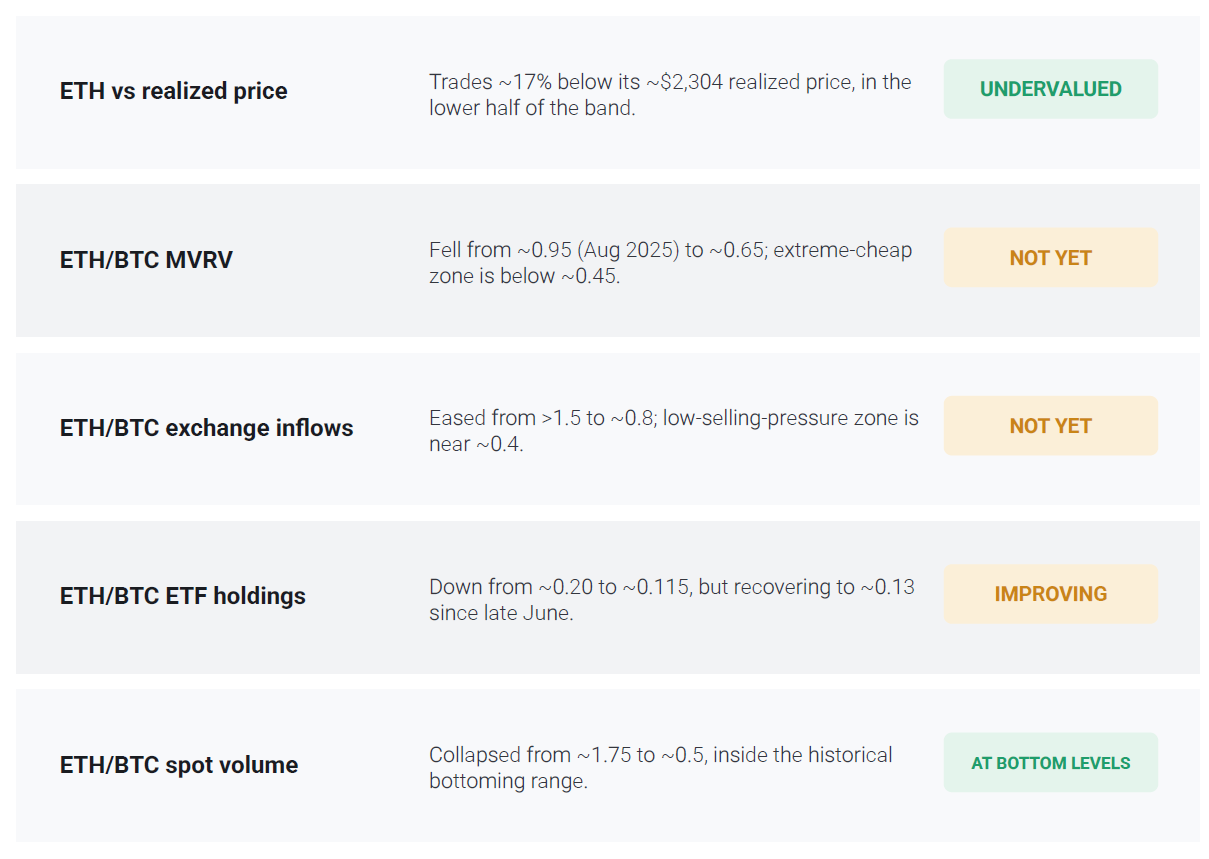
Ether is becoming increasingly attractive from a valuation standpoint, particularly relative to Bitcoin, but onchain data suggests the market has yet to reach a definitive cycle bottom, according to CryptoQuant.
In its latest weekly report, the analytics company said Ether (ETH) is trading roughly 17% below its realized price, or the average onchain acquisition cost of all ETH in circulation, of about $2,300. Historically, ETH trading below its realized price has coincided with periods of market undervaluation and long-term bottoms.
Ether is also showing signs of improving relative to Bitcoin (BTC). CryptoQuant said that ETH’s market value-to-realized value (MVRV) ratio has retreated from extreme overvaluation, exchange inflows have declined, exchange-traded fund (ETF) holdings have begun to recover after months of weakness, and ETH/BTC spot trading volumes have fallen into a range historically associated with market bottoms.
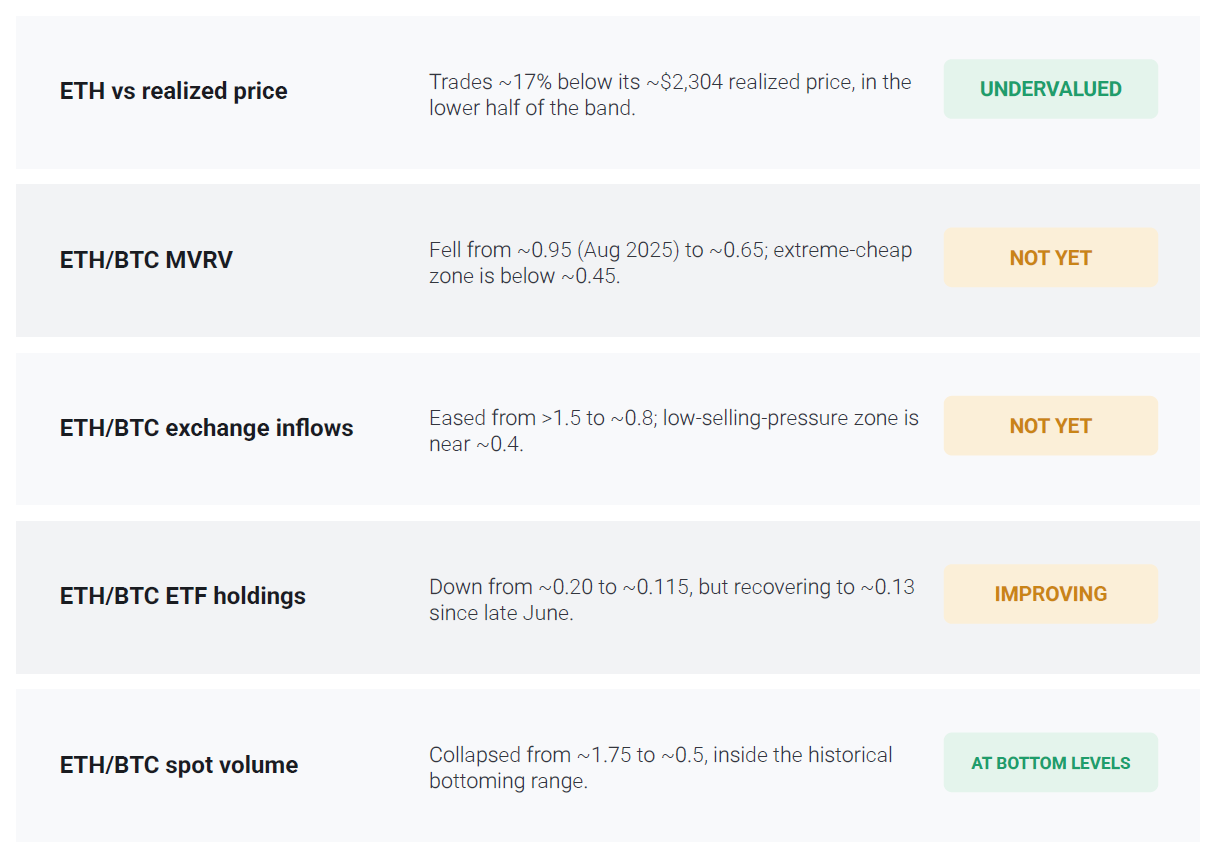
CryptoQuant says two of five key ETH bottoming indicators have been confirmed. Source: CryptoQuant
Even so, only two of CryptoQuant’s five bottoming indicators have reached historical reversal levels. The remaining metrics are improving but have yet to reach the extremes that have marked previous cycle lows, suggesting Ethereum’s bottom may still be forming.
The report comes as Ether briefly climbed above $1,950 this week and Bitcoin topped $67,000, buoyed by optimism surrounding the US CLARITY Act. At the same time, some market analysts have pointed to the potential for capital to rotate out of richly valued AI stocks and back into crypto, a shift that could further support Ether if risk appetite broadens.
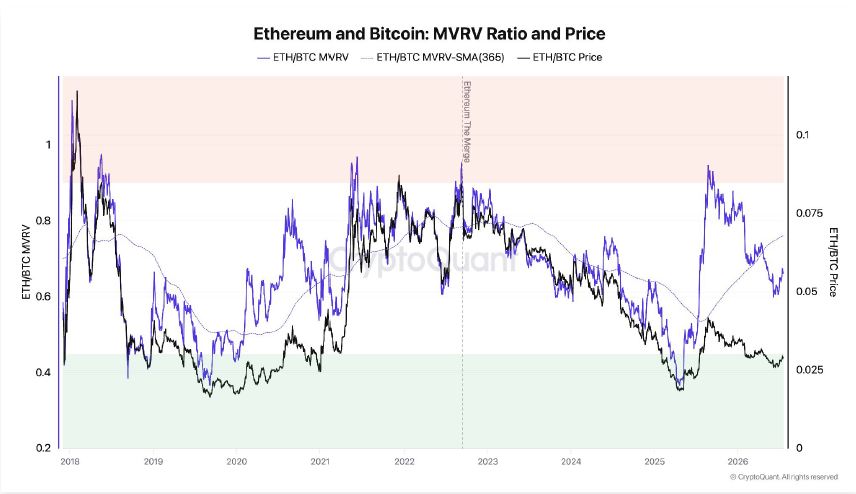
The ETH/BTC MVRV ratio has fallen from nearly 0.95 in August 2025 to around 0.65, signaling that Ethereum has become significantly cheaper relative to Bitcoin. Source: CryptoQuant
Related: Grayscale plans regular cash payouts from ETH, SOL staking rewards
Ethereum supply tightens as exchange outflows and staking climb
Ethereum has shown several constructive onchain signals over the past month. During the week beginning June 29, withdrawal activity on Binance, the world’s largest crypto exchange by trading volume, climbed to its highest level in more than three years.
Analysts generally interpret sustained exchange outflows as a sign that investors are moving assets into self-custody or staking rather than keeping them on exchanges for potential sale, although such flows do not guarantee accumulation.
Meanwhile, a record 34% of Ethereum’s circulating supply is now staked, according to Staking Rewards. As Cointelegraph previously reported, higher staking participation reduces the amount of ETH readily available for trading, potentially easing short-term selling pressure if demand remains resilient.
Tom Lee’s Bitmine Immersion Technologies, the biggest corporate ETH holder, continues to accumulate Ether, boosting its holdings by 325,000 ETH over a one-month period, despite sitting on large unrealized losses. It has set a target to hold 5% of the second-biggest crypto.
Related: Will the US get CLARITY this week? Bitcoin’s new $80K target: Hodler’s Digest, July 19


A hacker reportedly took over Robinhood CEO Vlad Tenev’s X account to promote a fake “VLAD” memecoin, posting what appeared to be a malicious token contract address.
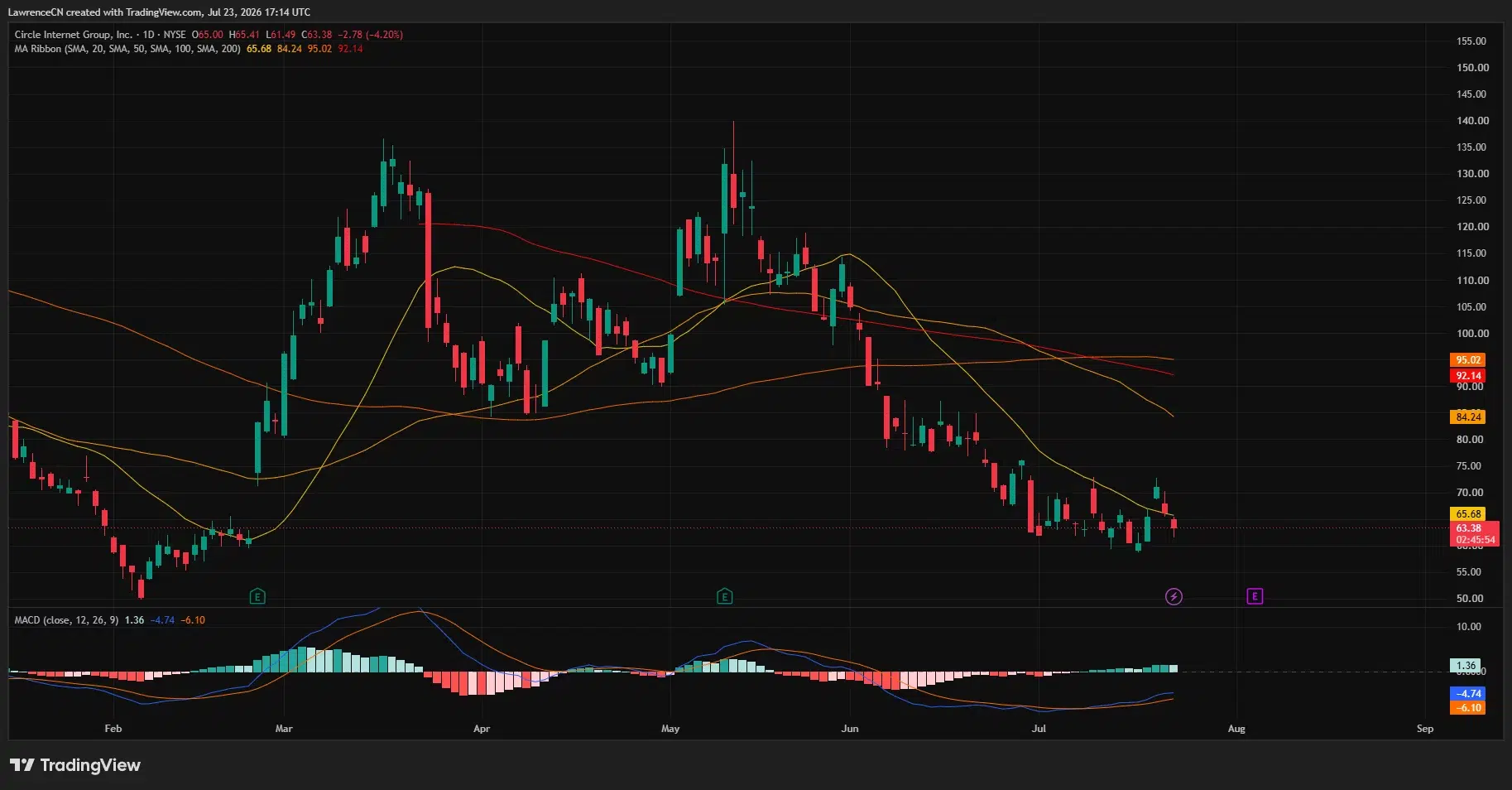
Cathie Wood’s ARK Invest has purchased 220,012 Circle Internet Group shares worth about $13.9 million as CRCL stock has fallen below $64 and every major daily moving average.
Summary
- ARK Invest purchased 220,012 Circle shares worth about $13.9 million during CRCL’s decline.
- CLARITY Act progress could improve regulatory certainty for Circle and other digital-asset companies.
- CRCL remains below major moving averages despite an improving daily MACD signal.
According to ARK Invest’s trading disclosure, the firm divided the purchase among three actively managed exchange-traded funds. The ARK Innovation ETF acquired 159,517 shares, while the ARK Next Generation Internet ETF and ARK Fintech Innovation ETF added 42,400 and 18,095 shares, respectively.
The transaction extended ARK’s buying during a steep decline in Circle’s market value. CRCL traded at $63.38 on July 23 after falling 4.20%, with the session producing a high of $65.41 and a low of $61.49, according to the daily TradingView chart.
Circle’s stock has struggled as weaker sentiment toward crypto-linked companies has reduced investors’ willingness to hold volatile digital-asset equities. Circle operates USDC, a dollar-backed stablecoin used across exchanges, payment services and decentralized finance applications.
Wood’s purchase suggests ARK remains willing to increase its exposure during the decline, although the investment manager has not guaranteed that CRCL has reached a bottom. ARK describes its investment approach as focused on companies tied to disruptive technologies and long-term growth, a strategy that can leave its funds exposed to sharp price swings.
Earlier this week, ARK used a similar approach with another high-volatility holding. As reported by crypto.news, four ARK funds purchased 170,634 SpaceX shares worth about $20.45 million while the stock traded below its $135 initial public offering price.
SpaceX then climbed 7.10% to $128.37, handing ARK an early unrealized profit on the new position, according to the crypto.news report. Although SpaceX and Circle operate in different industries, the transactions show ARK adding to selected companies after large declines rather than waiting for their charts to confirm a recovery.
CLARITY Act progress offers Circle a regulatory catalyst
Circle’s outlook has also become tied to negotiations over the Digital Asset Market Clarity Act, which could establish federal rules for digital-asset markets and divide regulatory responsibilities between the Securities and Exchange Commission and the Commodity Futures Trading Commission.
Senator Cynthia Lummis released an updated version of the legislation on July 22, combining texts advanced by the Senate Banking and Agriculture committees. In her announcement, Lummis described the coming weeks as a critical window for reaching an agreement that could allow the bill to become law.
Senate Banking Committee Chairman Tim Scott and Senate Agriculture Committee Chairman John Boozman have backed the revised framework. According to Lummis’ official release, Boozman argued that the proposal would give consumers, companies and markets clearer rules while adding safeguards for digital-asset activity.
For Circle, passage could reduce uncertainty surrounding businesses that issue stablecoins or provide related financial services. Such an outcome may make it easier for institutions to assess USDC-based products, but the proposal still requires enough Senate support and final approval before its provisions can take effect.
The latest draft faces political obstacles despite Republican support. Some Democrats have reportedly objected to the proposal’s treatment of crypto-related conflicts involving government officials, an issue that could complicate efforts to secure the 60 votes generally needed to advance legislation in the Senate.
CRCL remains bearish despite improving MACD momentum
CRCL’s daily chart shows that sellers still control the main trend even though one momentum indicator has started to improve. At $63.38, the stock sits below its 20-day simple moving average at $65.68, while the 50-day average is much higher at $84.24.
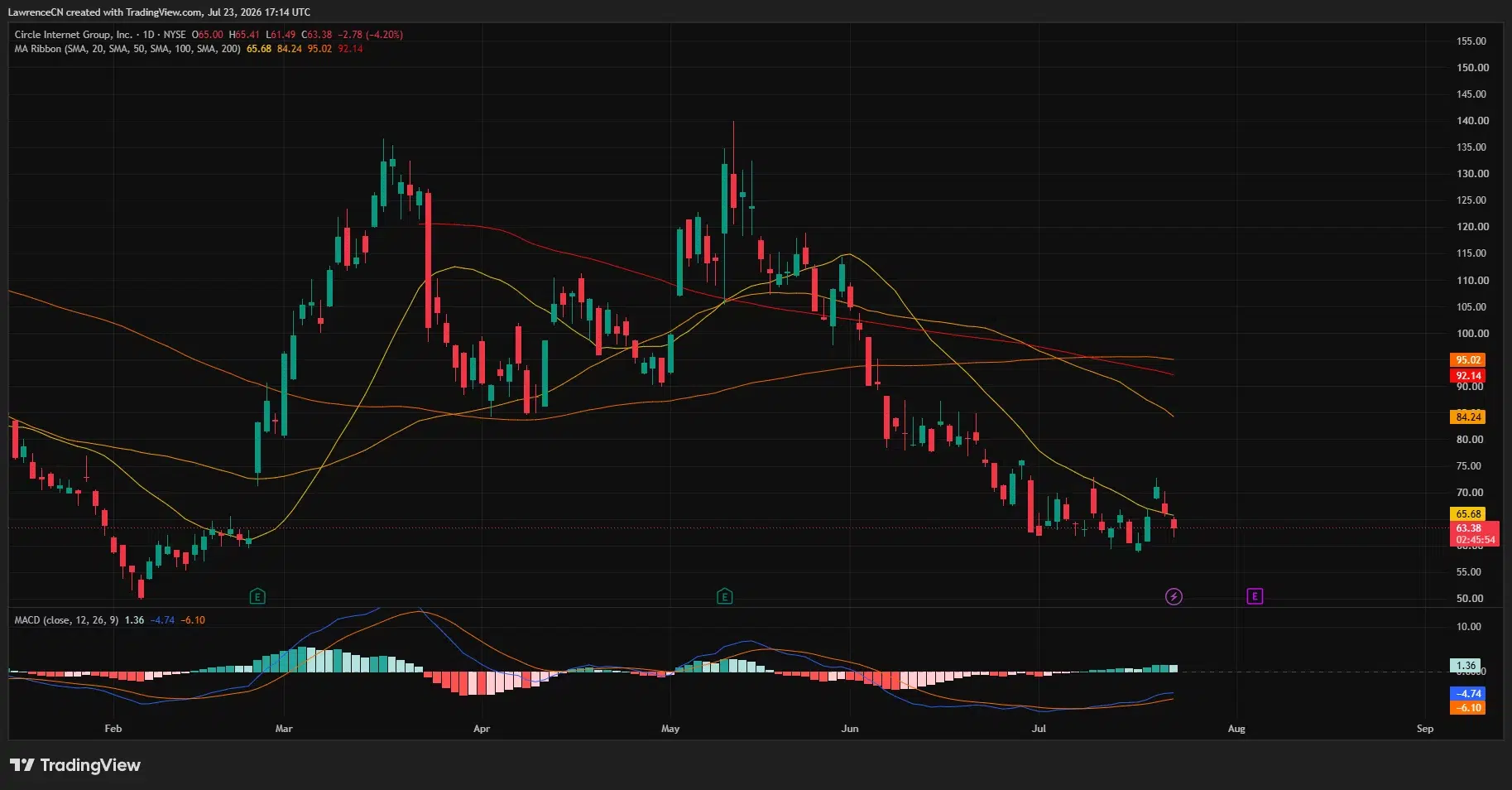
Longer-term resistance remains even further away. The chart places the 100-day moving average at $95.02 and the 200-day average at $92.14, leaving CRCL below all four trend indicators after a decline from its May peak near $140.
A recent rebound reached the $70–$72 region but failed to hold, according to the chart. Buyers would first need to recover the 20-day average at $65.68 before challenging that recent rejection zone. A daily close above $72 would provide stronger evidence that demand is returning, while the 50-day average at $84.24 would remain the next major obstacle.
On the downside, the July 23 intraday low places immediate support near $61.50. The chart also shows a demand area between $58 and $60, where buyers previously interrupted the decline. A sustained move below $58 would extend the sequence of lower lows and leave CRCL vulnerable to another leg down.
Momentum has offered one early sign of relief. The daily moving average convergence divergence line has risen to minus 4.74, above its signal line at minus 6.10, while the histogram has turned positive at 1.36.
Because both MACD lines remain below zero, the chart indicates that selling momentum has eased without confirming a trend reversal. Until CRCL recovers $65.68 and then $70–$72, ARK’s latest purchase remains a bet against an established downtrend rather than confirmation that Circle stock has formed a durable bottom.
Disclosure: This article does not represent investment advice. The content and materials featured on this page are for educational purposes only.

Bitcoin is stuck near $65,000, and trader Wise Crypto thinks AI spending is a big part of why.
The OG crypto poked above $66,000 earlier this week before losing steam, and the pattern points to money chasing AI stocks instead of crypto while inflation and bond yields keep pressure on risk assets.
Where the Money Is Actually Going
Wise Crypto laid out the case on X Thursday, noting that while spot Bitcoin ETFs have had seven consecutive days of inflows that have raked in just under $1 billion, the number was a small one next to the $6.9 billion that left those same funds in May and June.
Meanwhile, Big Tech is spending somewhere between $190 billion and $205 billion on AI infrastructure this year, with Nvidia’s data center revenue up 92% year over year, and AI-linked stocks have climbed roughly 69% since January. Bitcoin, over that same stretch, is down about 25%.
“Capital is flowing to AI, not crypto,” Wise Crypto wrote, pointing to two-year Treasury yields near 4.3% and ten-year yields near 4.6% as the forces keeping the dollar strong and investors cautious on risk assets.
The price data backs up the stall, as BTC was trading around $65,400 at the time of writing, down 0.6% on the day, after swinging between about $65,300 and $66,300 in the last 24 hours and between $62,500 and $66,900 over the past week. It is still up close to 5% across 30 days but sits roughly 45% below its all-time-high near $126,000 from last October.
“BTC needs lower inflation, falling yields & stronger demand to break $60K-$70K range,” claimed Wise Crypto.
Another market watcher, Ted Pillows, writing in his Thursday market report, pointed to Brent crude being near $94 a barrel after another round of US-Iran strikes, along with a ten-year TIPS real yield of about 2.31%, a post-pandemic high, as the direct drag on non-yielding assets like Bitcoin right now.
“I’d rather watch $64,000 get defended than chase a run back toward $66,500,” he said.
The Technical Levels Traders Are Watching
Michaël van de Poppe has said Bitcoin has already reached its target area, and that holding above the 21-day moving average keeps the door open for near-term gains, with $68,000 marking the next resistance zone and a break above it potentially opening a run to $73,000.
Fellow analyst Axel Adler noted that ETFs have taken in $439 million so far this week, while the so-called Coinbase discount, running for 78 days now, has started to narrow.
Further out, EGRAG CRYPTO flagged a developing double bottom pattern that would need a weekly close above $83,000 to gain traction, with $173,000 the eventual target if the setup plays out, though a weekly close below roughly $51,000 would invalidate it.
A similar reaction zone between $67,900 and $68,300 was pointed to by Bitfinex analysts, who also noted that short-term holders who bought in that range tend to sell once they recover their original positions, a pattern that has capped rallies before and could do so again if $68,000 comes back into play.
The post Analyst: Bitcoin Stuck Near $65K Because Capital Is Flowing to AI appeared first on CryptoPotato.
Crypto World
Tassat wants to help smaller banks tap the stablecoin boom before big banks lock them out


The announcement comes as stablecoins move further into mainstream finance following the passage of the GENIUS Act. Wall Street firms and banks are expanding stablecoin initiatives, while Citi projects the market could reach roughly $4 trillion by 2030.
At that scale, Sussman said, concentrating reserves among a few institutions could create liquidity and deposit risks.
“If you assume stablecoins scale to $5 trillion or $10 trillion, then there has to be something that helps the market reach equilibrium,” Sussman said. “It can’t just live in a really small circle because that will compound the risk on both sides.”
The platform itself will not run on a blockchain, though Tassat plans to connect it with tokenized asset and deposit networks. Sussman said that approach lowers the technical burden for smaller banks.
“There is a real risk that vast swaths of the U.S. banking ecosystem get left out in the cold,” he said. “I don’t think that’s healthy politically for the United States. I don’t think it’s healthy economically.”
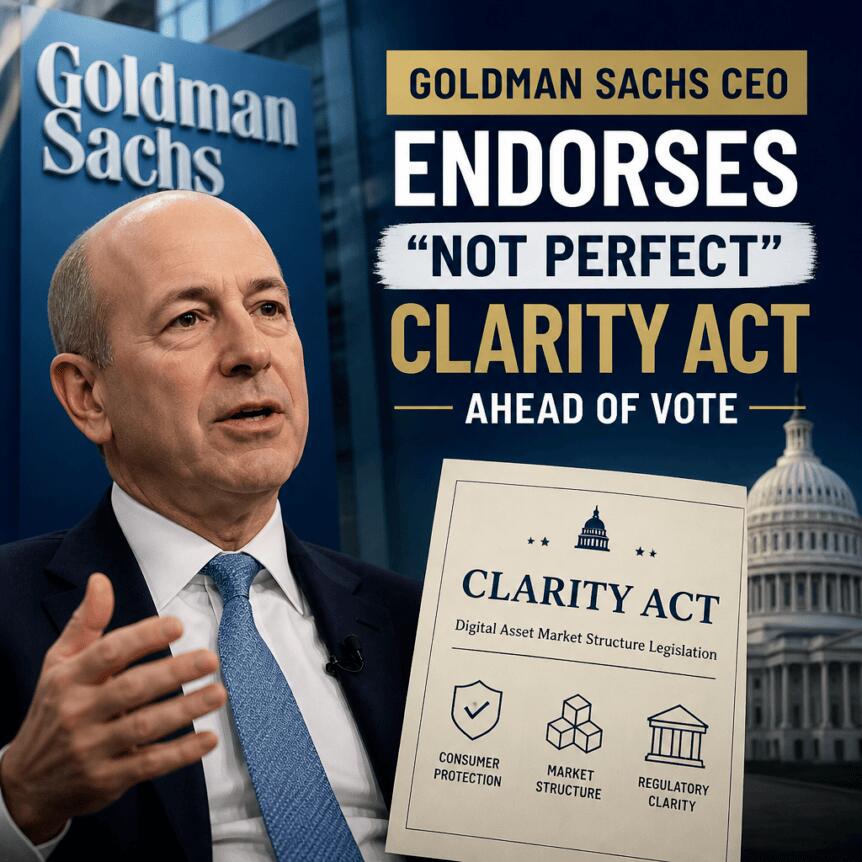
Goldman Sachs CEO David Solomon has voiced support for a US Senate bill intended to reshape crypto market structure, arguing that the proposed Digital Asset Market Clarity (CLARITY) Act is “not perfect” but could help create a more consistent framework for participants.
According to a Thursday report by Politico, Solomon framed the legislation as necessary to establish a “level playing field” that could improve market stability as digital asset markets continue to develop.
Key takeaways
- David Solomon says the CLARITY Act is “not perfect,” but supports it for creating a more “level playing field” to bolster stability.
- Many industry leaders oppose the bill’s approach, including concerns that it would allow certain crypto firms to pay yield related to stablecoins outside existing financial-institution rules.
- Republicans released the CLARITY Act text ahead of a potential Senate vote, but Senate leaders had not scheduled timing as of Thursday.
- Democrats and critics highlighted ethics provisions, with objections centered on enforcement and accountability mechanisms.
- The bill likely requires additional Democratic votes to reach the Senate’s 60-vote threshold.
Solomon’s “level playing field” argument
In comments reported by Politico, Solomon emphasized that legislation is rarely flawless, but maintained that CLARITY’s central purpose is to normalize how digital asset markets operate—at least relative to how traditional finance is regulated.
His view stands in contrast to broader skepticism within parts of traditional banking circles, where executives have questioned whether CLARITY expands regulatory permission in ways that could weaken investor and depositor protections.
Politico’s report also notes that Solomon’s endorsement is relatively uncommon among leaders at major financial institutions considering the bill.
Banking concerns over stablecoin yield permissions
A key point of contention involves whether crypto firms would be allowed to offer interest or yield on stablecoins under rules that critics say do not map cleanly to the protections expected of regulated financial institutions.
Earlier coverage highlighted that many peers oppose the bill on these grounds, arguing that the proposal’s stablecoin yield approach does not provide the guardrails banks would be expected to meet. Cointelegraph previously reported on these concerns.
The contrast in views is also reflected in remarks from JPMorgan Chase chief Jamie Dimon. As reported in an interview conducted in May, Dimon said CLARITY would let crypto companies pay interest on stablecoins “without the protection that they should have,” arguing that banks would not accept a similar arrangement. The interview was shared on YouTube.
Democrats focus on ethics provisions and enforcement
Even as the CLARITY Act moves toward a possible Senate vote, Democratic lawmakers have signaled resistance—not only on technical market-structure issues, but also on ethics language attached to the bill.
As described in reporting from Cointelegraph and subsequent commentary, Democrats are concerned that the ethics provisions do not go far enough and that enforcement would be left to the US Department of Justice rather than state authorities. If Republicans are unable to secure enough support beyond their ranks, the bill could stall at the 60-vote threshold required to advance in the Senate.
Senator Elizabeth Warren, a leading Democratic critic, said in a statement released alongside the Wednesday publication of the bill text that she believes the legislation is designed to protect President Donald Trump’s crypto profits and that it fails to adequately safeguard investors, the financial system, and national security. The statement was posted by the Senate Banking Committee’s minority.
Cointelegraph earlier also reported on Democrats’ objections to the ethics language during the markup process, underscoring how these provisions have become a central political obstacle for CLARITY. Earlier coverage details the core Democratic concerns.
What happens next in the Senate
Republicans released the full CLARITY Act text on Wednesday, setting the stage for potential Senate action. However, as of Thursday, Senate leaders had not scheduled a vote, according to the Politico report.
With multiple factions still divided—particularly over stablecoin yield permissions and ethics/enforcement mechanics—the immediate question for investors and market operators is whether amendments can narrow the gap between competing priorities or whether the bill will face a larger momentum reversal.
Readers should watch for whether Senate leaders set a vote date soon and, more importantly, whether any compromise emerges that could attract enough Democratic support to meet the 60-vote threshold—since the bill’s advancement appears tightly linked to both ethics politics and the future regulatory treatment of stablecoin-related yield.

A television station broadcasts Kevin Warsh, chairman of the US Federal Reserve, speaking after a Federal Open Market Committee (FOMC) meeting on the floor of the New York Stock Exchange (NYSE) in New York, US, on Wednesday, June 17, 2026.
Michael Nagle | Bloomberg | Getty Images
Investors are increasingly preparing for the Federal Reserve to hike interest rates as oil prices climb.
Fed funds futures are pricing in a roughly 82% likelihood that the central bank lifts borrowing costs at its September policy meeting, according to CME’s FedWatch tool. A week ago, those odds sat below 53%.
The central bank is still broadly expected to keep rates unchanged at the current 3.50% to 3.75% at its gathering next week. But even then, there’s a growing minority planning for an increase: Fed funds futures trading indicates a nearly 38% probability of a quarter percentage point hike, up from less than 12% a week ago.
Brent, the global crude benchmark, hit $100 a barrel on Thursday for the first time since late May amid a new round of tit-for-tat attacks between the U.S. and Iran. The average price for a gallon of gasoline in the U.S. reached $4 per gallon this week — the highest in more than a month, according to AAA.
Thursday’s employment data bolstered the view that the Fed can focus more on inflation — which could accelerate as energy prices climb — than the health of the labor market.
Initial jobless claims dropped to 187,000 in the week ended July 18, the Labor Department reported. That was the fewest claims since 1969, when the U.S. population was 60% of what it is today.
“At the moment, the outlook for economic growth is showing some signs of overheating if today’s weekly jobless claims figures can be believed,” said Christopher S. Rupkey, chief economist at FWDBONDS. “But for how long is the question if energy prices continue to spiral upward.”
Rising expectations for a rate increase may be adding to the downward pressure on the stock market Thursday, according to Larry Tentarelli, chief technical strategist at the Blue Chip Daily Trend Report. That’s on top of the breakout in oil prices and Treasury yields, and Alphabet‘s post-earnings swoon, he said.
The blue-chip Dow Jones Industrial Average tumbled more than 600 points in midday trading. The Nasdaq Composite — heavily weighted to technology stocks that can be sensitive to higher borrowing costs — shed nearly 3%.
“You really just have a perfect storm of headwinds right now,” Tentarelli said.

The Nasdaq Composite, 1-day
“We’ve got a Fed meeting in six days, and I think investors should not be in a hurry to buy anything,” he added. “There’s times where you can just sit it out and be patient.”
‘A readthrough’
Market participants looking for insights into the Fed’s outlook are closely monitoring the 2-year U.S. Treasury yield. The yield, which rose more than 6 basis points on Thursday, offers “a readthrough on what the Fed might do next,” said Ross Mayfield, an investment strategist at Baird.
U.S. 2-year Treasury, 1-month
While Mayfield said investors don’t need to worry about an interest rate move next week, September feels like a “live” meeting for the Fed.
Kalshi traders have similarly increased their bets of a September quarter point increase in recent days. Odds of such a move at that meeting rose to 48% midday on Thursday, up from about 30% a week ago.
To be sure, economists’ interest rate outlook through 2026 doesn’t signal an environment with tighter monetary policy.
The consensus forecast remains that the Fed won’t hike rates this year, according to FactSet. In 2027, economists anticipate the central bank will lower borrowing costs by half a percentage point.
— With additional reporting by CNBC’s Sean Conlon


Ripple has invested an undisclosed amount in Notabene to bring RLUSD payments to an institutional network processing more than $2 trillion in annualized transaction volume.
Summary
- Ripple invested in Notabene to integrate RLUSD into its institutional payment network.
- Notabene’s regulated infrastructure handles more than $2 trillion in annualized transaction volume.
- Ripple’s European licenses and U.S. policy push support its stablecoin payment expansion.
Notabene announced the strategic investment in a press release, adding that the two companies will work together to expand regulated stablecoin payments for businesses. Under the agreement, Notabene will integrate Ripple USD, commonly known as RLUSD, into Notabene Flow, its business-to-business stablecoin payment platform.
Once integrated, RLUSD could become available across one of the largest networks connecting regulated digital asset companies. Notabene described the collaboration as a route for institutions to use the stablecoin while meeting payment authorization and compliance requirements.
Alongside the RLUSD integration, Ripple and Notabene will examine how trusted payment authorization could support Ripple Payments. According to Notabene, its infrastructure gives regulated institutions the information needed to identify counterparties, understand payment purposes and approve transactions without adding unnecessary friction.
“The partnership is set to accelerate adoption of compliant stablecoin payments while creating a pathway for RLUSD to be integrated across one of the world’s largest institutional payment networks for digital assets,” Notabene stated.
Notabene gives RLUSD access to regulated payment counterparties
Notabene co-founder and CEO Pelle Braendgaard identified uncertainty over transaction details as a central problem for companies considering stablecoins. In his assessment, institutions need to know who is receiving a payment, why the transaction is taking place, and how it can be authorized within their existing controls.
Braendgaard argued that Notabene’s network provides those functions through connections with regulated institutions. Combined with Ripple’s payments business and RLUSD, he expects the infrastructure to help companies move stablecoin payment programs beyond limited trials.
“That is what Notabene and its network of regulated institutions solve. Paired with an enterprise-ready stablecoin like RLUSD and Ripple’s global payments reach, it turns compliant stablecoin payments from a pilot into a real growth engine that reaches more counterparties and moves more volume, faster,” Braendgaard said.
Ripple Senior Vice President of Stablecoin Jack McDonald also linked the investment to a long-standing barrier facing enterprise users. According to McDonald, Notabene supplies part of the compliant infrastructure that institutions require before moving money at an international scale.
“Together we’re helping build the compliant infrastructure institutions need to move value at global scale while expanding the utility of RLUSD.”
The agreement comes as Ripple builds regulated payment access for RLUSD in Europe. As crypto.news reported, Ripple Payments Europe appeared alongside 14 other companies in the European Securities and Markets Authority’s latest Markets in Crypto-Assets register update on July 18.
ESMA’s register lists Ripple Payments Europe SA as an authorized crypto asset service provider. According to the register, the approval enables Ripple’s European payments subsidiary to provide regulated crypto services across 29 European Union countries.
Ripple had previously secured authorization in Luxembourg under the MiCA framework. The company stated that the Luxembourg license allows its local subsidiary to provide services to financial institutions and businesses across the European Economic Area.
Paired with Ripple’s existing electronic money institution license in Luxembourg, the crypto asset service provider approval permits the company to offer crypto asset and stablecoin payment services. Ripple says banks, fintech firms and corporate clients can use a single integration to collect funds, exchange assets and make payments.
Regulatory progress supports Ripple’s institutional payment strategy
In the United States, Ripple is also pressing lawmakers to establish federal rules for crypto markets. Ripple CEO Brad Garlinghouse on July 22 backed Chief Legal Officer Stuart Alderoty’s call for Congress to pass the Digital Asset Market Clarity Act despite unresolved disputes surrounding the legislation.
Alderoty urged lawmakers not to abandon the bill while pursuing a perfect compromise. His appeal followed the release of updated legislative text and came as Congress moved closer to its August recess, while a group of Senate Democrats renewed resistance to the proposal.
Describing the CLARITY Act as a consumer protection measure, Alderoty argued that it would reinforce anti-money laundering and know-your-customer standards. He also maintained that the legislation would give law enforcement agencies and state authorities clearer powers to address misconduct.
Garlinghouse endorsed that assessment after Ripple had supported federal market structure legislation during the current negotiations. The company’s policy push accompanies rising institutional interest in stablecoin payments following the passage of the GENIUS Act.
RLUSD has also secured integrations beyond the planned Notabene Flow addition. Renewed interest in the stablecoin follows BNY Mellon’s plan to develop a 24-hour settlement system for the U.S. Treasury market, although the bank’s initiative remains separate from Ripple’s Notabene agreement.
Through the investment, Ripple gains a route into Notabene’s regulated network without acquiring the company or disclosing the size of its stake. Notabene, in turn, will add RLUSD to payment infrastructure already used by institutions handling more than $2 trillion in annualized transaction volume.
Convicted fraudster and Nigel Farage backer George Cottrell had $9 million deposited into his Polymarket account by two unknown sources.
That’s according to the Financial Times (FT), which reported that Cottrell’s Polymarket account — which has the username “GCottrell93” — received $8.8 million in October 2024.
It received $7 million across five different transactions from a wallet on crypto exchange OKX, and received another $1.83 million from a wallet on ChangeNOW.
These funds were used almost immediately to bet on whether or not Trump would win the US election. From here, the FT claims $13 million in winnings was sent to an OKX wallet while $282,000 was sent to ChangeNOW.
Cottrell was previously convicted of wire fraud in March 2017 after he was caught agreeing to launder drug trafficking proceeds.
For many years, Cottrell and his relationship with Farage had gone largely under the radar. However, this past year has seen him thrust into the limelight after Farage was discovered to have accepted, without declaring, a £5 million gift from multi-billionaire Tether investor Christopher Harborne.
Cottrell was also revealed to have funded staff, security, and housing for the Reform UK leader before his election in 2024.
None of this was declared, and has since been referred to the UK’s Parliamentary Commissioner for Standards.
Read more: Nigel Farage aide George Cottrell bets US war will last four more months
Cottrell has continued to bet on Polymarket throughout the year. Protos reported in March 2026 that he bet $41,000 that the US war with Iran would last another four months.
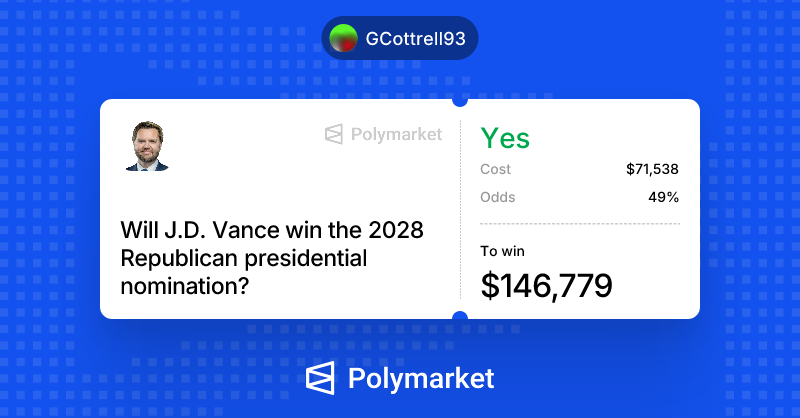
One of his larger bets currently involves $71,000 on whether or not Vice President JD Vance will win the Republican nomination for president in 2028.
In addition to the FT’s report, Byline Times also revealed today that Cottrell has in the past used a fraudulent Swiss passport, under the name of “Oscar Drewitt.”
This fraudulent identity was reportedly known by Reform UK’s former Treasurer, Mehrtash A’zami, who hired Cottrell into a City financial network while using this Swiss alias.
Byline Times also discovered that a fellow gambler called Hon Kong Yong introduced Cottrell to this network under the false alias, and that Yong and A’zami have companies registered under the same Montenegro Tivet office, which Harborne and two other former Reform UK officials were linked to.
Got a tip? Send us an email securely via Protos Leaks. For more informed news and investigations, follow us on X, Bluesky, and Google News, or subscribe to our YouTube channel.

Ethereum has climbed by 16% over the past month and is now showing a technical setup that has historically been followed by strong price recoveries, according to crypto analyst Ali Martinez.
He found that ETH’s MVRV ratio is nearing a bullish crossover above its 160-day simple moving average (SMA).
Recovery Hints
The MVRV Momentum measures the relationship between aggregate holder profitability and its medium-term trend line. Martinez explained that when the daily MVRV ratio moves back above the 160-day SMA, it indicates a shift out of capitulation and the beginning of a fresh accumulation phase. Interestingly, this is the first time the setup has emerged in 2026.
Over the past three years, crossovers above this level have consistently marked the end of distribution periods and preceded major rebounds in ETH’s price.
At the same time, large investors continue adding to their holdings. According to Lookonchain, an anonymous whale purchased 27,000 ETH worth $52.03 million through Galaxy Digital’s over-the-counter (OTC) desk after remaining inactive for three months.
Additionally, BSCN reported that BitMEX co-founder Arthur Hayes acquired another 644.34 ETH worth roughly $1.25 million, increasing his total purchases over the past eight days to 3,270 ETH. This follows his earlier $2.53 million ETH buy and comes alongside several other multi-million-dollar Ethereum purchases and staking activity reported earlier this week.
Prediction markets are also leaning bullish. In fact, Whale Insiders said Kalshi traders are forecasting ETH could climb as high as $3,210 this year.
Separate data also showed that investors withdrew around 1 million ETH, worth nearly $2 billion, from centralized exchanges over the past 30 days, which pushed exchange balances to their lowest level in a decade. Declining exchange reserves typically reduce selling pressure and support a bullish outlook.
On the institutional front, spot Ethereum ETFs have recorded consistent net inflows this month, raking in over $380 million during this period.
Alternative Outlook
Not all analysts share the same near-term outlook. Crypto analyst Nonzee, for one, argued that the crypto asset could still see one more rally before a deeper correction. He expects it to test $2,000, with a possible move to $2,200 if Bitcoin climbs to $70,000. However, he believes those levels would mark a bull trap rather than the start of a meaningful breakout.
According to the roadmap, Ethereum could spend seven to ten days in a distribution phase before falling into a final bottom zone between $1,300 and $900, which he considers the ideal accumulation range. Despite his bearish short-term outlook, Nonzee maintained a long-term price target of $7,000 for ETH.
The post Ethereum’s Next Leg Higher? Historic Indicator and Whale Activity Align appeared first on CryptoPotato.

Ethereum Nears Market bottom vs Bitcoin

Malcolm-Jamal Warner’s Widow ‘Still In Shock’

Emmanuel King Linked With El-Kanemi Warriors Head Coach Role


-

 Fashion6 days ago
Weekend Open Thread – Corporette.com
-

 Politics5 days ago
The House | The City of London can help the new chancellor deliver growth in every postcode
-

 Crypto World5 days ago
Ripple Payments Joins MiCA With 14 Firms, Does It Mean Anything For XRP?
-
 Crypto World6 days ago
Two July Windows Left: The CLARITY Act’s Senate Fight and What Failure Means
-

 Politics4 days ago
Democrats look to World Cup watch parties to register thousands of voters
-

 Crypto World6 days ago
Ripple wins EU-wide access as ESMA adds it to MiCA register
-

 Crypto World2 days ago
Grayscale Files For Worldcoin ETF, WLD Registers Sharp Rise
-

 NewsBeat3 days ago
Unregistered fitter used Gas Safe logo on business flyers
-

 Tech3 days ago
Sail Virtually Aboard The “Itanic” With IA-64 Emulator
-

 Crypto World7 days ago
Injective Submits SEC Transfer-Agent Registration to Onchain Ownership Records
-
 Tech3 days ago
Turtle Beach Command Series KB7 review: a nifty screen-equipped gaming keyboard
-

 NewsBeat6 days ago
Registration is now open for March for Men with Kev 2026
-
 Business2 days ago
New Jersey voter registration controversy explained: How 6,600 noncitizens got on the rolls, and what happens next
-

 Crypto World7 days ago
Claude Fable 5 Slips to Second in AI Coding Leaderboard
-

 News Videos7 days ago
Money | Class 12 Economics | CBSE Board Exam 2026-27
-

 Business7 days ago
Banco Bilbao Vizcaya Argentaria, S.A. (BBVA) Discusses Global Macro Environment and Economic Outlook for Core Markets Transcript
-

 Crypto World5 days ago
Kaspersky exposes OkoBot’s 20-module crypto wallet attack
-

 News Videos4 days ago
Big Money Is Entering XRP
-

 Business6 days ago
Airlines warn Sunshine Protection Act could disrupt flight scheduling
-

 NewsBeat6 days ago
Durham County Council to send out electoral registration emails
You must be logged in to post a comment Login