
Crypto World
Dow’s 3-Year Winning Run Isn’t a Crash Signal, Still 49% Odds of Double-Digit Gains

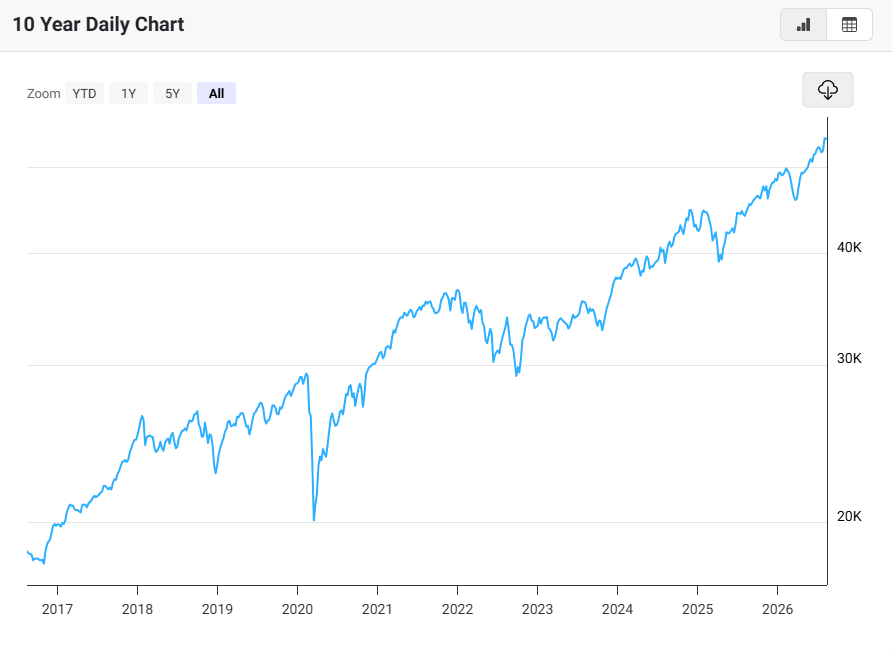
Three straight years of double-digit gains have not raised the odds of a Dow Jones Industrial Average pullback. That is the conclusion of MarketWatch contributor Mark Hulbert. The Dow’s historical baseline chance of another double-digit year still sits at 49%.
A narrative has spread on Wall Street that the streak alone makes a reversal overdue. Hulbert calls that reasoning the gambler’s fallacy, the same error behind coin-flip superstitions.
The Gambler’s Fallacy Behind the Crash Talk
Hulbert compares the market to a coin flip. A coin that lands heads several times in a row is still 50% likely to land heads again.
He points to 129 years of Dow data going back to the late 1890s. The odds of a double-digit year hover near 49%, regardless of how many strong years came before it. Historically, that baseline has barely moved even after multiple consecutive winning years.

Investors weighing whether a real downturn is brewing can compare Hulbert’s data with Cramer’s buyable crash framework. That guide separates mechanical sell-offs from systemic ones.
What the Research Shows About Crash Odds
Hulbert also cites research from Harvard University and the University of Hong Kong. The research uses trailing two-year returns to estimate crash risk. State Street Markets, working with the Harvard researchers, applies that framework to calculate current odds.
The current probability of a 40% drop over the next two years sits at 19%. That compares with a five-year average of 26%. Crash odds, in other words, are currently below normal.
Other Wall Street voices point to different warning signs. Some traders see echoes of the dot-com bust in the recent AI stock rotation. That is a separate concern from the streak-based narrative Hulbert addresses.
What About Other Risks?
Hulbert stresses that his model only reflects trailing returns. It does not account for other risks, including stretched valuations across US equities.
Wall Street sentiment remains split heading into the back half of the year. Fundstrat’s Tom Lee’s correction call shows some strategists still want a pullback before further upside. Meanwhile, raised S&P 500 forecasts from JPMorgan and CFRA signal broader confidence in the rally continuing.
For now, Hulbert’s bottom line holds. The Dow’s odds of finishing 2026 with a double-digit gain remain 49%. That is no better and no worse than in any other year.
The post Dow’s 3-Year Winning Run Isn’t a Crash Signal, Still 49% Odds of Double-Digit Gains appeared first on BeInCrypto.

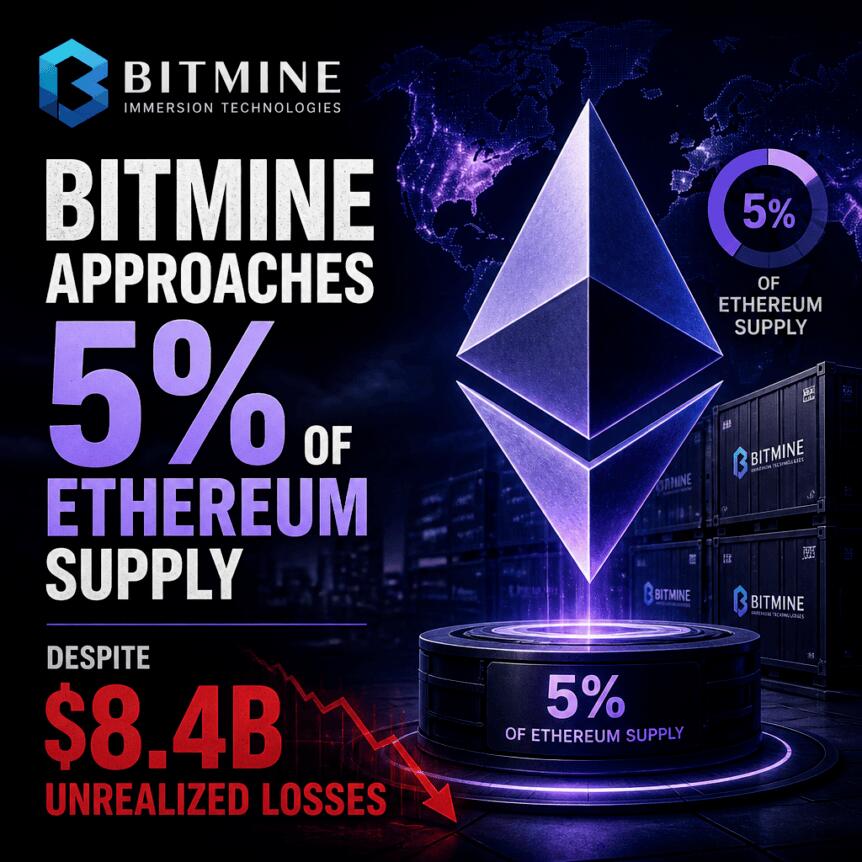
Tom Lee’s Ethereum treasury firm, Bitmine Immersion Technologies, has resumed accumulating Ether, adding 9,926 ETH in the week ending Aug. 16. The latest purchase brings the company’s total holdings to about 5.82 million ETH—around 4.8% of Ethereum’s circulating supply—bringing it close to a long-stated goal of owning 5% of all ETH.
While the move underscores Bitmine’s long-term conviction, the context is difficult. Ethereum’s extended bear market has meaningfully reduced the profitability of the treasury, with industry estimates indicating Bitmine is carrying more than $8.4 billion in unrealized losses on its ETH position.
Key takeaways
- Bitmine bought 9,926 ETH during the week ending Aug. 16, lifting total holdings to roughly 5.82 million ETH.
- That stake is valued at about $11 billion at a referenced ETH price of $1,893, but much of the ETH was reportedly acquired at higher prices.
- With holdings at ~4.8% of circulating supply, Bitmine is nearing its “Alchemy of 5%” target.
- Despite large unrealized losses, the firm continues staking more than 5 million ETH, supporting ongoing yield generation.
- Using a seven-day staking yield of 2.61%, Bitmine projects annualized staking rewards of about $287 million.
Bitmine’s weekly accumulation brings it closer to 5%
According to Bitmine’s disclosure on Monday, the company’s most recent tranche of purchases totals 9,926 ETH. The firm frames this as a continuation of its ETH treasury strategy, one that has led to weekly buying since launching the approach in June 2025.
By the end of the week ending Aug. 16, Bitmine’s ETH position totals roughly 5.82 million ETH. Based on the company’s own framing of Ethereum’s circulating supply, that equals approximately 4.8%. The firm has long described an “Alchemy of 5%” target—an ambition to accumulate 5% of the entire ETH supply—meaning it is now within striking distance of that milestone.
However, the purchase comes at a time when Ethereum’s market environment has punished portfolios built on aggressive accumulation. At an ETH reference price of $1,893, Bitmine’s holdings were valued at approximately $11 billion, but the article notes that a significant portion of the ETH was acquired at substantially higher prices.
Unrealized losses remain a central pressure point
The scale of Bitmine’s treasury continues to draw attention not just because of its size, but because of how far it has moved below prior acquisition costs during a prolonged bearish phase for Ether.
Industry data cited in the report suggests Bitmine is sitting on more than $8.4 billion in unrealized losses related to its ETH holdings. DropsTab’s estimate characterizes these unrealized losses as roughly 43% of the portfolio’s current value, based on the referenced valuation approach in the article.
This matters for investors and market watchers because a treasury strategy of this type is most resilient when it can offset price drawdowns with consistent yield. Without that, extended declines can turn accumulation into capital lock-up—especially when the target is based on a long-term percentage of supply rather than short-term price appreciation.
Staking keeps the treasury productive
Bitmine’s counterweight to unrealized losses is staking. The company said it is staking more than 5 million ETH, which it values at roughly $9.6 billion at current prices. By performing staking activities that help secure the Ethereum network, Bitmine continues to earn protocol rewards—turning part of its holdings into a more predictable cashflow stream tied to network participation.
Bitmine’s disclosure also highlights how staking yield can buffer volatility. Based on a seven-day staking yield of 2.61%, Tom Lee projected annualized staking rewards of roughly $287 million. The article frames these rewards as independent of Ether’s short-term price swings, emphasizing that yield accrues from staking activity even while market value fluctuates.
For readers assessing whether Bitmine’s strategy is sustainable, staking performance is therefore a crucial variable to monitor. If staking yields compress or if operational dynamics change, the balance between “paper loss” and ongoing earnings could shift.
What to watch as Bitmine heads toward 5%
As Bitmine pushes toward its “Alchemy of 5%” target, the next question is how quickly it can close the remaining gap from roughly 4.8% to 5% of circulating supply—while dealing with the reality that market pricing and acquisition costs may keep unrealized losses in focus. Investors should watch whether Bitmine maintains its weekly buying cadence, and whether staking yields remain strong enough to sustain the treasury’s economics during periods when Ether’s price lags.

BitMart’s official Chinese-language X account has demanded that exchange founder Sheldon Xia explain where user funds are, provide a verifiable disclosure of assets, and outline a repayment plan by Wednesday. The dispute comes as the troubled platform continues its wind-down process amid widely reported withdrawal delays and the earlier collapse in BMX token value.
In a Monday post, the account said some users were still unable to withdraw funds and that some employees had not received their final salary or compensation. It urged Xia to publish details including BitMart’s wallets, assets, liabilities, and available reserves, warning it would escalate the matter to regulators, law enforcement, lawyers, and the media if he did not meet the deadline. Cointelegraph previously reported that BitMart announced on July 26 it would wind down the exchange, with trading ending Aug. 26 and operations ceasing on Jan. 31.
Key takeaways
- BitMart’s official Chinese X account is demanding Sheldon Xia disclose BitMart’s wallet holdings and provide a repayment plan by Wednesday.
- The post alleges some users still cannot withdraw and that some employees have not received final compensation.
- BitMart has already entered a formal wind-down process, with trading set to end Aug. 26 and operations scheduled to stop Jan. 31.
- Sheldon Xia rejected the claims, saying the account’s accusations are “fabricated rumors,” and said he would pursue police and legal action.
- Arkham-tracked BitMart-attributed wallets reportedly fell from about $102 million (July 6) to around $36.5 million as of Monday, though the reasons are unclear.
Deadline set amid ongoing withdrawal complaints
BitMart’s latest challenge is framed around user access to funds and transparency. According to a machine translation of the account’s post, it said some users remained unable to withdraw and that internal compensation issues persisted for at least some staff members.
The account’s demand is not limited to a general explanation; it calls for a detailed and verifiable disclosure, including wallets, assets, liabilities, and reserves. It also set a clear escalation threat: if Xia does not deliver by the stated deadline, the account said it would submit evidence to regulators, law enforcement, legal representatives, and media outlets.
Cointelegraph attempted to contact BitMart for comment following the Monday post but did not immediately receive a response. It also remains unclear who authored the message, or whether the account is still operated under BitMart’s corporate control.
Wind-down timeline already in motion
These events are unfolding while BitMart carries out a pre-announced shutdown. As earlier coverage noted, BitMart said on July 26 it would wind down the exchange due to market and operational pressures, including BMX token volatility and user reports of withdrawal delays.
Under the company’s stated plan, BitMart ended new deposits and halted registrations as part of the wind-down. Trading on the platform is scheduled to end on Aug. 26, and the exchange’s operations are set to cease on Jan. 31. BitMart also warned that some withdrawals could undergo additional compliance and security reviews.
That backdrop matters because it suggests the dispute is not simply about whether an exchange will pay, but about the practical mechanics and timing of withdrawals and asset handling during the shutdown window.
Sheldon Xia denies wrongdoing and promises legal action
Sheldon Xia responded to the accusations in an X post on Monday, calling the claims “fabricated rumors” and saying he had preserved evidence. In a machine translation of his remarks, Xia said that during daytime U.S. time he would file a police report and send a lawyer’s letter to X, seeking technical and data forensics related to the post.
Xia further argued that employees were not being prioritized over customers, stating that “everyone is a client” and that there were no special privileges. He also previously denied that BitMart had misappropriated user assets.
In earlier communications, Xia told users not to rely on unverified claims or screenshots purportedly provided by current or former employees, reinforcing his position that the public allegations should be treated skeptically until substantiated.
Arkham wallet tracking shows sharp reductions—but interpretation remains unclear
Wallet movements are also central to what investors and users want to understand during a wind-down. According to Arkham’s on-chain entity tracking, wallets attributed to BitMart held about $36.5 million in crypto assets as of Monday.
Arkham’s data indicates a steep decline from roughly $71 million on July 26 and about $102 million on July 6. Those figures, however, come with important caveats. The tracked wallets may not represent the full set of assets controlled by BitMart, and it remains unclear how much of the reduction reflects customer withdrawals, internal consolidation, or transfers to other addresses.
In disputes like this, a key question is whether reductions in publicly tracked wallet balances reflect legitimate outflows to customers or whether they could suggest asset movement that is not fully explained. Until BitMart or Xia provides the kind of verifiable disclosure demanded by the X account—wallet list, liabilities, reserves, and a repayment framework—readers may be left comparing incomplete public signals.
What to watch next as the deadline approaches
With the promised Wednesday deadline now in focus, market participants will likely look for whether Xia provides a verifiable asset and liability disclosure and whether any repayment plan is detailed in a way that users can test against withdrawal status. Just as importantly, observers should watch how regulators and law enforcement respond to both sides’ public claims, and whether on-chain wallet tracking aligns with the explanations given for balance changes since BitMart began winding down.
Treasury’s new stablecoin rules would decide which dollar tokens can legally reach US buyers. Chains already running on a licensed dollar hold the edge, and six altcoins sit closest to it.
Nothing is final yet, and Treasury opened a 60-day comment period. The hard deadlines land in January 2027 and July 2028.
How Treasury’s New Stablecoin Rules Sort the Chains
Congress passed the Guiding and Establishing National Innovation for US Stablecoins (GENIUS) Act in July 2025. The idea is simple. A dollar token needs a US license to reach American users.
Two dates carry the weight. Unlicensed issuance inside the country ends on January 18, 2027. Then from July 18, 2028, platforms generally cannot sell payment stablecoins to US persons. Only licensed issuers pass.
No issuer holds that license yet, because licensing opens in 2027. However, the queue has already formed.
The Office of the Comptroller of the Currency (OCC) approved five trust bank charters last December on a conditional basis. Circle, Ripple, Paxos, Fidelity Digital Assets, and BitGo made that list. Circle then went further and won final approval in July.
Treasury Secretary Scott Bessent framed the goal as certainty.
“Treasury welcomes input from stakeholders as we work to provide the regulatory certainty businesses need to innovate and grow in America…” read an excerpt in the Monday announcement, citing Bessent.
Follow us on X to get the latest news as it happens
This is the third time Treasury has asked the industry to weigh in. It opened a second comment window last September.
Europe Already Ran This Experiment
The US is not first. Europe’s Markets in Crypto-Assets (MiCA) rules set a similar test, and the result is on record.
Binance told European users on March 3, 2025 that eight tokens would go. USDT also led that list. Margin pairs were delisted on March 27 and converted to USDC automatically.
Spot pairs then followed on March 31. In its announcement, Binance pointed users toward USDC.
That is the pattern the GENIUS Act now sets up for America, only on a far larger base.
6 Altcoins That Could Benefit From the Proposal
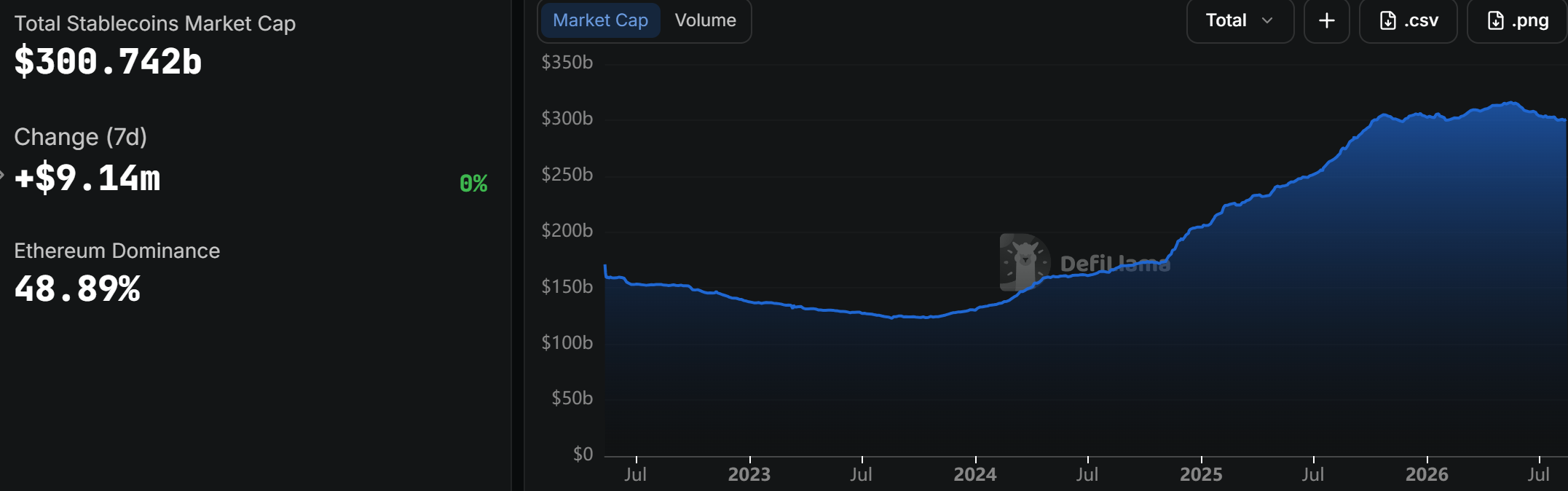
Stablecoins hold about $300 billion across all chains, according to DefiLlama.

The ranking below uses one measure. It is the share of each chain’s stablecoin supply that already sits with a licensed issuer.
- Hyperliquid (HYPE)
Hyperliquid carries $6.18 billion in stablecoins. USD Coin (USDC), issued by Circle, makes up 97.8% of it. No other major chain leans so hard on a single licensed issuer. HYPE trades at $59.34, up 3.9%. It is also the only altcoin here in profit over 12 months, at 26.3%.
- Arbitrum (ARB)
USDC covers 63.5% of Arbitrum’s $3.5 billion stablecoin base. Foreign-issued tokens face the tighter test, so that mix helps. ARB trades at $0.0749, up 1.2%.
- Polygon (POL)
Polygon holds $3.03 billion in stablecoins, with USDC at 53.3%. A slim majority therefore sits with a chartered issuer. POL changed hands at $0.0781 after a 3.8% gain.
- Solana (SOL)
Solana’s $15.33 billion base ranks third among all chains. USDC leads it at 43.5%, ahead of Tether (USDT). SOL trades at $75.84, up 0.9%.
- Ethereum (ETH)
Ethereum hosts $146.57 billion in stablecoins, nearly half the global total. However, USDT holds 50.4% of that. The rest, about $73 billion, is the deepest non-Tether pool anywhere. Meanwhile, ETH price near $1,900 reflects a 1.4% gain to $1,904.24.
- XRP
Ripple issues Ripple USD (RLUSD) and holds one of those conditional charters. More than half a billion dollars of RLUSD supply moved to XRPL. That network passed Ethereum as RLUSD’s main settlement venue in June. XRP trades at $1.002, up 0.3%.

Tron Holds the Largest Bet the Other Way
Tron carries $92.04 billion in stablecoins, second only to Ethereum. USDT makes up 97.9% of that. The chain therefore has almost no licensed alternative.
BeInCrypto reported in March that Tron’s USDT balance had passed Ethereum’s. TRX trades at $0.3313, up 0.1%.
Tether is not sitting still, however. It launched a US token called USAT in January through Anchorage Digital Bank. The company says USDT is working toward GENIUS Act compliance.
None of this promises a rally. Every altcoin listed except HYPE is down 58% to 86% over the past year. Monday’s moves also stayed under 4%. The comment file closes 60 days after Federal Register publication. That is where the real fight happens.
The post 6 Altcoins That Could Benefit From Treasury’s New Stablecoin Rules appeared first on BeInCrypto.


Strategy has raised $333.7 million through common stock sales without buying or selling Bitcoin last week, leaving its holdings unchanged at 840,447 BTC.
Summary
- Strategy raised $333.7 million from MSTR stock sales between Aug. 10 and Aug. 16.
- The company made no Bitcoin purchases or sales, keeping its holdings at 840,447 BTC.
- Strategy spent $132.2 million repurchasing STRC shares and $52.4 million on STRC dividends.
- Another $149.1 million was added to its U.S. dollar reserve, taking the total to $4.80 billion.
According to a Form 8-K filed with the U.S. Securities and Exchange Commission on Aug. 17, Strategy sold 3.46 million MSTR shares between Aug. 10 and Aug. 16 through its at-the-market offering program.
The company used $52.4 million of the proceeds to fund twice-monthly dividends on its Variable Rate Series A Perpetual Stretch Preferred Stock, or STRC. Another $132.2 million went toward STRC repurchases, while $149.1 million was added to its U.S. dollar reserve.
Strategy reported no Bitcoin purchases or sales during the seven-day period, a week after it sold Bitcoin to help finance another round of STRC repurchases.
Strategy uses MSTR proceeds for STRC buybacks
During the latest reporting period, Strategy repurchased about 1.39 million STRC shares for $132.2 million under its Digital Credit Securities Repurchase Program.
The company made no repurchases of its STRF, STRK or STRD preferred securities and did not buy back any MSTR common stock.
Following the STRC purchases, Strategy had about $653 million remaining under its $1 billion preferred securities repurchase authorization. Another $1 billion remained available under its separate common stock repurchase program.
Both programs were established under a capital framework approved in late June. As previously reported by crypto.news, Strategy’s board authorized up to $2 billion in security repurchases on June 29, split evenly between MSTR common stock and its preferred securities.
The same framework allowed the company to sell up to $1.25 billion of Bitcoin to fund its U.S. dollar reserve, preferred dividends, interest payments and security repurchases. The authorization did not represent a completed Bitcoin sale and gave Strategy the option to use its BTC holdings as a source of liquidity when required.
STRC, meanwhile, remained below its $100 par value. The preferred stock closed Friday at $94.78, down 1.03% during the session, and fell another 0.12% to $94.67 in Monday premarket trading, according to Yahoo Finance.
Strategy has been using several measures to support the preferred security after it fell well below par earlier this year. In June, CEO Phong Le personally bought $1 million of STRC and said he planned to hold the position until the security returned to par, likely longer.
At the time, Strategy had raised $335.5 million through MSTR sales and increased its dollar reserve to $1.4 billion, according to coverage published in June. STRC was trading below $90 when Le disclosed the purchase.
Strategy Bitcoin holdings remain at 840,447 BTC
Strategy’s decision not to buy Bitcoin last week came immediately after two consecutive weeks of BTC sales.
Between Aug. 3 and Aug. 9, the company sold 1,690 BTC for $108.6 million at an average price of $64,262 per coin. Strategy used the entire amount to repurchase about 1.15 million STRC shares.
The Bitcoin-funded STRC buyback reduced Strategy’s holdings to the current 840,447 BTC, while MSTR sales during the same week generated another $653.1 million. Of that amount, $650 million was directed to the dollar reserve and $3.1 million was added to unrestricted cash.
Strategy had sold another 1,638 BTC between July 27 and Aug. 2 for $104.7 million. Proceeds from that transaction were split between $52.4 million in STRC dividends and $52.3 million in preferred stock repurchases.
The two sales followed Strategy’s first Bitcoin disposal since December 2022. Between May 26 and May 31, the company sold 32 BTC for about $2.5 million, with the proceeds expected to help cover preferred stock distributions.
At the time, STRC had fallen below its $100 reference price while its annualized dividend rate had risen to 11.5%. The first Bitcoin sale broke a multiyear period in which Strategy accumulated BTC without selling any of its holdings.
Strategy later raised STRC’s annual dividend rate to 12% as part of its June capital framework. Management has said the dividend can be adjusted as it seeks to keep STRC trading close to its $100 par value.
Despite the recent disposals, Strategy remains the largest publicly disclosed corporate holder of Bitcoin. Its current 840,447 BTC were acquired for an aggregate $63.36 billion, including fees and expenses, at an average purchase price of $75,385 per coin.
Strategy dollar reserve reaches $4.80 billion
While Bitcoin holdings stayed unchanged last week, Strategy continued building the cash reserve used to meet obligations tied to its capital structure.
The company’s U.S. dollar reserve stood at $4.80 billion as of Aug. 16 after another $149.1 million was allocated from MSTR sales. The total includes expected proceeds from common stock transactions that had been executed but had not yet settled by Sunday.
Strategy created the reserve to fund dividends on its preferred securities and interest payments on outstanding debt. Its board retains authority over the use of the funds.
The cash position has increased quickly in recent weeks. Strategy entered August with a reserve of about $4 billion before adding $650 million during the Aug. 3 to Aug. 9 period, taking the total to $4.65 billion.
At the same time, Strategy has continued issuing common shares to provide liquidity. Last week’s sale of 3.46 million MSTR shares generated $333.7 million, following $653.1 million raised from the sale of about 6.59 million shares during the previous week.
The company still has substantial capacity to raise additional capital through its at-the-market programs. Its latest filing showed about $21.70 billion remained available for MSTR issuance and sales as of Aug. 16.
Strategy also reported no sales under its STRF, STRC, STRK or STRD at-the-market programs during the latest week. Remaining issuance capacity stood at about $17.51 billion for STRC, $1.62 billion for STRF, $2.10 billion for STRK and $4.01 billion for STRD.


The U.S. Treasury has proposed new rules defining when payment stablecoins are issued, offered, or sold in the United States as regulators prepare for key GENIUS Act restrictions beginning in January 2027.
Summary
- Treasury has proposed rules defining when payment stablecoins are issued, offered or sold in the United States.
- Stablecoin issuers will generally need a federal or state license when the GENIUS Act takes effect in January 2027.
- Foreign issued stablecoins will face separate requirements before digital asset service providers can make them available to U.S. users.
- The proposal is open for public comment for 60 days after publication in the Federal Register.
The U.S. Treasury Department said on Aug. 17 that its Notice of Proposed Rulemaking focuses on Section 3 of the Guiding and Establishing National Innovation for U.S. Stablecoins Act, opening another public comment process as the government works through the law’s remaining implementation requirements.
Under the proposal, Treasury would set the boundaries for what qualifies as issuing a payment stablecoin “in the United States,” a distinction that determines when an issuer must obtain a federal or state license under the GENIUS Act.
The department is also seeking to define when a digital asset company is considered to have offered or sold a payment stablecoin to a person in the United States. Treasury said the definitions are intended to give companies more certainty over when U.S. licensing and distribution restrictions apply.
Treasury Secretary Scott Bessent said the department was moving to implement the framework established by President Donald Trump and Congress while seeking feedback from companies and other stakeholders.
Bessent said the rules were intended to provide businesses with “regulatory certainty” while supporting U.S. innovation and maintaining the dollar’s position as the global reserve currency.
GENIUS Act rules would determine which issuers need licenses
Starting Jan. 18, 2027, the expected effective date of the GENIUS Act, companies generally will not be allowed to issue payment stablecoins in the United States unless they hold an appropriate federal or state license, according to Treasury.
Treasury’s latest proposal centers on determining when an issuer’s activities fall within that U.S. requirement. How the agency defines domestic issuance could determine which companies must obtain authorization before continuing to issue stablecoins accessible to U.S. customers.
The licensing requirements form one part of the federal stablecoin regime created after Trump signed the GENIUS Act into law on July 18, 2025. The legislation established separate paths for federally supervised issuers and qualifying state-regulated issuers while introducing reserve, redemption, compliance and disclosure requirements.
Regulators have spent much of 2026 developing the rules needed to put the law into operation.
The Office of the Comptroller of the Currency outlined its proposed framework in February, covering reserve assets, redemptions, capital, liquidity, custody, risk management and supervision for issuers falling under the agency’s authority. The proposal also included procedures covering applications and the wind-down of stablecoin operations.
Separate rulemaking has dealt with state oversight. In April, crypto.news reported on Treasury’s proposal for determining whether state regulatory systems are sufficiently similar to the federal framework. Under that process, issuers with less than $10 billion in circulation could remain under qualifying state supervision if the state regime meets federal standards.
Foreign stablecoins face separate U.S. restrictions
Foreign-issued stablecoins also fall within the latest proposal, with Treasury working to establish how tokens issued outside the country can continue to reach U.S. users.
Under the GENIUS Act, digital asset service providers generally cannot offer, sell or otherwise make a foreign-issued payment stablecoin available unless its issuer can comply with lawful orders and meets requirements tied to reciprocal arrangements between the United States and the issuer’s home jurisdiction, Treasury said.
The legislation gives Treasury a role in determining whether foreign stablecoin regulatory systems are comparable to U.S. requirements. Foreign issuers operating under qualifying regimes can gain access to the U.S. market if they also satisfy conditions imposed by the law.
Another restriction takes effect later. From July 18, 2028, digital asset service providers generally will not be permitted to offer or sell payment stablecoins to people in the United States unless the tokens were issued by a licensed issuer, according to Treasury.
Treasury’s proposed definitions of “offer or sell” and a person “in the United States” therefore affect exchanges, trading platforms and other digital asset businesses that make stablecoins accessible to American customers.
The agency previously sought industry views on many of the same jurisdictional questions through an Advance Notice of Proposed Rulemaking issued in September 2025. The latest proposal moves that process forward by setting out Treasury’s planned implementation of the Section 3 restrictions.
Treasury rule follows other GENIUS Act compliance proposals
Compliance requirements for licensed issuers have been developing separately from the rules governing where stablecoins may be issued and sold.
Treasury proposed AML rules earlier this year that would place permitted payment stablecoin issuers under Bank Secrecy Act requirements and require anti-money laundering, counter-terrorism financing and sanctions compliance systems.
Under that proposal, issuers would need systems capable of identifying suspicious activity and taking required action against transactions, including blocking, freezing or rejecting them when applicable. Companies would also need a designated U.S.-based person responsible for their compliance systems.
Federal regulators have separately proposed customer identification requirements, while bank regulators have been developing standards covering reserves, capital, redemptions, custody and operational controls.
The rulemaking process has taken longer than the timetable originally set by Congress. Federal regulators missed the July deadline for completing key GENIUS Act regulations, with several packages still in proposed form when the July 18, 2026 deadline passed.
The OCC’s main framework remained unfinished at the time, while Federal Deposit Insurance Corporation rules covering issuers linked to FDIC-supervised banks were also still moving through the regulatory process. Customer identification, anti-money laundering and sanctions proposals had not been completed either.
Missing the one-year rulemaking deadline did not automatically delay the law’s expected Jan. 18, 2027 effective date. As a result, prospective issuers have continued preparing for licensing, reserve management, redemption, customer verification and compliance requirements while regulators complete the remaining rules.
Treasury opens 60-day comment period on stablecoin proposal
For the Section 3 proposal released Aug. 17, Treasury is asking issuers, digital asset service providers and other interested parties to submit feedback on how the restrictions should operate in practice.
The rulemaking focuses specifically on the geographic and transactional boundaries that determine whether stablecoin activity falls under U.S. law, including when issuance occurs domestically and when a sale or offer is made to someone in the country.
Treasury said public comments could address issues raised by the proposed framework and would be considered before the regulations are finalized.
Members of the public will have 60 days from publication of the notice in the Federal Register to submit comments, and responses filed during the consultation will be publicly available through the federal rulemaking system.
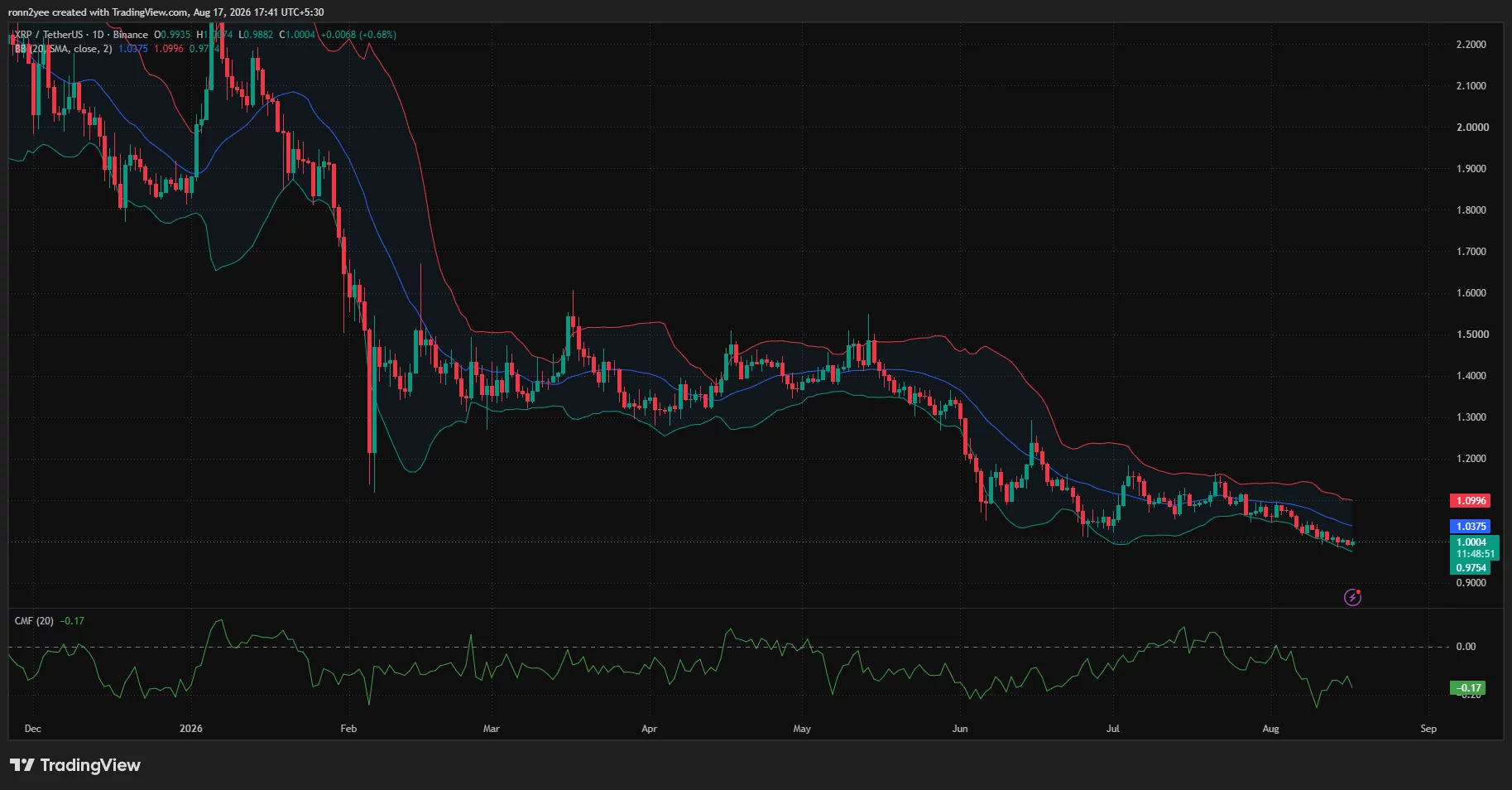
XRP price slipped 2.8% over the past seven days and briefly fell below the psychological $1 level as weak daily momentum, persistent capital outflows, and a broader downtrend kept buyers on the defensive.
Summary
- XRP price declined 2.8% over seven days and traded near $1.00 on Aug. 17.
- Daily Bollinger Bands place immediate resistance at $1.037 and support near $0.975.
- Negative daily Chaikin Money Flow shows that sellers still control the broader trend.
- Liquidation clusters near $1.01 and $0.98 could shape XRP’s next short-term move.
XRP price action today
According to data from crypto.news, XRP (XRP) price was trading around $1.00 on Aug. 17 after briefly falling below the level during the latest sell-off. The token has now lost about 73% from its cycle high above $3, according to market analyst Crypto Patel, while the daily chart continues to produce lower highs and lower lows.
The decline accelerated during the first half of August as XRP fell from approximately $1.14 to a low near $0.98. A short recovery subsequently returned the price to $1.00, but buyers have yet to secure a sustained daily close above nearby resistance.
XRP’s struggle around $1 follows a wider retreat that began after the token traded above $2 in January. It fell sharply to approximately $1.40 in February, consolidated through May, and then resumed its decline in June.
The latest breakdown has placed the token at one of its most important psychological levels. A daily close below $1 would confirm that sellers can keep the price beneath a zone that previously attracted buyers, while a quick recovery could turn the move into a false breakdown.
Lower market participation has added to the pressure. With fewer buyers absorbing sell orders, relatively modest selling can produce wider price swings around the $1 threshold.
Daily indicators keep XRP under pressure
XRP remains below the middle line of its daily Bollinger Bands, which stands near $1.037. The middle band acts as a short-term trend gauge, meaning the token must reclaim it before the chart can show an early improvement in momentum.
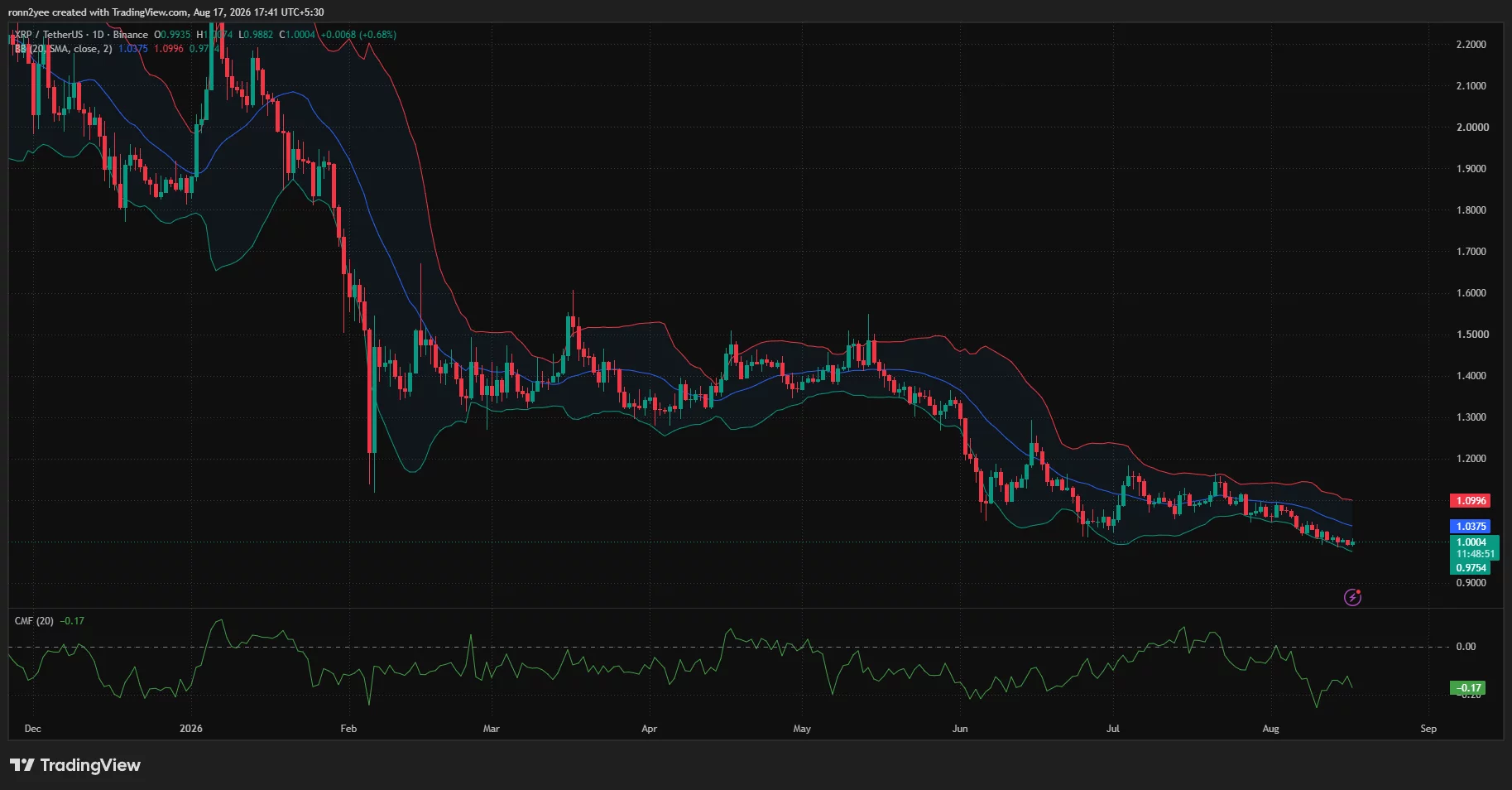
The upper Bollinger Band sits near $1.099, creating a wider resistance zone between $1.04 and $1.10. XRP has not traded above the upper end of that area since early August, when an attempt to hold around $1.14 failed.
The lower band is positioned at approximately $0.975. Price is currently pressing against this side of the range, showing that the market remains stretched toward the downside. Lower-band contact can precede a temporary bounce, but it does not confirm that the wider decline has ended.
Chaikin Money Flow on the daily chart stands at -0.17. A reading below zero indicates that selling volume has outweighed buying volume during the indicator’s 20-session measurement period.
Persistent negative money flow weakens the case for a durable recovery because rallies are receiving limited support from fresh capital. XRP would need the indicator to move back toward zero, alongside a recovery above $1.037, to provide stronger evidence that accumulation has returned.
4-hour XRP chart shows an early bounce attempt
The 4-hour chart offers a slightly more constructive signal. XRP was trading around $1.001 while its Chaikin Money Flow reading had risen to 0.09, suggesting that some buyers entered near the latest lows.
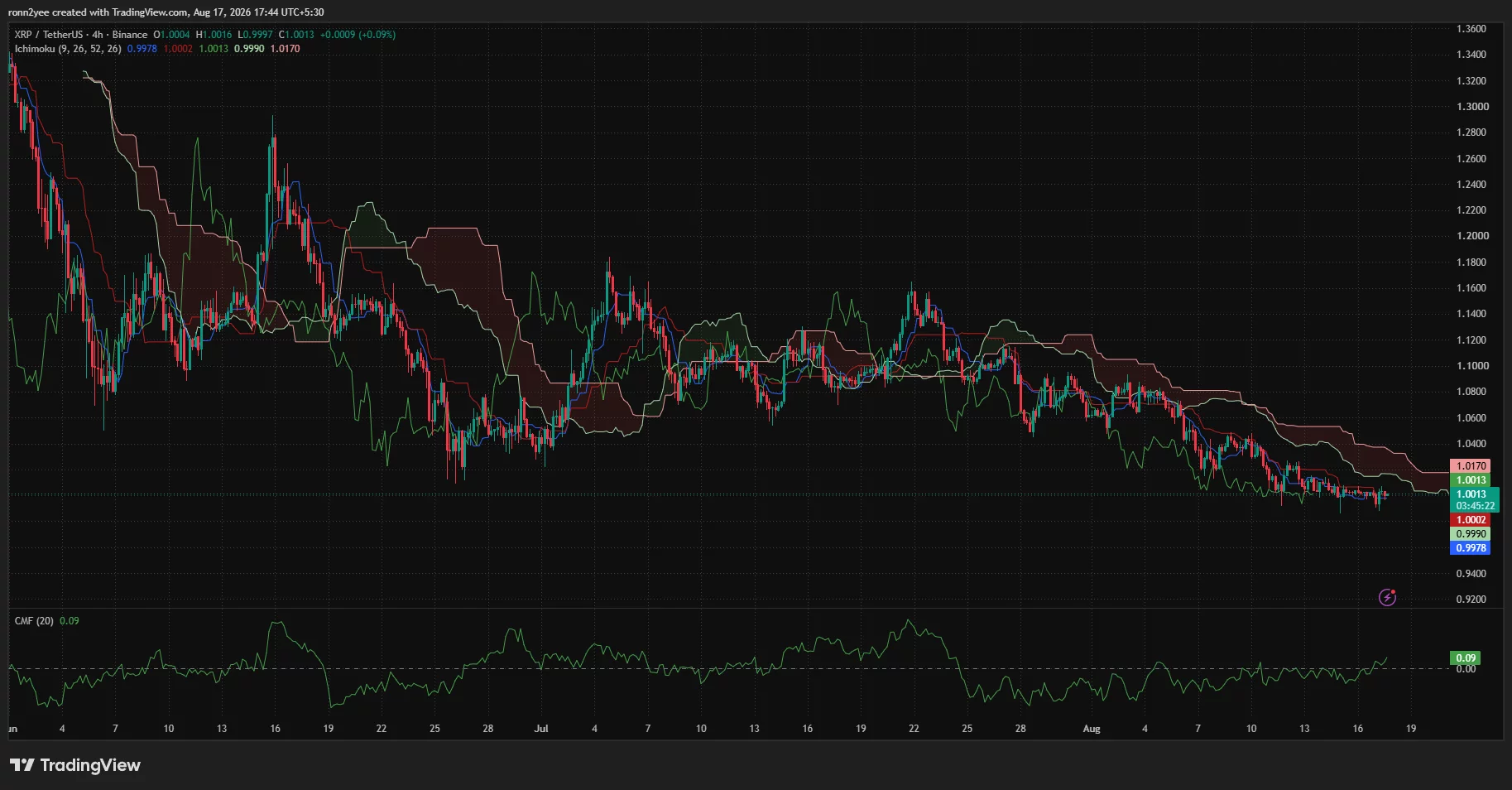
XRP price has also moved marginally above the Ichimoku conversion line near $0.998 and the baseline around $1.000. Those levels show that very short-term momentum has stabilized after the recent decline.
However, XRP remains below the main Ichimoku cloud, with its upper boundary near $1.017. The cloud has also continued to slope downward, maintaining the bearish structure visible since late July.
A 4-hour close above $1.017 would provide the first meaningful sign that buyers are regaining control. The next resistance levels would then sit near $1.037 and $1.05, followed by the daily upper Bollinger Band around $1.10.
Failure to clear the cloud could leave XRP trapped between $0.99 and $1.02. Another rejection near $1.01–$1.02 would increase the risk of renewed pressure on the August low.
Liquidation heatmap places $0.98 at risk
CoinGlass’ three-day liquidation heatmap shows a dense concentration of leveraged positions immediately above XRP’s current price. The strongest nearby upside pool is located around $1.011, with additional liquidity near $1.02.
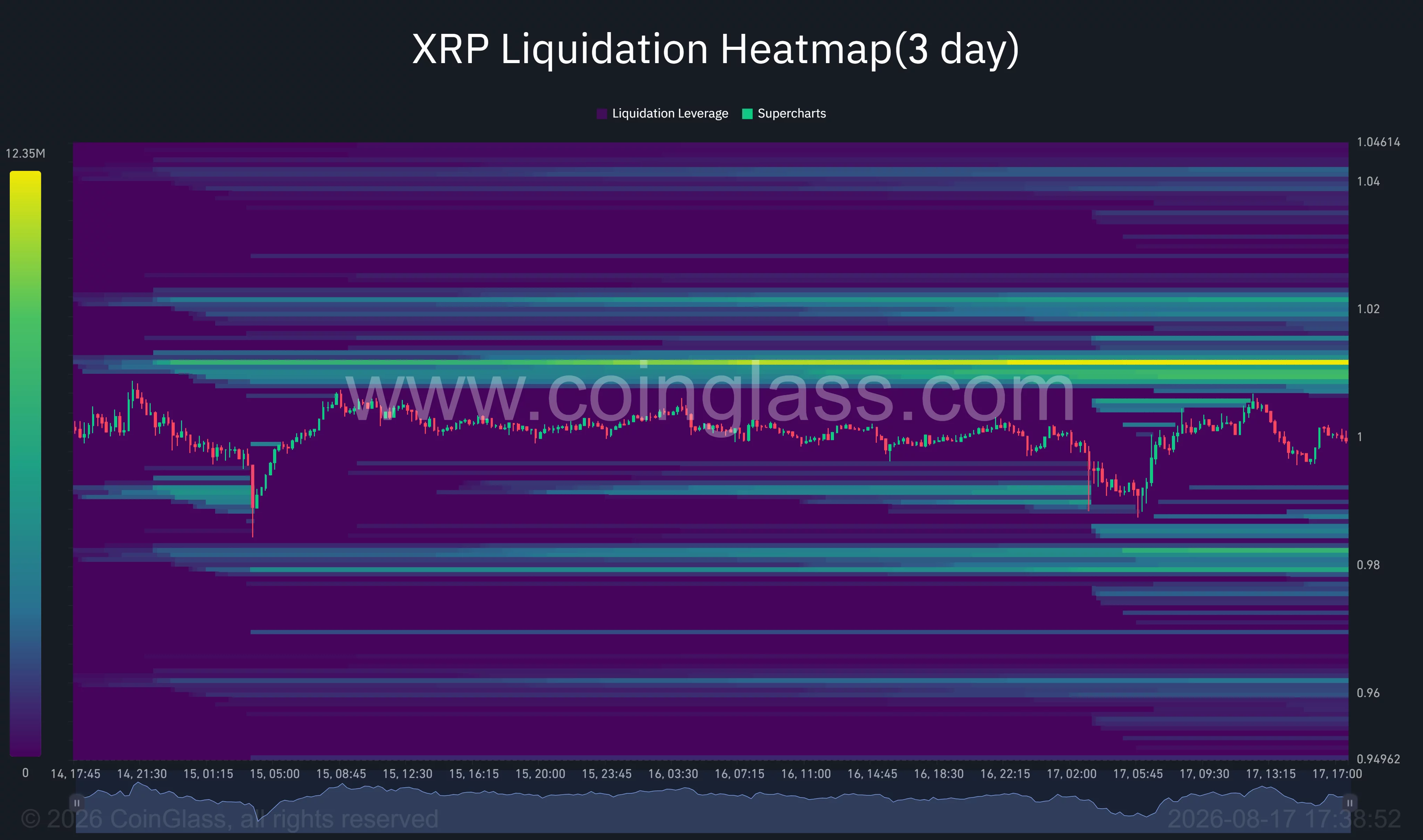
Price often moves toward areas containing large volumes of leveraged positions because liquidations can increase volatility once those levels are reached. A move through $1.011 could therefore trigger short liquidations and help XRP test $1.02.
The downside also contains several liquidity pockets. The clearest cluster sits near $0.98, close to the daily lower Bollinger Band at $0.975. Further concentrations appear around $0.96, although they are less immediate.
A decisive loss of $0.99 could expose the $0.98–$0.975 region and force leveraged long positions to close. If buyers fail to defend that range, XRP could extend its decline toward $0.96.
The heatmap leaves the token between competing liquidity pools, making $1.011 the immediate upside level and $0.98 the main downside target.
Analysts disagree over whether XRP has reached a bottom
Crypto Patel said XRP could fall another 20% to 40% before forming a major reversal. The analyst identified $0.85–$0.65 as a long-term accumulation range but said capital should be deployed gradually rather than used to catch an exact bottom.
Such a decline would require XRP to break the current $0.975 support and extend below the lower liquidity areas shown on the three-day heatmap. The analyst’s longer-term targets of $3, $5, $7, and $10 depend on a future reversal confirmation and are not supported by the current daily trend.
Analyst Gerla offered a more constructive interpretation, arguing that XRP is testing a long-term trendline while forming a bullish divergence on the relative strength index. A bullish divergence occurs when the price records a lower low while momentum produces a higher low, sometimes preceding a recovery.
The competing forecasts make confirmation around $1 more important than either projection. For US investors, the immediate setup remains tied to liquidity and broader risk appetite: reclaiming $1.037 would weaken the bearish case, while a daily close below $0.975 would expose $0.96 and potentially the analyst’s $0.85 accumulation level.
Disclosure: This article does not represent investment advice. The content and materials featured on this page are for educational purposes only.

The US Office of the Comptroller of the Currency (OCC) has granted World Liberty Financial conditional approval to operate as a national trust bank, a decision that immediately reignited political scrutiny over potential conflicts of interest involving President Donald Trump and members of his family.
In a Friday notice, the OCC said its conditional approval for World Liberty’s charter application would permit the company to proceed as “World Liberty Trust Company, National Association,” subject to regulatory and policy requirements. World Liberty’s filing indicates the bank would support US dollar-backed stablecoin issuance and would custody digital assets related to its USD1 token.
Key takeaways
- The OCC’s approval is conditional, allowing World Liberty to move forward as a national trust bank only under specified requirements outlined by regulators.
- World Liberty’s charter application contemplates issuing US dollar-backed stablecoins and providing custody for digital assets linked to its USD1 token.
- Criticism from US lawmakers centers on possible conflicts of interest tied to Trump family involvement and the OCC leadership appointment.
- Sen. Elizabeth Warren announced new legislation aimed at addressing what she described as “presidential corruption” in banking following the OCC’s action.
- The decision arrives amid a broader pattern of OCC approvals and conditional approvals for crypto firms seeking trust charters.
What the OCC approved—and what it still requires
The OCC’s Friday notice frames the action as consistent with statutory duties and ethical obligations. The regulator’s conditional approval means World Liberty may be able to operate under the proposed name—World Liberty Trust Company, National Association—but must satisfy the conditions attached by the OCC before fully realizing its intended banking activities.
According to World Liberty’s application, the planned business includes issuing stablecoins backed by US dollars and custodying digital assets connected to the company’s USD1 token. For investors and users watching the intersection of crypto rails and traditional finance, the significance lies in what a national trust bank framework can enable: a regulated structure for custody and, potentially, issuance-linked services, depending on how requirements are ultimately met.
Conflict-of-interest concerns drive the political backlash
Opposition to the approval is rooted in allegations that regulators and the White House could be subject to improper influence. The OCC’s action comes as lawmakers have pressed questions about relationships between World Liberty and the Trump family.
The OCC approval followed heightened scrutiny about potential conflicts of interest between the company and President Trump’s family. The president and three sons are described as affiliated with World Liberty. The head of the OCC, Jonathan Gould, was also nominated by Trump in 2025. Separately, World Liberty’s website has indicated that a Trump family entity controls 38% of the company’s equity interests.
While the OCC stated that it acted in line with its ethical obligations, the political dispute escalated immediately after the announcement. Sen. Elizabeth Warren said she had introduced legislation “to stop this kind of unprecedented corruption,” calling the OCC’s move “the most brazen act of self-dealing our financial system has ever seen.” Warren and nine other senators introduced the “Ending Presidential Corruption in Banking Act” following the approval.
Warren’s comments and the filing of new legislation underscore a key uncertainty investors should track: the OCC may have issued conditional approval, but Congress could still push for legal and oversight changes that affect how—or whether—such bank charters are granted or operated when political relationships are at issue.
Gould said review would be apolitical earlier
Prior to Friday’s decision, Gould had indicated the charter review would be conducted through an “apolitical and nonpartisan process.” Earlier coverage from Cointelegraph noted that Gould made this point while referencing the review process after correspondence from Sen. Elizabeth Warren.
In the Friday notice, the OCC emphasized that its “Comptroller and staff acted consistently with their statutory duties and ethical obligations with respect to the Application.” The regulator’s language suggests it believes the same standards applied regardless of the controversy—an important distinction for market participants assessing regulatory risk.
Still, the rapid pivot to legislative action suggests the dispute is not confined to regulatory conditions. The coming months will likely determine whether Congress focuses on reinforcing ethical firewalls for bank licensing in crypto-adjacent businesses, particularly where political ties are alleged.
World Liberty’s wider ecosystem ties remain under investigation
Beyond US regulatory concerns, the approval also reopened questions about World Liberty’s relationships with foreign entities. According to earlier reporting, an Abu Dhabi investment company backed by UAE national security adviser Sheikh Tahnoon bin Zayed Al Nahyan reportedly purchased a 49% stake in World Liberty in January 2025 for $500 million. Another UAE entity, MGX, used World Liberty’s USD1 stablecoin to invest $2 billion in crypto exchange Binance. The same reporting notes that Trump later issued a presidential pardon for former Binance CEO Changpeng Zhao.
A White House spokesperson has repeatedly said there were “no conflicts of interest“ with Trump’s investments, a position that lawmakers challenging the charter approval say does not address broader governance and transparency concerns.
The continued attention matters because national trust banking is tightly linked to trust, custody standards, and compliance. If lawmakers pursue investigations or new rules affecting how these relationships are disclosed or managed, the operational path for World Liberty’s stablecoin and custody plans could change.
How this fits into the OCC’s broader crypto charter push
The OCC’s conditional approval also reflects an ongoing trend under the Trump administration: approving or conditionally approving multiple applications from crypto companies seeking trust charters to expand their services in the US.
In December, the OCC approved applications from Circle, Ripple Labs, Crypto.com and Coinbase after passage of the GENIUS stablecoin bill in Congress, according to earlier coverage from Cointelegraph. That earlier wave of approvals sets a reference point for how the OCC has been moving toward regulated stablecoin and related services.
World Liberty’s case adds a new layer to that pattern because the controversy is not only about crypto compliance and licensing. It is also about the governance question of who benefits, who influences, and how regulators insulate decisions from political entanglement.
For readers, the next thing to watch is how the OCC’s conditions are spelled out and implemented for World Liberty’s charter to fully take effect, alongside whether Congress’s “Ending Presidential Corruption in Banking Act” gains traction that could reshape licensing standards for bank charters tied to politically connected firms.


OpenAI has signed a 20-year lease for 4.25 gigawatts of initial AI capacity at an Ohio data center supported by up to $105 billion in guarantees from Nvidia.
Summary
- OpenAI’s lease at the PORTS-Pike campus is expected to begin in phases in 2028.
- Nvidia has capped its initial guarantee obligations at a combined $105 billion.
- SB Energy will build, own, and operate the Pike County data center.
- Nvidia will invest $1.5 billion in SB Energy and provide the campus’s AI systems.
Nvidia’s Aug. 17 announcement said OpenAI will use the PORTS-Pike Technology Campus in Pike County, where SB Energy will build, own, and operate the infrastructure under the long-term lease.
The chipmaker will serve as the campus’s exclusive AI compute provider, supplying its DSX AI factory platform. OpenAI’s systems will use Nvidia GPUs, CPUs, and networking equipment, with the first capacity scheduled to become available in phases beginning in 2028.
Built across private and federal land, the campus will occupy the former Portsmouth Gaseous Diffusion Plant and surrounding property in southern Ohio. SB Energy is developing the project with AEP Ohio, the U.S. Department of Energy, and the Department of Commerce.
Nvidia has secured the land, power, and building shell required for an initial 4.25 gigawatts of IT load. The company also holds an option for the remaining 3.75 gigawatts, potentially taking the campus to 8 gigawatts of AI capacity.
Nvidia has provided a $105 billion lease guarantee
In an Aug. 17 SEC filing, Nvidia disclosed several residual-value guarantee agreements covering OpenAI’s initial 4.25-gigawatt commitment.
The company’s combined payment obligations under the agreements cannot exceed $105 billion. Each guarantee generally becomes effective when the related lease starts, provided SB Energy satisfies the ready-for-service conditions for the relevant section of the campus.
OpenAI remains responsible for paying the lease. Nvidia would face a payment obligation only if OpenAI became insolvent and defaulted or failed to make the required payments, according to the filing.
Following such an event, Nvidia would generally cover the difference between the lease’s guaranteed minimum value and the amount SB Energy recovered through a replacement tenant or property sale. Nvidia could also assume the lease, ask SB Energy to find another tenant, begin a sale process or allow the lease to end.
Another provision would let Nvidia postpone those remedies for up to one year while paying certain project costs. OpenAI has agreed to reimburse and indemnify the chipmaker for any money it pays to SB Energy under the guarantees.
The guarantee for each section can run until the 20th anniversary of the applicable lease. Nvidia’s obligation could end earlier if OpenAI terminates the lease under its terms, achieves a satisfactory credit rating or meets another termination condition stated in the agreements.
Addressing concerns about circular financing, Nvidia CEO Jensen Huang said OpenAI, rather than the chipmaker, will make the lease payments. If OpenAI does not use the capacity, Huang said the site could be offered to another eligible customer.
“Nvidia compute is versatile, fungible and broadly adopted,” Huang wrote, adding that the capacity could be resold to cloud providers, enterprises, AI laboratories or startups in the company’s customer network.
OpenAI will use Nvidia’s full AI technology stack
At the Ohio site, OpenAI will deploy Nvidia’s DSX platform across the initial 4.25-gigawatt buildout, subject to limited exceptions disclosed in the SEC filing. The platform combines data center facilities, computing hardware, networking, and software into one system.
Huang described land, power, and finished data center space as essential resources for the AI industry, where companies need large power commitments before installing computing equipment.
“We are securing long-lived infrastructure for Nvidia compute so OpenAI can deploy the most productive AI factories,” Huang said.
Alongside its guarantee, Nvidia will invest $1.5 billion in SB Energy. The investment will place the chipmaker beside existing investors SoftBank Group and OpenAI while providing capital for SB Energy’s data center projects and local commitments.
SB Energy and SoftBank plan to build at least 10 gigawatts of new electricity generation to support 8 gigawatts of IT capacity. The companies will also invest at least $4.2 billion in regional grid infrastructure through an agreement with AEP Ohio, Nvidia said.
According to the announcement, the power and grid arrangements are designed to prevent existing Ohio electricity customers from carrying the project’s infrastructure costs. SB Energy co-CEO Rich Hossfeld said the group would build the site while “protecting ratepayers” and investing in southern Ohio.
The project is expected to support about 35,000 construction jobs through 2032 and create roughly 2,500 permanent operating positions, Reuters reported. OpenAI and SB Energy have also established an $80 million community benefits fund after OpenAI added $40 million to SB Energy’s original commitment.
Funding from the program is intended for affordable energy, workforce training, employment programs, and local economic development. OpenAI CEO Sam Altman said the company wants Pike County residents to benefit through jobs, business opportunities, and community investment.
AI demand has increased competition for power and land
OpenAI’s lease adds to a series of large infrastructure commitments as AI companies secure electricity, grid connections and data center sites. Advanced computing projects often require years of preparation because utilities must add generation and transmission capacity before servers can begin operating.
For crypto investors, the same demand has increased interest in Bitcoin miners that already control powered land and grid connections. As crypto.news reported in May, former OpenAI researcher Leopold Aschenbrenner’s fund held positions in IREN, Core Scientific, Riot Platforms, CleanSpark, Bitfarms, Bitdeer, and Hive Digital as part of a power-and-compute investment strategy.
The fund’s SEC filing showed $13.67 billion in disclosed equity exposure at the end of the first quarter. Several miners have been converting existing sites or planned capacity into high-performance computing facilities because the infrastructure can serve AI customers as well as proof-of-work networks.
OpenAI has also diversified the cloud services used to distribute its models. In April, the company expanded its AWS access after revising its relationship with Microsoft, allowing OpenAI models and its Codex agent to become available through Amazon Bedrock.
While securing additional computing capacity, OpenAI has continued preparing for a possible public listing. Reports in June said executives were considering a potential 2027 IPO rather than accepting a lower valuation in 2026, while SoftBank shares fell 12.5% after the reports emerged.
Polymarket traders currently assign about a 20% probability to OpenAI completing an IPO by the end of 2026. Prediction-market prices can change as traders enter or leave positions and do not represent an announcement from the company.
Nvidia said the full guarantee agreements will be filed as an exhibit to its Form 10-Q for the fiscal quarter that ended July 26, 2026.
Miss a form, lose your money. That is the lesson of the FTX bankruptcy, and it drives the only dispute set for August 19.
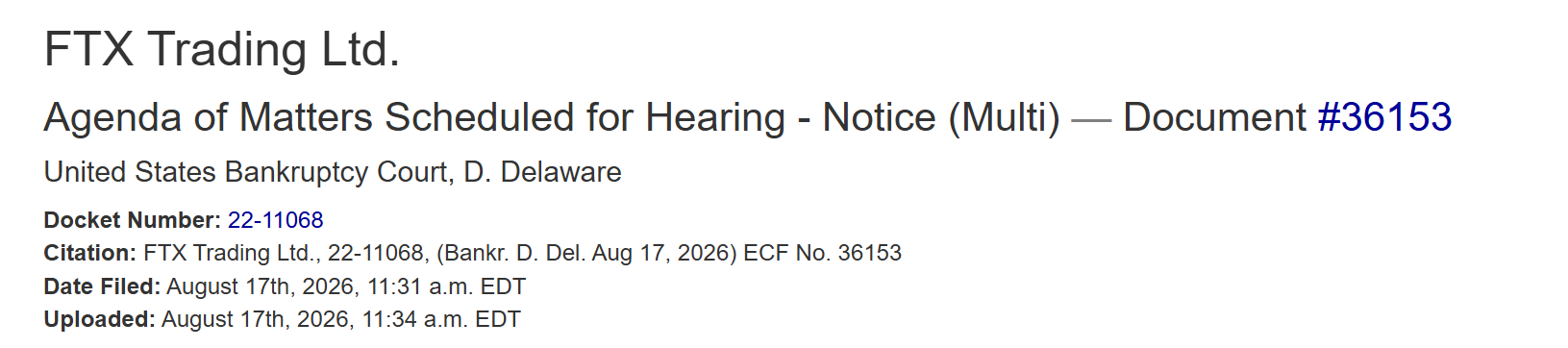
A court agenda filed Monday leaves one customer motion before Chief Judge Karen B. Owens. Claimant Daizhuo Chen wants a second chance at a verification deadline he missed.

What Is Left on the FTX Bankruptcy Docket
Chen filed his motion on March 27. He asks Owens to undo her refusal to let him finish his checks late.
He cites Federal Rules of Civil Procedure 59(e) and 60(b)(2). Those rules let a judge reopen a decision when fresh evidence appears. Owens has not said any exists here.
The timeline is tight and well documented. FTX told customers to begin verification by March 1, 2025, and to finish by June 1, 2025. Both deadlines closed at 4 p.m. ET.
The FTX Recovery Trust, the entity now winding down the estate, objected again on July 16. It has fought similar requests before.
Chen is not alone. D1 Ventures has chased $251,000 in USDC and USDT since December 2022. The Trust says that account never cleared verification either.
That motion was adjourned again with no new date. Two other suits were also pushed back, so both stay open.
Ernst & Young filed a final fee application. Counsel will submit orders without argument, another sign the estate is closing out.
Why a Missed KYC Deadline Can Cost a Creditor Everything
Verification is the gate to payment. Claimants must clear know your customer (KYC) checks, file tax forms, and onboard with BitGo, Kraken or Payoneer.
Skip any step and the money moves on without you. The Trust has said hundreds of thousands of customer claims were already thrown out for failing these checks.
The gap between the two groups is stark. Creditors who finished the paperwork have recovered their full claims, and several classes got more.
- Convenience claims, 120% recovered
- U.S. customer claims, 100%
- General unsecured claims, 100%
- Dotcom customer claims, 96%
Those totals run through the fourth round of repayments on March 31, which sent out about $2.2 billion. Roughly $900 million followed on July 31 in the smallest FTX distribution so far.
Money is still held back for contested claims. The Trust has asked to cut that reserve by $600 million, from $2.4 billion to $1.8 billion.
So Owens’s reasoning matters well beyond Chen. Anyone still shut out over paperwork will read it for an opening.
Sam Bankman-Fried has no role in any of this. His conviction and 25-year sentence were upheld in June. The appeal mandate issued in August ended his case at the Second Circuit.
The hearing starts at 9:30 a.m. ET on Wednesday by Zoom. Owens is expected to rule from the bench. Her answer will tell every late filer how much room is left.
The post FTX Bankruptcy Hearing Is Down to One Last Fight appeared first on BeInCrypto.
Disclosure: This article does not represent investment advice. The content and materials featured on this page are for educational purposes only.
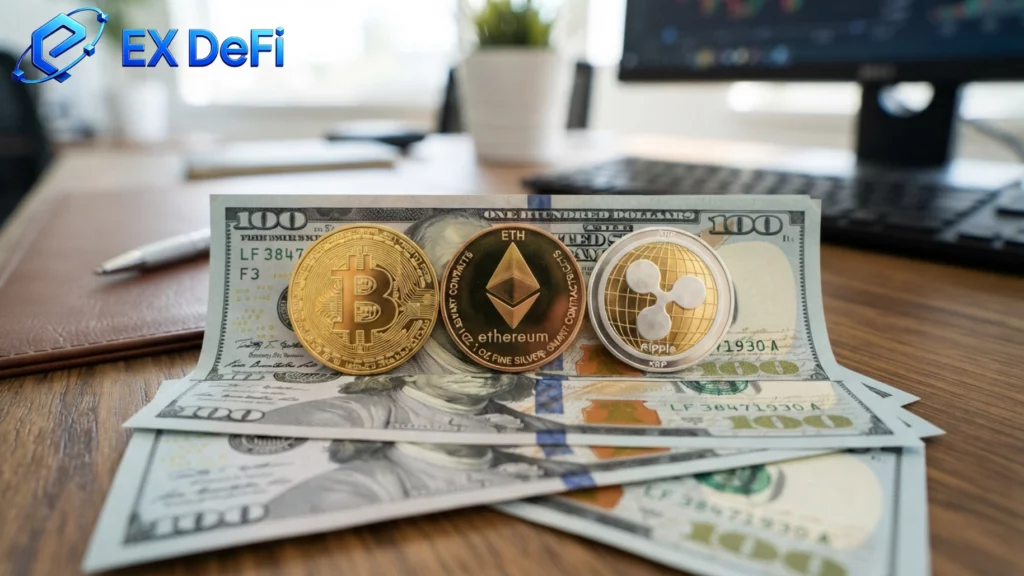
As BTC, ETH, and XRP face heightened volatility, EX DeFi is attracting attention with a cloud mining model focused on long-term digital asset participation.
Summary
- Bitcoin volatility is pushing investors to explore EX DeFi’s cloud mining model as an alternative way to earn from digital assets.
- EX DeFi is gaining attention among Bitcoin holders seeking diversified returns through cloud mining and renewable energy infrastructure.
- As crypto markets remain volatile, EX DeFi offers Bitcoin holders access to cloud mining without the need for costly mining hardware.
The cryptocurrency market has recently been rocked by another shocking security incident. Attackers exploited a vulnerability in the firmware of Coldcard hardware wallets to drain funds from numerous Bitcoin addresses, sparking widespread concern regarding the security of hardware wallets and the risks associated with self-custody of digital assets. Public investigations indicate that the scale of the theft linked to this vulnerability has already reached hundreds of millions of dollars, with the total loss still being tallied.
The incident began on July 30, 2026. Galaxy Research discovered that attackers transferred approximately 1,083 BTC from over 1,000 addresses in just 41 minutes, followed by subsequent waves of fund transfers. As investigations progressed through mid-August 2026, the number of confirmed affected addresses and the volume of stolen BTC continued to rise.
What makes this incident unique is that the issue did not stem from the Bitcoin blockchain itself; rather, it was linked to the random number generation mechanism used by certain Coldcard firmware versions when creating wallet seed phrases. This vulnerability rendered the seeds generated by some wallets predictable, thereby increasing the risk that private keys could be derived and funds stolen.
This has prompted many investors to reconsider a fundamental question: Is Bitcoin itself still safe?
In reality, this incident highlights security risks inherent in cryptocurrency storage tools and private key management, rather than a compromise of the Bitcoin network itself. For investors, selecting a secure and reliable method of asset management has become an increasingly critical aspect of digital asset investment.
As market panic intensified, the prices of major cryptocurrencies such as BTC, ETH, and XRP experienced significant volatility. Many investors began to wonder: beyond simply waiting for price appreciation, are there more efficient and sustainable ways to participate in Bitcoin’s long-term value growth?
Against this backdrop, a growing number of investors are turning their attention to EX DeFi — a platform offering stable returns by combining cloud mining with renewable energy. It allows investors to hedge against short-term market risks while focusing on Bitcoin’s long-term value and exploring more diversified ways to engage with digital assets.
A Firmware Flaw Dating Back to 2021
The root cause of this incident can be traced back to a firmware update released by Coinkite in 2021. The relevant update introduced a flaw in the random number generation process used for creating mnemonic phrases. Mnemonic phrases are a crucial component in generating master keys for hardware wallets; if randomness is insufficient, attackers can narrow down the range of potential seeds through calculation and analysis, thereby increasing the likelihood of recovering the associated private keys.
According to research organizations such as Galaxy Research, this issue had previously been reported to Coinkite by researchers. This large-scale attack indicates that some wallet seeds generated in the past may have been at risk for an extended period.
Public reports suggest that the specific range of affected Coldcard devices and firmware versions requires further confirmation via Coinkite’s official security announcements. Notably, simply updating the firmware does not fix wallet seeds that were already generated using the affected firmware; users must migrate their assets in accordance with the manufacturer’s security recommendations.
EX DeFi cloud mining: A new option for Bitcoin investors
Amidst heightened market volatility, an increasing number of digital asset investors are turning their attention to EX DeFi, seeking to explore diversified yield-generation models through methods such as cloud mining and yield aggregation.
For Bitcoin holders, EX DeFi offers a relatively straightforward way to participate in the digital asset ecosystem compared to high-volatility investment methods like futures trading. Users can access Bitcoin mining services without the need to deploy mining hardware or bear costs associated with equipment maintenance, allowing them to capitalize on Bitcoin’s long-term value while maximizing the utility of their digital assets.
Why is EX DeFi attracting increasing attention?
Amidst frequent security incidents involving digital assets, investors are paying greater attention to asset storage, platform security, and risk management.
1. Security and Stability
EX DeFi employs a multi-layered security architecture, integrating technologies from McAfee and Cloudflare alongside measures like offline cold wallets to provide comprehensive protection for platform operations and user assets.
2. Eco-friendly and Efficient
The platform’s mining operations utilize renewable energy sources — such as solar, wind, and hydroelectric power — aiming to minimize the environmental impact of energy consumption while maximizing computational efficiency.
3. Compliance and Transparency
The platform continuously improves its operational standards, data transparency, and user protection mechanisms, offering a clearer and more reliable environment for cryptocurrency services.
4. Smart Custody
EX DeFi handles daily operations, computing power management, and earnings settlement through a professional team and automated systems, allowing users to easily earn passive income.
5. Multi-currency Support
The platform supports a wide range of mainstream digital assets — including BTC, ETH, DOGE, SOL, XRP, USDC, LTC, and USDT — offering greater flexibility to diverse users.
6. Affiliate Rewards
The platform offers an affiliate program where users can earn referral commissions of 3% + 2% (up to a maximum of $50,000 in rewards) by inviting friends, making it easy to boost passive income even without making an investment themselves.
How do I use EX DeFi?
1. Sign Up
2. Select a Plan
Deposit Bitcoin or other supported digital assets, then choose a suitable mining plan based on budget and the contract term.
3. Earn Mining Returns
Once the contract begins, the system automatically contributes computing power to the mining pool; earnings are settled and credited to an account automatically within 24 hours. Upon contract expiration, the principal is automatically returned.
Examples of common contracts
BTC (Beginner Trial Contract): Investment: $100 | Term: 2 days | Daily Return: $4 | Total Profit: $100 + $8
DOGE (Golden Shell Mini Dogecoin Pro): Investment: $500 | Term: 6 days | Daily Return: $6.5 | Total Profit: $500 + $39
BTC (Canaan-Avalon-A1466): Investment: $1,000 | Term: 10 days | Daily Return: $13.4 | Total Profit: $1,000 + $134
LTC (Bitmain Antminer L7): Investment: $5,000 | Term: 20 days | Daily Return: $73.5 | Total Profit: $5,000 + $1,470
BTC (Bitmain S19K-Pro): Investment: $10,000 | Term: 30 days | Daily Return: $161 | Total Profit: $10,000 + $4,830
For more contract details, visit the EX DeFi website.
Summary
The Coldcard incident serves as a reminder to the market that the security of the Bitcoin blockchain and the security of digital asset storage tools are distinct issues. This incident did not involve a breach of the Bitcoin network itself; rather, it exposed the severe consequences that can arise from firmware vulnerabilities in specific hardware wallets, prompting investors to place greater importance on issues such as private key generation, asset custody, and platform security.
For long-term BTC investors, beyond monitoring price trends and market cycles, it is equally important to consider how to mitigate risks associated with relying on a single storage method and to explore more diversified approaches to digital asset management. EX DeFi aims to provide users with an alternative way to participate in the digital asset ecosystem through methods such as cloud mining, hash rate management, and renewable energy.
For more details, visit the official EX DeFi website.
Disclosure: This content is provided by a third party. Neither crypto.news nor the author of this article endorses any product mentioned on this page. Users should conduct their own research before taking any action related to the company.

I’ve found the best new-in M&S fashion for your autumn wardrobe

Bitmine Approaches 5% of Ethereum Supply, Despite $8.4B Unrealized Losses

The 4 Vikings Injury Issues After the Giants Game, Including a Season-Ending Gut Punch


-

 Fashion3 days ago
Weekend Open Thread: Ann Taylor
-
 NewsBeat6 days ago
Communication cards help banking customers access services or report scams
-
 Business7 days ago
Oil Price Today (August 11): Crude oil rises to $88 after Trump’s compensation demand dents Hormuz opening. Here’s why
-

 Crypto World7 days ago
Revolut wins French banking licence, creates second EU banking hub
-
 Sports4 days ago
This U.S. Amateur is a glimpse into golf’s future in more ways than you think
-

 Sports3 days ago
Birmingham 2026: Day 6 Timetable for Irish Athletes
-
 NewsBeat3 days ago
Myanmar says over 300,000 Rohingya refugees verified for repatriation as exodus enters ninth year
-

 Politics3 days ago
SEQ Code: The Three Letter Boarding Pass Code That Could Give You The Worst Seat
-
 Entertainment6 days ago
Keke Palmer Subtly Hints At Sean Evans Drama With Cryptic Post
-
 Entertainment7 days ago
57 Years Later, the Best Sitcom Ever Made Still Deserves a Reboot
-

 Fashion6 days ago
Coffee Break: The Fonteyn Jane Flat
-

 Tech6 days ago
Zoom Screen-Sharing Bug Let People Fully Take Over Other Devices On A Call
-

 Fashion6 days ago
Claire Life: Kicking Off MVAAFF With the C Suite Luncheon Featuring Phylicia Rashad, Letoya Luckett, and More!
-

 Fashion6 days ago
Should you refinance your debt? Pros, cons, and real numbers
-
 Crypto World6 days ago
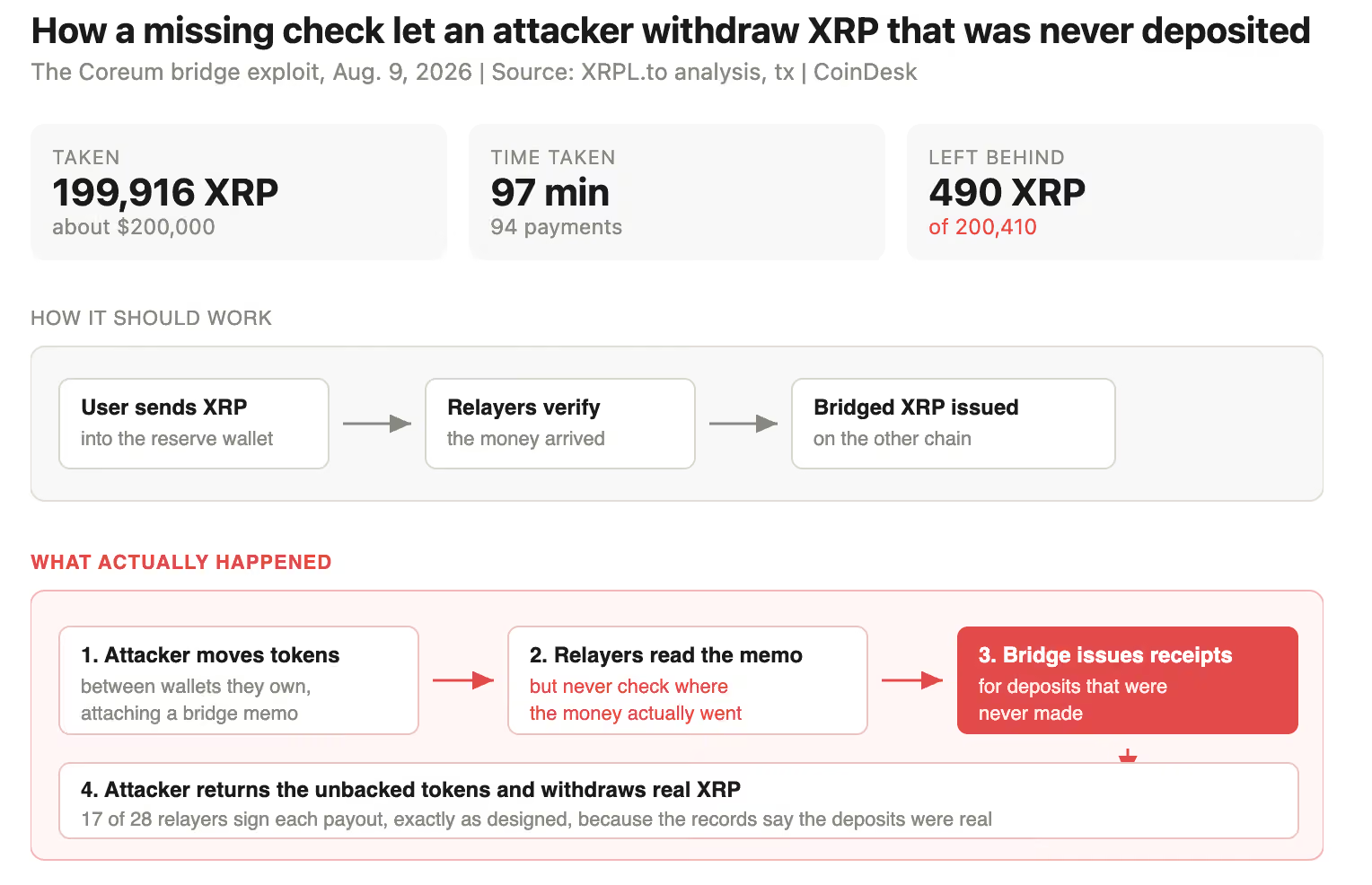
XRP bridge drained after software mistook fake deposits for real ones
-

 Sports5 days ago
DeQuan Jones in ‘high spirits’ after successful leg surgery
-
 Tech7 days ago
Zuck rekindles open weights Llama drama with Muse Glimmer
-

 Business7 days ago
(VIDEO) Emirates Unveils 2.4-Meter Arsenal Crest Sculpture Built From Recycled A380 And Boeing 777 Jet Parts
-

 Fashion7 days ago
How to Mix Diamond Rings With Gold & Silver Jewelry
-

 Fashion7 days ago
French Rose Gown with Cape Sleeves
You must be logged in to post a comment Login