Crypto World
Driving Enterprise AI Transformation & ROI in 2026

Artificial Intelligence is no longer an experimental capability; it is redefining how businesses generate revenue, manage risk, optimize operations, and compete at scale. In 2026, the impact of AI on businesses is visible in faster decision cycles, predictive supply chains, autonomous customer engagement systems, and data-driven product innovation. Intelligence is no longer layered onto systems; it is becoming the system itself.
Enterprises that embed AI into their operational core are compressing costs, accelerating time-to-market, and increasing customer lifetime value. Those who hesitate remain trapped in fragmented data environments and reactive decision models. The competitive divide is widening not because of access to AI tools, but because of how strategically AI is integrated into enterprise architecture, often with the support of an experienced AI Development Company capable of aligning technology with measurable business outcomes.
This guide breaks down the real impact of AI on business performance, from data maturity and workflow orchestration to ROI measurement and autonomous operations. It provides a structured roadmap for leaders who want to move beyond pilots, scale intelligently through comprehensive AI Development Services, and convert AI investment into a measurable enterprise advantage.
1. AI in 2026: From Pilots to Production – The Adoption Reality Check
Despite massive hype and rapid investment growth, the journey from pilot projects to enterprise-wide AI adoption remains uneven.
- Gartner forecasts global AI spending will exceed $2.5 trillion in 2026, with AI services, infrastructure, and software driving massive enterprise budgets.
- Research shows that only a small percentage of companies have AI fully embedded in core workflows, with as few as 5% deriving significant value from their deployments, despite broad adoption efforts.
- IBM’s Global AI Adoption Index reports 42% of enterprises actively deploying AI, while another 40% remain in the exploration stage.
This gap between adoption and actual impact highlights a defining theme of 2026: AI is no longer optional, but far from fully realized.
2. Why Many AI Projects Fall Short: The “Execution Divide”
Data shows that enterprises frequently struggle to scale AI beyond proof-of-concept (POC) due to:
1. Lack of AI-Ready Data
AI systems are only as effective as the data that fuels them. Fragmented, noisy, or siloed data pipelines undermine model accuracy and enterprise insight generation.
2. Misalignment of Strategy with Business Outcomes
Executives often invest in technology first and strategy second, leading to solutions that don’t solve real business problems.
3. Organizational Resistance
AI transformations require process redesign, workforce shift, and governance maturity, not just technology. Without aligning people and workflows, most initiatives stall.
4. Overemphasis on Tools vs. Outcomes
Although 78% of organizations report using AI, only a fraction derive a measurable business impact because their workflows remain unchanged.
This execution gap is why many teams invest heavily but see little strategic value.
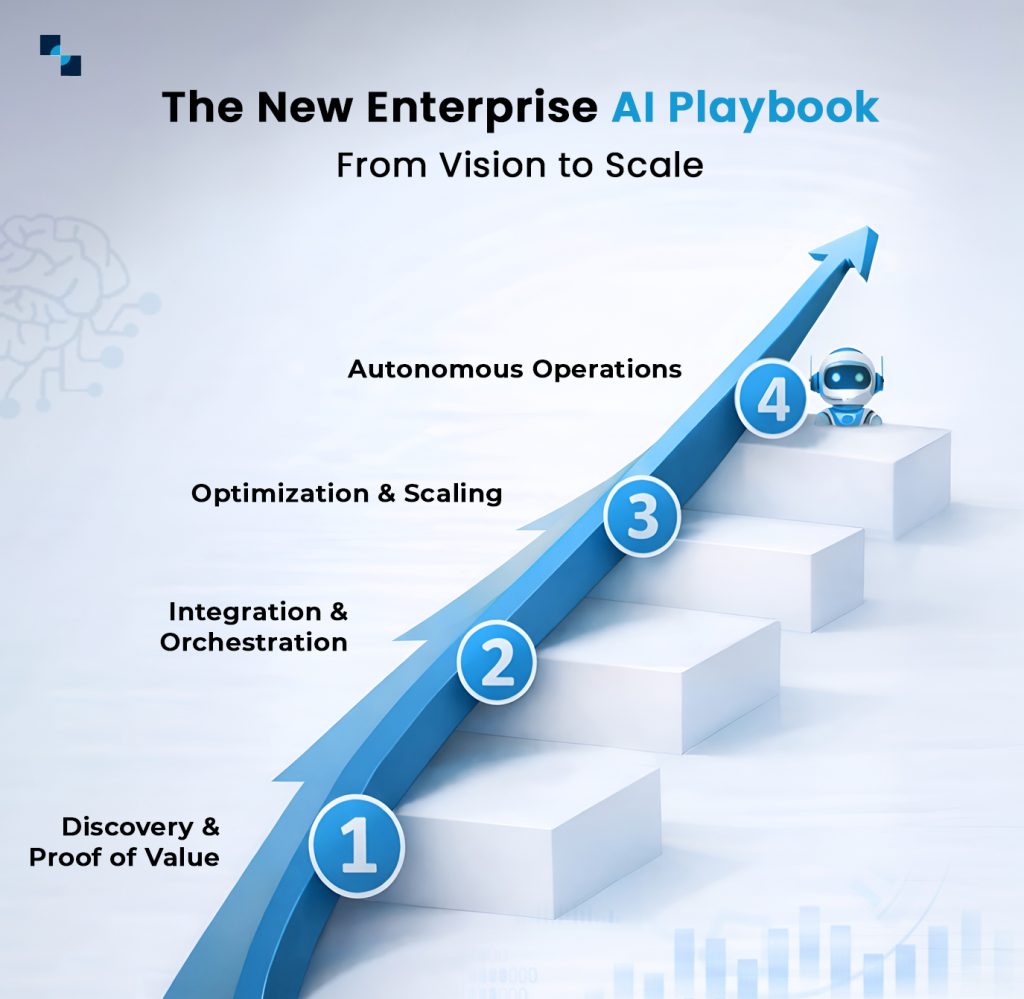
3. The New Enterprise AI Playbook: From Vision to Scale
To succeed in 2026, enterprises must follow a structured transformation path:
Stage 1: Discovery & Proof of Value
- Define specific business outcomes (e.g., cost reduction, revenue uplift, customer personalization).
- Identify high-impact use cases (e.g., automated claims processing, dynamic pricing models).
Stage 2: Integration & Orchestration
- Enterprises partnering with an AI Development Company for Business are embedding generative models directly into core operational workflows.
- Establish robust data governance frameworks.
Stage 3: Optimization & Scaling
- Transition from discrete models to a connected AI ecosystem that powers cross-functional intelligence.
- Track ROI consistently and build feedback loops for continuous improvement.
Stage 4: Autonomous Operations
- Mature organizations will reach a point where AI proactively manages resource allocation, pricing, and risk response.
According to Gartner’s 2026 Enterprise AI Outlook, the maturity of enterprise AI outcomes is increasingly determined by data readiness, seamless process integration, and clearly measurable ROI rather than by technology expenditure or model scale alone.

4. Demonstrable ROI: How AI Delivers Real Business Value
The most successful companies measure AI through three ROI dimensions:
Direct ROI
- Operational cost reduction
- Efficiency gains via automation and workflow augmentation
Indirect ROI
- Increased customer lifetime value through personalization
- Better customer satisfaction via AI-driven experiences
Strategic ROI
- Shorter product cycles
- Faster innovation via predictive insights and AI-augmented R&D
Organizations leveraging structured AI Development Services ensure that AI initiatives are aligned with measurable business objectives, linking model performance directly to revenue growth, operational efficiency, and strategic impact.
Recent enterprise research from Deloitte finds that AI delivers measurable outcomes such as enhanced customer relationships, operational efficiency, and increased revenue potential, though many companies are still in early phases of realization.
5. Generative AI: The New Enterprise Advantage
Generative AI has evolved from experimental technology into a critical enterprise capability. Unlike traditional AI that analyzes data, generative AI can create content, simulate scenarios, generate code, draft reports, design workflows, and support strategic planning. Enterprises partnering with an AI Development Company for Business embed these models directly into daily operational workflows across customer service, finance, marketing, procurement, and knowledge management.
Enterprises are deploying task-specific AI agents that handle repetitive, cognitive workloads, automate multi-step processes, support decision-making, and continuously optimize through real-time feedback. By engaging AI software developers, companies move beyond pilots toward integrated, enterprise-scale systems. These enterprise deployments are strengthened through structured AI software development services that ensure scalability, governance alignment, and long-term system resilience.
The result is a structural shift from standalone AI tools to digital workforce augmentation. Generative AI, implemented through AI-Powered Development Company expertise, becomes a strategic foundation that enhances productivity, accelerates execution, and transforms organizational performance into a scalable competitive advantage.
6. The Strategic Benefits of Partnering with an AI Development Company

Implementing AI at scale is not simply a technical exercise; it is an architectural transformation that touches data, workflows, governance, and long-term business strategy. Organizations that attempt to build advanced AI capabilities in isolation often encounter scalability bottlenecks, integration gaps, and unclear ROI.
Enterprises evaluating the best AI development companies prioritize scalability, governance maturity, architectural depth, and measurable ROI over experimental capability alone. Partnering with an experienced AI Development Company provides structured expertise that strengthens execution quality, accelerates deployment maturity, and ensures measurable business outcomes.
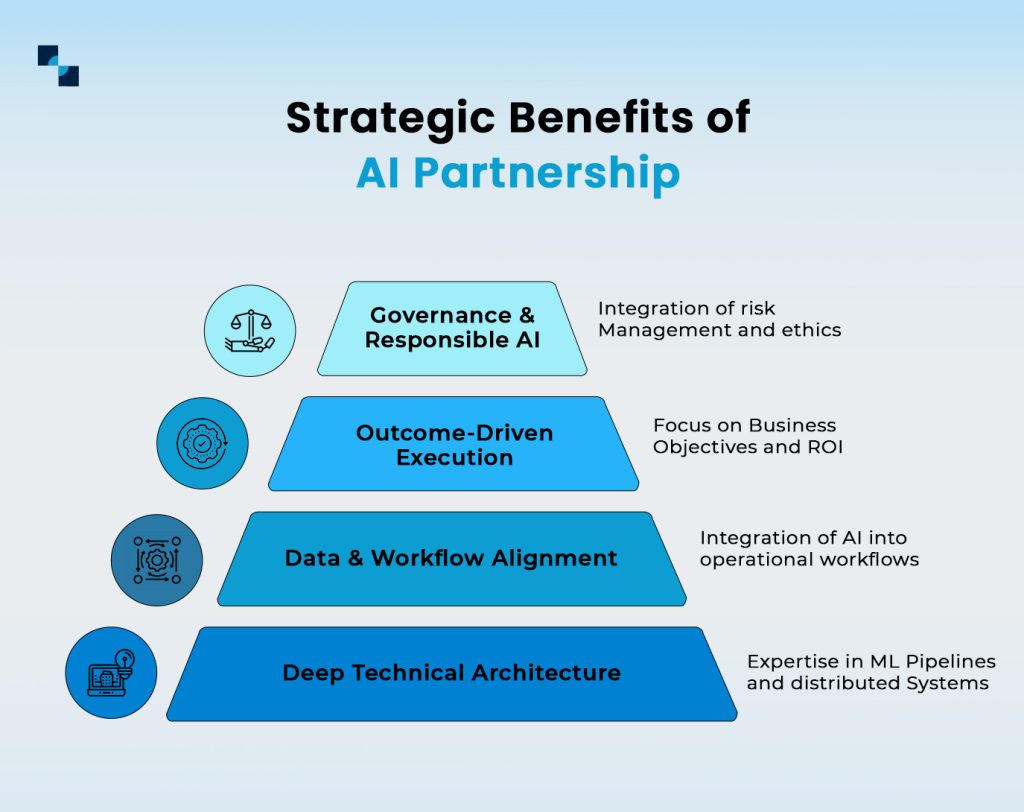
Deep Technical Architecture Capabilities
Enterprise-grade AI requires more than model deployment. It demands expertise in machine learning pipelines, large language models, agent-based orchestration, distributed systems, and secure infrastructure. Specialized AI teams understand how to design systems that are scalable, modular, and production-ready, not just experimental prototypes.
Data & Workflow Alignment
AI performance is fundamentally dependent on data quality and system integration. Strategic partners establish governed data pipelines, eliminate silos, and ensure models are embedded directly into operational workflows. This alignment transforms AI from a disconnected layer into a core operational engine.
Outcome-Driven Execution
Successful AI initiatives begin with business objectives, not algorithms. Experienced AI partners define clear performance metrics, build measurement frameworks, and align deployments with revenue growth, cost efficiency, and customer experience improvements. This approach ensures that AI investments translate into tangible enterprise value.
Governance, Risk, and Responsible AI
Enterprise deployment requires structured oversight. From model bias mitigation to compliance frameworks, data privacy safeguards, and auditability, governance must be engineered from the start. Strong AI partnerships integrate risk management and ethical design principles into system architecture, thus reducing exposure and ensuring long-term sustainability.
7. Workforce Transformation: The New Enterprise Skill Imperative
Artificial Intelligence is not merely optimizing workflows; it is redefining how work itself is structured, executed, and measured. As automation expands across cognitive and operational domains, roles are not simply being replaced; they are being redesigned. Organizations leveraging AI Development Services ensure that AI adoption is aligned with workforce transformation and skill development.
Across industries, millions of positions are evolving as AI systems absorb repetitive analysis, data processing, and routine decision-making tasks. Forward-looking enterprises engage ai software developers to equip employees with AI fluency, embedding it into performance metrics, leadership expectations, and career development pathways.
The emerging model is human enhanced by machine intelligence. Competitive advantage will depend not only on AI-Powered Development Company expertise but also on building intelligent teams capable of leveraging AI systems at scale.
Start Your Enterprise AI Transformation with Confidence
8. Building the AI-First Enterprise: The Future of AI Development Services
Over the next decade, AI will move beyond workflow support and become the structural backbone of enterprise design. Intelligence will be embedded across finance, operations, marketing, supply chains, product development, and risk management, not as a feature, but as core infrastructure built with AI Development Services.
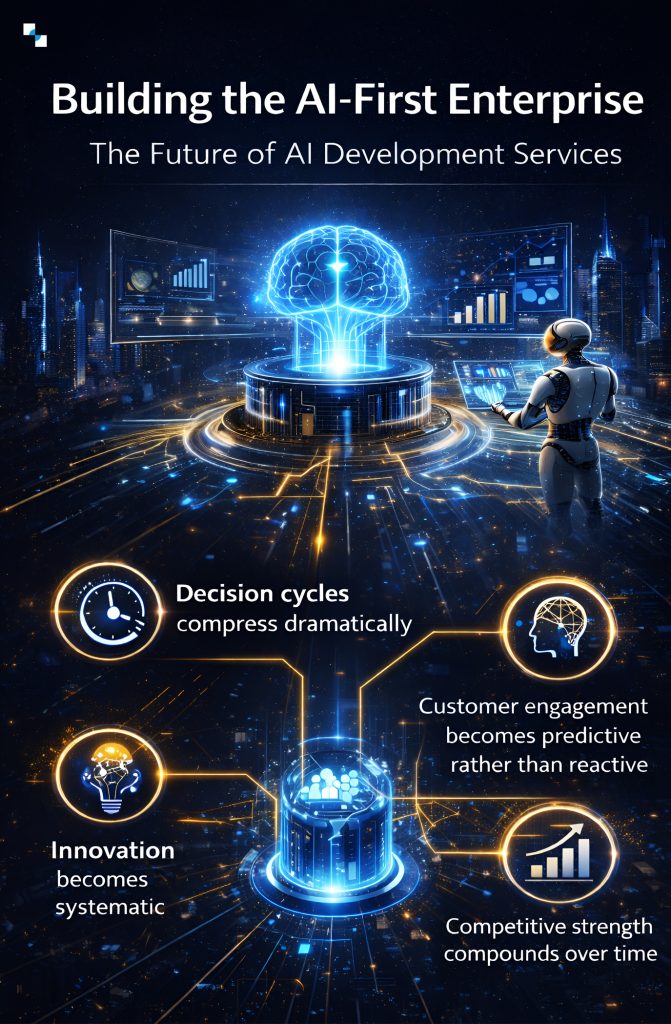
In AI-first organizations:
Decision cycles compress dramatically
Real-time data modeling enables dynamic forecasting, adaptive pricing, automated risk scoring, and continuous operational recalibration.
Customer engagement becomes predictive rather than reactive
Behavioral modeling anticipates needs, optimizes touchpoints, and adjusts experiences across channels in milliseconds.
Innovation becomes systematic
AI-assisted research, simulation environments, and rapid prototyping reduce development timelines and increase experimentation velocity.
Competitive strength compounds over time
Self-improving systems continuously refine algorithms using proprietary data, creating intelligence loops that are difficult for competitors to replicate.

The Standard for Modern Enterprise Excellence
Artificial Intelligence has moved from optional experimentation to operational expectation. Its impact on business performance is seen in margin expansion, faster decision-making, improved capital allocation, and measurable revenue growth. Enterprises must leverage AI Development Services to strengthen data foundations, align AI initiatives with financial metrics, embed governance, and build workforce capability for AI collaboration.
Organizations that treat AI as core infrastructure and partner with a trusted AI Development Company will outperform peers in efficiency, innovation speed, and customer value creation. Supported by custom AI development, businesses can institutionalize AI today to shape tomorrow’s market dynamics. Antier empowers enterprises with scalable, secure AI and blockchain solutions, driving measurable ROI through expert AI-Powered Development Company services with the dedicated support of experienced professionals guiding every stage of innovation and implementation.
Frequently Asked Questions
01. What is the current impact of AI on businesses as of 2026?
By 2026, AI is redefining business operations through faster decision cycles, predictive supply chains, autonomous customer engagement, and data-driven product innovation, becoming integral to enterprise systems.
02. Why do many AI projects fail to deliver significant value?
Many AI projects fall short due to a lack of AI-ready data, as fragmented and siloed data pipelines hinder model accuracy and limit enterprise insights.
03. How can enterprises effectively integrate AI into their operations?
Enterprises can effectively integrate AI by embedding it into their operational core, leveraging comprehensive AI development services, and aligning technology with measurable business outcomes to enhance performance and competitiveness.