
Crypto World
Dunamu and Visa Partner to Explore Stablecoin Payments, AI-Driven Financial Services


Dunamu, the parent entity of Upbit, has announced a strategic partnership with Visa. The partnership will explore stablecoin payments, AI-driven financial services, and international remittances.
Dunamu CEO Oh Kyung-seok and Visa Global President Oliver Jenkyn presented a roadmap for the partnership at Visa’s Global Market Support Center on August 26. However, they have not disclosed any product structure, launch date, blockchain, custody model, jurisdiction, or price details.
Dunamu and Visa Form Strategic Partnership
The partnership agreement was signed by Visa Worldwide Pte. Limited. Wu Blockchain elaborated on the partnership, saying the companies intend to combine Dunamu’s digital asset infrastructure with Visa’s global payments network. It will also explore stablecoin payments, global transfers, merchant settlements, AI-driven financial services, international remittances, and new user experiences.
“Dunamu, the operator of South Korea’s largest crypto exchange Upbit, has entered a strategic partnership with Visa to explore stablecoin payments, global remittances, and AI-driven financial services. The two sides are also considering business models based on the Open Standard dollar stablecoin OUSD. The specific service structure has not yet been determined.”
According to Dunamu and Visa, the partnership will consider applicable laws and regulatory requirements and develop services in a staggered manner. However, the announcement does not commit to a product launch or to offer stablecoin payments through Upbit. Dunamu added that the partnership will focus on regulatory compliance, transparency, interoperability, and stability. However, it did not elaborate on who would manage customer assets and compliance duties.
Meanwhile, Visa has expanded its stablecoin settlements and programmable payment work. It has also announced new infrastructure designed for AI-directed transactions, tokenized deposits, and stablecoins.
Will Open USD Be Part of the Arrangement
Dunamu and Visa also plan to evaluate business models involving the Open USD (OUSD). OUSD is a dollar-backed stablecoin developed using the Open Standard initiative. OUSD will support global payments and allows businesses to mint or redeem tokens without imposing any fee or volume limits. Open Standard lists Visa, Mastercard, BlackRock, Coinbase, and Dunamu among the organizations supporting the initiative.
However, Dunamu said in July that it did not agree to issue the OUSD stablecoin or participate in its launch and clarified it was still reviewing the proposal. The Visa partnership confirms that Dunamu will explore OUSD-based models. However, it does not clarify whether it will issue or operate the stablecoin.
Focus on Agentic Commerce
One of the partnership’s key focuses is payment infrastructure for agentic commerce. Agentic commerce is a digital shopping model in which AI models search, compare, select, and pay for products or services on behalf of users. Dunamu and Visa plan to explore the technology that supports the authorization, payment, and settlement for transactions completed by agentic commerce models. However, they have not disclosed how users will approve purchases, set spending limits, or dispute any transaction initiated and executed by AI agents.
AI purchases also raise several questions involving identity, consent, fraud, and liability. Additionally, stablecoin transactions are irreversible once completed on-chain. Visa has developed several tools to address these concerns, including AI agent verification and greater merchant control over automated transactions.
South Korean Legislation Could Affect Partnership
South Korea is yet to create a comprehensive regulatory framework for stablecoins, with lawmakers still debating who can issue won-based tokens and whether bank ownership should be mandatory. Additionally, dollar-based payment and remittance services could also be subject to the country’s anti-money laundering, foreign exchange, and virtual asset rules. Dunamu has acknowledged that regulatory developments in South Korea could affect its partnership with Visa. The company is also discussing stablecoin infrastructure with domestic technology and financial companies.
Visa and Shinhan Partnership
Visa’s partnership with Dunamu comes days after it announced a strategic agreement with the Shinhan Financial Group to test stablecoin issuance, remittance, and redemption on its payment platform. The agreement allows Shinhan to test stablecoin functions on Visa’s existing platform and create a business model that aligns with South Korea’s market. Shinhan also plans to connect Visa’s global payment network to its subsidiaries, including Shinhan Bank, Shinhan Card, and Jeju Bank. Jin Ok-dong, CEO of Shinhan Financial Group, stated that the agreement builds on its existing partnership with Visa and offers “differentiated financial experiences to customers.”
“Through this agreement, we have expanded our long-standing partnership with Visa to the broader digital finance sector.”
Disclaimer: This article is provided for informational purposes only. It is not offered or intended to be used as legal, tax, investment, financial, or other advice.



Cryptocurrency platform Bullish is extending a $100 million debt facility to USD.AI to finance GPU-backed loans for artificial intelligence infrastructure.


Yesterday, the SEC asked a federal court for injunctions against several crypto investment advisory firms who have displayed fake SEC certificates.
Naming crypto operators CryptoOrbit, Ftaexchange, Pinnacle, Quantum, RBH, and others, the SEC filed a total of 38 civil complaints over phony filings.
For example, the crypto-focused Quantum Financial Institute claimed it had registered investment advisor status that didn’t exist.
One of its incredible press releases pitched “a multi-dimensional intelligent investment system” and “courses” where students could learn about “bitcoin giveaways” and “the highest win-rate strategies, helping students understand the deep logic of the market.”
It even rendered a phony SEC certificate to dupe customers.
Commissioners are asking a federal court for injunctions to order civil penalties and to ban the defendants’ reporting exemption privileges for future advisory filings.
At the commission’s direction, FINRA has already removed non-compliant forms for these advisors from adviserinfo.sec.gov.
RBH Infinity Exchange Inc, Pinnacle Crypto Exchange Inc, THEVGPRO Ltd, Quantum Financial Institute Ltd, Ftaexchange Ltd, and other problematic crypto businesses are now defendants of US civil lawsuits.
SEC sues unregistered crypto advisors
Third-party, promotional write-ups of some of these crypto businesses falsely claimed that they carried valid SEC registration with numbers that precisely match yesterday’s SEC enforcement action.
Pinnacle, for example, marketed crypto swaps and its good standing with US regulators. THEVGPRO pitched a BTC backed “settlement security fund, enhancing global liquidity and payment efficiency” with registration numbers that the SEC never approved.
The SEC accuses these entities of making materially false statements on Form ADV, as well as failing to file disclosures.
Commissioners allege violations of Sections 204(a) and 207 of the Investment Advisers Act. They have not quantified investor losses in these initial complaints.
SEC staff attempted to contact many crypto advisors making false claims. Several phone numbers were disconnected or belonged to unrelated businesses. Postal mail was returned as undeliverable.
Read more: Who is Paul Atkins, Donald Trump’s pick for SEC chairman?
Disconnected phones, undeliverable addresses
Several unregistered investment advisors claimed to operate out of Colorado despite consistent use of Hong Kong IP addresses.
Apexium Securities Ltd, for example, allegedly used Hong Kong connections while listing a Colorado office where it had no presence.
Web3 University, another unregistered crypto operator, allegedly accessed FINRA’s filing system from the People’s Republic of China. It also used a disconnected phone number and listed an undeliverable Colorado Springs office.
CryptoOrbit, another defendant that commissioners sued yesterday, also claimed to possess SEC certificates that commissioners never issued.
An Ftaexchange crypto-focused press release touted digital asset trading and custody services with phony SEC registered investment adviser status as though it was in good standing.
A press release from RBH announced three health and intellectual-property-themed crypto tokens that are now worthless. It implored readers, “invest in the future — act now.” Hopefully they didn’t.
Pinnacle Crypto Exchange said it had completed SEC registration when it had not.
Absolutaris Base Limited was another defendant in yesterday’s SEC action.
The Better Business Bureau logged consumer complaints about this service, including worthless stock signals, a fake trading app, and advertisements about obviously unsustainable monthly returns of 20-60%.
Got a tip? Send us an email securely via Protos Leaks. For more informed news and investigations, follow us on X, Bluesky, and Google News, or subscribe to our YouTube channel.


Financials were not disclosed, though reports from earlier this year suggested Chelsea was targeting 65 million pounds a year ($88.3 million) for the sponsorship berth.
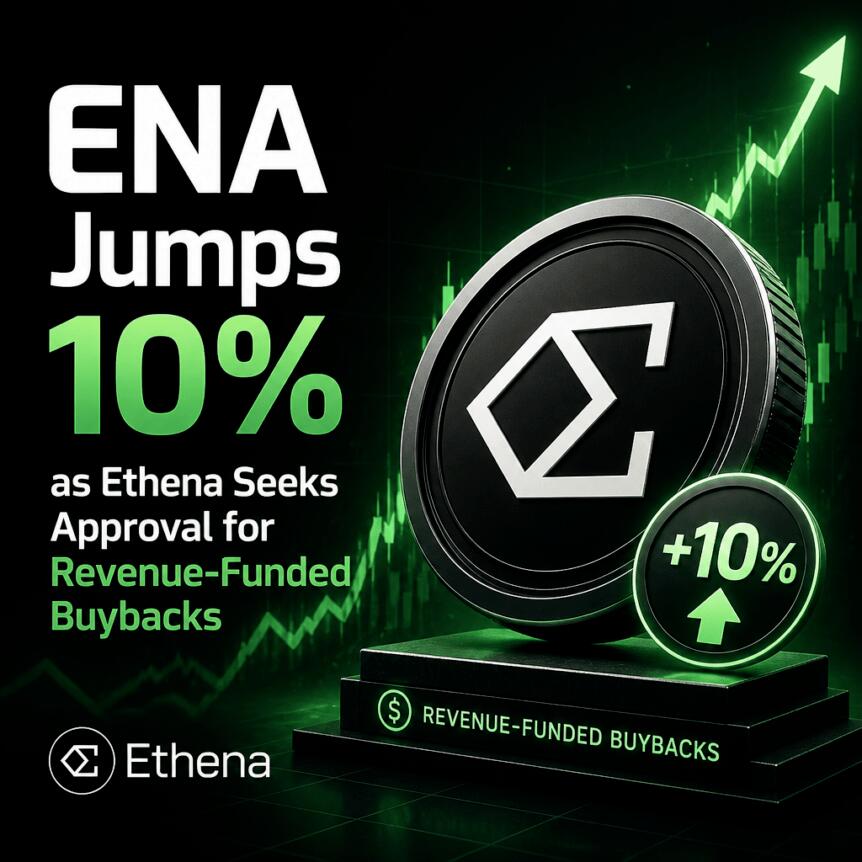
Ethena’s native token ENA surged after the Ethena Foundation announced a package of governance and treasury updates aimed at changing how the protocol’s revenue is handled and how certain investor token schedules unwind.
In an ecosystem update posted Thursday, the foundation detailed four changes, including a vote on a “fee-switch” mechanism that would direct a large share of net revenue toward ENA buybacks once Ethena’s synthetic dollar supply (USDe) reaches a specified milestone.
Key takeaways
- The Ethena Foundation opened a governance vote on a fee-switch proposal tied to USDe reaching a $7.5 billion milestone.
- Under the proposal, 95% of the foundation’s net revenue from Ethena’s core business lines would be used to buy ENA after the threshold is met.
- Tokenholders have until Sept. 2 to vote; at the time of publication, Snapshot showed 65 votes representing about 14.4 million ENA voting power, all in favor.
- The foundation also said it completed a buyout of locked ENA held by certain early investors and agreed to adjust remaining investor unlock timing to Oct. 5.
Fee-switch proposal links buybacks to USDe scale
The center of the announcement is a governance vote on whether to switch Ethena’s fee handling toward token repurchases. According to the Ethena Foundation’s blog post, 95% of the net revenue paid to the foundation from Ethena’s core business lines would be allocated to purchase ENA once the circulating supply of USDe reaches the first milestone of $7.5 billion.
Voting runs until Sept. 2. Data from Snapshot shows all cast votes so far have supported the proposal. At the time of writing, 65 votes accounting for roughly 14.4 million ENA in voting power were recorded, with every one of them in favor.
For ENA holders, the significance is practical: if implemented, the buyback program would effectively transform a portion of protocol revenue into recurring demand for the token—though the trigger is conditional on USDe growth, which means timing depends on how quickly supply climbs to the milestone.
ENA reacts as governance activity accelerates
Market pricing reflected the renewed focus on treasury policy. CoinGecko data shows ENA rose 10.7% over 24 hours and gained 27% over the past week, trading above $0.17 as of 8:11 am UTC on Friday.
Even without assuming the vote’s outcome, the governance framing itself can matter to traders: buyback mechanisms are often viewed as a direct link between protocol economics and token supply dynamics. Here, the foundation’s proposal is explicit about how revenue would be used after the USDe threshold is reached.
Locked token buyout and changes to investor unlock timing
Beyond the fee-switch idea, the Ethena Foundation outlined steps affecting locked ENA held by early participants. The foundation said it had bought locked ENA from certain major seed investors who reduced some holdings during the previous nine months.
In a separate development, the foundation stated it agreed with lead investors to release remaining unvested investor allocations on Oct. 5, replacing the existing monthly unlock schedule. The foundation emphasized that team tokens remain subject to their original vesting schedules.
Importantly, the change described in the update accelerates remaining investor unlocks rather than canceling the tokens. For market watchers, that distinction is notable: faster unlocks can increase near-term supply pressure if demand does not keep pace, even if buyback plans later aim to offset supply effects through repurchases.
Where Ethena’s stablecoin ranks and why it matters for ENA
Ethena’s synthetic dollar, USDe, is listed by DefiLlama as the sixth-largest stablecoin by market capitalization, with roughly $4 billion at the time referenced in the update. A protocol’s stablecoin scale can be consequential because governance proposals and revenue flows are often tied to activity that grows with circulating supply.
In this case, the foundation’s fee-switch vote is explicitly tied to USDe reaching $7.5 billion in circulating supply—meaning the token’s economics are positioned to change as the synthetic dollar expands. Investors should therefore track not only ENA’s price, but also USDe’s growth rate toward the milestone.
Strategic investor interest remains part of the backdrop
Ethena’s ecosystem update comes amid ongoing institutional attention. Earlier coverage cited an investment by M2 Capital, the investment arm of UAE-based M2 Holdings, which put $20 million into ENA as a strategic holding in September 2025 while total value locked neared $15 billion. The conglomerate had previously invested in the Sui Foundation.
While that investment does not determine the outcome of the new vote or the timing of unlocks, it underscores that ENA is being treated as a strategic position by at least some larger investors—precisely the group that is likely to weigh governance and supply-schedule changes closely.
With the fee-switch vote still open until Sept. 2 and the remaining unvested allocation timing now set for Oct. 5, the next key question for ENA holders is whether USDe’s path toward the $7.5 billion milestone keeps pace—while also monitoring how accelerated unlocks might affect supply in the interim.

Pi Network announced yesterday another expansion of SoloHost, adding OpenClaw and Atlassian MCP Server as featured applications available through the native Pi Desktop.
The two new additions were initially introduced alongside the recent Node 0.6.2 update, which we reported a few weeks ago, but are not being formally highlighted by the team as examples of how they intend to expand the utility of their Nodes beyond simply supporting the blockchain.
AI Push Expanded
The official blog post from the team highlighted the more broadly applicable addition called OpenClaw. It’s a locally run AI agent capable of assisting users with various tasks and operating using either a locally hosted AI model or external ones such as ChatGPT and Claude.
Its memory is stored locally on the user’s computer in either configuration, although requests sent to cloud models are still processed by the external providers.
The team explained that running OpenClaw through SoloHost places the agent inside a container that restricts its default access to unrelated files and resources on the user’s computer. Pi Desktop handles much of the technical setup automatically, reducing the need for Pioneers to manually configure servers, Docker environments, and other infrastructure.
OpenClaw joins Hermes, another local AI agent already available through SoloHost.
Second Addition
The Core Team outlined the second major change, Atlassian MCP Server, which targets a more specialized audience. It allows developers and professional teams to run their own local MCP server and connect compatible AI tools with Jira.
Pi Network said both of these new additions aim to transform its infrastructure into a practical computing platform. Recall that SoloHost saw the light of day on Pi2Day (June 28) and enables third-party devs to publish self-hosted applications that Pioneers can run through Pi Desktop.
In theory, this allows developers to access Pi’s network of over 420,000 claimed node operators, while providing Pioneers with additional uses for the computing resources they already operate.
Aside from the aforementioned additions, the Core Team recently introduced new pricing for its App Studio model, moving away from subsidized rates to reflect the actual AI service costs. The change went live on August 24.
The post Pi Network’s Major AI Change Is Now Live: Here’s What Pioneers Need to Know appeared first on CryptoPotato.
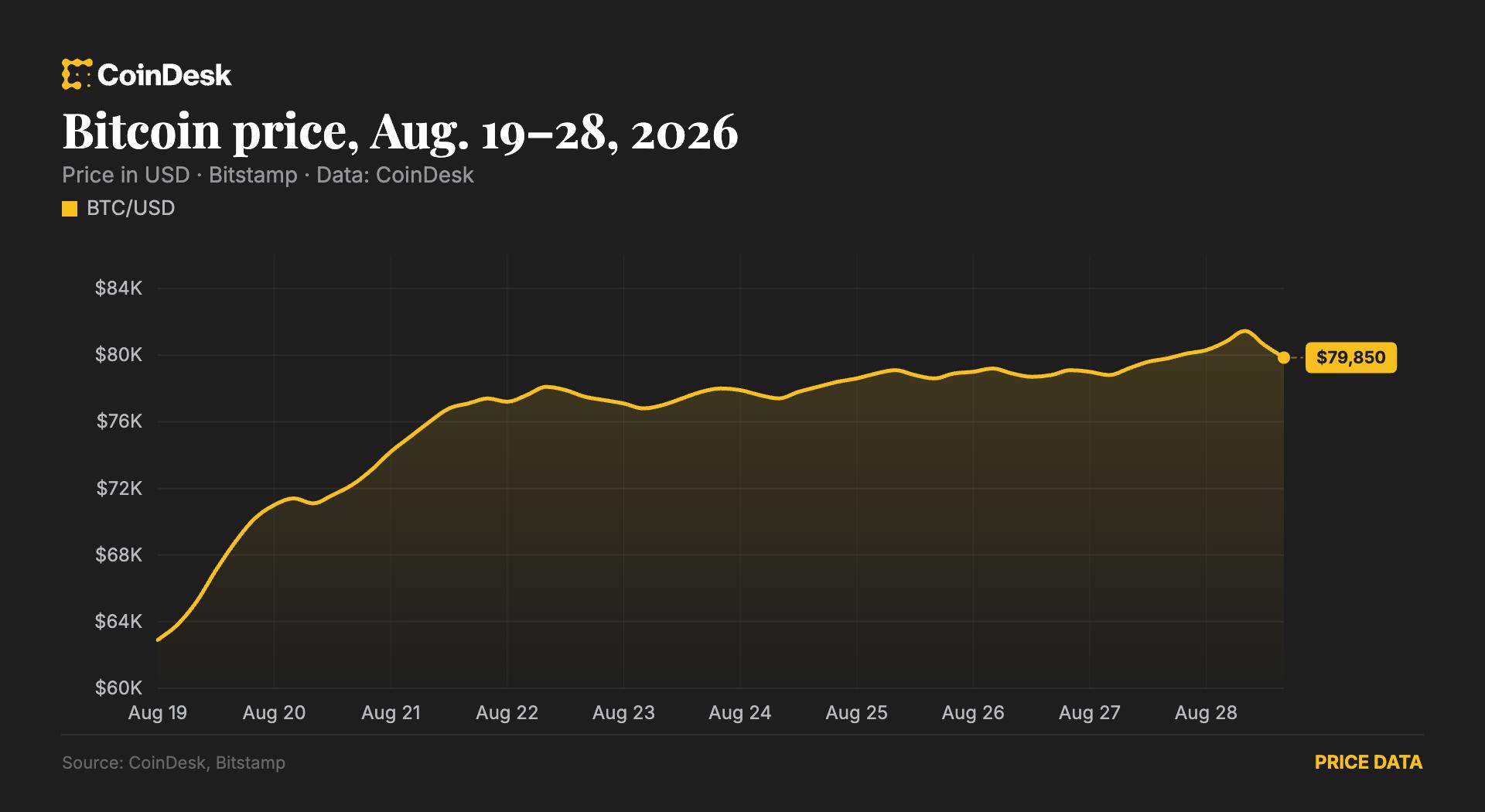
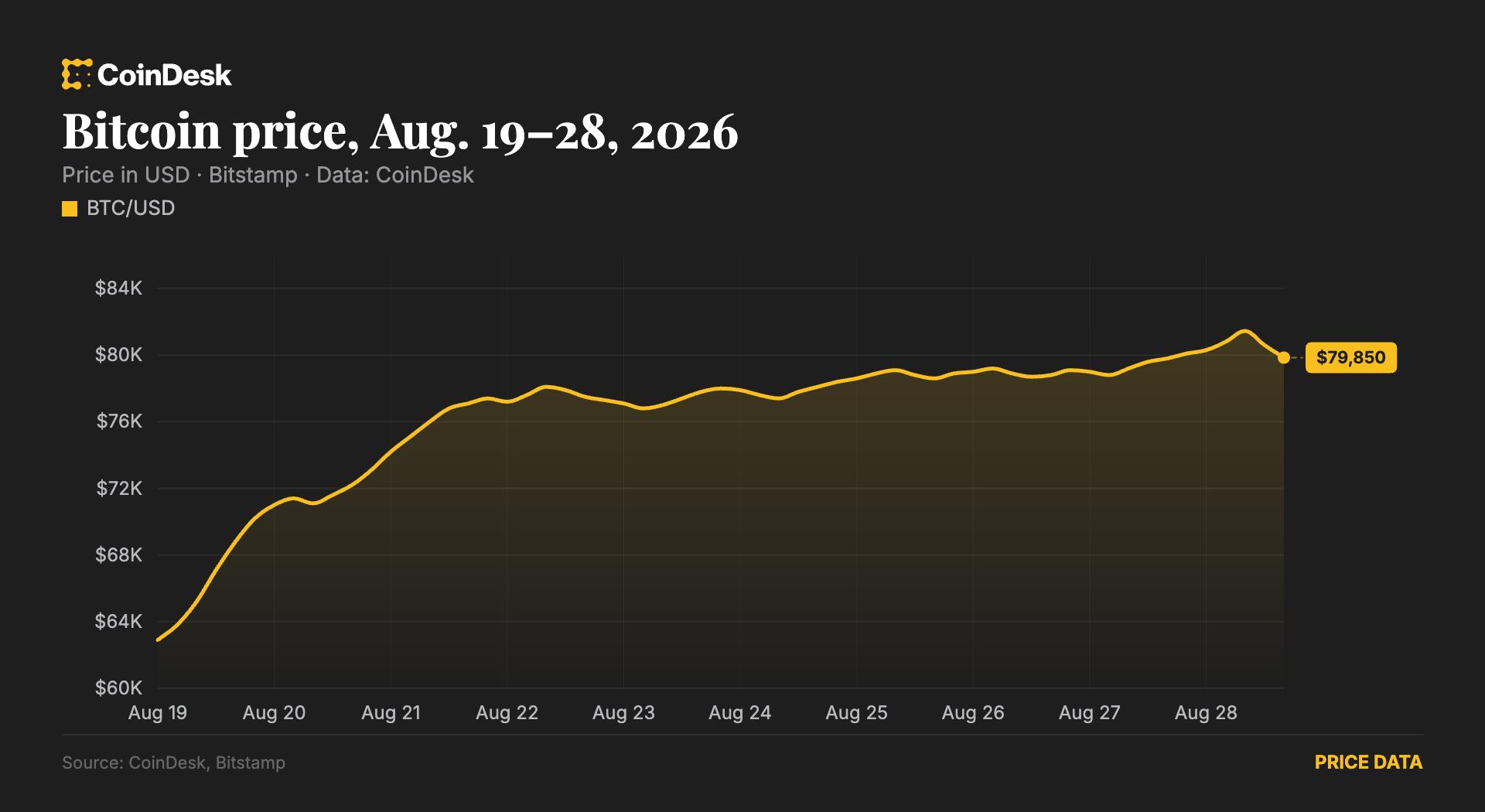
BTC briefly touched $81,455 overnight, its highest since May 15 as Nasdaq futures slipped and gold extended gains heading into the weekend.
On 26 August, the US Commerce Department released July data on the Personal Consumption Expenditures (PCE) index. Core PCE rose 0.2% month-on-month and 3.3% year-on-year, in line with market expectations. Ellen Zentner, Chief Economic Strategist at Morgan Stanley Wealth Management, noted that the modest upside surprise in inflation was not significant enough to shift the balance of expectations ahead of the Federal Reserve’s September meeting.
Earlier, on 19 August, minutes from the Fed’s July meeting showed that policymakers remained open to further rate increases if inflationary pressures persisted, with three committee members having already voted in favour of a hike. Against this backdrop, Treasury yields remain close to multi-year highs, keeping rate expectations tilted towards the possibility of further tightening.
Technical Analysis of Dow Jones
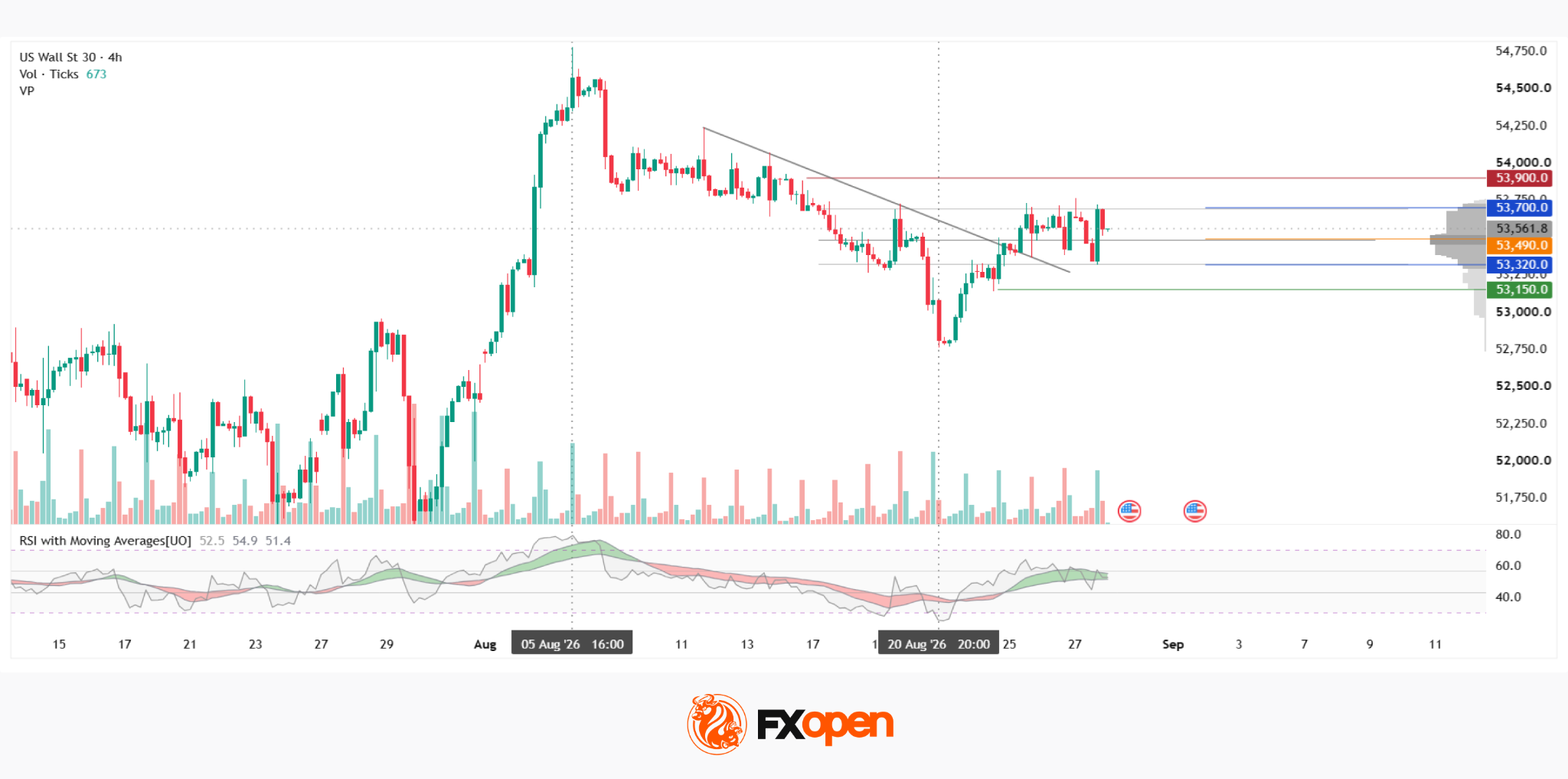
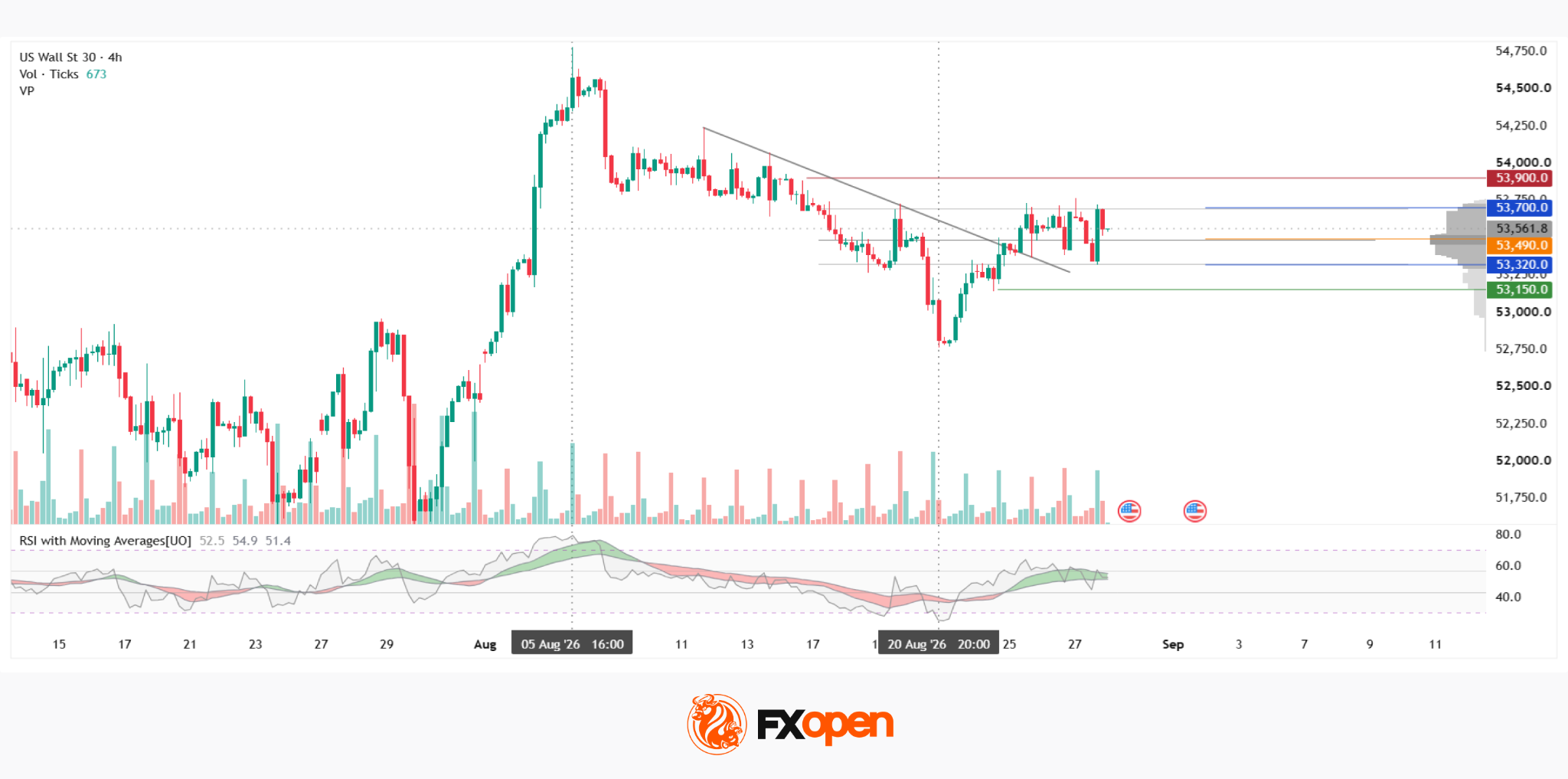
The four-hour Dow Jones chart (WS30m on FXOpen) shows a short-term downtrend, with prices steadily declining from a local peak around 54,700 and establishing a descending trendline in the process.
On 25 August, the index moved beyond the trendline and subsequently formed the current market profile. The index is now trading between the Point of Control (POC) at 53,490 and the upper boundary of the profile at 53,700.
If the breakout develops into a sustained advance, the next significant level to watch is the red resistance area around 53,900.
Conversely, if the trend breakout proves to be false and the decline resumes, the price would first need to move through the POC at 53,490 and then break below the lower profile boundary at 53,320. Only after clearing this area would the path towards the green support level around 53,150 become more open.
The RSI + MAs indicator currently shows readings of 52, 55 and 51. The oscillator and both moving averages remain within the neutral zone, although the moving averages are still displaying a bullish signal.
Key Takeaways
The attempted break above the descending trendline is taking place within a dense market-profile area, providing no clear confirmation of a sustained move in either direction.
The index’s next move could depend on whether the current divide in expectations surrounding the Fed’s September decision persists or whether incoming economic data shifts the balance decisively in one direction.
Trade global index CFDs with zero commission and tight spreads (additional fees may apply). Open your FXOpen account now or learn more about trading index CFDs with FXOpen.
This article represents the opinion of the Companies operating under the FXOpen brand only. It is not to be construed as an offer, solicitation, or recommendation with respect to products and services provided by the Companies operating under the FXOpen brand, nor is it to be considered financial advice.


The native token of the synthetic dollar protocol Ethena (ENA) registered double-digit gains after the Ethena Foundation unveiled four ecosystem changes, including a proposal for revenue-funded token buybacks and a completed buyout of locked tokens held by some early investors.
The Ethena Foundation opened a vote on a fee-switch proposal under which 95% of the net revenue paid to it from Ethena’s core business lines would be used to purchase ENA once the circulating supply of USDe reaches the first proposed milestone of $7.5 billion, the foundation said in a Thursday blog post.
Tokenholders have until Sept. 2 to cast their votes. At press time, 65 votes representing about 14.4 million ENA in voting power had been cast, all in favor of the fee-switch proposal, according to Snapshot.
The ENA token rose 10.7% over the 24 hours and gained 27% during the past week to trade above $0.17 as of 8:11 am UTC on Friday, according to CoinGecko data.
The foundation also said it had bought locked ENA from certain major seed investors who sold some of their holdings during the past nine months. Separately, it agreed with lead investors to release the remaining unvested investor allocations on Oct. 5, replacing the existing monthly unlock schedule. Team tokens will remain subject to their original vesting schedules.
The change accelerates the remaining investor unlocks rather than canceling the tokens.
Ethena’s synthetic dollar, Ethena USDe (USDE), ranks as the sixth-largest stablecoin with a $4 billion market capitalization on DefiLlama.
In September 2025, M2 Capital, the investment arm of UAE-based M2 Holdings, invested $20 million in ENA to make it its latest strategic holding. The conglomerate previously invested in the Sui Foundation.
Magazine: Ethereum risks losing No. 2 spot as stablecoins gain ground

Ethereum price is starting to stabilize, as the network’s next major upgrade puts its core economic assumptions under scrutiny. The dip is minor. The question hanging over it isn’t.
The Ethereum Foundation’s candidate Glamsterdam schedule aims to triple base-layer throughput by repricing gas to match actual resource consumption, but the repricing hits state-growing operations hardest.
EIP-8037 and EIP-8038, both still sitting in formal Review status, model a scenario where a 200 million gas limit pushes annual state growth to roughly 387 GiB, enough to blow past a cited 650 GiB performance threshold within a year. This is not a hypothetical stress test.
Geth’s state database already sat near 390 GiB in January 2026, and the gas limit hike from 30 million to 60 million alone tripled daily state creation from 105 MiB to 326 MiB.
None of this is priced in yet, and Ethereum’s official roadmap targets Q4 2026 with no fixed mainnet fork date. That leaves a live testing window and a market still deciding whether $2,500 is a floor or a ceiling.
Discover: The Best Token Presales
Can Ethereum Price Hold $2,500 Before the Glamsterdam?
ETH’s current $2,490 print sits just below the psychological $2,500 mark, with recent price action pinned inside a tightening range.
Our latest read flags $2,550–$2,600 as immediate resistance, while support layers sit at $2,400–$2,450 and, deeper, $2,200–$2,250. The pivot data placed the upper Bollinger Band near $2,530, a level that’s held for over a week now.

- Bull case: a clean break above $2,550 opens room toward the $2,600 band, with volume confirming continuation.
- Base case: ETH grinds sideways in the $2,450–$2,550 channel while Glamsterdam parameters finalize.
- Bear case: a failure to hold $2,400 support drags price toward the $2,200 zone, with state-bloat headlines adding fundamental drag on top of technical weakness.
Worth watching how EIP-8037’s testing outcomes land in the coming weeks. Repricing debates rarely move fast, but they move markets when resolved.
Trade XRP on Bybit and Get a Chance to Win Our $1,000 USDT Airdrop
Maxi Doge Targets Early Mover Upside as Ethereum Tests Key Levels
Ethereum near $2,500 with a market cap in the hundreds of billions doesn’t leave much room for asymmetric upside. A double from here is a monumental lift.
This is the math pushing traders toward earlier-stage plays where the ceiling isn’t already priced by institutional flow. Protocol-level economic shifts like Glamsterdam’s repricing tend to reward patience over speculation on majors, which is exactly why presale rotation picks up during consolidation phases like this one.
Maxi Doge is an Ethereum-based ERC-20 meme token built around a 1000x-leverage trading persona and holder-only trading competitions with leaderboard rewards.
The presale has raised $4.8 million at a current token price of $0.0002836, with a huge 65% APY staking live for participants. A Maxi Fund treasury backs liquidity and partnerships. Momentum around the raise has tracked broader meme-coin rotation activity.
Research Maxi Doge directly before the presale window closes.
Discover: The Best Crypto to Diversify Your Portfolio
The post Ethereum Price Faces Glamsterdam Test as 3X Network Speed Threatens Smart Contracts appeared first on Cryptonews.
Gold has staged a remarkable comeback, surging almost 14% in August alone and reclaiming levels not seen since May, a stark reversal from late July, when prices had dipped below $4,000. The rally has been driven by a genuinely unusual combination of forces: the US Treasury’s surprise decision to double its long-dated bond buyback programme reignited fears over fiscal credibility and dollar debasement, while persistent Middle East tensions and steady Chinese buying have kept safe-haven demand firmly in place.
All eyes now turn to Fed Chair Kevin Warsh’s Jackson Hole speech, the week’s pivotal event. A hawkish tone or a fresh rise in real yields could trigger meaningful profit-taking after such a sharp run-up, while continued dollar weakness would likely keep gold’s momentum intact. Adding to the tension, this week’s data slate, including preliminary Q2 GDP, jobless claims, and Michigan’s inflation expectations, gives markets plenty of reasons to stay on edge.
With gold already up nearly 96% over the past year and testing territory unseen in months, the metal finds itself balancing two powerful forces: genuine structural demand against a market that may finally be due for a pause.
Technical Analysis of XAU/USD
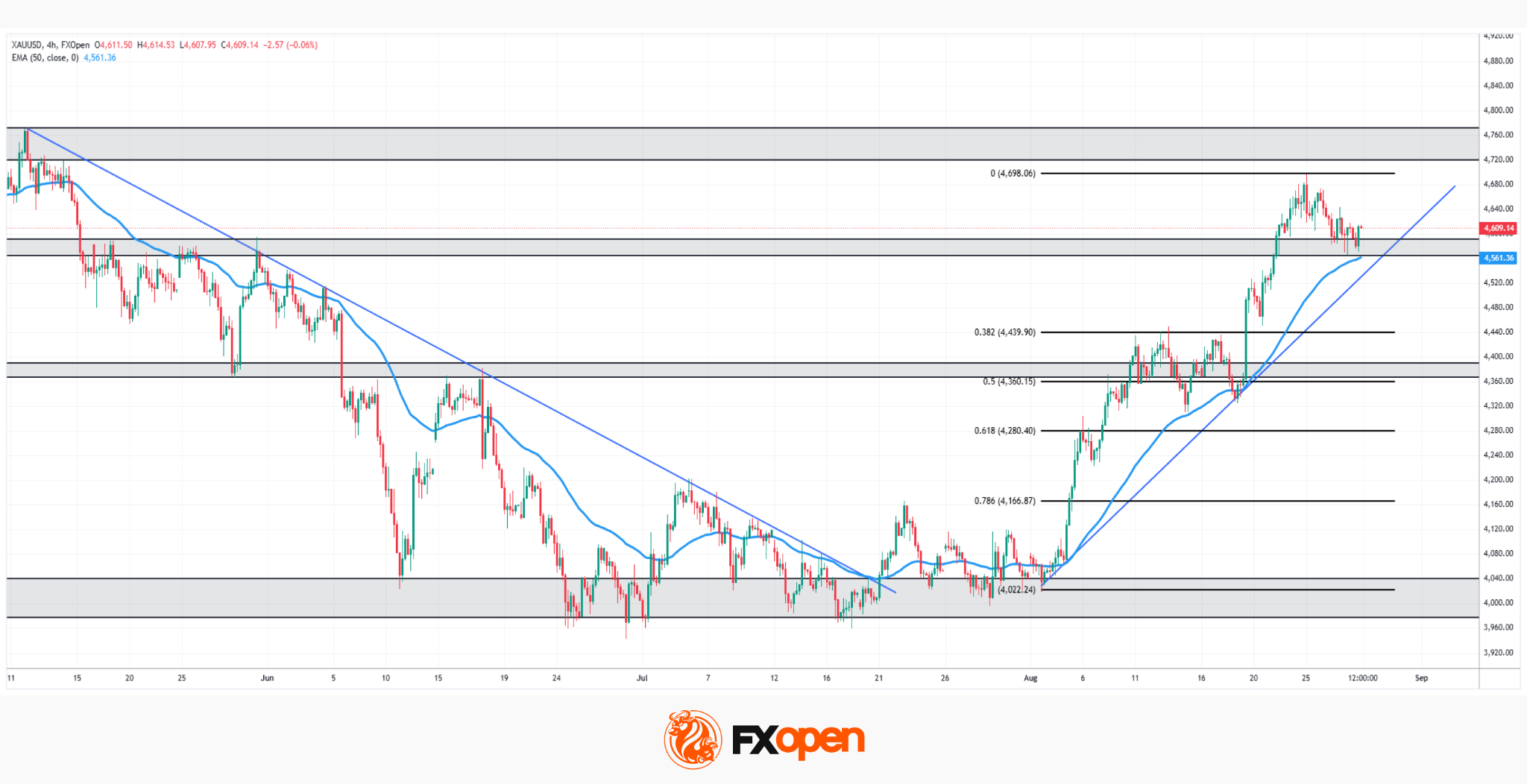
As the XAU/USD chart shows, gold has been trading within a well-respected ascending trendline since the 4,022 low in late July, having earlier broken decisively above the descending trendline that capped the May–July decline. Price recently touched a fresh high near 4,698, the 0 Fibonacci level, before pulling back and now testing the confluence of the ascending trendline and the 50-period EMA near 4,561.
Bullish Scenario
Should buyers defend this trendline-EMA confluence, the broader uptrend structure remains firmly intact. A renewed push higher would target a retest of the 4,698 high, with a confirmed break above that level opening the door toward the 4,760–4,800 resistance zone and fresh record territory beyond.
Bearish Scenario
Conversely, a decisive break below the ascending trendline and the 50-period EMA would signal that a deeper correction is underway, exposing the 0.382 Fibonacci retracement near 4,440 as the first real test, with a further slide risking a retest of the 0.5 level around 4,360.
With price sitting right at the intersection of a multi-week trendline and the 50-period EMA, gold’s next move looks set to determine whether this powerful August rally has more room to run or whether it’s due for a deeper pause.
Start trading commodity CFDs with tight spreads (additional fees may apply). Open your trading account now or learn more about trading commodity CFDs with FXOpen.
This article represents the opinion of the Companies operating under the FXOpen brand only. It is not to be construed as an offer, solicitation, or recommendation with respect to products and services provided by the Companies operating under the FXOpen brand, nor is it to be considered financial advice.

Europa League draw LIVE: Bournemouth, Sunderland, Crystal Palace and Celtic all learn opponents

Trump Signs Executive Order Renaming Lake Ontario as Lake America Amid Escalating Trade War with Canada

Bullish backs USD.AI with $100 million in financing to drive GPU-backed loans





-

 Fashion7 days ago
Weekend Open Thread: Madewell – Corporette.com
-

 Crypto World2 days ago
SpaceX stock could rise 75% to $240, JPMorgan says
-

 Business6 days ago
Musk’s Tesla, SpaceX Confirm $16.8 Billion ‘Terafab’ Chip Plant as World’s Largest Building in Texas
-

 Crypto World6 days ago
anatomy of crypto’s biggest liquidation event since 2021
-

 Crypto World3 days ago
A $30 Billion AI Fund Implodes, Now the SEC Is Investigating Wall Street’s Role
-

 Politics6 days ago
6 months on, Irish renters crushed by effects of government housing bill
-

 Crypto World2 days ago
Did Trump Just Move SpaceX Stock With One Truth Social Post?
-

 Crypto World2 days ago
Warsh Jackson Hole keynote puts financial innovation first
-

 Business5 days ago
Mystery AI Model ‘Ox Alpha’ Draws Developers With Free Access as Chinese Lab Origins Remain Debated
-
 NewsBeat6 days ago
The ‘Lucky Dip Gang’ causing carnage for clicks: After five thugs were killed speeding in the wrong direction on a motorway, GUY ADAMS investigates a sick new trend… and why police aren’t even allowed to pursue them
-
 Crypto World7 days ago
Nvidia Stock Suffers Longest Losing Streak Since 2022: Will Q2 Earnings End It?
-

 Business2 days ago
Walmart takes aim at younger shoppers with new fashion brand
-

 Business4 days ago
Moderna CEO warns China is pouring state money into mRNA technology
-

 Business4 days ago
NVIDIA Stock Drops Nearly 2 Percent to $210 on Seventh Losing Day Ahead of Critical AI Earnings
-

 Tech7 days ago
Unitree’s New Superman Robot Claims to Outjump and Outrun Every Human, Usain Bolt Included
-

 Business6 days ago
Will Tesla Stock Be Higher or Lower a Year From Now? Here’s What Wall Street Analysts Are Saying
-

 Business7 days ago
UK firms in critical financial distress rise 9% to 53,756
-

 Sports5 days ago
Deshaun Watson fires back at Browns fans after being booed: ‘It’s a disrespectful thing’
-
 Crypto World4 days ago
$92 Billion Nvidia Earnings Could Make or Break the AI Trade
-

 Crypto World5 days ago
Google Gemini AI Predicts Ethereum Could Become the Trade Retail Misses in 2026
You must be logged in to post a comment Login