
Crypto World
Earn daily passive crypto income with zero investment


Disclosure: This article does not represent investment advice. The content and materials featured on this page are for educational purposes only.
Mobile cloud mining expands in 2026 as BM Blockchain attracts beginner interest in BTC and DOGE mining.
Summary
- Mobile-first cloud mining platforms like BM Blockchain simplify Bitcoin mining without hardware or setup complexity.
- The platform offers beginner-friendly crypto mining with guided onboarding and mobile access to mining tools.
- As mining interest grows, BM Blockchain appeals with easy entry, no hardware needs, and streamlined participation.
As more people look up things like what Bitcoin mining is, how to mine Bitcoin, and whether any free cloud mining options still exist in 2026, the mobile-first crypto mining space keeps growing. On Android, iOS, and web dashboards, more users are choosing Bitcoin and Dogecoin cloud mining platforms instead of buying hardware, dealing with heat and power bills, or running dedicated mining rigs.
In real life, “free” usually doesn’t mean mining is forever at zero cost. In 2026, it more often points to free sign-ups, welcome bonuses, trial access, or mobile tools that let people get a feel for mining-related systems before paying for larger plans. That’s why comparison roundups still matter for anyone trying to understand how Bitcoin mining works, how BTC cloud mining platforms actually run, and which services might be easier for beginners.
Below is an original roundup of five platforms that people often mention when talking about the best cloud mining, the best crypto cloud mining options, and beginner-friendly ways to access Bitcoin and Dogecoin mining in 2026.
Top free cloud mining platforms (2026 comparison)
| Platform | Best For | Mobile Access | Entry-Level Feature |
| BM Blockchain | Beginner-friendly platform-based mining access | Mobile-friendly / browser access | Publicly referenced onboarding-related allocations valued at up to $108 |
| StormGain | Users looking for app-based mining activation | Android app | In-app mining activation cycle model |
| ECOS | Contract-style cloud mining access | Android / iOS app | Hosted infrastructure and integrated wallet tools |
| NiceHash | Users monitoring mining operations and hashrate markets | Android / iOS app | Mining marketplace and management interface |
| Binance Pool | Exchange ecosystem users seeking mining-related access | Mobile ecosystem support | Mining-related services integrated within a broader exchange environment |
1. BM Blockchain — Best for users looking for a low-barrier starting point
BM Blockchain can be seen as a beginner-friendly choice for people who want to try Bitcoin cloud mining or Dogecoin mining through a platform, instead of buying and running their own mining hardware. Based on publicly available industry information, BM Blockchain is described as focusing on letting users take part in infrastructure, access computing power, and get a more guided onboarding experience if they’d rather not deal with hardware setup themselves.
For those searching for things like how to mine Bitcoin or how to start mining Bitcoin without building a rig, this kind of platform setup may sound appealing because it removes a lot of the usual technical friction. Instead of setting up and tuning equipment, users can look through the platform’s tools, compare different ways to participate, and get started through a mobile-friendly experience.
Industry disclosures also mention welcome allocations during onboarding valued at up to $108, framed as participation incentives rather than any promised financial result. Interested investors who are comparing cloud mining apps or looking up the best cloud mining options, that kind of easier, low-effort onboarding could make BM Blockchain stand out as a place to begin.
BM Blockchain 2026 illustrative participation snapshot
| Model | Entry Amount | Term | Illustrative Daily Estimate | Illustrative End-of-Term Estimate |
| Starter Plan | $200 | 1 Day | $7.00 | $207.00 |
| A15 Compute | $1,200 | 2 Days | $43.20 | $1,286.40 |
| A2 Cluster | $3,600 | 3 Days | $136.80 | $4,010.40 |
| GPU Node | $8,000 | 2 Days | $344.00 | $8,688.00 |
| Hyd Compute | $16,800 | 3 Days | $924.00 | $19,572.00 |
Stable returns and a clear timeline: This is a truly hands-free way to earn Bitcoin daily.
BM Blockchain states that actual returns may vary depending on platform conditions, applicable terms, fees, operational assumptions, timelines, and broader market factors.
View the full contract and claim $108 worth of free hashrate!

2. StormGain — Best for a Bitcoin miner app experience
StormGain often comes up when people search for terms like best Bitcoin miner app, bitcoin miner app, or bitcoin mining apps, mainly because it offers a mobile-first way to access mining. Beginners in particular talk about it when they want an app that works through simple activation instead of dealing with a more technical contract-style dashboard.
A big reason StormGain shows up so much in beginner conversations is convenience. When someone is asking how to mine Bitcoin on a phone or is looking for a crypto mining experience on mobile, an app-based interface usually feels easier to approach than more traditional mining services.
3. ECOS — Best for structured contract-based cloud mining
ECOS often shows up in cloud mining roundups because it gives users a more structured setup, with hosted mining contracts and centralized tools to manage their accounts. Compared to lighter apps that focus more on quick activation, ECOS tends to suit people who want something more organized and a clearer, contract-style way of presenting the service.
For anyone looking into bitcoin cloud mining, BTC cloud mining, or how to start crypto mining, this approach can feel closer to getting longer-term access to mining infrastructure than just using a casual app.
4. NiceHash — Best for users interested in mining marketplace tools
NiceHash usually comes up less as a typical “free mining app” and more as a marketplace for mining power, along with a platform to manage day-to-day mining operations. That’s why it tends to appeal to people who want to see things like hashrate prices, use account tools, and track mining activity, instead of relying on a simple sign-up bonus approach.
For people looking up what miners are in blockchain, or trying to get a clearer picture of how mining marketplaces work, NiceHash is still one of the better-known names in this space.
5. Binance Pool — Best for exchange-integrated mining access
Binance Pool gets attention mainly because it links mining services with the wider Binance exchange ecosystem. For users who already use Binance regularly, this all-in-one setup can feel easier than running mining through a separate platform.
Looking at different cryptocurrency cloud mining services? People often see Binance Pool as a solid choice when it matters to have everything connected in one ecosystem, not just the mining access on its own.
Why Bitcoin and Dogecoin cloud mining continues to attract attention
Bitcoin is still the best-known digital asset by market value, and Dogecoin continues to get a lot of attention from everyday buyers. Put together, they show two very visible, but very different, corners of the digital asset market.
Many people who look up how to mine cryptocurrency, how to mine Dogecoin, or how long it takes to mine Dogecoin usually aren’t trying to run a large mining setup. More often, they’re looking for an easier way to get started so they can understand what it means to mine Bitcoin, how cloud-style options work, and whether a mobile-friendly service makes more sense for them than buying and managing their own hardware.
That’s part of why mobile crypto mining and browser-based tools are still getting more attention in 2026.
How to choose the right cloud mining platform
Every platform works a bit differently, and “free” doesn’t always mean the same thing everywhere. In real use, people should compare:
- Wwhat “free” actually means on the platform
- Whether the service is app-based, browser-based, or contract-based
- How clearly the participation model is explained
- Whether fees, estimates, and withdrawal rules are disclosed
- Whether the platform is designed for beginners or more advanced users
A practical way to do this is to begin on a platform with a lower entry barrier, get familiar with the participation rules, and try out the user experience first, then gradually increase the allocation.
Frequently asked questions
What is Bitcoin mining?
Bitcoin mining is basically how transactions get checked and then recorded on the blockchain, using computing power. In the past, that usually meant having dedicated mining machines, but a lot of people now start by looking into Bitcoin cloud mining platforms instead of buying and running hardware themselves.
How does Bitcoin mining work?
Bitcoin mining works by using computing power to confirm transactions on the network and help keep the blockchain secure. With cloud mining, people generally use remote services and rented infrastructure rather than owning and running the machines directly.
How can I mine Bitcoin as a beginner?
For those who are new, the easiest starting point is often an app or a platform that walks them through it. Many people who search for how to mine Bitcoin or how to start mining Bitcoin begin with cloud dashboards, instead of jumping straight into ASIC hardware.
What is cryptocurrency mining?
Cryptocurrency mining usually means using computing power to help process blockchain transactions and keep the network running safely. People searching for what cryptocurrency mining is or what cryptocurrency mining is are often trying to understand the difference between mining with their own hardware and joining through a cloud-based option.
What is the best Bitcoin miner app in 2026?
There isn’t one best choice that fits everyone. People looking for the best bitcoin miner app often compare things like how easy it is to use, how clear the terms are, how transparent it feels, and whether it’s mainly for activation, monitoring, or actually connecting users to a broader mining marketplace.
Can crypto be mined on a laptop or phone?
Most of the time, doing serious mining directly on a laptop or phone isn’t really practical anymore. That said, some people use cloud mining apps, crypto mining phone tools, or mobile-friendly dashboards that let them join or manage mining without making the device do the heavy work.
How to mine Dogecoin in 2026?
For those who are asking how to mine Dogecoin, it usually comes down to two routes: mine directly with the right hardware, or join through a cloud platform that offers access tied to Dogecoin. The cloud approach is often easier for beginners since they don’t have to deal with hardware setup.
How long does it take to mine Dogecoin?
That depends on how a person is mining, how much computing power is involved, and which platform or setup they’re using. So, searches like how long to mine Dogecoin and dogecoin cloud mining earnings can lead to very different expectations, depending on whether someone means solo mining, pooled mining, or a platform-based setup.
What does “cloud mining free” really mean?
Most of the time, it means free sign-up, a welcome bonus, a trial period, or limited-time activation — not endless mining with zero cost. It’s worth checking how each platform explains what “free” includes.
Conclusion
The mining scene in 2026 isn’t dominated by just one kind of product anymore. People can now choose from infrastructure-focused services, mobile-first onboarding platforms, mining marketplaces, and ecosystems tied to exchanges.
For those who are looking up things like what Bitcoin mining is, how to mine Bitcoin, the best cloud mining options, or how to mine Dogecoin, a good place to begin is usually a platform that clearly explains how someone can get access and makes it easier to start without having to own hardware. Publicly mentioned onboarding offers, like the $108 welcome incentive linked to BM Blockchain, also show how some platforms are trying to make it simpler for first-time users to get started.
As usual, it’s worth comparing the terms across platforms, understanding what each one actually means by “free,” and checking the participation rules before jumping in.
Disclosure: This content is provided by a third party. Neither crypto.news nor the author of this article endorses any product mentioned on this page. Users should conduct their own research before taking any action related to the company.



Anthropic is close to finalizing a roughly $1.5 billion joint venture with Blackstone, Goldman Sachs, and several other Wall Street firms to distribute artificial intelligence tools to private-equity-backed companies.
Summary
- Anthropic is nearing a $1.5 billion joint venture with Blackstone, Goldman Sachs, and Hellman & Friedman to deliver AI tools to private-equity-backed companies.
- The platform will target sectors including finance, operations, and enterprise software, with leading partners committing up to $300 million each and Goldman Sachs adding about $150 million.
- The move comes as Anthropic explores a valuation above $300 billion, while rival OpenAI pursues similar private-equity partnerships amid rising competition in enterprise AI.
A report by The Wall Street Journal said the platform will introduce AI applications across finance, operations, customer service, analytics, and enterprise software.
Anthropic, Blackstone, and Hellman & Friedman are leading the effort, with each expected to commit about $300 million to the venture. Goldman Sachs is set to join as a founding investor with an estimated $150 million contribution.
The structure brings together major financial institutions and an AI developer in a single push to commercialize enterprise-grade tools. The report noted that a formal announcement could come as early as May 4.
Interest in Anthropic has accelerated in recent months as its enterprise-focused AI products gain traction. The company is reportedly considering a new funding round that could lift its valuation beyond $300 billion, with some projections pointing as high as $900 billion. Those expectations have drawn strong attention from private equity players seeking early exposure to AI infrastructure and software providers.
The planned venture also arrives as competition intensifies. Rival OpenAI has been exploring similar partnerships with private-equity firms to expand adoption of its tools across business operations. The parallel efforts show how leading AI developers are turning to financial sponsors to scale deployment and integrate automation into portfolio companies.
Both Anthropic and OpenAI are also seen as potential candidates for an initial public offering later this year, adding another layer of urgency for investors looking to secure positions ahead of any listing.
Separately, Anthropic has entered early-stage discussions with UK-based semiconductor startup Fractile. Talks are focused on securing access to specialized inference chips designed to run trained AI models more efficiently.
Such hardware is critical for lowering operating costs and improving processing speeds as demand for AI workloads grows.
The discussions underline how developers are working to lock in compute supply alongside expanding their software reach through partnerships like the proposed joint venture.

Key Highlights
- Palantir’s Q1 2026 earnings release scheduled for May 4 after the closing bell
- Options market indicates potential ~10% price movement following the announcement
- Wall Street projects $1.54 billion in quarterly revenue, representing 74% annual growth
- Earnings per share estimated at $0.28, over twice last year’s Q1 figure
- Shares have declined 19% since the beginning of the year
Palantir Technologies (PLTR) prepares to unveil its first-quarter 2026 financial results today, with options activity suggesting significant volatility ahead.
Palantir Technologies Inc., PLTR
The options market is currently pricing in approximately 9.82% movement in either direction once earnings are disclosed. This figure sits marginally higher than the company’s three-quarter average post-earnings swing of 9.28%.
Shares are hovering near $144.44, reflecting a 19% decline from the start of 2026.
Wall Street consensus calls for quarterly revenue reaching roughly $1.54 billion, representing a substantial 74% increase compared to the same period last year. This growth rate would exceed the 39.3% expansion recorded during Q1 2025.
In its most recent quarter, Palantir delivered $1.41 billion in revenue, marking a 70% year-over-year jump. The company surpassed expectations across revenue, billings, and EBITDA metrics.
Regarding profitability, analysts anticipate $0.28 in earnings per share. This projection represents more than double the company’s Q1 2025 performance.
Management has pledged to maintain profitability throughout every quarter of 2026, making any shortfall in this area particularly significant for investors.
Spotlight on AIP Expansion
The primary focus for shareholders centers on Palantir’s Artificial Intelligence Platform (AIP) performance.
Executives have previously indicated that U.S. commercial revenue—primarily fueled by AIP customer adoption—would expand by at least 115% throughout the current year. Market participants are eager to see concrete evidence of enterprise customer acquisition and retention.
The U.S. commercial segment has emerged as the primary growth driver, meaning any deceleration in this area would likely trigger substantial selling pressure.
Government Contracts Remain Strategic
Despite heightened focus on commercial expansion, Palantir’s government business continues to play a critical role in the overall financial picture.
Market watchers will scrutinize any announcements regarding new contracts with U.S. defense agencies or foreign government entities. This division offers more stable revenue streams and serves as a counterbalance to the more dynamic commercial operations.
Full-year projections warrant close attention as well. Palantir has established a 2026 revenue target ranging from $7.18 billion to $7.19 billion. Investors will evaluate whether first-quarter performance positions the company favorably to achieve this goal.
Most analysts tracking PLTR have maintained their projections over the last month, indicating expectations that the company will meet its established targets.
The consensus rating from Wall Street stands at Moderate Buy, derived from 15 Hold recommendations, five Buy ratings, and two Sell calls. The mean price target of $191.74 suggests approximately 37.8% potential upside from present trading levels.
Recently, Palantir competitor Commvault announced its earnings and exceeded revenue projections, sending shares up 14.4% following the disclosure. The broader data and analytics software sector has gained 8.7% during the past month, while PLTR has dropped 2.4% over the same timeframe.

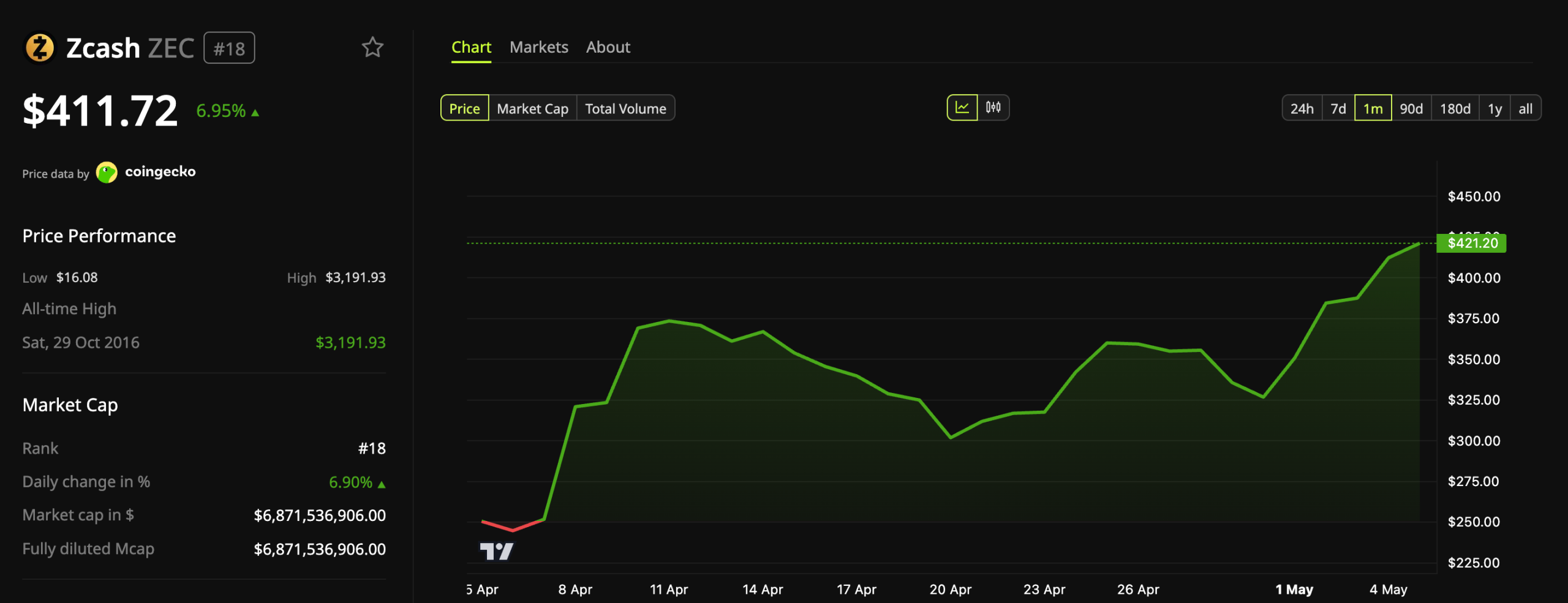
Zcash (ZEC) has surged nearly 16.8% over the past week, ranking among the strongest weekly performers in the top 100 cryptocurrencies.
The privacy-focused asset outperformed majors such as Bitcoin (BTC) and Ethereum (ETH) during the same period.
The Bull Case for Zcash Comes With a Built-In Ceiling
At the time of writing, ZEC traded at $411.7, up 6.95% over the past 24 hours.

Crypto trader Altcoin Sherpa previously identified $398 as a critical resistance level for ZEC. He suggested the coin could rally to the mid-$400s or low-$500s if ZEC holds above that level, and it has already cleared that zone. Nonetheless, he also expects a “big pullback” once ZEC reaches the levels.
Follow us on X to get the latest news as it happens
Zcash Rises as 3 Signals Point to a Fragile Rally
Meanwhile, the bullish view contrasts with on-chain analysis from Joao Wedson, founder and CEO of Alphractal. Wedson now sees three reasons for caution.
“ZEC has gained fresh momentum, but it lacks on-chain structure and sentiment support,” he said.
Wedson argued that long-term holders have already moved their coins earlier in the cycle, with little recent activity observed. He also pointed to a sharp drop in social media posts around the token.
Lastly, the “Alpha Price” metric, used to estimate potential cycle tops, shows a wide gap near $1,500, suggesting that such levels may be unrealistic given historical behavior.
“Even though ZEC is rising in the short term, extra caution is needed now due to market sensitivity. This could also be a signal for sellers who have not yet sold the remaining coins they still hold,” the executive added.
While Zcash continues to show strong short-term price action, the divergence between market momentum and underlying indicators suggests a more nuanced outlook. The current rally may persist if buying pressure holds, but weakening engagement and limited on-chain confirmation could increase downside risk.
For now, ZEC’s trajectory appears to hinge on whether it can sustain momentum above recent breakout levels while attracting renewed investor participation.
Subscribe to our YouTube channel to watch leaders and journalists provide expert insights
The post Zcash Outpaces Bitcoin and Ethereum, but Analyst Flags Three Cracks in the Rally appeared first on BeInCrypto.

A New York district court signed a restraining notice and three writs of execution to prevent the Arbitrum DAO from moving Ether believed to be tied to the Kelp exploit, according to a Friday post on the Arbitrum DAO forum by US law firm Gerstein Harrow LLP. The firm says its clients—unaffected by the Kelp exploit—won default judgments against North Korea in 2010, 2015 and 2016 and are owed about $877 million in compensatory and punitive damages, plus interest. It argues the stolen Ether is “property” in which the DPRK has a stake because the hacker group behind the attack is tied to the country.
The freeze comes as the Kelp DAO breach, which is believed to have been carried out by TraderTraitor, a North Korea–linked subgroup of Lazarus, sent shockwaves through the DeFi ecosystem. In the days that followed, Arbitrum’s Security Council moved to halt activity on a substantial amount of Ether tied to the incident—30,766 ETH, valued at over $73 million at the time—stewing in a wallet connected to the exploit.
The legal maneuver raises questions about who ultimately bears responsibility for losses tied to state-backed cyber operations and how recovered assets should be allocated when multiple parties claim stakes in stolen funds. Gerstein Harrow’s filing contends that the DPRK’s debt should be addressed without diverting funds away from the victims of the hack, a point raised by others in the community who warned that blocking the return of stolen funds to their rightful owners could shift the burden onto different victims who were themselves robbed.
Key takeaways
- A New York court has issued a restraining notice and three writs of execution to block the Arbitrum DAO from transferring frozen Ether linked to the Kelp exploit, according to Gerstein Harrow LLP.
- The law firm argues its clients hold approximately $877 million in a combination of compensatory and punitive damages against North Korea, plus interest, stemming from judgments in 2010, 2015 and 2016.
- Arbitrum’s emergency action previously froze 30,766 ETH (roughly $73 million at the time) held in a wallet associated with the Kelp attack, illustrating the ongoing friction between recovery efforts and legal claims.
- The Kelp hack, which occurred on April 18, is attributed to TraderTraitor, a Lazarus Group–linked actor, highlighting the intersection of cybercrime, sanctions enforcement, and crypto asset recovery.
- Gerstein Harrow has pursued similar efforts before, including cases involving funds frozen by Tether after the 2023 Heco Bridge hack and other DAO-related actions, underscoring a pattern of aggressive asset-claim strategies in crypto disputes.
Legal maneuvering around stolen assets and DAO freezes
According to the filing and public forum posts, the restraining notice seeks to prevent the release or movement of Ether seized in relation to the Kelp DAO breach. Gerstein Harrow frames its claim around three prior U.S. district court judgments against the DPRK, asserting that the government bears responsibility for the actions of the actor behind the attack. The firm contends the stolen Ether qualifies as property over which the DPRK maintains an interest because the hacker group is affiliated with the state. If the restraining order stands, victims of the Kelp exploit could face longer delays before recovering funds they believe belong to them or to sanctioned entities that claim an ownership stake.
In a related development, Arbitrum’s governance forum and community discussions have highlighted a potential path for victims. On April 25, Aave Labs proposed unfreezing the $73 million in Ether tied to the Kelp breach and redirecting those assets to DeFi United, a fund aimed at restoring rsETH and compensating holders. The proposal underscored a broader debate about how to reconcile restitution for criminal activity with the interests of legitimate token holders and DeFi participants.
One Arbitrum DAO member, posting under the handle Zeptimus, noted that if Gerstein Harrow’s action succeeds, the DPRK debt could theoretically be transferred to the Kelp DAO victims. The commentary captured the tension between pursuing accountability for state-backed cyber actors and ensuring that the victims of theft do not bear the burden of a geopolitical debt, a point echoed by other community voices who emphasize the need for a principled approach to asset recovery.
Gerstein Harrow’s ongoing litigation strategy
Gerstein Harrow has a history of pursuing claims on behalf of clients seeking a share of funds frozen or stolen in crypto incidents tied to sanctioned actors. In February, the firm filed a claim related to funds frozen by Tether after the 2023 Heco Bridge hack. The practice has also involved class actions against various DAOs and, in public commentary, has faced scrutiny from on-chain investigators who have questioned the firm’s use of research in court documents to support asset claims. For example, ZachXBT publicly accused the firm of leveraging his research to stake claims stemming from another major incident, illustrating the contentious nature of legal action in the crypto space.
Overall, the episode sits at the crossroads of sanctions enforcement, cybercrime attribution, and the evolving governance of frozen crypto assets. It also highlights the persistent question of how to allocate recovered funds when multiple plaintiffs and jurisdictions claim an interest, especially when a state actor is implicated in the underlying theft. The Kelp incident has sharpened debates about how to balance punitive measures against sanctioned states with practical restitution for individual victims and DeFi participants alike.
North Korea–affiliated actors have faced accusations of stealing at least $578 million across major incidents in April alone, reinforcing the perception of a coordinated, high-volume campaign against crypto networks. The Bybit hack and other exposures have further linked Lazarus Group operations to several high-profile breaches, prompting ongoing scrutiny from investigators and policymakers alike. In the wake of these actions, the crypto community is watching how courts will adjudicate claims to seized or frozen assets and whether recovery will advance or stall as legal strategies unfold.
As the dispute evolves, readers should monitor upcoming court filings and governance council decisions in Arbitrum as well as any further moves by Gerstein Harrow to recover or allocate seized assets. The balance between accountability for state-linked hacking and equitable restitution for victims remains unsettled, with the next steps likely to influence how similar cases are approached in the rapidly evolving landscape of crypto asset recovery and DAO governance.

Key Takeaways
- Institutional investors reduced technology holdings at the most aggressive pace witnessed in a decade, Goldman Sachs data shows
- The Magnificent Seven experienced net selling pressure during four out of the past five market sessions
- Figma shares have plummeted 49% in 2026, partially attributed to competitive pressure from Anthropic’s Claude Design platform
- ServiceNow stock has declined more than 40% year-to-date as broader SaaS sector concerns intensify
- MongoDB experienced a 37% decline over four months following disappointing revenue projections, though Wall Street maintains optimistic outlook
Institutional investors have executed their most substantial retreat from technology equities in ten years, based on information compiled through Goldman Sachs’ Prime Book. This widespread liquidation unfolded across a two-week period, characterized by both long position exits and short position closures.
Vincent Lin, an analyst at Goldman Sachs, noted that the magnitude of this risk reduction hasn’t been observed over the previous decade, with the exception of the meme stock phenomenon that occurred in early 2021.
The most severe selling pressure concentrated in semiconductor companies, technology hardware manufacturers, storage providers, and software developers. The Magnificent Seven collection of stocks — featuring major players such as Apple, Nvidia, and Microsoft — faced net selling activity in four of the most recent five trading days.
Three Technology Equities Facing Substantial Pressure
Even as institutional money managers retreated, certain Wall Street analysts are highlighting severely discounted technology stocks as attractive entry points. Figma, ServiceNow, and MongoDB represent three companies where analysts project potential gains of 33% or greater.
Figma completed its initial public offering in July 2025 with elevated market expectations but has faced challenges maintaining momentum. The stock experienced a 68% decline throughout 2025 and has suffered an additional 49% drop during the current year. Competition intensified when Anthropic introduced Claude Design, a solution that directly challenges Figma’s primary product offerings.
Nevertheless, Figma reported 40% year-over-year revenue expansion during the fourth quarter of 2025. The company maintains a net dollar retention rate of 136%. Wall Street’s consensus price target suggests approximately 114% appreciation from present trading levels.
ServiceNow delivers cloud-based workflow automation solutions to more than 8,800 enterprise clients, serving over 85% of Fortune 100 companies. The stock has experienced a decline exceeding 40% since the beginning of the year.
This depreciation occurred alongside a widespread software-as-a-service sector downturn that market participants have labeled the “SaaSpocalypse.” Investor anxiety regarding artificial intelligence’s potential negative impact on traditional software providers fueled the selloff.
Wall Street’s Perspective
Among 48 analysts polled by S&P Global, 43 assigned ServiceNow either a “buy” or “strong buy” recommendation. The average analyst price objective indicates potential upside exceeding 60% from current valuations.
ServiceNow’s CEO Bill McDermott has rejected the notion that artificial intelligence poses an existential threat to the business. During the company’s Q1 earnings conference, he stated, “There has never been a tailwind for ServiceNow like AI.”
MongoDB develops database technology utilized by over 60,000 clients, including approximately three-quarters of Fortune 100 enterprises. While shares rallied 80% throughout 2025, they’ve retreated roughly 37% during the past four months.
The downturn followed MongoDB’s below-consensus revenue outlook issued during its March financial update. Despite this setback, 30 out of 39 analysts surveyed by S&P Global maintain either a “buy” or “strong buy” rating.
The median 12-month price projection for MongoDB stands 33% above its current market price.
MongoDB operates with a gross margin of 71.31%, while the overall database software market maintains expansion, with artificial intelligence applications expected to serve as an additional catalyst for demand growth.
Crypto World
Is Your Career at Risk? How to Determine if You’re Among the 25% Most Vulnerable to AI Disruption
Key Takeaways
- Global analysis identifies approximately 838 million positions—nearly 25% of all jobs—as vulnerable to generative AI disruption
- Wealthier nations show 33.5% job exposure rate compared to just 11% in lower-income countries
- First quarter of 2026 witnessed 86 technology firms eliminate over 80,000 positions—the highest three-year figure
- Meta announced May workforce reduction of 10%; Microsoft initiated voluntary separation packages
- Industry analysts argue AI serves as convenient scapegoat while pandemic overstaffing and interest rate increases remain primary drivers
Bank of America has released findings based on International Labour Organization research indicating that approximately 838 million positions globally face exposure to generative artificial intelligence technologies. This represents roughly 25% of the worldwide workforce.
The analysis reveals that younger professionals, female workers, and those with advanced education credentials demonstrate the highest vulnerability levels. Developed nations with high-income economies experience the greatest impact, showing a 33.5% exposure rate. Conversely, lower-income countries register only an 11% exposure figure.
According to BofA’s economic team, affluent economies possess superior positioning to capitalize on AI-driven productivity enhancements. However, their analysis cautions that corporations spearheading AI infrastructure development will likely capture disproportionate benefits from these technological advances.
Economic researchers have challenged catastrophic unemployment predictions. They reference historical precedents—ranging from the Industrial Revolution through the digital era—demonstrating that technological shifts typically generate new employment categories following initial disruption.
Research from Goldman Sachs provides empirical support for this perspective. Their study examined over 20,000 American workers born during the 1950s through 1980s period, revealing that technology-displaced employees experienced genuine financial hardship—but not irreversible economic devastation.
These affected workers required approximately one additional month to secure new positions. Following reemployment, they experienced a 3% decrease in real wages. Throughout the subsequent ten-year period, their income growth lagged nearly 10 percentage points behind colleagues who maintained continuous employment.
Goldman’s analysis termed this phenomenon “occupational downgrading”—a process where professional skills depreciate in market value, forcing workers into less lucrative positions.
Technology Sector Employment Reductions Accelerate
During the first quarter of 2026, 86 technology corporations eliminated more than 80,000 positions. This figure represents a dramatic escalation from Q1 2025, when 103 companies reduced approximately 30,000 roles. The data marks the most severe quarterly reduction in three years.
Meta revealed April intentions to reduce its workforce by 10% during May. Microsoft distributed internal communications proposing voluntary departure packages to roughly 7% of employees. Additional companies implementing 2026 reductions include Spotify, Oracle, and Quora.
Numerous organizations have attributed these cuts to artificial intelligence advancement. March statistics showed AI cited as the primary factor in U.S. employment reductions, representing 25% of all job eliminations.
Does AI Actually Drive These Cuts?
During a March BlackRock gathering, OpenAI CEO Sam Altman suggested companies exploit AI as justification for workforce reductions. “Nearly every organization conducting layoffs attributes them to AI, regardless of whether AI genuinely factors into the decision,” Altman stated. Industry observers have labeled this behavior “AI washing.”
Venture investor Marc Andreessen identified two alternative explanations: historically low interest rates during the pandemic period and subsequent excessive hiring practices. His assessment suggests major corporations maintain 25% to 75% workforce surplus.
Epic Games CEO Tim Sweeney demonstrated unusual transparency when eliminating over 1,000 positions: “These layoffs have no connection to AI.”
The Bank of America analysis did not establish specific timeframes for when AI exposure might materialize into concrete job displacement.
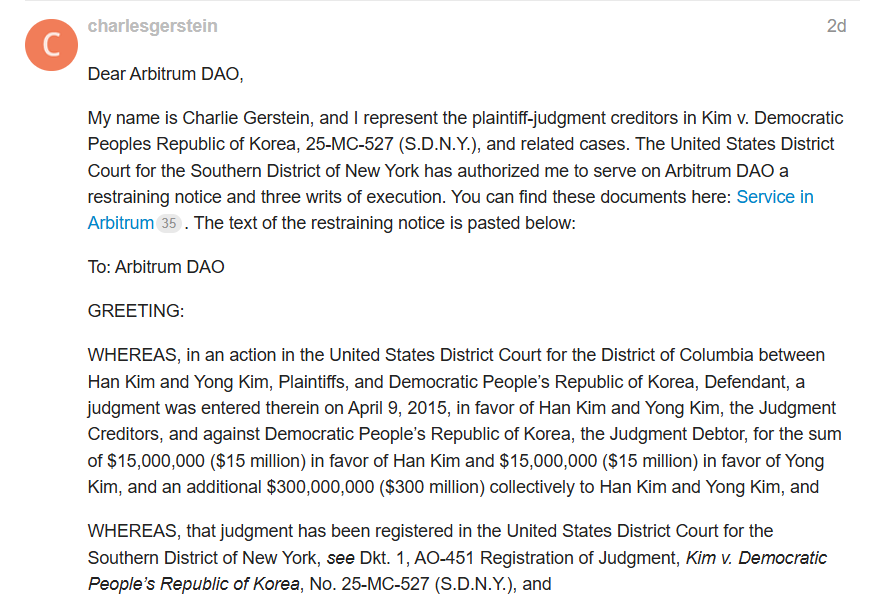
A US law firm has filed a restraining notice to block the transfer of frozen Ether from the Kelp exploit, arguing that its clients are owed over $877 million in compensation and damages by North Korea.
Charlie Gerstein, a lawyer for US law firm Gerstein Harrow LLP, said in a post on the Arbitrum DAO forum on Friday that a New York district court signed off on a restraining notice and three writs of execution preventing the DAO from moving the Ether under threat of contempt of court.
The law firm argued that its clients, who were not affected by the Kelp exploit, won default judgments against North Korea in three separate US court cases in 2010, 2015 and 2016 and are owed a collective $877 million in compensatory and punitive damages, plus interest. It also argued that its clients have a claim to DPRK property. Gerstein said in the restraining notice that the stolen Ether is “property” in which the DPRK has a stake because the hacker group is affiliated with the country.
The freeze could mean those affected by the Kelp exploit would need to wait longer to see their funds recovered. This isn’t the first time the firm has attempted to claim stolen cryptocurrency.
Kelp DAO suffered a $292 million hack on April 18, which is believed to have been carried out by TraderTraitor, a subgroup of North Korea’s state-backed hacking unit, Lazarus Group.
Days later, Arbitrum Security Council took emergency action to freeze 30,766 Ether (ETH), worth over $73 million, held in a wallet linked to the Kelp exploit.

Charlie Gerstein, a lawyer for Gerstein Harrow, posted a restraining notice seeking to prevent the Arbitrum DAO from moving the frozen Ether. Source: Arbitrum DAO
Funds were proposed for Kelp victims
Aave Labs proposed on April 25 that the Arbitrum DAO unfreeze the $73 million in Ether tied to the Kelp DAO attack and direct those funds to “DeFi United,” a fund aimed at restoring rsETH and compensating its holders.
An Arbitrum DAO member under the handle Zeptimus said that if the law firm’s action is successful, the DPRK debt will be transferred to the Kelp DAO victims.
“Your clients’ losses are real and the DPRK should answer for them. But the remedy the restraining notice asks for, blocking the return of stolen funds to their actual owners shifts the cost of the DPRK’s debt onto a different set of victims who were themselves robbed. That compounds the original harm; it doesn’t redress it,” they said.
Gerstein Harrow filed similar claims before
Gerstein Harrow has filed similar cases in the past, arguing its clients have a claim to funds stolen by the DPRK and frozen by crypto firms. In February, the firm filed a claim against funds frozen by Tether that were stolen in the 2023 Heco Bridge hack.
Related: North Korean hackers used AI-enabled social engineering in Zerion attack
It has also filed class-action suits against multiple DAOs. At the same time, onchain sleuth ZachXBT accused the law firm of using his research in court documents to stake a claim on funds from the $1.5 billion Bybit hack.

The law firm has three live cases against DAOs on its website. Source: Gerstein Harrow
North Korea-affiliated actors have been accused of stealing at least $578 million across major incidents throughout April and have been linked to many of the industry’s largest hacks, including the Bybit exploit.
Magazine: DeFi’s billion-dollar secret: The insiders responsible for hacks

Bitcoin is back in the news headlines. It cleared $80,000 this morning, reaching $80,450 at the session high in its strongest price in three months, as equity markets pushed higher and spot demand accelerated sharply.
Spot CVD exploded 199.1% during the breakout, climbing from $18.3 million to $54.8 million. This means the current rally is a move driven by direct buying, not leveraged manipulation.
Simultaneously, Strategy, the largest corporate holder of Bitcoin with more than 800 BTC, appears to be exiting a self-imposed quiet period around its Q1 2026 earnings. Michael Saylor has issued public signs suggesting the firm is preparing to resume acquisitions, even above its average buying price.
Strategy’s Strategy
MicroStrategy paused buying activity last week, consistent with the blackout period that typically surrounds quarterly earnings. That pause is now closing. Saylor’s public posture since the earnings call has shifted institutional accumulation signals from the firm.
Strategy’s most recent large tranche was 34,164 BTC for $2.54 billion 2 weeks ago. Before that, a February 2026 purchase of 2,486 BTC at an average of $67,710 demonstrated the firm’s willingness to buy into both strength and weakness. It’s a masterclass in dollar-cost averaging.
When MSTR stock surged 13.83% to $169.54 intraday as Bitcoin broke $78,000 just weeks ago, it validated a well-established dynamic: MicroStrategy’s equity trades as a high-beta amplifier of BTC price structure and a confirmed Q1 purchase in the next SEC filing would likely reprice both.
Discover: The best crypto to diversify your portfolio with
Wall Street Backdrop: Equity News and Bitcoin Correlation
Bitcoin’s $80,000 reclaim didn’t happen in isolation. Equity markets posted gains on the same session, and BTC followed, rising in direct correlation with NASDAQ. Traditional fund managers increasingly treat Bitcoin as a high-velocity proxy for high-beta tech exposure, which means equity tailwinds amplify crypto momentum disproportionately on the way up.

The regulatory backdrop is adding durability to that institutional confidence. Progress toward Senate crypto clarity legislation has reduced one of the key compliance uncertainties that kept larger allocators on the sidelines.
Bitcoin ETF inflows and Federal Reserve policy updates in mid-May are the next macro variables. If inflows accelerate as BTC holds above $80,000, the case for a sustained move toward $90,000 stops looking like a target and becomes a timeline. It’s not if, it’s when.
Discover: The best pre-launch token sales
The post Bitcoin News: $80,000 Resistance Broken as Saylor Signals Strategy Buy Return appeared first on Cryptonews.


Morgan Stanley is advising clients to hold 2%–4% Bitcoin exposure as demand for regulated crypto products grows.
Summary
- Morgan Stanley recommends 2%–4% Bitcoin exposure as clients seek regulated access through new investment products.
- MSBT attracted over $100 million before adviser access, showing strong self-directed demand for Bitcoin exposure.
- Oldenburg said bank-held Bitcoin remains possible, but Fed, Basel, and global rules still slow adoption.
The guidance was shared by Amy Oldenburg, the bank’s head of digital asset strategy, during the Bitcoin Conference in Las Vegas.
Oldenburg said the bank sees client interest in Bitcoin products, but adoption through financial advisers remains slow. She said the issue is tied to education and awareness, not only demand.
Oldenburg also said Bitcoin could one day appear on U.S. bank balance sheets. However, she made clear that such a move is not close.
She pointed to Federal Reserve guidance, Basel capital rules, and global regulatory demands as key hurdles. “It’s not totally out of the question,” Oldenburg said, while adding that large banks still need more alignment across regulators.
MSBT draws early self-directed demand
Morgan Stanley has already moved further into digital assets through MSBT, its Bitcoin-backed exchange-traded product. The product drew more than $100 million in its first six days of trading.
Oldenburg said those early inflows came from self-directed clients. The product was not yet available through Morgan Stanley’s advisory platform, which showed a gap between client activity and adviser adoption.
Stablecoin fund adds another digital asset product
Morgan Stanley Investment Management also launched the Stablecoin Reserves Portfolio, a government money market fund for stablecoin issuers. The fund trades under the ticker MSNXX and went live on April 23.
The fund invests in cash, short-term U.S. Treasury bills and notes, and overnight repurchase agreements backed by Treasuries. It targets a stable $1.00 net asset value and daily liquidity.
The product is designed for stablecoin issuers that need to hold reserves in regulated assets. Crypto.news reported that the fund has a $10 million minimum investment, a 0.15% management fee, and a 0.20% net expense ratio after waivers.
Crypto World
Market Analysis: Gold Builds Momentum While WTI Crude Oil Faces Renewed Selling Pressure
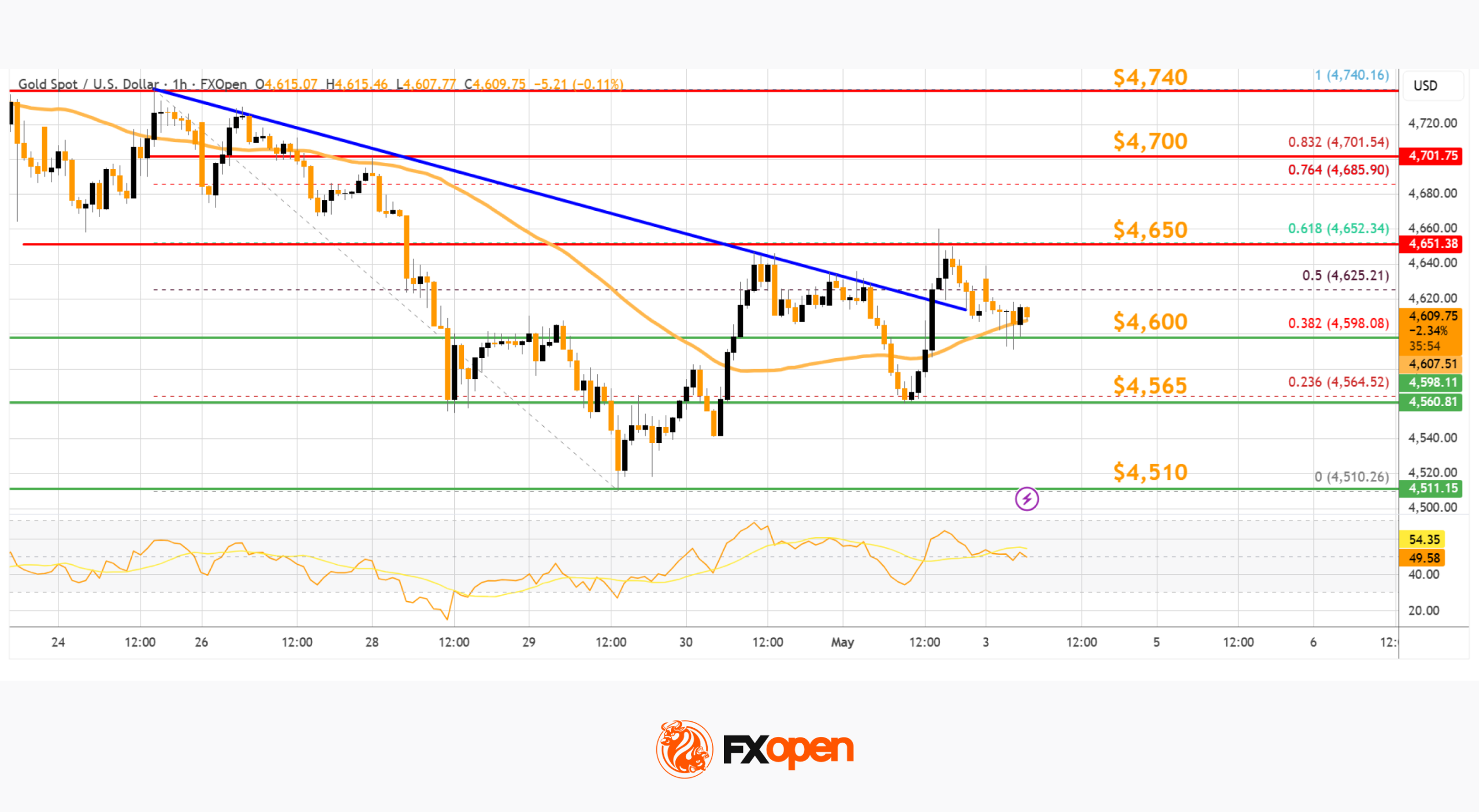
Gold price is consolidating above the $2,565 support zone. Crude oil is showing bearish signs and might decline below $96.50.
Important Takeaways for Gold and WTI Crude Oil Prices Analysis Today
· Gold price started a recovery wave from $4,500 against the US Dollar.
· It cleared a key bearish trend line with resistance at $4,620 on the hourly chart of gold at FXOpen.
· Crude oil prices failed to clear the $108 region and started a fresh decline.
· There is a connecting bearish trend line forming with resistance at $100.45 on the hourly chart of XTI/USD at FXOpen.
Gold Price Technical Analysis
On the hourly chart of Gold at FXOpen, the price found bids near the $4,500 zone. The price remained in a bullish zone and started a recovery wave above $4,550.
There was a decent move above the 50-hour simple moving average and $4,600. The bulls pushed the price above the 50% Fib retracement level of the downward move from the $4,740 swing high to the $4,510 low.
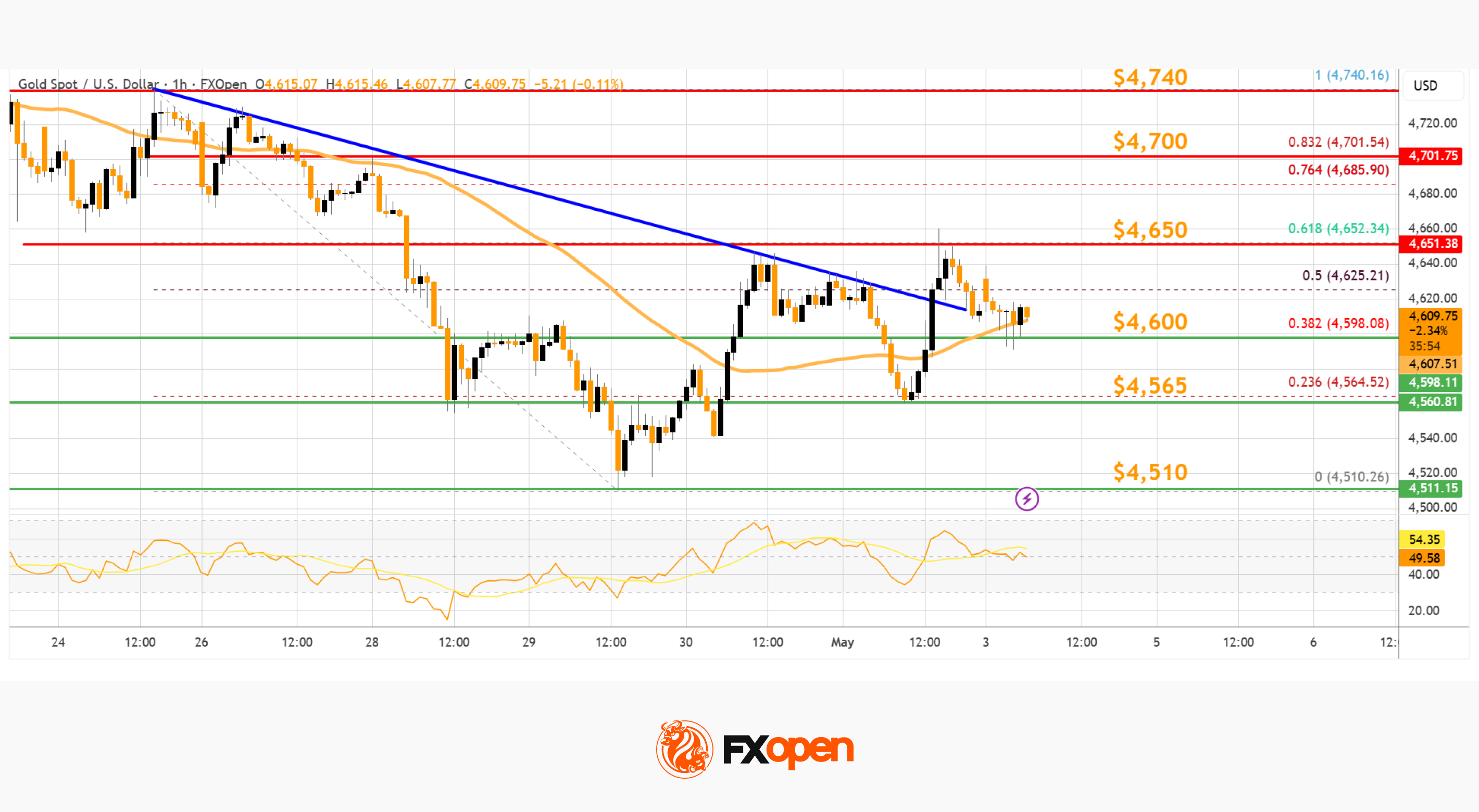
Besides, the price cleared a key bearish trend line with resistance at $4,620. Immediate hurdle is near the 61.8% Fib retracement at $4,650.
The next key breakout level sits at $4,700. An upside break above $4,700 could send Gold price toward $4,740. Any more gains may perhaps set the pace for an increase toward $4,850.
Initial bid zone on the downside could be $4,600. The first major buy zone sits at $4,565. If there is a downside break below $4,565, the price might decline further. In the stated case, the price might drop toward $4,510. Any more losses might push the price toward the $4,420 level.
WTI Crude Oil Price Technical Analysis
On the hourly chart of WTI Crude Oil at FXOpen, the price struggled to clear the $108 barrier against the US Dollar. The price started a fresh decline below $105.
The price even dipped below $100 and the 50-hour simple moving average. The bulls are now active near $96.00. A low was formed at $96.04, and the price is now consolidating losses. If there is a fresh increase, it could face sellers near the 23.6% Fib retracement level of the downward move from the $107.62 swing high to the $96.04 low.
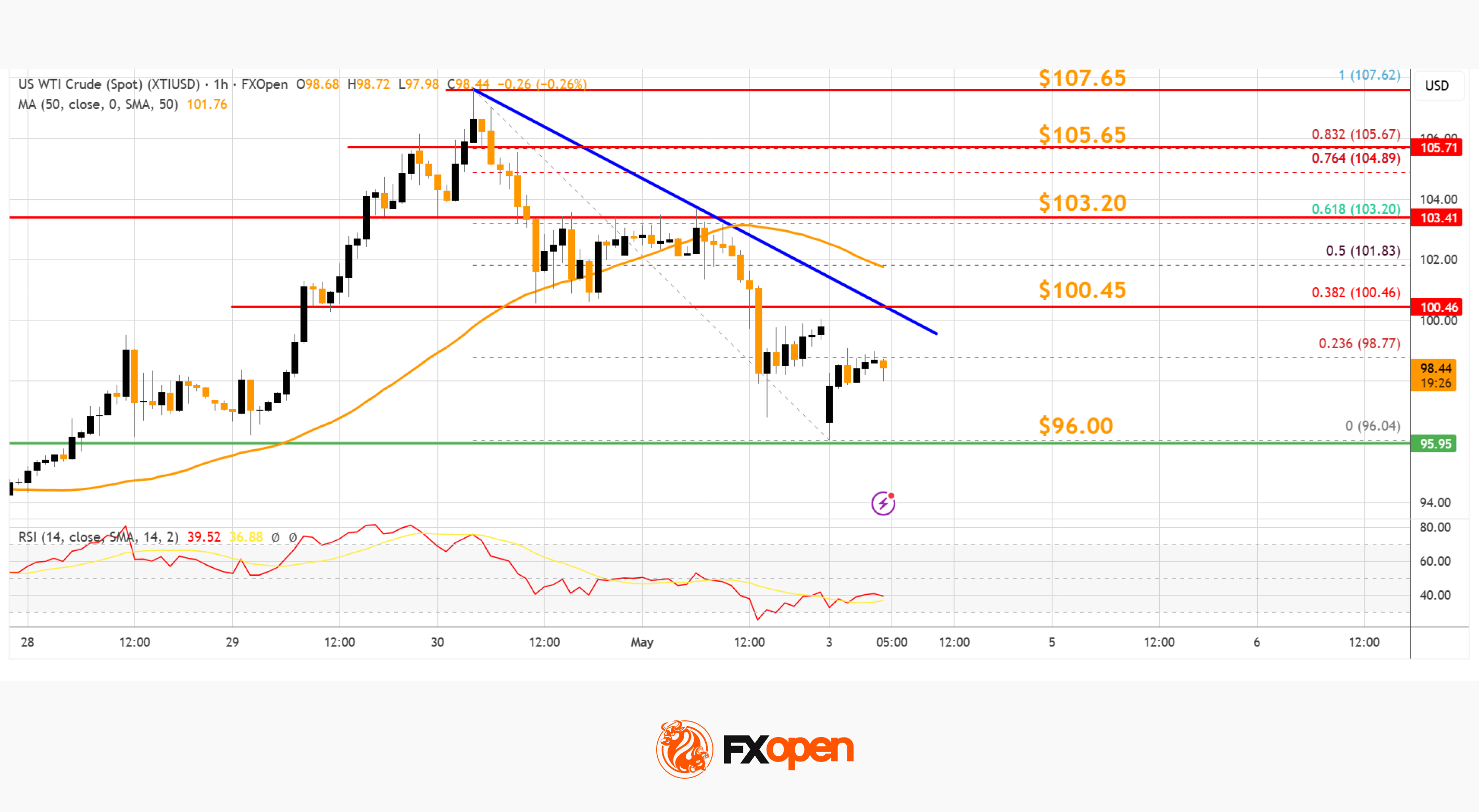
The first major hurdle for the bulls could be near a connecting bearish trend line at $100.45, above which the price could rise and test the 61.8% Fib retracement level at $103.20.
Any more gains might send the price toward $105.65. The main breakout zone sits at $108. Conversely, the price might continue to move down and revisit $96.00. The next major pivot zone on the WTI crude oil chart is $92.00.
If there is a downside break, the price might decline toward $90.00. Any more losses may perhaps open the doors for a move toward the $86.50 support zone.
FXOpen offers the world’s most popular cryptocurrency CFDs*, including Bitcoin and Ethereum. Floating spreads, 1:2 leverage — at your service (additional fees may apply). Open your trading account now or learn more about crypto CFD trading with FXOpen.
*Important: At FXOpen UK, Cryptocurrency trading via CFDs is only available to our Professional clients. They are not available for trading by Retail clients. To find out more information about how this may affect you, please get in touch with our team.
Start trading commodity CFDs with tight spreads (additional fees may apply). Open your trading account now or learn more about trading commodity CFDs with FXOpen.
This article represents the opinion of the Companies operating under the FXOpen brand only. It is not to be construed as an offer, solicitation, or recommendation with respect to products and services provided by the Companies operating under the FXOpen brand, nor is it to be considered financial advice.

Jose Benavidez Sr says just one man can test his son David Benavidez: “He’s the only guy”

Emmerdale airs ‘important’ move to mark UK’s annual deaf awareness week

Markets may be approaching near-term exhaustion after strong rally: Rohit Srivastava

Manchester United reach agreement with Casemiro over contract clause amid transfer speculation

US brings back mandatory military draft registration

Steven Gerrard disagrees with Gary Neville over ‘shock’ Chelsea and Arsenal claim | Football

My Daughter Wastes Money On Coffee (And I Don’t Like It)

Dr. Prathap C. Reddy financial district Apollo hospital Grand open#prathapcreddy#upasanakonidela

XRP PRICE REMAINS COMPRESSED & READY TO GO! – XRP NEW WALLET SURGE – $900 MILLION RWA IN 1 DAY!
-

 Tech7 days ago
Register Renaming | Hackaday
-

 Politics7 days ago
Drax board avoid their own AGM, accused of greenwashing & environmental racism
-

 Fashion5 days ago
Kylie Jenner’s KHY Enters a New Era with ‘Born in LA’
-

 Tech7 days ago
Images of Samsung’s rumored smart glasses have leaked
-

 NewsBeat16 hours ago
Channel 5 – All Creatures Great and Small series 7 new post
-
 Tech3 days ago
Trump’s 25% EU auto tariff breaches Turnberry Agreement that also covers semiconductors and digital trade
-

 Business5 days ago
Most Commercial Energy Audits Miss the Real Losses
-

 Business7 days ago
(VIDEO) Charlize Theron Climbs Times Square Billboard to Promote New Netflix Thriller ‘Apex’
-

 Crypto World6 days ago
CFTC’s AI will review U.S. crypto registration applications, chairman tells CoinDesk
-
 Sports3 days ago
Paul Scholes issues Marcus Rashford reality check as agreement emerges over Man United star
-

 Business5 days ago
Barclay Brothers Avoid Bankruptcy: HSBC Drops High Court Petitions After IVA Deal
-
 Entertainment7 days ago
Alicia Keys Calls Out Music Industry ‘Boys Club’
-
 Business5 days ago
Tesla Officially Registers Elon Musk’s Stock: What Investors Need to Know
-

 Tech6 days ago
Get Ready for More Brain-Scanning Consumer Gadgets
-
Crypto World6 days ago
Robinhood Phishing Scam Exploits Gmail Dot Feature to Bypass Security
-

 Entertainment7 days ago
Sister Wives: Janelle Posts New Scary Warning
-

 Crypto World6 days ago
Gmail Dot Trick Underpins Robinhood Phishing, Sending Real-Looking Emails
-

 Business3 days ago
Two Powerball Tickets Split $143 Million Jackpot in Indiana and Kansas
-

 Entertainment6 days ago
Michael Jackson’s Biopic Excluded Abuse Allegations For $25M
-

 Business6 days ago
Superdry co-founder accused of raping woman
You must be logged in to post a comment Login