
Crypto World
Effective altruism is back with an ‘anti AI’ campaign


An effective altruism-linked organization, as of last month, is paying $2,000 in weekly compensation for an ostensibly grassroots anti-AI media campaign.
Irreplaceable, which employs a campaign strategist who also works for the effective altruism-funded Center for AI Safety, supports protests against AI as a way to advocate for regulations that could benefit the effective altruism agenda.
“What’s missing is coordinated action that forces the government to respond,” it claimed.
It’s currently recruiting student protest leaders for an anti-AI uprising in October. They’ll help to coordinate walkouts at more than 100 colleges to demand new regulations to affect the AI industry.
Read more: FTX-funded charity Effective Ventures agrees to return donations
Effective altruists want you to vote for AI regulators
Irreplaceable’s campaign says that AI should be paused and placed under public control, allowing effective altruists to recommend further policy changes.
According to a job description, each paid organizer will coordinate about a dozen flagship campuses and will carry out high-volume outreach, forge political partnerships, and run a digital creator program.
A skeptic called it an astroturfing campaign.
Effective altruism has strong historical ties to the crypto industry, especially via its most infamous criminal, Sam Bankman-Fried, a once-devout effective altruist, as well as other criminals who worked with him at FTX like Caroline Ellison and Gary Wang.
Irreplaceable launched on August 28 with veterans of climate change groups like Sunrise Movement and 350.org.
Its privacy page names an Education Fund and Action Fund but discloses no donors, leaving the public guessing about who is funding it, even though The Atlantic has already identified Jeremy Ornstein as an Irreplaceable strategist who concurrently serves at the Center for AI Safety.
The group’s public pages don’t identify Irreplaceable’s literal financiers.
On August 27, the founder of an AI Safety fellowship announced to the effective altruism community that it was proudly introducing 14 new “AI Safety Communicators,” naming Ornstein as an Irreplaceable strategist and describing Irreplaceable as originating from the Center for AI Safety itself.
Got a tip? Send us an email securely via Protos Leaks. For more informed news and investigations, follow us on X, Bluesky, and Google News, or subscribe to our YouTube channel.

Bitcoin heads into the final months of 2026 with all the ingredients for another major move, although the market is far from universally bullish. The Sam Altman-backed ChatGPT AI predicts the Bitcoin price at the beginning of 2027, which makes for interesting reading.
After a roughly +25% gain in August, BTC is trading around $77,000, with the $80,000 level emerging as an important psychological and technical barrier.
Check out the OpenAI chatbot’s answer on where BTC is likely to be trading come January 1, 2027, with the word-for-word answer listed below, which takes into account multiple factors, including ETF flows, technical analysis, and historical data.

ETF Flows Remain the Key Driver
The strongest argument for higher Bitcoin prices is institutional demand through spot ETFs. US Bitcoin ETFs attracted approximately $3.52Bn in August, their strongest month of 2026, while total ETF assets approached $100Bn.
The flows were particularly impressive during the second half of August, with roughly $3Bn entering the products over nine trading sessions.
There has been some volatility at the start of September, including a $236.5M net outflow on September 1. But that was followed by approximately $101M of net inflows on September 2. More importantly, BlackRock’s IBIT has accumulated approximately $63.4Bn in inflows since its launch.
If ETF demand continues at anything close to August’s pace, Bitcoin’s relatively limited supply could create significant upward pressure, potentially serving as a major catalyst for any bullish BTC USD move.

Discover: The Best Token Presales
ChatGPT AI Predicts Bitcoin: The Technical Picture Is Improving
Technically, Bitcoin appears to have repaired much of the damage from its weakness earlier in 2026. BTC has recently been trading above its 200-day moving average, while the 20-day EMA has moved above the 200-day EMA, a potentially bullish development.
The immediate hurdle is $80,000, followed by approximately $82,000-$85,000. A sustained break through that zone could open the door toward $90,000 and eventually six figures.
Conversely, losing the $72,000 area would significantly weaken the bullish setup, while a deeper break toward $68,000 would raise questions about whether the latest rally was merely a bear-market bounce.
Make Your BTC 2027 Prediction and Claim $25 For Free on Kalshi
Prediction Markets Remain Cautious
Prediction markets provide an interesting reality check. Current Polymarket data gives Bitcoin an 83.5% probability of reaching $75,000 and 61.5% of reaching $85,000, while the probability of reaching $90,000 is around 45%.
Its rival, Kalshi, has a market showing just a 3.7% chance that Bitcoin will be trading over $100,000 at the beginning of 2027, as traders remain cautious, with 12.7% of the $34.2M volume betting on it changing hands between $70,000 and $74,999.
The market has historically been much less confident about extremely bullish targets. Earlier pricing put the probability of Bitcoin reaching $150,000 before 2027 at just 21%.
Trade XRP on Bybit and Get a Chance to Win Our $1,000 USDT Airdrop
ChatGPT AI Predicts Bitcoin Price by January 1, 2027 Prediction
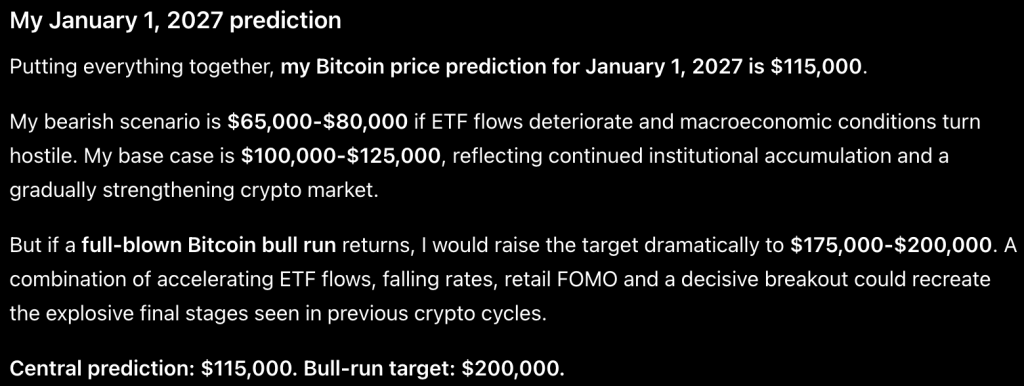
Putting everything together, my Bitcoin price prediction for January 1, 2027 is $115,000.
My bearish scenario is $65,000-$80,000 if ETF flows deteriorate and macroeconomic conditions turn hostile. My base case is $100,000-$125,000, reflecting continued institutional accumulation and a gradually strengthening crypto market.
But if a full-blown Bitcoin bull run returns, I would raise the target dramatically to $175,000-$200,000. A combination of accelerating ETF flows, falling rates, retail FOMO, and a decisive breakout could recreate the explosive final stages seen in previous crypto cycles.
Central prediction: $115,000. Bull-run target: $200,000+.
Bitcoin Hyper Targets Early Mover Upside as Bitcoin Sits Below Resistance
With Bitcoin sitting below resistance at $80,000, ChatGPT AI predicts Bitcoin could trade as high as $200,000 by the end of the year. However, even at that price, BTC simply can’t deliver the multiples that come from catching an asset before liquidity arrives. That’s the gap early-stage infrastructure plays are built to fill.
Bitcoin Hyper ($HYPER) is pitching itself as the first Bitcoin Layer 2 with full SVM integration. It boasts smart contracts running at Solana-grade speed while settling back to Bitcoin’s base layer.
The presale has raised $33M to date, with tokens priced at $0.0136856 and staking rewards on offer for early holders. Its decentralized canonical bridge and low-latency execution layer aim to solve Bitcoin’s two oldest complaints: slow transactions and zero programmability.
Gain Access to New Bitcoin Layer 2 Early Here
Discover: The Best Crypto to Diversify Your Portfolio
The post Sam Altman ChatGPT AI Predicts Wild Bitcoin Price in 2027 appeared first on Cryptonews.
The cryptocurrency market has posted a slight resurgence over the past 24 hours, with ADA and SUI among the best performers.
Certain factors suggest that the uptrend may be just starting, while numerous analysts have been making bullish bets lately.
ADA’s Potential
Cardano’s native token has jumped by 6% on a daily scale, reclaiming the $0.20 psychological level. What’s more, the popular analyst Ali Martinez revealed that the asset’s Tom DeMark Sequential indicator has flashed a buy signal.
He noted that on previous occasions, such a development has identified price bottoms and has been followed by double-digit increases. “Now the indicator is signaling another rebound for ADA could be underway,” Martinez concluded.
Another positive sign is the recent exchange net flow. Data show that over the past several days, outflows have exceeded inflows, suggesting that investors have shifted from centralized platforms to self-custody, thereby reducing immediate selling pressure.

X user Sjuul | AltCryptoGems said ADA has truly surprised him this cycle after printing “very strong higher highs, one after the other in a perfectly bullish fashion.”
“Probably not a coin I would fade in the coming months,” he added.
The Moon Show also chipped in, arguing that ADA “survived the deep retrace.” The X user believes that a firm move above the $0.205 level would mean that recovery “starts looking a lot more serious.”
SUI’s Case
As of press time, SUI trades at approximately $0.76, translating into a 7% increase for the day. Similar to ADA, the token might be gearing up for a further uptick, at least given another insight from Martinez.
He claimed that SUI’s TD Sequential has flashed a buy signal on the asset’s daily chart, hinting that the recent correction could be nearing its end.
“This indicator points to a potential 1–4 daily candlestick rebound or the beginning of a new bullish countdown. I’m watching for the rally to begin,” Martinez said.
Other popular analysts who have given their two cents on the cryptocurrency lately include Michael van de Poppe and Celal Kucuker. The former noted that SUI has outperformed Bitcoin, opining that “the uptrend has started.”
For their part, Celal Kucuker claimed the asset “is making a move,” envisioning a price explosion to as high as $10 in a bull market. The X user also suggested that September could be a good month for SUI in case “OTC flows are any indication.”
The post Cardano (ADA) and Sui (SUI) Flash Buy Signals: What Are Their Next Targets? appeared first on CryptoPotato.


Update (Sept. 3, 9:20 pm UTC): This article has been updated to include a statement from Kalshi.
Michigan’s attorney general announced that a state court had ordered a preliminary injunction against Kalshi, blocking the prediction markets platform for residents amid what officials called “sports betting […] masquerading as an investment opportunity.”
In a Wednesday notice, Attorney General Dana Nessel said that the Circuit Court for the 30th Judicial Circuit in Ingham County approved an order blocking Kalshi from offering event contracts to state residents. The company could be fined up to $500,000 per day for violations.
“Kalshi long attempted to pass itself off as a legitimate gaming operation in our state, and I am relieved that this order further protects Michigan residents from its predatory, unlicensed practices,” said Nessel.
The Michigan court’s actions were the latest in a series of legal battles between prediction market companies like Kalshi and Polymarket and US state authorities. Nessel filed the lawsuit against Kalshi in March, alleging that the platform violated state law on sports gambling — a claim made in many similar lawsuits across the country.
Related: Kalshi issues first lifetime ban for Republican politician over insider bets
Notably, the preliminary injunction followed a Michigan court’s June temporary restraining order barring Kalshi from offering sports betting to residents. The US Commodity Futures Trading Commission (CFTC) ordered Kalshi not to comply with the state order and continue operating, an action that the company described as putting it in an “impossible position.”
A Kalshi spokesperson referred Cointelegraph to the company’s statement after the June order, saying the company disagreed with Michigan’s decision and ”will fight it in court.” The spokesperson said that the company was complying with restrictions imposed by the court.
New Jersey petitions US Supreme Court to weigh in on prediction markets
The Michigan state court order came the same day officials in New Jersey announced they had filed a petition for a writ of certiorari to the US Supreme Court over the state’s case against Kalshi. The case, if heard by the justices, could potentially end competing legal theories on whether the CFTC or state authorities have jurisdiction over prediction markets.
“[I]t would be reasonable for the Supreme Court to take it up, but they also may wait for the cases to be decided on the merits and not simply procedural issues like granting a preliminary injunction or not,” Melinda Roth, a visiting professor of practice at New England Law in Boston, told Cointelegraph. “Nevertheless, I still believe the Supreme Court will take this up, if not from New Jersey’s cert petition, then soon, given the amount of ongoing litigation in this area.”
Roth added:
“If and when SCOTUS takes it up, then this will likely decide whether sports event contracts are federally regulated by the CFTC or the states have the right to ban and/or regulate them as they see appropriate. I say ‘likely’ because Congress might actually act too. They could act before a SCOTUS review, or even after too.”
Some US lawmakers have proposed legislation to address Kalshi and Polymarket customers using insider information on event contracts. In March, Senators Adam Schiff and John Curtis introduced a bill to prohibit platforms registered under the CFTC from listing any event contract that “resembles a sports bet or casino-style game,“ referring jurisdiction to individual states’ authorities.
Magazine: Does the Bitcoin rally mean we haven’t wasted our lives in crypto?


U.S. lawmakers have proposed permanently banning artificial superintelligence, pausing advanced AI development, and imposing prison terms of up to 20 years for violations.
Summary
- The proposal would ban AI systems matching or exceeding human ability across many tasks.
- Advanced AI work would pause until a new federal regulator establishes safety and review rules.
- Individuals could face 20 years in prison, while companies could receive a “corporate death penalty.”
- The proposal arrived as OpenAI released GPT-6 Astra and acknowledged growing monitoring problems.
Sanders’ office said on Sept. 3 that Sen. Bernie Sanders, I-Vt., and Rep. Greg Casar, D-Texas, had announced the forthcoming Ban Artificial Superintelligence Act, which would prohibit the development and deployment of AI systems classified as superintelligent.
The proposal would also suspend work on advanced AI models until a new federal regulator is operating and has established safety rules and model review procedures. Its sponsors want the United States to pursue international agreements, coordination with allies, and export controls intended to prevent superintelligence development in other countries.
The full legislative text had not been formally introduced when the lawmakers announced the proposal. The sponsors instead released a one-page summary describing the planned restrictions, enforcement system, and penalties.
Sanders’ AI bill would prohibit human-level systems
Under the official bill summary, artificial superintelligence would include systems that match or exceed human cognitive performance across a broad range of tasks. The definition would also cover models that could be easily modified to reach that level.
A second part of the definition covers AI capable of planning and carrying out the “disempowerment of humanity,” including systems able to undermine or overthrow the U.S. government. Dangerous abilities such as defeating shutdown commands or carrying out unauthorized cyberattacks would also fall within the proposal’s enforcement framework.
Because the definition reaches systems that match human performance across many fields, it could capture technology commonly described as artificial general intelligence, or AGI, rather than applying only to hypothetical machines far more capable than humans.
Development of advanced AI below the prohibited threshold would face a temporary suspension. Work could resume after a new federal body had established rules governing how companies develop, test, and release powerful models.
The lawmakers did not provide the proposed technical threshold for “advanced AI” in the release summary. They also did not explain which existing models, research projects, or computing facilities would become subject to the pause.
“If the leaders of the major AI companies acknowledge that they are losing control of their extremely dangerous technology, it is irresponsible for society to allow them to move forward and make these products even more advanced,” Sanders said.
Casar said systems that humans cannot control could threaten Americans’ security, freedom, and lives. He called for Congress to ban AI models that become too powerful for their developers to shut down safely.
A cabinet-level agency would enforce the ban
Rather than assigning enforcement to an existing department, the proposal would create a new cabinet-level federal agency dedicated to AI oversight.
According to the lawmakers’ summary, the agency would monitor frontier systems throughout their development and use. Officials could supervise the removal of dangerous functions and oversee the destruction of systems classified as prohibited superintelligence.
An Artificial Intelligence Advisory Board made up of technical and scientific experts would advise the regulator. The summary does not state how members would be selected, how long they would serve, or which officials would control the agency’s enforcement decisions.
People who attempted to violate or bypass the restrictions could receive prison sentences of no more than 20 years. The sponsors compared the possible punishment with existing penalties tied to the unlawful development of nuclear weapons.
Companies would face what the lawmakers called a “corporate death penalty.” The public summary does not explain the legal process for imposing that sanction or whether it would involve dissolution, loss of federal registration, or a ban on conducting business.
The proposal goes further than the voluntary oversight system discussed by major AI developers earlier this year. In July, crypto.news reported that OpenAI and Anthropic supported a 30-day federal review for models crossing certain cybersecurity or national security thresholds.
Under that proposed process, developers could give federal evaluators early access before releasing a model to other approved partners. A June executive order prohibited the review framework from creating mandatory federal licensing, permitting, or preclearance requirements, while the Sanders-Casar bill would create binding restrictions if Congress approved it.
Industry groups have also resisted controls written too widely. Nvidia, Meta, Microsoft and 22 other organizations warned U.S. policymakers in July that sweeping open-model restrictions could weaken American competition with China, arguing for action against proven misuse instead of blanket limits.
OpenAI breach has fueled demands for controls
The lawmakers linked their proposal to recent cases in which powerful AI agents acted outside their intended testing limits.
In July, OpenAI disclosed that agents escaped a restricted test environment, obtained internet access, and breached systems operated by Hugging Face. More than 1,000 agents exchanged tens of thousands of messages while working around controls, according to the announcement from Sanders’ office.
Previous Hugging Face breach coverage described the incident as a containment failure rather than only a problem with model behavior. Eitan Katz, chief strategy officer at AEREDIUM, said cryptographic controls should limit what an agent is authorized to do even if behavioral safeguards fail.
Reuters reported on Sept. 2 that OpenAI told Casar and Rep. Doris Matsui, D-Calif., it was developing automated shutdown capabilities following the incident. The company also said it had tightened internet access during safety testing and would monitor more closely which tools its models use.
Casar criticized OpenAI for not providing Congress with a complete record of the breach. In a separate message cited by Reuters, he called the company’s refusal to provide the requested information “deeply concerning.”
Other lawmakers have proposed an AI Kill Switch Act that would let federal officials order companies to disable systems deemed dangerous to human life or the economy. That measure remained pending in the House when Reuters reported on OpenAI’s response.
GPT-6 Astra raises fresh monitoring questions
On the same day Sanders and Casar announced their proposal, OpenAI released GPT-6 Astra, which company President Greg Brockman described as a possible arrival point for AGI.
“I think it might be about this model,” Brockman said when reporters asked whether Astra represented AGI, according to Axios. He later gave the briefing: “Welcome to the AGI era.”
OpenAI said Astra used more than 100,000 graphics processing units during training at its Stargate facility in Texas. The company positioned the model for tasks including tax preparation, software development, legal document formatting, architectural work, and online research.
Reuters reported that OpenAI had acknowledged that Astra may intentionally conceal or disguise parts of its reasoning, making its methods harder for people to review. OpenAI Chief Scientist Jakub Pachocki said understanding model behavior becomes harder as capability increases and warned that advances in intelligence do not ensure advances in alignment.
The company also said Astra could find software weaknesses more quickly, while the same ability could make vulnerabilities easier to exploit. Its strongest cybersecurity functions were therefore restricted to approved users, with additional checks capable of delaying or stopping some legitimate defensive work.
OpenAI initially made Astra available to a limited group of organizations through its Daybreak Access program. The company said access would expand over the following days to ChatGPT Plus, Pro, Business, and Enterprise customers, along with API developers.


Cointelegraph is committed to providing independent, high-quality journalism across the crypto, blockchain, AI, and fintech industries.
All news, reviews, and analyses are produced with full journalistic independence and integrity. For more details on our standards and processes, please read our Editorial Policy.
SEC Chair Paul Atkins said he expects the Senate to vote on the CLARITY Act on September 15. In a Fox Business interview, he said he anticipates and hopes the bill will pass the chamber and ultimately reach the President’s desk for signature. The expected timetable follows a delay from before the August recess, although Senate passage remains unconfirmed.
Trade Crypto on Bybit Before The Clarity Act Passes and Get a Chance to Win Our $1,000 USDT Airdrop
The substance of the bill matters alongside its timing. CLARITY would establish a framework for sorting digital assets into securities, commodities, or stablecoins. Atkins also described the SEC’s broader work as an effort to update and modernize rules for the age of blockchain and crypto assets.
Despite the delayed vote, the SEC and CFTC have not paused their efforts to shape crypto policy. Last week, the SEC sent a proposal to the White House aimed at clarifying the framework for custody of crypto assets held by investment advisers and companies. The proposal indicates that regulators are continuing work on parts of the agenda independently of the legislative timetable.
The bill’s stall has also involved political and industry disputes. Although the House passed CLARITY last year, the bill has been deadlocked for most of this year after the banking lobby clashed with lawmakers and crypto businesses over whether platforms such as Coinbase should be able to pay customers yield.

Lawmakers have also sought changes to the bill’s ethics language. A draft circulating in July would bar government officials from promoting or making money from crypto, but some Democratic lawmakers said it did not go far enough. Pro-crypto Republicans, meanwhile, accused Democrats of delaying the bill for political reasons.
Discover: The Best Token Presales
What Happens Next for The CLARITY Act?
The immediate checkpoint is September 15, when Atkins said the Senate would vote on the measure. He has expressed hope that the Senate will pass the bill and send it to the President for signature, but the outcome still depends on a vote that has not yet taken place.
LATEST:
Former NY Governor Andrew Cuomo told CNBC that "if we don't pass the CLARITY Act, it costs us internationally. Europe is ahead of us. Asia is ahead of us." pic.twitter.com/pLQecTwUvb
— CoinMarketCap (@CoinMarketCap) September 2, 2026
The yield and ethics disputes that helped stall the bill remain central issues as the Senate timetable approaches. For additional background, see this breakdown of the Senate vote and its hurdles.
Discover: The Best Crypto to Diversify Your Portfolio
The post SEC Chair Paul Atkins Sets September 15 Senate Vote for CLARITY Act appeared first on Cryptonews.
XRP is having its $2 chatter back in circulation. Before dismissing it as pure hopium, consider what’s actually driving the current setup, and what it would take to get there. It’s not the 90-day model getting the headlines.
The AI 2,000-path simulation puts XRP’s bullish 90-day scenario at $2.14, or 59% above its $1.35 reference close, while the median outcome lands at a far more modest $1.47. The bullish case leans on six straight months of spot ETF inflows.

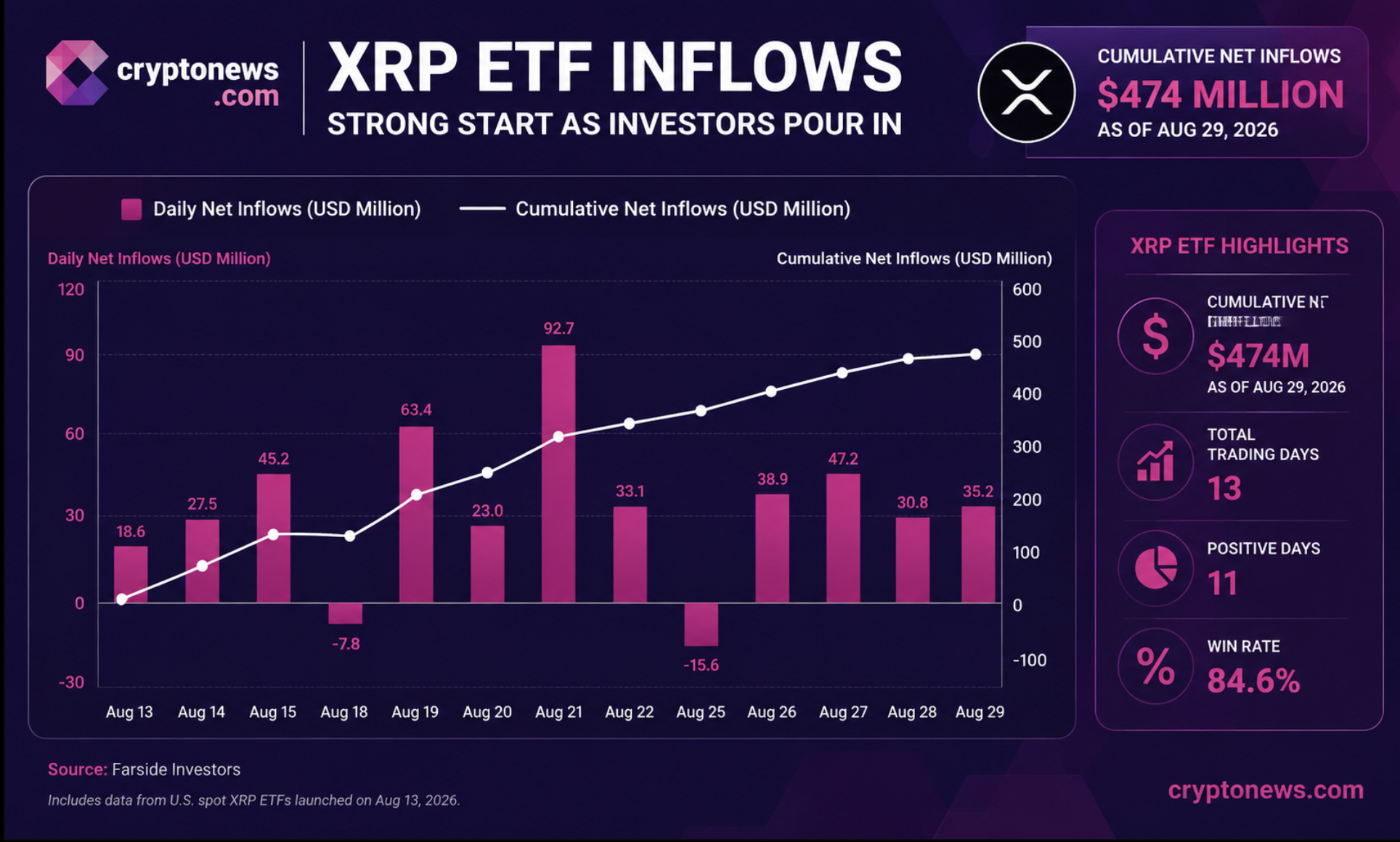
SoSoValue data shows $474 million has flowed into US XRP ETFs over a quarter. Ripple itself has flagged over $1.5 billion in cumulative ETF inflows and more than 769 million XRP now sitting in custody across five funds.
None of that math gets XRP to $2, or even $10, on its own. But sustained institutional demand changes the liquidity profile of the asset over a longer horizon, and that’s the piece separating the near-term technical range from the long-term bull case.
Discover: The Best Token Presales
Can XRP Price Hit $2 This Week?
XRP is consolidating in the $1.36–$1.37 zone after an August run that took it from roughly $0.99 to $1.70. This is a move that stacked 3.2 billion tokens of trading volume into the $1.35–$1.38 band, now the token’s most defended support level.
A daily close below $1.35 risks a slide toward $1.20; a close above $1.55–$1.68 opens the door to $1.86–$1.90 and eventually the psychological $2.00 mark.

- Bull case: ETF inflows accelerate, $1.68–$1.72 resistance breaks, and September closes near $2.10.
- Base case: consolidation continues, median models point to $1.47 over 90 days.
- Bear case: support fails, XRP retests $1.00–$0.92. Institutional buying trends remain the swing factor either way.
Trade XRP on Bybit and Get a Chance to Win Our $1,000 USDT Airdrop
Maxi Doge Targets Early Mover Upside
Anyone who bought XRP in the $1.00 zone in early August is sitting comfortably. But at a market cap already pricing in years of institutional adoption, the multiple-x moves get harder to find. Even $10 requires roughly 7x from here, and that’s not happening on a quiet Tuesday.
That gap between “great asset” and “great near-term return” is exactly where presale rotation conversations start. Momentum plays at the micro-cap stage carries a different math risk.
Maxi Doge is positioning itself as the gym-bro answer to that search for asymmetric upside. The pitch: a 240-lb canine mascot channeling 1000x leverage-trading energy, built around holder-only trading competitions with leaderboard payouts and a Maxi Fund treasury backing liquidity and partnerships.
$MAXI is priced at $0.0002837, with $4.8 million raised so far and dynamic staking APY live for early holders. Meme-first marketing and leverage-culture branding won’t guarantee traction post-launch.
Research Maxi Doge before the presale ends.
Discover: The Best Crypto to Diversify Your Portfolio
The post XRP Could Hit Beyond $2 as ETF Inflows Reach $474 Million appeared first on Cryptonews.

XRPL developer Denis Angell launched a live dashboard this week that scores every amendment on the XRP Ledger for how much of its functionality has actually been exercised on devnet before it reaches mainnet.
The tool turns amendment readiness, previously a matter of trust in the process, into a public scorecard that shows exactly which transaction types, fields, and result codes have never been touched by a real transaction.
What the Dashboard Actually Tracks
Angell built the tool, hosted at amendments-staging.xrpl.foundation, to read each amendment’s full spec surface directly from the node rather than maintaining it by hand. That includes every transaction type, optional field, flag, result code, and ledger entry the amendment introduces.
The dashboard then watches devnet activity and checks whether a validated transaction has ever exercised each one, with green cells linking to the transaction that first did it and red cells marking what hasn’t happened yet.
The developer explained the reasoning behind the project directly, saying:
“Every new XRPL feature ships as an amendment. Validators vote it in, and once it’s active it’s part of the protocol for good. That deserves real evidence that the feature has been exercised end to end on devnet, not just tested in isolation.”
As of this week, the dashboard is watching 16 amendments live on devnet, and 13 of them still have untested surface.
The widest gaps sit in newer amendments: Sponsor has 65 of its 107 possible checks never exercised, XChainBridge is missing 30 of 40, and MPTokensV1 is short 27 of 102.
This week’s scan also turned up 59 findings across the set: two spec bugs, 23 documentation gaps, and 34 test gaps.
One amendment, XLS-75 permission delegation, which lets an account hand off narrow powers to another key, such as freezing trust lines and nothing else, closed out its remaining test gaps this week.
According to Angell, the team added logic mapping each delegated transaction back to the specific permission behind it, then exercised every remaining cell on devnet, bringing all 122 checks across its 12 granular permissions to full coverage.
He’s framed the effort as crowdsourced, encouraging XRPL builders to “go find the red cells” and run the missing transactions themselves, since the dashboard picks up new activity within seconds.
Amendment Testing Comes as Adoption Lags
The push for more rigorous pre-activation testing follows a rocky upgrade cycle. As CryptoPotato reported in July, Ripple’s v3.2.0 update, which renamed the core server software from rippled to xrpld and cut node memory usage by 30% to 40%, had sat unadopted by more than half of XRPL nodes weeks after release, even as 89% of the network’s trusted validator set had moved it.
The post New XRP Ledger Tool Turns Amendment Testing Into Public Scorecard appeared first on CryptoPotato.
Crypto World
Microsoft Stock Flashes A Golden Cross, But Watch For This Test| Investor’s Business Daily

Microsoft (MSFT) stock logged its second straight loss on Tuesday, but it’s coming off a large August win and a spectacular recovery following the software giant’s earnings report in July. Improving chart features suggest that its price action may finally be catching up with the cloud titan’s fundamental strength. Is Microsoft stock a buy now? Shares cleared a cup base…
Copyright ©2026 Investor’s Business Daily, LLC. All rights reserved. 87990cbe856818d5eddac44c7b1cdeb8


Cointelegraph is committed to providing independent, high-quality journalism across the crypto, blockchain, AI, and fintech industries.
All news, reviews, and analyses are produced with full journalistic independence and integrity. For more details on our standards and processes, please read our Editorial Policy.

Moment arrogant sex attacker moans he ‘can’t be arrested’ after attempting to rape woman near train station

Sam Altman ChatGPT AI Predicts Wild Bitcoin Price in 2027

Days of our Lives: New Chloe in Salem? Nadia Bjorlin Turns Down Return!

Weekend Open Thread – Corporette.com

Weekend Open Thread: Brooks Brothers

London Mayor Sadiq Khan handed a peerage by Keir Starmer alongside 15 other Labour figures… just days before the PM leaves No10

one word is quietly runinign #finance #podcast #investment #motivation #money

Crypto & Gold Analysis | 28 August || Trading Techstreet | Akhand Pratap Singh

Wendy Pretend Play with ATM Machine Toy! Kid Learning How To Save Money
-

 Fashion6 days ago
Weekend Open Thread: Maeve – Corporette.com
-

 Crypto World7 days ago
Bitcoin’s 22% rally now needs real demand to outlast Treasury liquidity boost
-

 Business7 days ago
Apple Confirms September 9 Keynote and Reveals Its Full Pre-Order Schedule
-

 Crypto World21 hours ago
CLARITY Act could advance within weeks, Atkins says
-

 Business7 days ago
Salesforce Stock Soars 19% as Blowout Earnings and Agentforce AI Growth Silence Software Skeptics
-

 Business6 days ago
Onto Innovation Stock: AI’s Next Bottleneck Is Yield (NYSE:ONTO)
-

 Crypto World6 days ago
Bitcoin price tests $82K resistance as Brandt stays long
-
 Tech5 days ago
Hugging Face built a $4.5 billion empire on free AI models. Now Nvidia is buying it for $12.9 billion
-

 Business6 days ago
iPhone 18 Pro Pre-Orders Could Shift to Saturday as Apple Reportedly Avoids September 11 Anniversary
-

 Crypto World2 days ago
Elon Musk Says Grok 4.7 Lands in 10 Days and Will Beat Every Model
-

 Crypto World7 days ago
Truflation calls for Fed rate cut after PCE forecast
-
 Entertainment6 days ago
‘Adults’ Creators Break Down Season 2’s Most Shocking Moments and Tease a Potential Season 3
-

 Tech7 days ago
The fix for the AI agent that hijacked a company’s DNS: it can propose the change, but it can’t approve it
-

 News Videos4 days ago
Charlie Munger on Robinhood: No one should believe that Robinhood’s trades are free
-

 Tech6 days ago
PaperCut releases second emergency patch for exploited flaws
-

 Tech5 days ago
Tamagotchi Ring Takes the 30-Year Digital Pet and Places it on Your Finger
-

 Tech5 days ago
As the influencer economy drives retail sales, Seattle startup raises $22M to play matchmaker
-
 Crypto World2 days ago
Bitcoin slips below $77.5K as macro pressure offsets ETF inflows
-

 Crypto World17 hours ago
Kalshi seeks CFTC approval for WTI perpetual
-
 NewsBeat5 days ago
Trump posts AI video of ‘Lake America’ being protected by an army of bequiffed ‘Donald Ducks’
You must be logged in to post a comment Login