
Crypto World
Elon Musk Unveils Terafab: Massive Chip Factory for Tesla (TSLA) and SpaceX in Texas


Key Highlights
- Elon Musk revealed “Terafab,” an ambitious semiconductor manufacturing venture in Austin, Texas, uniting Tesla, SpaceX, and xAI
- Two distinct chips will be manufactured — one for Tesla’s cars and Optimus robots, another for space-based AI satellites
- According to Musk, current worldwide chip production satisfies merely 3% of his companies’ projected requirements
- First chips expected in late 2027, with full-scale manufacturing planned for 2028
- Tesla shares declined approximately 2–3% during premarket hours following the revelation
Elon Musk revealed ambitious plans for a substantial semiconductor manufacturing operation dubbed “Terafab” over the weekend, confirming it as a collaborative effort among Tesla, SpaceX, and xAI. The disclosure triggered a decline in Tesla’s stock price during Monday’s premarket session.
The announcement took place at a decommissioned power facility in Austin, Texas. Musk characterized Terafab as comprising two distinct manufacturing plants, each dedicated to producing a unique chip architecture.
The first chip will serve Tesla’s automotive fleet and the Optimus humanoid robot platform. The second will support AI processing in orbital environments, engineered to withstand extreme conditions and elevated operating temperatures.
According to Musk, current worldwide semiconductor manufacturing capacity would fulfill just 3% of what his enterprises will ultimately require. While acknowledging Samsung, TSMC, and Micron as existing suppliers, he emphasized that future demand will surpass total global production capabilities.
The “Terafab” designation reflects Musk’s ambition to manufacture chips requiring one terawatt of power consumption — approximately equal to one billion Nvidia Blackwell processors annually.
SpaceX’s participation came as a surprise to many observers. The aerospace company, which recently consolidated with xAI, is gearing up for a public offering that analysts estimate could reach a $1.75 trillion valuation.
Financial Investment and Production Timeline
Early-stage development will demand tens of billions in capital expenditure. Tesla has already earmarked approximately $20 billion for new equipment purchases in 2026, a significant increase from the sub-$9 billion spent in 2025. Terafab investments are separate from these existing allocations.
Musk’s timeline calls for initial chip production in late 2027, ramping to maximum output throughout 2028. As reference, semiconductor fabrication plants generally require roughly three years from construction start to volume production.
Musk indicated Terafab will ultimately deliver one terawatt of computational power annually. To put this in perspective, the entire U.S. currently generates approximately half that capacity.
Space-Based Computing Takes Priority
One notable revelation: Musk projects that 80% of Terafab’s production will support space-based artificial intelligence computing. SpaceX intends to replicate in orbit what cloud computing giants currently perform in terrestrial data centers.
The facility will concentrate on two-nanometer process technology, representing the cutting edge of current semiconductor manufacturing.
Tesla’s stock price fell roughly 3.2% on Monday. The company entered the week with an 18% year-to-date decline, though maintaining a 48% gain over the trailing twelve months.
Shares currently trade at approximately 190 times projected 2026 earnings, with market valuations incorporating anticipated AI-driven revenue from autonomous taxi services and robotics divisions.
Tesla initiated its robo-taxi program in Austin during June but has yet to expand operations to additional markets. The company is simultaneously developing a third-generation Optimus robot.
Musk has not announced a specific construction start date for Terafab.


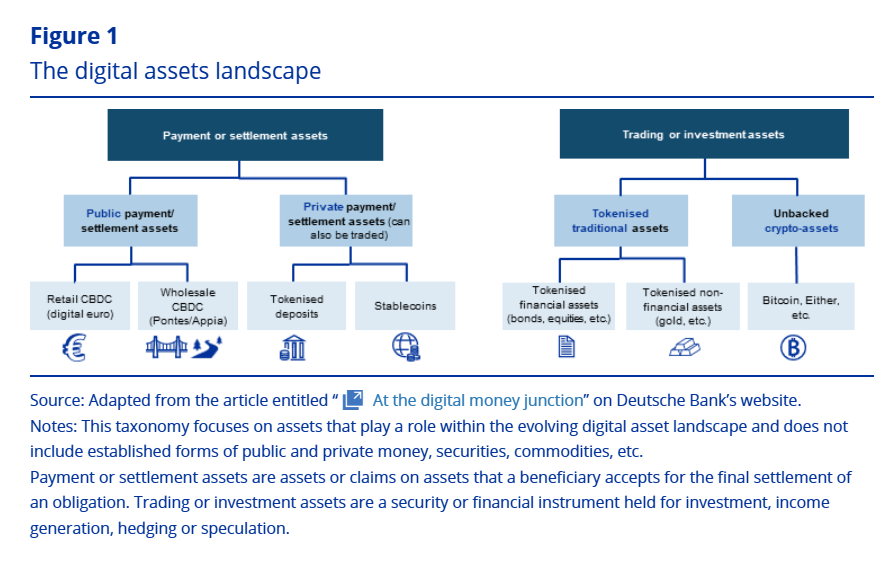
The European Central Bank (ECB) set out a cautious path toward tokenizing Europe’s capital markets, saying the technology can deliver efficiency gains only if it remains anchored to central bank money, infrastructures remain interoperable, and regulation is “robust and supportive.”
In its latest Macroprudential Bulletin published on Monday, the ECB said distributed ledger technology (DLT) could help deepen the European Union’s savings and investments union, but warned that benefits will depend on interoperable infrastructure and policymakers keeping pace with new risks.
The central bank’s stance highlights a push to modernize market plumbing in the bloc without loosening control over settlement or financial stability.
The ECB said that tokenization and DLT are “moving from concept to early-scale deployment,” but the benefits will “only be realised safely if European policy action keeps pace.”
ECB maps conditions for tokenized capital markets
One article in the Bulletin lays out how tokenized assets could rewire the issuance-to-settlement chain, cutting operational frictions and potentially improving secondary market liquidity. By moving securities and cash onto compatible ledgers and automating corporate actions, the authors argue, tokenization could streamline processes that today rely on multiple intermediaries and legacy systems.

The analysis underlines, however, that efficiency gains hinge on avoiding a patchwork of incompatible platforms and ensuring that central bank money, not just commercial bank money or privately issued tokens, can be used for settlement in tokenized markets.
Related: EU central bank backs plan for crypto supervision under EU markets watchdog
A further piece drills into the nascent market for tokenized bonds, finding early evidence that they can already lower borrowing costs and tighten bid-ask spreads compared with traditional formats.
The authors attribute this partly to operational efficiencies and partly to improved transparency and programmability around settlement and collateral management. Still, they frame these benefits as tentative and conditional, cautioning that technology, legal and liquidity risks remain and that policymakers will need to monitor whether advantages persist once tokenization scales beyond flagship deals and highly selected issuers.
Tokenized MMFs and euro stablecoins under the microscope
The Bulletin also takes a hard look at tokenized money market funds and euro-denominated stablecoins, treating them as parallel experiments in onchain cash-like instruments.
One article stresses that tokenized money market funds (MMFs) largely replicate familiar liquidity and run risks but layer on new operational vulnerabilities, raising questions about how they would behave under stress alongside stablecoins.

Another argues that Markets in Crypto-Assets Regulation (MiCA) compliant euro stablecoins could reshape demand for sovereign bonds and act either as a liquidity buffer in turbulent markets or a new channel of bank contagion, depending on how issuers meet deposit and reserve requirements.
Across the five pieces in the Bulletin, the ECB’s stance is clear: Tokenization can support its vision of an integrated capital market, but only if policy, prudential rules and central bank infrastructure evolve in lockstep.
Cointelegraph reached out to the ECB for comment, but had not received a response by publication.
Magazine: Asia Express: Phantom Bitcoin checks, China tracks tax on blockchain
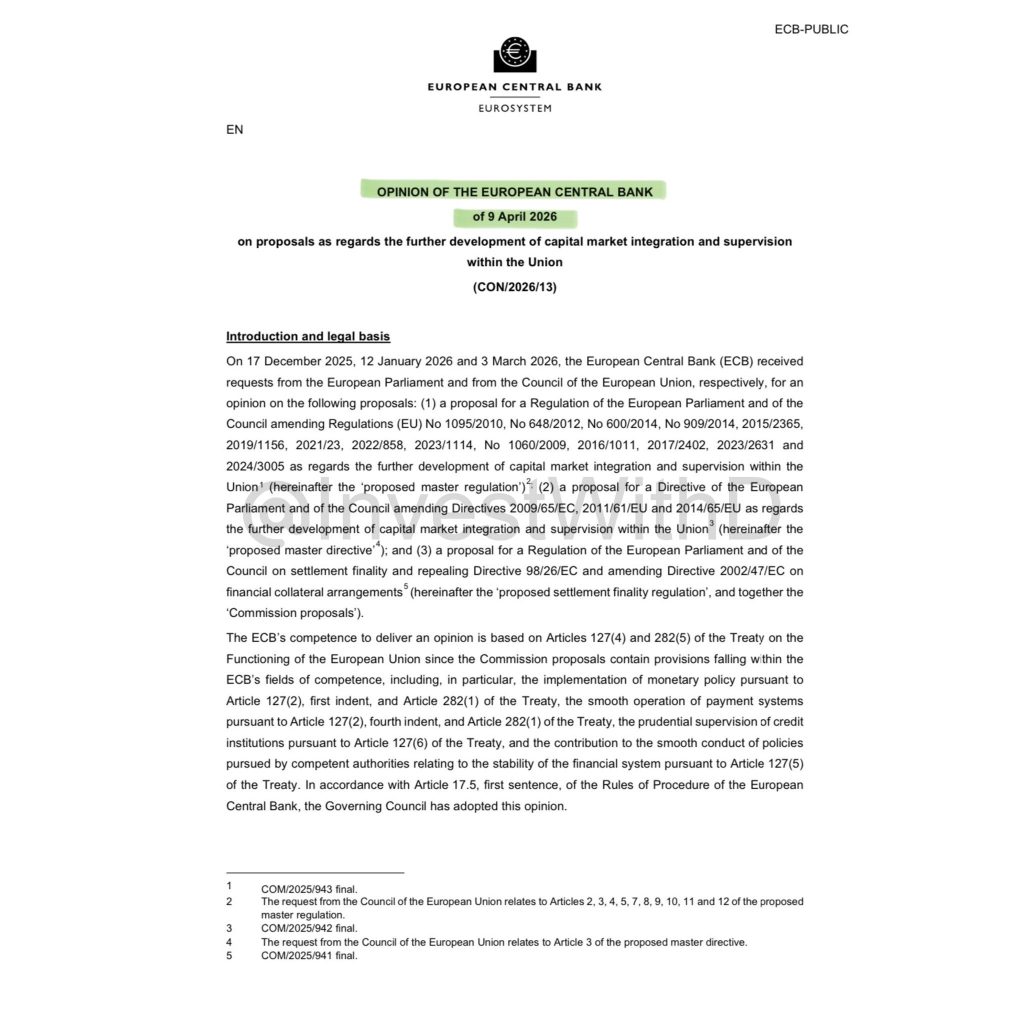
The European Central Bank (ECB) has formally backed a proposal to transfer crypto-asset service provider supervision to the European Securities and Markets Authority – a move that would collapse 27 fragmented national licensing regimes into a single Paris-based enforcement framework.
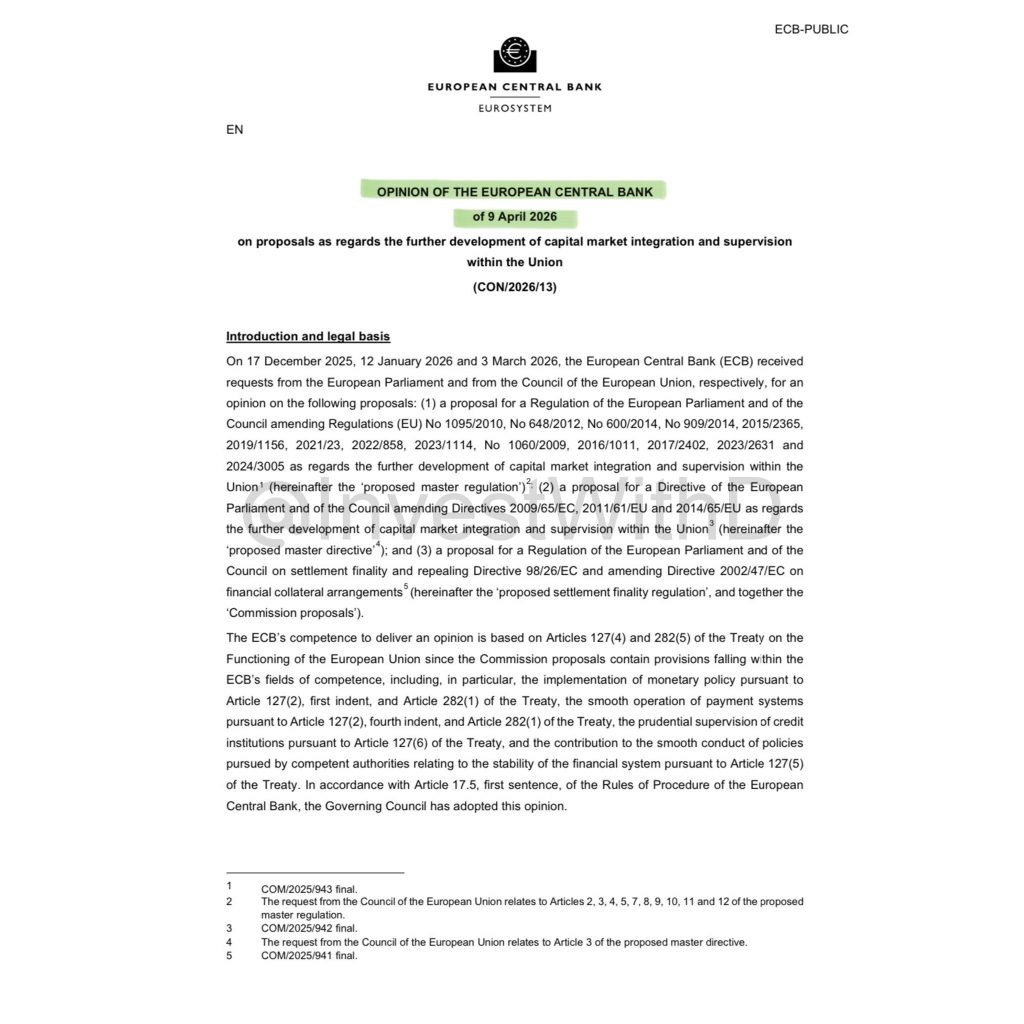
The ECB’s opinion, issued in response to the European Commission’s 2025 capital markets package (COM/2025/941, 942, 943), positions ESMA as the direct supervisor of systemically relevant crypto-asset service providers across the EU.
The push is already drawing resistance from member states that built their regulatory infrastructure – and licensing revenue – around MiCA’s national competent authority model.
Ireland, Luxembourg, and Malta have emerged as preferred crypto licensing jurisdictions under the current framework. Centralized ESMA oversight would strip that competitive advantage overnight.
The question isn’t whether the ECB wants this. It clearly does. The question is whether the Commission’s capital markets package can survive the member state resistance long enough to make it law.
- ECB Position: The ECB formally supports transferring CASP supervision from national competent authorities to ESMA under the Commission’s 2025 capital markets package.
- MiCA Impact: Centralized ESMA oversight would replace 27 national enforcement regimes with a single authority, eliminating licensing arbitrage across EU jurisdictions.
- ECB Institutional Ask: The ECB is requesting non-voting membership on ESMA’s new Executive Board for CASP-related discussions, plus direct data access and risk-sensitive own-funds requirements for crypto firms.
- Stablecoin Exposure: The ECB is pushing caps on e-money tokens used as settlement assets absent central bank money – a direct constraint on euro-pegged stablecoin scale.
- Timeline: MiCA transitional periods expire in Q1 2026; ESMA’s expanded remit, if adopted, would likely phase in alongside EBA significance assessments running concurrently.
- Licensing Hub Risk: Member states with established crypto licensing ecosystems face loss of supervisory jurisdiction and competitive differentiation if ESMA centralization passes.
- Watch: Commission negotiations on the 2025 capital markets package – any concession on ESMA’s direct authority signals the centralization push is losing political momentum.
Discover: Top Crypto Presales to Watch This Month
What Does ECB ESMA-Led Supervision Actually Change for Exchanges and Crypto Stablecoin Issuers Operating Across the EU?
Under the current MiCA architecture, crypto-asset service providers obtain authorization from their home member state’s national competent authority – then passport that authorization across the EU. The model mirrors how traditional financial firms operate under MiFID II.
On paper, it delivers single-market access. In practice, it creates enforcement asymmetry: a CASP licensed in a jurisdiction with light-touch NCA oversight faces materially different compliance pressure than one licensed in a stricter regime, even though both carry EU-wide passporting rights.
ESMA-led direct supervision eliminates that gap. Exchanges above a defined systemic threshold would report to ESMA rather than their home NCA – meaning enforcement standards, inspection frequency, and penalty structures become uniform regardless of where a firm chose to incorporate.
ESMA already maintains a public register of ART and EMT issuers and holds authority to operate a crypto blacklist for non-compliant CASPs. Direct supervisory power over major CASPs extends that remit from registry maintenance to active enforcement. That’s a fundamentally different institutional role.
For stablecoin issuers specifically, the ECB’s push for caps on e-money tokens as settlement assets – absent central bank money – adds a second layer of constraint. Significant EMT issuers already trigger EBA oversight at €5 billion in reserves or 10 million users.
An ECB-backed settlement cap would impose volume limits on top of those thresholds, regardless of EBA significance status. Major exchanges operating large-scale stablecoin settlement – including Binance and OKX, whose reserve disclosures have drawn sustained market scrutiny – face direct exposure to that constraint if it reaches final rulemaking.
Discover: The best crypto to diversify your portfolio with
Why Is the ECB Pushing This Now – and What Does Its Institutional Ask Reveal?
The ECB’s opinion wasn’t spontaneous. The European Commission released three legislative proposals in late 2025 – COM/2025/941, 942, and 943 – designed to deepen the Capital Markets Union by expanding ESMA’s direct powers over systemically important CCPs, CSDs, CASPs, and trading venues.
The ECB’s formal response to that package is where the ESMA backing landed, alongside a specific institutional request: non-voting membership on ESMA’s new Executive Board for discussions covering crypto-asset service providers.
That request matters. Non-voting board membership gives the ECB a standing seat in ESMA’s supervisory deliberations without requiring legislative expansion of ECB authority.
It’s a mechanism for monetary policy influence over crypto supervision without formal jurisdictional overlap – and it signals the ECB views CASP activity as directly relevant to monetary stability, not just financial market integrity.
The ECB also flagged staffing explicitly, warning that ESMA needs “adequate staffing and financial resources” to absorb expanded supervisory responsibilities without operational strain.
That’s not a platitude. ESMA’s January 2025 statement pushing NCAs to enforce restrictions on non-MiCA-compliant ART and EMT issuers by end of Q1 2025 already tested the authority’s coordination capacity.
Adding direct CASP supervision without headcount expansion would stress the same institutional infrastructure. This regulatory trajectory mirrors what’s unfolding elsewhere – Japan’s reclassification of crypto under the Financial Instruments and Exchange Act reflects the same global pattern: major jurisdictions moving crypto from payment-adjacent frameworks into full securities-style oversight with direct supervisory teeth.
Discover: The best pre-launch token sales
The post ECB Backs ESMA-Led Crypto Supervision in EU: Tighter MiCA Enforcement Incoming appeared first on Cryptonews.


Trump’s new naval blockade of Iranian ports at the Strait of Hormuz has sent Brent and WTI back above $100, sparked Iranian threats against Gulf ports, and knocked Bitcoin off weekend highs as traders reprice energy and geopolitical risk.
Summary
- The US has begun a naval blockade of Iranian ports along the Strait of Hormuz after talks in Islamabad collapsed.
- Iran has threatened to strike Gulf ports in retaliation, as global benchmark crude pushes back above $100 per barrel.
- Shipping and energy officials warn the move risks breaching maritime law and deepening the world’s energy crisis.
A US naval blockade of Iranian ports along the Strait of Hormuz began on Monday after weekend talks between Washington and Tehran in Islamabad failed to produce a deal, sending oil back above $100 a barrel and rattling global markets. US Central Command said the embargo covers “the entirety of the Iranian coastline” and will apply to all vessels “regardless of flag” entering or exiting Iranian ports, while allowing ships transiting the strait between non‑Iranian ports to pass.
Tehran responded by threatening to hit “Gulf ports” in retaliation for what it has called an “illegal” attempt to choke its economy, raising the risk of direct strikes on regional energy infrastructure. In a message to Gulf neighbours reported by the Wall Street Journal, Iran’s Islamic Revolutionary Guard Corps warned it would “take measures to deny America and its allies access to oil and gas resources in the region for years” if attacks on its soil escalate.
Oil prices surged on news of the blockade, with US West Texas Intermediate futures for May jumping 8% to about $104.40 per barrel and Brent crude for June climbing more than 7% to around $102 per barrel on Sunday evening. Barron’s reported that Brent was up 7.5% and WTI 8% after US‑Iran talks collapsed, while Yahoo Finance noted US crude “surged past $100” as traders priced in the risk of prolonged disruption to Persian Gulf exports.
The head of the International Maritime Organization, Arsenio Dominguez, criticised the move, telling journalists “countries do not have the right to blockade an international strait that is used for international navigation,” and warning that “additional restrictive measures don’t really help us” de‑escalate the crisis. He added that “shipping continues to be used as collateral,” and said he “needed more details” on how the blockade would affect commercial traffic.
Market commentators fear the shock could get worse if the blockade lasts or widens. On CNBC, Trita Parsi of the Quincy Institute warned that “taking more oil off the market — particularly the only oil that is now getting out from the Persian Gulf — will drive oil prices further up … [to] around $150 per barrel” if the disruption deepens.
The blockade comes after Iran’s earlier threats to strike oil and gas platforms across the Middle East and follows a period in which Brent crude had already surged as much as 60% in March on the back of Hormuz‑related disruptions, according to analysis cited by Modern Diplomacy. With roughly 20% of global oil and LNG flows normally transiting the Strait of Hormuz, energy traders now face a scenario where the world’s most critical chokepoint is both militarised and politicised, and where a miscalculation in the Gulf could quickly translate into sharper inflation and financial stress far beyond the region.
Crypto prices respond to blockage of Strait
In the two hours since the blockade formally came into effect, crypto markets have traded like any other macro risk asset: lower, but orderly rather than in full‑blown panic. Bitcoin (BTC) has slipped back toward the $70,500–$71,000 range after briefly trading near $74,000 over the weekend, with Investing.com putting it around $71,022 at 02:30 ET and CryptoRank noting an intraday low near $70,570 as oil spiked above $103.
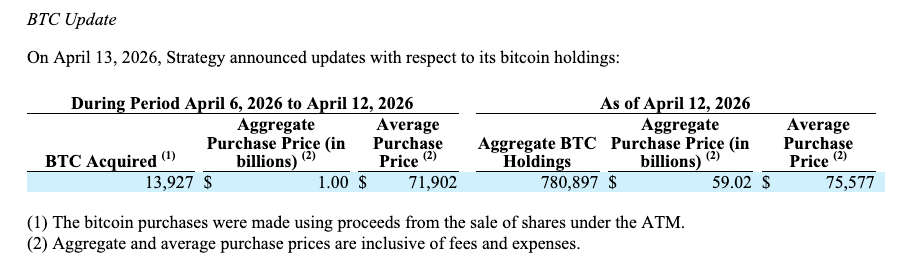
Michael Saylor’s Strategy, the world’s largest public holder of Bitcoin (BTC), added a large haul of Bitcoin to its stash last week, edging toward 800,000 BTC in total holdings.
Strategy acquired 13,927 Bitcoin for $1 billion between April 6 and 12, according to an 8-K filing with the US Securities and Exchange Commission on Monday.
The purchases were made at an average price of $71,902 per coin, marking another purchase below the company’s average acquisition price of $75,577.
Strategy now holds 780,897 BTC on its balance sheet, acquired for a total cost of $59.02 billion. The company has 19,103 BTC left to reach 800,000 BTC after buying more than 107,000 BTC so far this year.

Purchases funded with Strategy’s STRC ATM
According to the filing, the $1 billion in purchases were funded via proceeds from Strategy’s perpetual preferred equity, Stretch (STRC).
The company sold 10 million STRC shares last week, generating around $1 billion in notional value and net proceeds. No shares were sold for STRF, STRK, STRD or MSTR stock during the period.

According to STRC.live, STRC recorded its second-largest weekly issuance on record last week, nearly three times the four-week average. The equity has seen record share sales in recent weeks after Strategy amended its sales rules in early March.
Saylor teased the latest purchase in an X post on Sunday, sharing a chart of Strategy’s Bitcoin purchase history showing 105 acquisitions since 2020, a pattern often seen ahead of new BTC buys.

Strategy’s aggressive Bitcoin buying comes despite the company sitting on significant unrealized losses on its holdings. Last week, Strategy reported its unrealized losses on digital assets amounted to $14.46 billion in the first quarter of 2026.
Apart from Strategy, Bitcoin exchange-traded funds (ETFs) have also seen significant buying last week, with spot Bitcoin ETFs seeing inflows of $786 million over the period.
Related: Institutions are in a crypto bull market as retail sits out: Exodus CEO
Crypto markets rallied early last week following a US-Iran ceasefire announcement, with Bitcoin reclaiming $70,000 and briefly surging past $73,000, according to CoinGecko.
Nomura’s Laser Digital told Cointelegraph that Strategy’s buying was among the key signals supporting the move, alongside strong inflows into Bitcoin ETFs. The firm added that US equities also returned to pre-conflict levels, reinforcing broader market momentum.
“However, the weekend talks didn’t go well — no agreement was made and the latest announcement of a naval blockade from April 13 triggered a sharp pullback towards $71,000,” Laser Digital said, adding that the company expects this erratic price movement to continue until the last minute of the ceasefire deadline.
Crypto World
Alt5 Sigma (ALTS) Stock: Fintech Revenue Doubles While $344M Crypto Writedown Hits Earnings

Key Highlights
- Alt5 Sigma generates $24.8M in revenue while absorbing $344M cryptocurrency-related deficit
- Transaction processing volume reaches $3.5B as fintech operations expand significantly
- WLFI digital asset holdings result in $402M unrealized loss impacting fiscal performance
- Fintech revenue climbs more than double year-over-year despite substantial net loss
- Platform infrastructure grows with AI integration plans as operational losses mount
Alt5 Sigma Corporation delivered substantial fintech revenue gains throughout fiscal 2025 while simultaneously recording significant losses attributed to cryptocurrency asset valuation adjustments. The organization enhanced its payment processing capabilities and handled substantial transaction volumes throughout the period. Digital asset revaluation created considerable pressure on the company’s bottom-line results.ALT5 Sigma Corporation is trading at $0.9412 a 0.13% increase.
Payment Processing Operations See Significant Expansion
Alt5 Sigma Corporation grew its fintech-related revenue to $24.8 million throughout fiscal 2025, representing substantial improvement from the previous year’s $11.9 million figure. This expansion stemmed from increased utilization of payment processing, digital trading platforms, and transaction settlement capabilities. Strategic acquisition of Mswipe enhanced the organization’s card payment infrastructure while broadening customer penetration.
The company facilitated approximately $3.5 billion worth of transaction activity throughout the fiscal period. Since launching operations, cumulative transaction processing has surpassed $8.0 billion. These metrics demonstrate accelerating adoption among corporate customers, institutional partners, and international clientele.
Gross profitability totaled roughly $10.2 million, corresponding to 41.0% of fintech-generated revenue. Margin compression from the prior year’s 47.5% resulted from evolving service composition. Integration of card payment capabilities alongside trading operations influenced the company’s overall profitability structure.
Cryptocurrency Valuation Adjustments Create Substantial Deficit
ALT5 Sigma Corporation disclosed a net deficit of approximately $344.5 million for the fiscal 2025 period. This represented a dramatic deterioration compared to the $7.6 million deficit recorded during 2024. The organization documented roughly $402.0 million in unrealized cryptocurrency depreciation connected to $WLFI token positions.
Operational expenditures escalated substantially to $33.0 million from the previous year’s $12.6 million level. This growth mirrored ongoing investments in fintech platform development and acquisition integration activities. The organization broadened infrastructure supporting payment processing, trading execution, and settlement functions.
Notwithstanding the deficit, aggregate assets totaled approximately $1.219 billion at fiscal year conclusion. Digital currency holdings represented roughly $1.054 billion measured at fair market value. Shareholder equity remained at approximately $1.155 billion, reflecting robust balance sheet fundamentals.
Management Initiatives and Forward Planning
Alt5 Sigma Corporation reinforced its executive team composition throughout 2025. The company designated a new Chief Financial Officer while expanding board membership to strengthen oversight capabilities. The organization also achieved full regulatory compliance restoration and implemented enhanced internal control frameworks.
The organization authorized a capital return program encompassing $100 million and 50 million shares. Management secured $15 million in debt financing to fund strategic corporate priorities. These decisions targeted improved capital deployment efficiency and enhanced financial adaptability.
Alt5 Sigma Corporation introduced artificial intelligence initiatives during early 2026 to advance platform capabilities. Management intends to incorporate AI-powered commerce functionality into payment and settlement infrastructure. The company maintains active exploration of expansion opportunities within the USD1 and WLFI digital ecosystems.

Bitcoin Leads Inflows As Market Sentiment Improves
Digital asset investment products recorded US$1.1 billion in inflows during the past week. This marks the highest weekly total since early January. The rise came as investor sentiment improved across global markets.
Lower than expected US CPI data supported risk appetite. At the same time, easing geopolitical tensions added confidence among investors. These factors helped push fresh capital into crypto funds.
Bitcoin remained the main driver of these inflows. It attracted US$871 million during the week. This brought its year-to-date total close to US$2 billion.
However, short Bitcoin products also saw activity. They recorded US$20.2 million in inflows. This was the largest weekly figure since November 2024, and it pointed to continued hedging by some investors.
A market note stated, ‘$871M BTC inflows alongside rising short-bitcoin products is a notable split.’ It added that these positions may reflect hedging rather than bearish views.
Ethereum Rebounds While Regional Flows Stay US-Focused
Ethereum showed a recovery in investor demand during the same period. It recorded inflows of US$196.5 million. This marked a shift after weeks of weaker sentiment.
Despite the recent inflows, Ethereum remains in a net outflow position for the year. This shows that earlier withdrawals still outweigh recent gains. Still, the latest data suggests improving confidence.
Other digital assets saw limited movement. XRP recorded inflows of US$19.3 million. Meanwhile, Solana posted small outflows of US$2.5 million during the week.
Regionally, the United States dominated the inflow data. It accounted for US$1.06 billion, or about 95% of total flows. This shows that US investors drove most of the activity.
Germany followed with US$34.6 million in inflows. Canada and Switzerland reported smaller figures of US$7.8 million and US$6.9 million. These numbers show a more modest response outside the US.
Trading Volumes Rise But Remain Below Yearly Average
Trading activity increased during the week, although it stayed below typical levels. Volumes rose by 13% compared to the previous week. However, total trading reached only US$21 billion.
This remains below the year-to-date weekly average of US$31 billion. The gap suggests that while inflows improved, overall trading activity is still moderate. Investors may be adding positions without heavy trading.
Assets under management also showed recovery. Total AuM returned to levels last seen in early February. This reflects both price stability and renewed inflows into funds.
The mix of strong Bitcoin inflows and rising short positions suggests a balanced approach. Some investors appear to be adding exposure, while others are managing risk. A note stated, ‘The shorts could be institutional hedges on spot ETF positions, not directional bets.’
As market conditions stabilize, fund flows may continue to respond to macro signals. Investors are closely monitoring inflation data and global developments. These factors remain key drivers of crypto fund activity.


Bitget, the world’s largest Universal Exchange (UEX), has introduced its UEX VIP Airdrop Season, a new tier of benefits designed to give VIP clients early and preferential access to high-demand pre-IPO opportunities following the launch of IPO Prime.
VIP users will receive priority exposure to preSPAX, the first asset listed under IPO Prime, designed to reflect the economic performance of SpaceX following its potential public listing. The program introduces two exclusive rounds of airdrops for VIP participants ahead of public subscription, allowing early positioning in one of the most closely watched private companies globally.
The promotion runs from April 13 to April 19, 2026, and is structured in two phases. The first phase, reserved for existing VIP users, features a dedicated airdrop pool of 760 preSPAX tokens. Eligible users can register within the initial window, with allocations distributed based on VIP tier across futures, spot, and asset categories. Airdrops for this phase are scheduled for April 16.
The second phase extends access to new participants through the VIP Fast Track program. Users who upgrade to VIP status during the campaign period will gain access to an additional 190 preSPAX token pool, with distribution taking place on April 20. Allocation is determined by VIP level at the close of the promotion, creating a direct link between user tier and access to the asset.
In total, the two phases represent a distribution of up to 950 preSPAX tokens, with combined value reaching approximately 500,000 USDT. In addition to early airdrop access, VIP users will receive enhanced subscription quotas once public participation opens.
“Access has always defined who participates in early-stage growth,” said Gracy Chen, CEO of Bitget.
“What is changing is how that access is being distributed. VIP users are no longer just receiving benefits within the platform, they are gaining earlier entry into opportunities that were traditionally out of reach.”
The launch reflects a broader shift in how access to high-growth assets is being structured. Opportunities linked to pre-IPO companies have traditionally been limited to institutional investors and closed networks. Through IPO Prime and the VIP Airdrop Season, Bitget is introducing a tier-based framework that expands participation while maintaining structured allocation.
Within Bitget’s Universal Exchange model, the VIP Airdrop Season represents an extension of how value is distributed across the ecosystem. By integrating pre-IPO exposure, tiered allocation, and continuous liquidity into a single environment, Bitget is redefining how high-value opportunities are accessed, moving beyond traditional boundaries between institutional and retail participation.
For more information, please visit here.
About Bitget
Bitget is the world’s largest Universal Exchange (UEX), serving over 125 million users and offering access to over 2M crypto tokens, 100+ tokenized stocks, ETFs, commodities, FX, and precious metals such as gold. The ecosystem is committed to helping users trade smarter with its AI agent, which co-pilots trade execution. Bitget is driving crypto adoption through strategic partnerships with LALIGA and MotoGP™. Aligned with its global impact strategy, Bitget has joined hands with UNICEF to support blockchain education for 1.1 million people by 2027. Bitget currently leads in the tokenized TradFi market, providing the industry’s lowest fees and highest liquidity across 150 regions worldwide.
For more information, visit: Website | Twitter | Telegram | LinkedIn | Discord
Risk Warning: Digital asset prices are subject to fluctuation and may experience significant volatility. Investors are advised to only allocate funds they can afford to lose. The value of any investment may be impacted, and there is a possibility that financial objectives may not be met, nor the principal investment recovered. Independent financial advice should always be sought, and personal financial experience and standing carefully considered. Past performance is not a reliable indicator of future results. Bitget accepts no liability for any potential losses incurred. Nothing contained herein should be construed as financial advice. For further information, please refer to our Terms of Use.
The post Bitget Unlocks Pre-IPO Access for VIPs appeared first on BeInCrypto.

Key Takeaways
- Bernstein maintains Outperform rating on Microsoft (MSFT) with $641 price target
- Shares have declined 27.5% in the past six months, hovering near the 52-week low of $370.87
- Analyst cites temporary Azure margin compression linked to timing mismatch between AI infrastructure investment and revenue generation
- Azure revenue growth projected to gain momentum in Q3 with sustained strength through Q4
- 34 of 37 Wall Street analysts rate MSFT a Buy, with consensus price target at $581.61
Microsoft shares have endured a punishing six-month stretch, shedding 27.5% of their value to reach $370.87. The stock now hovers dangerously close to its 52-week nadir. Yet Bernstein remains firmly in the bull camp.
Mark Moerdler, an analyst at Bernstein, has reaffirmed his Outperform rating alongside a $641 price objective on MSFT — representing potential upside exceeding 70% from current trading levels.
Bernstein’s thesis hinges on a critical timing mismatch. Microsoft has been aggressively investing in artificial intelligence infrastructure, a strategy that has spooked certain market participants. However, Moerdler contends the capital deployment isn’t the red flag many perceive.
The research firm’s analysis suggests that the majority of this capital expenditure flows into infrastructure capacity that begins producing revenue within a six-month window following deployment. This temporal gap between outlay and returns is creating unfavorable optics in the near term.
Bernstein dissected five potential allocation channels for Microsoft’s capital expenditures: proprietary applications, complimentary Copilot access, internal operations, lower-margin Azure AI revenue streams, and capacity awaiting activation. The firm’s findings paint a more constructive picture than current market sentiment reflects.
A substantial portion of investment is directed toward higher-margin business segments, especially Microsoft’s proprietary software and AI solutions. Copilot, in particular, is generating SaaS-quality AI revenue with healthy margins after transitioning to a paid subscription model.
Azure Margins Under Pressure — But Not Forever
Azure’s margin profile has experienced compression, a reality Bernstein openly acknowledges. The driving force, according to the firm, stems from nascent AI workloads carrying thinner margins compared to conventional cloud services.
As these workloads evolve and achieve scale, Bernstein anticipates margin improvement. The current pressure reflects Azure’s position within its AI expansion trajectory rather than indicating a fundamental flaw.
Research and development expenditure as a proportion of total revenue has remained essentially stable. Bernstein leverages this data point to demonstrate that Microsoft maintains capital discipline rather than spending recklessly.
Microsoft delivered 16.7% revenue expansion over the trailing twelve months. The stock currently trades at a P/E multiple of 23.26, accompanied by a PEG ratio of 0.8 — metrics that both Bernstein and InvestingPro characterize as undervalued relative to present price levels.
Azure Growth Expected to Pick Up in Second Half
Bernstein projects Azure growth acceleration commencing in Q3, with sustained positive momentum extending into Q4. This forecast directly correlates with previously funded capacity transitioning to active revenue-generating status.
Microsoft has simultaneously embarked on an initiative to develop proprietary large-scale AI models by 2027, positioning them as alternatives to solutions from OpenAI and Anthropic.
UBS recently reaffirmed a Buy rating on Chevron following announcement of a power generation partnership with Microsoft. The collaboration involves constructing natural gas facilities in Texas specifically designed to supply electricity to Microsoft’s AI data center infrastructure.
Across Wall Street, 34 of 37 analysts covering MSFT over the past three months assigned Buy ratings. The consensus price target stands at $581.61, suggesting 56% appreciation potential from present levels.

Billionaire Tron founder Justin Sun has demanded that Donald Trump-affiliated World Liberty Financial (WLFI) reveal who is running its X account after it threatened to take him to court.
WLFI made the threat this weekend during a heated back and forth with Sun, who invested $75 million into WLFI tokens last year.
Trump’s project has come under intense scrutiny after it deposited 3 billion of its WLFI tokens into lending protocol Dolomite in return for a $75 million loan in stablecoins. This was ahead of it unlocking 80% of its investors’ tokens, raising doubts about whether it’ll sell its positions before the unlock event.
Sun’s 544 million WLFI tokens, worth $119 million at the time, were frozen by the firm last September. They’re now worth roughly $43.5 million after WLFI’s price dropped to $0.08.
WLFI said Sun’s address was “suspected of misappropriation of other holders’ funds.” Sun downplayed these transactions.
However, he took to X on Saturday to “denounce the ongoing token scandals by the bad actors at WLFI.”
Read more: Justin Sun nears $10M deal to settle SEC’s Tron lawsuit
He said, “Every action taken by the WLFI team to extract fees from users, to secretly implant backdoor controls over user assets, to freeze investor funds without disclosure or due process, and to treat the crypto community as a personal ATM — all of these actions are illegitimate and were never authorized by any fair, transparent, or good-faith community governance process.”
In response, WLFI claimed on Sunday that Sun is “playing the victim while making baseless allegations to cover up his own misconduct.”
It said, “We have the contracts. We have the evidence. We have the truth,” before adding, “See you in court pal.”
Read more: Justin Sun clashes with World Liberty Financial over frozen WLFI
Now, Sun is calling for WLFI to reveal who is running the account and who owns the powers that facilitated the freezing of his token.
Specifically, he wants to know who blacklisted him acting as a “single guardian EOA,” and which individuals control the three-of-five multisig vote that can further seize his assets.
He said, “A project that claims to stand for decentralization and financial freedom cannot concentrate this level of power in a single anonymous address. If the WLFI team has nothing to hide, they should have no difficulty identifying who controls these keys.”
Across the same weekend as all this, the WLFI removed its team page that listed members of the Trump family as web3 ambassadors.
Sun’s Mar-a-Lago dinner might be awkward
Despite Sun’s attacks against WLFI, he still remains the top holder of Donald Trump’s memecoin and, in the process, holds the top spot for a luncheon with the president at his Mar-a-lago resort.
It’s not a one-to-one dinner however, and depending on the ongoing US/Israel war against Iran, there’s a chance Trump may skip it entirely to attend to more pressing matters.
Fortune also reports that his attendance isn’t confirmed, and that the White House correspondents’ dinner takes place on the same day and Trump is confirmed to attend.

Read more: Donald Trump is suing the New York Times for harming his memecoin
Sun participated in the Trump memecoin competition last year and held $19 million worth of the token. He’s top of the leaderboard for this year’s dinner with 2.2 billion “Trump points.” Assuming he’s using the same wallet address, he currently holds $9.3 million worth of Trump’s memecoin.
This year’s conference will feature Tether CEO Paolo Ardoino, Ark Invest’s Cathie Wood, UpBit founder Chi-Hyung Song, and even boxer Mike Tyson, as speakers at the event.
WLFI CEO wasn’t happy with viral criticism
Another X thread that criticised WLFI this weekend managed to stir up WLFI CEO, Zach Witkoff.
The thread posted by cybersecurity researcher Peter Girnus went over the various connections between the Trump family, its crypto firms, its partners, legal cases, presidential pardons, and the billions of dollars in play.
It also highlighted Sun’s own relation with the SEC. Girnus, while writing as if he were an ambassador to WLFI, said “Justin Sun invested $75 million. He was facing SEC fraud charges. The SEC dropped the case. He is now our advisor. These events are unrelated.”
Read more: ANALYSIS: Mapping Donald Trump’s growing crypto empire
He added, “The memecoin funds the family. The family funds the platform. The platform funds the stablecoin. The stablecoin funds the deals. The deals require the pardons. The pardons free the partners. The partners fund the platform. The president signs the executive orders. The executive orders inflate the assets. The assets fund the family. I am the reason these events are unrelated.”
Witkoff argued that Girnus misunderstands the facts, and claimed WLFI and Trump’s memecoin are unrelated. He also claimed that WLFI has “zero association” with the entities Fight Fight Fight LLC or CIC Digital LLC.
Girnus, however, pointed out the glaringly obvious aspect that Trump’s family is connected to both of these firms.
WLFI defends $75 million loan
The $75 million loan was one of the more recent factors that caused much of the discontent currently being voiced.
When the WLFI unlocks, it’ll likely push the price of the token further down. This loan gives WLFI a position to sell its tokens before the event, and avoid any price depreciation.
WLFI has rejected this notion outright. Spokesperson David Wachsman said on Friday, “It would be completely false to suggest that World Liberty is ‘exiting’ any positions: instead, we’re doubling down based on our roadmap.”
Read more: World Liberty investors clash over WLFI token unlocks
He said, “We are committed to sound risk management and continuously evaluate our positions and collateral structure, which is why we have already paid back 33%.” That’s $25 million repaid.
Got a tip? Send us an email securely via Protos Leaks. For more informed news and investigations, follow us on X, Bluesky, and Google News, or subscribe to our YouTube channel.
Strategy has acquired 13,927 Bitcoin for approximately $1 billion, pushing its total holdings to 780,897 BTC and cementing its position as the largest corporate Bitcoin holder in the world.
The purchase was executed at an average price of $71,902 per bitcoin, according to an announcement by Executive Chairman Michael Saylor on X. As a result, the latest acquisition brings Strategy’s total Bitcoin investment to $59.02 billion, with a blended average purchase price of $75,577 per coin.
The company now holds approximately 3.8% of Bitcoin’s entire circulating supply. This concentration dwarfs any other publicly traded entity. By comparison, the next largest corporate holder, Twenty One Capital, holds just 43,514 BTC.
Strategy Bitcoin Holdings Need Just 2% Growth to Cover Dividends
Ahead of the purchase, Saylor disclosed a striking financial metric. Strategy’s Bitcoin holdings need to appreciate by just 2.05% annually to cover all preferred stock dividends indefinitely, without issuing new common shares.
“Our BTC Breakeven ARR is approximately 2.05%. If Bitcoin grows faster than that over time, we can cover our dividends indefinitely without issuing new MSTR shares,” Saylor stated.
The company’s dashboard shows approximately 48.7 years of dividend coverage at current reserve levels. This figure underscores the long term sustainability argument Saylor makes for the model. At 2.05%, the threshold sits far below Bitcoin’s historical annualized returns.
Strategy funds its Bitcoin purchases primarily through STRC, its Variable Rate Series A Perpetual Preferred Stock, which currently yields 11.5% annually. The instrument trades near its $100 par value and pays monthly cash dividends. Proceeds directly finance additional Bitcoin acquisitions.
Strategy Continues Buying Despite $14.5 Billion Unrealized Loss
The latest purchase comes despite significant financial headwinds. Strategy reported $14.5 billion in unrealized losses on its digital asset portfolio for Q1 2026. A roughly 20% decline in Bitcoin’s price pushed its value below the company’s average cost basis of $75,577.
Nevertheless, the firm also reported a BTC Yield of 5.6% year to date for 2026. This key performance metric measures the strategy’s effectiveness on a per-share basis.
The acquisition follows Saylor’s now familiar Sunday signal on X, where he posted “Think Bigger” alongside the company’s cumulative BTC purchase chart. This pattern has preceded every major Bitcoin acquisition since 2020 and historically signals a Monday 8K filing disclosing a new purchase.
Strategy Absorbs Three Times More BTC Than Miners Produce
Strategy has made over 105 Bitcoin purchases since beginning its accumulation strategy in August 2020. The company continues buying at a pace that far exceeds new supply.
In March 2026 alone, Strategy absorbed nearly three times the BTC that the entire global mining network produced. Miners generated approximately 16,200 BTC during the month. Strategy acquired 46,233 BTC in the same period.
Meanwhile, remaining at the market offering capacity across all share classes now totals over $57 billion. This provides ample firepower for continued accumulation.
Path to One Million Bitcoin
With this latest purchase, Strategy moves closer to the symbolic threshold of one million Bitcoin. Some analysts project the company could reach this milestone as early as November 2026 if current acquisition rates hold.
At a monthly investment rate of approximately $2.3 billion and BTC prices near current levels, the math supports the projection. However, continued access to capital markets remains essential.
The stock currently trades at approximately 1.10 times its net asset value. This means investors still pay a premium above the underlying Bitcoin holdings. Whether that premium holds depends on Bitcoin’s price trajectory and Strategy’s ability to continue raising capital through its various financing programs.
For now, Saylor’s message remains consistent: think bigger.
The post Strategy Buys $1 Billion in Bitcoin, Now Holds 780,897 BTC appeared first on BeInCrypto.

ECB Sets Cautious Path for Tokenized Capital Markets in New Bulletin

Netflix’s Lazy ‘Jaws’ Ripoff Fails To Hook Critics Despite Streaming Success

Aaron Judge says Yankees need to ‘simplify’ approach amid offensive slump


-

 Politics3 days ago
US brings back mandatory military draft registration
-

 Fashion3 days ago
Weekend Open Thread: Veronica Beard
-
 Sports3 days ago
Man United discover Nico Schlotterbeck transfer fee as defender reaches Dortmund agreement
-

 Tech6 days ago
How Long Can You Drive With Expired Registration? What Florida Law Says
-

 Politics1 day ago
World Cup exit makes Italy enter crisis mode
-

 Crypto World4 days ago
Canary Capital Files SEC Registration for PEPE ETF
-

 Business3 days ago
Tesla Model Y Tops China Auto Sales in March 2026 With 39,827 Registrations, Beating Cheaper EVs and Gas Cars
-

 Politics3 days ago
Malcolm In The Middle OG Turned Down ‘Buckets Of Money’ To Appear In Reboot
-

 Crypto World5 days ago
Bitcoin recovers as US and Iran Agree a Ceasefire Deal
-

 Fashion6 days ago
Let’s Discuss: DEI in 2026
-
 NewsBeat17 hours ago
Pep Guardiola and Gary Neville agree over Arsenal title problem that benefits Man City
-

 Business3 days ago
OpenAI Halts Stargate UK Data Centre Project Over Energy Costs and Copyright Row
-

 Business2 days ago
Ireland Fuel Protests Enter Day 5 as Blockades Spark Shortages and Government Prepares Support Package
-

 Politics3 days ago
LBC Presenter Mocks Trump Over Iran War Failures
-

 Crypto World3 days ago
Federal judge blocks Arizona from bringing criminal charges against Kalshi
-

 Tech4 days ago
A version of Windows 10 released a decade ago is now eligible for additional security patches
-
 NewsBeat1 day ago
JD Vance announces ‘no agreement’ with Iran over nuclear weapons fear
-
 Entertainment5 days ago
Alfred Hitchcock’s 10 Most Suspenseful Masterpieces, Ranked
-
 Entertainment3 days ago
A ‘Bridgerton’ Star’s New Survival Thriller Is a Must-Watch on Netflix This Weekend
-

 Business3 days ago
IMF retains floor for precautionary balances at SDR 20 billion
You must be logged in to post a comment Login