

Crypto World
Elon Musk’s SpaceX moves bitcoin for the first time in six months

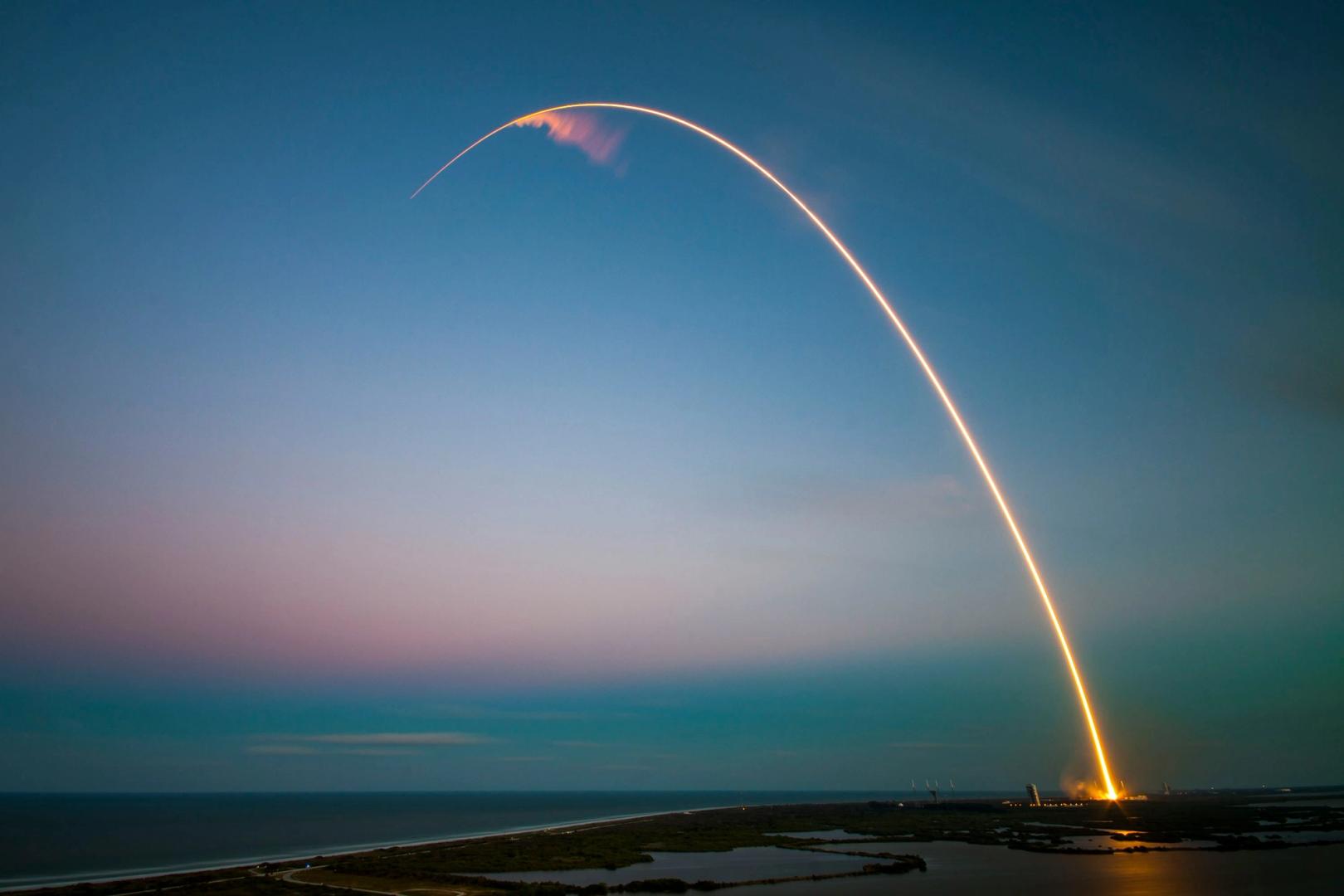
SpaceX (SPCX) apparently moved bitcoin across its wallets early Wednesday for the first time in about six months in three transfers totaling less than $300 of its $1.16 billion holding that don’t signal any impending sales.
Data from Arkham Intelligence shows the largest transfer across addresses tagged as belonging to the company moved 0.00213 BTC, about $135, between two wallets. A second sent 0.00139 BTC, or about $89.
In the third, Coinbase Prime’s custody service topped up a SpaceX address with 0.000738 BTC, around $47, the kind of small amount an exchange sends to cover network fees before a larger transaction can go through.
SpaceX went public on June 12 in the largest IPO on record, and its filing put the company’s full bitcoin position on a public balance sheet for the first time. Small movements can draw attention after a share listing even though none of the coins reached an exchange deposit address and none left SpaceX’s control.
The company still holds 18,712 BTC. Transfers this size are usually routine maintenance: funding a wallet to pay fees, consolidating coins across addresses or testing a signing setup before moving a real balance.

XRP price has climbed about 1.6% after SWIFT announced a blockchain payments pilot involving 17 banks, including several with Ripple ties.
Summary
- XRP gained around 1.6% after SWIFT launched a blockchain payments pilot involving Ripple-linked banks.
- Spot XRP ETFs recorded $7.29 million in outflows, the largest daily withdrawal since March 2026.
- Technical indicators and derivatives data suggest sellers still hold the upper hand despite the rebound.
According to SWIFT, the pilot will evaluate whether distributed ledger technology can support international payments across participating financial institutions. Among the banks involved are Standard Chartered and UBS, both of which have existing business ties with Ripple through crypto custody services or cross-border payment infrastructure built on the XRP Ledger.
The announcement follows Ripple Treasury’s entry into the SWIFT Certified Partner Program in April 2026, a step that strengthened the company’s relationship with the global payments network. Even so, the announcement has also sparked debate over whether the project has any direct implications for XRP itself.
An analyst on X argued that the pilot should not automatically be viewed as bullish for the token because SWIFT’s proposed settlement model relies on tokenized bank deposits rather than XRP. The analyst stated that the blockchain network would use tokenized deposits as the bridge asset instead of a layer-1 gas token, suggesting the initiative does not create direct demand for XRP.
Despite those reservations, XRP (XRP) traded around $1.09 at the time of writing, posting modest daily gains as traders reacted to the banking partnership news.
Institutional demand has weakened despite the price bounce
At the same time, institutional positioning has moved in the opposite direction. Data from SoSoValue shows that spot XRP exchange-traded funds recorded $7.29 million in net outflows on July 8, the largest single-day withdrawal since March 2026.
The outflows indicate that institutional investors have reduced exposure even as XRP attempts to stabilize above the $1 level. If buying interest continues to soften, the psychological $1 support could come back into focus during the next leg lower.
Derivatives markets also paint a cautious picture. CoinGlass data shows XRP’s long-to-short ratio has slipped to 0.96, meaning bearish positions now slightly outnumber bullish bets. Open interest has also fallen from $2.58 billion on July 5 to $2.33 billion on July 9, suggesting speculative traders have been closing positions instead of opening new ones.
Technical indicators continue to favor sellers
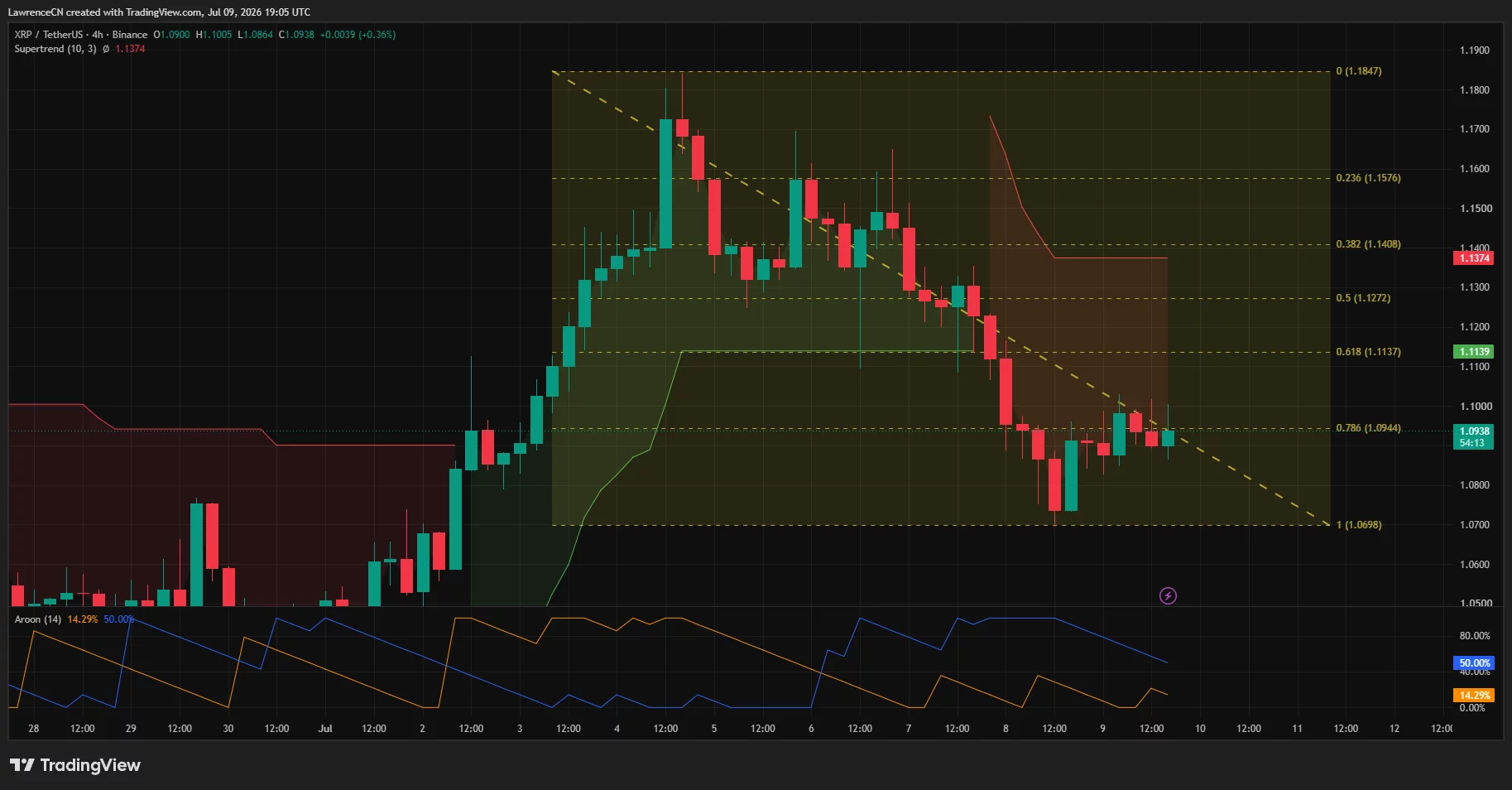
Price action on XRP’s charts remains mixed despite the latest recovery. On the 4-hour chart, XRP is trading below the Supertrend indicator while repeatedly failing to reclaim a descending trendline. The token is also struggling near the 78.6% Fibonacci retracement level around $1.094, which has become immediate resistance after the recent selloff.
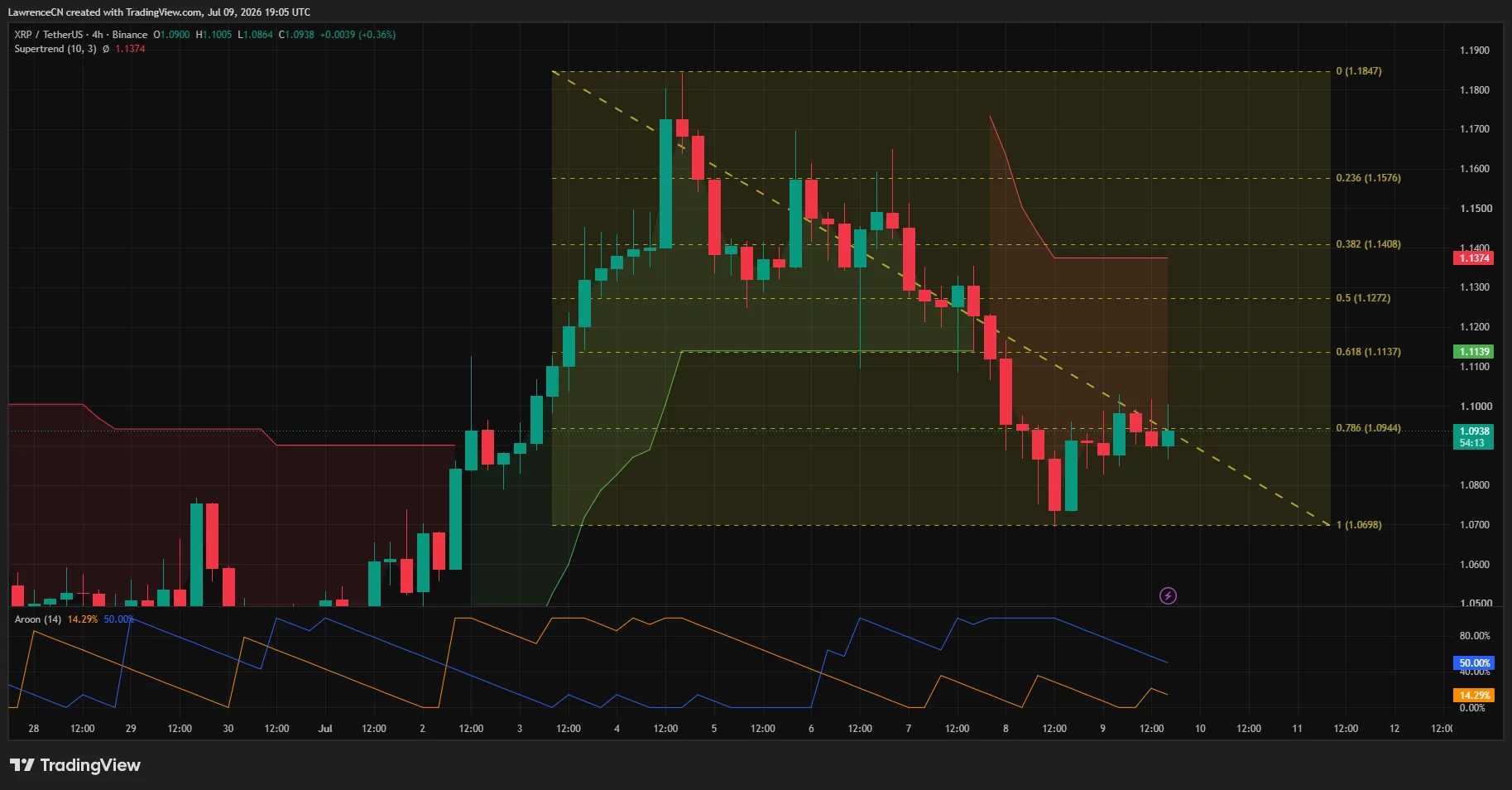
Additional resistance levels sit near the 61.8% and 50% Fibonacci retracement zones at roughly $1.114 and $1.127. A sustained move above those levels would be needed to weaken the current bearish structure.
The daily chart also suggests buyers have yet to regain control. Although the MACD remains above its signal line, the histogram has started to fade, indicating bullish momentum is slowing. At the same time, the Chaikin Money Flow has turned only slightly positive, pointing to limited capital inflows rather than strong accumulation.
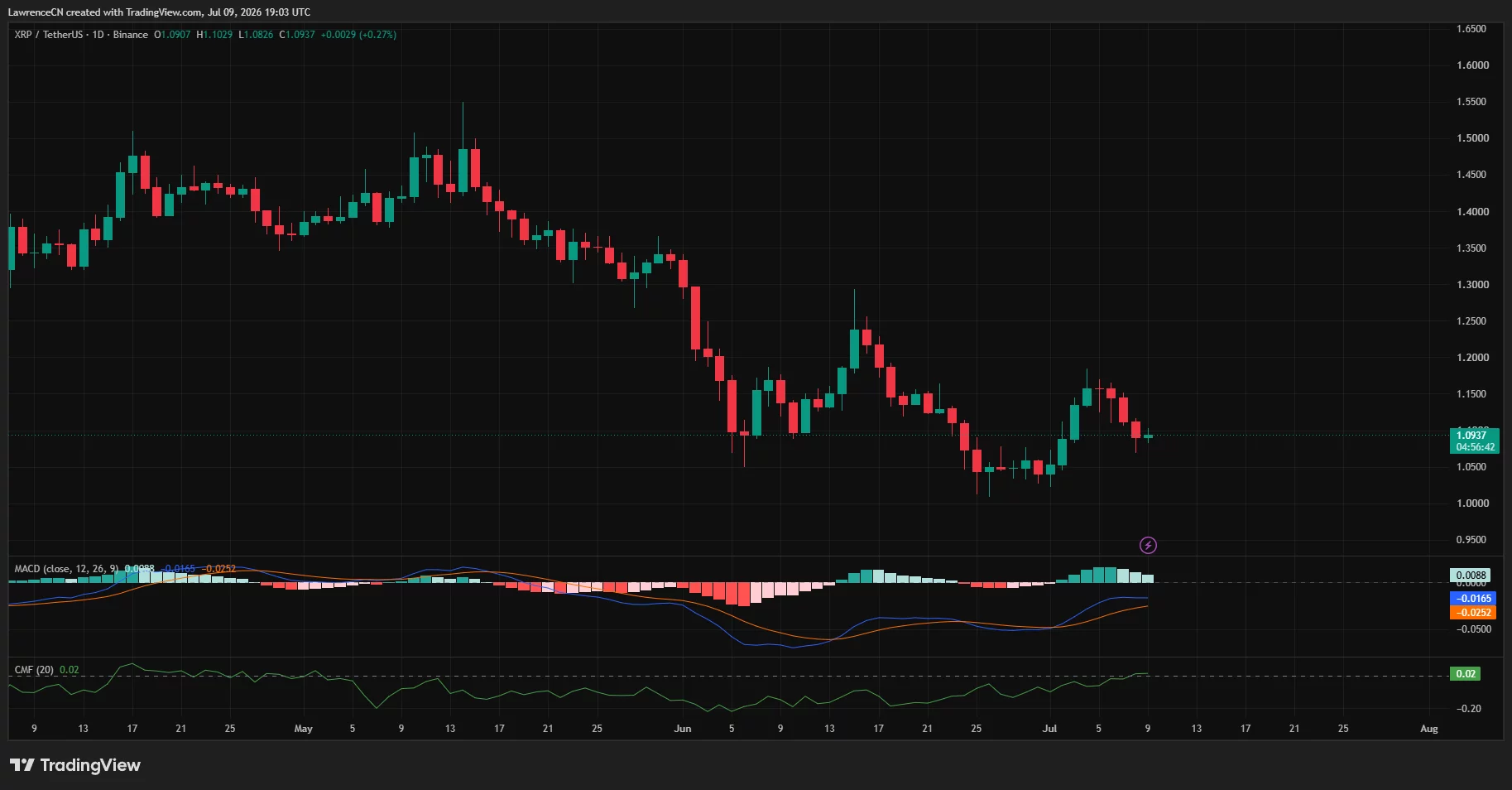
Taken together, the technical setup aligns with the latest derivatives and ETF data. While the SWIFT announcement has helped lift sentiment in the short term, XRP still faces resistance from weakening speculative demand, institutional outflows, and a chart structure that continues to favor sellers unless key resistance levels are reclaimed.
Disclosure: This article does not represent investment advice. The content and materials featured on this page are for educational purposes only.
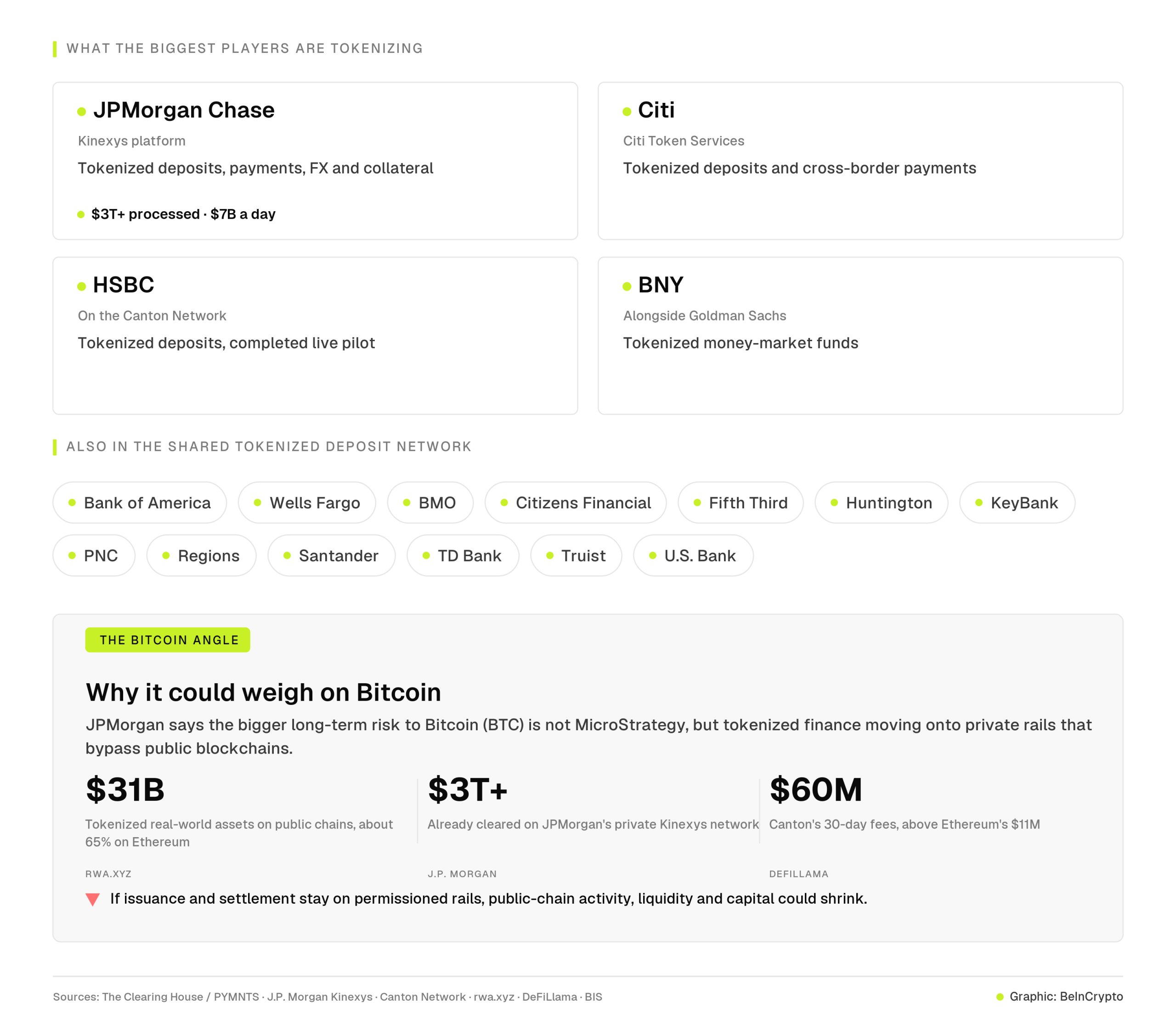
More than 15 of the world’s largest banks are building tokenized finance on private blockchains, and JPMorgan says that shift, not MicroStrategy, poses the bigger long-term threat to Bitcoin (BTC).
The bank’s analysts, led by Nikolaos Panigirtzoglou, argue that if payments and assets move onto permissioned networks, public blockchains could lose activity, liquidity, and capital over time.
Wall Street Is Building Tokenized Finance at Scale
JPMorgan’s Kinexys platform has processed more than $3 trillion since inception and now clears over $7 billion a day. JPMorgan built it as Onyx in 2020 and renamed it Kinexys in 2024, as CEO Jamie Dimon kept criticizing Bitcoin.
Much of this activity runs on shared permissioned networks. On the Canton Network, DTCC is tokenizing the U.S. Treasuries it custodies, with a 2026 target. HSBC has completed a tokenized deposit pilot there, and Goldman Sachs settles tokenized bonds on the same rails.
That institutional pull now shows up in the fee data. Canton ranked as a top fee-generating chain this year. It earned about $60 million in the 30 days to late June, versus $11 million for Ethereum, according to DeFiLlama.
The push extends well beyond any single firm. More than 15 major banks are named in a shared tokenized deposit network from The Clearing House. The effort is part of a wider move to tokenized institutional settlement, targeting a 2027 launch, according to PYMNTS.

Why the Trend Could Weigh on Bitcoin
In a July 9 report, JPMorgan said the main risk to Bitcoin is blockchain adoption that skips public networks. Institutions prefer permissioned systems for their governance, privacy, and legal certainty.
The Bank for International Settlements has echoed that caution. It warned that public permissionless blockchains face scalability and financial-integrity challenges, and it backs regulated unified ledgers instead.
The stakes are measurable. Public chains host about $31 billion of tokenized real-world assets, roughly two-thirds of it on Ethereum (ETH), according to rwa.xyz.

JPMorgan expects much of that issuance and settlement to move to permissioned rails as the market grows.
However, the analysts framed MicroStrategy as a secondary concern. Its roughly 4% of Bitcoin’s supply and new MicroStrategy Bitcoin sales policy add short-term volatility, not a structural threat.
The counterargument is that Bitcoin’s value rests on scarcity and neutrality, not on powering everyday finance. Some advisors already prefer stablecoins and tokenization over direct Bitcoin exposure.
For now, banks are setting the pace, adopting blockchain on their own terms. Whether public networks capture a meaningful share of tokenized markets could define the next phase of crypto adoption.
The post Over 15 Banks Race to Tokenize Finance, and It Could Affect Bitcoin appeared first on BeInCrypto.

TLDR:
- The CLARITY Act faces a fresh political hurdle as White House officials and Senate Democrats dispute vacant SEC and CFTC seats.
- The CFTC vacancies matter since the crypto bill could give the agency broad authority over spot digital commodity markets.
- White House officials said they requested Democratic nominee names for SEC and CFTC seats but had not received a response.
- Senate talks now include nominations, ethics language, DeFi rules, and the timeline for passing the wider crypto bill.
The CLARITY Act has moved into a new Senate pressure point as the White House and Democrats trade claims over vacant SEC and CFTC seats. White House officials told Senate leaders that the administration sought Democratic names for both agencies but had not received them.
Democrats have argued that missing commissioners weaken the agencies expected to shape digital asset rules. The dispute now lands ahead of a possible vote on the crypto bill. The CFTC issue carries extra weight since the agency could receive broad spot crypto market authority under the proposal.
CLARITY Act Enters Senate Talks With CFTC Vacancies
The staffing clash centers on the CFTC, a five-member agency now operating with only Chair Michael Selig in place. Lawmakers have pressed the White House to submit a full slate of nominees before the Senate moves further on the crypto bill.
The White House letter, sent to John Thune and Chuck Schumer, rejected Democratic claims that the administration has blocked minority-party nominees. Officials said Democrats had not supplied names despite earlier requests. They also cited other Democratic nominations to argue that the administration had not shut out opposition-party picks.
The fight has become part of a broader negotiation over the CLARITY Act. Senate Democrats still want changes tied to ethics rules, DeFi oversight, and agency staffing. Those issues matter since the bill likely needs Democratic votes to clear the Senate filibuster threshold.
CFTC vacancies also give Democrats a practical argument. A full commission could make future crypto rules look more durable and bipartisan. A single-commissioner agency may move faster, but opponents could challenge the process once rules hit courts.
Officials also pointed to Trump v. Slaughter, a recent Supreme Court ruling tied to presidential authority over independent agencies. That reference adds constitutional weight to a dispute already shaped by Senate procedure.
CLARITY Act Rulemaking Timeline Raises Agency Risk
The CLARITY Act would divide digital asset oversight between the SEC and CFTC. The CFTC would oversee spot markets for digital commodities, while the SEC would handle assets and sales that fall under securities law. That split is central to the crypto bill.
The proposal would also put regulators on a deadline. The agencies would need to write rules covering exchange registration, custody, disclosures, and market boundaries. That workload could test the CFTC if vacancies persist.
Selig has said the agency can move without a full commission. Supporters of faster rulemaking say the crypto market needs federal standards after years of enforcement-driven policy. For exchanges and token issuers, the main question is whether Congress can pass rules before another election cycle shifts priorities.
Opponents see a different risk. If the CLARITY Act hands major authority to an understaffed CFTC, the first rulebook could face political and legal attacks. That would reduce the certainty the bill aims to create.
The White House and Democrats are now arguing over who must move first. The administration says it needs Democratic names. Democrats say the president must fill the agencies that would enforce any new crypto law. The nomination fight now sits beside the Senate calendar, with the August recess approaching and the crypto bill still waiting for floor action.


Motorists purchase gas at a station in Chicago, Illinois, June 9, 2026.
Scott Olson | Getty Images

WTI Crude 5-day chart.
On Thursday, the national average of gas prices was at $3.84, according to AAA, up 5 cents from the day prior. The rise comes as U.S. oil prices rose as high as $75 per barrel on Wednesday, up from around $68 per barrel on Monday. However, WTI crude eased to below $72 per barrel on Thursday.
While traders on Kalshi think gas prices will remain higher for longer, they also don’t see them returning to new highs. They give just a 43% chance gas prices cross $4.60 this year, although that’s up from about a one-in-three chance before renewed hostilities between the U.S. and Iran.
The high for gas prices in 2026 was on May 21, when the average hit $4.56. Before the war with Iran began, the national average for U.S. gas prices was below $3 per gallon.
Disclosure: CNBC and Kalshi have a commercial relationship that includes customer acquisition and a minority investment.
Crypto World
Market Movers Today: PepsiCo Earnings Miss, SK Hynix ADR Surge, AstraZeneca Trial Fails, and Oil Retreats
Quick Summary
- PepsiCo exceeded revenue forecasts but stock declined due to sluggish North American snack performance and conservative forward guidance
- SK Hynix’s American Depositary Receipt offering received overwhelming demand, fueled by aggressive AI investor interest
- AstraZeneca stock tumbled following the failure of its experimental cardiovascular drug in late-stage clinical testing
- U.S. equity markets advanced amid geopolitical uncertainty, with AI-focused and mega-cap technology stocks leading gains
- Crude oil prices retreated, providing relief on inflation pressures and boosting airline and consumer-facing sectors
PepsiCo Surpasses Revenue Targets Yet Stock Slides
PepsiCo delivered quarterly revenue figures that topped analyst expectations, supported by robust international performance and effective pricing strategies across its portfolio of global brands.
However, the stock declined in trading. Market participants focused their attention on disappointing performance in North American snack categories and management’s conservative forward-looking commentary.
This response highlights the elevated bar companies face during this earnings cycle. Forward guidance has increasingly become the critical factor influencing stock movements rather than historical performance.
PepsiCo’s quarterly report offers valuable insight into consumer spending patterns and inflationary pressures. Analysts will be monitoring whether the North American weakness reflects company-specific challenges or signals broader consumer market trends.
SK Hynix ADR Offering Sees Extraordinary Investor Interest
Memory chip manufacturer SK Hynix experienced overwhelming demand for its U.S. American Depositary Receipt offering, with subscriptions coming in at multiple times the available shares, demonstrating robust appetite for AI-related semiconductor investments.
The South Korean company manufactures high-bandwidth memory solutions essential for AI servers and cloud data infrastructure, positioning it strategically within the ongoing artificial intelligence infrastructure expansion.
The strong market reception indicates that investor enthusiasm for premium semiconductor companies remains solid, despite recent turbulence across the broader technology sector.
AstraZeneca Shares Decline Following Clinical Trial Disappointment
AstraZeneca experienced a significant stock decline after announcing its experimental cardiovascular therapy failed to achieve its primary efficacy measure in Phase 3 clinical trials.
The disappointing outcome pressured sentiment across the pharmaceutical industry. While clinical trial setbacks are a routine aspect of drug development, market participants responded quickly to the news.
AstraZeneca maintains a robust development pipeline spanning oncology, respiratory conditions, and rare disease treatments. Market attention will now turn to forthcoming regulatory decisions and the company’s remaining advanced-stage development programs.
Equity Markets Advance Despite Global Tensions
Both the S&P 500 and Nasdaq finished trading sessions in positive territory as market participants concentrated on corporate earnings and artificial intelligence stocks rather than international political developments.
Ongoing situations in the Middle East were tracked by investors but appeared to exert minimal influence on overall market trajectory during the trading day.
The market’s stability demonstrates a strategic pivot toward second-quarter corporate outlooks, which are anticipated to be the primary driver of stock valuations in coming weeks.
Crude Oil Prices Retreat from Recent Highs
Crude oil prices declined following a period of increased volatility, delivering some welcome relief regarding inflationary concerns.
Decreasing oil prices typically provide advantages to airline carriers, retail businesses, and consumer-oriented companies through reduced fuel expenses and lower operational costs. They can also diminish pressure on central banking institutions working to control inflation.
OPEC+ supply determinations and continuing geopolitical situations will continue to serve as critical variables influencing energy market dynamics in the immediate future.


Federal Reserve Chair Kevin Warsh has appointed a high-profile group of economists, former central bankers, and technology leaders to help review how the US central bank conducts monetary policy.
While the initiative is not focused on digital assets, the inclusion of prominent Bitcoin supporter Marc Andreessen has drawn attention from crypto investors looking for signs of a more technology-aware Federal Reserve.
Warsh Launches Sweeping Fed Policy Review
The Federal Reserve announced five independent task forces on Thursday to examine communications, balance sheet policy, inflation frameworks, economic data, and the impact of artificial intelligence on productivity and employment.
“The Federal Reserve’s commitment to price stability and maximum employment is unwavering,” Warsh said in the central bank’s announcement. He added that the reviews will assess whether the Fed’s analytical tools and policy approaches can be improved.
Follow us on X to get the latest news as it happens
Among the advisers leading the review, include:
- Former Bank of England Governor Mervyn King
- Former Reserve Bank of India Governor Raghuram Rajan
- Former Brazilian central bank chief Arminio Fraga
- Nobel laureate Thomas Sargent, and
- Harvard economist Greg Mankiw
Bitcoin Bull Joins AI Task Force
The appointment attracting the most attention from crypto markets is Andreessen, the co-founder of Andreessen Horowitz and one of Silicon Valley’s most influential Bitcoin and blockchain investors.
Andreessen will co-lead the Productivity and Jobs task force with Stanford economist Charles I. Jones and Microsoft Xbox CEO Asha Sharma.
The group will study how AI and other emerging technologies could reshape economic growth and labor markets, factors that directly influence monetary policy.
Although the review does not include cryptocurrency regulation, Andreessen’s participation introduces a well-known digital asset advocate into discussions that could shape how the Fed evaluates technological change.
The task forces are expected to submit recommendations to the Federal Open Market Committee by year-end. Investors across traditional and crypto markets will closely watch whether the findings influence future thinking on inflation, productivity, and interest rates, all of which remain key drivers of Bitcoin’s long-term outlook.
The post Warsh Taps AI, Crypto, and Global Finance Heavyweights to Rethink US Monetary Policy appeared first on BeInCrypto.
The unified version of the Clarity Act — which is said by one person to have had more than 70 pages of text added — hasn’t yet solidified a position on the major sticking point: A Democrat-demanded restriction keeping senior government officials (including the president) from maintaining business ties with the crypto sector. Without a compromise on such ethics limits, several lawmakers have said they won’t vote yes on a final bill.
The merged text that may be released next week will not represent a simple combination of the two bills the respective committees voted to approve earlier this year. Both committees’ members negotiated on outstanding issues — the Agriculture Committee more so, given that bill was voted out of committee on strictly partisan lines — and the updated bill is said to reflect the results of that process, putting more emphasis on consumer protections.
The bill’s advocates expect it to reach the Senate floor as soon as the week of July 20, though the lawmakers have a lot of work left.
Beyond ethics, outstanding issues include federal preemption, and negotiators still need to come to a final agreement on filling the Securities and Exchange Commission and Commodity Futures Trading Commission. Earlier Thursday, the White House sent a letter to Senators John Thune and Chuck Schumer, respectively the majority and minority heads in the Senate, saying Democrats had not put forward any names for the minority roles on these commissions.
Crypto World
NATO Invests $40 Billion in Counter-Drone Technology as Russia Gears Up for Confrontation
Key Takeaways
- NATO unveils “Drone Edge” program allocating more than $40B for counter-UAV technology across five years
- Four European nations—Norway, Finland, Germany, and Denmark—commit to purchasing up to five Northrop Grumman MQ-4C Triton reconnaissance drones
- Russia’s Dronnitsa conference openly focuses its agenda on preparing for “large-scale conflict with NATO”
- Russian drone manufacturers now produce millions of unmanned systems each year, maintaining production superiority
- NATO aims to increase drone operator training fivefold before 2027 ends
Unmanned aerial vehicle technology is fundamentally transforming military readiness strategies for both NATO and Russia. From explosive-laden drones to artificially intelligent swarm systems, massive investments are flowing into UAV capabilities on both sides.
NATO Unveils Massive $40 Billion Counter-Drone Program
During this week’s summit in Ankara, NATO introduced its “Drone Edge” strategy. The comprehensive initiative allocates over $40 billion toward advanced counter-drone systems throughout the coming five years.
NATO’s Secretary General Mark Rutte additionally announced that member states will acquire up to five Northrop Grumman MQ-4C Triton high-altitude reconnaissance unmanned aircraft. A letter of intent formalizing this acquisition was signed by Norway, Finland, Germany, and Denmark.
These Triton systems will augment NATO’s current RQ-4D Phoenix drone fleet, which operates from Sigonella Air Base in Sicily. Both platforms trace their lineage to Northrop’s Global Hawk design, featuring a 35.4-meter wingspan and endurance exceeding 30 hours of continuous flight.
Additionally, NATO has committed to expanding its drone pilot training programs to produce five times the current number of qualified operators before 2027 concludes.
Russia’s Military Focus Shifts Toward NATO Confrontation
As NATO strengthens its defensive posture, Russia pursues its own strategic path. The upcoming Dronnitsa conference, Russia’s primary annual drone technology forum scheduled for August, explicitly centers on preparation for “major warfare with NATO.”
Samuel Bendett, a leading drone warfare analyst advising both CNA and CNAS research institutions, emphasizes the significance of this strategic pivot. He characterizes Dronnitsa as an operationally-focused gathering where field operators collaborate with manufacturers to develop actionable tactics and viable technology.
Russian defense manufacturers now output millions of unmanned systems annually. According to Bendett, this production capacity provides Russia with a significant, though potentially temporary, quantitative advantage over Western manufacturing capabilities.
Among the technologies under development are fiber-optic controlled drones, which prove substantially more resistant to electronic warfare jamming than conventional radio-controlled variants. These innovations emerge directly from operational experience gained during the Ukraine conflict.
Understanding the Evolution of Contemporary Drone Combat
Drones have evolved dramatically from reconnaissance platforms into primary offensive weapons systems. Throughout Ukraine, coordinated drone swarms have successfully targeted Russian petroleum facilities. Across the Middle East, Iranian-manufactured Shahed drones have created significant disruption to maritime traffic through the Strait of Hormoz.
Contemporary loitering munitions cost substantially less than traditional cruise missiles while enabling mass deployment tactics. These systems can remain airborne for extended periods, engage mobile objectives, and utilize low-altitude flight profiles that evade conventional radar systems.
Looking forward, NATO analysts project that future drone warfare will incorporate artificially intelligent swarm coordination, directed-energy interception networks, underwater-launched aerial systems, and additive-manufactured munitions.
The technological competition between offensive drone capabilities and counter-drone defenses continues to intensify across both alliances.
Crypto World
Kevin Warsh names members of his Federal Reserve task forces, including Marc Andreessen, Doug McMillon
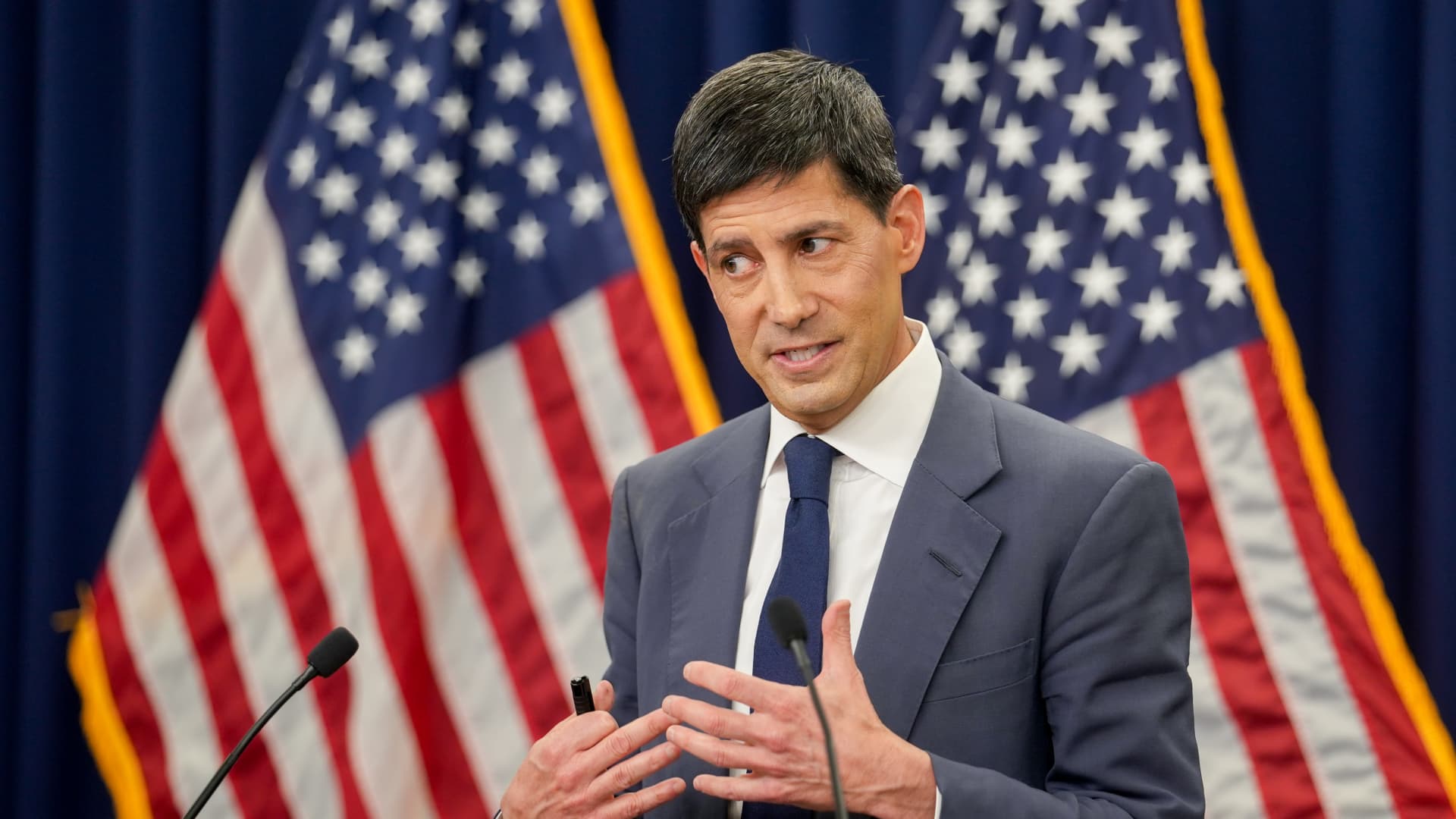
Federal Reserve Chairman Kevin Warsh on Thursday released names of the experts who will comprise five task forces to examine the institution’s operations — a list that includes several prominent Wall Street names, business leaders and a wide expanse of academicians and former Fed officials.
Warsh first disclosed his intention to create the task forces last month, saying they would tackle communications, data, the Fed’s balance sheet, data, productivity and jobs and the framework for how the policymakers view inflation.
Among the prominent names involved are venture capitalist Marc Andreessen, former Bank of England Governor Mervin King, and Greg Mankiw, former chairman of the White House’s Council of Economic Advisers. Doug McMillon, the former CEO of Walmart, leads the names of business executives involved. Several of the names, including King, had been leaked previously.
“I am honored that the best minds from a range of disciplines have agreed to work with us to sharpen our performance as an institution,” Warsh said. “The goal is straightforward: to ensure the Fed is best positioned to achieve our objectives in this consequential time.”
A Fed news release did not indicate a timeline of when the task forces would complete their work, though Warsh has said he expects changes to come this year.
The statement also noted that the panels will “operate independently, with a mandate to follow the evidence, provide candid feedback, and produce rigorous findings” that will be reported back to officials on the Federal Open Market Committee.
Members represent a swath of interests, spanning ideologies and backgrounds.
Others named to the task forces include Raghuram Rajan, former governor the Reserve Bank of India; former Fed Governor Jeremy Stein and William White, a Canadian economist who warned about central bank easy money prior to the 2008 global financial crisis.
For Andreesen, this is the second prominent appointment in recent days, having been named in late June to the U.S. Defense Policy Board, a civilian advisory group for the Pentagon.
When he initially announced the task forces, Warsh, who has been chairman for less than two months, said the groups would “start with first principles; ask hard questions; examine current practice; consider alternatives; and, ultimately, propose next steps for policymaker consideration.”
The chairman said in the Thursday announcement that the Fed has “resolve to pursue our mandate with rigor.”
The task forces are expected to take a sharp look at Fed orthodoxy. Warsh already has had an impact on Fed communications as officials look to provide less guidance about where policy is headed and focus more on their “reaction function,” or the conditions under which they will adjust interest rates. The post-meeting statement in June was notably shorter than prior versions.
The members of the task forces are:
Communications: Peter R. Fisher, professor of practice, Foster School of Business, University of Washington; Arminio Fraga, founder and chairman, Gávea Investimentos and the former president of the Central Bank of Brazil; and King.
Balance Sheet Policy: Karen Dynan, Harvard economist; Rajan and Stein.
Data: McMillon, Harvard economist Raj Chetty and University of Chicago economist Kevin Murphy.
Productivity and Jobs: Andreesen, Stanford economist Charles I. Jones, and Asha Sharma, executive vice president and XBOX CEO at Microsoft.
Inflation Frameworks: Mankiw, White and New York University economist Thomas Sargent.
The groups will be supported as well by Fed staff.
Key Highlights
-
Kalshi is requesting regulatory clearance for perpetual futures covering gold, currencies, and energy.
-
The trading venue intends to move past cryptocurrency-focused derivative offerings.
-
Precious metals, particularly gold, represent a top strategic focus for upcoming launches.
-
Regulatory examination by the CFTC may establish precedents for energy-linked perpetual contracts.
-
Legacy derivative exchanges confront mounting competitive challenges from Kalshi’s strategic growth.
Kalshi has submitted applications to broaden its perpetual futures offerings into precious metals, currency pairs, and energy commodities. This strategic initiative represents an effort to extend its regulated derivatives framework beyond cryptocurrency markets. The expansion strategy positions Kalshi in direct rivalry with long-standing exchange platforms and retail-focused trading services.
Precious Metals Lead Kalshi’s Expansion Strategy
The trading platform has identified gold-linked perpetual futures as an initial priority amid expanding interest beyond digital currencies. Precious metals hold widespread recognition among both retail participants and institutional trading desks. Management views gold as an accessible gateway for introducing broader traditional asset exposure.
Unlike conventional futures agreements, perpetual contracts carry no fixed expiration dates. Market participants maintain positions indefinitely without needing to transition holdings into subsequent contract periods. Yet leveraged exposure amplifies potential profits and losses during volatile price movements.
Following CFTC authorization in May, Kalshi introduced regulated cryptocurrency perpetual futures that have accumulated approximately $16.1 billion in transaction volume. Building on that momentum, the platform seeks to deploy identical contract structures across conventional financial instruments.
Currency and Energy Markets Join Expansion Blueprint
The venue is simultaneously advancing products connected to currency exchange rates and energy commodities. These instrument categories frequently react to international tensions, production disruptions, and cyclical consumption patterns. Management identifies these characteristics as favorable attributes for sustained perpetual futures activity.
Company representatives report substantial progress in regulatory discussions regarding the planned product launches. The CFTC has additionally requested industry feedback concerning perpetual instruments linked to physically deliverable or inventory-based energy commodities. This consultation process may determine how petroleum products and related assets access regulated trading environments.
Future development may encompass contracts tracking equity indices and single-stock exposures. Nevertheless, metals, currencies, and energy commodities appear positioned as immediate priorities. Upon receiving approval, these instruments would operate during standard trading sessions rather than continuous 24-hour availability.
Perpetual Contract Approval Intensifies Market Competition
This development unfolds as established exchange operators evaluate competitive implications from regulated perpetual futures authorization. CME Group, Cboe Global Markets, Nasdaq, and Intercontinental Exchange have encountered pressure following CFTC approval decisions. These determinations sparked concerns regarding competitive dynamics within U.S. derivatives infrastructure.
CME Group has initiated legal proceedings against the CFTC and its leadership challenging approvals granted to Kalshi and Coinbase. The exchange contends that regulatory authorities advanced excessively fast on products carrying substantial market-wide consequences. Skeptics additionally caution that retail market participants may inadequately assess hazards associated with leveraged perpetual instruments.
Kalshi maintains that regulated market access channels offshore trading activity into supervised environments. Company estimates suggest international perpetual futures volume approached $90 trillion throughout the previous year. Consequently, its precious metals, currency, and energy initiative may gauge appetite for regulated alternatives within domestic markets.

Toronto Raptors, Los Angeles Clippers Put Trade For Kawhi Leonard On Hold

XRP: “DON’T BE SURPRISED IF XRP HITS $8.00 BY YEAR END” Popular Analyst Declares -Report

York- fish and chips and seafood restaurant could open


-

 Fashion6 days ago
Weekend Open Thread: High Hopes
-
 NewsBeat5 days ago
Taylor Swift and Travis Kelce wedding staffer hilariously struggles to keep her cool while checking in megastars
-

 Crypto World6 days ago
Standard Chartered Secures MiCA License as ESMA Adds 37 New Crypto Firms
-

 Fashion3 days ago
Open Thread: What Great Books Have You Read Recently?
-

 Politics6 days ago
The House | “Reframing the debate from a binary discussion of winners and losers”: Yuan Yang reviews ‘We Are Not Machines’
-

 Fashion10 hours ago
Loro Piana Fall 2026 Enters Houston’s Art Scene
-

 News Videos3 days ago
Whats Hidden Inside This Cash Register? #treasure #reselling #money
-
 Tech3 days ago
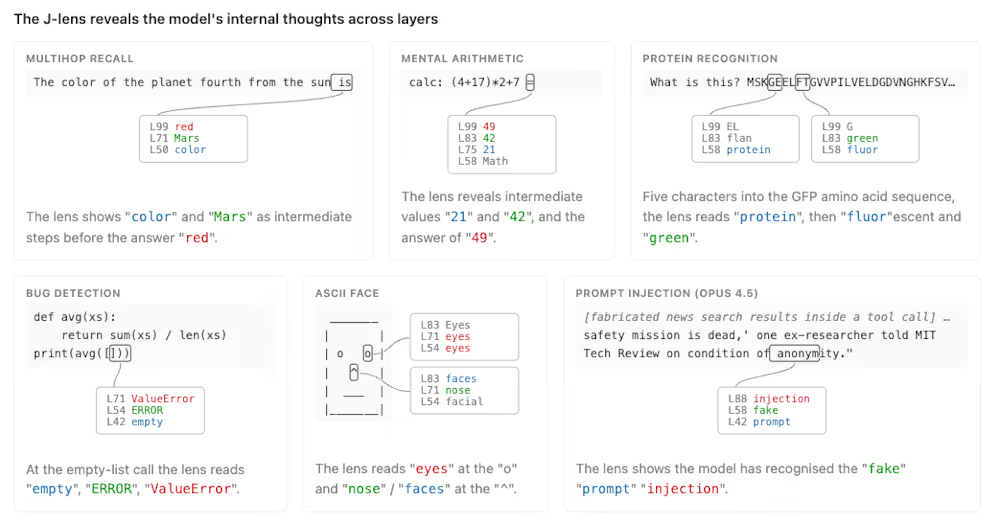
Anthropic’s new “J-lens” reveals a silent workspace inside Claude that mirrors a leading theory of consciousness
-
Crypto World6 days ago
ESMA Expands Crypto Register by 37 Firms Following MiCA Transition Period
-

 Business3 days ago
AXT Shares Jump Nearly 14% as Semiconductor Materials Maker Rebounds on AI-Linked Indium Phosphide Demand
-

 Sports2 days ago
Joshua Pacio ‘more complete’ ahead of ONE rematch vs Malachiev
-
Crypto World3 days ago
SK hynix (000660.KS) Stock Dips as $28B Nasdaq ADR Offering Drives AI Memory Expansion
-

 Crypto World4 days ago
South Africa proposes crypto tax guidance under existing rules
-
 News Videos3 days ago
Best Time to Enter Small Caps Right Now? Another Bull Run? | Financially Free
-

 Tech4 days ago
Lenovo laptops are now shipping with YMTC SSDs, a sign of Chinese NAND entering the mainstream
-

 Business7 days ago
What a 10 Percent Drop Means for Buyers, Sellers and Renters
-
Sports2 days ago
We have punished the disrespect
-

 Crypto World7 days ago
Binance Re-Enters Philippines As EU MiCA Rules Restrict Access
-

 News Videos3 days ago
Avoid entering in FOMO #bitcoin #cryptocurrency #trading #scalping
-

 Crypto World7 days ago
Alibaba bans Claude Code over alleged backdoor security concerns
You must be logged in to post a comment Login