

Crypto World
ETH Wallet Sales Under Scrutiny by Regulators


Long-dormant Ethereum (ETH) wallets dating back nearly eight years have begun moving funds again, according to on-chain monitoring shared by multiple crypto analytics sources. The activity has reintroduced additional ETH supply into the visible flow, coinciding with Ether trading slightly above the $1,500 mark. While some of these addresses have taken profits, other large holders appear to be continuing accumulation, resulting in a mixed ledger picture.
At the same time, analysts say long-term whale profitability has deteriorated across major ETH holder cohorts. This matters for compliance and institutional risk assessment because persistent unrealized losses can influence large-holder behavior, custody-related transfers, and the pace at which liquidity is redeployed across venues—factors that institutions often track when managing exposure and counterparty risk.
Key takeaways
- On-chain trackers reported activation of ETH addresses last used in 2017, with one group of wallets moving a combined 37,602 ETH after years of dormancy.
- Separately, large investors appear to be rotating into ETH through swaps involving BTC, while others have continued withdrawals from major exchanges.
- Analysts state that unrealized profitability for major ETH whale cohorts has turned negative for the first time since 2019, based on reported unrealized profit ratios.
- Institutional custody-related movements were also noted, including transfers involving Coinbase Prime, without confirmation of a market sale.
Eight-year-old wallets reactivate, bringing long-dated supply into motion
According to Lookonchain, four Ethereum wallets that collectively received 37,602 ETH nearly eight years ago—at an average price of about $830—became active after a prolonged period of dormancy. The same set of wallets reportedly held through multiple market cycles, including the 2021 and 2025 bull markets, when unrealized gains reached levels described as exceeding $150 million.
Lookonchain further reported that these wallets sold 33,623 ETH during Thursday’s activity at an estimated price near $1,560, with the realized profit now described as approximately $27.4 million. For compliance teams and market-structure monitoring, reactivation of long-dormant addresses can be a relevant signal: it may reflect liquidity management, tax or rebalancing actions, or simply opportunistic execution after extended inactivity—each with different implications for market integrity checks and risk controls.
Whales show mixed behavior: rotation into ETH alongside selective profit-taking
Beyond the reactivated wallet group, other large transactions were reported as continuing capital rotation into Ether. Lookonchain stated that one whale swapped 464 BTC, valued at about $27.6 million, for 17,750 ETH. Such cross-asset rotation can be meaningful in institutional workflows because it may affect spot liquidity dynamics and the timing of ETH supply relative to broader crypto market flows.
In a separate report, investor Chun Wang was described as acquiring 9,937 ETH and 147 wrapped Bitcoin. Lookonchain also cited recent behavior in which Wang withdrew nearly 87,000 ETH from Binance over the prior month, at an average purchase price reported as $1,749. Exchange withdrawals by large holders are often monitored for operational and counterparty risk reasons—particularly where trading activity, custody arrangements, or liquidity sourcing may change.
Institutional-related activity was also referenced. BlackRock was reported to have transferred 41,996 ETH and 4,577 BTC to Coinbase Prime. Movements to Prime are commonly associated with custody or operational management rather than an immediately confirmed spot sale. For regulated entities, the distinction matters: custody transfers can trigger reporting and monitoring workflows without implying directional market exposure.
Unrealized losses broaden across whale cohorts
Crypto analyst Darkfost highlighted that unrealized profit ratios for ETH whale cohorts—from 1,000 ETH up to more than 100,000 ETH—have turned negative. The analyst said this is the first time since 2019 that every major whale cohort is reported to be underwater on an unrealized basis.
While unrealized metrics are not guarantees of future behavior, they are frequently used by analysts as a proxy for risk posture and conviction. Darkfost added that when ETH prices test whale conviction historically, periods often align with long-term bottom zones. Even so, the current setup was framed as placing greater pressure on large holders in 2026, even as selective accumulation appears to persist.
For institutional compliance monitoring, this kind of broadening drawdown can be relevant when assessing the potential for forced selling, changes in collateralization behavior, or shifts in custody and transfer patterns—especially for firms with exposure to exchanges, OTC counterparties, or derivative counterparties whose operational decisions may be influenced by large-holder positioning.
ETH’s $1,500 area remains a focal point amid ongoing uncertainty
Separately from on-chain behavior, attention among market participants remains on Ether’s $1,500 level. The article sources cited that ETH fell to around $1,510 during Thursday’s sell-off, while not setting a new yearly low as Bitcoin moved to fresh 2026 lows.
Crypto trader Ardi characterized $1,500 as a key long-term support, arguing that daily closes below that region would undermine bullish assumptions formed since the 2022 bear market. Crypto investor Jelle similarly suggested that a sustained break could return ETH to a trading range last seen in early 2023, noting that the $1,500 zone has historically been defended during several major corrections since mid-2022.
Other participants pointed to the possibility of lower demand zones. Trader Cyclops identified a $1,070–$1,370 range as a potential accumulation area, describing it as a demand region established in early 2023. The same source noted that moving into that lower band would also mean ETH breaking below a multi-year ascending trendline—an outcome that could prolong uncertainty in market structure.
From a policy and risk perspective, the common theme is not price forecasting but the importance of clearly defined reference levels for institutional monitoring: support breaks can affect portfolio risk calculations, margin models, and liquidity planning. However, the unresolved question remains whether observed on-chain transfers reflect genuine distribution pressures or routine movements that do not necessarily translate into sustained sell-side flow.
Closing perspective
The reactivation of nearly eight-year-old ETH wallets, combined with reported negative unrealized profitability across major whale cohorts, underscores a market where long-dated holders are again participating in active liquidity. Watch for whether these movements translate into sustained net distribution or whether ongoing withdrawals and ETH-denominated swaps continue to offset the added supply. For compliance and institutional teams, tracking wallet reactivation, exchange withdrawal patterns, and custody-related transfers alongside regulatory monitoring frameworks remains a practical approach as crypto markets evolve.



Cathie Wood’s ARK Invest has expanded its positions in Coinbase, SpaceX, Circle, Bullish, and Robinhood by purchasing about $25.54 million worth of shares on Friday across several of its exchange-traded funds.
Summary
- Cathie Wood’s ARK Invest bought $25.54 million worth of Coinbase, SpaceX, Circle, Bullish, and Robinhood shares.
- Coinbase led the purchases with a $10.19 million investment, followed by $7.01 million in SpaceX and $5.79 million in Circle.
- The latest buys extend ARK’s recent accumulation of crypto-linked stocks as Wood continues to downplay persistent inflation concerns.
According to ARK Invest’s latest daily trade disclosure, Coinbase accounted for the firm’s largest purchase by value. The investment manager bought 68,366 Coinbase shares through the ARK Innovation ETF (ARKK), ARK Next Generation Internet ETF (ARKW), and ARK Fintech Innovation ETF (ARKF). Based on the stock’s Friday closing price of $149.06, the purchase was valued at roughly $10.19 million.
SpaceX ranked second among the day’s acquisitions. Across ARKK, ARK Autonomous Technology & Robotics ETF (ARKQ), ARKW, and ARK Space Exploration & Innovation ETF (ARKX), the firm purchased 45,728 shares worth about $7.01 million using the company’s closing price of $153.23.
Circle Internet Group was another major addition. According to the disclosure, ARK acquired 78,756 Circle shares through ARKK, ARKW, and ARKF, with the purchases valued at approximately $5.79 million based on the stock’s $73.57 close.
The buying continued with smaller additions to Bullish and Robinhood. ARK purchased 57,511 Bullish shares valued at around $1.34 million and another 12,269 Robinhood shares worth about $1.21 million, using Friday’s closing prices of $23.29 and $98.69, respectively.
Latest purchases extend a week of aggressive buying
The latest transactions follow several rounds of buying earlier in the week, when ARK increased its exposure to many of the same companies after their share prices declined.
As previously reported by crypto.news, the investment firm bought 9,014 Coinbase shares, 9,264 Circle shares, 9,136 Bullish shares, and 35,023 Robinhood shares after all four stocks finished Thursday’s session in negative territory. Coinbase fell 5.06%, Circle lost 3.06%, Robinhood declined 3.83%, and Bullish dropped 6.77% during that trading session.
Separately, ARK disclosed another purchase of 111,799 Coinbase shares earlier this week, valued at about $18 million. During the same period, the firm also increased its exposure to SpaceX by acquiring 210,121 shares worth roughly $32.5 million across four ETFs.
According to ARK Invest, the firm’s exchange-traded funds follow a portfolio policy that limits any individual holding to no more than 10% of a fund. As stock prices move, positions are periodically adjusted to keep allocations within those limits.
Wood continues backing crypto-linked companies despite macro concerns
The latest investments also come as Wood has maintained a constructive outlook on financial markets despite growing concerns about inflation and monetary policy.
As crypto.news previously reported, Wood said investor meetings across Asia and Europe showed that many market participants expect inflation to remain persistent and believe the Federal Reserve may need to tighten policy further. She argued the data point in a different direction.
In a series of posts on X, Wood said underlying inflation is close to disappearing when measured through unit labor costs. Using first-quarter figures, she noted that U.S. productivity increased about 3% year over year while compensation per hour rose roughly 3.5%, leaving implied underlying inflation at around 0.5%.
Wood also cited data from Truflation, saying the platform’s real-time inflation gauge has fallen from about 11% in 2022 to 1.8%, while its core inflation measure has eased to 1.4%. Her comments contrast with market expectations for a possible 25-basis-point Federal Reserve rate increase in September following May’s 4.2% U.S. consumer price inflation reading.
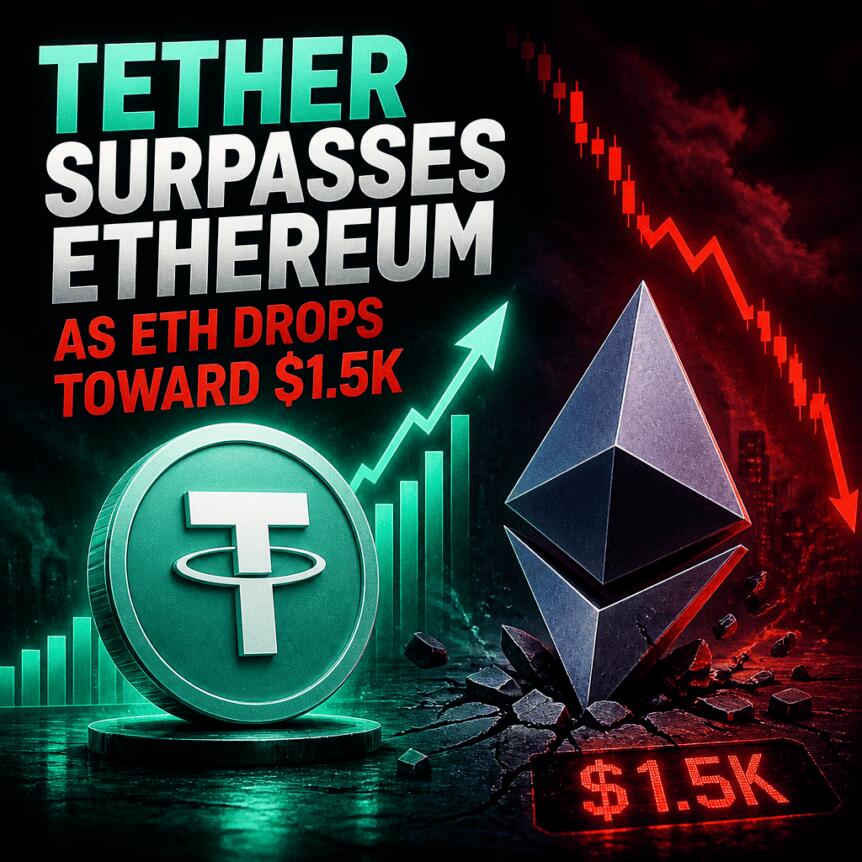
Tether’s USDt has flipped Ether (ETH) into the second spot by market capitalization after a sharp selloff pushed ETH to its lowest level of the year. The rotation underscores a broader theme playing out across crypto: during volatility, traders and institutions increasingly gravitate toward stablecoins for liquidity and risk management.
On Friday, ETH’s market value fell below $185 billion following a 5.2% drop over 24 hours, taking the token down to around $1,510 on Coinbase, according to TradingView. That decline allowed USDt—reported at roughly a $186 billion market cap—to overtake ETH. As Cointelegraph reported, Bitrue Research Institute’s research lead Andri Fauzan Adziima said the stablecoin move “highlights how the market still favors stability over ETH’s volatility right now.”
Key takeaways
- USDt surpassed ETH in market capitalization as Ether slid to about $1,510 on Coinbase after a 5.2% daily drop, per TradingView.
- Analysts interpret the flip as a sign that stablecoins remain preferred during volatility, even when the broader crypto market is shifting.
- Stablecoins represent nearly 15% of total crypto market capitalization, reflecting continued demand for reliable liquidity.
- Ether’s weakness is occurring alongside notable Ethereum Foundation staffing and leadership changes, even as new development initiatives take shape.
Why USDt taking the crown matters
When a stablecoin climbs in market cap during a drawdown, it’s rarely just a one-day anomaly. Stablecoins are often used as the “settlement layer” for trading and transfers—meaning their growth can signal that market participants are prioritizing capital preservation and fast execution over exposure to higher-volatility assets.
Andri Fauzan Adziima of Bitrue Research Institute framed the shift in exactly those terms, suggesting the market’s current preference for stability is outweighing ETH’s relative volatility. That perspective aligns with how market infrastructure typically behaves: deeper stablecoin liquidity can support higher trading activity and lower friction for entering and exiting positions across venues.
Stablecoin momentum and “cycle-independent” demand
The USDt/ETH flip comes amid ongoing stablecoin expansion. Cointelegraph pointed to accelerating stablecoin growth that now accounts for almost 15% of total crypto market capitalization. The article also notes that while stablecoin supply contracted by more than 30% during the last bear market, the latest cycle is different—stablecoin issuance and usage are reaching new highs.
In comments shared on Thursday, 21Shares argued that the current pattern is evidence that stablecoins are becoming one of crypto’s defining use cases and that demand increasingly does not depend on the market cycle. The firm’s statement said: “To us, that is the strongest evidence yet that stablecoins are one of crypto’s defining use cases – demand that no longer depends on the cycle.”
From a practical standpoint, that “cycle-independence” claim matters because it implies stablecoins can remain a structural part of crypto market activity even when risk appetite fades. And as liquidity deepens, more participants can trade with tighter spreads and faster settlement—an environment that can benefit both traders and builders who rely on stablecoin rails for recurring activity.
Ethereum under pressure, with ecosystem shifts underway
Ether’s decline isn’t happening in isolation. The article ties the selloff to a broader stretch of weakness, noting that ETH prices returned to crucial support levels last seen in October 2023 and April 2025. That matters for investors because repeated visits to long-term support can act as a decision point: buyers often step in to defend key ranges, but persistent failures can also accelerate downside.
At the same time, Ethereum’s institutional and organizational landscape has been changing. Cointelegraph cited multiple executive departures as well as a 20% workforce reduction at the Ethereum Foundation. Those internal moves can influence how quickly priorities shift, how quickly research and engineering programs move from roadmap to execution, and—importantly for market participants—how confidence forms around Ethereum’s near-term narrative.
Still, the article highlights a compensating development: a new nonprofit organization called Ethlabs was launched this week by key EF developers and researchers, with backing from ether treasuries Bitmine and Sharplink. The existence of a new entity doesn’t automatically resolve market concerns, but it does signal that ecosystem stakeholders are continuing to organize around Ethereum development rather than stepping away during turbulence.
Not all players are waiting: accumulation and cross-asset rotations
While the USDt flip is a bearish signal for ETH relative performance, the article also points to pockets of support at lower prices. Ether treasury company Sharplink reportedly bought the dip on Thursday, making its first purchase in eight months and acquiring 5,000 ETH. Separately, Bitmine—chaired by Tom Lee—has also been accumulating, adding 76,881 ETH last week, the article notes, referencing its broader bear-market accumulation efforts.
Beyond Ethereum, the stablecoin narrative isn’t unique to USDt. Cointelegraph also reports that Circle’s USDC flipped Ripple’s XRP in market capitalization as XRP retreated toward $1, a level described as its lowest since November 2024. The article gives market caps of $64 billion for XRP versus $73.6 billion for USDC, reinforcing the idea that in periods of weakness for specific assets, stablecoins can keep gaining share.
Circle’s USDC reached a $73.6 billion market capitalization in the comparison cited, while XRP fell back toward $1 and a $64 billion market cap.
For traders, these cross-asset rotations often become a liquidity story as much as a price story: stablecoins can act as a consistent “base” for risk management and positioning, while assets like ETH and XRP can experience sharper drawdowns when sentiment deteriorates.
Looking ahead, the market will likely watch whether ETH can defend its identified support zones and whether stablecoin growth continues to outpace broader crypto assets—especially in the face of ongoing Ethereum ecosystem changes. If USDt’s market cap lead holds during subsequent sessions, it may signal that “stability premium” demand is becoming increasingly persistent rather than reactive.

Key Takeaways
- Prominent crypto trader Garrett Jin has initiated a $21.73M short position on Zcash via Hyperliquid at an entry price of $418.90
- Approximately $4.93M of the total order has been executed, leaving $16.8M unfilled
- Complete execution would position Jin as the platform’s largest ZEC position holder
- Jin’s previous two Zcash trades generated combined profits of $11.66M
- Simultaneously, his 1,268 BTC long position entered at $76,117 faces unrealized losses exceeding $20M
Prominent cryptocurrency trader Garrett Jin has initiated a substantial short position targeting Zcash on the Hyperliquid decentralized trading platform. The position, valued at $21.73 million, carries an entry price of $418.90 per ZEC token.
Blockchain analytics expert Yujin first identified and reported the transaction. Initial data showed that $4.93 million worth of the position had been successfully executed, while the bulk—$16.8 million—remained in the order book awaiting fulfillment.
Potential Impact on Hyperliquid’s Zcash Market
Should the entire order reach completion, Jin’s position would establish him as the dominant Zcash trader on the Hyperliquid platform. This concentration represents significant individual market exposure within the exchange’s ecosystem.
On-chain monitoring service Lookonchain verified the details of Jin’s position. Their analysis revealed the active short employs 2x leverage across 11,780 ZEC tokens, representing approximately $4.92 million in value at the moment of documentation.
Lookonchain’s research also highlighted Jin’s successful track record with Zcash trading. His two preceding ZEC positions collectively yielded profits totaling $11.66 million.
This newest short position continues Jin’s established strategy of betting against Zcash price appreciation. His current wager anticipates ZEC values declining from the $418 threshold.
Bitcoin Long Position Faces Significant Drawdown
Contrary to his Zcash success, Jin’s Bitcoin holdings present a contrasting narrative. He maintains a leveraged long position comprising 1,268 BTC with an average entry point of $76,117 per token.
This Bitcoin trade currently shows substantial negative performance. The unrealized deficit on this position approximates $20.09 million based on recent market data.
Bitcoin’s market price stood around $60,411 during the reporting period, creating a considerable distance from Jin’s $76,117 entry level. This substantial price differential explains the magnitude of unrealized losses.
Taken together, these positions illustrate contrasting outcomes. While Jin has demonstrated profitability through Zcash short strategies, his more substantial Bitcoin wager continues accumulating losses.
Market observers closely monitor Jin’s trading activity due to the considerable capital involved in his transactions. Blockchain analysts including Lookonchain and Yujin systematically document his positions as they materialize on Hyperliquid’s platform.
The $21.73 million Zcash short position remains partially unfilled. Traders following Jin’s activities continue monitoring whether he will complete the full order execution.
Zcash traded at $407.65 during this reporting window, positioning slightly beneath Jin’s $418.90 short entry level. This price differential currently generates modest unrealized gains on the position.
However, his Bitcoin long exposure presents the more pressing challenge. With unrealized losses surpassing $20 million, it constitutes substantial downside risk within his active trading portfolio.

Crypto World
Ripple’s Brad Garlinghouse Slams Michael Saylor’s Bitcoin Strategy as ‘Financial Engineering’
Key Takeaways
- Brad Garlinghouse, Ripple’s CEO, has publicly condemned Strategy’s approach to funding bitcoin acquisitions through preferred shares
- Garlinghouse labeled the strategy as unsustainable “financial engineering” lacking long-term value creation
- STRC preferred shares plummeted to an all-time low, sinking 25% beneath their $100 par value
- Strategy’s common shares fell to their weakest point since February 2024, settling near $82
- Industry analysts at CryptoQuant recommended Strategy halt bitcoin acquisitions and focus on cash reserve restoration
Brad Garlinghouse, CEO of Ripple, maintains his optimistic outlook on bitcoin. However, he has voiced sharp concerns about Michael Saylor’s acquisition methodology.
During a Friday appearance on CNBC, Garlinghouse took aim at Strategy’s practice of issuing preferred shares to generate capital for bitcoin investments. He characterized this approach as “financial engineering” and argued it has inflicted damage across the cryptocurrency sector.
“Financial engineering does not drive long-term value,” Garlinghouse stated. “Team Michael Saylor wasn’t focused on the right stuff and that has hurt the overall market.”
As the head of Ripple, the organization responsible for XRP—a digital asset competing with bitcoin—Garlinghouse clarified that his concerns target the funding mechanism rather than bitcoin itself.
Strategy’s Funding Mechanism Explained
Over the past twelve months, Strategy has relied on preferred share issuances to finance its bitcoin accumulation strategy. The STRC preferred stock offers an 11.5% annual dividend yield and was intended to maintain a value close to $100.
However, Thursday saw STRC crash to unprecedented lows, plunging as much as 26% below its designated $100 par value. Garlinghouse characterized this decline as a “damning indictment” of the company’s approach.
Strategy’s common equity also experienced significant deterioration, reaching levels not seen since February 2024. Shares settled around $82 on Friday. Meanwhile, bitcoin dropped below $59,000 during the trading week.
When STRC trades substantially below $100, Strategy loses the practical ability to issue additional shares and continue bitcoin purchases. The company has suspended this activity temporarily.
Expert Analysis and Recommendations
CryptoQuant published research this week recommending that Strategy suspend bitcoin buying operations and prioritize strengthening its cash position. According to the firm’s analysis, the financial buffer supporting STRC’s dividend obligations has eroded dramatically—from over seven years of coverage down to approximately 14 months.
Benchmark-StoneX analyst Mark Palmer challenged the most pessimistic assessments. He acknowledged that Strategy’s funding mechanism has become “less efficient” but maintains it remains functional. Palmer dismissed comparisons between STRC and completely failed financial instruments.
Pressure on Strategy’s business model has intensified throughout the week. The dual challenge of declining bitcoin valuations coupled with STRC’s deterioration has created a challenging operational environment.
Garlinghouse’s public criticism adds significant weight to mounting questions surrounding the sustainability of Strategy’s preferred-share framework. He directly connected the model’s shortcomings to bitcoin’s recent descent below $59,000.
His fundamental position emphasizes that enduring value in cryptocurrency emerges from practical utility rather than sophisticated financial arrangements.
As of Friday’s close, STRC remains significantly below its $100 par value, while Strategy’s common stock continues trading near multi-year lows.
XRP is trading just above $1, leaving the token at its weakest price level of the year, but onchain data paints a different picture.
The exchange-held XRP supply continues to fall, Binance withdrawals have exceeded deposits for seven straight days, whale flows are holding positive and spot XRP exchange-traded funds (ETFs) have attracted $243 million in inflows since April.
The improving onchain data points to healthy network positioning, even as XRP continues to search for a price bottom.
XRP supply on exchanges continues to shrink
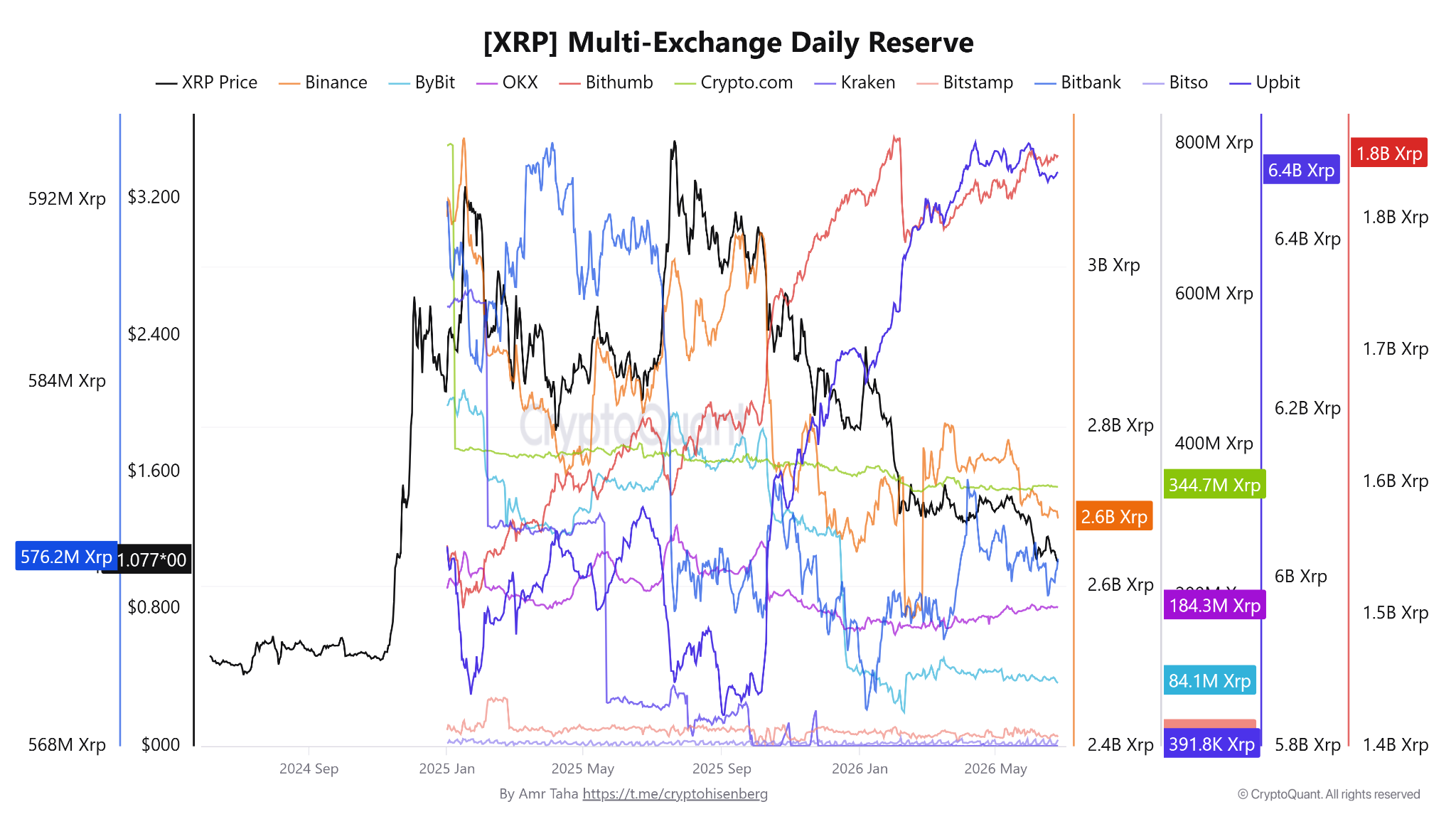
Crypto analyst Amr Taha noted that Binance’s XRP reserve has fallen to its lowest level since March after roughly 100 million XRP left the exchange over the past month. Binance’s balance stood at about 2.68 billion XRP on June 25, down from 2.78 billion XRP on May 12, accounting for the largest outflow among major trading platforms.
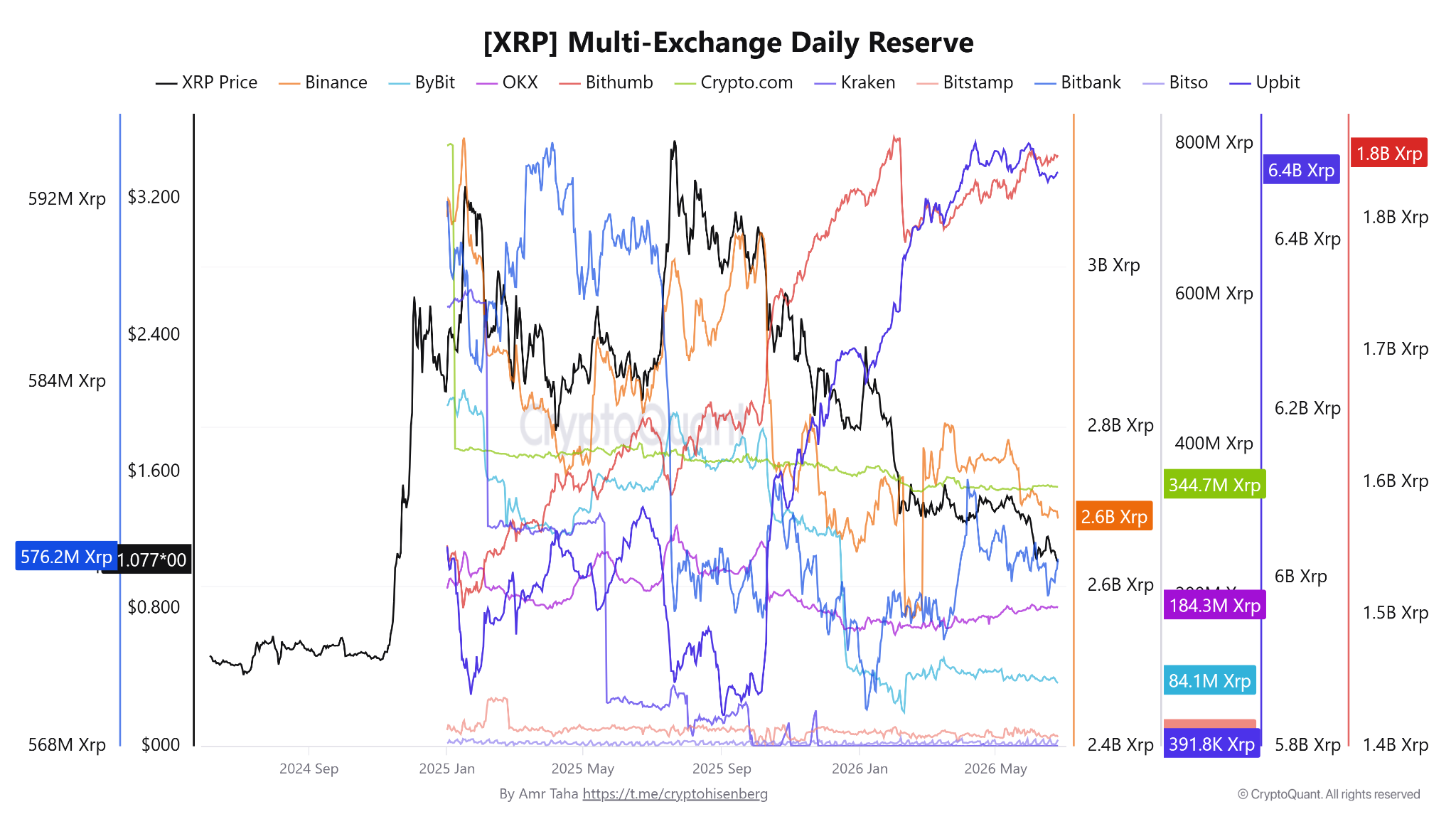
XRP multi-exchange daily reserve. Source: CryptoQuant
Other exchanges also posted smaller declines. Upbit’s reserve fell to 2.48 billion XRP on June 25 from 2.51 billion XRP on May 31, while Bybit’s holdings declined to 82 million XRP from 92 million XRP on June 2. Binance led in absolute outflows, while Bybit recorded the steepest percentage decline.
Taha also highlighted a significant shift in Binance transaction activity. XRP withdrawal transactions have exceeded deposits for seven consecutive days since June 17. The seven-day withdrawal share climbed to 53.8% on June 23, its highest reading since June 2024, while deposits fell to 46.1%, the weakest level since 2024.
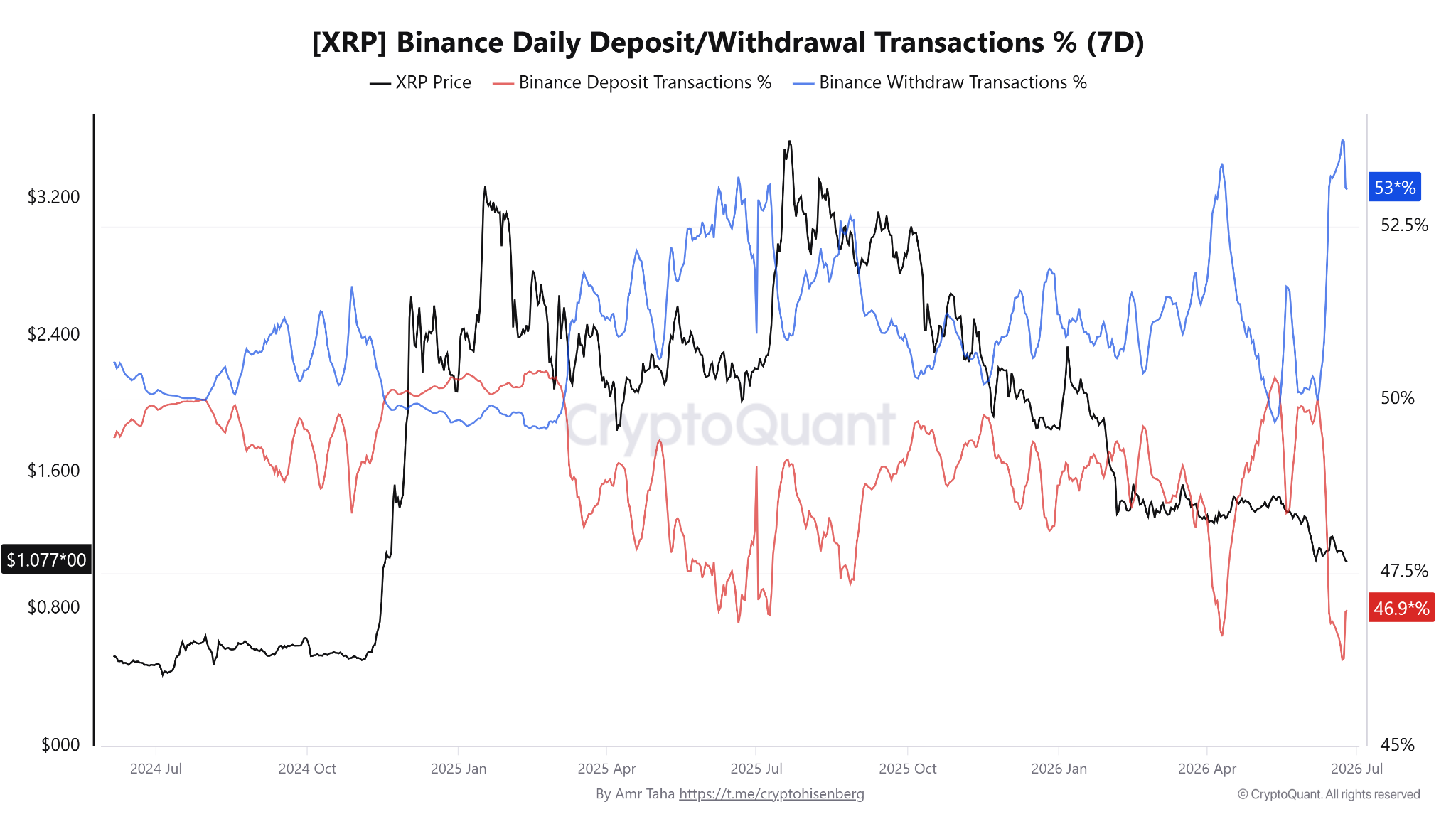
XRP daily deposit/withdrawal transactions (%) on Binance. Source: CryptoQuant
The metric tracks transaction count rather than XRP volume. This indicates users are moving coins off Binance more frequently than sending them to the exchange, marking the longest withdrawal-led stretch in roughly a year.
Large XRP holders supported the trend. XRP whale flow on the 90-day moving average has stayed positive throughout the quarter at 5.143 million XRP per day, showing consistent net accumulation by large wallets instead of distribution.
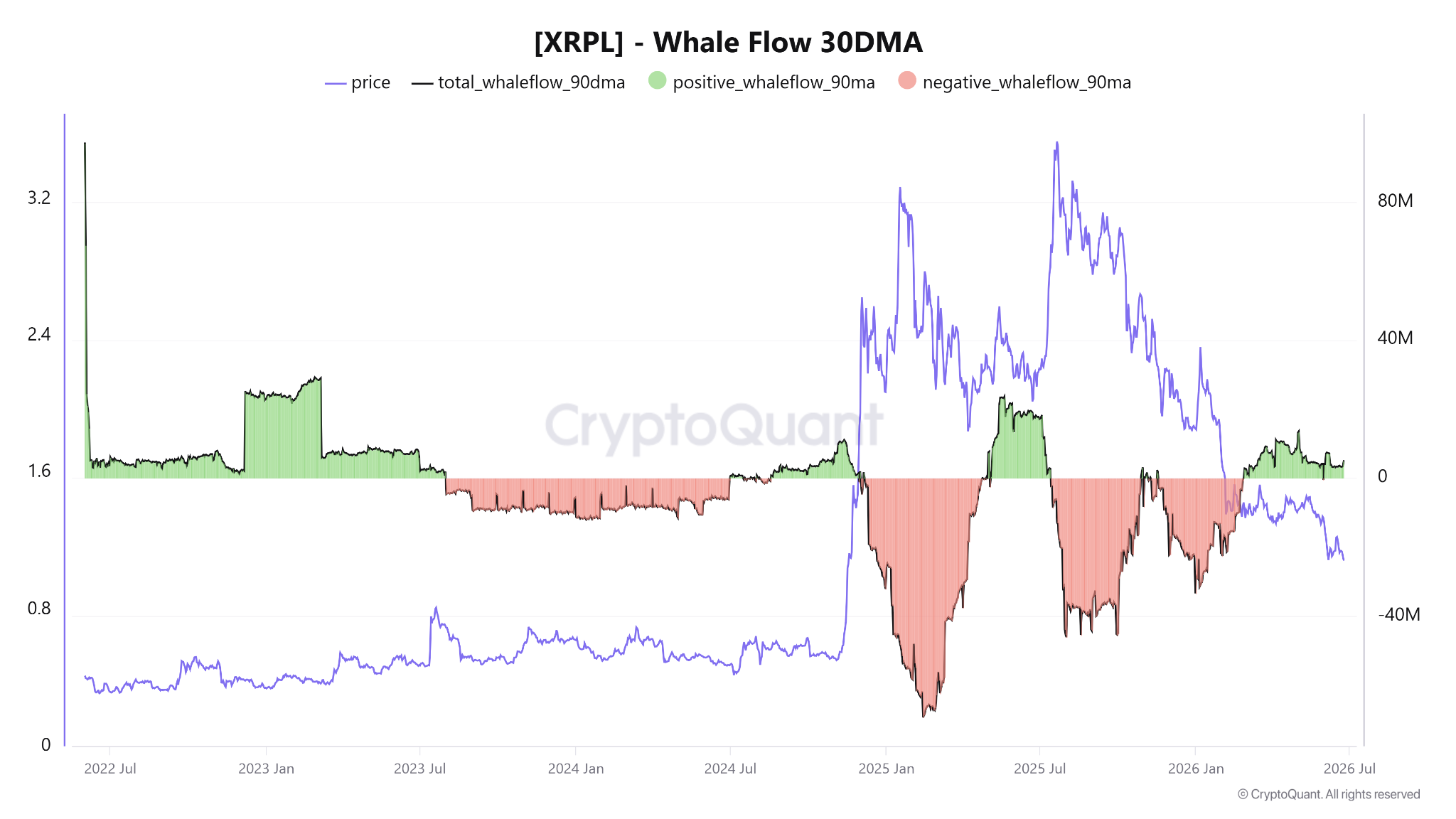
XRP whale flows. Source: CryptoQuant
Institutional demand has also added support. Spot XRP ETFs recorded $2 million in net inflows on June 24, lifting June’s total netflows to $31 million. Since April, the total cumulative inflows have reached $243 million.
Related: SBI to acquire Bitbank in $289M deal creating Japan’s biggest crypto exchange
XRP price approaches a major demand zone
From a technical standpoint, the higher-time-frame market structure remains bearish for the altcoin. XRP touched $1.01 on Thursday, its lowest price of 2026, leaving the token close to its first move below $1 since November 2024. The decline has pushed XRP down 43% year-to-date.
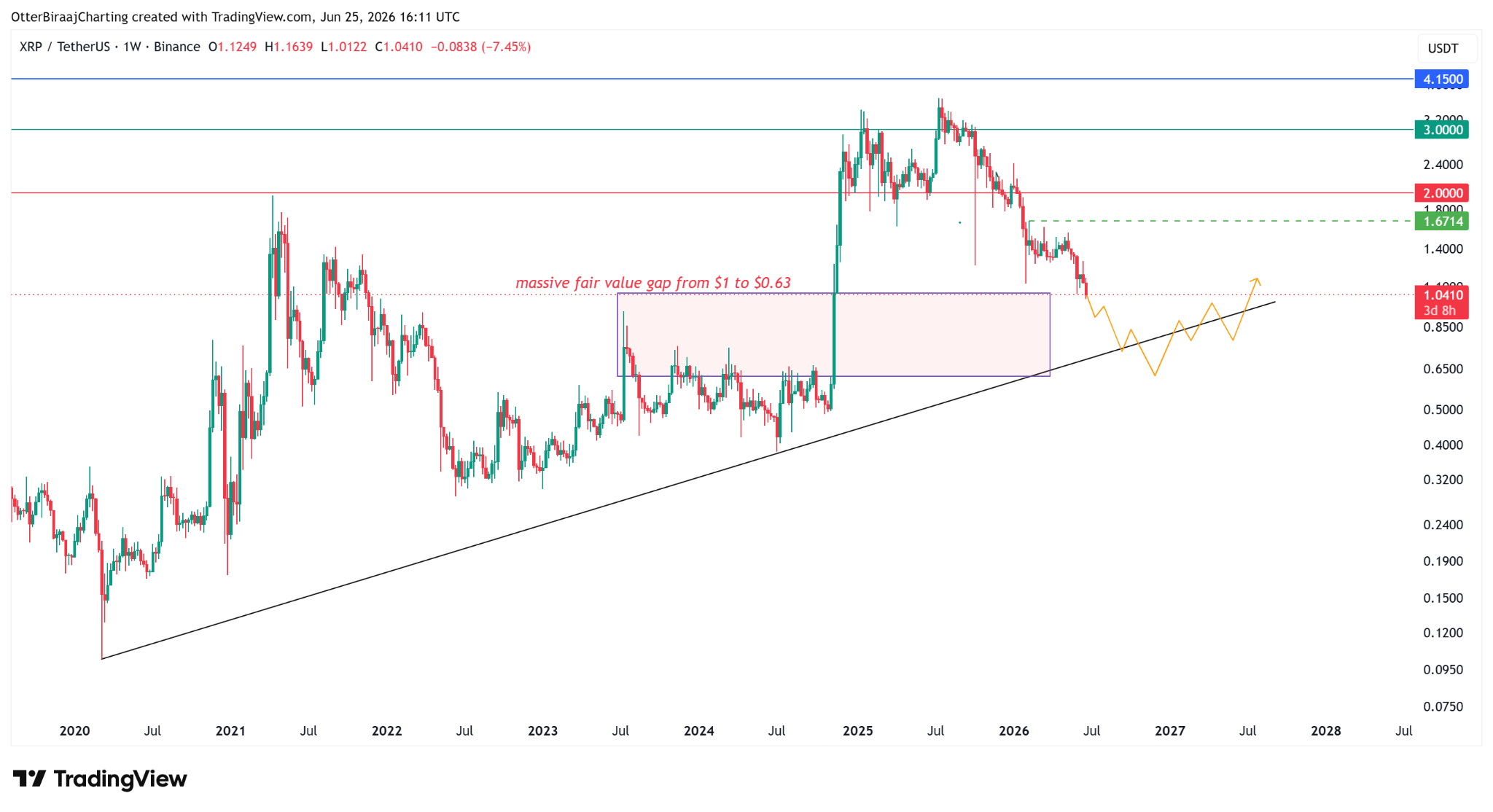
XRP/USDT, one-week chart. Source: Cointelegraph/TradingView
The next key area for XRP sits within the fair value gap between $1 and $0.63, an unfilled price gap created during the sharp rally in late 2024 that could attract buying interest if the decline extends in the coming weeks.
Black Swan Capitalist founder Versan Aljarrah continues to focus on the longer-term chart. The analyst said XRP has spent years building a large accumulation range with higher lows on both weekly and monthly timeframes.
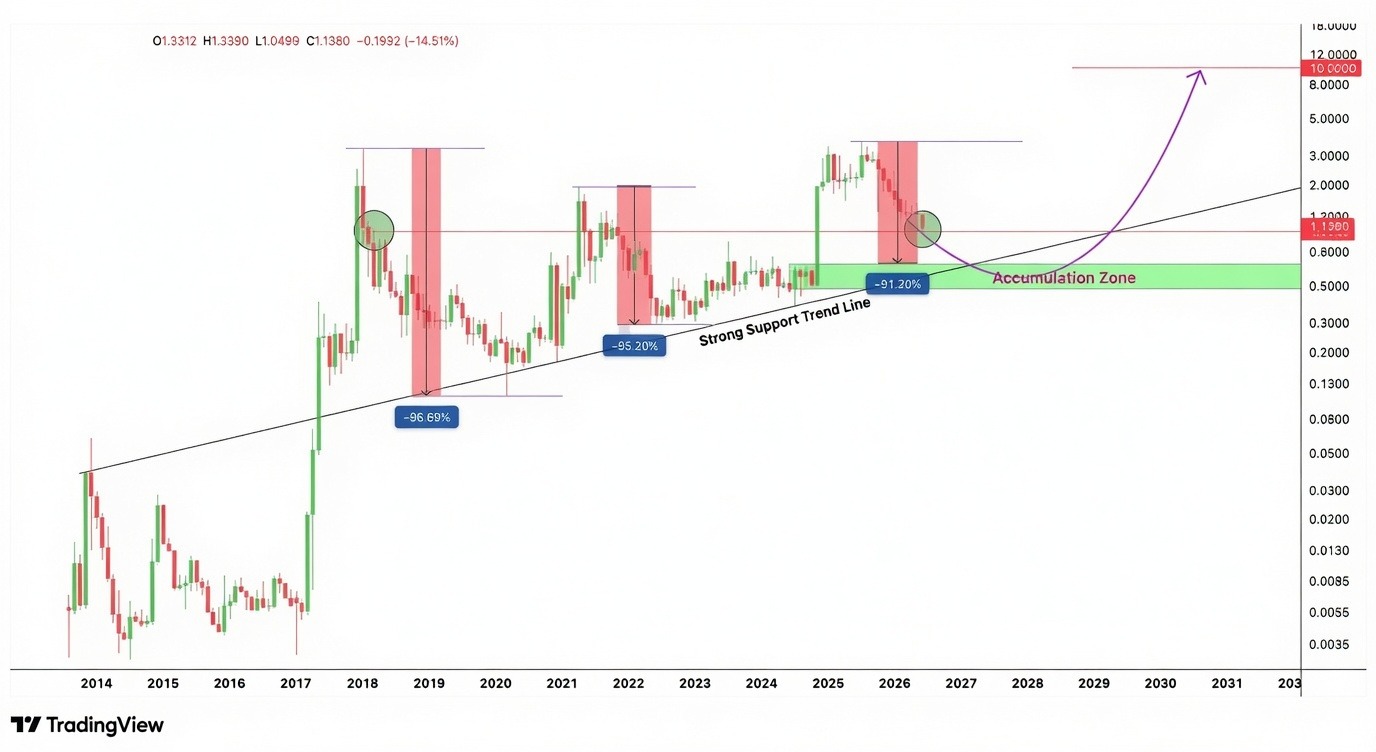
XRP/USD, one-month chart analysis by Versan Aljarrah. Source: X
Aljarrah argued that extended consolidations often produce stronger breakout moves once the price eventually breaks out of the range, with the analyst targeting $10, i.e., a 900% increase from the current price.
Related: HYPE down 22% from record highs: Will spot demand revive the uptrend?
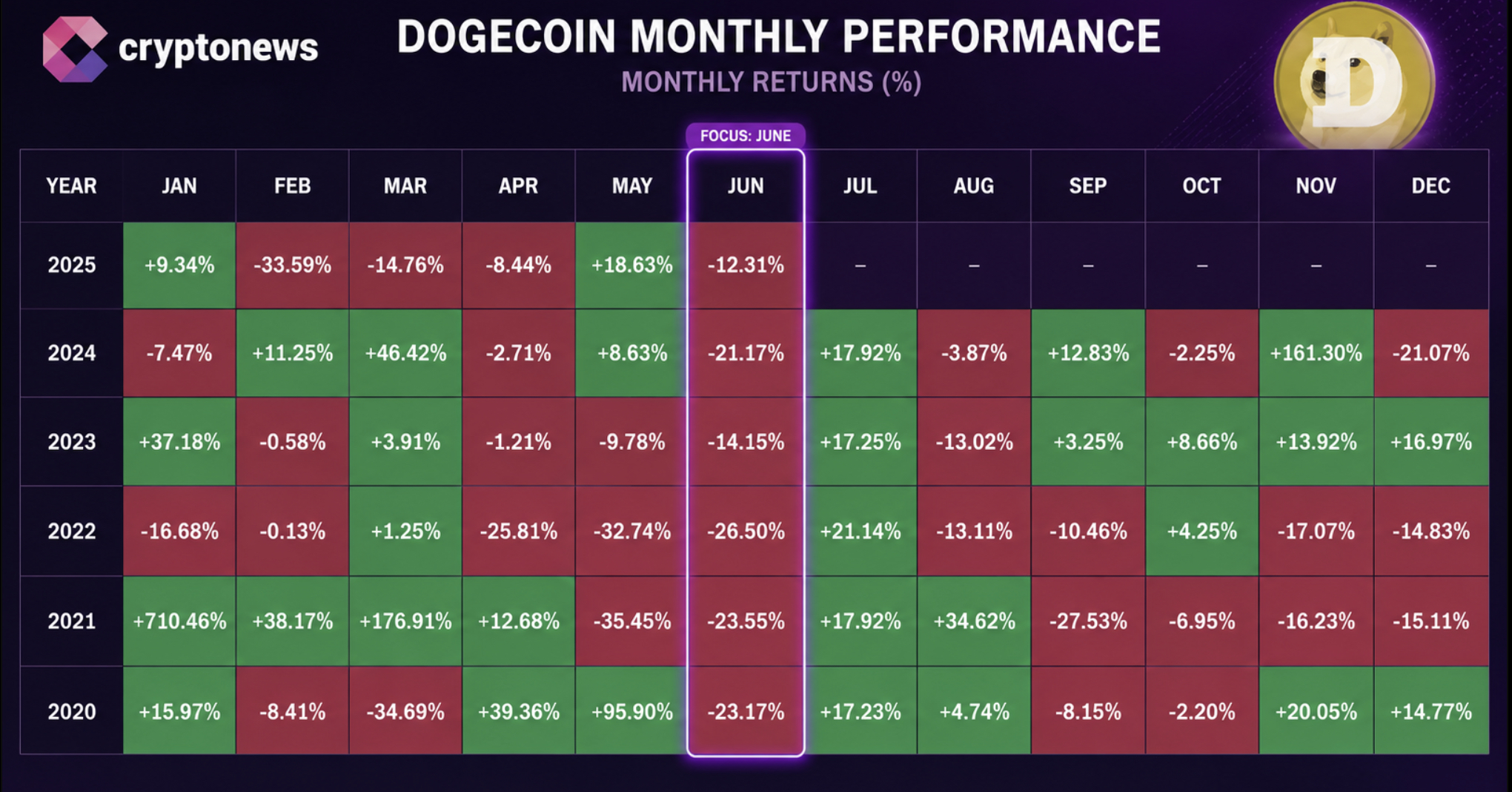
Dogecoin is trading at $0.073, down by more than 3% today, and something is about to make things worse. DOGE is entering its statistically worst month of the year with no confirmed catalyst in sight. What the seasonal data reveals about the next 7 days is not comfortable for holders.
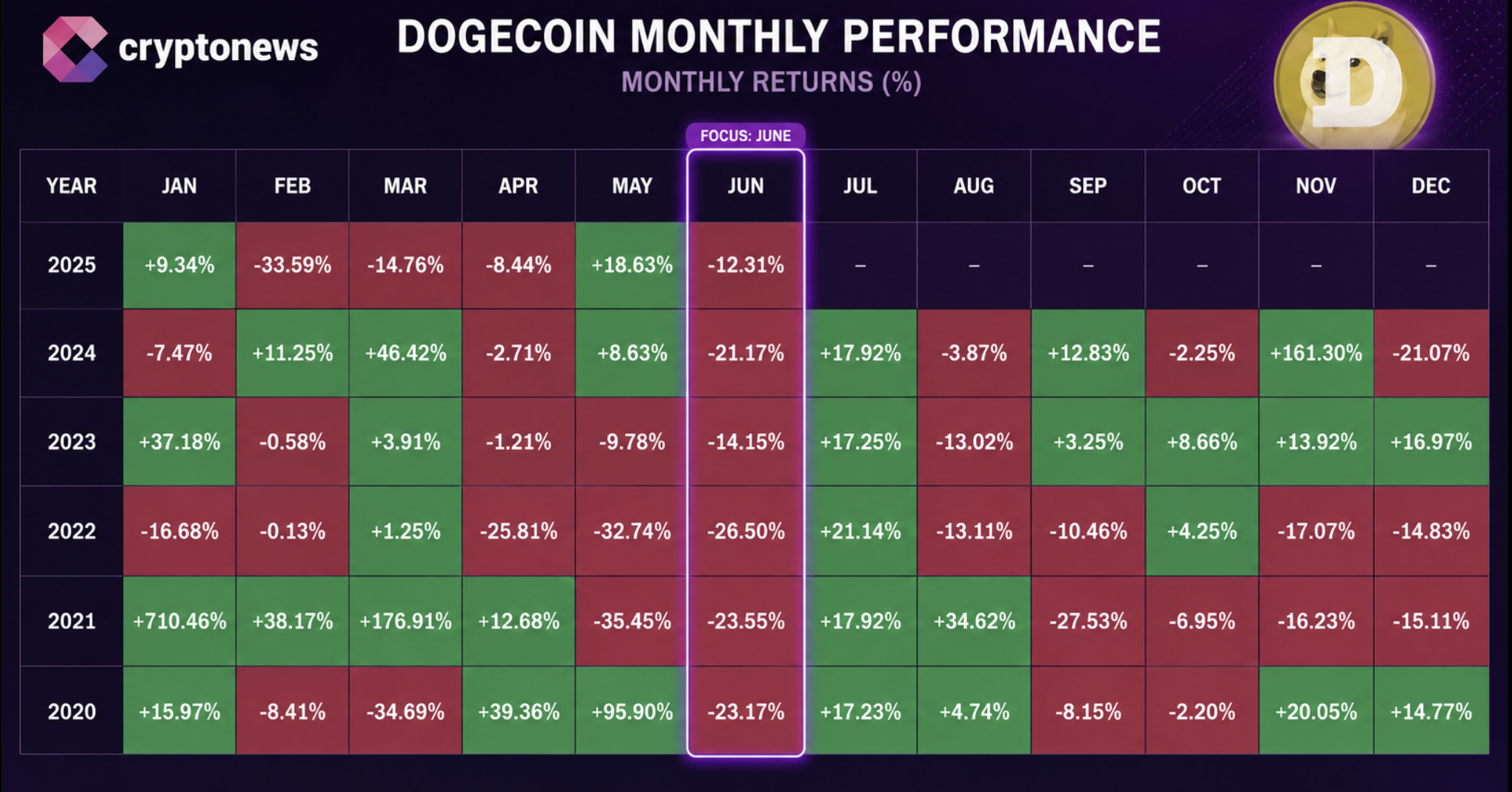
Nine consecutive red Junes. That is the streak DOGE carries into mid-2026, with data confirming the current weakness stems from a technical breakdown in a risk-off market environment. Another metric puts the average June return at -7.29%, with a median loss of 9.94% across the streak. Applied to the current price, that average loss projects DOGE near $0.07 by month-end — and Long Forecast’s model goes further, projecting a 15.6% drop in July that could push the coin toward $0.066.
Will Dogecoin dip further?
Discover: The Best Crypto to Diversify Your Portfolio
Can Dogecoin Hold $0.07 Support or Is a Deeper Drop Coming?
DOGE is trading near $0.075, holding slightly above a key support zone around $0.074. Recent selling pressure pushed the price lower, while trading volume remained elevated during the decline. That points to persistent distribution rather than a sharp panic-driven selloff.
Momentum remains weak but not deeply oversold. RSI is hovering near neutral territory, suggesting sellers still have room to press prices lower. Meanwhile, technical signals continue to lean bearish, with resistance clustered around $0.080, followed by the $0.085 area.

Don’t Miss Out on Our $1,000 USDT Airdrop on ByBit
If DOGE maintains support above $0.074 and market sentiment improves, a recovery toward $0.080–$0.085 becomes possible. A rebound in Bitcoin could help drive that move, especially if buyers return near current levels.
The most likely near-term outcome is consolidation between $0.074 and $0.082. Price action has already shown repeated reactions around these levels, while momentum indicators remain mixed, and conviction from either side is limited.
However, a decisive break below $0.074 could expose the next support zone near $0.070. In that scenario, bearish momentum may accelerate as traders reduce risk and buyers wait for stronger signs of stabilization.
Discover: The Best Token Presales
Maxi Doge Eyes Early-Mover Upside as Doge Tests Critical Levels
DOGE, sitting 82% below its late-2024 peak, is in a drawdown that prompts traders to reassess meme coin exposure entirely. The original memecoin’s upside from current levels is capped by heavy resistance overhead and a seasonal headwind lasting at least another month. That gap between risk and potential return is exactly what rotational capital looks for.
Maxi Doge ($MAXI) is positioning itself as the presale-stage alternative for traders who want meme coin exposure without the baggage of an asset sitting deep in a nine-year seasonal downtrend. The project has raised $4.8 million at a current price of $0.0002826, an ERC-20 token built around a “1000x leverage trading mentality.”
Its community structure includes holder-only trading competitions with leaderboard rewards, a Maxi Fund treasury for liquidity and partnerships, and dynamic staking APY. The branding leans hard into gym-culture meme humor (“Never skip leg-day, never skip a pump”), which has demonstrated real viral traction in the meme coin space.
Don’t Miss Out on Our $1,000 USDT Airdrop on ByBit
The post Dogecoin Faces Danger: Data Shows DOGE Price Could Collapse appeared first on Cryptonews.
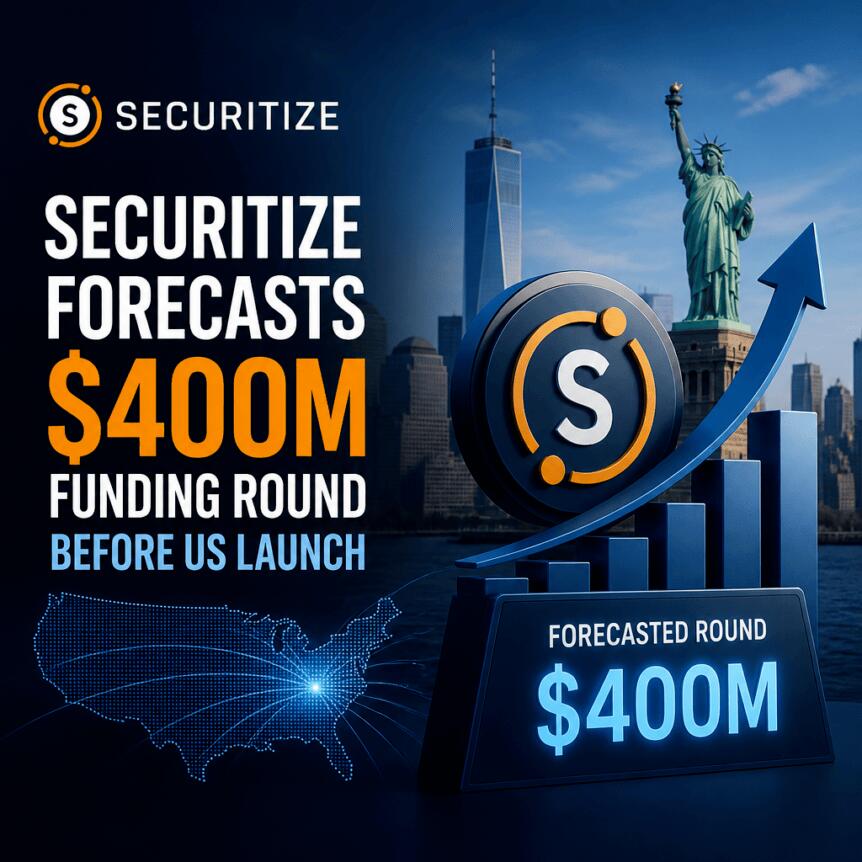
Securitize, a platform for issuing and managing tokenized securities, says it expects to raise roughly $400 million ahead of its planned public debut following a merger with Cantor Fitzgerald-backed SPAC Cantor Equity Partners II (CEPT). The update comes after the company reported final redemption results showing fewer shareholders than anticipated chose to exit the transaction.
In a statement released Friday, Securitize said that less than 30% of CEPT shareholders elected to redeem. With the deal structured to fund the company through merger proceeds and additional capital instruments, the firm estimates it will receive approximately $400 million in gross proceeds from the combination, including PIPE (private investment in public equity) financings, while excluding transaction-related expenses.
Key takeaways
- Securitize expects about $400 million in gross proceeds from its SPAC merger, supported by PIPE financing.
- Final redemption results from CEPT showed under 30% of shareholders redeemed, suggesting stronger-than-expected deal continuation.
- The transaction is scheduled to close on Wednesday, July 1, with trading expected to begin on the New York Stock Exchange on July 2 under the ticker SECZ.
- Securitize’s move highlights growing Wall Street engagement in tokenization as US regulators continue to scrutinize how tokenized securities are traded and implemented.
Redemptions come in lower than expected
SPAC mergers can hinge on whether public shareholders redeem their positions before the deal closes. In Securitize’s case, the company said its final redemption results indicate that fewer than 30% of CEPT investors opted out—an outcome that helped keep the merger on track and supported investor confidence.
Market reaction reflected that dynamic. CEPT shares rose on Friday, closing up 7% to $10.86 and extending gains in after-hours trading to around $11, according to available market listings.
For investors, the practical implication of lower redemptions is that less transaction capital is withdrawn at the last moment, which can reduce funding uncertainty right before a listing. While the merger’s final economics still depend on the deal’s full structure and closing conditions, redemption levels can serve as an early signal of whether the sponsor-backed plan has broad buy-in among the SPAC’s public shareholders.
Timeline: vote, closure, and expected NYSE debut
Securitize and CEPT said the business combination is expected to close on Wednesday, July 1, assuming shareholders approve the deal on Monday and other standard closing conditions are met. After the closing, the combined company is expected to begin trading on the New York Stock Exchange on Thursday, July 2, under the ticker SECZ.
The sequence matters for traders and market participants watching tokenization-linked listings. The gap between shareholder approval and the expected start of trading is when operational steps—such as completion of the transaction and readiness of post-merger listing—must align. Any changes in the schedule would be a key item for those tracking the tokenized-securities sector’s most prominent public-market entry points.
Why Securitize’s debut matters for tokenization
Securitize’s prospective public-market arrival is positioned as a milestone in the broader push to bring tokenized assets into mainstream finance—particularly as institutions increase their focus on tokenization infrastructure and regulated digital-asset rails.
“Reaching the public markets is a significant milestone for Securitize and a reflection of the growing momentum behind tokenization,” Securitize co-founder and CEO Carlos Domingo said in connection with the deal. Domingo also argued that the concept of major institutions embracing tokenized securities has shifted from “theoretical” to more mainstream over the past several years.
The company is backed by prominent financial institutions including BlackRock and Morgan Stanley, as well as established crypto players such as Coinbase and Circle. Securitize has also built credibility in the tokenization space by supporting the representation of assets on blockchains, and it has worked to translate that capability into regulated issuance and settlement processes.
Earlier this year, Securitize partnered with the New York Stock Exchange to create tokenized assets for the exchange’s upcoming tokenized securities platform, which is part of a wider trend of traditional venues exploring tokenized market infrastructure.
Regulatory backdrop: tokenized stocks still under scrutiny
The timing of Securitize’s public debut comes as US regulators continue to evaluate how tokenized securities should be handled in practice. Tokenization can span multiple categories—from tokenized real-world assets to digital representations of traditional stocks—raising questions about custody, transfer restrictions, market structure, and compliance.
Earlier coverage cited that the US Securities and Exchange Commission was reportedly prepared to allow trading of tokenized stocks under an innovation-related exemption, but that plan was delayed later after stock exchange officials raised implementation concerns. That context underscores why market participants will likely watch how Securitize and partners address operational and compliance details as public trading begins.
Other institutional commentary also points to growing expectations for tokenization adoption. For example, a report attributed to Standard Chartered suggested that tokenized assets active in decentralized finance could expand dramatically to $2.7 trillion by the end of 2030, projecting a 37-fold increase from earlier baselines. While such projections are longer-term and subject to change, they reflect how capital markets research firms are framing tokenization as an area with potential for significant expansion.
In the near term, what remains uncertain is how quickly regulatory clarity translates into broader market adoption beyond pilots and limited offerings—especially for tokenized equities where market structure questions can be complex. Investors should also keep an eye on whether tokenized-securities platforms built by major venues can achieve the liquidity, transferability, and compliance requirements needed for scale.
With CEPT’s lower-than-expected redemption rate and a clear path to an NYSE listing under SECZ, the next steps are straightforward: shareholder approval on Monday and the scheduled close on July 1. The bigger question for the sector is how regulatory guidance and real-world trading implementations evolve after these listings, and whether tokenization continues moving from concept and infrastructure into liquid, widely accessible markets.
Crypto World
Ethereum (ETH) Price Plummets as Whale Investors Face Historic Losses Not Seen Since 2019
Key Takeaways
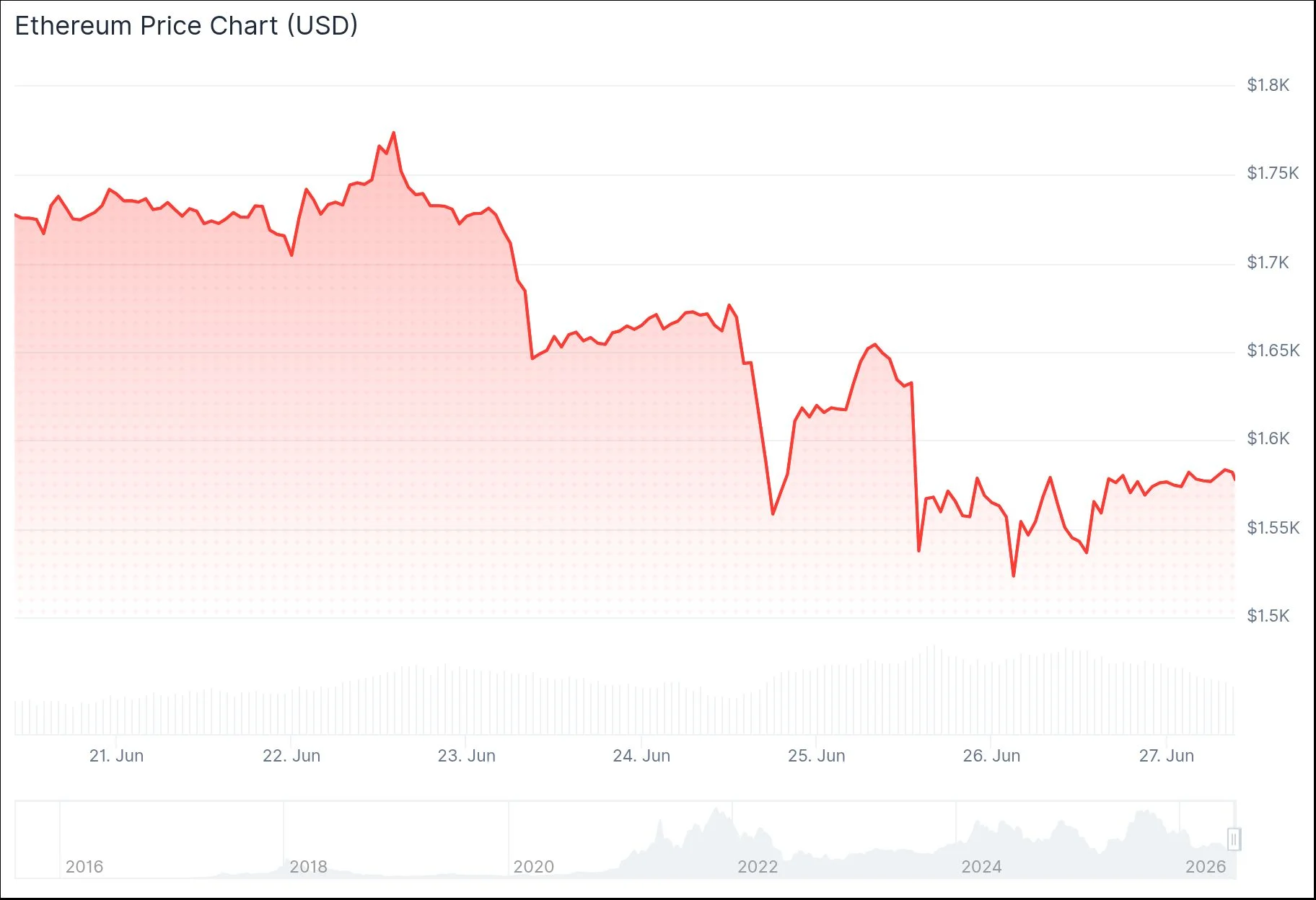
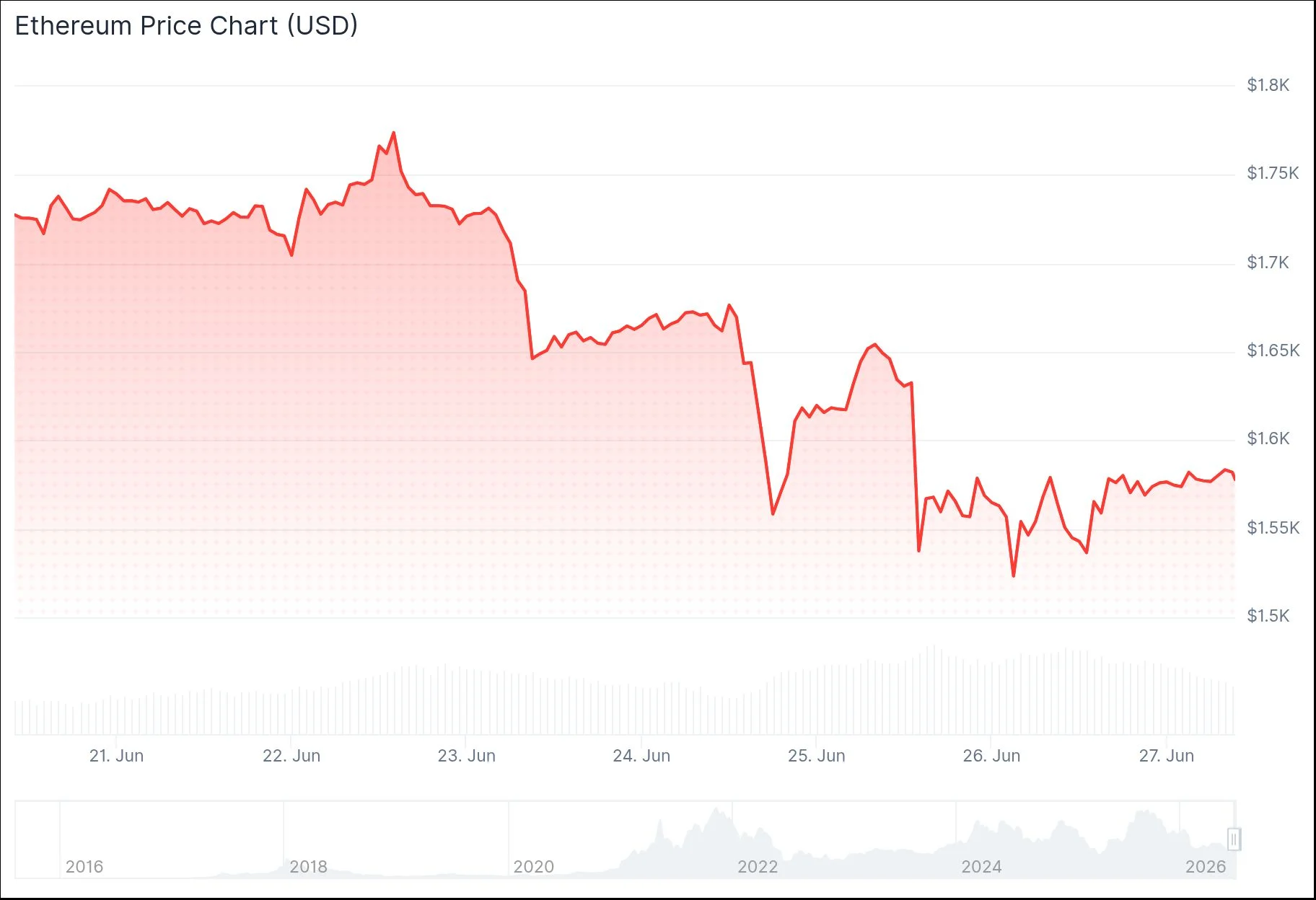
- Ethereum has declined 23.5% in the past month, currently trading near $1,557
- Large ETH holder groups are experiencing unrealized losses for the first time in five years
- Ethereum ETF products are approaching their seventh consecutive week of capital withdrawals
- A protocol developer highlights potential funding shortfall of approximately $30M annually in coming months
- Critical price levels: support zone at $1,500–$1,510; overhead resistance begins at $1,710
The world’s second-largest cryptocurrency has faced relentless downward pressure during June, sliding from levels above $2,000 to approximately $1,557 by June 26. This represents a monthly decline of 23.5%, with an additional 6.7% drawdown occurring over the past seven days alone.
In a symbolic shift, Tether’s total market capitalization has now surpassed Ethereum’s for the first time in history — $186.06 billion compared to $185.66 billion — underscoring ETH’s recent underperformance in the broader cryptocurrency ecosystem.
Market analyst Ted Pillows commented via social media that Ethereum “tapped the lows again” and observed that “momentum is still weak due to broader market correction.” He suggested that if ETH can successfully reclaim the $1,750 threshold, a potential relief bounce could materialize in the following month.
Technical analysis of the daily timeframe reveals that ETH violated an ascending trendline established in February. Following this breakdown, the asset experienced rapid declines through the $1,900, $1,800, and ultimately into the $1,550 region.
Major Holder Groups Recording Rare Loss Scenario
Data from CryptoQuant indicates that all significant Ethereum whale categories — including addresses controlling more than 100,000 ETH — are currently experiencing unrealized losses. This phenomenon has occurred only once previously, during 2019, which ultimately marked a long-term price floor for the cryptocurrency.
Historically, capitulation among large holders has coincided with market bottoms rather than signaling further deterioration. While smaller whale categories have periodically entered loss territory, the participation of the largest stakeholders in this condition represents an exceptional occurrence.
The Estimated Leverage Ratio (ELR) metric has simultaneously contracted from 1.11 to 0.85 throughout the past three weeks. This movement indicates substantial closure or liquidation of leveraged trading positions, potentially alleviating additional downside risk.
Exchange-Traded Fund Withdrawals and Development Financing Concerns
Ethereum spot ETF products are tracking toward seven straight weeks of net capital outflows, with the current period positioned to register the most significant withdrawals since January, based on SoSoValue analytics.
Trent Van Epps, Protocol Guild coordinator who recently departed the Ethereum Foundation following a five-year tenure, has issued a cautionary statement regarding core development financing challenges. He calculates that Ethereum’s essential development operations require approximately $30 million annually, an amount the Ethereum Foundation’s reserves may struggle to consistently provide.
Van Epps noted that Protocol Guild has allocated nearly $40 million to developers across four years, but emphasized this remains insufficient. He anticipates new institutional participants will need to emerge within the coming months to address the gap.
Primary technical levels to monitor: downside support positioned at $1,510 and the psychologically significant $1,500 level; upside resistance located at $1,710 and $1,774. The MACD indicator has returned to negative territory, with the signal line currently registering -78.35.


Kalshi has secured World Cup branding exposure through a strategic partnership with ADI Predictstreet, FIFA’s official prediction market partner for the 2026 tournament.
Summary
- Kalshi will receive FIFA World Cup branding exposure through its partnership with ADI Predictstreet.
- The agreement expands Kalshi’s sports strategy as trading volume tops $1 billion per day.
- The deal comes as Kalshi pursues a $40 billion valuation and challenges Illinois’ licensing law.
According to Kalshi, the agreement will place the company’s branding alongside ADI Predictstreet across stadium, television, and digital coverage beginning with the FIFA World Cup knockout stage. Although Kalshi is not an official FIFA partner, the arrangement gives the prediction market operator visibility at the tournament while ADI Predictstreet retains its official designation.
The companies said the relationship extends beyond tournament marketing. Kalshi will support the continued expansion of markets available on ADI Predictstreet’s platform as the partnership develops after the World Cup.
Why is Kalshi increasing its presence in sports?
The World Cup agreement adds to a series of football-focused partnerships announced by Kalshi in recent months. According to the company, it has also partnered with the Argentine Football Association, the Croatian Football Federation, Luka Modric, and Men in Blazers as it increases its presence around major sporting events.
At the same time, trading activity on the platform has continued to accelerate. Kalshi said daily trading volume surpassed $1 billion last week during heightened World Cup engagement across prediction market platforms.
Bank of America estimated that Kalshi accounts for roughly 89% of measured U.S. prediction market volume, placing it well ahead of other regulated competitors.
Commenting on the partnership, ADI Predictstreet Chief Executive Dimitrios Psarrakis said combining Kalshi’s market reach with ADI Chain’s infrastructure would introduce regulated prediction markets to more users worldwide.
Kalshi Chief Executive Tarek Mansour described the FIFA World Cup as an opportunity to increase awareness of the platform while encouraging more fan participation through prediction markets.
According to FIFA, ADI Predictstreet became the governing body’s first official prediction market partner in April before launching its Gibraltar-licensed platform ahead of the tournament. The service currently focuses on football-related markets and plans to expand into news, technology, entertainment, culture, and other real-world events.
The expanded 48-team FIFA World Cup features 104 matches across the United States, Canada, and Mexico, creating one of the largest global audiences for sports-related prediction products.
What else is shaping Kalshi’s expansion?
The World Cup partnership comes as Kalshi continues expanding both commercially and legally.
Earlier this week, the company filed a federal lawsuit challenging Illinois Senate Bill 3019, arguing that the state cannot require separate licenses for federally regulated sports event contracts. In its complaint, Kalshi said the Commodity Futures Trading Commission has exclusive authority over its contracts under the Commodity Exchange Act and argued that complying with Illinois’ licensing system would conflict with its obligation to operate a single national market.
Separately, Kalshi has entered discussions to raise fresh capital at a valuation of about $40 billion, according to reports. If completed, the financing would represent an 82% increase from the company’s $22 billion valuation during its $1 billion funding round in May, which included Coatue, Sequoia Capital, Andreessen Horowitz, and Morgan Stanley.
The latest developments also coincide with increased attention on the prediction market sector. Earlier this week, U.S. senators urged the CFTC to investigate Polymarket over allegations that it used deceptive advertising to reach American users despite restricting access in the country. The lawmakers also questioned whether the federal regulator has sufficient authority and resources to oversee prediction markets while continuing to argue that federal law preempts state regulation.
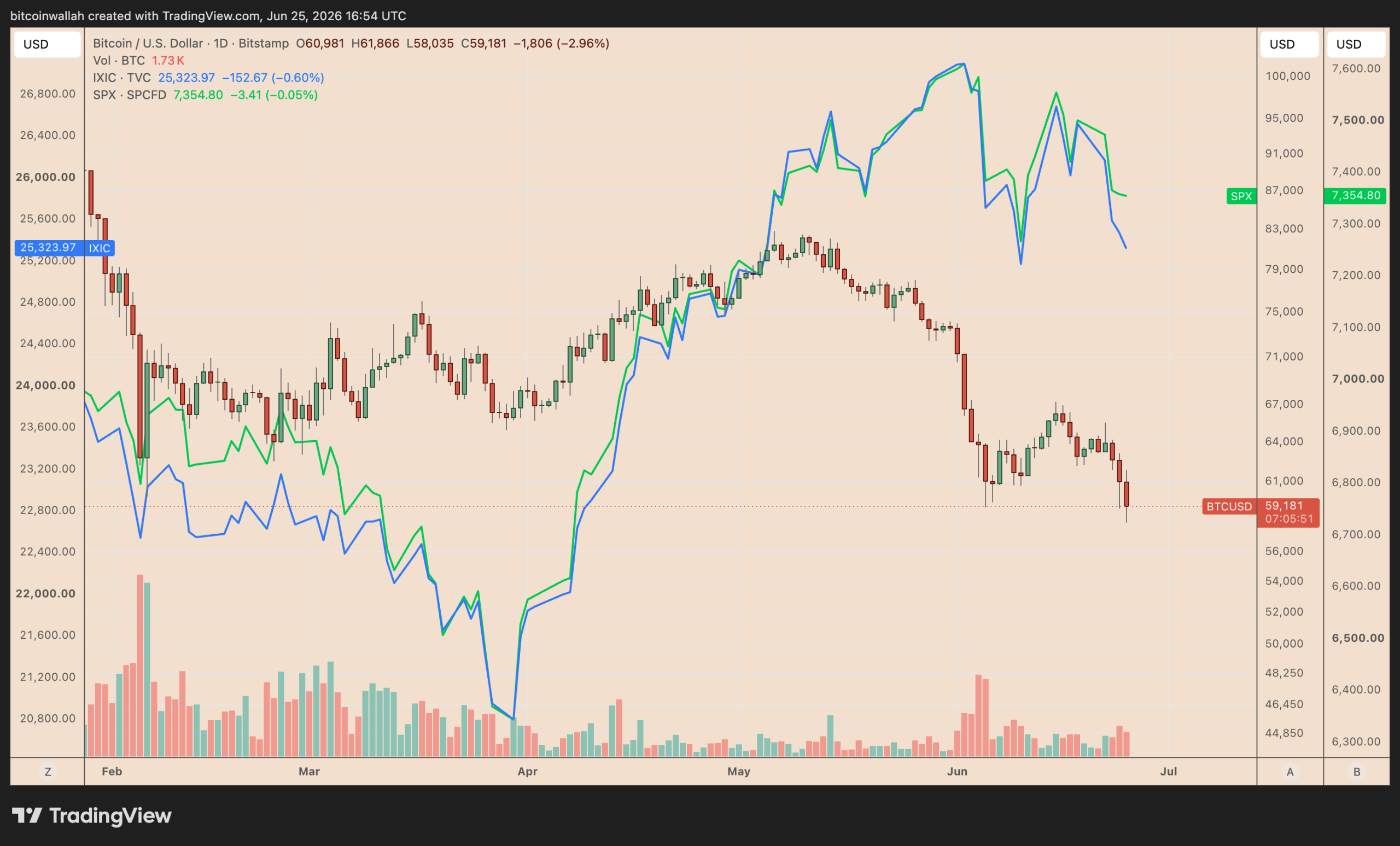
Bitcoin (BTC) dropped below $60,000, a key psychological support, on Thursday as losses in megacap technology stocks weighed on investors’ broader risk appetite, adding pressure to an already fragile crypto market.
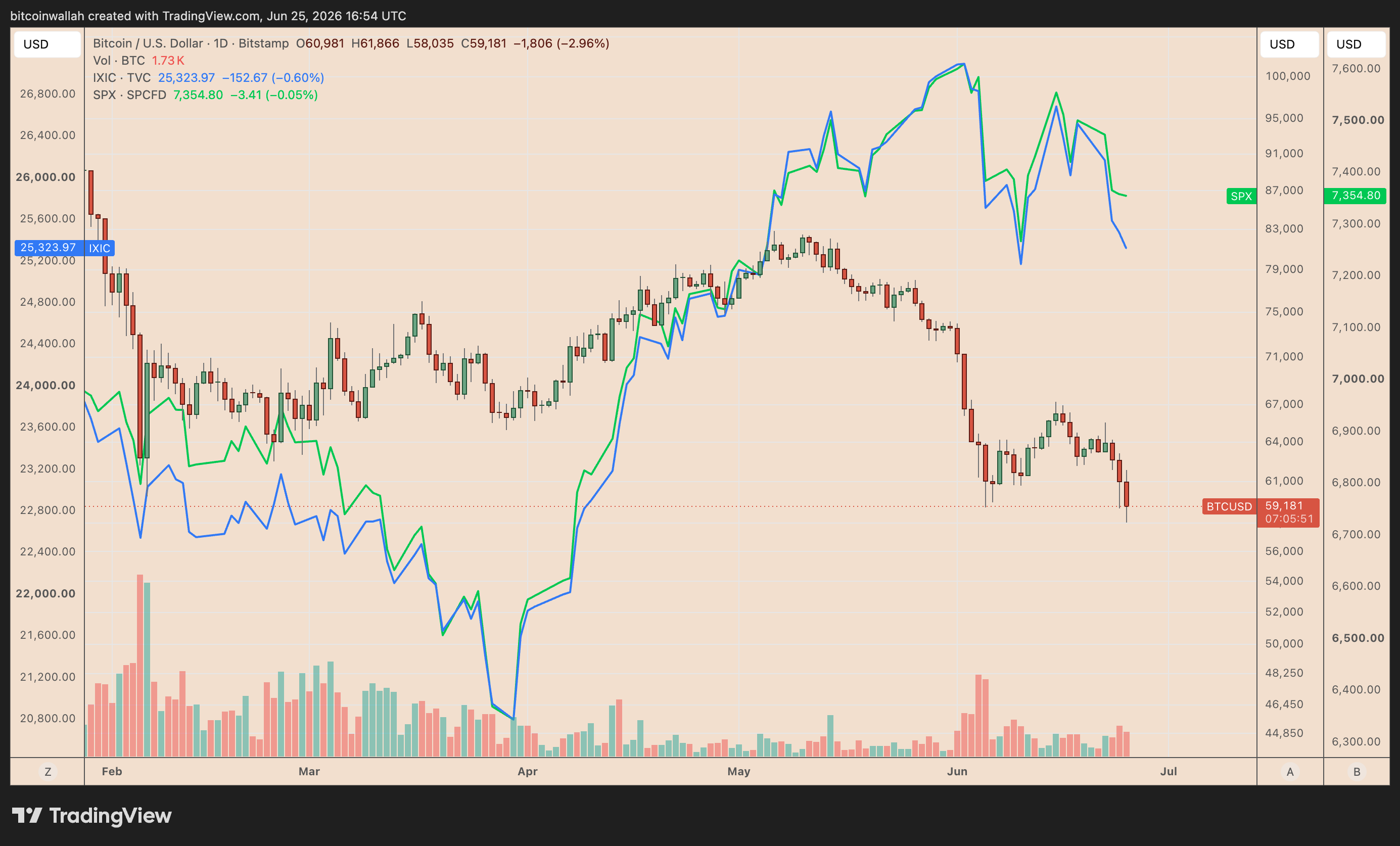
BTC/USD vs. Nasdaq and S&P 500 daily performance chart. Source: TradingView
The decline has triggered a classic bearish reversal setup that may push the BTC price under the $54,000 mark in the coming days.
Key takeaways:
- Bitcoin’s break below $60,000 has erased its June gains and activated multiple bearish setups.
- Bitcoin’s rounded top and daily bear flag breakdowns are both projecting a downside target below $54,000.
BTC’s rounded top breakdown signals more pain ahead
The BTC/USD pair fell as much as 4.8% on Thursday, hitting an intraday low near $58,000 and erasing its entire June advance. The pullback also completed what appears to be a rounded top pattern on the four-hour chart.
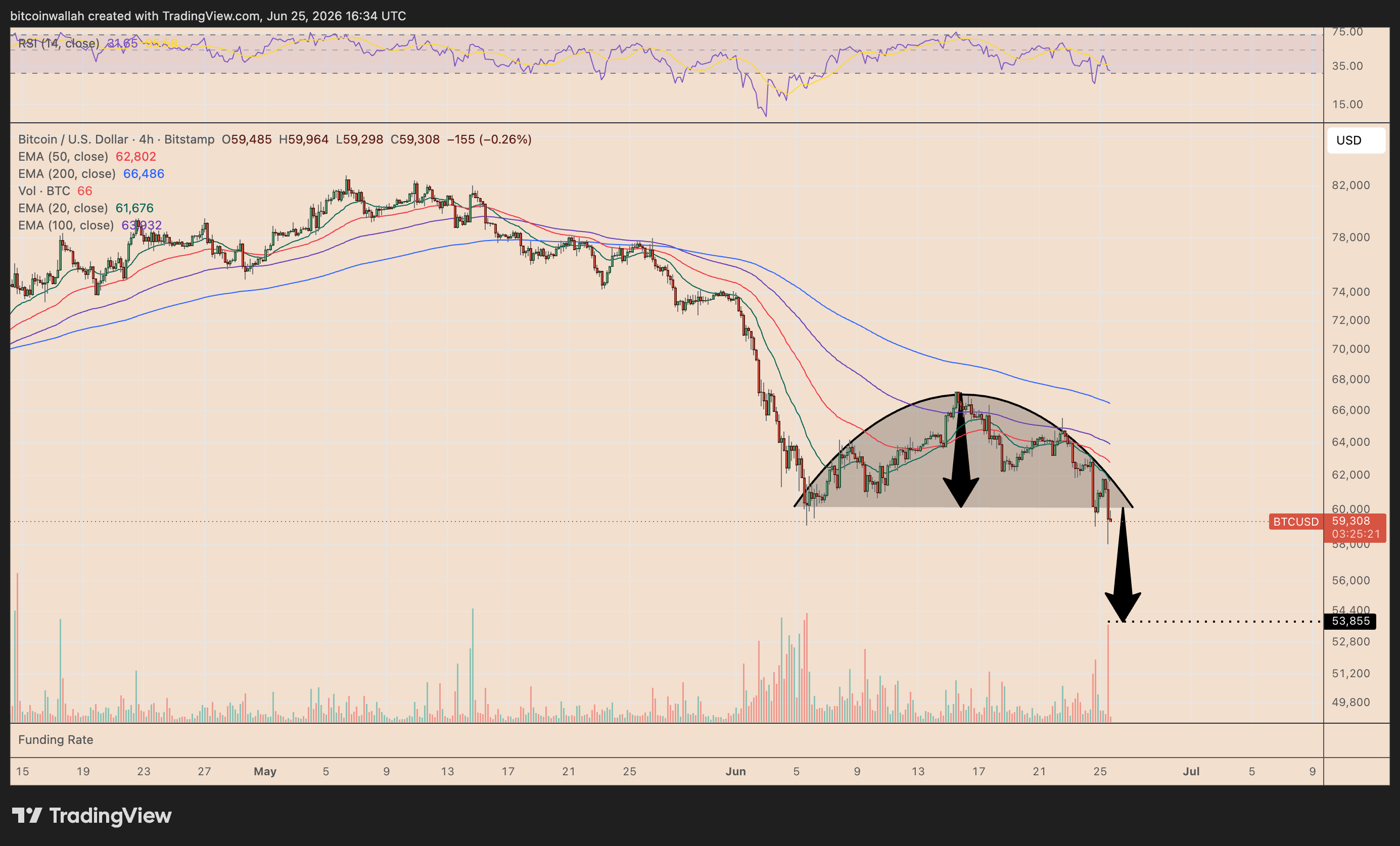
BTC/USD four-hour chart tracking the rounded top bearish setup. Source: TradingView
In technical analysis, a rounded top forms when buying momentum gradually exhausts, shifting the asset from an uptrend to a downtrend in an inverse-U-shaped structure. The pattern officially resolves when the price breaks below the “neckline” or the structure’s base support.
By measuring the distance from the top of the dome to the neckline and projecting that same distance downward from the breakdown point, analysts calculate a clear target.
For Bitcoin, this measured downside target sits just under the $54,000 level, representing an approximate 8.9% drop from current prices.
On the daily chart, Bitcoin has simultaneously triggered a bear flag breakdown.
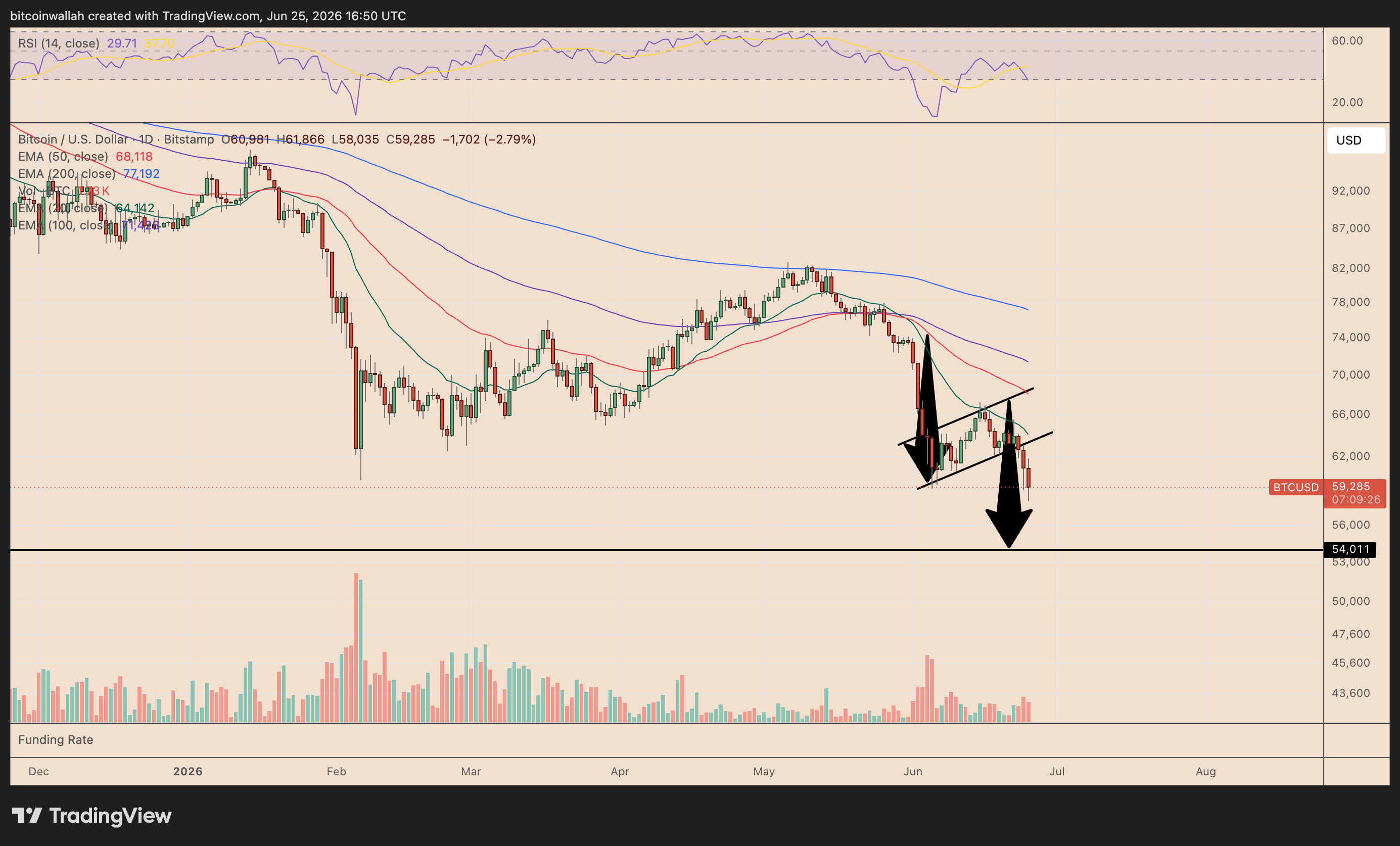
BTC/USD daily chart tracking the bear flag breakdown setup. Source: TradingView
This secondary pattern independently projects an identical move toward the $54,000 zone, adding substantial weight to the bearish case.
Bitcoin MVRV bands increase $54,000 target odds
Bitcoin’s on-chain price bands also point to the same downside area highlighted by the rounded-top and bear-flag setups.
Glassnode’s MVRV pricing bands compare Bitcoin’s market price with its realized price, or the average price at which coins last moved on-chain. In simple terms, they show whether the market is trading at unusually high profit or loss levels.
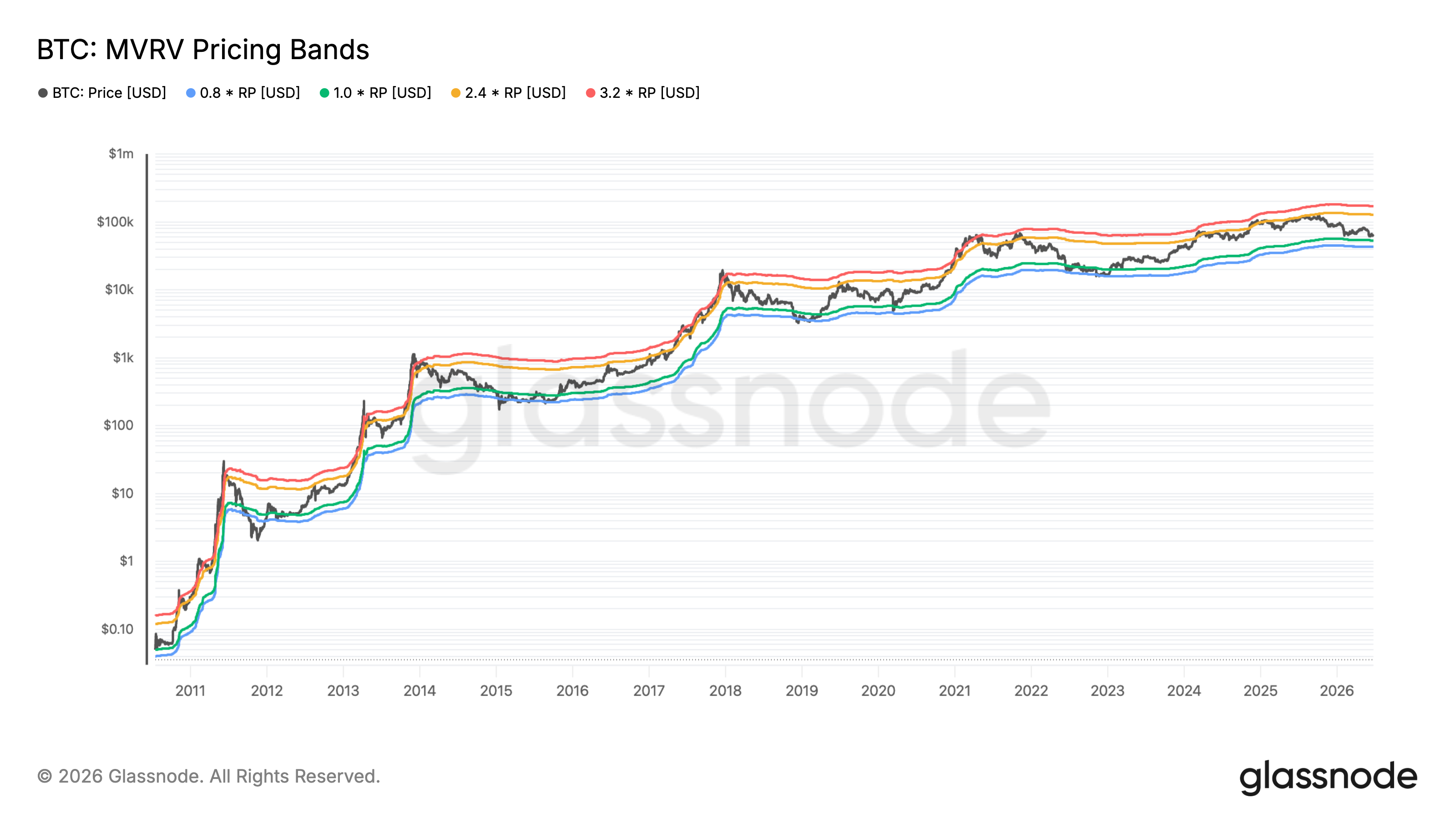
BTC MVRV pricing bands vs. price. Source: Glassnode
As of Wednesday, Bitcoin was trading near $60,997, while the 1.0 MVRV band, shown in green, sat around $53,390. That level closely matches the technical downside target near $54,000, making it an important support zone if BTC extends its decline.
Related: Bitcoin nearly loses $59K as DXY surges: Are traders bracing for more pain?
A deeper selloff, however, could push Bitcoin toward the 0.8 MVRV band, shown in blue, near $42,700. Historically, Bitcoin’s major bear-market bottoms have formed around this lower blue band, where unrealized losses become extreme, and capitulation risk rises.

Laura Kuenssberg: Is Andy Burnham Labour’s saviour, or just its best bet?

Gold on Track for Weekly Loss on Rate-Hike Fears

Cathie Wood snaps up $25.5M in Coinbase, SpaceX and Circle shares


-

 Entertainment7 days ago
Renter of Home in Anne Heche Crash Denies Settlement With Son
-
 Sports4 days ago
Two goals and an assist by sheer aura: Cristiano Ronaldo just entered the World Cup chat
-

 Tech5 days ago
Microsoft accidentally kills epic Outlook email threads
-

 Fashion17 hours ago
Weekend Open Thread: Staud – Corporette.com
-

 Business7 days ago
Soccer-U.S. defends Iran World Cup travel restrictions, says discussions ongoing
-

 Politics1 day ago
The House | Manchesterism won’t survive the painful trade-offs unless it gets citizens on board
-

 Politics1 day ago
Potential 2028er World Cup attendee leaderboard
-

 Business1 day ago
Asia stock markets slide as tech shares slump
-

 Tech2 days ago
A Look At A Gaggle Of Transputer Boards
-
Crypto World3 days ago
Bitcoin (BTC) Dips Below $62K, Ethereum (ETH) Plunges 6% Daily: Market Watch
-

 Crypto World3 days ago
Securitize Wraps Roubini's SEC-Registered ETF as Dubai VARA Digital Security
-
 Crypto World2 days ago
Dell (DELL) Shares Tumble Over 5% Following Analyst Downgrade to Hold
-
Business3 days ago
Entergy settles forward sale agreements, raises $672 million in cash proceeds
-

 Sports14 hours ago
FIH Pro League: India defeat Pakistan 7-1, register biggest win of campaign | Other Sports News
-

 Crypto World6 hours ago
Kraken's xStocks Opens Bending Spoons IPO Registration to EEA Retail
-

 Crypto World18 hours ago
RTX holders must register wallets before token distribution begins
-
Crypto World20 hours ago
Hyperliquid Named on Singapore MAS Investor Alert Register
-

 Crypto World7 days ago
Jake Chervinsky accuses CME of protecting derivatives monopoly
-

 Sports2 days ago
India vs Bangladesh LIVE Score, Women’s T20 World Cup: Bangladesh Opt To Bat; India Enter ‘Do-Or-Die’ Stage As Semi-Final Race Heats Up
-
 Tech6 days ago
Signal’s Meredith Whittaker says AI chatbots ‘are not your friends’ and calls Copilot agents a backdoor
You must be logged in to post a comment Login