

Connect with us

Crypto World

Ethena Expands USDe into Global Payments with New App

Published

on

Ethena Expands USDe into Global Payments with New App

Ethena has launched a global money app built around its USDe synthetic dollar, expanding the crypto-native asset into everyday payments, savings and cross-border transfers.

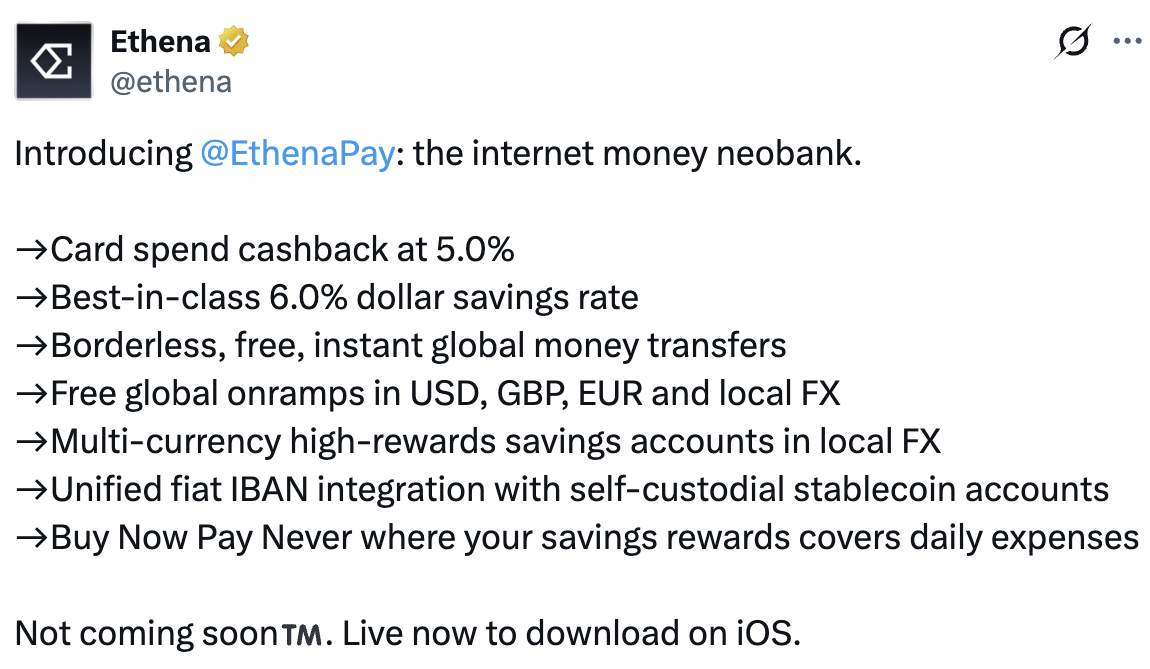
According to Tuesday’s announcement, the self-custodial Ethena Pay app allows users to hold USDe through a dollar-denominated balance, earn as much as 6% in annualized rewards and spend funds through a payment card, while supporting fiat onramps.

The beta rollout includes 48 countries across Latin America, the Caribbean, Africa, Asia and other regions, though the initial rollout is limited to 400 users, with access set to expand weekly, Ethena said in a Tuesday thread on X. Avalanche will serve as the exclusive settlement layer for payments and transfers.

Source: Ethena

Users can deposit fiat or crypto, with funds converted into USDe (USDe). The app enables using IBAN details to move money to and from external bank accounts into local currencies. MoonPay-owned Iron provides backend infrastructure.

Advertisement

Ethena Pay is not initially available in the US, EU, Canada, Taiwan or South Korea, though Ethena expects to expand into those markets during the beta, subject to regulatory approval.

Related: Chelsea FC gets a stablecoin sponsor after UK FCA warning to clubs

Ethena’s USDe grows as ENA rallies

Ethena is an Ethereum-based protocol behind USDe, a synthetic dollar designed to maintain its value near $1 without relying on traditional banking infrastructure.

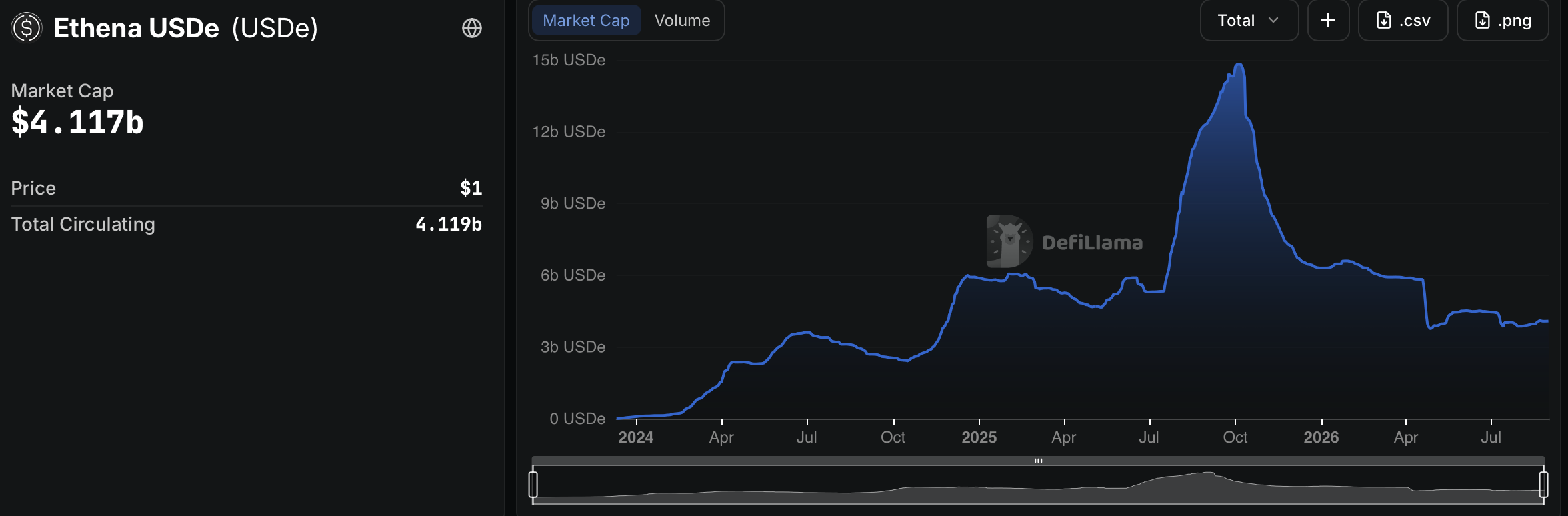
USDe uses crypto collateral alongside hedging strategies, including derivatives positions, to help maintain its peg. The asset has grown to a market capitalization of about $4.1 billion, making it the sixth-largest stablecoin, according to DefiLlama data.

Advertisement

USDe market cap. Source: DefiLlama

Ethena also operates ENA, the protocol’s governance token, which has a market capitalization of roughly $1.5 billion. The token has rallied sharply over the past month, gaining about 68%, but remains well below its previous highs.

On Friday, the Ethena Foundation proposed directing 95% of the net revenue it receives from Ethena’s core businesses toward ENA buybacks once USDe’s circulating supply reaches $7.5 billion. ENA rose more than 10% following the proposal and gained 27% over the week.

The token recorded about $595 million in trading volume over the past 24 hours, up 16% from the previous day, and was trading around $0.16 on Tuesday, according to CoinGecko.

Magazine: Does the Bitcoin rally mean we haven’t wasted our lives in crypto?

Advertisement

Source link

Continue Reading
Click to comment

You must be logged in to post a comment Login

Leave a Reply

Crypto World

Kalshi Issues First Lifetime Ban for Republican Politician over Insider Bets

Published

on

Kalshi Issues First Lifetime Ban for Republican Politician over Insider Bets

Prediction market platform Kalshi announced action against US House of Representatives candidate Laurie Buckhout and ousted Republican lawmaker George Santos over using insider information for trading on event contracts, in one of the first lifetime bans the company has imposed since its launch in 2021. 

In separate notices of settlement of disciplinary action announced on Friday, Kalshi’s compliance department said it had permanently suspended Santos from trading on the prediction markets platform and imposed a $71,356 penalty. Buckhout received a three-year suspension and a $2,590 penalty.

Both restrictions by Kalshi were made in response to investigations into Santos and Buckhout trading using event contracts that could be manipulated by their own actions. According to the platform, Buckhout, running in North Carolina’s 1st congressional district, “announced her candidacy for public office and was added as a market option for a contract on a North Carolina Congressional election,” while Santos “engaged in trading activity in certain markets related to his attendance at the State of the Union address” in February 2026.

“If a Trader is a decision maker, either directly or indirectly, or has any influence, directly or indirectly, no matter the scale and importance of the influence, on the outcome of the Underlying event of any Contract, that Trader is prohibited from attempting to enter into any trade, either directly or indirectly, on the market in such Contracts,” state Kalshi’s rules.

Advertisement

The actions by the company represented a significant crackdown at a time when prediction market platforms are under scrutiny by state and federal lawmakers over claims that many of the event contracts are susceptible to manipulation. President Donald Trump’s teleprompter operator, Gabriel Perez, was fined $172,000 by federal regulators after trading event contracts on Kalshi related to Trump’s speeches. 

While Kalshi’s compliance department reported that Buckhout “cooperated with the inquiry” and agreed to the three-year trading ban and penalty, the platform made no such statement in Santos’ case suggesting that the former US lawmaker had cooperated with its investigation.

Related: Trump teleprompter operator made $100K betting on Kalshi markets tied to speeches: ABC

Buckhout remains the Republican candidate for North Carolina’s 1st congressional district in the 2026 midterm elections, while Santos, formerly a representative for New York’s 3rd congressional district, was expelled from Congress in December 2023 amid fraud allegations.

Advertisement

In response to the settlement, Santos said in a Monday X post that Kalshi was an “unserious company.” Buckhout reportedly called her actions betting on her own congressional race a “dumb mistake.”

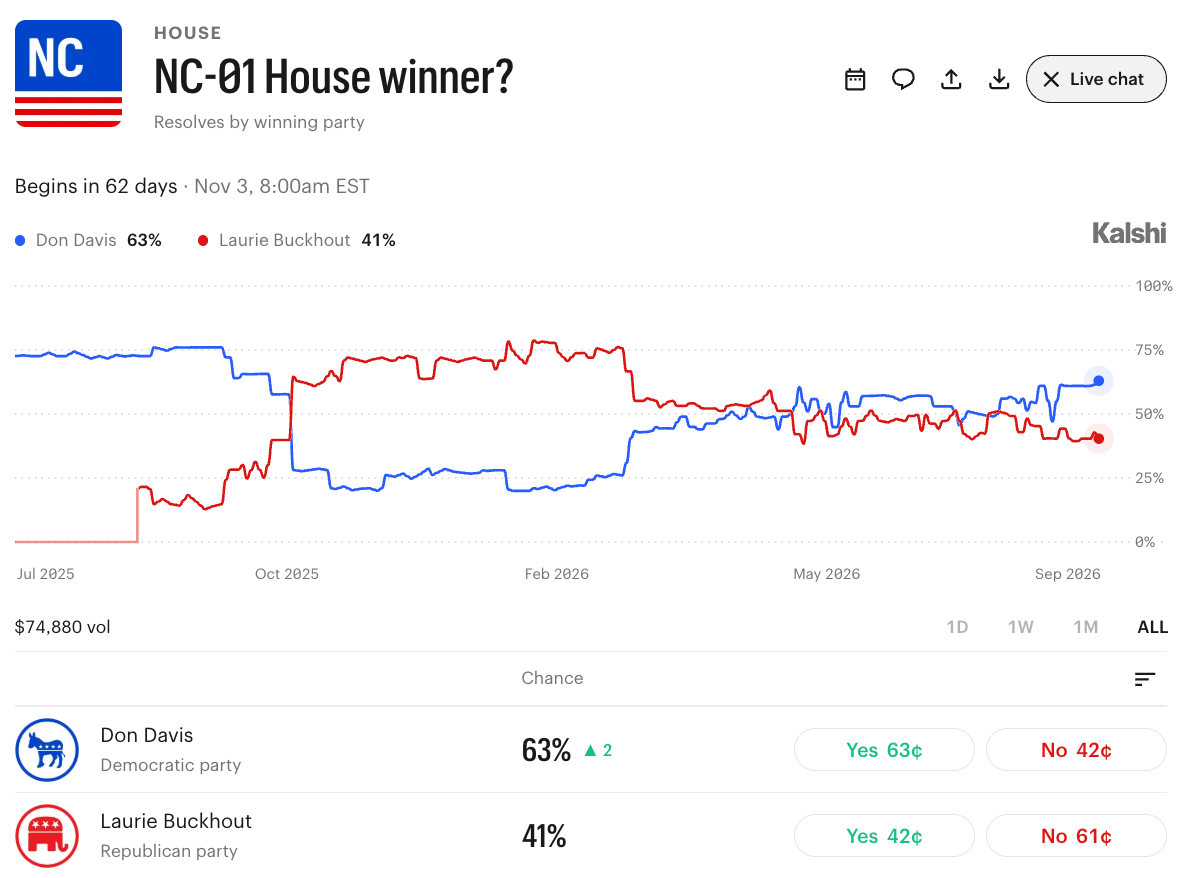
As of Tuesday, Kalshi still listed event contracts related to the outcome of Buckhout’s North Carolina race, giving Democratic incumbent Don Davis a 63% chance over the Republican’s 41%.

Event contract for Laurie Buckhout in North Carolina House race. Source: Kalshi

CFTC taps emergency authority in fed-state prediction markets legal battle

Kalshi and other prediction market platforms like Polymarket face several lawsuits filed by individual US state gaming authorities over allegations the companies are facilitating illegal bets on sporting events. At the same time, the sole commissioner and chair of the US Commodity Futures Trading Commission (CFTC), Michael Selig, claims that the agency has “exclusive jurisdiction” over prediction markets and vowed to take legal action against any state authority challenging this position.

Last month, the CFTC, in a rare move, invoked emergency authority opposing the state of New York attempting to bar Kalshi from offering contracts tied to sports, elections and other events.

Advertisement

Magazine: Does the Bitcoin rally mean we haven’t wasted our lives in crypto?

Source link

Continue Reading

Crypto World

SEC Proposes New Standards for US Transfer Agents

Published

on

SEC Proposes New Standards for US Transfer Agents

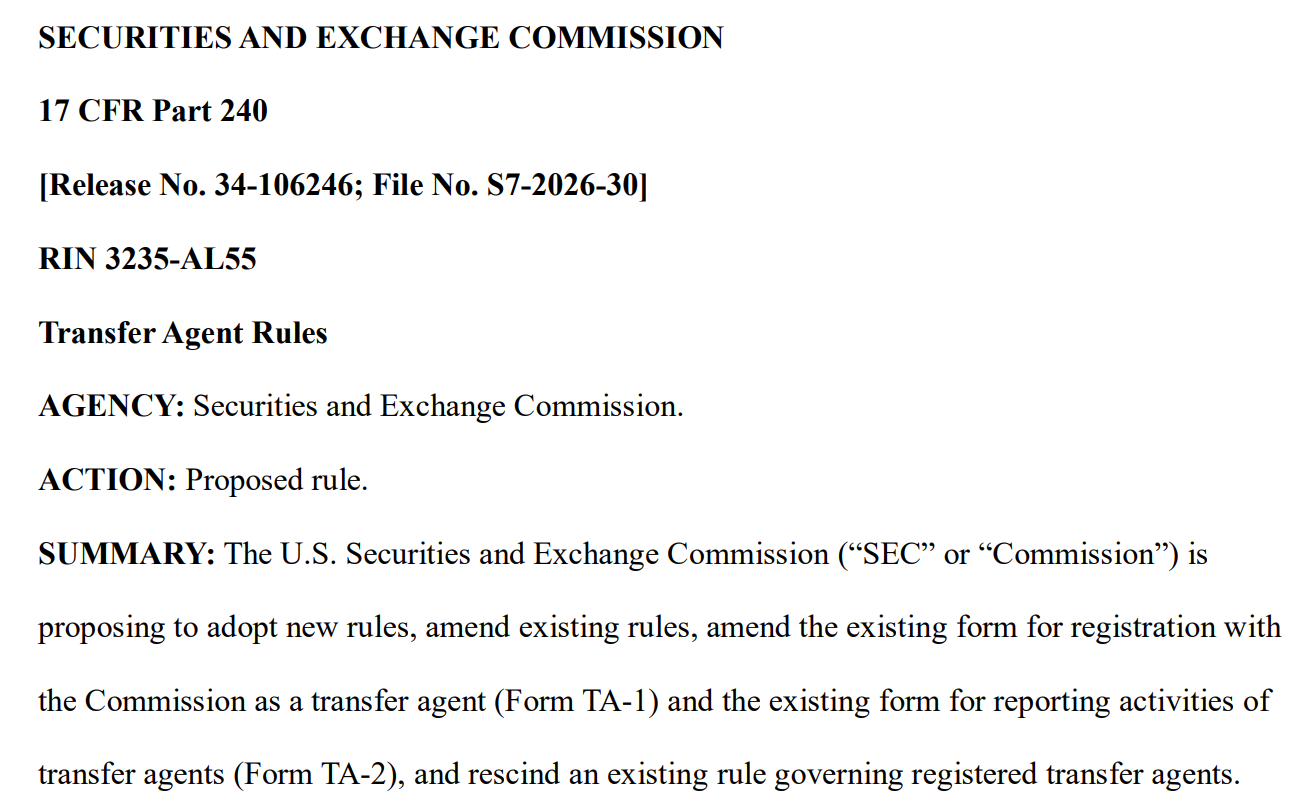
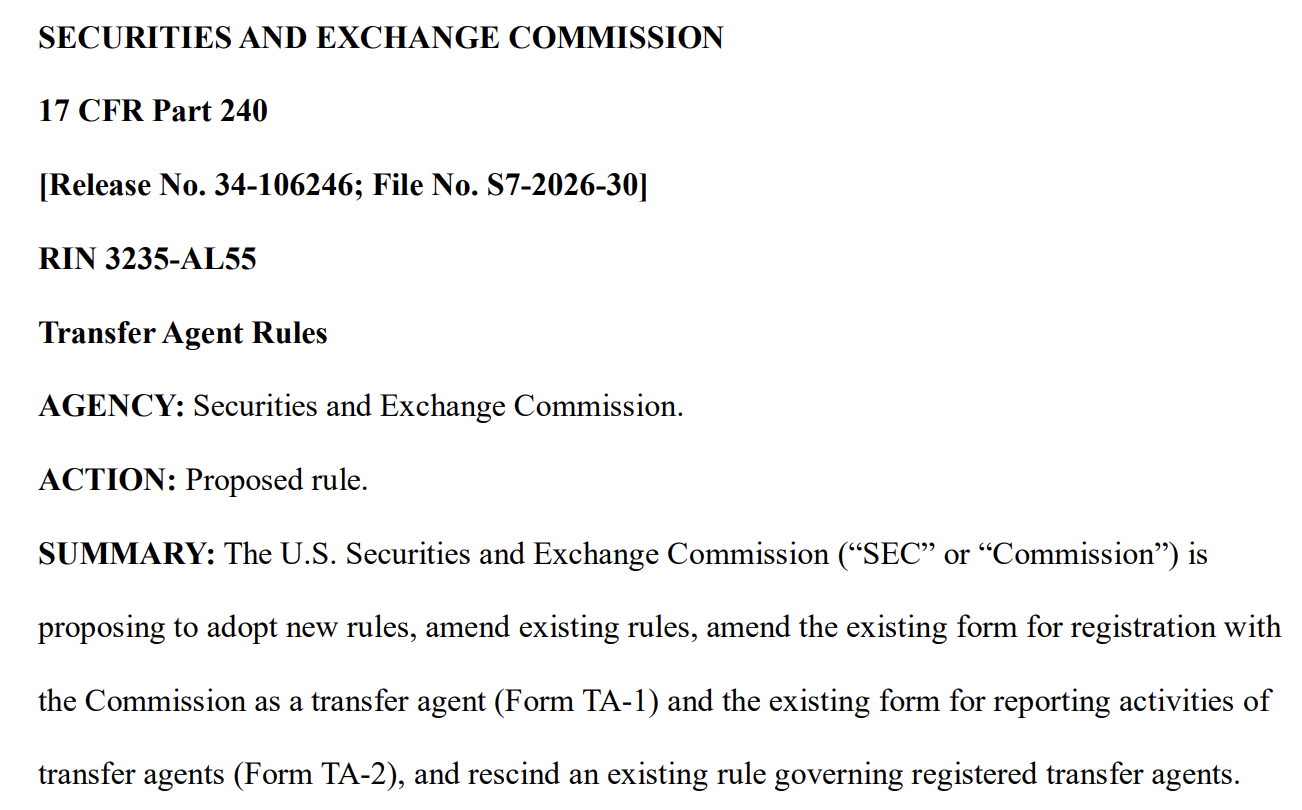
The US Securities and Exchange Commission (SEC) has proposed overhauling decades-old rules governing transfer agents as blockchain-based recordkeeping and tokenized securities become more prominent in US markets.

The proposal would update requirements covering registration, recordkeeping, safeguarding and securities transfers, while introducing new rules aimed at risks emerging from increasingly digital and automated market infrastructure.

“Market participants are actively seeking to bring blockchain-native, or ‘onchain’ transfer agents into the U.S. market,” the SEC said, pointing to models for blockchain-based recordkeeping, tokenized fund administration and cross-chain interoperability.

The agency said its existing framework does not adequately address those developments, particularly risks involving cybersecurity, operational resilience and the safeguarding of securities and investor records.

Advertisement

Under the proposal, transfer agents would face expanded reporting requirements and new compliance standards, including rules governing restrictive legends on securities and the use of third-party service providers.

SEC’s proposed Transfer Agent Rules. Source: SEC

The SEC said its transfer agent rules have not been substantively updated since the late 1970s and early 1980s, when the industry still relied heavily on paper certificates and manual recordkeeping.

The regulatory agency is seeking public comment on the proposed changes, with comments due 60 days after the proposal is published in the Federal Register.

Related: CFTC chair says agency will move forward on crypto regulation if CLARITY fails

Advertisement

SEC pursues broader securities rule changes

The SEC is “on a mission to simplify its rules,” according to analysis from law firm Cahill Gordon & Reindel sent to clients on Tuesday.

In May, the SEC proposed three major changes to public-company rules. The proposals would allow companies to opt for semiannual reporting, simplify the existing filer classification system and expand access to streamlined registered securities offerings.

Last week, the SEC sent a proposed overhaul of custody rules for investment advisers and investment companies to the White House for review, with potential changes covering how firms hold crypto assets for clients. The changes could provide clearer standards for how investment advisers and funds custody digital assets while complying with federal securities rules.

Magazine: Does the Bitcoin rally mean we haven’t wasted our lives in crypto?

Advertisement

Source link

Continue Reading

Crypto World

Meet Sean Parnell, Pentagon’s Chief Spokesperson and Army Secretary Contender

Published

on

Meet Sean Parnell, Pentagon's Chief Spokesperson and Army Secretary Contender

Prior to Army Secretary Dan Driscoll submitting his resignation Monday, Chief Pentagon spokesperson Sean Parnell had been suggested by some close to Defense Secretary Pete Hegseth as a potential replacement for the Senate-confirmed position.

The Hill reported last week that Parnell’s name was being floated, citing two unnamed sources familiar with the matter.

Asked about the reports, a senior Administration official told TIME: “Sean Parnell is 100% focused on the job he was appointed to by President Trump and Secretary Hegseth.”

News of Driscoll’s departure from the role he held for around 18 months came after months of reported tensions with Hegseth and turmoil within the department.

Advertisement

According to the Atlantic, a person familiar with Driscoll’s resignation said he had recently “brought up concerns with the Administration surrounding Army transformation and readiness and Hegseth’s blocking those efforts specifically by firing the generals who were responsible.”

White House spokesperson Anna Kelly did not address the tensions and fallout when approached by TIME, but instead emphasized that the United States Army is “more powerful than ever thanks to [Driscoll’s] work alongside the Commander-in-Chief and Secretary of War.”

Driscoll’s resignation is the latest in a series of high-profile departures within the Pentagon, following the April ouster of the Army’s top uniformed leader, Gen. Randy George, and the June departure of the lead commander in Europe and Africa, Gen. Christopher Donahue.

The Washington Post reported that Hegseth had sought to remove George several times and that Driscoll had previously blocked or delayed those efforts, arguing that George had done nothing wrong and should be judged on merit.

Advertisement

Alongside the reported tensions, Hegseth has also come under serious scrutiny for the duration and mounting cost of the Iran war, which surpassed the six-month mark last week.

“I don’t have any confidence in him anymore. I think he’s all over the place—he’s accelerating the retirement or forcing out some of the most distinguished leaders in the DOD that we have,” Republican Sen. Thom Tillis of North Carolina said in July.

Meanwhile, under Parnell, the Department of Defense has imposed various restrictions limiting journalists’ access in the Pentagon.

In an unprecedented move in June, the department designated its press office a classified area.

Advertisement

“The Pentagon Press Office has been redesignated as a Sensitive Compartmented Information Facility due to speechwriters from the Office of the Secretary of War sharing the facility,” said deputy Pentagon press secretary Joel Valdez. “As a result, journalists will no longer be permitted to enter the office space. There’s nothing controversial about that.”

Now, with talk turning to who may replace Driscoll in the pivotal role of Army Secretary, Parnell’s name continues to be floated. Notably, whoever is selected would need to be confirmed for the position by the Senate. 

Here’s what to know about Parnell, his military record, past controversies, and more.

Parnell is an Afghanistan veteran who penned a memoir on his experience

Advertisement

Parnell arrived in Afghanistan in 2006 and during his 16-month deployment was awarded two Bronze stars and the Purple Heart. He was deployed alongside his platoon, nicknamed the Outlaws.

He returned home with shrapnel in his leg and a brain injury that had left him with vision problems.

Following retirement on medical grounds, he penned a 2012 war story memoir titled Outlaw Platoon, in partnership with author John R. Bruning, detailing his experiences in the region.

Parnell went on to become a senior advisor for the Concerned Veterans of America and is credited with playing a key role in the passage of the Mission Act in 2018 under President Donald Trump, with the goal of delivering care and support for U.S. veterans.

Advertisement

Parnell previously criticized Trump before becoming a staunch supporter

Parnell backed now-Secretary of State Marco Rubio for the 2016 Republican presidential nomination where he faced off against Trump, who went on to win both the nomination and presidency.

According to Parnell, his support for Rubio, who at the time was a Senator in Florida, was cemented by his vocal backing of matters related to Veterans Affairs (VA).

“There are lots of strong options. But if fixing the VA, rebuilding our military, and doing right by our veterans is a top priority for you, then Senator Rubio should be your first and only choice,” Parnell said in a campaign press release.

Advertisement

In a separate interview, he described Rubio as a “unifying voice” who the country “desperately needs” and labeled him “my guy.”

By contrast, Parnell had called out Trump in 2015, referring to his criticism of the late Republican Sen. John McCain, a prisoner of war, as “the height of arrogance,” arguing that Trump had “no clue what our Vietnam POWs endured.”

However, Parnell had a change of heart once Trump took office, stating in a 2019 interview that the President had earned his respect “because he forces us to talk about issues. Political correctness doesn’t allow us to talk about them.”

At the 2020 Republican National Convention, Parnell further praised Trump, insisting he had “unleashed the economic might of this nation like no other President in our history.”

Advertisement

Parnell suspended his campaign for Senate amid abuse allegations

Parnell, after running unsuccessfully for the House in 2020, went on to launch a bid as the GOP Senate candidate in Pennsylvania. He suspended his Trump-backed campaign in November 2021, after losing a fight for custody of his children to his then-estranged wife, who had accused him in court of abuse.

Laurie Snell had alleged that Parnell choked her and injured their children. Parnell vehemently denied the claims.

Snell also testified in court that Parnell had been unfaithful.

Advertisement

Following Trump’s announcement in February 2025 that Parnell was tapped to become chief spokesperson for the Pentagon, some media coverage saw the abuse allegations revisited.

If Parnell were put forward for a Senate-confirmed position in the future, the historical allegations could be brought up in his confirmation hearing.

Source link

Advertisement
Continue Reading

Crypto World

Ethena Expands Ecosystem With Launch of Self-Custodial Money App

Published

on

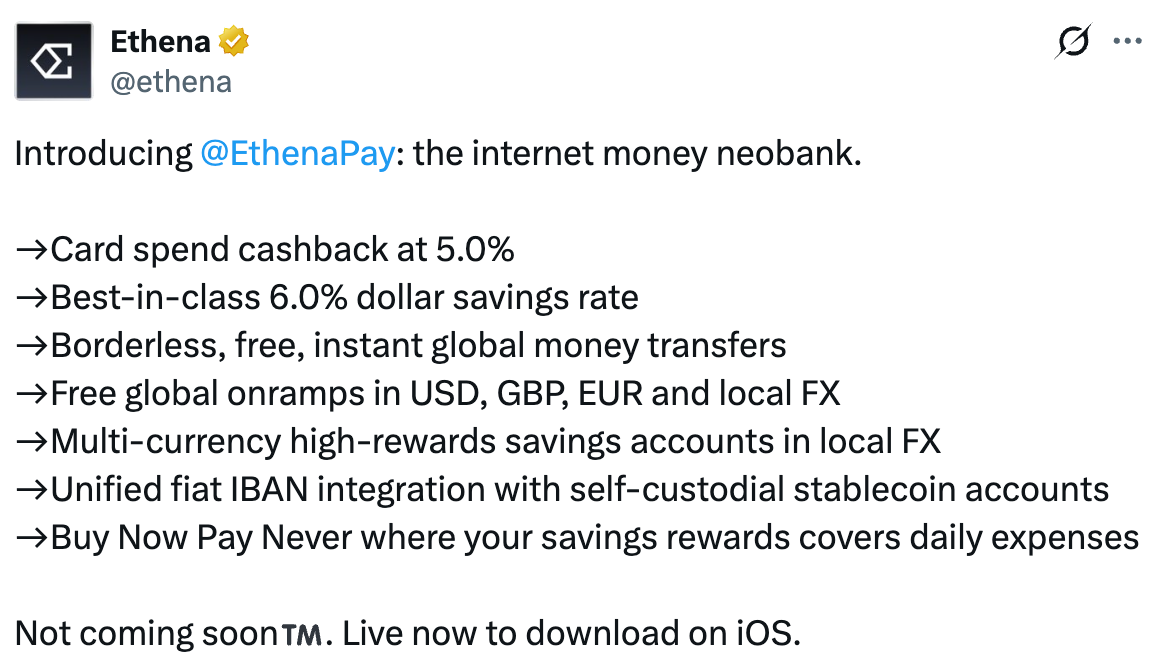
Ethena (ENA) has officially launched Ethena Pay, a self-custodial money app the project bills as “the internet money neobank,” advertising a 6% dollar savings rate, 5% card cashback.

It even has free transfers across roughly 50 countries at launch. It also comes with dollar savings, card spending, international transfers and free onramps in dollars, pounds and euros, with fiat account numbers tied to self-custodial stablecoin wallets.

Though access starts with 400 early users and expands weekly through a September beta. Notably, Avalanche (AVAX) is the exclusive settlement network, and a feature called Buy Now Pay Never puts savings rewards toward purchases without touching the principal.

Tiers and Caps

As mentioned, Ethena’s card cashback is at a flat 5%. The product page breaks it into tiers: the free Standard plan pays 4% on spending with cashback capped at $100 a month, while the Pro and VIP plans lift the monthly caps to $360 and $1,000, with 5% reserved for the top tier.

Advertisement

Savings follow the same pattern: Standard accounts earn 5%, upper tiers get the advertised 6%, and rewards pay out daily. A footnote says the rates rest on Ethena-reported weekly data and assume no net staking activity during reward vesting.

Users can generate a virtual Visa card in under a minute, spend it at more than 130 million merchants, and add it to Apple Pay, with Google Pay to follow. Third National issues the card under license from Visa, with program management from Signify Holdings, operating as Rain.

Advertisement

The card is not offered to US persons, and users must be 18 to register. Transfers between Ethena Pay users are free, with no monthly account fees, and euro, yen, and Brazilian real accounts are listed as coming soon.

Not a Bank, Though

Ethena Pay Ltd, incorporated in Malta, has clearly stated that it is not a bank, holds no customer funds, and provides fiat account numbers through licensed banking partners, while wallet keys stay with the user behind passkeys and biometrics.

Moreover, the official site flags that balances carry no coverage from the FDIC, the UK’s Financial Services Compensation Scheme or Malta’s depositor scheme, and the savings rate flows from the yield engine behind USDe, Ethena’s synthetic dollar, which has drawn its returns from a crypto basis trade.

USDe’s circulating supply stands near $4.2 billion, per DefiLlama, and Ethena says it has paid holders more than $750 million in rewards on over $30 billion of mints and redemptions. Ethena has widened its lineup before, launching USDtb, a stablecoin backed primarily by BlackRock’s BUIDL fund.

Advertisement

ENA, which recorded its biggest single day of network growth in more than three months in May after Grayscale added the token to its DeFi Fund, traded 8.6% higher on launch day, per CoinGecko.

The post Ethena Expands Ecosystem With Launch of Self-Custodial Money App appeared first on CryptoPotato.

Source link

Advertisement
Continue Reading

Crypto World

Tectonic’s $75M exploit was not an oracle failure, RedStone co-founder says

Published

on

DxSale exploit drains $7.3M in BNB through hidden contract backdoor

RedStone has said Tectonic’s estimated $75 million exploit resulted from weak collateral controls rather than an inaccurate oracle after TONIC’s reported price rose about 100-fold in 20 minutes.

Summary

  • An onchain researcher estimated that the Tectonic exploit affected about $75 million.
  • TONIC’s reported price increased roughly 100 times before the token was supplied as collateral.
  • RedStone said borrow caps tied to executable liquidity could have limited the losses.
  • Cronos has restarted after restoring its chain state to a point before the attack.

RedStone co-founder Marcin Kazmierczak told crypto.news that the oracle accurately reported TONIC’s price in the pool it monitored, but Tectonic allegedly accepted the reading without checking whether the token could be sold at that valuation in meaningful size.

Cronos validators halted block production on Aug. 30 after Tectonic disclosed an incident involving the decentralized lending protocol. Independent researcher Weilin Li estimated that approximately $75 million was affected, although neither Tectonic nor Cronos has confirmed the final loss.

Advertisement

According to Li’s initial analysis, the attacker pushed TONIC’s price about 100 times higher within roughly 20 minutes. The inflated tokens were then supplied to Tectonic as collateral, allowing the attacker to borrow assets with more established liquidity.

TONIC reportedly had a collateral factor of 20%, meaning the protocol allowed users to borrow assets worth up to one-fifth of the collateral’s reported value. Li identified about 364.6 trillion TONIC in the position, which would have needed a reported value of around $375 million to support approximately $75 million in borrowing.

Tectonic oracle reported a manipulated market price

Kazmierczak rejected the idea that the oracle itself necessarily produced incorrect data, drawing a distinction between observing the available market price and deciding whether that price is safe for a lending protocol.

Advertisement

“The oracle wasn’t wrong. It accurately reported the price of TONIC on the pool it was reading from at that moment,” he said.

A thinly traded token can register a high spot price after a limited number of trades, even when the market lacks enough buyers to support large sales at the same level. According to Kazmierczak, Tectonic’s alleged failure was accepting the manipulated price as collateral without testing how much TONIC could actually be sold before its value collapsed.

“Reporting a price and validating that a price is safe to lend against are two different jobs, and Tectonic’s design conflated them.”

The initial Tectonic incident left most of the identified assets on Cronos when validators stopped the chain. Li estimated that about $6 million had reached Ethereum, while roughly $60 million remained at one Cronos address. A second address holding close to $8 million raised his combined estimate to about $75 million.

Funds remaining at identified addresses should not be treated as recovered unless the network, protocol or affected users regain control of them. Cronos and Tectonic had not confirmed Li’s address attribution or asset estimates when the preliminary analysis was published.

Advertisement

Borrow caps could have limited the Tectonic loss

Among the safeguards available to lending protocols, Kazmierczak said borrow caps linked to executable liquidity would have provided the strongest protection. Such a cap limits the total amount users can borrow against an asset based on how much of the collateral could realistically be sold without causing a steep price decline.

“Even if TONIC’s reported price moves 100x, a borrow cap sized to what could realistically be exited without collapsing the market limits the damage regardless of what the price feed says,” he said.

Dynamic collateral factors, price-impact limits and minimum market-depth requirements could also have reduced Tectonic’s exposure, according to Kazmierczak. However, he argued that a properly set borrow cap can contain losses even when another risk parameter fails.

Tectonic apparently lacked those protections, he said, allowing a token with limited liquidity to support borrowing on the basis of a temporarily inflated valuation. Neither Tectonic nor Cronos has released a technical postmortem confirming which controls were active when the incident occurred.

Advertisement

Kazmierczak also cautioned against treating a longer time-weighted average price window as a complete solution. A TWAP calculates an average price across a set period, making brief market moves less influential than they would be under a spot-price feed.

Although longer windows can filter out short-lived price changes, Kazmierczak said protocols must set them according to each asset’s liquidity and trading history. In his assessment, a 100-fold increase in 20 minutes should have raised questions about TONIC’s eligibility as collateral rather than prompting a debate over the ideal averaging period.

“A move like TONIC’s, 100x in 20 minutes, isn’t a volatility event a wider TWAP window would smooth over. It’s a signal the asset shouldn’t have been usable as collateral at any meaningful size in the first place.”

Thin collateral has caused similar DeFi attacks

Tectonic’s reported attack followed an $8.7 million Moonwell exploit on Base on Aug. 27. Security firms said the Moonwell attacker manipulated the collateral value of the relatively illiquid MAMO token before borrowing cbBTC from the protocol’s mBTC market.

Following the incident, Moonwell lowered borrow caps across its Base Core Markets to 1 wei, effectively preventing new loans. It also reduced the supply caps for MAMO and WELL to 1 wei while investigating the transactions.

Advertisement

Kazmierczak compared Tectonic with Mango Markets and Moola Market, two protocols targeted through variations of inflated collateral pricing in October 2022. Mango Markets lost more than $100 million after Avraham Eisenberg increased the value of positions linked to the thinly traded MNGO token and borrowed other assets against them.

The Mango case also provides a U.S. legal example of how difficult it can be to apply existing fraud and commodities laws to automated lending systems. A Manhattan jury convicted Eisenberg in 2024 of commodities fraud, commodities manipulation and wire fraud, but a federal judge vacated the convictions in May 2025 over venue problems and insufficient evidence supporting the wire fraud count.

According to Kazmierczak, protocols repeatedly expose themselves to such attacks because listing a native governance token as collateral can increase its use and help attract deposits. The cost of weak settings may remain hidden until someone tests how the lending market responds to a manipulated token price.

He placed primary responsibility on risk curators and other service providers tasked with setting and maintaining collateral parameters, working alongside protocol developers and oracle providers. Governance participants may approve an asset listing, Kazmierczak said, but many voters lack the market-structure knowledge needed to judge liquidity and price-impact risks.

Advertisement

Cronos restored the chain to its pre-exploit state

Cronos has since restarted network operations after validators restored the blockchain to a point before the Tectonic incident. The network described the halt as an emergency action agreed through validator consensus to protect users.

Restoring the earlier chain state removed transactions recorded after the chosen rollback point from the restarted version of Cronos. Crypto.com CEO Kris Marszalek said the company’s centralized app and exchange continued to operate during the halt and that funds held through those services were unaffected.

Tectonic had asked users not to interact with the lending protocol while its team investigated the incident. Cronos has not published the technical process validators used to select and approve the restored state, while the promised postmortem is expected to address the attack, the emergency halt, and the subsequent restart.

Advertisement

Source link

Continue Reading

Crypto World

Strategy spends $635M buying back STRC as perpetual preferred stock lags $100 par

Published

on

BTC below $72,000 as Strategy sold 32 bitcoin for $2.5 million


STRC trades at $97.34 despite Strategy’s growing repurchases, while SATA’s higher dividend rate has helped it hold its $100 par value.

Source link

Continue Reading

Crypto World

Arbitrum (ARB) Pumps 27% Daily: The Start of a Bigger Move?

Published

on

Surprisingly or not, Arbitrum’s ARB leads the entire top 100 club today (September 1) as the strongest performer.

Some analysts expect further gains ahead, but a certain technical indicator suggests a short-term correction is also quite possible.

The 3-Month Peak

ARB experienced a sudden 27% daily increase and currently trades at around $0.11 (per CoinGecko), the highest point since late May. Its market capitalization surpassed $730 million, making it the 86th-largest cryptocurrency.

ARB Price
ARB Price, Source: CoinGecko

The double-digit increase is rather surprising given the slight overall decline in the market over the past day, and the most likely catalyst fueling the rally appears to be Robinhood.

Arbitrum’s team revealed that Robinhood Chain generated more than $1 million in fees in the last 24 hours. “As a dedicated Arbitrum chain, 10% of the protocol revenue flows back to the Arbitrum ecosystem,” they added.

Advertisement

According to X user Master of Crypto, ARB is nearing the end of a long consolidation after trading inside a clear symmetrical triangle, with resistance around $0.1495 and $0.1729.

“If ARB breaks above the triangle, the next move could target $0.1495 first, followed by $0.1729. A clean breakout could signal the start of a bigger trend move,” the analyst predicted.

For their part, X user OxNeena claimed that ARB is breaking out. In their view, holding above the key support just above $0.08 could open the door to further gains toward $0.12, $0.14, and $0.16.

Pullback Ahead?

Despite the aforementioned pump, ARB remains 98% below its all-time high. The token began trading in the spring of 2023 when its price briefly skyrocketed above $5.

The asset’s Relative Strength Index (RSI) suggests that narrowing the gap to the historical peak may have to wait a bit longer. The technical analysis tool, which measures the speed and magnitude of recent price changes, ranges from 0 to 100, with anything above 70 signaling a potential move south due to overbought conditions.

Advertisement

On the other hand, ratios below 30 hint that ARB has entered oversold territory and could be due for a resurgence. Currently, the RSI stands at around 73, reinforcing the bearish perspective.

ARB RSI
ARB RSI, Source: CryptoWaves

The post Arbitrum (ARB) Pumps 27% Daily: The Start of a Bigger Move? appeared first on CryptoPotato.

Source link

Continue Reading

Crypto World

Lumentum Stock Sets Up After 148% Gain

Published

on

Lumentum Stock: Lumentum Earnings Top Estimates As New Products Ramp

Lumentum (LITE) stock scaled an almost vertical wall in the heyday of the artificial intelligence trade in 2025 and early 2026. As investors rotated out of tech names over this summer, this star among data center infrastructure names passed a technical test by finding support at its 200-day moving average while carving a base. Other metrics also suffered minimal damage,…

Copyright ©2026 Investor’s Business Daily, LLC. All rights reserved. 87990cbe856818d5eddac44c7b1cdeb8

Source link

Continue Reading

Crypto World

Arch Lending Adds PAX Gold and Tether Gold as Collateral for Crypto-Backed Loans

Published

on

Arch Lending Adds PAX Gold and Tether Gold as Collateral for Crypto-Backed Loans

Arch Lending now accepts PAX Gold and Tether Gold as collateral, opening credit access to a class of investors that have largely sat outside digital-asset lending.

As gold’s recent run higher has renewed interest in the metal as a store of value, Arch Lending, the alternative-asset lending platform operated by ChainFi, Inc, today began accepting PAX Gold (PAXG) and Tether Gold (XAUT) as loan collateral at starting loan-to-value ratios of up to 75%.

Borrowing Against Gold Is Already Happening

Demand for credit against tokenized gold is documented rather than theoretical. On January 29, 2026, Aave governance data showed $24.99 million in outstanding debt against a $25 million isolated debt ceiling for Tether Gold, effectively full utilization, with the ceiling raised repeatedly in the following weeks as borrowing continued to fill available capacity.

That activity took place on a decentralized, DeFi protocol, at variable rates, without fiat funding or a regulated custodian. Arch Lending is the first institutional-grade lender to offer the same underlying trade through a regulated, custodial structure: fixed 12-month terms, funding in dollars or USDC, and eligible collateral custodied by Anchorage Digital, a federally chartered bank.

Advertisement

PAXG, issued by Paxos Trust Company, represents one fine troy ounce of gold from an LBMA-accredited London Good Delivery bar held in Brink’s vaults. XAUT, issued by TG Commodities Limited, represents one fine troy ounce from a London Good Delivery bar held in Swiss custody. Together they account for the overwhelming majority of a category that generated $90.7 billion in spot trading volume in the first quarter of 2026, according to CoinGecko, surpassing the $84.64 billion recorded across the whole of 2025.

A New Class of Borrower

Arch Lending is targeting a profile that has largely sat outside crypto lending: gold investors, wealth advisors, commodities traders, family offices, and corporate treasuries with existing precious-metals allocations.

“We’re seeing real demand from advisors and family offices with a gold sleeve who have never borrowed against it, because the process was slow and usually ended in a sale,” said Himanshu Sahay, Co-Founder and CTO of Arch Lending. “Tokenization fixed the plumbing. Credit is the part that makes it worth doing.”

Terms

Loans start at $250,000, generally with 12-month terms. Rates for monthly-payment loans begin at 9.25% APR between $250,000 and $750,000, comprising 8.50% interest and a 0.75% origination fee, falling to 7.25% APR above $5 million. Rates and fees are subject to applicable state requirements.

Advertisement
  • $250,000 minimum loan size
  • Up to 75% initial LTV
  • 85% margin-call threshold
  • 90% liquidation threshold
  • Generally 12-month loan structures
  • USD or USDC funding
  • No credit score is used for loan approval. Eligibility requirements apply.
  • No prepayment penalties
  • 24-hour cure window
  • Partial-only liquidation
  • Eligible collateral custodied by Anchorage Digital N.A., which maintains $100 million of insurance coverage through Lloyd’s of London
  • No rehypothecation

PAXG and XAUT now sit alongside Bitcoin, Ethereum, Solana, and XRP within Arch Lending’s collateral set, extending Arch Lending’s core Bitcoin-backed platform into a multi-asset credit ecosystem built around premier stores of value.

About Arch Lending

Arch Lending is a U.S.-based lending platform that lets holders of alternative assets borrow against their holdings without selling. Supporting Bitcoin, Ethereum, Solana, XRP, PAX Gold, and Tether Gold as collateral.

For more information visit: archlending.com.

The post Arch Lending Adds PAX Gold and Tether Gold as Collateral for Crypto-Backed Loans appeared first on BeInCrypto.

Source link

Advertisement
Continue Reading

Crypto World

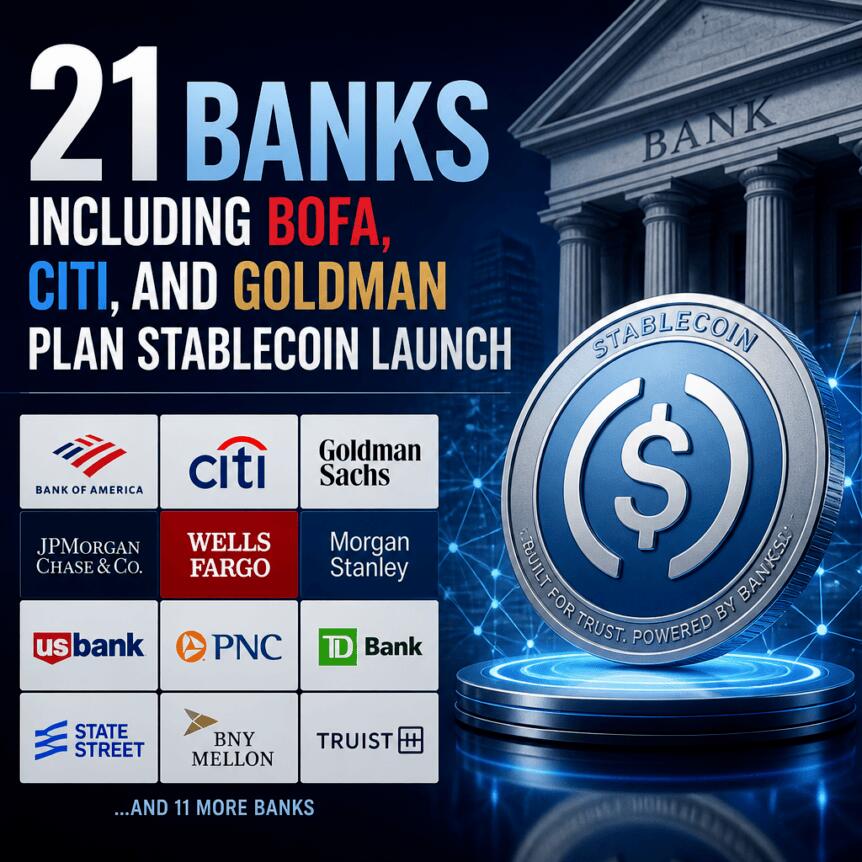
21 Banks Including BofA, Citi, and Goldman Plan Stablecoin Launch

Published

on

Crypto Breaking News

A consortium of 21 major financial institutions says it plans to form a new company dedicated to developing and issuing stablecoins, signaling a renewed effort from traditional banks to build digital-dollar rails that fit emerging regulations. The group announced Tuesday that it aims to launch a US dollar-denominated stablecoin in the first half of 2027, once the company is formed and other conditions are met.

Beyond a first US dollar product, the consortium says it intends to expand to stablecoins denominated in other G7 currencies, with a euro offering identified as its next priority. The planned tokens are intended to serve wholesale, institutional, and retail users, including applications such as cross-border payments and digital asset settlement.

Key takeaways

  • 21 large financial institutions plan to create a company to develop and issue stablecoins.
  • The initial product is expected to be a US dollar-denominated stablecoin in the first half of 2027.
  • Officials say the stablecoin framework will aim to comply with the US GENIUS Act and, where applicable, the EU’s MiCA.
  • After the dollar launch, the consortium’s stated next step is a euro-denominated stablecoin.
  • The consortium more than doubled compared with an earlier October effort involving 10 banks exploring reserve-backed stablecoins.

From bank pilots to a coordinated stablecoin company

The Tuesday announcement frames the initiative as a step toward a more formal, multi-institution approach to stablecoins. The consortium names Bank of America, Goldman Sachs, Citi, Deutsche Bank, UBS, Santander, MUFG, and Fidelity Investments, among others.

While stablecoins have already gained traction across parts of the financial ecosystem, this move stands out for its scale and for the breadth of the participating institutions across regions including North America, Europe, East Asia, and parts of the Middle East and Africa. The group’s expansion from the earlier, smaller effort suggests momentum is building toward shared infrastructure rather than isolated, institution-by-institution experiments.

In October 2025, Reuters reported that an initial group of 10 banks was exploring a 1:1 reserve-backed model of digital money available on public blockchains. The new consortium effectively builds on that earlier exploration, with the stated plan now moving closer to an eventual issuance roadmap, albeit still contingent on forming the company and meeting other unspecified conditions.

Advertisement

Regulatory alignment is central to the plan

Stablecoin projects increasingly rise or fall on regulatory fit, and the consortium is explicitly tying its design goals to compliance pathways. According to the announcement, the planned stablecoin will aim to comply with the US GENIUS Act and the EU’s Markets in Crypto-Assets Regulation (MiCA), where applicable.

This matters for more than public messaging. Stablecoin issuers and distributors typically need legal clarity around reserve management, redemption, consumer protections, and supervisory oversight. By explicitly referencing both US and EU frameworks, the consortium is signaling that it wants the token to operate not just as a blockchain-native instrument, but as an asset that can be integrated into regulated distribution channels.

That regulatory emphasis also aligns with broader shifts in the sector. Stablecoins have seen growing adoption in recent years, and the passage of GENIUS and MiCA has helped clarify routes that were previously more uncertain for mainstream institutions.

Where the consortium says it wants to use the token

The announcement says the stablecoin is designed for wholesale and institutional use as well as retail access. Use cases highlighted include cross-border payments and digital asset settlement—applications where speed, programmability, and transfer finality are often treated as advantages compared with traditional correspondent banking flows.

Advertisement

For investors and market participants, the inclusion of multiple target segments suggests the consortium wants the stablecoin to function across different integration levels: internal settlement for financial firms, cross-border transfer for payment corridors, and easier access for retail users through downstream partners.

The planned multi-currency expansion further indicates the project is not intended to be a one-off US dollar product. The consortium’s stated next priority is a euro-denominated stablecoin, which could matter for liquidity planning and for cross-border use cases within Europe and between regions.

Broader industry momentum: Asia policy, bank issuance, and institutional surveys

This consortium’s announcement comes amid other signs of institutional progress. In Singapore, for example, the country’s authorities are said to be considering allowing jointly issued cross-border stablecoins into its regulatory regime. The Tuesday announcement reportedly revisits an earlier position that limited the framework to domestic issuance.

Separately, institutional interest has been building through both surveys and product launches. Earlier in 2025, a Fireblocks survey of 295 executives found that 90% of respondents were using or planning to use stablecoins, underscoring that demand is not limited to crypto-native companies.

Advertisement

There have also been concrete issuance steps by major firms. According to coverage referenced by the article, Societe Generale’s crypto subsidiary has issued euro- and dollar-denominated stablecoins, and Fidelity has launched a US dollar-pegged FIDD stablecoin. The article also notes Standard Chartered’s backing of a Hong Kong dollar stablecoin venture.

Taken together, these developments suggest a shift from isolated experiments toward products that can be distributed, regulated, and operationalized at institutional scale. The consortium’s planned US-dollar launch in 2027 can be read as part of that same arc—moving from “can it work?” to “how does it fit within the rules and distribution networks?”

For market watchers, the key question is whether the consortium’s approach—reserve-backed stablecoins with compliance targets aimed at GENIUS and MiCA—will translate into a deployable issuance plan that other institutions can readily integrate with. Investors should watch for updates on the company’s formation, the exact token structure and reserve arrangements, and how the group coordinates cross-border deployment as regulators continue to clarify stablecoin treatment.

Risk & affiliate notice: Crypto assets are volatile and capital is at risk. This article may contain affiliate links. Read full disclosure

Advertisement

Source link

Continue Reading

Trending

Copyright © 2025