

Crypto World
Ethereum braces for CLARITY vote as bulls defend crucial support

Ethereum has risen 1.8% to $1,845 after Rep. Bryan Steil raised hopes for a Senate vote on the CLARITY Act next week, while ETF inflows and firm chart support kept traders cautiously bullish.
Summary
- Ethereum rose 1.8% as Bryan Steil raised hopes for a CLARITY Act vote next week.
- Spot Ethereum ETFs recorded $105 million in weekly inflows, their highest since April.
- ETH must defend $1,830 and break $1,854 to target the $1,947 resistance zone.
Steil, who chairs the House Financial Services Subcommittee on Digital Assets, told FOX Business that the bill could reach the Senate floor in the coming week. Passage could place ETH under a digital commodity framework and establish federal rules for its trading and oversight.
During a July 17 hearing, Steil urged lawmakers to complete the legislation as the Senate prepares to consider it. “Let’s pass CLARITY,” he stated in remarks published by the House Financial Services Committee.
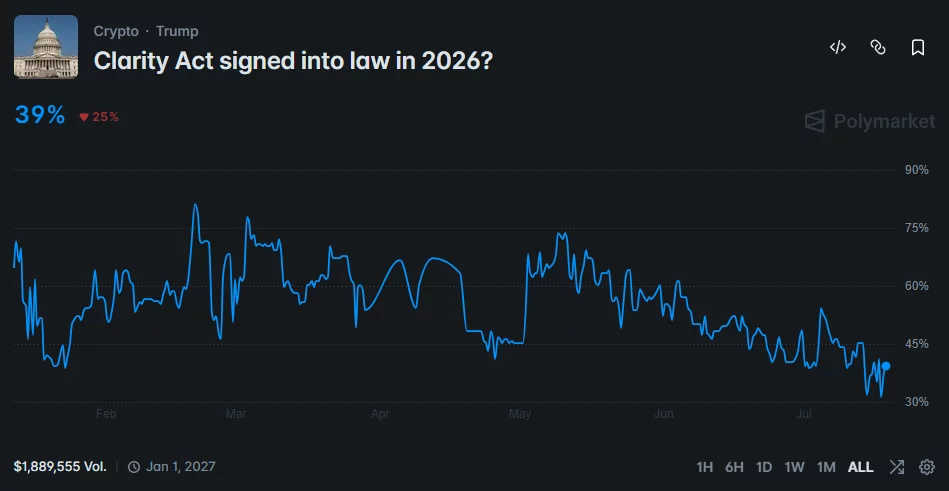
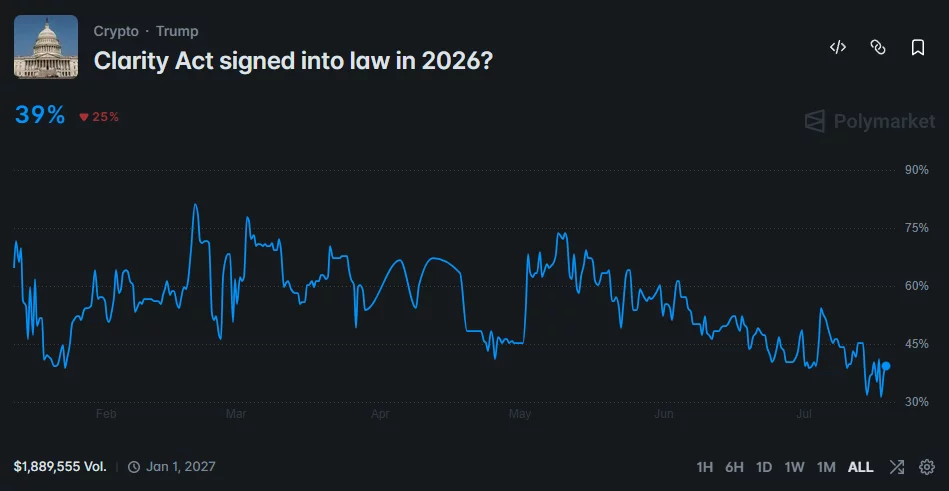
Polymarket traders raised the probability of the bill becoming law in 2026 to 39% from 30% on July 17. However, unresolved disputes over ethics rules and stablecoin yields have kept the odds below 50%.
Institutional flows have also improved. SoSoValue data showed that spot Ethereum ETFs attracted $105 million between July 13 and July 17, their strongest weekly inflow since April.
Ethereum’s decentralized finance activity has grown alongside the ETF demand. DeFiLlama placed the network’s total value locked at about $40.5 billion, up from roughly $36 billion at the start of July. The network also processed $978.9 million in decentralized exchange volume and 2.46 million transactions over the past 24 hours.
Ethereum must clear $1,854 to reopen the path toward $1,947
Ethereum’s daily chart shows a double-bottom structure formed around $1,511, with the neckline near $1,847. ETH briefly climbed to $1,947 before returning to test the neckline, which now overlaps with the 0.786 Fibonacci retracement at $1,853.82.
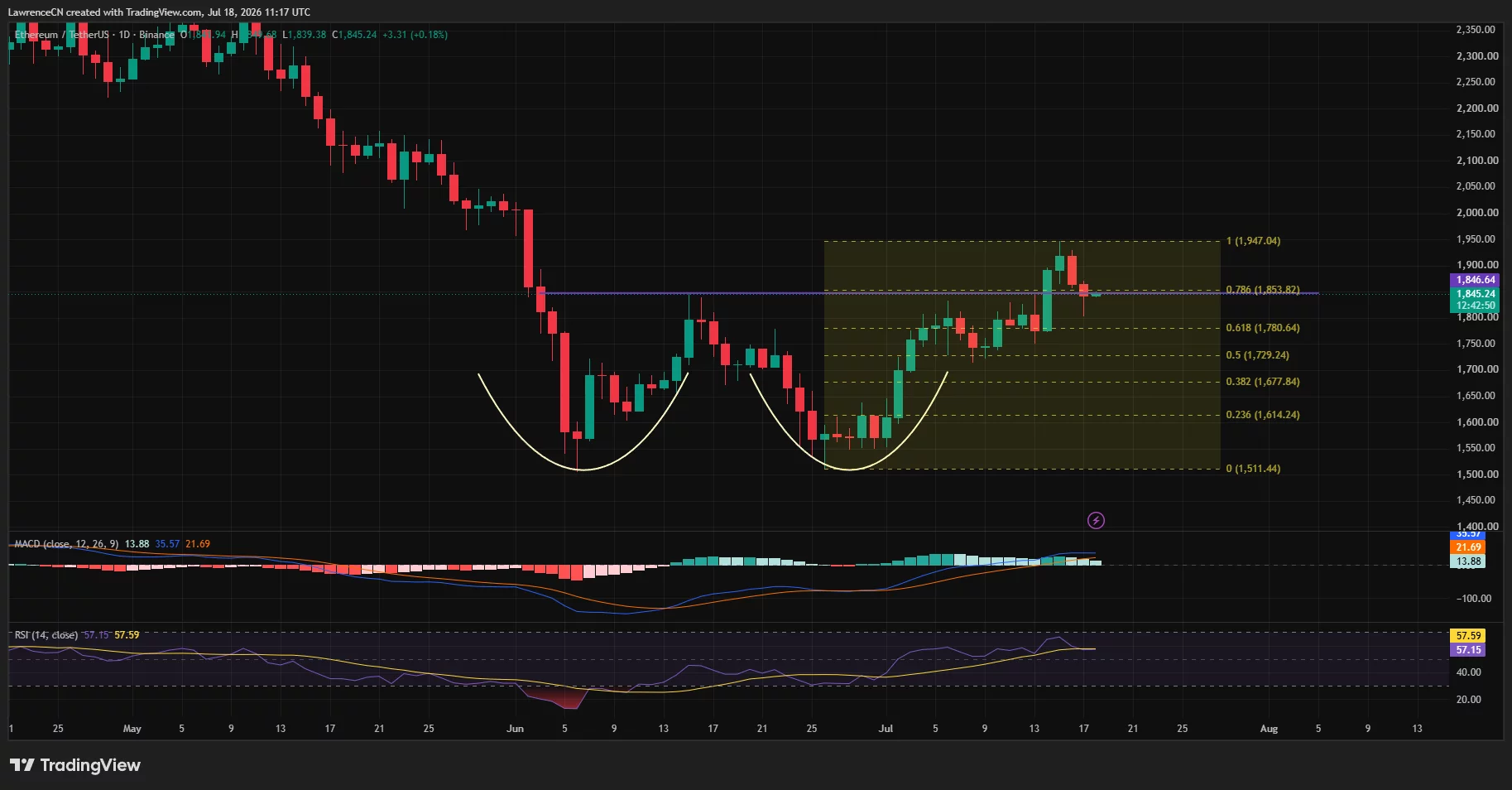
A daily close above $1,854 would place the recent $1,947 high and the 100-day exponential moving average near $1,939 back in play. The double-bottom structure has a measured target near $2,180, while crypto analyst Michaël van de Poppe expects $2,200 to $2,400 if the $1,780 support remains intact.
Daily momentum still favors buyers, although the pace has slowed. The MACD line stands at 35.57, above the 21.69 signal line, while the positive histogram has contracted to 13.88. The relative strength index sits at 57.15, leaving ETH below overbought territory.
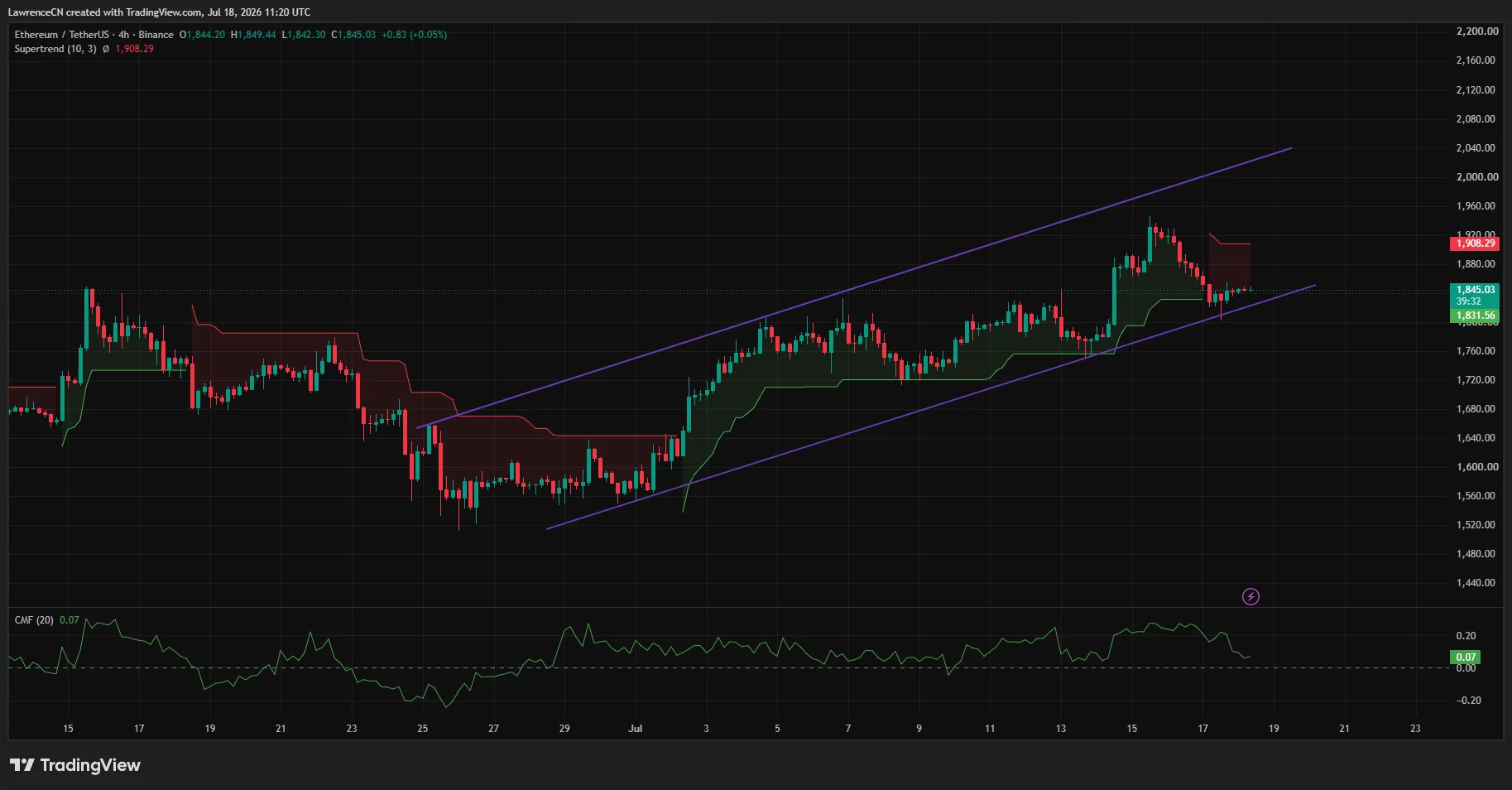
On the 4-hour chart, Ethereum (ETH) remains inside an ascending channel that has guided the recovery since late June. Its lower boundary and the previous Supertrend support meet around $1,830, while the upper boundary extends toward $2,040. Chaikin Money Flow remains positive at 0.07, but the active Supertrend resistance at $1,908 must fall before buyers can retest the July high.
CoinGlass’ 48-hour liquidation heatmap places the nearest dense leverage cluster between $1,860 and $1,870. More positions sit around $1,900, while downside liquidity has accumulated near $1,810 and $1,790.
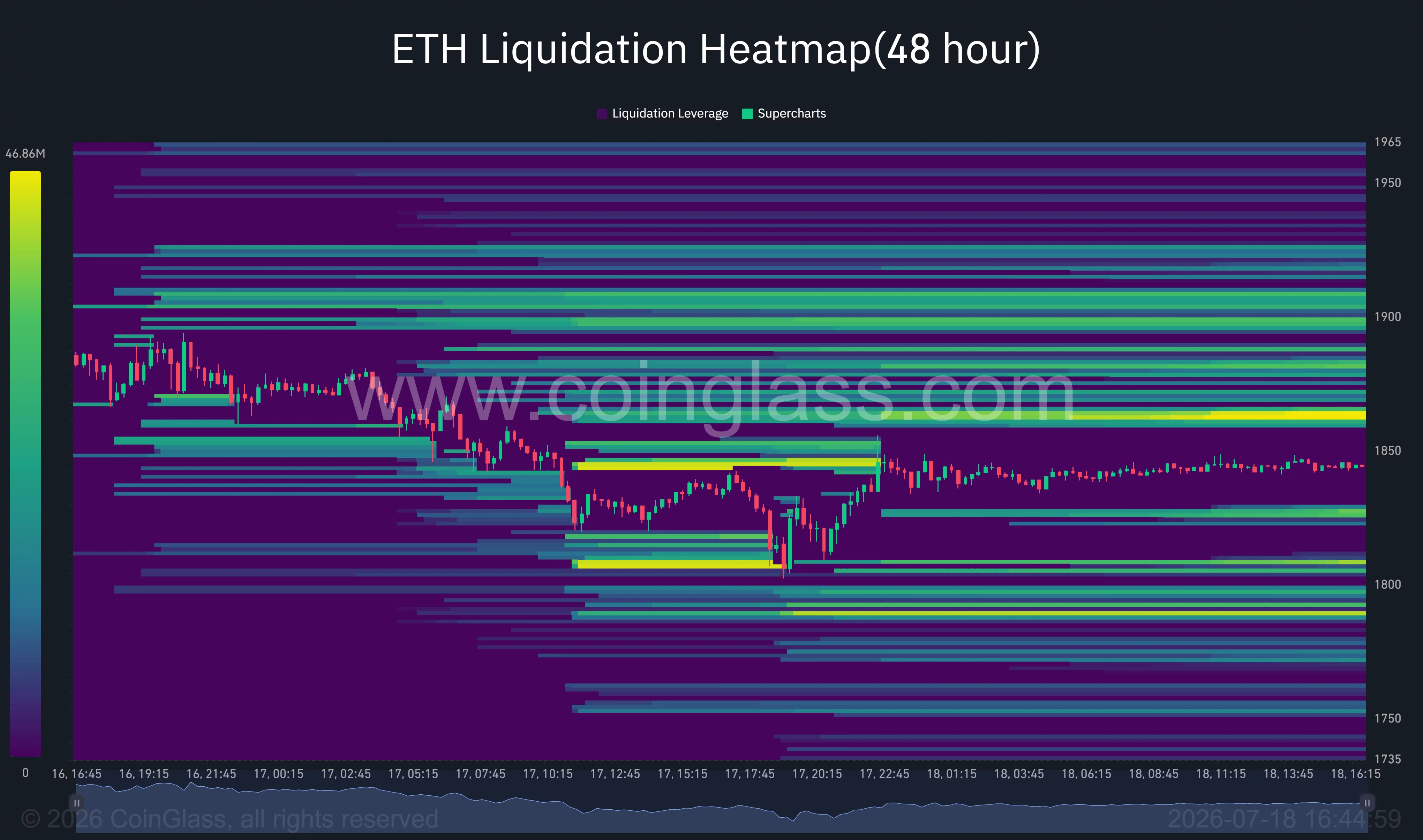
According to analyst Ted Pillows, the $1,820–$1,850 region will decide ETH’s next move.
“If Ethereum holds above it, expect another uptrend towards $1,950–$2,000.”
A break below $1,780 would weaken Ethereum’s recovery
Ethereum would lose its 4-hour channel if sellers force a close below $1,830. Such a move would expose the 50-day EMA near $1,812 and could trigger leveraged long liquidations around $1,810.
A deeper decline below the 61.8% Fibonacci level at $1,780.64 would weaken the double-bottom setup and open the 50% retracement at $1,729.24. Pillows also cited the escalating U.S.-Iran situation as a risk to the $1,820–$1,850 support zone.
Political uncertainty remains another invalidation risk. Failure to resolve the CLARITY Act’s ethics and stablecoin provisions could delay a Senate vote, remove the immediate catalyst behind ETH’s rebound, and place the $1,780 support under renewed pressure.
Disclosure: This article does not represent investment advice. The content and materials featured on this page are for educational purposes only.



For years, many online earning platforms have operated behind closed interfaces. Users could see balances, timers, referral structures and payout requests inside a dashboard, but they often had little ability to verify how funds moved, how rules were enforced or whether the system’s internal accounting matched reality.
Atlas System is entering that category with a different proposition: move the core logic on-chain. The project describes itself as a Web3 platform for voluntary mutual financing, built around Hybrid DAO mechanics, smart contracts and public blockchain verification. Its first product, Smart Cycle v1, is designed to place participation, claim logic and liquidity movement into a structure that users can inspect through BNB Chain and BscScan. The idea is not that blockchain removes risk. It does not. Instead, Atlas System’s pitch is that users should be able to verify more of what is happening under the hood.
From platform promises to contract-level visibility
Atlas System’s first release is built around Smart Cycle v1, a set of contracts deployed on BNB Smart Chain. The system uses USDT BEP-20 as its settlement asset and separates the architecture into several contract roles. The two main user-facing contracts are Lockup Flow and Daily Flow.
Lockup Flow is designed for fixed-term participation. A user selects a cycle, sends USDT into the contract and receives an on-chain order that records the amount, tier, maturity period and claim conditions. Once the selected term has ended, the user can submit a claim according to the contract’s logic and available liquidity.
Daily Flow follows a different structure. It is designed around a daily payout cycle, where calculated amounts become available progressively during the participation period rather than only at the end of a fixed lockup.
Atlas System also uses separate contracts for routing and partner-related accruals. Transport is used for routing and liquidity transfer, while Distribute is responsible for distributing and paying out partner accruals. This structure separates user participation flows from partner distribution mechanics, making each layer easier to inspect independently.
For users, this means activity is not limited to a private interface. Wallet interactions, token transfers, contract calls and claim-related transactions can be reviewed directly on BscScan.
Why BNB Chain matters
BNB Chain gives Atlas System a practical execution layer: low-cost transactions, BEP-20 support, high user familiarity and a widely used public explorer through BscScan.
That matters because the platform’s core claim is based on verifiability. A user can check whether their wallet interacted with the correct contract, whether USDT was transferred, whether a claim transaction was submitted and whether payout-related activity appears on-chain.
This does not make the platform risk-free. It does, however, change the information environment. In a closed online platform, users rely almost entirely on what the dashboard says. In an on-chain architecture, the dashboard can be compared against blockchain data. For a sector where trust has often depended on marketing, community momentum or the reputation of platform operators, that shift is meaningful.
PancakeSwap V3 and liquidity mechanics
A core part of the Smart Cycle v1 architecture is its interaction with PancakeSwap V3 liquidity infrastructure. Atlas System’s technical materials describe a shared base layer, PositionHandler, which handles interaction with PancakeSwap V3 liquidity positions.
In practice, PositionHandler connects Smart Cycle logic to an underlying liquidity position. It supports adding liquidity, removing liquidity and validating the active position used by the system.
This design makes liquidity a central part of the user experience. Claims and calculated payouts are not abstract numbers created outside the system. They depend on contract logic, liquidity routing and the conditions available inside the system at the time of the user’s request. That is also where the risk becomes clear.
Transparency does not equal safety
Atlas System’s own materials state that participation is voluntary and that return of contributed funds or additional calculated amounts is not guaranteed. Execution depends on available liquidity in the smart contract, which is formed by participants in the system. This distinction is important. Putting a model on-chain can make it more transparent, but it does not remove liquidity risk, smart contract risk, governance risk or operational risk. For an editorial audience, this is not a footnote. It is central to understanding the project.
A test case for online earning models
The broader question is whether on-chain infrastructure can change expectations for online earning platforms. Historically, users in this category have often accepted limited visibility. They joined platforms through referral networks, tracked balances through internal dashboards and trusted that payout logic was being applied as described.
Atlas System is trying to move that model toward a more verifiable standard. Its architecture gives users contract addresses, token flows, BscScan activity, published source code, whitepaper documentation and third-party audit reports.
That does not automatically make the model sustainable. Sustainability still depends on liquidity, participant behavior, contract design, operational decisions and whether the project addresses disclosed risk areas over time. But it does create a different baseline. Instead of asking users to trust a black box, Atlas System is asking them to inspect a system that exists, at least in part, on-chain.
About the Project
Platform | X | Facebook | TikTok | Telegram Channel | Youtube | GitHub
The post On-Chain, But Not Risk-Free: Inside Atlas System’s Smart Cycle Architecture appeared first on BeInCrypto.
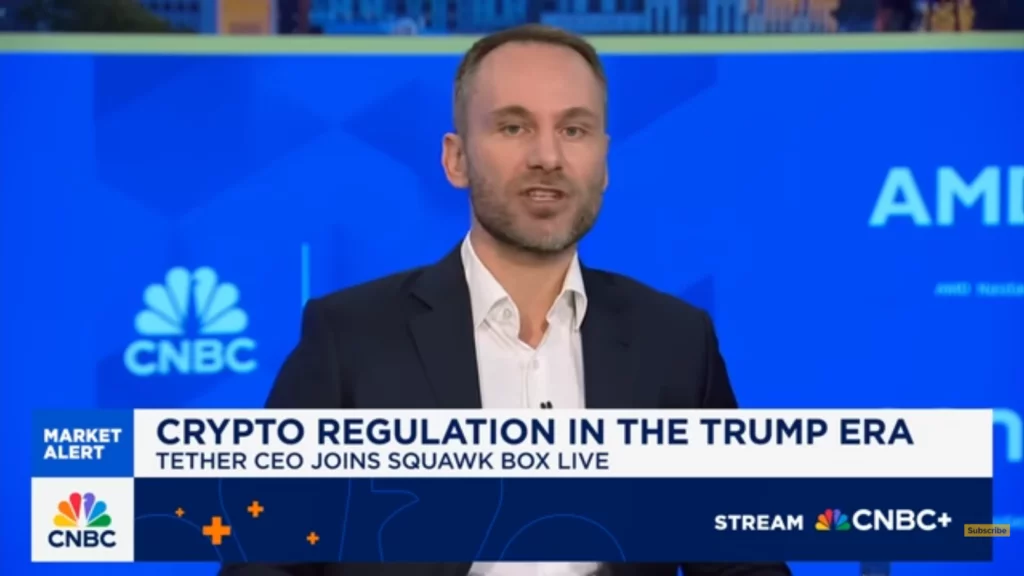
Tether has faced renewed scrutiny over whether USDT can remain available on U.S. crypto platforms unless the stablecoin issuer meets the requirements of the GENIUS Act before its compliance window closes.
Summary
- Tether could face restrictions on USDT in the United States if it does not meet GENIUS Act requirements before the 2028 compliance deadline.
- Legal experts say foreign stablecoin issuers still have time to comply, though some obligations may begin once the law takes effect.
- Tether has continued expanding USAT, enterprise payments and Latin American investments while U.S. stablecoin rules are still being finalized.
According to a CoinDesk report, the first anniversary of the GENIUS Act has brought renewed attention to Tether’s regulatory path as the company remains the largest stablecoin issuer by market value while U.S. regulators continue working on rules needed to fully implement the law.
President Donald Trump signed the Guiding and Establishing National Innovation for U.S. Stablecoins (GENIUS) Act into law one year ago. Although the legislation introduced a three-year transition period for compliance, questions remain over how some of its deadlines apply to foreign-issued stablecoins such as Tether’s USDT.
While U.S.-based Circle has moved to align itself with the incoming framework, Tether has not publicly detailed how it intends to bring USDT into full compliance. The report also noted that Tether did not respond to multiple requests for an updated position before publication.
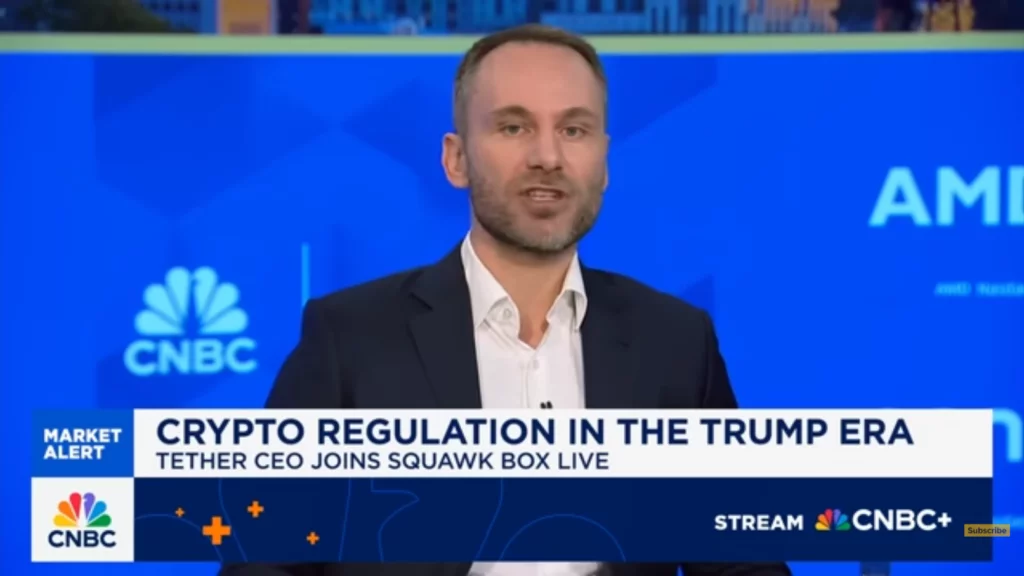
Last July, Tether chief executive Paolo Ardoino said the company intended to comply with the GENIUS Act. Speaking to CoinDesk after the bill was signed at the White House, Ardoino said, “Tether will comply with the GENIUS Act,” adding that the company planned to launch a separate U.S.-focused token while also ensuring USDT satisfied the law’s foreign issuer requirements.
Questions remain over compliance timeline
Even with two years remaining before the law’s general transition period expires in July 2028, lawyers continue to debate whether foreign issuers receive the same grace period as domestic companies.
Justin Levine, a lawyer at Davis Polk who advises clients on stablecoin regulation, told CoinDesk that foreign issuers will need to comply immediately with provisions allowing authorities to freeze and seize assets linked to illicit activity once the law becomes effective, which is expected around January. However, he said additional requirements tied to continued U.S. exchange listings would likely have a longer implementation period.
“Upon the effectiveness of the GENIUS Act, foreign issuers will need to immediately comply with lawful orders to seize and freeze coins held by illicit actors, but they will have a runway of approximately two more years to prepare for the additional requirements so that their coins may remain eligible for listing on U.S. centralized trading platforms,” Levine said.
He added that one of those future obligations, registration with the Office of the Comptroller of the Currency, would likely require a “significant undertaking.”
“So they do have time, as long as they comply with seize and freeze orders,” Levine said.
“But those that want to have their coins continue to be traded on U.S. centralized platforms and have that liquidity should still be thinking about it right now, even if it’s not imminent that they’re going to get delisted.”
CoinDesk also reported that an earlier legal interpretation published by law firm Paul Hastings had suggested foreign issuers could face a different compliance timeline. After the publication sought clarification, the report said the interpretation was removed from the firm’s website, while representatives did not immediately respond to requests for comment.
Further guidance from the Office of the Comptroller of the Currency has also left room for interpretation. CoinDesk said an OCC proposal includes a footnote indicating that 2028 remains the general compliance deadline but notes that certain requirements for foreign issuers begin once the law takes effect. These early obligations appear to center on cooperation with law enforcement requests involving asset freezes and seizures, while broader requirements would follow later.
Beyond these initial measures, foreign issuers are expected to satisfy additional conditions, including OCC registration, maintaining reserves at U.S. financial institutions, and operating under home-country supervision that the U.S. Treasury determines is comparable with the American regulatory framework.
Reserve structure draws attention
CoinDesk also pointed to Tether’s latest reserve disclosures, saying approximately one-quarter of USDT’s backing remained invested in assets that would not qualify under the GENIUS Act’s reserve standards. According to the report, those assets include bitcoin holdings, precious metals, and lending exposure.
The legislation instead requires qualifying stablecoins to be backed by highly liquid assets such as cash and short-term U.S. Treasury securities.
Although regulatory questions continue, Tether has already introduced USAT, a U.S.-focused stablecoin issued through banking partner Anchorage Digital with American compliance standards in mind. Adoption of the token has remained relatively limited compared with USDT.
Kevin Wysocki, head of policy at Anchorage Digital, told CoinDesk the company expects institutional adoption to move ahead of the legal deadline.
“Non-compliant stablecoins cannot be used by U.S. institutions when the safe harbor expires in 2028, but we don’t expect the market to wait,” Wysocki said. He added that Anchorage expects institutions to migrate toward “compliant, bank-issued digital dollars well ahead of that deadline.”
Expansion continues as regulation develops
Even as compliance discussions continue in the United States, Tether has expanded both its investment activity and enterprise payment strategy across several markets.
Earlier this month, the company led a $7 million funding round for Pact Labs to integrate USAT into payroll infrastructure serving a U.S. payroll market processing more than $11 trillion annually. Tether said the partnership is intended to allow employers to settle wages using blockchain payment rails instead of relying solely on conventional banking systems.
Outside payroll, Tether has also increased its focus on corporate treasury operations. Hyundai Motor America and Hyundai Motor Mexico recently completed a pilot cross-border treasury payment using USDT over the Avalanche blockchain, settling a $20,000 transfer in about seven minutes through infrastructure provided by Axiym, while Hyundai Card managed the compliance and operational framework for the transaction.
Latin America has remained another priority. Over recent weeks, Tether has invested $20 million in Brazilian exchange Mercado Bitcoin and another $20 million in Argentine digital bank Ualá as part of its latest funding round. The company also previously led a $14 million investment in Argentine crypto platform Belo to expand crypto payment products and financial services across the region.
Meanwhile, Bolivia is evaluating a proposal that would recognize USDT alongside the boliviano and the U.S. dollar within parts of its payment system. Local reports have indicated that Banco Unión and Banco FIE already provide services connected to USDT, although authorities have yet to publish a final legal framework.
Despite those international expansion efforts, the regulatory picture inside the United States remains unfinished. Federal agencies have yet to finalize the implementing rules required under the GENIUS Act, leaving stablecoin issuers without a complete regulatory framework to follow even as the first compliance obligations approach.
Trevor Tanifum, managing principal at consulting firm FS Vector, was cited in the report saying that some trading platforms with lower risk tolerance could choose to delist non-compliant stablecoins early, while larger exchanges with stronger legal resources may continue supporting them until regulators provide definitive guidance.
“It’s pretty much what has happened, I think, at every major crypto hurdle,” Tanifum said. “These platforms still count on a lot of transaction volumes, liquidity from non-U.S. issuers, and so I can’t see them giving up those volumes without a fight.”
At the same time, much of the crypto industry’s policy focus has shifted toward the proposed CLARITY Act, which lawmakers continue to debate in Congress. If enacted, the legislation could revise parts of the GENIUS framework, adding another layer of uncertainty as Tether, Circle and other stablecoin issuers prepare for federal oversight in the months ahead.
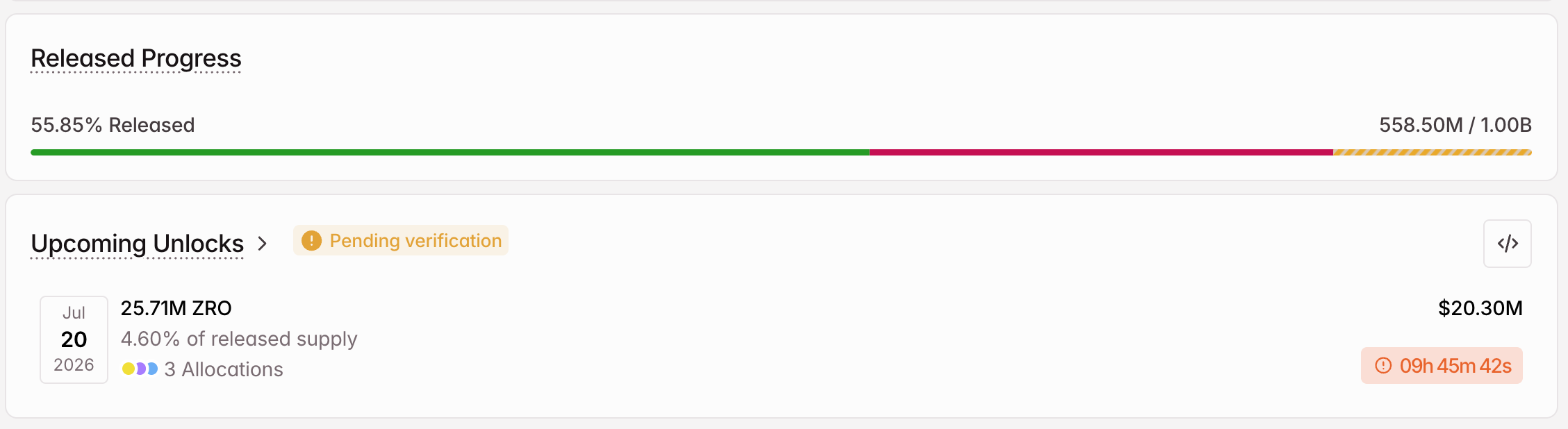
The crypto market will welcome tokens worth more than $704.5 million in the fourth week of July 2026. Major projects, including LayerZero (ZRO), Humanity (H), and Kaito (KAITO), will release significant new token supplies.
These unlocks could introduce market volatility and influence short-term price movements. So, here’s a breakdown of what to watch.
1. LayerZero (ZRO)
- Unlock Date: July 20
- Number of Tokens to be Unlocked: 25.71 million ZRO
- Released Supply: 558.5 million ZRO
- Total Supply: 1 billion ZRO
LayerZero is an interoperability protocol that connects different blockchains. Its primary goal is to facilitate seamless cross-chain communication. Thus, it enables decentralized applications (dApps) to interact across multiple blockchains without relying on traditional bridging models.
The team will unlock 25.71 million tokens on July 20, representing 4.6% of the released supply. Moreover, the supply is worth approximately $20.3 million.

LayerZero will award 13.42 million altcoins to strategic partners. Core contributors will get 10.63 million ZRO. Lastly, 1.67 million ZRO are for tokens repurchased by the team.
2. Kaito (KAITO)
- Unlock Date: July 20
- Number of Tokens to be Unlocked: 17.6 million KAITO
- Released Supply: 409.47 million KAITO
- Total Supply: 1 billion KAITO
Kaito is an artificial intelligence (AI)-powered Web3 information platform that aggregates and analyzes cryptocurrency market data from diverse sources like social media, governance forums, news, and more. The KAITO token serves as a medium of exchange, governance tool, and incentive mechanism within the platform.
On July 20, the team will unlock 17.6 million tokens, representing 4.3% of the current released supply. The supply is worth approximately $16.5 million.

The foundation will receive 1.19 million tokens. Core contributions will get 6.94 million tokens. Furthermore, early backers will receive 2.31 million KAITO. Finally, the team will direct 7.16 million KAITO for ecosystem and network growth.
3. Humanity (H)
- Unlock Date: July 25
- Number of Tokens to be Unlocked: 266.47 million H
- Released Supply: 3.1 billion H
- Total supply: 10 billion H
Humanity (H) is a decentralized identity protocol that utilizes biometric palm recognition, zero-knowledge proofs, and blockchain to verify the authenticity of real human users without exposing their personal data. It features a native Proof of Humanity (PoH) consensus mechanism.
On July 25, the protocol will unlock 266.47 million tokens. The tokens are worth $15.6 million and also account for 8.6% of the released supply.

The team will split the released supply six ways. Investors will get 55.56 million H. The ecosystem fund will receive 50 million H.
Furthermore, Humanity will allocate 42.86 million altcoins to identity verification rewards and 26.39 million H to Human Institute Strategic Reserve. Lastly, the foundation operations treasury will gain 12.50 million tokens.
In addition to these, other prominent unlocks investors can look out for in the fourth week of July include Plasma (XPL), Undeads Games (UDS), Soon (SOON), and more, which will contribute to the total market-wide releases.
The post 3 Token Unlocks to Watch in the Fourth Week of July 2026 appeared first on BeInCrypto.
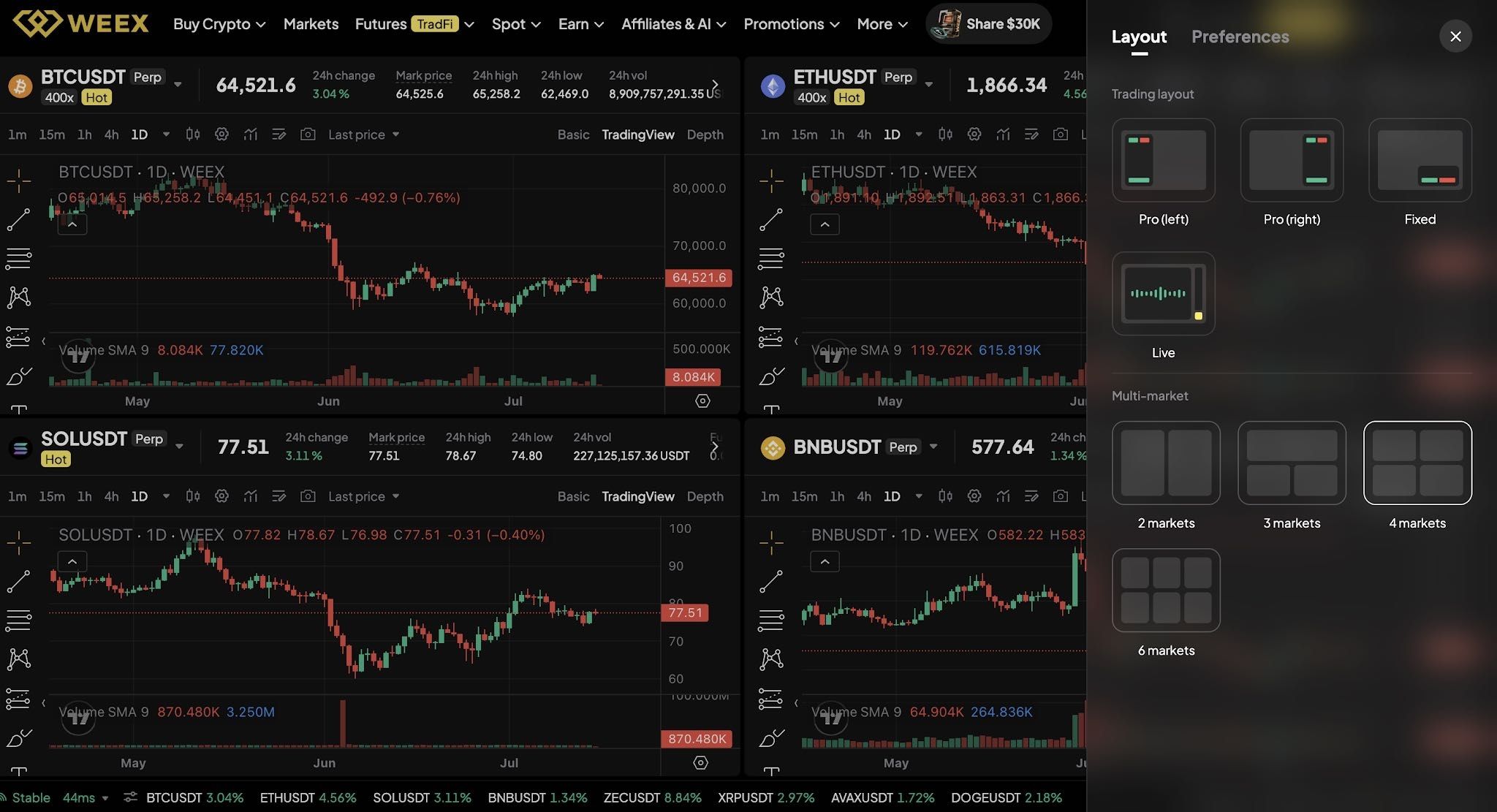

Global cryptocurrency exchange WEEX today announced the launch of Multi-Market Mode, a new screen layout designed for traders who need to track multiple assets in real time.
The feature splits a trader’s screen into 2, 3, 4, or 6 independent chart windows, each displaying a different trading pair — with every window functioning as its own fully independent, fully functional workspace. Rather than switching between tabs or losing sight of one market to watch another, traders can now monitor entire portfolios, correlated pairs, or cross-market opportunities side by side, all in a single view.
TL;DR
- What it is: A new layout option that splits your screen into 2, 3, 4, or 6 independent chart windows — each showing a different pair.
- Where to find it: Click “Layout” on any futures page, then pick your grid under “Multi-market.”
- What each window can do: Draw your own trendlines, drag the time range, switch timeframes, and switch assets — independently, per window.
- What’s fixed: Window sizes are locked, so your layout always stays clean and consistent.
- What’s remembered: Your setup saves automatically. Open the same layout again, and everything’s exactly how you left it.
Why Watching One Chart at a Time Is Costing You Trades
If you trade more than one coin, you already know the problem. You’re watching BTC, but the move happens on SOL. You switch tabs to check it, and by the time you’re back, BTC has already moved too. One chart at a time means you’re always one step behind whichever pair you’re not looking at.
Multi-Market Mode solves this the simple way: put more charts on the screen, so you stop having to choose which one to watch.
Introducing WEEX Multi-Market Mode: 2, 3, 4, or 6 Charts, One Screen
Open the Layout menu on any futures page and you’ll now see four new grid options under “Multi-market”: 2 markets, 3 markets, 4 markets, or 6 markets. Pick one, and it opens in a new tab — a clean, split-screen view where every window shows a different pair, side by side, all at once.
No more tab-switching. No more missed entries because you were looking somewhere else. Just pick your grid, and watch everything that matters, all at the same time.
Every Chart Works Independently — Draw, Drag, Switch, Repeat
Multi-Market Mode isn’t just charts sitting side by side doing nothing. Each window works on its own:
- Draw your own analysis — trendlines, annotations, whatever you use, on each chart independently
- Drag the time range — zoom into the last hour on one chart, the last month on another
- Switch timeframes — 1m on one window, 4H on the next, your call
- Switch coins — swap out any window for a different pair, anytime, without touching the others
Every window is its own workspace. What you do on one doesn’t affect the rest.
What’s Simplified in This View — And Why That’s a Good Thing
Multi-Market Mode is built for one job: watching several pairs clearly, at the same time. So a few tools that belong to deeper, single-coin analysis are left out here:
- No price alerts
- No fullscreen mode
- No quick market or limit order buttons
- A few chart icons and annotation toggles in the top-right are also removed to keep things clean
Everything else — your core drawing and annotation tools — stays fully usable. The difference is focus: Multi-Market Mode clears away the extras that only matter for one coin at a time, so nothing slows you down when your attention needs to move fast across 2, 3, 4, or 6 pairs at once. Less clutter per chart, more charts in view — that’s the trade that catches the moves a single-screen setup misses.
Your Layout Saves Automatically — Pick Up Right Where You Left Off
Set up your 4-market grid with your favorite pairs, your timeframes, your drawings — and it’s saved. Close the tab, come back tomorrow, open the same layout, and everything’s exactly how you left it. No rebuilding your setup every single session.
Who Should Be Using Multi-Market Mode?
| Type | Benefit |
| Swing traders | Track several setups at once and catch the moment your entry lines up |
| Arbitrage traders | Watch price gaps across multiple pairs in real time |
| Anyone tired of tab-switching | See it all on one screen, stop missing moves on the pairs you’re not actively watching |
How to Turn On WEEX Multi-Market Mode
- Log into WEEX
- Open any futures page
- Click the “Layout” button in the top right corner
- Under Multi-market, pick 2, 3, 4, or 6 markets
That’s it. Your new grid opens in a fresh tab, ready to go.
Stop choosing which chart to watch. Watch them all.
Try WEEX Multi-Market Mode now — watch more pairs, miss fewer moves.
About WEEX
Founded in 2018, WEEX has developed into a global crypto exchange with over 6.2 million users across more than 150 countries. The platform emphasizes security, liquidity, and usability, providing over 1,200 spot trading pairs and offering up to 400x leverage in crypto futures trading. In addition to the traditional spot and derivatives markets, WEEX is expanding rapidly in the AI era delivering real time AI news, empowering users with AI trading tools, and exploring innovative trade to earn models that make intelligent trading more accessible to everyone. Its 1,000 BTC Protection Fund further strengthens asset safety and transparency, while features such as copy trading and advanced trading tools allow users to follow professional traders and experience a more efficient, intelligent trading journey.
Follow WEEX on social media
X | Instagram | Tiktok | Youtube | Discord | Telegram
The post WEEX Multi-Market Mode: See 6 Crypto Pairs at Once, Catch Every Breakout appeared first on BeInCrypto.


Key takeaways
- LayerZero (ZRO) fell about 3% on Monday, extending last week’s 9% decline.
- The network is set to unlock 25.71 million ZRO tokens, equivalent to 4.6% of the total supply, increasing potential selling pressure.
- Despite bearish price action, futures trading volume surged 552%, reflecting heightened retail interest.
- Technically, ZRO remains in a downtrend, with support at $0.734 and a potential downside target near $0.532.
LayerZero (ZRO) extended its recent losses on Monday, falling roughly 4% as investors prepared for one of the project’s largest scheduled token unlocks.
The token has already declined about 9% over the past week, and the release of 25.71 million ZRO into circulation could add further selling pressure in the short term.
Although derivatives activity has surged ahead of the unlock, market positioning suggests traders remain cautious about the token’s near-term outlook.
Monthly token unlock adds supply pressure
According to Tokenomist data, LayerZero will unlock 25.71 million ZRO tokens on Monday, representing approximately 4.6% of the token’s total supply.
The newly unlocked tokens will primarily be allocated to strategic partners and core contributors.
At the same time, approximately 1.67 million ZRO, or 0.3% of the released supply, will be repurchased through a buyback program.
The planned buyback may signal confidence from the project’s core team, but the additional circulating supply is still expected to weigh on short-term price action as investors assess potential selling activity.
While institutional allocations are set to increase, retail traders have become increasingly active in LayerZero’s derivatives market.
CoinGlass data shows futures trading volume surged 552% over the past 24 hours to $248.65 million. Meanwhile, Open Interest (OI) increased 4.52% to $80.87 million, indicating new positions are entering the market.
The rise in both trading volume and Open Interest suggests growing speculation ahead of the token unlock.
However, sentiment appears to be shifting. Despite higher trading activity, perpetual futures funding rates have weakened.
The funding rate declined to 0.0061% from 0.0121% a day earlier, indicating demand for leveraged long positions is easing.
Lower funding rates often reflect reduced confidence among bullish traders, particularly before major token unlocks that increase circulating supply and create expectations of additional selling pressure.
The combination of rising speculative activity and weakening bullish positioning suggests investors remain cautious heading into the unlock event.
LayerZero price prediction: Bears remain in control
From a technical perspective, LayerZero continues to trade within a well-established downtrend.
The token remains below its 50-day Exponential Moving Average (EMA) near $0.957, reinforcing bearish momentum.
The outlook also remains negative following the death cross formed in late April, when the 50-day EMA crossed below the 200-day EMA—a signal often associated with sustained downward trends.
Technical indicators continue to support the bearish outlook. Relative Strength Index (RSI) reads around 36, indicating strong bearish momentum while remaining above oversold territory.
Both the MACD and signal lines remain below zero and continue trending lower, suggesting downside momentum persists.
These indicators show sellers continue to dominate despite increased derivatives activity.
The most important downside support remains at $0.734, the major structural support and Fibonacci anchor.
A decisive break below this level could accelerate selling and expose the next technical target at $0.532. Reaching this level would represent roughly 25% downside from current prices.
If buyers manage to regain momentum following the token unlock, the first resistance zone sits around $0.945 (23.6% Fibonacci retracement), with another hurdle at $0.957 (50-day EMA).

A daily close above this resistance cluster would reduce immediate bearish pressure and could open the door for a move toward $1.325.
However, reclaiming the 50-day EMA remains necessary before a broader recovery can develop.

Perpetual futures trading does not care about conviction. They care about your margin. The Trump administration’s move to open American markets to highly leveraged perpetual futures marks a structural shift that could pull more capital and retail participation into an instrument known for making and breaking fortunes in days. Crypto derivatives desks are already recalibrating. The real question is whether traders understand what they are actually holding.
The regulatory green light is significant. Previously, many U.S. traders turned to offshore venues such as Binance, Bybit, and OKX, accepting extra counterparty and jurisdictional risk for access. Bringing perpetual futures onshore introduces clearer compliance standards and deeper institutional participation. It also makes high leverage feel more familiar, even when the risks remain the same. A 10% move that spot traders absorb over time can wipe out a 50x position before lunch.
Meanwhile, open interest across major perpetual futures markets remains elevated, although it now shifts with changing market sentiment rather than climbing in a straight line. Funding rates continue to swing between neutral and positive, showing leveraged longs still step in aggressively during rallies. That usually works well until everyone crowds through the same exit. Then the elevator suddenly becomes a trapdoor.
That is why perpetual futures reward discipline more than confidence. Leverage shortens both profits and mistakes, leaving little room for hesitation. Used carefully, it can amplify returns. Used carelessly, it has a habit of turning heroes into cautionary tales before the weekend is over.
Discover: The Best Token Presales
How High Can Perpetual Trading Volumes Push Crypto Prices — and How Fast Can Leverage Reverse the Move?
Bitcoin has been the clearest case study. Perp-driven rallies often overshoot spot-driven moves because leverage compounds momentum. Every short liquidation adds fuel to the rally, until the script flips and overleveraged longs get flushed instead. The same pattern appears in mid-cap and meme coins, where thinner liquidity makes every squeeze feel louder.
Greater U.S. retail and institutional access could bring fresh capital, lift open interest, and improve price discovery. Assets with active communities and strong narratives may benefit the most. Still, leverage has a habit of throwing a party before sending everyone the bill.

However, volatility will likely remain tied to major macro data and Federal Reserve decisions instead of following a clean trend. The worst case is a macro shock triggering a synchronized long squeeze, where leverage accelerates losses and liquidation cascades overwhelm the order book.
Three metrics define today’s risk environment: funding rates, open interest relative to spot volume, and liquidation clusters around key price levels. Watch those before chasing chart patterns. Traders who ignore funding while staring only at candles are like drivers checking the rearview mirror on a sharp corner.
Try Bybit Perpetual Trading and Get a Chance to Win Our $1,000 USDT Airdrop
Maxi Doge Targets Early Mover Upside as Leveraged Markets Amplify Speculative Appetite
This is precisely the environment where early-stage, high-narrative assets attract disproportionate attention. When leverage is cheap and accessible, speculative capital doesn’t sit in blue-chips; it hunts for multipliers. Presale-stage projects with strong community mechanics have historically captured that energy before it prices in.
Maxi Doge ($MAXI) is built around exactly that thesis, a meme token on Ethereum that leans into the 1000x leverage-trading mentality without apology. The project has raised $4.8 million at a current presale price of $0.000283, with a staking model offering dynamic APY for holders.
The core mechanics include holder-only trading competitions with leaderboard rewards, a Maxi Fund treasury earmarked for liquidity provision and partnerships, and meme-first marketing anchored in gym-bro culture.
The community angle is the actual product here; the token is the access mechanism.
For traders already thinking in terms of leverage and asymmetric payoff structures, the logic of an early-stage presale entry is familiar. Research Maxi Doge before the presale window closes.
Discover: The Best Crypto to Diversify Your Portfolio
The post The Double-Edged Sword of Perpetual Trading: Hero to Zero, or Vice Versa appeared first on Cryptonews.

Hyperliquid announced on July 20 that its upcoming HIP-4 network upgrade will allow permissionless deployment of prediction markets.
The feature, which will launch on testnet before hitting the mainnet, will expand who can create outcome markets while introducing validator-approved templates and a staking system meant to keep those markets clearly defined and properly settled.
How HIP-4 Deployment Will Work
Outcome markets on Hyperliquid have so far only been deployed by validators, but the protocol is looking to change that. According to a post on Hyperliquid’s Telegram channel, validators will vote on standardized outcome templates that anyone meeting the HIP-4 requirements could then use to launch markets.
Those templates will be stored and enforced on-chain, with Hyperliquid saying that they are intended to cover events with sufficient liquidity and user interest while being unambiguous. The responsibility for defining and settling individual markets will lie with deployers according to the chosen template, and multiple deployers could even launch identical markets if they so wish.
Canonical markets created by validators will still exist, but they are expected to become less common, with Hyperliquid suggesting that ideally each year they should account for less than 10 outcome markets. Furthermore, the proposal also introduced financial incentives and penalties, including a 500,000 HYPE stake for anyone looking to become a HIP-4 deployer.
That stake will be locked for six months, and validators can slash it if markets are poorly defined or settled incorrectly under the template. Leaving a market unsettled for more than one week will also see a deployer’s stake slashed, and they are required to settle all their markets before unstaking.
Per Hyperliquid’s post, at first, each deployer will get capacity for 100 outcomes, or 200 outcome tokens, with more allocation planned through a future auction mechanism. The protocol also pointed out that eventually, deployers will be able to set fee sharing of up to 50% on their markets, although configurable fees will be included in another update in the future. Importantly, under HIP-4, only AQAv2 quote tokens will be supported.
“All specifications described above are preliminary and subject to change based on feedback,” the team clarified, adding that users will be informed once the feature goes on the testnet and updates on the documentation are made.
HYPE Not Moved
Even with the announcement, Hyperliquid’s native HYPE token stayed in the red. At the time of writing, it was trading near $60, down about 1% in 24 hours and nearly 10% in the last seven days. CoinGecko data shows it’s the same case across longer timeframes, with HYPE shaving almost 16% from its price across two weeks and nearly 13% in the past 30 days.
However, year-on-year, the asset has managed to stay in the green, being close to 34% higher than where it was 12 months ago, even though recent struggles have pulled it more than 21% below the $76.87 all-time high it hit about a month ago.
Hyperliquid’s push into permissionless outcome markets is coming on the back of a recent CoinGecko report showing that notional volume across prediction platforms hit a record $50.7 billion in June thanks to a calendar of sports events including the UEFA Champions League final, the NBA Finals, and Wimbledon. This helped push numbers for Q2 2026 to $113.8 billion, which is a 48.7% jump quarter over quarter.
The post HIP-4 Upgrade: Hyperliquid Opens Door to Permissionless Prediction Markets appeared first on CryptoPotato.


South Korean tax officials have proposed amendments to the country’s Criminal Procedure Act to establish a legal framework for seizing self-custodied digital assets, arguing that existing rules do not adequately cover wallets controlled through private keys.
Summary
- South Korean tax officials have proposed changes to criminal law to allow the seizure of self custodied digital assets.
- The proposal sets out warrant requirements and recommends court supervised joint wallets to store seized crypto assets.
- The recommendations follow recent efforts by the National Tax Service to strengthen crypto custody after a security breach exposed seized assets.
According to Digital Asset, four officials from South Korea’s National Tax Service, including investigation team leader Jang Hee-won, published a paper in the June edition of the Korea Institute of Criminology and Justice’s Criminal Policy Research journal outlining legislative changes for handling self-custodied virtual assets during criminal investigations.
The proposal focuses on digital assets held directly by individuals through private keys rather than those stored with exchanges or other third-party custodians. Personal wallets, including hardware wallets, fall into this category.
Existing law leaves gaps for self-custodied assets
The paper points to a 2025 South Korean Supreme Court ruling that found investigators acted lawfully when seizing Bitcoin held in an exchange wallet. While the authors said the decision confirmed that Bitcoin could be treated as property subject to seizure during criminal investigations, they argued it did not establish how authorities should seize assets stored in self-custodied wallets.
Unlike exchange-held assets, self-custodied digital assets cannot be physically possessed. The paper said that even if investigators seize a suspect’s private key or other access credentials, the owner could still retain another copy and transfer the assets elsewhere.
The researchers also argued that Article 120 of South Korea’s Criminal Procedure Act, which governs the execution of search and seizure warrants, was not designed for blockchain-based assets. They said transferring cryptocurrencies from one wallet address to another differs from opening or securing physical property, while the law also lacks procedural requirements covering asset types, wallet addresses, transfer methods and custody arrangements.
The paper further stated that existing provisions governing asset preservation before confiscation would not fully prevent suspects from disposing of self-custodied digital assets because they do not authorize transferring assets to another controlled address.
Paper proposes court-supervised custody process
To address those issues, the researchers proposed creating dedicated rules covering the seizure of self-custodied digital assets. According to the paper, search warrants should specify the type and quantity of digital assets being seized, verified wallet addresses, destination addresses, transfer methods, and storage procedures whenever a suspect or owner controls the relevant private keys.
Rather than transferring seized assets into a wallet managed by a single investigative agency, the authors recommended using jointly managed wallets involving the courts and investigative authorities to reduce theft and misuse risks. They also proposed allowing assets to be transferred temporarily to a court-designated address if immediate transfer to a jointly managed wallet is not practical and there is a risk that the suspect could move the funds.
The paper concluded that legislation should clearly define the conditions for wallet transfers, warrant requirements, custody arrangements and management procedures so seized digital assets remain under shared oversight instead of being controlled solely by investigators.
The proposal comes months after South Korea’s National Tax Service began reviewing plans to hire a private crypto custody provider following a February security lapse that exposed a wallet recovery phrase in an official press release. Unauthorized parties later transferred about $4.8 million worth of crypto assets, prompting the agency to establish a task force to improve seizure, storage and liquidation procedures while evaluating more secure custody systems.


A Japanese logistics company that counts Amazon Japan as a client plans to settle payments in the regulated yen stablecoin JPYC with business partners, including independent truck drivers, according to a report by Nikkei Asia.
Tokyo-listed AZ-COM Maruwa Holdings (9090), which reported 230.5 billion yen ($1.4 billion) in revenue for the fiscal year ended March, plans to use JPYC for fees and other payments to its network of around 2,300 partners, including subcontractors and truck drivers. The company has been working with Amazon Japan since 2017, providing delivery services for its online shopping operations.
The move marks the first large-scale corporate use of a stablecoin in day-to-day operations in Japan, signaling that mainstream adoption of tokenized assets continues to expand even as broader cryptocurrency valuations remain subdued in a lingering bear market.
JPYC is Japan’s first fully regulated yen-pegged stablecoin, and is issued by Tokyo-based fintech firm JPYC Inc. The stablecoin debuted in October last year under the Payment Services Act and maintains a strict 1:1 peg to the yen. It is 100% backed by bank deposits and Japanese government bonds. As of last week, its onchain circulation had surpassed 2 billion yen.
On 6 July, Ripple received a full Crypto-Asset Service Provider (CASP) licence under the Markets in Crypto-Assets (MiCA) regulation from Luxembourg’s financial regulator, the CSSF. The approval allows the company to offer regulated crypto payment services across all 30 countries of the European Economic Area (EEA). The market reaction was relatively muted, with XRP showing little upside, as the decision appears to have been largely priced in following the preliminary approval announced in June. Another factor to watch is the progress of US digital asset market structure legislation, which may now be delayed until late July or early August and could influence institutional demand for the token.
Technical Picture
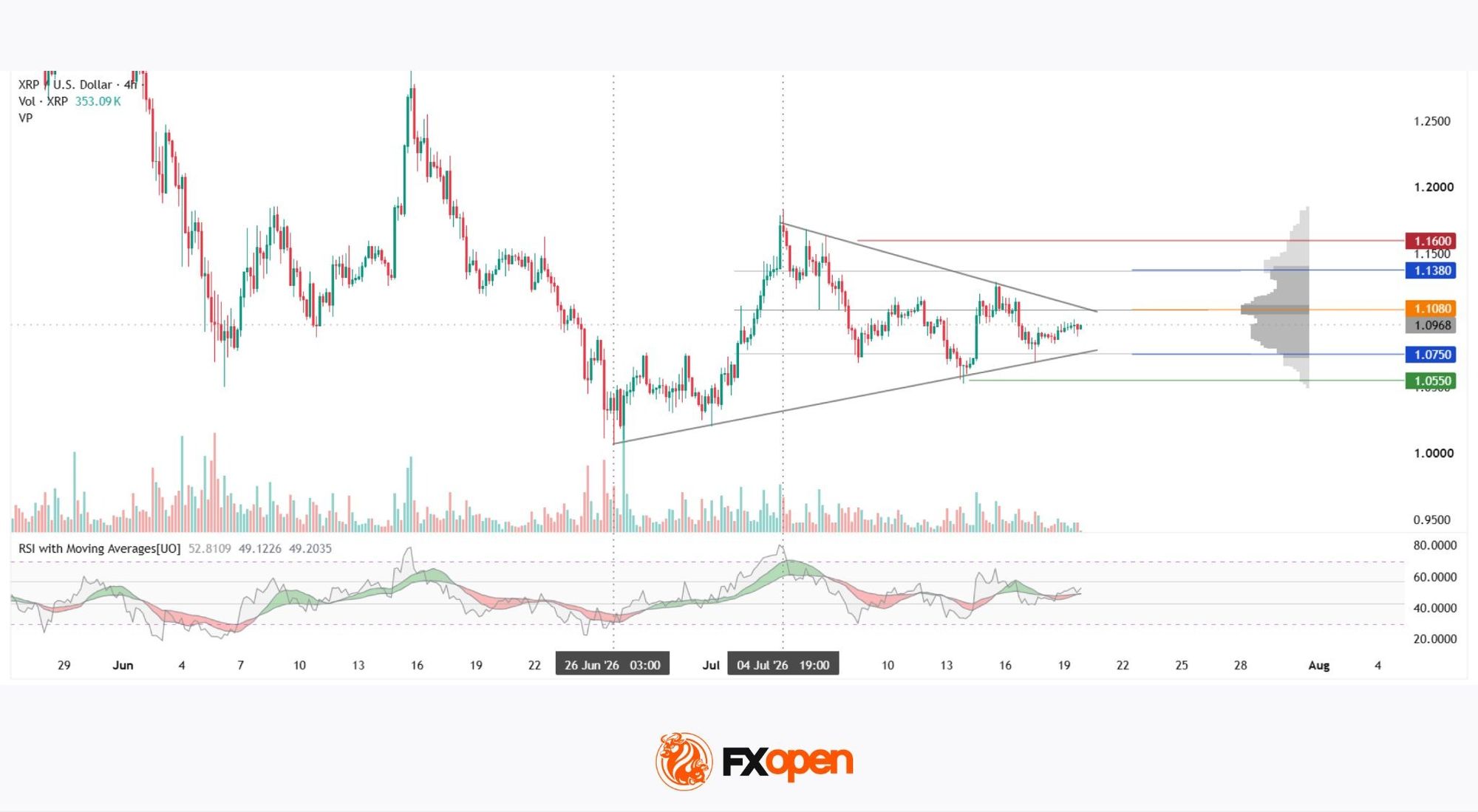
On the four-hour chart, XRP/USD recorded an unusually large spike in vertical volume on 26 June, followed by a bullish reversal that has since developed into a pattern resembling a symmetrical triangle.
The pair is currently consolidating within the current market profile, trading between the lower boundary at $1.0750 and the Point of Control (POC) at $1.1080. If the price breaks below the lower edge of the profile, the next notable support level could be found around $1.0550.
On the upside, a move above the upper boundary of the profile at $1.1380 could bring the $1.1600 area into focus as the next significant resistance zone.
As the triangle continues to develop, vertical trading volume has gradually declined, a pattern that often precedes a stronger directional move. Meanwhile, the RSI + MAs indicator remains neutral, with readings of 52, 49, and 49, showing no clear advantage for either buyers or sellers. The indicator lines are clustered closely together near the midpoint of the neutral zone.
Key Takeaways
The combination of declining volume and neutral RSI + MAs readings suggests that the market is consolidating within the triangle rather than preparing for an immediate breakout. While Ripple’s regulatory progress in Europe strengthens the token’s longer-term outlook, its impact on the current technical structure remains limited.
FXOpen offers the world’s most popular cryptocurrency CFDs*, including Bitcoin and Ethereum. Floating spreads, 1:2 leverage — at your service (additional fees may apply). Open your trading account now or learn more about crypto CFD trading with FXOpen.
*Important: At FXOpen UK, Cryptocurrency trading via CFDs is only available to our Professional clients. They are not available for trading by Retail clients. To find out more information about how this may affect you, please get in touch with our team.
This article represents the opinion of the Companies operating under the FXOpen brand only. It is not to be construed as an offer, solicitation, or recommendation with respect to products and services provided by the Companies operating under the FXOpen brand, nor is it to be considered financial advice.

Kotak Mahindra Bank shares fall over 3% despite Q1 profit growth. Analysts weigh in

On-Chain, But Not Risk-Free: Inside Atlas System’s Smart Cycle Architecture

20 Best MCU Movies, Ranked According to Letterboxd

Renter of Home in Anne Heche Crash Denies Settlement With Son

No Jackpot Winner as $257 Million Prize Rolls Over to $269 Million Monday Draw

Weekend Open Thread: Staud – Corporette.com

Donald Trump ACCIDENTALLY Admits That America Has LOST CONTROL of Bitcoin?! | EP 1546

USA Big Financial & Sex Scandal? Donald Trump Astrological Prediction | Prashant Kapoor LIVE

Why Mark Yusko Is Buying Bitcoin Before October
-
 NewsBeat4 days ago
London Mayor Sadiq Khan handed a peerage by Keir Starmer alongside 15 other Labour figures… just days before the PM leaves No10
-

 Fashion3 days ago
Weekend Open Thread – Corporette.com
-

 Politics2 days ago
The House | The City of London can help the new chancellor deliver growth in every postcode
-

 Politics5 days ago
Young campaigners urge incoming PM to act on outdoor junk food ads
-

 Crypto World4 days ago
CFTC blocks Kalshi from unwinding Michigan trades after court order
-

 Business4 days ago
Nvidia Stock Slips After Big Tuesday Rally as Huang Confirms Vera Rubin Chip Is Now in Production Today
-
 Crypto World3 days ago
Two July Windows Left: The CLARITY Act’s Senate Fight and What Failure Means
-

 Crypto World2 days ago
Ripple Payments Joins MiCA With 14 Firms, Does It Mean Anything For XRP?
-

 Politics20 hours ago
Democrats look to World Cup watch parties to register thousands of voters
-

 Crypto World2 days ago
Ripple wins EU-wide access as ESMA adds it to MiCA register
-
 Entertainment5 days ago
Disney’s Most Ambitious Failed Star Wars Attraction Is Coming to SDCC
-

 Business4 days ago
Palantir Shares Rise After Expanded Nvidia Partnership and Fresh Analyst Upgrades Ahead of Earnings Day
-

 Crypto World4 days ago
Injective Submits SEC Transfer-Agent Registration to Onchain Ownership Records
-

 Tech6 days ago
Get Your ESP32 Sunny Side Up With This Solar Dev Board
-

 News Videos6 days ago
XRP BOMBSHELL… XRP OMBOARDED FOR TRANSACTIONS!!!
-

 NewsBeat3 days ago
Registration is now open for March for Men with Kev 2026
-

 Tech6 days ago
Dark Secrets Emerge When Jailbreaking LLMs
-
 Sports5 days ago
New Cornerback Enters Vikings Trade Rumor Mill
-

 News Videos3 days ago
Money | Class 12 Economics | CBSE Board Exam 2026-27
-

 Business3 days ago
Banco Bilbao Vizcaya Argentaria, S.A. (BBVA) Discusses Global Macro Environment and Economic Outlook for Core Markets Transcript
You must be logged in to post a comment Login