
Crypto World
Ethereum Classic miners reverse Core Geth v1.13.0 migration after warning



Ethereum Classic node operators have been urged to avoid a disputed Core Geth v1.13.0 release after several mining pool nodes briefly adopted the software before returning to the maintained Argos client.
Summary
- Several Ethereum Classic mining pool nodes briefly moved to the disputed Core Geth v1.13.0 release before returning to Argos v1.12.23.
- Classix said 96 commits were pushed within 56 hours without outside review before v1.13.0 was released and promoted as a security update.
- The disputed client reenabled MESS and changed node discovery infrastructure, while Classix said no blocks, funds or services were affected by the incident.
- Classix urged operators to avoid v1.13.0 and asked Ethereum Classic GitHub administrators to tighten repository and review controls.
Classix said in a Sept. 16 incident report that the ethereumclassic/core-geth repository released v1.13.0 on Sept. 14 before the @ETC_Network account promoted it as an Ethereum Classic security update and told node operators to migrate. Similar messaging appeared on CoinMarketCap, while mining pools received emails from an ethereumclassic.com address.
The report described the release as a rogue version because the existing Core Geth maintainers had not reviewed it and the maintained etclabscore/core-geth repository had not issued the update. Classix recommended that operators continue using Argos v1.12.23, the current release from the repository that has maintained Core Geth since 2020.
Rogue Core Geth release reached some ETC mining nodes
Development of the disputed version accelerated during the days before its release. According to Classix, 96 commits containing 13,422 added lines and 3,977 deleted lines were pushed within 56 hours directly to the fork’s main branch without pull requests or outside review.
The ethereumclassic/core-geth repository itself had been forked from etclabscore/core-geth in December 2024. Activity increased on Sept. 12, 2026, when v1.13.0-rc1 was tagged. Six more release candidates followed before v1.13.0 was labeled stable at 15:06 UTC on Sept. 14. The @ETC_Network account published the migration request the following morning.
The software reached part of Ethereum Classic’s mining infrastructure before operators reversed the migration. Four 2Miners nodes were running CoreGeth v1.13.0 at 12:09 UTC on Sept. 15, according to node status data cited by Classix. By 23:35 UTC, all four had returned to Argos v1.12.23. Other listed mining pools remained on versions in the 1.12 series.
Some individual nodes continued running the disputed software. Etcnodes.org showed 11 v1.13.0 nodes at 07:33 UTC on Sept. 15, with the number falling to 10 by Sept. 16. Three of the remaining nodes matched bootnode IP addresses hardcoded into the new client, according to the report.
No blocks were lost, no chain reorganizations occurred, no funds were affected and no service interruption was recorded during the incident, Classix said. The report classified the event as high severity but low impact because the software altered consensus behavior while producing no recorded economic or transaction losses.
Ethereum Classic has faced chain reorganizations before. As crypto.news previously reported in its coverage of Ethereum Classic majority attacks, ETC suffered three majority attacks in August 2020, including reorganizations involving thousands of blocks.
Classix disputes v1.13.0 security claims
The v1.13.0 release told operators that every node running v1.12.x should upgrade and claimed each release in that series contained unpatched security issues, including a vulnerability allegedly used against Ethereum Classic bootnodes in March.
Classix challenged that description after reviewing seven security issues cited by the release. Five had already been addressed in maintained Core Geth releases between March and August, while the other two did not affect Ethereum Classic’s peer to peer path, according to the report.
CVE-2026-22862 and CVE-2026-26315 were among the vulnerabilities Classix said had been fixed in Aegis v1.12.21. Hermes v1.12.22 subsequently addressed other cryptographic issues, while Argos v1.12.23 incorporated delayed peer to peer message decoding from go-ethereum to address CVE-2026-26313.
Another listed issue, CVE-2026-22868, concerned KZG proof verification. Classix said it did not apply to Ethereum Classic because KZG proofs are associated with blob transactions introduced through Ethereum’s Cancun upgrade, which ETC has not activated. The report said a separate GraphQL query depth issue was not part of the peer to peer or consensus path and required GraphQL to be enabled manually.
Classix said Core Geth maintainer Diego López León reviewed the remaining differences and found no exploitable flaw in Argos that v1.13.0 corrected.
Core Geth changes included MESS and new bootnodes
Beyond its security claims, v1.13.0 changed how participating nodes could select chains and discover peers.
One modification reenabled Modified Exponential Subjective Scoring, or MESS, by removing the configuration that deactivated it at block 19,250,000. Ethereum Classic introduced MESS in 2020 as protection against chain reorganizations before disabling it through ECIP-1110 after Ethereum moved from proof of work to proof of stake.
Classix warned that different consensus clients could behave differently if only Core Geth nodes used MESS. Besu, Nethermind and Getc do not implement the mechanism, according to the report.
Historical reorganizations remain a particularly relevant issue for ETC. A crypto.news review of blockchain reorganization history described how miner consensus and competing chain histories can determine the outcome of reorganizations on proof of work networks.
The disputed client changed node discovery infrastructure as well. A commit replaced a DNS tree signing key maintained by etclabscore contributors since 2020 and hardcoded three new bootnode IP addresses. Two older discovery trees, blockd.info and etcdisco.net, were subsequently removed.
Three replacement domains were hosted through the same Cloudflare account, according to the report, while the repository acknowledged that an issue affecting the single account could remove all three paths. Operators following the migration instructions were not told who controlled the new signing key, Classix said.
The migration guide separately instructed operators to rotate their P2P node keys, citing CVE-2026-26315. Classix said Aegis had already fixed the underlying issue in March. Rotating a key changes a node’s network identity and forces it to rebuild peer connections through discovery infrastructure.
Ethereum Classic operators urged to return to Argos
Classix recommended that operators avoid ethereumclassic/core-geth v1.13.0 and continue running etclabscore/core-geth Argos v1.12.23. Operators that had already migrated were told to move back, restore their previous node key if it had been rotated and check their MESS configuration.
The report said Ethereum Classic operators should consider running different clients instead of concentrating network hash power on Core Geth. Nethermind, Besu and Getc remain available alternatives.
Client diversity has become a recurring security consideration across blockchain networks. Ethereum development, for example, continues to test upgrades across multiple execution and consensus implementations before deployment. Recent Glamsterdam testnet preparations included another private devnet after testing exposed consensus and execution implementation bugs ahead of the planned Sepolia activation.
Classix asked administrators of the ethereumclassic GitHub organization to tighten repository controls, require proposals and reviews before new repositories are created, protect default branches and identify maintainers for repositories distributing software. It separately requested that ethereumclassic/core-geth be removed or archived, or carry a warning explaining that it is not an official client.
Ethereum Classic itself does not designate an official developer, maintainer, website or client, according to the project’s website disclaimer quoted in the report. Classix said the maintained etclabscore repository derives its standing instead from its six year public history, active maintenance and adoption among ETC nodes.
The report is intended to serve as both an initial notification and an interim incident report. Classix said it would update the document if the remaining nodes are verified, organization maintainers respond or other material developments emerge.


Cornyn’s allies continued the persuasion campaign after the primary, which advanced the senator and Paxton to a runoff. According to a White House aide, Thune spent hours on the phone with Trump after the primary, trying in vain to persuade him to endorse Cornyn in the runoff. For more than two months, Trump resisted choosing between them. By May, however, Paxton had pulled decisively ahead. Trump’s own pollsters concluded that even his endorsement was unlikely to save Cornyn. Trump finally endorsed Paxton a week before the runoff, and took credit for the victory.
Since then, Paxton has struggled to raise funds necessary for a competitive Senate race in one of the nation’s largest states. Neither the Senate Leadership Fund, aligned with Thune, nor MAGA Inc., run by LaCivita, was eager to fill the gap. Despite its enormous cash reserves, by late August, MAGA Inc. had spent just $800,000 overall; its most conspicuous intervention was to help Darline Graham win the Republican nomination to succeed her late brother, Lindsey Graham, in South Carolina.
Crypto World
Bitcoin’s(BTC) post-Fed price bounce echoes the start of the 2022 bear market: Crypto Daily
Cryptocurrencies rallied after the Federal Reserve delivered its first interest-rate increase since July 2023, a counterintuitive reaction given the FOMC decision makes interest-bearing investments more attractive.
Bitcoin added almost 1% over the past 24 hours while zcash (ZEC) jumped by more than 23% to a record high.
Traders who remember previous Fed rate cycles, especially 2022, are likely to be cautious, however.
Bitcoin is currently about 40% below its October record high of $126,000. When the Fed began tightening in March 2022, it was also roughly 40% below its record high, the November 2021 peak.
Over the next 12 days, the largest cryptocurrency rallied 18% before sliding 50% for several months, a period that also saw the collapse of crypto exchange FTX.
The relief leg of that pattern has already begun, with bitcoin defying a shift to the downside after the U.S. Clarity Act was shelved, but ETF flows continue to demonstrate weakness, with $746 million exiting spot bitcoin funds on Tuesday and Wednesday alone.
Zcash rose more than 17% to nearly $1,358 as of Asian morning hours Thursday, far ahead of every other major, according to CoinDesk data.
Solana and hyperliquid each added about 3%, with BNB, dogecoin and ether up roughly 2%. Bitcoin climbed 1% to just above $76,400, XRP the same, and tron was flat.
The Fed raised its target range by a quarter point to 375 to 400 basis points on Wednesday, its first hike of the cycle after markets had priced the move at roughly 69% going in. Bitcoin barely moved on the decision. Alex Kuptsikevich, chief market analyst at FxPro, said in an email that bitcoin had already “overreacted negatively” to the CLARITY Act failing in the Senate this week, leaving it less exposed to a stronger dollar.
Some 86,816 traders were liquidated over 24 hours for a combined $345 million, per CoinGlass. Liquidation is when an exchange force-closes a leveraged position because the trader’s collateral no longer covers the loss. Shorts made up $208 million of that against $137 million of longs, so most of the pain landed on traders betting prices would fall.
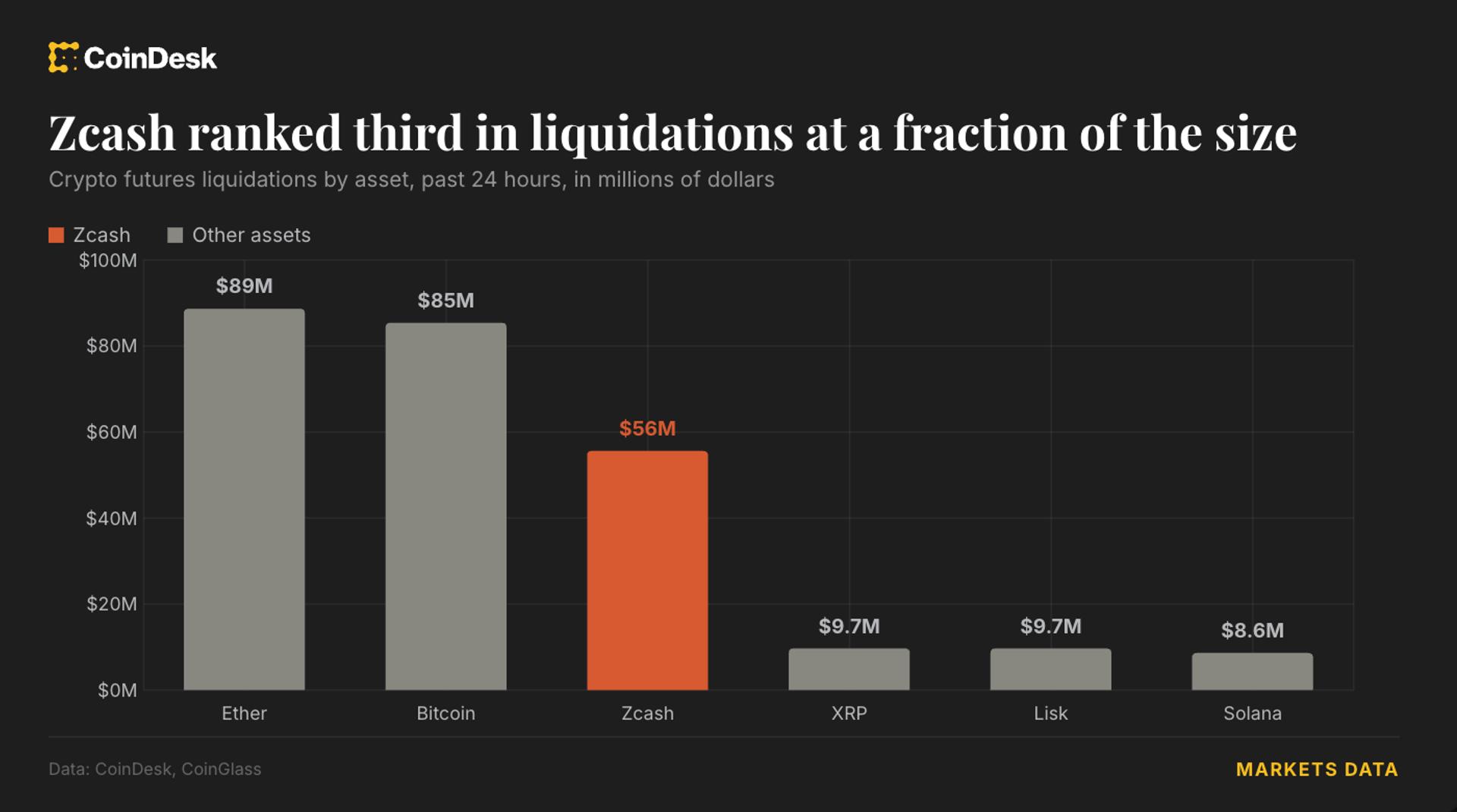
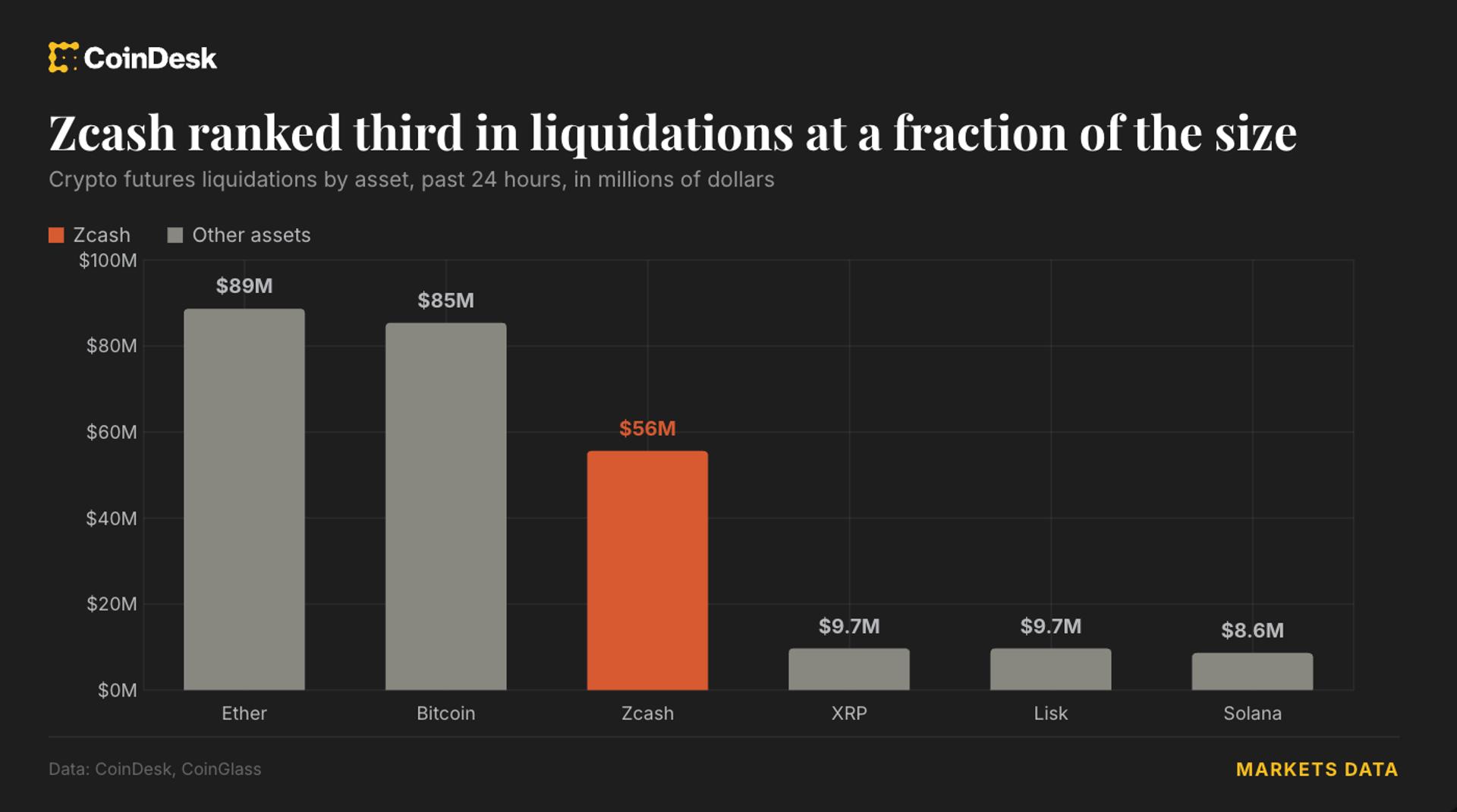
Ether led at nearly $89 million, bitcoin at $85 million and zcash at $56 million. The largest single order was an $18 million bitcoin position closed on Hyperliquid.
Zcash produced $56 million of liquidations on a market capitalization of $23 billion. Watch whether that leverage rebuilds through Thursday, because it has fuelled every leg of this run.
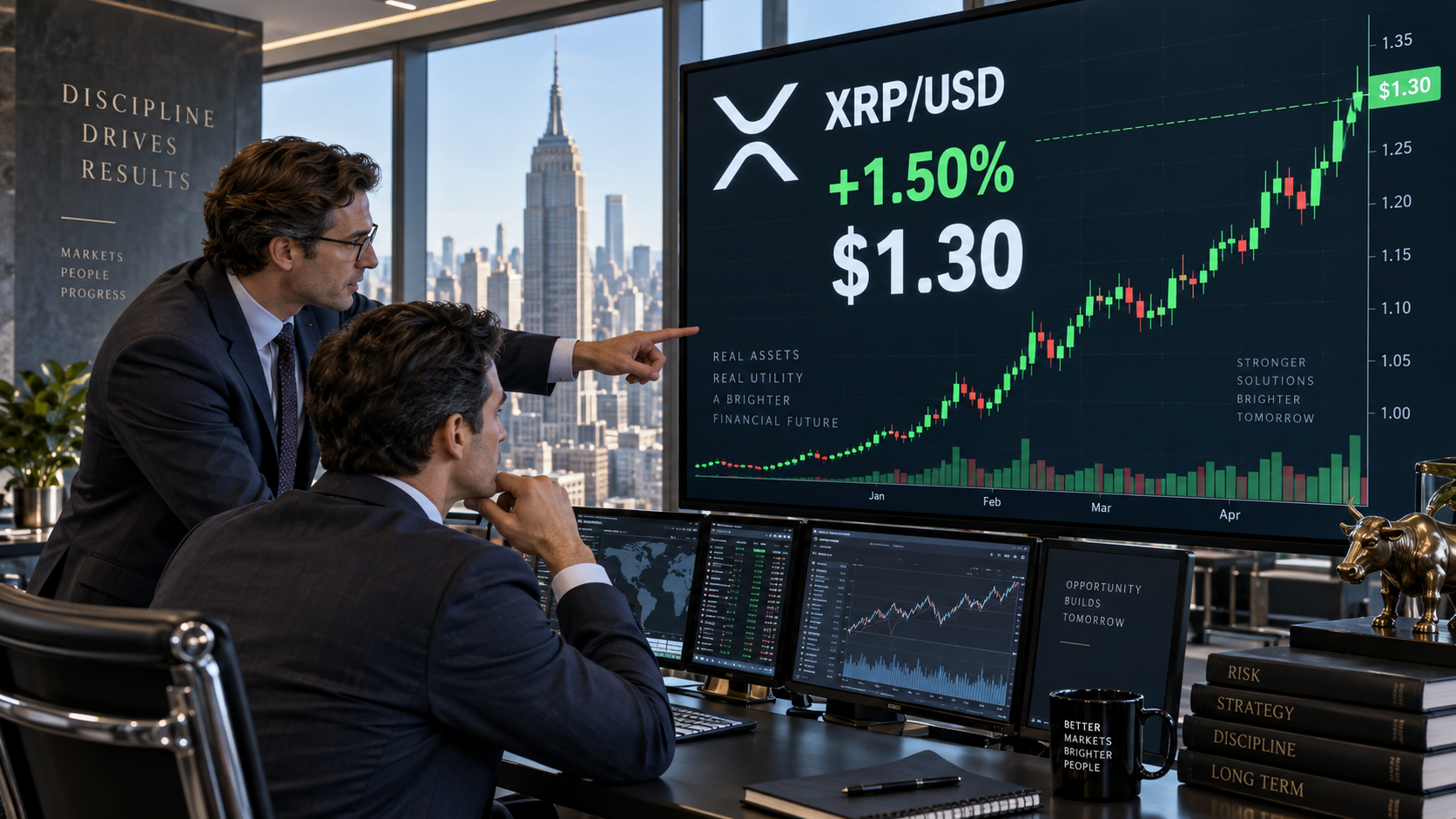

Key takeaways
- XRP’s long-to-short ratio stands at a bullish 1.06 as funding rates turn negative.
- XRP holds above its 50-day and 100-day EMAs at $1.284 and $1.255.
- A daily close above the 200-day EMA at $1.353 could place $1.90 in focus.
XRP extended its recoveries on Thursday after finding support at important technical levels. However, conflicting funding rates, long-to-short positioning, and on-chain signals indicate that traders remain uncertain about whether the rebounds can continue.
XRP traded near $1.30 while holding above its 50-day and 100-day exponential moving averages. A close above the 200-day EMA at $1.353 is required to strengthen its recovery.
XRP traders show mixed positioning
XRP’s long-to-short ratio rose to 1.06 on Thursday, approaching its highest level in more than a month, according to CoinGlass.
A ratio above one means traders hold more long positions than shorts, signaling a moderately bullish positioning bias.
Funding rates complicate the derivatives outlook for both tokens. XRP’s funding rate turned negative on Wednesday and stood at -0.0040% on Thursday.
Negative funding means short-position holders are paying longs, indicating that bearish positioning has become more aggressive.
This conflicts with XRP’s bullish long-to-short ratio and highlights the lack of consensus among futures traders.
CryptoQuant’s summary indicators point to cautious conditions across XRP’s spot and futures markets.
XRP is showing signs of overheating, while its futures market reflects sell-side dominance. Increased activity from retail traders could also introduce additional volatility if leveraged positions become crowded.
Taken together, the metrics suggest that XRP has not attracted enough consistent demand to confirm a sustained recovery.
XRP holds above the $1.25–$1.28 support zone
XRP traded near $1.30 on Thursday, maintaining a neutral and range-bound technical structure. The token remains slightly above its 50-day EMA at $1.284 and its 100-day EMA at $1.255. These moving averages create a broader demand zone between approximately $1.25 and $1.28.
The Relative Strength Index stands near 46, signaling neutral-to-weak momentum. Meanwhile, the Moving Average Convergence Divergence indicator remains below zero, showing that bullish pressure has yet to recover fully.

A break below the moving-average support cluster could expose the psychological $1 level.
The 200-day EMA at $1.353 represents XRP’s most important near-term resistance. A daily close above this level would improve the technical outlook and could open a path toward the next major horizontal resistance near $1.90.
Failure to clear $1.353 would keep XRP trapped within its current range and leave the $1.30 area vulnerable to another pullback.
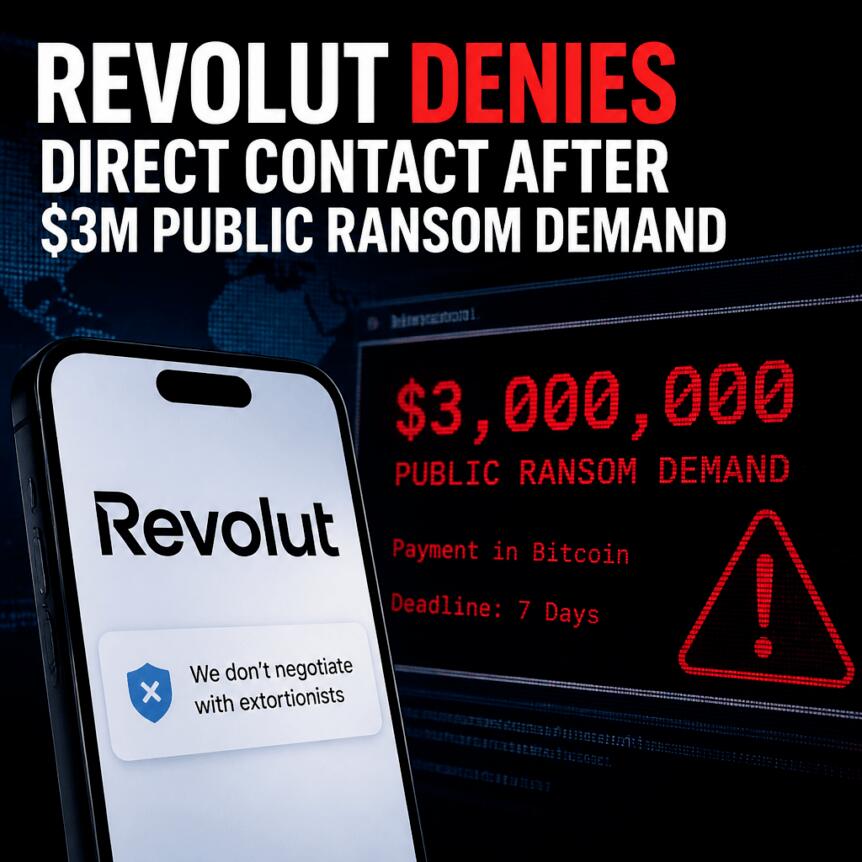
Revolut says it has received no direct messages from the hackers publicly demanding a ransom over a customer data breach, even as multiple groups compete for credit and threaten further disclosures.
A faction using the name “IAmNotAVillain” demanded 6,000 Monero (XMR)—worth about $3 million—within 24 hours, according to a report by the Financial Times. On Thursday, a Revolut spokesperson told Cointelegraph that the company has not received any direct contact or demand from the individuals behind those claims.
Key takeaways
- Revolut confirms it has not received direct communication from “IAmNotAVillain” despite public ransom threats.
- A rival claimant (“Revolut Smilik”) previously circulated a far larger Bitcoin demand, widening uncertainty over who controls the stolen data.
- Investigators in Italy are broadening the probe because the suspected intrusion involves an alleged compromise or cloning of a government email account.
- Regulators are pressing banks to review access security, suggesting the issue may extend beyond a single breach channel.
Competing ransom claims muddy attribution
Revolut’s lack of direct contact matters because public ultimatums do not automatically indicate which party actually holds the data, how much has been extracted, or whether the threat is actionable. In this case, “IAmNotAVillain” is only one name attached to online claims related to the breach.
Cointelegraph previously reported that Revolut disclosed the incident last week and tied its exposure to alleged access obtained using a fake government email account. When Cointelegraph attempted to check the “IAmNotAVillain” website, iamnotavillain.xyz, it was unavailable at the time of publication.
Adding further ambiguity, an earlier group calling itself “Revolut Smilik” reportedly made a demand of 10,000 Bitcoin (about $780 million at the time), a figure dramatically larger than the later XMR demand reported by the Financial Times.
In a notice on its site, “IAmNotAVillain” disputed the competing claim, alleging that a former associate had received only a small sample of the data before taking credit for the breach. The site also warned other parties not to “deal” with the rival claimant—an escalation that typically reflects internal disputes among actors rather than proof of control over the full dataset.
Meanwhile, a cybersecurity-focused account, Dark Web Informer, also flagged another website—revoloot.lol—as associated with a separate actor claiming responsibility. That site was also unavailable when checked by Cointelegraph. Together, these competing claims make it difficult for outside observers to confidently map which group is operating the extortion pipeline.
Why Revolut’s response is significant for customers and markets
Extortion incidents increasingly unfold as a chain of claims, samples, and retractions across multiple domains—often making it hard to determine whether a victim’s infrastructure can be directly negotiated with. Revolut’s statement that it has not received any direct contact suggests the company cannot yet validate that the public demand corresponds to a party willing or able to engage with the organization privately.
For affected customers, this distinction matters because it affects expectations around mitigation. Direct communications can sometimes include specifics about the data or the steps required to verify deletion. Without that channel, customer-impact assessments and remediation efforts rely more heavily on forensic findings than on attacker instructions.
For the broader crypto audience, the ransom component underscores how extortion ecosystems increasingly mix anonymity-preserving assets such as Monero with shifting claimant identities. In practice, the exact asset and headline valuation can change faster than the underlying breach details—particularly when multiple groups are signaling from the sidelines.
Italy expands the investigation beyond a single victim
While the extortion messaging continues online, the law-enforcement angle is also deepening. According to Italian news agency ANSA reported on Wednesday, Italy’s National Anti-Mafia and Anti-Terrorism Directorate has become involved because the suspected intrusion appears to concern a government entity.
Prosecutors in Reggio Calabria have opened an investigation into unauthorized access to a computer system of public interest. Investigators are working to determine whether the institutional email account was breached outright or cloned—an important technical distinction that can affect both accountability and how the wider ecosystem was targeted.
Italy’s privacy regulator has also asked banks to urgently review the security of their access systems. The regulator is separately examining whether other banks or financial institutions may have been affected, implying that the breach method may not have been isolated to Revolut’s environment.
Earlier coverage from Cointelegraph noted that the investigation centers on a government email account allegedly used to obtain customer data. With multiple claimant narratives still unfolding online, the official inquiry remains a key reference point for what investigators can substantiate about the intrusion path.
What to watch next
Investors, security teams, and customers should watch for two developments: whether Italian investigators can confirm the mechanism behind the government email compromise or cloning, and whether any attacker claim evolves into verifiable direct contact with Revolut or corroborating evidence about the amount and scope of the exposed data.


Strategy has repurchased nearly 9.96 million STRC preferred shares for $950.8 million since July 20 as the security recovered toward Strategy’s targeted $99-to-$100 trading range.
Summary
- 9.96 million STRC shares were repurchased by Strategy for approximately $950.8 million since July 20.
- STRC closed at $97.07 on September 16 after reaching an intraday high above $99 earlier.
- Strategy increased its preferred-securities repurchase authorization from $1 billion to $2 billion on September 8.
- Bitcoin sales funded roughly $161 million of STRC repurchases, according to company filings and Bloomberg.
- Strategy holds 845,050 Bitcoin after reporting no purchases or sales through September 13, filings show.
Strategy said in its Sept. 14 SEC filing that it bought another 1,420,467 shares of its Variable Rate Series A Perpetual Stretch Preferred Stock between Sept. 8 and Sept. 13 for $139.3 million, using its USD Cash balance. The company sold no shares through its at-the-market programs and bought or sold no Bitcoin during the same period.
Adding Strategy’s eight weekly disclosures from July 20 through Sept. 13 produces 9,961,554 STRC shares repurchased for approximately $950.8 million. Bloomberg separately calculated roughly $950 million of purchases and estimated that Strategy represented around 18% of total STRC trading volume during the period.
STRC recovered from near $70 toward its $100 stated amount
STRC’s rebound followed a steep decline that had taken the preferred security to nearly $70, according to Bloomberg. The shares later reached $99.03 intraday on Sept. 14 before pulling back. STRC closed the latest completed U.S. session on Sept. 16 at $97.07 after trading between $97.01 and $97.95.
Strategy has explicitly set a corporate objective for STRC to trade between $99 and $100. Its August investor materials say management uses dividend-rate decisions, repurchases, liquidity management and issuance policy to support trading near the $100 stated amount. Strategy cautions that the target is “not a price guarantee” and says the policy can change.
The company currently pays a 12% annualized dividend on STRC, equivalent to $0.50 for each full semi-monthly period on $100 of stated value when the dividend is declared. Strategy’s board has declared $0.50 payments for the periods ending Sept. 30 and Oct. 15.
Management has said it does not currently intend to recommend changing the 12% rate until STRC demonstrates sustained trading near $100. Strategy’s existing policy is similarly not to sell new STRC below its $100 stated amount. Both policies are statements of management intent and are not contractual obligations.
That issuance policy ties STRC’s price directly to Strategy’s ability to use the preferred stock for new capital. Strategy CEO Phong Le previously said the company intended to resume issuance when Stretch returned to par, saying, “when Stretch gets back to par, we’ll issue more.” As crypto.news reported in July, management linked new STRC issuance with its ability to raise funds that could be directed toward Bitcoin purchases.
Strategy spent $950.8 million across eight buyback periods
Strategy began the current sequence by buying 288,930 STRC shares for $25 million between July 20 and July 26. The next week brought another 912,143 shares for $81.2 million.
Purchases accelerated in August. Strategy paid $108.6 million for 1,152,020 shares during Aug. 3–9, followed by $132.2 million for 1,388,720 shares during Aug. 10–16. Another 1,431,212 shares cost $136.4 million during Aug. 17–23.
During Aug. 24–30, Strategy repurchased 1,557,177 STRC shares for $151.8 million. The company bought 1,810,885 more for $176.3 million during the period ending Sept. 7, followed by the latest $139.3 million transaction.
Strategy originally authorized up to $1 billion for repurchases of its digital-credit securities in June, with STRC identified as its first priority when management considered purchases accretive. On Sept. 8, the board increased the total authorization to $2 billion, including purchases already completed.
After the Sept. 8–13 transactions, Strategy reported $1.05 billion of remaining preferred-stock repurchase capacity. Its separate $1 billion authorization for repurchasing MSTR common stock remained unused.
Strategy says purchasing STRC below $100 can retire $100 of stated value for less than that amount and reduce future preferred-dividend requirements. The company has said it intends to scale repurchases more aggressively when discounts are deeper and taper purchases as STRC approaches $100.
MSTR and Bitcoin sales supplied much of the buyback cash
Bloomberg traced roughly $765 million, or approximately 80% of the repurchase spending since July 20, to MSTR common-stock sales, including money first placed into Strategy’s cash pool before being used for STRC. Another roughly $161 million came from Bitcoin sales.
The Bitcoin-funded portion can be directly reconciled with Strategy’s SEC disclosures. During July 27–Aug. 2, Strategy sold 1,638 BTC for $104.73 million and allocated $52.3 million of those proceeds to STRC repurchases. The remaining $52.4 million funded preferred dividends.
A week later, Strategy sold 1,690 BTC for $108.6 million at an average net price of $64,262. The company said all proceeds from that sale funded STRC repurchases. Together, the two disclosed allocations equal $160.9 million, consistent with Bloomberg’s roughly $161 million calculation.
Common-stock issuance funded several later purchases directly. Strategy allocated $132.2 million of MSTR sale proceeds to STRC buybacks during Aug. 10–16, $136.4 million the following week and $151.8 million during Aug. 24–30.
For the first two reporting periods in September, Strategy funded $315.6 million of STRC purchases from its USD Cash account. The balance fell from $1.61 billion on Aug. 30 to $1.44 billion on Sept. 7 and $1.30 billion by Sept. 13. The separate USD Reserve stood at $5.10 billion.
Bloomberg cited analysts who questioned how STRC will trade once company purchases decline. Rajiv Sawhney of Wave Digital Assets told Bloomberg that “The price is the product,” arguing that STRC needs to stay near par to function efficiently as a funding instrument. Strategy itself warns in SEC filings that its repurchases and dividend policies may fail to keep the security near $100.
Strategy keeps Bitcoin at 845,050 BTC while buybacks continue
Strategy reported no Bitcoin purchases or sales for the two consecutive periods ending Sept. 7 and Sept. 13. Its holdings therefore remained at 845,050 BTC, acquired for an aggregate $63.73 billion at an average cost of approximately $75,412 per Bitcoin.
The company’s most recent Bitcoin purchase came during Aug. 24–30, when it acquired 4,603 BTC for $369.7 million at an average price of $80,318. Strategy funded that purchase with MSTR ATM proceeds during the same week while allocating another $151.8 million from common-stock issuance to STRC repurchases.
Across the July 20–Sept. 13 window, Strategy spent roughly $950.8 million repurchasing STRC compared with $369.7 million on newly acquired Bitcoin. The preferred-stock purchases therefore consumed more than twice the amount directed to new BTC acquisitions during that period.
As crypto.news previously reported, Strategy’s management had linked renewed Bitcoin financing through STRC to the preferred shares recovering toward their $100 stated amount. STRC was trading around $87 when that strategy was discussed in July.
Crypto.news reported that STRC had become the largest holding in three major U.S. preferred-stock ETFs while still trading below par in July. The report cited approximately $756 million held across the three funds at that time.
Strategy’s Sept. 14 filing leaves the next repurchase decision open. The company retains roughly $1.05 billion of authorized preferred-security buyback capacity, while its policy permits purchases to be increased, reduced, suspended or discontinued depending on STRC’s price, liquidity, available capital and other market conditions.

Bitget, one of the world’s largest Universal Exchanges (UEX), has upgraded its Proof of Reserves (PoR) from four cryptocurrencies to 19 major assets, significantly widening the share of user holdings covered by its reserve verification infrastructure. The upgrade extends both platform-level reserve disclosures and personal Proof of Assets verification, giving users greater visibility into how assets held on Bitget are accounted for and the ability to independently verify their inclusion in reserve snapshots.
As exchanges expand the range of assets they support, reserve transparency needs to keep pace. The latest upgrade moves Bitget closer to making verification a standard layer across its ecosystem, rather than a safeguard limited to core cryptocurrencies.
The expanded coverage includes BTC, USDT, ETH, LTC, LINK, XRP, USDC, DOGE, BNB, SOL, ADA, NEAR, XAUT, TAO, SUI, ONDO, HYPE, PI, and USDGO. Through the upgraded PoR page, users can view the reserve ratio and amount of user assets for each supported asset, assess if reserves are sufficient, and see how user assets are distributed across different public blockchains.
Personal Proof of Assets verification has expanded across the same range, allowing users to independently check whether their holdings were included in a PoR snapshot using Merkle Tree verification. Detailed audit records, including Merkle hashes and snapshot information, remain available for users seeking deeper verification.
Bitget has published Proof of Reserves monthly since its launch in December 2022. As of August 2026, the platform had published 45 consecutive PoR reports, with its latest report showing a total reserve ratio of 122%, remaining above the 1:1 reserve standard. Bitget uses Merkle Tree technology to aggregate and verify user assets, allowing users to independently confirm whether their holdings are included in a particular Proof of Reserves snapshot. Users can also download the relevant data and further verify their asset records using publicly available verification methods.
“Users shouldn’t have to simply take our word for it, they should be able to verify their assets for themselves,” said Gracy Chen, CEO of Bitget. “Proof of Reserves has been part of Bitget’s transparency framework for nearly four years, and as the assets people hold on our platform become more diverse, that verification needs to expand with them. Expanding from four assets to 19 gives more users that visibility.”
For assets outside the scope of a particular audit, or where corresponding personal records have not yet been generated, Bitget’s Proof of Assets interface provides relevant notices to help users interpret their audit results accurately. As UEX brings a broader range of assets and markets into one trading environment, Bitget is extending the systems that allow users to independently examine what sits behind their holdings. Proof of Reserves, the Protection Fund, and Bitget’s broader security infrastructure form part of that approach, with the goal of making security increasingly measurable and verifiable as the ecosystem grows.
For more information, visit here.
About Bitget
Bitget is one of the world’s largest Universal Exchanges (UEX), serving over 125 million users and offering access to over 2M crypto tokens, 500+ tokenized stocks, ETFs, commodities, FX, and precious metals such as gold. The ecosystem is committed to helping users trade smarter with its AI agent, which co-pilots trade execution. Bitget is driving crypto adoption through strategic partnerships such as MotoGP™. Aligned with its global impact strategy, Bitget has joined hands with UNICEF to support blockchain education for 1.1 million people by 2027. Bitget currently expands in the tokenized TradFi market, providing the industry’s lowest fees and highest liquidity across 150 regions worldwide.
For more information, visit: Website | X | Telegram | LinkedIn | Discord
Risk Warning: Digital asset prices are subject to fluctuation and may experience significant volatility. Investors are advised to only allocate funds they can afford to lose. The value of any investment may be impacted, and there is a possibility that financial objectives may not be met, nor the principal investment recovered. Independent financial advice should always be sought, and personal financial experience and standing carefully considered. Past performance is not a reliable indicator of future results. Bitget accepts no liability for any potential losses incurred. Nothing contained herein should be construed as financial advice. For further information, please refer to our Terms of Use.
The post Bitget Broadens Proof of Reserves as 20+ Assets Become Verifiable appeared first on BeInCrypto.


South Korean police have reportedly referred 18 Polymarket users to prosecutors in an illegal gambling investigation involving 26 people who collectively wagered about 17.6 billion won (worth $12.7 million).
According to Asia Economy, data submitted by the National Police Agency to the office of Democratic Party lawmaker Yoon Kun-young showed that the Gangwon Provincial Police Agency had placed 26 people under investigation as of Tuesday and sent 18 of them to prosecutors. The report said the largest amount wagered by a single user was about 5.7 billion won ($4.1 million).
Police identified users by analyzing publicly available blockchain transactions, the report said. Polymarket lets users buy and sell contracts tied to the outcomes of real-world events and operates on a noncustodial, peer-to-peer structure with automated settlement. It does not maintain a conventional list of users by their real names, the report said.
Authorities reportedly said Polymarket transactions constitute illegal gambling under South Korea’s Criminal Act because users stake assets on outcomes that cannot be predicted with certainty. The users argued that Polymarket should instead be treated as a crypto-based derivatives investment market, according to the report.
South Korea moves against Polymarket
In June, Gangwon police launched South Korea’s first illegal gambling probe into local Polymarket users at the request of the National Police Agency. On Aug. 18, South Korean authorities moved to block Polymarket after determining that the prediction market provided an illegal gambling environment to users in the country.
The country’s media and communications review commission said the platform’s winner-takes-all structure encouraged speculative gambling, citing Polymarket’s role in operating markets, setting trading rules, providing crypto deposits, withdrawals, and settlement and collecting transaction fees.
Related: CFTC, US soldier accused of illegal Polymarket bet spar over interpretation of prediction markets
Polymarket argued that it did not provide Korean-language services or support payments in Korean won and that its noncustodial transactions and use of smart contracts meant it did not directly manage user funds. The commission rejected the argument, saying technical characteristics did not exempt a service from South Korean law.
Tae-Lim Kim, managing attorney at AXIS Law, told Asia Economy that the transactions could meet the legal requirements for gambling. He said describing them as prediction derivatives would be difficult to use as a direct defense in criminal proceedings, although the ability to trade contracts and exit positions before settlement could be relevant to a court’s assessment.
Magazine: Revolut ID thefts highlight KYC’s dangers: Here’s how to fix it
Faisal Bashir | Lightrocket | Getty Images
BEIJING — China’s artificial intelligence models may be enjoying rapid adoption but that isn’t yet translating into revenue, raising questions about company valuations.
All of China’s AI models combined generate only about 10% of the revenue reported for OpenAI and Anthropic, U.S.-based research firm Rhodium Group said in estimates published Thursday. That’s based on reports using an industry metric called annual recurring revenues, which attempts to capture fast growth by multiplying a recent monthly figure by 12.
DeepSeek’s ARR was the lowest among major Chinese AI companies, at $500 million, the Rhodium report said. MiniMax was next at $800 million, followed by Moonshot at $1 billion.
Z.ai told investors on Wednesday its latest ARR was $1.8 billion, according to a transcript seen by CNBC.
But even with $4 billion for ByteDance and $2.4 billion for Alibaba, that remained far lower than the $40 billion generated by OpenAI alone, not to mention $65 billion for Anthropic, Rhodium said.
Critically, the low revenue is far from keeping pace with how investors are valuing the Chinese startups.
“Valuations relative to revenue appear exorbitant for Moonshot and DeepSeek at present,” the Rhodium report said. The analysts noted estimated ratios of 50x and 163x, respectively, for the two startups.
That’s far above the 34x for OpenAI and 21x for Anthropic, the report said.
Z.ai forecast
To be sure, the Rhodium analysis could reference only the latest available figures from this summer, and usage of Chinese AI models has skyrocketed from low levels earlier this year.
Z.ai on Wednesday said it now expects its ARR by the end of the year to reach $3 billion, up from $2.4 billion previously forecast.
Rhodium also pointed out that Chinese AI labs are exploring ways to get a larger cut of revenue from third parties offering access to the models, whose open-source nature allows anyone with sufficiently capable hardware to download and run it independently of the developer.
U.S. models are mostly closed, and the cost per task for leading AI models from OpenAI and Anthropic is far higher than that of Chinese models, according to AI-comparison firm Artificial Analysis.
“The financing gap means it will be far more difficult for Chinese frontier AI labs to scale sustainably,” Logan Wright, partner at Rhodium Group, said in a statement to CNBC. He co-authored the report with research analyst Endeavour Tian.
“They will be heavily dependent upon a favorable climate in the equity market—historically that’s not an easy bet in China,” he said. “Government funding has been helpful on the hardware side of the buildout of compute capacity, but similarly will probably balk at direct funding for the frontier labs.”
Rhodium estimated more than 60% of equity investment in Chinese AI chips and servers came from state-affiliated sources.
It’s been a volatile year for Chinese AI companies that have listed.
Z.ai shares rose more than 5% in Thursday morning trading, recovering from a decline earlier this week following news of its second major fundraise in two months. The Hong Kong-traded stock has tumbled to levels seen this spring, after briefly more than tripling in price over the summer.
Shares of rival Minimax have struggled in recent months to hold above their IPO-day gains, after seeing shares spike in the spring.
—CNBC’s Jenny Lee contributed to this report.


H100 CEO Eirik Grøttum has increased his exposure to the Swedish Bitcoin treasury company through purchases totaling 407,163 shares for SEK 621,887, while H100 continues to report 3,506.4 BTC on its balance sheet.
Summary
- H100 CEO Eirik Grøttum bought 407,163 shares through Kode Oslo for SEK 621,887 this week.
- Kode Oslo now holds 2,771,787 H100 shares after purchases completed in August and September 2026.
- Companies associated with Grøttum collectively hold 5,399,464 H100 shares following the insider transactions disclosed today.
- H100 continues holding 3,506.4 Bitcoin after completing its Norwegian acquisition on August 10 this year.
- H100 issued 790,534,666 shares for the acquisition, which added 2,455.37 Bitcoin using no cash consideration.
H100 Group said in its Sept. 17 primary-insider disclosure that Kode Oslo AS carried out the purchases, with 405,663 shares acquired on Sept. 15 at an average SEK 1.53 and another 1,500 shares acquired on Aug. 19 at SEK 1.40. The combined average price was SEK 1.53 per share.
H100 CEO purchase lifts related holdings above 5.3 million
Kode Oslo now owns 2,771,787 H100 shares following the disclosed transactions. Grøttum serves on Kode Oslo’s board, owns 20% of the company and participates in its investment decisions, according to H100’s regulated notice.
A second associated entity, Olav Grøttum Holding AS, owns another 2,627,677 H100 shares. Grøttum owns that company entirely. Combined, the two businesses hold 5,399,464 H100 shares after the latest purchases.
The transaction concerns shares in H100 Group, not a new Bitcoin purchase by the company. H100’s disclosed Bitcoin position therefore remains separate from the CEO-related equity purchase.
Grøttum became H100’s chief executive on Aug. 11, one day after the company completed its large Norwegian Bitcoin-related acquisition. He previously served as CEO of Moonshot AS and had worked with H100 Chief Investment Officer Peter C. Warren managing Bitcoin holdings belonging to Geir Harald Hansen through Moonshot.
H100 said Grøttum’s background covers software development, quantitative trading, asset management and fintech. His appointment moved former CEO Johannes Wiik back into the chief operating officer role.
H100 still reports a 3,506.4 BTC treasury
H100’s latest company disclosures continue to place its treasury at 3,506.4 BTC. The position increased sharply on Aug. 10 when H100 completed its acquisition of NSD AS, which through a reorganization held Moonshot AS and PDI AS.
The transaction brought 2,455.37 BTC into the group, taking H100 from 1,051.03 BTC at the end of June to 3,506.4 BTC. H100 said the acquired companies had no outstanding financial debt.
No cash was paid for that acquisition. H100 issued 790,534,666 new shares to the sellers at SEK 1.86 each, representing consideration of approximately SEK 1.47 billion. The new shares increased H100’s outstanding share count to 1,128,931,358 immediately after the transaction.
The share issue represented roughly 70% of H100’s outstanding shares after closing. Geir Harald Hansen received a controlling position of approximately 69.2% through 781,676,551 shares following the deal, according to H100’s interim report.
H100 described the transaction as “the largest M&A transaction ever completed in the European Public Bitcoin Equity sector” and the first public-market acquisition completed on a Bitcoin-for-Bitcoin basis. Those descriptions are company claims and were not independently established across all European and global public-market transactions.
As crypto.news previously reported, the agreed valuation used Bitcoin at SEK 598,926.69, roughly $62,900, based on the Coinbase BTC/SEK spot price at the specified July 31 reference time. The figure was an acquisition valuation benchmark, not an open-market purchase price for 2,455.37 BTC.
Bitcoin exposure has become central to H100’s balance sheet
H100 began its Bitcoin treasury strategy on a much smaller scale. Its first purchase in May 2025 involved 4.39 BTC, after which the company raised equity and convertible financing to build its holdings.
By June 30, 2026, the company held 1,051.03 BTC before the Norwegian acquisition nearly tripled that amount. H100 describes itself as a technology company serving health and longevity providers while running an active Bitcoin treasury strategy.
The Bitcoin exposure has made H100’s reported earnings sensitive to cryptocurrency prices. Its second-quarter report showed an operating loss of SEK 88.7 million and a pre-tax loss of SEK 98.2 million. H100 said SEK 93.3 million of the pre-tax loss consisted of items that did not affect cash flow.
For the first half of 2026, the company reported a SEK 253.6 million pre-tax loss, while operating cash flow was negative SEK 12.7 million. Its equity ratio stood at 86% at June 30.
As crypto.news reported after the results, much of the quarterly accounting loss was linked to a non-cash write-down associated with Bitcoin’s lower valuation during the reporting period.
Grøttum wrote in the interim report that simply raising funds to accumulate Bitcoin was “unlikely to be sufficient on its own” for treasury companies. He said H100 planned to use capital allocation, capital-markets activity, acquisitions and operating cash flow alongside its Bitcoin holdings. The statement describes management’s strategy and does not guarantee future returns.
H100 is considering future share buybacks
The insider purchase follows a separate H100 announcement on Sept. 16 concerning new Swedish share-repurchase rules. Starting Dec. 5, Swedish public companies whose shares trade on multilateral trading facilities will be permitted to repurchase and hold their own shares. The change covers NGM Nordic SME, where H100 trades.
Grøttum said repurchases could become one of several capital-allocation options, particularly when H100 shares trade below net asset value. His comments describe a potential future tool, not an announced repurchase program.
H100 explicitly said no decision has been taken to repurchase its own shares. Any future program would require authorization from shareholders followed by a board resolution and disclosure under the applicable rules. The company’s Sept. 17 insider filing did not announce a change to its Bitcoin treasury, leaving the latest disclosed balance at 3,506.4 BTC.

Strictly Come Dancing’s new 7-minute spin-off announced by BBC ahead of 2026 series

Liverpool leads UK cities in digital move

How Trump Helped Put a Texas Senate Seat In Play



-

 Fashion6 days ago
Weekend Open Thread – Corporette.com
-

 Tech4 days ago
The Latest Weird Thing to Play Doom Is the Mapped-Out Brain of a Fruit Fly
-

 Business6 days ago
10 Most-Streamed Songs On Spotify In 2026 So Far, Led By Ella Langley’s Dominant Run On The Charts This Year
-

 Crypto World6 days ago
XAG/USD: Silver’s Short-Term Rally Meets Its Moment of Truth
-

 Crypto World7 days ago
2 Chip Stocks Broke Out This Week. Neither Was Nvidia
-

 Tech7 days ago
Battery life is the only iPhone 18 Pro and iPhone Duo upgrade I care about. Apple didn’t disappoint
-

 Crypto World7 days ago
OKX launches 10x OpenAI, Anthropic X-Perps in Europe
-

 Crypto World6 days ago
Diesel Tops $6 a Gallon for the First Time as 28 States Set Records
-

 Crypto World3 days ago
Elon Musk Drops a Bombshell: Grok 5 Could Be the AGI Breakthrough
-

 Business7 days ago
Western Digital Slips 2.7% as AI Storage Rally Cools After Record Cash and Guidance
-

 News Videos6 days ago
Facing Financial Fears
-

 Business4 days ago
Rivals Sam Altman and Elon Musk Rally Behind Dario Amodei’s Call for a Slowdown in AI Development
-
Crypto World7 days ago
Ethereum Price Analysis: Consolidation at $2.5K Tests Momentum as On-Chain Activity Surges
-

 Crypto World5 days ago
Can AI Build a Startup in 72 Hours? Elon Musk's Team Will Livestream the Test
-

 Entertainment6 days ago
News Specials, Movies, Shows, More
-

 Crypto World2 days ago
Kraken Lets xStocks Holders Earn Yield Through DeFi
-
 NewsBeat3 days ago
‘Sick conspiracy’: Trump says only guardrails AI needs is ‘a strong and smart (High IQ!) president’ in all-caps rant
-

 Crypto World6 days ago
Bitcoin ETFs Pull $167M as 2026’s Best Inflow Run Slows
-

 Crypto World7 days ago
US CPI forecast at 3.4% as tariff risks build
-
 Entertainment6 days ago
New Horror Movie Officially Earns a Rare Stephen King Recommendation
You must be logged in to post a comment Login