
Crypto World
Ethereum EIP-8363 Staking Proposal Faces Strong Community Backlash

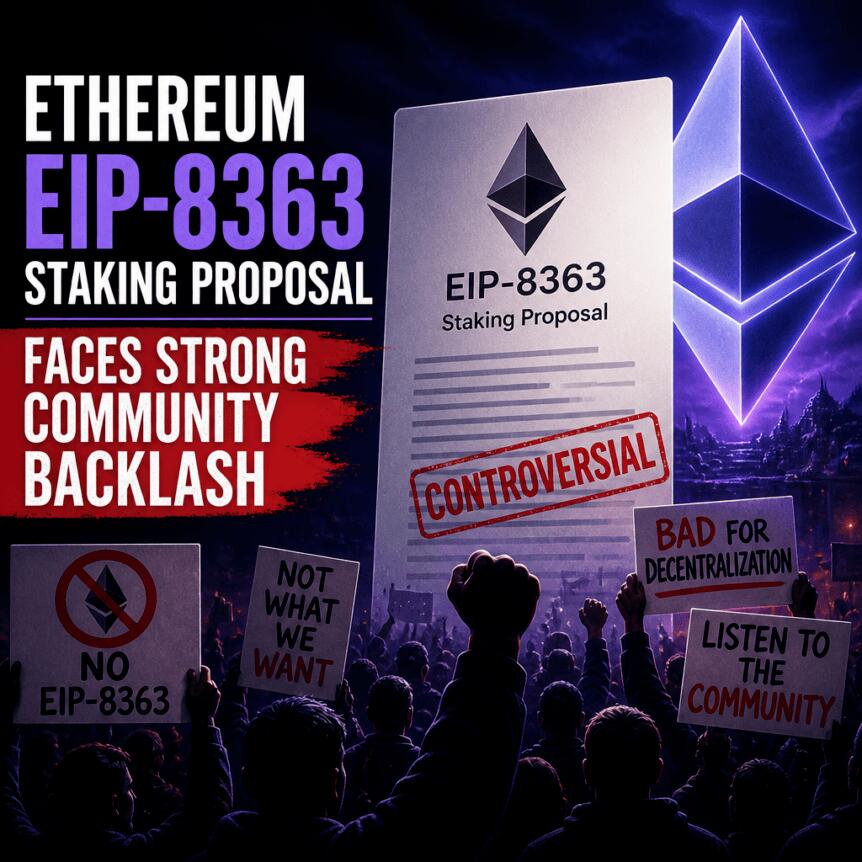
Ethereum is once again wrestling with its core incentive design. A proposed upgrade, EIP-8363 (“Tapered Issuance Burn”), would gradually reduce staking rewards as more Ether is locked up, with the idea of cutting new protocol issuance to zero once staking reaches a specified threshold.
The controversy is not abstract: Ether’s stake rate, DeFi’s reliance on staking derivatives, and institutional demand for predictable monetary policy all collide in the debate. Supporters argue that beyond a certain point, additional staking delivers diminishing security benefits—while critics warn that reducing issuance could destabilize parts of Ethereum’s financial plumbing and undermine trust in how the network governs its money.
Key takeaways
- EIP-8363 would taper validator rewards as staking participation rises, ultimately aiming to stop issuance when a target staking level is reached.
- Proponents say Ethereum has crossed into a zone where extra staking is less valuable for security and more harmful for non-stakers.
- Critics—including DeFi and institutional voices—argue the change could weaken decentralization, disrupt lending markets, and introduce “yield governance risk.”
- Opponents also contend that Ethereum’s inflation is already low and that market forces will likely slow staking further without altering issuance.
- The proposal’s timing is also drawing fire, with critics questioning its publication close to the Aug. 6 deadline for the next Ethereum upgrade proposals.
What EIP-8363 proposes—and why it sparked pushback
EIP-8363, published on the Ethereum Magicians forum (https://ethereum-magicians.org/t/eip-8363-tapered-issuance-burn/29263), is designed to rein in staking rewards as more ETH gets locked to secure the network. According to the proposal’s framing, the policy would eventually reduce new issuance to zero once 50% of Ether’s supply is staked.
Among the proposal’s authors are Ethereum Foundation researcher Justin Drake and ETHCC co-founder Jerome de Tychey. Their argument is that Ethereum has reached a point where incremental security gains from additional staking are no longer proportional to the issuance granted to validators. In their view, paying for security “beyond what the network needs” becomes a subsidy to existing staking participation at the expense of holders who are not staking.
But many in the ecosystem dislike what they see as a potential shift in Ethereum’s monetary logic. Mike Silagadze, founder of Ether.fi, criticized the idea on social media, saying it would be harmful to decentralization, adoption, and the network’s credibility.
“This is so disappointing on every level. […] This is bad for decentralization, this is bad for Ethereum adoption, and this is bad for the credibility of the network.”
Dr. Steve Berryman, Bitwise’s head of client partnerships for Ethereum, similarly argued that institutional adoption depends on certainty, and that changing issuance at the margin would introduce uncertainty that institutions are unlikely to tolerate.
“Institutional adoption requires certainty and playing with the issuance at the margin would cause uncertainty and institutions hate uncertainty.”
Is Ethereum already “over-staked”? The numbers behind the debate
Current network participation provides the backdrop for the disagreement. According to Validator Queue data (https://www.validatorqueue.com/), Ethereum has roughly 41.5 million ETH staked, yielding about 2.67% and representing around 34.07% of total supply.
Supporters of EIP-8363 maintain that while more staked ETH generally makes attacks harder, there comes a point where the extra security is increasingly marginal. The proposal, in that sense, targets the incentive mechanism: it aims to stop rewarding additional staking once Ethereum is already sufficiently hardened.
However, opponents challenge the premise that issuance is functioning as a meaningful “stealth tax” on non-stakers. Berryman argued that the market may naturally approach a ceiling in staking participation as yields fall, without needing changes to Ethereum’s issuance policy. He also suggested that participation growth has been influenced by institutional entrants—mentioning players such as Bitmine and BlackRock—and that after those entities complete their staking allocations, staking rates could plateau again.
Another dissenting view comes from commentator Leo Lanza, who opposes the proposal and disputes the idea that Ethereum’s inflation materially harms non-stakers. Lanza pointed out that Ethereum’s annual inflation is below 1% and compared it to gold’s supply growth range of roughly 1% to 2% annually, arguing that markets can solve the problem without protocol-level adjustments.
“The free market already solves this […] Let the market adjust.”
DeFi and decentralization concerns: the risks critics emphasize
Even if tapering issuance curbs unnecessary rewards, critics argue it may introduce second-order effects. A central concern is that staking is deeply embedded in Ethereum’s decentralized finance ecosystem through staking derivatives and related collateral usage. Silagadze argued that a policy like EIP-8363 would “kill a huge chunk of DeFi which is built around the staking ecosystem.”
Stani Kulechov, founder of Aave, raised additional worries. In his view, reducing staking rewards could encourage investors who treat ETH as a yield-bearing asset (or “ETH beta”) to rotate into alternative yield strategies—effectively punishing Ethereum for its growth. Kulechov’s concern is that the network could lose liquidity and composability that are tied to staking-linked yields.
“My concern is… those who are fine with ETH beta and yield might also sell ETH for other yielding assets […] Ethereum should not be punished for its growth.”
Technical stakeholders also caution against simplistic security arithmetic. Greg Koumoutsos, technical research lead at the Lido Labs Foundation, said that a staking ratio around one-third of supply does not appear unhealthy, while agreeing that thinking proactively about excessive staking is reasonable. More importantly, he argued the proposal oversimplifies what issuance is paying for—suggesting the broader system benefits include decentralization, operator diversity, censorship resistance, and network resilience.
“Ethereum is not only paying for slashable ETH; it is paying for decentralization, operator diversity, censorship resistance, and network resilience.”
In other words: lower issuance is not automatically a superior security policy unless those trade-offs are explicitly accounted for.
Who pays the price if rewards fall? The decentralization angle
Critics also argue that lowering rewards could affect validator participation patterns in ways that increase concentration. Koumoutsos noted that independent validators do not benefit from the same economies of scale as large staking businesses, exchanges, or institutional operators. If protocol rewards drop, he said, marginal solo validators could exit, leaving a thinner base of independent operators.
“A solo validator has real costs: some ideological solo stakers may remain, but many marginal solo validators will not, and fewer new ones will enter, if any.”
He added that large centralized platforms may be motivated by factors beyond yield—such as customer retention, regulatory positioning, and product integration—making them less likely to reduce staking even if rewards decline. Within delegated staking, the same dynamic could tilt incentives toward custodial products rather than onchain staking protocols, which tend to face higher ongoing maintenance, governance, and upgrade responsibilities.
Predictability versus adaptation: the governance-risk dispute
Supporters of EIP-8363 argue that stronger long-term monetary characteristics for Ether are worth the adjustment, while opponents counter that constant tweaking of Ethereum’s monetary policy undermines one of its biggest selling points: predictability.
Berryman said institutions care more about certainty than about marginal changes in staking yield, describing adjustments to the issuance curve as “yield governance risk.” His argument is less about absolute reward levels and more about whether the network’s monetary rules can be relied upon.
“It’s not broken, why try and fix it?”
Silagadze echoed the idea from an adoption perspective, arguing that any change with far-reaching implications—especially those affecting DeFi—could harm confidence among large institutions or nation-state actors that view Ethereum as a stable governance environment.
Beyond the substance of the proposal itself, the rollout has drawn procedural criticism. According to the reporting, EIP-8363 was published just two days before the Aug. 6 deadline for proposals to be considered for the next Ethereum network upgrade. Silagadze argued that a change with wide-ranging consequences should not have been introduced on such a short timeline.
That pressure highlights a broader tension in Ethereum governance: monetary and security incentives are interconnected, so every adjustment inevitably creates winners and losers across staking, DeFi, and institutional markets.
Readers should watch how the debate evolves in the lead-up to the relevant upgrade timeline—especially whether proponents adjust the scope or mechanics of tapering to address concerns about DeFi collateral effects, validator participation, and institutional predictability.


“We’ve really found—over the last decade, even—an accumulation of many, many risk factors for dementia,” says Dr. Jeffrey Kaye, a professor of neurology and biomedical engineering at Oregon Health & Science University and director of the Layton Aging and Alzheimer’s Disease Center (who wasn’t involved in the new study).
Other potential ways to lower dementia risk include keeping your brain active, being social, and doing regular physical activity, as well as cutting back on alcohol, eating a balanced diet, maintaining a healthy weight and cholesterol levels, managing hearing loss, and reducing exposure to air pollution. The WHO guidelines estimated that by addressing all of these modifiable risk factors, 45% of dementia cases could be avoided.
Some dementia cases can’t be prevented, however. Age, for example, is the single greatest risk factor: About one in 13 people from ages 65 to 84 have Alzheimer’s disease. Among people 85 and older, that rises to about one in three. A person’s genes, race, and gender also influence their odds of having dementia.

In this video, we’ll explore the key economic events and market trends, shaping the financial landscape. Get ready for insights into financial markets to help you navigate the week ahead. Let’s dive in!
👉 Key topics:
✔️US Inflation Rate
The first major event is the US inflation report on 12 August. Markets currently see a 55% probability of a Federal Reserve rate hike in September, but a weaker-than-expected inflation reading could reduce those expectations and put pressure on the US dollar. June’s softer inflation data already triggered a sharp dollar decline, while some analysts expect the Fed to keep rates unchanged for now and consider cuts next year.
✔️UK GDP Data
The UK GDP report on 13 August will be closely watched by sterling traders. Markets will focus on monthly, quarterly and annual growth figures. A significant surprise in the data could increase volatility across GBP pairs, with weaker growth potentially weighing on the pound.
✔️US PPI
The US Producer Price Index, also released on 13 August, will provide further insight into inflation pressures before they reach consumers. June’s weaker-than-expected PPI and Core PPI readings pushed the dollar lower, and another soft report could strengthen expectations of easing inflation and add further pressure on the US currency.
With several high-impact releases packed into the week, disciplined risk management will remain essential. Geopolitical developments continue to influence commodity and currency markets, while economic data could generate sharp short-term price swings.
Gain insights to strengthen your trading knowledge.
💬 Don’t forget to like, comment, and subscribe for more market insights every week.
Watch it now and stay updated with FXOpen.
This article represents the opinion of the Companies operating under the FXOpen brand only. It is not to be construed as an offer, solicitation, or recommendation with respect to products and services provided by the Companies operating under the FXOpen brand, nor is it to be considered financial advice.

The fund has been a point of contention across party aisles due to concerns the payouts to those who the Trump Administration claims were unfairly persecuted by the government could extend to people who participated in the Jan. 6, 2021, Capitol riots.
Blanche on Aug. 2 persuaded former GOP holdouts Senators John Cornyn of Texas and Thom Tillis of North Carolina to support his confirmation by assuring them, in writing, that the “anti-weaponization” fund had been rescinded.
But for Murkowski, it was not enough to sway her vote.
“I will oppose his nomination,” she said. “The country needs an Attorney General who will check the worst impulses of this Administration. I hope Mr. Blanche is able to achieve that, if confirmed, but I simply do not have confidence that will be the case.”
White House press secretary Karoline Leavitt, in an emailed statement to TIME, referred to Murkowski’s decision as “disappointing” and said Blanche is “exceptionally qualified and should be confirmed as the next Attorney General of the United States, so the Administration can continue to keep America safe.”


Michael Saylor posted a cringeworthy Q2 earnings call video this week, prompting an avalanche of criticism from Bitcoiners who are getting increasingly sick of Strategy selling bitcoin (BTC).
The AI-powered clip, created by “truth seeker maximalist” Alexes Nakamoto, features Strategy shareholders, including Head of Bitcoin Chatanya Jain, Chief Financial Officer Andrew Kang, and CEO Phong Le, dancing along to a rap “delivered” by Saylor in a bizarre semi-British accent.
The clip didn’t go down well with a community that’s growing increasingly frustrated at Strategy’s BTC sell-off, which has seen it shed 5,258 BTC (~$320 million) so far this year.
Read more: Bitcoiners are worried that Coinkite’s Blockclock could be spying on them
Strategy sold its first 32 BTC in May, then from June, it offloaded another 5,226 BTC.
One X user responded to the video, “I would like to never buy BTC again in my life after watching this,” while another asked, “Am I the only one who found this a little cringe?”
Others reminded Saylor that there’s still time to take down the video, while one declared, “Man what a day for the blind and deaf.”
Saylor’s lyrics go, “Maybe the best way to buy the most BTC is not to buy the most BTC. I’m gonna sell one, and then I’m gonna buy 10. You want us to sell none, and somehow buy 11 with money conjured by a genie underneath the desk.”
The Strategy founder has shared similar remixes and raps in the past, each of which attracted similar criticism, suggesting that he knows the content is embarrassing and wants it that way.
He also likes to post AI-generated images depicting himself in heroic poses and situations, many of which, like an image of Saylor fleeing a sinking ship, have aged terribly as the company began to sell its BTC.
Read more: Strategy has lost two-thirds of its mNAV in two years
Saylor distances himself from HODL claims
The backlash has become visceral enough to warrant a response from Saylor, who felt the need to clarify that he hasn’t specifically sold BTC from his personal wallet.
He posted on August 3, “When I say ‘Never Sell Your BTC,’ I speak as one saver to another. I have never sold mine. Not one satoshi. Strategy is a public company, not my wallet.”
Strategy currently holds 842,138 BTC, worth almost $59 billion.
The company’s CEO, Phong Le, said during the call that, “In the second quarter of 2026, Strategy strengthened its balance sheet while navigating a meaningful bitcoin price decline.
“We grew our BTC holdings by 11% to 846,000 BTC, reduced our convertible debt by 18% to $6.7 billion, increased our USD Reserve by 12% to $2.4 billion, and grew BTC Per Share by 5%.”
Saylor added, “In the midst of this phase of muted BTC sentiment and market skepticism, we continue to evolve our business model and establish digital credit as a new asset class. Our plan is to return STRC to health with stable demand, high liquidity, and low volatility trading near par.”
The firm revealed it suffered operating losses of $8.33 billion, of which $8.32 billion was made up of an unrealized loss on its digital assets.
Got a tip? Send us an email securely via Protos Leaks. For more informed news and investigations, follow us on X, Bluesky, and Google News, or subscribe to our YouTube channel.


Storj Labs, the company behind the decentralized cloud storage network Storj, filed for voluntary Chapter 11 bankruptcy protection in the U.S. Bankruptcy Court for the Northern District of West Virginia, Case No. 5:26-bk-00512, the company said in a blog post. Storj said the filing is meant to… Read the full story at The Defiant

Howmet (HWM) is the Big Cap 20 component in focus as the stock tests a key level after breaking out in June. The stock is wading in a 5% buy zone, rendering it actionable now. A handful of aerospace and defense stocks gained momentum on Thursday. Both Howmet and fellow aerospace stock ATI (ATI) reported robust earnings, causing several of…
Copyright ©2026 Investor’s Business Daily, LLC. All rights reserved. 87990cbe856818d5eddac44c7b1cdeb8
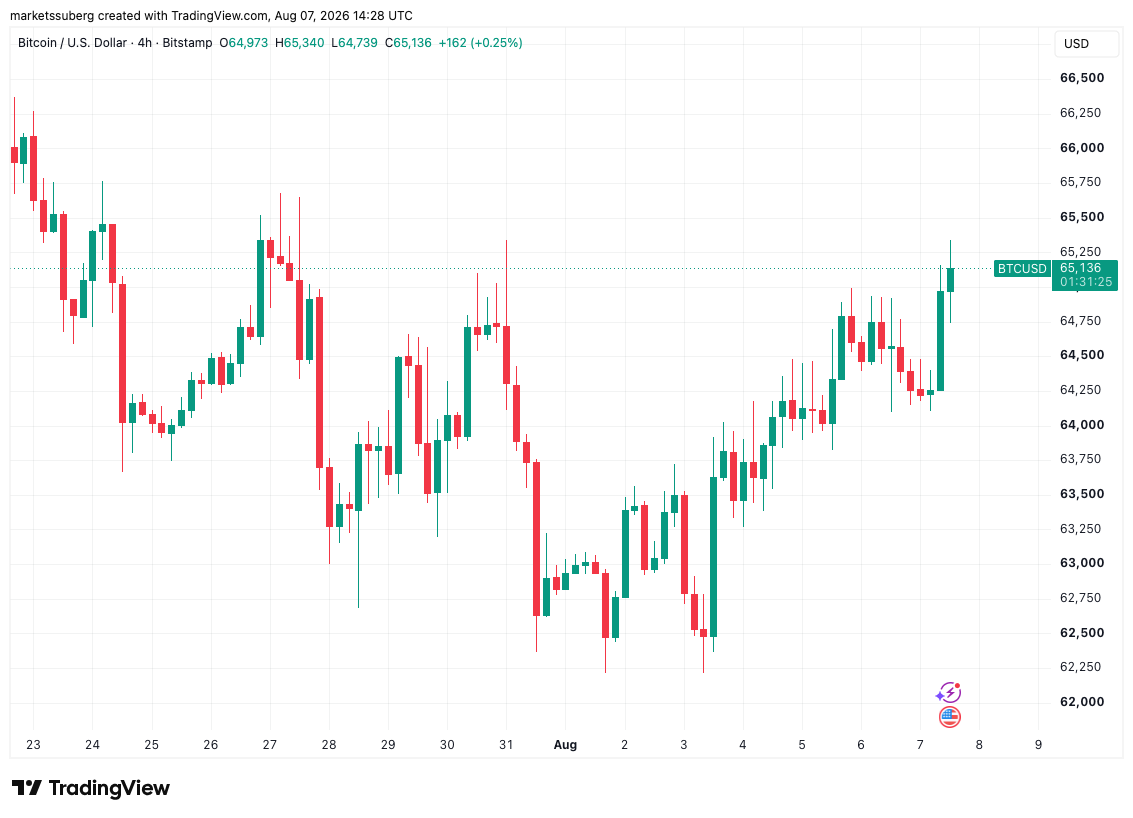
Bitcoin (BTC) hit new August highs into Friday’s Wall Street open as markets reacted to weaker US jobs numbers.
Key points:
- Crypto and risk assets gained after US nonfarm payrolls fell by 23,000 in July.
- Fed interest-rate bets for September shift from a 0.25% hike to a pause on signs of a weaker labor market.
- Bitcoin and altcoins stayed “resilient” after a week of bearish surprises, per analysis from QCP Capital.
Crypto, stocks higher on low nonfarm payrolls print
Data from TradingView showed BTC/USD hitting $65,340 on Bitstamp, up 1.3% on the day, as fresh US labour-market data was released.
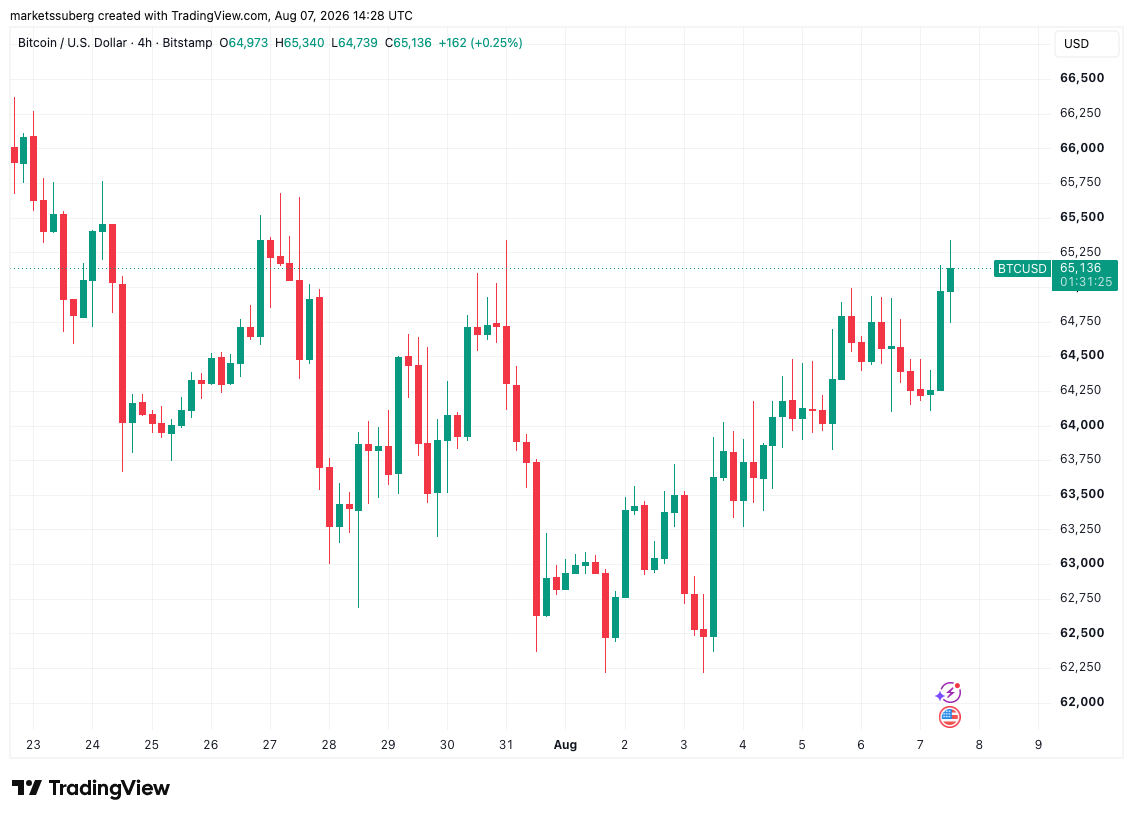
BTC/USD four-hour chart. Source: Cointelegraph/TradingView
The US economy lost 23,000 jobs in July, per nonfarm payrolls data from the Bureau of Labor Statistics (BLS), with the unemployment rate at 4.1%, numbers it described as “little changed” versus the month prior.
“The change in total nonfarm payroll employment for May was revised down by 66,000, from +129,000 to +63,000, and the change for June was revised down by 37,000, from +57,000 to +20,000. With these revisions, employment in May and June combined is 103,000 lower than previously reported,” an official statement added.
The combination of negative July values and downward revisions appeared to boost both crypto and US stocks, with traders linking weaker labor-market conditions with potential policy softening from the Federal Reserve.
The S&P 500 index opened 0.5% higher, while the tech-heavy Nasdaq Composite Index added just over 1%.
Data from CME Group’s FedWatch Tool reveals that markets are now expecting the Fed to hold interest rates at current levels at its September meeting. As late as yesterday, majority odds had favored a 0.25% rate hike.
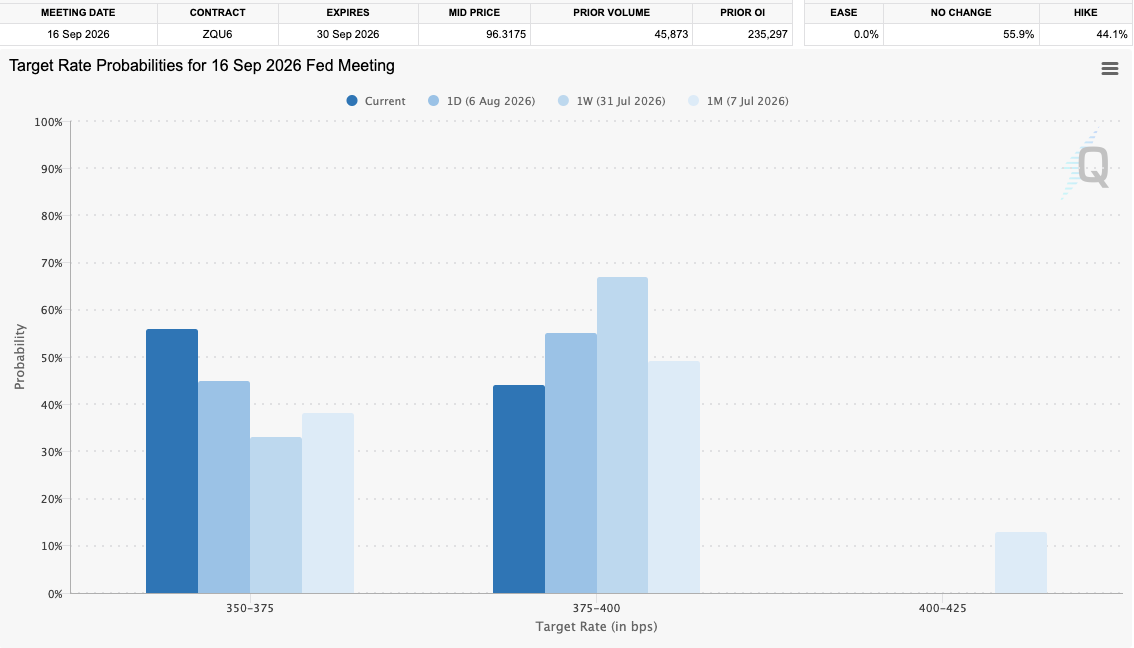
Fed target-rate probability comparison for September FOMC meeting. Source: CME Group
Prior to the employment data release, Ryan Lee, chief analyst at Bitget Research, said that it would “set the tone” for both the September meeting and the Fed’s annual economic Jackson Hole economic symposium, taking place at the end of August.
Fabian Dori, CIO at Sygnum Bank, predicted that Fed chair Kevin Warsh would be influenced by the extent to which payrolls data shifted lower.
“An orderly slowdown supports the liquidity relief case, while a print weak enough to raise growth concerns can still pressure risk assets even as rate odds move,” he said in comments sent to Cointelegraph.
Analysis praises Bitcoin, altcoin “resilience”
In its latest crypto and macro overview released on the day, trading company QCP Capital described the macro picture as “uncertain” for Bitcoin.
Related: Bitcoin price-metric basket sees longest capitulation since FTX blow-up: Glassnode
“For crypto, the week’s price action points to resilience rather than clear directional confirmation,” it summarized.
QCP noted that the fallout from the Coldcard wallet exploit, along with BTC sales by corporations including Strategy, had only sparked “limited demand for panic protection” on options markets.
Previously, Cointelegraph reported on option traders’ expectations for a BTC price trading-range breakdown to occur next month.
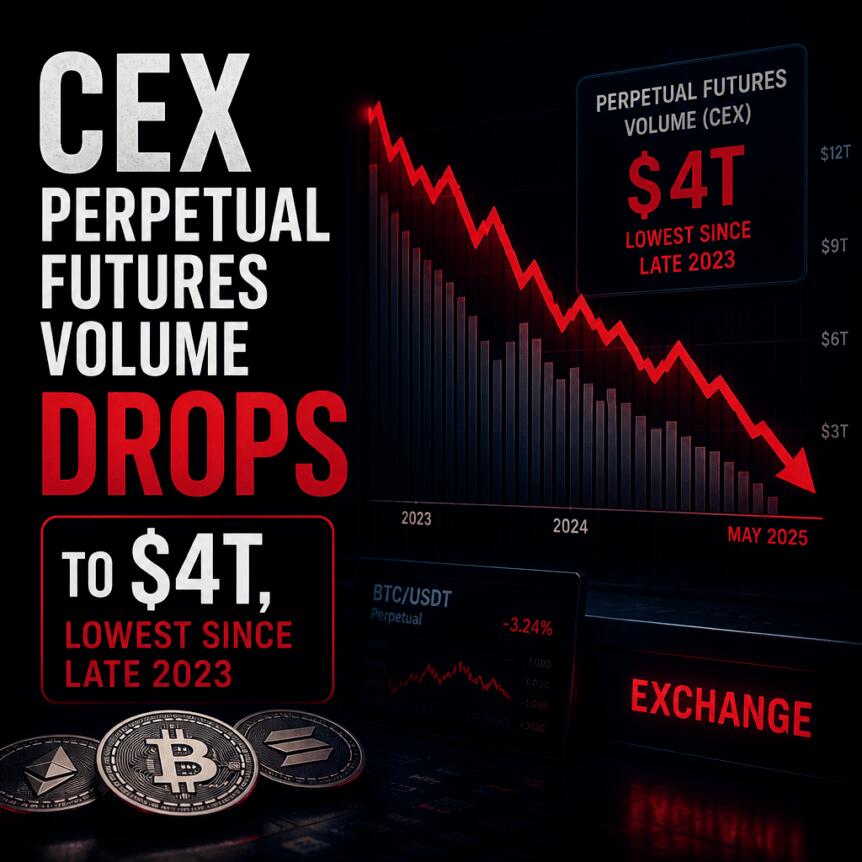
Trading activity in both centralized and decentralized crypto derivatives cooled sharply in July, with perpetual futures volumes hitting multi-month lows across major venues. The slowdown points to thinner speculative momentum—an environment where liquidity and positioning often matter as much as spot demand.
According to CryptoRank’s data posted on X, perpetual futures trading volume on centralized exchanges (CEXs) fell to $4 trillion in July, the lowest level in 31 months since December 2023. The same report also tracked weakness across spot markets during the month, reinforcing the picture of reduced overall market participation.
Key takeaways
- CryptoRank data shows CEX perpetual futures volume dropped to $4T in July, a 31-month low.
- Binance accounted for most CEX perp volume at $1.4T, while OKX and Bybit posted $607B and $300B respectively.
- Coinglass reports CEX spot trading volume declined 23.6% in July to $13.6B from $17.8B at the start of the month.
- DefiLlama data indicates DEX perpetuals fell to $531B in July, near a one-year low, with DEX open interest also sliding.
- On leading DEX Hyperliquid, tokenized RWAs grew in importance, even as overall DEX perp activity declined.
CEX perpetual futures slide to a 31-month low
CryptoRank said that in July, perpetual futures trading on centralized exchanges totaled $4 trillion—down to the weakest point since December 2023. The month’s decline followed a brief recovery between April and June, after which volume fell again across major venues.
Binance led CEXs by volume with $1.4 trillion in monthly perpetual futures activity, according to the CryptoRank post. OKX came next with $607 billion, followed by Bybit at $300 billion.
For market participants, changes in perp volume can be a useful proxy for speculative activity and the willingness of traders to take leveraged exposure. When volumes compress—especially after a short rebound—liquidity and price discovery in derivative-heavy markets can become less resilient, even if underlying spot interest remains intact.
Spot weakness and the pullback in derivatives activity
Part of the broader contraction appears tied to spot trading as well. Coinglass data cited in the report shows daily spot crypto trading volume fell 23.6% from July 1 to July 31, dropping from $17.8 billion to $13.6 billion.
This matters because spot and derivatives flows often move together during risk-on or risk-off phases. With spot participation weakening over the month, it becomes more difficult for perp markets to maintain high turnover—particularly when traders are less eager to hedge or express directional bets through leverage.
DEX perpetuals near a one-year low, open interest declines
Derivatives activity also weakened on decentralized exchanges. DefiLlama data indicates DEX perpetual trading volume fell to $531 billion in July, the lowest level since June 2025. The report also described a 21% decline from June 2026’s $676 billion.
Beyond volume, DEX open interest fell as well. According to the same DefiLlama figures, open interest on DEXs dropped to $17.9 billion in July from a September 2025 peak of $19.4 billion. Open interest reflects the total value of active, unsettled perp contracts and can help signal whether new capital is entering the market or existing positions are being reduced.
In other words, July’s slowdown was not just about lower trading counts—it also reflected less outstanding leveraged exposure on DEX venues.
Hyperliquid remains a volume leader as RWAs gain share
Even as overall DEX perpetual activity declined, Hyperliquid stood out as the leading platform. DefiLlama-tracked performance in the report shows Hyperliquid generated $199 billion in reported trading volume over the past 30 days.
What appears to have changed on Hyperliquid is not its dominance of volume, but the composition of that volume. A larger portion of Hyperliquid’s trading has come from tokenized real-world assets (RWAs). The report states that RWAs accounted for 32% of Hyperliquid’s second-quarter trading activity, which corresponded to 6.6% of the protocol’s $169 million quarterly revenue.
The shift toward RWAs also shows up in category rankings. The article notes that tokenized assets became Hyperliquid’s largest trading category for the first time last month, with RWAs representing 52% of the protocol’s total weekly trading volume between July 13 and July 19.
For traders and builders, this is a meaningful divergence from the broader July picture: while total DEX perp volume and DEX open interest declined, Hyperliquid’s internal mix leaned more toward tokenized assets. That suggests demand for certain contract exposures may remain sticky even when overall leverage appetite cools.
What to watch next
With both CEX and DEX perpetual activity at multi-month lows and spot volume also down in July, the next signal for traders will likely be whether August brings renewed spot engagement and sustained perp open interest, or whether the contraction becomes a longer trend. At the same time, the growing RWA share on Hyperliquid raises a separate question: can tokenized-asset flows offset softer broader derivatives momentum in the months ahead?

Then came No Child Left Behind. Signed into law in 2002, it promised that standards, testing, and accountability would finally close gaps in student achievement across race and class. The law succeeded in exposing disparities, but it also encouraged teaching to the test and narrowed what many schools taught. The gaps it sought to eliminate largely remained.
Now AI has become the latest reform wrapped in transformational promises. Its advocates are right about some of its potential in education. Generative AI can help explain difficult concepts, provide immediate feedback, translate instructional materials, and make individualized support more accessible than ever before. Teachers can use it to differentiate instruction and reduce routine administrative work. Used well, AI will almost certainly improve teaching and learning in many classrooms.
But what occurs in classrooms has never been the primary obstacle to educational equality. Students do not arrive at school with equal access to stable housing, nutritious food, quality health care, reliable internet, experienced teachers, safe neighborhoods, or family resources. These inequalities accumulate long before a child enters kindergarten and continue long after the school day ends. Chatbots, no matter how well-designed, will not erase them.


Phantom will end support for the Monad network on Aug. 26, the wallet company said on X on Friday, cutting off the high-throughput EVM chain roughly nine months after its November 2025 mainnet launch. "We'll soon begin notifying Monad users in-app with links to support articles that share options… Read the full story at The Defiant

Hitachi Energy India Q1 Results: Net profit rises over twofold to Rs 294 crore

Avoiding These 3 Things in Midlife Is Linked to 13 More Dementia-Free Years
“Heated Rivalry” season 2 reveals hotly anticipated Troy and Harris casting: Meet the new hockey lovers


-

 Fashion7 days ago
Weekend Open Thread: Wit & Wisdom
-

 Politics7 days ago
Meta enters AI-training agreement with far-right ‘propaganda rag’ Newsmax
-

 Politics5 days ago
Zack Polanski: an incitement to murder Nigel Farage?
-

 Crypto World6 days ago
MicroStrategy Post-Earnings CLARITY Act Push Could Add New Catalyst for Its Stock
-

 Crypto World6 days ago
XRP Ledger v3.3.0 brings five institutional features
-

 Crypto World7 days ago
New York sues Kalshi over prediction market gambling
-

 Crypto World5 days ago
Crypto PAC spending tops $2M in Michigan House race
-

 Business5 days ago
DTCR: Deleveraging And A Hedge Fund Collapse Point To A Possible AI Bottom
-

 Tech5 days ago
ESET tracks rise in malicious AI skills and adaptable malware
-
 Crypto World7 days ago
3 Fed Officials Just Explained Their Rate Hike Vote: Is Inflation Winning?
-

 Sports6 days ago
France Cricket implodes: letters hidden in a drawer and a board at war
-
Crypto World5 days ago
XRP Ledger urges node upgrade after manifest flood
-

 Crypto World6 days ago
Moneyflip CEO charged in $40K murder-for-hire plot
-
 Sports7 days ago
Bruno Fernandes decision made as Man United ‘discuss’ striker transfer option
-
Business7 days ago
FIFA has scrapped $20 billion World Cup sell-off plan, New York Post reports
-

 News Videos6 days ago
Financial Crash Expert: The 90-Day Collapse Timeline They Are Desperately Hiding.
-

 Sports2 days ago
Jordan Coyle & Cordiamo take Laya Arena Stakes at RDS
-

 Sports7 days ago
Commonwealth Games 2026 Live Updates | Day 9 CWG 2026: Lovlina Borgohain, Sachin Siwach Enter Final After Indian Judokas Script History
-
 Crypto World4 days ago
US Tech Stocks See Largest 5-Week Inflow in History: Can Nasdaq Break Its Downtrend?
-
 NewsBeat6 days ago
Tourist plane on sightseeing flight in Peru crashes into a field, killing all 13 people on board
You must be logged in to post a comment Login