
Crypto World
Ethereum Price Analysis: After a 35% Rally, Is ETH Ready for Another Leg Higher?

Ethereum’s sharp breakout has significantly improved its market structure, with strong momentum carrying the price toward the $2.5K region. While bullish continuation remains possible, the increasingly extended move leaves ETH vulnerable to a temporary pullback or sideways consolidation if supply begins to increase.
Ethereum Price Analysis: The Daily Chart
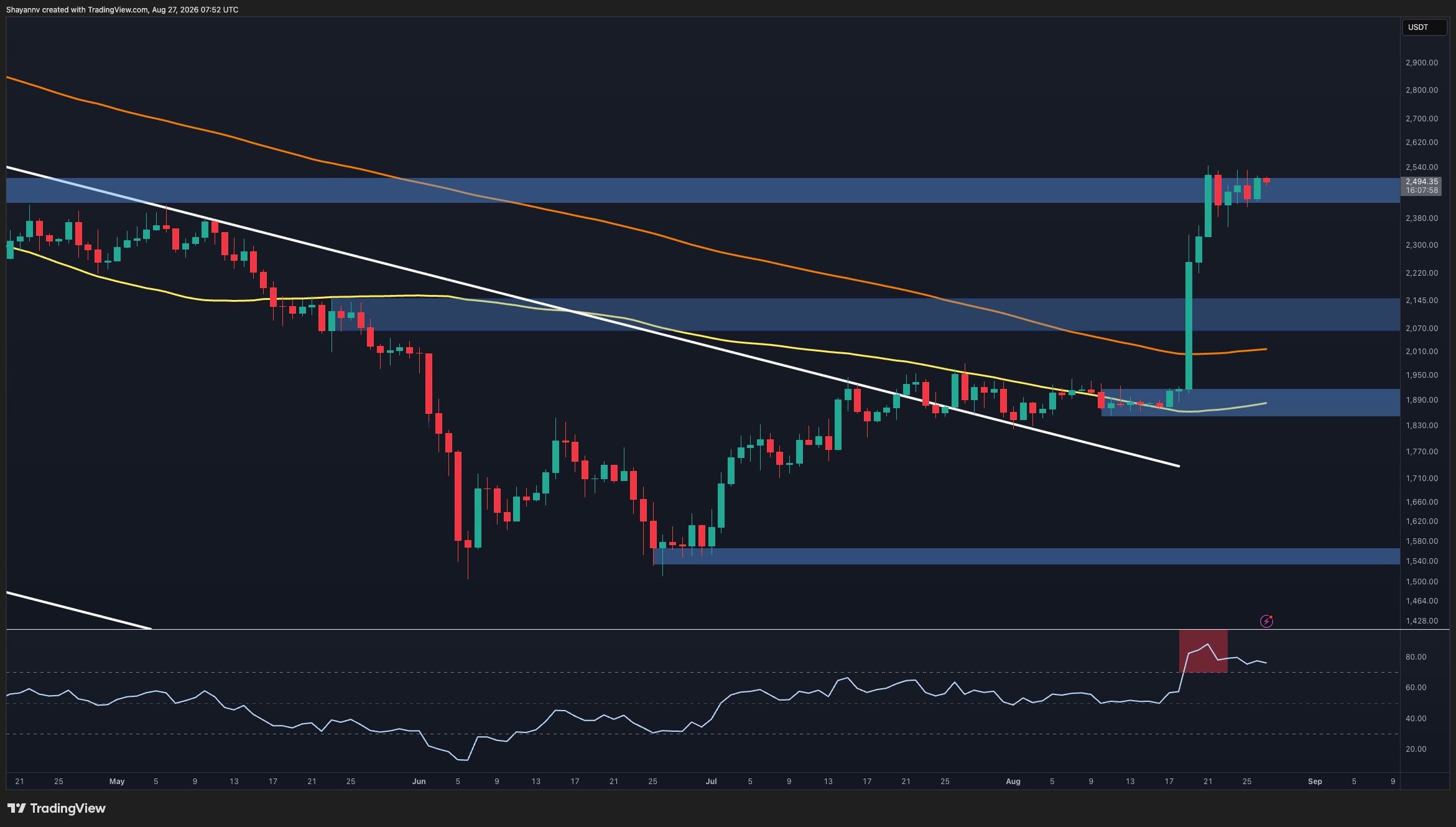
On the daily timeframe, Ethereum has decisively broken out of its prolonged bearish structure. The impulsive rally from the $1.85K-$1.92K demand zone pushed the price through the descending trendline, the major moving averages, and the $2.07K-$2.15K resistance zone with considerable strength.
ETH is now trading around $2.5K and testing the major $2.4K-$2.5K resistance zone. Momentum remains firmly bullish, supporting the possibility of continuation if buyers can absorb the available supply around this area.
However, the RSI has recently entered overbought territory following the vertical advance. This does not necessarily signal an immediate reversal, but it does indicate that the market is becoming increasingly extended. If supply increases around $2.5K, ETH could enter a period of sideways consolidation or begin a corrective pullback before attempting another leg higher.
The $2.07K-$2.15K zone represents an important support area in the event of a deeper correction, while the former $1.85K-$1.92K consolidation range remains the broader structural support.
ETH/USDT 4-Hour Chart
The 4-hour chart highlights the strength of the recent expansion more clearly. Ethereum surged almost vertically from around $1.9K and has since begun consolidating inside the $2.43K-$2.51K resistance zone.
Despite the lack of immediate follow-through above $2.5K, the short-term structure remains bullish. A decisive breakout and acceptance above the $2.51K region could indicate that buyers remain in control and open the door to further upside.
Nevertheless, after such an aggressive rally, a retracement would be technically reasonable. The first notable pullback target is the $2.22K-$2.31K zone. If selling pressure becomes more substantial, the second support region around $2.07K-$2.12K could become relevant.
Therefore, the primary scenario remains a bullish continuation based on the strength of momentum. Yet, increasing supply around the current resistance could first produce either a temporary correction toward these pullback zones or a sideways consolidation phase that allows the market to cool down.

Sentiment Analysis
The liquidation data adds another reason to expect potentially choppy price action in the short term. Liquidity is present on both sides of Ethereum’s current price, indicating that neither buyers nor sellers have established complete control.
This balanced positioning increases the possibility of sideways consolidation accompanied by liquidity sweeps in both directions. Price could temporarily move above or below the developing range to clear leveraged positions before establishing its next sustained trend.
Combined with the technical picture, this suggests that ETH’s broader momentum remains favorable for bullish continuation, but the path higher may not be straightforward. A period of consolidation or a temporary pullback could occur first as the market absorbs supply following the recent impulsive rally.

The post Ethereum Price Analysis: After a 35% Rally, Is ETH Ready for Another Leg Higher? appeared first on CryptoPotato.



Bitcoin price prediction has the leading digital asset trading at $79,400, down -0.4% on the day, as the market digests a violent breakout that briefly punched the price above $81,000 before sellers stepped in.
The pullback looks orderly rather than panicked, more consolidation than capitulation. There’s a bigger question sitting underneath this chart, and it involves a number most retail traders haven’t heard yet.
The move followed a decisive break above the long-standing descending trendline and the $66K-$67K resistance band that had capped BTC for months. Price then cleared the $72K-$74K supply zone in a single expansion leg, tagging roughly $79K-$81K before easing back.
Stronger-than-expected US PCE inflation data triggered some of the profit-taking, hitting gold and equities alongside crypto. That macro sensitivity is worth flagging: rate-path repricing still moves BTC more than most technical levels do, and the next several CPI/PCE prints will matter more than any chart pattern.
Bitcoin Price Prediction: Can BTC Hit $83K This Week?
BTC is consolidating in the high-$78K to $79K range after tapping a three-month high near $81,235.Recent price-prediction coverage flags $80K-$83K as the critical resistance shelf, a former swing-high zone likely to attract sellers on approach. Volume has stayed elevated through the pullback rather than collapsing, which typically favors trend continuation over reversal.
Bull case: daily acceptance above $83,000 would satisfy the threshold CryptoQuant analysts cite for confirming a fresh bull-cycle leg, opening a path toward the $94K-$98K supply zone. Bernstein’s standing $150,000 target sits well beyond that.
Base case: continued chopping between $77K and $81K while the market absorbs the recent gain.
Bear case: a break below the $72K-$74K zone, which would undercut the structural-reversal thesis and point back toward deeper trend support near $65K-$66K. Options positioning into upcoming expiries could accelerate whichever direction wins.
Make Your Prediction Count With $25 For Free on Kalshi
Bitcoin Hyper Targets Early Mover Upside as Bitcoin Tests Key Levels
A position taken near $66K looks smart right now. Bitcoin price prediction says that buying BTC at $79,500 and chasing a move toward $83K is a different trade; the easy asymmetry has already happened.
For traders who missed the trendline break, chasing spot exposure at these levels means capped upside for outsized risk. That’s pushed capital toward earlier-stage plays with more room to run.
Bitcoin Hyper ($HYPER) is building the first Bitcoin Layer 2 with native SVM integration, smart contracts running faster than Solana itself, settled with Bitcoin’s base-layer security.
The presale has raised $33,083,950.35 at a token price of $0.0136853, with staking rewards on offer at an unspecified high APY. Core features include a decentralized canonical bridge for BTC transfers and low-latency execution to address Bitcoin’s long-standing throughput and programmability gaps.
Trade Securey With 0% Trading Fees on MEXC
This is not financial advice. Crypto markets are highly volatile and presale tokens carry elevated risk. Always conduct independent research before investing.
The post Bitcoin Price Prediction: Can BTC Reclaim $80K This Week? appeared first on Cryptonews.
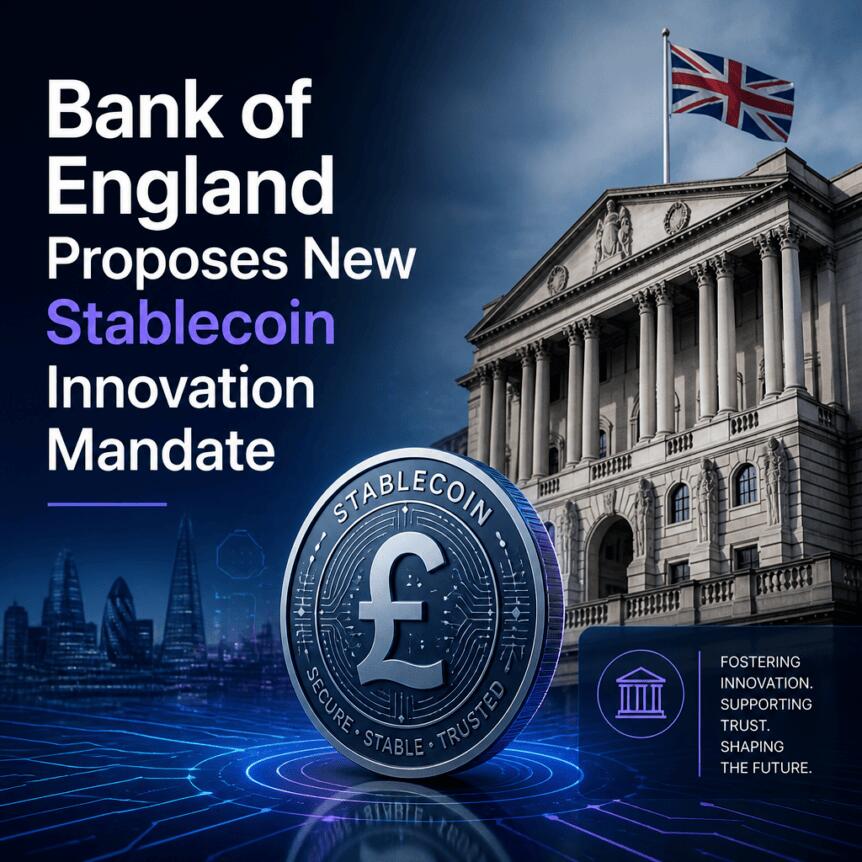
The UK government is proposing to give the Bank of England a secondary mandate focused on innovation in digital payments, explicitly covering payment systems that rely on “digital settlement assets” such as stablecoins. The move, announced by HM Treasury on Thursday, keeps financial stability as the Bank of England’s primary responsibility while carving out room for experimentation and development of emerging forms of digital money.
According to HM Treasury, the change would apply to the central bank’s oversight of payment infrastructure, with the expectation that the Bank of England will report progress to Parliament each year on how it is advancing the new payments innovation objective. The government plans to embed the mandate through amendments to the Financial Services and Markets Bill, which is set for further debate in the House of Lords on Sept. 7 and 9.
Key takeaways
- The Bank of England would gain a secondary objective to support innovation in payment systems and digital money, while financial stability remains the top priority.
- The mandate is intended to cover systems that use digital settlement assets, including stablecoins, linking UK stablecoin policy more directly to payments development.
- The Bank of England would provide annual updates to Parliament on its innovation work, potentially increasing public accountability for how stablecoin-related rules are implemented.
- The proposal is set to be incorporated through amendments to the Financial Services and Markets Bill, with House of Lords debates scheduled for Sept. 7 and 9.
- Industry reaction may hinge on the practical details of how the Bank of England’s annual reporting is used alongside existing stablecoin requirements.
Why the Bank of England’s “innovation” role matters for stablecoins
The announcement effectively broadens the Bank of England’s remit beyond purely stability-focused oversight. Under the proposal, the Bank of England would extend an existing regulatory approach applied to core market infrastructure—specifically central counterparties (CCPs) and central securities depositories (CSDs)—to also incorporate a payments innovation goal.
The significance for stablecoins is that the mandate is not limited to abstract research or central bank digital money alone. HM Treasury states that the mandate would cover payment systems using digital settlement assets, a phrasing that includes stablecoins and helps clarify that they are part of the UK’s wider payments technology agenda.
For market participants, this matters because regulatory emphasis can shape how quickly new payment rails move from pilot to deployment. A formal “innovation objective,” paired with parliamentary reporting, may also influence how the Bank of England balances caution with experimentation as stablecoin rules and related infrastructure testing develop.
Parliamentary reporting could intensify scrutiny
While the innovation mandate is described as secondary to financial stability, the details of implementation may determine how much room it creates for the stablecoin market to grow under the UK’s framework.
According to Maksym Sakharov, co-founder and CEO of WeFi, the annual reporting requirement could shift the balance toward greater public scrutiny. Sakharov told Cointelegraph that because the innovation objective is “secondary to financial stability,” it “overrides nothing,” but the Bank of England would still have to publish annual accounts of its work on payments innovation and digital money.
He suggested that this publication requirement could matter particularly because it would place additional attention on the stablecoin rules the central bank finalized in June. In other words, even if the innovation mandate cannot dilute stability obligations, the reporting component could increase the visibility of how those obligations are applied in practice.
Existing stablecoin requirements and a key reserve debate
Sakharov focused on specific requirements for “systemic stablecoin issuers,” including a reserve structure that—per his comments—requires issuers to keep at least 30% of their backing assets in non-interest-bearing deposits at the central bank.
He argued that the “reserve split is the first thing to fix,” adding that the requirement could influence whether a stablecoin business is commercially viable. This is a notable point for investors and operators because reserve rules directly affect cost structure, risk management, and the economics of issuance—factors that can shape which issuers can scale while still meeting compliance expectations.
Importantly, the Bank of England’s innovation mandate does not automatically change those reserve mechanics. However, by tying central bank reporting to digital payments innovation, the proposal could create additional pressure—politically and publicly—for regulators to explain how stablecoin market design aligns with broader payments modernization goals.
UK stablecoin momentum: from interoperability tests to cross-border alignment
The new mandate arrives as the UK increases its operational and policy work around stablecoins. In August, a group participating in the Bank of England’s Digital Pound Lab began testing whether a stablecoin could interoperate with a simulated digital British pound for a cross-border trade payment. HM Treasury and project reporting described the experimental platform as not using real customers or money.
Earlier, in mid-July, the UK and US published a joint statement on stablecoins that signaled intent to enable their use in cross-border finance and called for closer alignment between regulatory frameworks. The statement indicates the UK is seeking interoperability not just at the technical level, but also in how rules may converge across jurisdictions.
The UK’s approach also shows a pattern of adjusting earlier constraints. Cointelegraph previously reported that the Bank of England dropped plans to cap individual holdings at 20,000 British pounds and business holdings at 10 million British pounds, replacing those limits with a temporary cap of 40 billion pounds (about $52.9 billion) on issuance for each “systemic stablecoin.” That shift, paired with the July and August policy and testing activity, suggests UK regulators are working toward a structure that emphasizes systemic risk while allowing broader participation than earlier retail- and business-specific limits.
Additionally, the UK government’s direction to expand the Bank of England’s mandate fits within a broader effort to support innovation in tokenized and distributed ledger-based approaches—an idea echoed by City Minister Lucy Rigby, who said tokenisation and DLT could transform financial markets globally.
As lawmakers prepare for House of Lords debates on Sept. 7 and 9, market participants should watch not only whether the mandate is adopted, but also how the Bank of England translates “innovation” into measurable actions—especially in areas like systemic issuer requirements and reserve design that currently influence stablecoin business economics.


The courtroom combat across state and federal courts is so far producing roughly split outcomes, suggesting a big job may be coming for the Supreme Court.

Fruits and vegetables contain different antioxidants that protect your skin from damage from UV rays and pollution, she says. Omega-3 fatty acids, found in oily fish, walnuts, and flaxseeds, reduce inflammation in the body, which may guard against skin conditions.
Also, limit sugar, alcohol, and ultra-processed foods, like cookies, bacon, and sugar-sweetened beverages, Bragagnini adds. These foods may increase oil production in the skin and affect collagen production.
Overall, Green recommends the Mediterranean diet, which incorporates many of these principles and has been shown to benefit overall health. Research shows that the diet can also help manage inflammatory skin conditions, like acne or psoriasis.
Yet diet alone is “not going to necessarily change your skin in a month,” Katta says. It’s a long-term approach.
When to see a dermatologist about your skin
If you’re struggling with acne or are bothered by age-related changes like wrinkles, sagginess, or sun spots, see a dermatologist.


Crypto wallet maker OneKey and cybersecurity firm Anzen claim to have hacked version 1.22.1 of Ledger’s Ethereum app. Ledger outright disagrees, saying, “No Ledger user was hacked.”
Earlier today, OneKey founder Yishi Wang detailed how his security team reproduced a transaction replacement attack that takes place while a user is reviewing a legitimate transaction.
Wang declared, “We hacked ledger,” and warned users on Ledger’s older Ethereum app to update it, noting that Ledger has already fixed this in version 1.22.3.
Ledger says OneKey didn’t actually hack anything
Ledger’s Chief Technology Officer Charles Guillemet responded hours later, claiming that “reproducing an already-patched bug is not ‘hacking Ledger.’”
He added, “No user was hacked. No exploitation in the wild. Running an exploit against an old version after the fix has shipped is a lab exercise, not a finding.”
A Ledger spokesperson told Protos that OneKey “took the already disclosed findings and tried to replicate them in a lab environment.”
Read more: KuCoin criticized for helping ‘launder’ $9.5M from fake Ledger app
The Ledger Donjon team claimed this fix was shipped on August 13 in version 1.22.2, further contradicting OneKey’s claims.
Protos has reached out to OneKey for comment and will update this piece should we hear anything back.
Got a tip? Send us an email securely via Protos Leaks. For more informed news and investigations, follow us on X, Bluesky, and Google News, or subscribe to our YouTube channel.
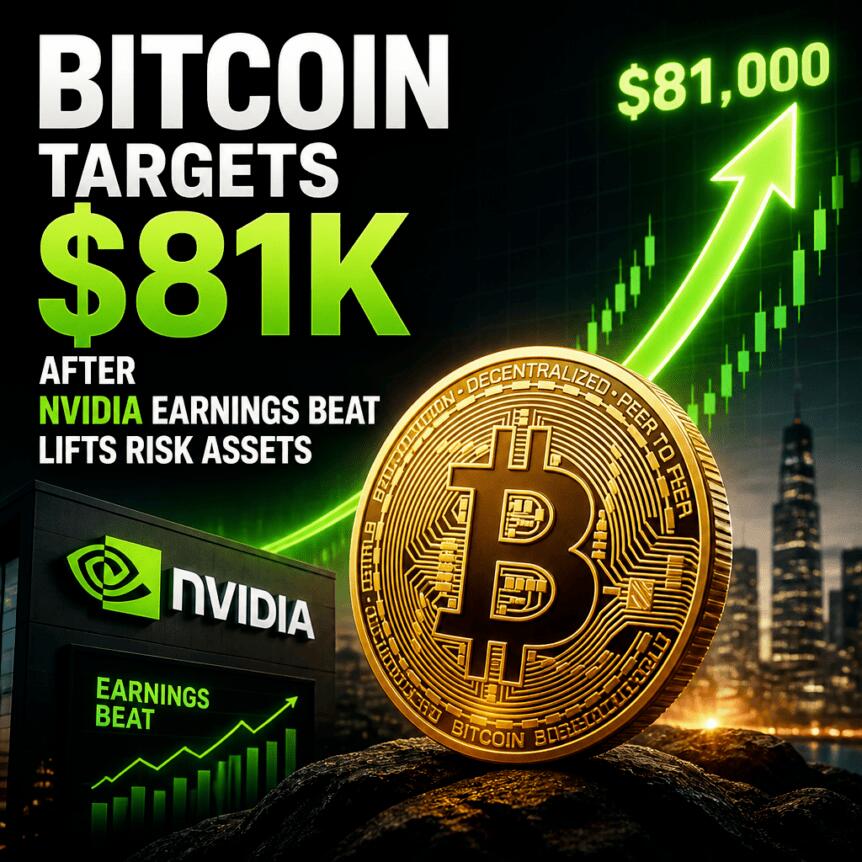
Bitcoin steadied above the psychological $80,000 level as a sharp rebound in US equities helped risk assets across markets. TradingView data showed BTC/USD pushing to a local high of $80,808 around the Wall Street open, with traders watching whether the latest move can hold as support.
The catalyst behind the broader bounce was Nvidia’s earnings surprise. Nvidia reported Q2 earnings of $96.2 billion—nearly $4 billion above expectations—sending its stock up more than 9% and lifting the Nasdaq Composite as investors rotated back into high-growth equities.
Key takeaways
- BTC reclaimed the $80,000 area after Nvidia’s earnings beat sparked a broader lift in US stocks and sentiment.
- Markets are focused on Fed chair Kevin Warsh’s Jackson Hole keynote on Friday amid uncertainty around inflation and the Fed reaction function.
- CoinGlass data showed crypto liquidations running around $417 million over 24 hours, suggesting pressure is easing as buyers absorb nearby sell liquidity.
- Analyst David Eng says the derivatives “liquidity wall” looks weaker ahead of August options expiry on Deribit, potentially improving the odds of a cleaner upside path if $82,000 breaks.
Nvidia lifts risk sentiment, Bitcoin follows
Nvidia’s upside surprise quickly spilled into crypto markets. After Wednesday trading, the company posted Q2 earnings of $96.2 billion—nearly $4 billion higher than expectations—prompting a major rally in its shares on Thursday. The stock surge translated into a wider market tailwind: the Nasdaq Composite was up about 1% at the time of writing, while Nvidia’s market capitalization increased by more than $400 billion.
That stock-market momentum mattered for Bitcoin in the near term because it reinforced the “risk-on” conditions that typically support higher-beta assets. TradingView charts reflected this with BTC/USD moving back toward and above $80,000 as bulls tried to defend the level early in Thursday’s session.
Commentary from trading resource The Kobeissi Letter on X highlighted the magnitude of the move, writing that Nvidia appeared on track for one of the biggest single-day market cap gains in stock history.
Jackson Hole focus returns as rates remain the swing factor
Even with crypto riding equity strength, attention is shifting quickly to monetary policy. Jackson Hole is already underway, and investors are bracing for Fed chair Kevin Warsh’s keynote speech on Friday.
The underlying reason is simple: Warsh’s comments could influence expectations for how quickly interest rates move—especially given the mix of inflation data and volatility in government bond yields referenced in coverage leading up to the event. According to CNBC, Kathy Bostjancic, chief US economist at Nationwide, said Warsh’s address is likely to be “extremely key” because long-term rates have risen and uncertainty remains about the inflation path and the Fed’s reaction function.
For Bitcoin traders, that matters because shifts in the interest-rate outlook often change how investors price duration risk, liquidity, and correlation across assets. When rates stabilize or expectations soften, conditions can become more supportive for crypto; when they reprice upward, momentum can fade quickly.
Sell-side liquidity appears to thin ahead of August options expiry
In crypto-specific flows, liquidation activity offered another clue. CoinGlass data showed liquidations edging higher to roughly $417 million over the prior 24 hours. The key nuance is how the market behaved: buyers were reportedly chipping away at an area of significant ask liquidity, helping Bitcoin hold firm rather than accelerating lower.
Earlier reporting cited a liquidity zone extending up to $86,000 that had been creating friction for additional upside. The current setup appears different in timing: with a major derivatives milestone approaching, that resistance may start to lose potency.
On the derivatives side, analyst David Eng described the prevailing “liquidity wall” as “weakening” ahead of Friday’s August options expiry on Deribit. The expiry cited in the report is $6.58 billion, corresponding to 81,700 BTC at the time referenced, with Eng suggesting that once Bitcoin clears $82,000, the path to higher levels (noted as $85,000+) could become “much cleaner.”
Options expiry events can increase volatility because market makers and traders rebalance positions when contracts settle. When open interest is concentrated around certain strikes, price often gravitates toward those levels as hedging and arbitrage dynamics intensify near the cutoff.
What traders should watch next
The near-term question for Bitcoin is whether it can consolidate above $80,000 and then challenge $82,000 with less friction than earlier in the week. If the liquidity pressure Eng flagged continues to dissipate into the August options expiry window, traders may see a more decisive move upward; if rates guidance from Warsh jolts markets the other way, the support narrative could be tested again quickly.
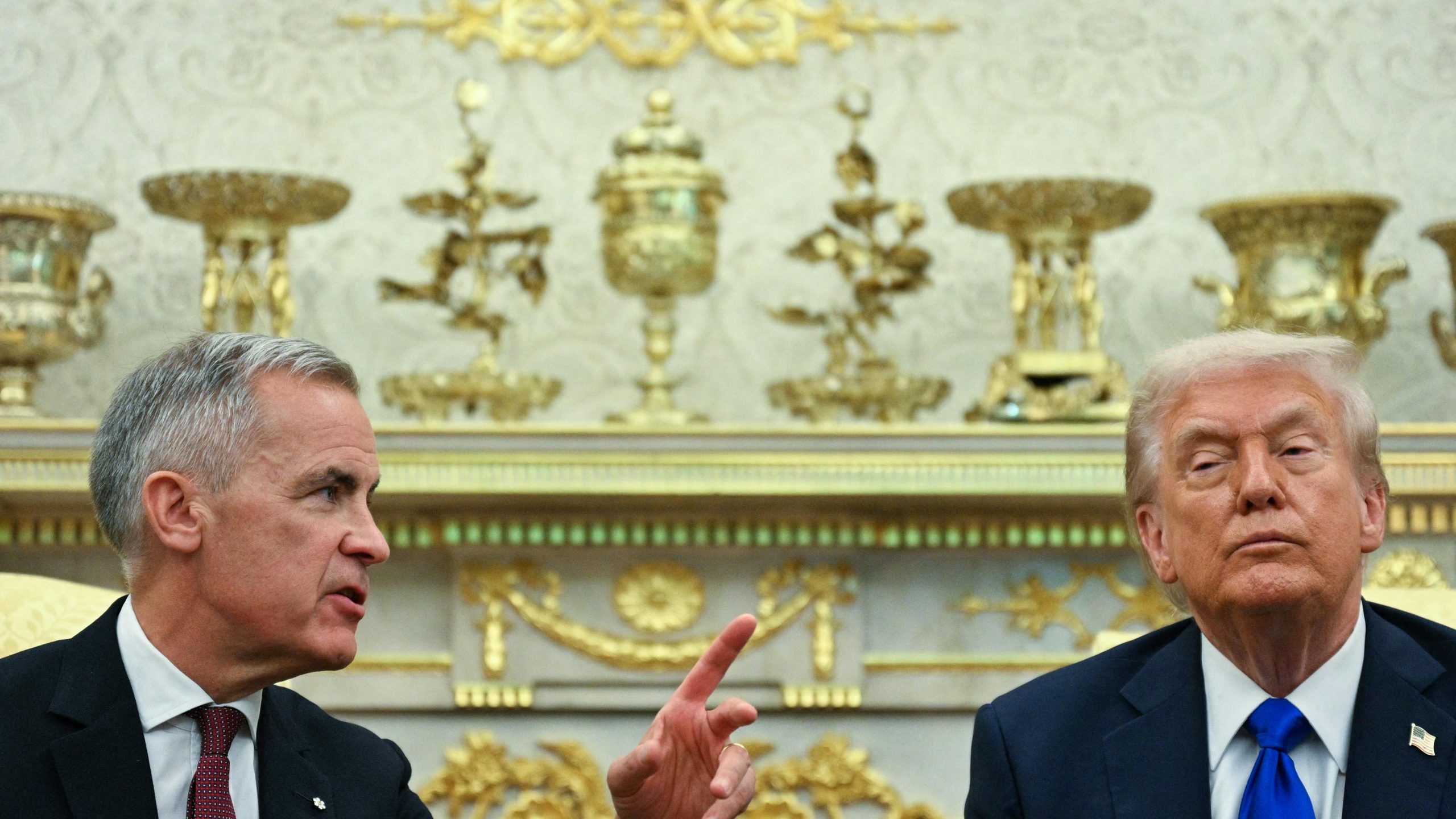
In response, Canada has imposed retaliatory tariffs of up to 50% on certain U.S. goods.
Trump has threatened to increase automobile tariffs on Canada to 50%, claiming: We don’t need Canada, they need us.”
The Trump Administration has also revived its rhetoric of referring to Canada as a “state”—a nod to Trump’s vocal ambition to annex Canada and make it the 51st state, an idea he has floated repeatedly since returning to the White House last year.
Vice President J.D. Vance during a speech in Brewer, Maine, on Monday said: “We have to remember, Canada is a state—sorry, Freudian slip.”
Canadian Prime Minister Mark Carney, meanwhile, has drawn focus to Canada’s burgeoning trade relations with other countries.
“Over the last year alone, Canada has signed more than 20 trade and security deals across five continents,” he said Wednesday. “Canada is now the best connected economy in the world,” he claimed, pointing towards trade alliances with countries in South Asia and Europe.
In Solana news today, SOL is trading at $105, up +9% over the past 24 hours, as validators weigh a governance shift that could reshape the network’s supply curve for years. Two proposals are quietly doing what most SOL price action can’t: forcing a real conversation about scarcity.
Solana voters are deciding on SGP-0002 and SGP-0003, formal votes tied to technical proposals SIMD-0550 and SIMD-0553, with voting running through epoch 1023 (expected around 15:30 UTC on Aug. 27). SIMD-0550 would double the annual disinflation rate from 15% to 30%, pushing the network toward its 1.5% terminal inflation rate by early 2029 instead of 2032.
Authors of the proposal estimate roughly 18.9 million fewer SOL issued over six years, worth an estimated $1.4-$1.5Bn based on 21Shares’ modeling. Meanwhile, SIMD-0553, which adds burn mechanics to compute-unit fees, has reportedly already cleared review and could push daily burns from 600-800 SOL to 7,500-9,000 SOL based on current network activity.
Tighter emissions rarely move price alone; execution and adoption still do the heavy lifting. But the timing matters: this vote lands as SOL grinds back above the psychologically loaded $100 mark, and traders are now weighing tokenomics against a chart that’s already showing signs of life.
Solana News: Can SOL Hold $100 Support This Week?
SOL’s move to $105 marks a nearly 5% intraday gain, with the session range spanning $96.93 to $102.40 — a wide band that suggests volatility is picking up alongside the governance news.
The $100 level is doing double duty here: it’s both a psychological line and recent resistance-turned-support. Reclaiming and holding above it opens a path toward $110-$120 if the SIMD votes finalize cleanly and burn data confirms the projected acceleration.
Base case: SOL consolidates in the high-$90s to low-$100s while the market waits on final vote confirmation and implementation timelines — nothing moves fast until activation is locked in.
Bull case: a clean SGP-0002 pass plus confirmed burn increases triggers a supply-shock narrative, dragging SOL toward prior highs.
Bear case: failed votes or delayed implementation send SOL back toward the mid-$90s, undercutting the scarcity thesis entirely.
Staking yield compression (down from 5.25% to 4.34% in year one under 21Shares’ model) is a real cost that holders should weigh against the upside from burning, similar to how Ethereum’s staking economics are scrutinized whenever validator incentives shift. For now, SOL’s structure favors patience over conviction.
Never Miss a Swing Again: Use AI Copy Trading Bots From CryptoHopper
Maxi Doge Targets Early Mover Upside as Solana Tests Key Levels

A near-5% SOL rally feels good if a position was already open. For anyone watching from the sidelines and following Solana news,, chasing SOL at $105 after this move means buying into an asset that needs a governance vote and multi-year implementation to fully realize its bull case, not exactly a quick trade.
That’s the gap early-stage presales are built to fill, and it’s part of why capital has been rotating into meme-coin presales during periods like this.
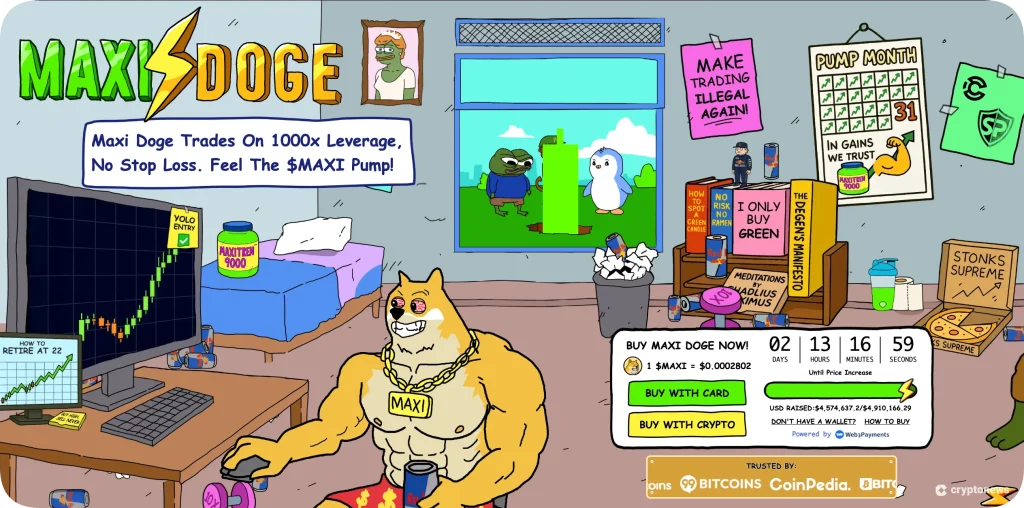
Maxi Doge ($MAXI) leans into leverage-trading culture rather than subtlety, a 240-lb canine mascot built around “1000x leverage” energy and holder-only trading competitions with leaderboard rewards.
The token sits at $0.0002835, with $4,849,428.64 raised so far and dynamic APY staking live for early holders. A Maxi Fund treasury backs liquidity and partnerships, and the marketing is unapologetically gym-bro (tagline: “never skip leg-day, never skip a pump”).
Get Ahead of the Next Big Meme Coin Launch Here Make Your Prediction Count With $25 For Free on Kalshi
The post Solana News: Proposals Could Cut $1.5Bn in SOL Issuance appeared first on Cryptonews.
Ripple Prime, the multi-asset prime brokerage arm of Ripple, has rolled out a Delta One offering aimed at institutional investors—bringing US equity derivatives into its existing platform. The new service lets clients trade total return swaps tied to US-listed equities and indexes, alongside digital assets.
In a Thursday announcement, Ripple Prime said the Delta One business is designed to broaden how hedge funds, asset managers and other financial institutions gain exposure to returns without needing to hold the underlying assets directly.
Key takeaways
- Ripple Prime launched a Delta One service offering total return swaps linked to US-listed equities, indexes and digital assets.
- Clients can execute with a single counterparty and cross-margin exposures across the supported asset classes, according to Ripple Prime.
- The offering is positioned for hedge funds, asset managers, and other financial institutions seeking flexible access to returns.
- Ripple Prime says it has more than $1 billion in regulatory net capital, supporting its prime brokerage and financing operations.
- Growth funding included a $275 million senior unsecured notes private placement earlier this year and a $200 million credit facility in May.
A Delta One bridge from prime brokerage to equity derivatives
At the core of Ripple Prime’s launch is a familiar structure from traditional markets: total return swaps. These contracts allow an investor to receive exposure to an asset’s overall returns—typically reflecting price appreciation and other relevant components—without owning the asset itself.
Ripple Prime’s Delta One service extends that approach to US equity-linked instruments. The company said clients can use the platform to obtain exposure through total return swaps referencing US-listed equities and indexes, as well as digital assets. For institutional participants, that combination matters because it can streamline portfolio construction across conventional and crypto-native exposures within one workflow.
Cross-margining and a “single counterparty” approach
Ripple Prime said the product is intended for clients that want efficiency in execution and risk management. By allowing clients to transact with a single counterparty and to cross-margin exposures across supported asset classes, the firm is effectively aiming to reduce operational friction that often comes with running multiple counterparties and separate margin regimes.
The company also framed the service as available “around the clock,” highlighting the practical reality that digital asset markets operate continuously while US equities run on defined trading hours. For multi-asset desks, the pitch is that exposure can be managed more continuously, rather than requiring separate processes across asset types.
How Ripple Prime’s platform is built—and what’s backing it
Ripple Prime is not starting from zero in the institutional services stack. The firm previously offered prime brokerage, clearing, and financing support across foreign exchange, derivatives, fixed income and digital assets. With the Delta One launch, Ripple Prime is adding another layer on top of that infrastructure—specifically by incorporating US equity derivatives exposure into its total return swap toolkit.
Ripple Prime also stated that the business has more than $1 billion in regulatory net capital. In practical terms, net capital is a key metric for firms operating in brokerage and derivatives-adjacent businesses, and it can influence how much risk capacity and lending or financing activity a firm can support.
Funding and corporate buildup behind the expansion
The Delta One announcement fits into Ripple Prime’s broader expansion path. Ripple Prime was created after Ripple completed its $1.25 billion acquisition of Hidden Road in October 2025 and then rebranded the business.
Earlier this year, Ripple Prime moved to strengthen its funding base for growth. In August, it closed a $275 million private placement of senior unsecured notes, according to earlier reporting from Cointelegraph. In May, Ripple Prime also secured a $200 million debt facility from funds managed by Neuberger Specialty Finance to expand its lending capacity for institutional clients, as covered previously by Cointelegraph.
Taken together, those steps suggest Ripple Prime is working to scale lending and prime services capacity while broadening the set of products available to institutional clients. The Delta One launch extends that scaling effort into equity-linked derivatives exposure, rather than keeping the product offering confined to digital assets or FX-based instruments.
For investors and institutional allocators, the most immediate question is how quickly counterparties and clients adopt the new Delta One service and whether cross-margining meaningfully changes margin efficiency for multi-asset portfolios. In the near term, traders should also watch for details on the specific contract terms and supported underlyings as the offering is rolled out, and for any further product expansions that connect Ripple Prime’s digital asset exposure to traditional market structures.
Mantle has accumulated about $880 million in stablecoins and tokenized assets as its onchain product range has expanded across equities, Treasuries, funds and yield-bearing assets.
Summary
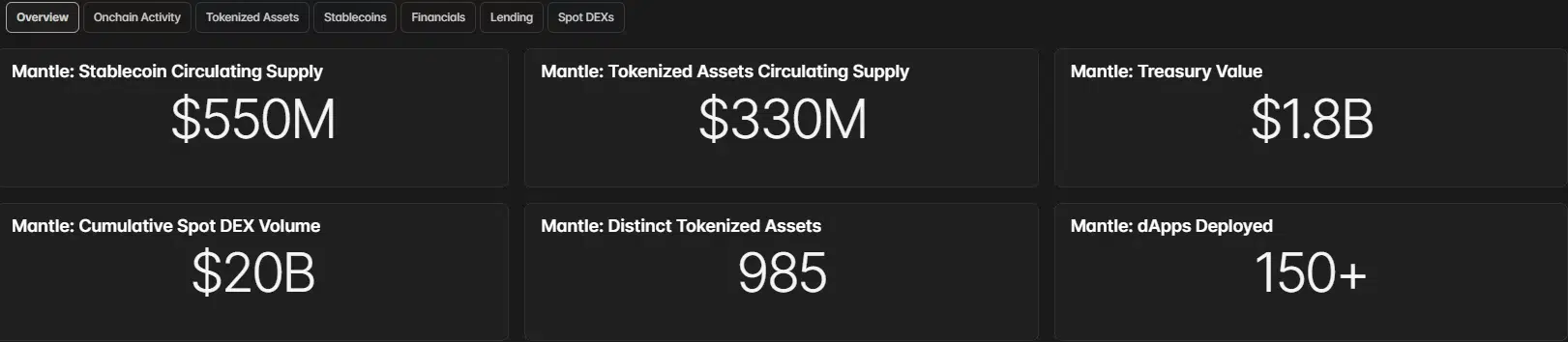
- Mantle holds about $550 million in stablecoins and $330 million in tokenized assets.
- USDT0 accounts for approximately $440 million, or nearly 80% of the network’s stablecoin supply.
- The network supports 985 distinct tokenized assets across six product categories.
- Mantle increased its tokenized equity selection from 10 products in April to 155 by late June.
Mantle’s asset base approaches $880 million
Blockworks Research data shows that Mantle’s stablecoin circulating supply has reached approximately $550 million, while tokenized assets on the network account for another $330 million. The two categories place the combined value at about $880 million.
Unlike networks built mainly around one class of real-world assets, Mantle’s tokenized supply covers commodities, stocks, U.S. Treasuries, yield-bearing stablecoins, a pre-IPO vault and the MI4 tokenized fund. Blockworks counts 985 distinct tokenized assets across the network.
Stablecoins provide most of the liquid capital available within the two categories. Based on the dashboard’s latest asset-level readings, their combined circulating supply stands at approximately $553.7 million, with USDT0 accounting for $440.03 million.
USDe ranks second with $57.93 million, followed by USDC at $34.15 million and conventional USDT at $12.96 million. AUSD contributes $5.15 million, while World Liberty Financial’s USD1 and Aave’s GHO account for $2.29 million and $1.23 million, respectively.
Calculated from the displayed figures, USDT0 represents close to 80% of Mantle’s stablecoin supply. The concentration means that most of the network’s dollar-linked liquidity comes from one asset, even though Mantle supports seven stablecoins.
Recent flows have added to the two largest positive movers. The dashboard recorded a daily USDT0 net inflow of $18.42 million and a USDC inflow of $9.94 million when the data was checked. Over 30 days, USDC supply increased 33.93%, while USDT0 rose 9.51%.
Smaller tokens posted faster percentage growth from lower starting levels. GHO supply climbed 203.5% during the same period, while USD1 rose 190.89%. In contrast, USDe fell 9.09%, standard USDT declined 2.28%, and AUSD slipped 0.09%, according to Blockworks.
Tokenized equities have expanded to 155 products
Equities have become a larger part of Mantle’s tokenized-asset catalog. Nansen counted 155 tokenized equities on the network at the end of June, up from only 10 in April, according to an Aug. 25 report.
The selection includes instruments tied to public companies, private businesses, and exchange-traded funds. Nansen identified products linked to SpaceX and Franklin Templeton’s U.S. Equity Index ETF among the available assets.
In November 2025, Mantle integrated Backed’s xStocks through an arrangement involving Bybit. The rollout brought tokens linked to Apple, Nvidia and Strategy shares onto Mantle, while Bybit supported direct deposits and withdrawals between its centralized exchange and the network.
Backed said at the time that its xStocks platform had processed more than $1.6 billion in tokenized equity volume. According to the company, each token was backed one-to-one by an underlying security held through licensed custodians in Switzerland.
Product structures remain important for investors because tokenized equities do not always provide the same legal rights. As crypto.news reported in August, some products deliver only synthetic price exposure and do not give holders ownership, voting rights, or other shareholder protections. Access can also depend on the issuer, distributor, and user’s jurisdiction.
Mantle’s products, therefore, need to be assessed according to their individual terms rather than grouped under a single ownership model. Backed’s one-to-one structure, for example, differs from tokenized derivatives that track a share price without transferring a claim on the underlying stock.
Mantle has added RWA yield through DeFi
Stablecoin liquidity on Mantle is also being used in yield products. On Aug. 25, the network opened its RWA vault to DeFi users after an earlier version distributed through Bybit passed $200 million in assets under management.
The DeFi vault accepts USDC and USDT0 through Fluxion, according to Mantle’s announcement. CIAN designed the non-leveraged strategy, Grove connects deposits to yield from the Sky ecosystem, and Fluxion provides the user interface.
Deposited assets gain exposure to returns from sUSDS, the savings version of Sky’s USDS stablecoin. Sky governance sets the applicable savings rate, so the return can change rather than remaining fixed throughout a deposit.
Mantle’s launch materials listed a target annual percentage yield of up to 6.5%, including campaign incentives. The offer also included Fluxion Points and an allocation of 5.14 million GROVE tokens, although the value received by each depositor depends on participation rules and token prices.
Without leverage, the vault removes one source of liquidation risk, according to Mantle’s product description. Users still face smart-contract failures, stablecoin price changes, liquidity conditions, and adjustments to Sky’s governance-set savings rate.
The self-custodial version also changes who controls the deposited assets. Bybit users previously entered the strategy through an exchange account, while Fluxion users approve transactions from their own wallets and remain responsible for managing their private keys.
Other network figures provide additional scale. Blockworks places Mantle’s treasury value at about $1.8 billion, cumulative spot decentralized exchange volume at $20 billion, and deployed decentralized applications above 150.
U.S. investors face access and ownership limits
For U.S. users, the presence of tokenized American equities on a public blockchain does not establish that the products are legally available in every state or to every investor. Eligibility depends on the issuer’s terms, distribution controls and applicable federal and state securities rules.
Stablecoin yield carries a separate regulatory question. The GENIUS Act prevents payment stablecoin issuers from paying interest or yield directly to holders, while rewards generated through exchanges, brokers, and DeFi protocols have remained part of congressional discussions.
Mantle and its partners describe the DeFi vault’s return as strategy-generated yield from sUSDS rather than a direct payment from a stablecoin issuer. Fluxion Points and GROVE incentives are provided separately from the underlying Sky savings return.
Tokenized-stock models also differ in how they treat U.S. securities. In August, Crypto.com introduced tokenized derivatives tied to 1,500 U.S. equities and ETFs for eligible users in the European Economic Area and other approved markets. Crypto.com said buyers receive price exposure but do not gain legal ownership or shareholder rights.
Regulated U.S. market operators are developing another model. The Depository Trust Company received a Securities and Exchange Commission no-action letter in December 2025 allowing a defined tokenization service for three years, covering eligible assets held in DTC custody.
Under DTC’s stated plan, potential assets include Russell 1000 stocks, major index ETFs, U.S. Treasuries and certain corporate bonds. The company selected Stellar for part of its multi-chain strategy and targeted the first half of 2027 for deployment.

Ben McKenzie Exposes Crypto’s Biggest Lies | Shane Smith Has Questions

Matteo Guendouzi continues to shine light on Mikel Arteta’s shrewdest Arsenal transfer

(VIDEO) Peter Cullen, the Legendary Voice of Optimus Prime in the ‘Transformers’ Franchise, Dies at Age 85





-

 Fashion6 days ago
Weekend Open Thread: Madewell – Corporette.com
-

 Crypto World2 days ago
SpaceX stock could rise 75% to $240, JPMorgan says
-

 Business5 days ago
Musk’s Tesla, SpaceX Confirm $16.8 Billion ‘Terafab’ Chip Plant as World’s Largest Building in Texas
-

 Crypto World6 days ago
anatomy of crypto’s biggest liquidation event since 2021
-

 Crypto World3 days ago
A $30 Billion AI Fund Implodes, Now the SEC Is Investigating Wall Street’s Role
-

 Politics5 days ago
6 months on, Irish renters crushed by effects of government housing bill
-

 Crypto World2 days ago
Did Trump Just Move SpaceX Stock With One Truth Social Post?
-

 Business4 days ago
Mystery AI Model ‘Ox Alpha’ Draws Developers With Free Access as Chinese Lab Origins Remain Debated
-
 NewsBeat5 days ago
The ‘Lucky Dip Gang’ causing carnage for clicks: After five thugs were killed speeding in the wrong direction on a motorway, GUY ADAMS investigates a sick new trend… and why police aren’t even allowed to pursue them
-

 Business3 days ago
Moderna CEO warns China is pouring state money into mRNA technology
-

 Business3 days ago
NVIDIA Stock Drops Nearly 2 Percent to $210 on Seventh Losing Day Ahead of Critical AI Earnings
-
 Crypto World6 days ago
Nvidia Stock Suffers Longest Losing Streak Since 2022: Will Q2 Earnings End It?
-

 Business6 days ago
UK firms in critical financial distress rise 9% to 53,756
-

 Sports5 days ago
Deshaun Watson fires back at Browns fans after being booed: ‘It’s a disrespectful thing’
-

 Tech6 days ago
Unitree’s New Superman Robot Claims to Outjump and Outrun Every Human, Usain Bolt Included
-
 Crypto World4 days ago
Google Gemini AI Predicts Ethereum Could Become the Trade Retail Misses in 2026
-

 Tech6 days ago
Faster chip in a familiar form factor
-

 Crypto World7 days ago
SEC Regulation Crypto vs CLARITY Act: which framework wins
-

 Business5 days ago
Will Tesla Stock Be Higher or Lower a Year From Now? Here’s What Wall Street Analysts Are Saying
-

 Business4 days ago
Tesla Recalls Nearly 3 Million Cars in China Over Hidden Door Handles Linked to Multiple Deaths Amid New Ban
You must be logged in to post a comment Login