
Crypto World
Ethereum price forms ascending triangle below $2,533

Ethereum price held near $2,500 on Aug. 28 as buyers defended the gains from its mid-August breakout, but an overbought daily reading and a dense band of leveraged positions around $2,550 left ETH facing a key resistance test.
Summary
- Ethereum price traded near $2,500 after rising about 35% from its mid-August consolidation range.
- A 4-hour ascending triangle placed immediate resistance between $2,533 and $2,550.
- Daily RSI reached 77.4, showing strong momentum but an increased risk of a pullback.
- Liquidation clusters near $2,550 and $2,470 could amplify the next move.
Hotter US inflation limits Ethereum’s breakout
According to data from crypto.news, Ethereum (ETH) price opened at $2,442.49 on Aug. 26 before recovering toward $2,500 over the next two days. ETH traded around $2,500 at the time of writing, leaving it close to the upper end of its three-day range.
The recovery followed an initial reaction to the latest US inflation report. The Bureau of Economic Analysis said headline Personal Consumption Expenditures inflation rose 0.2% monthly and 3.7% annually in July.
The annual figure exceeded the 3.6% increase expected by economists polled by Reuters. Core PCE, which excludes food and energy, matched forecasts at 0.2% monthly and 3.3% annually.
The hotter headline figure lifted the market-implied probability of a September Federal Reserve rate increase to 44% from 36%, Reuters reported. Higher rate expectations can weigh on speculative assets because they raise the relative appeal of interest-bearing investments and tighten financial conditions.
ETH nevertheless avoided a deeper reversal after falling toward $2,430 on Aug. 26. Buyers moved back into the market below $2,500, allowing the token to retain most of the advance that began near $1,870 in mid-August.
The rebound has also followed the US Treasury’s decision to expand its long-dated debt buybacks. The Treasury said it will increase the maximum size of liquidity-support operations for 10-to-30-year securities from $2 billion to at least $4 billion per operation, beginning Sept. 9.
However, the program is designed to support Treasury market liquidity rather than directly inject money into crypto markets. Its influence on ETH therefore depends on how bond yields, the dollar, and broader risk appetite respond.
Ethereum price forms an ascending triangle below $2,533
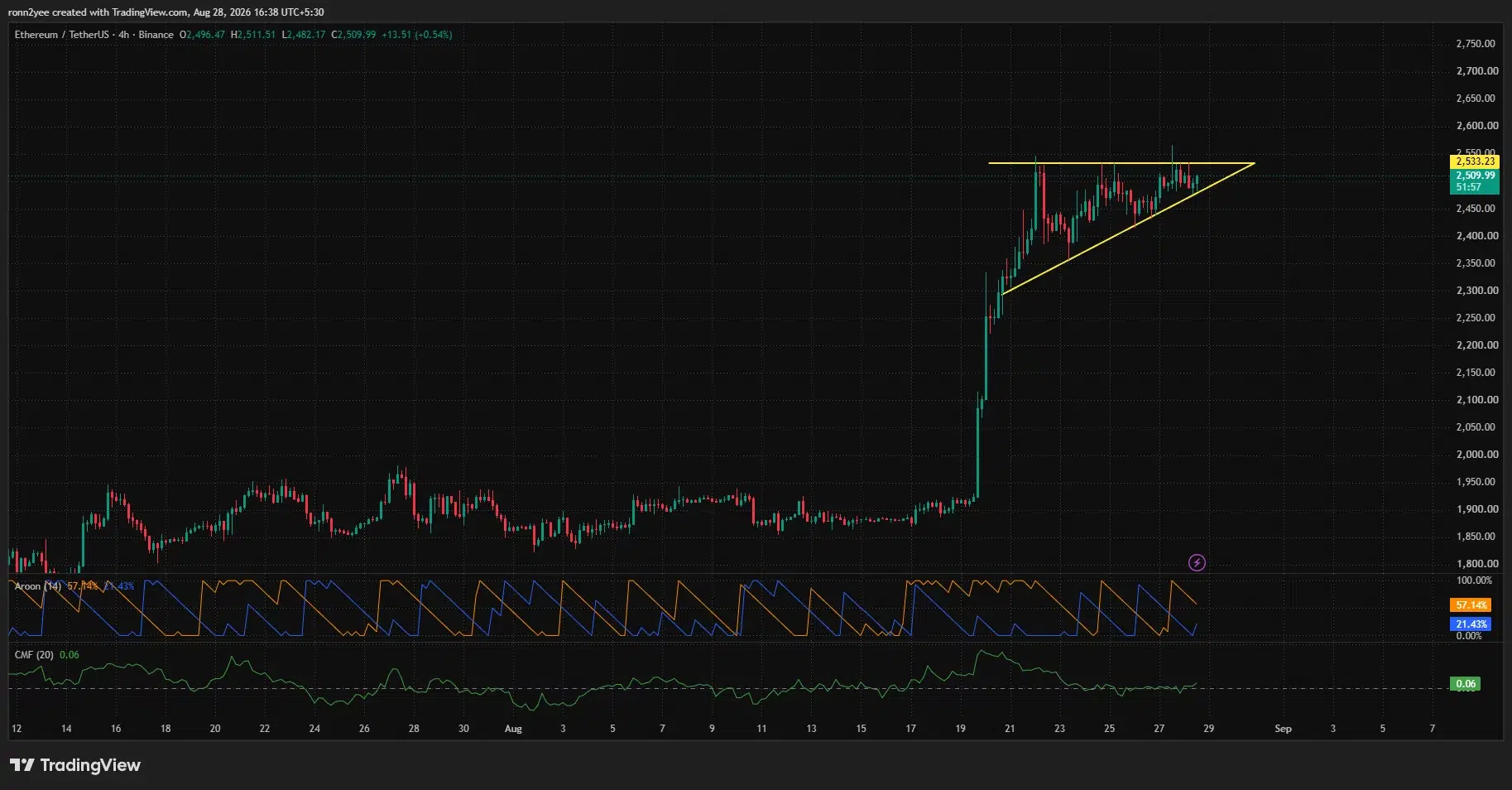
The 4-hour ETH/USDT chart shows Ethereum forming an ascending triangle after its rapid move from below $1,950. Price has repeatedly tested horizontal resistance near $2,533 while producing a sequence of higher lows.
An ascending triangle usually favors buyers when the price closes above its horizontal boundary with increased volume. A confirmed move through $2,533 would also clear the nearby $2,550 resistance area, where ETH has faced several rejections since Aug. 21.
The Aroon Up indicator stood at 57.14%, compared with an Aroon Down reading of 21.43%. The gap suggests that recent highs are more dominant than recent lows, although the Aroon Up reading has declined from earlier levels.
Chaikin Money Flow remained positive at 0.06. The reading points to modest net buying pressure, but it does not show the forceful inflows normally associated with a decisive breakout.
Crypto trader Daan Crypto Trades said in an Aug. 28 X post that ETH had produced a “solid breakout” and established a higher high on the weekly chart. He warned that a return below the former range around $2,300 would weaken the improved market structure.
A 4-hour close above $2,533 would strengthen the triangle setup and place $2,600 in view. Failure to clear the barrier could send ETH back toward the rising trendline, which sits near $2,470 and moves higher over time.
Daily RSI warns Ethereum may be overheated
The daily chart shows ETH trading above the 50% Fibonacci retracement level at $2,453.95. The level is measured from the January high around $3,399 to the June low near $1,509 and now acts as the closest major support.
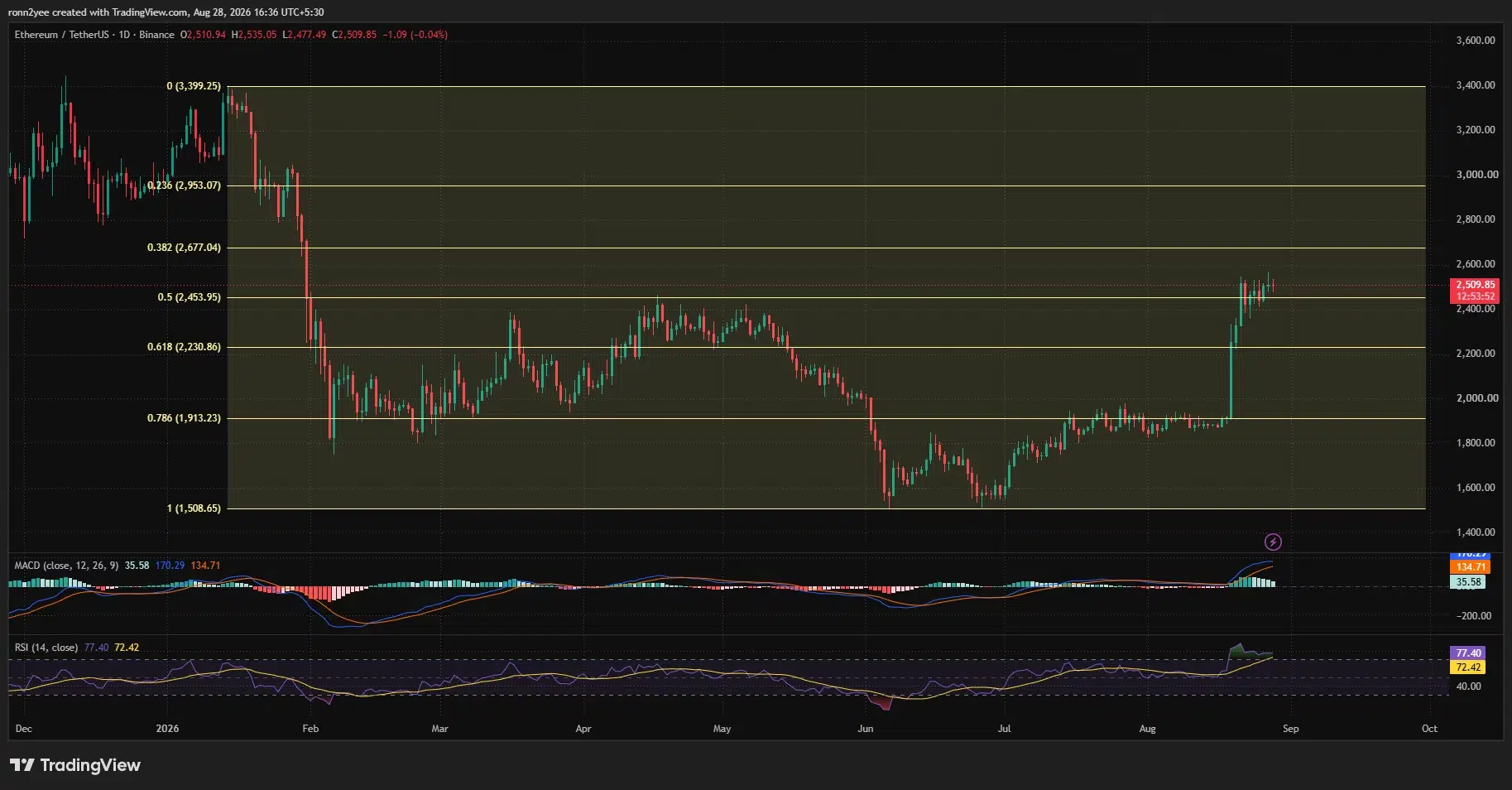
The next Fibonacci barrier sits at $2,677.04. A break above that area could open a path toward the 23.6% retracement at $2,953.07, placing the psychological $3,000 level within reach.
Trader Ted Pillows also identified $2,550 as the immediate resistance zone. In an Aug. 28 post, he said a weekly close above the level could support a move toward $3,000, while repeated rejection could expose the $2,000–$2,100 region.
Momentum indicators remain bullish but stretched. The daily Relative Strength Index stood at 77.4, above the 70 level commonly used to identify overbought conditions. Its RSI moving average was lower at 72.42.
The Moving Average Convergence Divergence indicator remained positive, with the MACD line above its signal line. However, the shrinking positive histogram suggests that upward momentum has started to ease as ETH tests resistance.
An overbought RSI does not guarantee an immediate decline. It instead shows that the advance has moved quickly and leaves the price more vulnerable if buyers fail to produce a breakout.
ETH liquidation map puts $2,550 and $2,470 in focus
The three-day CoinGlass liquidation heatmap shows leveraged positions building on both sides of Ethereum’s price.
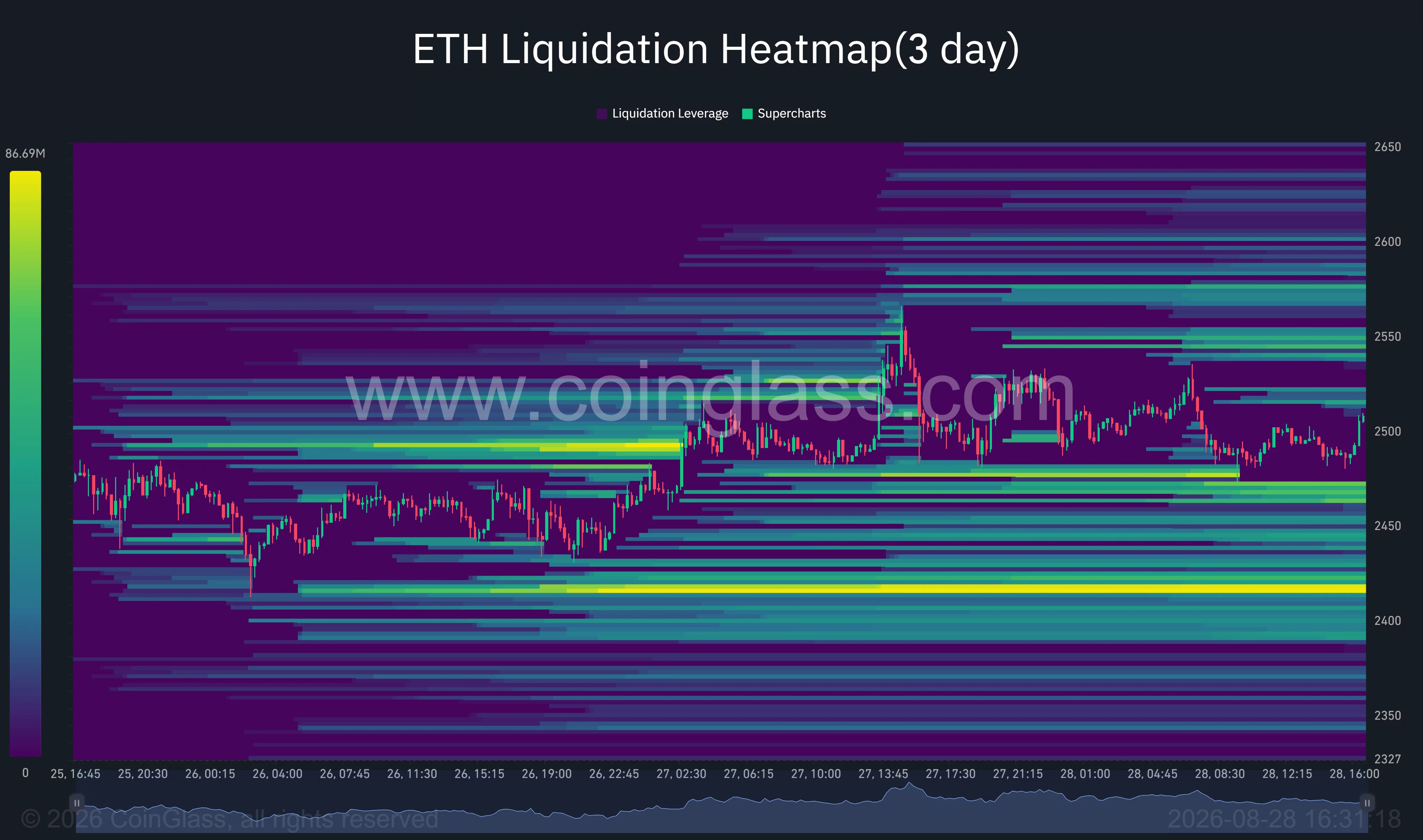
The nearest concentration above ETH lies around $2,540–$2,550, aligning with the horizontal resistance visible on the 4-hour chart. Additional liquidity appears between approximately $2,570 and $2,600.
A move through $2,550 could force short sellers to close positions, adding market buy orders and accelerating a push toward the higher clusters. The technical breakout would still require confirmation because a brief sweep of leveraged positions can reverse quickly.
Below the market, the closest liquidation concentration sits around $2,470–$2,480. A larger and brighter pool appears near $2,410–$2,420, making that region a possible downside target if ETH loses the 50% Fibonacci support at $2,454.
US spot Ethereum exchange-traded funds provide a mixed near-term backdrop. The products recorded about $192 million in net inflows on Aug. 26, but SoSoValue data showed roughly $11.4 million in net outflows during the following session.
Ethereum’s next move, therefore, rests on a narrow technical range. A confirmed close above $2,533–$2,550 would favor an extension toward $2,600 and $2,677, while a loss of $2,454 would expose $2,410 and potentially the former breakout area around $2,300.
Disclosure: This article does not represent investment advice. The content and materials featured on this page are for educational purposes only.



An Anthropic model cut the work needed to break a leading post-quantum signature candidate by a factor of 67 million last month, while Bitcoin and Ethereum published their own migration plans this week.

SentinelOne (S) stock fell after the cybersecurity firm reported second quarter earnings and revenue that edged by estimates while October quarter sales guidance met expectations. On an adjusted basis, SentinelOne earnings were 8 cents per share, doubling from 4 cents a year earlier. The Mountain View, Calif.-based cybersecurity company posted revenue of $292 million, up 21%. Wall Street analysts polled…
Copyright ©2026 Investor’s Business Daily, LLC. All rights reserved. 87990cbe856818d5eddac44c7b1cdeb8

Marvell Technology (MRVL) late Thursday edged above expectations for its fiscal second quarter and guided higher than views for fiscal Q3. But Marvell stock fell in extended trading. The Santa Clara, Calif.-based maker of data infrastructure semiconductor solutions earned an adjusted 94 cents a share on sales of $2.74 billion in the quarter ended Aug. 1. Analysts polled by FactSet…
Copyright ©2026 Investor’s Business Daily, LLC. All rights reserved. 87990cbe856818d5eddac44c7b1cdeb8

Workday (WDAY) stock fell after the enterprise software maker reported second-quarter earnings and revenue that edged by consensus estimates but subscription sales guidance only met expectations. The Workday earnings report came in after the market close on Thursday. The Pleasanton, Calif.-based company said Workday earnings rose 24% to $2.75 per share. Workday’s revenue climbed nearly 13% to $2.649 billion. Analysts…
Copyright ©2026 Investor’s Business Daily, LLC. All rights reserved. 87990cbe856818d5eddac44c7b1cdeb8

Several closely watched corporations far surpassed their earnings forecasts this summer, and some have billions of dollars in Trump tariff refunds to thank for padding their results. Where’s your refund? Studies show consumers indirectly ate much of the cost through rising prices, but these refunds instead flow to the companies that directly paid the Trump administration’s import taxes, regardless of…
Copyright ©2026 Investor’s Business Daily, LLC. All rights reserved. 87990cbe856818d5eddac44c7b1cdeb8


BitGo Holdings completed its acquisition of NYDIG’s institutional trading business on Aug. 27, adding derivatives, structured products, execution and financing services to its U.S. institutional platform.
Summary
- BitGo completed its acquisition of NYDIG’s institutional trading business, though financial terms remained undisclosed publicly.
- Approximately 30 NYDIG employees joined BitGo alongside institutional client relationships included in the completed transaction.
- The acquired operation provides derivatives, structured products, financing, execution, and customized capital markets services globally.
- NYDIG will concentrate on power, Bitcoin mining, and high-performance computing after selling the trading operation.
- NYDIG reports a three-gigawatt development pipeline, with one gigawatt deliverable during 2027 and 2028 combined.
The companies did not disclose the purchase price, payment structure, revenue contribution or acquired assets’ valuation. BitGo’s release said approximately 30 NYDIG employees and its institutional client trading relationships moved to the NYSE-listed company.
BitGo acquisition adds institutional market services
The acquired business works with asset managers, hedge funds, corporations, family offices and other professional investors. Its services include derivatives, financing, structured products and customized trading strategies.
Those operations expand BitGo beyond its existing custody, wallets, settlement, staking and trading infrastructure. The company can now offer institutions more services through one platform, although it has not detailed when every acquired product will become available under the BitGo brand.
CEO Mike Belshe said the acquisition would help BitGo support the “full lifecycle” of institutional digital assets. His claims that the deal will scale the company’s platform, improve efficiency and attract more clients remain forward-looking.
BitGo also said the acquisition and expanded products are “expected” to make client assets more likely to remain on its platform. It did not provide financial forecasts or retention targets supporting that expectation.
NYDIG shifts toward power and computing infrastructure
NYDIG will focus its resources on power generation, Bitcoin mining and high-performance computing data centers following the sale. Its website describes a development pipeline exceeding three gigawatts.
The company says more than one gigawatt could be delivered during 2027 and 2028. That schedule is a company projection and remains subject to construction, financing, energy availability and customer demand.
NYDIG expanded this business in 2025 by acquiring Crusoe’s Bitcoin mining operation, including more than 270 megawatts of power-generation technology. The latest transaction separates its institutional trading franchise from that growing power and computing portfolio.
NYDIG CEO Tejas Shah said the company sees a major opportunity in high-performance computing development. NYDIG has not disclosed the expected revenue, customers or financing attached to its stated pipeline.
Federal oversight supports BitGo’s integrated model
BitGo completed the acquisition after converting its trust operation into a federally chartered national trust bank. The charter strengthens the regulatory foundation for custody and settlement, but it does not automatically place every trading or derivatives service under one regulator.
Different products may still fall under banking, securities, commodities or state rules. BitGo did not identify which legal entities will provide the acquired derivatives and financing services or whether customers must sign new agreements.
The company completed a U.S. initial public offering in January, raising approximately $212.8 million after pricing shares at $18. As crypto.news reported, BitGo’s IPO valued the custody company at about $2 billion.
BitGo shares closed Aug. 27 at $7.16, up approximately 1.9% during the session. The share movement coincided with the announcement, but available market data does not establish that the acquisition caused the gain.
Integration details become the next test
The immediate task is transferring NYDIG’s clients, employees and operations into BitGo without interrupting trading or financing services. Pete Janney, now BitGo’s head of financial infrastructure, said the companies expect a smooth transition, but no timetable was provided.
Investors will next look for acquisition costs, revenue contributions and integration expenses in BitGo’s SEC disclosures. No separately indexed filing detailing the transaction’s financial terms was available when this article was prepared.
The deal follows BitGo’s wider push into institutional infrastructure. In related coverage, BitGo Korea secured registration to provide institutional custody and crypto transfers shortly before the NYDIG transaction.
The acquisition leaves BitGo with a broader range of services, but its commercial value will depend on client retention, product integration and the profitability of the acquired operation.


The Office of the Comptroller of the Currency revised its bank supervision and enforcement framework on Aug. 27, directing examiners to focus on material financial risks and substantive violations rather than minor procedural deficiencies.
Summary
- OCC revised two supervisory manuals to prioritize material financial risks and substantive legal violations consistently.
- The agency publicly released its Matters Requiring Attention manual for the first time Thursday afternoon.
- Proposed rules divide legal violations into substantive and technical categories based on potential customer harm.
- Technical violations could require correction without enforcement actions, MRAs, or regulator-prescribed remediation methods for banks.
- Comments are due thirty days after the proposal’s official publication in the Federal Register notice.
The OCC released two updated policy manuals alongside a joint final rule with the Federal Deposit Insurance Corporation. It also proposed a separate rule dividing violations of banking laws into “substantive” and “technical” categories.
The manuals establish current OCC policy, while the legal-violation framework remains a proposal. Its provisions will not become binding unless the OCC completes the federal rulemaking process.
OCC supervision will focus on material financial risks
The revised enforcement manual establishes three principles: escalation, tailoring and limiting corrective actions to measures needed to resolve a specific deficiency.
The OCC said enforcement responses should be proportionate and predictable. Examiners must consider the financial risk, legal violation and institution’s size and complexity when deciding whether formal action is warranted.
This framework does not require identical treatment for every bank. A practice at a large or complex institution may trigger an enforcement action even when similar conduct at a community bank would not.
The OCC said larger institutions face greater supervisory expectations because their operations and failures could present broader financial risks. That approach still requires examiners to connect the response to a specific deficiency.
Comptroller Jonathan Gould described the changes as a return to “risk-based supervision.” His claim that this approach will improve consistency is a policy objective whose results will depend on examiner implementation.
Matters Requiring Attention receive narrower standards
A Matter Requiring Attention, or MRA, is a supervisory directive requiring a bank’s board and management to correct a deficient practice. MRAs are generally not public enforcement orders.
The OCC publicly released its dedicated MRA manual for the first time. The document requires examiners to tailor MRAs using factors related to financial risk and limits their issuance to conduct meeting the new standard.
The joint OCC-FDIC final rule defines an unsafe or unsound practice around conduct that creates material financial risk. It also revises when supervisors may issue MRAs involving safety, soundness and legal compliance.
The rule is meant to reduce MRAs based primarily on policies, paperwork or internal processes when those shortcomings do not create material financial risk. It does not prevent action when weak controls produce meaningful harm or legal violations.
Proposed OCC rule creates two violation categories
Under the proposal, the OCC could issue an MRA for a legal or regulatory breach only when it qualifies as substantive.
A violation would be substantive when its nature, duration, frequency or severity could meaningfully affect the bank or its customers. At least one of five criteria must apply.
Those criteria cover systemic patterns, more-than-minimal financial effects, inaccurate books and records, customer harm or restitution, and insider misconduct or self-dealing.
A technical violation would not support an enforcement action or MRA. Examiners could require the bank to correct it, but could not dictate the method or demand unrelated remediation.
This does not mean technical violations may be ignored. Banks would still need to comply with applicable law and correct identified problems.
Comments are due 30 days after the notice appears in the Federal Register. Because publication had not established a calendar date when the OCC announced the proposal, the agency provided no fixed deadline.
Crypto banks fall under the same supervisory framework
The changes apply to all OCC-supervised national banks, federal savings associations and federal branches. That includes federally supervised trust banks conducting digital-asset custody, stablecoin reserve management or blockchain settlement.
As crypto.news previously reported, the OCC has returned permitted digital-asset banking activities to its standard supervisory channels after withdrawing several special restrictions and reputation-risk references.
The revised framework does not grant banks new crypto powers. It also does not remove requirements involving capital, liquidity, cybersecurity, sanctions, anti-money-laundering controls or consumer protection.
Its relevance lies in how examiners classify deficiencies at crypto-focused institutions. A minor documentation error could receive technical treatment, while custody failures, inaccurate records, customer losses or systemic compliance problems could remain substantive.
In related coverage, Circle received final approval to establish a federally supervised digital-asset trust bank. Other crypto companies are progressing through conditional charter applications.
Banks, industry groups and consumer advocates can now comment on whether the proposed distinction provides useful consistency or restricts supervisory intervention too sharply.


Veteran trader Peter Brandt said he remained long Bitcoin on Aug. 28 as the cryptocurrency traded near $80,000 after another unsuccessful attempt to establish a decisive breakout above $82,000.
Summary
- Bitcoin traded near $79,771 after reaching $81,280 but remained below the $82,000 resistance area Friday.
- Brandt disclosed a long Bitcoin position while warning he could exit within one trading day.
- The trader bought Bitcoin after an inverse head-and-shoulders breakout completed on August 20, 2026, officially.
- Bitcoin has gained approximately 28% during August after rebounding from July’s $57,717 low price area.
- U.S. spot Bitcoin ETFs attracted $1.92 billion across five sessions during the preceding rally week.
The crypto traded at approximately $79,771 at the time of writing, up about 1.2% during the session. It reached an intraday high near $81,280 before retreating, keeping the closely watched $80,000–$82,000 area unresolved.
Brandt disclosed his position in an X post listing several active trades. Alongside Bitcoin, he reported long positions in wheat, soybeans, corn, soybean meal, sugar and the Mexican peso. He was short lean hogs.
The trader did not disclose his BTC entry price, position size, leverage or intended exit level. He also warned that his positions could change within one day, limiting the statement’s value as a longer-term price forecast.
Peter Brandt remains long after buying the breakout
Brandt’s current position follows a major change in his technical outlook. On Aug. 20, he said he bought Bitcoin after an inverse head-and-shoulders pattern completed and the price broke above its neckline.
The pattern normally consists of three troughs, with the middle decline extending below those on either side. Technical traders often interpret a move above the neckline as a possible bullish reversal, although the formation does not guarantee further gains.
Brandt had previously assigned a roughly 60% probability to another BTC decline. He abandoned that view when the pattern completed, saying price action had changed the setup rather than continuing to defend his earlier scenario.
As crypto.news previously reported, Bitcoin entered Brandt’s projected $58,000–$62,000 range before later breaking higher. The cryptocurrency fell to about $57,717 on July 1 and then recovered toward $79,500 by Aug. 21.
That sequence matters because Brandt’s earlier bearish target was reached before his long entry. His latest position therefore represents a response to new price information, not necessarily a reversal of a failed forecast.
Bitcoin’s $82,000 level blocks another breakout
The crypto moved above $80,000 on Aug. 25 for the first time since mid-May. The price reached approximately $81,238 before losing momentum.
Friday’s intraday high near $81,280 produced another test of the same region. However, BTC had not recorded a sustained move above $82,000 at the latest snapshot.
Repeated tests make the zone technically relevant, but describing it as resistance remains a chart interpretation. A brief intraday move above the level would not necessarily confirm a breakout. Traders commonly look for a daily close and continued trading above the range.
Bitcoin’s session low was approximately $78,828. That leaves the market within a relatively narrow band between immediate support around $78,000–$79,000 and overhead resistance extending toward $82,000.
A decisive move outside that range could provide clearer evidence about short-term direction. Until then, both bullish continuation and another consolidation remain possible outcomes rather than confirmed forecasts.
August rally drew support from ETFs and macro conditions
The crypto has gained approximately 28% during August, putting it on course for its strongest monthly advance since November 2024. The move followed a decline of more than 50% from its October 2025 peak.
Institutional flows supported the recovery. U.S. spot Bitcoin ETFs attracted approximately $1.92 billion across five trading sessions during the week ending Aug. 21, with BlackRock’s IBIT receiving the largest portion.
The rally also followed changes in U.S. Treasury bond markets. Treasury officials announced larger buyback operations for older long-dated securities, while the dollar weakened and long-term yields declined.
In related coverage, Bitcoin gained 27% as debt concerns and Treasury buybacks returned to focus. Short liquidations accelerated the advance as bearish derivatives positions closed.
These forces provide context for Brandt’s position but do not prove that the rally will continue. ETF flows can reverse, short-covering provides temporary demand and macroeconomic conditions can change quickly.
What confirms Brandt’s Bitcoin setup next
The first test is whether BTC can close and remain above the $80,000–$82,000 range. Such a move would strengthen the breakout structure Brandt cited when opening his position.
Failure to hold the upper range could return attention to Friday’s low near $78,828 and the earlier breakout area. The exact invalidation level cannot be confirmed because Brandt has not published his stop or risk parameters.
His statement that positions may change within a day is also important. It means followers cannot assume he remains long after the disclosure without a newer update.
Brandt’s trade confirms only his position at the time of publication. BTC’s price behavior around $82,000, rather than the trader’s reputation, will determine whether the technical breakout continues.
Disclosure: This article does not represent investment advice. The content and materials featured on this page are for educational purposes only.


Ripple has recommended withdrawing the XRP Ledger’s pending XChainBridge amendment after concluding that its primary use case is already served by Axelar and broader developer demand has not emerged.
Summary
- Ripple recommends withdrawing XChainBridge after Axelar replaced its intended XRP Ledger EVM Sidechain role entirely.
- The pending amendment would add native asset bridges using independent witness servers between connected ledgers.
- Removing XChainBridge could eliminate more than 10,000 lines from the XRPL server codebase, Ripple estimates.
- Ripple controls one validator vote and cannot withdraw or activate the amendment unilaterally today alone.
- Developers with active XLS-38 projects can present evidence before the community completes withdrawal procedures formally.
Mayukha Vadari, a senior software engineer at RippleX, announced the recommendation on Aug. 27. XChainBridge, also known as XLS-38, remains in the XRPL validator voting process and has not activated on the mainnet.
Ripple estimated that withdrawing the proposal would allow developers to remove more than 10,000 lines of code from xrpld, the server software that powers the network. No code has been removed yet, and Ripple cannot complete the process independently.
XRP Ledger no longer needs XLS-38 for its EVM sidechain
XLS-38 was designed to provide a protocol-level framework for moving XRP and issued assets between the XRP Ledger and connected networks. Its intended users included public sidechains, private ledgers, permissioned networks and experimental chains.
The system relies on independent witness servers to monitor events on each connected ledger. Witnesses submit attestations confirming that assets were locked or destroyed before corresponding assets become available on the destination network.
One of the proposal’s main use cases was connecting the XRPL mainnet with its Ethereum Virtual Machine-compatible sidechain. Ripple later selected Axelar to provide that connection instead.
The XRPL EVM Sidechain launched with Axelar as its mainnet bridge in June 2025. Axelar’s validator network verifies cross-chain messages and connects the sidechain with XRPL and other supported blockchains.
Ripple said the EVM sidechain is now “better addressed” through Axelar. That remains the company’s technical assessment rather than a finding reached through an independent security comparison.
Weak developer demand changed Ripple’s assessment
Ripple initially kept XLS-38 available because developers could still use it for private sidechains and specialized networks that Axelar was not designed to support.
However, the company said it found little evidence of active projects requiring the native bridge. No production deployment has publicly identified XLS-38 as essential to its planned operations.
Maintaining the inactive implementation still requires reviews, tests and compatibility work whenever developers update xrpld. Ripple argued that this creates an ongoing maintenance burden without providing a corresponding mainnet benefit.
The recommendation does not mean the broader XRPL ecosystem has abandoned interoperability. Ripple pointed to Axelar, Wormhole, zero-knowledge systems and layer-2 designs as alternative approaches suited to different security and privacy requirements.
Cross-chain systems also introduce distinct risks. As previously reported, bridge exploits have caused more than $4 billion in reported losses since 2021, making verification design and operational security central considerations.
Ripple cannot remove XChainBridge by itself
The official XRPL registry lists XChainBridge as a pending amendment with a default “no” vote. Ripple operates only one validator vote among the network’s independent participants.
An XRPL amendment normally requires support from more than 80% of trusted validators for two continuous weeks before activation. With 35 validators in the current default configuration, at least 29 affirmative votes would exceed that threshold.
Ripple’s recommendation therefore neither withdraws the amendment immediately nor forces other validators to oppose it. Validators decide independently which amendments their infrastructure supports.
That separation is consistent with other XRPL proposals. In related coverage, Ripple’s support for lending amendments did not establish their activation because the proposals still required the broader validator threshold.
Withdrawal would proceed through staged software changes
Ripple proposed beginning with a pull request that marks XChainBridge as obsolete in the xrpld codebase. Servers upgrading to that release would automatically vote against activation.
Support would decline as validators install the updated software. Once active validators recognize the amendment as obsolete, developers could remove the XChainBridge implementation and the related fixXChainRewardRounding code in a later release.
No pull-request deadline, software version or final removal date has been announced. The timing depends on community feedback, code review and validator upgrades.
Ripple has asked developers or organizations building with XLS-38 to present specific use cases. A credible active deployment could lead the company to reconsider its recommendation before the staged withdrawal begins.
Bitwise’s U.S. crypto exchange-traded products attracted approximately $100 million in net inflows on Aug. 27, led by demand for Solana, Bitcoin and Hyperliquid funds, according to company CEO Hunter Horsley.
Summary
- Bitwise reported approximately $100 million in daily inflows across its U.S. crypto exchange-traded products Thursday.
- Solana products led with roughly $40 million, followed by Bitcoin products near $22 million overall.
- Hyperliquid and XRP products attracted approximately $20 million and $12 million respectively during Thursday’s session.
- BSOL recorded more than $126 million in trading volume, its highest session since launch Thursday.
- Trading volume measures shares exchanged while fund inflows represent net investor capital entering products directly.
Horsley said Solana products received about $40 million, the largest share of Bitwise’s daily intake. Bitcoin products followed with approximately $22 million, while Hyperliquid and XRP funds attracted about $20 million and $12 million respectively.
Ethereum products received approximately $1.4 million. The five disclosed categories total about $95.4 million, indicating that other Bitwise products or rounding accounted for the remainder of Horsley’s roughly $100 million figure.
The numbers are preliminary issuer disclosures. Bitwise had not published a fund-by-fund daily creation report alongside Horsley’s post, leaving independent confirmation dependent on later fund data.
Solana leads Bitwise crypto ETF inflows
Solana products captured approximately 40% of Bitwise’s reported daily inflows. Horsley did not identify every product included in that category, although the Bitwise Solana Staking ETF, or BSOL, is the company’s main U.S. Solana fund.
BSOL recorded more than $126 million in trading volume during the session, its highest total since launching on NYSE Arca in October 2025. The fund previously recorded about $108 million in volume on Aug. 24.
Trading activity has risen as BSOL has expanded beyond basic price exposure. The fund stakes most of its Solana holdings and distributes the resulting rewards after fees and expenses.
In related coverage, a major bank approved BSOL shares as collateral for loans with a maximum loan-to-value ratio of 25%. Bitwise reported at the time that BSOL held 8.18 million SOL and staked approximately 99% of its assets.
Those features may help explain why Bitwise’s Solana products outpaced its Bitcoin and Ethereum funds during Thursday’s session. However, one day of flows does not establish a lasting preference among institutional investors.
Hyperliquid and XRP capture another $32 million
Bitwise’s Hyperliquid products ranked third with approximately $20 million in reported inflows. Its XRP products added another $12 million.
Together with Solana, the three altcoin categories attracted roughly $72 million. That represented more than seven times the approximately $9.4 million combined difference between the disclosed Bitcoin and Ethereum figures.
The Hyperliquid total follows earlier demand for Bitwise’s BHYP fund. As previously reported, BHYP became the largest Hyperliquid ETF after a $19 million daily inflow in May.
XRP exchange-traded products have also experienced increased activity. In related coverage, XRP ETF cumulative flows crossed $1.57 billion as trading volume reached a record.
The daily distribution shows investors were adding exposure beyond Bitcoin. It does not reveal whether the buyers were financial advisers, hedge funds, retail brokerages or other institutions because exchange-traded fund creation data do not identify beneficial owners.
BSOL’s $126 million volume was not a $126 million inflow
Trading volume and net fund inflows measure different activity. Trading volume counts the total value of ETF shares exchanged between buyers and sellers during a session.
A share can trade several times without changing the number of shares outstanding. High volume therefore indicates liquidity and investor activity, but it does not mean the issuer received an equal amount of new capital.
Net inflows generally occur when authorized participants create additional ETF shares to meet demand. Outflows occur when shares are redeemed and assets leave the fund.
BSOL’s reported $126 million volume was consequently more than three times the approximately $40 million attributed to Bitwise’s entire Solana product category. The remaining trading involved transfers of existing shares or transactions that did not produce net creations.
This distinction is also relevant to Horsley’s broader $100 million figure. The amount describes reported inflows across Bitwise products, not the combined trading volume of those funds.
Bitcoin ETF streak supports broader crypto demand
Bitwise’s inflows came during a wider recovery in U.S. crypto investment products. Spot Bitcoin ETFs recorded eight consecutive sessions of net inflows through Aug. 26, attracting approximately $2.8 billion, according to SoSoValue data.
BlackRock’s IBIT accounted for about $2.02 billion, or 72%, of that streak. The funds received approximately $232 million on Aug. 26, below the $606 million daily peak recorded on Aug. 20.
Bitcoin traded near $79,770 on Aug. 28 after reaching an intraday high around $81,280. It has gained about 28% during August as ETF demand, a weaker dollar and changes in long-term Treasury markets supported its recovery.
The flow backdrop does not ensure continued price gains. ETF creations can reverse, and inflows may follow price momentum rather than predict it.
The next confirmation will come from official fund-level data showing whether Thursday’s creations raised shares outstanding and assets under management. Investors will also watch whether Solana continues leading Bitwise’s product lineup or whether the allocation returns toward Bitcoin.

Trump outlines cryptocurrency policies, allegiance to Genius Act allowing stable coins

Caroline Dubois snubs Los Angeles glamour for quiet life

Onto Innovation Stock: AI’s Next Bottleneck Is Yield (NYSE:ONTO)

Weekend Open Thread – Corporette.com

Weekend Open Thread: Brooks Brothers

London Mayor Sadiq Khan handed a peerage by Keir Starmer alongside 15 other Labour figures… just days before the PM leaves No10
Trump outlines cryptocurrency policies, allegiance to Genius Act allowing stable coins

She needs to RUN! Caleb Hammer realbrandoncavazos #fyp #calebhammer #financialaudit #money #finance

TOGI Sold Tiny Trucks For 72,000$ @ShaneStoffer #money #motivation
-

 Crypto World3 days ago
SpaceX stock could rise 75% to $240, JPMorgan says
-

 Crypto World1 day ago
Bitcoin’s 22% rally now needs real demand to outlast Treasury liquidity boost
-

 Business6 days ago
Musk’s Tesla, SpaceX Confirm $16.8 Billion ‘Terafab’ Chip Plant as World’s Largest Building in Texas
-

 Crypto World7 days ago
anatomy of crypto’s biggest liquidation event since 2021
-

 Crypto World4 days ago
A $30 Billion AI Fund Implodes, Now the SEC Is Investigating Wall Street’s Role
-

 Crypto World3 days ago
Warsh Jackson Hole keynote puts financial innovation first
-

 Business1 day ago
Salesforce Stock Soars 19% as Blowout Earnings and Agentforce AI Growth Silence Software Skeptics
-

 Politics7 days ago
6 months on, Irish renters crushed by effects of government housing bill
-

 Fashion9 hours ago
Weekend Open Thread: Maeve – Corporette.com
-

 Crypto World3 days ago
Did Trump Just Move SpaceX Stock With One Truth Social Post?
-

 Business6 days ago
Mystery AI Model ‘Ox Alpha’ Draws Developers With Free Access as Chinese Lab Origins Remain Debated
-
 NewsBeat7 days ago
The ‘Lucky Dip Gang’ causing carnage for clicks: After five thugs were killed speeding in the wrong direction on a motorway, GUY ADAMS investigates a sick new trend… and why police aren’t even allowed to pursue them
-

 Business3 days ago
Walmart takes aim at younger shoppers with new fashion brand
-
 NewsBeat2 days ago
Lindsay Clancy jury braces for closing arguments as judge tells court: ‘You’ve heard all the evidence’ – Live updates
-

 Business4 days ago
Moderna CEO warns China is pouring state money into mRNA technology
-

 Business7 days ago
Will Tesla Stock Be Higher or Lower a Year From Now? Here’s What Wall Street Analysts Are Saying
-

 Business4 days ago
NVIDIA Stock Drops Nearly 2 Percent to $210 on Seventh Losing Day Ahead of Critical AI Earnings
-
 Crypto World5 days ago
$92 Billion Nvidia Earnings Could Make or Break the AI Trade
-

 Business10 hours ago
iPhone 18 Pro Pre-Orders Could Shift to Saturday as Apple Reportedly Avoids September 11 Anniversary
-

 Business3 days ago
Thailand’s Eastern Economic Corridor Capital City (EECiti): Key Developments and Investment Opportunities
You must be logged in to post a comment Login