

Crypto World
Ethereum Price Prediction: How Close Is ETH to a Sub-$1.5K Breakdown?

Ethereum remains under significant selling pressure after losing a major support area and extending its decline toward the lower boundary of its broader trading range. While buyers have managed to defend the range lows for now, the market structure continues to favor the bears unless ETH can reclaim several key resistance levels overhead.
Ethereum Price Analysis: The Daily Chart
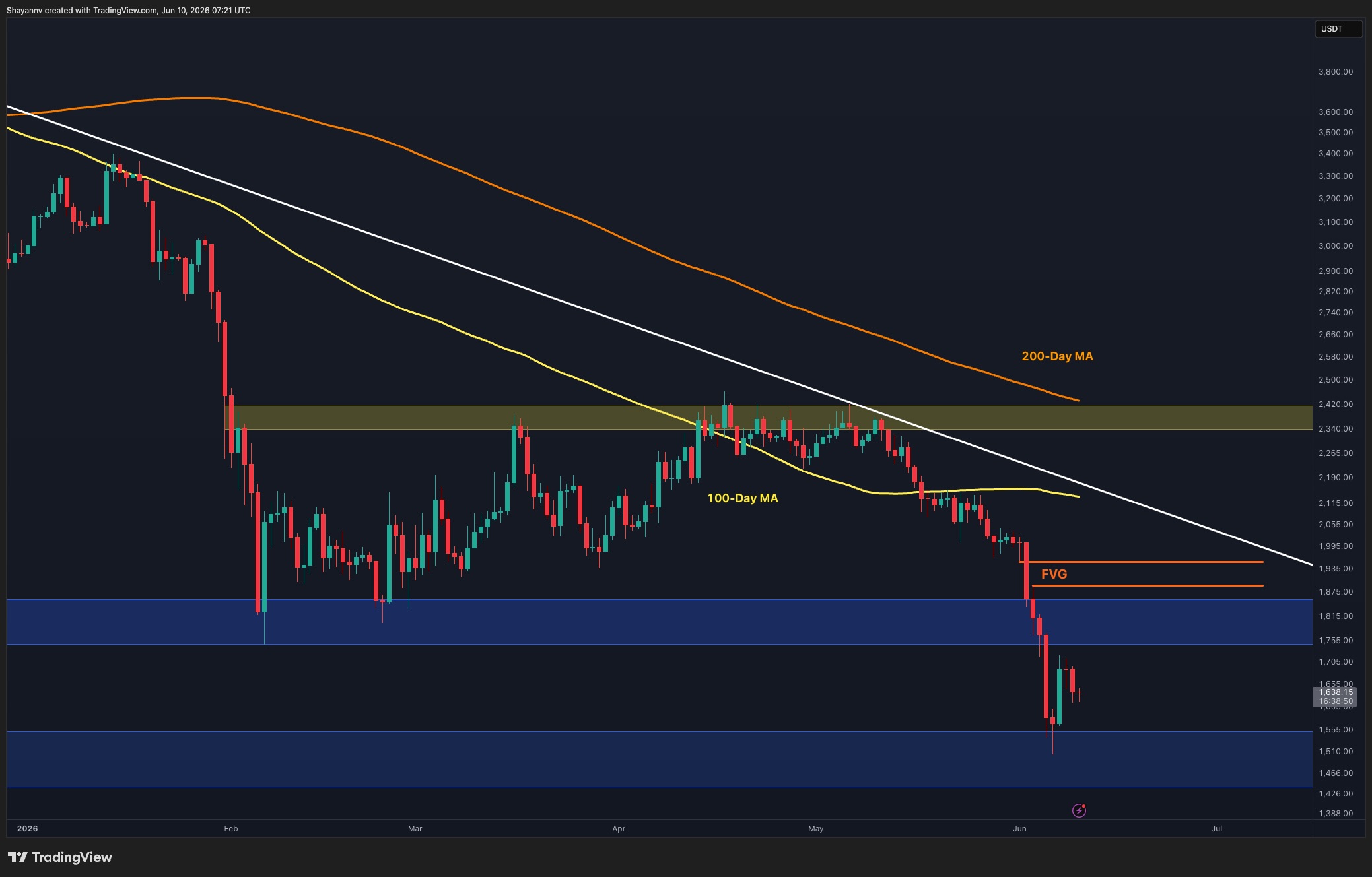
On the daily timeframe, ETH remains trapped within a broad range defined by the upper blue resistance zone around $1.75K-$1.85K and the lower blue demand area near $1.45K-$1.55K.
The recent breakdown below the upper range support marked an important structural shift. ETH lost the $1.8K region and quickly dropped into the lower portion of the range, eventually finding demand just above the lower blue box around $1.5K. The sharp rejection from that zone confirms that buyers are still defending the range floor, preventing a deeper bearish continuation for now.
However, the broader trend remains weak. The asset continues to trade beneath the descending long-term trendline as well as the 100-day and 200-day moving averages, all of which are sloping lower. This alignment suggests that sellers still maintain control despite the recent bounce.
As long as ETH remains between the two blue zones, the market can be viewed as range-bound rather than trending. The lower blue box around $1.45K-$1.55K remains the primary support area, while the upper blue box around $1.75K-$1.85K now acts as the first major resistance.
ETH/USDT 4-Hour Chart
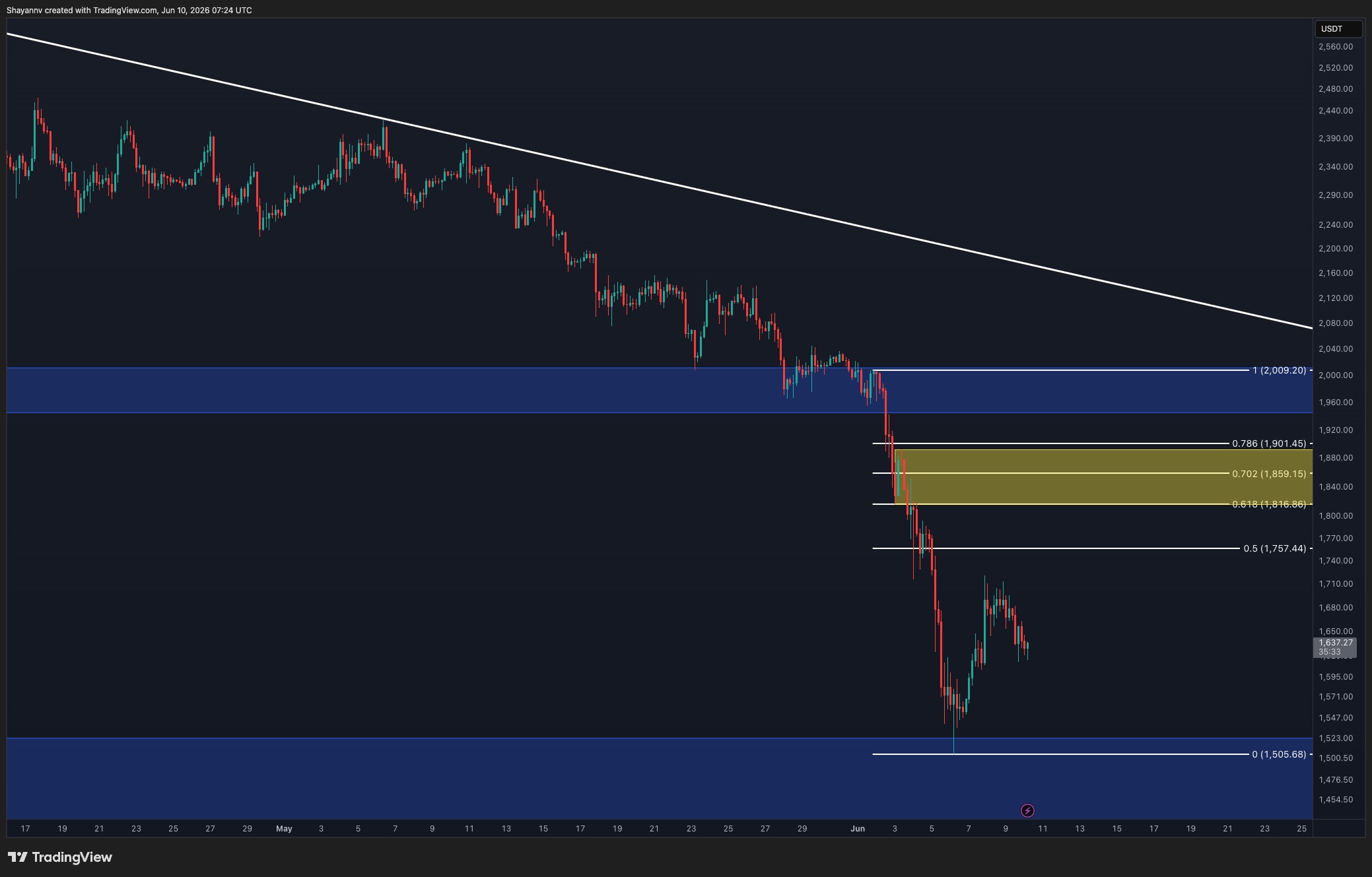
The 4-hour chart provides a clearer view of the recent capitulation and subsequent rebound. After breaking below the $2K support area, ETH experienced an aggressive sell-off that drove the price directly into the lower daily demand zone. The recovery that followed appears corrective so far, with the asset still trading beneath several important Fibonacci retracement levels derived from the latest decline.
The key area to watch is the Fibonacci resistance cluster between $1.82K and $1.9K. This zone contains the 0.618 retracement around $1.82K, the 0.702 level near $1.86K, and the 0.786 retracement around $1.9K. The concentration of these levels creates a notable supply region where sellers may attempt to re-enter the market.
Given the current structure, a continued relief rally toward this Fibonacci cluster appears possible before the next major directional move develops. Such a pullback would also align with the previous breakdown area, making it a technically significant resistance zone.
If ETH is rejected from the $1.82K-$1.9K region, the recent rebound could ultimately prove to be a bearish retest within the broader downtrend. On the other hand, a decisive break above $1.9K would weaken the bearish structure and open the door for a move toward the $2K-$2.05K resistance region.
Sentiment Analysis
The Binance liquidation heatmap highlights a notable concentration of liquidity resting between $1.7K and $1.8K.
This liquidity cluster aligns closely with several technical resistance levels visible on the price charts, including the 0.5 Fibonacci retracement near $1.76K and the lower portion of the broader Fibonacci resistance zone extending toward $1.8K. Such confluence often attracts price action as the market seeks nearby liquidity pools before establishing its next directional move.
From a derivatives perspective, the presence of dense liquidation levels above the current market price suggests that a short-term liquidity-driven squeeze remains possible. A move into the $1.7K-$1.8K area could trigger a wave of liquidations and fuel additional upside momentum toward the higher Fibonacci levels near $1.86K-$1.9K.
As a result, the liquidation profile supports the possibility of a relief rally in the near term, although the broader trend remains bearish until ETH can reclaim the major resistance cluster overhead. The interaction between the $1.7K-$1.8K liquidity pocket and the Fibonacci resistance zone may ultimately determine whether the current rebound evolves into a larger recovery or merely another lower high within the prevailing downtrend.

The post Ethereum Price Prediction: How Close Is ETH to a Sub-$1.5K Breakdown? appeared first on CryptoPotato.

South Korea’s Korea Exchange halted trading in KOSPI-listed shares for 20 minutes on July 28 after the benchmark fell 8.02% to 6,213.51.
Summary
- 8.02% KOSPI drop triggered a 20-minute marketwide circuit breaker at 10:13 a.m. Tuesday in Seoul.
- SK Hynix ADRs closed at $143.02, below their $149 offering price for first time Monday.
- July 29 brings SK Hynix earnings and additional KOSPI shares from its U.S. ADR offering.
The Level 1 circuit breaker took effect at 10:13 a.m. local time after the decline remained above 8% for one minute. It was the eighth KOSPI circuit-breaker activation of 2026 and the 14th on record.
Selling continued after trading resumed. Yonhap placed the index 8.59% lower at 6,175.71 at 11:20 a.m., while Reuters reported a decline of about 9.4% by 12:41 p.m. Korea time. The figures were intraday and may differ from the eventual closing level.
The KOSPI circuit breaker stopped the full market
The Level 1 mechanism suspended trading and order-taking in shares on the main KOSPI market for 20 minutes. The exchange then reopened trading through a 10-minute single-price call auction. The measure followed sell-side “sidecar” curbs earlier in the session, which temporarily stopped program trading as futures and cash shares fell.
The two controls serve different purposes. A sidecar pauses program orders, while a circuit breaker stops most trading across the market. The July 28 halt followed earlier 2026 activations on March 4 and 9, June 8, 23 and 26, and July 7 and 13, according to Korean market reports citing the exchange.
The latest decline extends a period of unusually sharp moves in South Korean equities. As previously reported, KOSPI volatility in June was intensified by margin calls, high retail leverage and the heavy index weight of Samsung Electronics and SK Hynix.
SK Hynix ADR fell below its $149 offer price
SK Hynix’s Nasdaq-listed American depositary receipts closed the previous U.S. session at $143.02, down 7.5%, according to Reuters. That was their first close below the $149 offering price since regular trading began in July. Market data showed an intraday low near $139.10, explaining reports that the ADR had briefly fallen below $140.
The verified closing figure differs from the $139.45 quote circulated in some early reports. That lower number appears to reflect an intraday or extended-hours quote rather than the official regular-session close. The ADR opened at $159.61, reached $164.30 and fell as low as $139.10 before closing at $143.02.
SK Hynix priced 177.9 million ADRs at $149 and raised about $26.5 billion in the U.S. offering. Each ADR represents one-tenth of a Korean common share. The company said the listing was intended to broaden its U.S. investor base and strengthen its position in AI memory markets.
Chip concerns drove the KOSPI selloff
SK Hynix shares in Seoul fell as much as 14%, while Samsung Electronics dropped as much as 13.4%, Reuters reported. The two chipmakers together account for nearly half of the KOSPI, so their declines exerted heavy pressure on the benchmark.
The selloff followed another decline in U.S. semiconductor shares. Investors were reassessing the scale and financing of AI infrastructure spending, including questions around whether chip suppliers and technology companies are supporting customer demand through large financial commitments. Those concerns remain market interpretations rather than evidence that orders have been cancelled.
China-related developments added pressure. Reuters cited analysts who pointed to the stock-market debut of Chinese memory producer ChangXin Memory Technologies and reports of progress in domestic deep-ultraviolet lithography equipment. Details about the equipment’s performance and commercial timeline had not been disclosed, so the competitive threat remains uncertain.
In related coverage, concerns around AI valuations had already pushed SK Hynix and Samsung lower during earlier July sessions. Another report examined how Bitcoin traded alongside technology shares during a prior KOSPI-led risk-off move.
Earnings and tighter ETF rules come next
SK Hynix is scheduled to publish its second-quarter results at 9:00 a.m. Korea time on July 29. The release will give investors updated figures for high-bandwidth memory sales, margins, capital spending and demand from major AI customers.
In April, the company reported first-quarter revenue of 52.58 trillion won and operating profit of 37.61 trillion won. SK Hynix attributed the results to strong demand for AI memory, high-capacity server DRAM and enterprise solid-state drives.
July 29 is also the scheduled KOSPI listing date for the newly issued common shares underlying the U.S. ADR sale. The additional shares may affect short-term supply and index positioning, although the company has not forecast a specific price effect.
South Korea’s Financial Services Commission is also accelerating restrictions on single-stock leveraged exchange-traded products. From July 31, retail investors must hold at least 30 million won in cash to make new or additional purchases. The previous 10 million won requirement allowed some securities to count towards the minimum.
The FSC has already suspended new listings and advertising for single-stock leveraged products. Further changes covering premium controls and watchlist rules are scheduled for August 19. The regulator said it would continue monitoring demand and consider more measures if volatility remains elevated.
For markets, the next confirmed events are SK Hynix’s earnings, the additional share listing and the July 31 leverage restrictions. Investors will also watch whether the KOSPI recovers after the halt and whether SK Hynix’s ADR can reclaim its $149 offering price.
Bitcoin has come under pressure since the U.S. stock market closed Monday, with South Korea’s Kospi leading Asian equities lower and providing risk-off cues to the cryptocurrency market.
BTC has fallen to $63,200 from nearly $65,000, a 2.7% decline that has spilled over into the broader crypto market and dragged down the likes of ether (ETH), XRP (XRP), solana (SOL), and others. The drop ends the brief resilience the market showed earlier Monday as shares in NVDA tanked on Wall Street.
The Senate has shelved the CLARITY Act to prioritize a Russia sanctions bill, making a vote on the much-awaited legislation, touted to deliver regulatory clarity and unlock massive institutional buying for digital assets, unlikely before next week. This leaves only the final days before the Aug. 8 recess.
Asian stocks cracked sharply, with South Korea’s Kospi index falling 10% to its lowest level since mid-April. The index has now dropped 25% from its mid-June peak. The latest decline featured steep losses in heavyweights such as Samsung and SK Hynix. “The market is falling out of love with chipmakers at the moment and that’s been a big driver of the bull market in South Korea,” InvestingLive wrote.
Bitcoin’s Monday rally that drove it to $65,600 on a couple of occasions has come to a screeching halt, as the asset has not only erased all gains but plummeted even more to a ten-day low.
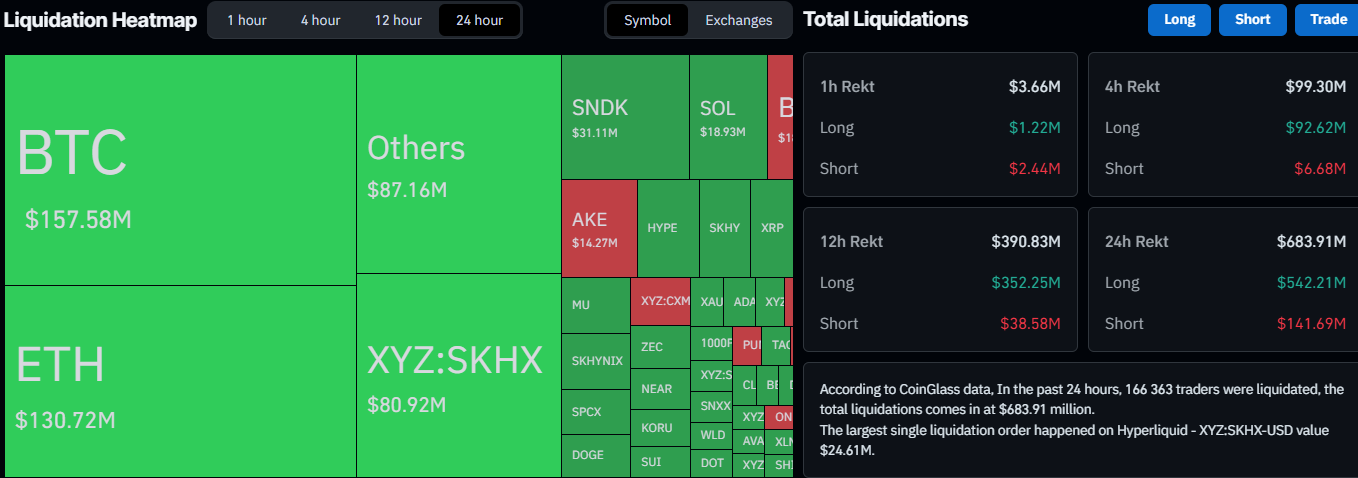
Most altcoins have followed suit, which has skyrocketed the daily liquidations to approximately $700 million.

The chart above paints a clear and painful picture. BTC had maintained $64,000 over the weekend before it jumped to a multi-day peak of $65,600 on Monday. It tried to take down that resistance twice, but it was stopped each time.
The second rejection was quite violent as it drove the asset south by nearly $3,000 in hours. Thus, BTC plummeted to $63,000 for the first time since July 17.
Popular analyst CRYPTOWZRD weighed in on the latest move south, indicating that the largest digital asset had closed bearish. They believe it’s essential for BTC to remain above the currently tested support at $63,000; otherwise, it could slump to new local lows.
ETH was yesterday’s top gainer, surging to a two-month peak of $1,980. However, it has lost $100 since then and now sits well below $1,900. XRP has dumped by 4.5% to $1.06, thus slipping below the coveted $1.10 support. SOL is down by a similar percentage, while HYPE has plummeted by 6%.
Expectedly, this big market move has harmed over-leveraged traders, as more than 165,000 such participants have been wrecked in the past 24 hours. The total value of liquidated positions has risen to almost $700 million on a daily scale. Naturally, BTC and ETH lead the pack.
This morning’s market crash comes just a day before the US Federal Reserve is scheduled to announce its interest rate decision, and the uncertainty around a potential hike has harmed risk-on assets like crypto.
The post $700 Million in Liquidations as BTC, ETH, XRP Plunge Ahead of FOMC appeared first on CryptoPotato.
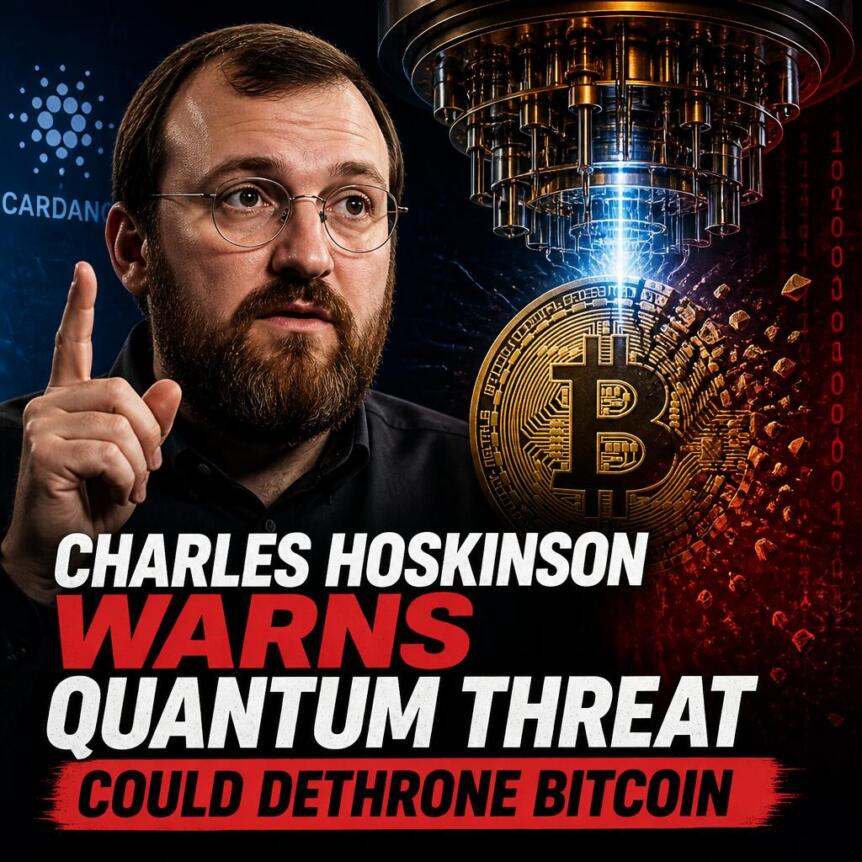
Cardano co-founder Charles Hoskinson has warned Bitcoin could lose its dominance if its governance system and community fail to coordinate a response to the quantum computing threat.
Bitcoin developers are already working on post-quantum solutions, including BIP 361, which proposes moving away from ECDSA and Schnorr signatures after a post-quantum system is selected.
Quantum Threat Could End Bitcoin Dominance
Hoskinson’s warning came during an interview with The Starting Block. The Cardano co-founder described Bitcoin as being “stuck in time” because any changes to the network require consensus across stakeholders including users, miners, node operators, and developers. According to Hoskinson, frustration with Bitcoin’s rigidity and inflexibility was one of the reasons behind the creation of Ethereum. Hoskinson was one of the original co-founders of Ethereum along with Vitalik Buterin. He stated during the interview, “The issue with Bitcoin is it’s frozen in time. It’s very difficult to change anything.”
Bitcoin uses elliptic-curve cryptography to prove the ownership of funds. Quantum computers, in theory, could decipher private keys from the public keys and authorize transactions without the owner’s knowledge or approval. Hoskinson believes the quantum threat could pose a major risk to the flagship cryptocurrency and its $1.3 trillion market capitalization, eventually stripping it of its dominance unless its governance mechanism adapts without impacting the qualities that give it value. “What made Bitcoin so strong is it survived external threats … including the loss of its founder. Quantum computers are yet another threat … if Bitcoin’s governance is such that it’s impossible actually to make meaningful progress, or they compromise the core reason to use Bitcoin, I don’t think Bitcoin’s going to stay the number one cryptocurrency.”
Cardano Better Equipped for Technical Threats
Hoskinson argued that Cardano’s formal on-chain governance and ability to approve upgrades make it better at responding to threats like the one confronting Bitcoin.
“Cardano is, in many ways, a spiritual successor [to Bitcoin]. It reflects correcting a lot of things that I think that Satoshi couldn’t get around to because of expertise or time but was directionally moving there.”
Cardano moved to full community governance after the Plomin hard fork in January 2025. ADA token holders can vote or delegate their vote to representatives called DReps. A constitutional committee and stake pool operators also participate in key decisions. This system helps Cardano approve hard forks and treasury decisions on-chain. Hoskinson argued that Cardano could use the system to vote on migrating away from quantum-vulnerable infrastructure.
Hoskinson added that Cardano is preparing for its largest upgrade, which would make the network “60-times faster.”
Not a Perfect System
However, Cardano has yet to undertake or complete such a migration because its governance system must evaluate technical designs, approve funding, and organize users, developers, and service providers. Cardano’s governance system has also witnessed several disputes. Cardano delegates recently rejected and challenged several proposals linked to Hoskinson and Input Output, including a proposal to research Leios scaling and quantum-resistant cryptography.
Bitcoin Developers Exploring Post-Quantum Options
Bitcoin’s governance allows developers to propose code. However, users and node operators decide on its implementation. Miners, exchanges, and wallet providers also influence decision-making. While this helps avoid frequent changes, it makes urgent coordination difficult. The community is tracking BIP-361, a proposal that phases out legacy ECDSA and Schnorr signatures to protect the network against the quantum threat. Several other proposals are also under consideration, including ones advocating new address formats, hybrid signatures, and recovery paths.
However, any measure will require wallets, exchanges, custodians, and dormant holders to migrate their funds without splitting the network or creating conflicting ownership rules.
Disclaimer: This article is provided for informational purposes only. It is not offered or intended to be used as legal, tax, investment, financial, or other advice.


Coinbase chief executive Brian Armstrong has argued that artificial intelligence will increase demand for crypto rather than replace it.
Summary
- Armstrong says AI agents will increase crypto demand by using programmable money for autonomous transactions.
- Chainalysis counted over 100 million x402 payments on Base, though meme-coin farming drove early growth.
- Coinbase combines Base, USDC, x402 and agent wallets to build its agentic finance payment stack.
In a July 27 post on X, he described Base, USDC and the x402 payment standard as the core of Coinbase’s “Agentic Finance,” or AiFi, strategy.
Armstrong wrote that “AI being a megatrend takes nothing away from crypto” and said AI agents would eventually complete more daily transactions than all people combined. The forecast has no set timeline. Current data shows growing x402 activity, but it does not prove that autonomous agents already exceed human payment use.
Armstrong links AI growth to programmable money
Armstrong rejected calls for crypto companies to pivot away from blockchain and focus only on AI. He said AI agents need programmable money because traditional bank accounts, cards and checkout pages depend on human identity checks and manual approval.
Under Coinbase’s model, software can hold a wallet, pay for an API request and receive a digital service without opening an account with each provider. Agents could buy data, computing power, research, media generation or storage through small payments that settle onchain.
The structure may raise transaction counts because one agent can make many low-value payments during a single task. However, transaction frequency does not show the total economic value of the activity. Armstrong’s claim therefore remains a company thesis rather than a measured outcome.
Base and x402 form Coinbase’s AiFi payment stack
Coinbase introduced Base in February 2023 as a low-cost Ethereum layer-2 network for onchain applications. The company did not build Base only for AI, but its lower fees and faster settlement later made it a main network for x402 payments.
Coinbase launched x402 in May 2025. The open protocol uses the HTTP 402 “Payment Required” status code to let websites and APIs request stablecoin payments. A client receives payment instructions, signs a blockchain transaction and gains access after the payment is checked.
USDC serves as a common settlement asset because its price tracks the U.S. dollar. Coinbase also offers Agentic Wallets, which let developers set spending and trading rules for AI systems. The wallets can pay for data and computing through x402 while operating without manual approval for each transaction.
As crypto.news previously reported, Coinbase also launched Coinbase for Agents, giving software access to trading, portfolio management and x402 payments under user-defined limits. The company later added x402 support for businesses that want to receive USDC directly from software agents.
Chainalysis counts more than 100 million Base payments
Chainalysis reported on June 3 that x402-linked payments on Base crossed 100 million transactions after about nine months of activity. The analytics company identified flows connected to the protocol and studied the wallets involved.
The report found that payments worth at least $1 made up 95% of the value transferred. It also said agentic payment wallets tended to be newer, held smaller balances and owned 550% more asset types than typical Base users.
Still, Chainalysis said meme-coin farming drove much of the early transaction growth. That detail limits claims that all 100 million payments came from independent AI agents buying useful services. Automated scripts, incentive campaigns and other software activity can also create x402 transfers.
As crypto.news reported in June, x402 had already passed 100 million Base transactions while Armstrong and other industry leaders promoted crypto as a payment layer for AI. Earlier crypto.news coverage also found that x402 activity reached 75.41 million transactions over one 30-day period, with Base and USDC leading usage.
Coinbase expands agent tools before quarterly results
Coinbase has continued adding products around the same strategy. Agentic.market allows software agents to find and purchase services using USDC. Developers can also use Coinbase tools to build wallets, set transaction policies and charge for API calls through x402.
Outside Coinbase, companies have begun testing the protocol for travel, cloud services and online content. Travala launched an AI hotel-booking system that lets agents search more than 2.2 million properties and pay with USDC on Base.
The market remains early. Coinbase’s products show that machines can initiate blockchain payments, but adoption figures depend on how analysts classify agent activity. Security, spending controls, identity rules and service quality will also shape wider use at present.
Coinbase will publish its second-quarter 2026 results on July 30 after U.S. markets close. The report may give investors more detail on stablecoin revenue, Base activity and developer products, although the company has not said it will disclose AiFi revenue separately.
Pseudonymous trader CrediBULL Crypto is calling for Ethereum (ETH) to reach $20,000 or higher, repeating a target he first laid out three weeks ago when the token was trading near $1,500.
According to him, Ethereum is finishing a multi-year base against Bitcoin (BTC) and is about to enter its first bull run since 2017.
The Charts Behind the $20K Call
Responding to a claim by alphatracker that ETH would go to $10K+, CrediBULL simply posted “$20K+,” and shared a link to a video where, instead of presenting the target as speculation, he built his case around long-term chart structures on both the ETH/USD and ETH/BTC pairs.
“I’ve always said $10K is the absolute minimum. I think $20K is realistic..,” the analyst said in the video. “I’m not going to say it’s a given… but $20K is super, super reasonable.”
He noted that Ethereum has spent years underperforming Bitcoin, leaving market sentiment at levels similar to previous cycle lows. But he argued that the ETH/BTC chart has finally reached what he considers to be a long-term accumulation zone after about four years of decline, and from there, he expects the world’s second-largest cryptocurrency to build a base before beginning what he described as the next impulsive move higher.
His next thesis tracked the ETH/USD chart itself, with the trader saying that Ethereum has completed the first leg of a larger five-wave structure and is now holding above an invalidation level near $1,385.
According to him, if that support stays intact, then the next advance could push ETH to around $10,000 before a later wave carries it above $20,000. He also argued that historical ETH/BTC ratios point to similar price levels if Bitcoin returns to its previous highs or continues into another expansion phase.
Furthermore, Credibull drew a comparison to April last year, when Ethereum sat near the same price it’s at right now and was widely written off as finished, only to break its all-time high a few months later. He said that the setup looks similar today, with the price holding above its last low rather than breaking it, something he treats as a sign that the broader uptrend is still intact.
Similar sentiments were shared by trader Saiyan, who set a base case of $10,000 for the cycle, prompting a pushback from Cheds Trading, who simply wrote, “That’s not happening.” But another market watcher, Sykodelik, sided with the bulls, arguing that a move above $10,000 should not be treated as unrealistic, given that it was just 2 times the Ethereum all-time high.
Where ETH Stands Now
ETH was trading above $1,900 at the time of writing, having gained nearly 4% in 24 hours and about 24% over the past month, according to CoinGecko data.
The token is still 60% below its ATH, and other analysts have flagged similar bottoming signals in recent weeks. For example, NoName pointed to a pattern of four lower highs as evidence that the bear market has already found a floor, while chartist Ali Martinez noted a bullish crossover in the asset’s MVRV ratio.
Funding rates on Binance have also climbed to their highest level in six months, something analysts at CryptoQuant say shows that sentiment has started to turn even though the price is still well below where it was around the same time last year.
The post Ethereum Could Hit $20K as Multi-Year BTC Base Completes: Analyst appeared first on CryptoPotato.
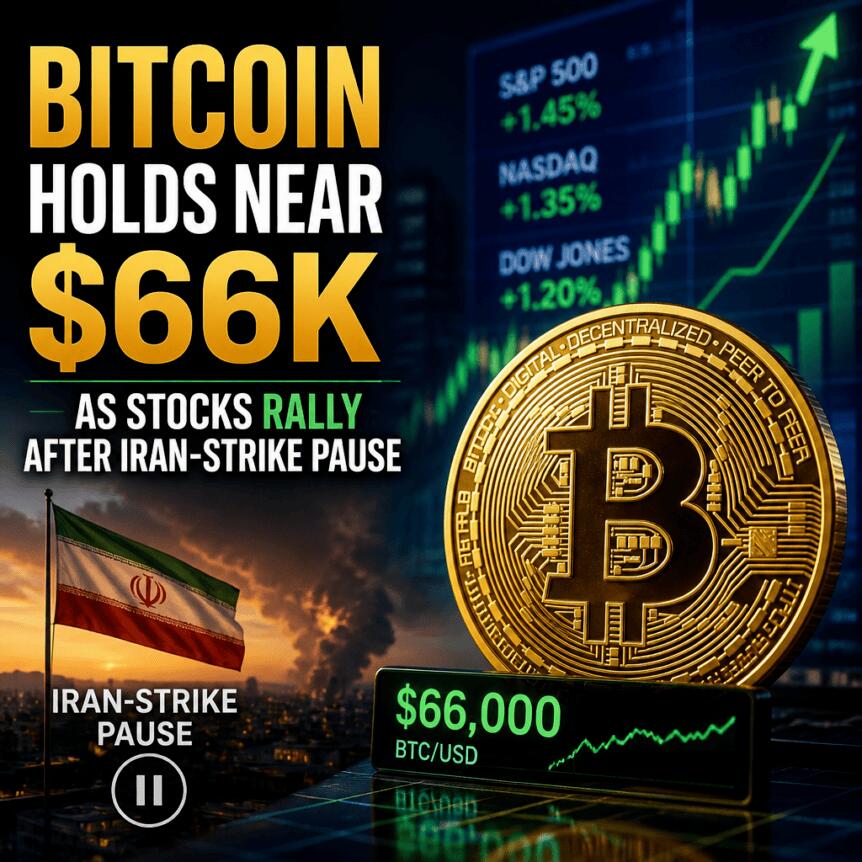
Bitcoin moved higher at the start of the week’s first Wall Street session, testing fresh local highs as broader markets opened in positive territory. The latest push came alongside reports of a pause in US–Iran tensions and renewed efforts connected to the Strait of Hormuz—an outcome that traders viewed as a near-term reduction in geopolitical risk.
According to TradingView data cited in market coverage, BTC/USD spiked toward the $66,000 area as risk assets gained traction. At the time of writing, US equity benchmarks such as the S&P 500 and Nasdaq Composite were up by roughly 0.3%, while WTI crude oil dipped before a modest rebound, reflecting a less volatile energy backdrop than earlier in the month.
Key takeaways
- Bitcoin pushed toward new local highs near $66,000 after a reported easing in US–Iran strike activity.
- Iranian and Omani discussions tied to maritime traffic via the Strait of Hormuz supported sentiment, with oil moving less sharply.
- BTC held two key short-to-medium-term trend levels on the daily chart: the 21-day and 50-day SMAs near $64.3k and $63.3k.
- Despite the bounce, market commentary emphasized the price base as “fragile,” with traders watching for follow-through toward $66k–$67k.
- Crypto short liquidations increased as price rose, with CoinGlass data showing the figure nearing $250 million over 24 hours.
Geopolitics and risk assets lift BTC at the open
The immediate catalyst for Bitcoin’s uptick was macro-linked sentiment tied to the Middle East. TradingView data showed BTC/USD jumping toward $66,000 as traders responded to reports that there had been a pause in strikes between the US and Iran.
Additional reporting referenced statements by an Iranian foreign ministry spokesman indicating that Tehran and Oman were “trying to establish mechanisms regarding maritime traffic” through the Strait of Hormuz, a chokepoint for global oil flows that had been closed. While headlines about reopenings and “mechanisms” can remain fluid, the market impact was clear: energy risk eased at the margin, and that helped equities—and Bitcoin—start the session with momentum.
WTI crude oil, often treated as a proxy for near-term geopolitical stress, fell toward about $82 per barrel before recovering modestly. The combination of a steadier oil tape and higher equity futures aligns with a classic “risk-on” relationship that can temporarily benefit liquidity in major crypto markets.
Macro headwinds remain, but crypto’s July performance stands out
Even with the immediate tailwind, traders were careful not to overstate the durability of the move. One potential constraint mentioned in the coverage was the risk of higher US bond yields, which can weigh on assets with lower real-yield support.
QCP Capital argued that—despite a more challenging macro backdrop—digital assets had generally outperformed equities during July. In its “Market Color” analysis, the firm said BTC and ETH were up about 11.6% and 24.6% month-to-date, respectively, noting that higher Treasury yields and periodic risk-off episodes had pressured broader markets.
Importantly for investors focused on regulation, QCP also flagged attention around the proposed CLARITY Act. The analysis described ongoing interest from digital asset participants because the bill could affect the US regulatory framework for the sector. The CLARITY Act was referenced as being under consideration, with market participants watching for any progress that could shift expectations around how digital asset rules might evolve.
Support levels hold—yet traders want proof beyond the bounce
On the chart, the rally’s quality mattered as much as the direction. Crypto trader and analyst Michaël van de Poppe highlighted that BTC was holding the 21-day and 50-day simple moving averages (SMAs). The levels cited were approximately $64,289 for the 21-day SMA and $63,261 for the 50-day SMA—areas that often function as magnets for both discretionary traders and systematic strategies.
Van de Poppe characterized the holding as a “strong signal” for long-biased positioning, but added that the structure was still “a little fragile.” In a posted view on X, he indicated he would prefer to see a decisive advance into the $66,000–$67,000 band within the next 1–3 days, which would indicate more persistent demand rather than a single-session push.
That distinction is crucial. A market can rise quickly toward resistance levels and still fail if buyers don’t expand after the initial liquidity draw. For traders, the next test is not just whether BTC reaches the higher range, but whether it can keep the bid long enough to convert a “spike” into a sustained move.
Liquidations rise as shorts get squeezed
Alongside price strength, liquidation data suggested that the move was accompanied by short-covering. CoinGlass data referenced in the coverage showed crypto short liquidations increasing as BTC rallied, with the metric nearing $250 million over a 24-hour period.
Liquidation spikes can be interpreted in two ways: they may signal aggressive leverage being forced out, or they may reflect a crowded short position that becomes vulnerable when the market turns upward. Either way, when large liquidation prints occur near key technical levels, they often coincide with bursts of volatility—meaning traders may see both acceleration and faster reversals if price fails to hold.
What to watch next
With BTC holding important moving averages while testing the upper end of the near-term range, the market now appears to be waiting for confirmation. Traders are watching whether Bitcoin can sustain interest into the $66,000–$67,000 zone, while broader risk sentiment could hinge on continued developments around US–Iran tensions and any tangible progress related to Strait of Hormuz maritime arrangements.

The Hong Kong Monetary Authority (HKMA) has introduced a new assessment framework aimed at helping banks prepare for the potential impact of quantum computing on the cryptography underpinning distributed ledger and digital finance systems. The move signals that Hong Kong’s rapid push toward tokenization and blockchain settlement is now paired with a formal push to address “post-quantum” security risks.
In a white paper released Monday, the HKMA unveiled the sector’s first Quantum Preparedness Index (QPI). The HKMA assigned an overall readiness score of 2.3 out of 10 across surveyed institutions and said roughly half of them had no formal post-quantum planning in place. The regulator’s goal is to raise the sector to a QPI score of 10 by 2030.
Key takeaways
- The HKMA’s first Quantum Preparedness Index scores the banking sector at 2.3/10, indicating limited readiness for post-quantum upgrades.
- According to the HKMA, around half of surveyed institutions lack formal post-quantum planning.
- Hong Kong’s tokenization and distributed ledger initiatives heighten the urgency of cryptographic migration planning.
- The regulator warns that sufficiently powerful quantum computers could eventually break RSA and elliptic-curve cryptography used in financial systems.
- The HKMA is targeting full sector preparedness by 2030 and is urging earlier inventories and risk assessments.
Why HKMA is turning to quantum preparedness now
The HKMA’s quantum framework arrives as the city expands how it uses tokenization in mainstream finance. Hong Kong has already issued three batches of tokenized green bonds totaling about HK$16.8 billion (around $2.1 billion) since 2023, according to government disclosures published on the government information site and related bond issuance updates since that period.
At the policy level, the HKMA is also advancing tokenized deposits and digital-asset settlement. It has been working on these capabilities under Project Ensemble, an initiative that Cointelegraph previously covered in the context of tokenization efforts and wholesale CBDC-related infrastructure.
Within this broader push, the HKMA’s central argument is that distributed ledger applications and payment networks rely on cryptography for core functions—and that a successful cryptographic compromise would create systemic vulnerabilities. The white paper states that if those protections were undermined, it could lead to severe disruption across the systems that depend on them.
The QPI score and what the assessment found
The white paper and the accompanying index formalize how the HKMA expects banks to think about readiness. With an overall QPI score of 2.3/10, the HKMA essentially portrays the sector as being in an early stage—before deep technical migrations and long-running system updates.
Two findings stand out from the HKMA’s release. First, it reports that around half of the surveyed institutions had no formal post-quantum planning in place. Second, it describes examples of early technical work: the HKMA says one institution completed a proof of concept applying post-quantum cryptography to distributed-ledger connectivity.
The HKMA also points to real-world experience in the industry, noting HSBC’s 2024 use of quantum-safe technology to move tokenized gold across distributed ledgers. This detail is included in the HKMA’s white paper as an example of post-quantum considerations being explored in connection with tokenized asset settlement.
Quantum risk: what could be broken, and why timelines matter
In the HKMA’s framing, the major threat comes from the possibility that quantum computers could run Shor’s algorithm at scale. In its view, that capability could eventually undermine widely used public-key systems such as RSA and elliptic-curve cryptography.
If that were to happen, the HKMA warns it could enable attackers to decrypt protected data or forge digital signatures—mechanisms used to authorize transactions, verify identities, and establish trust within financial systems.
The regulator emphasizes practical urgency rather than alarm. According to the white paper, replacing cryptographic systems embedded across infrastructure can take years. For that reason, it urged banks to begin with foundational work now—such as inventories of cryptographic assets, risk assessments, and migration planning—before machines with the required capability become available.
Hong Kong’s tokenization strategy raises the bar for security upgrades
The HKMA’s quantum effort aligns with its broader Fintech 2030 direction, announced as a strategy in 2025 that made tokenization a key pillar. Cointelegraph previously reported that tokenization was one of four strategic pillars within an overall plan of more than 40 initiatives in coverage of HKMA’s Fintech 2030 strategy.
The HKMA has signaled that its tokenization agenda includes acceleration of real-world asset (RWA) tokenization, regularization around tokenized government bond issuance, and exploration of tokenized Exchange Fund papers. It has also described blockchain settlement work supported by e-HKD, tokenized deposits, and regulated stablecoins.
Meanwhile, the business momentum behind digital assets and tokenized deposits appears to be building. In a speech, Hong Kong Financial Secretary Paul Chan said banks in the city held more than HK$14 billion (about $1.785 billion) in digital assets under custody at the end of 2025, up about 180% year over year. He also cited tokenized deposits reaching HK$29 billion (about $3.7 billion).
That combination—growing tokenization activity alongside a regulator-led push for cryptographic resilience—helps explain why the HKMA is moving beyond generic cybersecurity guidance and instead introducing a measurable readiness score. For market participants, the QPI structure may translate into clearer expectations for governance and technical planning as they integrate DLT into more of their regulated operations.
Going forward, banks in Hong Kong will likely need to watch how the HKMA tracks QPI progress toward the 10/10 by 2030 target and whether additional guidance is released on timelines, assessment methods, and post-quantum migration priorities. With the assessment showing low current readiness, the next phase to monitor is how quickly institutions turn plans into concrete inventories, testing, and system upgrades across ledger connectivity and transaction authorization layers.


Cointelegraph is committed to providing independent, high-quality journalism across the crypto, blockchain, AI, and fintech industries.
All news, reviews, and analyses are produced with full journalistic independence and integrity. For more details on our standards and processes, please read our Editorial Policy.
Zcash is expected to activate its NU6.3 “Ironwood” network upgrade at block height 3,428,143 on July 28.
Summary
- Ironwood activates at block 3,428,143, replacing Orchard with a separately tracked shielded transaction pool system.
- The turnstile blocks more ZEC leaving Orchard than entered, strengthening public supply verification after migration.
- Quantum-recoverable notes support future recovery, but Ironwood does not make Zcash quantum-secure today by itself.
The Zcash Foundation’s Zebra 6.0.0 release places the estimated activation near 13:00 UTC and tells every node operator to upgrade before the fork.
The upgrade introduces a new shielded pool and a v6 transaction format. It follows the disclosure of a flaw in the older Orchard pool that could have allowed an attacker to create counterfeit ZEC without an obvious public record.
Developers patched the flaw through emergency upgrades in June. They said they found “no evidence” of exploitation, but Zcash’s privacy design prevents them from proving that hidden inflation never occurred.
Ironwood creates a separately tracked shielded pool
According to the Zebra 6.0.0 release notes, Ironwood reuses Orchard’s Action structure and Halo2 proof system. However, it adds a separate note commitment tree, nullifier set, chain value pool and chain-history data. These records let nodes track the new pool independently from Orchard after activation.
Zebra also updates several node commands so operators can inspect the pool’s value and commitment-tree state. The Zcash Foundation’s GitHub release labels the upgrade critical for operators because older software will not follow the correct chain after the activation height.
Turnstile limits value leaving Orchard
Ironwood’s main supply safeguard is a turnstile between Orchard and the new pool. After activation, Orchard will stop accepting new outputs and internal transactions. Funds can move out, but the accounting rule prevents more ZEC from leaving Orchard than the amount that legitimately entered it.
The Ironwood design explanation says the mechanism gives users a public check on circulating supply without exposing private balances or transaction details. Instead, it would leave any excess hidden value trapped inside Orchard once the pool becomes exit-only.
As crypto.news previously reported, Zcash scheduled the July 28 hard fork after developers concluded that the patched bug still left a supply question they could not answer with certainty. Zcash founder Zooko Wilcox said the flaw was “unlikely to have been exploited,” while also stating that users should not need to rely on that assessment.
Notes gain a future quantum-recovery path
Ironwood also changes how shielded notes are created so they may be recovered through a future post-quantum protocol. The official ZIP 2005 specification calls the feature quantum recoverability. It binds more note data into the note construction, allowing a later recovery system to verify ownership without relying only on cryptography that a powerful quantum computer could break.
The change does not make current Zcash transactions quantum-secure. The specification says a separate recovery protocol must still be designed and activated later. Funds that remain in Sprout, Sapling or Orchard would not gain this recovery option. Wallets must move them into Ironwood notes to receive the new protection.
The same specification says existing Orchard addresses can receive Ironwood notes, reducing changes for users. Wallet developers must still add migration support. Users whose wallets do not update may face delays when moving Orchard funds, while exchanges may briefly pause deposits or withdrawals around the fork.
Zebra becomes mandatory as zcashd support ends
The upgrade also completes Zcash’s move away from the older zcashd node software. The network set zcashd’s end-of-support halt at block 3,417,100, before Ironwood activation. The official deprecation schedule says zcashd will not support NU6.3, leaving Zebra as the required node implementation for the new rules.
Zebra 6.0.0 includes a separate mempool security fix. The issue allowed peers to send expensive-to-check, non-standard transactions that could reduce node responsiveness while the traffic continued. The fix rejects those inputs before the costly verification step. The Foundation said the flaw affected availability only and did not allow invalid blocks, lost funds or consensus failure.
Related crypto.news coverage detailed Zcash’s two-step response to the Orchard vulnerability. Developers first disabled Orchard activity, then activated the NU6.2 hard fork with corrected code before restoring the pool. Ironwood now adds a separate accounting boundary rather than another patch inside the same pool.
The upgrade remains tied to block production, so its exact clock time may shift. If the chain reaches block 3,428,143 as expected, Ironwood will activate on July 28 and begin the Orchard-to-Ironwood transition.

Offering Crazy Money for this Dodge Charger

Street Food Carousel event to launch in Hartlepool this summer

ASX 200 Edges Higher to Near 8,934 Points as Investors Weigh Falling Oil Prices and Global Earnings News


-

 Fashion3 days ago
Weekend Open Thread: Brooks Brothers
-

 Crypto World7 days ago
Grayscale Files For Worldcoin ETF, WLD Registers Sharp Rise
-

 NewsBeat6 days ago
How a former Blue Peter presenter stunned America’s Got Talent judges
-

 Tech1 day ago
Intel is reversing course and bringing hyper-threading back to its server chips
-
 Business6 days ago
New Jersey voter registration controversy explained: How 6,600 noncitizens got on the rolls, and what happens next
-
 Entertainment6 days ago
Johnny Depp’s R-Rated Gothic Cult Classic Gets New Release Ahead of Sydney Sweeney Remake
-

 Crypto World5 days ago
Ethics, other provisions in crypto Clarity Act to be further discussed
-

 Politics18 hours ago
Luke Littler dismantles Gerwyn Price to retain title in Blackpool
-

 Sports4 days ago
2026 3M Open leaderboard: Scottie Scheffler finds putter in Round 1, sits three back
-
 Sports1 day ago
Commonwealth Games boxing: Jadumani Singh seals dominant 5-0 win over Pakistan’s Sumama Rehman to enter quarter-finals | Commonwealth Games News
-

 Fashion4 days ago
16 Dresses for the High Summer Event
-

 News Videos4 days ago
The Peugeot Family: How 200 Years of an “Old Money” Dynasty Died in A Boardroom
-

 Politics2 days ago
Spain sweeps the board at 2026 World Cup with individual awards
-
 Entertainment4 days ago
A New Post-Apocalyptic Gundam Anime Series Blasts Into SDCC
-

 News Videos1 day ago
BITCOIN JUST ENTERED THIS CRITICAL ZONE…
-

 Crypto World2 days ago
XRP Ledger adds $2.6B as RWA inflows rank second
-

 Crypto World5 days ago
Uniswap (UNI) pushes deeper into tokenized RWAs with permissioned trading pools
-

 Crypto World6 days ago
Sablier Labs Enters Maintenance Mode, Halts Development
-
Crypto World5 days ago
SEC Agrees to Overhaul Recordkeeping After Settling Coinbase Lawsuit Over Gensler’s Lost Texts
-

 Business4 days ago
Alliance Entertainment Holding Corporation (AENT) Discusses Evolution Into Omnichannel Distribution and Fulfillment Platform for Media and Collectibles Transcript
You must be logged in to post a comment Login