

Crypto World
Ethereum Tops $1,900 in a Six-Week High, Where to Next For ETH?


ETH tapped a six-week high of $1,940 in late trading on Wednesday and has held on to those gains into Thursday morning, where it remained above $1,900.
CryptoQuant analyst ‘Darkfost’ said on Thursday that the move was driven by positive inflation reports in the US, with CPI and PPI figures that came in well below expectations. ETH has posted nearly 10% gains over the past two consecutive days, he said.
“Since a low of around $1,500 in June, ETH appears to have entered a genuine shift in momentum, now showing a performance of over 25% for the period.”
Ether Short Squeeze Pumps Prices
The analyst added that the recent surge isn’t solely down to the strong macro data. “It also owes a great deal to the wave of short position liquidations that had been building up on Binance throughout the move.”
It was one of the largest “short squeezes” ETH has experienced on the exchange since June, with almost $30 million in futures wiped out in an hour or so. The largest single liquidation order over the past 24 hours happened on Binance with ETH/USDT valued at $11.9 million, according to Coinglass.
$30M in Shorts Liquidated in an Hour as ETH Breaks $1,900.
Driven by excellent CPI figures yesterday, followed today by a Producer Price Index (PPI) print that came in well below expectations (-0.3%), ETH has posted a performance of nearly 10% over these two consecutive days.… pic.twitter.com/HzGbUwc5RM
— Darkfost (@Darkfost_Coc) July 15, 2026
Arden House founder Alaoui Capital posted a heatmap showing that $2,000 is the level ETH “wants to test before anything else.” Meanwhile, analyst ‘Satoshi Flipper’ said that ETH has now broken out from its downtrend against Bitcoin, which is also bullish for altcoins.
“ETH just woke up,” said former BlackRock vice president and MilkRoad host John Gillen.
He added that bulls need to keep an eye on the $1,950 level at the 100-day exponential moving average, then $2,000. “Crack that and $2,200 comes into play, and then it could be off to the races,” he said.
“This summer just got interesting. Price may finally be reacting to strengthening fundamentals in Ethereum and in ETH the asset.”
Elsewhere on Crypto Markets
Total capitalization has remained flat on the day at $2.3 trillion as ETH is the only mover, up 3.2%
Bitcoin was cooling after its venture above $65,000, and most of the altcoins were flat. There were minor gains for XRP, Zcash, and Stellar, but it is Ethereum stealing the show at the moment.
The post Ethereum Tops $1,900 in a Six-Week High, Where to Next For ETH? appeared first on CryptoPotato.



A Bitcoin wallet that had remained inactive for more than eight years has transferred 5,908 BTC worth about $383 million, reviving another long-dormant holding as traders continue tracking large onchain movements.
Summary
- A Bitcoin wallet dormant for more than eight years transferred 5,908 BTC worth about $383 million to a new address.
- Onchain data showed the coins were not sent to a known exchange wallet, leaving the holder’s intentions unclear.
- The transfer followed another dormant whale move earlier this week, keeping large Bitcoin wallet activity in focus.
According to blockchain analytics platform Lookonchain, citing Arkham data, the wallet identified as “138EM…ReyiT” moved the entire 5,908 BTC balance to a new address at 7:15 p.m. ET on Wednesday. The coins remain in the recipient wallet, with no signs that they have been sent to a cryptocurrency exchange.
Arkham’s data showed the wallet originally received the Bitcoin in December 2017, when BTC traded near $16,800. The holdings were worth about $99.6 million at the time, compared with roughly $383 million at current market prices.
The timing of the original purchase makes the wallet notable. The holder kept the coins through Bitcoin’s nearly 80% decline in 2018, its rally to almost $69,000 in 2021, the subsequent fall to around $15,500 in late 2022, and the record high above $122,000 reached in October 2025, according to market price data. At that peak, the wallet’s balance was worth about $726 million.
While the movement has drawn attention, CoinDesk’s onchain analysis said the Bitcoin was transferred to a newly created, unlabeled address rather than a known exchange deposit address, indicating there is no onchain evidence of an immediate public sale.
The report also noted that the coins moved from a legacy Bitcoin address beginning with “1” to a newer SegWit address beginning with “bc1q.” According to CoinDesk, large holders often reorganize assets to upgrade wallet formats, improve custody, rotate private keys, prepare estate transfers, or arrange over-the-counter transactions that do not reach public exchanges.
Dormant whale activity remains in focus
The latest transfer follows another dormant Bitcoin wallet that became active earlier this week after more than seven years. As previously reported by crypto.news, blockchain intelligence platform Arkham said a wallet moved 2,931 BTC worth about $188 million to a new address after remaining inactive since Bitcoin traded near $6,500.
Although neither transfer has confirmed selling activity, CryptoQuant has reported that whale-sized deposits continue to dominate Bitcoin exchange inflows. Its exchange whale ratio recently stood at 0.99, indicating that the 10 largest transfers accounted for nearly all Bitcoin deposited to exchanges.
According to the firm, elevated readings have historically been associated with higher selling pressure because large deposits are more likely to precede sizable sales.

President Trump was expected to sit down with U.S. senators Thursday afternoon at the White House to try to resolve the ethics provision blocking the Digital Asset Market Clarity Act, an ethics provision that would restrict senior government officials, including the president, from holding personal crypto business interests while in office.
The meeting comes as the Senate faces a narrow window before its August recess. The current bill text does not include the ethics provision Democrats are seeking.

Discover: The Best Token Presales
What the Ethics Provision Would Cover
Democrats have demanded a provision covering the president, vice president, members of Congress, and potentially their spouses and children.
The White House has reportedly pushed for any restriction to be framed as a general officeholder rule rather than language that explicitly targets Trump.
Trump’s Crypto Exposure and the Ethics Fight
Trump disclosed he made more than $1 billion from crypto-related activity in 2025, primarily from the $TRUMP memecoin and World Liberty Financial. The disclosure directly inflamed the ethics fight.
Resolving the ethics provision is seen as the last major issue capable of derailing the bill’s momentum. The bill’s next steps would depend on whether leaders can incorporate ethics language acceptable to enough senators.
Senator Lummis is drawing a line in the sand: Get the crypto bill to the President’s desk now. — Hailey LUNC XRP (@TheMoonHailey) July 5, 2026
The CLARITY Act is officially on the Senate Legislative Calendar (No. 423). 
Crypto regulation is finally entering the chat. 
 https://t.co/0VoenmAsa5 pic.twitter.com/F9hNox9Xg2
Senate Majority Leader John Thune has said he will press forward with a floor vote later in July, whether or not the final ethics language is set.
Discover: The Best Crypto to Diversify Your Portfolio
What Happens Before the Clarity Act August Deadline
The Senate departs for summer recess in the first week of August, and midterm election politics are expected to dominate the calendar after that. A revised near-final version of the Clarity Act text was expected to circulate this week, but may slip as talks continue.

The open question is whether Trump will accept ethics language that materially restricts his own ongoing business interests. The White House meeting is an indication that negotiators are working toward a compromise, but the specific terms that emerge will determine whether enough Democrats back a floor vote.
The broader global push for crypto market structure frameworks adds context to how consequential U.S. action – or inaction – on the Clarity Act would be. A bill that resolves both the technical market-structure questions and the ethics conflict would set a baseline that other jurisdictions will reference. Stalling into the midterm cycle leaves that benchmark unset for at least another year.
Don’t Miss Out on Our $1,000 USDT Airdrop on ByBit
The post Clarity Act Stalls on Ethics Rules Curbing Trump’s Business Interests appeared first on Cryptonews.
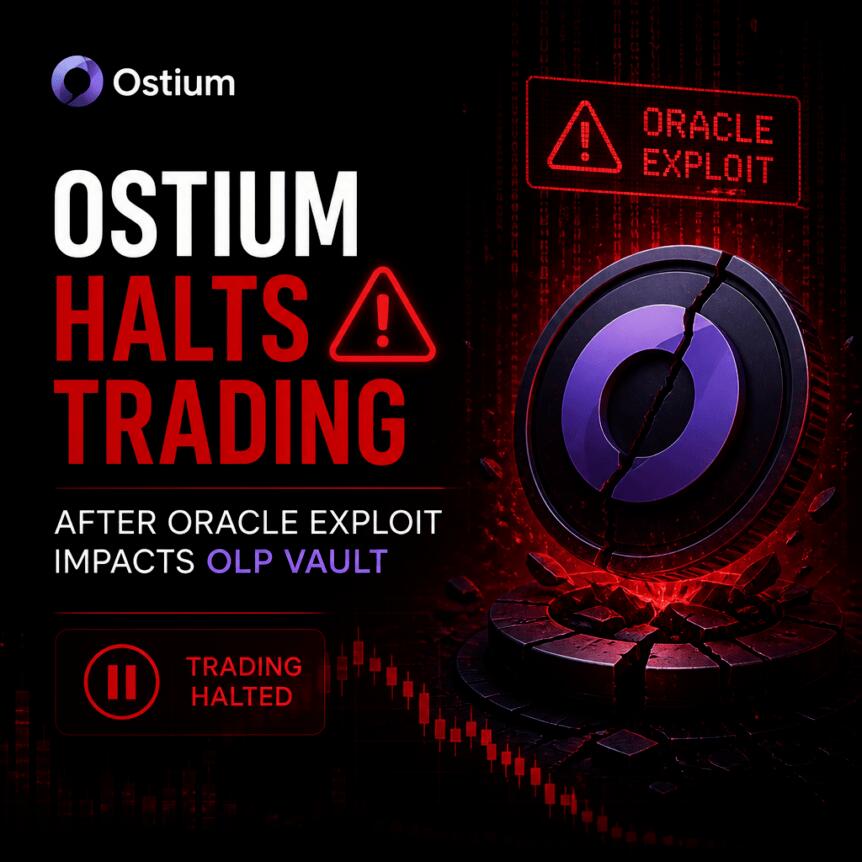
Ostium, a decentralized trading protocol for onchain perpetuals, has paused all trading after security firms reported an apparent exploit tied to its OLP liquidity vault. The pause comes alongside warnings that the incident may be linked to the protocol’s oracle system, which delivers external price data needed for trading.
Blockaid estimated the losses at roughly $18 million, while CertiK put the figure closer to $22 million. Both firms suggested the underlying issue involves a compromise of Ostium’s oracle layer, raising broader questions about the resilience of DeFi protocols whose critical components run outside their core smart contracts.
Key takeaways
- Ostium paused all trading after a reported issue affecting its OLP liquidity vault.
- Security firms Blockaid and CertiK estimated losses at about $18 million and $22 million respectively.
- Both reports pointed to an apparent oracle compromise as the likely driver of the incident.
- Ostium asked users to temporarily revoke token approvals for its contracts while it investigates.
Trading halted after security firms flagged an oracle-linked incident
According to reports from blockchain security companies Blockaid and CertiK, Ostium’s OLP liquidity vault appears to have been exploited. The figures cited by the two firms differ slightly—Blockaid estimated losses at approximately $18 million, while CertiK assessed the impact at roughly $22 million—illustrating the uncertainty that often follows fast-moving investigations.
Both firms attributed the apparent exploit to a compromise of Ostium’s oracle system. Oracles supply offchain or externally sourced price information to onchain markets, and a failure at this layer can undermine the pricing assumptions that perpetuals rely on for liquidations, settlement, and margin logic.
Ostium confirmed the operational response on X, stating that it paused all trading after identifying an issue related to the vault. The protocol later advised users to take an additional protective step: it recommended that users temporarily revoke approvals for its contracts until the team can complete its review of what happened.
“With user security being our first concern, we recommend that all users temporarily revoke approvals for our contracts until we can further investigate the recent incident.”
Why the pause and approvals warning matter for users
In DeFi incidents, the immediate risk is not always limited to the exploited vault itself. When a protocol suspects that permissions may be exposed—or that an attacker could interact with contracts in unintended ways—revoking approvals can reduce the chances of further unauthorized transfers or actions tied to existing allowances.
Ostium’s decision to halt trading suggests it wants to prevent new positions from opening or existing mechanisms from interacting with liquidity while the threat profile is unclear. Importantly, the protocol also said its team is still investigating and has not yet confirmed the root cause or validated the loss estimates provided by Blockaid and CertiK.
That gap—between an “apparent exploit” and an officially confirmed incident report—can be consequential. Traders typically need clarity on whether price data was manipulated, whether funds were drained from a single vault or multiple routes were used, and whether any remaining funds are still at risk. Until those questions are answered, the most practical step for users is to follow Ostium’s own mitigation guidance.
Ostium’s setup and the broader DeFi security problem
Ostium is built on Arbitrum and operates as an onchain perpetuals platform offering leveraged exposure to 75 trading pairs. Those pairs span stocks, ETFs, commodities, indices, foreign exchange, and cryptocurrencies.
The incident reinforces a pattern that security researchers have highlighted in recent months: DeFi attacks increasingly focus on offchain infrastructure—particularly oracle systems—rather than solely on vulnerabilities within base smart contracts. Even when onchain code is correct, the system can fail if the inputs it depends on can be altered, spoofed, or otherwise compromised.
This is not an isolated event. DeFi security reporting over the past year has repeatedly shown that oracle-related failures, privileged access compromises, and key-management issues can cause outsized damage. In April, Cointelegraph coverage cited DeFiLlama data indicating that crypto hacks produced nearly $630 million in losses during April—its highest monthly total since February 2025. DeFi protocols accounted for the majority of that number, with exploits at KelpDAO and Drift Protocol making up more than 80% of the month’s total.
With the Ostium pause, investors and market participants may want to think about how DeFi systems handle “trusted inputs.” When price feeds are a single point of failure, the operational integrity of decentralized markets can hinge on the security posture of components outside the core trading logic.
Institutional concerns: can DeFi scale if oracle risk remains central?
Beyond immediate losses, incidents like this renew an ongoing debate about whether DeFi is ready for institutional participation. Cointelegraph previously reported concerns about whether DeFi can meet the expectations of institutional risk frameworks, especially as bridge security and cross-layer dependencies continue to show weaknesses.
In an April research note, JPMorgan analysts described bridge security as a key challenge for the sector, calling into question how DeFi could scale for broader institutional involvement. Separately, Cointelegraph noted that shrinking DeFi yields can make security risks harder to justify, and that institutions may struggle to quantify hack risk even when interest in blockchain-based finance continues to grow.
Against that backdrop, the Ostium incident highlights a practical tension: perpetual trading platforms often offer sophisticated exposure, but they also rely on a chain of systems—especially oracles—that may introduce failure modes outside a typical smart-contract audit’s scope.
For builders and risk managers, the next phase will likely focus on operational transparency: what oracle data was used, whether the compromised component was identifiable, and how Ostium’s controls prevented wider contagion. For traders, the key question is whether the pause turns into a prolonged suspension until full verification, or whether the protocol can safely resume with updated safeguards.
Readers should watch for Ostium’s follow-up investigation findings, especially any confirmation of the oracle compromise hypothesis, plus further guidance on whether users must do anything beyond revoking approvals and waiting for resumption of trading.


Cointelegraph is committed to providing independent, high-quality journalism across the crypto, blockchain, AI, and fintech industries.
All news, reviews, and analyses are produced with full journalistic independence and integrity. For more details on our standards and processes, please read our Editorial Policy.

The U.S. Senate has unanimously approved a nonbinding resolution opposing any federal clemency for FTX founder Sam Bankman-Fried.
Summary
- Senators unanimously backed a resolution opposing any pardon, commutation or other federal clemency for Bankman-Fried.
- Bankman-Fried remains imprisoned for FTX fraud while his formal presidential pardon application continues seeking review.
- The resolution follows Trump’s earlier pardons of other prominent crypto figures, including Zhao and Ulbricht.
Senators agreed to the measure by unanimous consent on July 15, meaning no senator objected when it was brought before the chamber.
The resolution states that Bankman-Fried should “under no circumstances” receive executive clemency, including a presidential pardon or sentence commutation. The Senate measure does not limit the president’s constitutional pardon power, but it places the chamber on record against clemency for the former FTX chief.
Senate backs bipartisan resolution without objection
The Senate approved S.Res.772, according to the U.S. Senate Daily Press. The measure also states that denying clemency would support the rule of law and the integrity of the U.S. financial system.
Senators Cynthia Lummis and Ruben Gallego introduced the resolution on June 17. Lummis, a Republican from Wyoming, and Gallego, a Democrat from Arizona, serve on the Senate Banking Committee’s digital assets subcommittee. When introducing the measure, Lummis said Bankman-Fried “had his day in court,” while Gallego called for him to remain imprisoned.
Bankman-Fried continues to pursue a pardon
The Senate action follows Bankman-Fried’s request for presidential clemency. As previously reported by crypto.news, the former FTX chief submitted a pardon application in June while continuing efforts to challenge his conviction and 25-year prison sentence.
His legal options narrowed days later when an appeals court upheld his conviction. As reported by crypto.news, a three-judge panel rejected arguments that the trial court had wrongly limited evidence that Bankman-Fried wanted to present in his defense. The ruling left his conviction and sentence in place, though routes for further review remain available.
FTX collapse remains central to Senate opposition
A federal jury convicted Bankman-Fried in November 2023 on seven fraud and conspiracy charges linked to the collapse of FTX. Prosecutors accused him of moving billions of dollars in customer funds from the exchange to Alameda Research and using the money for investments, political donations and other spending.
A judge sentenced him to 25 years in prison in March 2024. Bankman-Fried has continued to dispute parts of the government’s case and has sought legal and political routes to reduce or overturn his punishment. Federal prison records cited in recent reporting indicate that his projected release date falls in 2044.
Trump’s earlier crypto pardons shape the backdrop
The resolution arrives after President Donald Trump granted clemency to other figures linked to the crypto industry. Trump pardoned Silk Road founder Ross Ulbricht in January 2025 and later pardoned Binance founder Changpeng Zhao in October 2025.
Bankman-Fried has not received support from the White House. As previously reported, Trump said in January that he did not plan to pardon the FTX founder. A White House spokesperson later referred reporters back to those remarks after Bankman-Fried filed his formal application.
The Senate resolution remains nonbinding and cannot block a president from granting clemency. However, its unanimous passage shows that no senator present objected to formally opposing a pardon or commutation for Bankman-Fried.
EUR/USD and GBP/USD continue to recover moderately following the recent weakening of the US dollar. European currencies have been supported by expectations that US inflationary pressures will continue to ease after softer-than-expected CPI and PPI data, reinforcing market hopes for a more accommodative Federal Reserve policy. However, the upside potential for both the euro and the pound remains limited amid persistent geopolitical tensions. The United States continues to carry out strikes against targets in Iran, supporting demand for defensive assets and periodically boosting the US dollar.
Today, traders will closely monitor a series of important economic releases from the United Kingdom, the eurozone, and the United States, which could determine the next direction for the major currency pairs.
EUR/USD
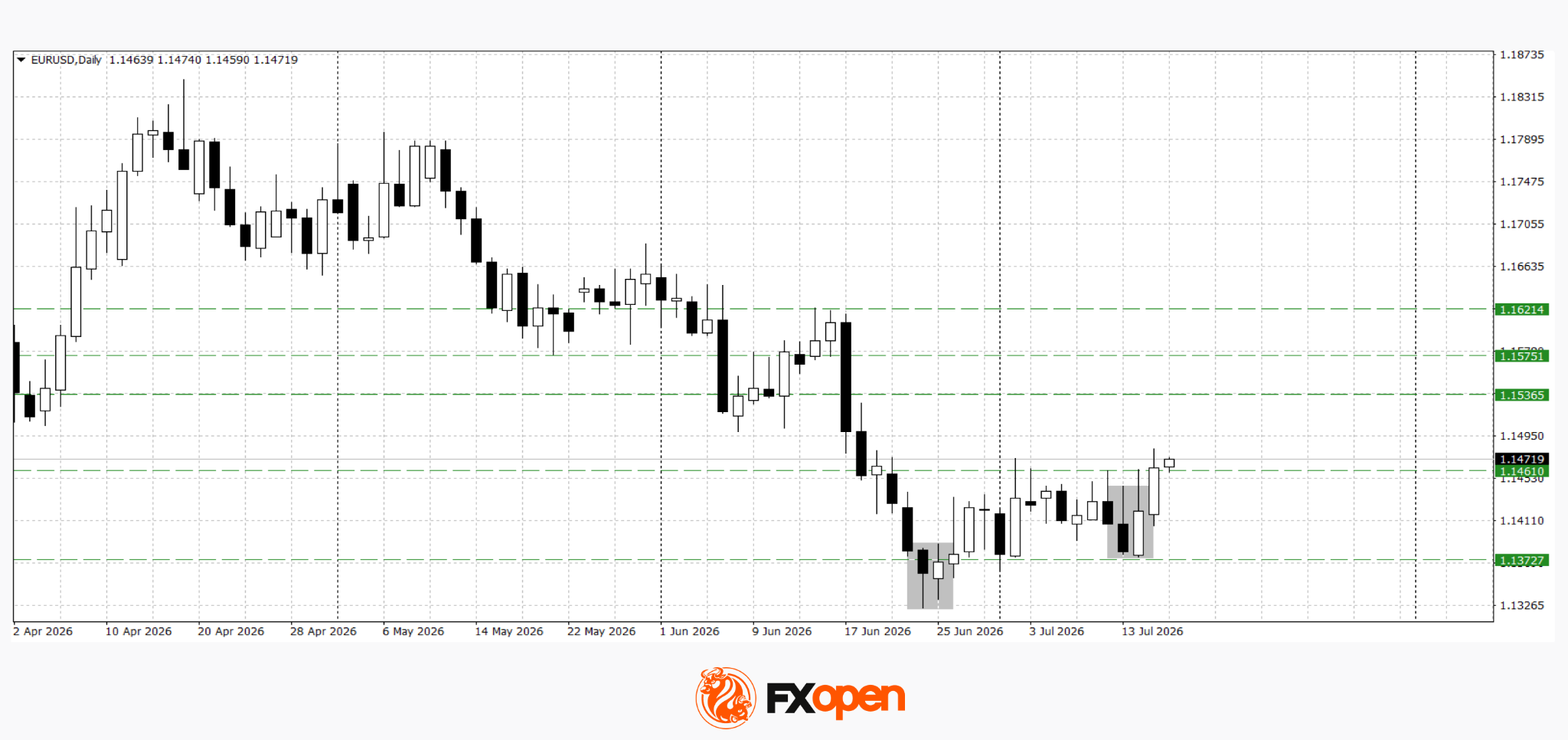
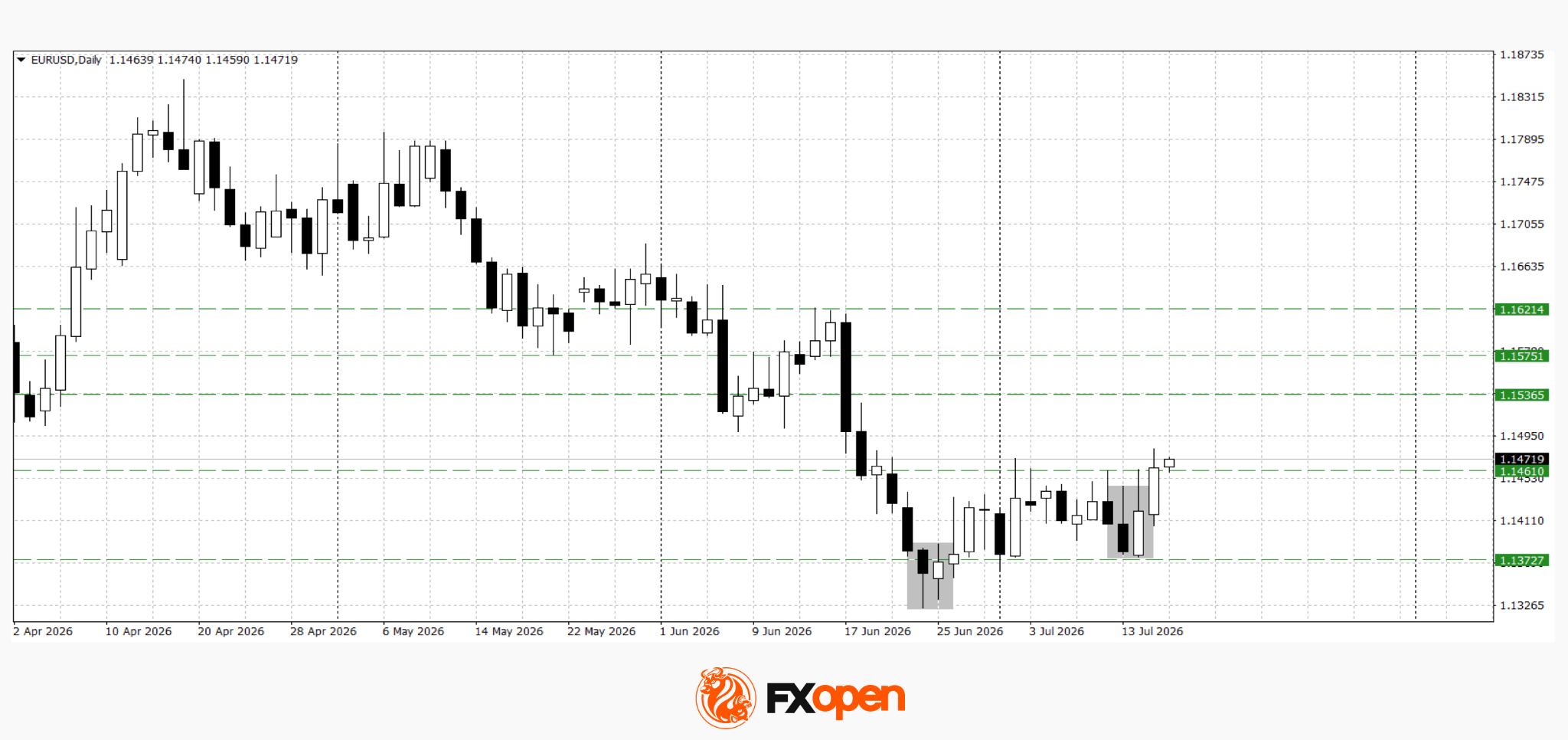
EUR/USD continues to develop after a bullish engulfing reversal pattern while attempting to establish itself above the key resistance level at 1.1460. Technical analysis suggests the pair could extend its advance towards the 1.1540–1.1580 area. The bullish scenario would be invalidated by a decisive move below 1.1370.
Key events for EUR/USD:
- 11:40 (GMT+3): Spain 10-year government bond auction;
- 15:30 (GMT+3): US Core Retail Sales;
- 15:30 (GMT+3): US Philadelphia Fed Manufacturing Index.
GBP/USD
GBP/USD is recovering more strongly than EUR/USD. Buyers have managed to establish the pair above the important 1.3500 resistance level, and positive UK macroeconomic data could pave the way for a further advance towards the 1.3610–1.3680 region. At the same time, after such a rapid rally, a corrective pullback could see the pair retest the 1.3440–1.3480 area, this time as support.
Key events for GBP/USD:
- 09:00 (GMT+3): UK Gross Domestic Product (GDP);
- 14:00 (GMT+3): NIESR Monthly UK GDP Tracker;
- 18:30 (GMT+3): Atlanta Fed GDPNow estimate.
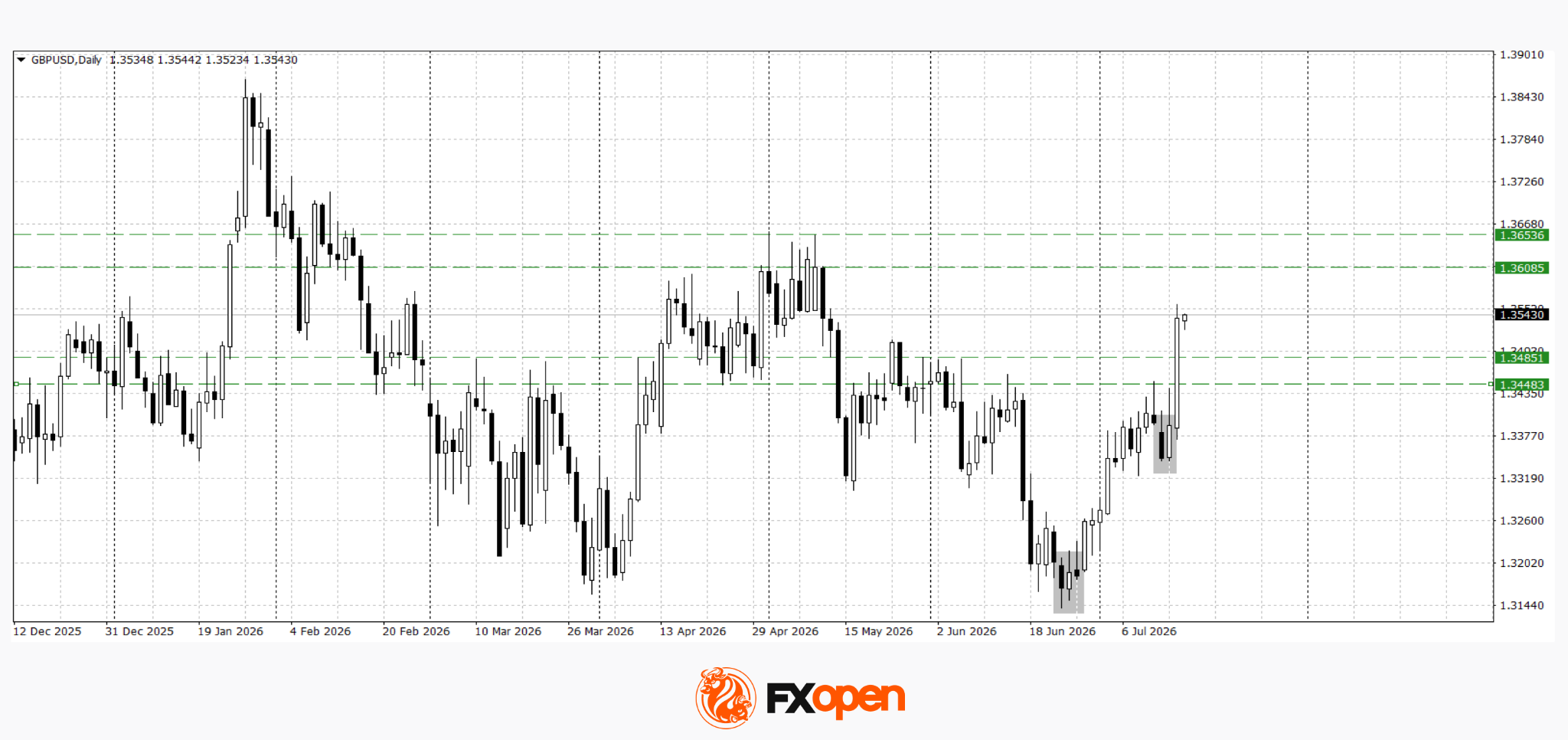
Overall, European currencies retain the potential to extend their recovery as markets continue to price in a more accommodative Federal Reserve. However, today’s economic releases from the UK, the eurozone, and the US could significantly reshape market sentiment. If US data once again disappoint expectations, EUR/USD and GBP/USD may receive additional support. Conversely, stronger-than-expected US figures could revive demand for the dollar and limit further gains in European currencies.
Trade over 50 forex markets 24 hours a day with FXOpen. Take advantage of low commissions, deep liquidity, and spreads from 0.0 pips (additional fees may apply). Open your FXOpen account now or learn more about trading forex with FXOpen.
This article represents the opinion of the Companies operating under the FXOpen brand only. It is not to be construed as an offer, solicitation, or recommendation with respect to products and services provided by the Companies operating under the FXOpen brand, nor is it to be considered financial advice.
Federal Reserve Chair Kevin Warsh testified before Congress on 14–15 July, reaffirming the Fed’s commitment to bringing inflation back to target while providing no clear guidance on the future path of interest rates. Meanwhile, June inflation data came in softer than expected, with annual consumer price growth slowing to 3.5% from 4.2% in May, temporarily supporting risk appetite. At the same time, the earnings season got underway, with Goldman Sachs reporting better-than-expected results on 14 July, providing additional support for the Dow Jones Industrial Average index (Wall Street 30 on FXOpen).
Technical Picture
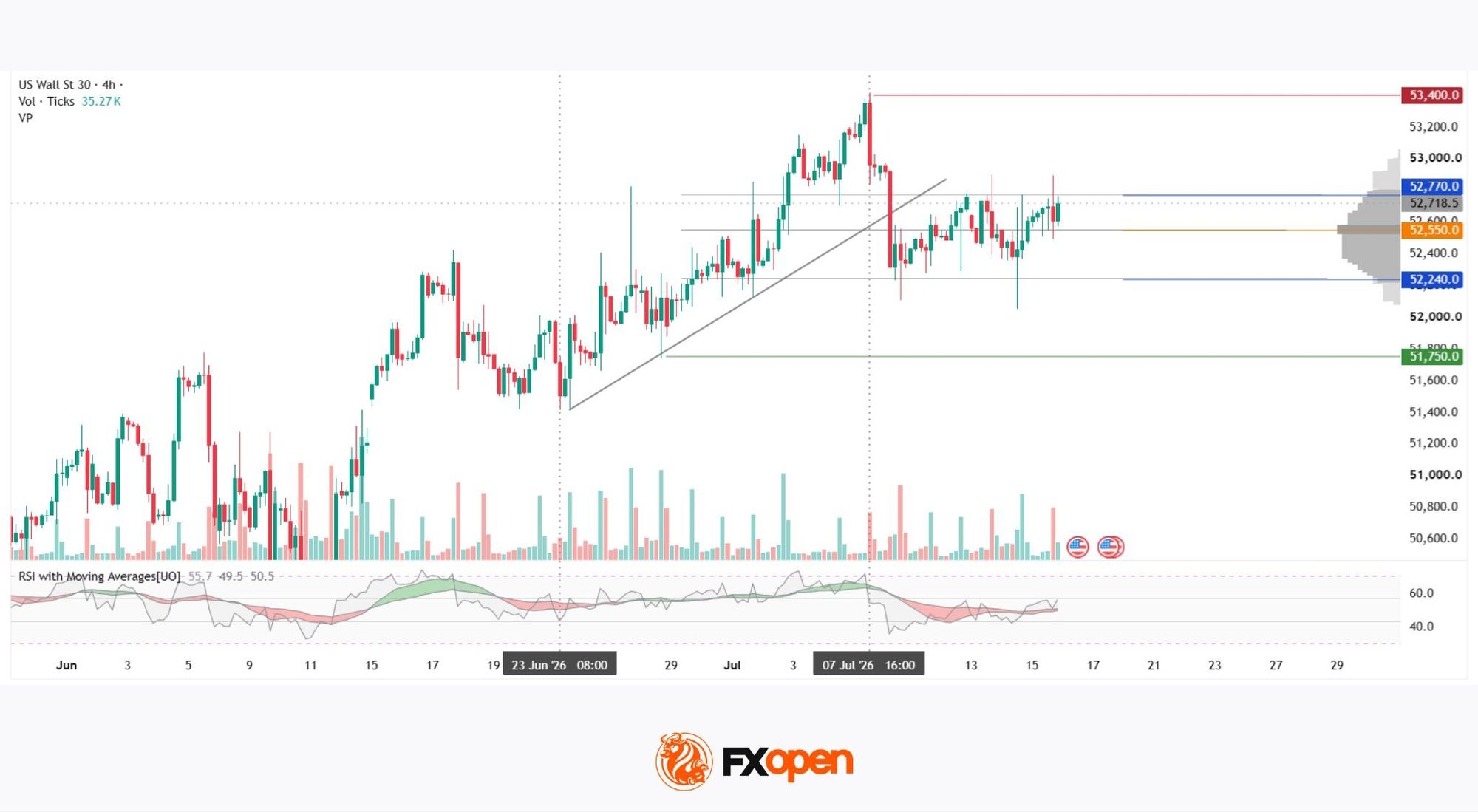
The Dow Jones Index (WS30m on FXOpen) advanced along an ascending trendline from its 23 June low, reaching the 53,400 area on 7 July, marked by the red resistance level. A sharp decline then followed, breaking below the trendline, with prices subsequently consolidating within the range of the large bearish breakout candle. Since then, the index has been trading within the current market profile, compressed between the profile’s upper boundary at 52,770 and the Point of Control (POC) at 52,550, awaiting a catalyst to break out of the current range.
If the bearish scenario unfolds and the price falls below both the trendline and the lower boundary of the market profile at 52,240, market participants might focus on the 51,750 area, where the index could potentially find support during a further decline. The RSI + MAs indicator currently shows readings of 55, 49, and 50 respectively, with all three remaining in neutral territory and providing no clear directional signal.
Summary
With the RSI lacking momentum and price remaining confined to a narrow range between the POC and the upper boundary of the market profile, the market appears to be in a pause following the failed trend breakout. A potential catalyst for a decisive move could come from the US June Retail Sales report, due later today, 16 July, while the Federal Reserve’s policy meeting on 29 July may provide the next major directional trigger.
Trade global index CFDs with zero commission and tight spreads (additional fees may apply). Open your FXOpen account now or learn more about trading index CFDs with FXOpen.
This article represents the opinion of the Companies operating under the FXOpen brand only. It is not to be construed as an offer, solicitation, or recommendation with respect to products and services provided by the Companies operating under the FXOpen brand, nor is it to be considered financial advice.


Bitcoin’s latest rebound may lack the buying support needed for a lasting breakout, according to the latest Bitfinex Alpha report.
Summary
- Bitfinex says Bitcoin’s CPI rally lacks sustained spot buying and relies heavily on macroeconomic repricing.
- Sustained ETF inflows could help Bitcoin secure acceptance above the key $68,000 to $68,300 band.
- Softer inflation data reduced rate-hike fears, but Bitfinex remains cautious about Bitcoin demand durability.
Bitcoin closed at $65,086 on July 14, gaining 4.4% and recording its highest close since June 22. Bitfinex said softer US inflation data drove most of the move by changing expectations around interest rates rather than attracting steady Bitcoin-specific demand.
The report described the rally as “borrowed strength,” citing limited spot buying, a negative Coinbase premium and inconsistent inflows into US spot Bitcoin exchange-traded funds.
Softer inflation data drives Bitcoin higher
The June Consumer Price Index fell 0.4% from the previous month, while annual inflation slowed to 3.5% from 4.2%. Core inflation stood at 2.6%, below market expectations.
The weaker inflation data reduced expectations for another Federal Reserve rate increase. According to Bitfinex, the odds of a July rate hike fell from 42% to around 12.3%, while the two-year US Treasury yield dropped as much as 14 basis points.
Bitcoin moved toward $65,000 as Treasury yields declined and the US dollar weakened after the inflation release.
Bitfinex said Bitcoin had shown little asset-specific demand before the CPI report. The firm pointed to ETF outflows, unchanged corporate holdings at Strategy and a negative Coinbase premium as evidence that macro conditions remained the main driver.
Bitcoin ETF flows remain a major test
US spot Bitcoin ETFs recorded $424.7 million in net outflows on July 13, according to the Bitfinex Alpha report. The outflow erased gains from the previous week, which had marked the first positive week after nine consecutive weeks of withdrawals.
The funds then attracted $181.1 million in net inflows on July 14. BlackRock’s IBIT accounted for $138.9 million of the total.
Bitfinex said future ETF flows will show whether institutional demand can continue beyond the immediate reaction to the CPI report. The firm wants to see steady inflows that continue regardless of short-term price movements.
Strategy also reported no change in its Bitcoin holdings during the latest reporting period. Its holdings remained at 843,775 BTC, while the company raised $466.7 million through an equity offering to support its corporate obligations.
$68,000 to $68,300 becomes Bitcoin’s key test
Bitfinex identified the $68,000 to $68,300 range as Bitcoin’s main decision zone. The short-term holder cost basis stood near $68,073, while the second-quarter opening price sat around $68,266.
The firm said Bitcoin needs sustained ETF demand and stronger spot buying to establish acceptance above this range. A rejection could keep the cryptocurrency within its broader trading range.
Options markets also showed continued caution. Bitfinex said traders were paying higher premiums for put options, which provide downside protection, even as Bitcoin rallied 4.4%.
The report also noted that rising funding rates could add risk if Bitcoin approaches $68,000 without stronger spot demand. Bitfinex said a rise above 15% to 20% in annualized funding near the resistance zone would increase the risk of another pullback.
Macro conditions remain central to the rally
Further inflation data has continued to support risk assets. As reported by crypto.news, softer producer price data also helped Bitcoin trade above $65,000 while reducing expectations for tighter monetary policy.
Bitfinex warned, however, that Bitcoin’s current rally remains closely tied to the interest-rate outlook. The firm said a rise in oil prices or renewed inflation concerns could quickly change market expectations.
The report identified ETF flows, the Coinbase premium and the $68,000 to $68,300 range as the main indicators to watch. Bitfinex remains cautious until Bitcoin shows sustained spot demand that can support prices even when macroeconomic conditions become less favorable.
Base has overhauled its growth strategy after its creator-first approach fell behind competing blockchain ecosystems in prediction markets and perpetual futures, prompting founder Jesse Pollak to step back from leading the Base App.
Summary
- Jesse Pollak admitted Base fell behind in prediction markets and perpetual futures after focusing on social products.
- Pollak will hand leadership of the Base App back to Coinbase while focusing on development of the Base blockchain.
- Base is now prioritizing trading, payments, stablecoins, and AI tools after abandoning its creator focused growth strategy.
According to a Wednesday post by Base creator Jesse Pollak on X, the network underestimated the importance of financial applications after betting that creator tools, content, and messaging would bring crypto to mainstream users.
Pollak said the strategy failed as demand for social products “disintegrated completely,” leaving Base behind in sectors that had become more important. While the network launched perpetual futures through Avantis and prediction markets through Limitless, he acknowledged both products trailed larger competitors.
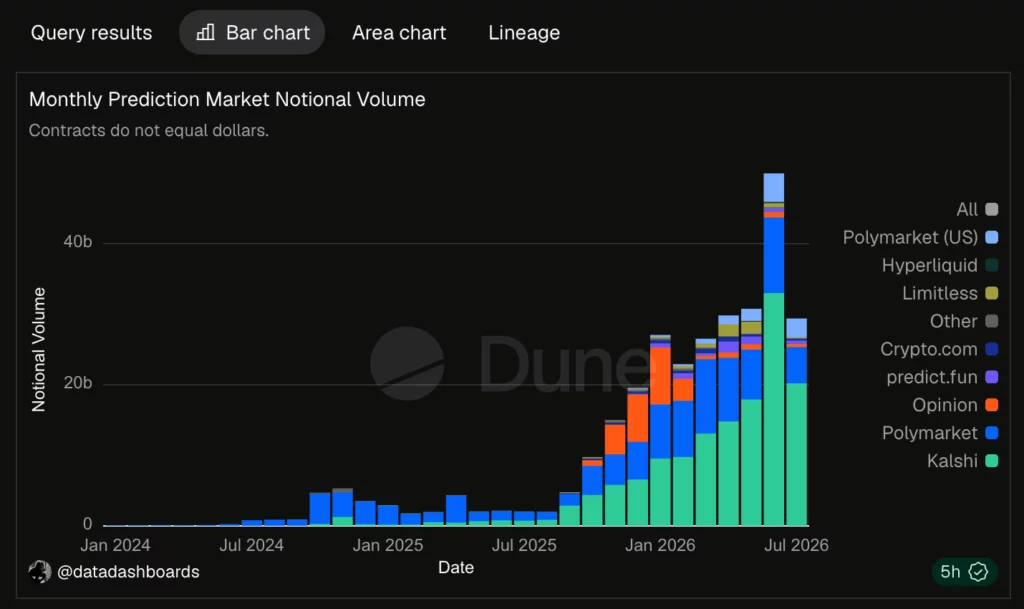
Dune Analytics data shows Base-native prediction market Limitless accounted for just 0.5% of total monthly notional prediction market volume in July.
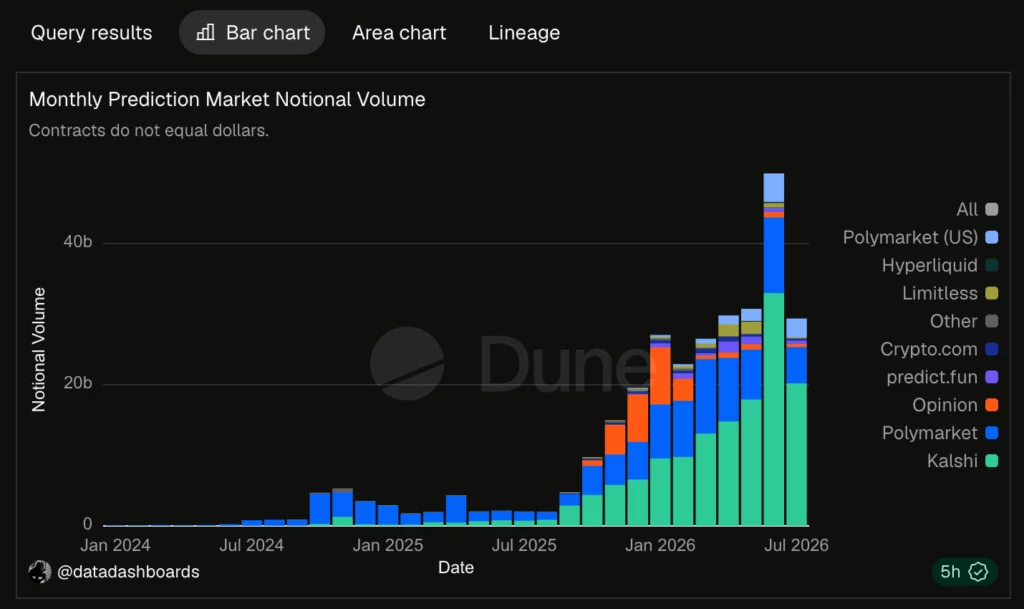
Source: Dune Analytics.
“We realized how our focus on social had meant that Base had fallen behind in key areas that were now increasingly critical,” Pollak wrote, adding that the network had “made the wrong bet.”
Base hands app leadership back to Coinbase
Alongside the strategic reset, Pollak said he will hand leadership of the Base App back to Coinbase, where Jordan Fish, better known as Cobie on X, will oversee the product. Pollak said he will instead concentrate on developing the Base blockchain.
The announcement comes days after Coinbase CEO Brian Armstrong publicly admitted the company’s content coin strategy had failed.
“They didn’t work and we pivoted early this year. We messed up, time to turn the page,” Armstrong said, responding to criticism on X earlier this week
Armstrong also said Coinbase now prioritizes trading, payments, and AI agents, with most of the company’s resources currently directed toward trading infrastructure. He added that payment systems require foreign exchange capabilities, while AI agents can build on both trading and payment tools.
Earlier this year, Base ended its Creator Rewards program and removed its Farcaster-powered social feed as part of the same strategic change. The rewards program, introduced in July 2025, was designed to let creators earn income from engagement, while Pollak described the Base App as an “imperfect Farcaster client.”
The decision follows more than a year of experiments with social products, including Farcaster integration, Zora content coins, and miniapps. Base had promoted those tools as a way to bring crypto to “a billion people,” but both Pollak and Armstrong have since said financial applications offer a stronger path for adoption.
Stablecoins and AI remain part of roadmap
While stepping away from social products, Base continues to expand its financial infrastructure.
Pollak said Base still intends to become “the blockchain for global finance” and “the place that the world’s money settles over the next century,” underscoring the network’s renewed focus on financial use cases over creator-led social experiences.
Last week, the network activated its B20 token standard on mainnet, creating a native framework for stablecoins, tokenized real-world assets, and other fungible tokens.
A few months earlier, Base introduced Base MCP, a Model Context Protocol tool that lets users manage crypto directly through AI chat interfaces while interacting with protocols including Morpho, Moonwell, Uniswap, Aerodrome, Avantis, Bankr, and Virtuals.
In April, Base said it was upgrading core infrastructure to support what it described as an AI agent economy. Its 2026 roadmap identifies tokenized real-world assets, stablecoins, prediction markets, global markets, and AI-powered applications among its development priorities.


Onchain investigator ZachXBT has criticized hardware wallets, arguing that users should not rely on them for critical transaction signing or storing large amounts of cryptocurrency.
Summary
- ZachXBT says current hardware wallets are unsuitable for critical transactions, naming Ledger as the worst.
- He argues a dedicated iPhone used only for crypto could provide a better operational setup.
- Recent wallet scams show attackers continue targeting crypto holders through fake apps and social engineering methods.
In a Telegram post, ZachXBT described hardware wallets as “complete garbage” and said he does not advise using them for important tasks. Instead, he suggested using a separate iPhone dedicated entirely to managing crypto assets.
ZachXBT singles out Ledger over frequent updates
ZachXBT directed his strongest criticism at Ledger, one of the largest hardware wallet manufacturers. He called Ledger “the worst” and claimed that frequent updates to Ledger Live can interfere with basic functions.
He said Ledger Live receives “regular updates for UI / apps for no good reason that break simple actions.” The comments represent ZachXBT’s personal assessment. He did not provide evidence that Ledger devices had suffered a new security breach or that their private-key protection had been compromised.
Ledger has since renamed Ledger Live to Ledger Wallet. According to the company’s official release notes, Ledger Wallet version 4.8.0 was released on June 11 with security improvements, interface changes and minor bug fixes.
The company continues to promote hardware-based signing as a way to keep private keys separate from internet-connected devices. ZachXBT’s proposal takes a different approach by using a smartphone reserved only for crypto transactions.
Hardware wallet users remain targets for crypto scams
The criticism comes as attackers continue targeting hardware wallet owners through social engineering and fake applications. These attacks do not necessarily involve breaking the security of the physical wallet itself.
As previously reported by crypto.news, a crypto holder lost more than $282 million in Bitcoin and Litecoin in January following a hardware wallet social engineering scam. ZachXBT reported that the attackers quickly moved the stolen funds through several services and converted part of them into Monero.
The incident showed how attackers can target users without directly compromising a hardware wallet’s technical security. Social engineering instead attempts to convince victims to reveal sensitive information or take actions that give criminals control over their assets.
Ledger users have also faced attacks involving software that impersonates official company products. Such cases can create security risks even when the physical hardware device continues working as designed.
Fake Ledger app stole $9.5 million from users
In April, a fake Ledger Live application listed on Apple’s App Store stole at least $9.5 million from more than 50 victims in one week, as reported by crypto.news. The fraudulent application copied Ledger branding and appeared to users searching for the company’s wallet software.
Victims reportedly entered their recovery phrases into the fake application, allowing attackers to gain control of their wallets. The stolen assets included Bitcoin, Ethereum, Solana, Tron and XRP. Apple later removed the fraudulent application from its store.
ZachXBT’s recommendation of a dedicated iPhone would reduce some exposure associated with using a device for everyday browsing, messaging and other online activity. However, a smartphone still depends on its operating system, installed software, backup practices and the user’s security habits.
The debate comes down to different approaches to crypto self-custody. Hardware wallets focus on keeping private keys isolated from general-purpose internet-connected devices. ZachXBT instead favors strict device separation through a phone used only for crypto. In both cases, users can still face risks from phishing, fake applications, exposed recovery phrases and social engineering.

Was King Charles right to entertain Harry, Meghan and their children at Highgrove? Have your say in the Palace Confidential poll

Ex-Sterling First director seeks to change bail for international travel

Sofía Vergara’s Bikini Style Screams ‘Yacht Wife’ — On Amazon


-

 Fashion7 days ago
Loro Piana Fall 2026 Enters Houston’s Art Scene
-

 Fashion5 days ago
Weekend Open Thread: Nutriplenish Leave-In Conditioner
-
 Sports7 days ago
2026 Genesis Scottish Open Thursday TV coverage: Round 1
-

 Sports6 days ago
Super Eagles star Moses Simon opens up on Liverpool transfer regret
-

 Tech7 days ago
Character.AI enters the microdrama arena with its own productions, but there’s a twist
-

 Politics20 hours ago
Young campaigners urge incoming PM to act on outdoor junk food ads
-

 News Videos2 days ago
XRP BOMBSHELL… XRP OMBOARDED FOR TRANSACTIONS!!!
-

 Tech2 days ago
Get Your ESP32 Sunny Side Up With This Solar Dev Board
-

 Tech2 days ago
Dark Secrets Emerge When Jailbreaking LLMs
-
 Sports11 hours ago
New Cornerback Enters Vikings Trade Rumor Mill
-
 Entertainment15 hours ago
Disney’s Most Ambitious Failed Star Wars Attraction Is Coming to SDCC
-

 Tech7 days ago
Level Infinite Launches Gangstar Mirage City in India with Pre-Registrations
-
 NewsBeat7 days ago
Major update after Huntingdon train attack as man enters plea
-

 News Videos3 days ago
how to make coin bank box with cardboard #scienceproject #money #diy #shorts
-
 Tech3 days ago
Cloudflare Precursor Watches Your Mouse and Keyboard To Decide If You Are Human
-
 Entertainment14 hours ago
Vicki Gunvalson Defends Discussing Heather Dubrow’s Money
-
Crypto World2 days ago
Ripple, Coinbase, Circle Join Linux x402 Foundation to Help Shape AI Payments
-

 NewsBeat11 hours ago
Watch: Is Donald Trump facing a popular backlash on immigration?
-

 Sports9 hours ago
Michigan officials not expected to discuss AD Warde Manuel at Thursday meeting
-
 NewsBeat10 hours ago
Firefighters issue update on Dovestone moorland blaze as fire enters fourth day
You must be logged in to post a comment Login