

Crypto World
Ostium Halts Trading After Oracle Exploit Impacts OLP Vault

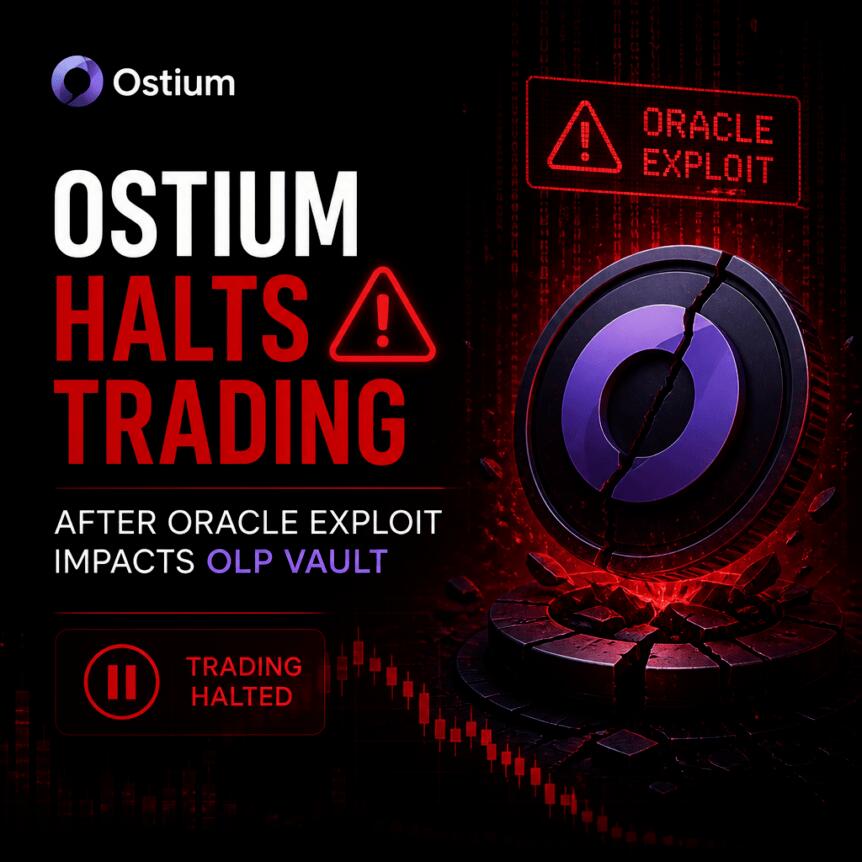
Ostium, a decentralized trading protocol for onchain perpetuals, has paused all trading after security firms reported an apparent exploit tied to its OLP liquidity vault. The pause comes alongside warnings that the incident may be linked to the protocol’s oracle system, which delivers external price data needed for trading.
Blockaid estimated the losses at roughly $18 million, while CertiK put the figure closer to $22 million. Both firms suggested the underlying issue involves a compromise of Ostium’s oracle layer, raising broader questions about the resilience of DeFi protocols whose critical components run outside their core smart contracts.
Key takeaways
- Ostium paused all trading after a reported issue affecting its OLP liquidity vault.
- Security firms Blockaid and CertiK estimated losses at about $18 million and $22 million respectively.
- Both reports pointed to an apparent oracle compromise as the likely driver of the incident.
- Ostium asked users to temporarily revoke token approvals for its contracts while it investigates.
Trading halted after security firms flagged an oracle-linked incident
According to reports from blockchain security companies Blockaid and CertiK, Ostium’s OLP liquidity vault appears to have been exploited. The figures cited by the two firms differ slightly—Blockaid estimated losses at approximately $18 million, while CertiK assessed the impact at roughly $22 million—illustrating the uncertainty that often follows fast-moving investigations.
Both firms attributed the apparent exploit to a compromise of Ostium’s oracle system. Oracles supply offchain or externally sourced price information to onchain markets, and a failure at this layer can undermine the pricing assumptions that perpetuals rely on for liquidations, settlement, and margin logic.
Ostium confirmed the operational response on X, stating that it paused all trading after identifying an issue related to the vault. The protocol later advised users to take an additional protective step: it recommended that users temporarily revoke approvals for its contracts until the team can complete its review of what happened.
“With user security being our first concern, we recommend that all users temporarily revoke approvals for our contracts until we can further investigate the recent incident.”
Why the pause and approvals warning matter for users
In DeFi incidents, the immediate risk is not always limited to the exploited vault itself. When a protocol suspects that permissions may be exposed—or that an attacker could interact with contracts in unintended ways—revoking approvals can reduce the chances of further unauthorized transfers or actions tied to existing allowances.
Ostium’s decision to halt trading suggests it wants to prevent new positions from opening or existing mechanisms from interacting with liquidity while the threat profile is unclear. Importantly, the protocol also said its team is still investigating and has not yet confirmed the root cause or validated the loss estimates provided by Blockaid and CertiK.
That gap—between an “apparent exploit” and an officially confirmed incident report—can be consequential. Traders typically need clarity on whether price data was manipulated, whether funds were drained from a single vault or multiple routes were used, and whether any remaining funds are still at risk. Until those questions are answered, the most practical step for users is to follow Ostium’s own mitigation guidance.
Ostium’s setup and the broader DeFi security problem
Ostium is built on Arbitrum and operates as an onchain perpetuals platform offering leveraged exposure to 75 trading pairs. Those pairs span stocks, ETFs, commodities, indices, foreign exchange, and cryptocurrencies.
The incident reinforces a pattern that security researchers have highlighted in recent months: DeFi attacks increasingly focus on offchain infrastructure—particularly oracle systems—rather than solely on vulnerabilities within base smart contracts. Even when onchain code is correct, the system can fail if the inputs it depends on can be altered, spoofed, or otherwise compromised.
This is not an isolated event. DeFi security reporting over the past year has repeatedly shown that oracle-related failures, privileged access compromises, and key-management issues can cause outsized damage. In April, Cointelegraph coverage cited DeFiLlama data indicating that crypto hacks produced nearly $630 million in losses during April—its highest monthly total since February 2025. DeFi protocols accounted for the majority of that number, with exploits at KelpDAO and Drift Protocol making up more than 80% of the month’s total.
With the Ostium pause, investors and market participants may want to think about how DeFi systems handle “trusted inputs.” When price feeds are a single point of failure, the operational integrity of decentralized markets can hinge on the security posture of components outside the core trading logic.
Institutional concerns: can DeFi scale if oracle risk remains central?
Beyond immediate losses, incidents like this renew an ongoing debate about whether DeFi is ready for institutional participation. Cointelegraph previously reported concerns about whether DeFi can meet the expectations of institutional risk frameworks, especially as bridge security and cross-layer dependencies continue to show weaknesses.
In an April research note, JPMorgan analysts described bridge security as a key challenge for the sector, calling into question how DeFi could scale for broader institutional involvement. Separately, Cointelegraph noted that shrinking DeFi yields can make security risks harder to justify, and that institutions may struggle to quantify hack risk even when interest in blockchain-based finance continues to grow.
Against that backdrop, the Ostium incident highlights a practical tension: perpetual trading platforms often offer sophisticated exposure, but they also rely on a chain of systems—especially oracles—that may introduce failure modes outside a typical smart-contract audit’s scope.
For builders and risk managers, the next phase will likely focus on operational transparency: what oracle data was used, whether the compromised component was identifiable, and how Ostium’s controls prevented wider contagion. For traders, the key question is whether the pause turns into a prolonged suspension until full verification, or whether the protocol can safely resume with updated safeguards.
Readers should watch for Ostium’s follow-up investigation findings, especially any confirmation of the oracle compromise hypothesis, plus further guidance on whether users must do anything beyond revoking approvals and waiting for resumption of trading.

Crypto World
Primit Season 1 Officially Launches: $100,000 Avalanche On-Chain Perp Trading Incentive Event Now Live
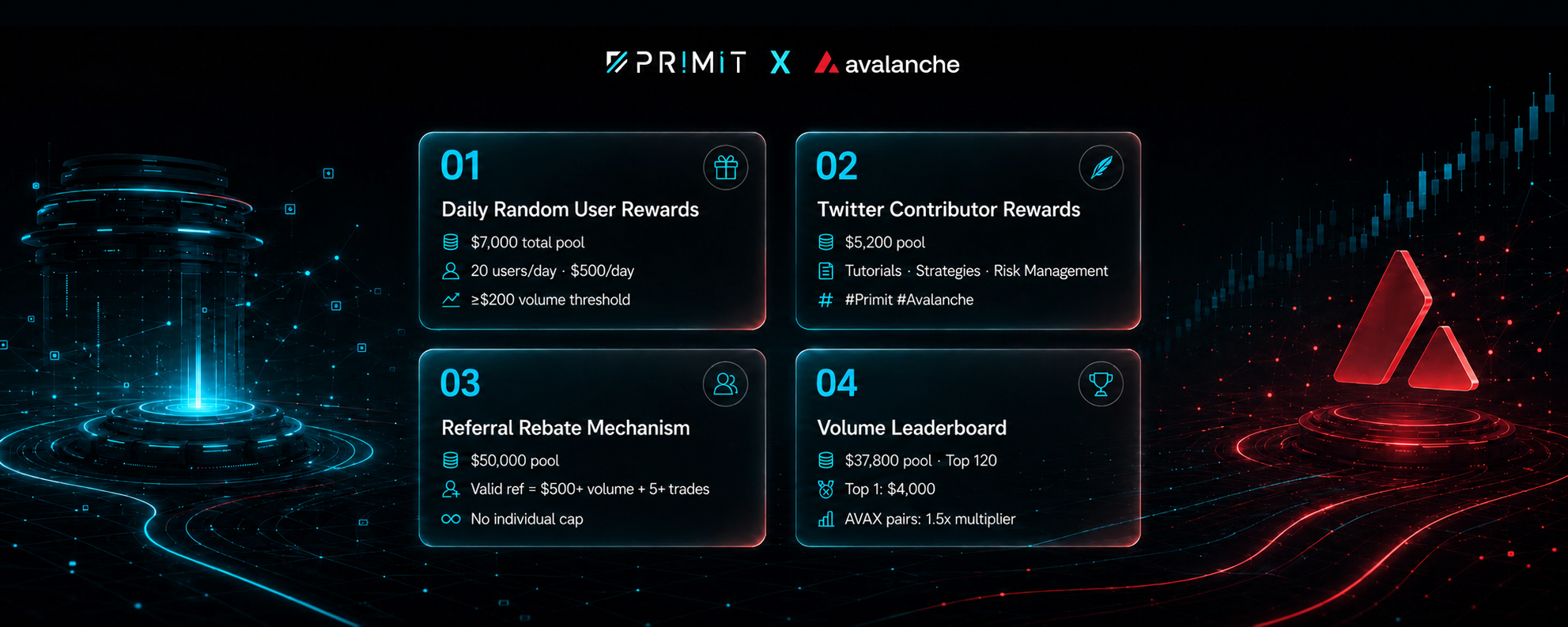
Primit × Avalanche Season 1 “On-Chain Perp Frenzy” is now officially live on the Avalanche network. With a total prize pool of 100,000USDT equivalentin AVAX and four simultaneous reward mechanisms, this marks the first large-scale on-chain perpetual trading incentive event in the Avalanche ecosystem.

Full Mechanism Overview
- Daily Random User Rewards ($7,000 pool)
- Every day, 20 users with ≥$200 trading volume are randomly selected to share a $500 pool. 280 total winner slots over 14 days. Draws execute automatically via script daily, with off-chain public verification.
- Twitter Contributor Rewards ($5,200 pool)
- For community content creators. Post high-quality Primit tutorials, strategy analysis, risk management, or reward breakdowns on Twitter/X with #PrimitAvalanche. Human + Agent review. Top contributors earn $300–$500 each.
- Referral Rebate Mechanism ($50,000 pool)
- Every user receives an auto-generated unique Referral Code. A referred user must register via the code and achieve ≥$500 cumulative volume with ≥5 trades during the event to count as valid. After the event, the $50,000 pool is distributed proportionally by valid referral volume. No individual cap.
- Volume Leaderboard ($37,800 pool, Top 120)
- Ranked by cumulative volume after the event:
- Top 1: $4,000
- Top 2: $2,500
- Top 3: $1,800
- Top 4–10: $1,000 each (total $7,000)
- Top 11–30: $450 each (total $9,000)
- Top 31–60: $250 each (total $7,500)
- Top 61–120: $100 each (total $6,000)
- Ranked by cumulative volume after the event:
Avalanche Multiplier
Volume from AVAX-related pairs or using native gas receives a 1.5x weighting. This design directs traders toward Avalanche’s core ecosystem assets while providing quantifiable on-chain activity data for the Avalanche Foundation.
Founder Quote
“Season 1 is not a simple airdrop event. It’s a product stress test. We aim to prove that on-chain perpetual trading is ready to carry real, high-frequency, professional demand. Avalanche’s infrastructure makes this possible.” — Team Primit
About Primit & Avalanche
Primit is a next-generation on-chain perpetual contract trading platform focused on low-latency, low-fee, fully transparent on-chain derivatives. Avalanche is a high-performance Layer 1 blockchain known for sub-second finality and minimal gas costs.
Follow Twitter : https://x.com/primitforall
Event Portal: https://app.primit.io/campaigns
Event Period: July 15 — July 28
The post Primit Season 1 Officially Launches: $100,000 Avalanche On-Chain Perp Trading Incentive Event Now Live appeared first on BeInCrypto.

Bitcoin’s “cycle peak buyers”—the investors who accumulated near the latter stages of the last bull run—may be nearing the point where their selling pressure fades, according to new on-chain analysis shared by Glassnode researcher Cryptovizart. The implication is straightforward: if realized losses among one-to-two-year holders keep rolling over, it can mark an early phase of relief from bear-market distribution.
The same report also points to a familiar near-term battleground for price action. Glassnode highlights short-term holders’ aggregate cost basis around $69,000, noting that this level overlaps with old 2021 all-time highs—often a zone where markets either break out decisively or become stuck in a wider range.
Key takeaways
- Glassnode’s realized-loss metric for 1–2 year holders is used as a historical bear-market “endgame” signal.
- Cryptovizart’s chart suggests realized losses recently passed $75 million before beginning a reversal.
- The next potential supply/resistance area centers on $69,000, where short-term holders’ cost basis aligns with former 2021 highs.
- Both signals emphasize shift in cohort behavior—not just price—to gauge whether the market is transitioning out of a bottoming phase.
Why realized losses among 1–2 year holders matter
Cryptovizart, the pseudonymous lead research analyst at Glassnode, laid out the framework in a post on X on Friday. In the analyst’s view, one of the most reliable early checks for whether a bear market has truly started to end is the Realized Loss volume (in USD) by 1–2 year holders.
In on-chain terms, the metric tracks the value of Bitcoin being moved at a loss by coins that have been held for roughly one to two years. When that loss realization rises during a downturn, it often reflects holders giving up after prolonged underperformance. When it starts to cool, it can indicate that the “heaviest distribution” is losing momentum.
According to the post, coins that last transacted at a loss did so during a window spanning July 2024 to July 2025. Over that interval, BTC/USD rose from roughly $62,800 to around $107,000, meaning that a large portion of investors who bought during the latter portion of the bull market are currently underwater on their allocation.
“As frustration builds with sustained price underperformance, this cohort tends to progressively increase loss realization.”
Cryptovizart argues that bear markets have historically lacked durable footing until this specific group begins to exhaust its sell pressure—when realized losses stop climbing and the trend begins to reverse.
The $75 million realized-loss rollover signal
The key visual in the analysis is a spike in realized losses measured on a 30-day moving basis. Cryptovizart notes that realized losses recently climbed to a level above $75 million before the indicator started turning downward.
In the analyst’s framework, the most watchable part isn’t just whether realized losses are elevated—it’s whether the 30D moving average of realized loss begins to cool and roll over. That change, Cryptovizart said, has often appeared among the clearest early signs that the market is moving beyond the phase of concentrated selling.
“When the 30D-SMA of their realized loss cools and rolls over, it has often been among the clearest early signals that the heaviest distribution phase is behind the market.”
For traders and investors, the practical value of this type of signal is that it ties market stress to behavior on-chain. Rather than relying purely on speculative narratives around price, it focuses on whether holders most likely to capitulate are actually doing so—or whether that pressure is beginning to fade.
From on-chain loss exhaustion to the $69,000 price battleground
Realized losses are only one piece of the puzzle for bottom-timing. Glassnode’s ongoing work also emphasizes the role of cost basis—particularly for speculators who bought closer to the current price regime.
In its newsletter edition The Week Onchain, Glassnode pointed to Bitcoin speculators’ aggregate cost basis as the next hurdle the market may need to clear for momentum to improve. In the report, that reference level is around $69,000.
Notably, Glassnode says that this cost basis zone also overlaps with old all-time highs from the 2021 bull market. From an order-flow perspective, that overlap matters because it combines two forces that can amplify short-term reactions: sellers who bought at that level (or near it) may be more inclined to exit once price returns, while buyers trying to reclaim prior “breakout” levels may need to overcome earlier supply.
“The first meeting with that level will likely draw a strong reaction, because the people most inclined to sell are the ones about to be made whole.”
Glassnode also framed the scenario in terms of what happens immediately after price approaches the region: a convincing reclaim could open the door for more sustained recovery, while rejection would suggest the market is still negotiating its range rather than transitioning into a new phase.
“A convincing reclaim would give the recovery room to run; a rejection keeps the range intact.”
What to watch next as these signals converge
The most important development implied by Glassnode’s research is the alignment of two different on-chain narratives: (1) realized loss pressure from 1–2 year holders appears to be rolling over, and (2) the market is approaching a widely watched cost-basis resistance zone near $69,000. If realized losses continue to drift lower while price tests that cost-basis level, bulls will likely look for a sustained reclaim rather than a short-lived bounce; if realized losses stop improving or cost-basis resistance holds, the probability of prolonged consolidation increases.
Readers should watch whether the 30-day realized-loss trend continues to cool and whether BTC can hold above or reject the $69,000 region as the next clear confirmation point for market participants.


Veteran trader Peter Brandt has identified a possible bottoming structure on Bitcoin’s chart after the cryptocurrency rebounded from its late-June lows. Brandt stressed that traders still lack enough evidence to confirm the setup.
Summary
- Peter Brandt sees a possible Bitcoin bottom pattern but stresses that confirmation remains far away.
- Bitcoin rebounded from below $58,000, but the recovery remains stalled around the $65,000 resistance zone.
- Recent ETF flows and macro relief support Bitcoin, while weak spot demand keeps analysts cautious.
Bitcoin traded near $64,000 on July 16 after failing to hold above $65,000. It has recovered from below $58,000, but questions remain over whether spot demand can support a broader reversal.
Brandt flags an unconventional Bitcoin bottom pattern
In aJuly 16 post on X, Brandt said Bitcoin’s chart could be developing an inverted head-and-shoulders bottom. He described the structure as “VERY VERY UNCONVENTIONAL” and added, “We do NOT know yet.” He presented the formation as an early possibility rather than a confirmed signal.
An inverted head-and-shoulders pattern includes three price troughs, with the middle decline extending below the surrounding lows. Traders often wait for a break above the neckline before treating the setup as confirmed. Bitcoin has not completed such a move.
Bitcoin rebound meets resistance near $65,000
Bitcoin has gained roughly 12% from its recent swing low below $58,000, but the rebound has struggled around $65,000. The cryptocurrency briefly moved above $65,400 before returning toward $64,000, showing that buyers have not secured a clean breakout.
Notably, Brandt took a cautious view in June when Bitcoin traded near $65,000. His chart showed BTC below its 18-week moving average and outside a rising channel, while on-chain data showed large holders moving coins away from exchanges as selling eased.
Spot demand remains a key question for Bitcoin
Bitcoin’s possible bottom pattern appears as other market indicators send mixed signals. A recent Bitfinex Alpha report said Bitcoin’s recovery relied heavily on changing interest-rate expectations following softer US inflation data rather than sustained Bitcoin-specific buying.
As reported by crypto.news, Bitfinex called the rally “borrowed strength” because spot absorption remained limited, the Coinbase premium stayed negative and ETF demand lacked consistency. US spot Bitcoin ETFs recorded $424.7 million in net outflows on July 13 before attracting $181.1 million the next day.
The pattern therefore appears against a market backdrop that still lacks the steady demand seen during stronger Bitcoin uptrends. Bitfinex identified the $68,000 to $68,300 area as a key decision zone and said stronger ETF inflows and steady spot buying could support acceptance above that range.
Bearish Bitcoin scenarios remain in play
Brandt’s latest observation follows months of cautious Bitcoin forecasts. In January, he said the cryptocurrency could fall toward $58,000 to $62,000, a range Bitcoin later reached during the 2026 downturn. His more recent charts also showed weakness even as whale selling slowed.
Other researchers have kept deeper downside targets in view. A crypto.news analysis of Bitcoin’s bear-market levels noted that some cycle-based forecasts place a possible floor near $38,000, though those projections depend on the current decline repeating older Bitcoin cycles.
Brandt has not declared that Bitcoin has completed a bottom. His chart points to a structure that may develop if price action improves, but his warning leaves confirmation unresolved. Bitcoin’s ability to reclaim resistance, attract steady spot demand and sustain ETF inflows remains central to the recovery.


Vlad.fun, a memecoin launchpad built on Robinhood Chain, has suspended operations after reporting what it called a “serious internal integrity issue” involving members of its team.
Summary
- Vlad.fun halted operations after discovering an internal integrity issue involving members of its own team.
- The launchpad investigates alleged misconduct while consulting legal counsel on possible action against those involved.
- Robinhood Chain’s early growth has been dominated by memecoin trading despite its tokenized finance focus.
The project said it took the platform offline while it investigates the matter and consults legal counsel.
The team has not disclosed the nature of the alleged conduct or identified anyone involved. In its official statement on X, Vlad.fun said it would take appropriate action based on the findings of its investigation.
Vlad.fun takes its platform offline
Vlad.fun said it discovered the issue around the platform’s launch and that members of its team were involved. The project said it would not “gloss over it” and paused operations while reviewing what happened. It has not said whether user funds, token contracts or other parts of the platform were affected.
Hours before announcing the suspension, the project also warned users that a token carrying the Vlad.fun name and appearing on its leaderboard was not official. The team reminded traders through its official X account that its launchpad is permissionless and allows anyone to create tokens. Vlad.fun has not stated whether the token warning and internal investigation are connected.
Robinhood Chain’s memecoin boom forms the backdrop
Robinhood launched its public blockchain mainnet on July 1 as an Ethereum Layer 2 built with Arbitrum technology. As previously reported by crypto.news, Robinhood designed the network to support tokenized real-world assets, decentralized finance applications and around-the-clock trading of stock tokens.
However, memecoin trading quickly became a major source of activity. A recent crypto.news analysis found that Robinhood Chain processed about $570 million in launch-week trading volume against roughly $21.68 million in liquidity, with speculative memecoin activity driving much of the turnover.
Galaxy Digital also reported that memecoins became the network’s most active early use case. Trading volume surged above $560 million on July 8 as interest in tokens including CASHCAT drew more users and liquidity to the new network.
Launchpad disruptions draw closer attention
Vlad.fun is not the first Robinhood Chain launchpad to experience an operational disruption during the network’s early growth. As previously reported, NOXA went offline after becoming a major venue for token launches on Robinhood Chain. Its associated tokens continued trading onchain while its website remained unavailable.
The circumstances are different. NOXA attributed its outage to a Cloudflare problem, while Vlad.fun has cited an internal integrity matter involving team members and said it is consulting lawyers. There is currently no public evidence connecting the two events.
Investigation leaves key questions unanswered
Vlad.fun has not provided a timeline for completing its investigation or restoring the platform. It has also not disclosed whether the alleged issue involved token launches, team wallets, trading activity, platform access or another part of its operations.
For now, the project’s statement remains the main source of information about the shutdown. Users are awaiting more details about the scope of the investigation and any legal action that could follow. The suspension comes as Robinhood Chain continues its rapid expansion, with memecoin trading playing a large role in the network’s early activity.
Bitcoin (BTC) “cycle peak buyers” could already be pointing the way to the next bear-market bottom.
Key points:
- Bitcoin hodlers who bought BTC one to two years ago are cooling selling pressure.
- The cohort’s realized losses have led to market bottoms once their uptrend reverses, Glassnode data shows.
- Speculators’ cost basis reinforces the next BTC price battleground at $69,000.
Glassnode: Bitcoin realized loss reversal “worth watching closely”
In an X post on Friday, Cryptovizart, the pseudonymous lead research analyst at onchain analytics platform Glassnode, showed a classic bottom signal potentially repeating.
The latest in a series of such signals, the latest puts buyers who bought BTC in the latter part of the bull market in focus.
“One of the metrics I watch most closely when trying to gauge a bear market’s end is, Realized Loss volume (in USD) by the 1-2 year holders,” Cryptovizart wrote.
Here, coins moving onchain at a loss last did so between July 2024 and July 2025. During that time, BTC/USD increased from around $62,800 to $107,000, placing the majority of investors underwater on their allocation.
“As frustration builds with sustained price underperformance, this cohort tends to progressively increase loss realization,” the post continues.
“Historically, bear markets have not found durable footing until this specific group exhausts its sell pressure.”
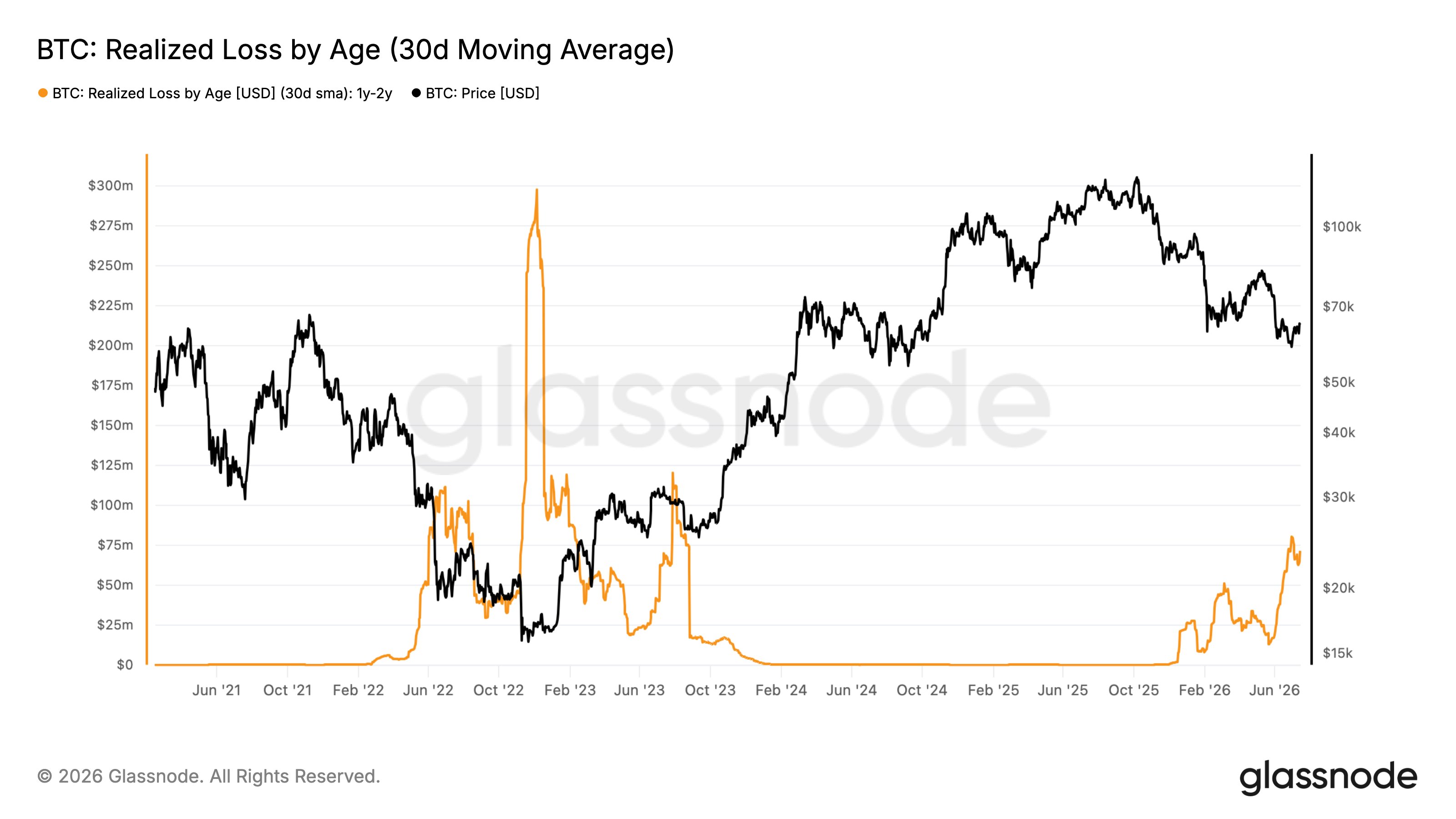
Bitcoin realized losses for 1-2 year hodlers (30-day moving average). Source: Cryptovizart/X
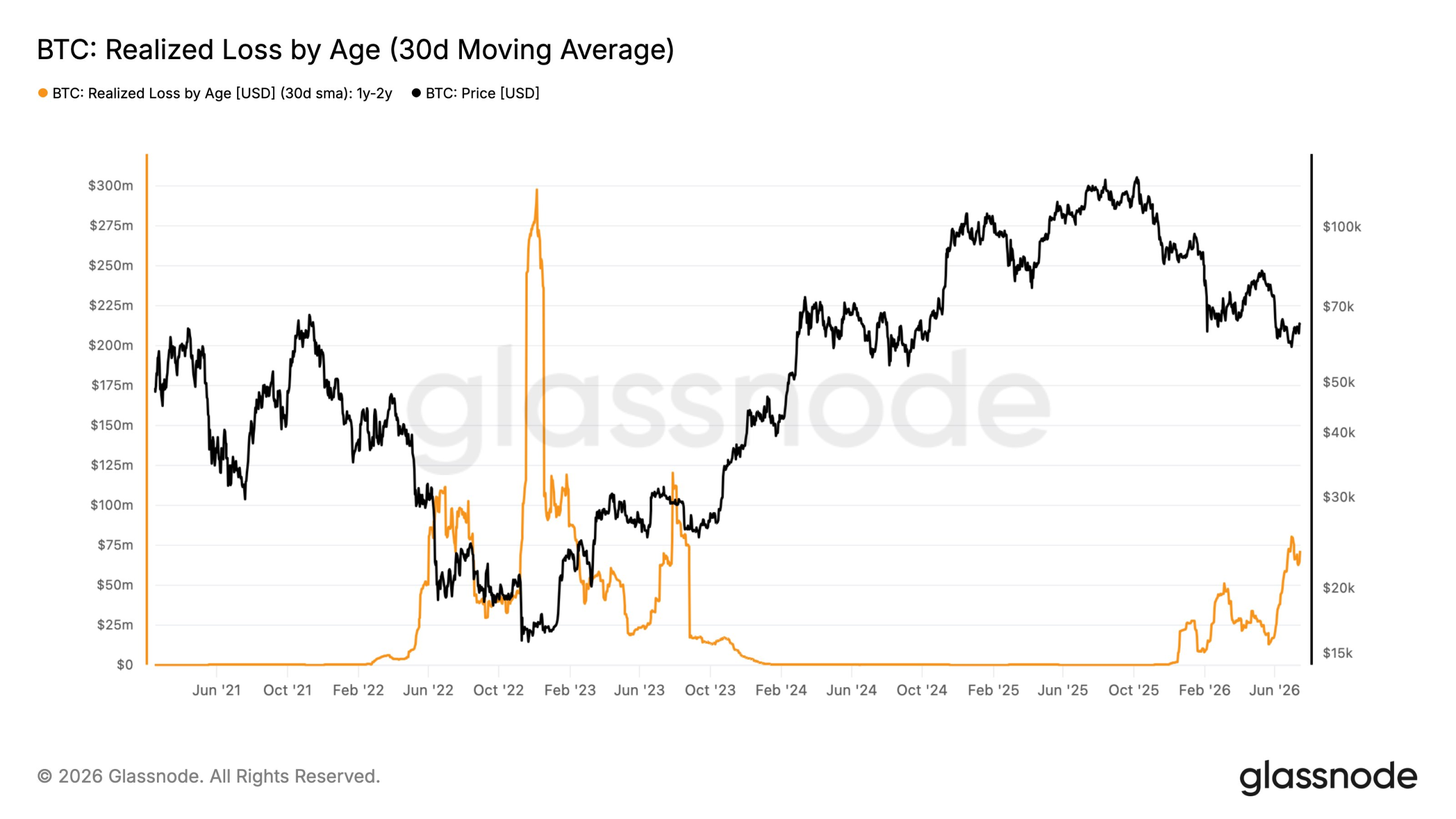
An accompanying chart shows a spike in realized losses on a 30-day rolling basis, with the tally recently passing $75 million before beginning a reversal. For Cryptovizart, that feature is key.
“When the 30D-SMA of their realized loss cools and rolls over, it has often been among the clearest early signals that the heaviest distribution phase is behind the market,” they added.
“Worth watching closely.”
Focus shifts to $69,000 BTC price showdown
Hodler realized losses are not the only onchain metric on the radar when it comes to timing the next macro BTC price floor.
Related: Bitcoin gets new $80K August target: Watch these BTC price levels next
As Cointelegraph reported, stochastic relative strength index (RSI) values on two-month time frames are creating classic market reversal conditions.
In the latest edition of its regular newsletter, The Week Onchain, Glassnode meanwhile flagged Bitcoin speculators’ aggregate cost basis as bulls’ next resistance hurdle.
At around $69,000, the cost basis for short-term holders (STHs) also coincides with old all-time highs from the 2021 bull market.
“The first meeting with that level will likely draw a strong reaction, because the people most inclined to sell are the ones about to be made whole,” it read.
“A convincing reclaim would give the recovery room to run; a rejection keeps the range intact.”
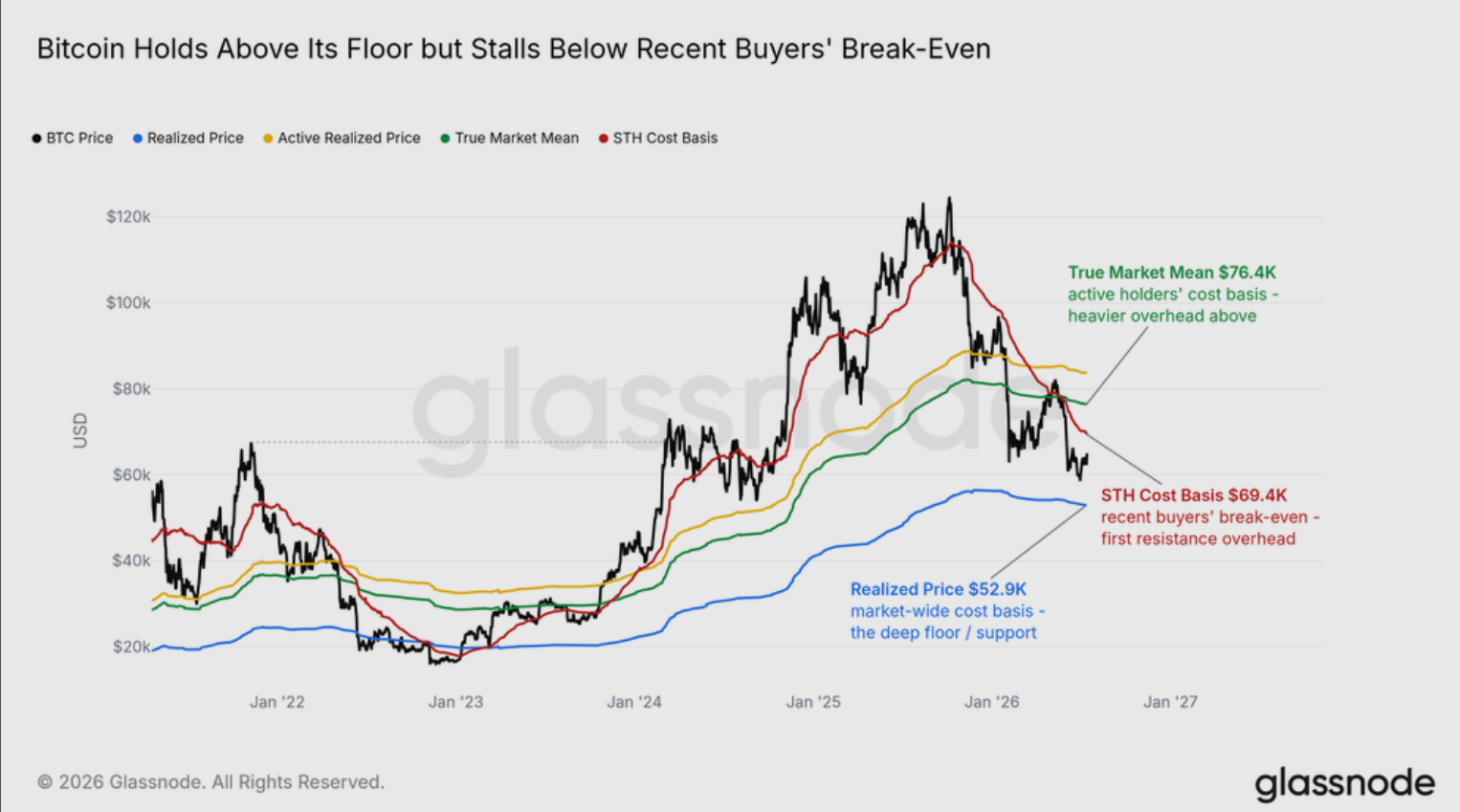
BTC/USD chart with cost-basis levels (screenshot). Source: Glassnode


A Bitcoin wallet that had remained inactive for more than eight years has transferred 5,908 BTC worth about $383 million, reviving another long-dormant holding as traders continue tracking large onchain movements.
Summary
- A Bitcoin wallet dormant for more than eight years transferred 5,908 BTC worth about $383 million to a new address.
- Onchain data showed the coins were not sent to a known exchange wallet, leaving the holder’s intentions unclear.
- The transfer followed another dormant whale move earlier this week, keeping large Bitcoin wallet activity in focus.
According to blockchain analytics platform Lookonchain, citing Arkham data, the wallet identified as “138EM…ReyiT” moved the entire 5,908 BTC balance to a new address at 7:15 p.m. ET on Wednesday. The coins remain in the recipient wallet, with no signs that they have been sent to a cryptocurrency exchange.
Arkham’s data showed the wallet originally received the Bitcoin in December 2017, when BTC traded near $16,800. The holdings were worth about $99.6 million at the time, compared with roughly $383 million at current market prices.
The timing of the original purchase makes the wallet notable. The holder kept the coins through Bitcoin’s nearly 80% decline in 2018, its rally to almost $69,000 in 2021, the subsequent fall to around $15,500 in late 2022, and the record high above $122,000 reached in October 2025, according to market price data. At that peak, the wallet’s balance was worth about $726 million.
While the movement has drawn attention, CoinDesk’s onchain analysis said the Bitcoin was transferred to a newly created, unlabeled address rather than a known exchange deposit address, indicating there is no onchain evidence of an immediate public sale.
The report also noted that the coins moved from a legacy Bitcoin address beginning with “1” to a newer SegWit address beginning with “bc1q.” According to CoinDesk, large holders often reorganize assets to upgrade wallet formats, improve custody, rotate private keys, prepare estate transfers, or arrange over-the-counter transactions that do not reach public exchanges.
Dormant whale activity remains in focus
The latest transfer follows another dormant Bitcoin wallet that became active earlier this week after more than seven years. As previously reported by crypto.news, blockchain intelligence platform Arkham said a wallet moved 2,931 BTC worth about $188 million to a new address after remaining inactive since Bitcoin traded near $6,500.
Although neither transfer has confirmed selling activity, CryptoQuant has reported that whale-sized deposits continue to dominate Bitcoin exchange inflows. Its exchange whale ratio recently stood at 0.99, indicating that the 10 largest transfers accounted for nearly all Bitcoin deposited to exchanges.
According to the firm, elevated readings have historically been associated with higher selling pressure because large deposits are more likely to precede sizable sales.

President Trump was expected to sit down with U.S. senators Thursday afternoon at the White House to try to resolve the ethics provision blocking the Digital Asset Market Clarity Act, an ethics provision that would restrict senior government officials, including the president, from holding personal crypto business interests while in office.
The meeting comes as the Senate faces a narrow window before its August recess. The current bill text does not include the ethics provision Democrats are seeking.

Discover: The Best Token Presales
What the Ethics Provision Would Cover
Democrats have demanded a provision covering the president, vice president, members of Congress, and potentially their spouses and children.
The White House has reportedly pushed for any restriction to be framed as a general officeholder rule rather than language that explicitly targets Trump.
Trump’s Crypto Exposure and the Ethics Fight
Trump disclosed he made more than $1 billion from crypto-related activity in 2025, primarily from the $TRUMP memecoin and World Liberty Financial. The disclosure directly inflamed the ethics fight.
Resolving the ethics provision is seen as the last major issue capable of derailing the bill’s momentum. The bill’s next steps would depend on whether leaders can incorporate ethics language acceptable to enough senators.
Senator Lummis is drawing a line in the sand: Get the crypto bill to the President’s desk now. — Hailey LUNC XRP (@TheMoonHailey) July 5, 2026
The CLARITY Act is officially on the Senate Legislative Calendar (No. 423). 
Crypto regulation is finally entering the chat. 
 https://t.co/0VoenmAsa5 pic.twitter.com/F9hNox9Xg2
Senate Majority Leader John Thune has said he will press forward with a floor vote later in July, whether or not the final ethics language is set.
Discover: The Best Crypto to Diversify Your Portfolio
What Happens Before the Clarity Act August Deadline
The Senate departs for summer recess in the first week of August, and midterm election politics are expected to dominate the calendar after that. A revised near-final version of the Clarity Act text was expected to circulate this week, but may slip as talks continue.

The open question is whether Trump will accept ethics language that materially restricts his own ongoing business interests. The White House meeting is an indication that negotiators are working toward a compromise, but the specific terms that emerge will determine whether enough Democrats back a floor vote.
The broader global push for crypto market structure frameworks adds context to how consequential U.S. action – or inaction – on the Clarity Act would be. A bill that resolves both the technical market-structure questions and the ethics conflict would set a baseline that other jurisdictions will reference. Stalling into the midterm cycle leaves that benchmark unset for at least another year.
Don’t Miss Out on Our $1,000 USDT Airdrop on ByBit
The post Clarity Act Stalls on Ethics Rules Curbing Trump’s Business Interests appeared first on Cryptonews.


Cointelegraph is committed to providing independent, high-quality journalism across the crypto, blockchain, AI, and fintech industries.
All news, reviews, and analyses are produced with full journalistic independence and integrity. For more details on our standards and processes, please read our Editorial Policy.


The U.S. Senate has unanimously approved a nonbinding resolution opposing any federal clemency for FTX founder Sam Bankman-Fried.
Summary
- Senators unanimously backed a resolution opposing any pardon, commutation or other federal clemency for Bankman-Fried.
- Bankman-Fried remains imprisoned for FTX fraud while his formal presidential pardon application continues seeking review.
- The resolution follows Trump’s earlier pardons of other prominent crypto figures, including Zhao and Ulbricht.
Senators agreed to the measure by unanimous consent on July 15, meaning no senator objected when it was brought before the chamber.
The resolution states that Bankman-Fried should “under no circumstances” receive executive clemency, including a presidential pardon or sentence commutation. The Senate measure does not limit the president’s constitutional pardon power, but it places the chamber on record against clemency for the former FTX chief.
Senate backs bipartisan resolution without objection
The Senate approved S.Res.772, according to the U.S. Senate Daily Press. The measure also states that denying clemency would support the rule of law and the integrity of the U.S. financial system.
Senators Cynthia Lummis and Ruben Gallego introduced the resolution on June 17. Lummis, a Republican from Wyoming, and Gallego, a Democrat from Arizona, serve on the Senate Banking Committee’s digital assets subcommittee. When introducing the measure, Lummis said Bankman-Fried “had his day in court,” while Gallego called for him to remain imprisoned.
Bankman-Fried continues to pursue a pardon
The Senate action follows Bankman-Fried’s request for presidential clemency. As previously reported by crypto.news, the former FTX chief submitted a pardon application in June while continuing efforts to challenge his conviction and 25-year prison sentence.
His legal options narrowed days later when an appeals court upheld his conviction. As reported by crypto.news, a three-judge panel rejected arguments that the trial court had wrongly limited evidence that Bankman-Fried wanted to present in his defense. The ruling left his conviction and sentence in place, though routes for further review remain available.
FTX collapse remains central to Senate opposition
A federal jury convicted Bankman-Fried in November 2023 on seven fraud and conspiracy charges linked to the collapse of FTX. Prosecutors accused him of moving billions of dollars in customer funds from the exchange to Alameda Research and using the money for investments, political donations and other spending.
A judge sentenced him to 25 years in prison in March 2024. Bankman-Fried has continued to dispute parts of the government’s case and has sought legal and political routes to reduce or overturn his punishment. Federal prison records cited in recent reporting indicate that his projected release date falls in 2044.
Trump’s earlier crypto pardons shape the backdrop
The resolution arrives after President Donald Trump granted clemency to other figures linked to the crypto industry. Trump pardoned Silk Road founder Ross Ulbricht in January 2025 and later pardoned Binance founder Changpeng Zhao in October 2025.
Bankman-Fried has not received support from the White House. As previously reported, Trump said in January that he did not plan to pardon the FTX founder. A White House spokesperson later referred reporters back to those remarks after Bankman-Fried filed his formal application.
The Senate resolution remains nonbinding and cannot block a president from granting clemency. However, its unanimous passage shows that no senator present objected to formally opposing a pardon or commutation for Bankman-Fried.
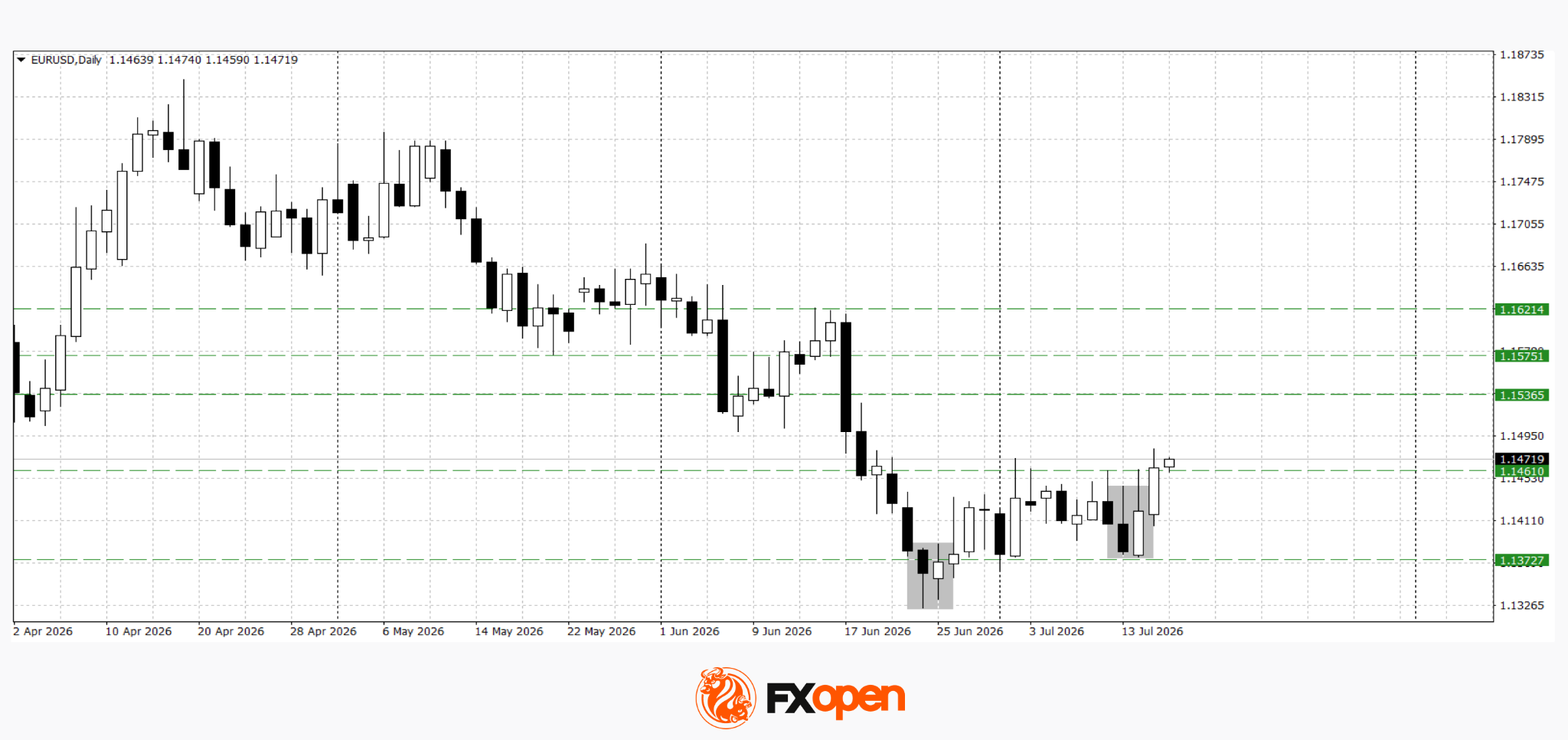
EUR/USD and GBP/USD continue to recover moderately following the recent weakening of the US dollar. European currencies have been supported by expectations that US inflationary pressures will continue to ease after softer-than-expected CPI and PPI data, reinforcing market hopes for a more accommodative Federal Reserve policy. However, the upside potential for both the euro and the pound remains limited amid persistent geopolitical tensions. The United States continues to carry out strikes against targets in Iran, supporting demand for defensive assets and periodically boosting the US dollar.
Today, traders will closely monitor a series of important economic releases from the United Kingdom, the eurozone, and the United States, which could determine the next direction for the major currency pairs.
EUR/USD
EUR/USD continues to develop after a bullish engulfing reversal pattern while attempting to establish itself above the key resistance level at 1.1460. Technical analysis suggests the pair could extend its advance towards the 1.1540–1.1580 area. The bullish scenario would be invalidated by a decisive move below 1.1370.
Key events for EUR/USD:
- 11:40 (GMT+3): Spain 10-year government bond auction;
- 15:30 (GMT+3): US Core Retail Sales;
- 15:30 (GMT+3): US Philadelphia Fed Manufacturing Index.
GBP/USD
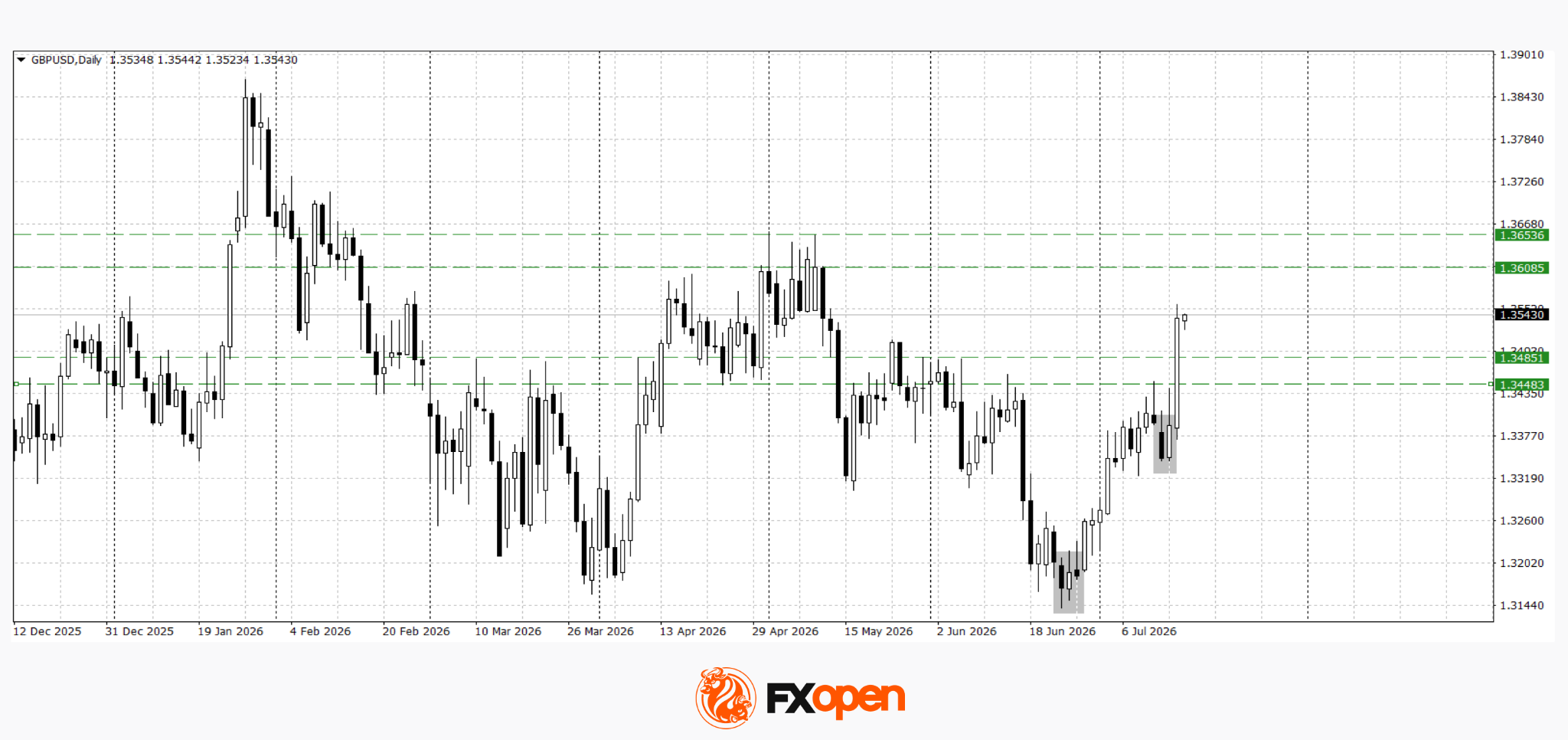
GBP/USD is recovering more strongly than EUR/USD. Buyers have managed to establish the pair above the important 1.3500 resistance level, and positive UK macroeconomic data could pave the way for a further advance towards the 1.3610–1.3680 region. At the same time, after such a rapid rally, a corrective pullback could see the pair retest the 1.3440–1.3480 area, this time as support.
Key events for GBP/USD:
- 09:00 (GMT+3): UK Gross Domestic Product (GDP);
- 14:00 (GMT+3): NIESR Monthly UK GDP Tracker;
- 18:30 (GMT+3): Atlanta Fed GDPNow estimate.
Overall, European currencies retain the potential to extend their recovery as markets continue to price in a more accommodative Federal Reserve. However, today’s economic releases from the UK, the eurozone, and the US could significantly reshape market sentiment. If US data once again disappoint expectations, EUR/USD and GBP/USD may receive additional support. Conversely, stronger-than-expected US figures could revive demand for the dollar and limit further gains in European currencies.
Trade over 50 forex markets 24 hours a day with FXOpen. Take advantage of low commissions, deep liquidity, and spreads from 0.0 pips (additional fees may apply). Open your FXOpen account now or learn more about trading forex with FXOpen.
This article represents the opinion of the Companies operating under the FXOpen brand only. It is not to be construed as an offer, solicitation, or recommendation with respect to products and services provided by the Companies operating under the FXOpen brand, nor is it to be considered financial advice.

Hosepipe ban exemptions: All the ways Britons can legally ignore restrictions
IBM Just Sent a Warning About Dividends

Primit Season 1 Officially Launches: $100,000 Avalanche On-Chain Perp Trading Incentive Event Now Live


-

 Fashion7 days ago
Loro Piana Fall 2026 Enters Houston’s Art Scene
-

 Fashion5 days ago
Weekend Open Thread: Nutriplenish Leave-In Conditioner
-
 Sports7 days ago
2026 Genesis Scottish Open Thursday TV coverage: Round 1
-

 Sports6 days ago
Super Eagles star Moses Simon opens up on Liverpool transfer regret
-

 Tech7 days ago
Character.AI enters the microdrama arena with its own productions, but there’s a twist
-

 Politics21 hours ago
Young campaigners urge incoming PM to act on outdoor junk food ads
-

 News Videos2 days ago
XRP BOMBSHELL… XRP OMBOARDED FOR TRANSACTIONS!!!
-

 Tech2 days ago
Get Your ESP32 Sunny Side Up With This Solar Dev Board
-

 Tech2 days ago
Dark Secrets Emerge When Jailbreaking LLMs
-
 Sports12 hours ago
New Cornerback Enters Vikings Trade Rumor Mill
-
 Entertainment16 hours ago
Disney’s Most Ambitious Failed Star Wars Attraction Is Coming to SDCC
-

 Tech7 days ago
Level Infinite Launches Gangstar Mirage City in India with Pre-Registrations
-
 NewsBeat7 days ago
Major update after Huntingdon train attack as man enters plea
-

 News Videos3 days ago
how to make coin bank box with cardboard #scienceproject #money #diy #shorts
-
 Tech3 days ago
Cloudflare Precursor Watches Your Mouse and Keyboard To Decide If You Are Human
-
 Entertainment15 hours ago
Vicki Gunvalson Defends Discussing Heather Dubrow’s Money
-
Crypto World2 days ago
Ripple, Coinbase, Circle Join Linux x402 Foundation to Help Shape AI Payments
-

 NewsBeat12 hours ago
Watch: Is Donald Trump facing a popular backlash on immigration?
-

 Sports9 hours ago
Michigan officials not expected to discuss AD Warde Manuel at Thursday meeting
-
 NewsBeat11 hours ago
Firefighters issue update on Dovestone moorland blaze as fire enters fourth day
You must be logged in to post a comment Login