
Crypto World
Exclusive Abu Dhabi F1 Hospitality Experience Now Available for Crypto Executives, Investors and VIP Guests


The Formula 1 Abu Dhabi Grand Prix is one of the most anticipated events on the UAE calendar, bringing together motorsport, luxury, business and entertainment at Yas Marina Circuit.
For the 2026 season finale, Crypto Breaking News and Web3 Digital can now provide access to an exclusive Sunday hospitality experience at the W Garage Terrace at W Abu Dhabi – Yas Island, designed for executives, investors, entrepreneurs, corporate guests and VIP clients looking to experience Formula 1 from a premium setting.
Located directly alongside the circuit, the W Garage Terrace offers an exceptional race-day environment combining close-up Formula 1 action with premium hospitality, networking and the distinctive atmosphere of Yas Marina.
Experience the Abu Dhabi Grand Prix from the W Garage Terrace
The W Garage Terrace offers an open-air vantage point overlooking Turns 12 and 13, placing guests close to the action while providing views across Yas Marina and its iconic superyachts.
The experience has been designed to combine the excitement of the Formula 1 season finale with a more intimate and sophisticated hospitality environment, making it particularly suitable for corporate entertainment, client engagement and private networking.
What the Experience Includes
- Exclusive Sunday access to the W Garage Terrace at W Abu Dhabi – Yas Island
- Premium views of the Formula 1 action around Turns 12 and 13
- Dedicated terrace and lounge seating
- Premium international dining throughout the experience
- Champagne service and premium beverages
- Curated social and networking areas
- Live entertainment and DJ sets
- Access to the unique W Abu Dhabi atmosphere during race weekend
- Post-race concert access, depending on the applicable ticket category
A Premium Setting for Business and Networking
The Abu Dhabi Grand Prix has become much more than a motorsport event. Every year, it attracts international entrepreneurs, investors, executives, celebrities and decision-makers to Abu Dhabi for one of the region’s most important lifestyle and networking weekends.
For companies operating in crypto, Web3, fintech, trading, investment and digital assets, premium Formula 1 hospitality can also provide an alternative environment for building relationships with clients and partners outside the traditional conference setting.
The experience can be particularly suitable for:
- Crypto exchanges and trading platforms hosting VIP clients
- Web3 and fintech companies entertaining partners or executives
- Private investors and high-net-worth individuals
- Corporate leadership and incentive programmes
- Family offices and investment companies
- International founders and entrepreneurs visiting the UAE
- Brands looking for premium client-engagement experiences
Corporate and Group Hospitality
Companies interested in bringing multiple guests can also request tailored corporate and group arrangements.
Depending on the size of the group and specific requirements, additional services and hospitality elements can be arranged to create a more personalised experience for clients, executives or strategic partners.
For larger corporate requirements, bespoke options can be explored individually based on availability.
More Than Just a Formula 1 Ticket
This experience is designed for guests looking for more than simply attending the race.
The combination of premium track views, hospitality, dining, entertainment and networking creates an opportunity to experience the Abu Dhabi Grand Prix from one of Yas Marina’s most distinctive locations.
Previous editions of the Garage Terrace experience have welcomed hundreds of guests, combining premium race viewing with elevated dining, free-flowing beverages and the atmosphere of the Formula 1 finale at Yas Marina.
Limited Availability for Abu Dhabi F1 2026
Hospitality inventory for the Abu Dhabi Grand Prix is limited and availability can change quickly as the race weekend approaches.
For this reason, current availability must be confirmed before any booking can be finalised.
Pricing is available privately upon request.
Individuals, companies and corporate groups interested in the W Garage Terrace experience can contact us directly with the number of guests and any specific hospitality requirements.
Premium Access to Other Global Sporting Events
Through our international hospitality network, Web3 Digital and Crypto Breaking News can also assist clients looking for premium access to other major sporting and live entertainment events worldwide.
Opportunities can include Formula 1 Grand Prix weekends, Grand Slam tennis, international football, major cricket events, concerts and bespoke VIP experiences.
If you are planning to attend a major international event and are looking for premium hospitality or hard-to-access experiences, our team can check available options based on your requirements.
Request Abu Dhabi F1 Hospitality Availability
To request current availability, private rates or corporate hospitality options for the 2026 Formula 1 Abu Dhabi Grand Prix, contact:
Web3 Digital / Crypto Breaking News
Email: hello@web3digital.ae
Website: www.web3digital.ae
Availability and hospitality options are subject to confirmation at the time of booking.



Strive has signaled another possible Bitcoin purchase after raising its holdings to 23,156 BTC, while its Nasdaq-listed ASST shares have climbed above $27 to a new yearly high.
Summary
- CEO Matt Cole posted Strive’s Bitcoin tracker, a step that has preceded earlier purchase announcements.
- Strive holds 23,156 BTC after buying 1,800 coins for approximately $143 million.
- ASST has gained more than 78% this year and nearly 120% over the past month.
- SATA’s return to its $100 par value could give Strive another route to finance Bitcoin purchases.
Strive Bitcoin purchase hint follows $143 million deal
Matt Cole, Strive’s chairman and CEO, posted the company’s Bitcoin portfolio tracker on X with the message, “Wall-breaking season at Strive,” raising expectations that another acquisition could be disclosed shortly.
Strive has used similar tracker posts before announcing additions to its Bitcoin treasury. Cole did not state how many coins the company may have purchased, how much it may have spent, or when a transaction took place, leaving any new acquisition unconfirmed until Strive releases an announcement or filing.
The hint follows Strive’s purchase of 1,800 BTC between Aug. 24 and Aug. 28. According to a U.S. Securities and Exchange Commission Form 8-K, the company paid an average of $79,431 per coin, including fees and expenses, bringing the total cost to about $143 million.
As crypto.news previously reported, the transaction increased Strive’s Bitcoin holdings from 21,356 BTC to 23,156 BTC. BitcoinTreasuries.net ranked the Dallas-based company as the fifth-largest publicly traded corporate Bitcoin holder, ahead of Bullish and behind Strategy, Twenty One Capital, Metaplanet, and MARA Holdings.
At a Bitcoin price of roughly $76,400 when the purchase was disclosed, the company’s holdings were valued at approximately $1.77 billion. Strive did not provide the combined acquisition cost for its entire treasury in the filing, while the market value of the position continues to move with Bitcoin’s price.
The 1,800-BTC purchase came one week after Strive added another 1,110 BTC for $81.5 million. Its average price for the earlier transaction was $73,409 per coin, meaning the company spent approximately $224.5 million to acquire 2,910 BTC across the two reporting periods.
Strive targets second place among Bitcoin treasury firms
Building on those purchases, Cole has said Strive could acquire more than 20,000 additional BTC and finish the year as the second-largest corporate Bitcoin holder behind Strategy.
“It’s not out of the realm of possibility for Strive to end the year as the 2nd-largest BTC holder,” Cole said.
Reaching that position would require Strive to move past Twenty One Capital, Metaplanet, and MARA Holdings based on the rankings cited after its latest confirmed purchase. The target also depends on acquisitions made by competing treasury companies, since several firms continue to raise capital for Bitcoin.
Cole has maintained an optimistic view of the asset during its recent recovery. In August, he said Bitcoin’s next cycle could become its strongest after the cryptocurrency gained 22.7% in one week and closed at $77,387.
During the same period, U.S. spot Bitcoin exchange-traded funds recorded $1.92 billion in net inflows, according to SoSoValue data. Cole linked his forecast to Bitcoin’s performance against the dollar and gold, along with investor demand for assets with limited supplies.
“Bitcoin priced in gold is reinforcing my view that the next Bitcoin cycle will be the strongest we have ever seen,” he said at the time.
Cole acknowledged that Bitcoin could pull back after its rapid advance, but said Strive remained willing to add exposure. In a separate August statement, he described Bitcoin as “historically cheap in this price range” and said the company felt comfortable accepting more risk to purchase additional coins.
Bitcoin has since recovered from around $63,000 to a recent high near $82,000, according to market data cited in the supplied report. The increase has raised the value of existing corporate holdings while supporting stocks whose market performance is closely tied to Bitcoin.
ASST stock leads major Bitcoin treasury companies
At the time of writing, ASST is climbing above $27 to its highest level of the year. The common stock has gained more than 78% since the start of 2026 and nearly 120% over the past month, making it the strongest performer among the 10 largest Bitcoin treasury companies during the cited period.
Strive’s rally has outpaced other companies in the same group. Strategy shares gained more than 45% during the past month but remained down over 7% for the year, while Metaplanet advanced more than 22% in the month and stayed over 37% lower year to date.
ASST gives investors exposure to Strive’s common equity rather than direct ownership of its Bitcoin. Its price can respond to changes in BTC, the size and cost of Strive’s treasury, operating results, financing expenses and the number of shares outstanding.
The structure has particular relevance for U.S. investors because both ASST and Strive’s preferred security, SATA, trade on Nasdaq. Investors can therefore gain exposure through regulated U.S.-listed securities, although the two instruments carry different rights and risks.
ASST holders own common equity and sit behind preferred shareholders in the company’s capital structure. SATA investors receive preferred dividends when declared, while its perpetual structure means the security has no scheduled maturity.
A recent SEC filing showed Strive’s Class A share count increasing by 3.58 million during the week of its 1,800-BTC purchase, from 79.89 million to 83.47 million. Effective common shares outstanding reached 93.26 million, while the assumed fully diluted count climbed to 96.52 million.
SATA could support another Strive Bitcoin purchase
Strive has funded its Bitcoin strategy through at-the-market programs for ASST and SATA, allowing appointed sales agents to issue shares gradually instead of arranging a single underwritten offering.
SATA has recently traded around its $100 par value, which can make additional issuance more practical because Strive can sell preferred shares without pricing them below their stated liquidation preference. The security carries a variable dividend and pays cash distributions every business day when declared.
In late August, BitcoinTreasuries.net estimated that SATA trading had generated enough potential funding capacity for about 1,192 BTC in one week. The estimate relied on trading volume at or above $100 and an assumed capture rate based on Strive’s earlier SEC filings; it did not confirm that the company had issued the shares or purchased the projected number of coins.
Strive increased its available at-the-market capacity in June to as much as $2.6 billion for SATA and $2.55 billion for ASST. Within the latest reporting period, SATA shares outstanding rose by 803,099 to 9.07 million, giving the preferred stock an implied aggregate liquidation value of about $907.4 million.
The company did not specify how much of its latest Bitcoin purchase came from ASST sales, SATA issuance, or existing cash. Its filing showed that both common and preferred share counts increased while the acquisition was completed.
Strive reported a second-quarter GAAP net loss of $257.6 million, including $234 million linked to lower fair values for its Bitcoin and Strategy STRC positions. As of Aug. 7, the company held $154.9 million in cash, about $48 million of STRC preferred shares, and no short- or long-term debt.
The company’s second-quarter filing also recorded $26.2 million in SATA dividends within its adjusted net loss attributable to common shareholders. Strive identified possible dilution from additional ASST or SATA issuance as a risk, while SATA creates a continuing preferred-dividend obligation because the shares are perpetual.


Hunter Biden has prepared to launch a 1 billion-supply meme coin called LAPTOP on Coinbase-developed Base on Sept. 9, with part of the token allocation set aside for people who lost money trading President Donald Trump’s TRUMP meme coin.
Summary
- Hunter Biden is set to launch the 1 billion supply LAPTOP meme coin on Base on Sept. 9, according to the Wall Street Journal.
- The founding team will receive 30% of the supply, locked for six months and gradually unlocked over two years.
- Another 20% will be distributed through two airdrops that include users who lost money trading Donald Trump’s TRUMP meme coin.
- Up to 30% of LAPTOP’s supply could be burned if preset events occur, including Bitcoin reaching a new all time high or LAPTOP overtaking TRUMP by fully diluted valuation.
The Wall Street Journal reported on Sept. 7 that Biden, the son of former President Joe Biden, is part of the founding team behind the project, which takes its name from the laptop controversy that became a major political issue during the 2020 U.S. presidential election.
LAPTOP will use a token distribution model that reserves 30% of the total supply for its founding team. According to the Journal, the allocation will remain locked for six months before gradually becoming available over a two-year period.
Another 20% has been designated for two rounds of airdrops, with eligibility extending to people who previously lost money on TRUMP. Hunter Biden’s Substack subscribers, friends and people on a mailing list maintained by video journalist Andrew Callaghan are expected to qualify as well.
LAPTOP meme coin will target TRUMP holders with airdrop
The decision to allocate tokens to TRUMP investors places the new project directly alongside the political meme coin market that developed after Donald Trump entered the sector.
TRUMP launched shortly before Trump returned to the White House in January 2025 and initially recorded a sharp price rally before losing most of its value.
In July, crypto.news reported that nearly 989,000 wallets that purchased TRUMP had accumulated a combined $3.81 billion in realized and unrealized losses through the end of June, citing blockchain data from Nansen. Trump’s 2025 financial disclosure showed a $636 million payout connected to the meme coin and at least $1.4 billion in crypto-related income.
The losses remained concentrated among retail holders even after TRUMP staged another rally in August. The token jumped approximately 93% between Aug. 13 and Aug. 23, moving from a record low of $1.37 to $3.60 before falling after team-linked wallets transferred $6.2 million worth of tokens to OKX.
Nearly 988,905 wallets remained underwater by a combined $3.81 billion during the period, while Trump-affiliated entities controlled 80% of TRUMP’s 1 billion-token supply under a vesting schedule running through January 2028, according to on-chain data reviewed in August.
LAPTOP’s planned airdrop would therefore direct part of its supply toward a large existing group of meme coin traders who have recorded losses on the president’s token.
Founders will control 30% of the LAPTOP supply
Beyond the 30% founder allocation and 20% airdrop pool, the LAPTOP project has earmarked another 20% of the supply for charitable donations, liquidity and distributions to exchange partners and market makers, the Journal reported.
Part of that allocation will cover accounting, legal, administrative and compliance expenses associated with the token foundation.
The remaining portion of the token structure is tied to an unusual burn system built around 30 predetermined events. Up to 30% of LAPTOP’s supply could be permanently destroyed if specified conditions occur within their assigned time limits.
One trigger would be a Democratic victory in the 2028 U.S. presidential election. Other conditions include Bitcoin reaching a new all-time high and LAPTOP’s fully diluted valuation exceeding that of TRUMP.
Tokens connected to conditions that are not met would be donated proportionally to charities instead of being destroyed, according to the Journal.
The structure links LAPTOP’s supply directly to political and crypto market events, including the performance of the token it is positioning itself against.
Political meme coins have previously shown large price swings around events involving the Trump family. TRUMP lost 55% within minutes after Melania Trump announced her MELANIA token in January 2025, erasing billions of dollars from its market capitalization as traders moved between the two assets.
By February 2026, TRUMP and MELANIA had fallen by more than 90% from their respective peaks, while estimates cited at the time placed retail losses across the Trump-branded tokens at more than $4 billion.
Hunter Biden has stepped up his crypto commentary
The LAPTOP launch follows a period in which Hunter Biden has taken a more public role through podcasts, news appearances and his Substack publication.
His recent commentary has extended into cryptocurrency, including the Trump family’s digital asset businesses and the controversy surrounding World Liberty Financial and crypto entrepreneur Justin Sun.
Trump-linked crypto ventures have faced continued scrutiny over the money generated for entities associated with the president and losses recorded by investors.
Public Citizen estimated in August that investors across five Trump-linked products were at least $4.7 billion underwater, including roughly $3.2 billion attributed to TRUMP holders and at least $1 billion connected to World Liberty Financial’s WLFI token.
The watchdog’s figures included both realized and unrealized losses. It estimated that Trump generated approximately $1.4 billion in crypto-related income during 2025, while the top 1% of profitable TRUMP wallets captured around $2.7 billion, or roughly 80% of all gains. The Public Citizen analysis called for Congress to add presidential divestment requirements to U.S. crypto legislation.
Political scrutiny surrounding TRUMP has reached the regulatory debate in Washington as well. Democratic Sens. Elizabeth Warren and Richard Blumenthal asked Securities and Exchange Commission Chairman Paul Atkins in August to investigate the token, citing investor losses and Trump’s reported earnings from the project.
Their request arrived while lawmakers were negotiating ethics provisions connected to the Digital Asset Market Clarity Act. The SEC had previously taken the position that meme coins generally do not qualify as securities under existing federal securities laws, leaving much of the sector outside its traditional enforcement framework.
The debate over TRUMP and crypto ethics has continued as lawmakers consider restrictions on government officials benefiting financially from digital asset ventures.
LAPTOP is scheduled to begin trading on Base on Sept. 9, with its 1 billion-token supply divided among the founding team, airdrop recipients, charitable and operational uses, and the event-linked burn mechanism.


Ripple CEO Brad Garlinghouse has cited an 86-tonne reallocation of Dutch gold reserves to argue that crypto networks can move value across borders faster than physical reserve systems.
Summary
- DNB sold about 59 tonnes of gold in New York and replaced it in London.
- More than 27 tonnes were moved physically between North America, Zeist, and London.
- Garlinghouse said crypto reduces the dependence of value transfers on asset location.
- DNB kept its total gold reserves unchanged while increasing the share stored in London.
Dutch gold transfer changed where reserves were held
De Nederlandsche Bank said it reallocated about 86 tonnes of gold between March and August 2026 to make its reserves easier to trade and strengthen its preparations for a possible crisis.
Most of the operation did not involve shipping the same bars across the Atlantic. According to the central bank’s announcement, DNB sold approximately 59 tonnes in New York before buying the same amount of market-standard gold in London.
DNB also used physical transfers for part of the operation. More than 27 tonnes were moved from the United States and Canada to its cash center in Zeist, while a similar amount of market-standard gold was transported from Zeist to London.
By combining sales, purchases, and physical transport, the central bank said it reduced the operational risks associated with relying on one transfer method. The approach also allowed DNB to avoid remelting bars that did not meet the standards required for direct trading in London.
No gold was added to or removed from the Dutch reserve during the process. Instead, the operation changed where the metal was held and improved the quality of the portion available for international transactions.
Following the reallocation, the Bank of England holds 32.1% of the Netherlands’ gold, up from 18.1%. DNB’s Zeist facility retains 30.8%, while New York and Ottawa each account for 18.5%.
Before the move, New York held 31.3%, and Ottawa held 19.7% of the reserve. DNB said London offers better access to the international gold market, particularly when financial conditions become volatile.
Brad Garlinghouse says crypto removes location barriers
Responding to the operation in an X post, Garlinghouse focused on how DNB transferred much of the reserve’s economic value without moving the same bars from New York to London.
The Ripple executive described global value transfer as an “ideal use case” for crypto, arguing that blockchain networks can settle transactions quickly and securely without requiring an asset to change physical locations. His comparison centered on the custody, transport, and trading arrangements needed when central banks reposition bullion.
“Why does financial value still depend on these location-centric processes?” Garlinghouse asked.
His argument did not mean that the Dutch central bank had used cryptocurrency or blockchain technology during the operation. DNB relied on established bullion markets, central-bank custody arrangements, and physical vault infrastructure to reorganize the reserve.
Garlinghouse instead used the transaction to contrast two different forms of settlement. Gold requires recognized vaults, approved bars, secure transport, and access to liquid trading centers, while a crypto asset can move between blockchain addresses without being transported as a physical object.
According to Garlinghouse, the total value of the crypto market has grown from approximately $1.5 billion in 2013 to around $2.7 trillion. He presented that increase as evidence that blockchain-based assets and transfer networks have developed into a large financial market within little more than a decade.
Ripple has built much of its business around institutional payments and settlement. In July, crypto.news reported on Ripple’s European expansion, noting that Ripple Payments had processed more than $100 billion across over 60 markets.
A separate June report examined how Ripple has moved from presenting itself as a direct replacement for bank infrastructure toward working alongside SWIFT. Banks can retain established messaging systems while using blockchain-based products for selected settlement and tokenization functions.
Germany’s gold transfer shows the physical burden
Garlinghouse also referred to Germany’s earlier repatriation of 674 tonnes of gold from Paris and New York to Frankfurt. The Bundesbank began the operation in 2013 and completed it in 2017, three years before its original deadline.
The total consisted of 374 tonnes from Paris and 300 tonnes from New York. Germany moved the metal in stages, bringing 37 tonnes to Frankfurt in 2013, 120 tonnes in 2014, 210 tonnes in 2015, 216 tonnes in 2016, and the final 91 tonnes in 2017.
Bundesbank specialists checked the authenticity, purity, and weight of the bars when they arrived in Frankfurt. After the program ended, Germany held 50.6% of its gold domestically, while the Federal Reserve Bank of New York stored 36.6% and the Bank of England held 12.8%.
The Bundesbank said its storage plan served two functions: maintaining confidence by keeping half of the reserve in Germany and preserving access to trading centers where gold could be exchanged for foreign currency quickly.
For U.S. readers, both the German and Dutch cases show the continuing role of New York in the international bullion system. Foreign central banks store gold at the Federal Reserve Bank of New York because the location supports custody and transactions with other official institutions, although moving or reallocating bullion still requires operational coordination.
Gold infrastructure remains central to reserve policy
Despite Garlinghouse’s comparison, DNB said the gold reallocation was designed to improve the resilience of its existing reserve system rather than replace bullion with a digital asset.
DNB Governor Olaf Sleijpen said the central bank does not expect that it will have to use its gold during a crisis. Even so, he said DNB must remain prepared for severe conditions and ensure that part of the reserve can be traded when needed.
The central bank also said experience with both physical transfers and market-based reallocations would be useful if another move became necessary. During a future disruption, transport constraints or trading conditions could prevent DNB from using one of the two methods.
The gold operation arrives as regulated institutions continue adding digital-asset services without abandoning existing financial infrastructure. In July, Germany’s DZ Bank began rolling out crypto trading through participating cooperative banks, giving retail customers access through their existing banking relationships.
The service supports Bitcoin, Ethereum, Litecoin, and Cardano, with Boerse Stuttgart Digital handling custody. Participation remains optional for individual cooperative banks, although hundreds of institutions were expected to introduce the service over time.
CZ says Bitcoin still faces established gold systems
Binance co-founder Changpeng Zhao has also compared Bitcoin with gold, although his assessment gave more weight to the infrastructure already built around the precious metal.
Speaking during a Bitcoin Asia fireside chat, Zhao said Bitcoin could eventually become more important than gold if governments begin treating it as a strategic reserve asset. He also acknowledged that gold benefits from mature systems for custody, valuation, and central-bank reserve management.
Gold’s place in official reserves has developed over many years, giving governments established rules and institutions for storing, auditing and trading the metal. Zhao said replacing that system could take time, particularly among large economies that already hold extensive bullion reserves.
National Bitcoin adoption has nevertheless entered official policy discussions in several countries. Zhao has advised governments on digital assets, including reserve-related initiatives, while continuing to argue that state adoption could influence Bitcoin’s long-term standing against gold.


NVIDIA CEO Jensen Huang says human-level AI has arrived. His company, Nvidia, supplies the hardware behind it and has a financial stake in convincing the world to keep spending on AI.
On Sunday, he credited OpenAI’s GPT-6 Astra with reaching artificial general intelligence, or AGI. Broadly, that means AI capable of handling intellectual work at human level. There is no universally accepted test.
Four days earlier, at a G20 meeting in North Carolina, Huang had sounded less certain.
“In the next couple of years, we are going to achieve essentially what people call AGI… In fact, I would argue that we’re practically there today… It either means a lot or it doesn’t mean anything,” he said.
That ambiguity extends to the contracts funding AI.
AGI Hype is Not Showing
OpenAI’s Microsoft deal once reportedly tied AGI to systems capable of generating about $100 billion in profit. An October 2025 revision required an independent expert panel to verify OpenAI’s declaration.
The companies rewrote their agreement in April. OpenAI’s payments to Microsoft now continue through 2030 regardless of technological progress. The financial arrangement no longer needs that verdict.
Meanwhile, Sequoia partners published “2026: This is AGI” in January. Physicist Mark Gubrud, who used the term in 1997, also says it has arrived.
The disagreement partly reflects different expectations. Anthropic chief Dario Amodei described a much higher threshold in February, months before Astra’s release.
“If you had the country of geniuses in a data center, we would know it… We don’t have that now. That’s very clear,” he said.
For investors, Huang’s Sunday claim leaves a practical question unanswered: how much human work can these systems reliably take over?
Cognitive scientist Gary Marcus remains unconvinced.
“Of course I fully expect that AGI will be achieved someday. But everything said before then is a premature declaration,” he noted.
The post Nvidia CEO Says Human-Level AI Is Here. He Sells the Chips. appeared first on BeInCrypto.
Bitcoin is trading above $79,000 after US spot ETFs pulled in a reported $730.9 million in a single day last week, their second-largest daily inflows of the year after the $843.6 million they drew in on January 14.
Crypto analysis platform CryptoRus, in its latest market letter, framed this week as a test of whether that institutional buying can push BTC through the closely watched $82,000 resistance level, something it calls a bullish test rather than a finished breakout.
Three Signals Behind the Breakout Test
CryptoRus pointed to three signals worth tracking. The first is the ETF print itself: Bitcoin held near $80,000 even after a stronger-than-expected US jobs report briefly pressured the market, and the letter reads that resilience as institutional buyers absorbing supply before resistance breaks, though similar spikes have shown up near past market tops.
The second is a leverage reset, with $554.2 million in crypto positions liquidated over 24 hours, $471.4 million of that being shorts and $276.7 million coming from BTC alone.
“That is real demand. It is not yet a completed breakout,” the letter said, adding that forced short covering can speed up a rally without guaranteeing organic demand sticks around once the squeeze ends.
The third signal is Zcash, which climbed from roughly $40 to above $1,200 over the past year and pushed into crypto’s top ten, a sign that speculative capital is concentrating around a scarcity narrative, with the risk of chasing a parabolic move.
“That strength matters beyond ZEC,” the note stated. “It shows that speculative capital is willing to concentrate aggressively when a narrative combines scarcity, renewed relevance, and crowded positioning.”
A Breakout Still Needs Confirmation
Bitcoin itself has changed little over 24 hours, up roughly 2 percent for the week and about 23 percent for the month, though it remains down close to 28 percent over the past year and around 37 percent below the $126,000 high it set last October. Daily trading volume sits near $22 billion, up about 13 percent from the prior session.
The report therefore puts $79,000 and $82,000 at the center of the current setup. A four-hour close above $82,000 followed by a successful retest would provide stronger confirmation. Losing $79,000, meanwhile, would weaken the immediate bullish case and put the liquidity area around $78,000 back in focus.
As things stand, ETF demand is strong, but $82,000 has not yet been cleared.
The post Bitcoin Tests $82K Resistance as ETF Buying Strengthens appeared first on CryptoPotato.

The UK’s Financial Conduct Authority (FCA) is reportedly in discussions with prediction market operators about whether it could ease a long-standing restriction on offering retail access in the country. The move, if it happens, would mark a notable shift from the regulator’s position since 2019—when it placed a permanent ban on selling, marketing, or distributing certain “binary options” to retail customers.
According to a Friday report by The Times, the FCA has been weighing lifting the prohibition for UK-based retail investors. The decision would specifically affect platforms that run event-driven markets—including contracts tied to sports, politics, and weather—where payouts are binary in nature.
Key takeaways
- The FCA’s 2019 rules effectively barred prediction market platforms from marketing binary options to retail consumers in the UK.
- The Times reports the FCA is now considering loosening that retail ban.
- UK retail traders reportedly have used VPNs to access US-based platforms such as Kalshi and Polymarket despite UK restrictions.
- If the FCA reverses course, UK operators could face regulatory questions similar to ongoing disputes in the United States.
Why the FCA’s 2019 ban mattered
The FCA’s restriction dates to April 2019. In a statement at the time, the regulator said firms were “prohibited from selling, marketing or distributing binary options to retail consumers.” The FCA framed binary options as high-risk products that should not be offered to the mass retail public in their existing form.
As noted in the original FCA reasoning from the ban, “Binary options are gambling products dressed up as financial instruments,” according to comments attributed to the regulator at the time, including statements made by the FCA’s executive director of strategy and competition, Christopher Woolard.
Prediction market platforms—particularly those built around event contracts that resolve in yes/no outcomes—often rely on that “binary” structure, even when offered as a market rather than a traditional sportsbook. That similarity is what brought them under the FCA’s broader binary options prohibition.
Reported UK retail access pressure and the VPN workaround
The backdrop to any potential change appears to be persistent retail demand and workarounds. The Times report says many UK-based users have continued trading on platforms such as Kalshi and Polymarket by using virtual private networks (VPNs) to bypass restrictions.
This matters for regulators because it signals that outright prohibition has not eliminated participation. Instead, it has pushed activity into a less transparent channel, with users potentially exposed to the risks and consumer protections—or lack thereof—of jurisdictions outside the UK.
Industry expectations for growth have also helped keep the spotlight on prediction markets. In April, Bernstein Research speculated, as reported by CNBC, that the overall prediction market sector could climb to around $240 billion in trading volume in 2026 and about $1 trillion by 2030. While such forecasts are not regulatory decisions, they shape how seriously both markets and policymakers view the category’s trajectory.
CNBC relayed Bernstein’s projections in April, giving a sense of scale that can influence how regulators evaluate whether a ban is proportionate to real-world usage.
What would change if the ban is lifted?
If the FCA moves to lift the retail ban, the most immediate implication would be legal clarity for platforms that currently operate under constraints for UK retail participants. However, it would not automatically resolve the underlying classification debate around whether event contracts should be treated as “binary options” under UK rules—or whether a more tailored regulatory framework could distinguish prediction markets from conventional binary betting.
Even with a UK relaxation, platforms would likely need to demonstrate how their products function, how they handle consumer protections, and how they address the core concerns the FCA cited in 2019.
Importantly, any UK decision would also be watched in light of disputes in the United States. In the US, state regulators and courts have been grappling with where prediction markets fit within existing gambling and securities frameworks.
US legal battles could shape expectations in the UK
Should the FCA loosen restrictions, UK platforms could face pressure to align with— or at least anticipate— the outcomes of ongoing US enforcement. The source material points to a parallel problem: in multiple US states, gaming authorities have challenged prediction market platforms over sports event contracts.
Earlier coverage highlighted that New Jersey officials petitioned the Supreme Court last week to hear its case against Kalshi, potentially leading to clearer boundaries between state and federal authority over prediction markets. That development, reported by Cointelegraph, underscores how unresolved jurisdictional questions can drive uncertainty for platforms—even when they are operating commercially.
While the UK and US legal environments are not the same, regulatory bodies typically consider international enforcement trends when reassessing product classification and risk. For retail users, any UK shift could also reduce the incentive to use VPNs, if lawful access becomes possible under an FCA-approved structure.
For now, readers should watch for whether the FCA’s reported discussions lead to formal rule changes or guidance—and, just as importantly, whether the regulator’s approach focuses on redefining prediction markets, imposing new consumer safeguards, or simply carving out an exception for retail access. The practical impact will depend on how the FCA draws the line between event-driven prediction and what it considers retail “binary options.”


Harmony has told ONE holders to leave smart contracts by Sept. 10 because liquidity pools, multisig vaults and on-chain applications cannot move to Ethereum under its proposed network closure.
Summary
- Sept. 10 is the deadline for users to remove ONE and other assets from Harmony-based smart contracts.
- Wallet and exchange balances would qualify for an automatic Ethereum airdrop after the final network snapshot.
- Liquidity pools, multisig vaults, and decentralized applications cannot be transferred through the planned migration.
- Eligible validators and delegators could receive payments from a $1.372 million pool over four quarters.
Harmony said users do not need to file a claim for replacement ONE tokens, but the automatic process only covers balances captured in the final blockchain snapshot.
The warning creates two different paths for holders. ONE kept in a standard wallet would be recorded and recreated on Ethereum, while tokens deposited into decentralized finance protocols may need to be withdrawn before the deadline.
Harmony has not disclosed when it will produce the final block or complete the airdrop. Sept. 10 is therefore an exit deadline for smart-contract users and the date from which validators may begin closing their nodes, not the confirmed date of the mainnet shutdown.
Why ONE holders must leave smart contracts
Under the proposal, Harmony would record ONE balances at the blockchain’s final block before issuing replacement tokens as ERC-20 assets on Ethereum. Covered balances include tokens in personal wallets, staking delegations, unclaimed validator rewards, and centralized exchange accounts.
The project said the new tokens would be sent to the same Ethereum-compatible addresses listed in the snapshot. Since Harmony uses addresses compatible with Ethereum’s format, holders would not need to complete a separate claim or submit personal information.
Smart contracts present a more complex problem. Although the snapshot can record how much ONE a contract holds, it cannot reproduce the full state, ownership rules, or functions of every application on Ethereum.
Liquidity pools may contain two or more assets and issue separate liquidity provider tokens representing each user’s share. Multisig vaults depend on contract rules that require several approved signers, while lending markets track collateral, loans, interest, and liquidation conditions. Harmony said such applications and positions cannot be copied automatically.
Users with funds in decentralized exchanges, lending services, or other Harmony applications must therefore interact with the relevant protocol and withdraw before Sept. 10. The project has not announced a separate recovery route for assets that remain locked in contracts after the deadline.
Removing liquidity may also require users to convert liquidity provider tokens back into their underlying assets. Any protocol-specific waiting period, withdrawal restriction, or unavailable interface could affect whether a user can complete the process before the cutoff.
Harmony has not published a complete list of affected applications. Holders will need to review their wallet activity and check whether any ONE or other tokens remain deposited in smart contracts rather than sitting directly at their addresses.
Exchange users will depend on platform support
ONE held on centralized exchanges is expected to qualify for the migration because Harmony plans to include exchange wallets in the final snapshot. The team said it would work with trading platforms to replace existing ONE balances and move listings to the ERC-20 version.
Individual customers would not control the migration process when an exchange holds their tokens. Each platform may set its own suspension schedule for deposits, withdrawals, and trading while it updates its wallet infrastructure.
Harmony has not named the exchanges supporting the move or released their operating schedules. Exchange users may need to monitor official notices to determine whether their platform will manage the conversion, require a withdrawal, or discontinue ONE trading.
Self-custody users face a different concern. The replacement tokens are supposed to arrive at the Ethereum address matching their Harmony wallet, so holders must retain access to the private key or recovery phrase controlling that address.
Sending tokens to another wallet before the snapshot would change which address receives the Ethereum allocation. Harmony has not yet announced the snapshot block, meaning users moving funds after leaving DeFi applications must continue tracking official updates.
The proposal would keep ONE’s total supply and issuance schedule unchanged. Harmony also plans to publish the Ethereum contract, snapshot calculations, and airdrop scripts for public review, although those materials were not available when the plan was announced.
As previously covered by crypto.news, the migration forms part of Harmony’s proposal to retire the Layer 1 network it launched in 2019. The team cited security threats from state-backed attackers and AI agents when explaining why it no longer wanted to operate an independent blockchain.
Validators can close nodes from Sept. 10
Validators may begin shutting down their nodes on Sept. 10 under a separate transition process. Harmony has allocated $1.372 million to compensate eligible validators and delegators, with payments scheduled over four quarterly installments.
Receiving compensation requires validators to stop their nodes within the stated period, sign an agreement, maintain their stakes, and continue working as governors. Harmony said the fund would also cover the difference between rewards earned at a validator’s last block and the network’s eventual final block.
Delegated ONE and unclaimed validator rewards would be placed into individual governor vaults rather than handled like ordinary wallet balances. The team has not explained how the $1.372 million will be divided or published the agreements that validators must sign.
Governors could later remain in the project’s decision-making structure or participate in Harmony’s proposed AI video business as operators or affiliates. Under the plan, future ONE issuance would support what the team calls a video “remix economy.”
Harmony said creators would publish prompts and other materials that users could modify, with AI agents producing additional video clips from each branch. Operators would manage video generation, distribution, and moderation, while staking and service uptime would affect their rewards.
The project has projected up to $1 million in combined operator revenue during the first year and plans to subsidize graphics-processing hardware. Harmony has also proposed a $10 monthly subscription and a recurring 30% commission for referred subscriptions, though neither figure represents confirmed revenue.
U.S. holders may need to preserve migration records
American holders may need records showing their original ONE purchases, withdrawals from Harmony applications, final snapshot balances, and receipt of the Ethereum tokens.
The IRS classifies digital assets as property and generally requires taxpayers to report sales, exchanges, and other disposals. Its digital asset guidance also requires taxpayers to answer a digital asset question on federal income tax returns.
Harmony describes the Ethereum asset as a replacement version of ONE with the same supply and emission rate. The IRS has not issued a decision on the tax treatment of this specific migration, leaving the result dependent on the transaction’s structure and each holder’s circumstances.
Closing a DeFi position before Sept. 10 could involve more than a wallet transfer. A user may need to exchange a liquidity provider token, repay a loan, remove collateral, or swap assets, and each action can create separate records relevant to U.S. reporting.
Exchange customers may receive transaction information through Form 1099-DA, where the reporting rules apply. The IRS states that taxpayers must still report taxable digital asset activity even when a broker does not issue the form.
Harmony deadline follows a disruptive August exploit
The deadline follows an August security incident in which attackers used a cross-shard verification flaw to create unauthorized ONE. Harmony’s later investigation found that more than 3 trillion tokens had been generated through six transactions.
One connected wallet attempted 534 transfers of 5 billion ONE within 106 seconds, according to the project’s reconstruction. Of that total, 477 transactions succeeded and moved 2.385 trillion tokens into wallets, exchanges, decentralized exchange routers, liquidity pools, bridges, and staking accounts.
Harmony initially proposed a two-shard blockchain rollback to checkpoints recorded at 11:25:37 p.m. UTC on Aug. 11. The plan would discard 141,628 shard 0 blocks containing 109,126 regular transactions and 315 staking transactions.
The network classified 104,545 of the regular transactions as automated activity, including almost 100,000 connected to decentralized exchange automation. Legitimate transactions completed after the checkpoints would also be removed under the rollback.
A separate staking flaw disclosed in December 2023 had previously created 146.28 million ONE across 74 delegator addresses. Harmony fixed that incident through an emergency hard fork at block 51,118,080.
In June 2022, attackers also stole about $100 million from Harmony’s Horizon Bridge after compromising keys controlling its multisig wallet. The project later revised its recovery plan after community opposition forced it to withdraw a proposal to mint 4.97 billion ONE for victim compensation.
As of September 7, 2026, Solana (SOL) trades near $105, roughly -65% below its January 2025 all-time high of around $295. The Sam Altman-backed ChatGPT AI predicts that Solana could blast past that all-time high by the end of 2026 if certain market conditions align.
After a prolonged period of consolidation and monthly declines earlier in the year, SOL posted a strong August recovery of about +46%, supported by accelerating US spot ETF inflows and improving network fundamentals.
Below, we have included the ChatGPT AI SOL price prediction by the end of 2026, which Solana maxis will be excited to read if the bull case scenario plays out.

ChatGPT AI Predicts Solana: ETF Flows Are the Key Swing Factor
The arrival of US spot Solana ETFs has fundamentally changed the investment case for SOL. Cumulative inflows had reached roughly $1.35Bn by September 1, with the products holding around $1.39Bn in combined assets.
However, recent flows provide a warning. Solana ETFs attracted only about $4.9M during the week ending September 4, down approximately -97% from the previous week’s $142.7M.
The important point is that demand has slowed rather than completely reversed. If ETF inflows accelerate again as Bitcoin and the wider crypto market strengthen, SOL could receive a substantial institutional tailwind during the final quarter.

SOL USD Technical Picture: How Significant is SOL’s Recovery Over $100?
Technically, Solana’s recovery above $100 is significant. SOL recently rallied from the low-$70s to above $109, demonstrating that buyers remain willing to defend the asset after a prolonged period of weakness.
For my forecast, the $100-$110 region is the key near-term battleground. A sustained move above $120 would improve the technical picture considerably and potentially open the door toward $150 and then $200.
Conversely, losing the $100 area decisively would weaken the thesis and could send SOL back toward the $80-$90 region before another attempt higher.
Catalysts Could Change the Equation
Solana’s biggest potential catalysts include continued institutional adoption, network upgrades, and growing activity across DeFi and payments.
The Alpenglow upgrade remains an important longer-term development, while additional network improvements should strengthen Solana’s proposition as a high-throughput blockchain.
There is also evidence that derivatives positioning is becoming less bearish. Leveraged funds reduced their SOL net-short exposure substantially between August 25 and September 1, although they remained net short overall.
Check Out the Solana Markets on Kalshi and Claim $25 For Free
ChatGPT AI Predicts SOL Price by January 1, 2027
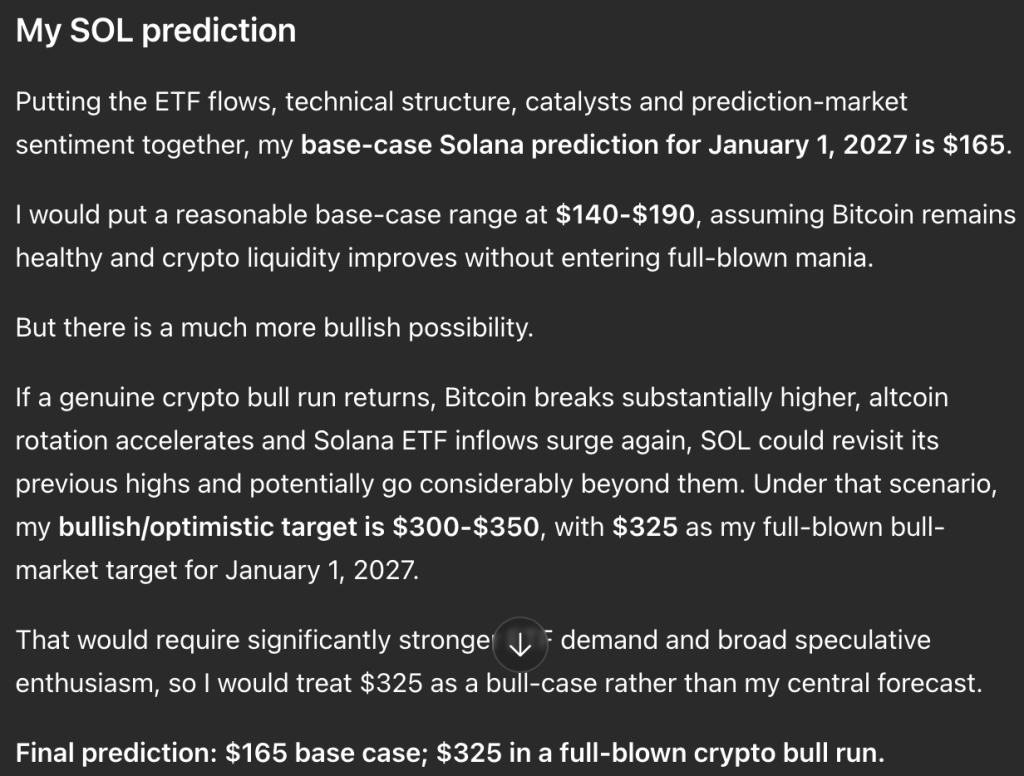
Putting the ETF flows, technical structure, catalysts, and prediction-market sentiment together, my base-case Solana prediction for January 1, 2027 is $165.
I would put a reasonable base-case range at $140-$190, assuming Bitcoin remains healthy and crypto liquidity improves without entering full-blown mania. But there is a much more bullish possibility.
If a genuine crypto bull run returns, Bitcoin breaks substantially higher, altcoin rotation accelerates, and Solana ETF inflows surge again, SOL could revisit its previous highs and potentially go considerably beyond them. Under that scenario, my bullish/optimistic target is $300-$350, with $325 as my full-blown bull-market target for January 1, 2027.
That would require significantly stronger ETF demand and broad speculative enthusiasm, so I would treat $325 as a bull case rather than my central forecast.
Final prediction: $165 base case; $325 in a full-blown crypto bull run.
Don’t Miss Out on Our $1,000 USDT Airdrop on ByBit
Bitcoin Hyper Targets Early Mover Upside as XRP Tests Key Levels
Ripple holders riding this bounce have a fair case for optimism, but let’s be honest about the math: even the bullish $4.40 target represents roughly 3x from current levels on a token with a market cap already in the tens of billions. That kind of upside takes real catalysts and time.
For traders hunting asymmetric setups, early-stage infrastructure plays at a fraction of that valuation are where the multiples get interesting, and Bitcoin Hyper is positioning itself as exactly that kind of bet.
Bitcoin Hyper ($HYPER) bills itself as the first Bitcoin Layer 2 with full SVM integration. It boasts a smart contract execution faster than Solana itself, built on Bitcoin’s base-layer security.
The presale has raised $33M at a current token price of $0.0136857, with staking rewards already live for early buyers. Its Decentralized Canonical Bridge aims to solve Bitcoin’s long-standing programmability gap without compromising trust assumptions.
Gain Access to New Bitcoin Layer 2 Early Here
Discover: The Best Crypto to Diversify Your Portfolio
The post Sam Altman ChatGPT AI Predicts a Huge Solana Move by the End of 2027 appeared first on Cryptonews.


Bitcoin has processed 893,391 transactions in one day, its fourth-highest daily total on record and a reading above the 99th percentile of its historical range.
Summary
- Bitcoin processed 893,391 transactions, up 23.4% from the previous day.
- Daily activity more than doubled from the corresponding level one year earlier.
- Galaxy Research ranked the session as Bitcoin’s fourth-busiest day in history.
- Low-value transfers have accounted for much of Bitcoin’s transaction growth during 2026.
Bitcoin transaction count enters its historical top four
Galaxy Research reported the milestone in a Sept. 7 post on X, placing the latest total among the most active days since Bitcoin began operating in 2009.
“Yesterday was the 4th largest daily transaction count in Bitcoin’s history,” the firm said.
At 893,391, the count also exceeded 99% of all daily readings recorded by the network, according to Galaxy’s data. The research firm did not identify a single event, application, or group of users responsible for the increase.
YCharts recorded the same total and showed that daily transactions had risen from 723,854, representing an increase of about 23.4% in 24 hours. Compared with 441,035 transactions on the corresponding day a year earlier, activity had climbed by approximately 102.6%.
The increase extends a recovery that was already visible earlier in 2026. Data based on Blockchair showed that Bitcoin processed 862,979 transactions on June 23, which ranked as the third-highest daily total at the time.
June’s average reached 651,655 transactions per day, up 90% from the 342,866 average reported for June 2025. Bitcoin’s median daily count had fallen to 417,151 during 2025, an 18% drop from the 508,934 median registered in 2024.
Earlier Blockchair figures placed April 23, 2024, at 927,010 transactions and Sept. 8, 2024, at 910,083. Galaxy’s updated fourth-place ranking for the 893,391 reading indicates that another session has since entered the top three.
Small Bitcoin transfers have driven much of the increase
Research from CryptoQuant has linked much of Bitcoin’s 2026 transaction growth to small transfers rather than a matching rise in the value moved across the network.
Transfers below 0.01 BTC accounted for about 80% of Bitcoin transactions in 2026, according to data cited by CoinMarketCap in August. Their share stood near 44% in 2023, meaning low-value transfers have nearly doubled their portion of the network’s daily activity.
CryptoQuant head of research Julio Moreno said the economic value carried by the transactions remained small compared with their share of the total count. While the data shows that more transfers are reaching the blockchain, it does not establish that a similar increase has occurred in payment value, investment demand, or unique users.
A July crypto.news examination of transaction-count limitations also found that raw totals can provide an incomplete picture when fees are low. Cheap transactions allow automated systems, applications, or a small number of users to generate substantial activity without moving a comparable amount of capital.
Bitcoin transactions can also contain several inputs and outputs. A sender may pay more than one recipient in a single transaction, while exchanges and custodians may combine withdrawals through batching. Users can also move funds between addresses under their own control, so a transaction does not necessarily represent a payment between two separate people.
Lightning Network payments are settled away from Bitcoin’s base layer until participants close or rebalance their channels. As a result, the 893,391 figure covers confirmed on-chain transactions rather than every payment made using Bitcoin-linked infrastructure.
Network data shows volume and addresses moving differently
Blockchain.com’s dashboard paired the 893,000 transaction reading with approximately 415,000 active addresses, down 10.7% from the previous period. The difference shows that transaction totals and address activity can move in opposite directions because one address may participate in several transfers.
Transferred value reached about $3.36 billion, an increase of 33.8%, while total network fees stood near $191,073, down 8.1%, according to the same dashboard. Fee revenue therefore declined even as the number of confirmed transactions increased.
BitInfoCharts separately showed an average transaction fee near 0.0000024 BTC, worth about $0.19 at the recorded price, and a median transfer value of roughly $34.69. Its latest 24-hour window did not align exactly with the calendar-day period used by Galaxy, so the readings describe surrounding network conditions rather than the same fixed reporting period.
The relationship between high transaction volume and modest fees depends partly on the amount of block space consumed by each transfer. A transaction with many inputs can use more data than a simple payment, while exchanges can reduce their footprint by placing several customer withdrawals in one transaction.
Ordinals previously showed how a new type of activity could change Bitcoin’s transaction profile. During an earlier record in 2023, more than 307,000 Ordinals-related transactions were recorded in one day, according to Dune data cited at the time by Blockworks. Galaxy’s latest post did not attribute the September 2026 increase to Ordinals, Runes or another protocol.
U.S. investors face different on-chain and ETF exposure
For American investors, the importance of Bitcoin transaction activity depends on how they hold the asset. Buyers who use self-custody wallets create or receive on-chain transfers, while shareholders in U.S.-listed spot Bitcoin exchange-traded funds trade securities through brokerage accounts.
An earlier Bitcoin ETF explainer detailed how fund creations and redemptions differ from ordinary exchange purchases. Buying an ETF share does not directly create a Bitcoin transaction for each investor because authorized participants, fund sponsors and custodians handle the product’s underlying settlement process.
Daily blockchain totals cannot separate ETF-related custody movements from exchange withdrawals, individual payments, mining transfers, or wallet reorganizations. Transaction count also does not show whether a transfer represents buying or selling because the blockchain records movements between addresses rather than the purpose behind them.
Recent activity among older wallets provides another example of the distinction. A September report on older holdings cited K33 Research data showing that nearly 890,000 BTC moved during a seven-day period in early August, the highest seven-day active supply reading of 2026. Bitcoin was trading within one of its narrowest 30-day ranges since 2023 at the time, separating the on-chain movement from a major price breakout.
U.S. tax rules also treat Bitcoin transactions according to their purpose instead of their appearance on the blockchain. The Internal Revenue Service states that moving digital assets between wallets or accounts owned by the same taxpayer is generally not a taxable event, while selling crypto, exchanging it for another asset, or using it to buy goods and services can produce a reportable gain or loss.
Chainalysis estimated in August that the United States accounted for $112.6 billion of potentially taxable on-chain crypto activity during 2025. Its research placed the worldwide total above $457 billion but estimated that transactions within the reach of international reporting rules represented only 14% of the activity identified.
Under IRS guidance, taxpayers must retain records showing the asset’s acquisition date, cost basis, disposal date, proceeds, and resulting gain or loss for taxable digital-asset transactions.


Liquid Network has recovered 3,400 BTC worth about $269.2 million from the self-described white-hat hackers behind a 4,000 BTC withdrawal, although nearly $47 million remains outstanding.
Summary
- The actors returned 3,400 BTC, recovering about 85% of the withdrawn funds.
- Roughly 598.5 BTC, worth about $47 million, remains in the withdrawal-linked address.
- Blockstream told the actors that its bridge nodes had been patched before the repayment.
- Liquid has not announced when its bridge and L-BTC services will resume normal operations.
Liquid Network has recovered 85% of the withdrawn Bitcoin
On-chain data shows that the actors returned 3,400 BTC, worth about $268.2 million when confirmed, to the Liquid Federation wallet in Bitcoin block 965,950. The transfer recovered about 85% of the withdrawn funds, while 598.5 BTC worth roughly $47 million remained in the actors’ address. Blockstream had previously told the group through a signed transaction message that its bridge nodes were patched and the funds were “safe to return.”
Around 598.5 BTC, valued at roughly $47 million, remained in the withdrawal-linked address after the larger transfer. The actors have not publicly explained why they retained the remaining coins or stated whether another repayment will follow.
Sunday’s incident began when a customer sent 4,000 Liquid Bitcoin, or L-BTC, to SideSwap’s peg-out service. SideSwap allows users to move value from the Liquid sidechain back to the Bitcoin network through an authorized withdrawal process.
The actors later identified themselves as “whitehats” in a message attached to a Bitcoin transaction. White-hat hackers generally find and report security weaknesses so developers can repair them, often receiving a bounty under terms agreed with the affected project.
No publicly disclosed agreement has established that the Liquid actors had permission to withdraw the funds, however. Blockstream and the actors also have not published terms granting a bounty or allowing the group to retain nearly 600 BTC.
As crypto.news reported before the return, the actors had offered to send back “most” of the Bitcoin once Blockstream fixed the vulnerability. At that point, no repayment had been confirmed, and the withdrawal represented about 95% of the Bitcoin reportedly held in Liquid’s federation wallet.
On-chain messages led to the 3,400 BTC repayment
Communication between Blockstream and the actors took place through messages attached to Bitcoin transactions, allowing both sides to exchange instructions without relying on a private messaging service.
In one transaction message, the actors told Blockstream to repair the flaw before they returned the Bitcoin.
“Please fix the bug first,” the message said. “The chain is under risk at latest commit right now. Make sure every node is patched. Then we will transfer the money back safely after confirming the fix.”
Following that confirmation, the actors sent 3,400 BTC to the Liquid Federation address. The exchange shows that the repayment depended on the actors accepting Blockstream’s statement that the affected nodes were safe, though neither side has released a technical report identifying the flaw or explaining how the withdrawal became possible.
Liquid disabled its bridge nodes after detecting the transaction and asked exchanges to suspend L-BTC deposits and withdrawals. The shutdown restricted movement between Liquid and the Bitcoin base layer while developers investigated the incident and applied the patch.
Blockstream has said the key used during the withdrawal was not compromised, according to Reuters. The company has not released a complete post-mortem detailing whether the flaw affected SideSwap, the bridge software, Liquid’s Elements codebase, or another part of the peg-out process.
Ledger CTO questions the white-hat description
Ledger Chief Technology Officer Charles Guillemet challenged the actors’ description of themselves after they returned most of the coins but retained nearly 600 BTC.
“So, 3,400 BTC were refunded,” Guillemet wrote on X. “The ‘white hats’ still hold 600 BTC. If this was ever a negotiated reward under an encrypted contract signed on-chain, it looks more like extortion than white-hat hacking!”
His comment focused on the lack of disclosed terms covering the retained Bitcoin. A conventional bug bounty normally sets the reward and return conditions before a researcher keeps part of the affected funds, while no comparable agreement between Blockstream and the actors has been made public.
A similar issue emerged after the Verus Ethereum bridge exploit in May. In that case, the attacker returned 75% of the stolen funds and kept 1,350 ETH, then worth about $2.8 million, after Verus publicly offered settlement terms. The Liquid repayment differs because Blockstream has not said that the remaining 598.5 BTC constitutes an approved bounty.
White-hat claims also do not determine an actor’s legal status by themselves. Any legal assessment would depend on factors such as authorization, the method used to obtain the assets, communications between the parties, and applicable laws. No U.S. regulator or law enforcement agency has announced an action tied to the Liquid withdrawal.
L-BTC holders await details on backing and withdrawals
Liquid is a federated Bitcoin sidechain developed by Blockstream. Users lock BTC through its peg system and receive L-BTC on the sidechain at a one-to-one ratio, allowing faster settlement and asset transfers without moving every transaction across the Bitcoin base layer.
A recent bridge security explainer described how systems that lock assets on one network and issue corresponding tokens elsewhere depend on the security of their custody, validation, and message-processing systems. Failures at any of those points can interrupt redemptions even when the underlying blockchain continues operating normally.
For U.S.-based users, the immediate issue is operational rather than a change to federal crypto rules. American holders who use L-BTC face the same suspended deposits, withdrawals, and peg services as other users, while native BTC held directly on the Bitcoin blockchain is separate from Liquid’s sidechain system.
Liquid has not disclosed whether the returned 3,400 BTC has fully restored backing for the corresponding L-BTC supply. The network also has not said how it plans to handle any gap created by the 598.5 BTC still controlled by the actors.
No reopening time has been given for the bridge nodes, and exchanges were still being asked to keep L-BTC deposits and withdrawals suspended. Blockstream has also not published the promised technical account of the flaw or confirmed whether the actors intend to return the remaining Bitcoin.

Strive signals new Bitcoin buy as ASST hits yearly high

NHL Defensemen Salaries: Which Teams Are Spending The Most On Their Blue Line In 2026-27?

A Vacuum Tube Computer For The Home

Weekend Open Thread – Corporette.com

Weekend Open Thread: Brooks Brothers

London Mayor Sadiq Khan handed a peerage by Keir Starmer alongside 15 other Labour figures… just days before the PM leaves No10

Michael Kiwanuka, Tom Misch – Money (Official Video)

Why Do We Need Cryptocurrencies? Why Was Bitcoin Invented? Learn Cryptocurrency A-Z Malayalam E01

He Quit A Stable Job For A Friend’s Brand New Company Financial Audit Freeze
-

 Fashion3 days ago
Weekend Open Thread: Beyond Yoga
-
 Crypto World3 days ago
Bitcoin price stalls near $82K as key resistance holds
-

 Politics3 days ago
Best Gaming Laptops, CPUs, TVs, And Keyboards To Upgrade Your Set Up For GTA VI
-

 Tech3 days ago
The Birds Outside, Drawn For You Automatically
-

 Crypto World4 days ago
IMF Says El Salvador’s Post-Review Bitcoin Purchases Used No Public Funds
-
 Crypto World3 days ago
U.S. added stronger than expected 162,000 jobs in August as labor market bounced back
-

 Sports4 days ago
Alexandre Pato consortium’s Northampton Town investment approved
-

 Sports4 days ago
Commanders’ Chig Okonkwo is a top breakout fantasy football candidate
-

 Sports3 days ago
Golden Eaglets Drawn in Group B for 2026 WAFU B U17 Championship
-
 Crypto World3 days ago
XRP price breaks falling channel as bulls target $1.53
-

 Politics4 days ago
A new European chapter for Gibraltar
-

 Politics3 days ago
How To Avoid Winter Colds: 4 Everyday Habits That Spread Germs, Says Pharmacist
-

 Politics3 days ago
The House | Bin the lectures, bring gossip and be ready to banter: how the new PM should prepare for his Trump encounter
-

 Crypto World3 days ago
From warning to listing: UK’s largest retail investment platform opens access to crypto ETNs
-

 Crypto World3 days ago
FinCEN flags $12.7B tied to Southeast Asia crypto investment scams
-

 Tech3 days ago
A Worthy Android Ereader, With Some Tradeoffs
-

 Tech3 days ago
How To Edit Claude’s Memory
-

 Crypto World3 days ago
Trezor Data Breach Impacts 67,000 More US Customers
-

 Politics4 days ago
33 Cosy Autumn Home Decor Ideas: Blankets, Pumpkin Decorations, And Candles
-

 Tech3 days ago
beyerdynamic AVENTHO Y Debuts at IFA 2026 and Makes Wireless Headphones Less Disposable
You must be logged in to post a comment Login