
Crypto World
Fairshake’s $10 million Illinois misfire marks first big hitch in crypto political surge

Losing a race is unusual for the crypto industry’s political action committee, Fairshake, which has recorded a dominant record in the past two congressional elections. But the Illinois primaries this week saw its biggest-ever setback, likely to conclude with a new member of the Senate next year being somebody the PAC spent more than $10 million trying to defeat.
Illinois Lt. Gov. Juliana Stratton won her Democratic primary, and her state’s Democrat lean means she’s likely to be its next senator after the November general election. One of Fairshake’s affiliates had devoted millions to purchase opposition advertising in that race and to support two of her opponents — representing more than 5% of the funds it’s said it had on-hand this year to devote to the congressional contests.
Not only did that money fail to win the outcome the group aimed for, but Stratton may eventually be a member of the 100-member Senate in which a single lawmaker can have a very potent influence, and she’ll be well aware of the industry’s efforts to oppose her. Crypto advocacy group Stand With Crypto, which evaluates politicians and political candidates, graded Stratton with an “F” on digital assets issues, even though she doesn’t have a significant personal record on crypto policy apart from the state’s industry-opposed regulatory regime signed by her boss last year.
“If you support pro-crypto policies, we will show up big,” Fairshake spokesman Geoff Vetter said in a statement. “If you oppose crypto and American innovation, we will show up big. That message is now clear at both the state level and federal level.”
The industry had mixed results in Illinois, supporting three pro-crypto candidates who won their primaries, and one other who didn’t. A person familiar with the PAC’s strategies said that it saw the loss as a one-off and that it was unlikely that other candidates it opposes down the road will have similar campaign resources they can tap.
Starting with the 2024 elections, Fairshake — primarily backed by Coinbase, a16z and Ripple — has targeted multiple Senate races in which it spent more than $10 million trying to influence the outcome. In its biggest spend in the last cycle, it devoted a towering $40 million to oppose former Senator Sherrod Brown, the Ohio Democrat who as ex-chairman of the Senate Banking Committee stood in the way of crypto legislation. (Brown is trying for a comeback this year, though Fairshake hasn’t yet announced its plan for Brown’s challenge of Senator Jon Husted.)
La Shawn Ford, who won his Illinois 7th District congressional primary to potentially join the House of Representatives next year, was another of Fairshake’s targets in a race in which the PAC spent almost $2.5 million. He accused the PAC of pumping out misleading and defamatory accusations in its ads. While he may represent a future political opponent for the sector, Fairshake celebrated wins for Donna Miller, Melissa Bean and incumbent Representative Nikki Budzinski in other House races in that state.
In 2024, Fairshake and its affiliates supported 53 candidates who ended up in Congress, losing in just five races, though many of the favored candidates were clear frontrunners. The super PAC was widely seen as establishing an industry model for a campaign-finance strategy in which more than $100 million devoted to congressional races (often primaries in districts in which one party has a dominant position) can influence the outcomes for dozens of seats. Fairshake purposefully didn’t craft its political ads to reference its own main aim to foster crypto, but it instead made ads based on whatever was the biggest political vulnerability it saw in opponents or positive points it noted in allies.
Fairshake has been very public about the $193 million war chest it started the campaign season with. The funds aren’t just an election tool. Crypto lobbyists and insiders have acknowledged that it also acts as a caution to sitting lawmakers weighing crypto legislation now moving through Congress. Members know that their decisions on crypto bills could bring either millions of dollars in support or opposition in their campaigns, often far exceeding the amount of money that congressional campaigns can raise from direct donors.
Fairshake doesn’t expect to win everything, but it does expect to win most of the races they get involved with, the person said, and it’ll make the point that opposing crypto innovation will be expensive for politicians.
Some candidates that Fairshake opposed in the past did go on to support crypto initiatives, but Stratton criticized the “MAGA-backed crypto bros” that opposed her. Her crypto intentions in the Senate, if she gets there, remain to be seen.
Read More: Crypto campaign PAC Fairshake marks first wins in 2026 U.S. congressional primaries


A Financial Times report this week outlined a provocative idea from Iran’s trade sector: charge ships transiting the Strait of Hormuz a tariff paid in Bitcoin. The plan would let empty oil tankers pass without charges, but other vessels would owe a levy of $1 per barrel, settled in BTC, over a two-week window and after an on-waterway assessment to verify the cargo isn’t weapons-related, according to Hamid Hosseini, spokesperson for Iran’s Oil, Gas and Petrochemical Products Exporters’ Union.
The story arrives as geopolitical tensions flare and markets react. On X (Truth Social), former U.S. President Donald Trump asserted that a two-week ceasefire with Iran would include the “complete, immediate, and safe opening of the Strait of Hormuz,” a claim that Iran’s state media later echoed by reporting a 10-point plan delivered to Washington as a precondition for any deal, including the continued control of the waterway and sanctions relief. The exact terms of any accord remain fluid, but the FT report highlights how crypto-enabled mechanisms could become part of broader political and economic signaling in a high-stakes standoff.
Geopolitical friction has already disrupted regional shipping and energy flows. After intensified U.S.–Israel–led strikes against Iranian targets in February and March, the Strait of Hormuz has seen shipments constrained and tensions rise, contributing to a rally in crude oil that briefly pushed prices above $100 per barrel. In crypto markets, Bitcoin likewise moved during the period of heightened volatility, trading in a wide range as traders priced in the risk backdrop.
Beyond current events, the narrative builds on prior evidence that Iran has leaned on crypto rails to navigate sanctions and currency pressures. Elliptic reported in January that Iran’s central bank had acquired roughly half a billion dollars’ worth of Tether USDt, a signal of the rial’s volatility driving demand for dollar-pegged stablecoins. Separately, TRM Labs has tracked large-scale crypto flows linked to Iran, estimating about $3.7 billion in total crypto activity from January through July 2025, a figure cited in coverage surrounding Iran’s evolving crypto footprint. For more context, see the reporting that referenced TRM Labs, and the Elliptic analysis linked to Iran’s stablecoin acquisitions.
Key takeaways
- Iran reportedly weighs a Bitcoin-based tariff for Strait of Hormuz transit, charging $1 per barrel for non-empty cargo while allowing empty tankers to pass without charges.
- Payments would be prompted within a two-week window, with vessels assessed individually to confirm cargo legitimacy and weapon-free status, per the union spokesperson cited by the Financial Times.
- The proposal comes amid ongoing geopolitical flare-ups and energy-market volatility, set against a backdrop of broader sanctions dynamics and potential relief talks.
- Longer-term context shows Iran’s crypto activity as part of sanctions navigation: Elliptic notes substantial USDT holdings, and TRM Labs records substantial inflows and flows related to Iranian crypto use (Jan–Jul 2025).
- Readers should watch how policymakers, shipping operators, and crypto market participants respond to the FT report and any subsequent official statements or regulatory clarifications.
Hormuz toll: a crypto twist on maritime economics
The Financial Times’ account centers on a regulatory pivot that would blend transport pricing with digital asset settlements. If implemented, the BTC-based toll model would apply a simple per-barrel tariff to shipments crossing the Hormuz route, aiming to consolidate revenue amid sanctions pressures and to test the practicality of crypto-as-fee mechanics in critical chokepoints. The proposal specifies that the tariff would be collected in Bitcoin, with the logistics package requiring ships to settle payments quickly—“a few seconds”—to minimize traceability and potential sanction enforcement risk, according to Hosseini’s description of the process observed by the union.
The plan’s two-week horizon aligns with a provisional, high-visibility window rather than a long-term price signal. Even as it surfaces as a potential policy experiment, the reporting underscores how crypto rails could be positioned as geopolitical tools—whether for financing logistics, signaling political intent, or pressuring opponents through new payment frictions. The FT piece stops short of confirming that such a policy will be adopted, but it illustrates the kinds of mechanisms policymakers are weighing in an era of sanctions and blockade-era finance.
Geopolitics and markets: energy, sanctions, and crypto co-movement
Market dynamics over the past several months have shown that energy disruptions and crypto volatility can move in tandem, albeit imperfectly. The period of heightened tension around Hormuz coincided with a spike in oil prices and a broad oscillation in Bitcoin’s price, reflecting traders’ attempts to navigate the intersection of real-world risk and on-chain liquidity. The possibility of crypto-enabled tolls adds a new dimension: it could introduce a measurable crypto flow that tracks shipping activity in a region that shapes global oil pricing and geopolitical risk appetites.
The Trump assertion about a potential ceasefire and Hormuz opening, though unconfirmed and contested in official channels, amplifies the sense that the Iran-US standoff remains a live, strategic story with tangible financial undercurrents. If a BTC-payment framework for Hormuz passes from concept to policy, it could become a focal point for how Western sanctions policy, shipping finance, and crypto settlements intersect in real-world commerce. Observers will be watching not only for official confirmations but also for how such a mechanism would be audited, taxed, and regulated across different jurisdictions.
Iran’s crypto footprint: sanctions, stability, and opacity
The broader crypto-adoption narrative in Iran isn’t new, but recent data points underscore its relevance to policy and markets. Elliptic’s analysis in early 2025 highlighted Iran’s sizable holdings of USDt, pointing to a deliberate use of stablecoins to stabilize liquidity amid currency pressures. Meanwhile, TRM Labs documented substantial Iranian crypto activity totaling several billions of dollars over the first half of the year, illustrating the scale at which digital assets flowed through or around conventional financial channels. These patterns don’t guarantee a specific policy outcome in Hormuz, but they do suggest that crypto channels are considered—from a fiscal and strategic standpoint—by actors navigating sanctions, currency depreciation, and access to global markets.
For investors, traders, and builders, the episode reinforces a few practical takeaways. First, crypto-based payments and settlement methods can enter political calculations in ways that affect cross-border logistics and risk premia. Second, the on-chain footprint of sanctioned economies remains an area of close scrutiny for analysts and enforcement agencies, with real implications for compliance, monitoring technology, and liquidity flows. Finally, the linkage between energy markets and crypto markets—with prices, volatility, and liquidity all in play—continues to shape risk management and hedging considerations for market participants.
As the situation unfolds, readers should watch for clearer official statements about any Hormuz-related policy and for data from shipping groups and energy markets that could either validate or debunk the feasibility of a BTC settlement regime. The evolving narrative also invites questions about international law, the enforceability of crypto-based tariffs, and how such experiments would interact with existing sanctions regimes and financial sanctions regimes across multiple jurisdictions.
The broader takeaway is that crypto assets are increasingly embedded in geopolitics, not just as speculative instruments but as functional components of policy signaling, logistics, and revenue streams. What comes next will likely hinge on how quickly authorities weigh in, how ship operators adapt to new payment rails, and whether any pilot evolves into a enforceable policy on Hormuz traffic.
Iran will charge tankers $1 per barrel in bitcoin to cross the Strait of Hormuz during a two‑week US ceasefire, adding a crypto tax to the world’s key oil chokepoint.
Summary
- Iran will charge ships $1 per barrel in crypto to cross the Strait of Hormuz during a two-week US ceasefire.
- Tankers must disclose cargo by email, then get only seconds to pay in bitcoin before passage is cleared.
- The move comes as oil prices whipsaw below $100 amid a fragile truce over a chokepoint that once carried about 20% of global supply.
Iran will force every oil tanker transiting the Strait of Hormuz during the new two-week ceasefire with the US to pay a $1-per-barrel toll in cryptocurrency, turning the world’s most sensitive oil chokepoint into a de facto bitcoin paywall. According to the Financial Times, Tehran will demand that shipping companies settle the fee in digital assets, primarily bitcoin, as it seeks hard-to-trace revenues while sanctions bite. Hamid Hosseini, spokesperson for Iran’s Oil, Gas and Petrochemical Products Exporters’ Union, said the system is designed to slow traffic on Iran’s terms and tighten control over what moves through the corridor.
Under the scheme, tankers must first email Iranian authorities with detailed cargo manifests before entering the strait. Hosseini told the Financial Times that once the email is received and Tehran completes its assessment, “vessels are given a few seconds to pay in bitcoin, ensuring they can’t be traced or confiscated due to sanctions.” He added that “everything can pass through, but the procedure will take time for each vessel, and Iran is not in a rush,” underscoring that the stated aim is to prevent weapons shipments during the pause in fighting. With typical crude cargoes ranging from 500,000 to 2 million barrels, a single transit could mean crypto payments of $500,000 to $2,000,000 per voyage.
Ceasefire, crypto and a global oil lifeline
The toll comes as Washington and Tehran test a fragile truce that hinges on a partial reopening of the Strait of Hormuz, which before the war carried roughly a fifth of the world’s seaborne oil. A senior Iranian official told Reuters that Iran could reopen the strait “limited, under Iran’s control” as early as Thursday or Friday, ahead of talks with US officials in Pakistan. Oil markets have already reacted: Brent futures slid about 13% to roughly $94.76 per barrel and US benchmark WTI dropped more than 15% to around $95.79 after President Donald Trump agreed to the two-week ceasefire, conditional on the “immediate and safe” reopening of the strait.
In Washington, Trump has floated turning the tolls themselves into a joint business model. “We’re thinking of doing it as a joint venture,” he told ABC News’s Jonathan Karl, calling it “a way of securing it — also securing it from lots of other people. It’s a beautiful thing.” That suggestion follows earlier musings that the US could impose its own tolling regime on ships using the strait, effectively monetizing a corridor where even a $1-per-barrel surcharge is a small fraction of crude trading in the mid-$90s but represents a new geopolitical tax on a market still reeling from weeks of war-driven price spikes.
Standard Chartered is reportedly weighing a restructuring of its majority-owned crypto custodian Zodia Custody, as large banks look to bring more digital asset infrastructure inside their core banking operations.
The United Kingdom-based lender plans to fold Zodia’s crypto custody business into a division inside its corporate and investment bank that already offers similar services, while keeping Zodia operating as a standalone Software-as-a-Service (SaaS) platform for digital asset custody, according to Bloomberg on Wednesday, citing people familiar with the matter. An announcement on the restructuring could reportedly come as soon as this month.
It is not yet clear whether Standard Chartered has opened negotiations with Zodia’s minority shareholders, which include Northern Trust, Emirates NBD, National Australia Bank and SBI Holdings.
Standard Chartered has rapidly expanded its own digital asset footprint, reportedly exploring the launch of a crypto prime brokerage platform through its venture arm, SC Ventures, and rolling out institutional crypto trading in summer 2025.
Related: Standard Chartered says faster stablecoin turnover could curb demand
The bank was an early mover into digital assets, setting up Zodia in 2020 with Northern Trust, and the custodian has since raised external capital and grown across seven offices in Europe, Asia and the Middle East.

Cointelegraph reached out to Standard Chartered and Zodia, but had not received a response by publication.
How other big banks are internalizing crypto custody
Standard Chartered’s reported rethink comes as other global banks take digital asset custody directly under regulated banking entities. In February, Morgan Stanley applied for a US de novo national trust bank charter, which would allow it to custody certain digital assets and execute purchases, sales, swaps, transfers and staking services for clients within a bank-regulated framework.
In October 2022, BNY Mellon launched a Digital Asset Custody platform in the US that lets selected clients hold and transfer Bitcoin (BTC) and Ether (ETH) alongside traditional assets on a single platform, positioning the bank as a core provider of both conventional and tokenized asset servicing.
Magazine: Bitcoin’s ‘biggest bull catalyst’ would be Saylor’s liquidation — Santiment founder


Visa’s Intelligent Commerce platform lets AI agents shop, compare, and transact on behalf of consumers, and the company says the majority of business leaders are ready for it.
Payments giant Visa is opening its Intelligent Commerce platform to businesses worldwide, expanding the infrastructure that allows artificial intelligence (AI) agents to shop, compare, and complete purchases on behalf of consumers and enterprises.
The move comes one week after Visa published its Business-to-AI (B2AI) Report, which found that 53% of U.S. business leaders surveyed would allow AI agents to negotiate prices or terms directly with other AI agents on their behalf. The report also found that 71% of businesses said they are willing to optimize products, offers, and experiences specifically for AI agents, while 77% are already using or piloting AI in their operations.
On the consumer side, nearly 40% of Americans reported making a purchase they normally would not have considered as a result of using an AI agent or tool, an early signal that autonomous systems are actively shaping demand rather than merely filtering it.
Visa’s Intelligent Commerce framework provides a suite of integrated APIs spanning tokenization, authentication, payment instructions, and transaction signals, enabling AI agents to transact securely on behalf of users.
Pilot programs have already been running across multiple regions. In Asia-Pacific and Europe, pilots launched in early 2026, while readiness work is underway in Latin America and the Caribbean. In the Middle East, Visa is working with developer Aldar to allow customers in the United Arab Emirates to use AI agents to pay recurring fees like real estate service charges.
A core component of the framework is the Trusted Agent Protocol, an open framework introduced in October 2025 that helps merchants distinguish between malicious bots and legitimate AI agents acting on behalf of consumers.
Heated Race
Visa’s global push arrives amid intensifying competition over who will control the payment rails for AI agent commerce. Two crypto-native protocols are racing to become foundational infrastructure for AI payments: Coinbase’s x402 standard, which recently moved under Linux Foundation governance with backing from Google, Stripe, and Visa itself, and the Machine Payments Protocol (MPP), launched by Stripe’s Tempo blockchain.
On the crypto front, Visa has been hedging its bets. Visa Crypto Labs launched the CLI tool in March, a command-line payment interface that lets AI agents make payments without API keys or pre-funded accounts — directly targeting the same autonomous agent use cases that crypto protocols are pursuing. The company also expanded its stablecoin collaboration with Bridge in March, with plans to bring stablecoin-linked cards to over 100 countries.
The competing approaches highlight a growing fault line in the industry. Traditional payments players like Visa and Mastercard are building trust layers on top of existing card rails, while crypto proponents argue that blockchain infrastructure is better suited for a world in which AI agents are first-class economic actors.
Visa’s CMO Frank Cooper III framed the company’s vision in terms of its B2AI framework, describing a shift where commerce moves from market-to-human to market-to-machine, with AI agents evaluating, negotiating, and transacting on behalf of people.
This article was written with the assistance of AI workflows. All our stories are curated, edited and fact-checked by a human.
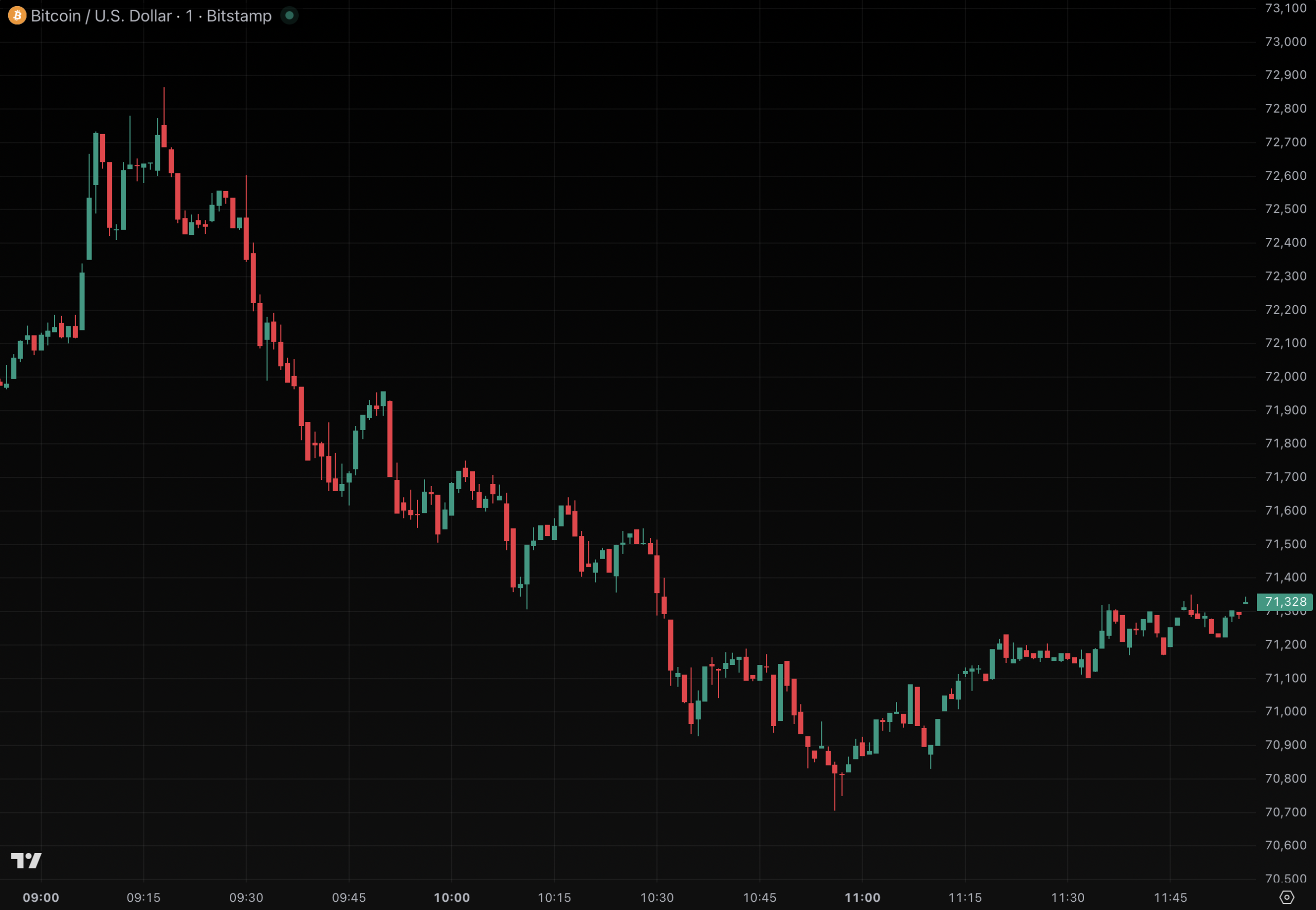
Iran told tanker operators on Wednesday that they must pay bitcoin (BTC) to pass through the Strait of Hormuz.
The use of BTC, mentioned by name by Hamid Hosseini, a spokesman for the country’s oil exporters’ union, ensures payments “can’t be traced or confiscated due to sanctions,” even though the first part of that quote is certainly inaccurate.
Moreover, there will be “a few seconds” to pay, according to the spokesman.
All BTC can be traced on-chain, and the US Treasury has sanctioned Iranian BTC wallet addresses since at least 2018.
Even more embarrassingly, the spokesman claimed that BTC payments will complete within seconds, even though BTC transactions normally require several minutes to settle.
Anyway, Hosseini claims that oil tankers will somehow email Iranian authorities about cargo, submit to an inspection, and then pay a toll of $1 per barrel of oil in BTC.
FT published the news at 8:57am New York time. Whether on that news or for unrelated reasons, BTC rallied from $72,000 to $72,865 within 20 minutes. BTC then retraced that rally entirely, dipping back below $92,000 within half an hour.
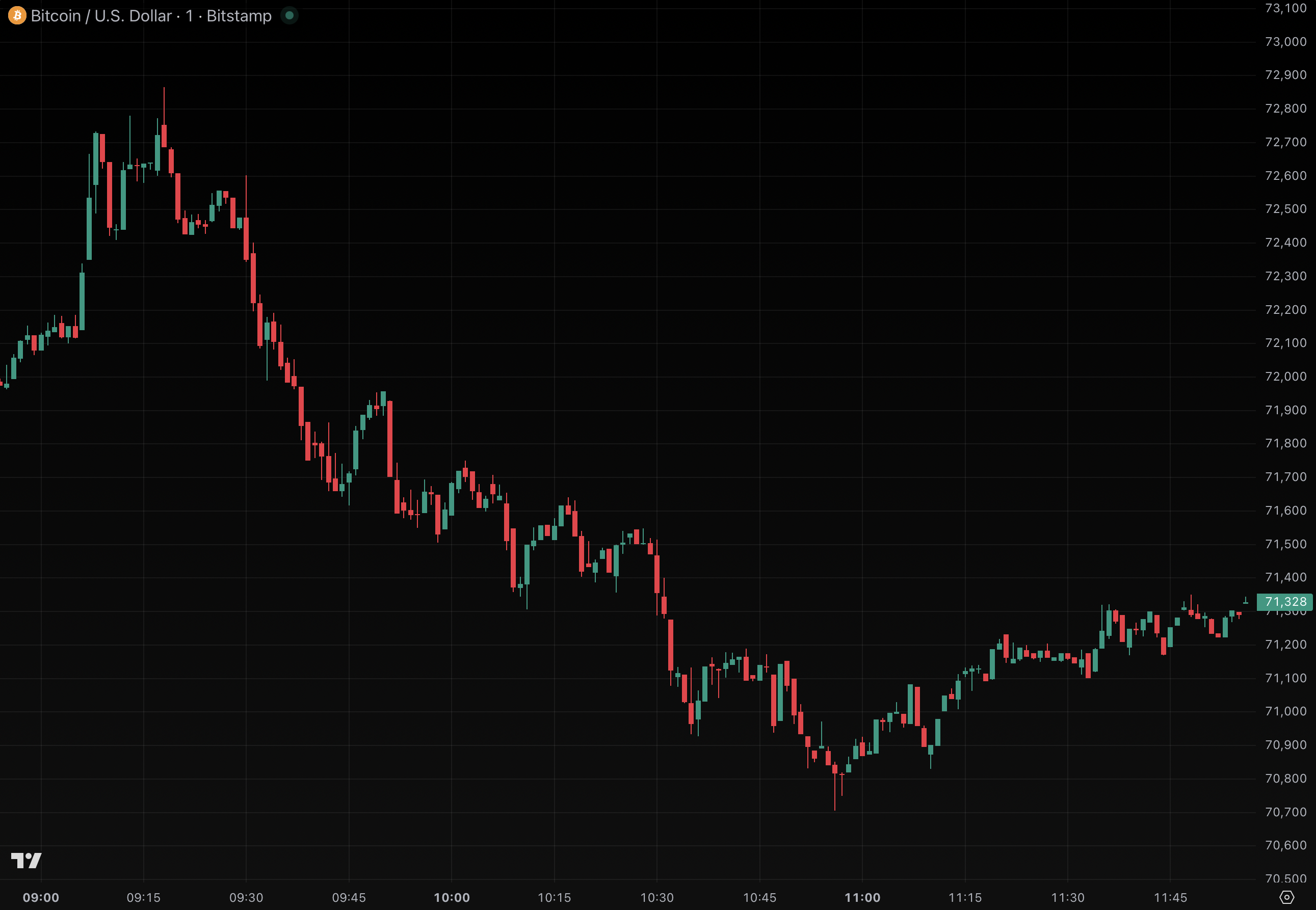
Prior to the news last night, BTC rallied substantially, gaining about 6% on ceasefire discussions between the US and Iran.
Iran’s bitcoin rationale is half-right
Although BTC is easy to trace, the unfreezable half of Hosseini’s logic is technically defensible.
Unlike BTC, most major stablecoins can be frozen. Blockchain analytics firm Elliptic found Iran’s central bank accumulated over $500 million worth of tether (USDT) in 2025. In June of that year, Tether froze $37 million in wallets linked to the central bank.
In March 2026, Tether froze another $6.7 million tied to IRGC and Houthi-linked networks.
Unlike BTC which settles over several minutes, USDT can settle within seconds. The stablecoin served as Iran’s preferred oil settlement rail, until Tether started blacklisting its wallets.
Read more: US hits Iran’s ‘shadow banking’ network in Hong Kong, UAE
Sanctioning Iranian BTC wallets
Although no company can freeze BTC, the US Office of Foreign Assets Control (OFAC) sanctioned Iranian BTC wallets on ransomware allegations in November 2018.
Since then, Chainalysis, Elliptic, and TRM Labs have built entire product lines around mapping Iranian-linked BTC and crypto flows.
In January 2026, OFAC designated UK-registered exchanges Zedcex and Zedxion for processing crypto assets for Iran’s IRGC, attaching crypto wallet addresses to that action.
According to the Chainalysis 2026 Crypto Crime Report, IRGC-linked addresses accounted for more than 50% of all value flowing into Iran’s crypto ecosystem in Q4 2025.
Over the full year, those addresses received at least $3 billion.
Any company that does pay the toll without US approval faces another problem. US, EU, and UK sanctions generally prohibit transactions with IRGC-affiliated entities.
OFAC’s interpretation of the International Emergency Economic Powers Act applies equally to BTC transfers as it does wire payments.
Specifically, a 2022 federal case in Washington DC established precedent that advertising crypto services as “designed to evade US sanctions” can serve as evidence of a sanctions-evasion conspiracy.
Got a tip? Send us an email securely via Protos Leaks. For more informed news, follow us on X, Bluesky, and Google News, or subscribe to our YouTube channel.
Crypto World
Securitize Partners with Currenc Group to Tokenize Shares on Ethereum and Solana: Securitize


Tokenization firm Securitize has partnered with Nasdaq-listed Currenc Group to tokenize its ordinary shares on Ethereum and Solana blockchains.
Securitize announced a partnership with Currenc Group (Nasdaq: CURR) to tokenize the company’s ordinary shares on Ethereum and Solana. The move comes as Securitize was recently named the first digital transfer agent in the NYSE’s onchain securities initiative. Tokenized shares will enable 24/7 trading, lower costs, fractional ownership, and DeFi integration.
The partnership represents a continuation of efforts to bring traditional equities onto blockchain infrastructure. Securitize’s designation as a digital transfer agent by the NYSE signals institutional momentum behind onchain securities infrastructure. The tokenization of Currenc Group’s shares demonstrates practical implementation of blockchain-based equity trading for publicly listed companies.
Sources: Securitize (Twitter/X)
This article was generated automatically by The Defiant’s AI news system from publicly available sources.
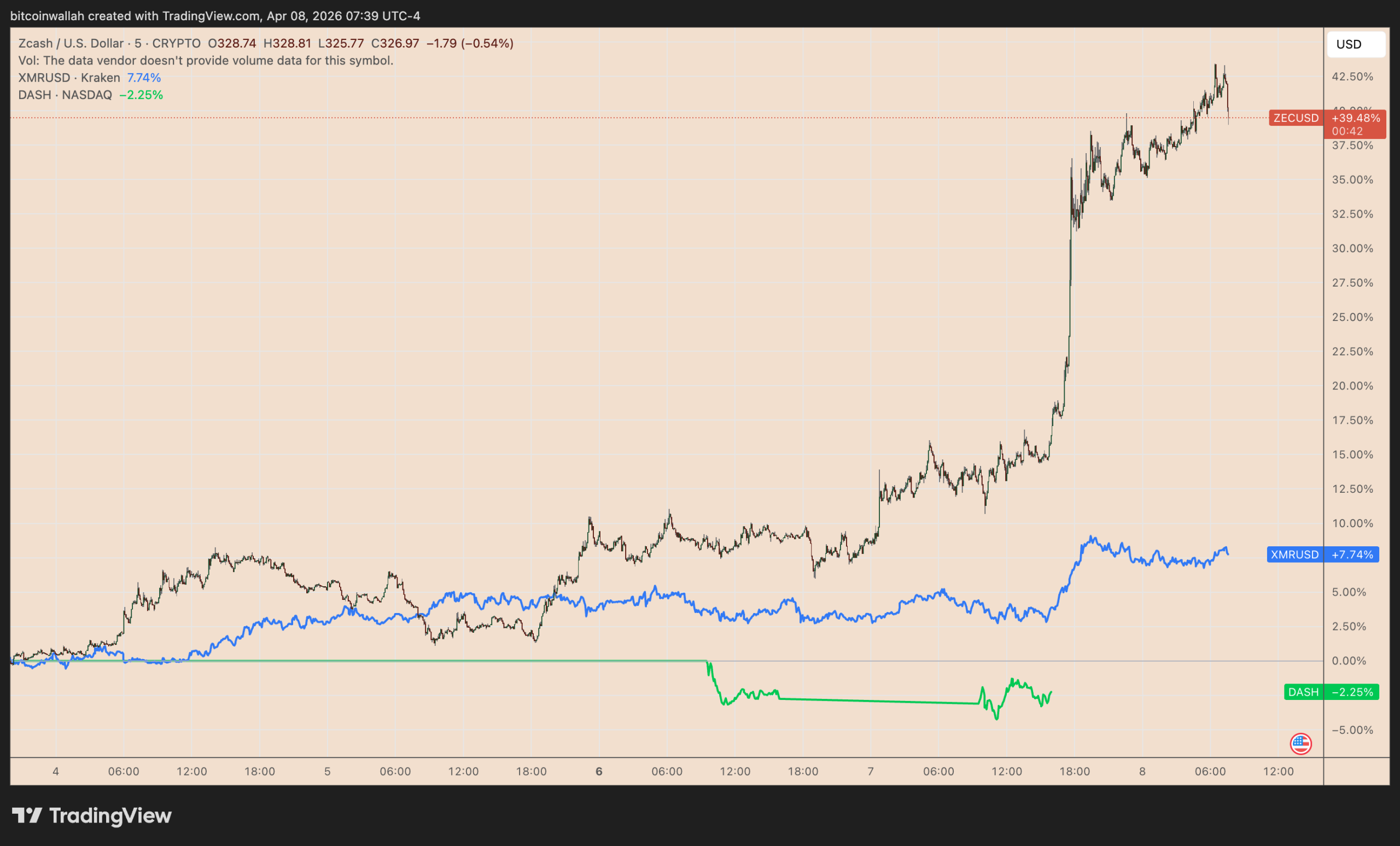
Zcash (ZEC) rallied after President Donald Trump announced a two-week ceasefire deal with Iran, leading gains in a broader relief rally across global risk markets.
Key takeaways:
-
A 2021-style fractal warns ZEC price could fall 40% toward in the coming weeks.
-
Over $50 million in long leverage sits below current prices, leaving ZEC exposed to a possible crash.

ZEC rally risks becoming a 2021-style bull trap
The privacy coin rose over 30% in the past 24 hours to $336.50 on Tuesday, its highest level since January. Its top rivals also climbed, with Monero (XMR) up 3% and Dash (DASH) up 8%.
ZEC’s latest rebound is starting to resemble the setup that followed its 2021 peak. Back then, it entered a prolonged bear cycle after peaking near $392.
During this correction, ZEC underwent multiple sharp bounces after testing its 0.238 Fibonacci retracement line at around $85, only to see its upside momentum weakening underneath a descending trendline resistance.

Zcash’s current setup looks similar. Its 0.236 Fib level near $197 is again acting as strong support, while a descending trendline continues to cap upside attempts.

A continued rebound could lift ZEC toward its 0.5 Fibonacci retracement level near $370, which also lines up with the descending trendline resistance.
But the rally could lose steam if bulls fail to break above the trend line, raising the risk of a pullback toward the $197–$200 support zone. In that case, the current move may start to look like the 2021 bull trap setup.
Related: Zcash devs raise $25M from major VCs months after ECC split
Conversely, a decisive breakout above the trendline may trigger a falling wedge breakout setup, with a measured upside target at around $1,200.

In the past, multiple analysts, including BitMEX co-founder Arthur Hayes and Alphractal CEO and Co-Founder Joao Wedson, have predicted the ZEC price to reach $1,000 or higher.
ZEC liquidation data raises downside risks
Zcash’s liquidation heatmap points to greater downside risk in the coming weeks.
For instance, Binance’s ZEC/USDT contracts may see $3.81 million worth of cumulative short liquidations if the price rallies above $380 in the coming weeks.

In comparison, roughly $50.56 million in cumulative long positions could be wiped out if the price drops below $260.
Markets tend to move toward zones where many leveraged positions are concentrated. In ZEC’s case, the larger concentration sits below the current price, where long liquidations far exceed potential short liquidations above.
The heatmap also highlights $305–$306 as the largest single liquidation pocket, with about $1.76 million in leveraged positions clustered in that range. That makes it an important near-term level to watch.
This article is produced in accordance with Cointelegraph’s Editorial Policy and is intended for informational purposes only. It does not constitute investment advice or recommendations. All investments and trades carry risk; readers are encouraged to conduct independent research before making any decisions. Cointelegraph makes no guarantees regarding the accuracy or completeness of the information presented, including forward-looking statements, and will not be liable for any loss or damage arising from reliance on this content.


On-chain AI agents are increasingly capable of reasoning through complex DeFi strategies, but ERC-8211’s devs say a shared on-chain execution layer was lacking.
Blockchain infrastructure company Biconomy has unveiled ERC-8211, an execution standard for on-chain AI agents, co-developed with the Ethereum Foundation, per an X post on April 7. The development falls under the EF’s Improve UX initiative.
The new standard — referred to as “smart batching” — lets AI agents carry out complex, multi-step DeFi strategies without pre-encoding every parameter at signing time. The specification was published on April 6 alongside an open-source reference implementation and a live demo.
The proposal lists four authors, primarily current and former Biconomy engineers: Mislav Javor, Filip Dujmušić, Filipp Makarov, and Venkatesh Rajendran.
According to Biconomy’s X post announcing the development, the core issue facing on-chain agent interaction with protocols is that current batch execution on Ethereum is static and locks in calldata before a transaction hits the chain. But DeFi is dynamic: swap outputs shift with slippage, bridge fees fluctuate, and lending vault ratios change block by block.
The post illustrates the issue with an example of an agent trying to swap ETH for USDC on Ethereum, and then deposit the USDC to a DeFi lending protocol like Aave. The agent in that case has to estimate the swap output in advance. Estimate too high and the batch reverts, estimate too low and funds sit idle.
“Static batching forces a bad choice: hardcode an optimistic amount and risk a revert, or underestimate conservatively and leave value stranded,” the X post reads.
ERC-8211’s smart batching introduces three “building blocks” to address the issues around static batching: fetchers that read live on-chain state at execution time, constraints that validate resolved values before each call proceeds, and predicate entries — a way to check whether on-chain conditions are met.
As Ethereum’s official account put it in an X post today, the standard “allows users and agents to express multi-step composable actions as a simple off-chain script with built-in safety.”
Per Biconomy’s announcement post, the standard is account-agnostic, and compatible with ERC-7683, ERC-4337, and interoperability standards that are supported by the Ethereum Foundation Protocol’s Improve UX track.
The authors also note that the standard is designed to complement the broader agent infrastructure stack on Ethereum, namely ERC-8004 for agent identification and reputation, ERC-8183 for agent-to-agent commerce, and Coinbase-developed agent payment protocol x402.
An Ethereum Magicians discussion thread for the new standard is open for technical feedback, the announcement notes.
As The Defiant reported last month, the number of ERC-8004 AI agents registered across blockchain networks has grown sharply this year, with the largest number of agents using the standard on BNB Smart Chain. Yet most remain limited to basic swaps and transfers.
On the infrastructure side, the Ethereum Foundation has also recently set up a dedicated “dAI Team” aimed at making Ethereum the preferred settlement layer for AI agents and the machine economy, as The Defiant reported.
This article was written with the assistance of AI workflows. All our stories are curated, edited and fact-checked by a human.
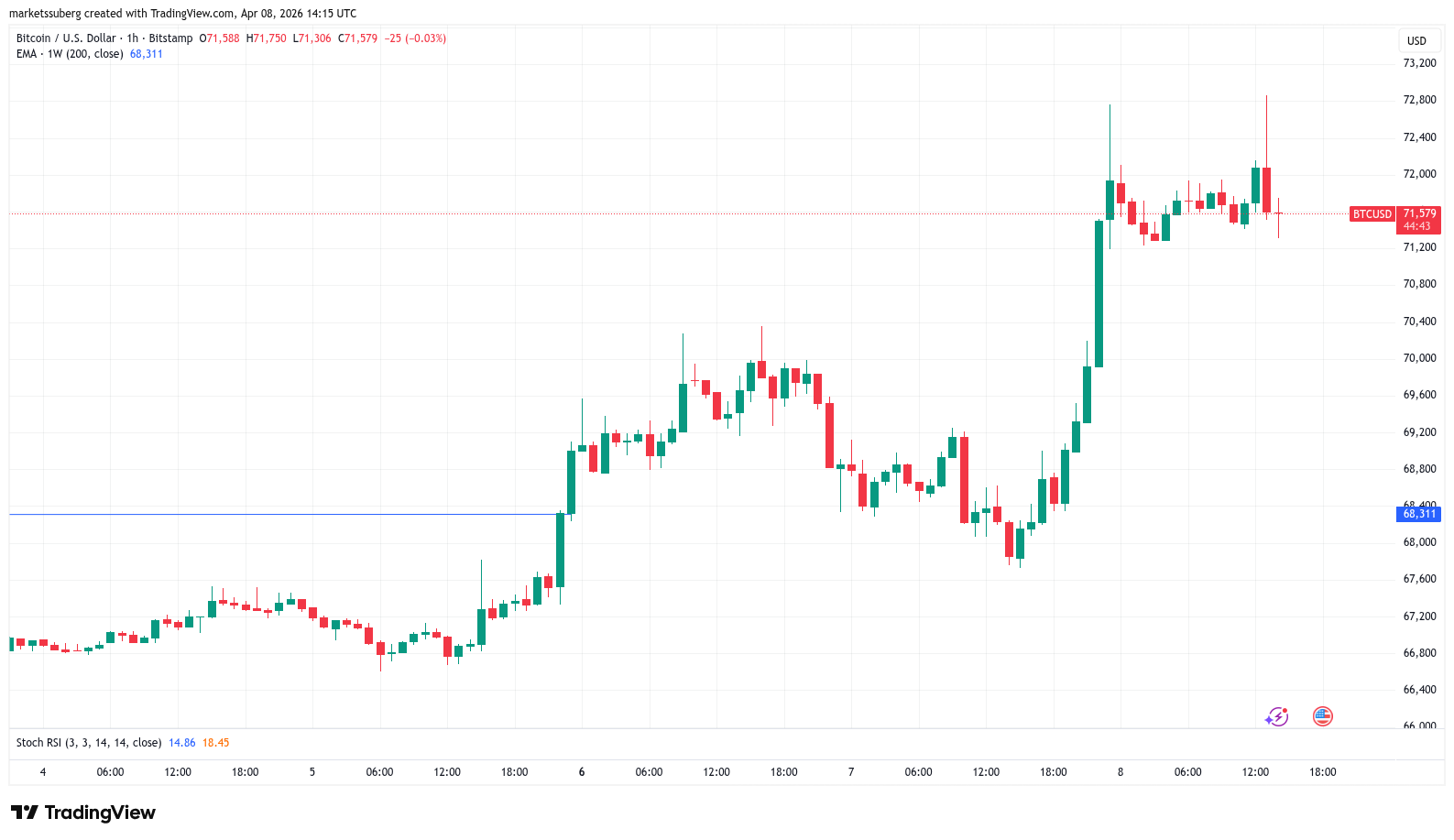
Bitcoin bulls failed to stay above $72,000 for long as BTC price action already began to discount the impact of a US-Iran ceasefire agreement.
Bitcoin (BTC) hit new three-week highs into Wednesday’s Wall Street open as stocks surged on a US-Iran ceasefire.
Key points:
-
Bitcoin briefly hits new three-week highs before round-tripping its gains.
-
Iran ceasefire relief fails to last as traders demand that bulls reclaim higher levels.
-
More volatility is due thanks to US inflation reports.
BTC price fails to stay above $72,000
Data from TradingView captured BTC/USD reaching $72,865 on Bitstamp before cooling the day’s gains.

News of a minimum two-week ceasefire between the US, Israel and Iran sent risk assets higher in an instant, with the S&P 500 up by more than 2.5% at the open.
WTI crude oil declined to as low as $91 per barrel as oil-supply crisis fears eased and traffic began to resume through the Strait of Hormuz. This came despite reports of an attack on a Saudi oil pipeline.

“The S&P 500 is now set to open above 6,800, trading just 2.9% away from a new record high. The index has added +$1.6 TRILLION today,” trading resource The Kobeissi Letter wrote in its latest market coverage on X.

Among Bitcoin market participants, the relief was also palpable.
“I mentioned earlier that a ceasefire would be a clear direction on the markets. It happened,” crypto trader Michaël Van de Poppe wrote in an X response.
“Bitcoin breaks through the crucial $71K level and builds a bullish structure. Oil is down and the Strait is open, which means that there’s a mean reversion play active on Bitcoin.”

Van de Poppe described the need to hold support at $69,500 as “crucial.”
“That would strengthen the entire theory of a higher lows, higher highs and continues the momentum upwards and is likely going to fall alongside a new all-time high on the Nasdaq,” he added.
More inflation volatility on the horizon
Trader Daan Crypto Trades meanwhile said that $72,000, a sticking point in recent weeks, needed to be cleared.
Related: Bitcoin RSI ‘nearly perfectly’ copying end of 2022 bear market: Analysis
“Another day another test of the $72K level. Let’s see if the bulls can push through this time around,” he told X followers.
“I want to see a clean break and hold above that area. Ideally for more than 1-2 days this time.”

Earlier, Cointelegraph reported on other traders’ concerns about overall BTC price strength, which argued that Bitcoin bulls “still have a lot of work to do.”
The remainder of the week will see key US inflation releases, these set to show the initial impact of the Iran conflict and spark characteristic risk-asset volatility.
This article is produced in accordance with Cointelegraph’s Editorial Policy and is intended for informational purposes only. It does not constitute investment advice or recommendations. All investments and trades carry risk; readers are encouraged to conduct independent research before making any decisions. Cointelegraph makes no guarantees regarding the accuracy or completeness of the information presented, including forward-looking statements, and will not be liable for any loss or damage arising from reliance on this content.

Key Takeaways
- Successful investing relies on consistent discipline rather than market forecasting.
- Strategic diversification minimizes losses from incorrect investment decisions.
- Growing economic downturn worries underscore the need for stronger risk management.
- Market analysts increasingly emphasize defensive positioning, quality assets, and liquidity.
- Successful investors stick to systematic approaches and resist emotion-driven choices.
Superior investment performance doesn’t come from accurately predicting market movements. Instead, it emerges from cultivating consistent practices that enhance decision-making quality, particularly during periods of heightened uncertainty and negative sentiment.
This approach proves especially relevant today. Economic downturn anxieties have intensified amid inflationary pressures, elevated oil prices, and international conflicts affecting economic projections. Recent Reuters coverage highlighted Goldman Sachs increasing its U.S. recession probability forecast to 30%, while Federal Reserve Vice Chair Philip Jefferson acknowledged dual risks facing employment stability and price levels.
Prioritize methodology over speculation
Many market participants assume winning strategies depend on identifying ideal securities at opportune moments. However, accomplished investors typically achieve results through consistent, systematic frameworks that eliminate common pitfalls undermining portfolio performance.
This requires understanding your rationale for each holding, recognizing its function within your overall allocation, and identifying potential failure scenarios. It demands acknowledging that perfect accuracy remains impossible.
Warren Buffett emphasized this principle when noting that “temperament is also important,” highlighting how emotional discipline significantly influences investment outcomes. This wisdom endures because many devastating portfolio errors occur when panic or euphoria drives decision-making.
Among the most valuable practices investors can develop is documenting the thesis behind each acquisition. When you cannot articulate your investment case concisely, you likely haven’t achieved sufficient comprehension.
Acknowledge downside scenarios and diversify strategically
Sophisticated investors don’t fixate exclusively on potential gains. They seriously consider outcomes when their assumptions prove incorrect.
This consideration becomes critical amid heightened recession concerns. Late March Reuters reporting indicated Morgan Stanley reduced global equity exposure while increasing allocations to cash and U.S. Treasuries as market participants adopted more protective stances. Reuters additionally noted American financial advisors expressing elevated concern regarding volatility, inflation, and geopolitical uncertainty entering the second quarter.
Diversification stands among the most accessible yet powerful mechanisms available to investors. While it won’t eliminate losses entirely, it prevents isolated errors, sector-specific troubles, or single macroeconomic themes from inflicting excessive harm.
This entails distributing capital across varied asset categories, sectors, and geographic markets. Resilient portfolios typically blend growth-oriented positions with stability-focused holdings rather than concentrating everything in fashionable themes.
Gold may serve a function within this framework. Reuters recently cited UBS Global Wealth Management’s Solita Marcelli stating, “Gold continues to play its historical role as a haven during periods of currency debasement and inflation.” While gold shouldn’t constitute an entire strategy, modest protective positions offer value when risk factors intensify.
Maintain consistency during market turbulence
Investment’s greatest challenge frequently isn’t security selection. Rather, it’s maintaining rational strategies when markets gyrate wildly and emotions intensify.
This difficulty appears to be escalating. April 8 Reuters coverage reported volatility-focused funds liquidated approximately $108 billion in equities since early March, amplifying market fluctuations during an anxious period. Such selling creates pressure for investors to respond quickly, even when immediate action proves counterproductive.
This explains why systematic discipline proves essential. March Reuters reporting highlighted BlackRock CEO Larry Fink encouraging clients to maintain market exposure despite volatility, while recognizing that artificial intelligence gains and broader market advances may distribute unevenly. This guidance provides value by combining prudence with persistence.
Several straightforward practices generate meaningful improvements. Contribute according to predetermined schedules rather than attempting to time entries perfectly. Rebalance at established intervals instead of responding to every news cycle. Maintain adequate cash reserves so downturns present opportunities rather than crises. Reduce portfolio review frequency if constant monitoring triggers poor choices.
Concluding Perspective
Top-performing investors rarely exhibit the most aggressive behavior or loudest predictions. Instead, they demonstrate composure, acknowledge risk parameters, implement thoughtful diversification, and adhere to systematic processes during uncertain conditions. With recession probabilities rising yet forecasts remaining ambiguous, this moment favors prioritizing disciplined execution over prediction attempts. This fundamental reorientation can substantially enhance long-term investment performance.


Man charged with 12 offences as car rammed into house in Derry

10 questions for Michael Slavin of Northern Stage

Iran Weighs Crypto Tolls for Strait of Hormuz Shipping


-

 NewsBeat6 days ago
Steven Gerrard disagrees with Gary Neville over ‘shock’ Chelsea and Arsenal claim | Football
-

 Business6 days ago
No Jackpot Winner and $194 Million Prize Rolls Over
-

 Fashion5 days ago
Weekend Open Thread: Spanx – Corporette.com
-

 Crypto World7 days ago
Gold Price Prediction: Worst Month in 17 Years fo Save Haven Rock
-

 Business4 days ago
Expert Picks for Every Need
-

 Business3 days ago
Three Gulf funds agree to back Paramount’s $81 billion takeover of Warner, WSJ reports
-

 Sports4 days ago
India men’s 4x400m and mixed 4x100m relay teams register big progress | Other Sports News
-

 Business7 days ago
Login and Checkout Issues Spark Merchant Frustration
-

 Tech20 hours ago
How Long Can You Drive With Expired Registration? What Florida Law Says
-
Business3 days ago
No Jackpot Winner, Prize to Climb to $231 Million
-

 Tech6 days ago
Commonwealth Fusion Systems leans on magnets for near-term revenue
-

 Fashion2 days ago
Massimo Dutti Offers Inspiration for Your Summer Mood Board
-

 Tech7 days ago
Drawing Tablet Controls Laser In Real-Time
-

 Crypto World7 days ago
Ripple rolls out enterprise crypto treasury platform for corporates
-

 Fashion1 day ago
Let’s Discuss: DEI in 2026
-
Politics5 days ago
Wings Over Scotland | The quality of mercy
-
 Sports7 days ago
Steal Gary Woodland’s subtle power move for longer drives
-
Sports7 days ago
Tom Pelissero Drives the Final Nail in the Coffin
-
 Tech7 days ago
Battery Tester Outperforms Cheaper Options
-

 Tech7 days ago
Following Artemis II’s Journey Around The Moon
You must be logged in to post a comment Login