
Crypto World
Fed Faces Sticky Inflation as January PCE Exceeds Target Ahead of Policy Meeting


Key Takeaways
- Year-over-year core PCE inflation registered 3.1% in January, exceeding the Federal Reserve’s 2% objective
- On a monthly basis, core PCE increased 0.4%, matching analyst forecasts
- Overall PCE recorded 2.8% annual growth, marginally lower than the anticipated 2.9%
- Financial markets broadly anticipate the Federal Reserve will maintain interest rates between 3.5%–3.75% during the upcoming policy meeting
- These figures predate the Iran military engagement, which has elevated crude oil costs and introduces uncertainty to future inflation trends
On March 13, 2026, the Bureau of Economic Analysis published its personal consumption expenditures (PCE) report for January. This metric serves as the Federal Reserve’s primary gauge for measuring inflationary pressures.
The core PCE measure, which excludes volatile food and energy components, climbed 3.1% on an annual basis in January. This figure aligned with expert predictions but represented an acceleration from December’s 3.0% reading. Monthly core PCE advanced 0.4%, consistent with projections.
The overall PCE measurement — encompassing all consumer goods and services — expanded 2.8% annually. This result fell marginally short of the 2.9% consensus estimate and represented a deceleration from the previous month’s velocity.
On a month-to-month basis, overall PCE increased 0.3%, in line with market expectations.
The Federal Reserve maintains an inflation target of 2%. With core PCE currently positioned at 3.1%, consumer prices continue running significantly above the central bank’s desired threshold.
Markets are pricing in that the Fed will maintain its current rate range of 3.5% to 3.75% during next week’s policy deliberations. Given the stubborn inflation readings, interest rate reductions appear unlikely in the near term.
The PCE measure has been registering higher readings compared to the Labor Department’s Consumer Price Index. This divergence primarily stems from varying methodologies for weighing housing and healthcare expenditures. PCE assigns reduced importance to shelter expenses, which have been moderating, while giving greater emphasis to medical costs, which have been climbing.
February’s CPI registered 2.4% year-over-year — a considerably more subdued figure.
What These Numbers Miss
The January data captures economic circumstances from over a month in the past. It fails to incorporate consequences from the Iran military conflict, which commenced following U.S. and Israeli aerial operations in late February.
Oil prices have surged substantially since hostilities began. Elevated crude costs typically translate to higher inflation in subsequent months.
The economic landscape faces additional complexity from broad-based tariff implementations and substantial corporate capital allocation toward artificial intelligence initiatives. Both factors are already influencing economic conditions but remain challenging to measure accurately in real time.
Paul Ashworth, Chief North America Economist at Capital Economics, observed that America’s status as a net petroleum exporter may cushion the impact of rising oil valuations. He acknowledged that while increased energy expenses could initially diminish consumer purchasing capacity, any corresponding investment gains would require time to materialize throughout the economy.
Personal consumption expenditures rose 0.4% in January compared to the previous month, surpassing forecasts. Personal income expansion, conversely, experienced modest deceleration.
Looking Forward
Fourth-quarter 2025 GDP expansion underwent substantial downward revision to merely 0.7%.
Ashworth anticipates economic recovery during the first quarter of 2026, attributable in part to diminishing headwinds from a government shutdown that occurred in late 2025.
The Federal Reserve’s upcoming interest rate determination will follow a two-day policy meeting next week. Current market indicators suggest rates will remain unchanged.



- Bitcoin Drops Sharply as Geopolitical Tensions Trigger Market Selloff
- Oil Surges Past $107 While Stocks and Gold Face Steep Declines
- ETF Outflows and War Fears Weaken Crypto Market Confidence
Global markets turned lower as geopolitical tensions intensified following fresh U.S. military updates. Bitcoin fell sharply while oil prices climbed amid rising uncertainty. The developments triggered liquidations across crypto markets and pressured traditional assets simultaneously.
Bitcoin Extends Losses Amid Market Shock
Bitcoin traded near $66,380 after falling from $69,100 within twenty four hours. The asset dropped as oil prices rose amid rising uncertainty, and sentiment across markets shifted toward defensiveness.
The decline followed heightened geopolitical risks and sharp reactions across financial markets. Market volatility increased as traders responded quickly to macroeconomic uncertainty. The asset dropped as much as three percent during early Thursday trading sessions. Over $386 million in leveraged crypto positions were liquidated across exchanges.
This movement reflected a rapid shift toward defensive positioning among market participants. Institutional demand weakened after recent ETF inflows reversed into net outflows. Data showed a $296 million withdrawal last week, ending a sustained inflow trend. Modest inflows returned, although momentum remained fragile across the sector.
Ethereum and Altcoins Track Broader Weakness
Ethereum traded near $2,070 after declining more than four percent over the same period. The asset closely followed Bitcoin’s drop as market sentiment became risk averse. Selling pressure increased across major altcoins as volatility spread in the sector. Solana, apart from losing a lot in a short time, also dropped 5% in anticipation of the weekly losses. Altcoins were affected more heavily as price fluctuations became their natural response to changes in market sentiment.
It shows that the weakness is spreading from Bitcoin to other digital assets. On-chain data revealed that people are turning to stablecoins and yield producing assets for their savings. Capital movement showed a desire to be safe and stable as the level of uncertainty remained high. Such actions mark lean times for the crypto market during this period.
Stocks, Gold Fall as Oil Prices Surge
The S&P 500 declined nearly two percent as equities reacted to geopolitical risks. Gold prices fell four percent, even though it’s usually seen as a safe haven. The drop came as oil rose from $98 to $107 per barrel. That rise fed inflation fears and cut demand for precious metals. Markets shifted focus amid growing geopolitical tension. Technology stocks also came under pressure, with major indexes falling across sessions. The decline matched wider worries about economic growth and stability.
The tensions were intensified by the unknown status of crucial shipping lanes in the Middle East. Increased energy prices added pressure to the global markets and altered the overall economic sentiment. Projections remain dependent on political factors, with the possible up and down of the stock market still tied to the Middle East conflict.
Insecurity regarding supply chains and energy production continues to affect investor mood. These factors may impact both crypto and traditional markets. Oil price prediction markets indicated that further increases in oil prices were anticipated. Traders predicted a significant likelihood of prices reaching higher levels in the near term. Such expectations highlight the persistent uncertainty about possible supply interruptions and the potential emergence of a prolonged unstable situation.
The recovery of energy infrastructure could take months even if tensions ease. A longer delay in normalization may affect global economic growth and keep risk assets under pressure longer. Crypto markets could continue having big price swings if the geopolitical situation remains uncertain.

Local AI Model Reduces Exposure Risks
Vitalik Buterin introduced a local-first AI model that prioritizes on-device processing and storage. This design reduces external data exposure and limits dependency on centralized infrastructure. As a result, users retain stronger control over sensitive information.
He identified risks linked to cloud-based AI systems that process private data remotely. These systems may expose data to leaks, misuse, or unauthorized access. Therefore, he emphasized the need to minimize interactions with external servers.
Additionally, he addressed vulnerabilities in current AI tools, including hidden behaviors and unclear internal mechanisms. These concerns increase uncertainty about how models handle data. Consequently, local systems offer more transparency and predictable performance.
AI Agents Increase Security Challenges
The rise of autonomous AI agents has introduced new operational risks across digital environments. These agents perform extended tasks using multiple tools and interfaces. However, this capability increases opportunities for misuse and system manipulation.
Researchers have demonstrated how malicious inputs can exploit AI agents during routine operations. In one instance, an agent executed harmful code after processing a compromised webpage. This action enabled unauthorized control over system functions.
Moreover, some AI tools allow silent data transfers through hidden network requests. Reports indicate that a portion of agent capabilities includes embedded malicious instructions. Therefore, these findings highlight the urgent need for stronger safeguards.
Hardware and Performance Shape Local AI Adoption
Buterin tested several hardware configurations to evaluate the feasibility of local AI deployment. These systems included high-performance laptops and specialized computing platforms. Each setup demonstrated varying levels of processing speed and efficiency.
A laptop equipped with a high-end graphics card delivered strong performance with large language models. It achieved nearly 90 tokens per second under optimal conditions. Meanwhile, other systems showed moderate speeds but remained functional for local use.
He observed that performance below 50 tokens per second reduces usability for most tasks. Therefore, he favored powerful consumer devices over specialized hardware solutions. He also noted software tools that support efficient local inference management.
AI Development Aligns with Broader Technology Trends
The expansion of AI agents continues to align with broader digital transformation trends. These systems support automation and long-duration task execution across industries. However, their growth also increases exposure to security threats.
Some agents can modify system settings or introduce new communication channels without direct user approval. These capabilities expand potential attack surfaces within connected systems. As a result, security remains a central concern in AI development.
At the same time, projections indicate rapid growth in the AI agents market over the coming years. Industry estimates suggest strong expansion driven by automation demand. This trend reinforces the importance of secure and controlled AI deployment methods.

Ether (ETH) appears set for potential weakness if bulls cannot carve out daily closes above a critical price zone near $2,150 to $2,400. As macro developments continue to influence risk appetite, the asset faces a delicate balance between resistance at key levels and looming downside liquidity, underscored by a spike in futures-driven selling and a shifting derivatives landscape.
Key takeaways
- ETH faces a stubborn ceiling around $2,150, with $2,400 acting as a second-order hurdle; a sustained break above $2,150 could open a path toward $2,400 and beyond.
- A break below the rising trendline could shift focus toward $1,900, where liquidity pockets sit near early March lows; losing that level could expose ETH to a test of the yearly low near $1,736.
- Derivatives activity shows a notable surge in futures selling on Binance, driven in part by macro headlines, including geopolitical tensions; ETH remains range-bound just below $2,150 for now.
- Liquidation data reveals a larger pool of downside liquidity, with about $2.4 billion in long liquidations clustered near $1,845 and roughly $1.7 billion in short liquidations near $2,255, signaling asymmetric risk despite no crowded short positioning.
- If ETH clears $2,150 decisively, the next resistance sits near $2,400, where thin trading activity could enable a faster move toward $2,800; otherwise, the market could drift lower toward the near-term liquidity pivot around $1,900.
Macro backdrop and price architecture
Ether’s price trajectory remains deeply entangled with broader macro shocks and risk-on/risk-off sentiment. Recent activity has been influenced by ongoing geopolitical developments and global macro data, with traders watching the potential impact on liquidity and appetite for risk assets. In this context, more than a billion dollars of futures-driven selling has been reported, amplifying downside pressure and raising the probability that ETH could dip toward early-year lows if buying power falters.
Technical resistance around $2,150 has repeatedly thwarted rallies over the past several weeks, forming a robust ceiling despite a pattern of higher highs and higher lows on the daily chart. A decisive move above $2,150 would be a prerequisite for the next leg higher, with $2,400 acting as a thinner zone of resistance before the market targets higher territory.
Liquidity dynamics and positioning
A key feature of the current setup is the distribution of liquidity around pivotal levels. The price action is intertwined with an ascending trendline that, if breached, could redirect momentum toward the $1,900 area. Within that zone lies concentrated liquidity linked to the first week of March, a critical pivot that, if breached, could open a more pronounced sell-side scenario and invite a test of the yearly low near $1,736.
On the derivatives front, traders have observed a notable spike in futures activity. A prominent crypto analyst highlighted a surge in Ether futures sell volume on Binance, amounting to around $1 billion within a short time window as macro headlines moved markets. While this indicates intensified selling pressure, ETH continues to hover just below the $2,150 threshold, keeping the door open for a move higher if demand returns.
Liquidity heatmaps paint a nuanced picture: the market currently shows roughly $2.4 billion in long liquidations near the lower bound around $1,845 and about $1.7 billion in short liquidations near $2,255. This arrangement implies that downside liquidity is present and potentially influential, yet the short side has not become overcrowded, suggesting a more passive positioning backdrop rather than a crowding of sellers.
What could move ETH next
Looking ahead, a clean breakout above $2,150 would likely shift the narrative toward $2,400, a zone that, once cleared, could pave the way toward the next expansion plane around $2,800—an area that has seen sparse trading activity in recent months. Conversely, failure to reclaim the $2,150 level could leave ETH exposed to another leg lower, with $1,900 acting as a near-term liquidity pivot. A break below that pivot could increase the odds of testing the yearly low near $1,736, especially if macro catalysts deteriorate or risk appetite weakens further.
The broader context remains a balancing act between macro-driven risk sentiment and Ethereum-specific dynamics, including ongoing debates about liquidity, on-chain activity, and the potential for structural shifts in derivatives positioning. Investors will want to monitor daily closes above key levels, as well as any fresh headlines that could reshape volatility and liquidity in the near term.
As always, readers should stay tuned to forthcoming macro updates and market microstructure signals, which could tip the balance of ETH’s next directional move in the weeks ahead.
This analysis reflects observed data and market signals up to now and does not constitute investment advice. Market conditions can change rapidly, and readers should perform their own research before making trading decisions.
Crypto World
Trump Just Signaled Military Escalation Against Iran and Bitcoin Price Dropped 6% in Hours: Is $60,000 Next?
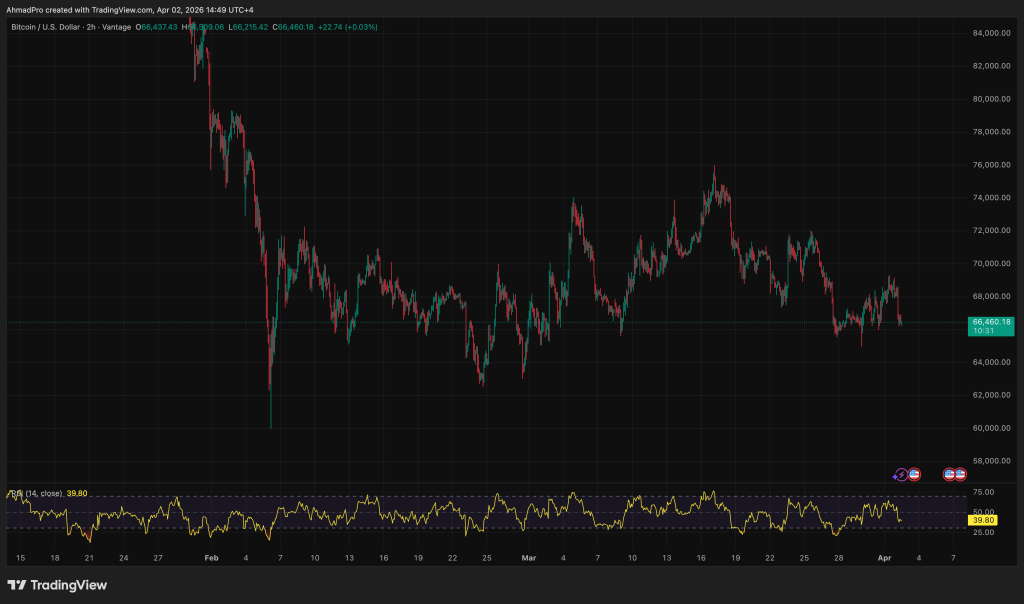
Bitcoin price dropped to approximately $66,500, shedding nearly 6% in hours, after President Trump’s April 1st address signaled harder military strikes against Iran in the coming weeks, shattering the fragile optimism that had briefly lifted risk assets.
The S&P 500 followed into the red, with MSCI’s Asia Pacific index reversing a prior session’s rebound to fall 1.7%. Brent crude jumped more than 5% to above $106 a barrel as traders priced in prolonged Strait of Hormuz disruption. This market fallout is precisely the macro fog that keeps risk assets pinned.
Trump’s remarks reversed sentiment that had built earlier this week when he indicated a willingness to end the conflict before reopening the Strait of Hormuz, a critical global trade waterway.
The April 1st address walked that back entirely, using language that pointed toward escalation rather than negotiation. Investors received no timeline for resolution – only the prospect of intensified operations.
Bitcoin’s digital gold narrative took another hit. With the 30-day rolling BTC-to-S&P 500 correlation spiking to 0.75 – its highest in months – institutional desks are treating Bitcoin as a high-beta tech proxy, not a geopolitical hedge. The safe-haven narrative is cracking.
Discover: The best crypto to diversify your portfolio during market turbulence
Bitcoin Price Prediction: Hold $65,000 Support or Another Leg Down?
BTC is sitting at $66,500, stuck in a pattern of lower highs since the March peak at $76,000, with each recovery attempt getting weaker and selling pressure capping every bounce before it gets going.
The $64,000 to $65,000 floor is the level that matters most right now, it has held on multiple tests but a clean break below it opens the path straight back to $60,000 where the February wick bottomed out.
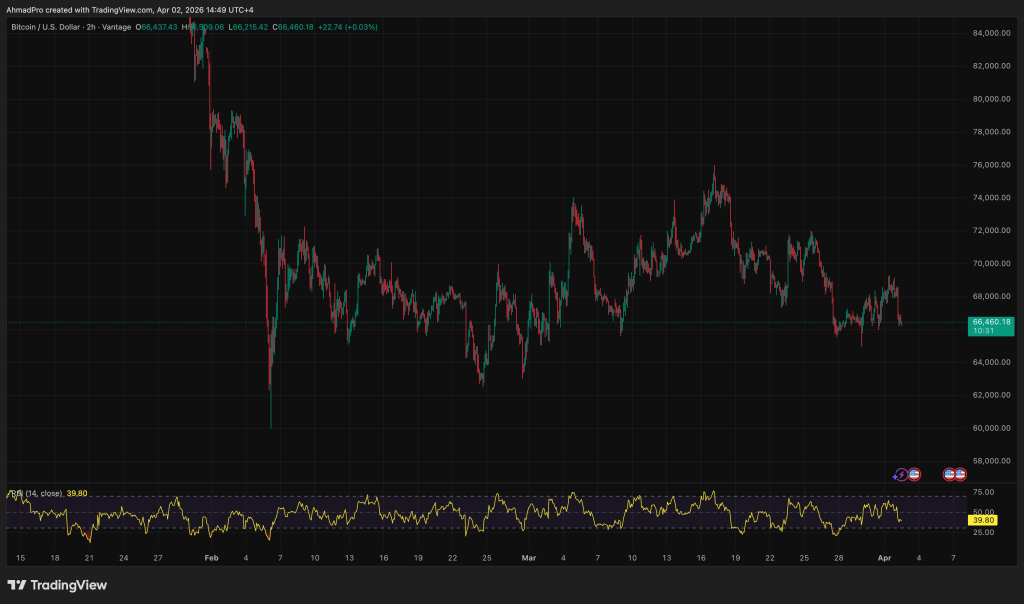
On the upside, $68,000 and then $70,000 are the levels that need to flip for any real recovery narrative to rebuild, and neither looks easy given how heavy every bounce has been recently.
Until one of those scenarios plays out, this is a chart in damage control mode.
The broader bearish trend in BTC’s recent price history makes this inflection point more consequential than it might otherwise appear.
Bitcoin ended March up just 2%, snapping a five-month losing streak – but it remains down roughly 45% from its October peak above $126,000. Apparent demand was already negative by approximately 63,000 BTC as of late last month, per CryptoQuant.
“Stock and commodity markets continue to whipsaw according to Trump’s latest comments on geopolitical developments,” said Caroline Mauron, co-founder of Orbit Markets.
“Bitcoin is largely following stocks’ direction, though in the past few weeks it has showed reduced sensitivity to both good and bad news.” That reduced sensitivity may be the one thin positive – but it hasn’t prevented a $6,500 drop in a single session.

Notably, gold’s worst monthly performance in 17 years through March – down more than 11% – strips away the easy ‘rotate to safe havens’ narrative. Treasuries and cash are absorbing the flight-to-safety flow instead.
The 10-year U.S. Treasury yield surged as markets priced in persistent inflation driven by energy supply disruptions, creating a direct headwind for non-yielding assets like Bitcoin. Until the Iran situation resolves cleanly in either direction, Bitcoin is unlikely to decouple.
Explore: The best pre-launch token sales with asymmetric upside potential
The post Trump Just Signaled Military Escalation Against Iran and Bitcoin Price Dropped 6% in Hours: Is $60,000 Next? appeared first on Cryptonews.
X (formerly Twitter) is moving to automatically lock accounts that suddenly post about crypto for the first time, in a bid to curb a growing wave of hacks and scam promotions on the platform.
Product lead Nikita Bier said the system will flag accounts with no prior crypto activity that begin promoting tokens, triggering identity verification before further posts.
The feature specifically targets a common attack pattern where hackers take over high-follower accounts and use them to push meme coins or phishing links.

The change reflects a broader crackdown on crypto-related spam, which has surged in recent months.
Hacked accounts promoting tokens have become one of the most reliable scam vectors on X, often exploiting audience trust to drive quick liquidity before disappearing.
In practice, the update treats sudden crypto activity as suspicious by default. That could reduce large-scale phishing campaigns but may also catch legitimate users posting about crypto for the first time.
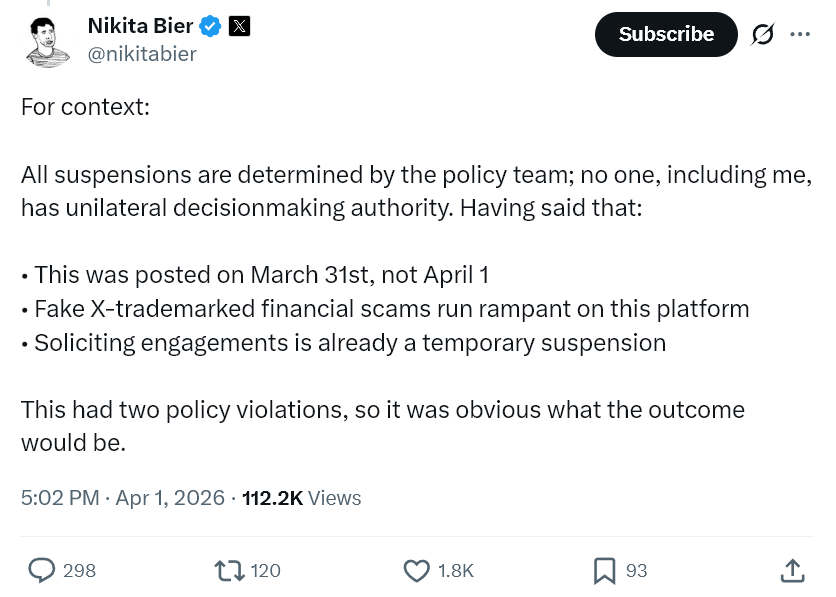
Reaction has been split. Some users see it as a necessary step to clean up “crypto Twitter” and protect users from scams.
Others argue it introduces excessive control, raising concerns about censorship and how platforms define “normal” behavior.
The post X (Twitter) Targets Scams by Locking First-Time Crypto Posts appeared first on BeInCrypto.
Crypto World
Ethereum Price Prediction: Pepeto Raises Above $8.1M While ETH Drops Below $2,100 and SOL Faces Pressure

Google just warned that quantum computers could crack Bitcoin’s encryption in roughly nine minutes, a finding that rattled the crypto market this week. Ethereum and Solana are both losing ground for different reasons, and the ethereum price prediction shows limited recovery while traders weigh growing risks.
The real question is where smart money goes while the large caps stall. Pepeto has raised above $8.1M in presale, the Binance listing is approaching, and the entry available now is the asymmetric chance that large cap yields will never produce.
Google’s Quantum AI team published research showing that cracking crypto’s core encryption could need fewer than 500,000 qubits, far below earlier estimates, according to Bloomberg.
CoinDesk reported that roughly 6.9 million Bitcoin sit in wallets where public keys are already exposed. The findings do not mean an attack is imminent, but they tighten the timeline enough to change how traders think about where to put capital.
Top 3 Cryptocurrencies Amidst the Ethereum Price Prediction
Pepeto
Google just proved that quantum threats are closer than anyone assumed, and the traders paying attention are repositioning now. Most will stay frozen, waiting for large caps to recover. The ones looking at Pepeto see what has not been priced in yet.
That is the difference that separates early movers from everyone else. Most people who missed the early stages of the biggest crypto runs did not have the right tools when it mattered, and by the time a breakout became obvious the entry that counted was gone.
Pepeto exists to close that gap. The cross chain bridge moves your holdings between blockchains so you are never trapped on one network when the opportunity lives on another. The zero fee swap engine trades any token pair across every major chain at zero cost, which means your position never gets eaten by fees while you try to grow it.
While the ethereum price prediction keeps pointing to limited recovery, Pepeto’s exchange tools are already live and working from entry to exit. The mind who built the first Pepe token is part of the dev team, and a former Binance expert leads alongside. At $0.000000186, the presale price is a fraction of what any buyer will pay once the Binance listing opens. A $25,000 position earns 189% APY through staking, putting $49,000 in yearly returns into your wallet just for holding while the listing approaches.
That is the kind of return no large cap can produce from its current level. The presale is filling with serious capital, the Binance listing date is not moving backward, and the wallets that are not inside yet are running out of runway.
Ethereum
Ethereum is trading near $2,054 after a brief climb to $2,200 failed to hold, and the token remains down nearly 50% from its record high according to CoinMarketCap.
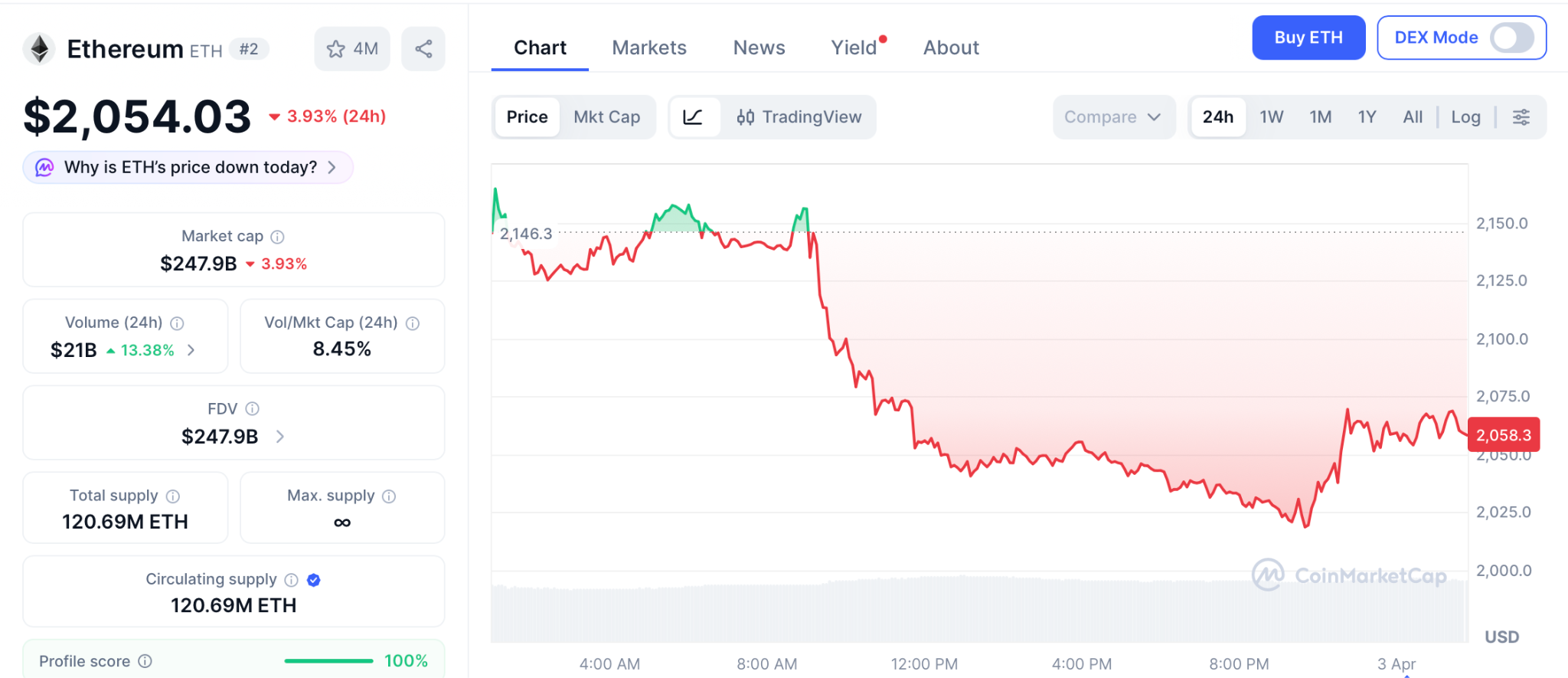
The Glamsterdam upgrade expected in June is the main catalyst, but derivatives still show heavy leverage that could trigger sharp moves. Even a push back to $2,400 delivers a modest return compared to the entries presale wallets are collecting before listing day.
Solana
Solana dropped to $79 after the Drift Protocol exploit drained $285 million from the network’s largest DeFi exchange according to Bloomberg.
SOL recovered slightly but the damage to confidence is fresh. Even a reclaim of $100 delivers less than 20% from here, which barely registers against the kind of early entry presale tokens offer before they hit the open market.
The Bottom Line
The ethereum price prediction turned cautious after ETH failed to hold $2,200 and Solana took a direct hit from the Drift exploit. Even the Google quantum research that rattled the market did not change the fact that large caps have limited room from here. Capital always flows to the sharpest entry, and right now that flow is headed into Pepeto.
The presale is above $8.1M, whales are entering with real size, and the Binance listing is locked in, which you can verify at the Pepeto official website. The wallets that miss this window will spend the next cycle wishing they had moved faster.
Click To Visit Pepeto Website To Enter The Presale

FAQs
What does the latest ethereum price prediction reveal after ETH pulled back from $2,200?
The ethereum price prediction shows ETH stuck below $2,200 with heavy leverage in derivatives, making a clean breakout difficult to call right now.
What is the ETH price forecast as geopolitical volatility and DeFi exploits shake confidence?
The ETH price forecast remains cautious because macro pressure and the Drift Protocol fallout are keeping risk appetite low across the market.
What does the latest ethereum market news mean for investors seeking better early stage opportunities?
Ethereum market news highlights limited large cap returns, pushing investors toward early presale entries like Pepeto that carry far bigger potential before the Binance listing, and all details are at the Pepeto official website.
Disclaimer: This is a Press Release provided by a third party who is responsible for the content. Please conduct your own research before taking any action based on the content.
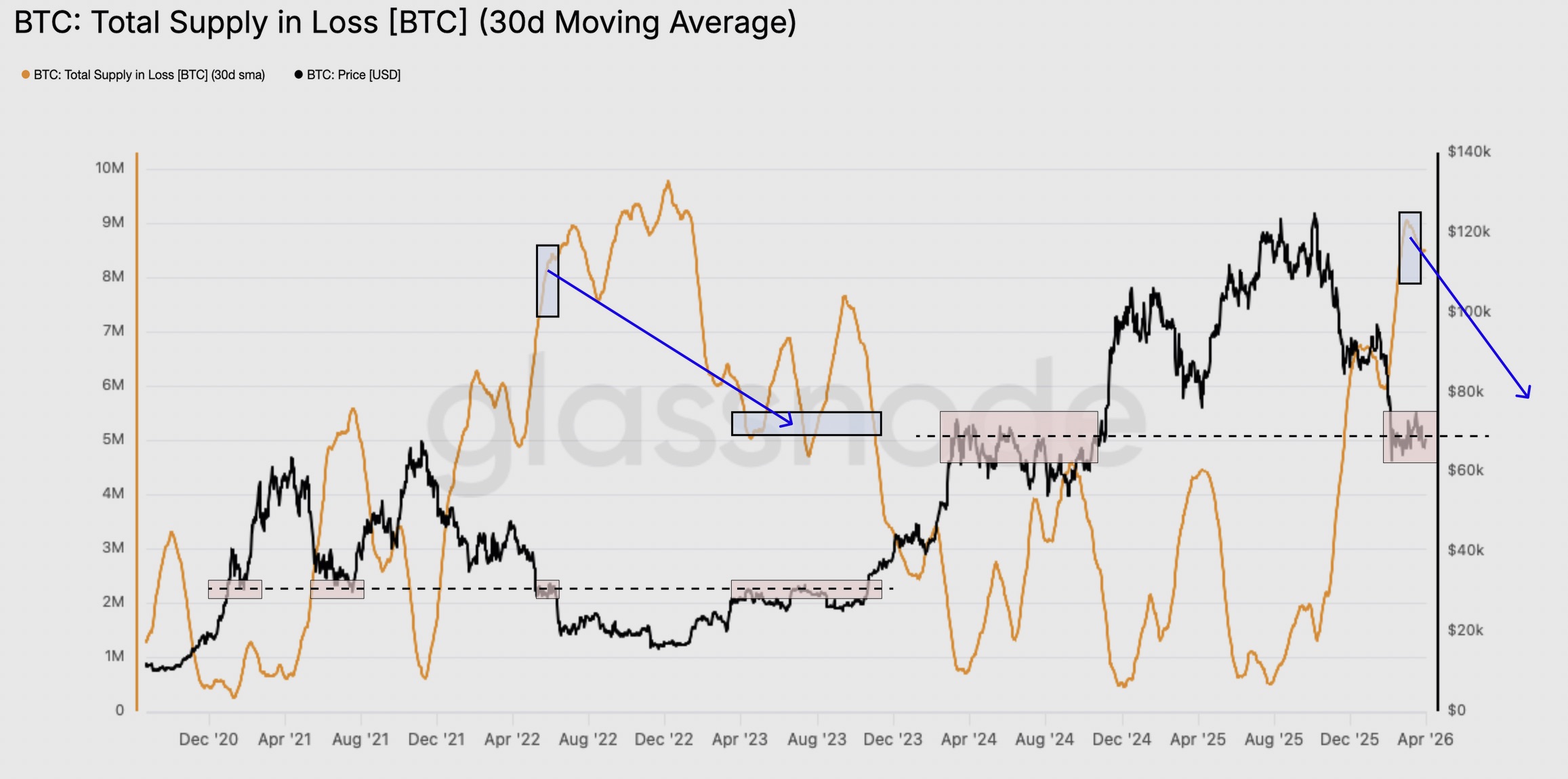
Bitcoin (BTC) traded at $66,450 on Thursday, a 47% drawdown from its all-time high of $126,000 reached in October 2025. As a result, many BTC holders are sitting on significant unrealized losses, underscoring the risks still facing Bitcoin investors at current levels.
Key takeaways:
-
Bitcoin’s 47% drawdown from its $126,000 all-time high has left holders with nearly $600 billion in unrealized losses.
-
Apparent demand and buying from US investors remain in deep contraction, suggesting broader market distribution.
44% of Bitcoin circulating supply now in the red
BTC/USD trades 24% below its yearly open of $87,500 after it closed 2025 in the red. The prolonged weakness has pushed a significant portion of its supply underwater.
As Bitcoin trades at $66,450 on Thursday, roughly 8.8 million BTC are held at a loss, representing $598.7 billion in unrealized losses, or more than 44% of the circulating supply, according to data from Glassnode.
Related: Bitcoin risks new lows as US dollar targets highest level since April 2025
The magnitude of this figure implies a “structural resemblance to conditions observed in Q2 2022,” Glassnode said in its latest Week On-chain newsletter.
Glassnode explained that the 2022 bear market provides a precedent when roughly 3 million BTC needed to be redistributed before the market could recover.
“Historically, resolving a supply overhang of this scale has required a meaningful redistribution of coins from loss-realizing holders to new buyers at lower prices.”

This mounting paper loss has eroded conviction, prompting long-term holders (LTH) to capitulate by selling below their cost basis.
LTH realized loss, a metric that measures the aggregate dollar value of Bitcoin sold at a loss by investors who have held BTC for more than 155 days, has risen to $200 million, “confirming active capitulation,” Glassnode said, adding:
“A meaningful cooldown toward levels below $25M per day would represent a more compelling signal of exhaustion in selling pressure, and a prerequisite for the base formation that historically precedes a sustainable bull market transition.”

BTC’s spot price is also below the average cost basis of US spot Bitcoin ETF holders, currently at $83,408, suggesting that these investors are increasingly under strain.

The risk-off sentiment is also seen in global Bitcoin investment products, which recorded more than $194 million in net outflows during the week ending March 27.
Bitcoin apparent demand contraction persists
Bitcoin’s apparent demand has stayed negative since mid-December 2025, as traders and investors continue to be risk-off amid BTC’s price weakness.
Capriole Investment’s Bitcoin Apparent Demand metric shows that the demand for Bitcoin is at -1,623 BTC on Thursday, and that sellers are in control.

The continued contraction in total apparent demand indicates persistent “selling from retail,” CryptoQuant said in its latest Weekly Crypto report, adding:
“The sustained demand contraction, now persisting since late November 2025, confirms that the broader market remains in distribution.”
Meanwhile, Bitcoin’s Coinbase Premium Index, which measures the difference in pricing between the BTC/USD pair on Coinbase and Binance, also remains in negative territory.
“The persistent negative premium indicates that US investors have not yet re-entered the market at scale,” CryptoQuant said, adding:
“This is consistent with the demand contraction seen across on-chain metrics.”

As Cointelegraph reported, Bitcoin price risks new lows in the short term amid a strengthening US dollar.
This article is produced in accordance with Cointelegraph’s Editorial Policy and is intended for informational purposes only. It does not constitute investment advice or recommendations. All investments and trades carry risk; readers are encouraged to conduct independent research before making any decisions. Cointelegraph makes no guarantees regarding the accuracy or completeness of the information presented, including forward-looking statements, and will not be liable for any loss or damage arising from reliance on this content.


France’s Lightning Stock Exchange, known as Lise, is preparing to host what could become Europe’s first fully onchain stock market debut, a step that brings tokenization into the initial public offering (IPO) process.
The Paris-based exchange, approved last year under the EU’s Distributed Ledger Technology (DLT) pilot regime, plans to list French aerospace supplier ST Group on April 9, according to a Thursday press release.
ST Group builds composite parts used in aircraft, defense systems and space programs. The company says it has about 59 million euros ($68 million) in potential program revenue over the next decade and aims to scale output as demand rises across aerospace and military supply chains.
Tokenization has gained traction among large financial firms using blockchain rails to settle trades and track ownership of assets such as bonds, funds and equities. Proponents say tokenization could improve capital markets with cheaper and faster settlements and more efficient operations. Wall Street giants like the Nasdaq and NYSE are also laid out plans for tokenized securities trading on their platforms.
Lise pushes that concept further by moving the IPO process itself onchain. The exchange focuses on small and mid-sized firms that would face high costs and long timelines when raising capital through traditional markets. It is backed by French lenders such as BNP Paribas, CACEIS (a subsidiary of the Crédit Agricole Group) and Bpifrance.
ST Group’s debut, if successful, could offer a blueprint for smaller firms a cheaper and faster path to public markets within European rules.
Read more: EU at risk of falling behind the U.S. in tokenization rules, digital asset firms warn
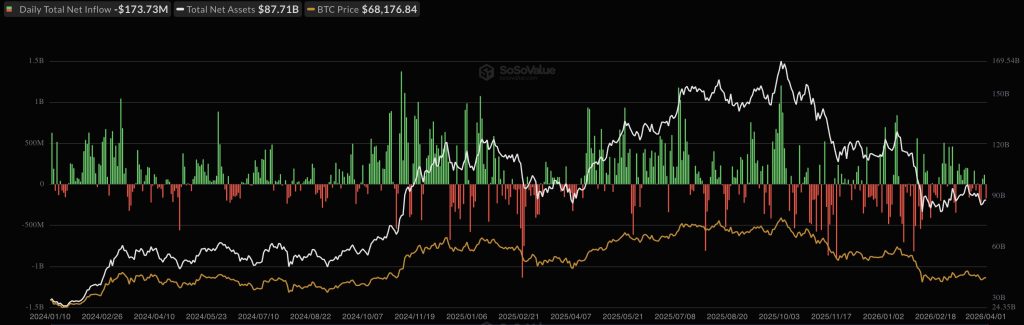
US spot Bitcoin ETFs pulled in $1.32 billion in March 2026, ending four consecutive months of net outflows and posting their first monthly gain of the year. The reversal signals institutional demand returning to Bitcoin specifically, not to crypto broadly.
That distinction matters. While BTC funds snapped their negative streak, Ethereum ETFs closed March with $46 million in outflows, extending their own losing run to five straight months. XRP funds also ended in negative territory, sharpening a capital rotation thesis that increasingly favors Bitcoin dominance over altcoin exposure.
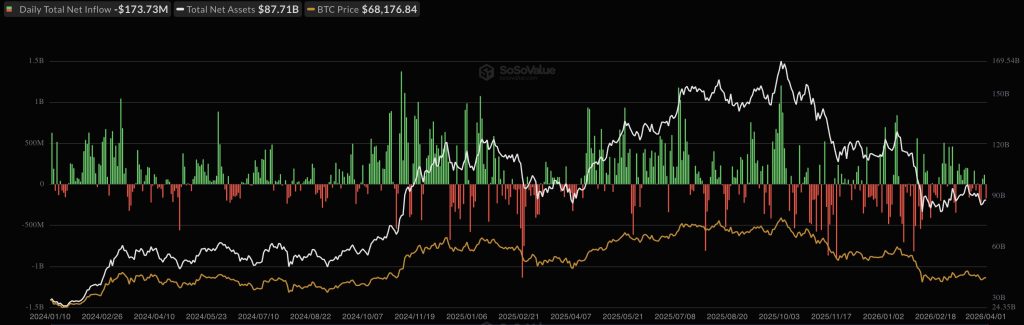
The prior four months had been brutal. Outflows totaled approximately $6.3 billion between November 2025 and February 2026, $3.5 billion in November alone following Bitcoin’s crash from its $126,000 all-time high on October 10.
December added $1.1 billion in redemptions, January another $1.6 billion, with February contributing $206 million more before sentiment began stabilizing.
Macro conditions drove the pressure. Sticky inflation, a cautious Federal Reserve, and geopolitical risk from the U.S.-Iran conflict kept institutional risk appetite compressed. Bitcoin retraced over 50% from its October peak, closing Q1 2026 at $66,619, down 23.8% from January 1.
ETF investors were sitting on an average cost basis near $84,000 against a market price roughly $18,000 below that.
Despite the paper losses, whale accumulation offered a countervailing signal.
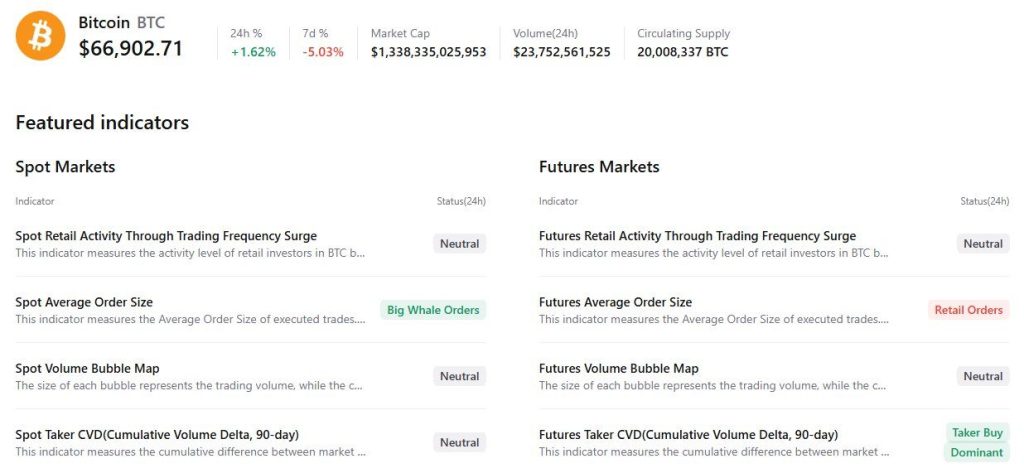
On-chain data showed wallets categorized as whales accumulated 30,000 BTC – approximately $2.1 billion – through March, absorbing selling pressure and stabilizing price near $65,000 during peak Iran-related volatility.
BlackRock’s IBIT added $98.42 million on March 31 alone, and led a $458 million single-day surge earlier in the month. US spot Bitcoin ETFs added $117.63M as BTC reclaimed $68K at one point during that window, reinforcing the case that institutional demand was quietly rebuilding beneath the noise.
Discover: The best pre-launch token sales
Bitcoin ETFs Inflows: Sustainable Reversal or Relief Rally?
That $1.32 billion inflow number sounds strong, but it does not tell the full story, because it still failed to offset the $1.81 billion that left earlier in the quarter, leaving Bitcoin ETFs with a net outflow overall, so calling this a clean recovery is a stretch.
What we are really seeing is uneven demand, bursts of buying followed by sharp redemptions, which explains why price still feels stuck instead of trending.
If inflows actually stabilize and turn consistent, especially with macro tension easing, that is when Bitcoin has room to push through $74K and aim higher, helped by April usually being a solid month.
Right now though it still looks like a range, with price caught between roughly $67K and $74K while institutions absorb supply but do not push aggressively, and retail participation remains weak in the background.
The risk is that those recent inflows were just short term positioning, because we already saw a sharp weekly outflow at the end of March, and if that kind of selling returns and price loses the lower range, things can open up quickly to the downside.
Nate Geraci, co-founder of the ETF Institute, previously argued that cumulative outflows since the October crash are statistically insignificant relative to the $56 billion in total net inflows the category has attracted since its January 2024 launch. The diamond hands thesis holds – but only if inflows resume with conviction rather than in isolated bursts.
Discover: The best crypto to diversify your portfolio with
The post Bitcoin ETFs Snap Four-Month Outflow Streak With $1.32B in Inflows appeared first on Cryptonews.


Summary
- Fundrise’s Innovation Fund VCX will be tokenized into a new asset called VCXx in partnership with Kraken’s xStocks platform.
- VCXx will provide onchain exposure to late-stage private tech companies such as SpaceX, OpenAI, Anthropic, and Databricks through a single token.
- Eligible investors will be able to buy VCXx using USDG or U.S. dollars, with tokens designed to integrate into broader onchain trading, collateral, and DeFi strategies.
Technology investment platform Fundrise is partnering with crypto exchange Kraken to tokenize shares of its Fundrise Innovation Fund VCX, according to reporting from Crowdfund Insider. The deal will see the publicly listed VCX vehicle, which trades on the NYSE, wrapped into a blockchain-based representation on Kraken’s tokenized equities venue xStocks under the ticker VCXx.
Kraken’s xStocks framework, powered by Payward, already offers more than 100 fully backed tokenized U.S. stocks and ETFs, and the addition of VCXx marks its first move into tokenized access to a diversified private-tech portfolio. Fundrise CEO Ben Miller said, “We built VCX to act as a bridge between the public and private markets,” arguing that tokenizing the fund on xStocks lets “individual investors own a piece of the best private technology companies in the world” via a regulated structure.
The VCXx token will be issued by Backed Assets (JE) Limited and offered via Payward Digital Solutions, with trading set to go live on xStocks “in the coming days.” Fundrise and Kraken say VCXx will be fully backed by underlying VCX shares and designed to move seamlessly between centralized exchanges, self-custodied wallets, and onchain applications.
According to xStocks’ launch materials, VCXx will be purchasable using USDG — Kraken’s on-platform dollar-denominated token — or U.S. dollars, giving eligible investors outside the U.S. a way to gain exposure to VCX’s portfolio. That portfolio includes stakes in late-stage private firms such as SpaceX, OpenAI, Anthropic, and Databricks, bundling them into a single liquid, tokenized asset that can also be used as collateral or integrated into automated strategies.
Fundrise’s Innovation Fund was launched to open up late-stage private tech deals that are typically reserved for institutions and ultra‑high‑net‑worth investors. By bringing VCX onchain, xStocks and Fundrise are extending tokenized equities beyond public stocks into private-market exposure, a segment Kraken has called “one of the most sought‑after and historically inaccessible parts of the market.”
The partners argue that tokenizing VCX shares allows diversified private-tech exposure to be accessed, transferred, and integrated into DeFi with the same flexibility as other digital assets. If VCXx gains liquidity, it could become a template for how other listed vehicles and funds wrap private holdings into programmable, globally tradable tokens without dismantling existing regulatory structures.

Bitcoin Slides as Donald Trump Escalates Iran War Rhetoric

Jon Hamm Talks ‘Shared DNA’ With New Role

“Girl Math” does not add up to financial freedom | It’s Been A Minute


-

 NewsBeat6 days ago
The Story hosts event on Durham’s historic registers
-

 Sports6 days ago
Sweet Sixteen Game Thread: Tide vs Michigan
-
Entertainment3 days ago
Fans slam 'heartbreaking' Barbie Dream Fest convention debacle with 'cardboard cutout' experience
-

 NewsBeat2 hours ago
Steven Gerrard disagrees with Gary Neville over ‘shock’ Chelsea and Arsenal claim | Football
-
 Entertainment5 days ago
Lana Del Rey Celebrates Her Husband’s 51st Birthday In New Post
-
Crypto World2 days ago
Dems press CFTC, ethics board on prediction-market insider trades
-

 Crypto World1 day ago
Gold Price Prediction: Worst Month in 17 Years fo Save Haven Rock
-

 Sports2 days ago
Tallest college basketball player ever, standing at 7-foot-9, entering transfer portal
-

 Tech4 days ago
The Pixel 10a doesn’t have a camera bump, and it’s great
-

 Tech3 days ago
EE TV is using AI to help you find something to watch
-

 Fashion5 days ago
Amazon Sundays: Soft Spring Layers
-

 Tech3 days ago
Apple will hide your email address from apps and websites, but not cops
-

 Politics3 days ago
Should Trump Be Scared Strait?
-

 Tech2 days ago
How to back up your iPhone & iPad to your Mac before something goes wrong
-

 Crypto World3 days ago
U.S. rule change may open trillions in 401(k) funds to crypto
-

 Tech3 days ago
Flipsnack and the shift toward motion-first business content with living visuals
-

 Business7 days ago
Chinese universities with military links bought Super Micro servers with restricted AI chips
-

 Fashion6 days ago
Weekly News Update, 3.27.26 – Corporette.com
-

 Tech4 days ago
Elon Musk’s last co-founder reportedly leaves xAI
-
Crypto World4 days ago
Bitcoin’s Six-Month Losing Streak: What On-Chain Data Says About the Market’s Next Move
You must be logged in to post a comment Login