

Crypto World
Fewer Than 300 Made the Cut: Ivan Nevzorov on MiCA, CASP Licensing, and What’s Next for Crypto Firms

Of the more than 3,000 companies that were legally serving crypto clients across the EU as recently as this June, fewer than 300 hold the right to do so today, according to CASP Tracker.
The reason is the Markets in Crypto-Assets Regulation (MiCA), which took full effect across the European Union on 1 July 2026: from that date, only a company holding Crypto-Asset Service Provider (CASP) authorisation — granted by a regulator in one EU member state and passported across the rest of the bloc — can serve EU clients. Companies that previously operated under national Virtual Asset Service Provider (VASP) registrations had exactly until that date to convert. Most didn’t.
We talked to Ivan Nevzorov, CEO at SBSB Fintech Lawyers, about what’s actually left for them now — and why the shortcuts most of them reach for first usually aren’t the ones that hold up.

Let’s start with the obvious one. A company still doesn’t have a CASP licence today — what happens to it now?
Ivan Nevzorov: Look, here’s the thing people don’t want to hear: the deadline’s already passed. From July 1st, every day you keep serving EU clients without authorisation is a day you’re in breach of MiCA — a minimum €5 million fine under Article 111, and in France it can mean criminal liability for whoever’s responsible. So the answer everyone expects to hear, “just go get licensed,” isn’t actually on the table anymore for a company operating today. You can’t file an application, keep the lights on for months while it gets reviewed, and call that compliance.
Which really leaves two paths. One, you wind down, because the business can’t meet the new standard. Two, you relocate — move your base to a friendlier jurisdiction. Though that one only keeps you legal if you stop marketing into the EU completely and let clients come to you on their own, what’s called reverse solicitation. Keep advertising to EU users from outside the bloc, and you’re breaking the exact same rule, just from a different address.
We’ll come back to relocating, because it’s genuinely its own conversation. Let’s start with winding down, since that’s where most of these companies actually are right now — and honestly, it’s painful to watch, because most of them didn’t do anything wrong. They just didn’t get there in time, and for a lot of them, the reasons had nothing to do with how good their compliance actually was.
Winding down sounds like the more straightforward path, at least. Is it actually?
Ivan Nevzorov: Not as straightforward as people think, and there’s a right way and a wrong way to do it. The wrong way is switching off the app and disappearing — the client assets sitting in those accounts don’t vanish, and holding them is a regulated activity in itself. To the regulator, that company hasn’t gone anywhere. It’s still operating without a licence, only now it’s also stopped answering its clients. The right way is one of two things: an orderly wind-down, or transferring your clients to a CASP that’s already authorised.
ESMA’s actually spelled out what an orderly wind-down has to look like: stop onboarding, stop any marketing into the EU, restrict yourself to settling what’s already open. And transferring clients sounds simpler on paper, but being on the CASP register only tells you a firm’s allowed to take clients — it doesn’t tell you they’re actually set up to onboard a few thousand new ones at once. A lot of the firms that got authorised fastest didn’t build a crypto compliance function from zero — they already held a MiFID or e-money licence and just converted it, lighter scrutiny attached. Good for them, but it also means some of these brand-new CASPs are banks running crypto as a side product, not specialists who can absorb a wave of migrating clients. Every single one of those clients still needs full AML and KYC re-verification before the new CASP can touch their money. That’s months of work for a team that does it every day. Longer for a team that doesn’t.
You’d think the bigger platforms would have this solved by now. Is that actually the case?
Ivan Nevzorov: Less than people think, and Binance is actually a fair example of why. A platform with years of European operating history and enormous legal and compliance resources still ran into real MiCA licensing problems — the same wall a lot of much smaller companies are hitting. That tells you something worth sitting with: this isn’t a gap you close just by throwing money or headcount at it. If a company at that scale couldn’t get it fully sorted before the deadline, a smaller operator shouldn’t assume they’ll just muscle through it either.
Let’s rewind for a second — only a couple hundred companies actually made it through while that was still possible. What was going wrong for the rest?
Ivan Nevzorov: Honestly, it’s rarely the paperwork. A technically correct application just gets you in the room — it doesn’t win you the decision. We saw one filing get rejected over how the share capital was deposited, and that requirement isn’t even written into MiCA, anywhere. The regulator just invented a formality that isn’t in the text. That’s the pattern I keep seeing: whatever reason they put on paper is almost never the real one. The real reason comes to you informally, if it comes at all, and it’s about how they read the company — do you actually understand your own risk model, who’s accountable for what, who your clients really are. A compliance policy copied from a template answers none of that. It’s the first thing I flag when someone walks into SBSB with one.
And the second thing people underestimate completely: where you filed mattered almost as much as what you filed. This wasn’t one process across the EU — it was twenty-seven versions of it, moving at completely different speeds, with completely different appetites for saying no. Germany’s BaFin wasn’t shy about it: its first-ever MiCA enforcement action was rejecting Ethena’s application and then forcing the company to wind down its German operation and redeem its tokens. Italy’s regulator went the other way — it spent most of the transition period without having authorised anyone at all, so filings there just sat. Same regulation, wildly different odds depending on the door you knocked on. A few countries never even built the door — Poland’s the loudest example, it went into the deadline with no authority issuing CASP licences at all — but that’s the extreme end of a spectrum the whole market was sitting on.
Let’s talk about the companies actually going through the licensing process, then — a first application in a market they haven’t touched yet, or a return down the line after an orderly exit. What does a strategy that actually works look like, in practice?
Ivan Nevzorov: Honestly, it starts before you’ve touched a single form. You go talk to the regulator first, find out exactly what they expect from a business like this one, and only then do you build the structure around that answer — the AML policy, the governance, the documentation. MiCA’s a directive, which means every country implements it a little differently, so a compliance package that worked in one member state gets rechecked before you dare reuse it somewhere else. People skip that step constantly, and it costs them.
At SBSB, a full mandate for us looks like this: company formation, the application itself, handling the regulator correspondence, and then the parts most founders genuinely can’t build alone — banking relationships, payment infrastructure, penetration testing through our partners, licensed compliance software. And staffing matters just as much. Regulators check AML certifications early, so get that sorted before the application goes in, not after you’ve already filed.
How should a company actually choose which EU market to apply in — Germany, Austria, the Netherlands, Estonia?
Ivan Nevzorov: I don’t give every client the same answer, honestly, and if anyone tells you there’s one magic jurisdiction, they’re oversimplifying it for you. But the differences between regulators are real, and by now they’re well documented. Germany’s BaFin gives you the heaviest signature in Europe — corporate clients respect it — but you pay for it: a German entity, at least two qualified directors actually present in the country, capital paid up at filing, and a documentation pack that runs to hundreds of pages, with the formal filing in German. France is the opposite story: the AMF had been licensing crypto firms under its own national regime for five years before MiCA existed, so firms already registered there got a genuinely streamlined path, and the regulator’s crypto unit knows what it’s looking at. Luxembourg, Ireland, and Malta became the hubs the big exchanges actually picked: Coinbase went through Luxembourg, Kraken through Ireland, OKX and Crypto.com through Malta. That’s not a coincidence; it’s where the process was mature enough to handle a file that size.
But here’s what I actually tell clients: the regulator’s speed shouldn’t decide it — your own capacity should. Every serious regulator now checks for the same thing: a real office, real staff on the ground, a credible plan for that specific market. Pick the jurisdiction where you can honestly show that, not whoever’s got the shortest queue — a fast process with no substance behind your application just gets you a fast rejection. And yes, Germany leads on raw licence numbers right now, but a good chunk of that is banks and brokers converting a licence they already had, not crypto-native firms getting freshly approved. “Germany has the most CASPs” and “Germany’s the easiest place for a crypto company” are two different claims, and people mix them up constantly. I don’t think any single country’s lead holds for long anyway — regulator capacity is finite everywhere. We’ve watched this movie before, it’s basically what happened with Curaçao’s gaming licence reform. Once the volume outpaces what the regulator can actually process, the process itself becomes the bottleneck.
Let’s come back to relocating, the third path you mentioned earlier. For companies thinking globally, how should they weigh an EU licence against licences elsewhere — Latin America, Asia, offshore?
Ivan Nevzorov: Look, the safest position is full compliance everywhere you operate — better banking terms, full market access, nothing sitting in a grey area. But that takes a budget most startups just don’t have. So in practice, most of them end up running from a business-friendly base — El Salvador, Panama, the UAE, Singapore, Mexico, these come up constantly — and serving EU clients only through reverse solicitation, sometimes with geo-blocks stacked on top for the riskier markets.
But notice what those two options really are: one’s too expensive for most, and the other cuts you off from actively winning EU clients at all. Which is why the question I hear constantly right now is: can’t I just operate under someone else’s licence? And here’s where MiCA catches people off guard. In payments, under the Second Payment Services Directive, PSD2, there’s a proper agent model — an unlicensed company can work the market on behalf of a licensed one, and the industry uses it everywhere. MiCA has nothing like that. Articles 59 and 60 draw a hard line around who’s allowed to provide crypto services at all, so the classic white-label — an unlicensed provider serving clients in its own name under someone else’s licence — formally doesn’t work.
What nobody forbids, though, is supplying a licensed CASP with technology or marketing. That’s fully legal, and the entire market has rushed into the gap between those two points — KvarnX, Bitpanda, Bit2Me are all running their own versions of it, and Spain’s regulator has even given the grey-label approach a cautiously positive read, with real limits attached. The catch is what role you’re actually playing: the licensed partner holds every wallet, every bank account, every client transaction. You’re the technology behind their offer, not the provider in front of the client. For a lot of companies that’s a perfectly good way back into the EU market. Just be honest with yourself about which side of that line your business model actually needs to be on.
Last one — once a company has the CASP licence, what does the ongoing workload actually look like?
Ivan Nevzorov: Getting the licence is honestly the easy part to talk about. Staying licensed is where companies actually get tested. I’ve watched a licence get pulled by an EU regulator within months of being granted, because the business just didn’t follow through on what it promised in the application. What actually matters, once you’re authorised, is exactly what you signed up for on paper — active risk assessment, ongoing AML monitoring, reporting to the regulator on time, every single time.
Has that gap between paperwork and practice actually cost one of your clients?
Ivan Nevzorov: This one’s a bit different — no regulator pulled anything here, and it’s actually from outside crypto. But it’s the same underlying lesson, so it’s worth telling. We had a client at SBSB who did everything right on paper: MSB registration, their API — Authorised Payment Institution — licence, connected to a banking-as-a-service partner, targeting the European market. Business plan solid, AML policy solid, source-of-funds checks all cleared. Where it fell apart was the economics nobody had stress-tested. The marketing spend needed to actually hit their projected client volume ran well above what they’d budgeted. The partner bank’s own compliance screening filtered out a chunk of the high-risk client segment their whole model was built around. And the tariffs the bank actually offered were thinner than what they’d planned for. Nothing illegal happened anywhere in that chain. The business just didn’t survive contact with the market it was built for. They made the call to sell, and we’ve already found a buyer — sold it, more or less, at this point.
One thing that’s genuinely changed the economics here is AI in compliance monitoring. Transaction monitoring that used to eat up a whole team can run with a fraction of the people now — cheaper for the company, and from what regulators have signalled, easier for them to work with too. None of that replaces the basic requirement, though. The licence is the easy part. Staying licensed — that’s the job.
If you had to give one piece of advice to a company still sitting on this decision — wind down or relocate, transfer or hold — what would it be?
Ivan Nevzorov: Pick your strategy and start moving — this week, not this quarter. The window between now and the first wave of regulatory checks is the only asset these companies have left, and it’s shrinking: we flagged back in May that the first checks would land around the third quarter of this year, and the Netherlands has already shown how this plays out — their central bank fined Kraken €4 million and Crypto.com €2.85 million under the old registration regime, and OKX €2.25 million just last year, for something that happened two years earlier.
A company that uses these months to actually execute — transfer the clients, close out the obligations, or get the relocation structure in place — walks into that first check with a story of action behind it. A company that’s still weighing its options in September walks in with an explanation for why it did nothing. Given the choice, I know which conversation I’d rather have with a regulator.
Disclaimer: The above article is sponsored content; it’s written by a third party. CryptoPotato doesn’t endorse or assume responsibility for the content, advertising, products, quality, accuracy, or other materials on this page. Nothing in it should be construed as financial advice. Readers are strongly advised to verify the information independently and carefully before engaging with any company or project mentioned and to do their own research. Investing in cryptocurrencies carries a risk of capital loss, and readers are also advised to consult a professional before making any decisions that may or may not be based on the above-sponsored content.
Readers are also advised to read CryptoPotato’s full disclaimer.
The post Fewer Than 300 Made the Cut: Ivan Nevzorov on MiCA, CASP Licensing, and What’s Next for Crypto Firms appeared first on CryptoPotato.



Balaji Srinivasan’s Network School, a community of “digital nomads,” is eyeing a new campus in Kazakhstan after its Forest City campus had its business license revoked over alleged premises-use violations.
A memorandum of understanding was signed between Kazakhstan’s Minister of Digital Development, Innovation and Aerospace Industry, Zhaslan Madiyev and Srinivasan to establish the first Network School campus in Kazakhstan, according to a statement from the ministry.
The Kazakhstan agreement gives the Network School a potential new base after its Johor operation was ordered to cease operations effective Wednesday. Kazakhstan has been positioning itself as an emerging technology hub, including plans for Central Asia’s first “crypto city” in Alatau.
“Ironically, this whole drama with Balaji literally validated the network state thesis,” said Dragonfly Capital managing partner Haseeb Qureshi. “The whole idea of a network state is taking a dense group of talent and capital, and collectively negotiating with states. The Malaysia drama set up Balaji to negotiate better terms with another state to copy and paste the network there. “
“Our new campus will become a haven for global techno-optimism, with expedited visas, streamlined redomiciliation, and active recruitment of talent,” Srinivasan said Tuesday.
Network School faces loss of Malaysia Digital status
The new memorandum of understanding with Kazakhstan comes as the Forest City campus faces regulatory action on several fronts.
On Tuesday, the Iskandar Puteri City Council (MBIP) revoked the business license of NSO Malaysia Sdn Bhd, which operates the Network School, alleging the company breached licensing conditions and premises usage requirements.
This led to the Malaysia Digital Economy Corporation (MDEC) announcing it is taking immediate steps to revoke the Malaysia Digital status of NSO Malaysia, which requires companies under the program to follow all local and federal laws.
Malaysia Digital is a recognition awarded to qualified technology and digital companies, providing them with tax incentives, freedom of ownership and allowing the employment of local and foreign workers, among other incentives.
Meanwhile, Onn Hafiz Ghazi, Chief Minister of Johor State, has urged Malaysia’s federal authorities to continue investigating whether the Network School violated immigration laws.
Related: Balaji seeks Malaysia deal, threatens exit after Network School probe
“This matter cannot be taken lightly, especially since Johor is a strategic entry point for the country bordering Singapore. Any weaknesses or abuse of the immigration system must be addressed promptly, firmly, and without compromise,” said Onn.
On Friday, Srinivasan denied reports that the Network School was shutting down, claiming that it had received two notices, with one notice requiring it to “change the text of a sign” and the other regarding a coworking site, created by joining two adjacent units, that had a valid license on one side, not on the other.
“We have a remedial period for both issues, and will remediate them shortly. But our members are otherwise unaffected,” he said.
Cointelegraph reached out to Srinivasan and Network School for comment.
Magazine: Binance & OKX users face $1,900 fines in Vietnam, Coinbase in China? Asia Express


Coinbase began offering a High Yield tier on its USDC lending product paying about 7.02% APY, roughly double the 3.63% APY on its standard Core tier, days after Robinhood Earn launched a competing 7% campaign. Both products route deposits through Morpho, a decentralized lending protocol with $7.11… Read the full story at The Defiant
Traders on Hyperliquid, the onchain exchange that settles the largest share of crypto perpetual futures volume, are trading more money through builder-deployed markets for stocks, commodities and indices than through the platform's native crypto contracts. Those builder markets, deployed under… Read the full story at The Defiant


Crypto companies already licensed under the European Union’s Markets in Crypto-Assets Regulation (MiCA) could still exit the market as compliance costs mount, according to Gate Europe’s CEO.
Giovanni Cunti told Cointelegraph’s Chain Reaction on Monday that stricter regulatory requirements have made it increasingly difficult for new entrants to compete and that some licensed firms could ultimately be unable to absorb the ongoing costs of operating under the framework.
“I think there are going to be quite a few more of the ones that acquire MiCA license that will not be capable to sustain the cost and the resources that are needed to carry on this business in the long term,” Cunti said.
MiCA is the EU’s regulatory framework for crypto assets. The bloc’s 18-month transition period ended on July 1, requiring crypto firms serving EU customers to operate under authorization or cease offering regulated services.
The deadline prompted several exchanges to restrict or withdraw services in parts of Europe while licensed firms began operating under the new regime. Binance, the world’s largest crypto exchange by trading volume, was not able to secure a MiCA license before the deadline.
Compliance costs reshape Europe’s crypto market
Cunti also warned that MiCA’s stricter regulatory requirements could drive some crypto startups and projects outside Europe. While the framework has strengthened investor protections, he said it leaves less room for innovation than jurisdictions with lighter rules.
He said some projects may choose to launch in jurisdictions with less restrictive regulatory requirements instead of navigating the bloc’s compliance regime.
“We may need to be prepared that some projects, possibly some important projects, may be looking at other jurisdictions with different guidelines,” he said.
Related: ESMA MiCA warning puts Binance EU service changes under scrutiny
To be sure, the number of companies authorized under MiCA continues to grow, albeit at a slower pace.
On Friday, the European Securities and Markets Authority added 14 crypto-asset service providers (CASPs) to its register, bringing the total to 294 after adding 37 firms in ESMA’s first update following the July 1 transition deadline.
Cunti said the higher regulatory burden is reshaping Europe’s competitive landscape, but the shrunken market also presents an opportunity for those remaining crypto service providers.
“There was a market with thousands of operators, and now there is a market with only hundreds,” Cunti said.
“So definitely there is a big opportunity for all of us. There is an ongoing migration because customers do not want to lose access to this market,” he added.
Magazine: The British Virgin Islands are a top crypto hub no one ever talks about: Here’s why


Grayscale filed an S-1 registration statement with the U.S. Securities and Exchange Commission on July 20, 2026, to launch a spot Worldcoin ETF, according to the filing's EDGAR record. The filer entity, Grayscale Worldcoin ETF, is registered under file number 333-297570 and accession number… Read the full story at The Defiant


Lending protocol Morpho has launched Morpho Midnight on Base, adding fixed-rate, fixed-term loans to its onchain credit network alongside the variable-rate markets offered through Morpho Blue.
In an announcement sent to Cointelegraph, Morpho said the offer-driven protocol lets lenders and borrowers propose their own interest rates, maturities and other loan terms instead of relying on a protocol-defined utilization curve. Loans are issued as fixed obligations, with terms set through competing offers rather than algorithmic pool pricing.
Predictable rates and defined maturities are standard features of traditional credit markets. However, they remain uncommon in decentralized finance (DeFi), where borrowing costs generally fluctuate based on market utilization. Fixed terms could make onchain lending more attractive to institutions and businesses that need to manage funding costs, returns and risk exposure in advance.
A Morpho spokesperson told Cointelegraph that Midnight is live on the Base mainnet, initially supporting cbBTC and USDC across multiple maturity dates. The spokesperson said Morpho deliberately kept the launch contained as part of a progressive rollout that prioritizes security.
The spokesperson said crypto-native lenders, borrowers and curators already active on Morpho Blue had shown interest in Midnight. Several unidentified enterprises and institutions are also building products on the protocol in beta, with announcements expected as those products go live.
Morpho’s fixed-rate lending plans take shape
Morpho first outlined the fixed-rate system in 2025 under a broader “Morpho V2” roadmap. It described an intent-based, peer-to-peer marketplace where users could submit custom offers, price loans through market demand and keep capital earning variable yield until a fixed-rate offer was matched.
In April, Morpho named the fixed-rate protocol Midnight and clarified that it was not a replacement for Morpho Blue. While Blue provides open-ended, variable-rate lending pools, Midnight externalizes loan risk, interest rate and duration to market participants.
The protocol then released Midnight’s whitepaper and codebase in May, saying that its “offered capital” model was intended to avoid a recurring problem for fixed-rate DeFi protocols: liquidity being locked or fragmentation across maturity dates.
Related: Grayscale plans regular cash payouts from ETH, SOL staking rewards
Midnight’s launch follows Morpho’s $175 million funding round in June, led by Paradigm, Andreessen Horowitz’s a16z crypto and Ribbit Capital. At the time, Morpho said it planned to expand integrations with banks, asset managers and large platforms while adding features associated with traditional credit markets.
Morpho’s infrastructure already underpins variable-rate lending products distributed through major crypto platforms. In April, Coinbase launched Morpho-powered USDC loans for United Kingdom users, allowing them to borrow against Bitcoin (BTC), Ether (ETH) and cbETH on Base.
The loans carried variable rates and no fixed repayment schedule, illustrating the open-ended borrowing model that Midnight intends to complement.
Magazine: Ethereum’s EEZ could pull other blockchains into its orbit


XRP Ledger’s v3.2.0 software has reached 66% validator adoption, with 99 validators now running the release as the network approaches a July 29 amendment activation.
Summary
- XRP Ledger v3.2.0 now runs on 66% of tracked validators and 57.33% of nodes.
- The fixCleanup3_2_0 amendment holds 85.71% support ahead of its July 29 activation.
- The update fixes vault, lending, and permissioned DEX issues while renaming rippled to xrpld.
According to recent XRPL Explorer data, 481 nodes, or 57.33% of the tracked network, have installed v3.2.0. The figures show that the latest software has gained ground since its June rollout, although a sizeable share of operators remain on the previous release.
Version 3.1.3 still runs on 42 validators, equal to 28% of the validator set covered by the tracker. Another 323 nodes, representing 38.41% of the 825 observed nodes, also continue to use the older software.
Software adoption and amendment approval are separate processes on the XRP Ledger. Installing v3.2.0 gives operators access to the latest fixes, while an amendment requires support from at least 80% of trusted validators for two consecutive weeks before its rules can take effect.
The fixCleanup3_2_0 amendment has already crossed that voting threshold. XRP Ledger governance data shows 85.71% support, with 30 validators voting in favor and five opposing the proposal.
Having secured the required backing, the amendment is scheduled to activate on July 29, 2026, at 09:57 UTC. Support must remain at or above 80% throughout the countdown; otherwise, the network’s two-week timer will restart.
Validator backing keeps the amendment on schedule
XRPL validator Vet has urged node operators to update their software before activation so their infrastructure remains compatible with the amended protocol. Operators using unsupported versions can become amendment-blocked once new rules go live, preventing their servers from determining the valid state of the ledger.
Unlike a feature release built around new user-facing products, fixCleanup3_2_0 combines maintenance changes for functions already available on XRPL. The official v3.2.0 release announcement identifies fixes covering Single Asset Vaults, the Lending Protocol, the Permissioned decentralized exchange, Multi-Purpose Tokens, and Permissioned Domains.
For Single Asset Vaults, the package addresses accuracy and rounding issues that can affect how deposited assets and shares are calculated. Lending Protocol changes correct related accounting behavior, while the Permissioned DEX and Permissioned Domains receive fixes for problems found after their earlier implementation.
Amendment voting allows validators to decide whether those consensus-level changes should become binding across the ledger. Even though v3.2.0 is already running on most tracked validators, the amendment will not alter mainnet behavior until the waiting period ends successfully.
Crypto.news reported earlier in July that fixCleanup3_2_0 had entered its final activation window after approval moved above 80%. The current 85.71% reading leaves a buffer of 5.71 percentage points, but XRPL rules still require support to hold until the scheduled activation time.
XRPSCAN’s amendment tracker lists fixCleanup3_2_0 as a proposal introduced through version 3.2.0. Its status also means operators must install compatible software even though running the release does not automatically count as an affirmative amendment vote.
Version 3.2.0 prepares XRPL infrastructure for new activity
Released in mid-June, v3.2.0 has also changed the name of the XRP Ledger’s core server software from “rippled” to “xrpld.” The rename follows XLS-0095, a technical proposal intended to align the server’s identity more directly with the XRP Ledger.
The change affects more than the executable’s name. Under XRPL’s migration instructions, operators moving from version 3.1.3 must update the configuration file from rippled.cfg to xrpld.cfg, along with related paths and deployment settings.
Node operators may also need to revise database directories, package references, scripts, service definitions, and server metadata. XRPL documentation provides a migration process designed to preserve existing node data while replacing the former server naming conventions.
Beyond the rename, the XRP Ledger development team describes v3.2.0 as a cleanup and maintenance release. The software retires amendments that have remained active for more than two years and continues work to divide the libxrpl codebase into smaller modules, which can make future development and maintenance easier.
Those infrastructure changes arrive while projects are testing new payment uses on the ledger. Ripple-backed t54.ai recently reported that XRPL had processed more than 1 million AI-driven payments through the x402 protocol and launched an AI Hub for agents, developers and payment services.
According to t54.ai, the hub was developed with support from Ripple developers and the XRP Ledger Foundation. It collects AI projects, autonomous agents, developer tools, payment services and technical resources in one place for teams building XRPL applications.
With eight days remaining before the scheduled amendment date, validator voting has kept fixCleanup3_2_0 on course. The remaining task falls to node operators still running older software, as the July 29 activation will apply the maintenance rules across the XRP Ledger if approval stays above the required level.


Disclosure: This article does not represent investment advice. The content and materials featured on this page are for educational purposes only.
Bitcoin’s recent rally and ETF inflows are boosting market sentiment as traders look beyond BTC to emerging projects such as Remittix.
Summary
- Bitcoin’s rally shifts attention to Remittix as its presale surpasses $31 million and ecosystem expansion continues.
- Remittix tops $31 million in presale funding as Bitcoin’s rebound fuels interest in emerging crypto projects.
- Remittix nears a $32 million presale milestone as Bitcoin strength revives demand for altcoin opportunities.
Bitcoin has returned to the centre of market attention after climbing to around $65,500, its highest level in roughly two weeks. The move came as risk appetite improved, chip stocks rebounded and U.S. spot Bitcoin ETFs recorded five straight sessions of inflows worth more than $600 million.
The return of Bitcoin momentum is now pushing traders to look across the wider crypto market for altcoins with stronger growth potential. One of the projects gaining attention is Remittix, which has now passed $31 million in its presale after announcing a major ecosystem expansion through Remittix Markets.
Bitcoin momentum puts altcoins back on watch
Bitcoin remains the biggest signal for the wider crypto market. Recent coverage showed Bitcoin reaching the $65,500 area before traders began watching whether the move could hold, while CoinDesk also reported that Bitcoin had previously pulled back after hitting a similar monthly high as profit-taking entered the market.
That matters because Bitcoin strength often helps bring attention back to higher-growth altcoin plays. When Bitcoin stabilises or pushes higher, investors usually begin searching for smaller projects with clearer catalysts, stronger upside narratives and upcoming launch events.
Remittix surpasses $31m as RTX momentum builds
Remittix has now passed $31 million in its presale, putting the project close to the key $32 million milestone where the team is expected to reveal the official launch date.
That gives RTX a clear near-term catalyst at a time when traders are looking beyond Bitcoin for new opportunities. The project has also confirmed a wider ecosystem direction, with PayFi, Remittix Markets and future Earn products becoming the core story around RTX.
This is why Remittix is starting to stand out. It is not only a presale with a launch countdown. It is becoming a product-led ecosystem built around crypto payments, trading access and real-world utility.
PayFi targets a massive payments problem
The strongest part of the Remittix story is still its PayFi platform.
Crypto is easy to buy, hold and trade, but using it for normal bank payments remains difficult. Users often need exchanges, wallet transfers, conversions and withdrawal steps before digital assets can become usable fiat.
Remittix is designed to solve that problem by letting users send crypto to any bank account in the world, while the recipient receives fiat directly. That gives the project a clear use case in the global payments industry, which Remittix positions as a $19 trillion opportunity.
The platform is now fully developed and has already been tested by members of the community. That gives RTX a stronger foundation before launch than projects relying only on future promises.
Remittix markets expands the ecosystem
Remittix has also revealed Remittix Markets, its new perpetual futures trading platform.
This adds a second major growth layer to RTX. PayFi gives Remittix its real-world payments angle, while Remittix Markets adds trading activity, perps demand and another reason for users to engage with the ecosystem.
As Bitcoin hits a two-week high and traders search for the next high-growth altcoin story, Remittix is building momentum with a developed PayFi platform, a major ecosystem expansion and a $32 million launch date reveal milestone now approaching.
Discover the future of PayFi with Remittix by checking out their project here.
FAQ
Why is Bitcoin in focus right now?
Bitcoin is in focus after climbing to around $65,500, its highest level in roughly two weeks, supported by renewed risk appetite and spot Bitcoin ETF inflows.
How much has Remittix raised so far?
Remittix has now passed $31 million in its presale and is approaching the $32 million milestone for its official launch date reveal.
What makes Remittix different from other presales?
Remittix has a fully developed PayFi platform tested by community members and has expanded the RTX ecosystem with Remittix Markets, its new perps trading platform.
Disclosure: This content is provided by a third party. Neither crypto.news nor the author of this article endorses any product mentioned on this page. Users should conduct their own research before taking any action related to the company.

Wrapped Ethereum (WETH) recorded 113,000 whale transactions worth more than $100,000 over the past week. This figure is its highest level since May 2021, according to on-chain analytics platform Santiment.
The surge indicates that significant capital is moving through Ethereum’s trading, lending, liquidity, and decentralized finance (DeFi) infrastructure rather than remaining idle in wallets.
WETH Whale Activity
Santiment, in its latest post on X, revealed that the increase coincides with several signs of rising demand for Ethereum. These include accelerating inflows into US spot Ether ETFs, with BlackRock’s ETH products absorbing a large share of recent inflows, as well as growing activity on Robinhood Chain, which uses ETH for gas and has processed heavy decentralized exchange (DEX) volume since its July 1 launch.
The analytics firm also pointed to increasing corporate treasury participation, as it highlighted Bitmine’s holdings of around 5.8 million ETH and backing from Bitmine, SharpLink, and Joe Lubin for Ethlabs to cater to the increasing institutional demand for Ethereum.
While they do not guarantee a price rally, these factors are worth paying attention to.
Next Key Levels
As for ETH’s price, the world’s largest altcoin by market cap, climbed to $1,934 on Wednesday, rising by almost 9% on the week and 4.5% on the day. Earlier, crypto analyst Ali Martinez said Ethereum remains above the “must hold” level of $1,850; its next upside target would be $2,300.
MN Trading founder Michaël van de Poppe also believes that if the crypto asset holds the crucial support zone above $1,800, it should “trigger a continuation upwards.”
A similar projection was made by another analyst, Tony Research, who said ETH could first climb above $2,000, with a move toward the $2,200 area possible if Bitcoin reaches $70,000. However, the rally is expected to be followed by seven to 10 days of distribution before Ethereum falls into a final bottom zone between $1,260 and $890, which the analyst described as a dollar-cost averaging (DCA) opportunity.
According to the forecast, that decline would pave the way for a new bull cycle, with Ethereum eventually targeting $7,000.
The post Wrapped Ethereum Just Logged a Five-Year Whale Record: Here’s Why It Matters for ETH appeared first on CryptoPotato.
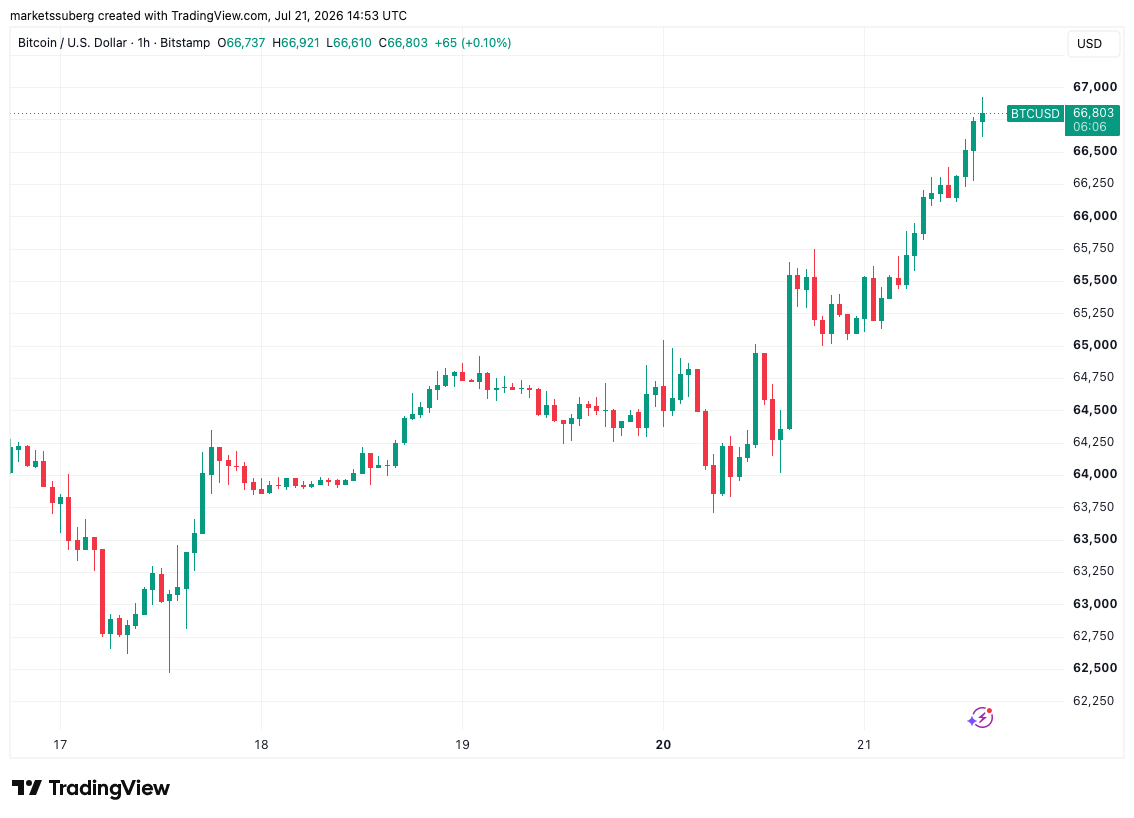
Bitcoin (BTC) built on gains at Tuesday’s Wall Street open as crypto echoed resilient US stock markets.
Key points:
- BTC price action approached $67,000 despite new geopolitical and macroeconomic pressures.
- Neither the US-Iran war nor proposed international trade tariffs were able to disrupt risk-asset upside.
- Bitcoin needed a reclaim of its 21-week simple moving average to challenge the bear market, analysis warned.
Bitcoin, stocks ignore Iran war, fresh US tariffs
Data from TradingView showed BTC/USD approaching $67,000, closing in on seven-week highs.
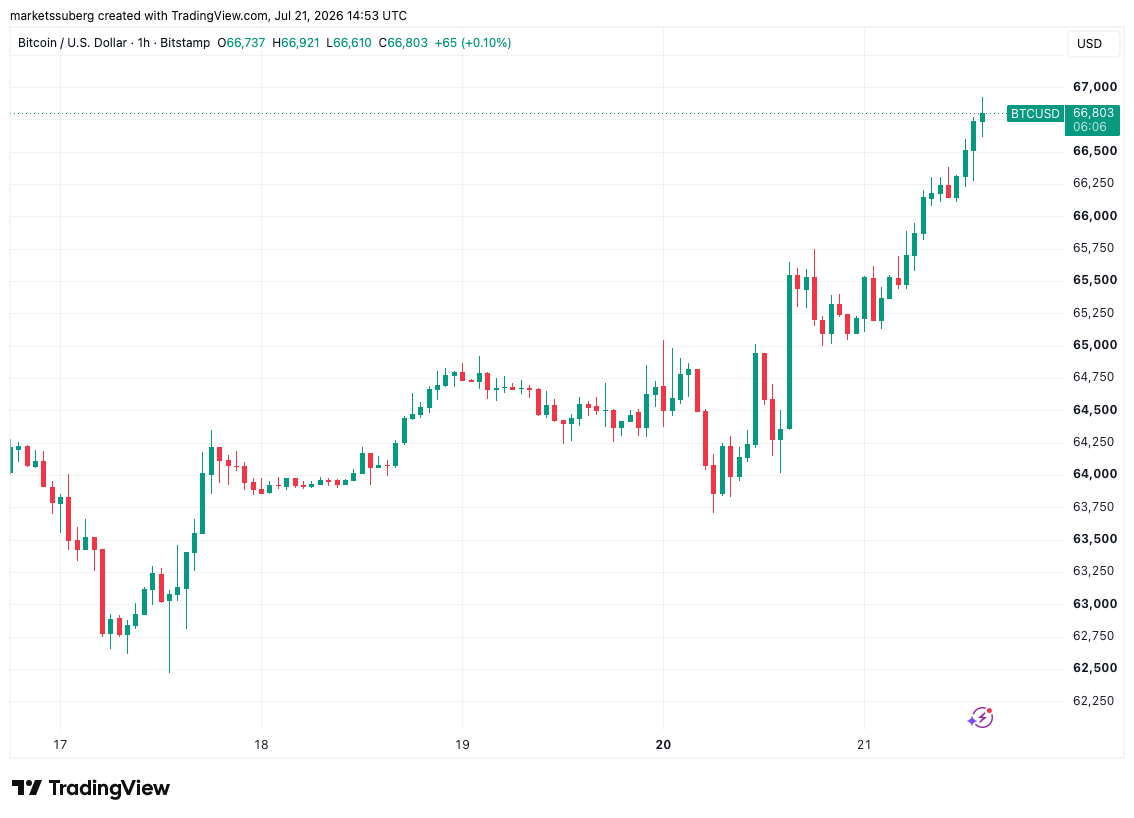
BTC/USD one-hour chart. Source: Cointelegraph/TradingView
Upward momentum that began the day showed little signs of stopping despite macro conditions that seem to favor a risk-off mindset.
The US-Iran war saw further escalation on the day as Iran struck Amazon facilities in Bahrain in response to US strikes, while the Strait of Hormuz oil route remained closed.
As a result, WTI crude oil prices reached their highest levels in over a month, nearing $85 per barrel.
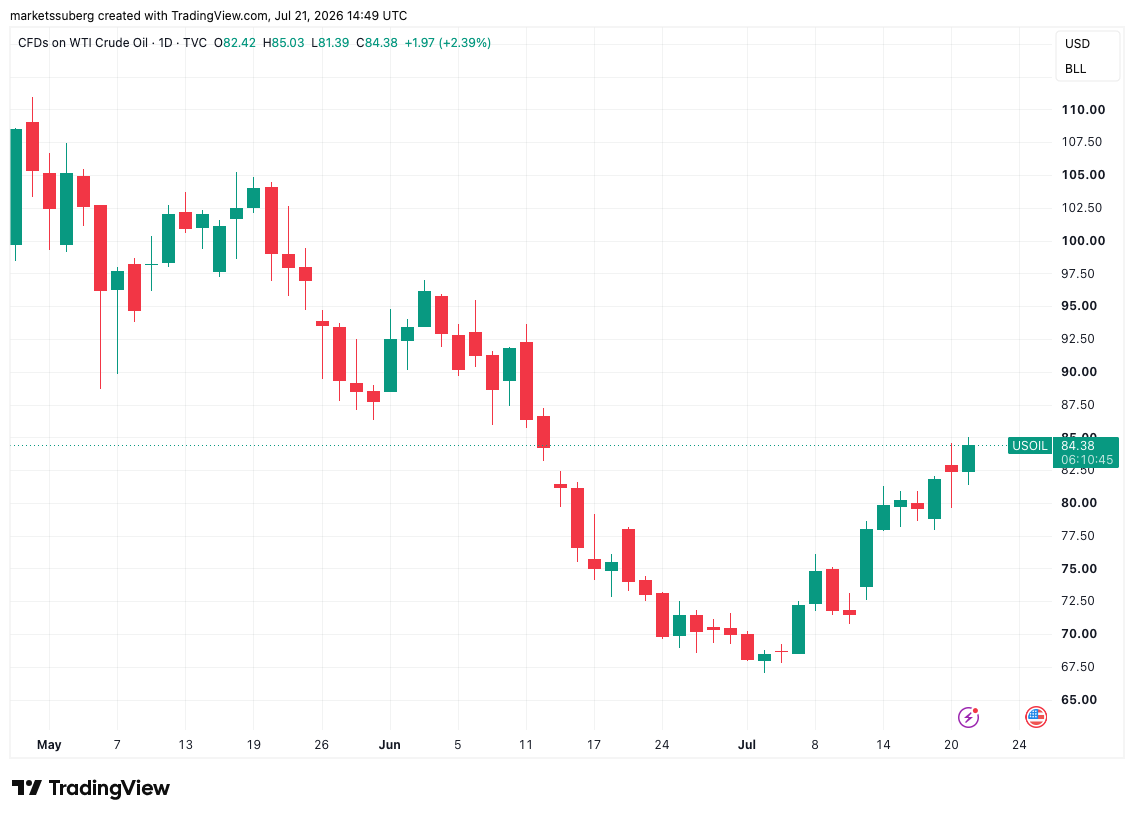
CFDs on WTI crude oil one-day chart. Source: Cointelegraph/TradingView
Multiple media reported US president Donald Trump plans to introduce new 10% international trade tariffs. These would follow 50% measures imposed on Canada this week.
Despite these notional headwinds for crypto and risk assets, traders attributed the lack of bearish reactions to expectations that the situation would ultimately resolve in markets’ favor.
“Markets are pricing in peace,” YouTube channel host Crypto Rover summarized in a post on X to their 1.6 million followers.
Caleb Franzen, creator of Bitcoin and macro analysis resource Cubic Analytics, was confident about the near-term trend in the S&P 500 index.
“I reiterate… I have zero fear, concern, or worry with S&P 500 futures looking like this,” he told X followers on Monday.
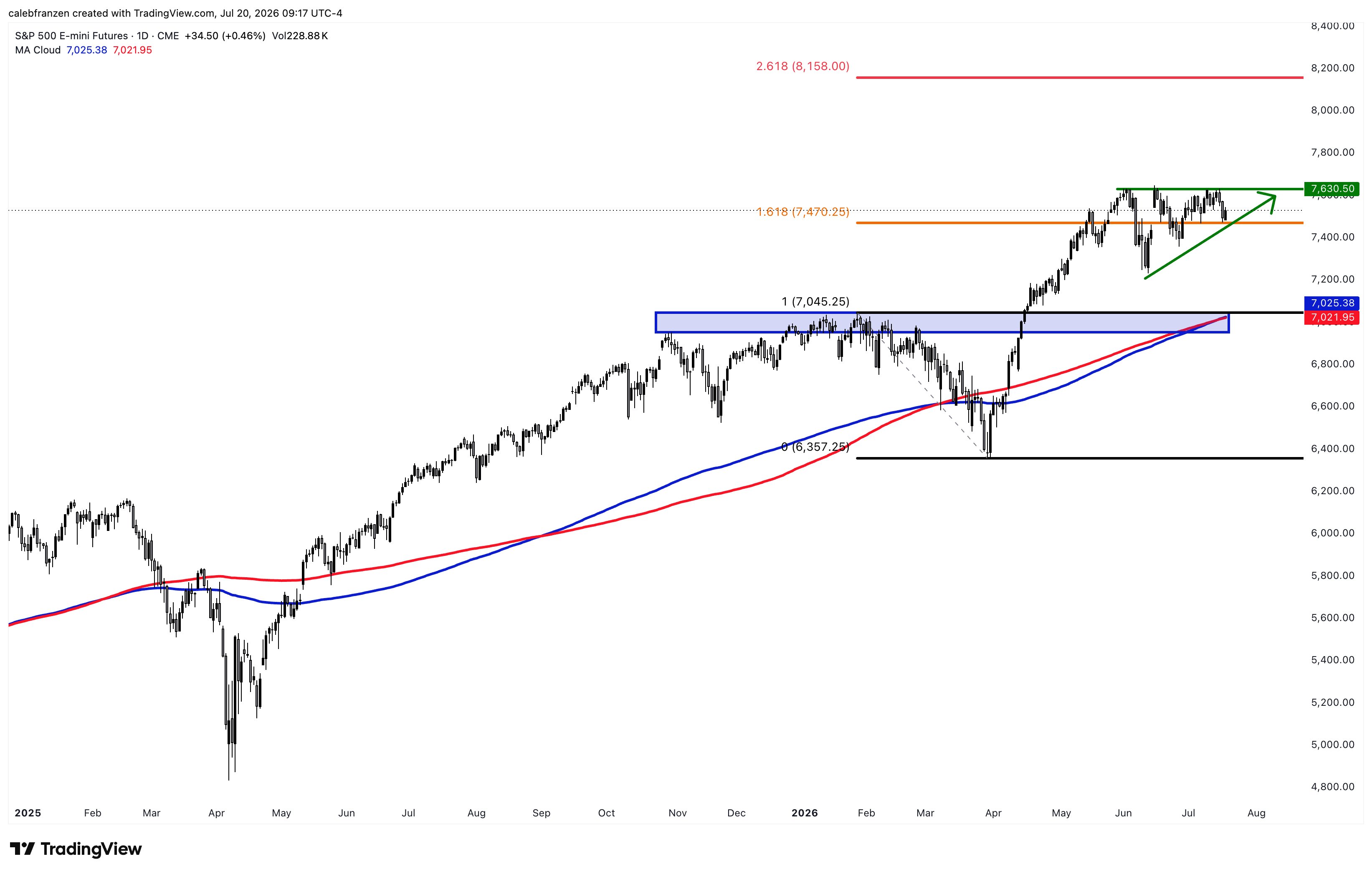
S&P 500 futures one-day chart. Source: Caleb Franzen/X
To be sure, words of caution came from figures such as JPMorgan CEO, Jamie Dimon, who warned that markets were treating current risks too lightly.
BTC price needs 21-week trendline reclaim: Analyst
While some traders looked for a retest of levels up to and including $70,000, Keith Alan, cofounder of trading resource Material Indicators, was conversely cautious on the BTC price outlook.
Related: Trader maintains $67K BTC price target: Five things to know in Bitcoin this week
Despite a “golden cross” involving the 21-day and 50-day simple moving averages (SMAs) on Monday, the bear market, he warned, had gone nowhere.
“Bear Markets don’t always look like Bear Markets, especially in lower timeframes,” he wrote in his latest X analysis.
“The macro trend will be challenged if Bitcoin pushes above the 21-Week SMA. Until that happens, the Bear Market remains intact.”
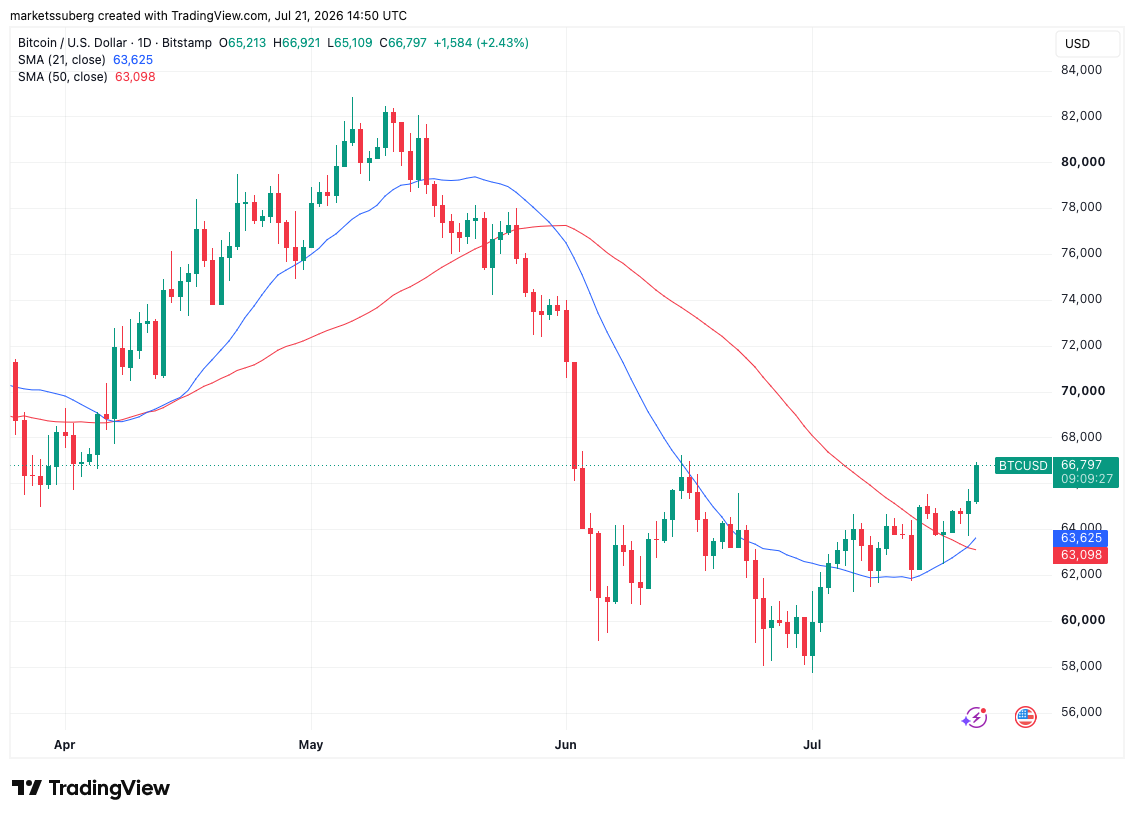
BTC/USD one-day chart with 21-week, 50-week SMA.
Source: Cointelegraph/TradingView
The 21-week SMA stood at $69,720 at the time of writing, coinciding with Bitcoin’s then-all-time high from 2021.
Alan acknowledged that there was “no real resistance” until $67,250.

Europe issues new rules to curb sexualisation of women athletes on TV | Other Sports News

TSMC might set up a price hike that could come straight for your next phone, laptop, or tablet

Aehr Test Systems Stock Soars 26% as AI Chip-Testing Demand Extends Rally After Earnings Beat This Month


-
 NewsBeat5 days ago
London Mayor Sadiq Khan handed a peerage by Keir Starmer alongside 15 other Labour figures… just days before the PM leaves No10
-

 Fashion4 days ago
Weekend Open Thread – Corporette.com
-

 Politics4 days ago
The House | The City of London can help the new chancellor deliver growth in every postcode
-

 Politics7 days ago
Young campaigners urge incoming PM to act on outdoor junk food ads
-
 Crypto World5 days ago
Two July Windows Left: The CLARITY Act’s Senate Fight and What Failure Means
-

 Crypto World6 days ago
CFTC blocks Kalshi from unwinding Michigan trades after court order
-

 Crypto World4 days ago
Ripple Payments Joins MiCA With 14 Firms, Does It Mean Anything For XRP?
-

 Business6 days ago
Nvidia Stock Slips After Big Tuesday Rally as Huang Confirms Vera Rubin Chip Is Now in Production Today
-

 Politics2 days ago
Democrats look to World Cup watch parties to register thousands of voters
-
 Entertainment6 days ago
Disney’s Most Ambitious Failed Star Wars Attraction Is Coming to SDCC
-

 Crypto World4 days ago
Ripple wins EU-wide access as ESMA adds it to MiCA register
-

 Crypto World17 hours ago
Grayscale Files For Worldcoin ETF, WLD Registers Sharp Rise
-

 Crypto World5 days ago
Injective Submits SEC Transfer-Agent Registration to Onchain Ownership Records
-

 Business6 days ago
Palantir Shares Rise After Expanded Nvidia Partnership and Fresh Analyst Upgrades Ahead of Earnings Day
-

 Tech1 day ago
Sail Virtually Aboard The “Itanic” With IA-64 Emulator
-
 Tech22 hours ago
Turtle Beach Command Series KB7 review: a nifty screen-equipped gaming keyboard
-

 NewsBeat5 days ago
Registration is now open for March for Men with Kev 2026
-

 NewsBeat2 days ago
Unregistered fitter used Gas Safe logo on business flyers
-
 Sports6 days ago
New Cornerback Enters Vikings Trade Rumor Mill
-

 News Videos5 days ago
Money | Class 12 Economics | CBSE Board Exam 2026-27
You must be logged in to post a comment Login