
Crypto World
FortisX.fi: Where Professional-Grade Staking Finally Meets Real Liquidity

In a market still obsessed with flashy token launches and unsustainable farming yields, most serious crypto holders quietly face the same frustration: their assets sit idle or locked up in rigid staking positions while network unbonding periods drag on for weeks. FortisX.fi quietly solves that problem with a hybrid model that combines managed staking across major PoS networks and internal liquidity pools that deliver competitive, variable yields without the usual headaches.
Launched as an infrastructure play back in 2018 and now managing over $156 million in allocated assets, FortisX isn’t chasing retail hype. It’s built for long-term holders who want their Bitcoin, Ethereum, Solana, XRP, stablecoins, and a dozen other major assets to actually work—while still being able to access capital when they need it.
Two Paths, One Powerful Engine
FortisX offers two complementary products that run on the exact same data-driven risk and allocation framework. The choice comes down to your time horizon and liquidity preference.
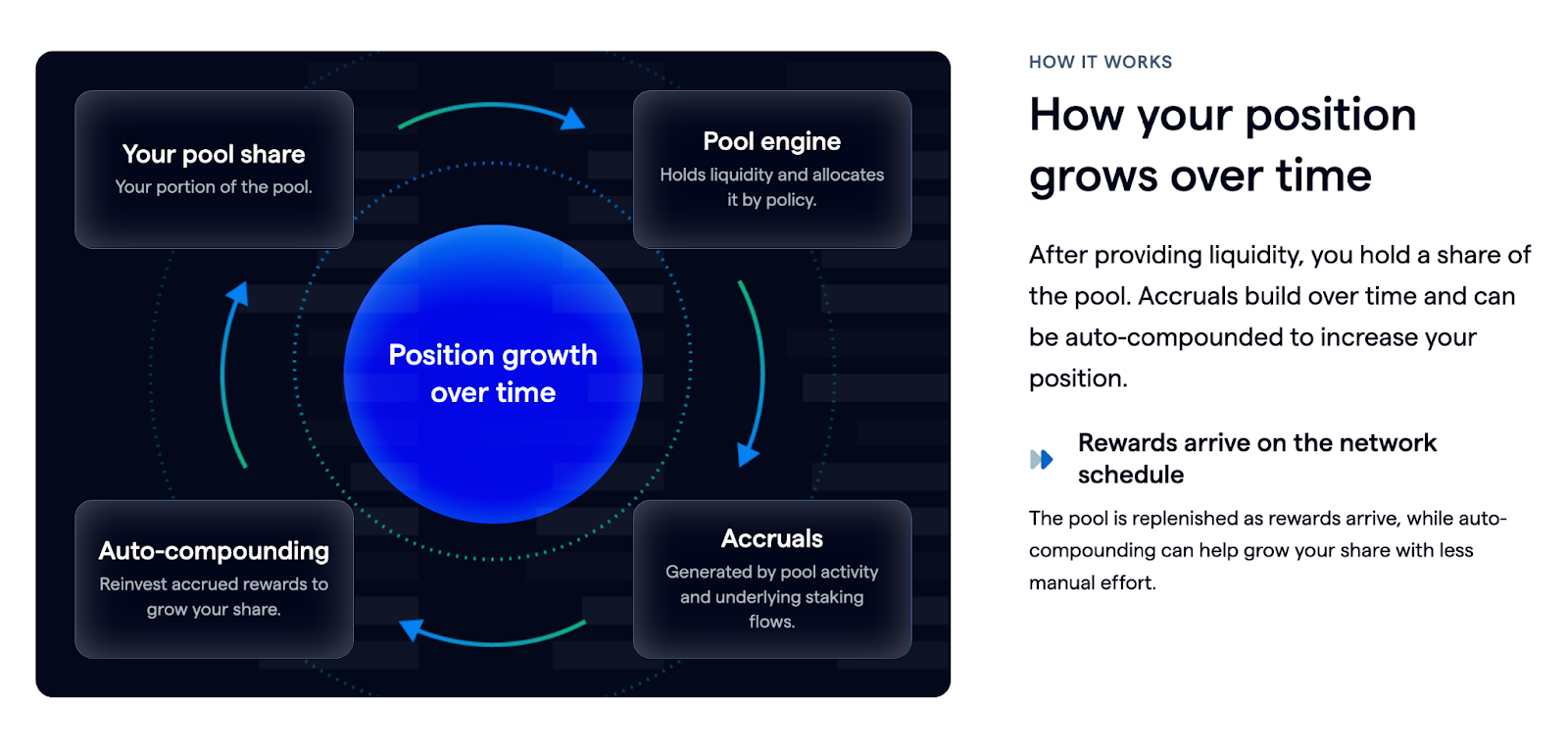
Liquidity Pools are the more dynamic option. You provide liquidity into FortisX’s internal pools, which sit directly on top of the platform’s native staking engine. These pools absorb the timing friction that plagues most Proof-of-Stake networks—Ethereum’s exit queues, Solana epochs, Polkadot’s 28-day unbonding, Cosmos slashing risks, and so on.
The result? Variable yields currently estimated between 8.3% and 27.1% APY (with a median hovering around 18%), paid out from a combination of underlying staking rewards plus operational economics like spreads and fast-exit premiums.
What makes these pools stand out is transparency and flexibility. Yields fluctuate with real pool activity under clearly documented rules rather than opaque black-box mechanics. Withdrawals are available anytime within available liquidity—no forced lock-ups on the platform side.
Popular pools right now include USDT, XRP, ETH, SOL, and several others across 23 supported assets. If you’re a holder who likes the idea of their capital staying productive but doesn’t want to wake up to a 21-day wait to sell during a market move, this is the product designed for you.
Managed Staking, by contrast, targets those who prefer a more passive, network-native approach. The platform allocates your stake across carefully vetted validators using strict diversification policies, real-time on-chain analytics, and continuous risk monitoring.
Current estimated APRs range from 3.8% to 20% depending on the network (Ethereum around 3.76%, Solana ~6.72%, Cosmos up to 19%, etc.), with a median around 6.1%. The engine handles validator performance, concentration risks, slashing probabilities, and network-specific quirks so you don’t have to. An internal liquidity layer still smooths entry, reward payouts, and partial exits where possible, giving it a meaningful edge over raw native staking.
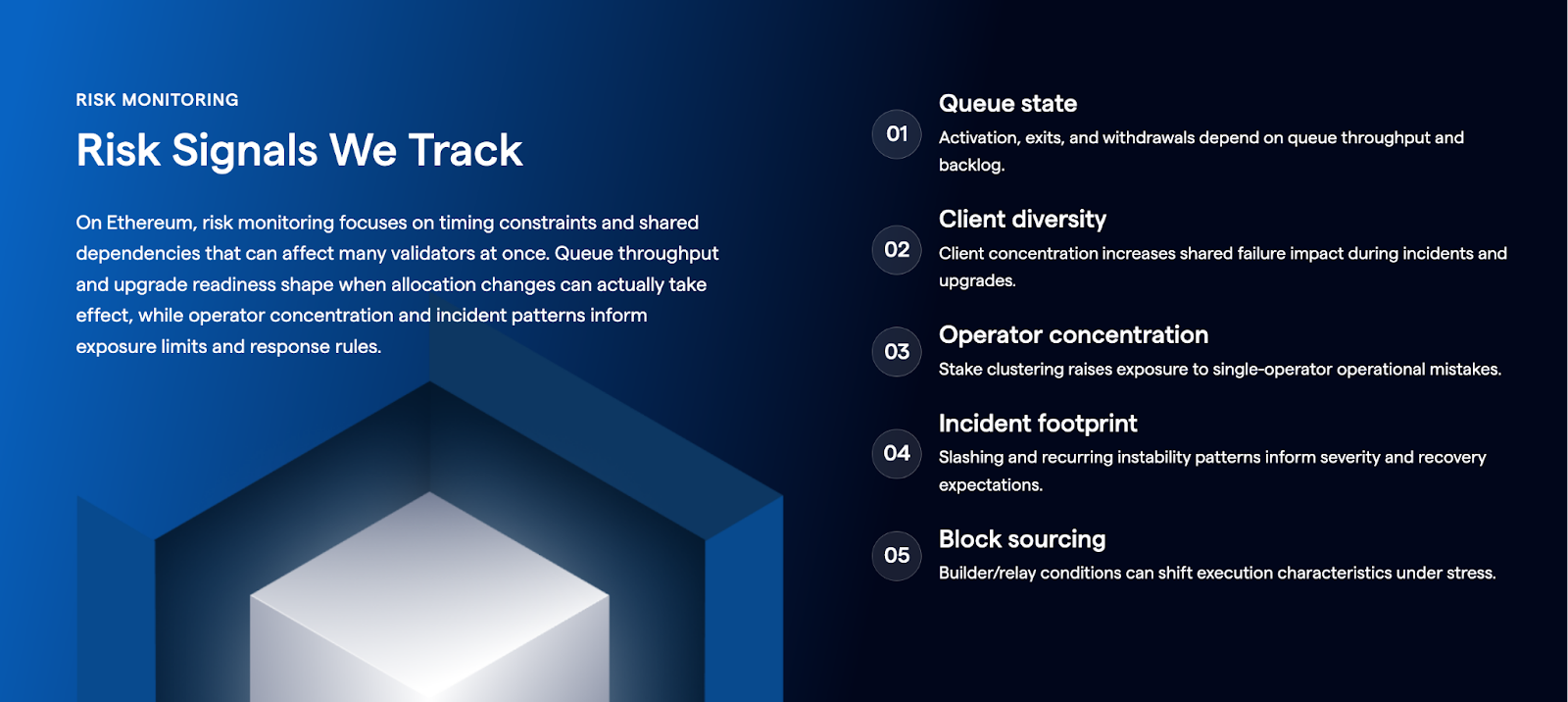
Both products share the same under-the-hood infrastructure: Fireblocks MPC-grade custody (keys never touch the staking operations directly), two independent audits (CertiK and Cyberscope) with all medium and low findings remediated, and a public policy engine that anyone can review.
Built Like Infrastructure, Not Another DeFi Experiment
What separates FortisX from the sea of liquid staking tokens and centralized exchange staking programs is its obsessive focus on operational transparency and risk management. The same analytics engine that powers allocations is exposed via API for developers and institutions. Validator metrics, network fees, block times, active set concentration—everything is visible and rules-based rather than “trust us.”
This isn’t marketing fluff. The platform has been operating since 2018 as a staking infrastructure provider before expanding into user-facing products. In an era where many DeFi protocols have collapsed under the weight of over-leveraged incentives or hidden smart-contract risks, FortisX’s conservative, data-first approach feels refreshingly institutional without being boring.
Compare it side-by-side:
- Native staking: High effort, full network risk exposure, long unbonding periods.
- Exchange staking: Convenient but you’re trusting the platform’s terms and often centralized custody.
- Liquid staking tokens: Great for composability but variable slippage, protocol-specific risks, and sometimes diluted yields.
- FortisX: Combines professional validator management with built-in liquidity and full visibility into the rules.
Why This Matters in 2026
PoS networks now dominate the blockchain landscape for good reason—energy efficiency, real economic security, and sustainable yields. But the average holder still struggles with the practical realities of participation. FortisX removes those friction points without turning yield into a speculative game.
Whether you’re parking stablecoins for steady income, rotating through blue-chip assets like SOL or XRP for higher variable returns, or simply diversifying a long-term portfolio, the platform gives you options that actually match how professional investors think about capital efficiency.
Yields will always fluctuate with market conditions and network activity—that’s the nature of real DeFi. But the combination of audited security, transparent policies, instant-ish liquidity where networks allow it, and a battle-tested team makes FortisX one of the more credible yield solutions available today.
If you’ve been sitting on idle crypto wondering how to put it to work without sacrificing sleep, FortisX.fi deserves a serious look. Head over to the site, explore the pools or staking dashboard, and see how the numbers stack up against your current setup. In a market that rewards patience and infrastructure over hype, this is the kind of quiet utility that actually compounds.
The post FortisX.fi: Where Professional-Grade Staking Finally Meets Real Liquidity appeared first on BeInCrypto.



South Korea’s financial regulators have ordered all domestic crypto exchanges to adopt a single, strict system for delaying withdrawals, aiming to block a surge in voice phishing scams that rely on speed.
The Financial Services Commission and Financial Supervisory Service announced the new rules, removing the discretion exchanges once had to let users bypass holding periods, local news outlets report.
In the past, platforms set their own exceptions to keep trading fast. Fraud groups learned those rules and coached victims to slip through them.
Voice phishing scams often push victims to convert cash into crypto and send it out within minutes. A delay, even a short one, can interrupt the scam by giving victims time to reconsider or allow alerts to surface before funds leave an account.
Under the new system, exchanges must apply the same criteria when reviewing withdrawal exceptions. These include account history, transaction patterns and sudden changes in behavior. Officials expect fewer than 1% of users will qualify for instant withdrawals. Platforms must also tighten identity checks and monitor fund flows more closely.
The move marks a shift from industry-led safeguards to a national standard.
In other markets such as the U.S. and Europe, withdrawal holds are common but set by individual firms. Some exchanges even let users set their own timelocks to prevent unwanted withdrawals.
The South Korean regulators did not immediately respond to CoinDesk’s request for further comment.
Crypto World
Alibaba (BABA) Shares Surge Nearly 8% Following Major AI Data Center Unveiling in China

Key Highlights
- Alibaba partnered with China Telecom to unveil a 10,000-chip AI computing facility in Shaoguan, Guangdong, utilizing Alibaba’s proprietary Zhenwu processor technology.
- This facility represents the first large-scale deployment of Zhenwu chips in China’s Greater Bay Area, capable of handling AI model training with parameters reaching hundreds of billions.
- Performance metrics show 30% improved training and inference efficiency, with individual card throughput jumping nearly tenfold compared to earlier technology.
- Expansion plans call for scaling the facility to 100,000 chips, while smaller enterprises can access computing resources through China Telecom’s service platform.
- This deployment comes after a comparable 10,000-chip Huawei Ascend 910C facility began operations in Shenzhen the previous month.
Alibaba (BABA) and China Telecom have unveiled a massive AI computing facility featuring 10,000 chips in Shaoguan, located in Guangdong province. The infrastructure relies exclusively on Alibaba’s proprietary Zhenwu AI processors, which were engineered by the company’s T-Head semiconductor division.
Alibaba Group Holding Limited, BABA
This unveiling represents a milestone as the largest Zhenwu chip deployment to date within the Greater Bay Area region. According to Alibaba Cloud, this initiative signals a transition in China’s AI computing landscape “from achieving high-end performance milestones to widespread industrial adoption.”
The facility employs an advanced high-performance networking framework that enables all 10,000 processors to function as a unified supercomputing system. Alibaba reports this configuration achieves 30% greater training and inference efficiency, while individual card throughput shows nearly a tenfold improvement over previous-generation systems.
The infrastructure supports training for AI models containing hundreds of billions of parameters — positioning it alongside the most sophisticated AI development projects worldwide.
The system maintains a latency level of 4 microseconds, which Alibaba credits to the sophisticated networking framework connecting the processors. This metric is critical for enterprise AI applications where rapid response times are essential.
Beijing’s Drive Toward Indigenous AI Computing Infrastructure
This launch aligns with a comprehensive national initiative. Beijing incorporated intelligent computing infrastructure into its 15th five-year strategic plan last month, while an AI action blueprint from the State Council issued in August emphasized optimized expansion of computing capabilities nationwide.
By the conclusion of June last year, China’s aggregate computing capacity reached 962,000 petaflops — representing 21% of global capacity, marking a 73% year-over-year increase, based on data from the China Academy of Information and Communications Technology.
The Shaoguan facility has already been implemented in healthcare and advanced manufacturing applications. Small and medium-sized enterprises can obtain computing access via China Telecom’s platform, with flexible pricing options based on card usage or hourly rates.
Alibaba has also revealed intentions to expand the facility from 10,000 to 100,000 chips. This expansion strategy targets cost reduction and enhanced resource utilization.
Industry Context: Huawei and China’s Semiconductor Competition
This announcement follows a comparable achievement from the previous month, when China’s inaugural 10,000-card intelligent computing facility — utilizing Huawei’s Ascend 910C processors — commenced operations in Shenzhen.
That facility delivers 11,000 petaflops of computing power and has been integrated with another 3,000-petaflop facility activated in 2024. Shanghai is simultaneously developing a 10,000-card facility through an INESA state-owned subsidiary, designed for compatibility with various domestic processor architectures.
While Chinese processors continue to lag behind Nvidia in individual performance metrics, Beijing’s approach emphasizes large-scale cluster infrastructure and optimized networking to narrow the performance differential.
U.S. export controls on Nvidia processors have expedited China’s domestic semiconductor development trajectory. Alibaba’s T-Head division has played a pivotal role in this effort, alongside Huawei.
BABA shares advanced 7.79% on the announcement day, with after-hours trading adding another 0.82% to its Hong Kong-listed shares (728-HK).

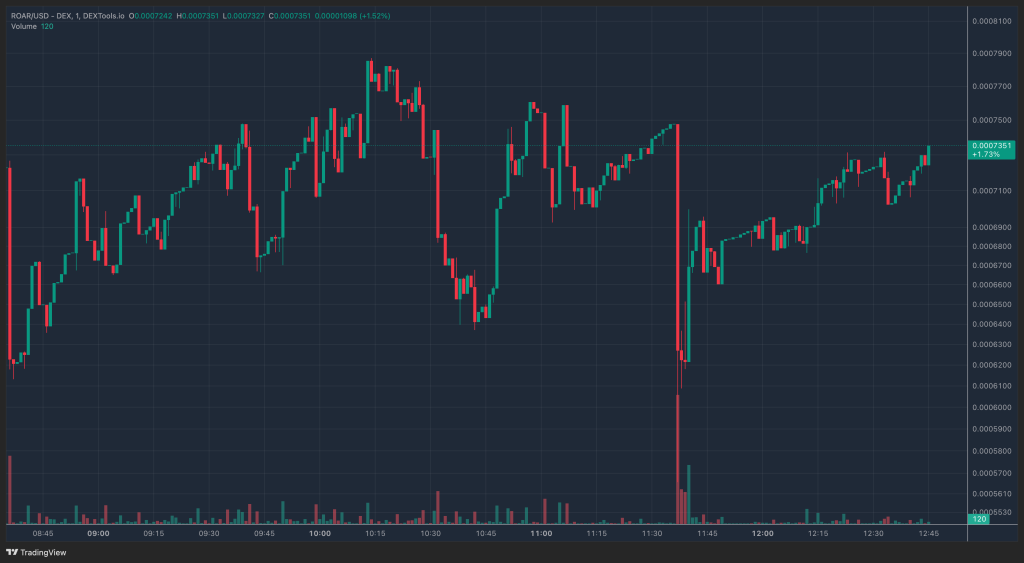
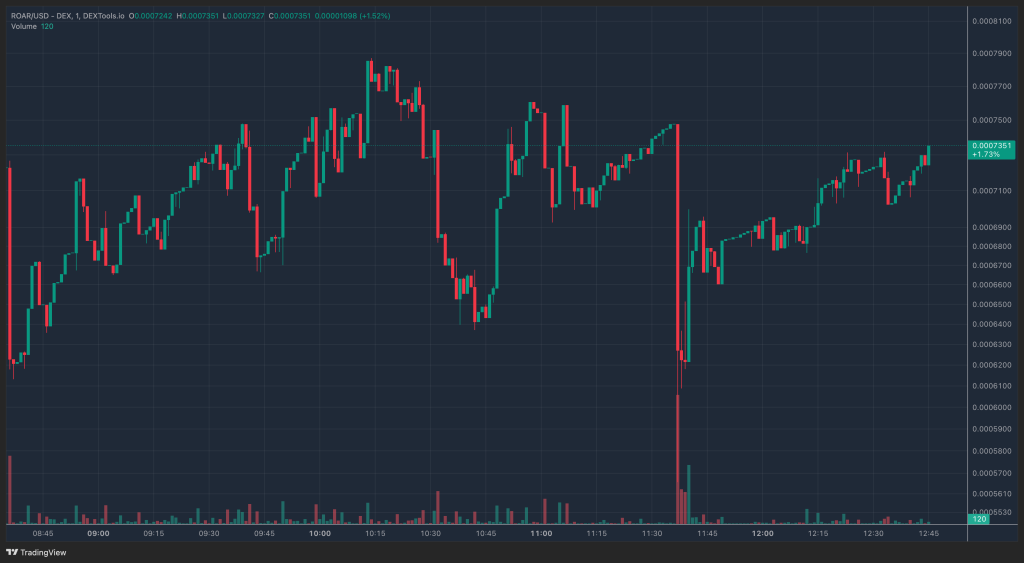
The Russian Oil Asset Reserve, known by its ticker symbol ROAR crypto, is a new meme coin token launched on the Solana blockchain in early April 2026.
It operates as a narrative-driven meme coin rather than a traditional financial instrument, with its primary appeal rooted in geopolitical storytelling around Russian energy dominance.
Marketed as a “sovereign energy protocol,” ROAR positions itself at the intersection of cryptocurrency and global oil markets, using dramatic imagery of Siberian crude reserves, pipelines, OPEC influence, and a rising Eastern alliance to attract traders seeking the next big hype cycle.
The token trades primarily on decentralized exchanges such as Meteora and other Solana-based platforms, has a fixed supply of roughly 1 billion tokens, and has no major centralized exchange listings.
At first glance, it seems harmless. But there is much to uncover about why to stay away from this coin.
What is Russian Oil Asset Reserve (ROAR Crypto)?
ROAR’s promoters paint an enticing picture. Official-looking websites describe the token as “backed by real Siberian energy in the new world order,” claiming that each unit is “conceptually pegged” to verified Siberian crude reserves and that holders gain “direct exposure to the most powerful commodity on Earth.”
Social media campaigns and influencer videos have amplified this narrative, sometimes falsely suggesting that Russian leadership or state entities are behind the project, complete with AI-generated clips purporting to show high-level endorsements.

However, these claims collapse under scrutiny. ROAR is not backed by any physical oil reserves, nor is it redeemable for barrels of Siberian crude or any other tangible commodity.
There is no legal mechanism, escrow, or audited collateral tying the token’s value to actual energy assets; the “conceptual peg” is purely marketing language with zero enforceable backing.
Independent analyses, including one of the project’s own secondary websites, explicitly state that it is a “speculative digital asset on the Solana blockchain” and “not backed by physical oil reserves or any government entity.”
Who Is Behind ROAR Crypto?
This is the exact same campaign and method that was used for previous tokens like United States RX, Golden Dome, and US Oil Reserve crypto.
All these tokens claimed to be backed by officials, but all turned out to be scams and went to zero later. This is probably the same or multiple teams following the same playbook.
They create a token, pay promoters across Instagram, TikTok, and other social platforms to push short videos and reels, and that is likely how you ended up hearing about it.
ROAR crypto is almost certainly a rug-pull scam or, at best, a low-effort meme coin riding on political sentiment, and you probably should stay away. Be aware and always DYOR.
Oil Prices Drop Amid Iran Ceasefire, Bitcoin Gains: Is New Layer 2 Bitcoin’s ROAR Crypto?
Here’s the honest tension with ROAR crypto at current levels: the upside to fair value is roughly 15–35% from here, maybe a rug pull. That’s a solid return, but it’s a very different risk profile than catching an asset at its earliest stage. Traders who rode HYPE from its lows have already captured the outsized gains.
That dynamic is exactly what’s drawing attention to Bitcoin Hyper, a presale project positioning itself as the first-ever Bitcoin Layer 2 with SVM integration, bringing Solana Virtual Machine speed and smart contract capabilities directly to the Bitcoin ecosystem without sacrificing Bitcoin’s security. The pitch for Hyper crypto is infrastructure-level: breaking Bitcoin’s three core limitations of slow transactions, high fees, and limited programmability, all at once.
The numbers are already moving. Bitcoin Hyper has raised more than $32M at a current presale price of $0.0136782, with staking rewards available to early participants. Features include sub-second transaction finality, a Decentralized Canonical Bridge for seamless BTC transfers, and low-cost smart contract execution. Recent coverage has flagged the project as one gaining traction alongside the ROAR crypto narrative.
Visit the Bitcoin Hyper Presale Website Here.
The post What Is Russian Oil Asset Reserve? Is ROAR Crypto The Next Big Thing Or Scam? appeared first on Cryptonews.


- Solana price has gained in the past 24 hours as Bitcoin retests $72,000.
- The SOL token could rally to $150 amid the US-Iran ceasefire.
- However, continued weakness could allow bears to target $70 or lower.
Solana’s latest rebound has revived bullish speculation, with decent gains aligning with an uptick for risk asset markets.
As traders digest the impact of easing geopolitical tensions amid the ceasefire between the US and Iran, the key question is whether a shift in sentiment could propel Solana to its year-to-date highs of $150.
Solana eyes $90 as geopolitical risk cools
As noted, the broader cryptocurrency market pushed higher overnight Tuesday after US President Donald Trump announced a two‑week ceasefire deal with Iran.
The news has eased fears of a deeper regional conflict, with the Pakistan‑brokered talks coming ahead of a 48‑hour deadline set by Washington.
Stocks and cryptocurrencies rose as risk sentiment changed from defensive positioning to an aggressive hunt for upside exposure.
The sharp gains saw more than $425 million in short positions liquidated in the past 24 hours, with over $100 billion added to the global crypto market capitalization.
Bitcoin edged above the $72,000 mark, and Ethereum climbed to $2,270, boosting altcoins as traders rotated capital back into major tokens and high‑beta plays. Solana’s upswing had SOL advancing to above $86.
The move toward $90 erases part of last week’s drawdown that followed the Drift Protocol exploit.
SOL price analysis
While SOL’s percentage gains pale in comparison to intraday moves of Zcash, Bittensor, and LayerZero, the uptick was still significant from a market‑structure point of view.
The recovery helped re‑establish a higher trading range, suggesting that the worst of the exploit‑driven capitulation may be over if the ceasefire holds and broader crypto inflows continue.
On the charts, SOL has recently been shadowed by a developing bear flag formation.
The classic chart pattern usually signals downside continuation if a clean break occurs, and its formation had bears threatening a drop back toward the $70 region.

The bounce to near $90 is crucial even as the bearish structure remains.
If bulls can consistently defend the $80-$85 band and convert the area into a solid demand zone, the next immediate resistance is likely to emerge around $95-$100.
This is where prior supply and key moving averages converge, and a breakout could pave the way for a higher resistance cluster in the $120-$135 zone.
Bulls can target January 2026 highs near $150.
However, if buyers fail to break and hold above the $90 level, the technical backdrop would increasingly favor an extension of the downtrend.
This outlook exposes SOL to renewed downside pressure toward $70, with critical support near $54.
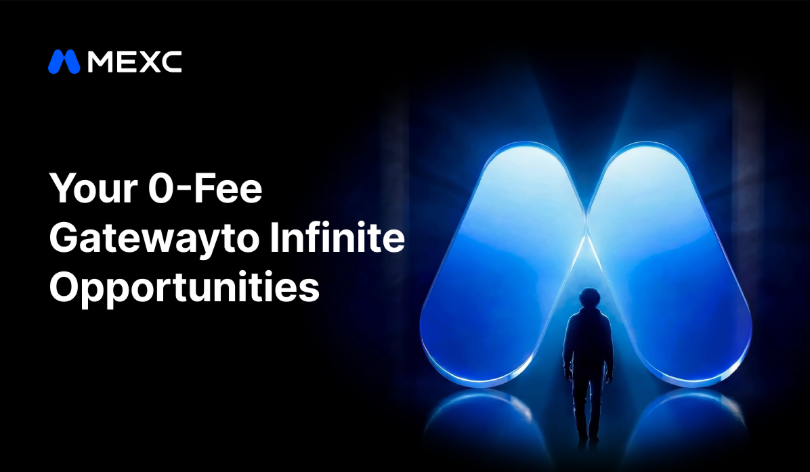
MEXC, one of the world leaders in 0-fee digital asset trading, today announced a comprehensive brand upgrade to mark its 8th anniversary. This milestone transformation signals MEXC’s evolution from a traditional exchange into a universal gateway for global markets, built on the two core pillars of “0 Fees” and “Infinite Opportunities”.
The walls between asset classes—crypto, equities, and commodities—begin to collapse into a single, continuous global trading system, yet rising fees and friction have restricted user access. MEXC directly addresses this imbalance, aiming to make global opportunities more accessible regardless of geography or capital. MEXC prioritized product strength and a “0 Fee” model. Backed by a team of 2,000 professionals, the platform is advancing its infrastructure through AI-driven tools and enhanced transparency standards — further lowering barriers and expanding access for traders worldwide.
At the center of this brand upgrade is MEXC’s newly introduced logo — a symbol of openness and access. Evolving from the brand’s core “M” into a simpler and more fluid symbol of the new MEXC. This visual transformation represents four key pillars of MEXC evolution.
- More Possibilities – Its shape echoes infinity, representing MEXC’s commitment to unlocking more assets, more products, more market access, and more possibilities for users worldwide. This reflects MEXC’s belief that opportunity should not be limited by entry barriers, product access, or user stage.
- More Accessible – Its dual form can also be interpreted as two zeros, reflecting MEXC’s 0 Fee philosophy. More than a pricing message, these two zeros symbolize MEXC’s effort to remove barriers and make opportunities more accessible and actionable for every user.
- More Open – The new MEXC logo evolves from the brand’s core “M” into a simpler, more fluid, and more open symbol of the new MEXC. It preserves the brand’s familiar identity while expressing a new stage of growth — one that is more modern, more global, and more user-centered.
- More Connected – At the same time, the logo’s connected and open structure expresses MEXC’s role as a Trusted Global Gateway — a platform built to connect users to broader markets and broader opportunities through a more seamless, user-centric experience, supported by reliable infrastructure across the world.
MEXC believes opportunities should be open to everyone, and has built MEXC to be commended as your 0-fee gateway to infinite opportunities.
- Beyond Pricing: 0 fees is a structural commitment to remove one of the biggest barriers in trading.
- Shared Value: In the past year alone, MEXC 0-fee model has returned more than $1 billion to our users. This is not a short-term campaign, but a fundamental shift in how value is created and shared.
- Unified Access: “Infinite opportunities” means giving users broader, simpler access to global markets. Whether it is crypto, US stocks, MT5-based assets, or prediction markets, users can act on opportunity through one account and one gateway
As the industry enters a new phase where markets converge and access becomes the defining advantage, MEXC is accelerating its mission to become the infrastructure layer connecting users to global opportunities and setting a new standard for exchanges — where trust is as critical as performance, and users remain at the center of the ecosystem.
About MEXC
MEXC is the world’s fastest-growing cryptocurrency exchange, trusted by more than 40 million users across 170+ markets. Built on a user-first philosophy, MEXC offers industry-leading 0-fee trading and access to over 3,000 digital assets. As the Gateway to Infinite Opportunities, MEXC provides a single platform where users can easily trade cryptocurrencies alongside tokenized assets, including stocks, ETFs, commodities, and precious metals.
MEXC Official Website| X | Telegram |How to Sign Up on MEXC
The post MEXC Brand Upgrade: Infinite Opportunities with 0 Fees appeared first on BeInCrypto.


BlackRock’s BUIDL token on Ethereum has exceeded $1 billion in market capitalization, up approximately 115% year-to-date.
BlackRock’s BUIDL token on Ethereum has surpassed $1 billion in market capitalization, achieving roughly 115% gains year-to-date as of April 6, 2026. The milestone marks significant growth for the tokenized fund product since the start of 2026.
BUIDL represents BlackRock’s foray into on-chain tokenized assets, offering exposure to short-duration U.S. Treasury bills and cash equivalents on the Ethereum blockchain. The token’s market cap growth reflects broader institutional adoption of blockchain-based financial products.
Sources: Token Terminal
This article was generated automatically by The Defiant’s AI news system from publicly available sources.
Vugar Usi, the newly appointed CEO of MEXC, has a provocative explanation for the collapse in memecoin trading: the tokens didn’t lose their appeal, the rest of the financial system caught up to them.
Gold moves on a Trump tweet. Oil spikes on a geopolitical rumor. Equities swing on a single Fed headline.
“Everything has kind of become a meme at this point,” Usi said in an interview with CoinDesk.
“Meme coins were driven by social sentiment, virality, speculation,” he continued, adding that today one of “President Trump’s tweets does all these three.”
That thesis underpins his plan to reposition MEXC, long synonymous with memecoin speculation, into a broader “trade everything” platform spanning tokenized equities, commodities and prediction markets, built around a retail base that accounts for roughly 98% of activity by his estimate.
“It’s very funny to see that memecoins today are fighting for the same attention that gold and silver does,” Usi said.
The bet is that retail doesn’t need replacing with institutional flow, it needs more things to speculate on.
Usi points to prediction markets, where traders bet on the outcome of events rather than the price of assets, and to political announcements that move commodities and equities before most of the market has time to react — what he describes as trading by people “who have their close proximity to the news.”
The whole thesis hinges on whether retail is fading or simply migrating to whatever asset is most volatile at any given moment.
Betting against the institutional pivot
That view puts MEXC on a different trajectory from its largest competitors.
Binance, OKX, and Bybit have spent the last two years courting institutional liquidity, building out derivatives desks, and positioning for the ETF-driven flows that increasingly dominate bitcoin’s price discovery.
Usi, a Bitget veteran who helped scale that exchange to the world’s fourth-largest before joining MEXC, is betting in the opposite direction. At Bitget, he said, roughly 80% of trading volume came from institutions. At MEXC, it is almost entirely retail, and he wants to keep it that way.
“Retail is our bread and butter,” Usi said, framing MEXC’s zero-fee model — which he claims returned $1.1 billion to users in 2025 — as the real marketing engine, in contrast to the Messi endorsements and Formula One sponsorships that defined his previous employer’s rise.
His plan is to extend that model across asset classes, adding tokenized stocks, gold, silver, prediction markets, and eventually card and earn products, positioning MEXC less as a crypto exchange than as a retail-first Robinhood competitor operating offshore taking cues from Asia’s superapps.
Fixing failures
The harder question is whether MEXC can expand without tripping over the regulatory problems that have plagued it over the past few years.
MEXC spent much of 2025 managing fallout from the so-called White Whale incident, in which a pseudonymous trader alleged that $3 million of his funds had been frozen under opaque risk-control rules.
After months of public pressure, MEXC’s chief strategy officer Cecilia Hsueh issued a public apology in October, acknowledging that the company’s “risk, operations, and PR teams have not kept up” with its growth.
“We fucked up. We apologize to The White Whale, and his money is already been released. He can claim it at any time,” Hsueh wrote on X.
Data shows that withdrawals from MEXC surged in the aftermath and remain elevated throughout 2025. But, in the last few months, that trend has reversed.
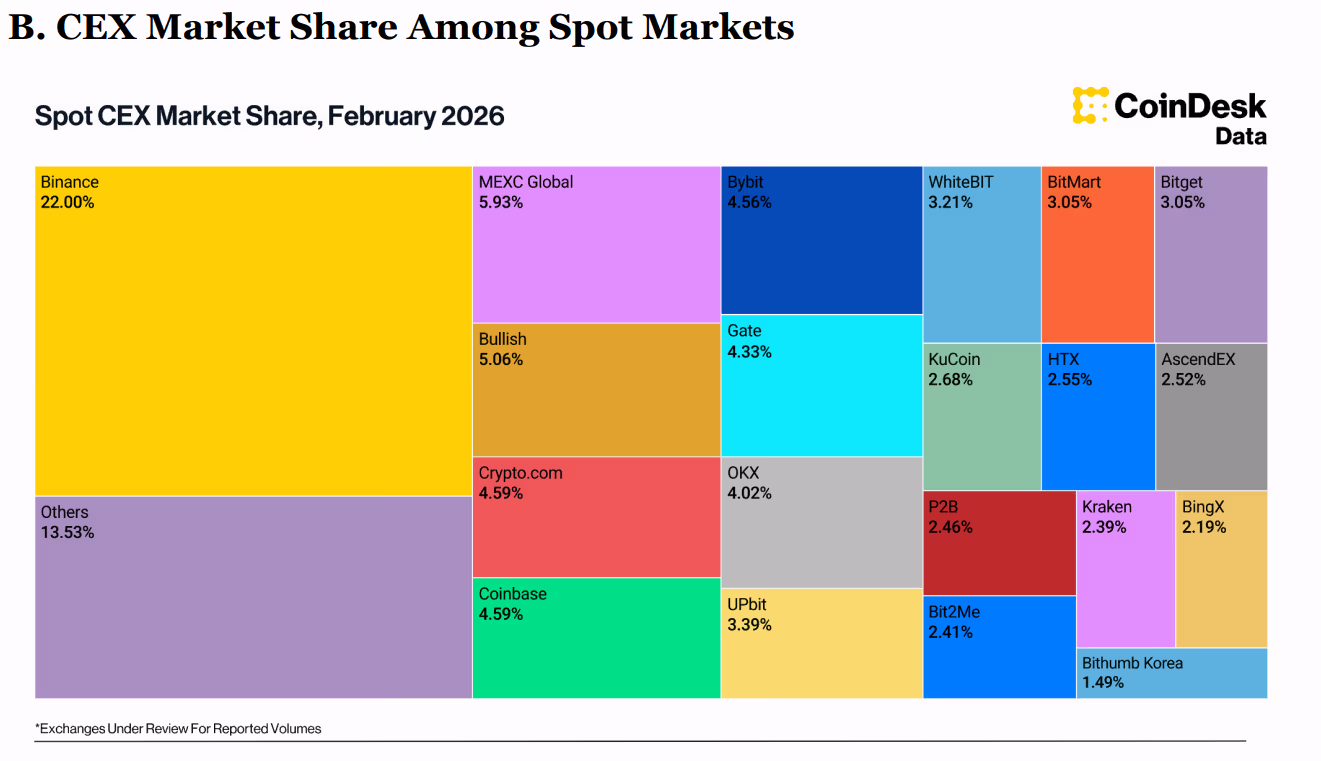
Data from CoinDesk Research shows MEXC commanded second place in exchange volume at the end of 2025 with a 5% market share, while CoinGecko highlights its 90% growth in volume throughout the year.
“MEXC commands a high market share despite falling in the lower-tier category (grade C). This continues to underline the disconnect between volume capture and assessed risk/compliance among certain venues,” a CoinDesk data exchange benchmark report from November reads.

Compliance readiness was “one of the key missing points in MEXC’s growth,” Usi told CoinDesk.
He said the exchange has “kick-started” conversations with regulators across Europe, the Middle East, and Southeast Asia, with the goal of building a platform that is “more transparent, more compliant.”
On a potential U.S. entry, even in the event the CLARITY Act passes, he was noncommittal, calling the market “expensive and complex.”
That hesitation reflects a deeper constraint: the speed, extreme listing breadth, and minimal friction that powered MEXC’s rise are the same traits that draw regulatory scrutiny, leaving it to pursue a global “everything app” strategy without the licenses, banking rails, or institutional clients its competitors are building around.
Can MEXC add guardrails without losing its edge?
There’s a certain kind of crypto trader that loves everything MEXC is and would hate to see it change.
The question is whether MEXC can clean up its model without losing the memecoin chaos that made it work.
Or, is that even necessary? Data shows that MEXC’s growing loyal traders might not care.
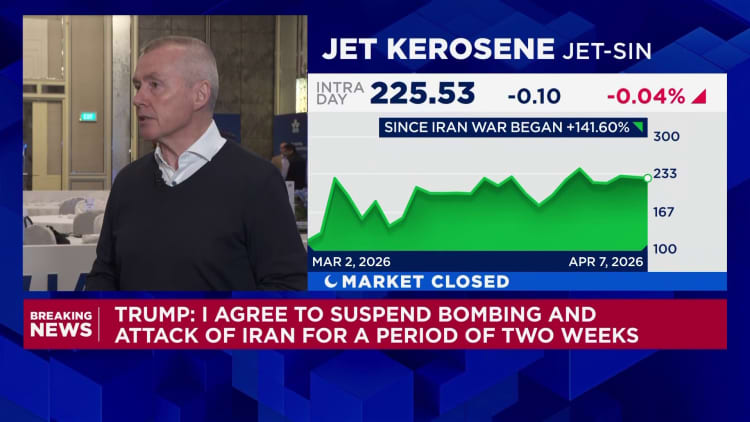
Bridgewater founder Ray Dalio speaks in Shanghai on April 8, 2026.
CNBC
SHANGHAI/BEIJING — Hedge fund magnate Ray Dalio is optimistic that a highly anticipated meeting next month of the U.S. and Chinese presidents can go a long way toward soothing bilateral tensions.
“The next meeting will have a particular emphasis on trade, but also capital flows,” the founder of Bridgewater Associates told CNBC’s Eunice Yoon on Wednesday in Shanghai.
Dalio said he expected the two leaders to demonstrate “empathy” and work through challenges together. “Investors should be encouraged by these things,” he said, noting it “carries through” to investments and markets.
While the three major U.S. averages have rebounded from losses during trade tensions about a year ago, the S&P 500 is still down more than 3% so far this year, due in part to concerns stemming from the Iran war.
U.S. President Donald Trump is scheduled to visit Beijing on May 14 and 15 to meet with Chinese President Xi Jinping. Trump was originally set to travel in late March, but delayed the plans due to the Iran war.

Lack of contact between the U.S. and China is “the biggest source” of bilateral tensions, said Dalio, wearing a pin bearing both the U.S. and Chinese flags.
He was in Shanghai for a ceremony marking the end of a 10-day ocean exploration voyage that was organized by his non-profit OceanX and U.S. and Chinese groups to support bilateral relations. Dalio founded OceanX in 2016 with his son Mark to promote exploration and stewardship of ocean resources.
The U.S. consul general in Shanghai and a vice mayor of the Chinese city also attended the Shanghai event. Ten students from each of the two countries participated in the trip, which started in Hong Kong.
The “Chinese-American relationships and the oceans are the two most important things for the well-being of humanity,” Dalio said.
As U.S.-China tensions escalated over the years, climate has been widely seen as a rare area of cooperation between the two countries.
A Trump-Xi meeting next month could be the first of four times the two leaders see each other in person this year, Dalio noted. The “world order’s changing and these two leaders need to discuss how best to approach that,” he added.
The presidents of the world’s two largest economies met in South Korea last fall, where they agreed to lower tariffs for one year. Beijing also postponed implementation of stricter rare earth export controls by the same period.
When asked about the Iran war and Trump’s two-week ceasefire announcement, Dalio emphasized that investors should look beyond the “news of the day” and said a “world war of sorts is going on.” In a LinkedIn post published Tuesday, he said the current combination of military confrontations, geopolitical and economic tensions bore comparison to past world wars.
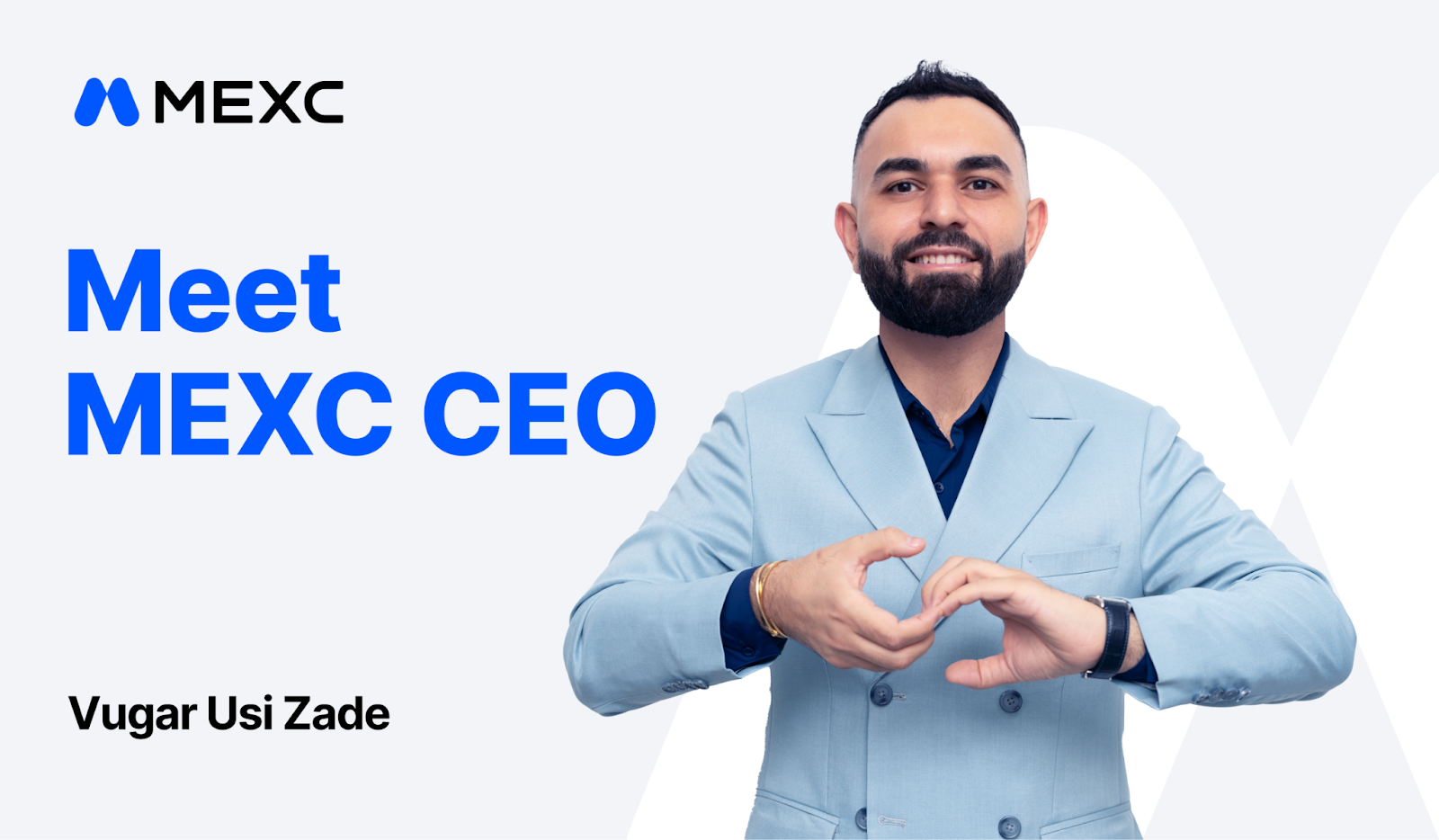
MEXC, one of the world leaders in 0-fee digital asset trading, has announced the appointment of Vugar Usi as Chief Executive Officer. This transition, coinciding with MEXC’s 8th Anniversary, initiates a strategic brand evolution, signaling MEXC’s commitment to accelerating international expansion, cementing its user-centric philosophy, and driving its ‘Infinite Opportunities’ vision forward.
Driven by a commitment to user-led global expansion, MEXC has undergone a comprehensive operational transformation over the past year. As the company marks eight years of innovation, it established itself as one of the world’s top five exchanges by trading volume and the fastest-growing exchange of 2025, achieving a 90.9% year-on-year increase according to CoinGecko. In tandem with this rapid scale, MEXC has fortified its risk-control frameworks, embedded transparency throughout its operations, and implemented cultural and strategic reforms. Navigating the next tier of global leadership now demands an executive defined by profound industry conviction and operational excellence, rather than conventional credentials.
Vugar Usi brings more than a decade of high‑growth, transformational experience across Fortune 500 companies and leading Web3 platforms—including his role in scaling Bitget into a top‑tier exchange. As MEXC’s COO, he led initiatives to deepen transparency and enhance risk management. With this track record, he now steps into the CEO role to advance the company’s vision fully, decisively and swiftly.
Under Usi’s leadership, MEXC will expand what “Infinite Opportunities” means in practice. The platform is moving beyond crypto to offer MT5‑based assets and prediction markets — giving users a single destination to trade everything that matters to them. This sits alongside 0-fee trading, which removes one of the biggest friction points for everyday traders. In the past year alone, our zero-fee model has returned more than $1 billion to our users. Zero fees is a structural commitment to remove one of the biggest barriers in trading.
“What drew me to MEXC was the product,” Usi said.
“Even before joining, I saw an exchange that was faster, smoother and more responsive than its peers. That user‑centric approach is woven into everything from 0-fee trading to decisions that put real users ahead of institutions. Rooted deeply in the philosophy of ‘Infinite Opportunities’ is the belief that every trader, regardless of geography or starting capital, deserves meaningful access to the power of crypto.”
“To mark this eight-year milestone and strategic transformation, MEXC has also unveiled a new logo and brand that reflects its strategic transformation. The design evolves from the brand’s core “M” into a simpler and more fluid symbol. Its shape echoes infinity, representing “Infinite Opportunities” for users worldwide, while its dual form can also be seen as two zeros, reflecting MEXC’s “Zero Fee” commitment.”
Usi’s background in public policy will help advance MEXC’s global compliance readiness and regulatory alignment. He intends to institutionalize higher standards of governance, security and accountability to ensure the platform operates transparently, particularly as MEXC scales into new asset classes, including equities and multi‑asset derivatives. The company will continuously refine its control frameworks as user needs evolve, keeping the protection of customer funds non‑negotiable.
“MEXC is the dark horse of this industry, consistently outperforming competitors who focus on marketing over product,” Vugar concluded.
“We win through product strength, competitive fees and genuine community engagement. Having served as MEXC’s Chief Operating Officer, I take on the CEO role with a clear mandate to accelerate our commitment to transparency and user‑centric innovation. Our philosophy is right, our product is strong, and we are moving forward with confidence.”
As CEO, Vugar Usi will scale global operations, strengthen MEXC’s user‑first “trade‑everything” platform, deepen regulatory engagement and enhance risk management to reinforce the exchange’s position as an accessible platform of choice for traders worldwide.
For more insight from Vugar , visit the CEO letter here.
About MEXC
MEXC is the world’s fastest-growing cryptocurrency exchanges, trusted by more than 40 million users across 170+ markets. Built on a user-first philosophy, MEXC offers industry-leading 0-fee trading and access to over 3,000 digital assets. As the Gateway to Infinite Opportunities, MEXC provides a single platform where users can easily trade cryptocurrencies alongside tokenized assets including stocks, ETFs, commodities, and precious metals.
MEXC Official Website| X | Telegram |How to Sign Up on MEXC
The post MEXC Appoints Vugar Usi as CEO to Drive Global ‘Infinite Opportunities’ Vision appeared first on BeInCrypto.

Three wallets. Half a million dollars. Zero prior on-chain history. The pattern on Polymarket US-Iran ceasefire market is raising the insiders questions that don’t have clean answers, and the blockchain receipts are already public.
Crypto markets absorbed the ceasefire news with a sharp Bitcoin spike toward $71K, but the real story may be what happened on Polymarket hours before Trump posted anything.
So this Guy on Polymarket put 10K$ on Iran USA ceasefire the same day at average of 2.8¢ — Baba Cryptonath
And walked away with $450,000 pure profit
Insider Trading or pure luck? pic.twitter.com/0vRGwnpHPN
 (@BabaCryptonath) April 8, 2026
Blockchain analytics firm Lookonchain flagged three newly created wallets that collectively profited $484,575 betting “yes” on the “US x Iran ceasefire by April 7” market, with entry probabilities ranging from just 2.9% to 10.3%. The wallets were created and funded on Tuesday with no prior on-chain activity before placing their bets.
Discover: The best pre-launch token sales
Polymarket Insiders Allegations
Individual profits broke down as $200,525, $158,600, and $125,450. One trader’s first transaction hit the market at 1:59 pm UTC on Tuesday, just 8.5 hours before Trump confirmed the deal on Truth Social at 10:32 pm UTC. The other two entered at 10:01 am UTC Tuesday and 8:50 pm UTC Monday, respectively.
This isn’t the first time suspicious Polymarket accounts have surfaced around geopolitical outcomes. Anonymous wallets previously netted roughly $400,000 on US-Venezuela events under similar circumstances.
The ceasefire market logged $60 million in 24-hour volume and $162.6 million total, signaling genuine crowd interest, but the timing on these three wallets cuts too clean to ignore.
Polymarket’s Iran-related markets reached $90 million in volume over 48 hours (April 6–8), with the ceasefire contract alone generating $57 million in that window. The “US x Iran ceasefire by April 7” market settled at 100¢, full probability, after the two-week ceasefire was confirmed, paying out at maximum. A parallel market, “US x Iran ceasefire before Oil hits $120?”, also resolved at 100¢ “Yes.”
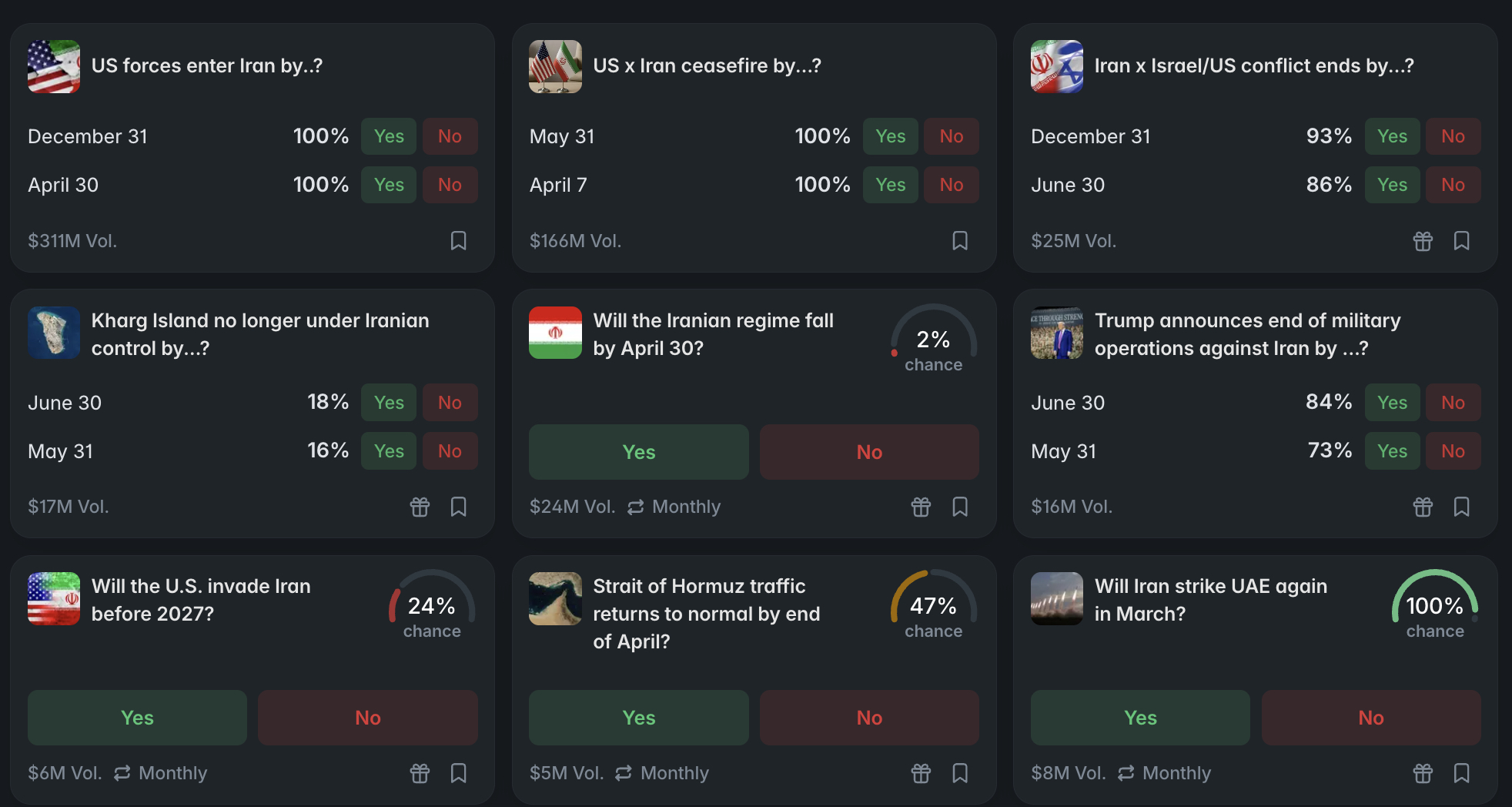
The platform has already faced political heat, pulling “rescue mission” markets amid bipartisan backlash, labeling war-related prediction contracts “dystopian.”
Discover: The best crypto to diversify your portfolio with
LiquidChain Eyes Cross-Chain Infrastructure as Geopolitical Volatility Drives DeFi Demand
Geopolitical shocks don’t just move prediction markets. They fragment liquidity, and traders rotate simultaneously between Bitcoin, Ethereum, and Solana positions, and most infrastructure still can’t handle that cleanly. That’s a structural problem LiquidChain is specifically built to solve.
LiquidChain is a Layer 3 infrastructure project that fuses Bitcoin, Ethereum, and Solana liquidity into a single execution environment as a Unified Liquidity Layer.
The Order grows. The Order evolves. ⟁ — LiquidChain (@getliquidchain) April 8, 2026
 https://t.co/vqvBcdSQYC pic.twitter.com/stB6CDGAVD
Developers deploy once and access all three ecosystems. The architecture also includes Single-Step Execution and Verifiable Settlement, targeting the latency and fragmentation that multi-chain traders experience under volatile conditions, exactly the kind April 7 produced.
The project has raised more than $645K at a current presale price of low $0.01447. LiquidChain has drawn attention alongside Bitcoin ETF inflows as institutional appetite for multi-chain DeFi infrastructure grows. Not to forget, the project offers more than 1600% APY staking bonus for early buyers.
Research LiquidChain’s presale details here.
The post Polymarket Insiders Back? Traders Placed Big Bet Right Before Iran Ceasefire News appeared first on Cryptonews.

How To Make Money Online Without Investment And Experience Using AI Tools | AI Earn Money

When is the Grand National 2026? Date, start time, latest odds and how to watch

Holista CollTech fails to restrain foreign orders over ProImmune stoush

Why Israel is blocking foreign journalists from entering

Bitcoin: We’re Entering The Most Dangerous Phase

Alan Cumming Brands Baftas Ceremony A ‘Triggering S**tshow’
How To Make Money Online Without Investment And Experience Using AI Tools | AI Earn Money

The Real Legacy Trump’s Facing: The Man Who Led America to One of Its Greatest Defeats Ever

Money can’t buy what’s Real & Gone #hindipoetry #shortsfeed #shortsviral #ytshorts #yt #lifelessons
-

 NewsBeat6 days ago
Steven Gerrard disagrees with Gary Neville over ‘shock’ Chelsea and Arsenal claim | Football
-

 Business5 days ago
No Jackpot Winner and $194 Million Prize Rolls Over
-

 Fashion5 days ago
Weekend Open Thread: Spanx – Corporette.com
-

 Crypto World7 days ago
Gold Price Prediction: Worst Month in 17 Years fo Save Haven Rock
-

 Business2 days ago
Three Gulf funds agree to back Paramount’s $81 billion takeover of Warner, WSJ reports
-

 Sports4 days ago
India men’s 4x400m and mixed 4x100m relay teams register big progress | Other Sports News
-

 Business4 days ago
Expert Picks for Every Need
-

 Business6 days ago
Login and Checkout Issues Spark Merchant Frustration
-

 Tech13 hours ago
How Long Can You Drive With Expired Registration? What Florida Law Says
-
Business3 days ago
No Jackpot Winner, Prize to Climb to $231 Million
-

 Tech6 days ago
Commonwealth Fusion Systems leans on magnets for near-term revenue
-

 Crypto World7 days ago
Ripple rolls out enterprise crypto treasury platform for corporates
-

 Fashion2 days ago
Massimo Dutti Offers Inspiration for Your Summer Mood Board
-

 Tech7 days ago
Drawing Tablet Controls Laser In Real-Time
-

 Crypto World7 days ago
Why It’s Partnering, Not Issuing
-
Politics5 days ago
Wings Over Scotland | The quality of mercy
-
 Sports7 days ago
Steal Gary Woodland’s subtle power move for longer drives
-
 Tech7 days ago
Battery Tester Outperforms Cheaper Options
-

 Business3 days ago
Akebia Therapeutics, Inc. (AKBA) Discusses Pipeline Progress and Strategic Focus on Kidney Disease Treatments at R&D Day – Slideshow
-

 Sports7 days ago
Mohsin Naqvi-Led Pakistan Cricket Board Blasted By Younis Khan After 20 Million Rupees Fine On Naseem Shah
You must be logged in to post a comment Login