David Raya produced a fine goalkeeping display in Arsenal’s win over Sporting (Picture: Getty)
Shay Given was quick to shut down criticism of David Raya following Arsenal’s victory over Sporting, with his fellow pundit claiming Caoimhin Kelleher was the superior goalkeeper of the two.
Raya is widely considered to have been the standout goalkeeper in the Premier League this season, producing a string of decisive performances to help the Gunners take a nine-point lead at the top.
The Gunners have shipped just 22 goals in the English top flight and the Spain international has been central to the side’s defensive rigidity, playing every single minute with only seven matches remaining of the campaign.
Mikel Arteta decided to rest Raya for two major setbacks in the Carabao Cup and FA Cup prior to Arsenal’s trip to Lisbon – and his absence was felt as the north Londoners’ quadruple hopes went up in smoke.
Advertisement
But the 30-year-old was restored to Arteta’s starting XI for Arsenal’s Champions League quarter-final first leg on Tuesday night and produced three important saves to keep the scoreline level before Kai Havertz’s breakthrough in the first minute of stoppage time.
‘It’s unbelievable,’ the German told Amazon Prime when asked about Raya’s showing between the sticks.
Raya is ‘the best in the world’, according to Arsenal forward Havertz (Picture: Getty)
Havertz came on and scored the winner for the Gunners in Lisbon (Picture: Getty)
‘I think still underestimated in the world of football but, for me, the last two seasons, the best ‘keeper in the world.
‘He’s outstanding, he’s saved us so many times and we’re very glad to have him.’
Advertisement
Arteta was also glowing with his praise, admitting Arsenal were ‘very lucky’ to have such an ‘extraordinary’ goalkeeper in their ranks.
‘He had two moments where he made two big saves. And that’s the Champions League, the Champions League is always decided in the boxes and because there’s so much quality here,’ Arteta said.
‘At the moment he’s phenomenal and extraordinary since he joined us. We are very lucky to have him.’
However, it appears Raya is still yet to completely win over all fans and pundits, with Kenny Cunningham picking out what he felt was a ‘small weakness’ in the Spaniard’s game on Premier Sports Ireland.
The ex-Republic of Ireland, Wimbledon and Birmingham defender raised eyebrows with his bold assertion that Brentford’s Kelleher was the better goalkeeper.
Advertisement
‘In terms shot-stopping: very good, athletic. Does he make a fair number of good quality saves? Yeah, absolutely,’ Cunninham said shortly after Arsenal’s 1-0 win.
‘Decent with the ball at his feet, yeah. I think Caoimhin Kelleher is better in terms of his ball distribution.
Kelleher is a better all-round ‘keeper than Raya, says Cunningham (Picture: Getty)
‘In terms of coming off his line and dominating the box, the six-yard box and beyond, and really imposing himself, I don’t think he does it often enough.
‘I think he goes into his shell a little bit when the opposition put players into the six-yard box and I don’t think he dominates. I think that’s the small weakness in his game.
‘That’s why I don’t put him up with the likes of [Gianluigi] Donnarumma, [Thibaut] Courtois… Alisson we know is on the slide a little bit, to an extent.
Advertisement
‘Caoimhin Kelleher, for me, is the better goalkeeper. You need to tell me what attribute in his [Raya] game is better than Caoimhin Kelleher in terms of his shot-stopping, his distribution and his ability to command his box.
‘Where does he get the advantage on Caoimhin Kelleher? Those three facets.’
Cunningham was joined in the studio by former Newcastle goalkeeper Given (Picture: Premier Sports Ireland)
Shay Given, sat alongside Cunningham in the Premier Sports Ireland studio, made it clear he disagreed with his fellow countryman’s remarks about Raya.
‘I’m not sure you can compare Caoimhin Kelleher and David Raya. I’m here to talk about David Raya because he played tonight,’ the former Newcastle goalkeeper responded.
‘I said this before the game and I’m not saying I’m right and he’s [Cunningham] is wrong, I’m just saying the performance tonight was absolutely brilliant.
Advertisement
‘We talk about the save in the first half…’
Given hit back at Cunningham’s ‘harsh’ criticism of Raya (Picture: Premier Sports Ireland)
Before Given could finish his sentence, Cunningham cut in: ‘One save, one very good save in the first half! That’s it. That [the praise from Kai Havertz] is his team-mate there, blowing smoke.’
But according to Given, Raya’s contribution this season is undoubtedly one of the key factors in Arsenal finding themselves in such a strong position in both the Premier League and Champions League.
‘You speak to people who know about goalkeepers and ask them… I think he’s one of the reasons they’re nine points clear at the top of the Premier League,’ Given explained.
‘One of the reasons why they’re probably one foot in the semi-finals of the Champions League is because of David Raya as well.
Advertisement
‘There are big games coming up around the corner over the next seven weeks and he’ll play a huge part in what they’re going to succeed with.’
Raya went home with the Player Of The Match award (Picture: Getty)
On Cunningham’s claims that dominating the box was a ‘weakness’ for Raya, Given added: ‘I disagree with that as well. He’s one of the springiest, he picks crosses up from lots of stuff that other goalkeepers don’t come for.
‘I disagree with that totally. There was one at the start of the second half, he was on the halfway line, out for a header.
‘He’s a sweeper ‘keeper, he’s on the front foot and he reads the game so well. It’s not just about shot-stopping, it’s about decision-making, setting the tone of the game.
‘As a goalkeeper, he does everything.’
Advertisement
Cunningham was capped 72 times by the Republic of Ireland (Picture: Getty)
Cunningham was not done there, though, insisting Raya remained a level below the likes of Donnarumma and Courtois due to a lack of ‘aura’ and ‘personality’.
‘I think it is just in terms of the confidence. I think it’s an aura, a personality, a presence,’ he went on.
‘It’s difficult to put your finger on it. Hopefully I’m giving you an understanding of what I’m talking about.
‘I’m talking particularly in terms of crosses coming into the box, corner kicks, long throw-ins, it’s such an important part of the game.
‘Those other goalkeepers that you’re speaking about [Donnarumma and Courtois], for me, are ones who take responsibility.’
Advertisement
But again, Given hit back, pointing out how Donnarumma was a poor example to use based on some of the Italian’s performances for Manchester City this season.
‘I think Donnarumma has struggled this year, at times, with balls into the box and crosses into the box,’ he said.
‘He’s getting involved in fighting people and punching at stuff, flapping at things when balls are in the box and the physicality of it so I don’t think that’s a good example.
‘I think Donnarumma is a brilliant goalkeeper, I just think you’re being extremely harsh [on Raya], to say the least.’
A sci-fi horror film has been ranked the best British film of the 21st century in the BFI’s prestigious Sight and Sound critics’ poll
Determining which films truly deserve the title of greatest of all time is no simple task, yet many have attempted it, including Britain’s own British Film Institute (BFI). Since 1952, Sight and Sound, the BFI’s esteemed magazine, has conducted a decennial poll to identify cinema’s finest achievements.
Advertisement
The most recent edition in 2022 saw more than 1,600 film critics, programmers, curators, archivists and academics submit their personal top 10 choices. These votes are compiled into a definitive ranking of the 250 greatest films ever made.
Given the sheer scale of this catalogue, we’re highlighting the list’s top-ranked British film from the 21st century – Under the Skin, a compelling thriller featuring Scarlett Johansson as an alluring extraterrestrial who drives through Scotland hunting for victims.
This sci-fi horror represents the vision of English director Jonathan Glazer, whose later work, The Zone of Interest, garnered accolades at the BAFTAs and Cannes in 2023.
A decade earlier, though, Glazer loosely adapted Under the Skin from Michel Faber’s novel of the same title. Johansson plays an unnamed extraterrestrial in human form who targets vulnerable, isolated men.
Advertisement
Remarkably, numerous sequences showing Johansson’s character travelling across Scotland and approaching men were genuine encounters filmed with concealed cameras, reports the Express.
While the novel explicitly reveals her ultimate purpose (specifically, to murder and process the men as food) without mystery, the film adopts a considerably more cryptic stance.
Explaining its position at number 169 on the list, the BFI stated: “The icily brilliant Scarlett Johansson stars as an alien predator scouring Scotland’s streets for human prey, in Jonathan Glazer’s astonishing amalgam of fantasy and reality.
Advertisement
“Mixing mind-bending visuals and hallucinatory sound design with an unexpected naturalism, Glazer returned to the screens after a nine-year absence in audacious style, utilising guerrilla filmmaking tactics to capture Glasgow and its unsuspecting inhabitants with intimate realism.”
The film holds a favourable 83% approval rating on Rotten Tomatoes, though its deliberately ambiguous narrative divided opinion, as the website’s critical consensus readily acknowledges.
“Its message may prove elusive for some, but with absorbing imagery and a mesmerising performance from Scarlett Johansson, Under the Skin is a haunting viewing experience.”
At the film’s Venice Film Festival premiere, the Guardian described it as a “genuine Marmite moment”, noting: “Some saw it as a masterpiece, others as a bore. The film’s closing credits played out to an accompaniment of booing.”
Despite performing poorly at the box office, the picture still earned BAFTA nominations for Outstanding British Film and Best Original Music.
A glowing review from the Chicago Sun-Times said: “This is what we talk about when we talk about film as art.”
Film lovers continue to argue over whether the picture genuinely warrants recognition as one of the finest.
Advertisement
“I just watched Under the Skin and I can’t decide whether it is a masterpiece or a terrible movie,” asked one viewer on Reddit in 2025, more than ten years following the film’s debut. “What is your opinion?”
One replied: “It’s one of the best movies of the previous decade.” Another concurred: “Masterpiece absolutely. Couldn’t stop thinking about that movie for weeks. Still think about it sometimes.”
A third summed it up: “It’s one of my favourite films, but one of my friends who I saw it with in theatres despised it.”
Under the Skin is available to stream on platforms including Amazon Prime, Apple TV, Sky Store and Google Play.
His decision to cut one food from his diet could be the secret behind his remarkable health and longevity
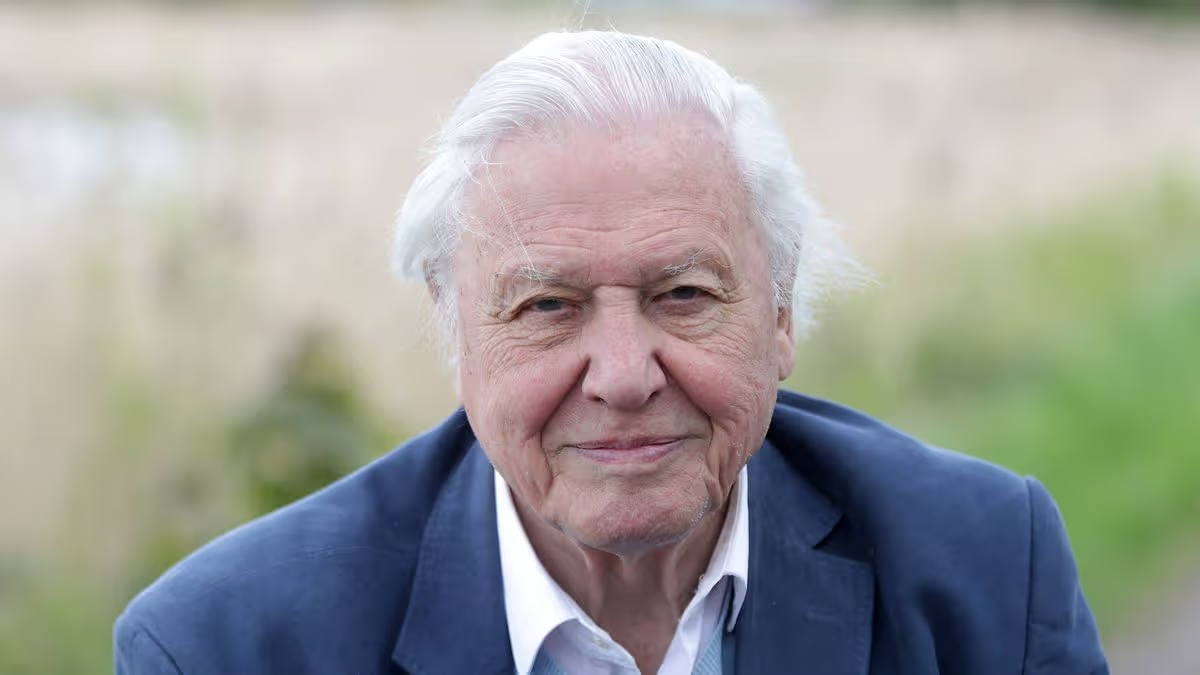
Legendary nature presenter Sir David Attenborough has previously said he’d love to reach his 100th birthday, which is just a few days away. The broadcasting icon credits part of his well-being and energy to a simple dietary choice that could help more people stay healthy for longer.
Advertisement
While not a complete vegetarian, it’s well documented that Sir David has cut out red meat consumption, a decision he suspects may be extending his life. This shift in habits isn’t new – Attenborough spoke openly about his dietary choices as far back as 2017.
He said: “I have certainly changed my diet. Not in a great sort of dramatic way. But I don’t think I’ve eaten red meat for months.” He admitted that although he continues to eat cheese and fish, he has otherwise “become much more vegetarian” than he’d ever imagined.
“There is clear science behind the benefits of adopting a more plant-based diet when it comes to overall health and longevity.” The 99-year-old has reduced his consumption of red meat, which includes things like beef, lamb, mutton, pork, veal, venison and goat.
The TV icon will mark his 100th birthday on Friday, May 8, having been born in 1926. As this remarkable milestone approaches, he has admitted during one of his most recent programmes, Ocean, that he is ‘approaching the end of his life.’
Advertisement
The NHS warns that eating too much processed and red meat can raise the likelihood of developing bowel (colorectal) cancer. A number of products in these categories contain high levels of saturated fat, which may cause blood cholesterol to rise when eaten in large quantities.
Elevated cholesterol heightens the risk of coronary heart disease, reports Surrey Live. Anyone considering cutting certain foods from their diet should make sure they’re still getting essential nutrients and consult their doctor beforehand.
Failing to maintain a nutritious, balanced diet may lead to health complications. Experts at Harvard Health suggest that people who want to cut down on red meat should find suitable alternatives to maintain sufficient protein intake.
Advertisement
Daniel Pendick, former executive editor of Harvard Men’s Health Watch, claims that replacing just one daily portion of red meat with other options might reduce mortality risk by 7% to 19%. People could swap red meat for other protein sources such as fish, chicken, turkey, nuts, beans, low-fat dairy products and whole grains.
Despite maintaining a healthy diet and staying mentally sharp, Sir David Attenborough revealed his private worries about growing older during a 2021 interview with Anderson Cooper. He shared his anxiety about mental decline and the fear of becoming “helpless” through conditions such as Alzheimer’s.
He also told the Telegraph about his worries regarding getting older and “coming to terms” with possible memory loss. But, Sir David remains a prominent figure, lending his voice to BBC wildlife documentaries with projects airing as recently as January 2026.
Advertisement
What are the benefits of cutting out red meat?
Red meat is widely associated with elevated levels of saturated fat, which can raise LDL ‘bad’ cholesterol and increase the risk of cardiovascular disease, according to Cleveland Clinic Health Essentials. Research further suggests that reducing or eliminating red meat may lower the risk of heart disease and related deaths.
Certain studies have linked excessive red meat consumption to a heightened risk of colorectal cancer, according to the Scottish Cancer Foundation. Cutting back on red meat may also reduce the risk of other cancers.
Evidence additionally suggests that a high red meat intake is associated with an increased chance of developing type 2 diabetes. Diets that restrict or exclude meat tend to be lower in calories and fat, supporting weight loss and helping maintain a healthy weight.
Advertisement
A meat-free diet is typically rich in fibre from vegetables, fruits, and wholegrains, which promotes a healthy gut microbiome and can boost metabolism and general wellbeing. It is essential to consult your GP before making any decision to reduce your red meat intake.
Who is David Attenborough?
Sir David Attenborough has mesmerised millions by bringing the natural world into our living rooms and classrooms. Throughout the decades, his extraordinary career has been driven by an insatiable passion for discovery, exploration, creativity, and enlightenment.
The celebrated writer, broadcaster, and naturalist studied at Clare College, Cambridge. Following a period with an educational publishing firm, he began his broadcasting journey as a BBC trainee in 1952. Serving as controller of BBC Two, he was instrumental in introducing Europe’s first colour television transmissions.
Advertisement
For seven decades, he has been the legendary voice of natural history programming, showcasing the splendour of the natural world through iconic series including Life on Earth, The Private Life of Plants, and The Blue Planet. More than 40 species of flora and fauna bear his name, alongside a constellation.
Instead, it was announced that “AJ”, 36, will box relative unknown Kristian Prenga in Saudi Arabia on 25 July, before fighting Fury later in 2026 – likely in the UK this autumn, possibly at Wembley Stadium, and almost certainly on Netflix.
Pop star Dua Lipa at the Berlinale film festival in February (AFP/Getty)
And there has been another moving part, it seems, with Saudi matchmaker Turki Alalshikh expressing a keen desire for British pop star Dua Lipa to be part of the Joshua vs Fury event.
Advertisement
Sky Sports even reported that Alalshikh had threatened to pull the plug on the fight if the “Levitating” and “Don’t Start Now” singer would not take part – although the alleged claim certainly could have been made in jest.
In any case, the BBC has now reported that Dua Lipa, 30, was approached to feature at the event, and that the three-time Grammy winner declined.
If a replacement can be found, it will not be the first time a musical act has performed at a fight with Saudi involvement. For example, Eminem performed a set before Terence Crawford beat Israil Madrimov in 2024, and later that year, Oasis frontman Liam Gallagher did the same before Joshua was stopped by Daniel Dubois.
Enjoy 185+ fights a year on DAZN, the Global Home of Boxing
Advertisement
Never miss a fight from top promoters. Watch on your devices anywhere, anytime.
ADVERTISEMENT. If you sign up to this service we will earn commission. This revenue helps to fund journalism across The Independent.
As well as the afore-mentioned songs, Dua Lipa counts “Dance The Night”, “Houdini” and “Training Season” among her most-popular tracks. She also collaborated with Elton John on the hit song “Cold Heart”, and with Calvin Harris on the hugely-successful “One Kiss”.
As The Devil Wears Prada returns to the big screen, here’s everything you need to know about author Lauren Weisberger – from her Vogue beginnings to the book that became a cultural phenomenon.
Few novels have had the kind of lasting cultural impact as The Devil Wears Prada. First published in 2003, the story of a young assistant navigating the high-pressure world of fashion quickly became a bestseller, before going on to inspire a hit film, stage adaptations and renewed interest as sequel buzz grows.
Advertisement
Its sharp take on ambition, power and toxic workplaces has kept it relevant across generations, particularly as conversations around work culture continue to evolve. At the centre of it all is Lauren Weisberger, the author whose early career experiences helped shape one of the most recognisable workplace stories of the past two decades.
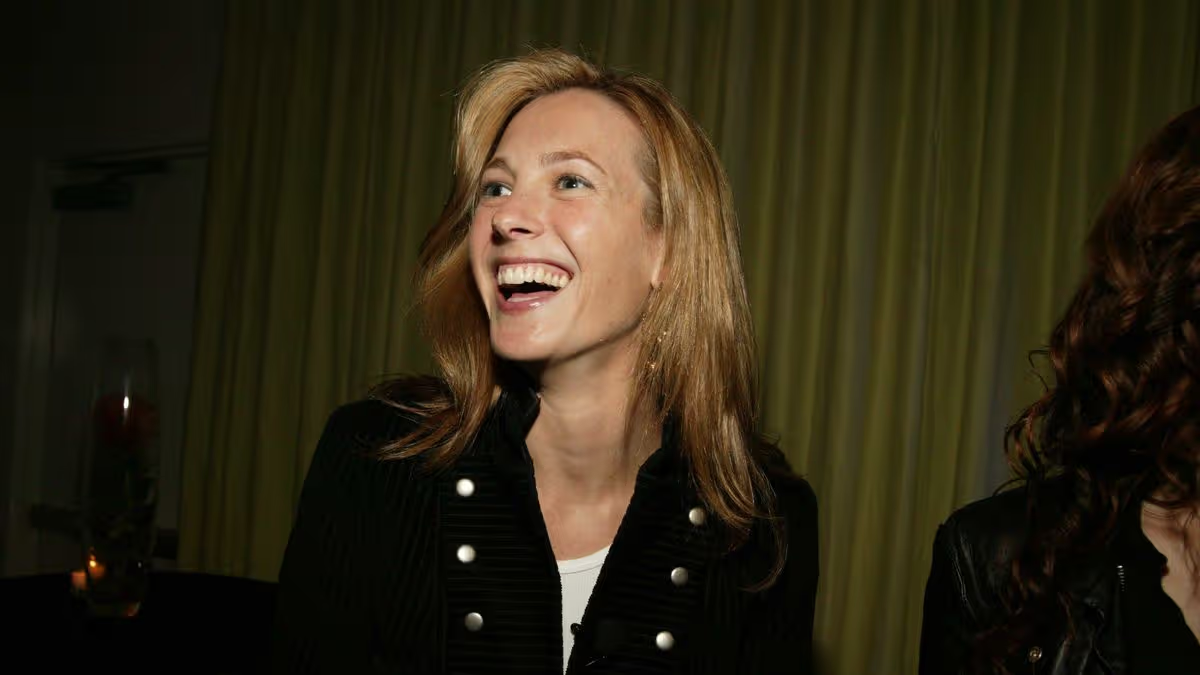
Before becoming a novelist, Weisberger worked as an assistant at Vogue, working under editor-in-chief Anna Wintour, a role she has described as “demanding” and intensely fast-paced, with an around-the-clock workload during her time at Vogue. The position would later form the basis of The Devil Wears Prada.
Advertisement
After leaving the magazine, Weisberger turned to writing, drawing on her experiences to create the character of Andrea Sachs – a young woman thrown into an intense, high-stakes work environment. The book spent six months on The New York Times bestseller list and quickly resonated with readers, particularly those familiar with toxic workplace dynamics and ambition-driven career paths
A story that refuses to fade
More than 20 years on, The Devil Wears Prada continues to resonate – something Weisberger herself has reflected on in a recent essay for Vogue: “I am experiencing a kind of existential whiplash,” she wrote, noting that something she created in her twenties is “still relevant” and “somehow… trending again.”
She added that the story has “persisted… like a glamorous ghost that refuses to leave the building,” pointing to its evolution from novel to film, musical and now a renewed wave of interest.
Advertisement
The 2006 film adaptation, starring Meryl Streep and Anne Hathaway, expanded the story’s reach globally, transforming it into a defining pop culture moment. “There is a moment… when you realise the story is no longer yours,” Weisberger wrote, reflecting on how audiences have embraced and reinterpreted her work over time.
The original novel captured the sharp, unfiltered perspective of someone in their early twenties, she notes that experience has brought a more nuanced understanding of ambition, identity and compromise – themes that remain central to the story’s appeal.
One reader posted on Reddit: “I personally think Miranda was meaner from the book.” While another added: “The movie softened a lot of the edges of the book… I liked the drama of the book more.”
While The Devil Wears Prada remains her most famous work, Weisberger has built a wider catalogue of novels exploring similar themes of ambition, relationships and life in New York.
Her books include Everyone Worth Knowing (2005), Chasing Harry Winston (2008) and Last Night at Chateau Marmont (2010), as well as the sequel Revenge Wears Prada (2013), which revisits Andrea Sachs years later. Across these stories, Weisberger has continued to focus on the intersection of career, identity and personal relationships – often set against high-pressure, aspirational backdrops.
As interest builds around a potential sequel, it’s clear that The Devil Wears Prada has endured for more than just its fashion setting. “We keep returning because the questions at its centre are universal,” Weisberger wrote, pointing to themes around ambition, identity and the cost of success.
Advertisement
More than two decades after its release, the story continues to resonate with new audiences – proving that its core ideas remain as relevant now as they were when it was first written.
Love reading? Join our community of fellow readers in the Mirror Book Club to dive deeper into the books everyone is talking about.
Between the newly-enforced EES rules and jet fuel price-induced cancellations and suspensions, 2026 is proving quite the year for fliers.
If you don’t want what may be an already more-tiring-than-usual process to take even longer, Ryanair has said on its site that not all bags can be checked in.
Which bag can I not check in?
“Smart bags”, or bags with a lithium battery and charging port, cannot be checked in to the hold if the battery can’t be removed.
Advertisement
Even if you can remove the battery to check the bag in, their site reads, “The battery must not be placed in the hold under any circumstances.
“The removed battery must be carried with you in the cabin and placed in small baggage that is placed underneath the seat in front of you or on your person.”
Removed batteries must not be placed in the overhead lockers. The removed battery can’t be more than 100Wh, either.
If the battery is not removable, Ryanair said it must not exceed 2.7Wh.
Advertisement
The ‘Wh’ stands for watt-hour and is generally on the battery. If it’s not, the UK Civil Aviation Authority said: “If only the milliampere hours (mAh) are marked on the battery, then divide that number by 1000 to get ampere-hours (Ah). For example, 4400 mAh / 1000 = 4.4 Ah.”
“Smart bags with non-removable batteries above 2.7Wh are not permitted onboard,” says Ryanair.
The UK Civil Aviation Authority said on their site that, “Baggage equipped with a lithium battery(ies) exceeding 0.3 g for lithium metal batteries, and a Watt-hour rating of 2.7 Wh for lithium-ion batteries, must be carried as carry-on baggage unless the battery(ies) is removed from the baggage, protected from short circuit and carried in the cabin.”
In other words, smart bags with lithium batteries generally can’t go in the hold on most airlines.
Advertisement
Why aren’t smart bags generally allowed in the hold?
Oil markets have been thrown into disarray as the Strait of Hormuz, a critical global shipping corridor, is still effectively shut
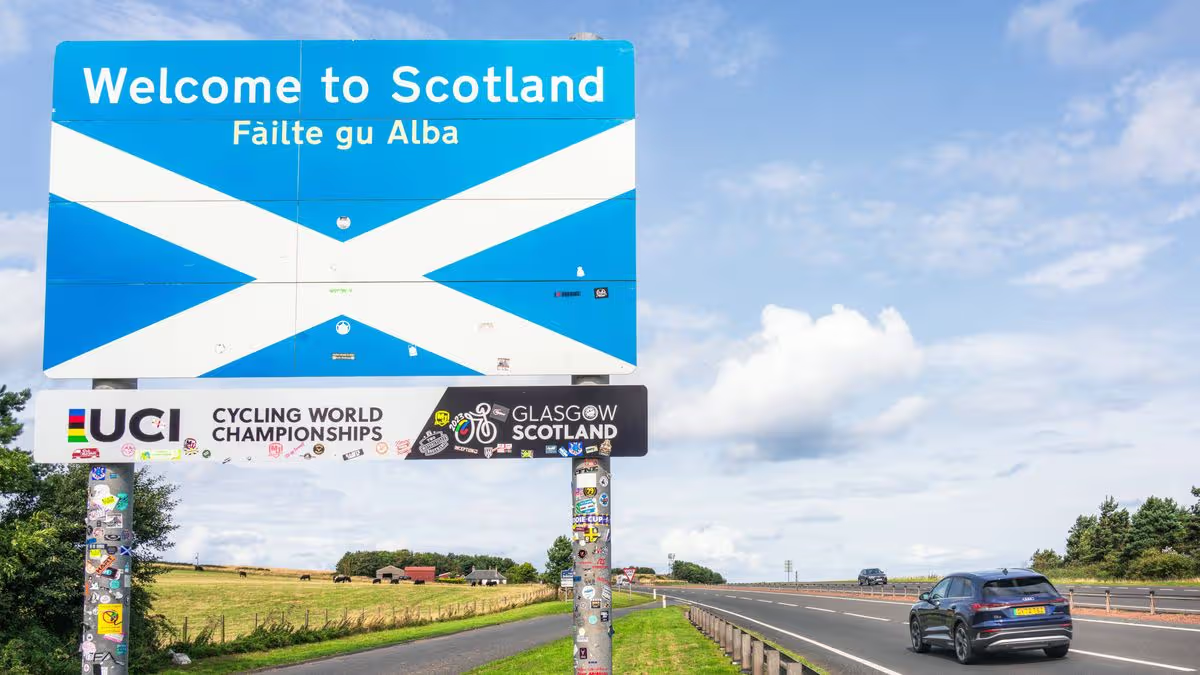
Scottish drivers are understandably worried about fuel prices as global oil markets remain unstable. The effective closure of the Strait of Hormuz, a key shipping route off the coast of Iran, are raising fears about supply and costs, and there’s no quick fix in sight.
Advertisement
To help people use fuel efficiently, experts at RAC have outlined steps drivers can take to ease any financial strain – as well as one thing to avoid. While slowing down, avoiding speeding or harsh braking are well-known ways to conserve fuel, it stresses that it’s far from the only option available.
Regular vehicle maintenance and servicing can play a crucial role in keeping engines running efficiently and can significantly improve fuel economy. Drivers are also being advised to minimise excess weight in their vehicles, as a lighter load can help reduce fuel consumption.
It explains: “Don’t leave your roof bars and roof box on because they create wind resistance and cause your car to use more fuel through the ‘drag’ effect. This is increased the faster you drive.
“According to the Energy Saving Trust an empty roof rack adds 16% drag when driving at 75mph. At the same speed a roof box adds 39%, making your vehicle much less fuel efficient. Driving with an open window also has a similar effect.”
Advertisement
Motorists can also try limiting how often they use air-con. The RAC continues: “Only use air conditioning when necessary, as it draws power from the engine and increases fuel consumption. The same applies to heating, so if fuel efficiency is a priority, try to dress appropriately for the weather even when you’re in the car.”
Finally, it stresses that it’s “particularly important to make sure your tyres are inflated to the correct pressure as indicated in your owner’s manual.” This is because “underinflated and overinflated tyres both adversely affect fuel economy.”
Your tyre pressure should match your load. If your car is full of people and luggage, inflate the tyres to the higher recommended level.
Advertisement
Drivers should not panic-buy fuel
This is the one thing people should avoid. Just remember not to panic buy. As reported by Manchester Evening News, Luke Bosdet, a spokesman for the AA, urged people to “stick to their usual refuelling routines. There’s no point wasting time, fuel and money queuing when drivers don’t need to.”
For more money-saving tips on fuel, visit the RAC website.
Jefferson Lewis, 47, was arrested late on Thursday night local time in Alice Springs.
The young girl, referred to by her family as Kumanjayi Little Baby in line with Indigenous customs, was reported missing from her central Australian home late on Saturday.
Authorities located the body, believed to be hers, shortly before midday on Thursday, about 5km south of the original crime scene.
Advertisement
Local reports said a crowd attacked Mr Lewis when he appeared in a local community and beat him unconscious before police intervened.
Police said they had long suspected that Lewis received assistance from people in the community before he appeared at a town camp.
“For him to be able to appear in Alice Springs last night just confirms to us that he was getting support from somebody,” police commissioner Martin Dole of the Northern Territory said.
“My message to those people is, look out because we’re coming for you as well.”
Advertisement
Community unrest outside the Alice Springs Hospital where a man arrested in connection with the alleged killing of Kumanjayi Little Baby was taken on 30 April 2026 (Reuters)
When officers took him to a local hospital, hundreds of “angry” residents gathered, shouting for him to be killed and demanding “payback”, according to the ABC.
The situation escalated into rioting as people threw rocks and bottles, set vehicles on fire, and damaged property. Police responded with rubber bullets and tear gas to control the crowd.
Several officers were injured in the violence.
The unrest continued into the next day, leaving streets littered with debris and signs of looting nearby. Authorities later transferred Mr Lewis to Darwin for his safety and to prevent further violence.
“As a result of presenting himself, members of that town camp decided to inflict vigilante justice upon Jefferson, and we received numerous phone calls saying he was in the process of being assaulted,” Mr Dole said on Friday.
Advertisement
A picture released by police shows Kumanjayi Little Baby (Northern Territory Police)
The violence followed days of search for the girl, who had gone missing from a remote Aboriginal town camp near Alice Springs.
Hours after the girl’s death was confirmed, Mr Lewis was reportedly seen wandering near the Charles Creek town camp in central Alice Springs.
“Members of that town camp decided to inflict vigilante justice upon Jefferson and we received numerous phone calls saying he was in the process of being assaulted,” Mr Dole said.
“Our police officers were attacked at that time, as were the St John Ambulance crew that attended to assist. They were turned on by about 200 people, but they were able to get out of there and get Mr Lewis to hospital.”
A police officer reacts next to a damaged vehicle during community unrest outside Alice Springs Hospital (Reuters)
Videos from outside the Alice Springs Hospital showed protesters demanding “payback”, meaning a form of traditional punishment under Aboriginal law in Central Australia.
Reports said anger within the community remained high. “The feeling is that the police are protecting this guy. They are shooting us with rubber bullets,” Harley Myers, an Arrernte man from Alice Springs, said.
Advertisement
“It’s like the system is not sticking up for us and letting us get our own traditional payback.”
“We’re united because it hurts all of us,” he added, “because she was only five years old and it could happen to any of our kids. I don’t want that to happen to any of our kids at all.”
Indigenous leaders, however, urged calm. “Bringing the word ‘payback’ into this scenario just fuels violence,” Michael Liddle, an Alyawarre man and Alice Springs local, told the BBC.
“There’s a system set up here, where there is a person in custody, and the Western rules will deal with that person.”
Advertisement
A police vehicle burns after community members clashed with police outside Alice Springs Hospital in Australia (Reuters)
The girl’s grandfather also called for calm on Friday. “What has happened this week is not our way,” Robin Granites, a senior Yapa elder, said in a statement.
“Our children are precious, of course, we are feeling angry and hurt at what has happened. This man has been caught, thanks to community action, and we must now let justice take its course while we take the time to mourn Kumanjayi Little Baby and support our family.”
On Thursday, the girl’s mother, who was not named, said: “It is going to be so hard to live the rest of our lives without you. Me and your brother will meet you one day.”
Mr Dole said charges against Mr Lewis were likely to be filed in the coming days.
It’s often assumed that expanding access to education is progressive – that it’s a means of ensuring social, economic and political development. However, this is not always the case.
We’ve carried out research examining the relationship between education and authoritarianism with a focus on Eritrea. Eritrea has been under a single political party and leadership since its independence in May 1993. The country lacks a functioning or implemented constitution and freedom of the press.
Our research has concluded that, in countries under authoritarian rule, education is not necessarily a path to empowerment. Instead, it’s a fertile ground for the spread of authoritarianism. Governments can spread their ideas and principles through repressive and ideological state apparatus – the processes and organisations they use to maintain power. This includes education.
Authoritarian regimes such as Eritrea claim to address societal problems through social justice and cohesion. However, they consolidate power around a single or dominant regime, which restricts democratic institutions and erodes civic liberties. They also apply preferential treatment based on political loyalty. People are elevated to positions of power for allegiance rather than merit. This causes division and political polarisation in the name of protecting national security.
Advertisement
Expanding education
Authoritarian states use education to maintain political stability to ensure the survival of the regime. Although many authoritarian regimes expand access to education, it is often used as a means of control and a tool for manufacturing loyalty.
For example, since independence, the number of schools and student enrollment in Eritrea has increased around fourfold. However, such regimes also see education as an opportunity to impose their attitudes onto young people. They use education to keep students isolated from ideas that may differ from or be critical of the regime.
Authoritarian regimes use deception and misinformation to uphold their ideology and extend their control. In doing so, they attempt to ensure that citizens accept the legitimacy of their rulers without question.
Additionally, authoritarian regimes politicise the school curriculum. They manipulate content, such as in history and citizenship education. This is used to mislead citizens and make them supporters of the degradation of human rights.
For example, Eritrea’s school curriculum normalises the creation of a militarised citizen who upholds the Eritrean People’s Liberation Front’s legacy and revolutionary culture. Similarly, North Korea uses school education to shape students’ behaviour, attitudes and beliefs to be compatible with and supportive of the regime. This is often supported by controlling the teaching and learning process and the academic environment.
Monitoring teachers and research
Authoritarian regimes recognise that safe education spaces can help students develop critical thinking and eventually question the country’s political system. They monitor teachers and school leaders, and promote those loyal to the regime’s ideas and principles. And, rather than encouraging critical thinking, they foster students’ sense of nationalism and patriotism.
Academic research is also a target of authoritarian regimes because of its scrutiny of government policies and actions. Researchers’ academic freedom is limited, and their choice of research topics is policed.
Most of these control measures are imposed in the name of protecting national security. For example, Eritreans are not allowed to conduct critical research that challenges the existing systems, inequalities and power structures of the country.
Advertisement
Researchers who cross the boundaries and criticise authoritarian regimes are silenced. Some are fired from their jobs while others face prison terms.
Meanwhile, authoritarian regimes rely on loyal academics to promote the state’s narrative. Loyal academics are also used to conceal authoritarian regimes’ failures by presenting selective evidence.
Many authoritarian states, such as China, Eritrea and North Korea, also incorporate military training into education. They blend political and ideological instruction to sustain their power. They teach students discipline and promote patriotism to develop loyal and obedient citizens.
Militarisation education sometimes places teachers and school leaders under military control. In Eritrea, all secondary school students complete their last year under military authority. This approach leads students to drop out of school. Additionally, it causes students and teachers to leave the country.
Advertisement
Authoritarian regimes manifest their true nature by spreading their ideas and principles. Our research shows that the education system is one of the most important levers in the propaganda machine for authoritarian countries.
We hope you love the products we recommend! All of them were independently selected by our editors. Just so you know, HuffPost UK may collect a share of sales or other compensation from the links on this page if you decide to shop from them. Oh, and FYI — prices are accurate and items in stock as of time of publication.
One day, someone will invent an injection that means we never have to reapply sunscreen again. But until that day comes, it is a sad and unfortunate truth that sunscreen is a daily skincare essential – and more so in the sunny months than ever.
Despite the undeniable benefits of wearing SPF – it protects against skin cancer, and prevents visible signs of ageing, etc, etc – it is a pretty spenny necessity, which can make it all the more tempting to skip it. Fine, we’ll admit it.
Advertisement
If you need a little extra nudge to stock up on sunscreen this year, that’s completely understandable. Or at least iHerb seems to think so, because it’s launched a ‘buy one, get one 50% off’ promotion on its entire sunscreen range. Can we get a ‘whoop whoop’ for iHerb?
If you’ve not yet stocked up on sunscreen for the season ahead – and even if you have – now’s the time to do it.
But this isn’t one of those sales that applies to just one or two items. Whether you’re looking for a kids’ sunscreen, one that’s suitable for sensitive skin, or a face sunscreen, iHerb has every kind of SPF you could want. We’re talking over 300 products – woah.
To make sure you don’t miss it, we’ve rounded up our tried and tested favourites from its summer sale to stock your baskets with right now.
Advertisement
Best sunscreens to shop on iHerb now
If you’re looking for a face sunscreen, it’s gotta be fragrance-free. This one from Eucerin is super lightweight, and it’s even loaded with hyaluronic acid to help lock in hydration.
Not every sunscreen works under makeup, but this one from Aveeno absorbs so quickly, you won’t have any problems with pilling. It also won’t leave a white cast, making it ideal for darker skin tones.
If you have oily skin, you’ll know the struggle of finding a sunscreen that doesn’t break you out. But Cetaphil is a go-to high street brand for a reason: it actually works at keeping skin clear. This moisturiser contains SPF30, but just be aware you’ll need to top up after a couple of hours.
One of the trickiest things with body sunscreen is finding one that won’t stain your clothes and leave you with a pile of white-turned-yellow clothes at the end of the summer. This one from Eucerin might take a little while to sink in, but it passes the colour transfer test, and it’s hydrating so it leaves your skin feeling great, too.
Looking for a sunscreen to take with you on the go? This baby one from Cetaphil comes in stick form, so you won’t have to worry about getting dirty hands creamy, and slots neatly into the tiniest of bags.
If you’re swimming in the sea – lucky you – this sunscreen is formulated to be reef-safe, and is water-resistant for up to 80 minutes so you don’t have to reapply every time you need a cool down. It even has a light shimmer to it, if you’re in the market to channel Edward Cullen in the sunshine.
We all need to be kept on our toes, which is why this sunscreen feels on the thicker side upon application, but later sinks in completely. Thrilling! This zinc formula is also suitable for kids and adults alike, so you won’t have to worry about keeping two different lotions on you at the same time.
If there’s one thing that’s going to convince your kids to wear sunscreen, it’s if it smells like tangerine and vanilla. This SPF 40 zinc formula might leave a little greasy layer on your skin, but it’s water resistant for over an hour, and it’s made from 98% natural ingredients.
When you have .2 seconds to slather your baby in sunscreen before they start wriggling, there’s no time for messing around with squeezy bottles and screw caps. This mineral sunscreen stick makes application quick and easy, and it’s hypoallergenic so it’s great for sensitive skin.
Korean skincare has really taken off in the last few years, and for good reason. This sunscreen feels more like a moisturiser than an SPF, as it’s loaded with niacinamide and centella to soothe your skin. It’s also super lightweight and sensitive-skin friendly, making it ideal for reapplying throughout the day and layering under makeup.
With an SPF ranking of 60+, this sunscreen will keep your face ultra-protected in even the sunniest of conditions. Plus, Hawaiian Tropic just smells like summer, so it’s a must (if you know, you know).
The London restaurant employing people who have experienced homelessness has relaunched as 130 Primrose, with a MasterChef judge joining as executive chef and trustee
When Positive News visited Home Kitchen last year, the Primrose Hill restaurant was already doing something unusual. On the face of it, this was a polished north London dining room serving scallop ceviche, guinea fowl and monkfish from the former home of long-standing restaurant Odette’s. Behind the scenes, however, it was trying to prove that fine dining could open up new routes into work for people who had experienced homelessness.
Now the project has entered its next chapter. Home Kitchen Diner has relaunched as 130 Primrose, become a registered UK charity, and appointed Monica Galetti, the chef, broadcaster and MasterChef judge, as its executive chef and a trustee.
Advertisement
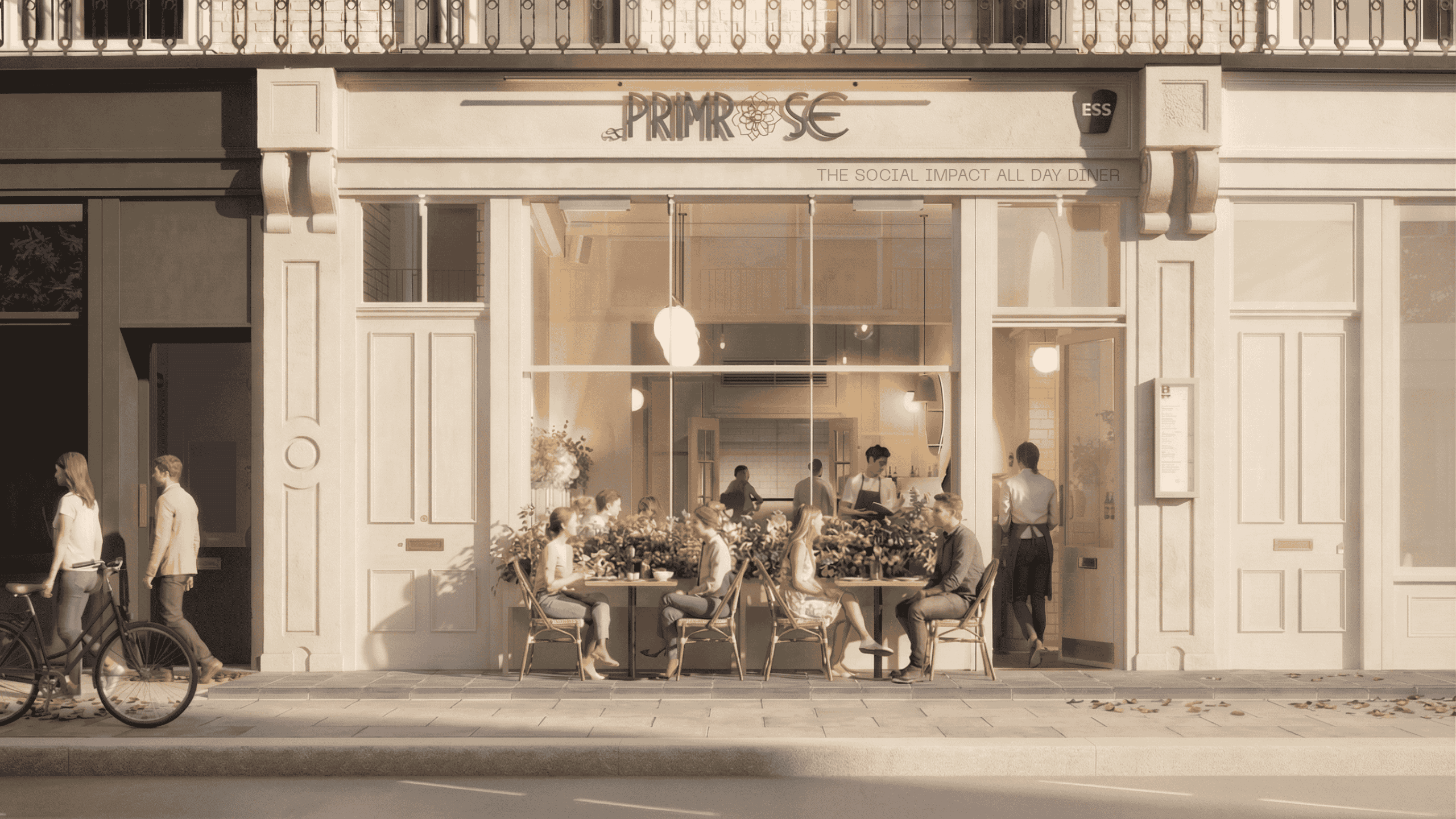
The restaurant, based at 130 Regent’s Park Road in Primrose Hill, opens on 8 May with a new name, a new menu and the same central mission: to recruit, train and employ people with lived experience of homelessness, offering paid work, accredited training and a stepping stone into long-term hospitality careers.
Advertisement
Seating 50 covers, 130 Primrose will be open seven days a week from 9am, serving breakfast, lunch and dinner in a relaxed, brasserie-style setting, with additional street-side seating. Its à la carte menu will draw on Mediterranean influences, with touches of Galetti’s Samoan heritage to be introduced later. At lunchtime, sandwiches and salads will also be available, while evenings will feature an additional charcuterie and cheese offering. A speakeasy-style cocktail bar is set to open on the lower ground floor later next month.
Galetti, who is also a regular volunteer at Soup Kitchen London, will shape the restaurant’s food and training offer, while head chef Eric Zhang will lead the kitchen full time.
“I’ve seen first-hand how, with the right support, people can rediscover hope, dignity and purpose through opportunities like this,” said Galetti.
Advertisement
cChef, broadcaster and MasterChef judge Monica Galetti will be 130 Primrose’s executive chef and a trustee
“That’s why I didn’t hesitate when I was asked to help shape the culinary future of this incredible project. My first task is to create an exciting new menu that attracts customers to support our mission – celebrating the best British seasonal ingredients with a little twist of fun.
“Later, I’ll weave in touches of my Samoan heritage, giving our trainees a unique development opportunity and helping them to stand out when they move on in their career in hospitality.”
Advertisement
The restaurant first opened in 2024 as a social enterprise and operated for a year until August 2025, working with referral partners including Crisis, Beam, The Big Issue, Soup Kitchen London, Only A Pavement Away and the Beyond Food Foundation. Its first cohort included prison leavers, refugees from Afghanistan, Iraq and Ukraine, people in addiction recovery and others affected by homelessness.
Each employee at 130 Primrose will be offered a six-month contract as part of the front-of-house or kitchen team, with the opportunity to complete qualifications including food hygiene and allergen awareness certifications. Once they complete their time at the restaurant, they will be supported into further opportunities within hospitality.
I’ve seen first-hand how, with the right support, people can rediscover hope, dignity and purpose through opportunities like this
The previous incarnation of the project employed 16 people affected by homelessness, five of whom moved into permanent roles elsewhere in hospitality. The team behind 130 Primrose regard that as a success, but not the limit of what the model can achieve.
“Too often, people facing homelessness are excluded from work and written off by society – seen only for their circumstances, not their potential,” said Michael Brown, co-founder and trustee.
Advertisement
“At the same time, the hospitality industry, among many other challenges, faces a shortage of committed, qualified staff. We’ve started to close both gaps, to prove that talent can flourish anywhere and change perceptions. But we must do more. We must build on what we’ve learned and scale up to provide more opportunities for more people who need them.”
Each employee at 130 Primrose will be offered a six-month contract as part of the front-of-house or kitchen team
Advertisement
The name 130 Primrose is intended to signal that shift. While it takes its cue from the restaurant’s address, it also draws on the Latin phrase prima rosa, a symbol of spring and new beginnings. The charity says the name reflects its aim to foster renewal, confidence and lasting opportunity.
That sense of renewal is clearest in the stories of people who have already passed through the restaurant. Ade, a father of three and business graduate who had experienced street homelessness and hostel living, joined the kitchen team in August 2024. He has since moved into full-time employment with Soup Kitchen London and has maintained 18 months of continuous work.
Seb, a prison leaver who was released into homelessness, discovered a talent for cooking through the project. After joining the first cohort, he went on to work at the Megaro Hotel under Michelin-starred chef Adam Simmonds, who was Home Kitchen’s first executive chef.
Advertisement
We’ve started to close both gaps, to prove that talent can flourish anywhere and change perceptions
“These are people with an extraordinary life experience doing extraordinary things with the right support,” said Brown. “Employment brings dignity, belonging, and a future.”
The charity is now recruiting candidates through referrals from its partner organisations and says its longer-term ambition is to expand the model to cities across the UK. It hopes to become a recognised pipeline of skilled, diverse talent for the hospitality industry, while helping to reshape perceptions of homelessness.
The challenge now will be to prove that the concept can keep working not only as a powerful social intervention, but as a restaurant that people want to return to for the food. Galetti’s arrival should help on that front, though it is important that the story does not become only about a famous chef lending her name to a good cause. The real test will be whether diners come for the food and leave with a different understanding of homelessness, work and what people can do when given the chance.
As Positive News reported last year, the restaurant was never simply about charity. It was about standards, confidence, training and the belief that service can work both ways: guests are fed, and those serving them are given the chance to rebuild careers, routines and futures.
Advertisement
At 130 Primrose, that recipe is being refined. The new menu may be the hook, but the bigger offering is still opportunity.
Images:
Be part of the solution
At Positive News, we’re not chasing clicks or profits for media moguls – we’re here to serve you and have a positive social impact. We can’t do this unless enough people like you choose to support our journalism.
Advertisement
Give once from just £1, or join 1,800+ others who contribute an average of £3 or more per month. Together, we can build a healthier form of media – one that focuses on solutions, progress and possibilities, and empowers people to create positive change.



























![Qkyou - MONEY ft O-Neang [VIDEO LYRICS]](https://wordupnews.com/wp-content/uploads/2026/02/1770711855_maxresdefault-80x80.jpg)




































You must be logged in to post a comment Login