
Crypto World
Foundry’s Zcash Pool Captures 29% of Hashrate in First Month

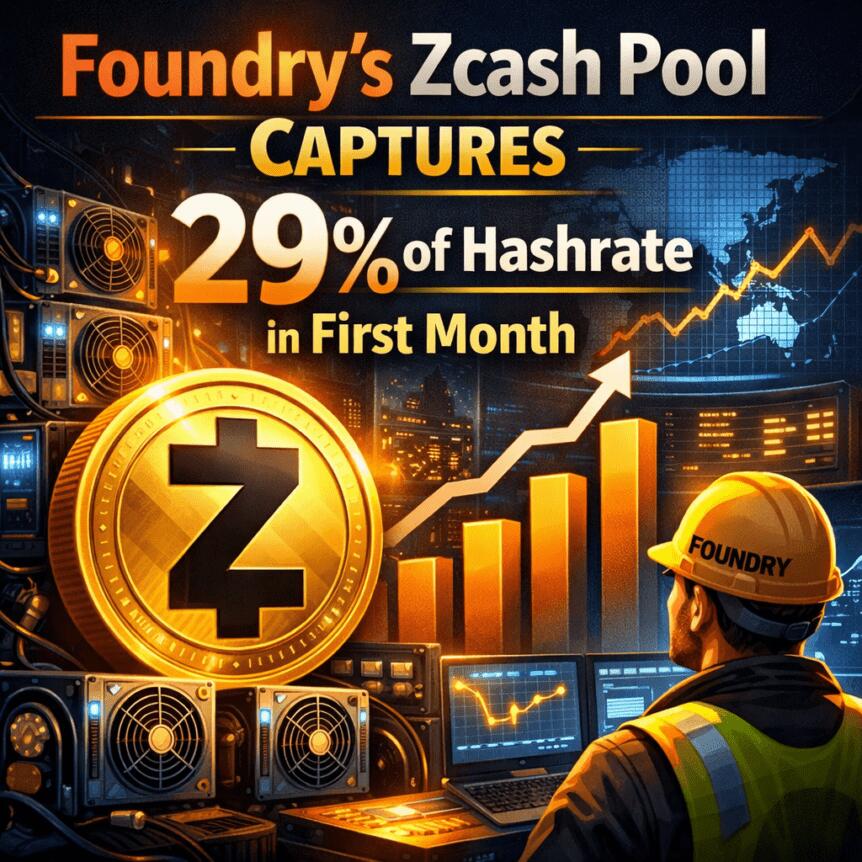
Foundry Digital, a leading crypto mining pool operator, has launched a dedicated Zcash mining pool aimed at institutional participants. The company says the new pool now accounts for about 29.2% of the Zcash network hashrate, built through partnerships with multiple institutional miners. Foundry did not disclose the specific miners behind the capacity, stating only that a broad base of institutional clients is participating.
As part of the roll-out, Foundry also launched a Zcash block explorer, which shows the Foundry Zcash Pool has mined 2,344 blocks since its launch earlier this month. Zcash blocks are produced roughly every 75 seconds, with a block reward of 1.25 ZEC, which translates to about $458 at prevailing prices. According to Zcashinfo.com, the pool began accumulating hashrate around March 4—roughly a week before the public unveiling.
Foundry’s asserted hashrate share arrives after the pool operator’s rapid ascent reshaped the Zcash mining terrain. The shift has coincided with a notable decline in ViaBTC’s dominance, which had previously controlled a large slice of the network. Zcashinfo.com data indicate ViaBTC’s share has fallen from 68.1% on Feb. 27 to about 37% at the time of writing, underscoring how institutional players are reconfiguring the network’s mining distribution. In context, Coinbase’s security PSA from September 2023 singled out ViaBTC’s dominant position as a risk factor for network security, highlighting ongoing concerns about concentration in PoW ecosystems.
Key takeaways
- Foundry launches a dedicated Zcash pool and claims it now controls about 29.2% of the network hashrate, built through multiple institutional partnerships; the pool’s operators have not disclosed the participating miners.
- The pool has mined 2,344 blocks since launch, with Zcash block times around 75 seconds and a block subsidy of 1.25 ZEC (roughly $458 at current prices).
- Foundry’s rise appears to be shifting Zcash’s mining leadership away from ViaBTC, whose share has dropped toward 37% from well over 68% earlier in the year, according to Zcashinfo.com.
- Context on market dynamics and security: Coinbase flagged ViaBTC’s dominance as a risk in 2023, illustrating broader concerns about centralization in PoW networks.
Assessing the impact on Zcash’s network and the broader mining ecosystem
The emergence of a substantial institutional Zcash pool marks a notable development for a privacy-focused PoW network that has historically seen concentration around a handful of operators. Foundry’s approach—positioned as a compliant, purpose-built mining solution for institutions—reflects a growing demand among professional miners seeking predictable governance and operational resilience in a privacy-oriented blockchain environment. In practical terms, this shift can influence network security dynamics, fee structures, and block production consistency, particularly if more institutional actors join or reallocate capacity to Zcash over time.
From a market perspective, Zcash has enjoyed a period of outperformance versus many peers, with a marked price rally over the past year. Data from CoinGecko show ZEC’s market capitalization hovering around the multi-billion-dollar range, and the asset has been among the better performers within the broader crypto space over the last year, including a pronounced uptick in the month following Foundry’s initial Zcash Pool announcement. The current macro context—coupled with rising attention to privacy-focused assets—helps explain why institutions might view Zcash as a credible, long-horizon exposure despite broader market headwinds.
Industry observers will be watching whether additional institutional operators follow Foundry’s lead and join the Zcash mining scene, and how the distribution of hashrate evolves in the near term. A more diversified pool ecosystem could reduce single-point failure risk but may also complicate governance and monitoring for network security. As with other PoW networks, centralized concentration remains a perennial concern; how this balance shifts in practice will influence miners’ decision-making, hardware deployment, and the perceived resilience of Zcash’s privacy guarantees.
For readers seeking more granular data, Foundry’s Zcash Pool is documented in the press release and related materials, including coverage of the pool launch. The company’s own disclosures align with broader reporting on mining pool dynamics and the ongoing discussions around centralization risk in proof-of-work networks.
To follow the latest developments in Zcash mining and market activity, keep an eye on pool-hashrate distributions, block explorer metrics, and commentary from major industry players as institutional participation in privacy-focused networks continues to evolve.
What happens next may hinge on whether additional institutional clients enroll with Foundry or pursue similar deployments with other privacy-centric projects. As Zcash and other PoW networks navigate security concerns and decentralization trade-offs, readers should watch for updates on hashrate concentration, regulatory considerations, and any new tooling or audits that accompany institutional mining ventures.
Sources and context: Foundry’s pursuit of an institutional-grade Zcash pool was announced in collaboration with industry coverage and corroborating data from Zcashinfo.com, which tracks pool distribution, as well as contemporaneous reporting on ViaBTC’s historical dominance and Coinbase’s security notes. Public references to Zcash block economics and market position can be explored via CoinGecko’s Zcash page and related market data.

Crypto World
Hut 8 cuts bitcoin credit costs with FalconX refinancing, freeing 3,300 BTC from collateral
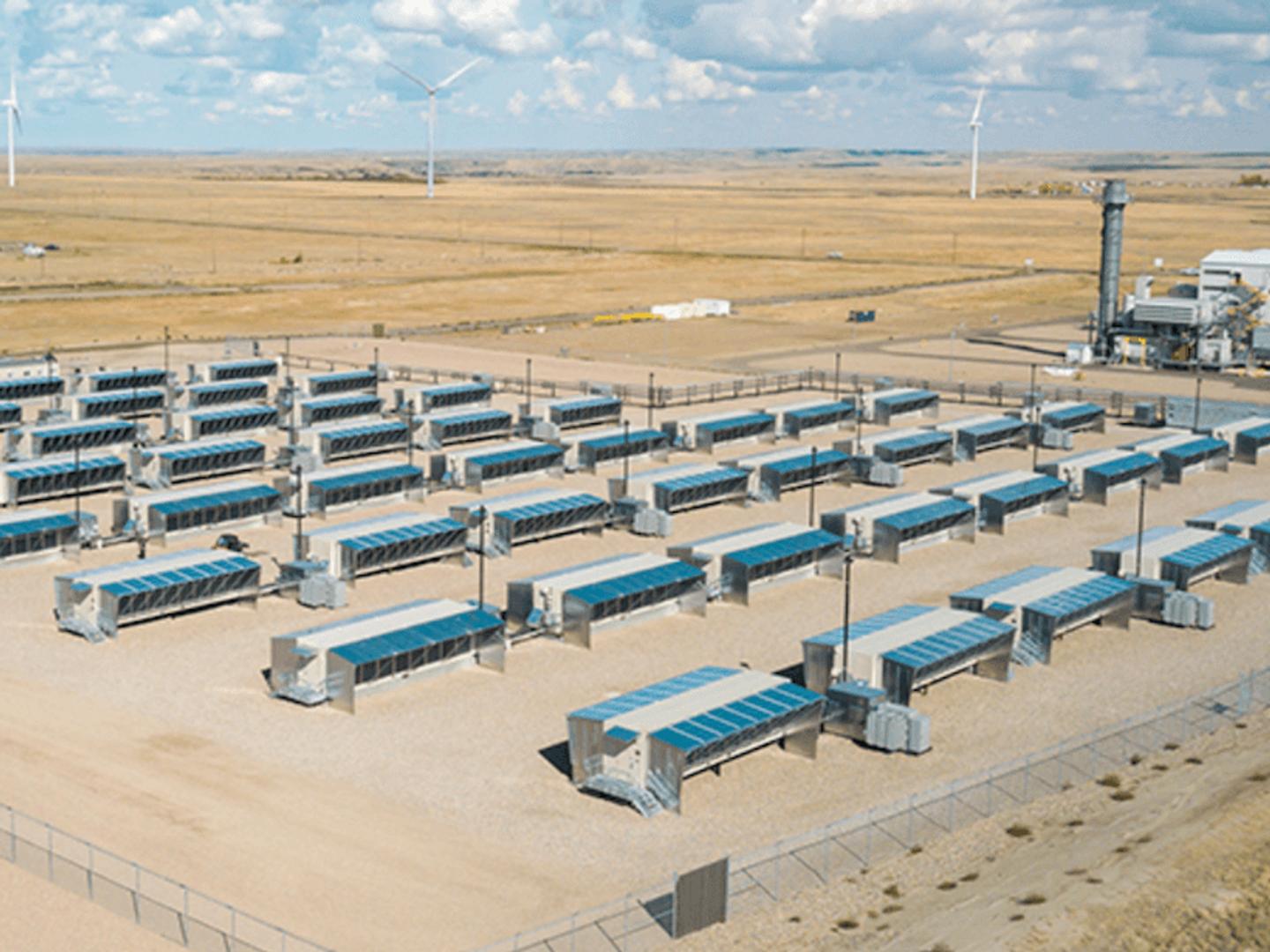
Hut 8 (HUT), a bitcoin miner turned energy and AI compute company, has refinanced its bitcoin-backed credit facility, replacing its existing Coinbase Credit arrangement with a new $200 million facility with FalconX.
With the new deal, Hut 8 cut its fixed interest rate to 7% from 9%, a 200-basis-point improvement, according to a press release. The move is part of the firm’s focus on lowering its cost of debt on bitcoin-backed credit and broader cost of capital, the company said. The deal also frees up approximately 3,300 bitcoin that were previously pledged as collateral, worth roughly $260 million as of May 1, giving Hut 8 greater flexibility to deploy that capital.
“This refinancing strengthens our balance sheet by decreasing our cost of debt while simultaneously increasing Bitcoin held outside collateral covenants, resulting in additional liquidity to deploy into the growth of our business,” said Sean Glennan, CFO of Hut 8.
“It advances our broader objective of optimizing the role of bitcoin on our balance sheet and lowering our cost of capital,” he added.
The trend of refinancing for better terms continues among mining firms, as they seek to improve their credit terms and free up more capital for their pivot to AI and move away from volatile bitcoin revenues in favor of long-term leases.
Last week, Hut 8 priced $3.25 billion of senior secured notes to fund construction of a 245-megawatt data center at its River Bend campus in St. Francisville, Louisiana, according to an April 28 SEC filing. The project, first announced in December, has a 15-year, $7 billion lease with AI infrastructure firm Fluidstack, backed by Google, with a total potential value of up to $17.7 billion if all renewal options are exercised.
Another miner, Riot, also recently secured improved terms on its $200 million bitcoin-backed credit facility with Coinbase, lowering the rate to a fixed 6.15% from 8.3% and releasing 1,544 of pledged collateral bitcoin, signaling growing lender confidence in its expanding data center business.
Hut 8 shares rose about 1.5% on Monday as bitcoin rallied above $80,000.
Read More: Riot extends $200 million Coinbase credit facility, and bitcoin weakness could mean more sales
Brent crude jumped more than 5% on Monday to above $120 a barrel, but US bonds rose sharply as Iranian drones struck the Fujairah Oil Industry Zone, the UAE’s main oil export outlet outside the Strait of Hormuz.
The UAE Ministry of Defence intercepted three of four Iranian cruise missiles, while a fourth fell into the sea. Two passenger flights to Dubai were diverted as alerts spread across the Emirates.
US Bond Market Sends Warning
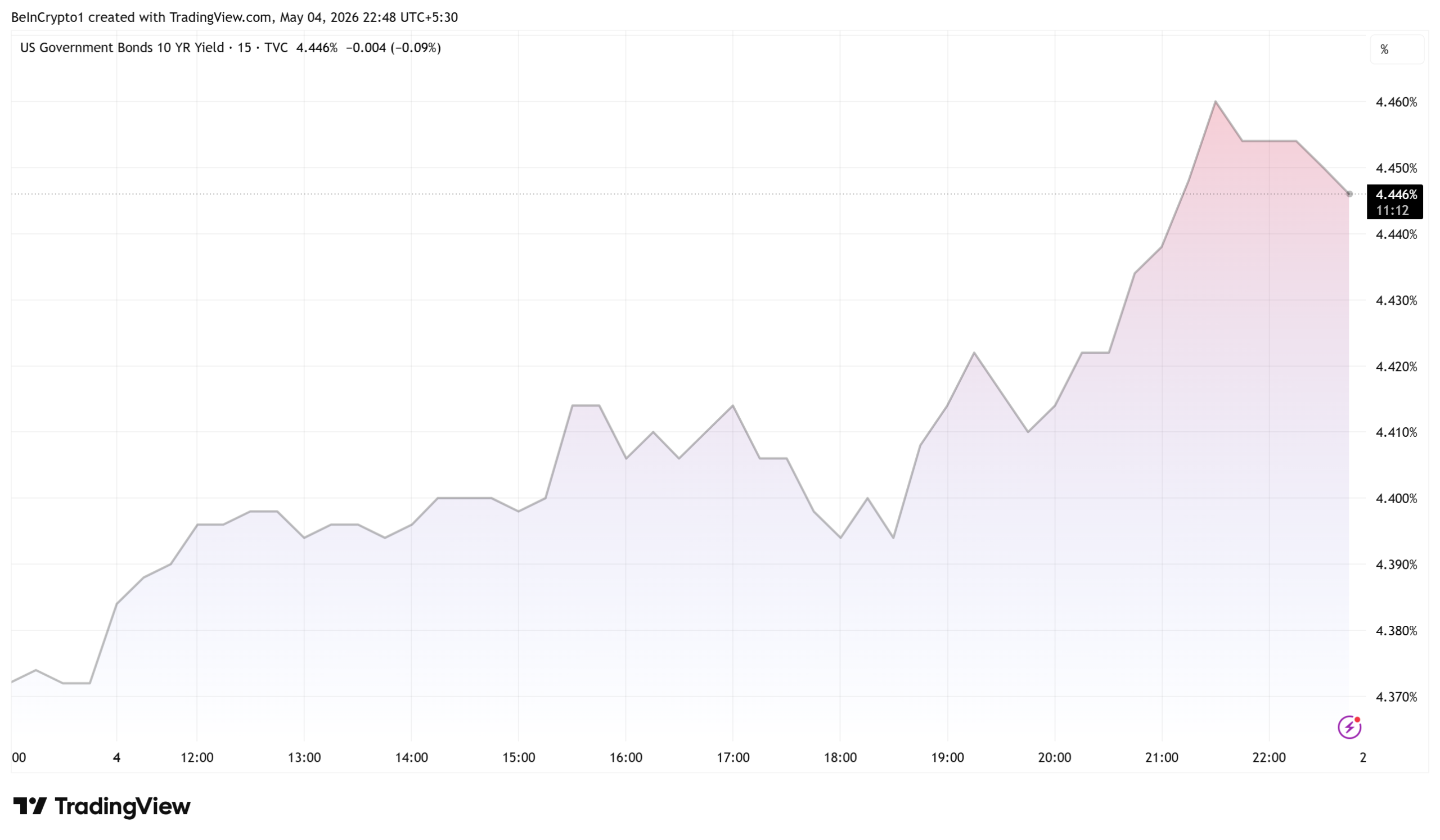
The 10-year U.S. Treasury yield climbed to 4.46%, a nine-month high as traders price in inflation pressure from rising energy costs.
In bond market language, a sell off means investors are selling bonds, which pushes prices down and yields up. So a bond sell off signals rising yields. They’re the same event described from two angles:
- Price view: bonds sold off (prices fell)
- Yield view: yields surged

Fed funds futures now imply no Federal Reserve rate cuts until December 2027. Traders see a 38% probability of a rate hike by March 2027.
Bonds typically rally on geopolitical risk. Monday’s move suggests markets view sustained inflation as the bigger threat.
“It appears that $5/gallon gas prices and 7%+ mortgages are on the way. The bond market needs help,” wrote analysts at The Kobeissi Letter.
Strike Hits Hormuz Bypass Hub
The UAE ministry of defense indicated detecting four munitions coming from Iran. Reportedly, three missiles were successfully intercepted over the country’s territorial waters, and the last one fell into the sea.
“The Ministry of Defence confirmed that the sounds heard in scattered areas of the country are the result of the successful interception of the aerial threats,” they wrote in a post.
Three Indian workers were moderately injured at Fujairah. A tanker was struck north of the port over the weekend.
Loading operations at the Hormuz bypass hub have been partly suspended after three drone strikes in four days. The attacks broke a fragile US-Iran ceasefire that took effect on April 8.
“Tonight, perhaps, a new chapter of power will unfold, one the adversaries have never witnessed before,” Iranian Brigadier General Ibrahim al-Fiqari warned of further escalation in a post on X.
The Fujairah hub is the UAE’s only major oil export outlet outside the Strait of Hormuz. A pipeline built specifically to bypass the chokepoint feeds it.
The post US Bond Markets Sell Off As Iranian Drones Hit UAE Fujairah Hub appeared first on BeInCrypto.

Prediction markets are evolving from retail speculation platforms into institutional-grade financial instruments, driven by demand for precise macro hedging and clearly defined binary outcomes, according to a May 4 report by Bernstein.
The report highlights why institutional investors may find these markets attractive — namely, they allow users to hedge specific event risks, such as tariffs, elections and geopolitical developments, using contracts that resolve to simple yes-or-no outcomes.
Bernstein pointed to the first bespoke institutional block trade executed on Kalshi last week as a key milestone. A block trade refers to a privately negotiated, large transaction typically arranged between institutional counterparties.
The deal was brokered by Greenlight Commodities and involved a Houston, Texas-based environmental hedge fund and Jump Trading as the liquidity provider. The custom contract was tied to the clearing price of California’s May carbon allowance auction, illustrating how prediction markets can be tailored to specific client needs.
“We believe the introduction of block trading and bespoke contracts could expand participation from institutional investors seeking targeted exposure to event risks,” wrote the Bernstein analysts.
Separately, Bernstein said Clear Street’s partnership with Kalshi gives institutional investors a regulated way to access prediction markets, allowing them to trade these contracts alongside traditional assets like stocks and futures.

Listing of Kalshi’s largest active event contracts by volume. Source: Bernstein
Related: US Senate bans itself from betting on prediction markets
Retail leads prediction markets as institutional interest grows
The shift toward institutional adoption is notable given that prediction markets are still largely driven by retail activity. A recent report by Bitget Wallet and Polymarket found that retail users accounted for more than 80% of the $25.7 billion in prediction market volumes recorded in March.
Greater institutional participation could accelerate the market’s growth, with Berinstein projecting that prediction markets could evolve into a trillion-dollar industry by the end of the decade.

Prediction market trading volumes topped $25 billion in March. Source: Bitget Wallet
Regulatory momentum in the United States is also shaping the sector’s trajectory, though the landscape remains uneven.
Kalshi operates as a federally regulated exchange under the Commodity Futures Trading Commission, while Polymarket received conditional approval in late 2025 to offer event contracts in the US through regulated channels.
Magazine: How to fix suspected insider trading on Polymarket and Kalshi
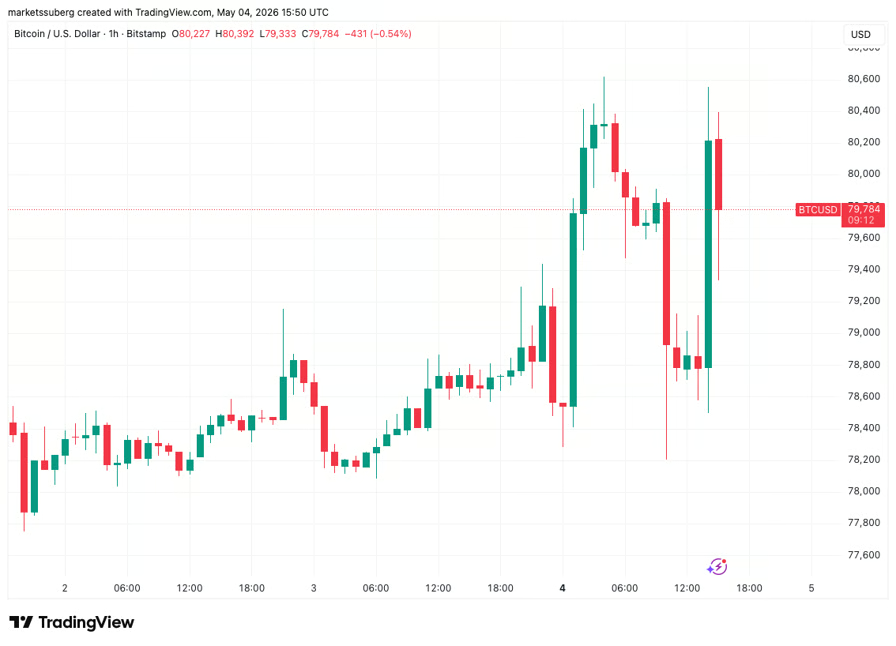
Bitcoin (BTC) saw volatility at Monday’s Wall Street open as fresh US-Iran war events sparked instability.
Key points:
- Bitcoin wobbles around the $80,000 mark as Iran tensions steer risk-asset markets.
- The overhead CME futures gap becomes the new target for traders wanting proof of BTC price strength.
- Short-term holders approach breakeven on their unrealized losses.
Iran injects fresh BTC price volatility with $80,000 at stake
Data from TradingView showed whipsaw BTC price action as $80,000 became a central focus for both bulls and bears.

BTC/USD one-hour chart. Source: Cointelegraph/TradingView
News that Iran had struck a petroleum facility in the United Arab Emirates sent oil prices surging on the day, with US stocks under pressure.
WTI crude added over 5% to return past $105 per barrel, while Brent hit $119 per barrel — within striking distance of its highest levels in nearly three years.

CFDs on Brent crude oil one-day chart. Source: Cointelegraph/TradingView
Earlier, trading company QCP Capital described the Iran situation as “fluid.”
“For now, markets appear to be pricing in de-escalation. That calculus could change quickly,” it wrote in its latest Market Color analysis.
For Bitcoin itself, QCP argued that the semi-filled gap in CME Group’s futures market formed the key resistance hurdle for buyers to overcome.
“Opened up with a new small CME gap. It is also well on its way to close the previous large gap from $84K,” trader Daan Crypto Trades continued on the topic in a post on X.
“Good to mark these levels on your chart as they could act as a ‘magnet’ and local reversal zones if price trades close/into them.”

CME Bitcoin futures 15-minute chart. Source: Daan Crypto Trades/X
Bitcoin speculators almost wipe out unrealized losses
Onchain analytics platform CryptoQuant added another important level in the form of the aggregate cost basis of Bitcoin’s short-term holders, or speculative investors holding for up to six months.
Related: BTC price can ‘easily’ hit $95K: Five things to know in Bitcoin this week
“The more probable scenario is a cautious recovery attempt toward STH realized price,” contributor Crazzyblockk wrote in a QuickTake blog post.
“A confirmed daily close above $81,500 flips that level from resistance to support, opening the path toward $87–92K. Failure sends price back to test new money realized price near $76,500.”

Bitcoin aggregate cost basis (realized price) by UTXO age (screenshot). Source: CryptoQuant
Crazzyblockk added that Bitcoin’s long-term holders were “unbothered” about their average 27% unrealized losses.
Crypto World
Bitcoin drops to $79,000, ETH, SOL, DOGE sharply lower on renewed U.S.-Iran war tensions


Bitcoin dropped to $79,074 in late Asian hours Monday, reversing nearly $1,500 from a $80,594 intraday high that had marked the highest print since January 31.
The pullback came as Iran’s Fars news agency claimed two missiles hit a U.S. patrol boat near Jask Island after the vessel allegedly ignored Iranian warnings to leave its territorial waters. Brent crude jumped more than 5% to trade above $113 a barrel before paring the gain.
The U.S. denied the report shortly after and said no American ship had been struck. Oil and equity futures pared their initial moves on the denial, but bitcoin held its decline as traders priced in the fragility of the ceasefire that has held since early April.
Other majors followed bitcoin lower from intraday highs but stayed positive on the day.
Ether traded at $2,341, up 1.2% over 24 hours after touching $2,368 earlier. Solana sat at $84.08, up just 0.2% on the day after starting Monday at $85.14. XRP slipped to $1.40 and BNB to $623. Dogecoin held its gains better than most, up 2.3% on the day to $0.1102 with the weekly print still at 12.1%.
The escalation arrived hours after President Donald Trump announced on Truth Social that the U.S. would begin escorting ships stranded in the Persian Gulf through the Strait of Hormuz starting Monday, an operation dubbed Project Freedom that involves guided-missile destroyers, aircraft, and drones.
Iran responded by announcing it had “redefined the control zone” in Hormuz, extending its claimed maritime borders to Fujairah and signaling that Tehran would regulate shipping traffic in the area regardless of U.S. operations.
Bitcoin had broken $80,000 for the first time since January, with $301 million in shorts liquidated as the move unfolded earlier Monday. The Senate’s Clarity Act compromise on stablecoin yield, released Friday, had been adding to the risk-on tone heading into the week.
Whether the U.S. denial holds or fresh confirmations emerge from either side will likely set the tape for the rest of the U.S. session.
Crypto-related stocks rallied Monday, led by Circle (CRCL) and Coinbase (COIN), as progress on U.S. digital asset legislation and bitcoin breaking above $80,000 lifted sentiment across the sector.
Circle, issuer of the USDC stablecoin, surged 18%, extending recent gains, while U.S.-focused crypto exchange Coinbase rose about 7%. BitGo (BTGO), a digital asset infrastructure firm offering custody and stablecoin services, climbed roughly 10%.
Strategy (MSTR), the largest corporate bitcoin holder, crypto-friendly digital broker Robinhood (HOOD) and Ethereum (ETH) treasury firm Bitmine (BMNR) were also up 3%-4%, underscoring the broad-market advance.
The move came as bitcoin pushed above $80,000 during the session, reaching its strongest level since late January and providing a tailwind for the broader crypto sector. BTC advanced nearly 2% over the past 24 hours, leading the broader crypto benchmark CoinDesk 20 Index’s 1.2% gain.
Further boosting investor optimism were signs that the long-debated Digital Asset Market Clarity Act, a key piece of U.S. legislation to regulate crypto markets, is moving closer to passage.
A newly released compromise would prohibit stablecoin issuers from offering yield on idle balances, while still allowing rewards tied to usage and transaction activity, according to a Friday text. The approach addresses one of the most contentious aspects of the bill and aligns with earlier discussions in Washington.
Clarity Act progress
That clarification appears to be a pivotal moment that brings the bill closer to passage, according to Markus Thielen, founder of 10x Research.
“The latest compromise removes one of the final obstacles for the legislation,” said Thielen in a Telegram message. With the stablecoin yield issue addressed, lawmakers are expected to move toward a formal markup, potentially as soon as this week, he added.
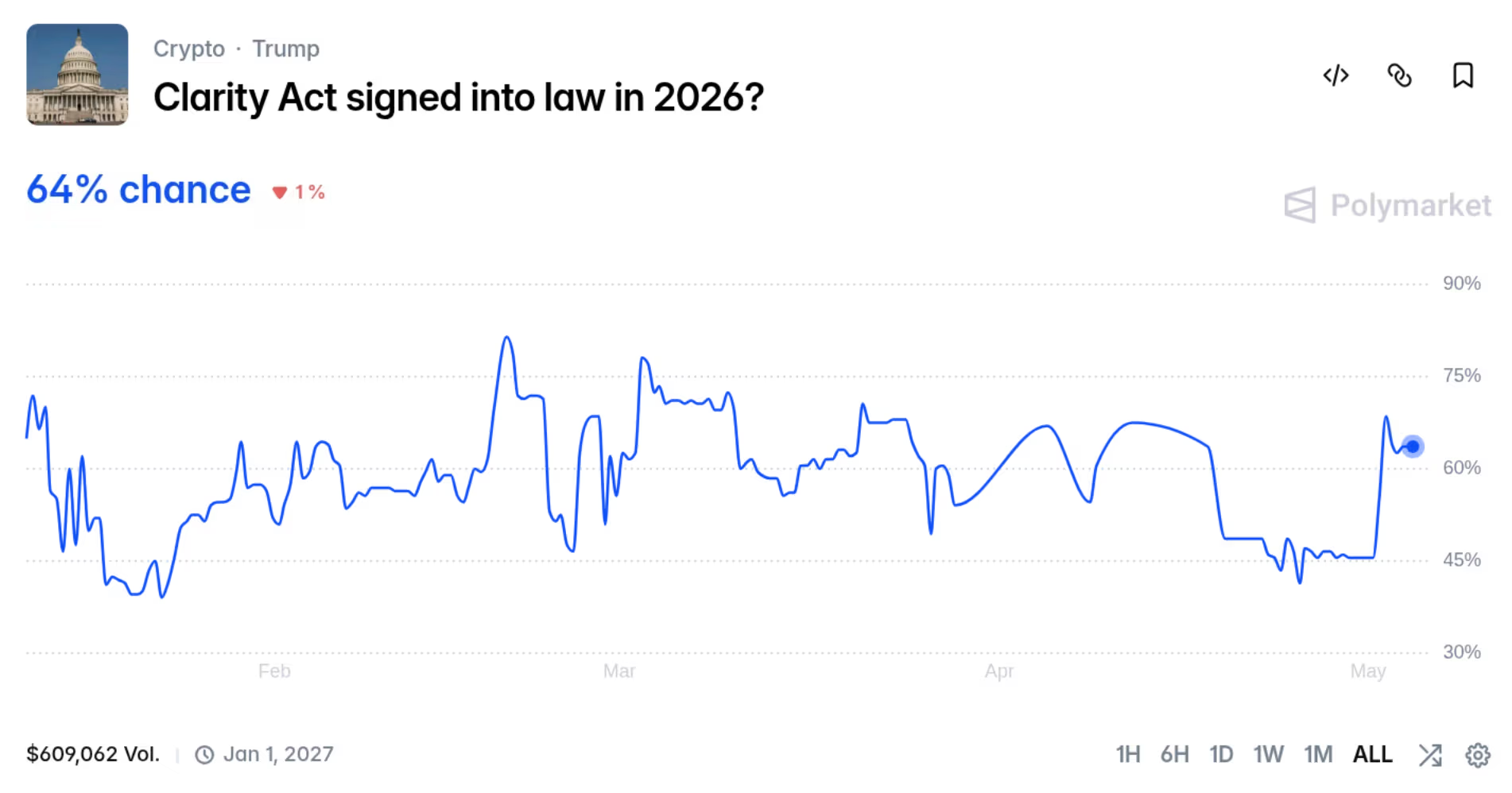
Odds of passage on the prediction platform Polymarket have risen to 64%, reflecting growing confidence that the bill will advance.

With that, “equity markets are beginning to price in potential winners,” Thielen said.
Circle, as a regulated stablecoin issuer, is widely seen as a potential beneficiary of clearer rules, particularly if stablecoins are formally positioned as payment tools rather than yield-bearing assets, he said.
The firm’s upcoming earnings, due next week, adds another layer of momentum for the stock, Thielen noted.
After releasing last quarter’s report in February, Circle’s shares surged around 100% in the following weeks, and investors may have started to position for further gains ahead of earnings.
ePBS, Block-Level Access Lists, and EIP-8037 repricings combine to unlock a 200M gas limit floor, a throughput jump that could keep network fees pinned for years.
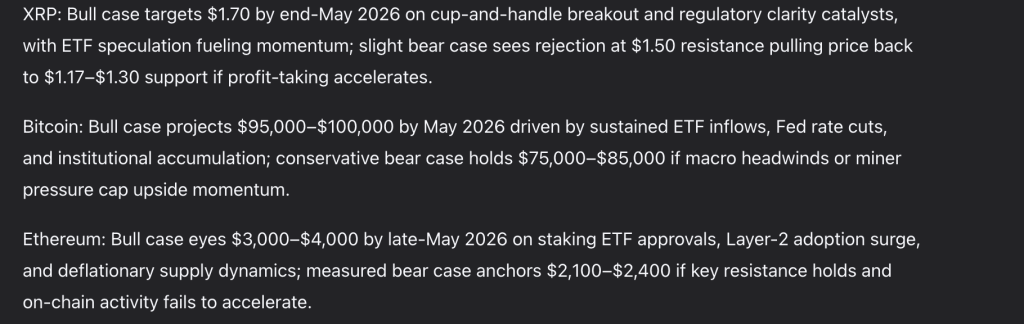
We prompted China’s Alibaba Qwen AI to predict near-term price predictions for XRP, Bitcoin, and Ethereum, and the result is a tightly structured outlook.
It leans on macro easing, ETF momentum, and asset-specific catalysts to justify another leg higher.
As per Qwen AI, Bitcoin is expected to push toward $95,000–$100,000 on sustained ETF inflows, potential Fed rate cuts, and continued institutional accumulation.
Which is interesting because Bitcoin just reclaimed $80,000 making the prediction realistic and possible.

Alibaba AI frame Ethereum for a move into the $3,000–$4,000 range, driven by staking ETF approval narratives, Layer-2 expansion, and deflationary supply mechanics.
XRP, meanwhile, is positioned around a technical breakout scenario, with a cup-and-handle structure and regulatory clarity acting as the core drivers behind a move toward $1.70.

What makes this set of predictions stand out is the balance between catalysts and structure. Qwen is not just projecting targets, it is tying each move to a specific trigger.
Bitcoin depends on liquidity and macro conditions. Ethereum relies on institutional product expansion and on-chain growth. XRP is driven by technical breakout confirmation and sentiment shifts tied to regulation and ETF speculation.
The question now is whether price action is actually confirming those triggers, or if the market is still lagging behind the narrative.
Price Prediction: Can Bitcoin, Ethereum, and XRP Validate These Alibaba Qwen AI Breakout Predicts?
Bitcoin is now trading around $78,996, still holding comfortably above the $75K pivot that Qwen’s entire bullish case depends on.
As long as this level holds, the structure supports continuation toward $95K–$100K, driven by ETF inflows and improving macro conditions.
The key shift here is stability. BTC is not just hovering at support anymore, it is maintaining strength above it.
That said, momentum is still not fully expanding. If the price slips back below $75K, the market is likely to rotate into the more conservative $75K–$85K range, delaying the breakout scenario.
Ethereum price is sitting near $2,339, still below the critical reclaim zone. The $2,400–$2,600 range remains the barrier that must be overcome for the $3,000–$4,000 projection to align with reality.
Right now, ETH is close, but not there yet. Holding above $2,300 keeps the structure intact, but without a push higher, it remains in a reactive phase.
Lose this level, and the downside toward $2,100–$2,200 comes back into focus. The narrative is strong, but price still needs to confirm it.
XRP is trading around $1.39, just below the key $1.50 resistance that defines the breakout scenario.
This keeps the setup very tight. If XRP can push through $1.50 and hold above it, the move toward $1.70 becomes a direct continuation play, aligning with the cup-and-handle breakout thesis.
Momentum can build quickly from there, especially with regulatory clarity and ETF speculation still in the background.
On the downside, rejection at $1.50 keeps XRP within its current range and brings the $1.17–$1.30 support zone back into play. That range now acts as the key defense level. Losing it would weaken the structure and shift the tone back toward consolidation rather than expansion.
Across all three, the structure remains intact and slightly stronger than before, but the breakout is still not confirmed.
Prices are holding in the right zones, but the market still needs that next push to turn positioning into momentum.
Discover: The best crypto to diversify your portfolio with
AI Predicts That Bitcoin Hyper Could Outperform Them All
Early-stage infrastructure plays offer a different risk/reward profile entirely, and some traders rotating between cycles are already looking there.
Bitcoin Hyper is positioning itself as infrastructure for the next leg: the first Bitcoin Layer 2 with Solana Virtual Machine (SVM) integration, claiming sub-Solana latency while inheriting Bitcoin’s security layer.
The project has raised $32M in its presale at a current token price of $0.013679, with staking available at high APY for early participants.
The core thesis, bringing fast, low-cost smart contracts to Bitcoin without abandoning its trust model, targets a gap that neither Ethereum nor Solana fills directly.
The post China’s Alibaba AI Predicts the Price of XRP, Bitcoin, Ethereum by the End of May 2026 appeared first on Cryptonews.
Crypto World
Pavel Durov Just Took Over TONCoin as Its Largest Validator and Cut Fees to Near Zero: Is This the Catalyst TON Has Been Waiting For?
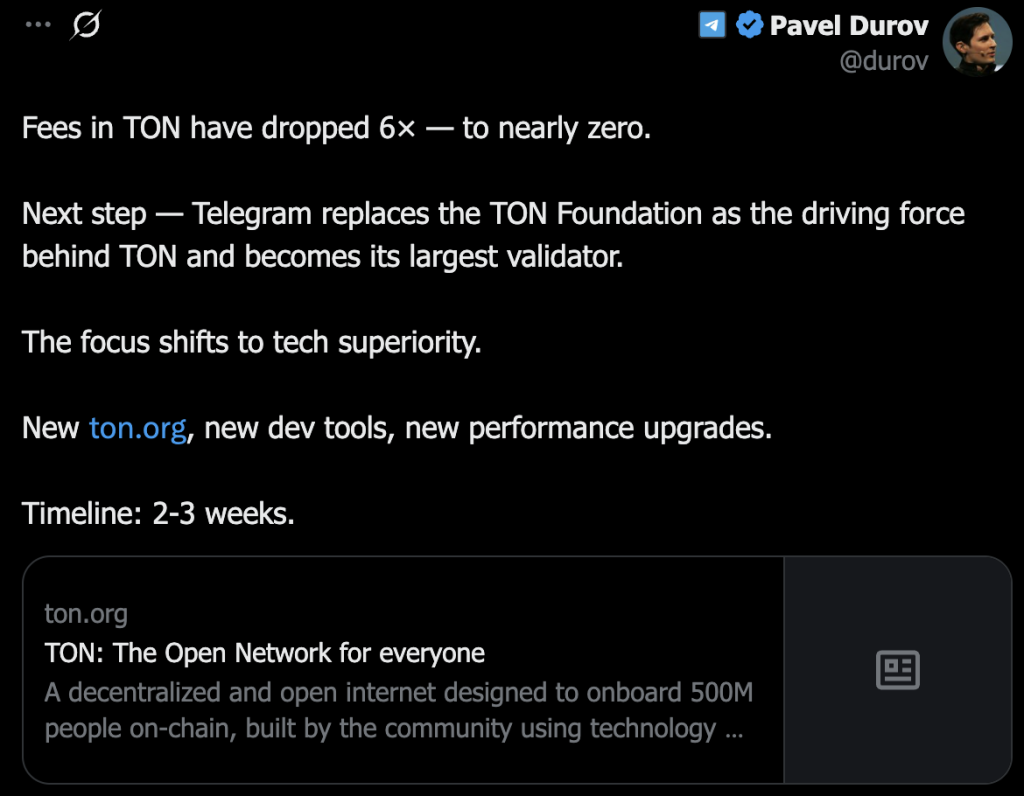
In a bold move that sent ripples through the crypto world, Telegram founder Pavel Durov announced today that fees on The Open Network (TONCoin) have already dropped 6x, plummeting to nearly zero.
But that’s just the beginning. Telegram is stepping up to replace the TON Foundation as the primary driving force behind the blockchain, becoming its largest validator.
This shift marks a major turning point for TON. After delivering a 10x speed upgrade in April (Step 1 of the “Make TON Great Again” plan), the network is now accelerating its transformation with Telegram’s direct involvement.

The focus is shifting squarely to technological superiority, backed by a refreshed ton.org website, new developer tools, and significant performance upgrades, all expected to roll out in the next 2–3 weeks.
Discover: The best crypto to diversify your portfolio with
Why This Matters For Telegram And Toncoin Foundation
Durov is making a direct bet on scale.
Telegram’s nearly 1 billion users combined with TONCoin ultra-low-cost infrastructure is the thesis. Near-zero fees and sub-second transactions open the door for seamless in-app payments, mini-apps, DeFi, and mass adoption at a scale most blockchains cannot touch.
Many transactions could soon become completely feeless.
For developers it means easier building and faster iteration. For the broader ecosystem it signals Telegram’s full commitment to turning TON into a high-performance backbone for real-world applications, not just another speculative asset.
Speculation is not the endgame here. Everyday utility is. With Telegram firmly in the driver’s seat, the Make TON Great Again roadmap is just getting started.
Discover: The best pre-launch token sales
The post Pavel Durov Just Took Over TONCoin as Its Largest Validator and Cut Fees to Near Zero: Is This the Catalyst TON Has Been Waiting For? appeared first on Cryptonews.


OpenAI has sealed a $10B joint venture dubbed DeployCo with major private equity firms, giving it capital, governance access, and a captive pipeline to roll AI across thousands of portfolio companies.
Summary
- OpenAI has finalized a $10 billion joint venture with a consortium of major private equity firms to accelerate deployment of its enterprise AI tools across portfolio companies.
- The vehicle, known internally as DeployCo, will see PE investors commit around $4 billion, while OpenAI is expected to contribute up to $1.5 billion and retain super‑voting control.
- The agreement underscores how AI labs and buyout firms are aligning to use foundation models to overhaul operations in thousands of traditional businesses.
Market reports indicate that OpenAI has now closed a $10 billion joint venture with a group of private equity backers, an entity that previous filings and leaks identified as “DeployCo,” formed in Delaware as a limited liability company.
DeployCo structure and capital commitments
According to details first outlined by the Financial Times and relayed by outlets such as Bloomberg, the structure assigns a pre‑money valuation of roughly $10 billion to the new venture and is designed to act as a dedicated distribution vehicle for OpenAI’s workplace and enterprise products.
The private equity syndicate is led by TPG, with Bain Capital, Advent International, Brookfield Asset Management, and Goanna Capital also named in reports as core investors, collectively expected to invest about $4 billion for equity stakes, board seats, and influence over deployment priorities.
OpenAI, for its part, is set to provide an initial equity commitment of around $500 million, with the option to increase that to as much as $1.5 billion over time, while maintaining super‑voting rights that give it effective control over the venture’s strategic direction.
In one LinkedIn summary of the term sheet, the company is described as offering investors a 17.5% annual return floor over a five‑year period, a structure one source quoted by the FT said was “a floor… but we expect it to be much higher.”
A distribution play for enterprise AI
The goal of DeployCo is not to build consumer apps but to “deploy OpenAI’s software across the portfolio companies” of the participating private equity firms, using capital and governance rights to push AI integration into manufacturing, retail, healthcare, finance, and other sectors those funds own.
Coverage from Reuters and Yahoo Finance frames the venture as a way for OpenAI to secure a pipeline of thousands of business customers in one stroke, while PE managers see it as a tool to cut costs, grow revenue, and defend legacy holdings from AI‑driven disruption.
Analysts quoted in market commentary argue the initiative marks a shift from AI labs selling generic API access toward tightly integrated, outcomes‑linked deployments, with OpenAI effectively tying its fortunes to the performance of buyout firms’ portfolios.
In a recent crypto.news analysis, the deal was described as “a whole new AI distribution war,” positioning OpenAI’s DeployCo against rival structures from Anthropic and other labs that are courting private equity and infrastructure investors with similar joint‑venture models.
Another crypto.news overview emphasized that the $10 billion vehicle could become a template for how foundation‑model companies raise capital and secure enterprise reach without going public.
A separate crypto.news briefing stressed that by committing its own capital and guaranteeing returns, OpenAI is blurring the line between software vendor and financial sponsor, taking on more balance‑sheet risk in exchange for deeper operational control.

Panthers add longtime S Mike Adams to coaching staff

DHS Demanded Google Surrender Data on Canadian’s Activity, Location Over Anti-ICE Posts

Bach to the future at iconic jazz venue – Positive News

Manchester United reach agreement with Casemiro over contract clause amid transfer speculation

US brings back mandatory military draft registration

Steven Gerrard disagrees with Gary Neville over ‘shock’ Chelsea and Arsenal claim | Football


-

 Politics7 days ago
Drax board avoid their own AGM, accused of greenwashing & environmental racism
-

 Fashion6 days ago
Kylie Jenner’s KHY Enters a New Era with ‘Born in LA’
-

 NewsBeat1 day ago
Channel 5 – All Creatures Great and Small series 7 new post
-

 Tech7 days ago
Images of Samsung’s rumored smart glasses have leaked
-
 Tech3 days ago
Trump’s 25% EU auto tariff breaches Turnberry Agreement that also covers semiconductors and digital trade
-

 Business6 days ago
Most Commercial Energy Audits Miss the Real Losses
-

 Crypto World6 days ago
CFTC’s AI will review U.S. crypto registration applications, chairman tells CoinDesk
-
 Sports3 days ago
Paul Scholes issues Marcus Rashford reality check as agreement emerges over Man United star
-

 Business5 days ago
Barclay Brothers Avoid Bankruptcy: HSBC Drops High Court Petitions After IVA Deal
-
 Business5 days ago
Tesla Officially Registers Elon Musk’s Stock: What Investors Need to Know
-

 Tech6 days ago
Get Ready for More Brain-Scanning Consumer Gadgets
-
 Crypto World6 days ago
Robinhood Phishing Scam Exploits Gmail Dot Feature to Bypass Security
-

 Crypto World7 days ago
Gmail Dot Trick Underpins Robinhood Phishing, Sending Real-Looking Emails
-

 Entertainment7 days ago
Sister Wives: Janelle Posts New Scary Warning
-

 Entertainment7 days ago
Michael Jackson’s Biopic Excluded Abuse Allegations For $25M
-

 Business4 days ago
Two Powerball Tickets Split $143 Million Jackpot in Indiana and Kansas
-

 Business7 days ago
Superdry co-founder accused of raping woman
-
 Crypto World7 days ago
Meme Coin Based on White House Shooter Conspiracy Rallies 320%
-

 Tech7 days ago
YouTube TV’s Multiview Feature Just Got A Game-Changing Upgrade
-
Business7 days ago
Opus Genetics president Benjamin Yerxa sells $39,121 in stock
You must be logged in to post a comment Login