

Crypto World
Galaxy Commits $5M to Help Developers Quantum-Proof Bitcoin

Galaxy Digital has launched a new push to accelerate post-quantum security work for Bitcoin, pledging up to $5 million in grants for open-source developers. The initiative is designed to support research and engineering across quantum-resistant upgrades, including cryptography research, migration tooling, and formal security reviews.
Alongside the funding, the company announced the formation of a quantum advisory council as part of its Bitcoin Quantum Readiness Initiative. Galaxy said Tuesday that the council will bring together researchers with backgrounds spanning cryptography, applied security, and academic computing—an attempt to turn abstract “quantum risk” discussions into concrete development roadmaps.
Key takeaways
- Galaxy Digital is offering up to $5 million in open-source grants aimed at post-quantum cryptography work for Bitcoin-related systems.
- The grant scope covers more than algorithms, including Bitcoin signature schemes, wallet/custodian migration tools, and security audits.
- A new quantum advisory council under the Bitcoin Quantum Readiness Initiative includes researchers from the University of Calgary, MIT, and Boston University.
- Market debate over timelines remains unsettled, with some executives arguing there’s decades before a meaningful threat while other research emphasizes preparation windows.
- Existing standards momentum matters because NIST has already published post-quantum encryption standards that could inform future Bitcoin migrations.
What Galaxy Digital is funding
Galaxy’s announcement ties its grant program to practical components of a potential Bitcoin post-quantum transition. According to the company’s statement, the funding will support “quantum-resistant upgrade proposals” and post-quantum cryptography research, with additional emphasis on Bitcoin signature schemes.
The proposal also explicitly targets the implementation layer that many teams often treat as an afterthought: wallet and custodian migration tooling. That matters because even when a cryptographic replacement is theoretically possible, moving users, keys, and custody infrastructure to new standards typically requires careful engineering, operational planning, and risk-managed rollouts.
Galaxy also said the grants include support for formal security audits—an area that can be decisive for institutional adoption, especially when new cryptographic constructions may be unfamiliar to auditors or deployed systems.
Who is on Galaxy’s quantum advisory council
Galaxy Digital’s Quantum Readiness Initiative adds an advisory layer through a council that includes Barry Sanders, professor and scientific director of Quantum City at the University of Calgary; Damien Bérubé, an MIT Sea Grant Knauss fellow; and Eran Tromer, professor of computer science at Boston University.
While advisory councils don’t directly change Bitcoin protocol code, they can influence which research paths are prioritized, how proposals are evaluated, and what “readiness” criteria developers should meet. For builders, that can reduce uncertainty by clarifying the kinds of cryptographic schemes and migration methods most likely to survive scrutiny.
Galaxy’s earlier announcement of the Bitcoin Quantum Readiness Initiative provides the broader context for this step: the new grants and council are positioned as ways to convert readiness planning into deliverables that can be used by open-source contributors.
https://www.galaxy.com/newsroom/galaxy-launches-bitcoin-quantum-readiness-initiative
How much Bitcoin could be exposed?
Concerns about quantum risk have sharpened around how future quantum computers could affect cryptographic systems currently used to secure Bitcoin. Analytics provider Glassnode has argued that a sizable portion of Bitcoin’s supply could be exposed if “cryptographically relevant” quantum computers emerge.
As reported by Glassnode via a Cointelegraph-linked analysis, around 30% of Bitcoin’s supply could be at risk. Glassnode’s breakdown further distinguishes between coins it considers “structurally unsafe” (about 10% of supply due to output type) and “operationally unsafe” (about 20% of supply tied to key or address management practices).
That split matters for investors and developers because it suggests two different problem categories. “Structural” concerns relate to the cryptographic assumptions embedded at the protocol or script level, while “operational” concerns point to practices that exchanges, custodians, and wallet operators can potentially adjust faster than they can rewrite protocol fundamentals.
The timeline fight: “decades” vs “years”
Perhaps the biggest unresolved question behind any post-quantum plan is timing. The community’s debate remains active, with different researchers and executives placing drastically different weights on when quantum capabilities could become dangerous to today’s signature schemes and related cryptographic assumptions.
Blockstream CEO Adam Back argued in November 2025 that Bitcoin faces no “meaningful quantum threat” for at least the next 20 to 40 years. He framed this as sufficient runway for adoption of post-quantum cryptography standards approved by the US National Institute of Standards and Technology (NIST).
At the same time, other research emphasizes a shorter preparation horizon. NIST released its first set of finalized post-quantum encryption standards for key establishment and digital signatures in August 2024, including algorithms that could support future migrations across industries and potentially Bitcoin-related upgrades.
NIST’s standardization is important to the debate because it reduces the “unknown unknowns” around what algorithms might be considered credible at the cryptographic policy level.
Beyond general standards, practical migration proposals are already circulating. In December 2025, Blockstream Research published a paper proposing a hash-based signature scheme as a “promising path for securing Bitcoin in a post-quantum world.” The proposal, as described in coverage, targets replacing Bitcoin’s ECDSA and Schnorr signatures with a scheme designed so that security relies solely on cryptographic hash functions.
And while Back’s long timeline suggests extensive lead time, Bernstein has argued for a shorter window: in an April report referenced in coverage, Bernstein suggested Bitcoin “has about three to five years to prepare” for a post-quantum security upgrade.
Why this matters now even if the threat is distant
Even if quantum breakthroughs are decades away—as some industry leaders expect—the hard part is rarely the cryptography alone. It’s the migration: coordinating changes across wallets, custodians, infrastructure providers, developer ecosystems, and the security processes that institutions use to deploy and maintain cryptographic systems.
Galaxy’s grant design reflects that reality. By funding not only quantum-resistant proposals but also wallet and custodian migration tooling and formal audits, the program acknowledges that “readiness” is an engineering and operational challenge, not just a theoretical one.
For Bitcoin holders, the near-term takeaway is less about expecting immediate protocol changes and more about watching whether the community converges on migration paths that can be implemented safely and iteratively—without forcing rushed transitions if timelines shift.
Readers should watch how Galaxy’s grants translate into concrete open-source deliverables—especially any proposals that connect signature-layer changes to realistic wallet and custody migration plans—and whether ongoing research narrows the gap between long-range quantum timelines and shorter “prepare now” arguments.



Key takeaways
- Dogecoin (DOGE) is trading below $0.070 after dropping 5% in the previous session.
- Risk-off sentiment driven by geopolitical tensions has reduced demand for speculative assets like meme coins.
- DOGE futures open interest has declined, while trading volume has surged 76%, indicating increased retail activity.
Dogecoin (DOGE) remained under pressure on Friday, trading below $0.070 after suffering a 5% decline in the previous trading session.
The world’s largest memecoin has weakened alongside the broader cryptocurrency market as investors reduce exposure to speculative assets amid heightened geopolitical tensions and deteriorating market sentiment.
Geopolitical uncertainty weighs on memecoins
Dogecoin has historically been one of the most sentiment-driven cryptocurrencies, with its price closely tied to retail investor enthusiasm and broader market risk appetite.
Recent geopolitical developments, including escalating tensions between the United States and Iran, have pushed investors toward a more cautious stance.
The decline in market confidence is reflected in CoinMarketCap’s Fear & Greed Index, which dropped to 37 on Friday from 40 earlier in the week, signaling that sentiment is shifting further toward fear.
As speculative demand fades, meme coins such as DOGE have experienced stronger selling pressure than many larger cryptocurrencies.
Dogecoin’s derivatives market presents a mixed picture. According to CoinGlass, DOGE futures open interest declined to approximately $1.10 billion, indicating a slight reduction in outstanding leveraged positions.
However, futures trading volume surged 76% to around $1.38 billion, suggesting retail traders remain highly active despite the recent price decline.
The increase in trading activity alongside falling prices points to heightened volatility rather than renewed bullish conviction.
Additional derivatives indicators continue to favor sellers. DOGE’s perpetual futures funding rate slipped to approximately -0.0016%, indicating that short sellers are paying long-position holders.
Negative funding rates generally reflect bearish market expectations and growing demand for short positions.
DOGE remains below key technical levels
From a technical perspective, Dogecoin continues to trade within a well-established downtrend.
The meme coin remains below both the 50-day EMA at $0.0788 and the 200-day EMA at $0.1032
Remaining beneath these indicators keeps the short-term and medium-term outlook tilted in favor of sellers.
Momentum indicators show bearish conditions persist, although DOGE is approaching oversold territory.
The Relative Strength Index (RSI) is hovering near 31, indicating selling pressure remains strong, and the asset is nearing levels where buyers may begin looking for value.
Meanwhile, the Moving Average Convergence Divergence (MACD) is testing its signal line, suggesting bearish momentum may continue building if sellers maintain control.
The next important support level lies at $0.0641. A daily close below this level could accelerate losses and trigger another wave of selling.
On the upside, buyers must overcome several resistance levels before sentiment can improve:
- $0.0700 – Immediate resistance
- $0.0777 – Secondary resistance
- $0.0788 – 50-day EMA
Together, these levels form a significant resistance zone that bulls must reclaim to signal a potential trend reversal.

Dogecoin remains vulnerable as weakening market sentiment and geopolitical uncertainty continue to pressure speculative assets.
Unless broader market sentiment improves and DOGE reclaims the $0.070–$0.079 resistance zone, the meme coin could remain on course to test support near $0.0641 in the coming sessions.

Odos is a popular decentralized exchange aggregator that helps users find efficient token swap routes across numerous DEXs and liquidity sources. Instead of acting as a custodian of user funds, the protocol is designed to let traders connect their own wallets and execute on-chain transactions. During this process, they retain full control of their assets, which never leave their custody.
The company behind it, however, has announced on July 23rd that it’s winding down operations, with the application entering read-only mode on July 27th. All company-operated services will permanently shut down on July 30, 2026.
The team has emphasized that Odos is non-custodial and has provided instructions for users seeking different guidance, so the following breaks down the most common questions you may have.
What Happens on July 27 and July 30 Regarding Odos DEX?
Can I still use Odos to swap tokens?
Yes, but only for a limited time. Existing users can continue to use the platform freely and as usual until July 27. On that date, the application will switch to read-only mode. From that day until July 30, users will only be able to view wallet balances and transaction histories. They will not be able to execute new swaps or any other interactive functions on the protocol.
Can I create a new account or wallet?
No. New account registrations, wallet creation through ODos, and new limit orders were disabled on the day the announcement to wind down was made – on July 23rd.
Will my crypto disappear after the shutdown?
No. As we mentioned above, Odos is non-custodial. This means that the company doesn’t hold any of your funds. Your crypto remains on the respective blockchain and is controlled by you, not by Odos.
Do I Need to Move My Funds?
I connected MetaMask, Rabby, Ledger, or another wallet. Do I need to do anything?
In most cases, no. If you used a self-custody wallet, your assets remained accessible through that wallet after Odos shuts down. You can simply continue using another aggregator or DeFi application going forward.
I created my wallet using Google, Apple, email, or another social login. What should I do?
If your wallet was created directly through Odos using a social or email login, the company advises that you should transfer your assets to another wallet or export your private key before July 30. Although instructions to access your wallet will remain available on the Odos official page even after the shutdown, completing the process early reduces the risk of unnecessary complications later.
Will the ODOS token disappear?
No. The ODOS token exists on-chain and is independent of the aggregator’s functioning. According to the company, it doesn’t take custody of the token or act as its market maker. This means that the shutdown shouldn’t alter its underlying on-chain mechanics.
The team also said that the Odos DAO operates separately from the company and that it will communicate any future decisions independently.
To the Odos community: after much consideration, the operating company behind Odos is winding down its operations. The app moves to read-only on July 27, and all Odos services shut down permanently on July 30, 2026. Odos is non-custodial: your assets remain yours and on-chain. If… pic.twitter.com/9btbBLyhRL
— ODOS (@odosprotocol) July 23, 2026
The post DEX Aggregator Odos is Shutting Down: What Users Need to Do Before July 30 appeared first on CryptoPotato.
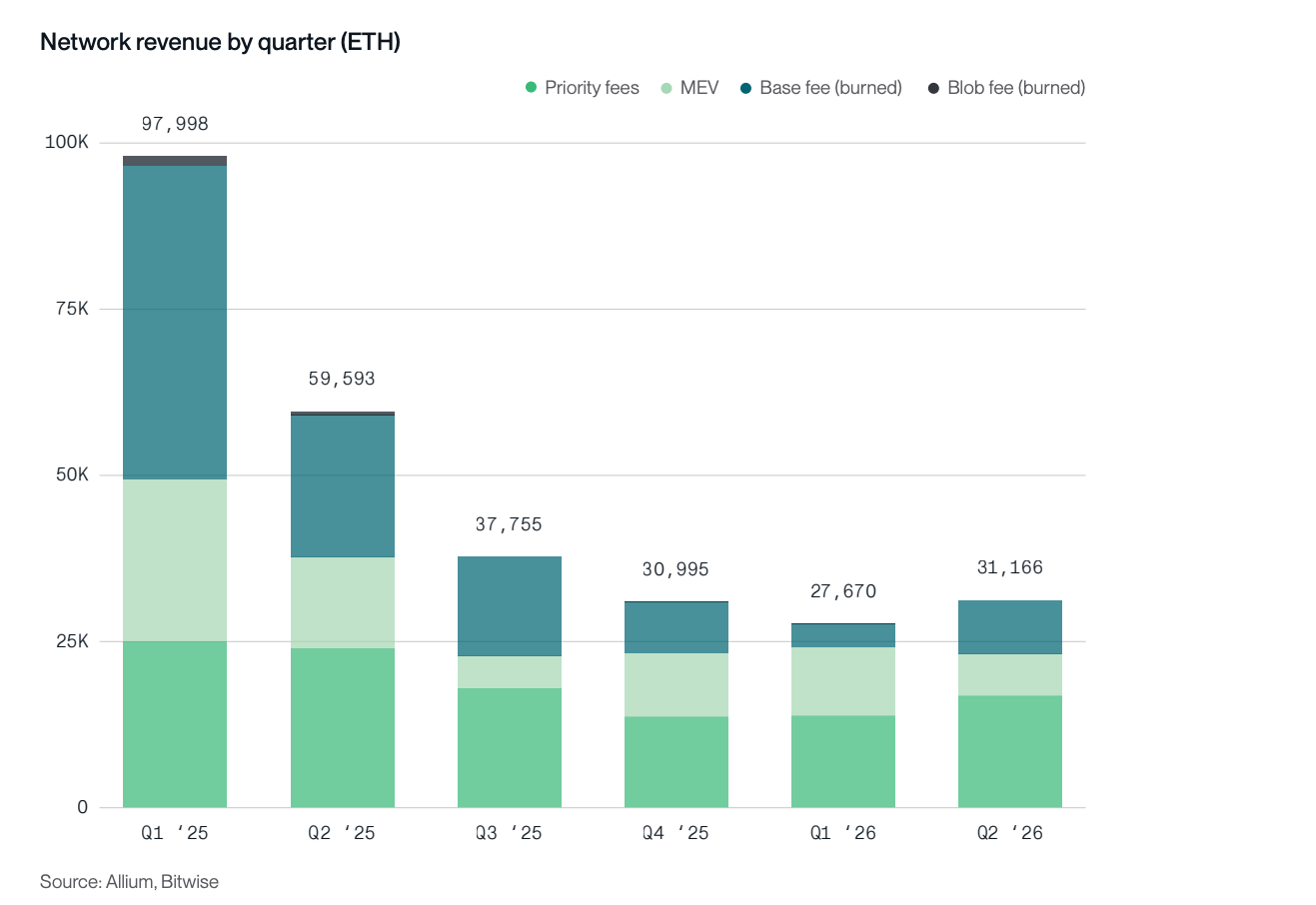
Ethereum (ETH) network fee revenue fell 51% year-on-year to roughly $64 million in the second quarter, even as transaction activity rose and staking climbed to a record, according to a new Bitwise report.
The decline reflected cheaper and more abundant blockspace rather than fading interest, the asset manager said. Measured in ETH, quarterly revenue actually rose for the first time in over a year.
Ethereum Activity Rises Even as Revenue Drops 51%, Bitwise Finds
Ethereum revenue reached about $131 million in the second quarter of 2025. A year later, it stood near $64 million, a sharp drop in dollar terms.
Usage moved the other way. Ethereum processed 203.9 million transactions in the quarter, up from 121.1 million a year earlier. Throughput rose to 26 transactions per second, from 15. This came as Ethereum’s block gas limit increased to 60 million.
“The divergence between revenue and activity is the theme of the quarter. While fees fell, usage climbed,” the report read.
Researchers at Bitwise attributed the gap to protocol design. Networks made blockspace cheaper and more abundant, enabling users to pay less per transaction.
Follow us on X to get the latest news as it happens
The Dollar Drop Was Partly a Price Effect
The USD figure also masked a shift beneath the surface. In ETH terms, revenue rose from 27,670 ETH in the first quarter to 31,166 ETH in the second quarter.

That marked the first quarterly increase in over a year. The dollar total fell mainly because ETH’s price weakened during the period.
Staking followed the same upward path. Active stake reached a record 40.2 million ETH, representing about 33% of total supply, amid continued institutional inflows.
The pattern extended beyond Ethereum. Solana (SOL) processed 9.8 billion non-voting transactions, near its all-time high, while dollar revenue fell.
Avalanche (AVAX) handled 236 million transactions on its C-Chain, up from 58 million a year earlier. Lower congestion, not weaker use, brought fees down.
Subscribe to our YouTube channel to watch leaders and journalists provide expert insights
The post Ethereum’s Falling Fees Do Not Mean Falling Use, Bitwise Finds appeared first on BeInCrypto.


The European Union will prohibit Belarusian nationals and residents from owning, controlling or managing crypto exchanges and other crypto service providers regulated under the Markets in Crypto-Assets (MiCA) framework starting Aug. 25.
The measure appears in Council Decision (CFSP) 2026/1847, adopted Thursday to amend the EU’s sanctions framework targeting Belarus over its involvement in Russia’s war against Ukraine. The document expands an existing restriction that applied only to companies providing crypto wallet, account or custody services.
The decision enters into force on July 24, while the expanded crypto provision will apply from Aug. 25.
Under the amendment, Belarusian nationals and residents may not own or control an EU-based entity providing “any other crypto-asset services” as defined under MiCA or hold a position on its governing body.
MiCA’s service categories include operating trading platforms, exchanging crypto assets, executing and transmitting client orders, placing crypto assets, providing transfers, offering investment advice or portfolio management.
EU expands crypto sanctions after MiCA transition ends
The sanctions expansion comes weeks after the end of MiCA’s transition period on July 1. Crypto companies without authorization were ordered to wind down or face enforcement actions.
Related: Ripple secures full MiCA license for crypto services across Europe
The Belarus restriction follows a broader EU push to target crypto platforms and financial networks accused of helping Russia evade sanctions imposed over its war in Ukraine.
On Thursday, as part of its 21st sanctions package against Russia, the EU extended its transaction ban to 14 crypto-related service platforms outside the bloc and introduced a mechanism allowing it to prohibit dealings with any foreign crypto provider used by Russia to evade sanctions. The final package expands on the June 11 proposal, which targeted 11 crypto platforms.
The proposal followed the United Kingdom’s May 26 sanctions against Huobi Global S.A., the Panamanian company behind HTX, over alleged support for Russia-linked financial networks involving sanctioned entities A7 and Garantex.
HTX denied wrongdoing, telling Cointelegraph that regulatory compliance “remains our absolute top priority” and that it strictly adheres to regulatory frameworks in the jurisdictions where it operates.
Magazine: Why Australia’s $17B crypto opportunity depends on regulation
This Friday, we examine Ethereum, Ripple, Cardano, Binance Coin, and Hyperliquid in greater detail.
Ethereum (ETH)
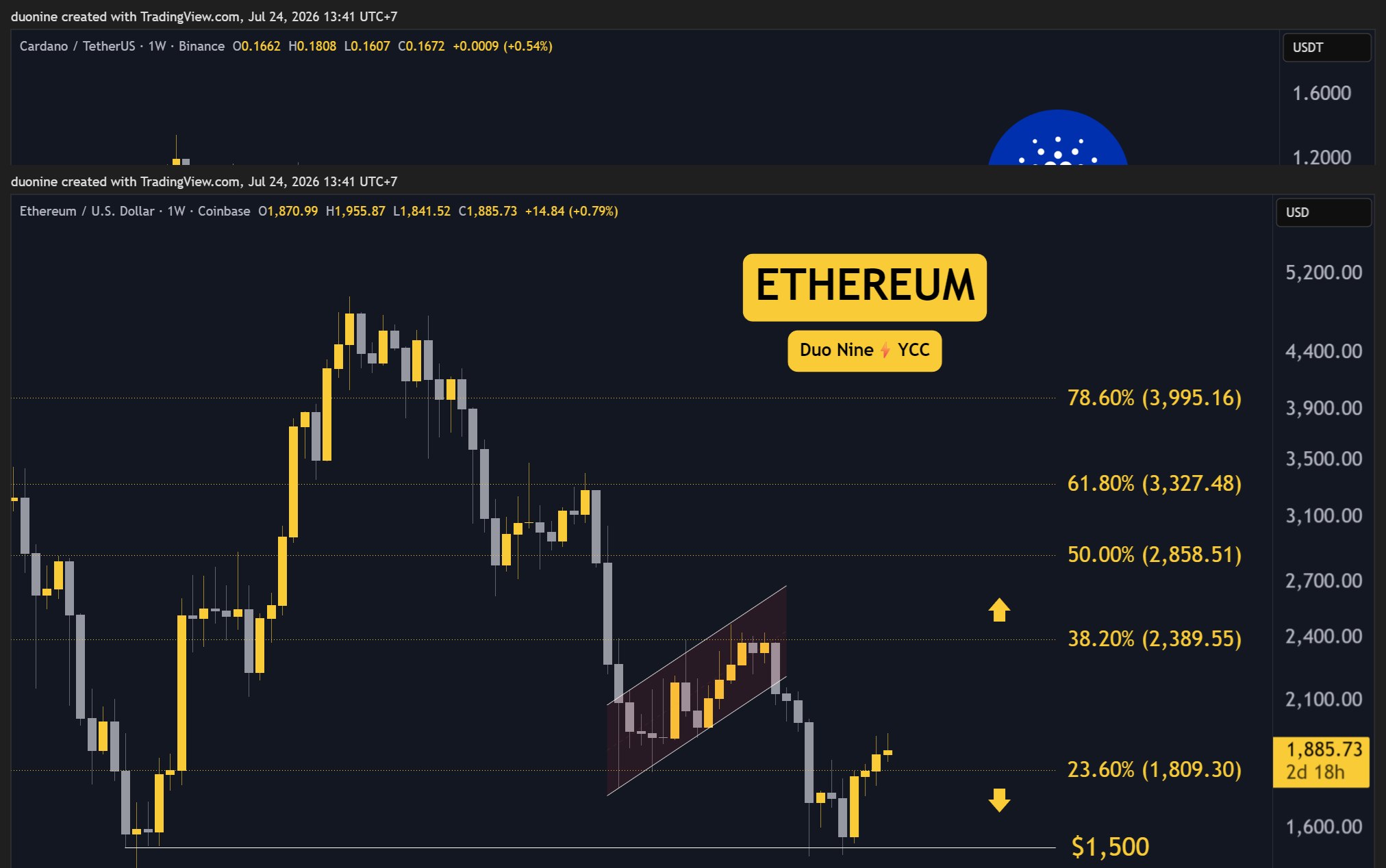
Ethereum moved higher by 3% this week as buyers gained control of the price action since late June. This relief rally started once the support at $1,500 was tested and held.
At the time of this post, ETH is facing some resistance as the price approaches the key psychological level at $2,000. It is likely to bring back sellers and could send the price into a pullback.
Looking ahead, the cryptocurrency remains in a macro downtrend. While this rally is a positive change, sustaining it beyond $2,000 seems a big ask right now. Only if $2,000 turns into support does ETH have a good shot at breaking the prevailing downtrend.
Ripple (XRP)
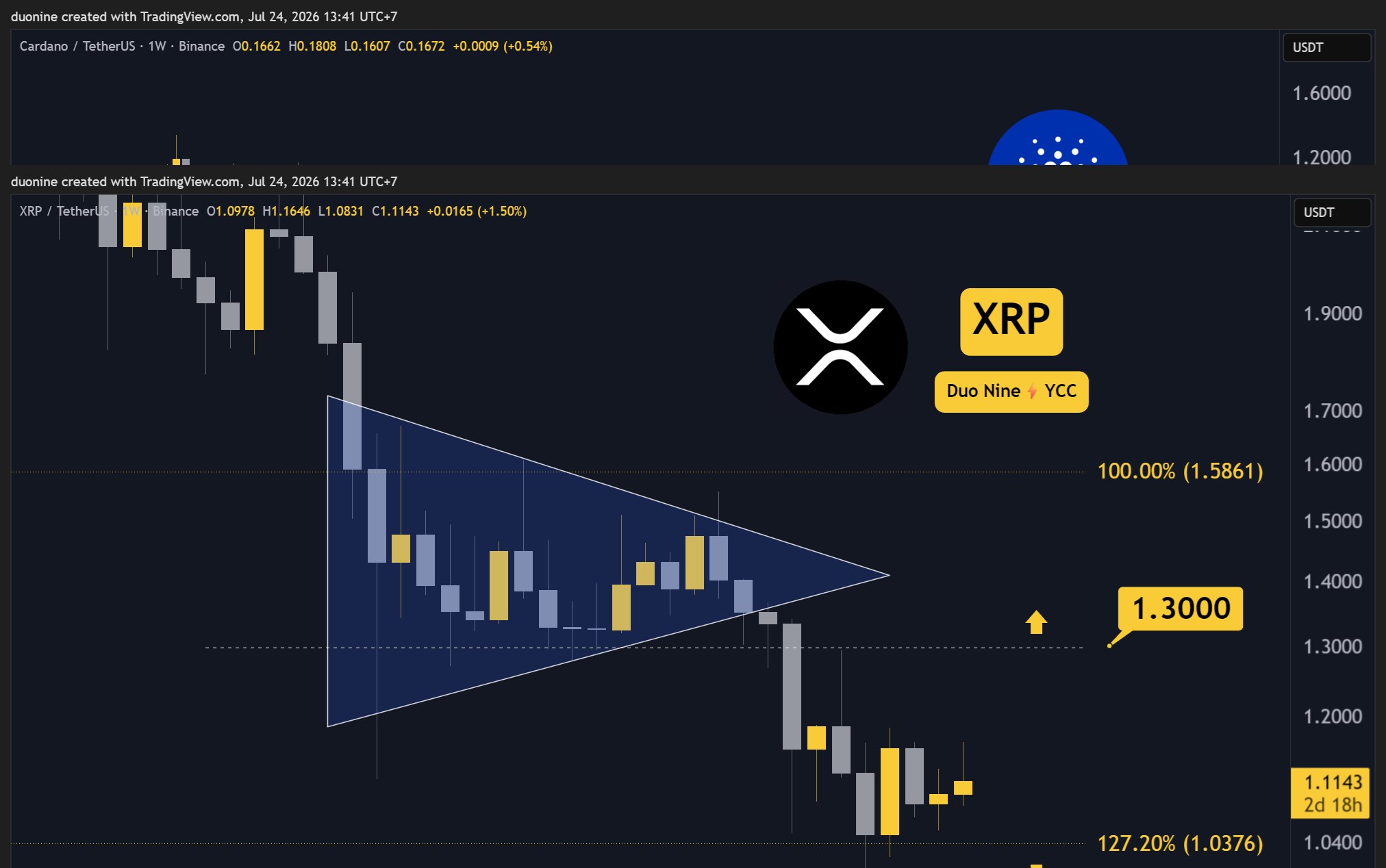
XRP also managed to book a 3% gain this week as buyers have kept the price well above the key support at $1. The current resistance is at $1.2, and until it is broken, it is unlikely this cryptocurrency can make sustained gains.
With volume declining steadily month-over-month, XRP currently lacks the momentum for a major breakout. Market participants seem to have retreated since the drop in February and have not returned to date.
Looking ahead, the current consolidation above $1 is a positive development. However, it can equally be a pause taken by sellers before they attempt another go at the key support.
Cardano (ADA)
ADA had a positive week, closing 6% higher. This comes after the price made a head and shoulders reversal pattern with the key support around $0.15. As long as that level holds, buyers have the advantage.
Nevertheless, Cardano still has to make clear higher lows and higher highs before we can be confident in a reversal and end to the current macro downtrend. For that to happen, the price will have to move beyond $0.25.
Looking ahead, the weekly momentum indicators such as the MACD are giving a bullish bias. This is a promising sign that sellers could be exhausted here, which may allow buyers to take back control for a longer period.

Binance Coin (BNB)
Binance Coin looks weak throughout the past seven days and made no gains. The price still needs to break the resistance at $580, which has kept buyers in check over the past month. Without a clear breakout, BNB is forced to move sideways or even seek lower levels to find buyers.
The price also saw decreased volatility and volume. This could also be related to the recent regulatory changes that forced EU users to find a new exchange. That is bearish for the BNB price as it lowers demand for the token.
Looking ahead, this cryptocurrency is found in a downtrend with no signs that this will end any time soon. As such, watch the support at $500, which could be tested in the future before buyers return.

Hype (HYPE)
Surprisingly, HYPE was flat this week and lost 5% of its valuation in the past month. This highlights that the uptrend may be over. The price is also under $60 at the time of this post, which is concerning since it may encourage sellers to push even lower.
If this cryptocurrency loses its macro uptrend, then a larger and more significant correction could follow. Right now, the longer the price sits under $60, the higher the chance that HYPE will fall much lower. Key support levels are found at $56 and $52.
Looking ahead, HYPE had a fantastic rally in the first half of 2026, and it seems the second part of the year could end up in a major correction. That may see HYPE revisit previous levels under $50. If so, this can also be a key buying opportunity.

The post Crypto Price Analysis July-24: ETH, XRP, ADA, BNB, and HYPE appeared first on CryptoPotato.


Poolin has filed for Chapter 11 bankruptcy protection in the United States as it moves to sell its Texas bitcoin mining assets under a court-supervised process while carrying about $173 million in prepetition obligations.
Summary
- Poolin has filed for Chapter 11 bankruptcy while seeking to sell its Texas bitcoin mining assets through a court supervised auction.
- About $163.7 million of Poolin’s $173.1 million in prepetition obligations relates to IOUs issued after wallet withdrawals were suspended in 2022.
- Interest from AI infrastructure operators has helped drive bidding for the company’s power assets as miners increasingly repurpose data centers beyond bitcoin mining.
According to filings in the U.S. Bankruptcy Court for the District of New Jersey, Singapore-based Poolin and its U.S. subsidiaries, Lonestar Dream Inc. and Lonestar Taproot LLC, filed voluntary Chapter 11 petitions on July 22. The debtors said the proceedings are intended to facilitate an orderly sale of their remaining assets rather than revive the business as an operating mining company.
Court records show Poolin estimated it has between 10,001 and 25,000 creditors, assets worth between $1 million and $10 million, and liabilities ranging from $100 million to $500 million.
A declaration filed by Chief Restructuring Officer Michael DuFrayne states that the companies owed approximately $173.1 million before bankruptcy. About $163.7 million of that total relates to unsecured IOUs issued to Poolin Wallet customers after withdrawals were suspended during the cryptocurrency market downturn in 2022.
Mining and hosting operations at the company’s Pyote and Tarbush facilities in West Texas ended on July 10, with only a small workforce remaining to secure the sites and assist with the sale process, according to the declaration.
Texas assets head to auction
Meanwhile, the debtors have already signed separate asset purchase agreements with Thor CALAP LLC, establishing a combined stalking-horse bid of $52 million for the Texas assets.
The agreements include a $15 million offer for the Pyote property together with its related power rights and equipment, while a separate $37 million bid covers the Tarbush site’s power rights and equipment. Court filings note that the Tarbush transaction does not include the property’s surface-use agreement.
Under Section 363 of the U.S. Bankruptcy Code, the stalking-horse agreements set the minimum price for the auction while allowing higher competing offers before any final sale receives court approval. Each mining site may also be sold independently if separate bids provide better value for creditors.
Before reaching the proposed transactions, the debtors spent roughly three months marketing the assets to more than 335 prospective buyers and investors. According to the court declaration, the outreach targeted cryptocurrency miners, artificial intelligence and high-performance computing operators, hyperscale data center companies, private equity firms and real estate investment trusts.
The marketing effort resulted in 28 signed nondisclosure agreements and seven letters of intent covering both individual facilities and the combined portfolio.
Court filings state that interest from AI infrastructure operators increased the potential value of the sites because of their existing electrical systems and power capacity, even though Poolin’s own mining and hosting business had become unprofitable. Since their formation, Lonestar Dream and Lonestar Taproot accumulated losses of approximately $45.9 million.
Wallet collapse left customers with IOUs
Founded in China in 2017 by Zhibiao “Kevin” Pan, Fa Zhu and Tianzhao Li, Poolin grew into one of the world’s largest bitcoin mining pools and held the top position globally by September 2019.
Alongside mining, the company expanded into financial services through Poolin Wallet, which allowed customers to borrow USDT against cryptocurrency collateral before later introducing interest-bearing deposit products.
The business model came under increasing pressure after China prohibited bitcoin mining in 2021 and digital asset prices declined sharply the following year.
According to the Chapter 11 declaration, Poolin transferred customer collateral to Antalpha Technologies and borrowed roughly $213 million against cryptocurrency valued at approximately $355.8 million at the time.
The filing states that the borrowed funds supported construction of the Texas mining facilities, purchases of mining machines, customer withdrawals, interest payments and day-to-day operating expenses.
As cryptocurrency prices continued falling, Poolin Wallet suspended withdrawals in September 2022 and distributed IOU tokens representing customers’ frozen balances.
Around 11,700 wallet users held balances exceeding $100 when approximately $163.7 million worth of IOUs were issued, according to the declaration.
The court filing further states that Antalpha liquidated Poolin’s collateral in November 2022, when management estimated the company owed about $260 million against digital assets then valued at roughly $265 million.
Since then, Poolin has not resumed normal business operations. Its remaining assets now include approximately $1.2 million held in a New Jersey bank account, an office lease and an intercompany claim. Certain Poolin Wallet users have also filed legal claims against the debtors in both the United States and Singapore.
Mining infrastructure attracts AI interest
While the bankruptcy centers on creditor recoveries, the sale process also shows how mining infrastructure has become valuable for buyers outside the cryptocurrency industry.
According to the Chapter 11 declaration, many parties approached during the marketing process were focused on artificial intelligence and high-performance computing rather than bitcoin mining alone, as existing power connections and electrical infrastructure have become increasingly attractive for AI data center projects.
Poolin’s bankruptcy also comes months after another major mining operator entered insolvency proceedings. Earlier this year, Russian miner BitRiver faced court-supervised bankruptcy over unpaid debts tied to power supply, data center operations and service contracts.
The interest follows a pattern already emerging across publicly listed mining companies. Earlier this week, Ionic Digital secured SEC approval for its planned Nasdaq listing after repositioning much of its business toward AI infrastructure. The company, created from Celsius Network’s bankruptcy restructuring, has converted part of its Texas campus from bitcoin mining to AI computing under a long-term agreement with AI cloud provider Nscale.
A similar strategy has been adopted by IREN, which acquired Spain’s Nostrum Group in June to add approximately 490 megawatts of grid-connected power for AI cloud expansion across Europe. The company has reported rising AI cloud revenue even as bitcoin mining income declined. HIVE Digital and Bitdeer have also announced projects converting mining facilities into high-performance computing infrastructure.
Poolin’s case differs from those companies because it is liquidating assets through Chapter 11 rather than expanding into AI operations itself. Still, the court filings indicate that demand from AI-focused buyers has strengthened interest in the Texas properties during the auction process.
The debtors said unsecured creditors, including Poolin Wallet customers, could receive distributions if the auction produces successful sales. According to the Chapter 11 filings, however, the final recovery will depend on competing bids, administrative expenses, sale costs and court approval of a liquidation plan.
Ripple has launched Ripple Mint and invested in compliance firm Notabene as it works to expand institutional use of Ripple USD.
Summary
- Ripple Mint gives institutions tools to mint, redeem, bridge and monitor RLUSD across supported networks.
- Notabene will add RLUSD to its compliance network serving institutions across more than 100 jurisdictions.
- RLUSD holder growth continued, but monthly transfer volume fell 25% to about $10.95 billion overall.
The two updates address different parts of the stablecoin process. Ripple Mint gives approved customers a direct way to issue, redeem, bridge and track RLUSD. The Notabene deal places the token inside a business payment network built for regulated firms.
The releases came during a mixed month for RLUSD. A July 24 market snapshot placed monthly transfer volume near $10.95 billion, down about 25% from $14.6 billion. Holder numbers rose 6%, while active addresses increased 70%. Market value fell almost 5% during the same period. The figures show broader wallet participation but lower total value moving through the token.
Ripple Mint automates institutional stablecoin operations
Ripple Mint replaces more manual RLUSD workflows with a web console, application programming interfaces and webhook alerts. Existing institutional customers can mint and redeem RLUSD, check account balances and follow each transaction from fiat receipt to onchain settlement. Ripple also uses shared reference IDs to connect each stage, which can make internal tracking and reconciliation easier.
The platform supports fiat settlement and transfers across supported blockchains. Ripple said customers can connect Mint to their own systems instead of relying only on staff using a dashboard. The company framed the product for exchanges, market makers, fintech firms and other institutions that need repeated stablecoin operations. Ripple Mint is available to existing RLUSD customers, while Ripple has not published pricing or wider access terms.
Notabene adds a compliance route for RLUSD payments
Ripple also made an undisclosed strategic investment in Notabene. The companies plan to add RLUSD to Notabene Flow, a platform for business stablecoin payments. They will also study how Notabene’s payment authorization tools can work with Ripple Payments. Notabene says its network connects more than 2,300 institutions across over 100 jurisdictions and processes more than $2 trillion in annualized transaction volume.
Notabene Flow focuses on identity checks, counterparty information and transaction approval before funds move. That process can help financial firms apply Travel Rule and internal compliance controls to stablecoin payments. Ripple stablecoin executive Jack McDonald said, “Institutional adoption depends on more than efficient settlement rails alone.” Financial terms were not disclosed, and neither company named the first institutions expected to use RLUSD through Notabene Flow.
RLUSD expands across more blockchain networks
Ripple has also widened RLUSD access beyond the XRP Ledger and Ethereum. Through Wormhole’s Native Token Transfers framework, the stablecoin now connects to the XRPL EVM sidechain, Base, Optimism, Ink and Unichain, with access spanning more than 40 supported networks. The setup is designed to move native RLUSD between chains without creating separate wrapped versions.
As crypto.news reported in June, the multichain rollout targets exchanges, payment applications and decentralized finance services. Ripple said XRP and RLUSD can serve different roles across those markets, including settlement, swaps, collateral and liquidity. However, activity on each network will depend on available integrations, market makers and user demand rather than technical access alone.
Usage data remains mixed despite wider access
RLUSD remains one of the larger regulated dollar stablecoins. Ripple’s reserve page reported $1.51 billion in circulating RLUSD and $1.62 billion in reserve funds as of July 16. Standard Custody & Trust Company issues the token under a New York Department of Financial Services limited-purpose trust charter. Ripple says cash, cash equivalents and U.S. Treasuries back RLUSD, with monthly independent attestations.
Related activity on the XRP Ledger has continued to grow. As previously reported, Ripple-backed Evernorth said RLUSD pairs had generated more than $2.5 billion in XRP Ledger trading since launch, including about $900 million through the RLUSD/XRP pair over six months. Ripple and SBI also launched RLUSD in Japan in June after local approval, adding another regulated distribution channel.
Still, the July transfer decline shows that supply and wallet growth do not always produce higher payment use. Stablecoin transfer volume can change with exchange flows, treasury movements, market-maker activity and large institutional transactions. Rolling 30-day figures can also move quickly as older transactions leave the calculation window.
Ripple Mint may reduce the work needed to create and redeem RLUSD, while Notabene may give more institutions a compliant route to send it. The next measure will be whether those tools produce sustained payment and settlement volume. Ripple has not released volume targets, customer forecasts or a schedule for publishing adoption data tied to either launch.
After attracting nearly $1 billion over seven trading sessions, US-listed spot Bitcoin ETFs recorded their first daily net outflow since July 13.


Dogecoin fell 4.5% and ether dropped 2.5% on Friday, leading a broad but shallow retreat across the majors as the market consolidated a strong week, per CoinDesk data. XRP and Solana each slipped about 2.5%, while bitcoin held up better, down 0.6% to around $65,400.
The pullback barely dented the weekly picture. Bitcoin is still up 3% over seven days, ether 1.8%, and most majors remain green on the week, with Hyperliquid the exception at down 3.5%.
There was no single catalyst behind Friday’s move, more a pause after the run-up than a reversal.


LayerZero and Keeta have partnered to make tokenized commercial bank deposits transferable across Ethereum, Solana, Base and the Keeta Network.
Summary
- Keeta stablecoins will represent commercial bank deposits and move across four networks through LayerZero infrastructure.
- Nine fiat currencies are scheduled to launch across supported public blockchains later during July 2026.
- Bivo will hold backing deposits while issuers retain control over contracts, transfers, and compliance requirements.
The companies plan to launch the service later in July 2026, giving institutions a way to move bank-backed digital money across several public blockchains.
The system will use Keeta Stablecoins, which the companies describe as tokenized commercial bank money. Commercial bank deposits held through Bivo and its partner-bank network will back the tokens. The initial release will cover the U.S. dollar and eight other fiat currencies.
Keeta Stablecoins target multichain settlement
According to the official LayerZero announcement, the first currencies will include USD, EUR, JPY, CNY, GBP, CAD, MXN, AED and HKD. The companies did not provide a specific launch date or name the institutions that will use the product at launch.
The product targets treasury, payment and settlement work. An institution could hold a token linked to a commercial bank deposit and transfer it between supported networks. Keeta CEO Ty Schenk said, “The future of institutional money isn’t a walled garden.” He said Keeta wants regulated bank money to move across chains rather than remain inside one closed system.
LayerZero supplies the cross-chain token standard
Keeta Stablecoins will use LayerZero’s Omnichain Fungible Token Standard. LayerZero’s technical documentation says the OFT model lets one fungible token exist across several chains while maintaining one global supply. A transfer removes tokens from circulation on the source network and credits the same amount on the destination network.
The partnership says the issuing institution will retain contract authority across the supported networks. LayerZero also offers stablecoin controls such as transfer restrictions, rate limits, pause functions and separate operational roles. These controls allow an issuer to apply internal policies while keeping the token available on more than one blockchain.
Bivo provides the deposit and payment connection
Bivo will provide access to U.S. payment rails and its partner-bank network. Keeta identifies Bivo as a licensed money transmitter with NMLS number 2572288. California’s Department of Financial Protection and Innovation also lists Bivo as a regulated money transmitter in the state.
The announcement does not state whether every token holder will receive deposit insurance or hold a direct claim against a named bank. It only says that commercial bank deposits held through Bivo will back the tokens. The companies also did not disclose reserve reporting rules, redemption fees, minimum transaction sizes or which entities will issue each currency.
The structure differs from many stablecoins that hold cash, Treasury bills or other reserve assets outside a customer deposit account. Keeta and LayerZero still use the term “stablecoins” for the product, but they describe the backing as commercial bank money rather than a mixed reserve portfolio.
Tokenized deposit projects gain wider attention
Banks and crypto firms have tested several forms of tokenized deposits in 2026. JPMorgan and other large U.S. banks have worked on a shared network for tokenized deposits, with a possible 2027 launch. That project would operate through a bank-led system rather than distribute deposits across several public chains.
In another model, Custodia Bank and Vantage Bank tested a dual-purpose token that acts as a bank deposit inside their Hazel network and as a stablecoin when it moves outside the network. The Keeta and LayerZero plan instead focuses on issuing several fiat-linked assets across Ethereum, Solana, Base and Keeta from the start.
LayerZero already supports cross-chain distribution for payment and tokenized-asset products. As previously reported, PayPal expanded PYUSD to additional networks through LayerZero infrastructure. Ondo Finance also used LayerZero for cross-chain transfers of tokenized stocks and exchange-traded funds.
Cross-chain systems also carry technical and operational risks. In April, attackers drained about $292 million from Kelp DAO’s rsETH bridge after compromising infrastructure used by a LayerZero verifier. LayerZero said the attack affected Kelp DAO’s single-verifier setup rather than the core protocol. The company later stopped signing messages for applications using one-verifier configurations and urged projects to use several independent verifiers.
Keeta will also add LayerZero as an anchor inside its network. Keeta uses anchors to connect blockchains and traditional payment systems. The company says its network reached 11.2 million transactions per second during a public stress test conducted with Google’s Spanner engineering team, although that result does not represent normal production volume.
The companies have not disclosed launch partners, expected transaction volume or pricing. Their July rollout will test whether institutions want tokenized commercial bank money that can move across public chains while the issuer keeps control over transfers and compliance settings.

The Real Financial Landscape for Many Lawyers

Coastguards vote of no confidence following plans to stop volunteer payments

Mr. Market Hates Oracle For Doing The Right Thing, Creating A Buying Opportunity (ORCL)


-

 Fashion7 days ago
Weekend Open Thread – Corporette.com
-

 Politics6 days ago
The House | The City of London can help the new chancellor deliver growth in every postcode
-

 Crypto World6 days ago
Ripple Payments Joins MiCA With 14 Firms, Does It Mean Anything For XRP?
-
 Crypto World7 days ago
Two July Windows Left: The CLARITY Act’s Senate Fight and What Failure Means
-

 Politics5 days ago
Democrats look to World Cup watch parties to register thousands of voters
-

 Crypto World6 days ago
Ripple wins EU-wide access as ESMA adds it to MiCA register
-

 Crypto World3 days ago
Grayscale Files For Worldcoin ETF, WLD Registers Sharp Rise
-

 Tech3 days ago
Sail Virtually Aboard The “Itanic” With IA-64 Emulator
-

 NewsBeat4 days ago
Unregistered fitter used Gas Safe logo on business flyers
-
 Tech3 days ago
Turtle Beach Command Series KB7 review: a nifty screen-equipped gaming keyboard
-

 NewsBeat7 days ago
Registration is now open for March for Men with Kev 2026
-

 News Videos5 days ago
Big Money Is Entering XRP
-
 Business2 days ago
New Jersey voter registration controversy explained: How 6,600 noncitizens got on the rolls, and what happens next
-

 Crypto World6 days ago
Kaspersky exposes OkoBot’s 20-module crypto wallet attack
-

 Business7 days ago
Airlines warn Sunshine Protection Act could disrupt flight scheduling
-
 Entertainment3 days ago
Johnny Depp’s R-Rated Gothic Cult Classic Gets New Release Ahead of Sydney Sweeney Remake
-

 NewsBeat6 days ago
Durham County Council to send out electoral registration emails
-

 Crypto World6 days ago
MiCA Licensing Faces Delays as ESMA Adds 14 CASPs to Register
-

 Crypto World1 day ago
Ethics, other provisions in crypto Clarity Act to be further discussed
-

 Crypto World6 days ago
Chip Stocks Enter Bear Market After Moonshot Ai Unveils Kimi K3 Model
You must be logged in to post a comment Login