
Crypto World
Gen Z trusts code over bank promises

Welcome to our institutional newsletter, Crypto Long & Short. This week:
- Haider Rafique of OKX shares a firm study on the generational perspectives of crypto investing
- Top headlines institutions should pay attention to by Francisco Rodrigues
- Sky defies 2026 downturn in Chart of the Week
Expert Insights
Gen Z Trusts Code Over Bank Promises
By Haider Rafique, global managing partner, OKX
It’s no secret that the banking industry is worried about crypto disruption.
After months of intense lobbying, the Senate Banking Committee postponed its markup of market structure legislation, due in part to banks’ stance on stablecoin yield.
But it might not matter, because banks have a much bigger crisis on their hands: they’re completely missing out on younger consumers based on the basic principle of trust.
Given the behaviors we’ve observed on the OKX app around the world, we decided to conduct a study to understand generational perspectives in our evolving industry.
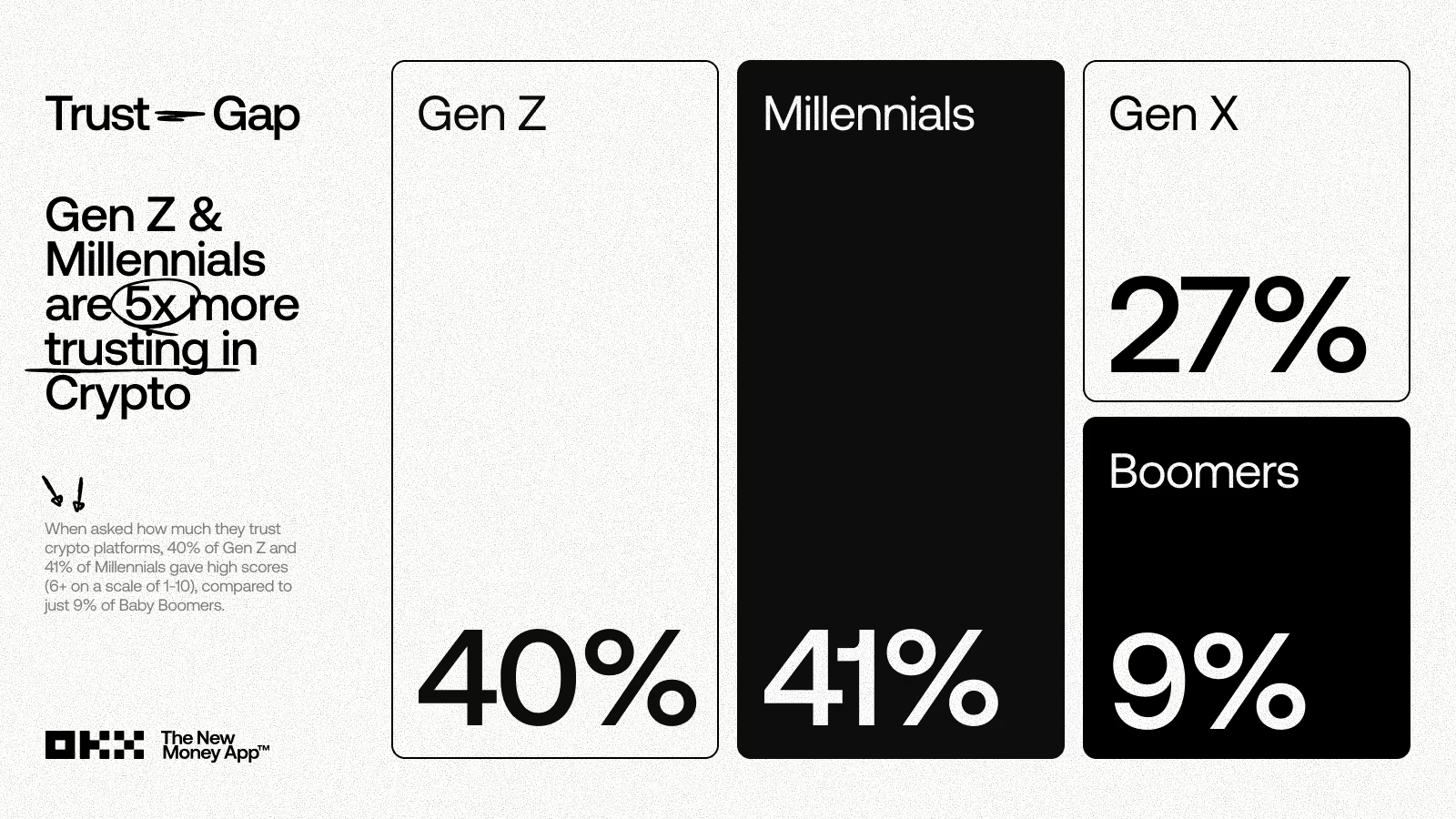
The key insights paint a clear picture: Gen Z and millennial consumers are nearly 5x more trusting of crypto compared to their boomer counterparts. Additionally, one in five Gen Z and millennial consumers say they have low trust in traditional financial institutions, while nearly three quarters (74%) of baby boomers maintain high levels of trust in the old system.

The “why” behind all of this is much deeper than viral trends and memecoins. This is a generation raised on open‑source code and real‑time dashboards who now expect the same transparency from TradFi.
And now, as the world moves on-chain and everything gets tokenized, it’s clear that young people see the digital economy as their stock market.
TradFi isn’t theirs. It belongs to their parents and grandparents.
A generation shaped by institutional failure
A recent FINRA and CFA Institute report suggests a sizable share of Gen Z investors now lean heavily into crypto relative to other assets — a behavioral signal that younger Americans are willing to look outside traditional channels when they don’t believe they’re getting transparency or competitive returns. According to the study, nearly 20% of Gen Z investors only hold crypto.
For banks, this should be a wake‑up call that trust is no longer something institutions can declare but something they must demonstrate.
Boomers built their financial lives in an era when institutions were the safest option available. Regulation meant protection, and trust was something you extended first and questioned later.
Gen Z has lived through the opposite. They came of age during the aftermath of the 2008 financial crisis, entered adulthood with high student debt and now face a housing market millions of units short alongside ongoing inflation.
They’ve also lived through years of policy whiplash on student loans, shifting repayment rules and weakened borrower protections. These reversals reinforced a simple lesson that institutional promises can change overnight. When trust is repeatedly tested, skepticism becomes rational.
Banks aren’t losing Gen Z to crypto; they’re losing them to trust.

Control over promises
That skepticism is reshaping what influences trust for younger generations. For boomers, security means regulatory oversight and the perceived stability of legacy institutions.
Contrarily, Gen Z consistently ranks platform security above regulation as the top driver of trust. For Gen Z, security is more personal and technical with direct ownership of assets, the ability to verify how systems work and the freedom to move value without intermediaries.
It’s why both Gen Z and millennials are 4x more bullish on crypto in 2026 compared to boomers. They can see transactions on-chain, self‑custody, audit protocols and understand the rules without waiting for a quarterly statement or a regulator’s update.

Transparency is central to this shift. Boomers tend to equate trust with regulatory approval, but Gen Z equates trust with visibility. They want to understand how decisions are made, how risks are managed and how incentives are aligned. They want clarity on fees, yields and conflicts of interest, and systems that are open by default.
Traditional banks have historically struggled here. Their value proposition was built in an era when limited transparency was often treated as a feature. And now, when a generation is accustomed to real‑time dashboards and proof of reserves, the idea of waiting for a monthly statement feels absurd. Transparency has become a baseline requirement for credibility.
The future of finance
Banks should be asking themselves: why do younger customers trust transparency more than tradition? Younger Americans want the stability of regulated finance paired with the transparency and control of digital assets, and they want products that reflect how they already interact with technology and money. The institutions that understand this shift and build for it will define the future of finance. The ones that don’t will continue to watch as younger Americans look elsewhere.
Headlines of the Week
Francisco Rodrigues
Markets stumbled this past week and miner capitulation intensified. That led to the steepest decline for Bitcoin’s mining difficulty since 2021, while corporate accumulation of cryptocurrencies and other assets continued and Russia moved closer to formalize crypto-backed lending.
Chart of the Week
Sky defies 2026 downturn
Sky has decoupled from the 2026 market downturn, outperforming BTC, CD5, and the CD20 index by 45%, 50% and 57% respectively YTD. This resilience is anchored by a consistent business model: January revenue surged 1.5x YoY to $19 million, fueling $10.4 million in YTD buybacks ($8.5 million in Jan; $1.9 million last week) and driving a flight to quality that pushed the USDS (Sky’s stablecoin) market cap from $5.8 billion to $6.5 billion.

Listen. Read. Watch. Engage.
Note: The views expressed in this column are those of the author and do not necessarily reflect those of CoinDesk, Inc., CoinDesk Indices or its owners and affiliates.



In this market, idle funds are the biggest risk. Most crypto users worry about volatility. More experienced participants tend to focus on a different factor: opportunity cost. When markets slow down, extended sideways movement is rarely neutral from a capital perspective.That’s why a growing number of traders are reallocating funds toward more capital-efficient DeFi models.
Each day capital remains unused can result in missed returns compared to more efficient allocation strategies.
A Structural Issue: Many Platforms Incentivize Passive Capital
Many platforms are structured in ways that benefit from users leaving funds idle, trading less frequently, operating under limited transparency, and responding slowly to changing market conditions.
Speed, yield, and flexibility are frequently highlighted, but are not always fully realized in practice.
By contrast, newer DeFi models are increasingly based on the idea that active capital allocation tends to outperform passive positioning.
In crypto, real conviction shows up on-chain.
Users aren’t just registering on these platforms — they’re allocating capital almost immediately. That behavior usually only happens when three conditions are met:
1. Control Is Absolute
Funds remain non-custodial. No permission risk. No “maintenance pauses” when volatility spikes.
2. Capital Efficiency Is Obvious
These platforms illustrate how idle assets can underperform and how quickly capital can be redeployed when infrastructure allows.
When performance becomes measurable rather than hypothetical, user hesitation tends to decline.
3. Exit Is Always Available
Third, liquidity and exit flexibility remain available. Prolonged lockups often undermine trust, which is why many modern DeFi protocols aim to minimize them.
Knowing that capital can be reallocated quickly, both in and out, often increases user confidence and willingness to deploy funds.
Market Dynamics Are Shifting, Often Without Broad Attention
Here’s what’s happening quietly:
- Smart money is reducing exposure to platforms with opaque incentives
- Traders are prioritizing flexibility + yield, not branding
- Capital is flowing toward systems that reward action, not patience
Several emerging DeFi platforms sit at the intersection of these trends.
This isn’t a future narrative. It’s a present reallocation.
Waiting for “Confirmation” Is a Losing Strategy
Many users say they’ll wait:
- for more coverage
- for bigger headlines
- for social proof
By the time that happens, the best conditions are already gone.
In crypto markets, earlier participation is often linked to asymmetric return profiles rather than elevated risk alone.
Early-stage phases of new platforms tend to favor participants who allocate capital sooner, before incentive structures evolve or compress.
From Registration to Deployment: Minutes, Not Friction
IODeFi removes the usual excuses:
- Registration is fast
- Wallet connection is seamless
- Deposits are straightforward
- Capital becomes productive immediately
This reduces unnecessary complexity and lowers the learning curve associated with capital deployment.
Final Thought: Precision Often Outperforms Excessive Caution
Caution feels safe. But in crypto, it often means underperforming by default.
Such platforms are not universally suitable, but they reflect a broader shift toward treating capital as an actively managed resource.
While some participants remain on the sidelines, others have already begun reallocating capital.


The new system lets institutions earn yield and access liquidity without moving Bitcoin out of custody.
Lombard on Wed., Feb. 11, launched Bitcoin Smart Accounts, a new product that allows institutions to use their Bitcoin in decentralized finance (DeFi) without moving it out of custody.
Lombard is a DeFi protocol with more than $1 billion in total value locked (TVL), according to DeFiLlama. The new product allows Bitcoin held with custodians, in MPC setups, or in self-custody wallets to be used as on-chain collateral, according to a press release viewed by The Defiant.
The process eliminates the need to transfer Bitcoin to a DeFi platform first, allowing institutions to keep their BTC in their existing custody arrangements. Bitcoin is currently trading at $67,615, down 1.5% on the day, per CoinGecko.
The product targets roughly $500 billion in Bitcoin that is currently held in professional custody by asset managers, corporations and high-net-worth individuals. Most of that Bitcoin does not currently participate in DeFi because transferring assets can create legal, operational or security risks.
“For 17 years, institutions could have the security of top custodians, or they could have on-chain utility — never both,” said Jacob Phillips, co-founder of Lombard. “Bitcoin Smart Accounts are a settlement network, similar to that of SWIFT and ACH, that eliminate that trade-off, and allow Bitcoin to stay in custody and settle on-chain, transforming Bitcoin from a passive asset into usable capital.”
How it Works
Institutions begin by adding a Smart Account designation to their existing custody setup, according to Lombard. Their Bitcoin is then recognized on-chain through a receipt token called BTC.b, which represents the held BTC.
The underlying Bitcoin remains with the custodian at all times, the company said, and legal ownership does not change.
Furthermore, the product will launch with Morpho, a lending protocol with more than $5.7 billion in TVL (and the seventh-largest protocol by TVL), according to DeFiLlama. Through the integration, Bitcoin held in custody can be used as collateral in Morpho’s lending markets.
This allows institutions to borrow against their BTC or potentially earn yield without transferring the underlying assets out of custody.

TLDR
- Paxful has been sentenced to pay a $4 million fine after pleading guilty to money laundering and prostitution charges.
- The company processed over $3 billion in crypto trades between 2017 and 2019, including transactions linked to Backpage.
- The U.S. Department of Justice initially sought a $112 million penalty but reduced it to $4 million based on Paxful’s financial situation.
- Paxful also agreed to pay a separate $3.5 million civil penalty to the Financial Crimes Enforcement Network.
- The case highlights the legal risks faced by cryptocurrency exchanges involved in facilitating illegal activities.
Paxful Holdings, a peer-to-peer Bitcoin marketplace, has been sentenced to pay a $4 million fine after pleading guilty to charges of fostering illegal prostitution, violating money-laundering laws, and knowingly handling criminal proceeds. The company, which ceased operations in 2023, processed over $3 billion in crypto trades between 2017 and 2019. U.S. authorities also revealed that Paxful had facilitated transactions linked to Backpage, a platform notorious for promoting illicit sex work.
Paxful Pleads Guilty to Criminal Charges
Paxful entered a plea agreement with U.S. authorities in December, admitting to its involvement in illegal activities. The peer-to-peer exchange knowingly transferred Bitcoin for customers linked to criminal schemes, including money laundering and fraud. During this period, Paxful made substantial profits, collecting approximately $30 million from its operations.
The Justice Department emphasized that Paxful’s actions allowed illegal transactions to take place undisturbed. “By putting profit over compliance, the company enabled money laundering and other crimes,” said Eric Grant, U.S. Attorney for the Eastern District of California. The company also processed Bitcoin for Backpage, a platform heavily involved in prostitution and trafficking, further complicating its legal standing.
Impact of the $4 Million Fine on Paxful
Originally, the Justice Department had sought a fine exceeding $112 million. However, the company’s inability to pay that amount led to a drastically reduced penalty. After considering Paxful’s financial situation, the final fine was set at $4 million, which a federal judge affirmed during a sentencing hearing.
In addition to the criminal fine, Paxful agreed to pay a separate $3.5 million civil penalty to the Financial Crimes Enforcement Network (FinCEN). The company’s founders were also implicated, with Artur Schaback, Paxful’s co-founder from Estonia, pleading guilty to violating anti-money laundering laws in 2024. Paxful’s operations and marketing strategies were scrutinized, with the company once boasting about the “Backpage Effect” in boosting its business.
The court’s ruling reflects a broader commitment to holding companies accountable for facilitating illegal activity. U.S. Attorney Eric Grant emphasized that the sentence serves as a clear warning. Companies that fail to prevent criminal activities on their platforms will face severe legal consequences under U.S. law. Paxful’s plea deal marks a pivotal moment in the ongoing effort to regulate cryptocurrency exchanges and curb illegal use.
The $4 million fine, while a fraction of the initial demand, underscores the seriousness of the charges and Paxful’s role in criminal networks. This case serves as a reminder of the legal and financial risks faced by cryptocurrency exchanges that fail to comply with U.S. laws.


Editor’s note: Mastercard and the Central Bank of Syria have launched a series of structured knowledge-sharing exchanges and technical workshops focused on payments, regulation, and financial infrastructure. The initiative follows a memorandum of understanding signed in September 2025 and aims to strengthen institutional capacity within Syria’s financial sector. Through tailored sessions led by Mastercard experts, the program targets regulatory frameworks, compliance practices, and global trends in digital payments. The collaboration reflects broader efforts by the Central Bank to modernize financial systems, align with international standards, and support a more resilient and future-ready payments ecosystem.
Key points
- Mastercard and the Central Bank of Syria are running technical workshops under a 2025 cooperation framework.
- The program focuses on regulatory capacity, compliance, and modern payments infrastructure.
- Knowledge transfer is delivered by Mastercard’s global subject matter experts.
- The initiative supports financial sector modernization and institutional resilience.
Why this matters
Strengthening regulatory and institutional capabilities is a foundational step in rebuilding trust and functionality within a national financial system. For Syria, exposure to international best practices in payments and compliance can support safer, more efficient financial services and help lay the groundwork for broader digital finance adoption. For the market, this type of capacity-building initiative signals a focus on long-term infrastructure, governance, and alignment with global standards, all of which are essential for sustainable financial development.
What to watch next
- Additional workshops or technical sessions delivered under the cooperation framework.
- Policy or regulatory updates informed by the knowledge exchanges.
- Further collaboration between the Central Bank and international technology providers.
Disclosure: The content below is a press release provided by the company/PR representative. It is published for informational purposes.
Damascus, Syria; 11 February 2026: Mastercard and the Central Bank of Syria have launched a series of structured knowledge sharing exchanges and technical workshops aimed at strengthening institutional capabilities and advancing best practices in payments and financial services.
The initiative builds on the strategic cooperation framework established through a memorandum of understanding (MoU) signed in September 2025, and reflects the Central Bank’s broader efforts to modernize the financial sector and create an enabling regulatory framework that is aligned with international standards.
Under the program, Mastercard’s global subject matter experts will deliver tailored technical sessions and knowledge transfer aligned with the Central Bank of Syria’s policy priorities. The exchanges focus on regulatory capacity, compliance frameworks, and emerging global trends in payments and financial infrastructure, supporting a more resilient and future-ready financial ecosystem.
“These workshops represent a pivotal step in strengthening institutional capacity and aligning our regulatory and market practices with international standards. By drawing on Mastercard’s global expertise, we are equipping policymakers, regulators, and market participants with the tools needed to modernize Syria’s financial infrastructure. This next phase of collaboration reflects our shared commitment to rebuilding trust, enhancing resilience, and advancing Syria’s reintegration into the international financial system.” said His Excellency Dr. Abdulkader Husrieh, governor, Central Bank of Syria.
“At Mastercard, we are dedicated to working with the Central Bank of Syria and local financial sector players to strengthen the country’s digital payments infrastructure and expand access to financial services for consumers and businesses. In line with our belief that capacity building is a foundational element of sustainable and inclusive financial development, we are keen to share our knowledge to support institutional learning and raise awareness about global best practices in financial systems,” said Adam Jones, division president, West Arabia, Mastercard.
Building on its extensive experience, gained from operating payment networks in more than 200 countries and territories, Mastercard serves as a trusted partner, technology provider and policy advisor to governments worldwide. The company’s collaboration with the Central Bank of Syria stands to benefit millions of potential financial services users across the country.
About Mastercard
Mastercard (NYSE: MA) powers economies and empowers people in 200+ countries and territories worldwide. Together with our customers, we’re building a resilient economy where everyone can prosper. We support a wide range of digital payments choices, making transactions secure, simple, smart and accessible. Our technology and innovation, partnerships and networks combine to deliver a unique set of products and services that help people, businesses and governments realize their greatest potential.
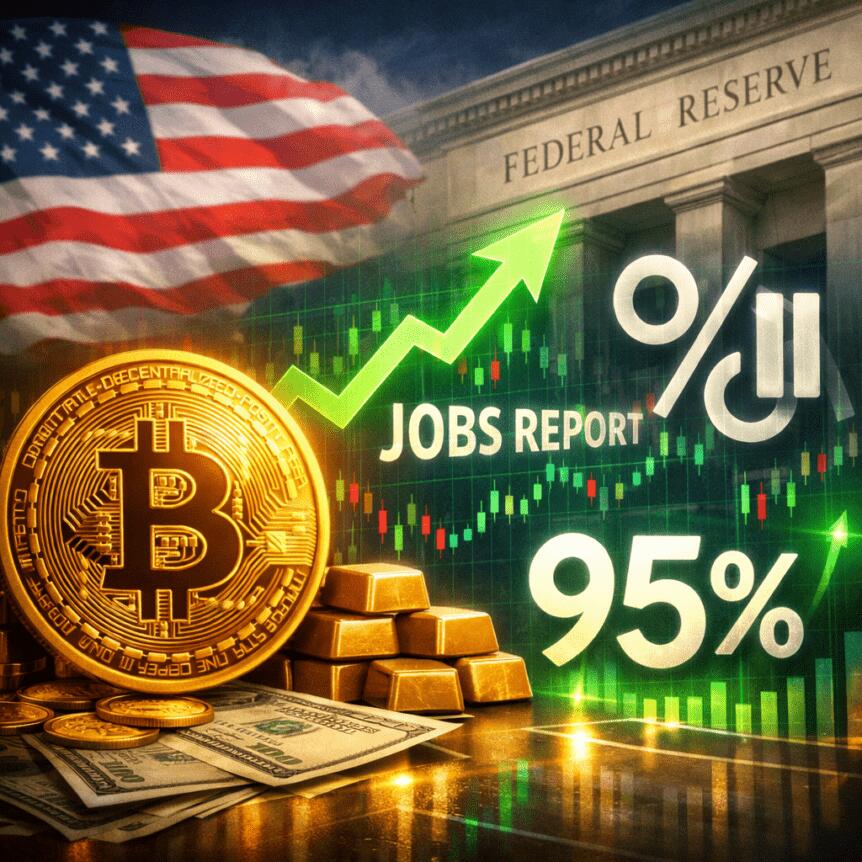
Bitcoin (CRYPTO: BTC) faced a volatile session as U.S. payrolls data surprised to the upside, complicating the path for the Federal Reserve and market risk appetite. After an early intraday spike toward the high $60,000s, the largest cryptocurrency retraced, leaving traders weighing whether a deeper pullback is coming or a temporary pause in risk-off sentiment is enough to support a rebound. The reaction came as the broader equity complex wobbled, with major indices trading in divergent fashion in response to the jobs release and the Fed’s likely response to it. The day’s price action underscores how macro news can quickly reframe crypto downside risk and the near-term technical setup.
Key takeaways
- Bitcoin briefly spiked toward the $69,000 mark intraday before reversing, with the move followed by a pullback that extended losses through the session.
- U.S. nonfarm payrolls rose by 130,000 in January, well above the 55,000 consensus, while the unemployment rate ticked down to 4.3% from 4.4%.
- Despite the strong jobs data, the signal for the Federal Reserve to hold rates at the March meeting persisted, supported by futures markets showing a high probability of a pause.
- The S&P 500 inched higher early but then gave back the gains, while the Nasdaq Composite slid, illustrating mixed risk-asset responses to the same macro print.
- Analysts and traders flagged a potential “slow bleed” scenario for BTC toward the sub-$60,000s or mid-$50,000s if buyers fail to reclaim key levels, with attention fixed on Friday’s CPI release for further clarity.
Tickers mentioned: $BTC
Sentiment: Bearish
Price impact: Negative. A sharp intraday spike gave way to a renewed downward slope, signaling renewed anxiety about near-term downside risk.
Trading idea (Not Financial Advice): Hold. The market is testing whether downside pressure can be contained above key support levels, with forthcoming inflation data likely to drive the next leg.
Market context: The broader crypto environment remains sensitive to macro narratives—especially inflation trajectories and the likelihood of further monetary tightening or pauses—which shape liquidity and risk sentiment across digital assets.
Why it matters
The January employment report cemented a narrative in which a robust labor market reduces the near-term impulse for the Fed to cut rates, complicating the outlook for risk assets, including bitcoin. While stronger payrolls can intensify fears of higher-for-longer policy, the sheer resilience of the job market also mitigates the chance of a sharp recession, which can paradoxically support risk appetite in certain regimes. The market’s response in equities—modest gains in the S&P 500 that faded while tech-heavy indices retreated—reflects a nuanced equilibrium: traders are parsing whether macro strength translates into higher yields and tighter financial conditions, or whether cooling inflation signals will eventually embolden a broader risk-on posture.
Bitcoin’s price action over the session underscored those crosscurrents. The initial move higher suggested a renewal of demand, perhaps driven by the prospect of a Fed pause and the possibility of liquidity support from markets still navigating 2026’s macro landscape. Yet as the day evolved, the lack of follow-through on the upside and the re-emergence of selling pressure highlighted how quickly technical conditions can pivot on a single data release. For market participants, the takeaway is clear: macro prints will continue to define crypto volatility in the near term, even when the fundamental picture for blockchain technologies remains intact and the long-run adoption thesis remains intact.
Looking ahead, traders will be watching not only next week’s inflation data but also ongoing risk signals from both traditional markets and on-chain metrics. The interplay between macro cues and crypto-specific dynamics—such as exchange inflows, funding rates, and retail participation—will determine whether BTC stabilizes near current levels or tests critical supports in the low to mid-$60,000 range. The Fed’s eventual policy stance, as reflected in the FedWatch indicator and related market pricing, will remain a major driver, shaping whether risk assets get a sustained push or retreat into a risk-off regime.
What to watch next
- Friday’s Consumer Price Index (CPI) release to gauge inflation momentum and its impact on the Fed’s course.
- The March FOMC decision and the probability of a rate pause, as reflected in futures markets.
- BTC price action around key support levels near $64,000, $62,000, and the rumored $50,000 downside scenario.
- Market breadth signals in equities and whether risk-on appetite improves or deteriorates in the wake of inflation data.
- Any new official guidance from major market participants and notable traders regarding the balance of risk and potential upside catalysts for BTC.
Sources & verification
- U.S. Bureau of Labor Statistics January nonfarm payrolls report showing 130,000 jobs added and the unemployment rate at 4.3%.
- CME Group FedWatch Tool indicating high odds of a rate pause in March.
- TradingView BTCUSD price charts capturing intraday spikes and retracements on the session.
- Kobeissi Letter’s analysis on unemployment trends and the Fed’s expected stance.
- Price context and reference points discussed in market commentary noting BTC’s potential low-$60k to mid-$50k scenarios and prior coverage of $69,000 significance.
Bitcoin volatility and the jobs data backdrop
Bitcoin (CRYPTO: BTC) traded with pronounced sensitivity to the day’s macro data, underscoring how quickly crypto markets respond to shifts in macro policy expectations. The price momentum was highly event-driven: a brisk move up toward the $69,000 area was followed by a swift reversal, dragging the session into negative territory as the day wore on. The early move appeared to reflect a tempered optimism around a potential pause in rate hikes, but the subsequent pullback suggested that investors are not yet prepared to embrace a renewed up-leg without more convincing evidence of durable demand.
The January nonfarm payrolls report delivered numbers well above expectations—130,000 jobs added against a forecast of 55,000—while the unemployment rate declined to 4.3%. Such a strong labor market reduces the immediate pressure on the Fed to cut rates, implying a higher probability that policy normalization will proceed at a measured pace. In the near term, that translates to a cautious stance for crypto and other risk assets, even as the longer-term inflation trajectory remains a central question for market participants. The data fed into a narrative that a Fed pause would persist, a conclusion reflected by the CME FedWatch Tool’s readings that traders viewed the odds of a March pause as elevated, a signal that liquidity conditions may not tighten rapidly enough to derail risk appetite completely, but also that upside momentum in BTC would require a solid commitment from buyers at key price junctures.
Asset markets showed a mixed response. The S&P 500 edged higher in early trading before retracing, while the Nasdaq Composite slipped, highlighting a bifurcated risk environment where value and growth cohorts moved in different directions in response to the same macro release. Gold, often a proxy for macro uncertainty, also exhibited choppy behavior, briefly touching fresh February highs before trimming gains as traders weighed the likelihood of further volatility in the real economy. The nuance here is important: even with a robust January jobs report, the macro landscape remains unsettled, leaving markets to calibrate inflation expectations against the probability of a slower but still uncertain path for monetary policy.
Among traders, sentiment leaned toward caution. The Kobeissi Letter’s commentary framed the data as supportive of the view that the Fed would pause, a narrative that aligns with a broader market expectation of a softer near-term policy stance. Yet the absence of a decisive bounce in BTC underscored a critical point: macro strength does not automatically translate into immediate crypto upside, particularly when the price must contend with meaningful resistance around prior highs and the looming risk of a renewed downturn if buyers fail to reclaim and sustain momentum above critical levels. In this context, BTC’s journey from the intraday peak back toward sub-$70,000 territory epitomized the current tension between macro resilience and crypto-specific risk management.
https://platform.twitter.com/widgets.js

Coinbase has launched crypto wallet infrastructure that allows AI agents — programs that can think and transact without human input — to spend, earn and trade crypto.
In a post on Wednesday, Coinbase programmers Erik Reppel and Josh Nickerson said the new Agentic Wallets feature aims to build on today’s agents, which can answer questions, summarize documents, and assist with tasks, but can’t execute trades or orders on behalf of users.
“The next generation of agents won’t just advise — they’ll act,” the pair said, adding that AI agents will be able to do everything from monitoring decentralized finance positions and rebalancing portfolios to paying for compute and API access and participating in creator economies.

Reppel and Nickerson said Agentic Wallets build on Coinbase’s AgentKit framework, introduced in November 2024, which enabled developers to embed wallets into agents.
The agents can transact via Coinbase’s x402, a purpose-built payments protocol for autonomous AI use cases that has already reportedly seen 50 million transactions.
Through x402, “Agents acquire API keys, purchase compute, access premium data streams, and pay for storage – all autonomously, creating truly self-sustaining machine economies,” the programmers said.
Reppel and Nickerson said agents would be able to operate on the Ethereum layer-2 network Base, “Managing positions and executing strategies wherever the opportunities exist.”
“Build agents that monitor yields across protocols, execute trades on Base and manage liquidity positions 24/7. Your agent detects a better yield opportunity at 3am? It rebalances automatically, no approval needed because you’ve already set permissions and controls.”
AI agents now operable on the Bitcoin Lightning Network
Lightning Labs, the team behind the Bitcoin layer-2 Lightning Network, also released a new toolset on Wednesday that enables AI agents to transact on Lightning using the L402 protocol standard.
The AI agents can also run a Lightning node and manage a Lightning wallet containing native Bitcoin (BTC) without access to the private keys.

Meanwhile, Crypto.com CEO Kris Marszalek launched ai.com on Monday, a platform that lets users create personal AI agents to perform everyday tasks on their behalf.
Marszalek said the AI agents can perform anything from managing emails and scheduling meetings to canceling subscriptions, carrying out shopping tasks and planning trips.
Crypto leaders are bullish on agentic AI
Jeremy Allaire, the CEO of stablecoin issuer Circle, predicted on Jan. 22 that billions of AI agents will be transacting with crypto and stablecoins for everyday payments on behalf of users in three to five years.
Former Binance CEO Changpeng “CZ” Zhao has shared a similar view, stating that “native currency for AI agents is going to be crypto” and will do everything from buying tickets to paying restaurant bills.
Related: Deel taps MoonPay to roll out stablecoin salary payouts in UK, EU
Outside of crypto, tech giant Google introduced the Universal Commerce Protocol on Jan. 11 to power agentic commerce.
Google’s protocol uses its Agent Payment Protocol 2 to facilitate transfers on behalf of users, with Google Pay serving as the default payment handler for US dollar transactions.
Magazine: The critical reason you should never ask ChatGPT for legal advice
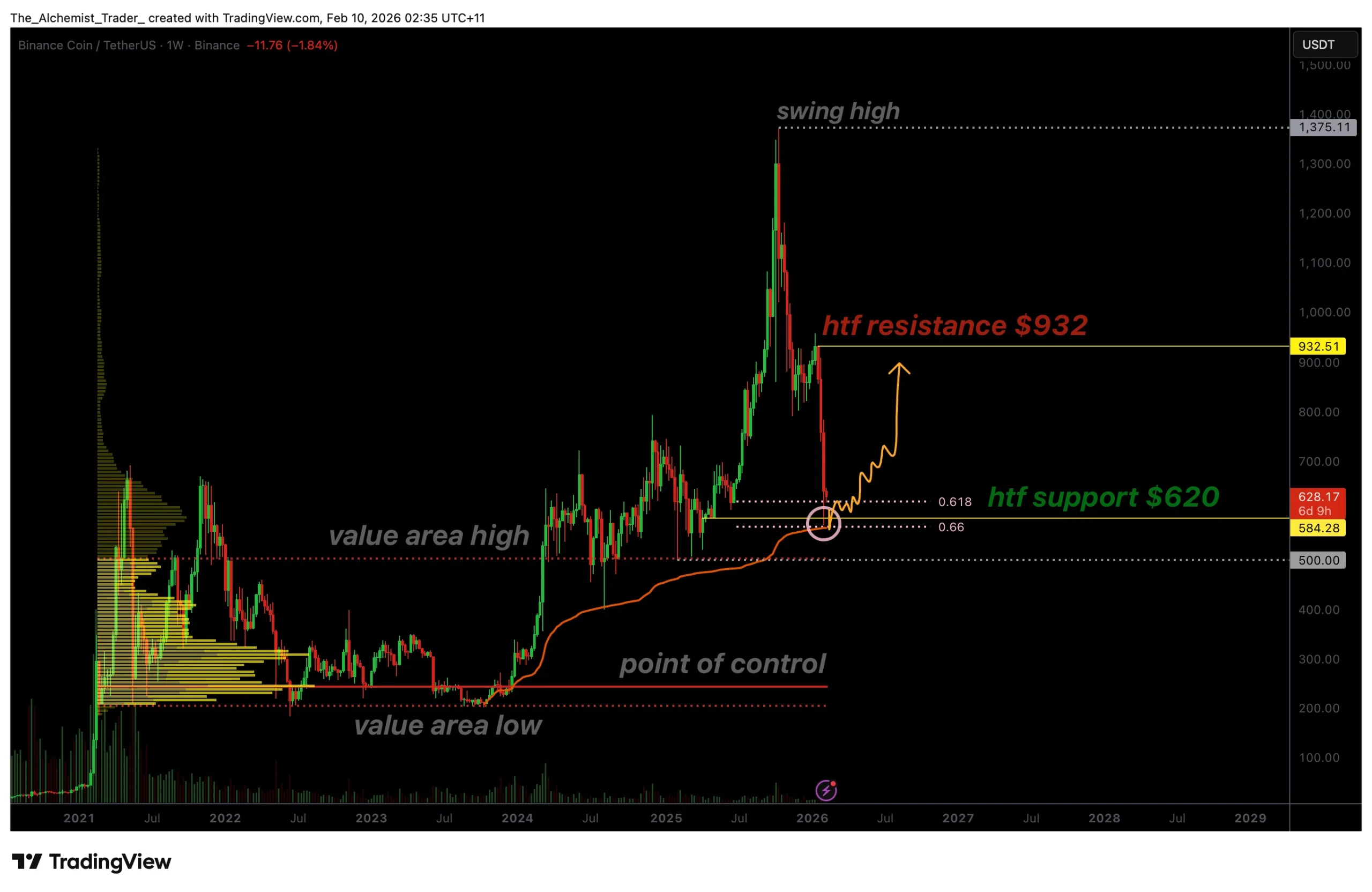
BNB price is now trading around $609, slipping below the previously defended $620 golden pocket level and putting long-term support to the test.
Summary
- Price dips under the $620 0.618 Fibonacci “golden pocket”
- Trading near the 200-week moving average, a key macro support
- Structure remains intact — but bulls need a reclaim of $620
Binance (BNB) is once again at a critical inflection point after losing the $620 region that had been acting as a high-timeframe support cluster. Following weeks of corrective pressure, price briefly stabilized at the 0.618 Fibonacci retracement before slipping modestly lower, now hovering near $609.
This move shifts the technical narrative slightly: rather than cleanly holding support, BNB is now probing the lower bounds of a major confluence zone. Whether this becomes a deviation below support or the start of deeper consolidation will likely define the next multi-week trend.
BNB price key technical points
- $620 remains the high-timeframe golden pocket (0.618 Fibonacci retracement)
- Price is hovering around the 200-week moving average
- A reclaim of $620 would strengthen the bullish case
- Sustained acceptance below opens the door to further downside exploration
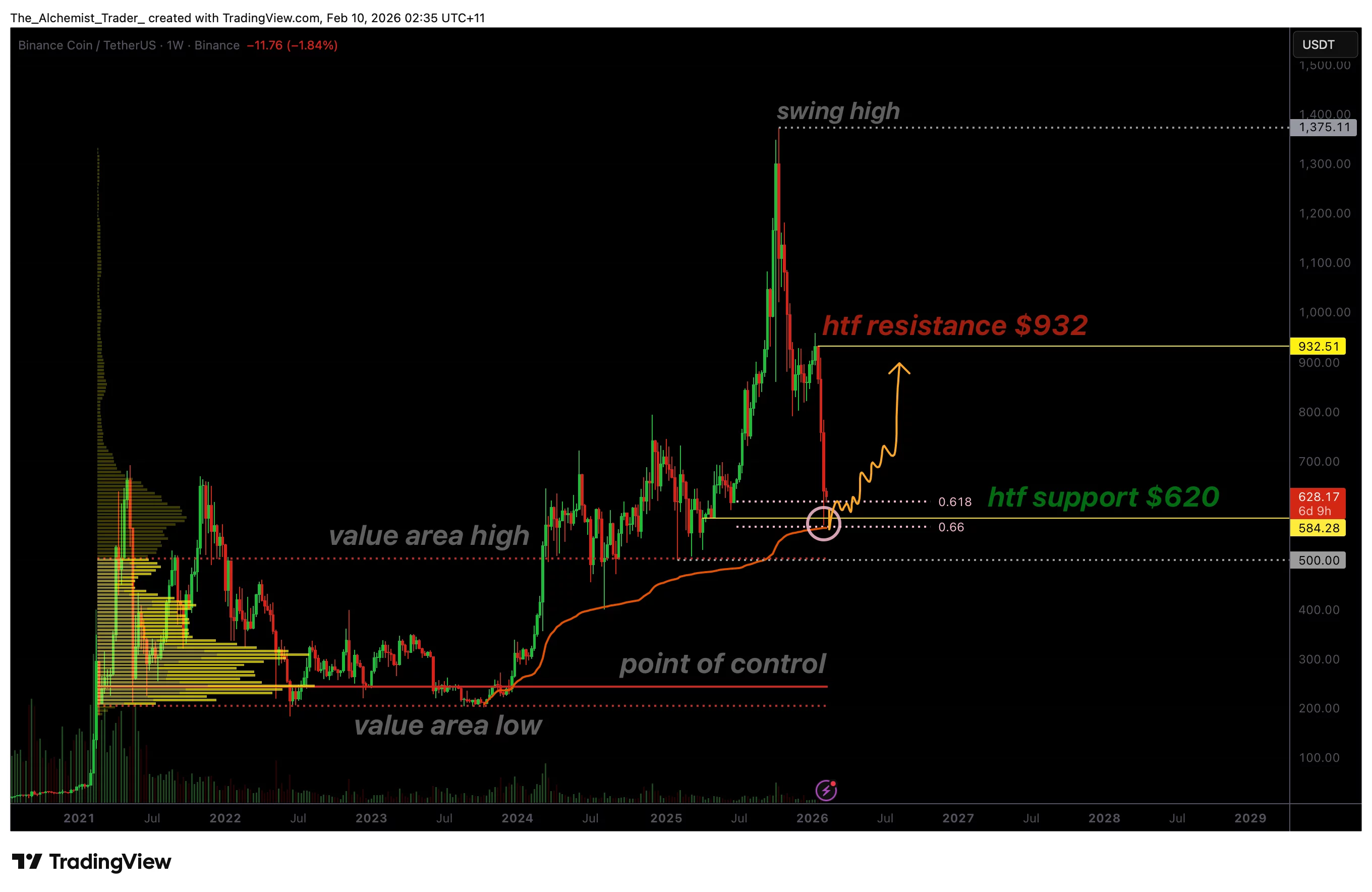
The $620 level continues to carry heavy technical weight. It marks the 0.618 Fibonacci retracement of the broader advance — often referred to as the “golden pocket,” a zone that frequently acts as a high-probability reversal area.
However, with BNB now trading below that level, the focus shifts to whether this is a temporary liquidity sweep or a more meaningful breakdown.
Importantly, price remains near the 200-week moving average — a widely followed macro trend indicator. Historically, sustained closes below this level tend to invite extended consolidation, while swift recoveries often signal a false breakdown.
The next few weekly closes will therefore be critical.
Market structure supports a potential bottom
From a broader market structure perspective, the chart has not yet confirmed a full trend reversal. While the loss of $620 weakens the immediate bullish structure, BNB has not decisively broken down into lower macro territory.
This type of price action — slipping below support before reclaiming it — is common during bottoming formations. Markets often sweep liquidity below obvious levels before rotating higher.
If buyers step in and push price back above $620 with conviction and expanding volume, the move could be classified as a deviation, reinforcing the broader bullish structure.
If not, deeper consolidation becomes increasingly likely.
Upside targets come back into focus
Bullish case:
- Reclaim and hold above $620
- Strong weekly close back inside the golden pocket
- Gradual rotation toward higher resistance
- $932 remains the key high-timeframe resistance target
Bearish case:
- Continued weekly closes below $620
- Loss of the 200-week moving average
- Expansion in selling volume
- Potential move toward lower value areas before base formation
What to expect in the coming price action
The $932 high-timeframe resistance remains the primary upside objective if macro structure holds. However, reclaiming $620 is the first major hurdle bulls must clear before that target comes back into play.
With BNB now around $609, this is no longer simply a stabilization story — it is a support test.
High-timeframe setups require patience. The coming weekly closes will determine whether the current move becomes a confirmed breakdown or a classic deviation below major support.
For now, the broader structure is under pressure but not broken. A decisive reclaim of $620 would quickly restore bullish momentum. Failure to do so would shift focus toward extended consolidation before any meaningful upside rotation can begin.
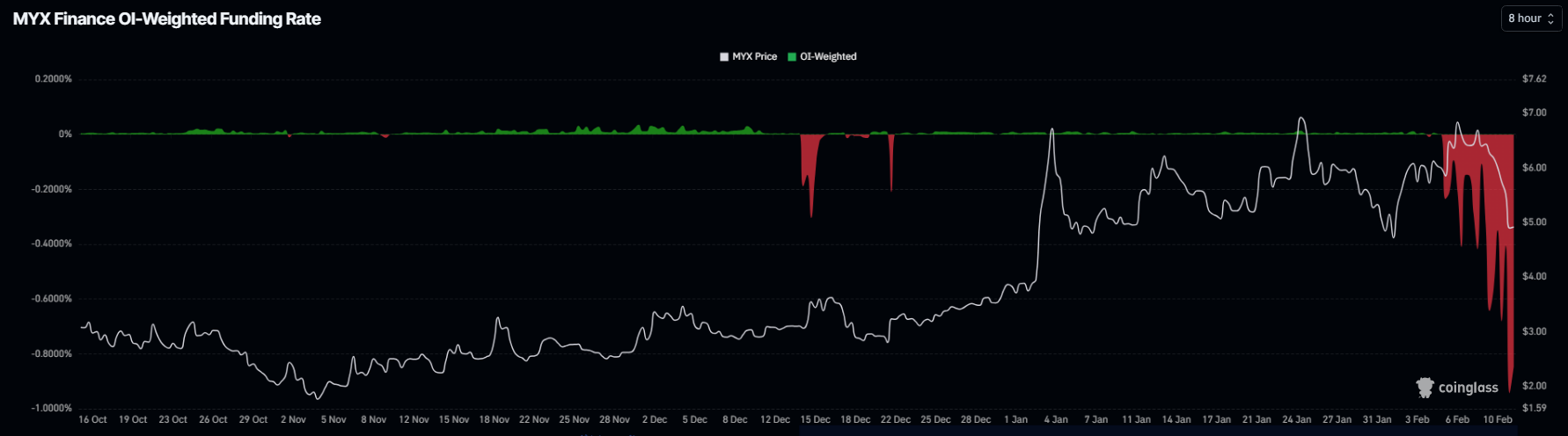
MYX Finance price has dropped sharply, slipping below the critical $5.00 level and signaling growing downside risk.
The breakdown follows several sessions of declining momentum. Selling pressure accelerated after MYX failed to hold key intraday support. Market structure now reflects a bearish shift.
MYX Traders Turn Bearish
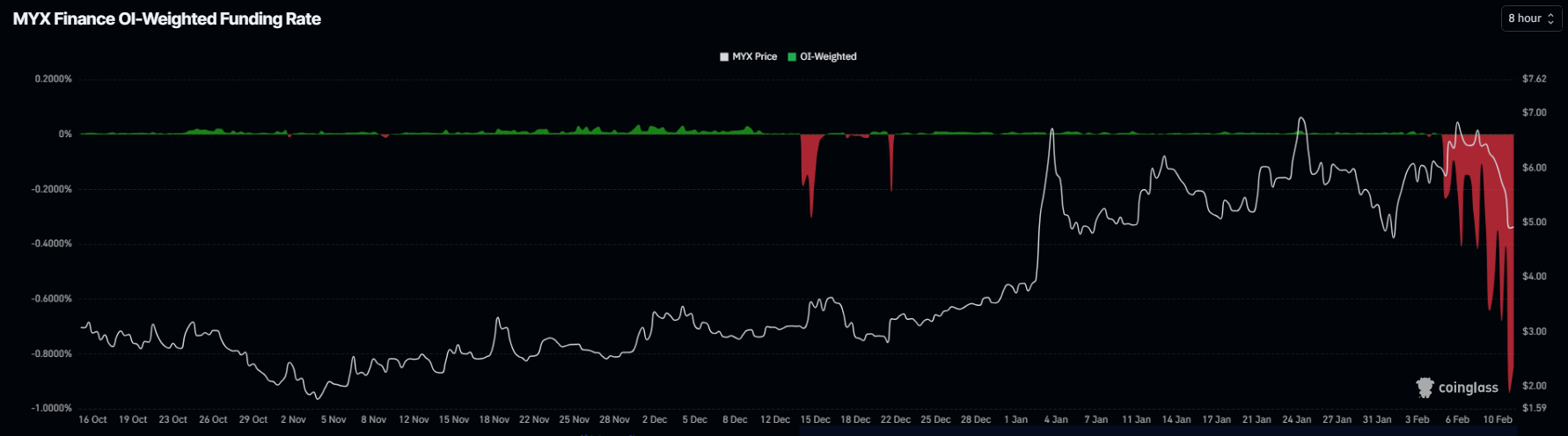
The recent dip has triggered increased short positioning among MYX traders. Funding rate data shows the futures market is dominated by short contracts. Negative funding reflects bearish conviction, as traders position for further declines in MYX Finance price.
Sponsored
Sponsored
A surge in short interest often signals expectations of a deeper correction. Traders appear to be anticipating a price crash they can capitalize on through leveraged positions. This imbalance in derivatives markets may amplify volatility and reinforce downward pressure if selling accelerates further.
Want more token insights like this? Sign up for Editor Harsh Notariya’s Daily Crypto Newsletter here.
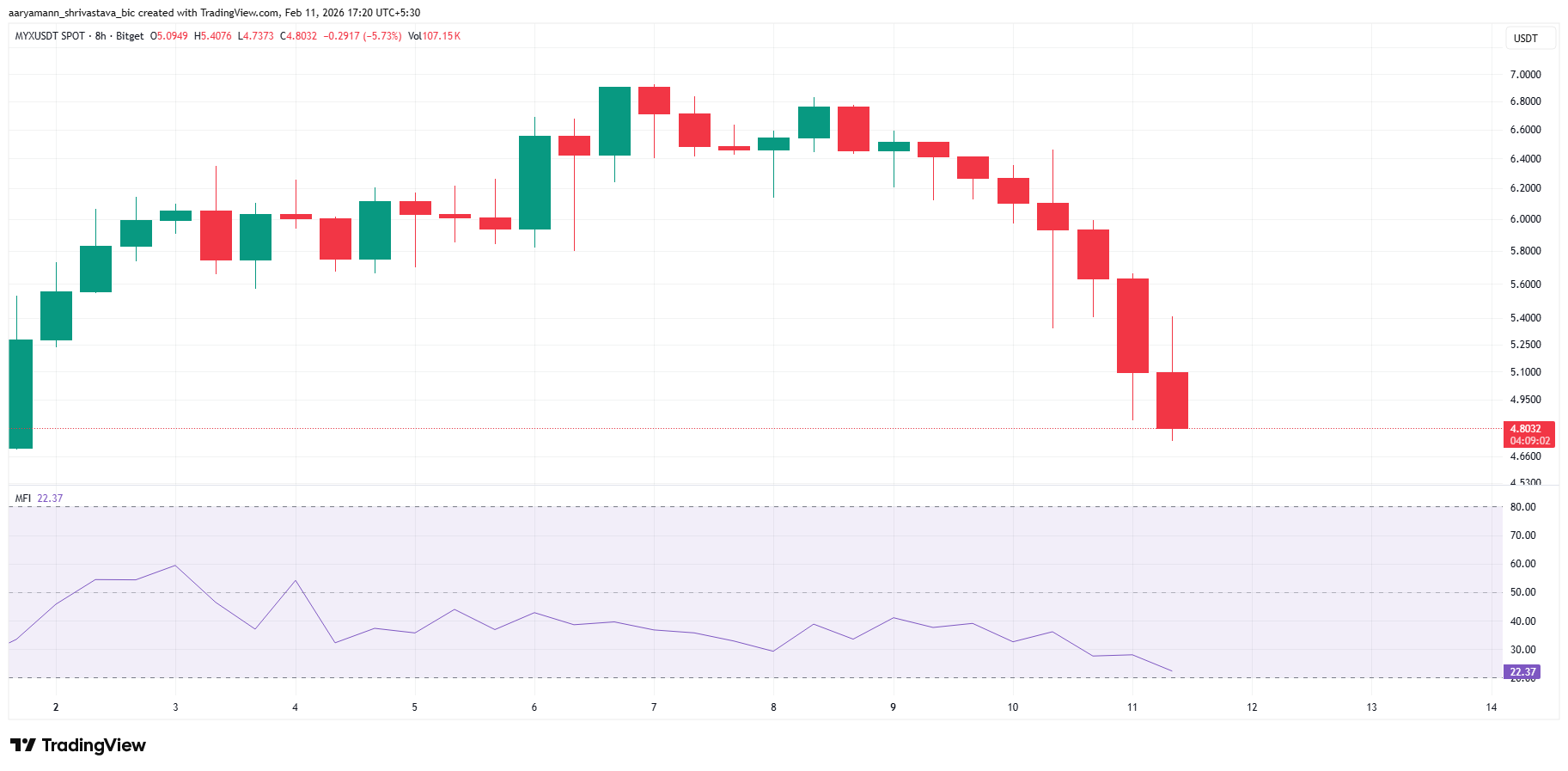
The Money Flow Index, or MFI, indicates heavy selling pressure on the MYX price, reinforcing the ongoing correction. The indicator has trended lower in recent sessions, reflecting sustained capital outflows. This weakness confirms that bearish momentum remains dominant across short-term trading activity.
Although the MFI is approaching the oversold threshold, it has not yet dropped below the 20.0 mark. A decisive move under that level typically signals selling saturation, where accumulation may emerge at discounted prices. If accumulation strengthens, MYX could attempt a technical rebound.
MYX Price May See Further Decline
MYX price is down 23% in the last 24 hours, trading at $4.87 after sliding below $5.00. The token now appears to be breaking down from a bearish ascending wedge pattern. Such formations often precede sharp corrections when support levels fail.
The wedge structure projects a potential 43% decline toward $2.81, coinciding with the 1.78 Fibonacci level. However, a more immediate and realistic target lies near the $4.07 (1.23 fib line) support zone. A confirmed break below $4.61 would increase the probability of testing $4.07, with further downside risk if broader crypto sentiment deteriorates.
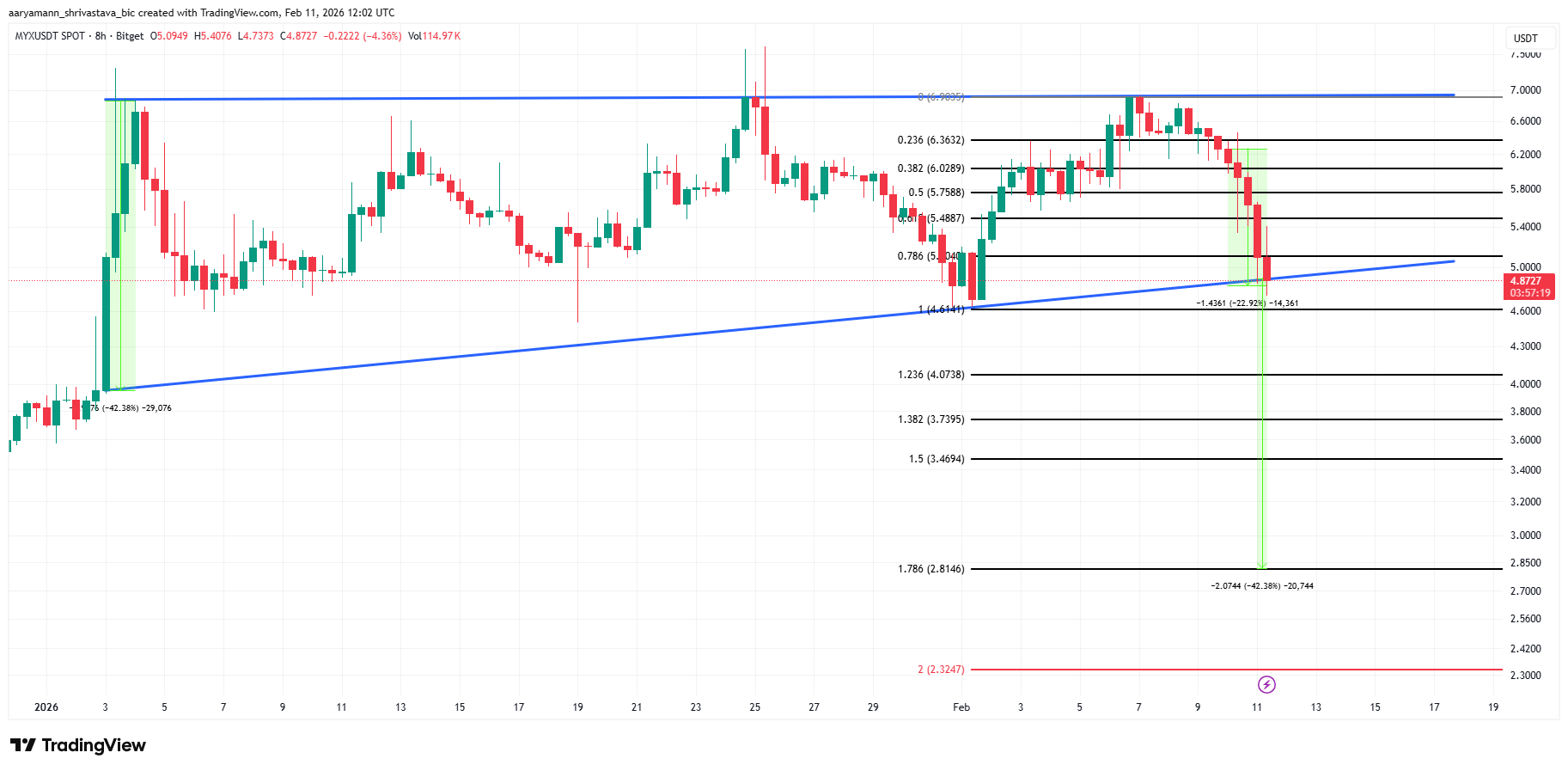
A shift in investor behavior could alter this outlook should MYX end up being oversold, as the MFI hints at. If inflows begin to outweigh outflows and short positions unwind, MYX Finance may attempt stabilization. A decisive move above $5.75 resistance would invalidate the bearish thesis and potentially drive the price toward $6.00 in the near term.
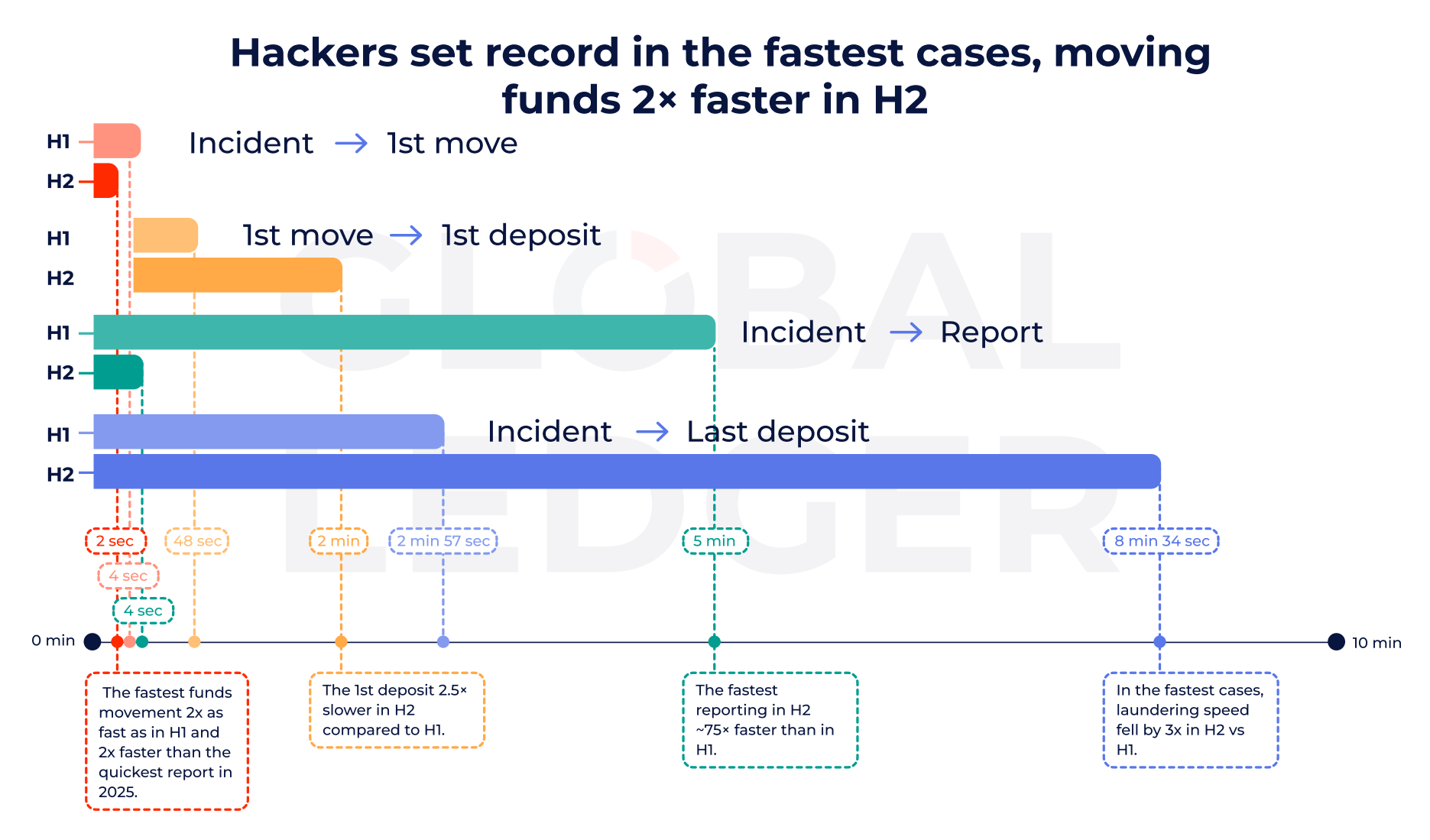
Crypto hackers are now moving stolen funds in as little as two seconds after an attack begins. In most cases, they shift assets before victims even disclose the breach.
That is the clearest finding from Global Ledger’s 2025 analysis of 255 crypto hacks worth $4.04 billion.
Sponsored
Sponsored
Blink and It’s Gone: Crypto Laundering Now Starts Before Disclosure
The speed is striking. According to Global Ledger, 76% of hacks saw funds move before public disclosure, rising to 84.6% in the second half of the year.
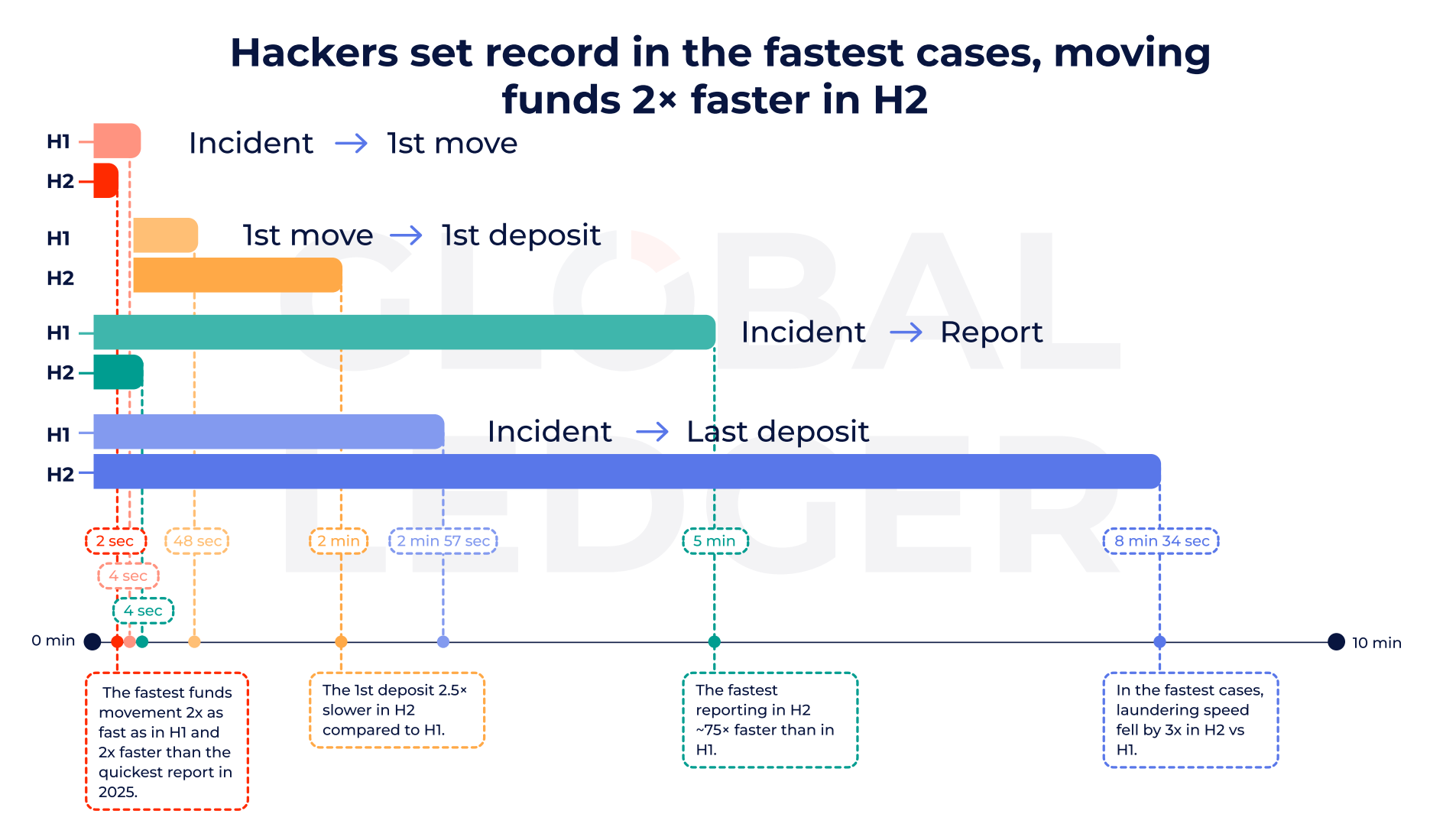
This means attackers often act before exchanges, analytics firms, or law enforcement can coordinate a response.
However, speed tells only part of the story.
While first transfers are now near-instant, full laundering takes longer.
On average, hackers needed about 10.6 days in the second half of 2025 to reach final deposit points such as exchanges or mixers, up from roughly eight days earlier in the year.
In short, the sprint is faster, but the marathon is slower.
Sponsored
Sponsored
This shift reflects improved monitoring after disclosure. Once incidents go public, exchanges and blockchain analytics firms label addresses and increase scrutiny.
As a result, attackers break funds into smaller pieces and route them through multiple layers before attempting cash-out.
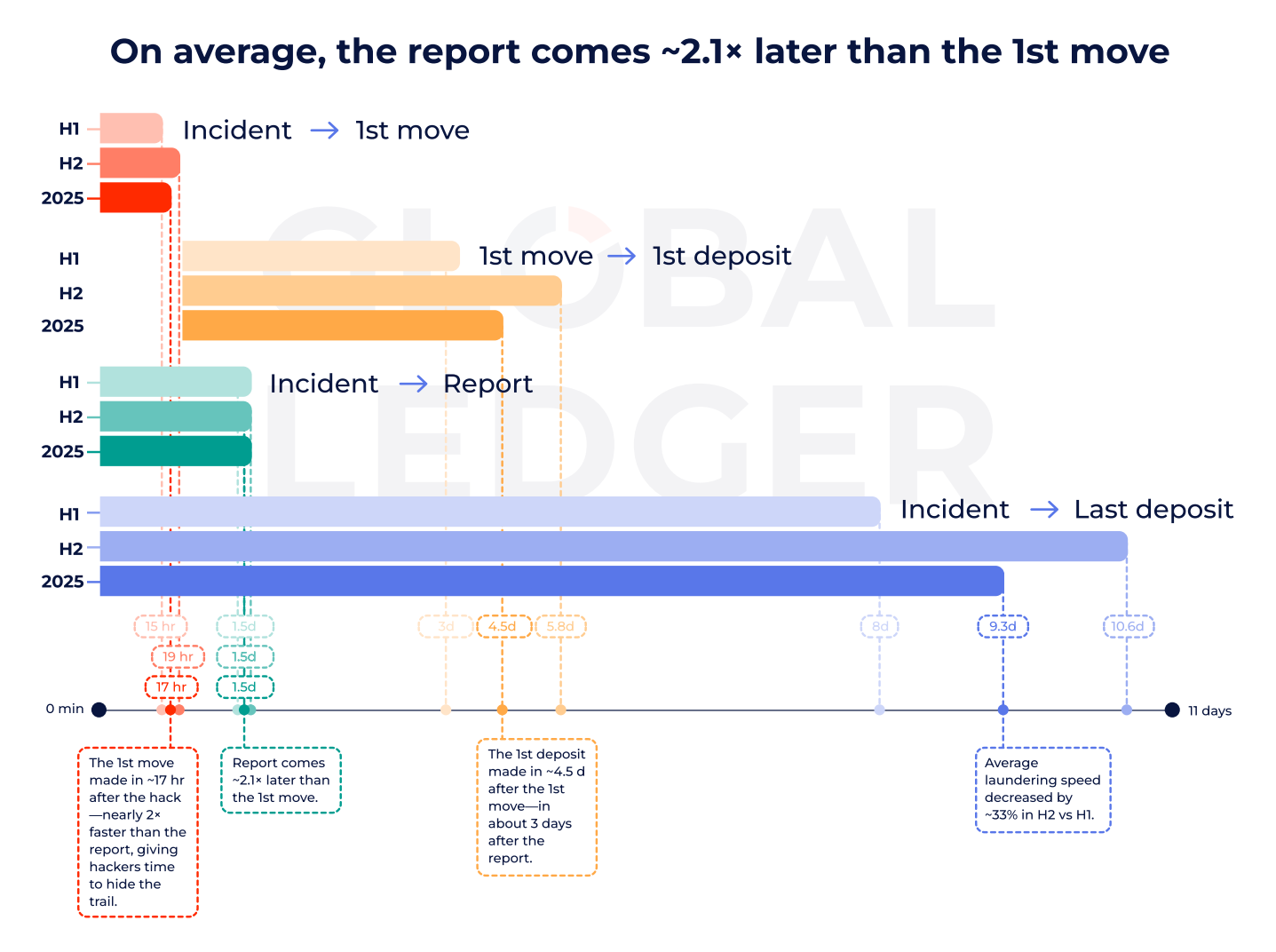
Hacking Speed Increased, but Crypto Laundering Speed Became Slower. Source: Global Ledger
Sponsored
Sponsored
Bridges, Mixers, and the Long Road to Cash-Out
Bridges have become the main highway for that process. Nearly half of all stolen funds, about $2.01 billion, moved through cross-chain bridges.
That is more than three times the amount routed via mixers or privacy protocols. In the Bybit case alone, 94.91% of stolen funds flowed through bridges.
At the same time, Tornado Cash regained prominence. The protocol appeared in 41.57% of hacks in 2025. Its usage share jumped sharply in the second half of the year, following sanctions changes cited in the report.
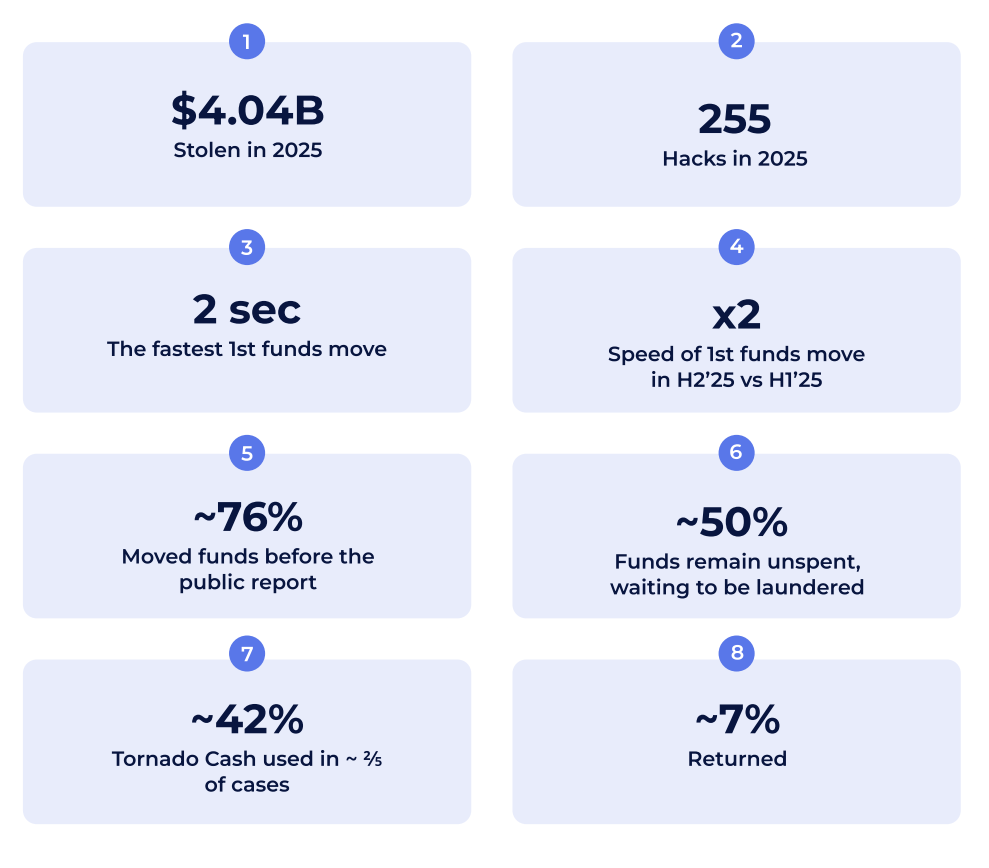
Meanwhile, direct cash-outs to centralized exchanges fell sharply in the second half. DeFi platforms received a rising share of stolen funds. Attackers appear to avoid obvious off-ramps until attention fades.
Sponsored
Sponsored
Notably, nearly half of all stolen funds remained unspent at the time of analysis. That leaves billions sitting in wallets, potentially waiting for future laundering attempts.
The scale of the problem remains severe. Ethereum accounted for $2.44 billion in losses, or 60.64% of the total.
Overall, $4.04 billion was stolen across 255 incidents.
Yet recovery remains limited. Only about 9.52% of funds were frozen, and 6.52% were returned.
Taken together, the findings show a clear pattern. Attackers now operate at machine speed in the first seconds after a breach.
Defenders respond later, forcing criminals into slower, staged laundering strategies. The race has not ended. It has simply entered a new phase—measured in seconds at the start, and days at the finish.
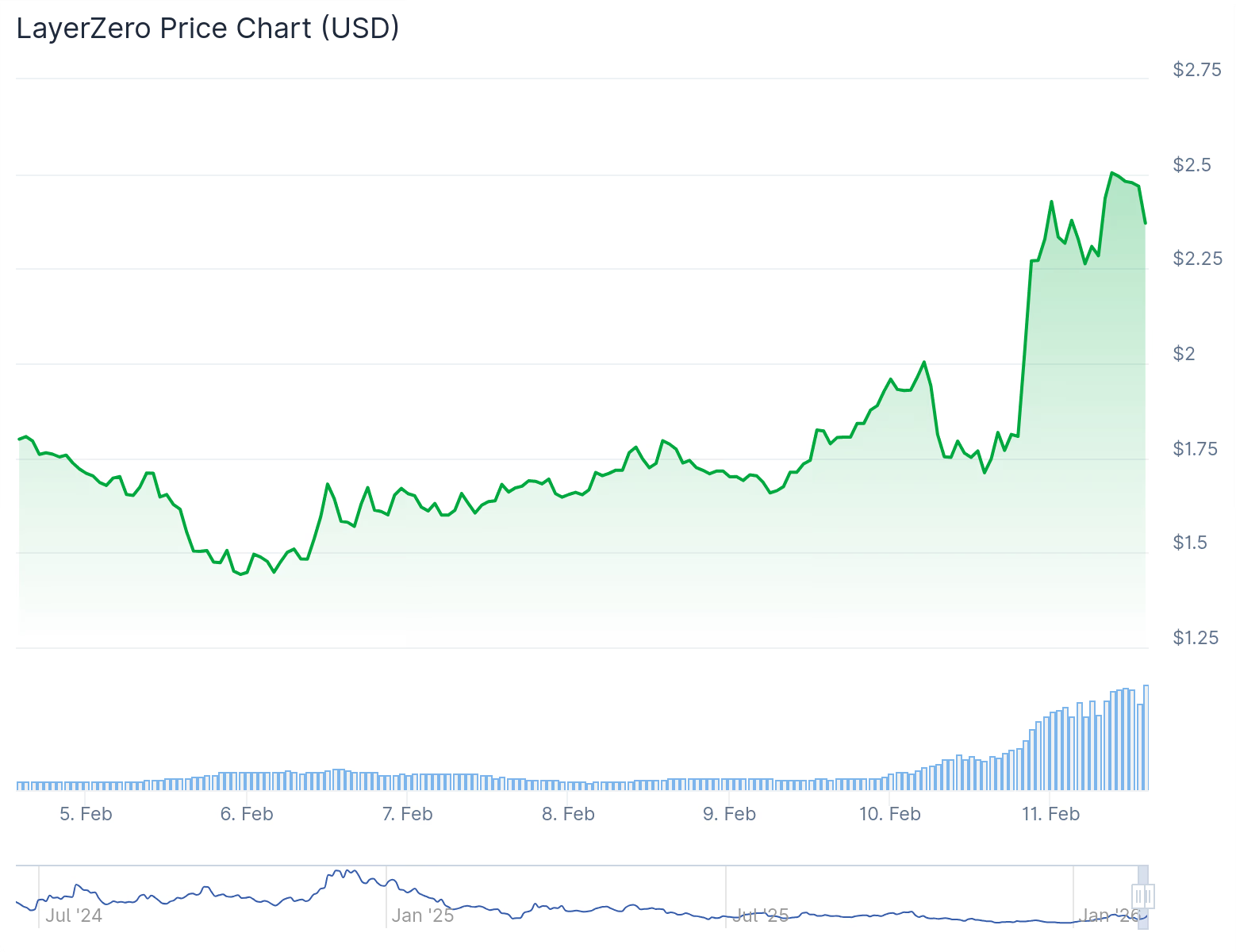
LayerZero announced its Zero blockchain yesterday, built in collaboration with Citadel, ICE, and Google Cloud.
LayerZero’s ZRO token is leading the altcoin market today, rallying 40% after unveiling Zero, its new Layer 1 blockchain.
ZRO sold off immediately after yesterday’s announcement; however, after more details emerged – such as Ark Invest founder Cathie Wood stepping on board as an advisor – the token surged from $1.7 to $2.5.

The ZRO token has been pricing in an impending announcement throughout 2026, and has been one of just a handful of strong altcoins over the last six weeks. The move brings ZRO’s market capitalization to $481 million, its highest level since January 2025.
In addition to Wood, the protocol also added Michael Blaugrund, the vice president of Strategic Initiatives at Intercontinental Exchange (ICE), and Caroline Butler, the former Head of Digital Assets at the Bank of New York Mellon, and co-chair of the Commodities and Futures Trading Commission (CFTC), to its advisory board.
LayerZero brands Zero as “the first multi-core world computer” and says it’s been designed to address all existing bottlenecks in blockchain design, with an explicit goal of 2 million transactions per second (TPS) for every component in its system.
“We have replaced the fragmented, one-size-fits-all model with a unified high-performance system that treats multiple applications like concurrent processes on a single modern multi-core CPU. Due to this massive cost reduction, Zero is not only an alternative to existing blockchains; it provides a credible alternative to centralized cloud providers like AWS,” the Zero debut article claims.
“By stripping away the overhead of redundant replication, we have finally made decentralization viable on a global scale. Zero is the first truly scalable, multi-core world computer,” the article concluded.

OMG THEY WILL ALL MOVE TO “XRP”?!?! MEGA BULLISH NEWS

Developers ‘must pay fair share’ towards city infrastructure as new charges considered

FDA escalates cake mix recall to Class I over undeclared milk allergen

Smart energy pays enters the US market, targeting scalable financial infrastructure

Software stocks enter bear market on AI disruption fear with ServiceNow plunging 10%

Wikipedia volunteers spent years cataloging AI tells. Now there’s a plugin to avoid them.


-

 Politics3 days ago
Why Israel is blocking foreign journalists from entering
-
 Sports5 days ago
JD Vance booed as Team USA enters Winter Olympics opening ceremony
-

 NewsBeat2 days ago
Mia Brookes misses out on Winter Olympics medal in snowboard big air
-
 Business3 days ago
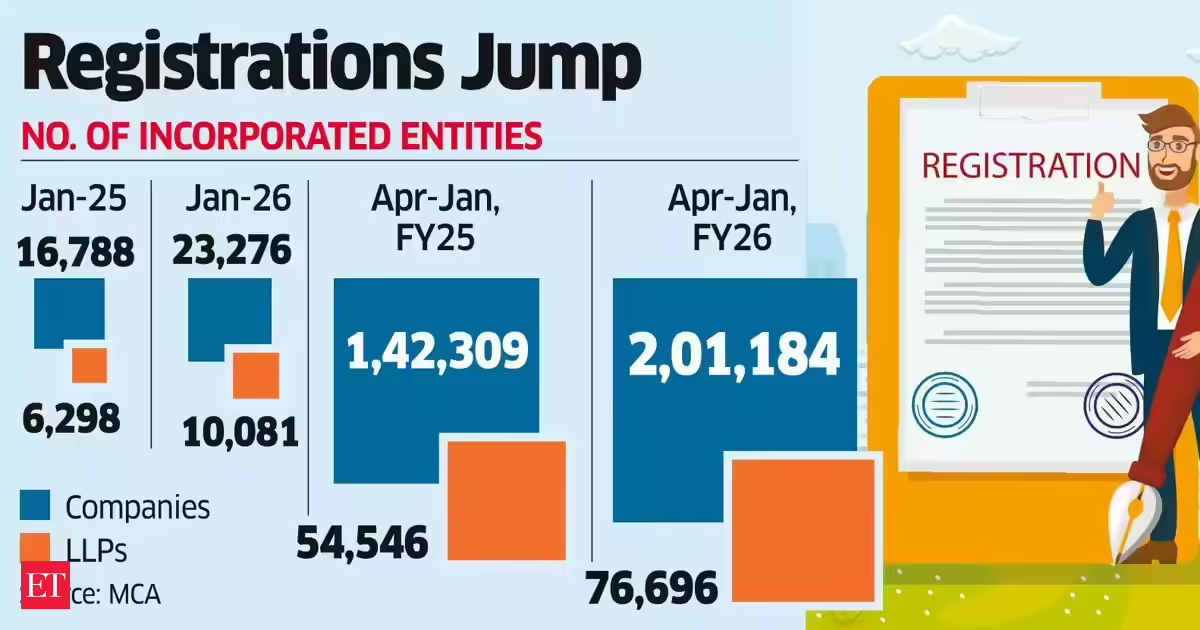
LLP registrations cross 10,000 mark for first time in Jan
-

 Tech5 days ago
First multi-coronavirus vaccine enters human testing, built on UW Medicine technology
-

 Business3 days ago
Costco introduces fresh batch of new bakery and frozen foods: report
-

 Sports1 hour ago
Big Tech enters cricket ecosystem as ICC partners Google ahead of T20 WC | T20 World Cup 2026
-

 Tech22 hours ago
SpaceX’s mighty Starship rocket enters final testing for 12th flight
-

 NewsBeat3 days ago
Winter Olympics 2026: Team GB’s Mia Brookes through to snowboard big air final, and curling pair beat Italy
-

 Sports3 days ago
Benjamin Karl strips clothes celebrating snowboard gold medal at Olympics
-
Sports4 days ago
Former Viking Enters Hall of Fame
-

 Politics3 days ago
The Health Dangers Of Browning Your Food
-
Sports6 days ago
New and Huge Defender Enter Vikings’ Mock Draft Orbit
-

 Business4 days ago
Julius Baer CEO calls for Swiss public register of rogue bankers to protect reputation
-
 NewsBeat5 days ago
Savannah Guthrie’s mother’s blood was found on porch of home, police confirm as search enters sixth day: Live
-

 Business6 days ago
Quiz enters administration for third time
-

 Crypto World1 day ago
Blockchain.com wins UK registration nearly four years after abandoning FCA process
-
 Crypto World2 days ago
U.S. BTC ETFs register back-to-back inflows for first time in a month
-
 NewsBeat3 days ago
Residents say city high street with ‘boarded up’ shops ‘could be better’
-
Sports2 days ago
Kirk Cousins Officially Enters the Vikings’ Offseason Puzzle