
Crypto World
Germany moves to tax bitcoin like stocks as new draft bill targets tax-free gains



Existing holdings would keep the current tax treatment, which can allow tax-free sales after a 12-month holding period.



The former Chainlink and Curv executive will lead the blockchain organization’s push into institutional finance and quantum-resistant security.
Crypto World
KYC data is an irresistible honeypot for hackers, and we must change how it is collected


Privacy-preserving identity verification systems could allow individuals to prove only what a service needs to know while keeping the underlying information under their control, writes Coin Center’s Laz Pieper.

Mexico is stepping up its hunt for illegal crypto mines, a move that it hopes will cut down on large-scale electricity theft, after it dismantled a dam-powered operation with 300 computers.
Located in rural northern Puebla, the secret crypto mine illegally siphoned electricity generated from Mexico’s Nuevo Necaxa dam.
Local media reports that Puebla’s Public Security Secretariat will expand its search for similar sites across neighbouring states.
Read more: Malaysian minister says crypto miners behind $722M electricity theft
The agency’s head, Francisco Sánchez, said, “This activity consumes a great deal of energy and generates a lot of noise, which is why operators seek out isolated and very remote locations.”
Puebla’s authorities suspect the operation may have helped legitimize and launder the profits of other illegal activities.
Murder of Mexican keyboardist linked to BTC
Elsewhere in Mexico, Mexican prosecutors believe that the murder of Jonathan Meléndez, his pregnant wife Ana Paula Barragán, their three-year-old daughter Sofía, and 21-year-old nanny Aleyda Romero, was motivated by a BTC stash the killers believed was worth millions of dollars.
Diego Sebastián “N” and Gerardo “N” were arrested on September 2. No BTC was stolen in the homicide, and a witness account later referred to a device that held 3 million pesos in crypto (worth $177,000).
Read more: Paraguay shuts illegal bitcoin mines that stole enough power to light a city
Legitimate BTC mining companies have to factor in energy costs to power the computers, the cost of keeping them cool, and local regulations on commercial electricity usage.
However, illegal operations look for weak or poorly maintained energy infrastructure that they can redirect without raising suspicions.
Got a tip? Send us an email securely via Protos Leaks. For more informed news and investigations, follow us on X, Bluesky, and Google News, or subscribe to our YouTube channel.


Germany is putting a deadline on tax-free Bitcoin (BTC). Buy before December 31, 2026 and the old rules follow your coins, but buy later and the taxman comes.
That date sits inside a draft law from the finance ministry, and while nothing has passed yet, German investors are already doing the arithmetic.
The Rule That Made Germany Different
For years, Germany had it such that you hold your crypto for 12 months and the profit was yours, untaxed. Sell sooner and you paid income tax, up to 42%.
It gave a country famous for paperwork a reputation as one of Europe’s friendliest homes for long-term crypto holders.
The draft seen by Handelsblatt kills the clock, with every sale expected to become taxable. Gains would meet a flat 25% withholding tax, the same one Germany charges on shares and dividends.
A solidarity surcharge also lands on top, so that the first €1,000 ($1,163) of yearly gains stays free, and losses could finally be written off against other gains.
The Part That Stings
The ministry says the exemption rewards speculation.
“It is unfair that hard-earned income and capital gains are taxed, while profits from speculation with crypto assets remain largely tax-free,” read the report, citing the German Federal Ministry of Finance.
Yet under this draft, the speculators do better. A top-rate trader flipping coins inside a year pays 42% today. They would pay roughly 26%.
The person who bought quietly and waited goes from zero to roughly 26%. Berlin expects €160 million ($186.2 million) from all of this in 2028, reaching €350 million ($407.35 million) by 2031.
It still has to survive cabinet, the Bundestag and the Bundesrat, Germany’s two parliamentary chambers. Lawmakers rejected a similar attempt in May.
BeInCrypto saw this coming in July, when the budget framework quietly targeted the tax exemption. Exchanges would only withhold the money automatically from 2028, in step with wider crypto tax reporting rules.
Until parliament votes, the clock is still running.
The post Germany’s Bitcoin Tax-Free Era Could End: The Date Every Crypto Investor Must Know appeared first on BeInCrypto.


The motion for a preliminary injunction comes a few weeks after the Crypto Council for Innovation and Blockchain Association sued to block the law.
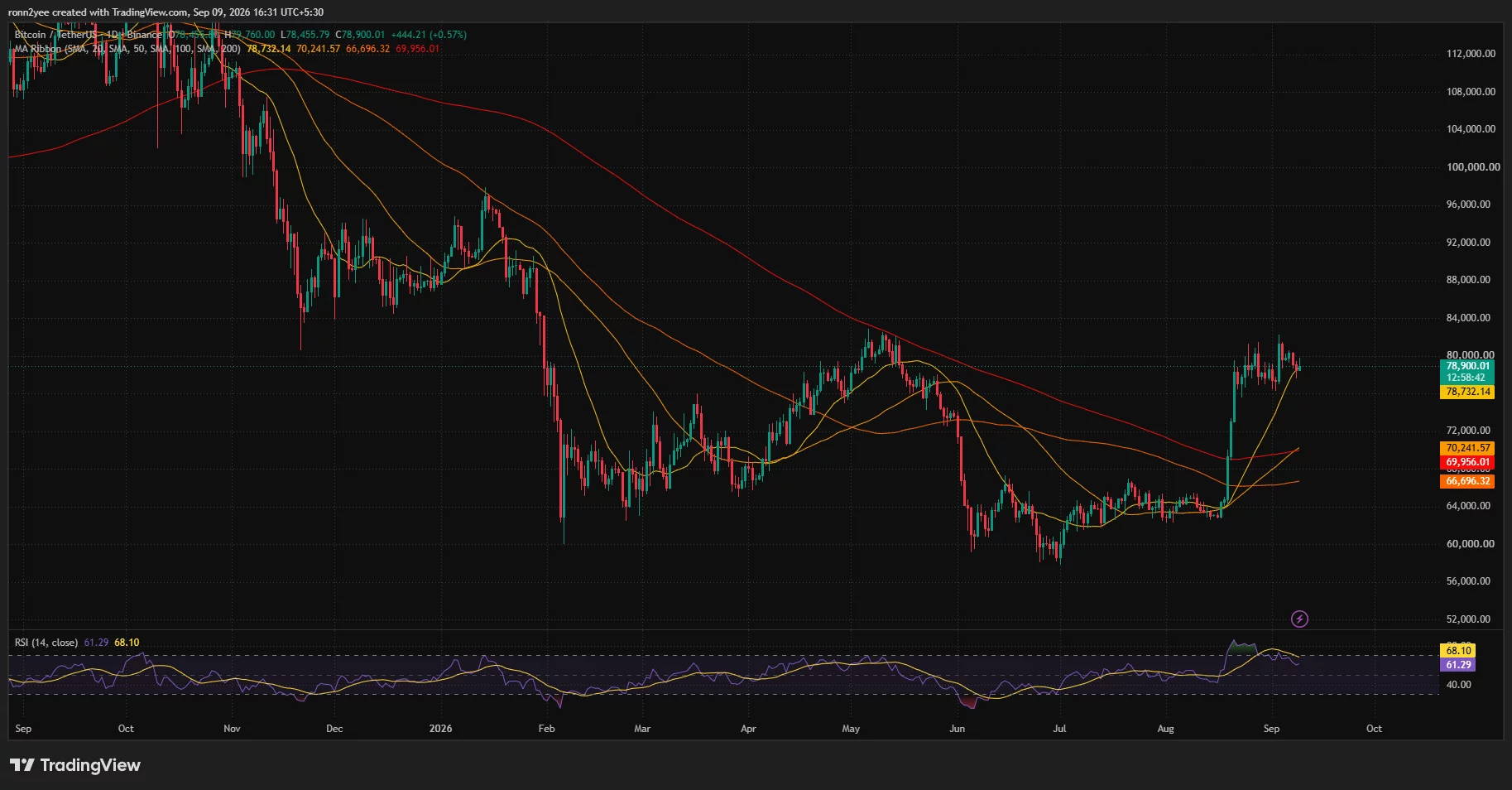
Bitcoin price slipped below $79,000 on Sep. 9 as weakening short-term momentum and liquidity clusters on both sides of the market raised the risk of a sharper move.
Summary
- Bitcoin price traded near $78,900 after falling from above $81,000 on Sep. 4.
- The 4-hour price dropped below its Bollinger Band midpoint at $79,188.
- An ADX reading of 18.31 points to weak short-term trend strength.
- Liquidation liquidity is concentrated near $80,000 above and $77,000–$78,000 below.
Bitcoin price struggles to hold $79,000
According to data from crypto.news, Bitcoin (BTC) price traded near $78,900 at the time of writing, down from an opening price of $81,271 on Sep. 4. The asset briefly fell to $78,455 during the latest daily session before buyers pushed it back toward $79,000.
The six-day pullback followed Bitcoin’s failed attempt to extend its rally above $81,000. Price reached a local high above $82,000 earlier in the period but could not hold those gains as macro concerns and leveraged liquidations weighed on demand.
Bitcoin’s broader daily structure remains constructive despite the decline. BTC is trading slightly above its 10-day simple moving average at $78,732, while the 20-day SMA is much lower at $70,242.
The 50-day, 100-day, and 200-day averages are grouped between approximately $66,700 and $70,000. Bitcoin’s position above those longer-term indicators shows that the larger recovery has not broken down, even as short-term momentum cools.
Daily relative strength has also weakened. The RSI stands at 61.29, down from recent highs and below its signal average of 68.10. The reading remains above the neutral 50 level, but the decline suggests buyers have lost some momentum since BTC tested $82,000.
4-hour indicators show weak momentum
Bitcoin’s 4-hour chart presents a less favorable picture. BTC is trading below the Bollinger Band midpoint at $79,187, which now acts as immediate resistance.
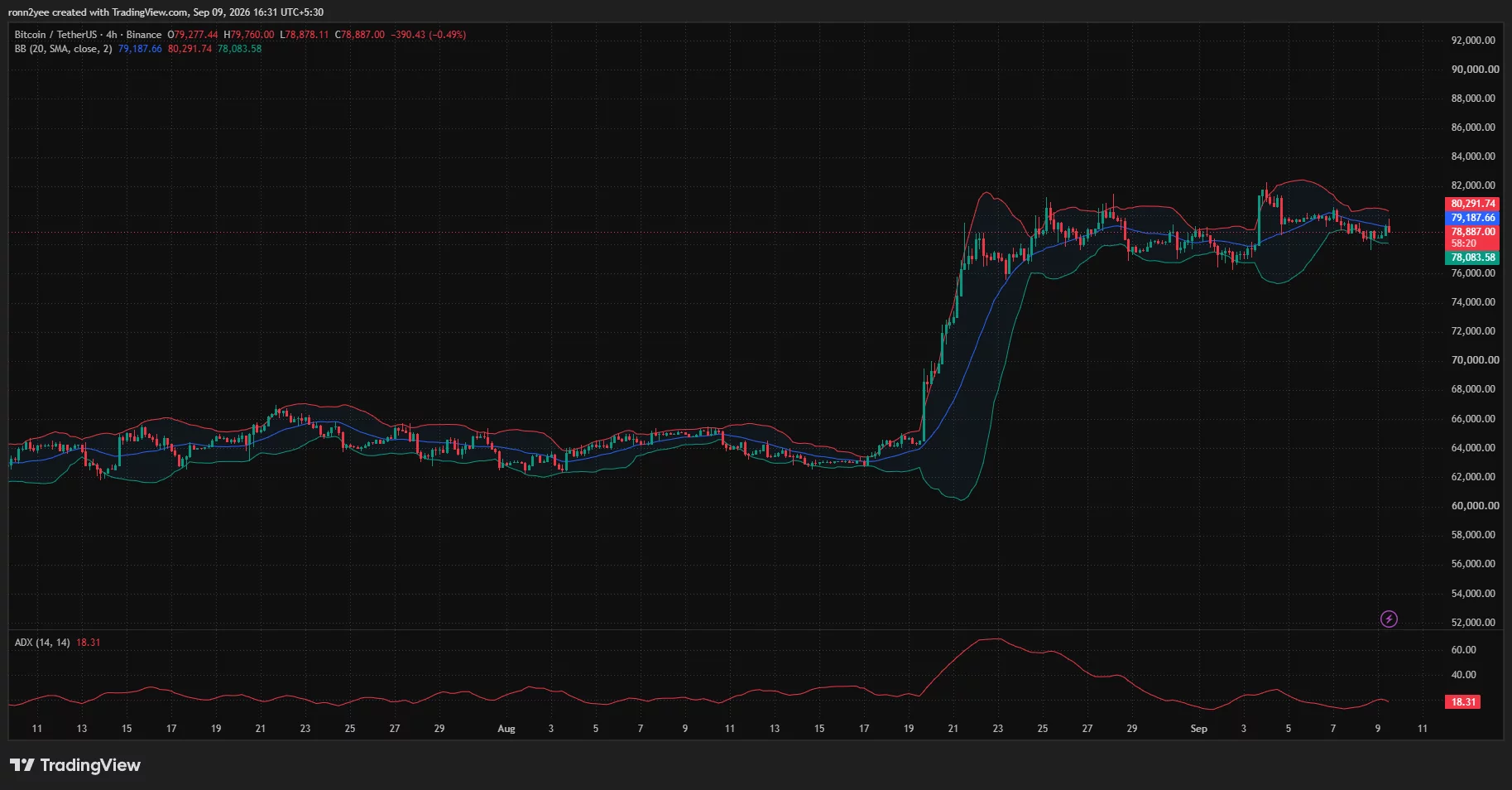
The upper band is near $80,292, while the lower band sits at approximately $78,084. Price has moved toward the bottom half of the range after repeatedly failing to establish support above the midpoint.
A break below the lower band could expose the intraday low around $78,450, followed by the psychological $78,000 level. Buyers would need to reclaim $79,200 before attempting another move toward the upper band and the $80,000 mark.
The average directional index stands at 18.31 on the 4-hour chart. ADX readings below 20 generally indicate that the market lacks a strong trend, which supports the possibility of further sideways movement before a larger breakout.
Low trend strength does not identify the direction of the next move. However, it can leave Bitcoin vulnerable to sudden volatility when the price reaches concentrated areas of leveraged positions.
Liquidation heatmap puts $77,000 and $80,000 in focus
CoinGlass’ 24-hour liquidation heatmap shows several liquidity bands around Bitcoin’s current price. The nearest concentrations above the market appear between approximately $79,200 and $80,000.
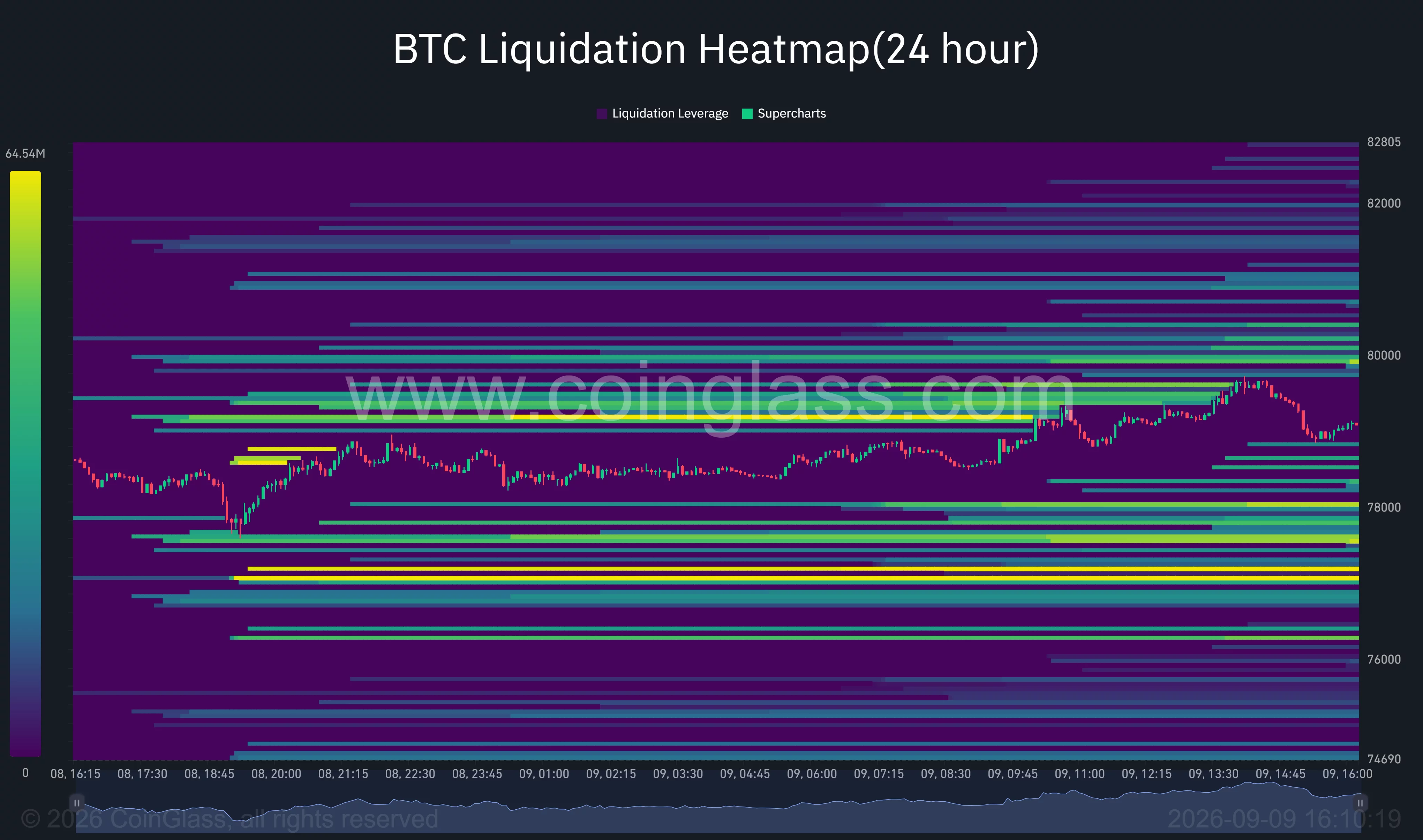
A move into that area could force leveraged short positions to close, adding buy pressure and helping BTC retest $80,300. Further liquidity is visible around $80,500 and between $81,500 and $82,000.
Liquidity is also stacked below the market. The heatmap shows a large concentration near $78,000, followed by a brighter and potentially larger band around $77,000.
A break below $78,000 could therefore trigger long liquidations and accelerate a fall toward $77,000. Additional liquidity appears near $76,300, making that level relevant if the $77,000 area fails.
Market commentator Whale Factor also pointed to a “tug of war” around $80,000, citing a separate 30-day liquidation map. The analyst noted that leveraged positions are concentrated both above and below Bitcoin, creating conditions for a cascade in either direction.
Bearish divergence raises risk of a $76K retest
Crypto analyst Gerla identified a bearish divergence between Bitcoin’s price and RSI. According to the analyst, BTC may still sweep the $82,000 region and form a higher high, but RSI has recorded lower highs at the market’s recent peaks.
A bearish divergence forms when price reaches higher highs while a momentum indicator moves lower. Traders often view the pattern as a warning that an advance is losing strength, though it does not confirm a reversal by itself.
Gerla said the bearish setup would activate only after a confirmed break below channel support near $76,000. A move above $84,000 would weaken the bearish view, according to the analyst.
The chart levels create three immediate scenarios. Holding $78,000 could keep Bitcoin inside its current range, while a recovery above $79,200 would put $80,000–$80,300 back in play. A daily or sustained 4-hour break below $78,000 would increase the chance of a liquidity-driven move toward $77,000 and then $76,000.
For US traders, Treasury yields and expectations for Federal Reserve policy remain important external factors. Higher yields can reduce demand for risk assets, while any shift in rate expectations could add volatility to Bitcoin’s densely positioned derivatives market.
Bitcoin is therefore caught between long-term technical support and fading short-term momentum. The next confirmed break outside the $78,000–$80,300 range could determine whether BTC revisits $82,000 or extends its correction toward $76,000.
Disclosure: This article does not represent investment advice. The content and materials featured on this page are for educational purposes only.
Crypto World
Tehran Targets U.S. Base in Jordan In Retaliation for U.S. Destroying Iranian Oil Tankers


Iran said it targeted a U.S. base in Jordan with a series of missiles overnight after the U.S. military struck five Iranian oil tankers amid renewed hostilities in the region.
“The defeated and aggressor U.S. terrorist military, out of desperation, attacked several Iranian commercial and oil vessels,” said the Islamic Revolutionary Guard Corps (IRGC), according to Iranian state media.”This powerful battle will continue.”
A spokesperson for the Jordanian Armed Forces said a barrage of “20 ballistic missiles” had been launched towards its territory. The country’s air defense system successfully intercepted and destroyed 18 of the missiles, while the remaining two” fell in areas devoid of population centers.”
The IRGC on Wednesday claimed to have targeted two U.S. vessels and eight oil tankers in the Strait of Hormuz as part of its wider retaliatory operations, as reported by Iranian state media.
U.K. Maritime Trade Operations said it had received reports involving several merchant vessels in the region that were subject to “disabling fire,” but it was unable to confirm the nature or impact of the disturbances.
U.S. Central Command (CENTCOM), in response, denied the IRGC’s claims, saying that “no U.S. Navy warship has been struck” as “all IRGC attempted attacks failed.”
The escalation comes after CENTCOM on Tuesday said it destroyed five Iranian crude oil tankers in response to Iran targeting U.S. Navy ships with ballistic missiles over the previous two days.
“The U.S. warship successfully evaded the attempted Iranian attacks and continued to patrol regional waters. No American personnel were harmed,” said the U.S. defense force.
The active hostilities and attacks on shipping mark a serious escalation in the reignited war, which experienced a brief respite before flaring up again last week.
The U.S. and Iran are trading retaliatory attacks as President Donald Trump pursues a campaign of military and economic pressure on Iran, with Tehran threatening it could escalate the conflict further by targeting U.S. oil and gas interests in the Gulf.
Iran has specifically denounced the U.S. attacks on its oil shipments, with the Iranian Foreign Ministry on Wednesday insisting the strikes are “not only a dangerous escalation of tensions in the region, but also a clear threat to regional and international peace and security.”
Iran-backed Houthis escalate regional instability with attacks on Saudi oil infrastructure
Meanwhile, the Iran-backed Houthi militia in Yemen contributed to the regional instability by launching attacks on four cities in Saudi Arabia on Tuesday, with the aim of targeting oil infrastructure.
Saudi Arabia’s Ministry of Foreign Affairs said 73 people had been injured in the strikes.
The attacks came after weeks of escalation between the Houthis and the Saudi-backed government of Yemen, shattering a four-year informal cease-fire in the country’s civil war.
“The U.S. has a very strong defensive military relationship with Saudi Arabia, and we’re watching those events very closely. It’s been going on for some time,” Secretary of State Marco Rubio said Tuesday.
The renewed fighting threatens to further disrupt shipping through the Bab al-Mandeb strait, a critical trade route off the Arabian Peninsula for oil and global commerce.

Japan’s Bitcoin treasury-focused firm Metaplanet is facing renewed scrutiny from shareholders after controversy erupted around the company’s “10th Series” executive option pool and the dilution mechanics tied to its ongoing BTC accumulation.
The dispute centers on how the pool was structured—set at 20% of fully diluted shares and designed to expand automatically as Metaplanet issued new shares to finance additional Bitcoin buys—prompting critics to argue that management’s incentives increased at the expense of existing holders.
Key takeaways
- Shareholders have challenged Metaplanet’s 10th Series executive option pool, arguing its built-in expansion led to significant dilution.
- Metaplanet says the pool was frozen at 319.5 million shares on Aug. 18, but critics claim the earlier growth still magnified dilution for existing shareholders.
- Bitcoin Magazine CEO David Bailey defended the incentive design in posts on X, while pseudonymous shareholder “Bitcoin Pharaoh” alleged personal benefit from options and raised concerns about fairness.
- Metaplanet CEO Simon Gerovich said the company would review governance and compensation policies, after an update that the CEO exercised 92,000 shares from the 10th Series pool.
- Industry commentator Matthew Sigel said further exercise rights from the 10th Series should be frozen and replaced with a shareholder-approved plan tied primarily to BTC per fully diluted share.
Why the 10th Series option pool became contentious
Backlash intensified as multiple Metaplanet shareholders questioned the design and outcomes of the company’s 10th Series executive option pool. According to the dispute described by shareholders on X, the pool was established to represent 20% of fully diluted shares and to automatically expand as new shares were issued to fund Metaplanet’s Bitcoin accumulation.
Critics point to the scale of the growth. One shareholder claim summarized the change as the pool expanding from roughly 46 million shares to 319.5 million shares. While that characterization reflects the objections raised in social posts, Metaplanet’s response provides the key operational detail: the company said it froze the pool at 319.5 million shares on Aug. 18.
In a Tuesday X post, Bitcoin Magazine CEO David Bailey defended the model, arguing that allowing management a 20% slice of the cap table over five years “isn’t some crazy number.” Bailey also wrote that he has been invested in Metaplanet “since day zero,” framing his support as long-term alignment rather than short-term compensation.
Responses from Metaplanet and shareholder pressure for transparency
Following the public debate, some shareholders said they are asking Metaplanet to cancel additional shares created from the 10th Series changes and to provide more transparency around future decisions. The criticism is not only about dilution in theory, but about the sequence of how the pool expanded while new share issuance financed Bitcoin purchases.
Metaplanet acknowledged in an Aug. 18 notice that expanding the share pool “amplifies the dilution borne by existing shareholders.” That admission is central to the contention: even if a freeze stops further automatic expansion, shareholders argue the damage had already accrued.
One pseudonymous shareholder, “Bitcoin Pharaoh,” also alleged that Bailey personally benefited from Metaplanet stock options, claiming Bailey received 300,000 options at a strike price of 105 Japanese yen when Metaplanet’s stock was reportedly trading at 510 yen. The allegation was presented as part of the shareholder critique, emphasizing perceived incentive misalignment and potential conflicts around board-related roles. Bailey did not provide a detailed rebuttal within the text provided, but he did publicly defend the overarching executive option structure.
CEO Gerovich: governance review and the 10th Series exercise update
Metaplanet CEO Simon Gerovich said the company would review governance and compensation policies and share updates once the work is complete. In a Sunday X post, Gerovich also sought to distance himself from shareholder discussions tied to MMXX Ventures, explaining that he is a significant but non-majority shareholder in MMXX’s parent company and that he does not hold an executive role.
Separately, on Aug. 31, Metaplanet revealed that the CEO exercised 92,000 shares from the 10th Series executive options pool. The exercise detail matters in this context because it illustrates that the incentive program in question moved from a theoretical cap-table mechanic into completed transactions tied to company performance and/or capital-market actions.
As the controversy escalated, Metaplanet’s earlier documentation and the Aug. 18 freeze appear to be the company’s attempt to address the immediate dilution concern by halting further pool expansion. However, critics continue to argue that transparency and fairness still require broader remedy—particularly if earlier expansions increased dilution beyond what holders expected.
External calls to freeze remaining rights and replace the structure
Outside commentary has added pressure by reframing what a better incentive approach could look like. VanEck’s head of digital asset research, Matthew Sigel, argued in a Wednesday X post that Metaplanet should “freeze” further exercise rights from the 10th Series option pool. Sigel also suggested holders voluntarily surrender the excess rights and weigh additional options tied to shares that were already exercised.
Most notably, Sigel proposed replacing “Series 10” with a shareholder-approved five-year incentive plan tied primarily to BTC per fully diluted share. That suggestion speaks directly to the core criticism: that tying the incentive to a cap-table percentage, rather than directly to Bitcoin ownership metrics normalized by fully diluted share count, can create outcomes where management’s equity gain does not map cleanly to shareholders’ contribution after dilution effects are considered.
At the time of Cointelegraph’s report, it indicated a request for comment from Metaplanet on whether the company would consider freezing remaining shares in the executive pool. The market also appeared to react to the debate and corporate updates: Metaplanet shares closed higher in Wednesday’s Tokyo trading, trimming their five-day decline to roughly 16.3%, according to Yahoo Finance.
For investors, the next key signal to watch is whether Metaplanet’s announced governance review results in concrete changes—particularly around whether any remaining 10th Series rights will be frozen and whether a new, shareholder-approved incentive framework is put forward and clearly tied to Bitcoin per fully diluted share rather than automatic cap-table expansion.




Corn has launched a private members club for digital asset holders after closing its Bitcoin layer-2 network, as a third investment from Polychain Capital has taken its total funding to $19 million.
Summary
- Corn’s former Bitcoin layer 2 ceased operations on June 30 after holding around $1 billion at its peak.
- Polychain has invested three times, though Corn has not disclosed the size of its latest contribution.
- Members can deposit USDC and USDT, with card balances settling in USDC on Base.
- Rain issues and processes the card, which will be available in over 50 countries, including the United States.
Corn closed its Bitcoin layer 2 after deposits fell
Corn said in a statement shared with crypto.news that its new club combines a stablecoin payment card with a named concierge, private events and travel services for digital asset holders.
The launch follows Corn’s decision to retire the Bitcoin layer-2 network on which the company was originally built. Although the network held around $1 billion in deposits at its peak, founder Chris Spadafora said much of the capital had arrived to collect incentives rather than use the network over time.
“We built serious infrastructure and it worked. At peak the network held around a billion dollars in deposits. What it taught me is the difference between usage and demand,” Spadafora said.
According to the founder, much of the capital moved elsewhere once the incentives returned to normal. Watching the deposits leave changed how the team assessed product demand and eventually led it to reconsider Corn’s business.
The network ceased operations on June 30, 2026, Spadafora said. Corn notified its community in advance and provided an extended withdrawal period before the shutdown.
Step-by-step guides explained how users could bridge assets out of the network, close protocol positions, and claim locked tokens. Withdrawals remained available through Corn’s self-service bridge until the sequencer went offline.
Spadafora said the experience also showed the team that Bitcoin had settled into a role as an asset people saved, while stablecoins had become a tool for transfers, spending and settlement.
“Private banks don’t recognize self-custody. Concierge services don’t take stablecoins. So instead of shipping more rails, we built what sits above them: a private members club purpose-built for digital asset holders.”
Corn’s new model replaces blockchain infrastructure with a service business built on existing payment and stablecoin systems. Every member receives one assigned concierge who keeps track of their preferences, portfolio, and priorities, according to the company.
Polychain’s third investment takes funding to $19M
Polychain Capital has invested in Corn for a third time, bringing the company’s total funding to $19 million. Corn declined to break out the amount supplied through the latest investment.
Before securing the new backing, Corn told Polychain that the thesis behind its original funding had not found product-market fit, Spadafora said. The company then presented its findings on how crypto holders store and use their money, along with a plan for a membership club tied to a stablecoin card.
“Their latest investment shows their conviction not only in our new direction, but in our team as a whole. Funds don’t make a third investment out of politeness,” Spadafora said.
According to the founder, the money will support the concierge operation, card rollout, and member experience. He described the spending plan as focused on “depth, not reach,” with personal service forming the main product.
Polychain co-chief investment officer Luke Pearson said:
“We’re deepening our support for Corn because we believe their approach stands out from the rest. They’ve taken the private-client service and concierge relationship only found at the top tier of traditional finance products, and are building and reimagining it for people whose money lives in stablecoins and whose lives operate around the world.”
Corn has positioned the club as an alternative to crypto cards that compete mainly through fees, rewards, and interest rates. Instead, the company is pairing stablecoin spending with invitation-only services and direct support from a named concierge.
Applications can be submitted through Corn’s website, but the company will review each request before granting membership. A prospective member’s holdings form part of the assessment, although Corn has no published asset threshold or fixed approval formula.
Corn stablecoin card provides variable limits based on member holdings
Approved members receive a Visa card with variable spending limits based on the digital assets they hold. Corn said the assets are not pledged as collateral because spending settles against the member’s stablecoin balance.
Members can deposit USDC and USDT from major blockchain networks, according to Spadafora. Regardless of the deposit network or supported stablecoin, balances settle in USDC on Base.
Corn said members place their stablecoins in an embedded wallet controlled by the user rather than a pooled company account. The available balance determines the card’s spending threshold, while the funds remain in the wallet until a purchase occurs.
“Corn never holds the balance and there’s no pooled account anywhere in the system,” Spadafora said. “Spend settles against the member’s own balance, which stays in their wallet until the moment of spend.”
A card transaction is authorized through Visa in real time against a limit linked to the deposited balance. Settlement then draws from the member’s stablecoins through the infrastructure operating behind the card.
Rain, a regulated card platform, issues and processes Corn’s cards, Spadafora said. Members must complete full know-your-customer checks through a regulated identity provider before using the product.
According to the founder, identity documents do not touch Corn’s servers. Withdrawals from the card path require authorization from the member and a co-signature from the card platform, meaning neither party can move funds alone.
The card will be available to members in more than 50 countries, including the United States. Corn plans additional market-by-market rollouts through the fall.
Demand for stablecoin-linked cards has risen alongside their availability. As crypto.news reported in August, tracked crypto card spending reached $759 million in July, up from $306 million a year earlier.
Cardholders completed nearly 9 million purchases during the month, with an average value of about $86, according to Paymentscan data cited by a16z crypto. USDC accounted for 58% of the tracked volume, while USDT handled another 26%.
Optimism processed about 29% of the tracked blockchain settlement, followed by Solana and Base at 19% each. Corn’s use of Base for USDC settlement places the card on one of the three largest networks in Paymentscan’s July dataset.
A separate August report on stablecoin card forecasts cited a Paymentscan headline total of about $1.04 billion for July. Variations in reporting methods can produce different totals, particularly when datasets combine transactions observed onchain with figures supplied by card providers.
Corn membership adds concierge and quarterly programs
Alongside the card, Corn’s membership includes private dinners and events in cities where members live or travel. Requests go through the member’s assigned concierge rather than a general support channel.
The company is also introducing two quarterly programs. Impossible Moments will present private openings, limited seats, and other experiences that are not ordinarily available for public booking, with each listing offered at a stated price.
Under Corn Curated, a guest tastemaker will select restaurants, hotels, and travel experiences for the following three months. Members can arrange items from the list through their concierge, while each curator will introduce the person responsible for the next quarter.
The first program experiences will roll out this quarter, according to Corn. Future offerings will cover sporting events, travel, private dining and cultural experiences arranged through the company’s network.
For US users, Corn enters a market where stablecoin infrastructure now operates under a federal framework created by the GENIUS Act. An earlier report on the Open USD initiative noted that the law established national rules for payment stablecoin issuers after President Donald Trump signed it in 2025.
Visa said at its June 2026 Payments Forum that its stablecoin settlement run rate had reached about $7 billion as of March. More than 160 stablecoin-linked card programs were live or under development at the time, according to figures included in the same report.

US Authorities Accuse Chinese AI Companies Of Industrial-Scale Campaigns To Copy American Models

OMG XRP IS ABOUT TO RUN OUT!??! MAJOR SUPPLY SHOCK LEAK?!?!

Burnham insists he’ll be ‘relentless’ in defending the Falklands as Argentina ramps up sanctions – but Tories blame Labour ‘weakness’ over Chagos for encouraging Buenos Aires

Memory prices are slowing because buyers ran out of money

Phones confiscated, players sent home: Pakistan’s England tour turmoil revives memories of Mohammad Amir, Salman Butt and Mohammad Asif’s 2010 Lord’s spot-fixing scandal | Cricket News

Bitcoin price risks $76K drop as $78K support weakens


-
Tech1 day ago
Memory prices are slowing because buyers ran out of money
-
Sports1 day ago
Phones confiscated, players sent home: Pakistan’s England tour turmoil revives memories of Mohammad Amir, Salman Butt and Mohammad Asif’s 2010 Lord’s spot-fixing scandal | Cricket News
-
 Crypto World12 hours ago
Bitcoin price risks $76K drop as $78K support weakens
-

 NewsBeat23 hours ago
England up in reading, maths and science rankings as Scotland and Wales dip
-

 Crypto World13 hours ago
Ethereum price stalls below $2,500 as ADX drops to 11
-

 Business1 day ago
Egyptian TV Presenter Sarah Khalifa, 11 Others Sentenced To Death In Major Drug Trafficking Case In Cairo
-

 Crypto World1 day ago
Visa expands stablecoin card network to 160 programs
-
 Tech1 day ago
Strong Password Policy and Password Manager Guide
-
 Crypto World23 hours ago
Brent Crude Oil Moves Above $100 for the First Time in 3 Months
-

 Crypto World20 hours ago
Robinhood Stock: How To Take Advantage With Reduced Risk
-

 Business10 hours ago
Meta debuts long-awaited personal AI agent, Muse
-
 NewsBeat22 hours ago
Tehran’s assertive rhetoric signals a new and dangerous phase in conflict
-

 Tech22 hours ago
Google’s revived nuclear power plant gets $1.9B loan from US government
-

 Sports19 hours ago
Ballon d’Or 2026 Nominees: Lionel Messi In, Cristiano Ronaldo Out; Erling Haaland Included In Top 30
-
 Business16 hours ago
Oil Higher on Hormuz Escalation, Weighing on Sentiment
-

 Crypto World21 hours ago
Intel Stock Jumps 9% on Chip Price Hike Report, US Stake Gains $36 Billion
-

 Business1 day ago
Claim Your Share Of $50 Million Disney Streaming Price Settlement By Sept. 8 Tonight
-

 Tech1 day ago
Stoke Space raises another billion to rival SpaceX at re-flying rockets
-

 Politics1 day ago
Critics Rip Trump After He Revives His Most Dubious 9/11 Claim
-

 Politics22 hours ago
The Ultimate September Reset Guide: How To Refresh Your Mind And Life This Autumn
You must be logged in to post a comment Login