
Crypto World
Germany’s AllUnity expands EURAU to Solana as euro stablecoins gain traction



AllUnity, a joint venture backed by DWS, Flow Traders and Galaxy Digital (GLXY), took its euro-backed stablecoin, EURAU, to the Solana blockchain, extending the token’s reach to a high-speed network often used for payments and trading.
EURAU, which debuted last July on Ethereum, is fully reserved and issued under a regulated e-money framework aligned with the European Union’s MiCA rules, the company said in an emailed statement. By adding Solana, AllUnity aims to offer faster settlement and lower transaction costs for euro-denominated transfers.
The setup allows businesses and developers to move euros onchain in seconds. Payments firms, for example, could send cross-border payouts to contractors in real time instead of waiting days for bank transfers, and the same mechanism can also support trading, lending or treasury management using a stable euro unit.
The move reflects growing interest in non-dollar stablecoins, especially in Europe, where firms seek digital assets that meet regulatory standards. While U.S. dollar tokens dominate the $300 billion stabelcoin market, euro-pegged tokens have seen rapid growth, doubling since the start of 2025 to almost $1 billion.
The S&P projected the market could reach 570 billion euros ($672 billion) by 2030. French Finance Minister Roland Lescure called for more euro-denominated stablecoins and urged EU banks to explore tokenized deposits.
AllUnity also highlighted that demand for regulated euro stablecoins is rising, and that expanding across multiple blockchains could help drive broader adoption in both finance and corporate payments.
“As demand for compliant euro stablecoins accelerates, Solana’s speed and scalability make it a natural environment for institutional-grade settlement and cross-border payments,” said Peter Grosskopf, CTO and COO of AllUnity.
AllUnity said several partners, including Bullish (owner of CoinDesk), Privy, Hercle and Transak, are preparing to use EURAU on Solana for payments, trading and fiat onramps.
Read more: Europe’s banks are going all in on crypto



Wasabi Protocol is the latest victim in what appears to be a record bad month for DeFi hacks.
On-chain perpetual futures protocol Wasabi has been hacked with attackers draining over $5 million across Ethereum, Base, Berachain, and Blast, blockchain security firm PeckShield reported on X from their alerts account earlier today, April 30.
Wasabi acknowledged the incident on X, urging users to avoid using the protocol while investigations are under way:
“We’re aware of an issue and are actively investigating. As a precaution, please do not interact with Wasabi contracts until further notice.”
In a follow-up post, the team confirmed it had engaged professional on-chain security responders, including SEAL 911 and Blockaid.
Peckshield’s main X account added that it appears that Wasabi’s admin key has been compromised.
In response to Wasabi’s X post about the ongoing incident, on-chain investigator ZachXBT called out the protocol for reportedly using a single external owned account (EOA), referring to a user-controlled wallet managed by a private key, instead of more secure setups, like a multisig: “Why did a single EOA seemingly have so much control without basic safeguards?
DeFi’s Worst Month Yet?
The hack caps off a brutal month for DeFi, marked by two major exploits and over twenty smaller incidents. The former head of DeFi at Monad wrote on X today that April 2026 has turned out to be DeFi’s worst month in terms of losses from hacks and exploits:
“April 2026 was the worst month ever in terms of DeFi exploits — ~$635M lost in total, 28 incidents in 30 days.”
The month’s two largest incidents in terms of dollar losses were the Drift and Kelp DAO hacks. On April 1, Solana-based perpetuals exchange Drift Protocol suffered roughly $270 million in outflows, spanning more than 15 distinct token types, in what The Defiant reported as a North Korean state-linked operation six months in the making.
Then, on April 18, an attacker, also suspected of being North Korean state-backed, exploited a LayerZero bridge on Kelp, forging a cross-chain message that tricked the protocol into minting 116,500 rsETH with nothing locked on the source side. The attacker then deposited the unbacked rsETH into Aave as collateral and borrowed approximately $236 million in real WETH, as The Defiant reported.
The response to the Kelp incident has included an unprecedented collective effort among DeFi protocols and individuals, dubbed DeFi United, which has raised over $300 million to restore the backing of Kelp’s rsETH.
This article was written with the assistance of AI workflows. All our stories are curated, edited and fact-checked by a human.

TLDR
- Exponent raised $5 million in a seed funding round led by Multicoin Capital to expand its platform on Solana.
- The funding round included participation from Solana Ventures, RockawayX, and several other crypto investors.
- The company structured the investment as a SAFE agreement with token warrants.
- Exponent plans to launch an upgraded platform with an onchain interest rate order book.
- The new system will allow users to convert variable yield into fixed-rate positions.
Exponent has raised $5 million in seed funding to expand its yield exchange platform on Solana. The round was led by Multicoin Capital, with participation from several crypto-focused investors. The company plans to launch an upgraded platform focused on broader yield infrastructure.
Solana-based Exponent Advances Yield Infrastructure Plans
Exponent confirmed the $5 million seed round led by Multicoin Capital, with backing from Solana Ventures and RockawayX. Other investors included L1D, Prelude, and Theia Blockchain, along with individual contributors.
The startup also received support from Solana Labs CEO Anatoly Yakovenko and Solana Foundation executive Nick Ducoff. The company structured the funding as a SAFE agreement with token warrants, according to CEO Thomas Lefort.
Lefort stated that the fundraising process began in May and concluded in August last year. However, he declined to disclose valuation details or investor governance roles.
The funding increases Exponent’s total capital raised to $7.1 million after a prior $2.1 million round. The company launched its platform in late 2024 and has processed over $2 billion in yield volume.
Exponent reported serving more than 35,000 users since its launch. The platform generates revenue through fees tied to derivatives issuance and trading activity.
New Platform Features Target Active Yield Management on Solana
Exponent plans to release an updated version of its platform next month with expanded functionality. The upgrade will introduce a fully onchain interest rate order book and strategy vaults.
Lefort said the order book will allow users to convert variable yield exposure into fixed-rate positions. He explained, “Users can lock in rates based on their expectations of future market conditions.”
The feature will also support leveraged positions tied to lending and staking protocols. For instance, users of Kamino can convert variable returns into fixed-term outcomes through Exponent.
The platform will also introduce strategy vaults for simplified yield participation. These vaults will allow asset managers to package and offer structured yield strategies to users.
Lefort explained that the vaults will operate under predefined rules that limit capital deployment. He said, “This ensures consistent risk management while allowing broader participation.”
Exponent is onboarding asset managers and preparing markets for stablecoins and real-world assets. Early partners include RockawayX, Hastra, OnRe, and Solstice.
The company currently employs 12 team members and focuses on product rollout and system security. Lefort confirmed that about $1 million from the new funding will support audits and a bug bounty program.
Exponent stated it will remain focused on Solana due to its performance capabilities. The company aims to scale its infrastructure within the existing ecosystem.

Crypto World
Polymarket taps Chainalysis to bring Wall Street-level oversight to crypto prediction markets


Crypto-based prediction market Polymarket has tapped blockchain analytics firm Chainalysis to monitor trading activity and enforce its market rules, as it works to address concerns about insider trading and market integrity.
Chainalysis brings a suite of tools, including investigative software and onchain monitoring systems, to flag suspicious behavior, based on a model designed to identify patterns consistent with traders acting on non-public information, the firms announced on Thursday.
The move comes amid growing scrutiny of prediction markets. Critics have argued that platforms like Polymarket could be vulnerable to insiders — such as political operatives or corporate employees — placing informed bets before information becomes public. In traditional finance, such activity is illegal and closely monitored. In crypto-based markets, enforcement has been less clear.
Polymarket’s response is to lean into the transparency of blockchain. Because every trade is recorded onchain, activity can be traced and analyzed after the fact. By layering Chainalysis’ data tools on top, the company aims to detect suspicious trades in real time and, if needed, share evidence with regulators.
In simple terms, Polymarket is bringing in a kind of digital police force. The goal is to show that even in a decentralized environment, rules can be enforced. The broader aim is to reposition Polymarket as a credible financial platform rather than a crypto betting site.
“Polymarket was built onchain because transparency matters, and our platform shows what markets can look like when trades are open, traceable, and accountable by design,” said CEO Shayne Coplan.
Coplan has argued that prediction markets serve a broader purpose than speculation. He described them as “a very useful thermometer of the world,” where prices reflect the probability of real-world outcomes, at an event in New York this week.
Still, that usefulness depends on trust. If users believe markets are being skewed by insiders, prices become less reliable. That risk has grown as Polymarket has expanded, gaining mainstream attention during events like elections and attracting both retail traders and institutional interest.
Coplan has emphasized building something durable, focusing on products that “last” instead of chasing short-term trends.


The Ethereum Applications Guild launches as a global non-profit to fund, coordinate, and grow Ethereum’s app layer using membership fees and ETH staking yield.
Summary
- The Ethereum Applications Guild (EAG) establishes as a global non-profit to drive Ethereum’s shift to application layer development.
- EAG introduces membership fees based on institutional scale and ETH staking yield donations for sustainable funding.
- 2026 Global Applications and Developers Program targets emerging regions with education, hackathons, and community building.
The Ethereum Applications Guild (EAG) announced its official launch on April 30, 2026, as a global non-profit organization dedicated to advancing Ethereum-native applications with real-world impact.
This initiative, led by ecosystem stakeholders worldwide, aims to transition Ethereum from infrastructure maturity to vibrant application deployment through four core directions: accelerating real-world apps, connecting builder networks, creating unified evaluation frameworks, and securing sustainable funding. EAG’s formation responds to the ecosystem’s need for coordinated growth amid Ethereum’s price hovering around $2,260.
Membership operates on contributions scaled to institutional size, such as valuation, market cap, or assets under management (AUM), funneling funds into an ecological growth pool. A key mechanism donates portions of ETH staking yields—via partnerships like HashKey Cloud—directly supporting developers. “EAG connects builders, institutions, and ecosystem stakeholders to foster the sustainable growth and broader reach of the Ethereum applications ecosystem,” states the official site.
2026 Global Program Details
Simultaneously, EAG unveiled its 2026 Global Applications and Developers Program, running May to September across Latin America, Africa, Oceania, and India. Activities include developer education, hackathons, research projects, regional roadshows, and ecological showcases to bolster local communities. The program builds on EAG’s April 22 launch at the Ethereum Applications Gathering in Hong Kong, emphasizing underrepresented regions for inclusive expansion.
EAG’s efforts align with Ethereum’s thriving developer base, which added over 16,000 contributors in 2025 alone, outpacing rivals. By integrating transparent staking pools—like the EAG Contribution Pool supporting 32 to 2048 ETH per node—rewards sustain app innovation without centralized control. This positions Ethereum, currently second in market cap, for broader adoption.
Recent crypto.news coverage highlights Ethereum’s developer momentum despite price stalls, while stories on HashKey’s EAG tie-up and ETH staking surges underscore funding innovations. Earlier reports on Ethereum’s Q4 contract boom validate the app layer push. EAG’s model ensures long-term viability, channeling staking rewards transparently into growth funds as Ethereum eyes real-world scaling.
Crypto World
Gemini shares surge on potential prediction market challenge to Kalshi, Polymarket, Hyperliquid


Gemini Space Station (GEMI), the crypto exchange run by Cameron and Tyler Winklevoss, received U.S. Commodity Futures Trading Commission (CFTC) approval for a derivatives clearinghouse (DCO) license, allowing it to enter regulated derivatives and crypto’s fastest-growing, most-contested sector, prediction markets.
The approval allows Gemini to clear and settle trades in-house instead of depending on external providers, giving it greater control over how its prediction market products function and scale.
Gemini shares climbed about 7% following the announcement.
Prediction markets have become one of crypto’s fastest-growing areas, with trading volume increasing over 300% in 2025 to $63.5 billion, and Hyperliquid, a DeFi derivatives platform, is getting ready to compete with incumbents such as Kalshi and Polymarket. Wall Street is also in, as Roundhill Investments is expected to roll out the first U.S. exchange-traded funds (ETFs) tied to prediction markets on May 5, while two other asset managers are preparing similar products.
The approval builds on the crypto firm’s December 2025 debut of a prediction marketplace via another affiliate, Gemini Titan, which received a designated contract market (DCM) authorization from the CFTC.
With DCM and DCO licenses in place, Gemini is positioned to offer a full-stack trading ecosystem spanning sport, crypto, futures, options, and event-based contracts, the company said. Gemini also expressed intentions to expand into crypto futures, options and perpetuals for U.S. users.
“Today marks a major milestone in Gemini’s marketplace expansion,” Cameron Winklevoss said in the statement, framing the development as part of a broader push toward a “super app” for financial services.
In February, Gemini made public its plans to enter the prediction markets sector and focus solely on the U.S. when it announced its exit from the U.K., European Union and Australia, which included a staff reduction of roughly 25%.
“The reality is that America has the world’s greatest capital markets and America has always been where it’s at for Gemini,” the founders said, adding that their “thesis is that prediction markets will be as big or bigger than today’s capital markets.”


A few weeks ago, abnormal temperature spikes at a Météo-France station near Paris-Charles de Gaulle (CDG) triggered a criminal complaint and an investigation. According to French media reports, the readings were linked to Polymarket bets that generated tens of thousands of dollars in gains. Whether the full mechanics are ultimately proven exactly as suspected is almost beside the point. The real story is simpler: a market that settles money on a single physical observation is only as strong as the data chain underneath it.
Most commentators focus on how to prevent this specific incident from recurring. But the more important question is why anyone should be surprised it happened at all.
When everything becomes tradable, everything becomes a target
The same week this story broke in France, Polymarket announced the launch of perpetual futures contracts on crypto, equities, and commodities, with up to 10x leverage and no expiration date. Kalshi confirmed a similar product days later.
A temperature bet in Paris and a leveraged Bitcoin perp look like they belong to different worlds. They do not. Both are expressions of the same underlying movement: markets are expanding into every domain where an outcome can be observed, measured, and settled. Prediction markets started with elections and sports, then moved to weather, then to 5-minute crypto price windows, and now to continuous derivatives on any asset class. The trajectory has been consistent for years.
As these markets multiply, so does the surface area for manipulation. The CDG incident is not an isolated curiosity. It is what happens when financial incentives meet fragile data infrastructure.
The oracle problem, in the physical world
In decentralized finance, the “oracle problem” refers to the difficulty of feeding reliable real-world data into systems that execute financial contracts automatically. The discussion tends to be abstract, focused on API redundancy and cryptographic verification of data feeds.
What happened at CDG, whatever the investigation ultimately concludes, is the oracle problem in its most concrete and physical form. A financial market worth real money was settling against the output of a single instrument at a single location, with no cross-referencing, no redundancy, and no anomaly detection. As a meteorologist, I can say that a sudden three-degree spike at a single station, occurring in the early evening and absent from every neighboring observation, would immediately raise questions in any operational forecasting context. The fact that it did not trigger any automated safeguard before the financial settlement is what should concern us. This vulnerability is not specific to Polymarket.
Weather derivatives on the CME, parametric insurance contracts, agricultural index products, catastrophe bonds with parametric triggers: every one of these instruments depends on the integrity of observational data. And the vast majority still rely on surprisingly thin data pipelines. The industry has spent decades refining pricing models and regulatory frameworks. It has invested almost nothing in determining what certifies the data that triggers the payout.
The real infrastructure race
If every measurable risk is going to become a continuously priced, tradable instrument, and I believe the direction is now irreversible, then the critical bottleneck is not the trading platform, the blockchain or the regulatory approval. It is the data certification layer.
Who measured the temperature? With what instrument? When was it last calibrated? How many independent sources corroborate the reading? Who can audit the chain of custody? These questions are not glamorous, and they will never attract the attention that a new trading product does. But they are the load-bearing structure. Without answering them, you end up with what we saw at CDG: a system that can be compromised by someone with a heat source and a bus ticket to Roissy.
The companies that will define the next decade of parametric and prediction markets are not the ones building the most impressive trading interfaces. They are the ones building the trust layer between the physical world and financial settlement: certified, multi-source, tamper-evident data infrastructure. The plumbing is unglamorous. It is also the only thing that makes the rest of the architecture credible.
Fifteen years from now, insurance will undergo a similar evolution
The traditional insurance model works as follows: an event occurs, a claim is filed, an adjuster visits, a negotiation unfolds, and a payment is made weeks or months later. This model is a product of a world where we could not observe, measure, and verify losses in real time. It was designed for informational scarcity.
That scarcity is ending. Satellite imagery now resolves at sub-meter precision. IoT sensor networks provide continuous environmental monitoring. Weather models assimilate observations in near-real time. Settlement can execute onchain in seconds. The infrastructure for continuous, parametric, self-executing risk transfer is being assembled, and the pace is accelerating.
Within fifteen years, if your vineyard suffers a late frost, you will not call your broker. A parametric contract, priced in real time against a continuously updated risk surface, will automatically settle the morning after the event. The payout will reach your account before you finish inspecting the vines.
That product will be systematically cheaper, faster, and more transparent than traditional indemnity insurance. Not because it covers a different risk, but because the transaction cost structure collapses entirely. No adjusters, no claims handlers, no moral hazard investigations, no 18-month settlement cycles. When you remove that much friction from risk transfer, you do not improve the existing product. You replace the architecture.
Prediction markets, perpetual contracts, weather derivatives and parametric insurance: these are not separate industries evolving in parallel. They are stages along the same trajectory: the progressive financialization of every observable risk, priced continuously, settled instantly, and available to anyone willing to pay the market price.
The CDG incident may have involved tens of thousands of dollars. Its real significance lies in its role as an early signal. The future of risk transfer will depend entirely on the quality and integrity of the data underneath, and right now, that layer is dangerously underdeveloped.


- An OG Shiba Inu whale sold 800 billion SHIB for $4.9 million.
- SHIB held $0.0000060 support, trading near $0.0000063.
- If buyers absorb selling pressure further, SHIB could revisit $0.0000075 resistance.
Shiba Inu (SHIB) price is showing resilience around $0.0000063, with bulls holding near a critical support level despite a major sell-off by a whale.
The memecoin’s slight dip and intraday rebound come as cryptocurrencies navigate broader market headwinds. SHIB’s daily performance also saw a 17% spike in trading volume, which stood at $170 million as of Thursday.
OG Whale sells 800 billion SHIB for $4.9 million
Dogecoin dominated memecoin headlines this week as a double-digit bounce pushed the DOGE token above $0.10. The gains were also reflected in peers like Shiba Inu, with SHIB rising to highs of $0.0000065.
On April 29, Bitcoin fell below $75,000 following the Fed’s interest rate decision.
DOGE slipped below the psychological level, while SHIB declined to $0.0000060.
The dip coincided with a pivotal transaction from one of Shiba Inu’s original whales, who initially acquired 103.33 trillion SHIB tokens in 2020 for just $13,760.
The purchase represented 16.84% of the token’s total supply at launch.
On April 30, 2026, the wallet offloaded 800 billion SHIB, netting roughly $4.9 million.
This sale forms part of a broader divestment strategy: in recent years, the whale has liquidated 4.06 trillion SHIB, generating $37.6 million in proceeds.
Notably, the address still holds 99.27 trillion SHIB, currently valued at about $625.41 million.
An OG whale, who once spent $13,760 to buy 103.33T $SHIB (worth $8.9B at peak), sold another 800B $SHIB($4.9M) today.
This OG spent only $13,760 to buy 103.33T $SHIB, sold 4.06T $SHIB for $37.6M over the past few years, and still holds 99.27T $SHIB($625.41M) — 16.84% of the… pic.twitter.com/F0bB0VP5t0
— Lookonchain (@lookonchain) April 30, 2026
Such moves by early holders often signal profit-taking after prolonged appreciation, typically putting pressure on prices. However, SHIB’s resilience above $0.0000060 suggests buyers are stepping in on dips.
Shiba Inu price forecast
SHIB’s price trajectory reflects mixed signals amid recent market swings.
Over the past week, the token posted modest gains as rival memecoin Dogecoin surged past $0.10, supported by renewed retail enthusiasm.
However, the past 24 hours have brought renewed pressure, with SHIB dipping slightly after Bitcoin retreated following the Federal Reserve’s April 29, 2026, policy announcement.
The Fed’s decision to hold rates steady added to uncertainty, triggering a broader crypto sell-off, with rising oil prices adding to the pressure.
SHIB has held firm at its key support in the $0.0000060–$0.0000063 range, as accumulation absorbs much of the selling pressure.
If buyers maintain momentum, bulls could target resistance at $0.0000075.
A breakout above this level could open the door to $0.000008, particularly if Bitcoin rebounds.

Currently, the RSI and MACD on the daily chart suggest potential upside momentum.
On the downside, failure to hold support could see SHIB test $0.0000058.
With overall market sentiment still fragile, SHIB’s direction will depend on sustained buying interest and broader macroeconomic cues.
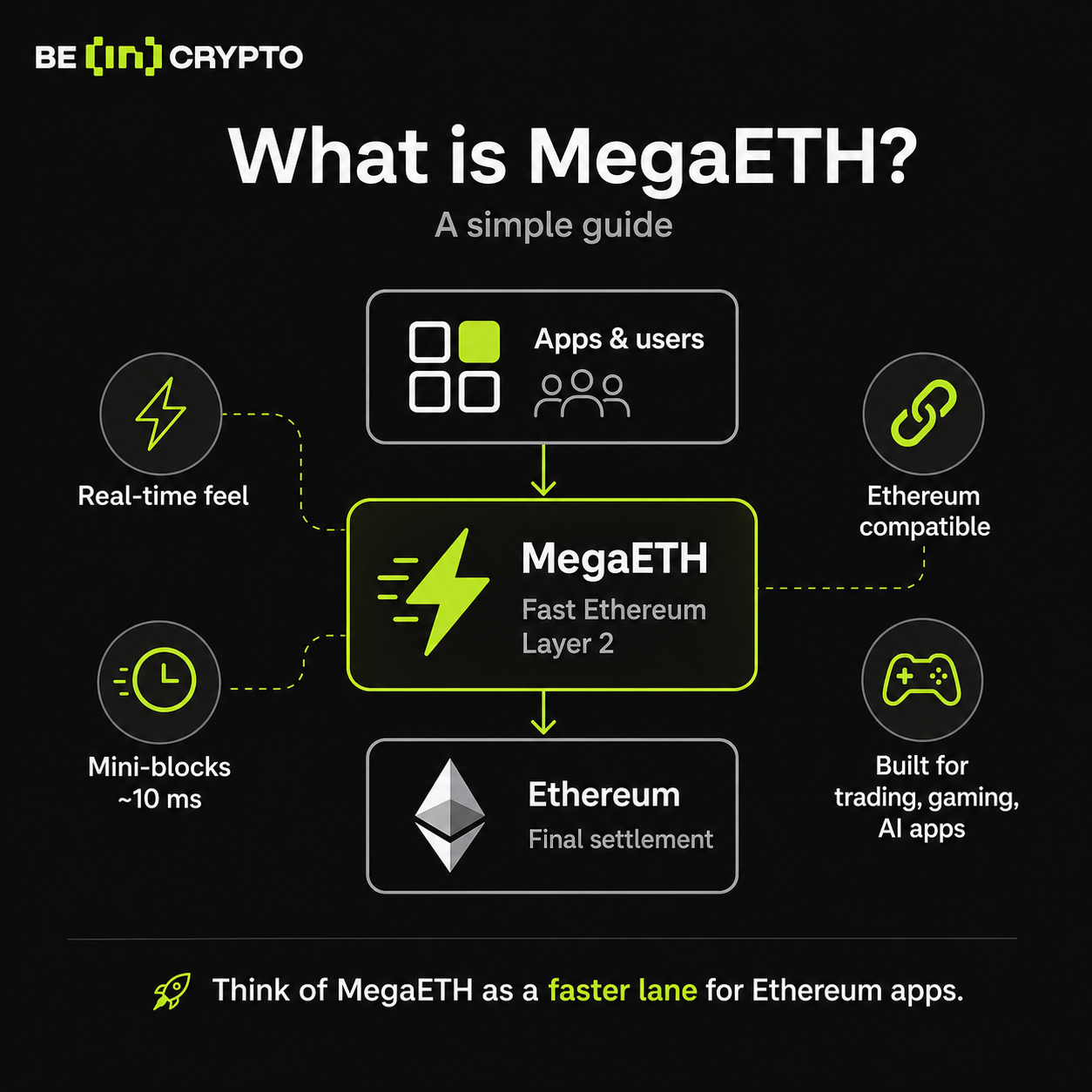
MegaETH launched its MEGA token on April 30, 2026, turning one of crypto’s most talked-about Ethereum scaling projects into a live market asset.
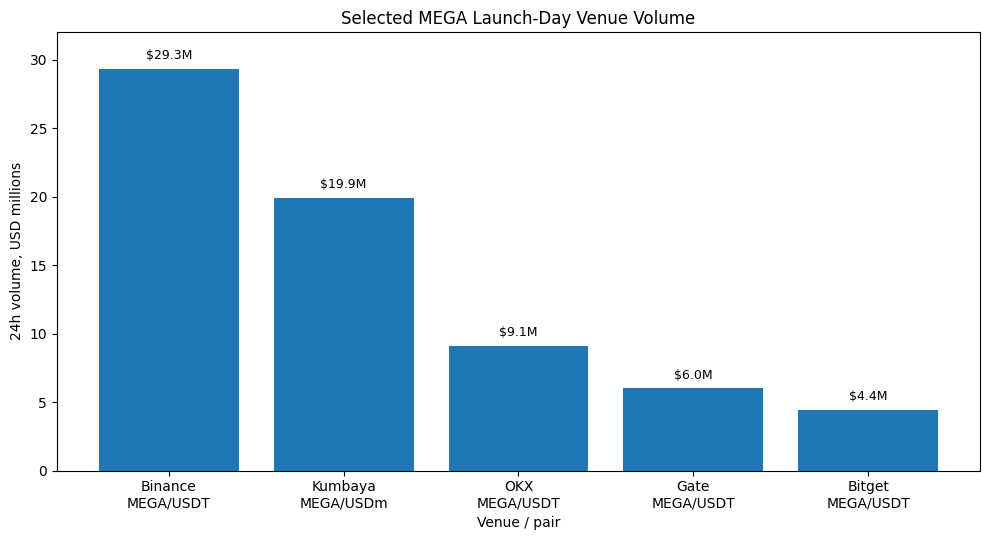
The token began trading across major centralized exchanges, including Binance, KuCoin, Bitget, MEXC, Bybit, OKX, and Gate, while on-chain liquidity formed quickly on MegaETH-native venues such as Kumbaya.
Launch-day market data showed MEGA trading in a rough range of $0.16 to $0.22, with an implied fully diluted valuation near $1.65 billion based on a 10 billion token supply. The altcoin launched with a market cap of nearly $200 million.
The hype around MEGA comes from three things:
- MegaETH’s promise of real-time Ethereum performance.
- Its unusual tokenomics.
- Strong ecosystem push built around apps, NFTs, public-sale participation, and exchange listings.
What Is MegaETH?
MegaETH is an Ethereum Layer 2 network built for very fast transaction processing.
In simple terms, it wants to make Ethereum feel closer to a Web2 app. That means trades, games, payments, and on-chain apps should respond almost instantly, rather than waiting several seconds for block confirmations.
MegaETH does this through a custom execution environment called MegaEVM. It still works with Ethereum tools and Solidity smart contracts, but it changes parts of the execution model to support faster processing.
The network uses mini-blocks that can be produced roughly every 10 milliseconds. It also produces standard EVM blocks around every second, which helps keep compatibility with wallets, explorers, and developer tools.
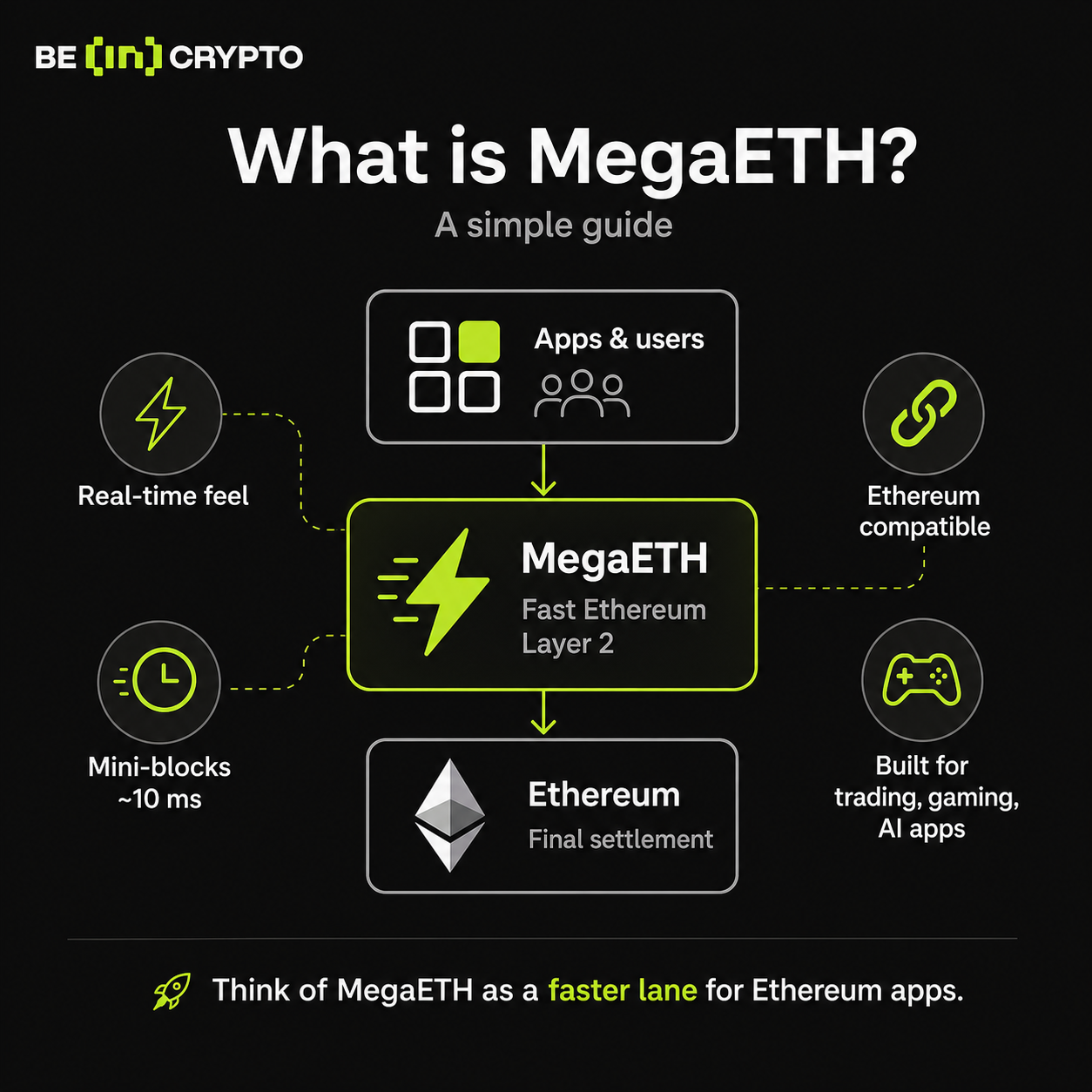
At the base layer, MegaETH settles to Ethereum. It also uses EigenDA for data availability and follows an OP Stack-aligned optimistic rollup model.
That makes it part of the Ethereum scaling family. However, it is more customized than a normal “copy-paste” Layer 2.
Why Is MegaETH So Hyped?
MegaETH became popular because it gives crypto users a simple promise: Ethereum, but much faster.
Most Layer 2 networks compete on cheaper fees, better liquidity, or ecosystem incentives. MegaETH went after speed as its main story.
The project markets itself as “real-time Ethereum.” That phrase matters because many crypto apps still feel slow compared with normal internet apps.
A fast chain can make a real difference for use cases like trading, prediction markets, gaming, AI agents, consumer apps, and high-frequency DeFi. These sectors need instant feedback. Waiting several seconds can break the experience.
MegaETH also attracted attention because of its backers and early supporters. The project raised capital from Dragonfly and also had high-profile names linked to its early funding rounds, including Vitalik Buterin, Joseph Lubin, Cobie, Figment, and Mert Mumtaz.
Then came the cultural layer.
MegaETH built a strong community around Fluffle NFTs, the MegaMafia builder group, and a public sale that drew heavy demand. The public sale reportedly attracted more than $1.39 billion in commitments and closed heavily oversubscribed.
That gave MEGA a strong pre-launch narrative before the token even started trading.
The MEGA Token Launch: Price, FDV, Listings
MEGA launched on April 30, 2026. It has been listed by 11 major centralized crypto exchanges on launch day, including Binance, KuCoin, OKX, MEXC, Bybit, and more.
The token traded in a wide early range. Later launch-day snapshots showed MEGA around $0.16–$0.20, with a 24-hour high near $0.2249.
Based on the full 10 billion token supply, that puts MEGA’s FDV around $1.65 billion in later launch-day tracking. The circulating supply was around 1.13 billion MEGA, implying a market cap of around $186 million.
The first trading day has been messy and volatile, which is normal for newly launched tokens. Indexers added markets at different speeds, volume moved between centralized exchanges and on-chain pools, and early price discovery changed quickly.
MEGA Tokenomics Explained Simply
MEGA has a fixed total supply of 10 billion tokens.
The most important part of the tokenomics is that more than half of the supply goes to KPI-based rewards. That means tokens unlock based on network milestones rather than only fixed calendar dates.
According to MegaETH’s MiCA white paper, the allocation is:
| Allocation | Tokens | Share |
| KPI rewards | 5.33 billion | 53.3% |
| VC allocation | 1.47 billion | 14.7% |
| Team and advisors | 950 million | 9.5% |
| Foundation / ecosystem reserve | 750 million | 7.5% |
| Sonar public sale | 500 million | 5.0% |
| Echo round | 500 million | 5.0% |
| Sonar bonus pool | 250 million | 2.5% |
| Fluffle round | 250 million | 2.5% |
The structure is unusual because MEGA tries to tie token distribution to real network activity.
That sounds cleaner than a normal unlock schedule. Still, it also gives the foundation an important early role in confirming whether milestones have been met.
MEGA is expected to support governance, incentives, future staking, future sequencer rotation, and potentially gas payments. Some of these features are live or partially active. Others are still planned.
MegaETH Timeline: How It Got to Launch
| Date | Milestone |
| June 2024 | MegaETH raised a seed round led by Dragonfly, with high-profile Ethereum and crypto backers involved. |
| December 2024 | MegaETH raised $10 million through Echo. |
| Late 2024 to early 2025 | The Fluffle NFT program became part of the community and token allocation story. |
| March 6, 2025 | Public testnet rollout began. |
| March 21, 2025 | MegaETH’s public testnet opened more broadly, with high-throughput and low-latency claims. |
| September 2025 | MegaETH introduced USDm in partnership with Ethena. |
| October 2025 | MegaETH announced native Chainlink Data Streams integration. |
| October 22, 2025 | MegaETH published its public sale framework. |
| October 27–30, 2025 | The Sonar public sale ran and closed heavily oversubscribed. |
| December 2025 to February 2026 | MegaETH shipped several mainnet upgrades. |
| February 2026 | MegaETH mainnet launched with more than 50 apps reported. |
| April 23, 2026 | MegaETH hit the KPI requiring ten MegaMafia apps live on mainnet. |
| April 30, 2026 | MEGA launched and began trading. |
The MegaETH Ecosystem
MegaETH’s ecosystem is built around several layers.
The first layer is the chain itself. This includes the sequencer, MegaEVM, Ethereum settlement, EigenDA, and the bridge infrastructure.
The second layer is liquidity and stablecoin infrastructure. USDm is the most important piece here. MegaETH introduced USDm with Ethena, and it plays a central role in the project’s economic model.
The third layer is data and interoperability. Chainlink Data Streams and CCIP are part of this stack. These tools help apps access fast price data and move assets across chains.
The fourth layer is applications.
MegaETH has pushed the MegaMafia builder network as a core part of its ecosystem. Projects linked to the ecosystem include Cap, Kumbaya, Showdown, Ubitel, WCM, Stomp, HitOne, Nectar AI, Brix, Pump Party, Prism, and others.
These names matter because MegaETH’s TGE was tied to live app deployment. The token launch did not happen only because a date arrived. It happened after MegaETH said the ecosystem had cleared a required app milestone.
That gave the launch a stronger “network is live” framing.

Why MegaETH Is Trending in Crypto Right Now
MegaETH is trending because it sits at the intersection of several active crypto narratives.
The first is Ethereum scaling. Ethereum still has the deepest developer ecosystem, but it struggles with speed and cost at the base layer. MegaETH offers a version of Ethereum that aims to feel much faster.
The second is high-performance infrastructure. Crypto has spent years talking about consumer apps, on-chain games, real-time trading, and AI agents. Most of those use cases need low latency. MegaETH is trying to serve that market.
The third is token design. MEGA’s KPI-based rewards give traders and users a clear story to follow. If the network grows, more milestones can unlock more incentives.
The fourth is launch momentum. A major public sale, strong community marketing, NFT allocation, and listings on large exchanges created a lot of attention at once.
That combination explains the hype. It does not guarantee long-term success, but it explains why MEGA became one of the most watched launches of April 2026.
What Makes MEGA Altcoin Different From a Normal L2 Token?
Most Layer 2 tokens rely on governance, incentives, and ecosystem grants.
MEGA includes those elements, but it adds two more ideas.
The first is KPI-based rewards. More than half the supply is tied to network milestones. This gives token holders a reason to track app growth, stablecoin usage, and network performance.
The second is the USDm economic loop. MegaETH wants USDm activity to support the wider network economy. In the project’s own framing, revenue or rewards linked to USDm can help fund MEGA buybacks, subject to legal limits.
This is one reason traders are watching the ecosystem closely. If USDm usage grows, MEGA may have a clearer value-capture story than many generic governance tokens.
That remains an execution challenge. The model has to prove itself through real usage.
The Main Risks
MegaETH is still early, and the risks are real.
The first risk is centralization. MegaETH currently relies on a single active sequencer. That sequencer orders transactions and plays a major role in the network’s performance.
There’s also admin control. Aave’s technical review noted that key roles were held through multisig arrangements. That is common for young networks, but users should understand the trust assumptions.
The fourth risk is token execution. MEGA’s long-term value depends on real app usage, USDm adoption, governance, staking, and future sequencer economics. Several parts of that story are still developing.
The final risk is market structure. Launch-day trading was volatile. The FDV was already large, while only a portion of the supply was circulating.
That does not make MEGA bad. It means buyers should treat the first days of trading carefully.
The post What Is MegaETH and Why Is the MEGA Token So Hyped? appeared first on BeInCrypto.

The press release announces Incrypted Conference 2026, Ukraine’s largest crypto event, returning to Kyiv on June 13. The two-stage program will be staged at the Parkovy venue, with the entire third floor used and a VIP zone, reflecting an expanded scale. The gathering aims to bring together more than 3,000 participants, over 50 speakers, and representatives from international companies to discuss the future of Web3 and the synergy between artificial intelligence and decentralized technologies. With support from major industry partners and a broad global lineup, the event continues a tradition of crypto-focused dialogue in Ukraine and the wider region.
Key points
- Date: June 13, 2026
- Location: Parkovy, Kyiv
- Program features: two parallel stages (Main Stage and Workshop Stage) and a VIP zone on the third floor
- Speakers and participants: more than 50 speakers, over 3,000 participants
- Partnerships: 50+ partners, including BingX, OKX, MEXC, TrustWallet, and Bitget
Why it matters
By expanding the venue, widening the speaker pool, and focusing on Web3 alongside AI, the conference underscores Ukraine’s ongoing role as a crypto hub and a venue for international collaboration. The orchestration of multiple sessions, a VIP zone, and a large partner network suggests a structured environment for knowledge exchange, industry networking, and potential partnerships at a moment of rapid innovation in decentralized tech.
What to watch
- Updates to the speaker lineup and session timings will be announced as the event approaches
- Ticket sales and information updates will be posted on the conference site
- Additional partner announcements or sponsorships may be disclosed
Disclosure: The content below is a press release provided by the company or its PR representative. It is published for informational purposes.
Incrypted Conference 2026:
Ukraine’s Premier Crypto Event Returns to Kyiv this June
Kyiv is set to host the fourth Incrypted Conference 2026, the largest crypto event in Ukraine and Eastern Europe. It will also traditionally become the central event of Ukrainian Blockchain Week.
The conference will take place on June 13 and will bring together over 3,000 participants, leading industry experts, and representatives of international companies to discuss the future of the Web3 industry. Additionally, this year the event will actively discuss the artificial intelligence and its synergy with decentralized technologies.
This year, the event is significantly expanding its scale: the entire third floor of the “Parkovy” is being utilized, including a VIP zone with exclusive activities. The program will unfold on two parallel stages — the Main Stage for key discussions and the Workshop Stage for practical sessions.
More than 50 speakers will perform at Incrypted Conference 2026. Featured experts include Yaroslav Zheleznyak (MP of Ukraine), Anton Dziuba (DOUBLETOP), Cryptomannn, Nik Smogorzhevskyi (Solus Group), Andriy Hnatyuk (Superteam Ukraine) and many other influential industry figures.
The event was supported by market leaders, including BingX, OKX, MEXC, TrustWallet, and Bitget. In total, more than 50 world-class partners are participating in the conference.
“We are continuing the tradition of hosting large-scale crypto events in Ukraine, despite all challenges. This year, the Incrypted Conference will be even more impactful thanks to the practical Workshop Stage and a wider range of speakers and topics. Our goal is to create a platform where new ideas and strategic partnerships are born,” — Ivan Pavlovskyi, CEO of Incrypted.
Last year, the conference gathered such iconic figures as Peter Todd, Danylo Hetmantsev, Ruslan Magomedov, and other speakers on one stage, confirming its status as the main platform for dialogue between the crypto community, business, and regulators.
Incrypted is the leading Ukrainian media specializing in crypto and blockchain, organizer of the largest industry conferences, and builder of the ecosystem for the development of the Web3 community in Ukraine and beyond.
Bitcoin (BTC) rebounded 32% to a 10-week high of $79,500 on April 22 from its sub-60,000 multi-year low. But recent buyers took advantage of the rally to exit as the price has since corrected to $76,000 on Thursday, with $80,000 proving a tough barrier to break.
Key takeaways:
- Bitcoin sell pressure risk exists around $80,000, a resistance level that may delay the bulls.
- Short-term holders and Bitcoin ETF investors keep selling, frustrating recovery attempts.
Bitcoin price can’t crack $80,000
As Cointelegraph reported, Bitcoin failed to break above $80,000 as its rebound fell short of a bull market comeback.
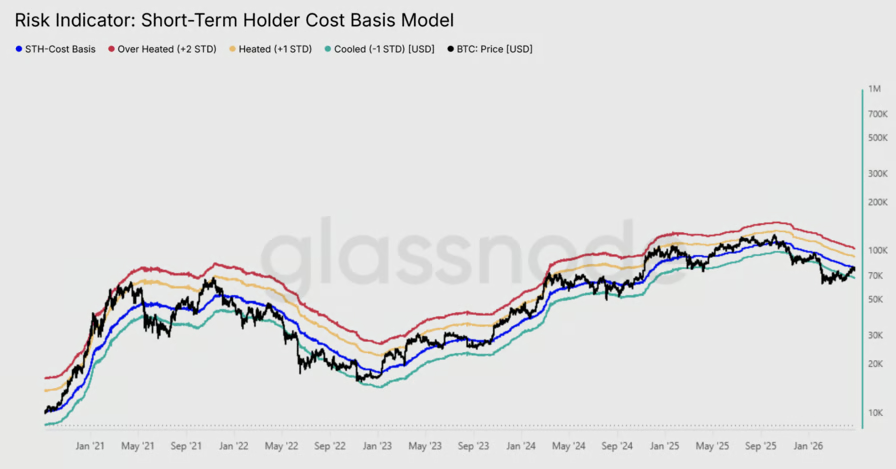
This is due to the resistance zone between the True Market Mean at $78,000 and the Short-Term Holder (STH) cost basis at $79,000, which continues to cap upward momentum, as recent buyers used this range to exit near breakeven.
“This behavior is a textbook pattern in bear markets, where price approaches the breakeven level of the most price-sensitive cohort, the incentive to exit positions overwhelms incoming demand, exhausting upside momentum,” Glassnode said in its latest Week Onchain newsletter, adding:
“With this rejection confirming overhead resistance, the mid-term bias tilts toward further downward pressure.”
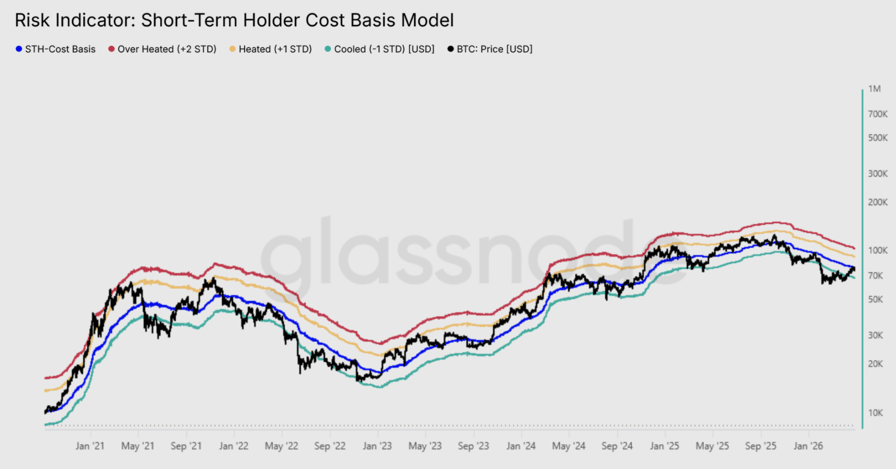
Bitcoin STH cost basis model. Source: Glassnode
Bitcoin’s cost basis distribution data shows that investors hold about 475,301 BTC at an average cost of $77,800-$80,880, reinforcing the significance of this resistance zone.
Traders say the BTC/USD pair must flip the resistance at $80,000 into support to target higher highs toward $84,000.
After reclaiming the 50-day and 100-day simple moving averages, BTC/USD has sent “one bottoming signal after another firing on higher timeframes,” technical analyst SuperBitcoinBro said in a Wednesday post on X, adding:
“But I agree it needs to get past 80K.”
Daan Crypto Trades said the $80,000 level remains the “main level for the bulls in the short/mid term.”
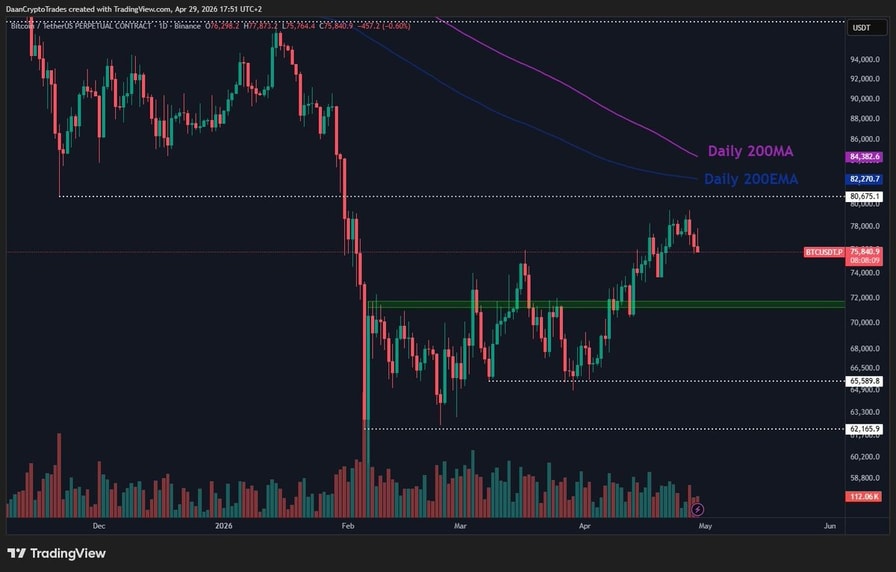
BTC/USD daily chart. Source: X/Daan Crypto Trades
As Cointelegraph reported, Bitcoin breaking $80,000 would signal that the bulls are still in control, paving the way for the next big resistance at $84,000.
BTC selling by short-term holders halts rally
Additional onchain data shows “heavy distribution” by short-term holders, as these investors booked profits on Bitcoin’s recent rally to $80,000.
The 24-hour SMA of STH Realized Profit shows that as the price approached the $80,000 level, recent buyers realized profits at a rate of $4 million per hour.
The 24-hour SMA of STH Realized Profit is a real-time measure of how aggressively recent buyers are realizing gains.
The metric spiked as high as $7.2 million per hour on April 15, about roughly “four times the base level that had established itself since mid-April, confirming that short-term holders seized the rally as a distribution opportunity,” Glassnode said, adding:
“The buy side simply lacked sufficient liquidity to absorb this wave of profit realization, capping momentum and triggering the subsequent rejection.”
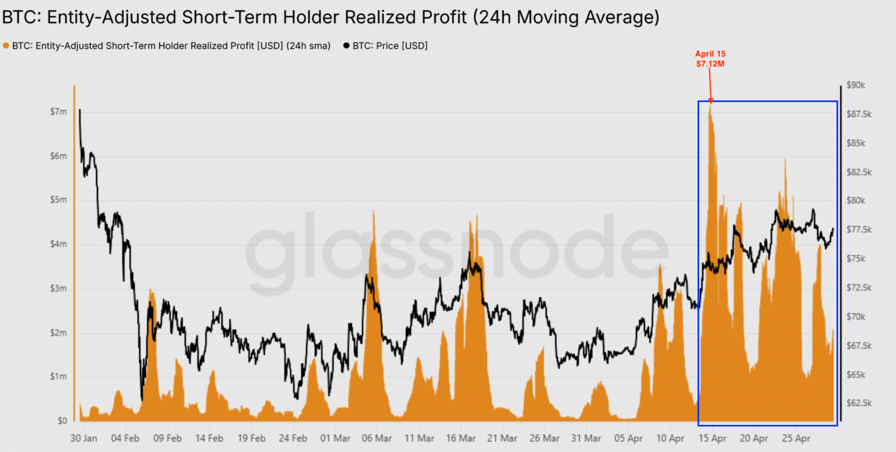
Bitcoin Entity-Adjusted STH realized profit. Source: Glassnode
More selling pressure came from US spot Bitcoin exchange-traded funds, which have recorded outflows for three consecutive days, totaling $390 million.
This marked the longest outflow streak since March 20, when a three-day outflow streak accompanied an 11.5% BTC price drop after rejection at $76,000.
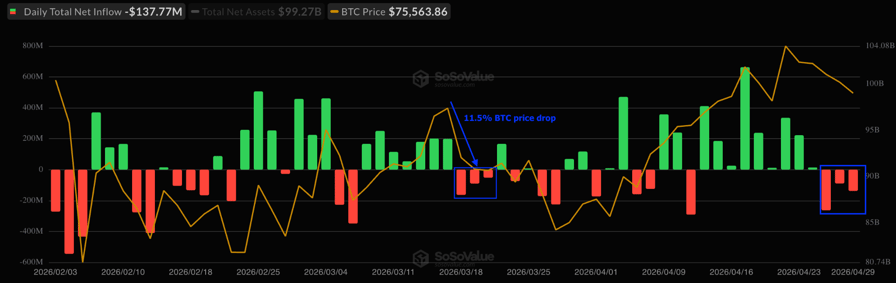
Spot BTC ETF flows chart. Source: SoSoValue
Analysts at Wise Advise said that the return to spot BTC ETF outflows after a nine-day inflow streak is the first sign that “the local top may be in.”

Eddie Hearn and Frank Warren give contrasting dates for Joshua vs Fury super fight

Ex-Spandau Ballet star Ross Davidson jailed for rape

How an International Environmental Campaign Intertwines with Local Interests

Manchester United reach agreement with Casemiro over contract clause amid transfer speculation

US brings back mandatory military draft registration

Steven Gerrard disagrees with Gary Neville over ‘shock’ Chelsea and Arsenal claim | Football

Financial Planner SHOCKED At Princess’s Spending Habits – Prince$$ – 110 – Cortney

Adam Calls Money Man a Broke Idiot for Trying to Flex Cash on Him

Complete Financial Accounting Course – 11-Hour Full Tutorial for Beginners
-

 Tech3 days ago
Register Renaming | Hackaday
-

 Fashion6 days ago
Weekend Open Thread – Corporette.com
-
Crypto World5 days ago
Hyperliquid $HYPE Rally Builds Momentum as AI Sector Enters Prove-It Phase
-

 Business7 days ago
Patterson-UTI Energy, Inc. (PTEN) Q1 2026 Earnings Call Transcript
-

 Politics3 days ago
Drax board avoid their own AGM, accused of greenwashing & environmental racism
-
 Sports4 days ago
IPL 2026: Ruturaj Gaikwad registers slowest fifty of the season, enters all-time unwanted list | Cricket News
-

 NewsBeat4 days ago
LK Bennett closes all stores after entering administration
-

 Crypto World6 days ago
Michael Saylor says BTC winter is over. Market analyst disagrees, says bitcoin was in a pullback
-

 Fashion2 days ago
Kylie Jenner’s KHY Enters a New Era with ‘Born in LA’
-

 Tech3 days ago
Images of Samsung’s rumored smart glasses have leaked
-
 Entertainment5 days ago
Mariah Carey Slams Deposition Claims In Brother’s Lawsuit
-
Crypto World7 days ago
Is Algorand One of the Few Quantum-Resistant Blockchains? Here’s What the Data Shows
-

 Tech3 days ago
Why Blue Badges Disappeared From Toyota Hybrids
-

 Business2 days ago
Most Commercial Energy Audits Miss the Real Losses
-
 NewsBeat6 days ago
Trump threatens to review UK’s claim to Falkland Islands and punish Nato allies over Iran war disagreement
-

 Business6 days ago
Jeanine Pirro announces closure of Federal Reserve building cost probe
-

 Tech5 days ago
Microsoft to roll out Entra passkeys on Windows in late April
-

 Business3 days ago
(VIDEO) Charlize Theron Climbs Times Square Billboard to Promote New Netflix Thriller ‘Apex’
-

 Crypto World2 days ago
CFTC’s AI will review U.S. crypto registration applications, chairman tells CoinDesk
-
 Crypto World6 days ago
Nvidia (NVDA) Stock Jumps 5% as Intel Earnings Ignite Semiconductor Rally
You must be logged in to post a comment Login