
Crypto World
Goldman Sachs Adds 3 European Stocks to Conviction List

Goldman Sachs has added three stocks to its European “Conviction List – Directors’ Cut” list. The list tracks the bank’s buy-rated European equities.
The inclusions are the payment processing company Adyen, the German energy firm RWE, and the German insurer Talanx. All three arrive with different setups.
Adyen Draws the Biggest Upside Call
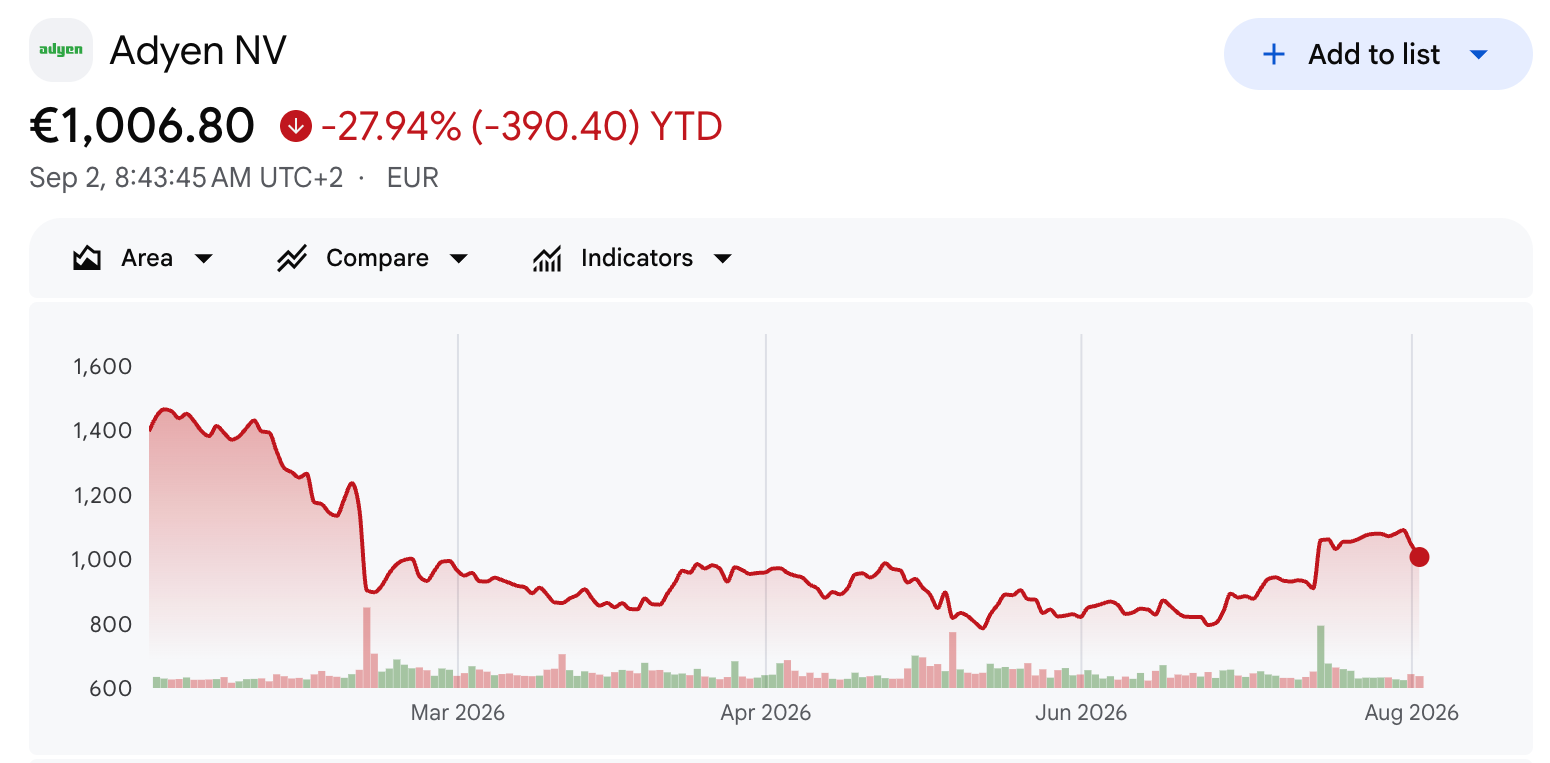
The bank sees 77% upside for Adyen, the largest call among the three additions. Adyen closed at €1,006.80 on September 1, down 3.88% for the session.
The Dutch payment processor sits roughly 37% under its 52-week high of €1,600.80. It also remains down nearly 28% in 2026.

Analyst Mohammed Moawalla credits Adyen’s integrated platform for its edge. He points to new client ramps, including the Toast partnership in the US and Shopify’s European expansion.
Goldman also expects Adyen to benefit from agentic commerce. The bank flagged tie-ups with OpenAI, Google, and Microsoft.
Follow us on X to get the latest news as it happens
RWE and Talanx Round Out the Additions
Next, RWE closed at €58.58 on September 1 and has gained roughly 30% so far this year. Goldman set a €75 target, implying 28% upside.
Analyst Alberto Gandolfi expects the grid spending and possible data center deals to lift the valuation. He also flagged stronger US renewable returns and potential LNG profits.
Lastly, Talanx carries a €141 target, representing 13% upside. The stock traded near €125, close to a 2026 high. It has gained 12% yeat-to-date.
Analyst Andrew Baker described its Retail International arm, which sells policies outside Germany, as an “underappreciated growth engine” and projected that premiums there would rise 8% to 10% annually through 2030.
Goldman dropped Hannover Re, along with Enel, Wise, and Zalando from the list. Two of Goldman’s three September calls lean on AI.
Subscribe to our YouTube channel to watch leaders and journalists provide expert insights
The post Goldman Sachs Adds 3 European Stocks to Conviction List appeared first on BeInCrypto.


Luke Dashjr’s Bitcoin hard fork went live on September 1, and it arrived almost empty. The new BLAKE2b chain drew little hashrate, while Blockstream CEO Adam Back reduced the whole episode to one line.
Dashjr broke away from Bitcoin (BTC) by swapping its mining algorithm, a change meant to let ordinary computers mine again. Miners and exchanges largely ignored him.
Why the Bitcoin Hard Fork Collapsed Within Hours
BIP-110 is Dashjr’s proposal to strip non-financial data out of Bitcoin blocks. His camp calls the main network “Spamcoin.” Meanwhile, most of the community treated the September 1 chain split as a non-event.
The pattern repeats. An earlier BIP-110 chain died after two blocks in August. Mining pool OCEAN then faced calls to replace its leadership after routing customer hashrate to that chain without clear consent.
The algorithm swap also cut Dashjr off from the industry’s hardware base. BLAKE2b replaces SHA-256, so the specialized rigs that secure Bitcoin cannot touch the new chain. Computing power on the fork fell right after launch.
Adam Back Delivers the Punchline
Back needed seven words to sum up the result.
Live by the fork, die by the fork.
Adam Back, CEO of Blockstream, posted on X.
Dashjr, however, still frames the minority chain as the genuine article. On X he claims the BTC ticker has belonged to Bitcoin for over a decade, and that Bitcoin has now moved to BLAKE2b. Chain data contradicts him.
Bitcoin Knots, the node software Dashjr maintains, pushed similar arguments in August. David Schwartz, Ripple’s former chief technology officer, called them nonsense at the time.
Traders barely reacted. The original network produced blocks without interruption. BTC changed hands near $76,942, down roughly 1.33% in 24 hours.
No major exchange has listed the coin. One small beta platform opened deposits under the ticker BTCB2, since no official symbol exists yet.
BTCB2 bids there topped out at $82, roughly 900 times below BTC, while the lowest ask sat at $190. That 131.7% spread signals almost no real trading.
A chain without miners, listings, or bids still needs buyers who value its blocks.
The post A Bitcoin Hard Fork Went Live September 1. Miners, Exchanges, and Traders Ignored It appeared first on BeInCrypto.
Crypto World
Bitcoin Drops to 10-Day Low, Altcoins Retrace Following New US-Iran Attacks: Market Watch
Bitcoin was rejected on a few occasions at $79,000 in the past several days, and the latest leg down pushed it to under $76,500 for the first time since August 23.
The most evident reason behind this correction, which has impacted numerous altcoins as well, comes from the Middle East, where the US and Iran initiated new violent strikes against each other.
BTC Slips
The primary cryptocurrency’s major breakout that began on August 19 led to a massive surge of over $16,000, driving it to over $81,000 on a couple of occasions last week before the bears stepped up and halted the move. The subsequent retracements were quite modest aside from the Friday drop to $77,000 after the hawkish speech from Jackson Hole by the new Fed Chair, Kevin Warsh.
Nevertheless, BTC’s more positive sentiment prevailed in the following days, and the asset managed to recover some ground during the weekend. It even tapped $79,000 on Sunday evening before the US and Iran resumed the strikes against each other, and bitcoin dipped by two grand.
The bulls intervened once again on Tuesday, pushing the cryptocurrency to $79,000 once again. However, another leg down followed that drove BTC to $76,500 for the first time in ten days. This came after reports that the US and Iran had carried out more violent strikes.
BTC remains at $77,000 as of now, with its market cap of under $1.550 trillion. Its dominance over the alts has also declined slightly to 59.6% on CoinMarketCap.

FIL, UNI, BTW Defy the Trend
The larger-cap alts are almost all in the red. Ethereum is down below $2,400 after a 2% daily decline; XRP has slipped further away from $1.35; SOL is slightly below $100. TRX, HYPE, ZEC, DOGE, XMR, and LINK are also in the red. Uniswap is the only notable exception, surging by almost 10% to over $6.2.
There are also other gainers from the mid- and lower-cap alts, such as FIL (14%), BTW (13%), and SKY (6%). Most other alts have retreated over the past day.
The total crypto market cap is down by almost 1% daily to $2.6 trillion on CMC.

The post Bitcoin Drops to 10-Day Low, Altcoins Retrace Following New US-Iran Attacks: Market Watch appeared first on CryptoPotato.


HashKey Group said on Sept. 2 that it had joined the Depository Trust & Clearing Corporation’s Digital Assets Advisory Services Industry Working Group, becoming its first Asian digital asset service provider.
Summary
- HashKey joined DTCC’s digital assets working group as its first Asian digital asset service provider.
- DTCC’s May announcement identified more than 50 participants, while HashKey now cites over 100 institutions.
- HashKey plans to contribute Asia Pacific regulatory experience toward institutional token issuance, settlement and custody standards.
- DTCC targets an October launch for tokenization services after conducting production transactions with custodied securities.
- HashKey already participates in Hong Kong initiatives covering tokenized bonds, funds, notes and settlement infrastructure.
The Hong Kong based company will participate in discussions about how tokenized securities can be issued, transferred, settled and safeguarded through institutional market infrastructure.
HashKey said the working group now includes more than 100 financial institutions, asset managers and digital asset companies. Participants named in its announcement include JPMorgan Chase, Goldman Sachs, Nasdaq and the New York Stock Exchange.
DTCC’s own May announcement named more than 50 participating organizations. The larger figure provided by HashKey appears to reflect additions made since the group was publicly introduced, although DTCC has not published an updated complete membership list.
HashKey brings Hong Kong experience to DTCC
HashKey operates digital asset trading, asset management and onchain infrastructure businesses across several regulated markets. Its operations include businesses in Hong Kong, Singapore, Japan and Bermuda.
Since 2023, the company has participated in tokenization projects led by Hong Kong financial authorities. It is a member of the Hong Kong Monetary Authority’s Project Ensemble Architecture Community, which examines how tokenized deposits and wholesale central bank money could support transactions involving tokenized assets.
HashKey has also joined Hong Kong’s Tokenised Bond Expert Group. The company said it has supported the issuance and circulation of tokenized money market exchange traded funds, bonds and structured notes.
That experience is relevant to the DTCC group because Hong Kong has been testing institutional tokenization under a regulated framework. As previously reported, Hong Kong regulators have also been developing tokenized fund and settlement infrastructure intended to connect digital assets with existing financial systems.
HashKey said it would contribute its Asia Pacific regulatory and operational experience to discussions on global tokenization standards. Its participation does not represent regulatory approval of a HashKey product, membership in DTC or a commitment by DTCC to use HashKey infrastructure.
DTCC working group supports an October service launch
DTCC formed the industry working group to advise the development of its tokenization service. The group includes banks, brokerages, asset managers, exchanges, custodians and blockchain infrastructure companies.
In its official May release, DTCC said participants would help examine product functionality, operational processes and market standards. The work covers how eligible securities can move between traditional records and blockchain based representations.
The service is designed to let DTC participants create tokenized versions of eligible securities already held in DTC custody. These representations are often described as digital twins because the underlying security remains within the regulated depository structure.
Participants would be able to transfer tokenized securities to approved wallets and convert them between conventional and tokenized formats. DTCC says its model is intended to preserve the ownership rights and investor protections attached to the underlying securities.
The working group is advisory. Its members can provide technical and operational feedback, but participation does not give them authority over DTCC’s systems or guarantee commercial access to the final service.
Production transactions tested several market functions
DTCC completed its first group of tokenized transactions in a production environment in July. The tests used securities held at DTC and covered equity transfers, collateral pledges, securities lending and delivery versus payment transactions involving U.S. Treasuries and repurchase agreements.
The trials ran across DTCC’s private blockchain based on Hyperledger Besu and the public Canton Network. Assets involved in the program reportedly included Microsoft and Circle shares, the Invesco QQQ Trust, the SPDR S&P 500 ETF and a BlackRock Treasury exchange traded fund.
JPMorgan also completed a conversion involving shares of the Invesco QQQ Trust. The transaction demonstrated how a security held at DTC could be represented through a blockchain based record without removing the underlying asset from the established custody system.
In related coverage, the production tests were described as a step toward onchain settlement for tokenized securities. They did not amount to an unrestricted public launch, and participation remained limited to approved institutions and test scenarios.
DTCC plans to introduce standardized tokenization services in October 2026. The initial service will include compliance and distribution controls, while later releases may add automation for issuance, servicing and corporate actions.
DTCC connects tokenization with existing custody
DTC is a central securities depository and a systemically important financial market utility in the U.S. HashKey said the depository safeguards more than $114 trillion in assets.
That figure describes the value of securities held within DTC’s custody infrastructure. It should not be interpreted as the value of assets already tokenized or scheduled to move onto blockchains.
DTCC’s approach differs from platforms that issue tokens outside the traditional custody system. Its planned service keeps the underlying securities within DTC while recording approved tokenized representations across supported networks.
The structure aims to connect blockchain based transfers with existing ownership records, compliance controls and settlement processes. DTCC says this could allow tokenized assets to use established market liquidity and investor protections, but those expected benefits will depend on the final service design and institutional adoption.
HashKey’s next role will be to participate in working group discussions as DTCC moves toward the October launch. Neither company disclosed a separate HashKey integration, jointly issued tokenized product or commercial agreement.
Robinhood Chain has been booming in popularity throughout the past month, becoming the talk of town in crypto Twitter, or more like crypto X.
The network saw its total value locked expand by a whopping 93% in the past 30 days, according to data from DeFiLlama, surpassing the likes of Plasma, Avalanche, Sui, and others.

The popular platform, which allows users to scan newly released cryptocurrencies by chain and monitor the performance of different tokens, DexScreener, is flooded with coins on Robinhood Chain, which is indicative of the level of interest the network is attracting. Platforms like FOMO are seeing a surge in interest as the concept of social trading gains traction.
As CryptoPotato reported, the volume aggregated through the network’s automated market makers hit $1.3 billion.
But what are some of the more interesting projects that are attracting investors? Let’s find out.
PONS: Pons Family, Robinhood’s Pump.fun?
Starting off, we have PONS, the native cryptocurrency of the Pons (dot) family platform. As described in their own documents:
“pons is a place to launch and trade tokens on Robinhood Chain. You can browse launches, open any token to see its details, and trade straight from your wallet. Pons never holds your funds. Every launch and trade is a transaction your wallet asks you to approve.”
Undoubtedly the main large actor on Robinhood Chain, PONS boasts a market capitalization of around $285 million at the time of this writing – impressive for a coin launched less than two months ago.

Its price action has been all over the place over the past few days, especially after Hyperliquid announced it would support perps for PONS. The token skyrocketed to a high of slightly below $0.5, only to plummet to about $0.36 and then recover to $0.4, where it’s currently trading at the time of this writing.
PONS is seen as the main “infrastructure play” on Robinhood Chain, and many associate it with Pump.fun – an alternative token launchpad that was largely behind the “meme coin season” that took place on Solana in 2024. However, some market observers have expressed caution, pointing out that expansion of existing solutions (much like Pump.fun itself) to Robinhood Chain could cause serious pressure on PONS.
Cash Cat (CASHCAT)
If you’ve been on crypto X in the past couple of months, you’ve undoubtedly heard stories of people becoming millionaires in a few days after buying and holding Robinhood Chain’s premier meme coin – CASHCAT.
There’s really no way to explain what the token is about other than just reading its name – it’s just that: a cat-themed meme coin, currently sitting at a market capitalization of $280 million, up 40% in the past week. It’s pretty much impossible to break down its gains for a longer period of time because the zeros become far too much, but that’s also a tale as old as crypto meme coin cycles now. Recall DOGE, SHIB, WIF, FARTCOIN, and whatnot.
Holders argue that it’s the network’s largest and most promising meme coin, while countless others are trying to replicate its success by minting alternative meme coins on Pons.

Artificial Inu (AI)
Things change fast in this space and AI is perhaps the main example. The token is actually paired against tokenized Nvidia stock – it’s not paired against the USD, which is one of the more interesting concepts of Robinhood Chain. In other words, the “dog” trades directly against NVDA, which is largely described as the most important stock in the AI space.
Trading activity is also growing the token’s vault, while the generated fees are either burned or locked.
Combined with the virality of a dog-themed meme coin, this has allowed it to explode in both interest and value throughout the past few days, and achieve a market cap similar to that of Cash Cat.

The above are three of the largest coins on the Robinhood Chain by market cap. None of it should be taken as financial advice or recommendation. The article is strictly for informational purposes.
The post Watch These 3 Coins on Robinhood Chain This Week appeared first on CryptoPotato.


Prospect Markets has signed a definitive agreement with Crypto.com’s U.S. derivatives business and OG Prediction Markets to launch a regulated sports-focused prediction market platform in the United States, with the company targeting a third-quarter rollout ahead of the NFL and NBA seasons.
Summary
- Prospect Markets signed a definitive agreement with Crypto.com and OG Prediction Markets to offer regulated event contracts to U.S. customers.
- Prospect Brokerage will distribute contracts offered by Crypto.com’s CFTC registered derivatives exchange through OG Broker.
- The company is targeting a third quarter launch ahead of the upcoming NFL and NBA seasons.
- Prospect cited Bernstein estimates that prediction market volumes could reach $240 billion in 2026 and around $1 trillion annually by 2030.
Prospect Markets said on Sept. 1 that its indirect wholly owned subsidiary, Prospect Brokerage USA LLC, executed the agreement with OG Prediction Markets and Crypto.com | Derivatives North America, or CDNA, moving the partnership beyond a previously announced nonbinding letter of intent.
The arrangement will allow Prospect Brokerage to distribute event contracts offered by OG.com and CDNA to U.S. customers, giving the Canadian-listed company its first route into the fast-growing U.S. prediction market business.
Prospect said the agreement clears the way for the company to onboard customers and begin generating revenue from the product, with further details on branding, marketing and the exact launch date expected before the platform goes live.
Prospect Markets secures regulated U.S. prediction market access
Through the agreement, Prospect Brokerage will operate as a Commodity Futures Trading Commission-registered introducing broker and connect customers with event contracts listed by CDNA.
CDNA operates as a CFTC-registered designated contract market and derivatives clearing organization. Prospect customers will be introduced to the contracts through Crypto.com affiliate Foris DAX FCM LLC, which operates as OG Broker and is registered as a futures commission merchant.
The structure gives Prospect access to existing federally regulated trading and clearing infrastructure instead of requiring the company to build its own exchange and clearing operation.
Crypto.com launched the OG platform in February, offering CFTC-regulated contracts tied to sports, financial markets and other real-world events. The product combines prediction trading with social features and leaderboards, while contracts are provided through Crypto.com’s U.S. derivatives infrastructure.
Prospect plans to build its offering around sports, where event contracts have generated a large share of prediction market activity.
“We intend to be live for sports fans ahead of the upcoming NFL and NBA seasons,” Prospect Markets founder and CEO Johnny Chen said.
Chen called the definitive agreement a “company-defining milestone” and said the companies had worked toward completing the deal during the year.
Crypto.com Chief Legal Officer Steve Humenik said the partnership would use the company’s CFTC-registered clearing and exchange infrastructure to provide regulated event contracts to U.S. customers.
“Formalizing this definitive agreement with Prospect is a major step in expanding access to fully regulated, event-based prediction markets across the U.S.,” Humenik said.
Sports contracts have driven prediction market volumes
Prospect is entering the sector after sports trading helped push prediction market volumes to record levels during the 2026 FIFA World Cup.
Combined monthly trading volume across major prediction platforms increased from less than $5 billion in September 2025 to approximately $25.7 billion in May 2026, according to figures cited by Prospect. The company said monthly notional volume surpassed $50 billion in June as the World Cup and NBA Finals drove activity.
Sports represented roughly 85% of trading volume on the sector’s largest platform during June, Prospect said. Prediction markets captured an estimated 27% of legal U.S. sports-betting volume during the World Cup, compared with around 9% at the beginning of 2026.
Crypto.news previously reported that World Cup prediction markets pushed sector-wide activity to roughly $45 billion in June, while Polymarket alone handled close to $5 billion in tournament-related trading.
Chainalysis later estimated that the World Cup generated $20 billion in blockchain prediction-market volume from the beginning of the year through the end of the tournament. More than 400,000 wallets participated, with $5.7 billion traded during the competition’s five-week run.
Prospect cited Bernstein estimates that prediction market trading could reach approximately $240 billion in 2026, up 370% from 2025, before climbing to around $1 trillion annually by 2030. The research firm expects distribution partnerships, institutional participation and clearer federal rules to contribute to that expansion.
Bernstein has made similar projections while examining individual platforms. In June, the firm estimated that Robinhood could generate $586 million from prediction markets in 2026, compared with $150 million in 2025, after World Cup activity pushed daily market volumes as high as $4.8 billion.
Crypto.com expands distribution for its event contracts
The Prospect agreement adds another distribution channel for Crypto.com as the company pushes its regulated prediction products beyond its own platforms.
In May, Crypto.com and OG entered a multiyear partnership with the U.S. SailGP Team that made them its official crypto exchange and prediction market partners. The deal allowed fans to access CFTC-regulated SailGP contracts through OG.
Robinhood was separately reported in July to be discussing a deal that could bring Crypto.com event contracts to its prediction markets hub. No final agreement had been announced at the time.
Distribution agreements have become a common route for financial platforms seeking prediction-market exposure without operating their own designated contract markets. Gemini Space Station and Apex Fintech Solutions signed a letter of intent in August under which Gemini Titan would provide regulated crypto prediction contracts to brokerages using Apex’s infrastructure.
The Prospect arrangement follows a similar model, with CDNA providing the exchange and clearing infrastructure while Prospect controls the customer-facing distribution channel.
U.S. sports event contracts remain under regulatory scrutiny
Prospect’s planned launch comes while federal and state authorities remain divided over the regulatory treatment of sports event contracts.
CFTC-regulated exchanges have maintained that event contracts offered through designated contract markets fall under federal derivatives law. Several state gaming regulators and industry groups have challenged that position, arguing that sports contracts function as wagering products and should comply with state gambling laws.
The U.S. gaming industry urged Congress in June to restrict sports prediction markets from operating under federal derivatives rules, arguing that the products allow platforms to bypass state and tribal gaming requirements.
Legal disputes have since continued in several states. A federal judge in Wisconsin rejected a CFTC request in July to stop the state from applying its gambling laws to federally regulated prediction market operators, including Crypto.com, Kalshi, Polymarket, Robinhood and Coinbase.
Prospect said its planned product will use CDNA’s CFTC-registered exchange and clearing infrastructure, with OG Broker handling the futures commission merchant relationship and Prospect Brokerage operating as the registered introducing broker.
The company is targeting a launch during the third quarter and said it will release further information on the platform’s product, branding, launch timing and marketing plans.
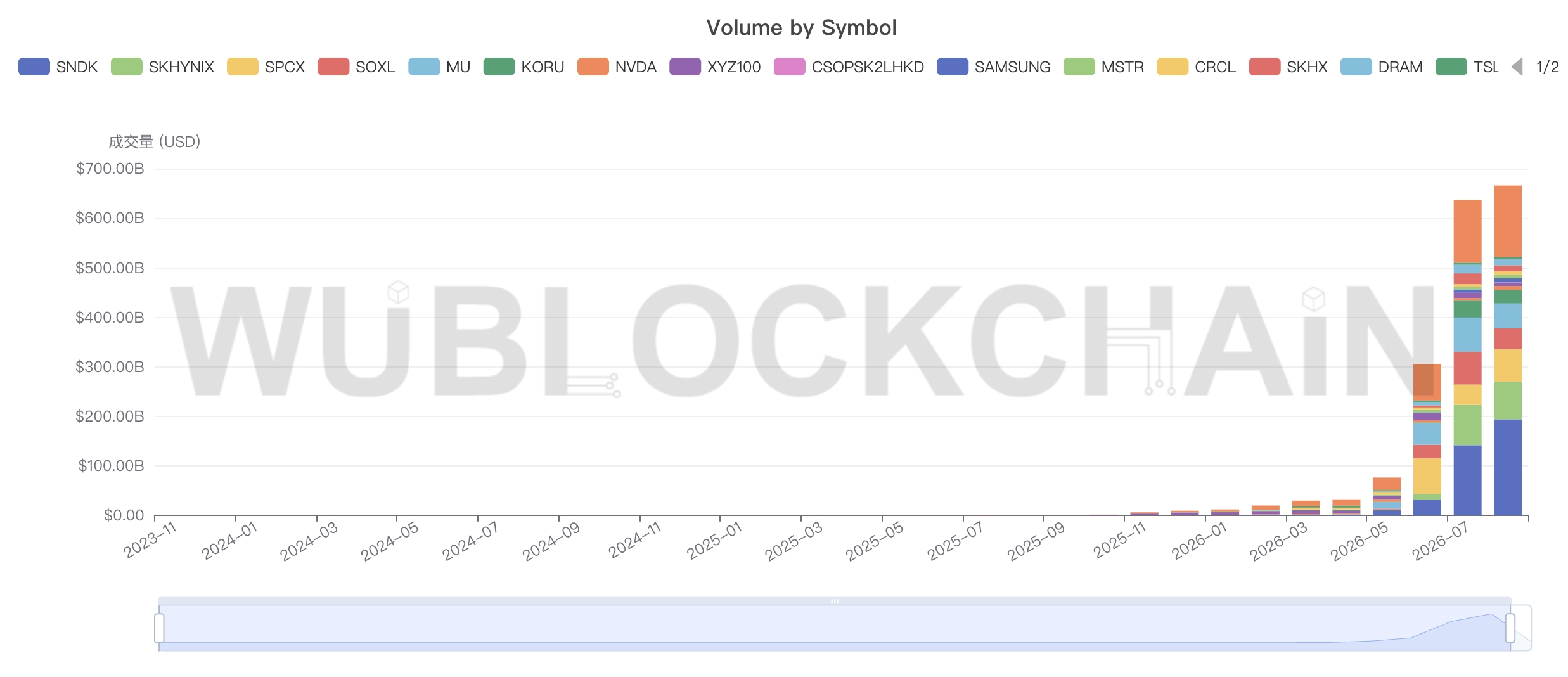
Stock perpetual futures on centralized crypto exchanges traded $665.42 billion in August, according to WuBlockchain Data Center. 3 underlying names produced more than half of that activity.
The total rose 4.6% from $636.19 billion in July. Still, the figure is 56.5 times higher than January’s $11.58 billion.
Chip Stocks Still Control the Equity Perp Market
SanDisk (SNDK) led all underlying assets in August volume, with $193.58 billion. SK Hynix (SKHYNIX) followed at $75.89 billion, and the SpaceX-tracking SPCX contract added $65.93 billion.
Follow us on X to get the latest news as it happens

Together, the three represented 50.4% of the market. That concentration echoes what CryptoQuant documented in July, when memory and semiconductor names dominated exchange flows.
Notably, SNDK perpetual volume equaled 62.4% of the stock’s US spot turnover on August 19, the highest reading on record in WuBlockchain’s tokenized equities data. The ratio eased to 38.0% by August 26.
No other equity-linked perpetual comes close. Circle (CRCL) ranked second at 47.2%, while Nvidia (NVDA) and Meta both sit below 3%.
Exchanges Widen Their Stock Derivatives Lineup
Meanwhile, Binance reported roughly $433.4 billion in traditional finance (TradFi) perpetual volume for August, about 15 times January’s $29.5 billion. Equity-linked contracts generated $342.9 billion of that figure, or close to 79%.
The exchange is now adding options on more than 1,000 US stocks and exchange-traded funds (ETFs) for eligible users outside the United States.
Rivals are moving in parallel. Bybit plans to start 24/7 options trading on September 17, using SpaceX and Nvidia perpetuals as the underlyings.
Whether the market broadens beyond memory chips will determine if September repeats August’s narrow structure.
Subscribe to our YouTube channel to watch leaders and journalists provide expert insights
The post 3 Stocks Drive Half of August's $665 Billion CEX Perpetual Futures Volume appeared first on BeInCrypto.
Gold has hit a wall this week, sliding to two-week lows near $4,320 and posting an 8.7% drop from last week’s three-month highs near $4,700. The catalyst is unmistakable: Fed Chair Warsh’s hawkish Jackson Hole remarks, warning the Fed still has “work to do” without clearer evidence inflation is returning to target, sent September hike odds surging from roughly 36% before his speech to over 66% today. Rising Treasury yields and renewed Middle East tensions, following fresh US strikes and Iranian retaliation against the UAE and Jordan, have only added to the pressure.
Despite this sharp pullback, the broader picture remains genuinely constructive: gold still gained around 10% in August alone after the US Treasury’s surprise move to double its long-dated bond buyback programme reignited fears over fiscal credibility, the so-called debasement trade that has underpinned much of this year’s rally.
All eyes now turn to Friday’s Non-Farm Payrolls report, the week’s decisive catalyst. A weak print could quickly reverse this hawkish repricing and revive gold’s momentum, while a strong one would likely deepen the current correction heading into the Fed’s September 15–16 meeting.
Technical Analysis of XAU/USD
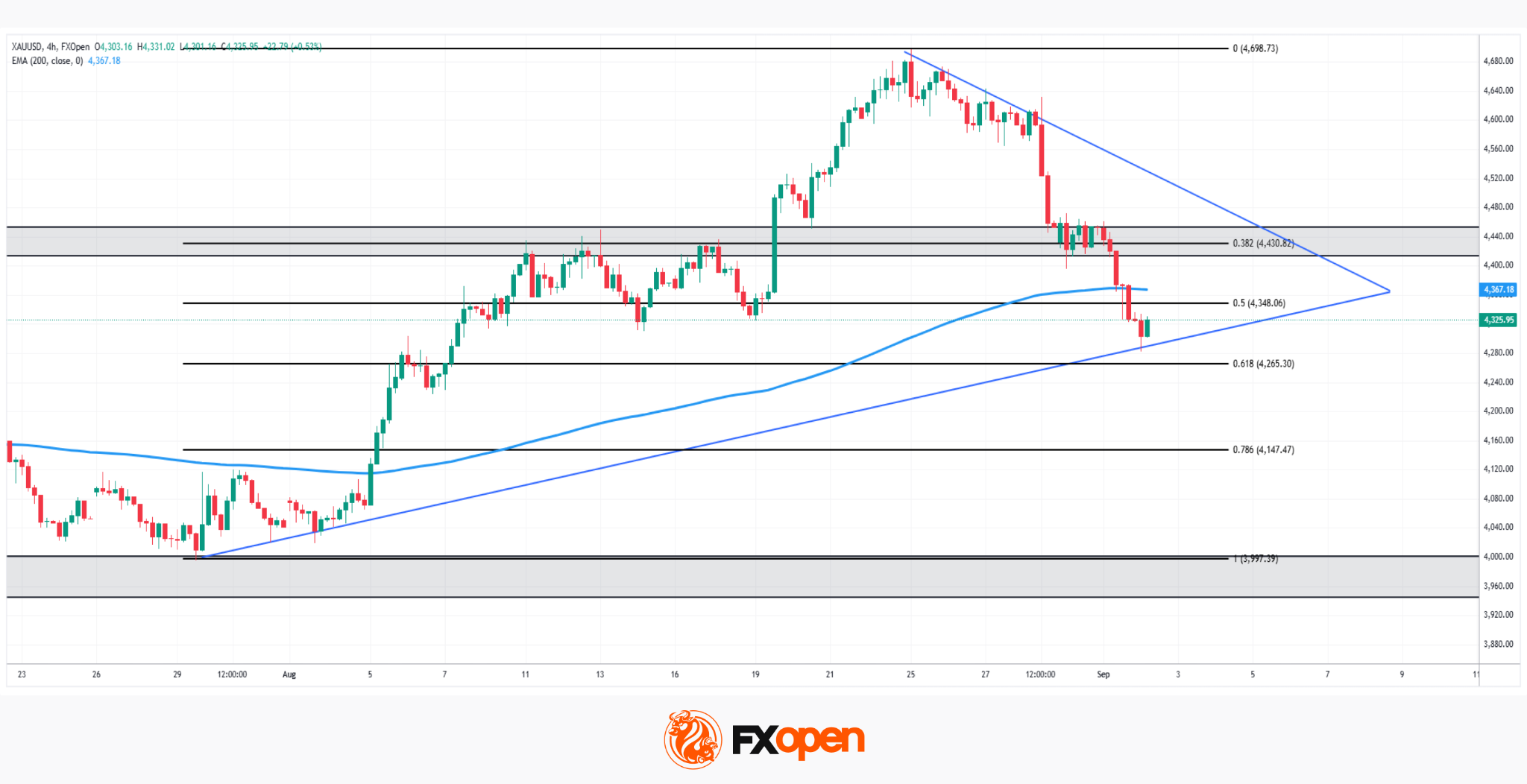
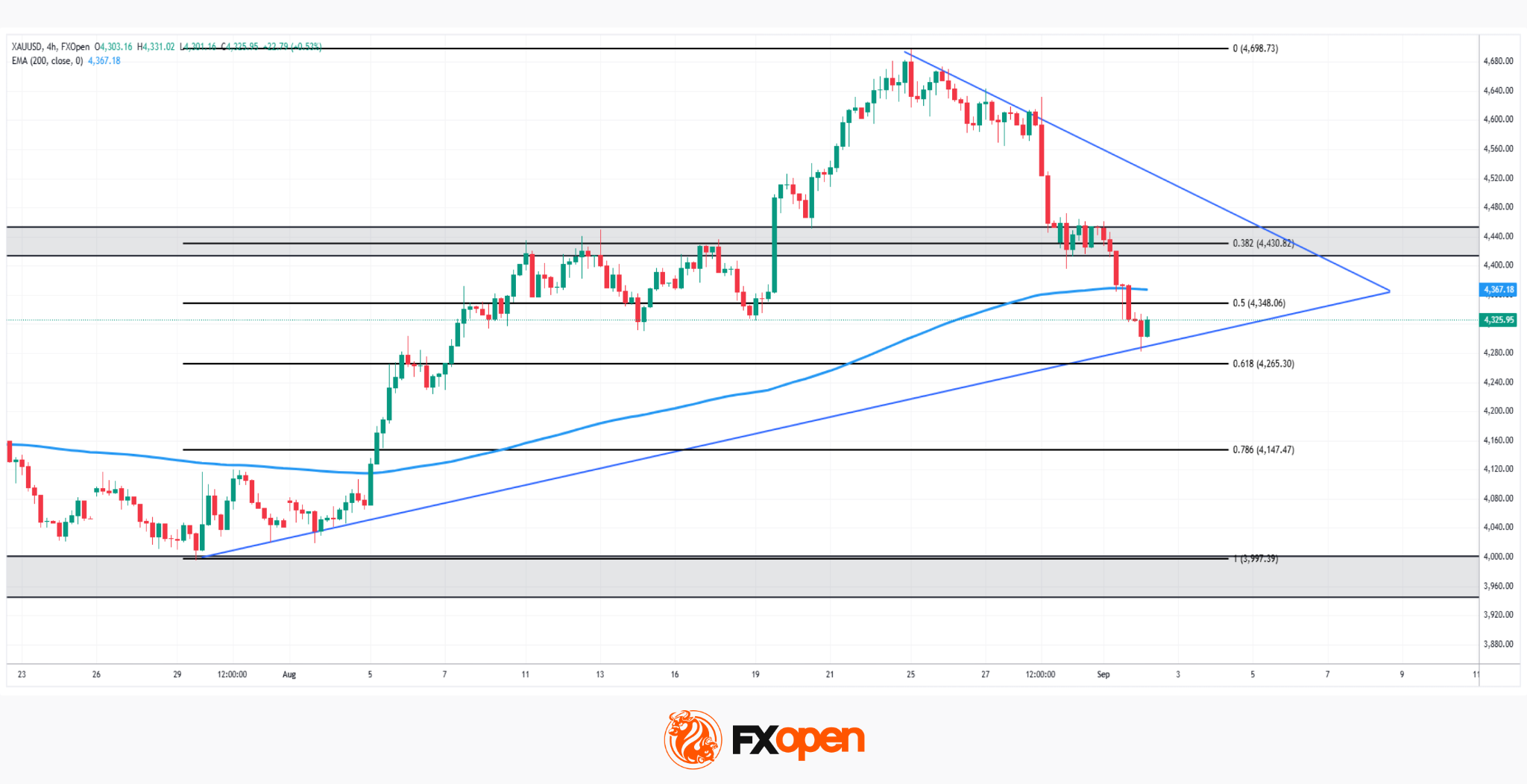
As the XAU/USD chart shows, gold has pulled back sharply from the 4,698.73 highs and is now trading between two key confluences: above the 0.618 Fibonacci retracement near 4,265, which aligns with the ascending trendline off the late-July lows, and below the 0.5 retracement near 4,348, which coincides with the 200-period EMA at 4,367.
Bullish Scenario
Should buyers defend the 0.618-trendline confluence, the broader recovery structure remains intact. A push back above the 0.5 retracement and the 200-period EMA would open the path towards reclaiming the descending trendline, with scope to challenge the 0.382 level near 4,431.
Bearish Scenario
Conversely, a decisive break below the 0.618 retracement and the ascending trendline would signal that the correction has real legs, exposing the 0.786 level near 4,147, with a deeper slide risking a full retest of the 3,997 low that anchored the entire August rally.
With price squeezed between a defended trendline-Fibonacci confluence below and a stubborn EMA-Fibonacci resistance above, gold’s next move looks set to determine whether Friday’s jobs report tips the balance towards renewed strength, or confirms this correction has further to run.
Start trading commodity CFDs with tight spreads (additional fees may apply). Open your trading account now or learn more about trading commodity CFDs with FXOpen.
This article represents the opinion of the Companies operating under the FXOpen brand only. It is not to be construed as an offer, solicitation, or recommendation with respect to products and services provided by the Companies operating under the FXOpen brand, nor is it to be considered financial advice.


Twenty One Capital CEO Raphael Zagury said Bitcoin is experiencing its first “hashrate bear market” as network computing power remains below its late 2025 record and listed mining companies redirect infrastructure investment toward artificial intelligence.
Summary
- Raphael Zagury called Bitcoin’s prolonged computing power decline its first ever hashrate bear market publicly.
- Bitcoin hashrate fell roughly 22% to 24% from its late 2025 peak, presentation materials showed.
- Zagury said artificial intelligence creates a competing use for miners’ power capacity and infrastructure today worldwide.
- Public miners increasingly pursue AI computing, though several companies continue operating substantial Bitcoin mining fleets.
- Lower network hashrate can increase surviving miners’ revenue share after Bitcoin adjusts mining difficulty downward.
Zagury presented the argument at Bitcoin Asia in Hong Kong on Aug. 28. Twenty One Capital subsequently filed the prepared transcript with the U.S. Securities and Exchange Commission.
Bitcoin hashrate approached 1.3 zettahashes per second late last year before entering a prolonged decline, Zagury said. His presentation materials calculated a drawdown of approximately 22% to 24% from the peak.
“Hashrate bear market” is Zagury’s description of the current cycle rather than an official Bitcoin network classification. It refers to the unusually long period during which estimated computing power has failed to return to its previous record.
Bitcoin hashrate decline differs from the 2021 shock
Bitcoin’s hashrate measures the estimated computing power miners contribute to securing the network and competing for block rewards. A higher figure generally means more machines or more efficient equipment is operating.
Zagury contrasted the current decline with the disruption caused by China’s 2021 mining ban. Hashrate fell rapidly during that episode as companies shut down Chinese facilities, but recovered as machines moved to North America, Central Asia and other regions.
The present cycle has developed more gradually. Rather than relocating the same machines, operators are reconsidering whether new electricity and data center capacity should be allocated to Bitcoin mining at all.
“This has been the longest period that we’ve seen from an all-time high until recovery,” Zagury said.
Network estimates vary because Bitcoin does not publish an exact count of active machines. Analysts infer hashrate from block production rates and mining difficulty, which means daily readings can fluctuate sharply.
CoinWarz estimated hashrate at about 829 exahashes per second on Sept. 2, after readings moved above one zettahash during several days in late August. Longer moving averages provide a clearer measure than daily estimates.
Previous analysis found that Bitcoin mining difficulty had fallen 19.9% from its November peak by late July. Hashrate had remained in a downward trend for approximately 287 days, according to Bitcoin Magazine Pro data cited in that report.
AI gives miners another use for scarce power
Bitcoin miners and AI data centers compete for several of the same resources. Both require large power connections, cooling systems, land, data center buildings and access to capital.
AI facilities require different chips, networking equipment and construction standards from Bitcoin mines. Converting a mining site is therefore more complicated than replacing ASIC machines with graphics processors. Sites with secured power and fiber access can nevertheless provide a starting point for high performance computing development.
Zagury said this option changes the hashrate cycle because miners can now direct capital toward another computing market instead of automatically expanding their Bitcoin fleets.
“If you look at the public mining companies out there, there really isn’t anybody staying the course to mine Bitcoin at scale,” he said. “Pretty much everybody is leaving the industry right now.”
The statement describes a broad trend but should not be read literally. MARA, CleanSpark, Riot, Bitdeer and other publicly traded companies continue operating large Bitcoin mining fleets, even as some explore or build AI infrastructure.
The shift is most advanced at companies such as TeraWulf, IREN, Core Scientific, HIVE and Cipher. TeraWulf reported $21 million in AI and high performance computing hosting revenue during the first quarter, exceeding its Bitcoin mining revenue for the first time as its AI business became its largest revenue source.
Cipher has also obtained a $200 million revolving credit facility to finance its expansion into long-term AI data center contracts.
Low cost miners could gain network share
Zagury rejected the idea that Bitcoin mining is inherently a poor business. He argued that profitability depends on where an operator sits on the industry’s cost curve.
A miner with efficient equipment and low electricity costs can remain profitable under conditions that force a higher-cost competitor to shut down. Capital structure also matters because heavy debt and short repayment schedules can create pressure even when a facility remains operationally competitive.
Hash price, which measures expected miner revenue for a unit of computing power, remains low compared with historical levels. That puts pressure on operators using older machines or expensive electricity.
However, declining network hashrate can benefit miners that remain active. Bitcoin adjusts mining difficulty every 2,016 blocks, or approximately every two weeks, to keep average block production close to ten minutes.
When computing power leaves the network, a downward difficulty adjustment can make it easier for remaining miners to find blocks. Each surviving operator can then control a larger share of the network without adding machines.
“The beautiful thing about Bitcoin mining being in a bear market of hashrate is that, for those that stay around, they naturally get a higher share of the market,” Zagury said.
That benefit does not guarantee higher profits. Revenue still depends on Bitcoin’s price, transaction fees, electricity costs, equipment efficiency and the amount of competing hashrate.
Bitcoin price must outpace hashrate growth
Zagury said mining has the best chance of outperforming Bitcoin when the asset’s price increases faster than network hashrate.
If Bitcoin rises by 50% while hashrate remains flat, a miner’s revenue can increase without an equivalent rise in competition. If computing power grows faster than Bitcoin’s price, each operator’s network share and revenue per machine can decline.
Zagury recommended buying Bitcoin directly before investing in mining for someone allocating only a small amount of capital. He said investors considering larger, diversified allocations could combine Bitcoin with mining exposure.
“If you only have $1, buy Bitcoin first,” Zagury said. “I think that’s the best way to express your view.”
His position reflects Twenty One Capital’s stated approach of measuring potential investments against Bitcoin. The Tether-backed company treats the cryptocurrency as its main benchmark and argues that an operating business must justify its additional risks by offering a credible path to outperforming BTC.
Mining companies face construction, electricity, equipment, management and financing risks that do not arise from holding a spot Bitcoin exchange-traded fund. They can also offer operating leverage when Bitcoin rises faster than their costs and network competition.
Energy flexibility remains mining’s main advantage
Zagury also defended Bitcoin mining against criticism that it wastes electricity. He argued that energy use supports economic development and that mining offers a flexible source of demand.
ASIC machines can shut down and restart faster than heavy industrial facilities. Miners can therefore reduce consumption when electricity demand rises and resume operations when unused capacity becomes available.
The ability to curtail operations has led miners to participate in grid stabilization programs, particularly in energy markets with variable renewable generation. Financial and environmental results depend on the underlying power source and the terms of each arrangement.
AI data centers generally require steadier power than Bitcoin mines because customer workloads cannot be interrupted as easily. Bitcoin mining may therefore retain a role at sites where electricity is abundant but unreliable or cannot be transmitted economically.
Zagury said mining now provides four forms of optionality: flexible energy demand, increased network share when competitors leave, proximity to Bitcoin’s protocol and reusable data center infrastructure.
Whether miners capture those benefits will become clearer through upcoming difficulty adjustments and public company results. Filings will show how much capital miners direct toward new ASIC equipment compared with AI construction.
The sector’s direction is unlikely to be uniform. Some operators will retain Bitcoin mining, others will combine mining with AI hosting, and companies controlling the most attractive power sites may shift more aggressively toward high performance computing.

Iran reports civilian deaths from U.S. strikes
CENTCOM said it struck air defense sites, radar systems, maritime assets and facilities, mine laying capabilities, and communications sites.
Iran, however, reported that U.S. strikes killed civilians and damaged civil infrastructure. The southern port cities of Chabahar and Konarak were struck by four projectiles, Iranian state media IRNA reported, citing a provincial official. Projectiles also hit a wedding ceremony in the city of Kuhestak in Sirik County, Deputy Governor of Hormozgan Province Ahmad Nafisi told Mehr news agency.
At least five people were killed and more than 50 injured in Sirik, according to the Iranian Red Crescent Society, a humanitarian group. Mehr reported that a 4-year-old child was among the dead.
Tavanir, Iran’s national electricity company, said the strikes caused power outages in parts of Hormozgan Province.
Citing the deputy governor of Iran’s Khuzestan province, IRNA reported that another seven people were killed and eight injured in U.S. strikes on three locations in the province.
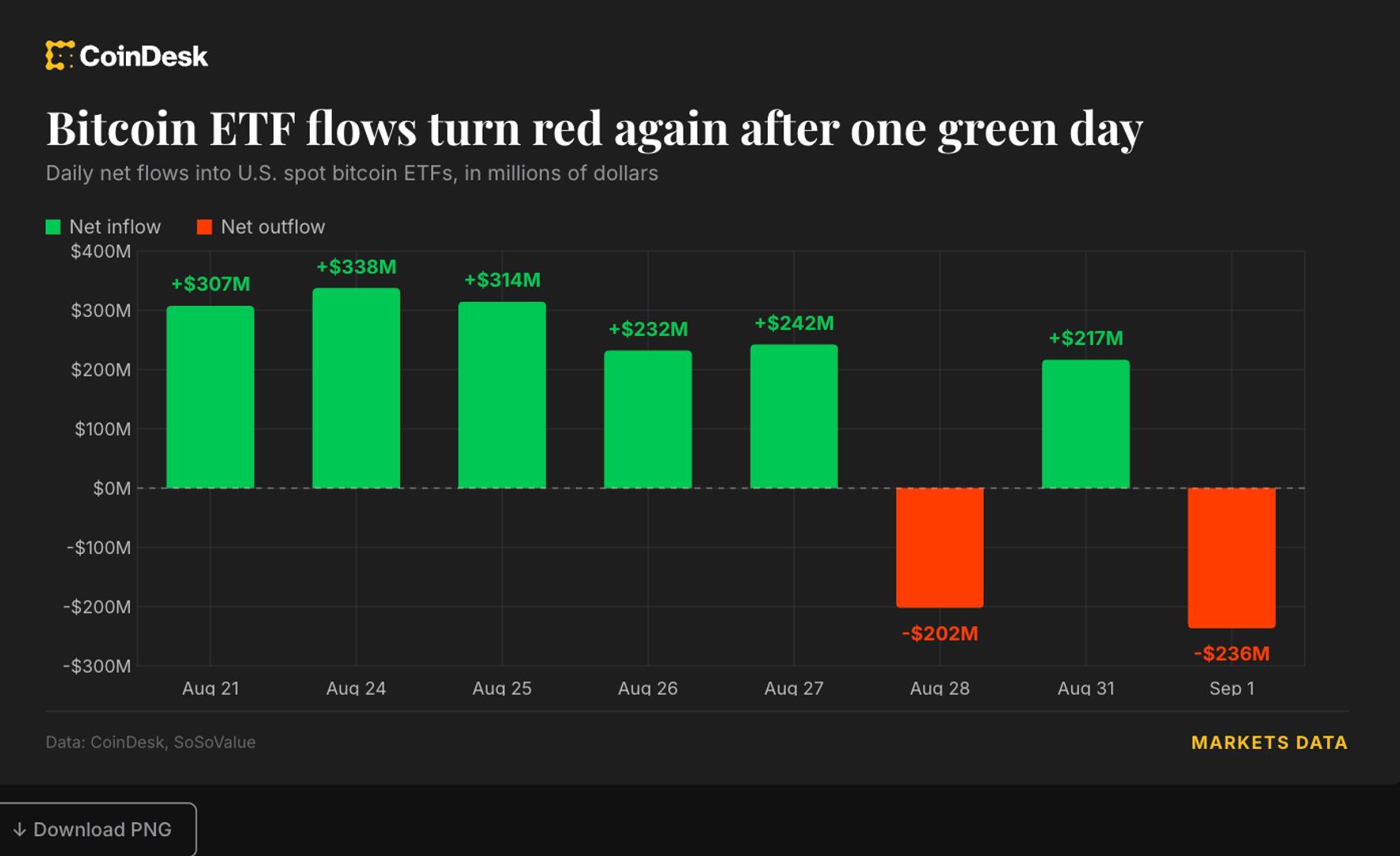
Bitcoin slipped below $77,500 and every major is red on the day. The smaller crypto ETFs kept taking money while the bitcoin funds gave some back.

Ex-Pakistan Coach Calls Out PCB, Brutally Exposes Reason Behind Pakistan’s Decline: “Absolutely Ridiculous”

The AI layoffs may have finally ended, and businesses might be hiring more workers just to be able to use AI effectively

XRP RED ALERT: $258.79 RIPPLE PRIME Just Confirmed





-

 Fashion5 days ago
Weekend Open Thread: Maeve – Corporette.com
-

 Crypto World5 days ago
Bitcoin’s 22% rally now needs real demand to outlast Treasury liquidity boost
-

 Crypto World7 days ago
Warsh Jackson Hole keynote puts financial innovation first
-

 Business5 days ago
Apple Confirms September 9 Keynote and Reveals Its Full Pre-Order Schedule
-

 Crypto World6 days ago
Elon Musk Grok Bot Promise: We Will Make You Whole if AI Loses Your Money
-

 Business5 days ago
Salesforce Stock Soars 19% as Blowout Earnings and Agentforce AI Growth Silence Software Skeptics
-

 Business4 days ago
Onto Innovation Stock: AI’s Next Bottleneck Is Yield (NYSE:ONTO)
-
 NewsBeat7 days ago
Lindsay Clancy jury braces for closing arguments as judge tells court: ‘You’ve heard all the evidence’ – Live updates
-

 Business7 days ago
Walmart takes aim at younger shoppers with new fashion brand
-

 Crypto World6 days ago
NVIDIA revenue hits $96.2B as AI demand doubles
-

 Crypto World4 days ago
Bitcoin price tests $82K resistance as Brandt stays long
-

 Crypto World7 days ago
Nvidia Q2 Earnings Reveal $96.2 Billion Beat, So Why Is NVDA Falling?
-

 Business5 days ago
iPhone 18 Pro Pre-Orders Could Shift to Saturday as Apple Reportedly Avoids September 11 Anniversary
-
 Tech4 days ago
Hugging Face built a $4.5 billion empire on free AI models. Now Nvidia is buying it for $12.9 billion
-
 Tech6 days ago
Claude Cowork gets its own browser that doesn’t touch your tabs, bookmarks, or saved passwords
-

 Crypto World5 days ago
Truflation calls for Fed rate cut after PCE forecast
-

 Tech4 days ago
PaperCut releases second emergency patch for exploited flaws
-

 Tech6 days ago
Apple’s iPhone 18 Pro event is on September 9
-

 Crypto World6 days ago
GENIUS Act missed its deadline as OCC writes rules anyway
-

 News Videos3 days ago
Charlie Munger on Robinhood: No one should believe that Robinhood’s trades are free
You must be logged in to post a comment Login