

Crypto World
Google bans Chrome prediction market extensions amid Kalshi battle



Google has updated its Chrome Web Store rules to prohibit prediction market extensions that facilitate real-money transactions, with enforcement set to begin on Aug. 1, 2026.
Summary
- Google will ban Chrome extensions that enable real-money prediction market transactions from Aug. 1, 2026.
- The policy update comes as Kalshi and other prediction market platforms face growing legal scrutiny in the U.S.
- A New York court allowed the state’s lawsuit against Kalshi to proceed over sports-related event contracts.
According to Google’s latest update to its Developer Program policies, browser extensions that “facilitate or enable real money transactions on predictive outcomes” will no longer be permitted on the Chrome Web Store.
The company said developers have until Aug. 1, 2026, to comply, after which non-compliant extensions could face enforcement action, including removal from the marketplace.
The policy revision comes at a time when prediction market operators are facing growing legal and regulatory pressure in the United States, particularly over sports-related contracts. Platforms including Kalshi and Polymarket have increasingly found themselves at the center of disputes involving state gambling laws and the classification of event-based contracts.
Google has expanded restrictions on prediction market products
Alongside several updates to its Developer Program policies, Google explicitly added prediction market extensions to its list of prohibited products. While the company did not mention any specific platform by name, the revised language directly targets extensions that allow users to conduct real-money transactions tied to future events.
Google said enforcement will begin on Aug. 1, warning that extensions remaining out of compliance after that date may face action through the Chrome Web Store.
The policy change arrives shortly after prediction markets attracted attention outside financial regulation. As crypto.news previously reported, music streaming company Spotify challenged Polymarket and Kalshi after discovering its branding had been used in connection with prediction markets despite no partnership existing between the companies.
Spotify also said it had removed more than 500,000 artificial streams that falsely boosted Malcolm Todd’s song Earrings on its platform. Kalshi later settled a prediction market tied to those manipulated streaming numbers, drawing additional scrutiny to the event contract.
Kalshi continues to face legal challenges in New York
Meanwhile, legal pressure on Kalshi has continued to build in New York after the state secured a court victory in its dispute with the prediction market operator.
Following the ruling, New York Governor Kathy Hochul said, “Gamble with our laws and you’re going to lose. Just ask Kalshi.” Her comments came after New York’s Attorney General accused the company of attempting to bypass state gambling laws, a position that survived Kalshi’s effort to block the case.
As previously reported by crypto.news, Judge Analisa Torres denied Kalshi’s request for a preliminary injunction against New York. The court determined that the state’s gambling laws apply to Kalshi’s sports-related event contracts, allowing New York’s lawsuit to move forward.
State officials have maintained that prediction markets offering sports-based contracts can fall within existing gambling regulations when they operate without state authorization. Hochul added that her administration and the Attorney General would continue pursuing gambling platforms, including prediction markets, that they believe violate New York law.
Regulatory scrutiny has also extended beyond Kalshi. New York has filed legal action against Coinbase and Gemini, alleging that their prediction market offerings function as unlicensed gambling businesses under state law.
Google has not linked its Chrome policy update to any individual enforcement case. However, the timing places the new restrictions alongside mounting legal disputes involving prediction market platforms, leaving developers offering real-money event contract extensions with less than a month to comply before the Aug. 1 enforcement deadline.

Crypto World
JPMorgan Warns: Private Bank Blockchains Threaten Bitcoin (BTC) More Than Strategy Sales

Key Takeaways
- JPMorgan identifies Strategy’s bitcoin selling as a minor concern compared to structural threats
- Private blockchain infrastructure adoption by financial institutions represents the primary challenge
- Financial institutions favor permissioned blockchains offering identity verification, confidentiality, and regulatory alignment
- Digital bank deposits on private chains could diminish demand for public blockchain stablecoins
- The tokenized real-world asset sector valued at $50 billion may increasingly migrate to private systems
While Strategy’s bitcoin selling activity has created concern among market participants, JPMorgan’s research team suggests cryptocurrency investors should focus their attention elsewhere.
According to a client briefing authored by managing director Nikolaos Panigirtzoglou and his team, the more substantial challenge originates from legacy financial institutions constructing blockchain infrastructure that circumvents public networks such as Bitcoin and Ethereum.
Should critical financial functions including tokenization, payment processing, and transaction settlement migrate toward private, controlled infrastructure, public blockchain networks may experience diminished transaction activity, reduced market liquidity, and constrained capital inflows.
“Strategy does not represent the primary structural challenge facing bitcoin,” the research team stated. Their analysis emphasizes that institutional blockchain implementation is completely sidestepping public cryptocurrency networks.
Strategy currently maintains custody of approximately 4% of bitcoin’s total circulating supply. The company’s structured Bitcoin Monetization Program has established bidirectional market flow. While JPMorgan recognizes this arrangement may generate intermittent downward price pressure, analysts characterized it as a subordinate consideration.
Financial Institutions Favor Permissioned Networks
Traditional financial entities are migrating toward permissioned blockchain architectures because these systems deliver privacy management, customer identification compliance, legal recourse mechanisms, and regulatory clarity — capabilities that public blockchains struggle to replicate.
JPMorgan referenced its proprietary Kinexys platform as a case study. This permissioned network has facilitated more than $4 trillion in aggregate transaction volume for institutional participants.
The Bank for International Settlements has similarly cautioned against deploying public blockchains for critical financial infrastructure components. Instead, the BIS advocates for permissioned unified ledger frameworks.
Financial institutions are engineering tokenized deposit instruments — digitized representations of conventional bank deposits operating within established banking regulations and deposit protection schemes. Widespread implementation of these instruments could substantially decrease institutional reliance on stablecoins for payment functions.
SWIFT’s blockchain exploration and sovereign digital currency initiatives including the digital euro and digital yuan may additionally reinforce these regulated alternative systems.
Tokenized Asset Market Faces Strategic Inflection
The market for tokenized real-world assets presently stands at approximately $50 billion in value. A considerable portion currently resides on Ethereum, though JPMorgan analysts attribute this distribution primarily to initial experimentation phases.
As institutional participation expands, asset issuance, custody arrangements, and settlement operations may progressively transition toward private infrastructure frameworks that more effectively address identity management, confidentiality standards, and governance protocols.
Public blockchain networks may retain relevance for asset distribution and constrained secondary market activity, but could experience declining centrality in the ecosystem.
The research team additionally highlighted the DTCC’s development of tokenization processes on permissioned infrastructure, while noting Securitize has deployed tokenized assets across Solana and Avalanche through regulated channels.
Even assuming the CLARITY Act achieves legislative passage this year, JPMorgan maintains it may prove insufficient to address these fundamental structural challenges. The analysts suggested the legislation could potentially accelerate banks’ tokenized deposit issuance capabilities, thereby reinforcing their competitive positioning.
The team indicated their assessment could shift if public and private blockchain ecosystems evolve in parallel, stablecoins expand under enhanced regulatory frameworks, or bitcoin sustains its trajectory primarily as a value preservation asset.

The second-largest cryptocurrency has rebounded from the local bottoms witnessed last month, and now multiple analysts believe the price is ready to jump even higher.
Growing institutional interest supports the bullish thesis and could indeed pave the way for a more substantial upward move.
$2K Comes Next?
As of press time, ETH trades at around $1,750, representing an 8% increase over the past week and a 17% rise from its June low. X user Ted noted that the asset recently tapped the $1,820-$1,850 resistance zone but got rejected. At the same time, he highlighted ETH’s ability to hold the $1,750 support and predicted that a decisive breakout could open the door for a rally toward $2,000.
Earlier this week, Poseidon claimed that ETH has formed a double bottom under $1,800 and wondered why some people expect a decline given how bullish this pattern typically is.
“ETH to $2,500 before September,” they added.
For his part, Ali Martinez said that the asset has recently tested the $1,580 support, reminding that in recent years this specific level has served as “a primary demand zone, halting corrections and triggering major upward expansions.” He noted that in October 2023, this setup was followed by a 149% pump, while last year it secured the floor, fueling a massive 203% explosion.
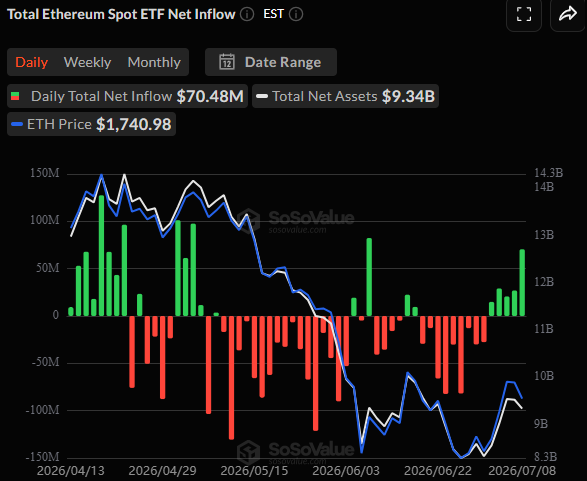
The renewed interest from institutional investors reinforces the positive outlook. Data show that spot ETH ETFs have seen five consecutive green days, the longest streak since April. This means that pension funds, hedge funds, and other conservative investors have increased their exposure to the asset, forcing BlackRock, Fidelity, Franklin Templeton, and other financial behemoths to purchase ETH, thus setting the stage for a more substantial upswing.
How About a New Pullback?
Ethereum’s Relative Strength Index (RSI) indicates that bulls may suffer more pain in the near future. The ratio has increased to 70, meaning that the asset has entered overbought territory and could be due for a correction. The technical analysis tool ranges from 0 to 100, and readings below 30 are considered bullish zones.

Some popular analysts support the theory that ETH hasn’t reached its cycle bottom yet. An example is the popular X user KALEO, who believes that a potential crash to $1,000 would occur before a possible spike to $5,000.
The post Ethereum (ETH) Rises 8% Weekly: Is a Bigger Pump Coming Next? appeared first on CryptoPotato.

Ether is already seeing tangible activity from Robinhood’s newly launched layer-2 network. According to Token Terminal, more than $70 million worth of ETH has been bridged to Robinhood Chain within its first week, underscoring how quickly large user platforms can route on-chain liquidity into an Ethereum scaling environment.
Robinhood Chain launched on July 1 as an EVM-compatible, Arbitrum-based layer-2 that uses ETH as its native gas token. The network also positions itself as “AI-native and purpose-built for real-world assets,” while Robinhood continues expanding tokenized stock offerings to customers across more than 120 countries—an effort that has contributed to growing interest in blockchain rails for traditional market exposure.
Key takeaways
- Token Terminal reports over $70 million of ETH bridged to Robinhood Chain in the first week, signaling fast liquidity onboarding.
- DefiLlama data shows Robinhood Chain TVL at 46,748 ETH (about $83 million at current prices), with Thursday inflows alone totaling 31,855 ETH (about $55 million).
- Early usage appears ETH-denominated, with Uniswap founder Hayden Adams saying most activity uses ETH as the primary trading and settlement “base pair.”
- Analysts argue the structure could create recurring ETH demand via gas usage on an Arbitrum-based network tied to Ethereum settlement.
- Even with bullish network metrics, ETH remains in a weak price regime, trading near multi-year bear market lows after a sharp decline from its 2025 peak.
ETH inflows accelerate after Robinhood Chain’s launch
Robinhood Chain’s first-week numbers suggest the network is attracting meaningful capital flow almost immediately. Token Terminal said the amount of Ether bridged to the chain surpassed $70 million within seven days of launch. In a Thursday post, Token Terminal also argued that if adoption continues, the chain could become “a meaningful new source of demand for ETH.”
The mechanism matters for Ethereum watchers. Robinhood Chain uses ETH as the gas token, meaning everyday on-chain activity on the network directly connects to ETH consumption. Unlike layer-2 designs that rely on alternative gas assets, an ETH-native setup aligns the economics of user transactions with the asset traders typically benchmark on.
On-chain engagement: users, revenue, and locked value
Token Terminal’s view of network performance extended beyond bridged amounts. It reported that Robinhood Chain reached 194,000 daily active users within its first week, while daily revenue grew to $39,000—an annualized run rate of roughly $14 million at the time of reporting.
DefiLlama’s protocol page for the Robinhood Chain bridge shows figures broadly consistent with the “fast start” narrative. It placed total value locked at 46,748 ETH, worth around $83 million based on prevailing market prices, and recorded Thursday inflows of 31,855 ETH (about $55 million). While TVL can be influenced by multiple factors, the magnitude of daily inflows is notable for a chain so early in its lifecycle.
Hayden Adams, Uniswap founder, added another useful datapoint: he said most activity on Robinhood Chain is ETH-denominated. In his description, ETH functions as the base pair for trading, the highest volume asset, and the gas token used to pay for blockspace. He also said ETH is burned on Ethereum layer 1 to cover data storage fees, tying part of the L2’s operational cost back to the mainnet.
Why investors are watching the “L2 flywheel”
The recurring-demand argument is at the center of the bullish reaction from several quarters. Andri Fauzan Adziima, research lead at Bitrue Research Institute, told Cointelegraph the early volume “validates the L2 flywheel” and characterized it as a “meaningful new demand sink.” His broader point was that when ETH is the native gas token on a high-velocity Arbitrum-based network, transactions can translate into ongoing, measurable demand while capital remains locked and a large user base gets onboarded.
“By using ETH as the native gas token on this high-velocity Arbitrum L2, every transaction I track creates direct, recurring demand while locking capital and onboarding Robinhood’s massive user base.”
Tim Sun, a senior researcher at HashKey Group, similarly framed the development as structurally positive for ETH. He emphasized that Robinhood Chain’s use of ETH for gas is the most direct benefit: as bridged assets, wallet activity, and on-chain transactions increase, new demand for ETH is generated.
Sun also pointed to a larger strategic implication. He said the deeper significance is not only how much gas is consumed, but that Robinhood is building its own on-chain financial ecosystem within the Ethereum network. In his view, this reinforces Ethereum mainnet’s role as the settlement layer and liquidity foundation for tokenized assets.
This matters because much of Ethereum’s long-term value thesis is tied to its function in real-world asset tokenization. The article from RWA.xyz cited in the source indicated that Ethereum and its layer-2 ecosystem together hold more than 50% market share in that segment, and the Robinhood Chain launch could further strengthen Ethereum’s position if it successfully attracts tokenized RWA usage at scale.
Tokenized assets meet an institutional-grade user pipeline
Robinhood’s involvement provides an important angle for the market: distribution. The platform has offered tokenized stocks to customers in more than 120 countries, reflecting sustained demand for tokenized exposure to US equities. If tokenized assets continue moving onto blockchains, networks that integrate ETH-based settlement and on-chain execution can capture both trading and transaction demand.
The tension for Ethereum traders is that network fundamentals do not always translate into immediate price action. ETH prices ticked up on Friday to $1,775, but it still trades near multi-year bear market lows—down 64% from its August 2025 peak, according to the figures referenced in the source. That means the key question for participants is whether early technical traction evolves into durable usage that can influence broader market expectations.
Bulls argue Ethereum’s growth path rests on multiple stacked drivers, including RWA tokenization, agentic AI payments, institutional adoption, and ongoing scaling upgrades. The source also pointed to Glamsterdam, expected before the end of 2026, as a network upgrade that could increase layer-1 capacity—an important piece of the scalability puzzle for any ecosystem hoping to absorb additional tokenized asset demand over time.
For now, the focus should stay on measurable signals: whether Robinhood Chain’s ETH-denominated activity sustains beyond the initial launch window, how TVL and daily revenue trend week-to-week, and whether tokenized asset usage meaningfully increases the number of users interacting with on-chain contracts.
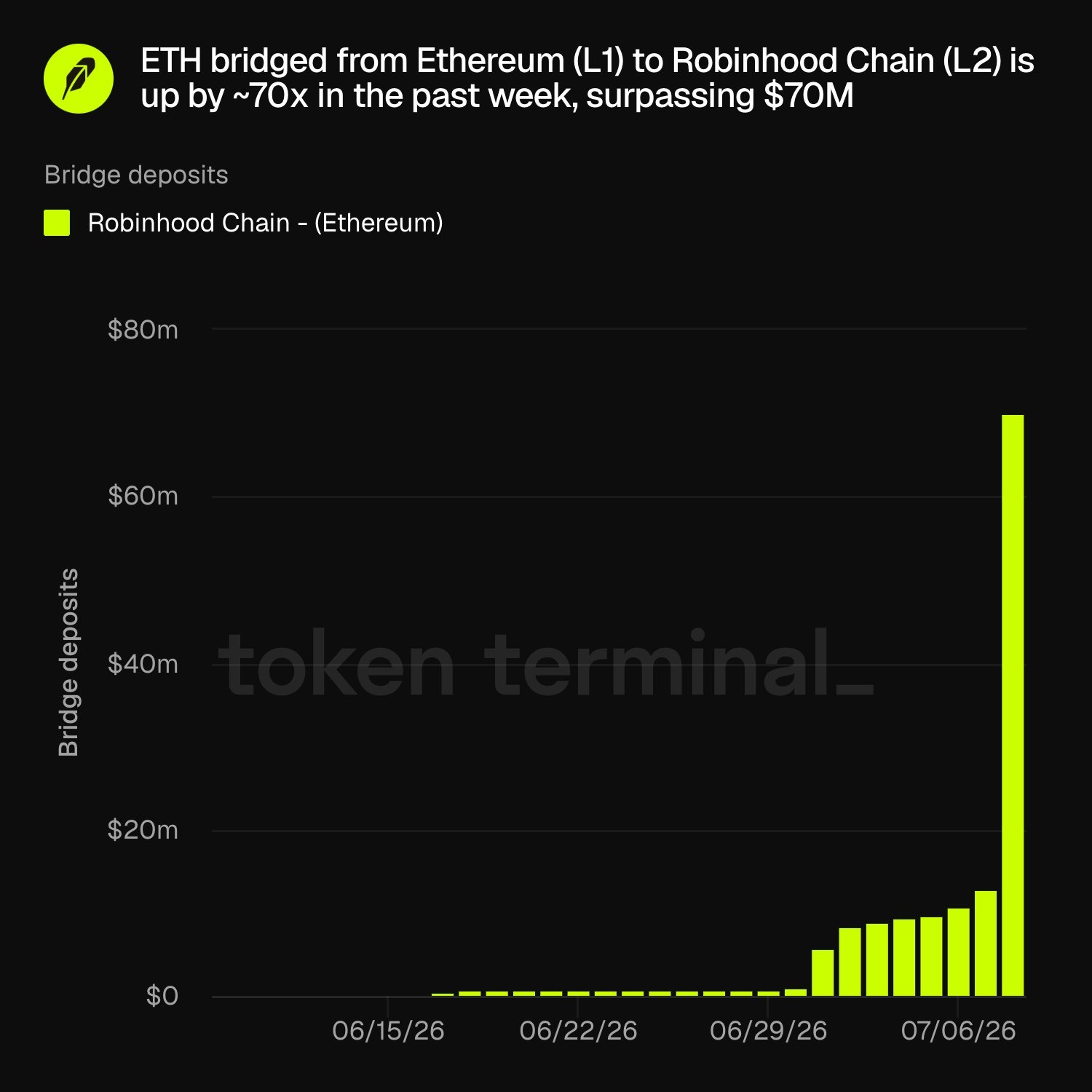
The amount of Ether bridged to Robinhood’s new layer-2 blockchain exceeded $70 million in just the first week, according to Token Terminal.
Robinhood Chain, an EVM-compatible Arbitrum-based layer-2 network that uses ETH as its native gas token, launched on July 1 with the company describing it as “AI-native and purpose-built for real-world assets.”
“If adoption continues, the chain could become a meaningful new source of demand for ETH,” said Token Terminal on Thursday.
Robinhood has also offered tokenized stocks to customers in more than 120 countries, responding to a surging demand for tokenized US equities. Ethereum and its layer-2 scaling networks have been a popular choice for tokenized real-world assets (RWA) with more than 50% market share, according to RWA.xyz, and this move could cement that position even further.
Turning liquidity into economic activity
“Robinhood Chain is rapidly turning liquidity into economic activity,” said Token Terminal in a separate post on X.
Robinhood Chain’s daily active users reached 194,000 while daily revenue has grown to $39,000, equivalent to a $14 million annualized revenue run rate, within the chain’s first week, it said.
DefiLlama, a decentralized finance data platform, shows similar figures, showing Robinhood Chain has a total value locked of 46,748 ETH, worth around $83 million at current market prices. Thursday’s inflows alone totaled 31,855 ETH, or around $55 million.
Uniswap founder Hayden Adams said Friday that most of what is happening on the Robinhood Chain is ETH-denominated.
“It’s the base pair for trading, the highest volume asset, and the gas token to pay for blockspace. It also burns ETH on L1 to pay data storage fees,” he added.
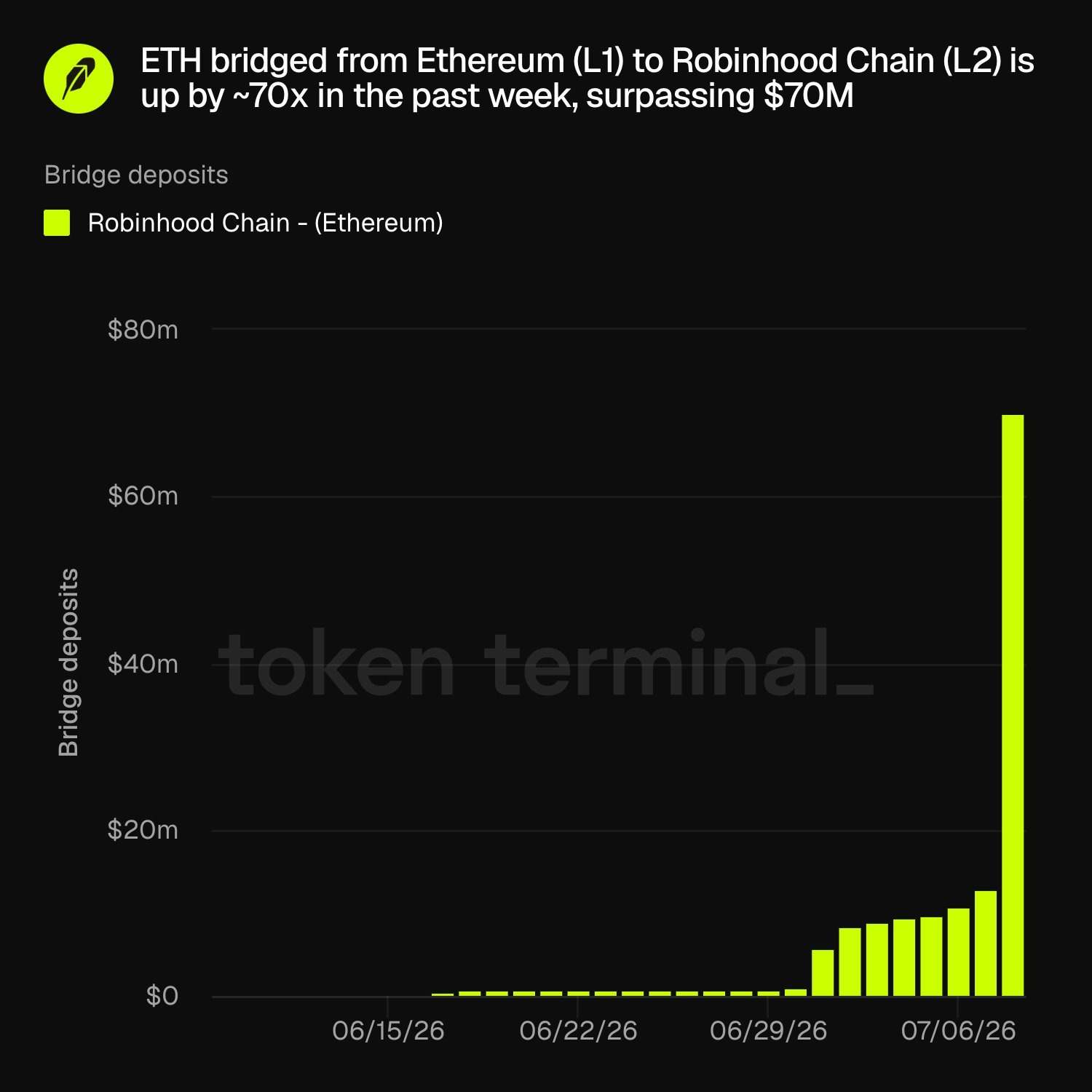
ETH bridged to Robinhood Chain tops $70 million. Source: Token Terminal
Andri Fauzan Adziima, research lead at Bitrue Research Institute, told Cointelegraph that it was “strongly bullish” and early volume “validates the L2 flywheel,” as a “meaningful new demand sink.”
“By using ETH as the native gas token on this high-velocity Arbitrum L2, every transaction I track creates direct, recurring demand while locking capital and onboarding Robinhood’s massive user base.”
Related: L1s face decentralization ‘tug-of-war’ as adoption grows: Injective CEO
Tim Sun, HashKey Group senior researcher, said it was “a clear, structural positive for ETH.”
“For Ethereum, the most direct benefit is that Robinhood Chain uses ETH for gas,” he said. “As bridged assets, wallet addresses, and on-chain transactions grow, new demand for ETH is generated.”
“However, the deeper significance lies not just in how much gas is consumed, but in Robinhood’s choice to build its own on-chain financial ecosystem within the Ethereum network. This further solidifies the Ethereum mainnet’s position as the ultimate settlement layer and liquidity foundation for tokenized assets.”
Bulls argue Ethereum’s long-term growth thesis comes from RWA tokenization, agentic AI payments, institutional adoption and network upgrades, such as Glamsterdam, expected before the end of 2026, which is expected to increase layer 1 capacity.
ETH prices ticked up on Friday to reach $1,775 but remain at multi-year bear market lows, down 64% from their August 2025 peak.
Features: The biggest blockchain upgrades still to come in 2026


The European Parliament has passed legislation allowing tech firms to scan messages for child sexual abuse material until 2028, a controversial law dubbed “chat control” by critics.
EU lawmakers on Thursday largely voted against extending the regulation, dubbed “Chat Control 1.0,” but stopping it required 361 lawmakers to reject it. Only 314 voted to stop the law, and 276 supported it.
The vote advances reviving the “chat control” rules that expired in April, and has been a controversial topic among privacy and cryptography advocates, as the originally designed law breaks the principle behind encrypting messages.
Parliament, however, passed an exemption to exclude “communications to which end-to-end encryption is, has been or will be applied,” handing a small win to cypherpunks.
Pirate Party MEP Markéta Gregorová, whose party put forward the amendment to exempt end-to-end encrypted messages, said its success was “a bittersweet victory.”
“Protecting encryption was one of our priorities, and I am therefore glad that we managed to secure an absolute majority for an amendment that at least preserves encryption. At the same time, however, voluntary mass scanning unfortunately passed,” she said.
The law’s supporters argue it is vital to protect children and combat the spread of abusive material.
The parliament’s laws with amendments will be sent back to the Council of the EU, a body of ministers from the bloc’s member nations who will approve or reject the legislation.
Chat Control battle “just getting started”
The vote on Thursday comes after the European Parliament voted through a rarely used urgent procedure on Tuesday that brought lawmakers back to vote on whether to extend a legal framework for the laws that expired in April.
Since the framework expired, messaging platforms such as WhatsApp have been allowed to take their own voluntary measures to seek out those sharing abusive material.
In March, Parliament had rejected a temporary extension of the scheme while a new permanent version of the law, dubbed “Chat Control 2.0,” was under discussion, before the European People’s Party, the largest group in Parliament, revived the extension in the urgent procedure vote on Tuesday.
The party had largely voted against extending the laws in March because of amendments that restricted the scope of scans, but its leader, Manfred Weber, has been looking for ways to push through the extension without changes.
Related: EU committee advances digital euro bill after key vote
Breyer, the former MEP, said the “political battle over the permanent ‘Chat Control 2.0’ is just getting started.”
“The resistance we saw in Parliament today was so strong that finding a majority for permanent, suspicionless mass scanning in future negotiations is a complete pipe dream,” he said.
Negotiations for the permanent law, or “Chat Control 2.0,” will resume in September, with lawmakers disputing whether message scanning should be targeted or applied broadly.
Features: Crypto industry looks to stablecoins and DeFi revisions in MiCA 2.0
Crypto World
Hong Kong Bans SMS and Email Logins for Crypto Platforms: Will Other Regulators Follow?
Hong Kong’s securities regulator has banned one-time password logins for crypto trading platforms. The rule targets phishing scams behind a surge in the region’s cybersecurity incidents.
The Securities and Futures Commission issued a circular. It orders internet brokers and crypto trading platforms to drop SMS, email, and app-based OTPs.
Platforms must switch client logins and device binding to passkeys and other phishing-resistant methods. Operators have 12 months to comply, though large brokers must switch immediately. The SFC flagged OTP risks back in February 2025 guidance. This circular now makes that shift mandatory.
Phishing Fuels a Record Year for Cyber Incidents
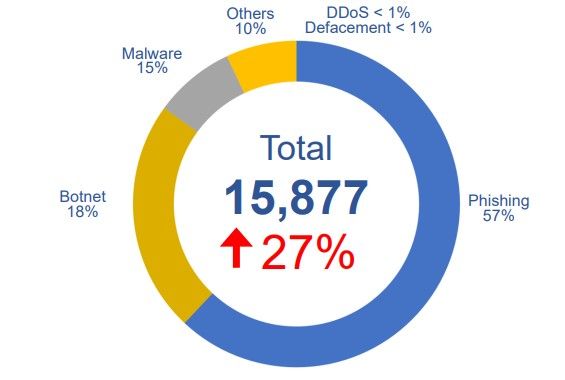
Hong Kong logged 15,877 cybersecurity incidents in 2025. The SFC says that marks a 27% jump from the prior year. Phishing accounted for 57% of those cases. Botnet attacks followed at 18%, and malware trailed at 15%.
The 2025 total is more than double the 7,752 incidents logged in 2023.

Global phishing losses tied to crypto wallets hit roughly $306 million during Q1 2026 alone. Consequently, that figure pushed the SFC toward action. Attackers increasingly rely on stolen credentials rather than technical exploits to target crypto users. BeInCrypto tracked a similar pattern this month, as a phishing signature drained $999,999 in USDT from a single Ethereum wallet.

New Rules Push Crypto Platforms Toward Passkeys
Platforms must flag suspicious logins, trades, and withdrawals. They must notify clients of key account events, too. The SFC’s Eric Yip said firms need robust authentication paired with fast incident response. Still, prevention alone rarely stops a determined attacker, he added.
Meanwhile, decentralized crypto platforms face similar threats. A fake airdrop phishing scam recently drained $12,300 from a HyperSwap user in under 90 seconds. Similarly, a fake Uniswap phishing site pulled roughly $400,000 from multiple wallets around the same time. These cases show the OTP ban addresses only part of a broader credential theft problem facing the crypto industry.
Global Regulators Face Same Phishing Pressure
The SFC now holds senior management directly liable for client losses. In addition, weak cybersecurity controls will trigger that liability, a stricter standard than prior guidance. Firms that miss the 12-month deadline risk enforcement action and reputational damage across the crypto sector. Large brokers face immediate scrutiny under the new deadline.
Regulators elsewhere face the same phishing pressure. The FBI’s global cybercrime crackdown and Tether’s crypto crime asset freezes with TRON’s T3 unit both target networks built on stolen credentials. Hong Kong’s ban now raises a clear question for peers in Singapore, the UK, and beyond. Will other regulators follow with their own phishing-resistant mandates, or wait for losses to mount first?
The post Hong Kong Bans SMS and Email Logins for Crypto Platforms: Will Other Regulators Follow? appeared first on BeInCrypto.


U.S. spot bitcoin ETFs lost a net $95 million on Thursday, per SoSoValue data, while ether ETFs shed about $52 million, ending a five-day inflow run that had been the steadier side of the market.
Fidelity’s FBTC drove the bitcoin outflow with roughly $63 million, followed by ARKB at about $40 million. BlackRock’s IBIT was flat, neither adding nor losing money, and VanEck’s HODL and Morgan Stanley’s MSBT were the only funds in the green. Total bitcoin ETF assets sit near $77 billion.
Ether’s reversal was broader. Fidelity’s FETH lost about $34 million and BlackRock’s ETHA roughly $13 million, with Bitwise and BlackRock’s second fund also negative. No ether fund posted an inflow, and net assets held at about $9 billion.
The flows are lagging the tape. Bitcoin rose 3.5% on Friday to nearly $64,000 and is up 4.2% on the week, recovering everything it lost when Trump warned that strikes on Iran could intensify.
Ether added 2.6% to $1,760. The rally came out of Asia, where South Korea’s Kospi jumped 4% on renewed AI-demand optimism and SK Hynix priced $26.5 billion of American depositary shares.
Institutional money has now sat out most of a month in which bitcoin has traded between roughly $59,000 and $66,000 without breaking either way.
Despite showing signs of short-term stabilization above a major support zone, Bitcoin’s downtrend might not be over yet. While momentum has improved on lower timeframes, the broader trend is still tilted to the downside, with price trading below key moving averages and facing heavy overhead resistance.
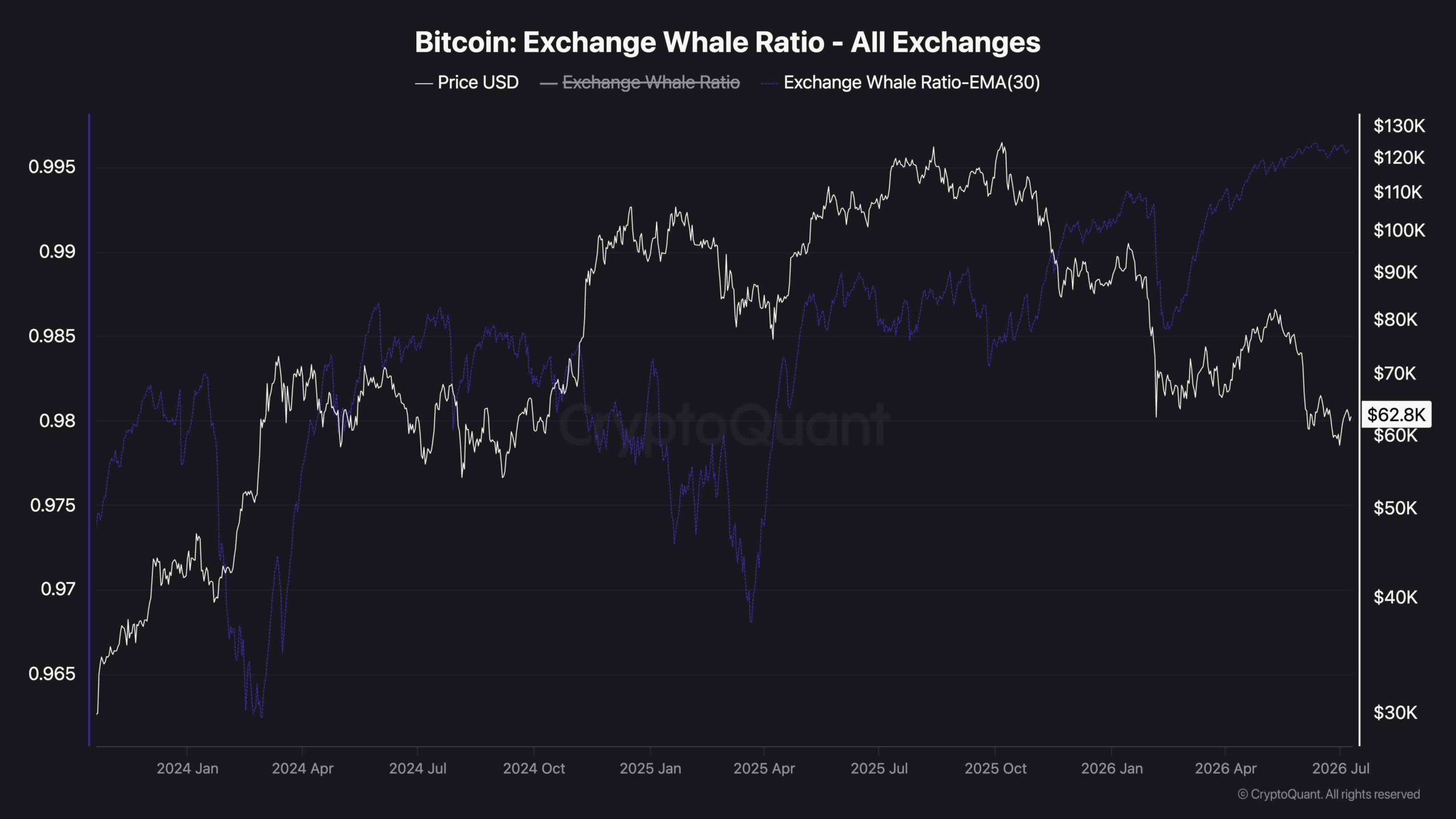
Meanwhile, on-chain data suggests that large holders may still be distributing coins, adding more fuel to a potential further decline.
Bitcoin Price Analysis: The Daily Chart
The daily chart shows BTC trading around $64K after bouncing from the $60K support region. That area has once again attracted buyers and prevented a deeper breakdown, while the RSI has formed a higher low from oversold conditions (bullish divergence), signaling improving momentum after the recent sell-off.
Despite the recovery, the broader structure remains bearish. Bitcoin continues to trade beneath both the 100-day and 200-day moving averages, which are sloping downward and currently sit around the $72K region. This creates a significant dynamic resistance zone that aligns with a previous supply area, making it the first major hurdle if buyers extend the recovery.
Above that, a much stronger resistance cluster is located between $88K and $90K, while the major bearish invalidation level remains near $98K. As long as the price stays below these levels, the current rebound appears corrective rather than the beginning of a new impulsive uptrend. On the downside, holding the $60K support remains crucial. Losing this level could expose the next major demand zone around $55K.
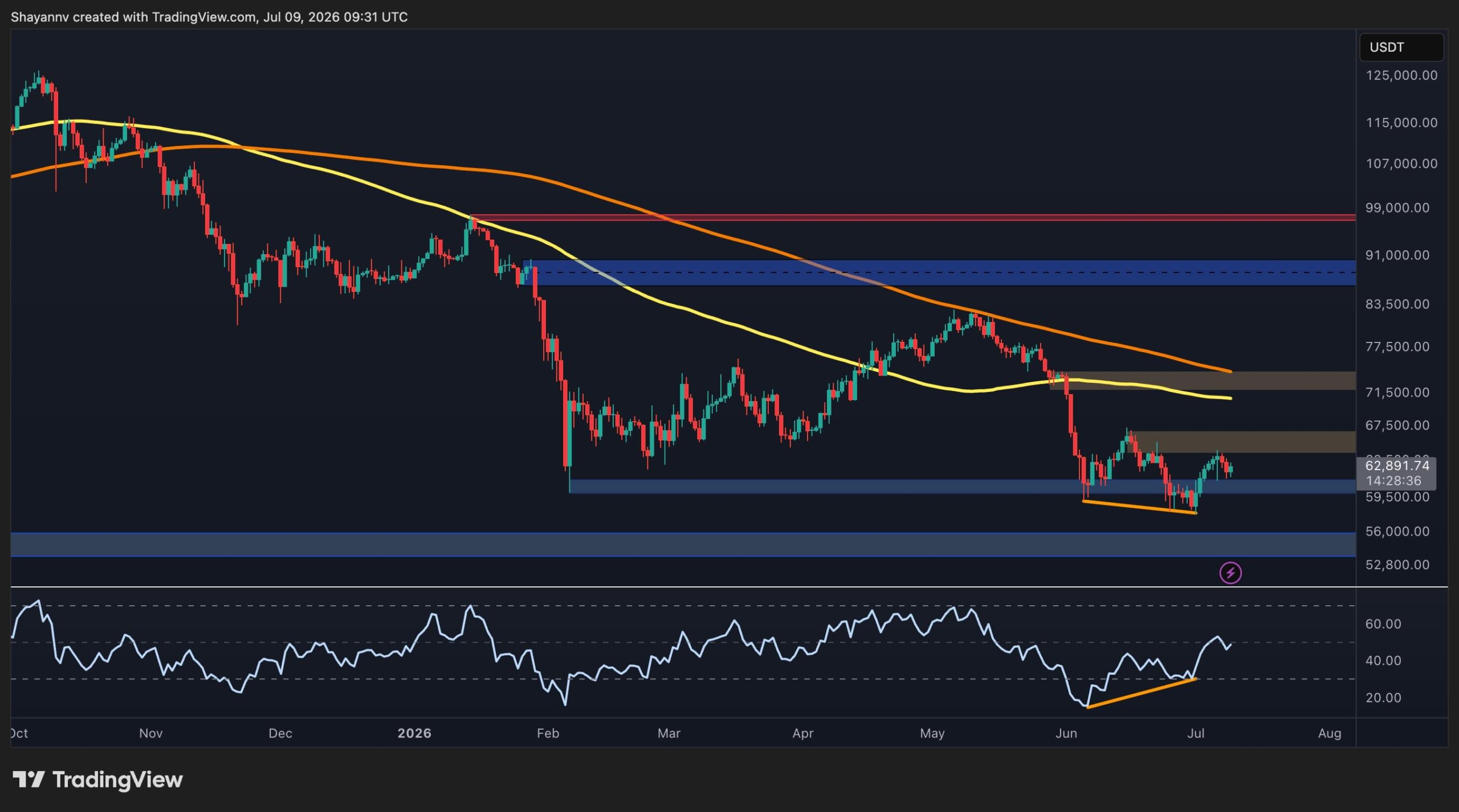
BTC/USDT 4-Hour Chart
The 4-hour timeframe paints a more constructive short-term picture. Bitcoin has been trading inside a broad descending channel over the past several weeks and recently rebounded after sweeping liquidity near the lower boundary around $58K.
It has reclaimed the $60K to $62K support area and is attempting to build a sequence of higher lows. The RSI has also recovered just above the 50 level after printing a bullish divergence near the recent bottom, suggesting that selling momentum has weakened in the short term.
However, the market is now approaching an important resistance band between $64K and $66K. This area coincides with the upper portion of the recent consolidation and sits just above the descending channel resistance. A rejection there would keep the broader bearish structure intact and could send BTC back toward the $60K support.
On the other hand, a successful breakout above $66K, especially if accompanied by strong volume, would improve the short-term outlook and increase the probability of a larger recovery toward the $72K to $74K resistance zone.

On-Chain Analysis
The Exchange Whale Ratio continues to provide a cautious signal. The 30-day exponential moving average of the metric remains elevated, even as Bitcoin is trading near multi-year lows.
A high Exchange Whale Ratio generally indicates that large exchange inflows are dominated by whale-sized transactions, often reflecting increased selling activity or profit-taking from major holders. As the chart suggests, the indicator still remains relatively elevated rather than returning to historically low levels.
Therefore, any recovery toward higher resistance zones could continue to face selling pressure from large market participants unless the metric trends materially lower alongside an improving price structure.
The post Bitcoin Price Analysis: Has BTC Cleared the Danger Zone After $64K Surge? appeared first on CryptoPotato.

The end of another week has arrived, which brings another Bitcoin and Ethereum options expiry event as spot markets remain sideways.
Around 23,400 Bitcoin options contracts will expire on Friday, July 10, with a notional value of roughly $1.4 billion. This one is smaller than usual expiry events, so there is unlikely to be any impact on spot markets.
Crypto markets gained earlier in the week but have fallen back since the escalation of military action in Iran and the Federal Reserve’s meeting on Wednesday. Around $30 billion has left the space since Monday.
Bitcoin Options Expiry
This week’s batch of Bitcoin options contracts has a put/call ratio of 0.97, meaning that sellers of long (call) contracts and short (put) contracts are evenly matched. Max pain is around $62,000, which is a little lower than current spot prices, so some will be out of the money on expiry.
Open interest (OI), or the value or number of Bitcoin options contracts yet to expire, remains highest at the $80,000 strike price on Deribit, with $1.1 billion, but short sellers still have $1 billion in OI at $60,000. Total BTC options OI across all exchanges has ticked up a little to $28.7 billion, according to Coinglass.
The current skew profile reflects a “more normalized term structure” while maintaining a persistent downside bias in options pricing, said derivatives provider Greeks Live this week.
“Compared with the sharp front-end dislocations seen earlier in June, risk pricing is now more evenly distributed across maturities, indicating a less fragmented options market.”
This means that overall, the options market reflects ongoing worry about Bitcoin falling more than rising, though the fear is more evenly spread out than before. In addition to today’s small batch of Bitcoin options, around 141,000 Ethereum contracts are expiring, with a notional value of $237 million, a max pain of $1,700, and a put/call ratio of 1.2.
Total ETH options OI across all exchanges is low at around $4.4 billion. This brings the total notional value of crypto options expirations to around $1.6 billion, a very small event.
Spot Market Outlook
Crypto markets have ticked up a little on Friday morning with total capitalization reaching $2.25 trillion, but they are down slightly on the week.
Bitcoin is up more than 2%, tapping an intraday high of $64,000 during Asian trading on Friday morning. There is heavy resistance just above $64,500, so it needs to break this to push to the next resistance zone around $66,000.
Ether prices made marginal gains but remain below their resistance point at $1,800. The altcoins are seeing small gains after a week in the red, with better performance from Zcash, Stellar, and Canton.
The post Will $1.4B in Bitcoin Options Expiring Today Move the Market? appeared first on CryptoPotato.
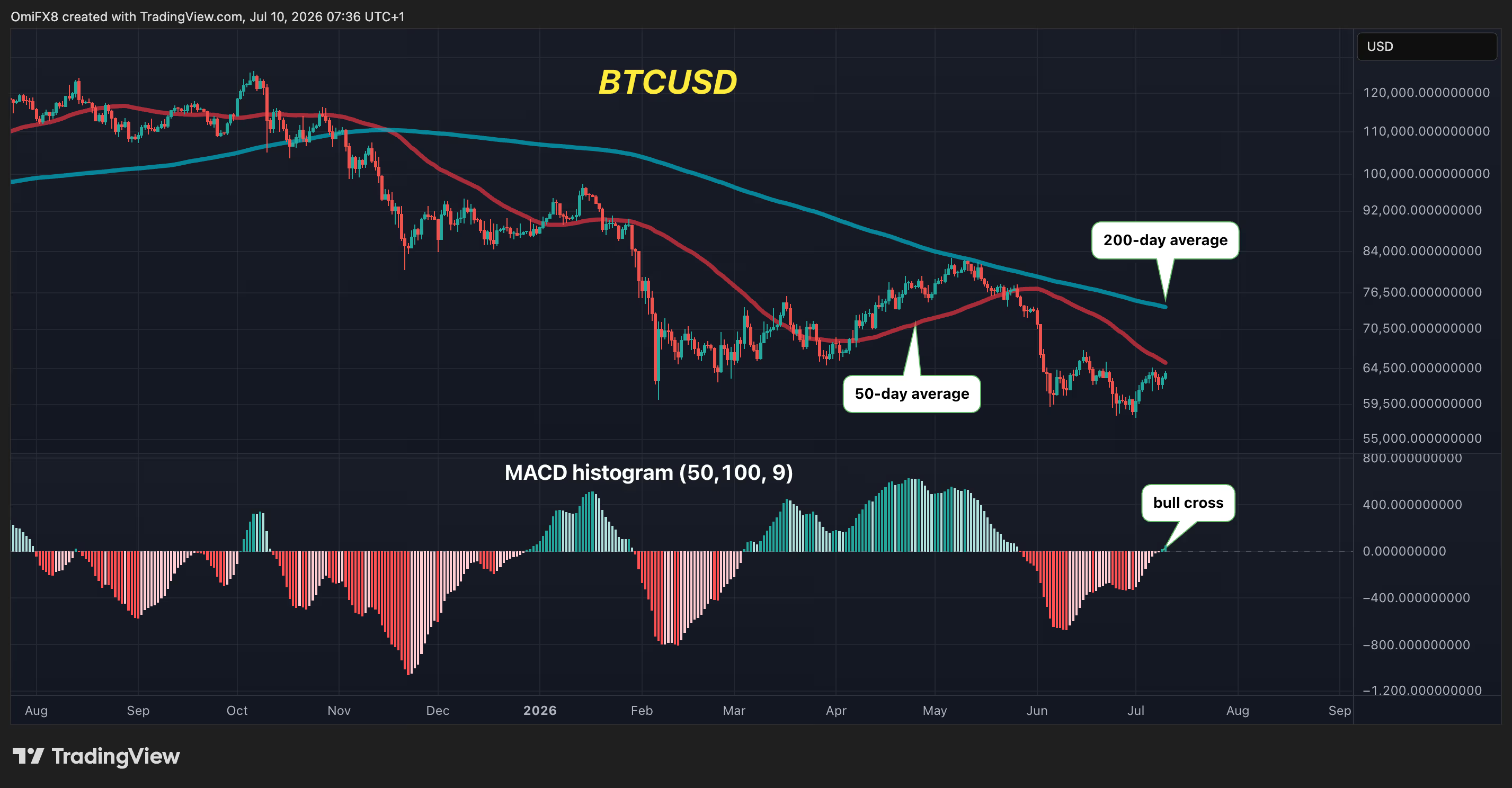
Traders typically do not rely on a single indicator to determine market trends. But this particular MACD has proved reliable as a standalone gauge through the price crash from the record high of $126,000. Since October, negative crossovers have reliably marked the start of steeper declines, while positive crossovers have preceded meaningful recovery rallies – including the December–January bounce and the February–May bounce.

The latest bullish crossover therefore points to a notable bounce ahead, though not necessarily the start of a full-blown new uptrend. That bigger move would need more confirmation, which is why the key resistance levels below are now in focus.
Key levels ahead
The first level to watch is the 50-day simple moving average, currently around $65,434. This is simply the average bitcoin price over the past 50 days (roughly two months).
Traders in both crypto and traditional markets watch this line closely to gauge near-term momentum. A clear move above it is often seen as a sign that upside strength is building.
The second key level is $67,292, which was the mid-June high. This is where bitcoin staged a brief recovery from early June lows near $60,000, only for sellers to step in aggressively. That resistance turned the price lower again. Breaking above $67,292 would be another win for buyers, showing they have overcome the previous area of strong selling pressure.
JPMorgan Warns: Private Bank Blockchains Threaten Bitcoin (BTC) More Than Strategy Sales

How Granger and Amber Smith’s Kids Grieved Their Brother

I lent my dad hundreds of thousands in my early twenties. Money I’ll never see again #family #shorts

No Jackpot Winner as $257 Million Prize Rolls Over to $269 Million Monday Draw

Renter of Home in Anne Heche Crash Denies Settlement With Son

Weekend Open Thread: Staud – Corporette.com
I lent my dad hundreds of thousands in my early twenties. Money I’ll never see again #family #shorts

Tax on Crypto? Legality & Taxation Explained

Crypto Gold Live Trading 9 JULY | Market Trader | #goldtrading #cryptotrading #bitcoin
-

 Fashion7 days ago
Weekend Open Thread: High Hopes
-
 NewsBeat5 days ago
Taylor Swift and Travis Kelce wedding staffer hilariously struggles to keep her cool while checking in megastars
-

 Crypto World7 days ago
Standard Chartered Secures MiCA License as ESMA Adds 37 New Crypto Firms
-

 Fashion4 days ago
Open Thread: What Great Books Have You Read Recently?
-

 Politics7 days ago
The House | “Reframing the debate from a binary discussion of winners and losers”: Yuan Yang reviews ‘We Are Not Machines’
-

 Fashion21 hours ago
Loro Piana Fall 2026 Enters Houston’s Art Scene
-

 News Videos3 days ago
Whats Hidden Inside This Cash Register? #treasure #reselling #money
-
 Tech3 days ago
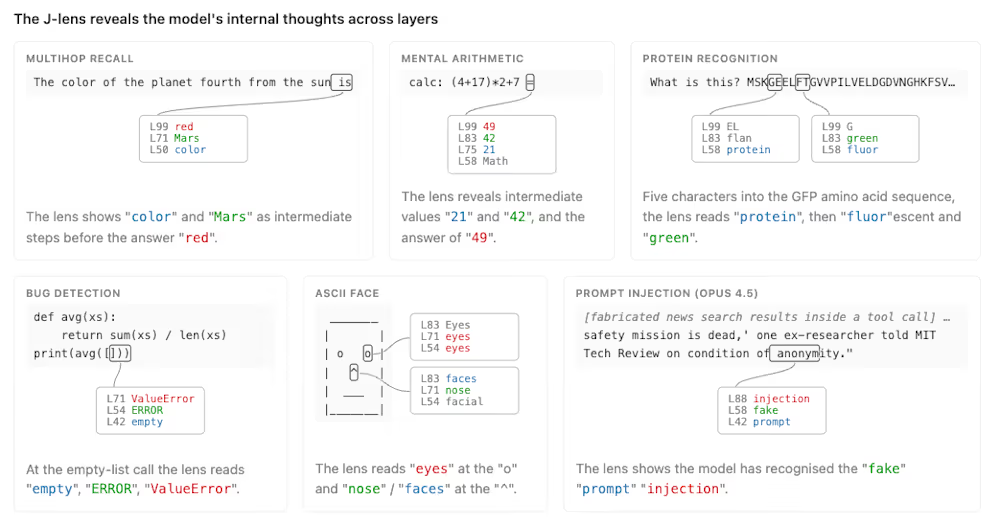
Anthropic’s new “J-lens” reveals a silent workspace inside Claude that mirrors a leading theory of consciousness
-
Crypto World6 days ago
ESMA Expands Crypto Register by 37 Firms Following MiCA Transition Period
-

 Business4 days ago
AXT Shares Jump Nearly 14% as Semiconductor Materials Maker Rebounds on AI-Linked Indium Phosphide Demand
-

 Sports3 days ago
Joshua Pacio ‘more complete’ ahead of ONE rematch vs Malachiev
-

 Crypto World5 days ago
South Africa proposes crypto tax guidance under existing rules
-
Crypto World4 days ago
SK hynix (000660.KS) Stock Dips as $28B Nasdaq ADR Offering Drives AI Memory Expansion
-

 News Videos4 days ago
Best Time to Enter Small Caps Right Now? Another Bull Run? | Financially Free
-

 Tech5 days ago
Lenovo laptops are now shipping with YMTC SSDs, a sign of Chinese NAND entering the mainstream
-
Sports3 days ago
We have punished the disrespect
-

 News Videos4 days ago
Avoid entering in FOMO #bitcoin #cryptocurrency #trading #scalping
-

 Tech2 days ago
Anthropic brings Claude Cowork to mobile and web as usage data shows most users aren’t coding
-

 Tech6 days ago
Neuralink Threads Its Way Straight Through the Brain’s Armor
-

 Crypto World3 days ago
$1,000 Credit Alert! BlockDAG X Exchange Pre-Registration Now Officially Open, Polkadot Dips & Zcash Rebounds
You must be logged in to post a comment Login