

Crypto World
Hashed Open Finance Launch Testnet of Maroo, First Sovereign L1 Blockchain for KRW Stablecoins and AI Agents


[PRESS RELEASE – SEOUL, South Korea, May 7th, 2026]
Korea’s first won-denominated public blockchain goes live with built-in regulatory compliance and native AI agent identity, integrating with Model Context Protocol (MCP), Claude skills, Gemini CLI, and Cursor. The underlying technology already powers BDAN Pocket, a digital wallet used by 4 million citizens of Busan.
Hashed Open Finance, the fintech subsidiary of global Web3 venture capital firm Hashed, today launched the public testnet for Maroo, the first sovereign Layer 1 blockchain built for Korea’s KRW stablecoin economy.
With the global stablecoin market almost entirely denominated in U.S. dollars, Maroo offers Korean banks, fintechs, and AI agents native infrastructure to transact in won-denominated digital assets. The technology underpinning Maroo already powers BDAN Pocket, a digital wallet used by 4 million citizens of Busan in partnership with the Busan Digital Asset Exchange (BDAN).
The Maroo testnet is now open to external developers, banks, fintechs, and AI builders. The launch positions Korea among the first countries to design a public blockchain around its own currency rather than the U.S. dollar.
Maroo was designed from the outset with regulatory compliance, auditability, and verifiable privacy embedded in its core, allowing banks and fintechs to launch real-world services on Maroo while preserving the openness of a public chain. The chain operates on a dual-track model: an “Open Path” available to anyone, and a “Regulated Path” for transactions that require prior verification. Both paths share the same chain, allowing Maroo to test whether everyday users and regulated financial services can coexist on a single infrastructure.
Rather than relying on after-the-fact reviews, Maroo enforces compliance as code at the moment a transaction is made. Its Programmable Compliance Layer (PCL) currently covers five core policies: KYC verification, transfer limits, blacklist filtering, time-based volume caps, and AI agent transactions. Any non-compliant transaction is blocked on-chain instantly. Policy sets can be updated through a separate pipeline, allowing the network to adapt to new laws and service policies without redesigning the core protocol.
To prepare for a future where AI agents actively participate in financial transactions, the testnet also introduces the Maroo Agent Wallet Stack (MAWS). Built on the ERC-8004 standard, MAWS assigns each AI agent a unique on-chain identity. Agents can execute transactions autonomously, but only within user-defined permissions and limits. MAWS integrates seamlessly with major AI developer tools, including the Model Context Protocol (MCP), Claude skills, Gemini CLI, and Cursor. To balance autonomy with user control, users can instantly revoke permissions if abnormal behavior is detected.
On the testnet, transaction fees are paid in OKRW, a KRW-denominated test token, allowing users to participate in the network without holding volatile crypto. Beyond technical testing, Maroo offers practical scenario demos that showcase real-world utility, including KYC integration with Kakao, Korea’s leading messaging platform. Hashed Open Finance plans to introduce more advanced privacy features, including a Shielded Pool, in its next milestone later this year, with a mainnet launch to follow rigorous security audits.
“In this testnet, we have translated the core design from our January litepaper into a live network environment,” said Hojin Kim, CEO of Hashed Open Finance. “A framework where AI agents hold unique on-chain identities and autonomously execute financial transactions within user-defined rules will be a meaningful milestone for the future of blockchain-based finance.”
“Stablecoins aren’t just another financial product — they’re the infrastructure that will define what a nation’s currency looks like in the digital age,” said Simon Kim, CEO of Hashed. “Right now, that infrastructure is being built almost entirely on top of the dollar. Maroo is a rare chance for Korea to design its own digital financial order on the foundation of the won. Our goal is to make it an open platform where anyone — banks, financial institutions, fintechs, and the new kinds of players that will emerge in the AI era — can come in and experiment with the next generation of finance.”
Start building on Maroo today. The testnet is fully open to the public. Developers can access full documentation and begin building immediately at [docs.maroo.io], with the RPC endpoint available at rpc-testnet.maroo.io and on-chain activity viewable through the block explorer at [explorer-testnet.maroo.io]. AI builders can deploy AI agent wallets through [agent.maroo.io]. End users can try compliant KRW stablecoin transactions at the demo portal [experience.maroo.io], with KYC available at [kyc-testnet.maroo.io]. Banks, fintechs, and financial institutions interested in piloting Maroo for production services or partnership opportunities are invited to contact Hashed Open Finance at [inquiry@hashedopenfinance.com].
About Hashed
Hashed partners with the founders shaping the next paradigm in blockchain, AI, and content, joining them from the earliest moments as technology redraws the boundaries of industries. Headquartered in Seoul and operating from five global hubs across San Francisco, Singapore, Bangkok, Bangalore, and Abu Dhabi, Hashed provides the capital, networks, and on-the-ground execution that help founders move beyond a single region and reach meaningful scale in global markets.
About Hashed Open Finance
Hashed Open Finance is the fintech subsidiary of Hashed, established to lead Korea’s next generation of financial innovation, starting with stablecoins. The firm works with established financial institutions and global partners to research, develop, and commercialize blockchain-based applications across stablecoins, real-world asset (RWA) tokenization, and security token offerings (STOs).
The post Hashed Open Finance Launch Testnet of Maroo, First Sovereign L1 Blockchain for KRW Stablecoins and AI Agents appeared first on CryptoPotato.

Zug, Switzerland, May 7, 2026 – After years of research, engineering, and community collaboration, Panther Protocol Foundation announced that Panther Protocol is now live on Polygon.
The deployment introduces what the team describes as “programmable privacy” for decentralized finance — infrastructure designed to enable confidential on-chain interactions while supporting verifiable compliance when required.
The Panther interface is accessible at: https://pantherdao.app.
A new phase for privacy in DeFi
Panther combines zero-knowledge cryptography, non-custodial architecture, and DAO governance to support privacy-preserving interactions within decentralized environments.
Users interact directly with smart contracts while retaining full control of their assets, with cryptographic proofs generated locally in their own browser or device.
Compliance without surveillance
The initial deployment includes a compliance-enabled zone powered by credentials issued by independent providers such as AMLBot via PureFi tooling.
Participants present zero-knowledge attestations on-chain, allowing the protocol to verify eligibility without exposing personal data or transferring identity information to the DAO or protocol infrastructure.
According to the team, the model is designed to support privacy-preserving compliance workflows that may be compatible with institutional participation.
Integration with existing DeFi liquidity
The system is designed to integrate with existing decentralized liquidity sources, enabling confidential interactions without isolating users from broader DeFi markets.
Panther Reward Points (PRPs)
The network introduces Panther Reward Points (PRPs), a participation-based mechanism that recognizes protocol activity.
Users accrue PRPs through actions such as interacting with privacy-enabled zones and other qualifying protocol interactions, according to rules defined by Panther DAO governance.
According to the project, PRPs are intended to support long-term ecosystem participation as Panther expands across additional chains and integrations.
Built for the long term
Panther’s architecture includes Forensic Data Escrow, enabling governed disclosure of encrypted metadata under defined conditions, alongside a roadmap that includes:
- Multi-chain expansion
- Additional integrations and adapters
- New zones and participation models
A grant approved by Panther DAO will support open-source development work intended to enable a potential future community deployment on Base.
About Panther Protocol Foundation
Panther Protocol Foundation is a non-profit organization that supports the ecosystem through research funding, open-source development grants, and ecosystem initiatives.
The Foundation does not operate the protocol, deploy smart contracts, host interfaces, custody assets, or provide financial or digital asset services.
For more information, visit www.panther.org.
To learn more about Panther Protocol, visit www.pantherprotocol.io.
Media contact:
- Joris Koopman
- Marketing and Ecosystem Lead at Panther Protocol Foundation
- joris@panther.org
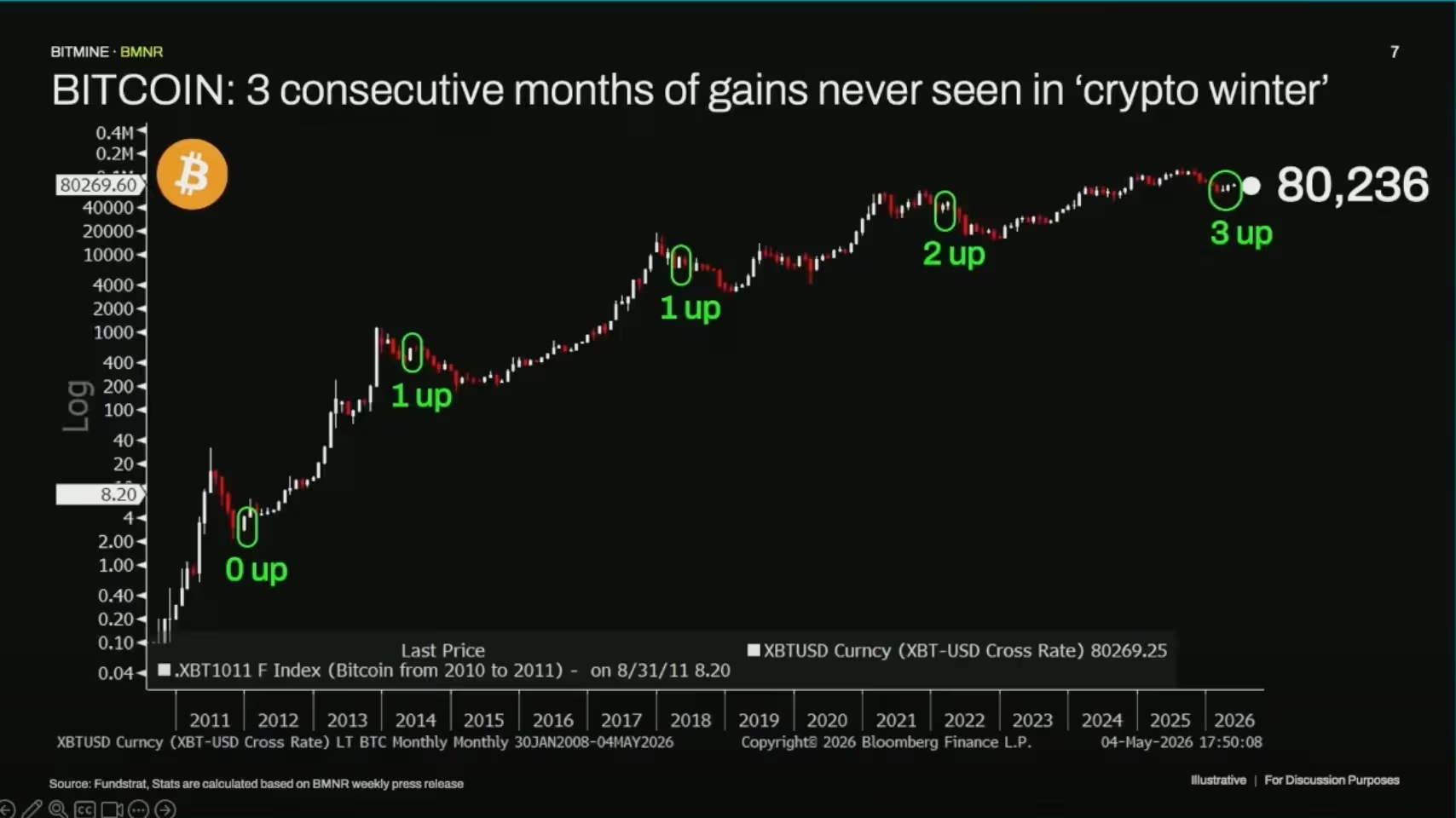
The crypto bear market is likely over, arguing that a fresh cycle driven by tokenization and artificial intelligence-powered financial services is beginning to take shape, said Tom Lee, chairman of Bitmine (BMNR) and co-founder of Fundstrat.
Speaking at Consensus 2026 in Miami on Thursday, Lee pointed to bitcoin’s recent strength as a historical signal that the market leaving behind the downtrend that saw prices crater from $126,000 in October to $60,000 in February.
After positive monthly returns in March and April, BTC is up another roughly 5% in May so far, which would be the third consecutive positive monthly return.
“You have never in a bear market if bitcoin closes up three consecutive months,” Lee said. “If bitcoin closes above $76,000 this month, the bear market is definitively over.”

The CoinDesk Bitcoin Price Index closed April at $76,300, while the asset is currently trading just below $80,000.
Lee said investors remain psychologically anchored to the last crypto downturn and are underestimating the strength of the current rebound. He also pointed to bullish technical signals from veteran trader John Bollinger, who recently said his trend models had turned positive on bitcoin.
Adding to the bullish narrative, Lee noted that software stocks — a sector that was battered amid concerns of AI disrupting its business model and Fundstrat recently upgraded — have historically traded in close correlation with bitcoin. Since tensions escalated between the U.S. and Iran, Lee added, crypto assets have outperformed most traditional markets, with ether (ETH) leading gains.
Tokenization and AI agents driving next cycle
Fueling the next bull market in crypto are two megatrends that are disrupting finance: all assets migrating onchain called tokenization and artificial intelligence (AI) agents using blockchain rails.
Lee argued that AI agents are going to need money to move value autonomously, and for that they will increasingly rely on blockchain networks and tokenized financial systems.
He pointed to stablecoin adoption as evidence the transition is already underway. Stablecoin transaction volumes have already surpassed Visa payments, he said, while he pointed to Grayscale’s report that the $300 trillion securities market will eventually migrate to blockchain rails as tokenized assets.
“The networks that host a large share of tokenized activity are going to capture the economic value,” Lee said.
That shift could radically reshape the economics of finance itself, he argued. Lee compared JPMorgan — projected to earn roughly $60 billion this year with 300,000 employees — to firms like stablecoin issuer Tether and trading giant Jane Street, which generate similar profit levels with just a fraction of the workforce.

“Native digital companies using blockchain as settlement eliminate a lot of processes and people,” he said.
In Lee’s view, crypto-native financial firms could increasingly resemble the internet companies that displaced legacy media and telecom giants over the past two decades.
“In 10 years, half of the largest financial institutions in the world will be native digital,” he said.
UPDATE (May 7, 17:01 UTC): Adds presentation slides cited by Tom Lee during his Consensus 2026 keynote.
Crypto World
Crypto Polo Cup returns for its fourth edition in Palm Beach during Consensus Miami week

Palm Beach, Florida, May 7, 2026 – Hosted by Luna PR, the fourth edition of the Crypto Polo Cup (CPC) will take place on May 9, 2026, at the Santa Clara Polo Club, alongside Consensus Miami. The invite-only event will bring together institutional leaders, founders, and investors across the digital asset and financial sectors.
Since its debut in Palm Beach in 2022, Crypto Polo Cup has established itself as a premier gathering the intersections of digital assets, finance, and culture. Now in its fourth year, the 2026 edition will welcome more than 500 guests for a day blending sport, entertainment, and high-caliber networking.

“The Crypto Polo Cup has grown into a global meeting point for leaders across industries, creating a space where meaningful relationships are formed, strategic conversations happen, and real collaboration takes shape,” said Nikita Sachdev, Founder and CEO of Luna PR. “We are proud to bring CPC back to Florida, where it first began, and to welcome our global community during Consensus Miami week.”
The event will feature two professional polo matches, offering a distinctive setting for meaningful conversations and high-value connections. Alongside the match, guests will have the opportunity to connect with senior leaders across the financial sectors in a more intimate environment.
This year’s edition is supported by a select group of partners whose involvement reflects the continued industry backing behind CPC including TEXITcoin, Binance, Naoris, AMINA, Solana Company, CakeWallet, Unicoin, Quantum, CoinRoutes, and Sailo Tech.
This year’s ambassador lineup spans across government, global exchange leadership, venture capital, media and digital asset innovation, reflecting the breadth of industries that CPC brings. Ambassadors include:
- Michael Carbonara, Congressional Candidate FL-22
- Rachel Conlan, Global CMO of Binance
- Yana Prikhodchenko, CEO of Cointelegraph Global
- Tess Hau, Founder of Tess Ventures
- Silvina Moschini, Founder of Unicorn Hunters
- Michael Terpin, Founder and CEO of Transform Ventures
- Matthew Jason Nordgren, Founder and Managing Partner of Arcadian Capital
- Ran Neuner, Founder of Crypto Banter
- Gary Hopkinson, Managing Director of Clear Street
- Analys Falchuk, Investor Relations Manager, OG Advisory Group.
Their participation reinforces the CPC’s position as a meeting point for leaders shaping the future of technology, finance, media, and global markets.
CPC continues to serve as a platform to major industry gatherings, offering a more informal environment for connection and collaboration. Attendance is invitation only. Limited media access is available upon request.
About Crypto Polo Cup
The Crypto Polo Cup is where the world of investment, innovation, and influence converges. Since its inception in Palm Beach, Florida, in 2022, it has become a premier invitation-only event that attracts the biggest players in venture capital, blockchain, and emerging technology. With billions in investment capital represented on and off the field, this is where deals are made, partnerships are formed, and the future of Web3 takes shape.
Powered by Luna Media Corp, a global powerhouse that houses eight companies, including Luna PR – the leading PR agency in Web3, the Crypto Polo Cup is a gathering of visionaries who are shaping the future of technology and finance.
Media contact

Institutional fund managers are quietly reawakening interest in digital assets, led by Bitcoin, as market sentiment improves and the pathway for regulated exposure broadens. CoinShares’ April 2026 Digital Asset Fund Manager Survey captures how 26 institutions, collectively managing about $1.3 trillion, are navigating a cautious entry into crypto portfolios. Allocations remain modest, hovering around 1% of assets under management, a level CoinShares describes as a typical entry sizing in a de-risking environment.
Bitcoin remains the digital asset with the most compelling growth outlook, CoinShares head of research James Butterfill wrote in the report.
Yet the picture is not uniform. The survey highlights incremental progress in exposure to core assets, with a notable tilt toward Bitcoin as the asset seen to offer the strongest upside, alongside modest improvements for Ether (ETH) and Solana (SOL) versus prior quarters. Specifically, about 32% of respondents reported already holding Bitcoin, while around 25% have exposure to Ether. The numbers signal a cautious but real shift toward established, highly liquid digital assets even as investors weigh internal governance standards and evolving regulatory guidance.
Key takeaways
- Bitcoin dominates the growth outlook among institutional participants, with 32% already invested and 1% average portfolio allocation, underscoring a measured entry approach in a maturing risk framework.
- Interest is broadening modestly to Ether, with roughly 25% of surveyed managers already holding ETH; Solana and other ecosystems show firmer but still tentative uptake.
- Overall crypto allocations remain restrained, as institutions balance potential upside against internal restrictions and ongoing regulatory uncertainty.
- Inflows into crypto investment products have been resilient, led by Bitcoin demand, signaling a stronger tilt toward regulated exposure and exchange-traded structures.
- Regulatory clarity and the continued expansion of spot Bitcoin ETFs are shaping the adoption path, even as managers pivot from legacy altcoins toward newer DeFi protocols and emerging blockchain sectors.
Rising inflows and the ETF tailwind
The upbeat tone from CoinShares aligns with broader institutional flow patterns seen in the first weeks of 2024 and beyond, as regulated vehicles gain traction. Data in recent weeks showed crypto investment products posting multiple consecutive weeks of inflows, with Bitcoin-led demand driving the trajectory. In a related momentum signal, exchange-traded products tracking digital assets attracted about $1.2 billion in inflows through April 27, marking the fourth straight week of gains and lifting total inflows in that stretch to roughly $3.9 billion.
The momentum has extended into early May, with U.S. spot Bitcoin ETFs reporting nearly $1 billion in net inflows in a single week as BTC traded back above the $80,000 level, according to SoSoValue data. This pattern reinforces a takeaway echoed by several surveys: regulated exposure is reducing operational frictions for institutions that previously faced custody and counterparty concerns.
The appetite for regulated exposure is also reflected in broader market surveys. A separate study conducted by Coinbase and EY-Parthenon found that about 73% of institutional investors plan to increase their digital asset exposure within the year, with most expecting crypto prices to move higher over the next 12 months. Taken together, these data points suggest that institutional demand for regulated crypto products is becoming more flexible and sustained as market sentiment improves and the regulatory backdrop gradually stabilizes.
From legacy altcoins toward new rails: what’s changing in allocation dynamics
One notable thread in the April survey is a shift away from “legacy” altcoins toward newer decentralized finance protocols and emerging blockchain sectors. While Bitcoin remains the anchor for growth prospects, the appetite for alternative chains is evolving. This mirrors a broader industry trend in which institutions seek exposure through regulated vehicles, yet also differentiate within the crypto ecosystem by favoring assets tied to scalable, real-world use cases or robust security and governance frameworks.
Internal constraints and regulatory ambiguity linger as the principal barriers to broader adoption. The survey underscores that even with a more constructive sentiment, institutional participants continue to navigate governance approvals, risk management policies, and compliance checks that can slow or cap how quickly and how much they allocate to digital assets. The dynamic suggests that while the market is progressing, the speed of institutional onboarding will remain contingent on policy clarity and the reliability of regulated product suites.
Regulatory momentum and the path ahead for institutions
Several factors contribute to the changing institutional calculus. The launch and expansion of spot Bitcoin ETFs have been widely cited as a turning point for institutions seeking regulated, regulated exposure without direct custody of digital assets. The ETF framework reduces friction around custody, settlement, and reporting, enabling more traditional asset allocators to participate in crypto markets with familiar risk controls.
For investors and builders, the implications are meaningful. As more regulated products gain traction and more institutions report incremental exposures, liquidity in Bitcoin and select blue-chip assets can strengthen, potentially supporting price discovery and stabilizing volatility in the near term. At the same time, the evolving regulatory landscape—particularly around custody, exchanges, and stablecoins—will influence how quickly inflows translate into long-term allocations and portfolio diversification strategies.
Looking ahead, market observers will watch several developments. In the near term, continued inflows into regulated products and any acceleration in the adoption of spot ETFs will matter for market structure and capital formation. In the medium term, the degree to which institutional desks implement risk controls, diversify into DeFi rails, and incorporate on-chain governance considerations will shape the pace and scope of institutional participation. Finally, regulatory clarity—especially around stablecoins and cross-border settlement—remains a pivotal hinge on how broadly the crypto market integrates into mainstream asset management.
In investors’ minds, Bitcoin’s role as a tested, liquid, and regulatory-friendly exposure appears to be the anchor around which broadened crypto exposure could revolve. James Butterfill’s summary underscores a pragmatic view: Bitcoin’s growth outlook remains the most compelling among digital assets, even as the market observes gradual improvements in other major holdings like Ether and Solana.
As the spring season unfolds, the question for readers is not only where allocations stand today but how quickly institutions will move from “entry sizing” to deeper, more diversified exposure. With regulated product suites expanding and sentiment turning more constructive, the coming quarters could reveal whether this uptick in professional interest translates into sustained, material changes in the crypto market’s institutional footprint.
Market-watchers should stay tuned for updates on ETF distributions, new fund launches, and any shifts in regulatory guidance that could alter banks’ and asset managers’ risk appetites. If the current trend holds, 2026 may prove to be a year when institutional participation becomes a more regular, if measured, feature of crypto market dynamics rather than a episodic surge.
One of the largest cryptocurrency conferences of the year takes place between May 5 and 7, and Pi Network’s own Chengdiao Fan and Nicolas Kokkalis will take the stage to deliver speeches.
Perhaps due to the building anticipation and the recent protocol updates, the project’s native token posted a minor gain in the past 24 hours.
Co-Founders to Speak
Some of the most notable names in the cryptocurrency industry, such as Binance’s Changpeng Zhao, Ripple’s Brad Garlinghouse, and Strategy’s Michael Saylor, will take the main stage during the highly anticipated conference, alongside Eric Trump, Kevin O’Leary, and Grant Cardone. In total, more than 500 speakers will be at the event, and Pi Network’s co-founders will join them today and tomorrow.
Chengdiao Fan will take the stage on May 6 between 11:15 and 11:35 AM EDT. She will speak on “aligning web3, AI, and blockchain for utility” to explore how Pi Network’s infrastructure, verified identity, and “globally engaged network can support utility-driven products and AI-era business models,” according to the team’s X post.
Recall that some of the latest Pi moves in AI and blockchain included completing over 526 million validation tasks by combining the growing technology phenomenon and human input.
Nicolas Kokkalis will join a panel on Thursday between 10:15 and 10:45 AM EDT at the same Convergence Stage, titled “How to prove you’re human in an AI world (without doxing yourself).” The participants will talk about how the Internet’s trust model is breaking as AI systems become capable of creating bots that can generate profiles and interact like real users.
The team said both these sessions will highlight the project’s approach to the AI era:
“Supporting utility-driven products and sustainable business models through blockchain, verified identity, and a globally engaged network, while enabling global identity verification and providing authenticity solutions through Pi’s native KYC solution.”
It’s worth noting that Pi Network’s co-founders made major announcements at previous big conferences, which may be why community members anticipate history repeating itself.
PI Price Rebounds
The protocol’s native token rocketed to $0.20 last week, where it was halted and driven south to $0.17 within hours. However, it rebounded swiftly in the following days and earlier today pumped above $0.186. This came following the latest project updates and announcements about the upcoming ones.
Although PI failed to join yesterday’s market-wide revival, in which BTC surged above $81,500 for the first time in over three months, it stands in the green today and has solidified its position as the 45th-largest cryptocurrency by market cap.

The post Pi Network’s PI Reclaims Key Support Ahead of Founders’ Speeches in Miami appeared first on CryptoPotato.
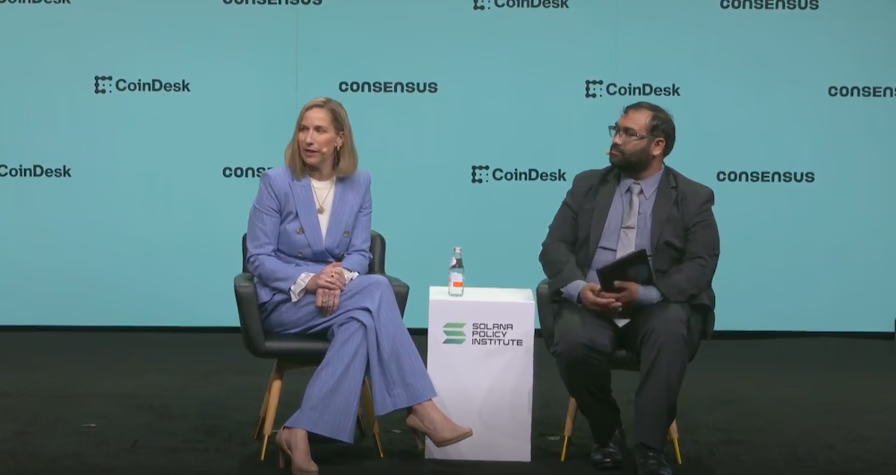
The CLARITY crypto market structure bill could see a markup in the US Senate Banking Committee as early as next week, according to Kara Calvert, the vice president of US policy at crypto exchange Coinbase.
“My prediction is that we have a markup next week,” Calvert told the audience at the Consensus 2026 crypto industry conference in Miami, Florida.
She said that the bill needs at least 60 votes to pass in the Senate and that the CLARITY bill needs bipartisan support to become law. She said:
“That means you need Democrats. You need a bipartisan bill, and we have all been working really hard to make sure that bipartisanship holds. I think the big question is, how do these votes shape up over the next few days?”
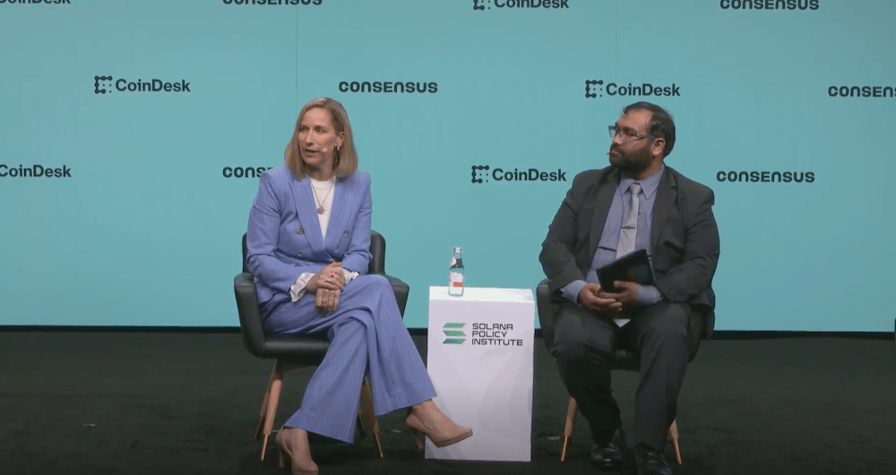
Kara Calvert, pictured on the left, provides an update on the CLARITY market structure bill. Source: Consensus 2026
A HarrisX survey on Thursday revealed that there is strong, broad-based and consistent demand for clear federal rules. A 70% majority of voters say the US should already have passed clear cryptocurrency legislation, and 62% say it is important that the US set the global rules for digital finance.
The CLARITY bill stalled in January after Coinbase withdrew its support for the legislation, citing several concerns, including a lack of legal protections for open source software developers, a prohibition on stablecoin yield, and decentralized finance (DeFi) regulations.
Related: US senator says crypto market structure vote may happen by August
Coherent tax policy remains a barrier to institutional adoption
A lack of coherent tax policies is the main “barrier” to institutional crypto adoption, Calvert said, adding that tax reform is a bigger issue for institutions than market structure legislation.
Many of these institutions just want to buy and hold cryptocurrencies or trade digital assets, but are burdened by tax compliance and reporting requirements, she said.
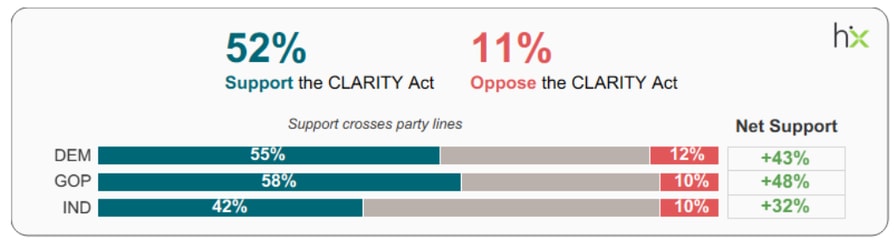
A HarrisX poll shows there is broad bipartisan support for passage of the CLARITY Act. Source: HarrisX
Tax reporting requirements under the current regulations mean the Internal Revenue Service (IRS) forces crypto exchanges to document every crypto transaction using 1099-DA forms, she added.
“We’re sending out millions of 1099-DA’s for things like $1 transactions — that makes zero sense,” Calvert said.
She added that she “hopes” tax reform legislation can advance through Congress in 2026, citing several crypto tax proposals submitted by US lawmakers, including the Digital Asset PARITY Act, introduced by Representatives Max Miller and Steven Horsford in March.
“I think that we will see action in the Senate. I think we will see legislation, probably in the next month or two, in the House,” she said.
Update (May 7 at 9:47 PM UTC): This article has been updated to include a statement from Binance.
The US Department of the Treasury reportedly demanded that Binance follow a monitoring program put in place by a 2023 deal between authorities and the cryptocurrency exchange, following reports that the company facilitated $1 billion to entities tied to Iran.
According to a Thursday report by The Information, the Treasury Department “privately demanded” that Binance be in compliance with a monitoring program to which it had agreed after reaching a deal with US authorities in 2023. The deal, which included a $4.3 billion settlement with Treasury and the US Department of Justice, required Binance to comply with a three-year monitoring program overseen by government officials.
The reported letter from Treasury followed reports that Binance fired individuals responsible for telling the exchange’s executives that $1 billion flowed through the platform to entities tied to Iran. A group of senators followed, urging Treasury Secretary Scott Bessent to report on Binance’s adherence to the 2023 settlement.
“Binance is committed to cooperating with the independent monitor and our ongoing collaboration with relevant agencies,” a spokesperson for the exchange told Cointelegraph in response to the report. The spokesperson said:
“We welcome constructive feedback from the Treasury and view this oversight as an important part of continuously strengthening our compliance and anti-money laundering controls. We are providing the monitor with full cooperation and transparency.”
Binance’s ties to the Trump administration have come under scrutiny since a United Arab Emirates-based entity invested $2 billion in the crypto exchange using the USD1 stablecoin issued by World Liberty Financial, the company co-founded by US President Donald Trump and his sons. Trump also pardoned former Binance CEO Changpeng Zhao in October 2025.
Related: US authorities freeze $344M in crypto linked to Iran
Zhao pleaded guilty to one felony charge related to failure to maintain an anti-money laundering regime at Binance as part of the 2023 settlement.
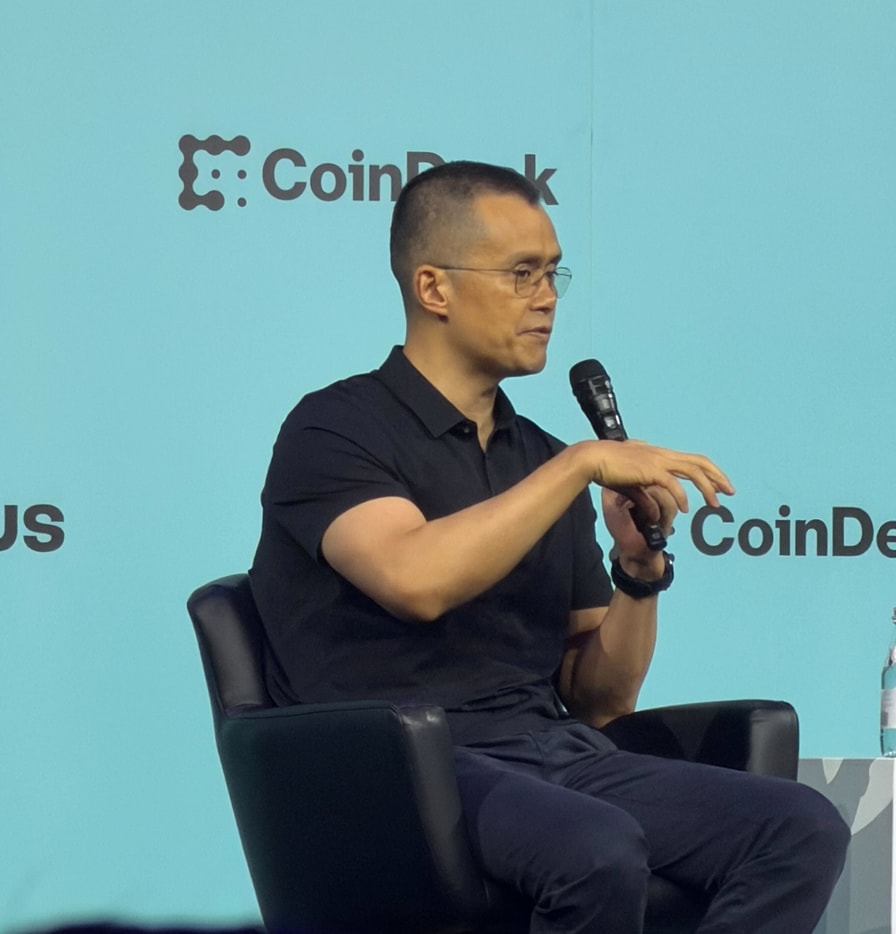
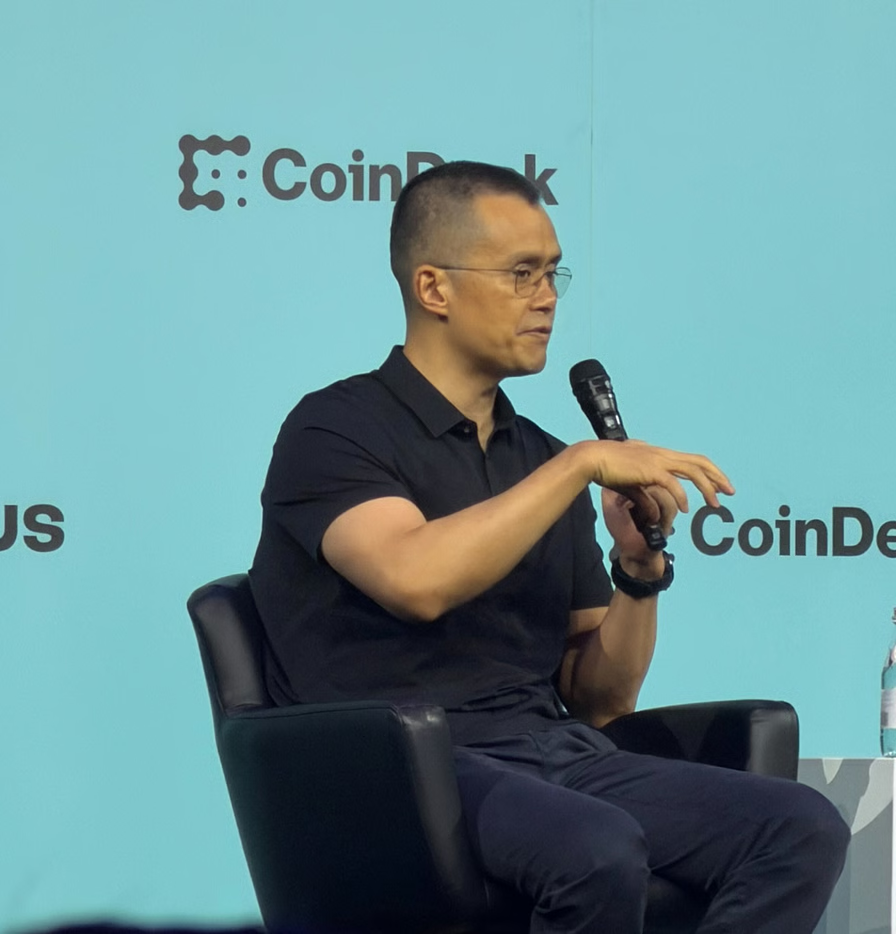
Changpeng Zhao speaking at Consensus on Thursday. Source: Cointelegraph
Zhao rules out leading another crypto company
The Information’s report coincided with Zhao’s appearance at the Consensus conference in Miami on Thursday.
The former CEO said he had been “trying to avoid [the] US” but floated the idea of revitalizing Binance.US to give users access to global liquidity. He also dismissed the idea of being in a leadership role at a crypto company again, having resigned as Binance CEO in November 2023.
“I don’t think I’ve got the stamina to run another startup, to lead another company,” said Zhao. “I’m a one-trick pony. I’m okay with that level. I’m done.”
Magazine: Guide to the top and emerging global crypto hubs: Mid-2026

TLDR
- 21Shares launched the 21Shares Canton Network ETF on Nasdaq under the ticker TCAN.
- The ETF provides direct exposure to Canton Coin, the native token of the Canton Network.
- The Canton Network focuses on privacy-preserving blockchain infrastructure for institutional finance.
- Major firms, including Goldman Sachs, Microsoft, and DTCC, support Digital Asset, the network’s primary developer.
- The launch adds to a growing list of crypto exchange-traded funds in the United States.
A new Crypto ETF began trading on Nasdaq as 21Shares launched the 21Shares Canton Network ETF under ticker TCAN. The fund offers direct exposure to Canton Coin, the native token of the Canton Network. The listing expands the range of crypto-linked exchange-traded products in the United States.
Crypto ETF Expands Access to Canton Coin
21Shares listed the 21Shares Canton Network ETF on Nasdaq on Thursday under the ticker TCAN. The Crypto ETF gives investors direct exposure to Canton Coin, which powers the Canton Network. The firm said the product marks the first U.S. ETF tied directly to the token.
Canton Coin serves as the utility token for the Canton Network, which focuses on institutional finance use cases. The network supports privacy-preserving transactions and data management across financial markets. Major firms, including Goldman Sachs, Microsoft, and DTCC, support Digital Asset, the network’s primary developer.
Andres Valencia, executive vice president of investment management at 21Shares, addressed the launch in a statement. He said, “The Canton Network has attracted strong institutional interest given its focus on privacy-preserving infrastructure for capital markets.” He added that backing from Nasdaq, Moody’s, and Deloitte reflects confidence in shared blockchain infrastructure.
Valencia stated, “When you see names like Nasdaq, Moody’s, and Deloitte supporting a common blockchain infrastructure, you are looking at infrastructure that has the potential to reshape how data and capital move across global markets.” He linked the ETF launch to that institutional support. The company confirmed that TCAN seeks to track the performance of Canton Coin.
TCAN joins a growing list of crypto exchange-traded funds that launched over the past year. Fund issuers have introduced products tied to SOL, XRP, DOGE, HBAR, and Polkadot. As a result, the U.S. market now offers broader access to digital asset exposure through regulated vehicles.
Regulatory Shift Fuels Crypto ETF Growth
The U.S. Securities and Exchange Commission oversees approvals for exchange-traded funds, including crypto products. Since January 2025, the agency has taken a more supportive stance toward digital assets. President Donald Trump returned to office that month and appointed Paul Atkins as SEC Chairman.
Chairman Atkins has moved to clarify the agency’s position on cryptocurrencies. The SEC issued guidance stating that most cryptocurrencies do not qualify as securities. That position has influenced the pace of Crypto ETF filings and approvals.
Market participants have responded with new applications and product launches. As a result, issuers continue to expand offerings across different blockchain networks and tokens. The debut of TCAN adds another fund to the expanding lineup of crypto-linked ETFs trading on U.S. exchanges.

Driven by the green wave sweeping the entire crypto market, Solana’s native token briefly pumped above $90, reaching its highest level in the past 20 days.
Currently, the asset appears to be at a crossroads, with some analysts calling for a pump above $100, while certain indicators signal an impending correction.
In the Middle of a Breakout?
According to the popular analyst Ali Martinez, SOL is undergoing a bullish breakout and seems to be escaping a symmetrical triangle to the upside. He believes that a spike in buying pressure could send the price to $92 or even $96. However, traders may need to hope for a potential push to the upper boundary, as the analyst recently argued that anything within the $77-$94 range falls into a “no-trade” zone.
Other market observers who touched upon Solana’s performance and made predictions include X users Julian and Wealthmanager. The former noted the volatility lately, but claimed that buyers remain active. They described $85 as an important support level, adding that if SOL stays above $90, it could see another move higher.
Additionally, the strategist outlined that Solana’s biggest strengths lie in its consistently high network usage, driven by strong meme coin trading activity, a large number of active users, and fast, low-cost transactions.
“Short-term moves can still be aggressive, but in the bigger picture, SOL still looks like one of the strongest coins in the market,” they concluded.
WealthManager was even more bullish, forecasting that a pump to the psychological milestone of $100 is “just a matter of time.”
Time to Cool off?
Certain technical indicators, such as Solana’s Relative Strength Index (RSI), suggest that the bears may soon retake control. The ratio recently jumped to 80 before slipping to the current 66, which is quite close to overbought territory. The index runs from 0 to 100, and conversely, anything under 30 is typically seen as a precursor of a rally.

Next on the list is the rising amount of SOL tokens being transferred from self-custody to centralized exchanges lately. This is considered a bearish factor since it increases the immediate selling pressure.

Meanwhile, the analytics platform Lookonchain revealed that a newly created wallet opened a 20x short position on 240,000 SOL worth more than $21 million. Such an aggressive bet against the asset could weigh on sentiment, as it suggests that the person or entity may be acting on information of upcoming news or events that retail investors don’t have access to.
The post Solana (SOL) Reaches a 3-Week High: Is $100 Just a Matter of Time? appeared first on CryptoPotato.
Michael Saylor’s comment this week that Strategy might sell portions of its Bitcoin holdings, is a decision that gives the BTC treasury company Strategy, optionality, according to BTC advocate Samson Mow.
“Never selling limits optionality. Public markets are war. In war, you need all available tools at your disposal,” Mow said after company co-founder Saylor’s comment during Strategy’s first-quarter earnings call on Tuesday. That the company might sell some BTC in the future, Mow added:
“The more tools Strategy holds, the fewer angles its adversaries have. A company with real optionality is hard to game: it might sell, hedge, issue, or buy. A company that has publicly vowed to only ever do one thing has handed a map to short sellers and arbitrageurs.”
Strategy is the largest publicly traded Bitcoin treasury company, according to BitcoinTreasuries, and holds 818,334 BTC at the time of this writing, and any potential sales could weigh on spot BTC market prices, according to some crypto market analysts.

Strategy’s total BTC holdings over time. Source: Strategy
Related: Strategy takes Bitcoin buying breather ahead of Q1 earnings report
As he signals potential BTC sales, Saylor says company can fund dividends “forever” on BTC alone
“We’ll probably sell some Bitcoin to fund a dividend, just to inoculate the market, just to send the message that we did it,” Saylor said during the earnings call.
He said that if the price of BTC appreciates by more than 2.3% annually, the company can fund its dividends “forever” and would also allow Strategy to pay dividends “without selling a single share of stock.”
“We could stop selling MSTR common stock right now,” Saylor said, adding, “We can fund the dividends with Bitcoin sales.”

Saylor discusses paying dividends using BTC appreciation. Source: Strategy
If the company can issue more of its STRC preferred stock and BTC rises above the breakeven level, it would be able to fund dividends indefinitely, while also continuing to increase the amount of BTC it holds, Saylor said during the earnings call.
The average cost of Strategy’s BTC holdings is $75,537 apiece, according to the company’s website. At last look on Thursday, Bitcoin was changing hands at about $79,976, according to CoinMarketCap.
Strategy funds its BTC purchases through a mixture of corporate debt and equity instruments, a practice that has raised concerns with some investors over shareholder dilution and leverage-fueled buying.
Magazine: Bitcoin’s ‘biggest bull catalyst’ would be Saylor’s liquidation: Santiment founder

Bold and the Beautiful: Brooke Erupts After Hope Runs to Logan!

H&M Studio and Premium Selection: Are they worth the extra cost?

Investigation after man found dead in field

Manchester United reach agreement with Casemiro over contract clause amid transfer speculation

US brings back mandatory military draft registration

Steven Gerrard disagrees with Gary Neville over ‘shock’ Chelsea and Arsenal claim | Football


-

 NewsBeat4 days ago
Channel 5 – All Creatures Great and Small series 7 new post
-

 Crypto World15 hours ago
Upbit adds B3 Korean won pair as Base token gains Korea access
-
 Tech6 days ago
Trump’s 25% EU auto tariff breaches Turnberry Agreement that also covers semiconductors and digital trade
-
 NewsBeat17 hours ago
NCP car park operator enters administration putting 340 UK sites at risk of closure
-
 Sports6 days ago
Paul Scholes issues Marcus Rashford reality check as agreement emerges over Man United star
-

 Entertainment6 days ago
Met Gala 2026 Rumored Guest List Is Turning Heads
-

 Business7 days ago
Strait of Hormuz Blockade Persists Amid US-Iran Standoff, Sending Oil Prices Soaring
-
Entertainment6 days ago
New on Prime Video in May 2026 — Full List of Movies and Shows
-

 Tech7 days ago
Meta ends Sama contract after Kenyan workers report seeing intimate footage from Ray-Ban smart glasses users
-

 Entertainment6 days ago
Kylie Jenner Hit With Second Lawsuit From Ex-Housekeeper
-

 Sports6 days ago
Cavaliers vs. Raptors Game 6 live score, updates, highlights from 2026 NBA playoffs first-round series
-
 Sports6 days ago
David Benavidez responds to team Canelo saying the fight will never happen
-
 Sports6 days ago
IPL 2026: ‘Love you darling’- Hardik Pandya’s reaction to MS Dhoni steals the show |Watch | Cricket News
-

 Entertainment6 days ago
Young and the Restless Next Week: Cane Arrested & Matt’s Deadly New Scheme!
-
Entertainment5 days ago
New Netflix Movies in May 2026 — My Top 3 Picks to Stream
-

 Entertainment5 days ago
Melissa Joan Hart and More Stars Attend 2026 Kentucky Derby
-

 Business5 days ago
Luka Doncic Injury Update: Doncic’s Hamstring Recovery Slows Lakers’ Hopes Against Thunder: Can He Run Yet?
-
Crypto World5 days ago
Pi Network Mandates Protocol 23 Upgrade for All Mainnet Nodes Before May 15 Deadline
-

 Sports7 days ago
What Preity Zinta Said After Punjab Kings’ First Defeat Of IPL 2026
-

 Crypto World5 days ago
Bitcoin mining equities rise in 2026 as BTC lags behind
You must be logged in to post a comment Login