
Crypto World
Hedera (HBAR) Price Breaks Out In Preparation for 60% Rally

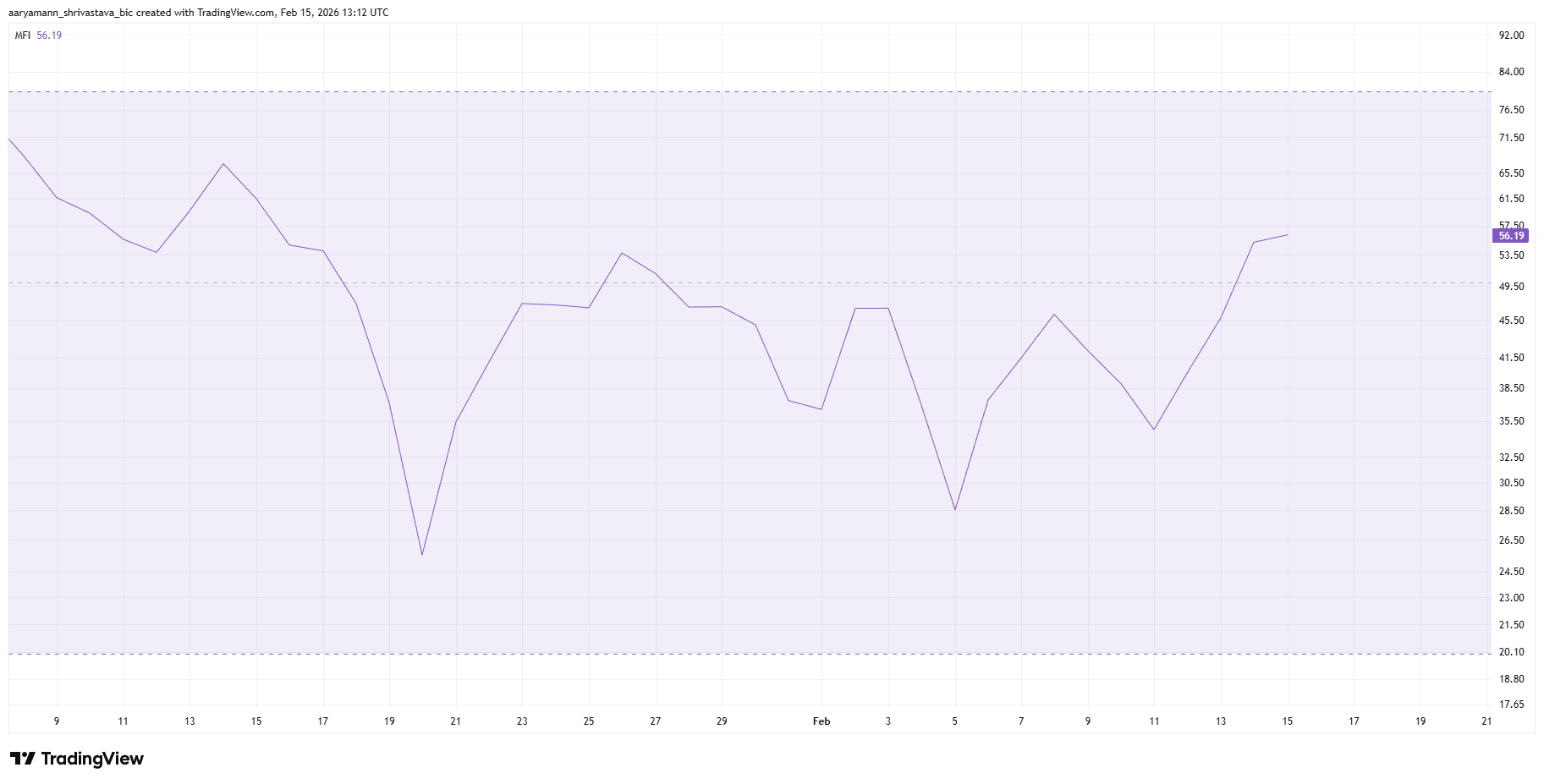
Hedera price has surged in recent sessions, positioning HBAR for a breakout from a bullish chart pattern.
The recent move reflects improving sentiment across select altcoins. However, breakouts require follow-through buying.
Sponsored
Sponsored
HBAR Investors Are Buying
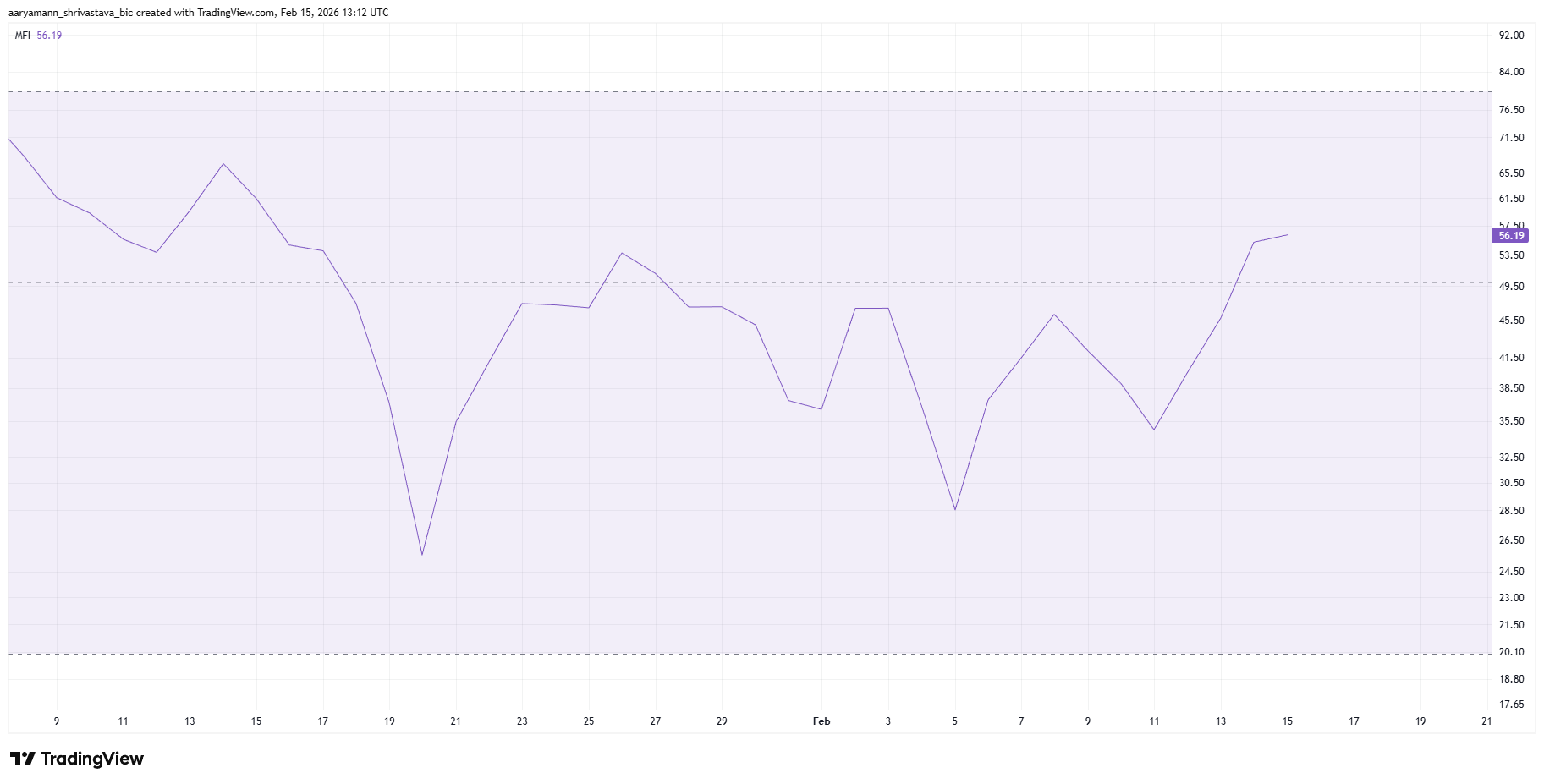
The Money Flow Index indicates rising buying pressure for HBAR. The indicator has trended upward, signaling that capital is flowing back into the asset. Strengthening MFI readings often reflect growing demand during early recovery phases.
Investors appear to be accumulating as the price begins to climb. Increased participation provides liquidity support and reinforces bullish structure. If buying pressure continues building, HBAR could maintain upward momentum beyond near-term resistance.
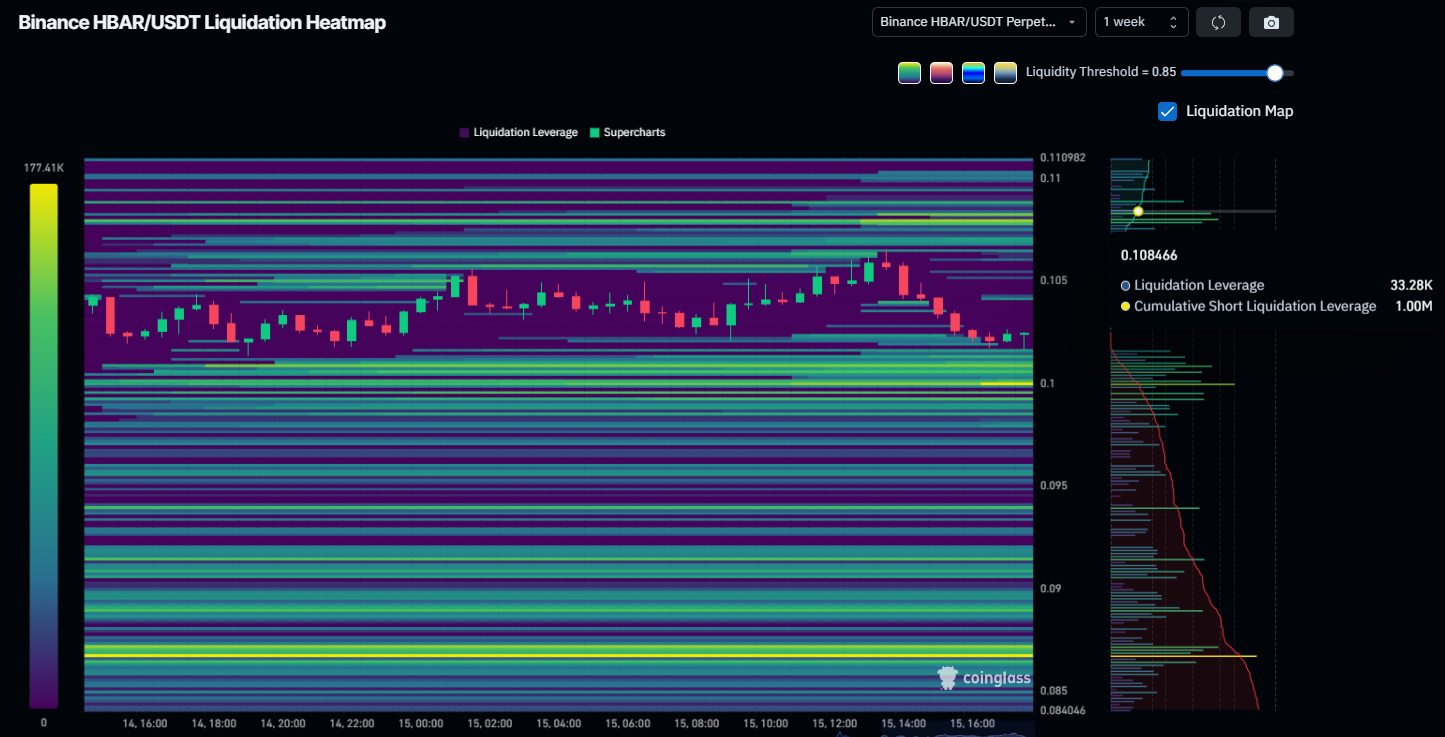
The liquidation heatmap highlights $0.1084 as a critical level. Around that range, approximately $1 million worth of short positions could face forced liquidation. A move through this zone would likely accelerate upside volatility.
Short liquidations often create rapid price spikes. When bearish traders are forced to cover positions, buying pressure intensifies. For HBAR, clearing $0.1084 could serve as a catalyst for extended gains.
Sponsored
Sponsored
However, investors must sustain bullish momentum until that level is reached. Without steady accumulation, the market may struggle to generate the necessary pressure. Breakout durability depends on consistent inflows and reduced profit-taking.
HBAR Price Needs To Secure Support
HBAR price is trading at $0.1025, pressing against the $0.1030 resistance. Securing this level as support would confirm a breakout. However, a decisive close above resistance could shift sentiment toward sustained recovery.
The token has been moving within a descending broadening wedge. This formation projects a potential 57% rally upon confirmation. While that projection signals strong upside potential, a more realistic target lies near $0.1234, which would recover recent losses.
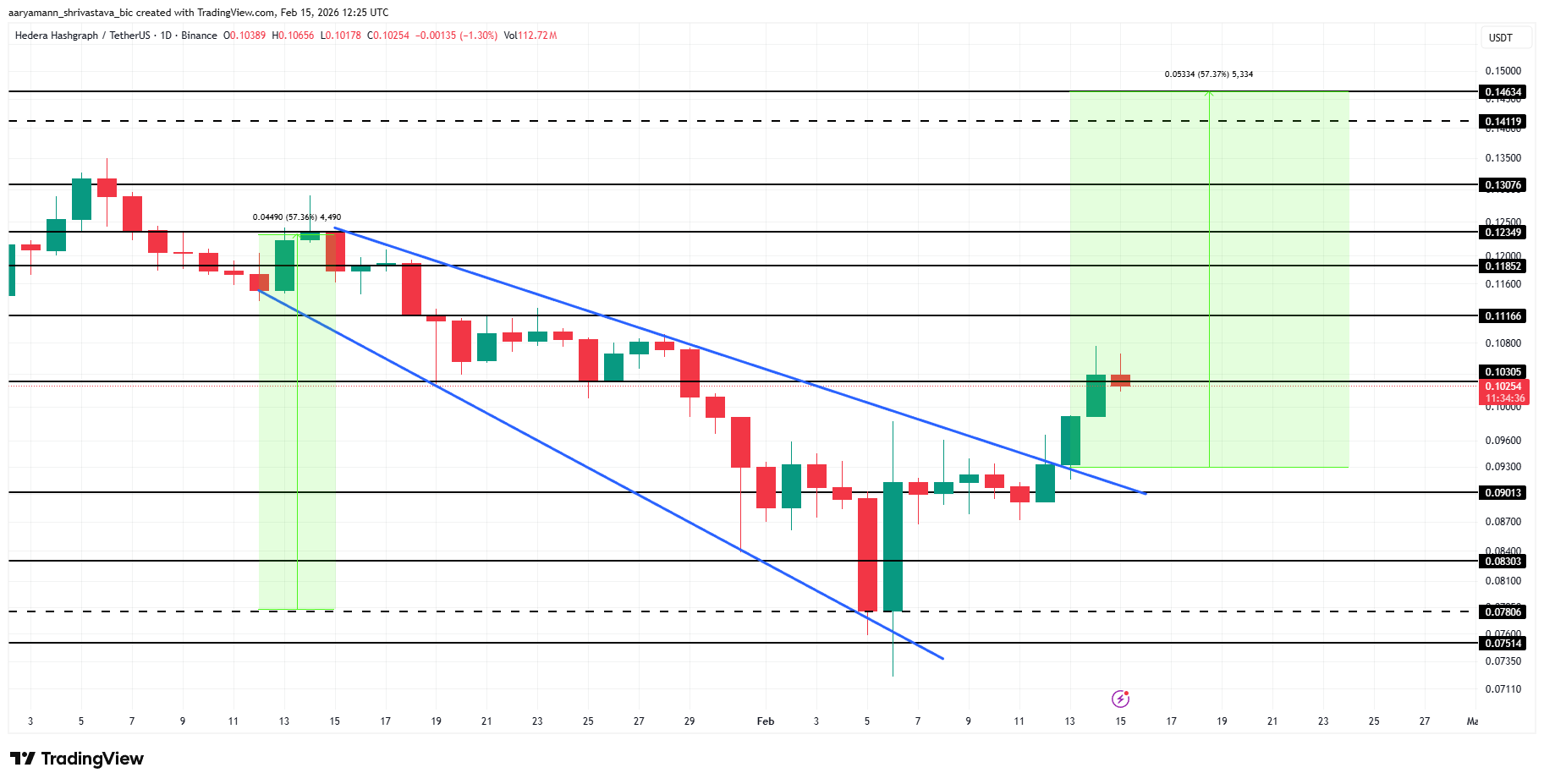
On the other hand, if investors begin booking profits prematurely, downside risk increases. A pullback toward $0.0901 support would invalidate the bullish thesis. Going forward, maintaining buying pressure remains essential for Hedera’s price to extend gains and sustain breakout momentum.


Bitcoin briefly touched a fresh intra-day high near $68,589 as markets absorbed a mix of geopolitics and macro signals. The move came alongside a broad risk-on rally in U.S. equities, with the Dow Jones Industrial Average climbing more than 1,125 points, the S&P 500 rising around 2.9%, and the Nasdaq advancing about 3.8%. The day’s headlines centered on chatter about ending a war involving the United States, Israel and Iran, buoying sentiment even as traders remained wary of sustaining gains in the crypto market.
On Tuesday, The Wall Street Journal reported that President Trump told aides he could consider ending the conflict with Iran, with the Strait of Hormuz partially open but no formal statement issued. Separately, unconfirmed reports attributed to Iranian President Masoud Pezeshkian suggested Tehran might be seeking a path to exit the war, though such remarks have not been independently verified. Whether the statements prove reliable or not, they contributed to a mood shift that encouraged risk-taking across traditional markets, even as crypto traders kept their expectations in check.
Despite the synchronized bounce in risk assets, observers caution that Bitcoin’s ability to sustain the breakout remains uncertain. Analysts cited by Cointelegraph highlighted that a daily close above the 50-day moving average near $68,879 would be a meaningful signal of a potential trend shift. From there, some see room for a liquidity-driven extension toward approximately $82,000, but only if buyers step in with durable, directional commitments rather than headline-driven moves.
Key takeaways
- Bitcoin briefly rose to about $68,589 as geopolitical and macro headlines supported a risk-on backdrop.
- U.S. equities logged a broad rally: the Dow up by more than 1,125 points, the S&P 500 up roughly 2.91%, and the Nasdaq up about 3.83%.
- Analysts say a daily close above the 50-day moving average near $68,879 would mark a potential trend change and could unlock further upside if leveraged players unwind or cover shorts.
- Crypto traders remained skeptical of a durable breakout, with much price action driven by headlines, equities, and perpetual futures rather than sustained buy-side conviction in spot markets.
- Cointelegraph notes point to flat open interest in futures and weak spot demand since the Feb. 6 sell-off below $60,000, alongside short-term traders selling below cost basis around $85,800 and stablecoin inflows near a two-year low.
The market backdrop: what’s really pushing the price action
In the broader market, the relief rally follows a period of heightened attention to policy and conflict dynamics. The weekend and early-week headlines suggested at least a possibility of de-escalation, with Trump’s communications and unconfirmed statements from Iranian leadership contributing to a mood swing that benefited risk assets. However, the cryptocurrency market did not display the same confident impulse that characterized equities, underscoring a divergence between macro optimism and crypto-specific demand.
In a sense, Bitcoin’s price trajectory remains tethered to a mix of headline risk and technical thresholds. The $68,879 level—the approximate 50-day moving average—has emerged as a practical line in the sand. A daily close above that level would be interpreted by many traders as a sign that bullish momentum can persist beyond a few sessions. Conversely, failure to clear that barrier could reinforce a rangebound pattern, leaving BTC prone to whipsaws tied to news flow and broader market sentiment.
Analysts highlighted that the market’s appetite for directional bets remains constrained. The research notes that a lack of durable bid depth—evidenced by flat open interest in Bitcoin futures and tepid spot demand since the February dip below $60,000—suggests most price moves are driven by news and correlated markets rather than a broad base of new buyers. This posture makes BTC more vulnerable to abrupt reversals if headlines turn sour or if macro conditions deteriorate again.
What traders are watching next
Beyond the immediate friction at the $68,879 threshold, traders are watching for clearer signals from both the spot and futures markets. A sustained move past that line could invite a liquidity-driven push higher if liquidations and stop-orders align to reinforce the breakout. In practice, that would require a broad shift in investor posture—from cautious footing to active accumulation among spot buyers and ETF-like vehicles, if applicable in the current market environment.
On the technical front, the next real milestones are shaped by volatility regimes and risk tolerance. If Bitcoin can establish a daily close above the 50-day moving average, buyers may gain confidence to press toward higher targets. If not, the picture could tilt back toward consolidation, with traders awaiting a fresh catalyst to re-ignite momentum. This dynamic underscores a larger question facing the crypto market: will the current price action translate into durable demand, or will it remain a series of episodic rallies tethered to headlines?
On-chain signals add nuance to the story. Cointelegraph highlighted that stablecoin inflows to exchanges are near a two-year low, which generally signals a cautious stance among traders. Simultaneously, open interest in Bitcoin futures and spot demand have remained flat since the Feb. 6 decline, reinforcing the impression that the market is not currently laying down strong directional bets. These indicators suggest that even as price moves translate into headlines-based enthusiasm, the fundamental bid for Bitcoin remains restrained—a critical factor for readers weighing whether this rally has legs or is likely to falter.
For investors and builders, the unfolding scenario offers a key lesson: headlines can temporarily lift risk assets, but the path to sustained upside in BTC depends on a credible, durable bid from market participants across the full spectrum of the ecosystem. In this context, the potential for a broader move will hinge not just on geopolitical optics but on the crypto market’s ability to attract real spot demand and to overcome the structural restraint that has characterized the current cycle.
Looking ahead: uncertainty and the path forward
While the Wall Street Journal’s report on possible de-escalation added a narrative tailwind, the absence of official confirmation means markets remain in a wait-and-see posture. For Bitcoin, the critical test remains whether buyers can sustain a move beyond the near-term technical ceiling and ignite a longer-lasting uptrend. Until then, the price action could continue to reflect a tug-of-war between headline-driven optimism and the more cautious posture seen in on-chain metrics and spot-market activity.
Readers should watch for any tangible policy developments that could shape risk appetite and for evidence of improving spot demand, not just speculative leverage. In the near term, the absence of a clear bid from the spot market and muted open interest imply that BTC could continue to drift within a familiar range until a decisive catalyst emerges.
As markets digest these signals, the next few sessions may reveal whether the current optimism has a durable basis or if crypto markets will revert to a more cautious stance as the macro and geopolitical backdrop evolves. The balance between headlines, technical levels, and real demand will determine whether BTC can translate short-term enthusiasm into a sustained move higher or retreat to the lower end of its recent trading band.


Key takeaways
- Binance’s BNB is down 4.5% in the last 24 hours and now trades below $590.
- The bearish performance comes as President Trump threatens to attack Iran’s power plants.
BNB (formerly Binance Coin) is currently trading below $585 as of Thursday, continuing its three-week decline.
The correction has deepened following US President Donald Trump’s statement that the ongoing US-Iran conflict could last until late April, which has dampened investor sentiment towards riskier assets.
From a technical standpoint, momentum indicators are signaling a potential for further downside in BNB.
Trump’s remarks weigh on market sentiment
Bitcoin, Ether, BNB, and XRP are in the red after President Trump warned on Wednesday that the US-Iran war could extend until late April. He also threatened to target Iranian power plants and stated that Iran would be sent back to the “Stone Age” if an agreement is not reached.
These statements have tempered hopes for de-escalation, further reducing investor appetite for riskier assets. As a result, the US Dollar (USD) and oil prices have strengthened, while US equities and other high-risk assets have come under pressure.
Retail interest in BNB has also declined in recent days. According to CoinGlass, BNB’s long-to-short ratio reads 0.80 on Thursday, its lowest point in a month.
A ratio below one indicates bearish market sentiment, with traders betting on a further decline in BNB’s price.
BNB could dip to February’s low
The BNB/USD 4-hour chart is bearish and inefficient as BNB has underperformed in recent days.
Currently, BNB is trading well below the 50-day, 100-day, and 200-day Exponential Moving Averages, which all trend higher above the current price and frame a broader bearish backdrop.
The Relative Strength Index (RSI) on the 4-hour chart reads 42, below the neutral 50, indicating a bearish bias. The Moving Average Convergence Divergence (MACD) is also drifting deeper below the zero, signaling persistent selling pressure rather than a completed downside exhaustion.

If the bearish trend persists, BNB will retest the initial support at $570.16 (February’s low). A break below this level would open the way toward lower daily lows and deepen the corrective phase toward the key psychological level at $500.
However, if the bulls regain control of the market, they would encounter immediate resistance at $697, in line with the descending EMAs.
A sustained recovery above this barrier would be needed to ease the current bearish tone and expose the next resistance at $790.79.

Polymarket, the prediction-market platform, rolled out a broadened fee model on March 30, expanding taker fees beyond crypto and sports to a wider array of categories. In the days that followed, metrics tracked by DefiLlama show a sharp rise in on-platform activity monetized through fees, with daily trading fees crossing the $1 million mark on Wednesday and Thursday. Revenue after incentives climbed to as high as $995,000 on Wednesday before easing to roughly $899,000 on Thursday. The shift underscores how Polymarket is recalibrating its economics to lock in ongoing investor interest amid intensifying regulatory scrutiny.
The broadening of the fee schedule coincides with a deliberate push to monetize activity more aggressively. Polymarket expanded taker fees to categories such as finance, politics, economics, culture, weather and tech, while keeping geopolitical and world events free of fees. The core idea appears to be extracting more value from routine trading activity, a move that aims to sustain liquidity and growth even as jurisdictions around the world tighten oversight of prediction markets. Data from DefiLlama illustrates the immediate impact: daily fees surged from about $363,000 on Monday to more than $1 million on midweek days, with revenue after incentives peaking at near $1 million on Wednesday before settling lower on Thursday.
Key takeaways
- DefiLlama data show Polymarket’s daily fees jumped from roughly $363,000 to over $1 million in the days after the March 30 fee overhaul, signaling a dramatic monetization shift.
- Revenue after incentives rose to as high as about $995,000 on one day, then moderated to around $899,000 on the following day, reflecting how the new fees translate into platform economics.
- The fee expansion added taker charges across more categories—finance, politics, economics, culture, weather and tech—while keeping geopolitical and world-events fees free.
- Regulatory pressure remains a core driver of strategy, with ongoing limits on access in multiple jurisdictions and actions by U.S. states, even as investor interest persists.
Regulatory pressure tightens across borders
The surge in Polymarket’s fees arrives amid a broader regulatory crackdown on prediction markets across Europe, North America and beyond. In Europe, the platform has faced mounting restrictions as regulators argue that it operates as an unlicensed gambling venue in several jurisdictions. Hungary and Portugal, for example, moved to block or limit access in January over licensing concerns and, in Portugal’s case, questions around political betting. These frictions complicate user acquisition and liquidity, even as demand for event-based markets remains visible among certain trader cohorts.
Other notable developments illustrate the global regulatory tension. In Argentina, a court order issued on March 17 ordered a nationwide ban on Polymarket, contending that the platform allowed users to place bets without sufficient identity and age verification, raising concerns about accessibility for underage users. Polymarket’s own geoblock information indicates the platform is currently blocked in 33 countries, a figure that underscores the cross-border compliance challenges faced by the operator. Kalshi, a competing prediction market, reports even broader restrictions, stating it is banned in 52 jurisdictions.
Across the United States, the regulatory environment remains unsettled. At least 11 states have taken legal action against prediction markets such as Polymarket and Kalshi, with cease-and-desist orders or new legislative proposals under consideration in several states. Despite these crackdowns, both platforms have signaled an ability to pursue expansion, with reports of potential large-scale fundraising rounds that could value each platform around $20 billion. The tension between growth ambitions and regulatory risk continues to shape the trajectory of the sector.
In late March, Polymarket and Kalshi introduced new trading restrictions aimed at curbing insider trading after criticism about well-timed bets and concerns about market integrity. The reform push signals a desire to bolster trust in event markets while navigating a landscape where regulators are increasingly vigilant about preemptive positions and information asymmetries.
Investor interest persists amid a risk-laden backdrop
The interplay between monetization, regulatory risk and investor sentiment remains delicate. The private investment narrative around Polymarket received a high-profile boost when Intercontinental Exchange, the parent of the New York Stock Exchange, reportedly invested about $600 million in Polymarket last week. The move underscores a sustained interest from large financial players in the potential of structured prediction markets, even as the sector contends with licensing, anti-gambling, and consumer-protection concerns in key markets.
On the funding side, both Polymarket and Kalshi are rumored to be exploring new rounds that could push their valuations into the tens of billions of dollars, highlighting a long-term belief among some investors that event-based markets can scale beyond their current regulatory envelopes. The ongoing push for expansion, paired with legal scrutiny, creates a dynamic where monetization levers, compliance, and user protection must co-evolve to maintain liquidity and participation.
As a matter of policy and practicality, March 24 saw explicit steps to address market integrity concerns through tightened trading rules, setting a precedent for how similar platforms might balance rapid growth with stronger oversight. The broader market will continue to watch how regulators respond to these shifts, whether geoblocking efforts intensify, and how exchanges balance revenue opportunities with responsible operator practices that protect users and maintain fair markets.
Readers should stay attentive to regulatory updates, particularly in Europe and the United States, where the legal status of prediction markets remains unsettled in several jurisdictions. The evolution of Polymarket’s fee model, alongside liquidity dynamics and enforcement actions, will likely shape how users engage with event-based markets in the coming months and whether investor appetite for large-scale funding rounds sustains the sector’s momentum.
What to watch next: regulatory clarity in key jurisdictions, the sustainability of elevated fee-driven revenue, and whether the ongoing confluence of large-cap investment and stricter market rules will redefine how forecast markets operate at scale.
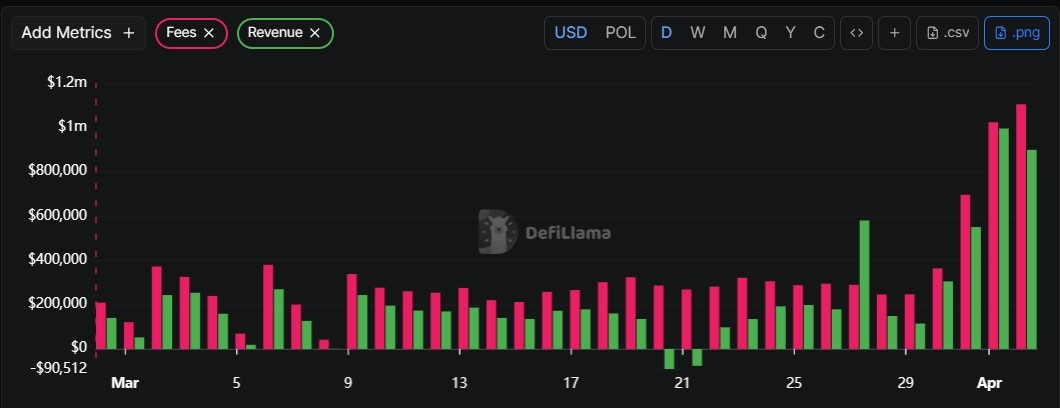
Prediction market Polymarket’s recent fee expansion has started to affect its numbers, with daily fees and revenue climbing sharply in the days following a March 30 price overhaul.
According to DefiLlama data, daily fees rose from about $363,000 on Monday to over $1 million on both Wednesday and Thursday, while revenue (the portion retained after incentives) reached as high as $995,000 on Wednesday before easing to about $899,000 on Thursday.

The jump follows the rollout of a broader fee model on Monday, when the platform expanded taker fees beyond crypto and sports to categories including finance, politics, economics, culture, weather and tech, while keeping geopolitical and world events fee-free.
The spike shows how aggressively Polymarket is monetizing trading activity to maintain continued investor interest amid regulatory scrutiny in the US, Europe and other countries worldwide. Last week, Intercontinental Exchange, the parent company of the New York Stock Exchange, invested $600 million in Polymarket.
Prediction markets face growing regulatory scrutiny
The fee and revenue spike comes as prediction markets, including Polymarket, face growing regulatory scrutiny across multiple jurisdictions.
In Europe, Polymarket has faced mounting restrictions, with Hungary and Portugal moving to block or limit access in January over concerns that the platform operates as unlicensed gambling. Regulators in both countries cited licensing issues and, in Portugal’s case, concerns around political betting.
Related: Peter Brandt, Polymarket traders don’t see new Bitcoin highs this year
On March 17, a court in Argentina ordered a nationwide ban on Polymarket, arguing that the platform allowed users to place bets without sufficient identity and age verification. The court said this meant that even children and adolescents could access the platform and place bets without any control.
According to Polymarket’s website, the platform is currently blocked in 33 countries. Kalshi, on the other hand, reports that it’s banned in 52 jurisdictions.

In the United States, at least 11 states have taken legal action against prediction markets such as Polymarket and Kalshi, with several issuing cease-and-desist orders or considering new legislation.
Despite regulatory crackdowns, Polymarket and Kalshi are looking to expand, with both reportedly exploring new funding rounds that could value each platform at around $20 billion.
On March 24, Polymarket and Kalshi introduced new trading restrictions to curb insider trading following criticism over well-timed bets and growing concerns around market integrity.
Magazine: Are DeFi devs liable for the illegal activity of others on their platforms?


Key takeaways
- BTC is down 2%, erasing the recovery earlier this week,
- US-listed spot ETF recorded an outflow of $173.73 million on Wednesday, breaking its two days of inflow this week.
Bitcoin faces continued losses amid weaker institutional demand
Bitcoin (BTC) prices continued to decline on Thursday, trading below $67,000, almost completely erasing the recovery from earlier in the week. Institutional demand also appears to be faltering, as spot Exchange Traded Funds (ETFs) experienced a significant outflow of over $173 million on Wednesday, ending a two-day streak of inflows.
This decline in demand coincides with a growing sense of bearish sentiment in the market, which is further amplified by US President Donald Trump’s recent remarks suggesting an escalation of the ongoing conflict.
On Wednesday, President Trump addressed the nation, warning that the ongoing conflict could drag on until late April. He stated that the US would take extreme measures over the next two to three weeks, including threats to attack Iranian power plants and send Iran back to the “stone age” if no agreement is reached.
These statements have dampened hopes for de-escalation, which in turn has reduced investor appetite for riskier assets. The US Dollar (USD) and Oil prices have risen as a result, while US equities and other risk assets have suffered, effectively erasing the gains Bitcoin saw earlier this week.
Data from CoinGlass indicates that institutional interest in Bitcoin remains uncertain. Spot Bitcoin ETFs saw a significant outflow of $173.73 million on Wednesday, following two days of positive inflows earlier this week. This suggests indecisiveness among institutional investors, who appear hesitant to increase exposure to risk assets amid ongoing market uncertainty.
According to Glassnode’s weekly report on Wednesday, Bitcoin remains trapped within a broad trading range of $60,000 to $70,000. While the market shows early signs of stabilization, it has not yet shown enough momentum to break decisively in either direction.
The report indicates that Bitcoin’s on-chain conditions reflect a continued period of repair, with elevated supply in loss and long-term holder capitulation still not fully resolved. However, spot demand has shown some improvement, signaling that sellers are not entirely in control of the market anymore.
Bitcoin Price Forecast: BTC could record further losses
The BTC/USD 4-hour chart is bearish and efficient as Bitcoin is trading below $66,400 on Thursday, erasing the recovery from earlier this week. The near-term bias is mildly bearish.
Bitcoin remains capped well below the clustered 50-day, 100-day, and 200-day Exponential Moving Averages (EMAs) between roughly $70,800 and $84,800, which reinforces downside pressure despite the recent bounce attempts.
Currently, the technical indicators are bearish. The Relative Strength Index (RSI) on H4 sits at 51, just above the midline.
The Moving Average Convergence Divergence (MACD) remains below the signal line, indicating persistent selling pressure.
If the market continues its decline, sellers would meet immediate support at $65,900. Breaking this level would expose the key psychological level at $60,000.

On the flipside, if the bulls regain control of the market, they would encounter resistance at the $69,200 level, with the major resistance around $72,600.
A daily close above $72,600 would signal a bullish break from the sideways structure and open the door toward the 100-day EMA near $76,400.


Metaplanet (3350) continued to scale its accumulation strategy through the first quarter of 2026, acquiring 5,075 BTC for approximately $398 million, implying an average purchase price of about $78,000 per coin.
The Tokyo-based firm has has generated a BTC yield of 2.8% year-to-date.
As of March 31, Metaplanet holds a total of 40,177 BTC, acquired for roughly $3.9 billion, with an average cost basis of approximately $97,000 per BTC.
Metaplanet is now the third largest bitcoin treasury company worldwide, overtaking MARA Holdings after the miner reduced its bitcoin stack significantly.
Twenty One Capital (XXI) holds second place with 43,514 BTC, according to Bitcoin Treasuries, while Strategy (MSTR) is by far and away the largest with over 762,000.
Shares of Metaplanet were down 2%, trading at 302 yen ($1.89).
Crypto World
Audit admin keys, not just code, expert says after $200 million Drift exploit: Crypto Daybook Americas
By Omkar Godbole (All times ET unless indicated otherwise)
Programmable blockchain Solana’s SOL token has hit five-week lows after an exploit at one of its largest perpetual decentralized exchange, Drift, underscored that security risks go beyond just smart contracts.
“If you’re building in DeFi, audit the surface area of your admin key. Not only the smart contracts,” Omer Goldberg, founder of Chaos Labs, said, explaining what went wrong.
Goldberg explained in his X thread that the attacker compromised Drift’s admin key. This single key gave the attacker god-like control — like handing someone the master password to the entire bank vault with no limits or alarms.
Using this power, the attacker created a fake collateral market for a worthless token called CVT. They maxed out the risk parameters so the system treated hundreds of millions of this junk token as safe, high-value collateral. In the same transaction, they switched the CVT price oracle to one they fully controlled, artificially pumped its value to sky-high levels, lifted the circuit breakers on major assets (removing withdrawal limits) such as USDC, eETH and others, and drained over $250 million worth of tokens.
This also worked because Drift features a single shared liquidity pool that holds everyone’s collateral and trading funds, providing a seamless trading experience. (Imagine putting all your money in a single bank account and losing everything in a signature hack).
The real issue wasn’t a bug in the code. It was the enormous “surface area” of that admin key, or the massive damage one compromised signer could cause by rewriting protocol-wide risk rules, assigning oracles, and disabling safety guards.
This isn’t the first time a compromised privileged key has led to big losses. Just 10 days earlier, Resolv was drained for $25 million in tokens after attackers compromised a SERVICE_ROLE key.
So, the message is clear: protocol safety now depends as much on strong governance and key controls as it does on smart contract audits.
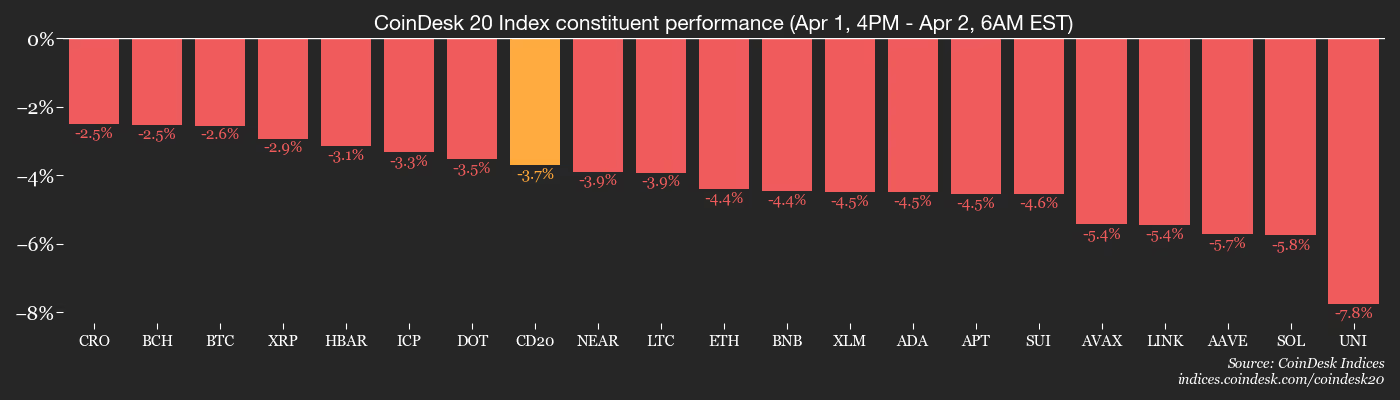
As for markets, SOL’s near 3% drop to $78.30, the lowest since late February, is consistent with the weakness in bitcoin , ether (ETH), XRP (XRP) and the wider market, as represented by the CoinDesk 20 Index.
The culprit once again is President Donald Trump’s renewed threat to Iran, which has sent oil prices higher. In the short term, these headlines could continue to lead movements in both traditional and crypto markets. Stay alert!
Read more: For analysis of today’s activity in altcoins and derivatives, see Crypto Markets Today
What to Watch
For a more comprehensive list of events this week, see CoinDesk’s “Crypto Week Ahead“.
- Crypto
- Macro
- April 2, 8:30 a.m.: U.S. Initial Jobless Claims for week ending March 28 (Prev. 210K)
- Earnings (Estimates based on FactSet data)
Token Events
For a more comprehensive list of events this week, see CoinDesk’s “Crypto Week Ahead“.
- Governance votes & calls
- Unlock DAO is voting to transfer 3 ETH to its Base multisig to swap for USDC to cover current and future operational expenses. Voting ends April 2.
- Aavegotchi DAO is voting to elect nine multi-sig signers, maintain a 5-of-9 signature threshold, and set their quarterly compensation at $1,000 paid in GHST. Voting ends April 2.
- Arbitrum DAO is voting across two proposals to transition its Code of Conduct and Procedures into living documents managed by OpCo, and to upgrade to ArbOS 60 Elara. Voting ends April 2.
- Unlocks
- April 2: Ethena (ENA) to unlock 2.18% of its circulating supply worth $16.05 million.
- Token Launches
Conferences
For a more comprehensive list of events this week, see CoinDesk’s “Crypto Week Ahead“.
Market Movements
- BTC is down 2.53% from 4 p.m. ET Wednesday at $66,459.24 (24hrs: -3.1%)
- ETH is down 4.66% at $2,043.77 (24hrs: -4.16%)
- CoinDesk 20 is down 3.59% at 1,891.30 (24hrs: -3.81%)
- Ether CESR Composite Staking Rate is up 1 bp at 2.77%
- BTC funding rate is at 0.0001% (0.0635% annualized) on Binance

- DXY is up 0.51% at 100.16
- Gold futures are down 3.56% at $4,641.60
- Silver futures are down 6.47% at $71.15
- Nikkei 225 closed down 2.38% at 52,463.27
- Hang Seng closed down 0.7% at 25,116.53
- FTSE is down 0.08% at 10,356.15
- Euro Stoxx 50 is down 1.61% at 5,640.26
- DJIA closed on Wednesday up 0.48% at 46,565.74
- S&P 500 closed up 0.72% at 6,575.32
- Nasdaq Composite closed up 1.16% at 21,840.95
- S&P/TSX Composite closed up 0.58% at 32,957.95
- S&P 40 Latin America closed up 0.95% at 3,658.43
- U.S. 10-Year Treasury rate is up 5.1 bps at 4.372%
- E-mini S&P 500 futures are down 1.17% at 6,540.50
- E-mini Nasdaq-100 futures are down 1.51% at 23,830.00
- E-mini Dow Jones Industrial Average Index futures are down 0.97% at 46,353.00
Bitcoin Stats
- BTC Dominance: 58.58% (+0.04%)
- Ether-bitcoin ratio: 0.03079 (-2.02%)
- Hashrate (seven-day moving average): 1,016 EH/s
- Hashprice (spot): $31.48
- Total fees: 2.55 BTC / $174,507
- CME Futures Open Interest: 107,610 BTC
- BTC priced in gold: 14.4 oz.
- BTC vs gold market cap: 4.44%
Technical Analysis

- The chart shows solana’s daily price swings in candlestick format with the Ichimoku cloud, a trend indicator, identified by the shaded area between green and red lines.
- The token’s price has crossed back below the cloud, indicating continuation of the broader decline. The pattern is similar to what we saw in mid-January, following which prices dropped sharply.
- Ichimoku cloud, invented by a Japanese journalist, is widely used to spot trend changes. Crossovers above and below the cloud are said to represent bullish and bearish shifts in trends.
Crypto Equities
- Coinbase Global (COIN): closed on Monday at $172.99 (-0.93%), -3.17% at $167.50 in pre-market
- Circle Internet (CRCL): closed at $90.74 (-4.89%), -1.59% at $89.30
- Galaxy Digital (GLXY): closed at $17.37 (-5.85%), -2.42% at $16.95
- Bullish (BLSH): closed at $35.07 (-1.85%), -2.79% at $34.09
- MARA Holdings (MARA): closed at $8.04 (-1.47%), -2.74% at $7.82
- Riot Platforms (RIOT): closed at $12.55 (+1.54%), -4.94% at $11.93
- Core Scientific (CORZ): closed at $15.30 (+2.27%), -3.66% at $14.74
- CleanSpark (CLSK): closed at $8.62 (+1.29%), -3.38% at $8.33
- CoinShares Valkyrie Bitcoin Miners ETF (WGMI): closed at $34.86 (+0.11%)
- Exodus Movement (EXOD): closed at $6.68 (+2.77%)
Crypto Treasury Companies
- Strategy (MSTR): closed at $122.78 (-1.62%), -2.09% at $120.21
- Strive (ASST): closed at $10.16 (+1.40%), -3.44% at $9.81
- SharpLink Gaming (SBET): closed at $6.46 (+0.16%), -3.72% at $6.22
- Upexi (UPXI): closed at $0.99 (+0.20%), -5.16% at $0.94
- Lite Strategy (LITS): closed at $1.13 (-2.59%), -5.31% at $1.07
ETF Flows
Spot BTC ETFs
- Daily net flow: -$173.7 million
- Cumulative net flows: $55.92 billion
- Total BTC holdings ~ 1.29 million
Spot ETH ETFs
- Daily net flow: -$7.1 million
- Cumulative net flows: $11.58 billion
- Total ETH holdings ~ 5.71 million
Source: Farside Investors
While You Were Sleeping
Trump stirs market, political angst with vague timeline for Iran (Bloomberg): The $31 trillion U.S. Treasuries market notched its worst monthly performance since late 2024 in March, with bond investors concerned that the war-driven surge in oil prices would ignite inflation.
‘We are going to hit them hard’: Markets disappointed, oil up again after Trump speech (euronews): Oil rose sharply and European stocks fell after Trump said in his first national address since the Iran war began that the U.S. would continue its attacks on Iran.
Gold, silver fall as investors doubt Trump’s exit plan (The Wall Street Journal): Gold and silver prices swung into the red, alongside industrial metals and equities. Spot gold prices were down 3%, at roughly $4,670 a troy ounce. Spot silver fell more than 5%.
The bitcoin treasury boom is unwinding as some companies and governments sell holdings (CoinDesk): Those who rushed into bitcoin over the past two years are now heading for the exits and it’s not a great sign for the market.


United States President Donald Trump has vowed to continue military operations as the country’s Middle East war with Iran enters the third week of intensified hostilities.
Summary
- Trump says U.S. will intensify strikes on Iran’s critical infrastructure over the next two to three weeks as military operations expand.
- Iran warns of “crushing” retaliation and rejects ceasefire talks, claiming US and Israeli strikes have hit only limited targets so far.
- Major cryptocurrencies have fallen in response to the recent escalation.
“We are going to hit them extremely hard over the next two to three weeks. We’re going to bring them back to the Stone Ages, where they belong,” Trump said, adding that the United States would no longer tolerate “state-sponsored provocation” against American assets.
Further, Trump noted that Iran has repeatedly violated the terms of every previous diplomatic deal and confirmed that U.S. forces are going to aggressively target critical infrastructure across the country.
“We are going to hit each and every one of their electric generating plants very hard and probably simultaneously […] We have not hit their oil, even though that’s the easiest target of all, because it would not give them even a small chance of survival or rebuilding,” he added.
The ongoing war in the Persian Gulf has rattled both traditional and emerging markets, and the escalation has led to a massive spike in oil prices immediately after Iran threatened to permanently blockade the Strait of Hormuz.
Since the war began, Bitcoin has dropped nearly 12%; meanwhile, despite its reputation as a safe haven, Gold has also slumped sharply as a surging U.S. Dollar and rising bond yields outweigh geopolitical fears.
Trump says the oil situation will improve
Trump acknowledged concerns over surging gas prices but downplayed the economic impact, saying it was a temporary ”short-term” situation and that he expects global supply routes to open up once Tehran surrenders.
“When this conflict is over, the strait will open up naturally. It’ll just open up naturally. They’re going to want to be able to sell oil because that’s all they have to try and rebuild. It will resume the flowing and the gas prices will rapidly come back down,” he said.
He went on to add that the U.S. Economy is “strong and improving” and the domestic energy sector will be “roaring back like never before.”
“Thanks to the progress we’ve made. I can say tonight that we are on track to complete all of America’s military objectives shortly. Very shortly,” Trump said.
Iran threatens retaliation
Even though Trump said that back-channel discussions for a ceasefire were ongoing, Iranian leaders have vehemently denied that there are any serious talks underway.
After the latest speech, the Iranian Revolutionary Guard has vowed a “devastating” retaliation, adding that so far, the U.S. and Israel have been striking “insignificant” targets.
A spokesperson to the Supreme Leader said the two countries have “incomplete” information about the nation’s underground military capabilities and warned that any further strikes would be met with “crushing, broader and destructive” attacks.
He added that the bulk of Iran’s missile production takes place in ”places that you do not know at all.”
On Wednesday, reports suggested that Iran has blacklisted 18 tech companies, including Silicon Valley giants like Microsoft and Google, stating they would be considered as “legitimate targets” in response to cyber strikes on Iran.
“From now on, for every assassination, an American company will be destroyed,” The Guard, which the U.S. designates as a terrorist organization, warned on Tuesday.
Crypto markets under pressure
Major cryptocurrencies besides Bitcoin—including Ethereum, XRP, and BNB—have started to drop sharply and have losses between 3-5% as of last check.
If the macro situation continues to deteriorate, it could spell trouble for the liquidity of these volatile high-beta assets, especially as Bitcoin is hovering very close to a major support area around $65,000.
If this support breaks, it could trigger a massive wave of liquidations, potentially sending the broader market into a prolonged crypto winter fueled by geopolitical instability.
Bitcoin (BTC) price slipped below $67,000 on April 2, falling roughly 2.8% in 24 hours and extending a year-to-date decline that now sits near 23%.
The drop aligns with a pattern forming across on-chain data, chart structure, and derivatives positioning. One cohort of buyers has been steadily exiting since January, and the technical picture now threatens a 14% correction if a key level fails.
The Buyers Who Bought the Dip Are Walking Away
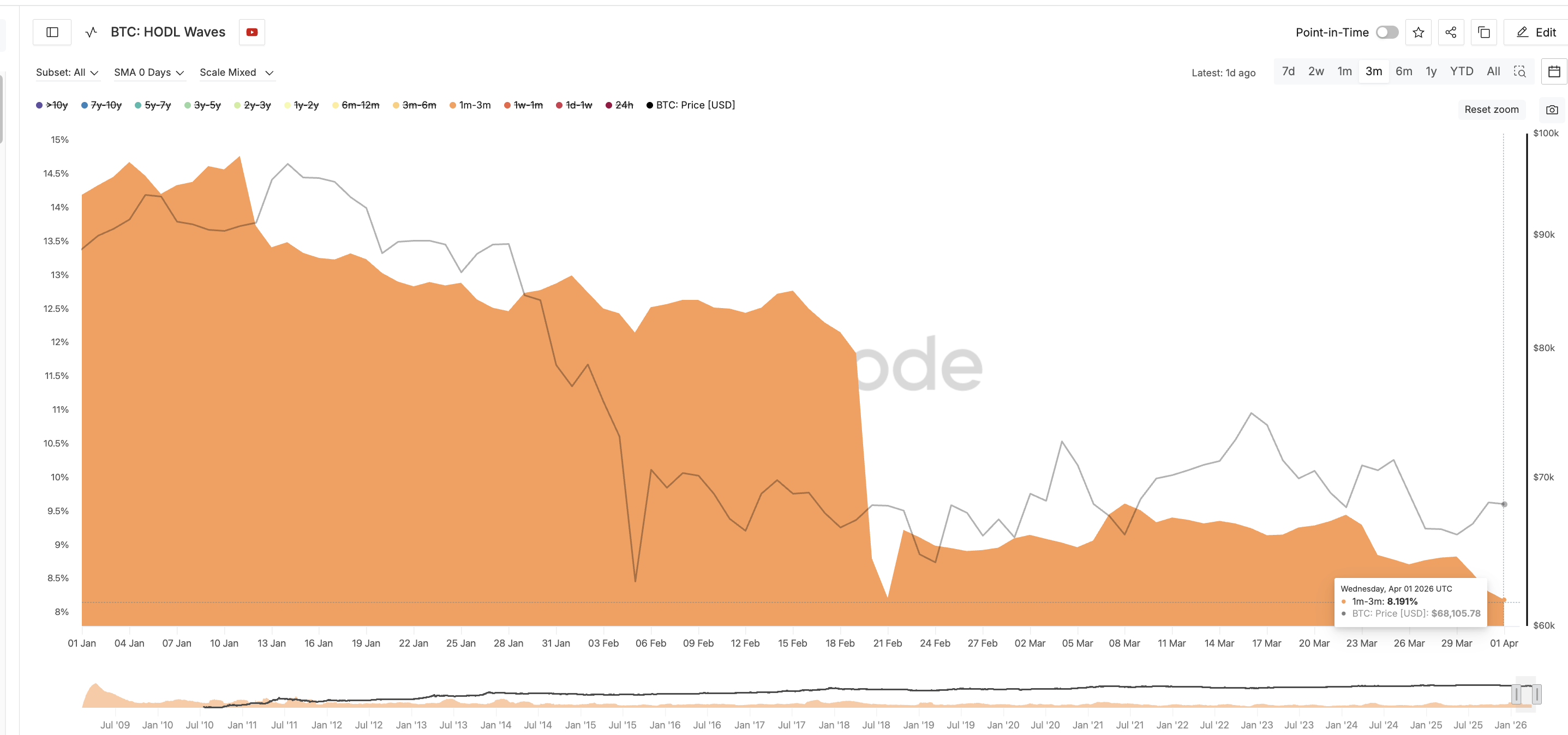
BTC HODL waves, an on-chain metric that tracks the percentage of supply held by different age groups, show a dramatic exit from the 1-month to 3-month cohort. On January 14, this group controlled 14.67% of the total Bitcoin supply. By April 1, that figure had fallen to 8.19%, its lowest reading of the year.
The decline accelerated in two distinct waves. The first came post mid-February, when the cohort’s share dropped from 12.72% on February 15 to single digits by February 22. A second aggressive leg down arrived around March 22, when the reading slipped from 9.44% and continued falling without recovery.
Want more token insights like this? Sign up for Editor Harsh Notariya’s Daily Crypto Newsletter here.
This group represents participants who accumulated during the Q1 drawdown, expecting a bounce. Their persistent selling over nearly three months signals that short-term conviction has evaporated. When recent buyers distribute at a loss rather than averaging down, it typically reflects capitulation rather than healthy rotation.
That behavioral shift is visible on the Bitcoin price chart as well. Since late February, the daily timeframe has been forming a head and shoulders pattern. The pattern validates the weakness that the HODL wave data already flagged.
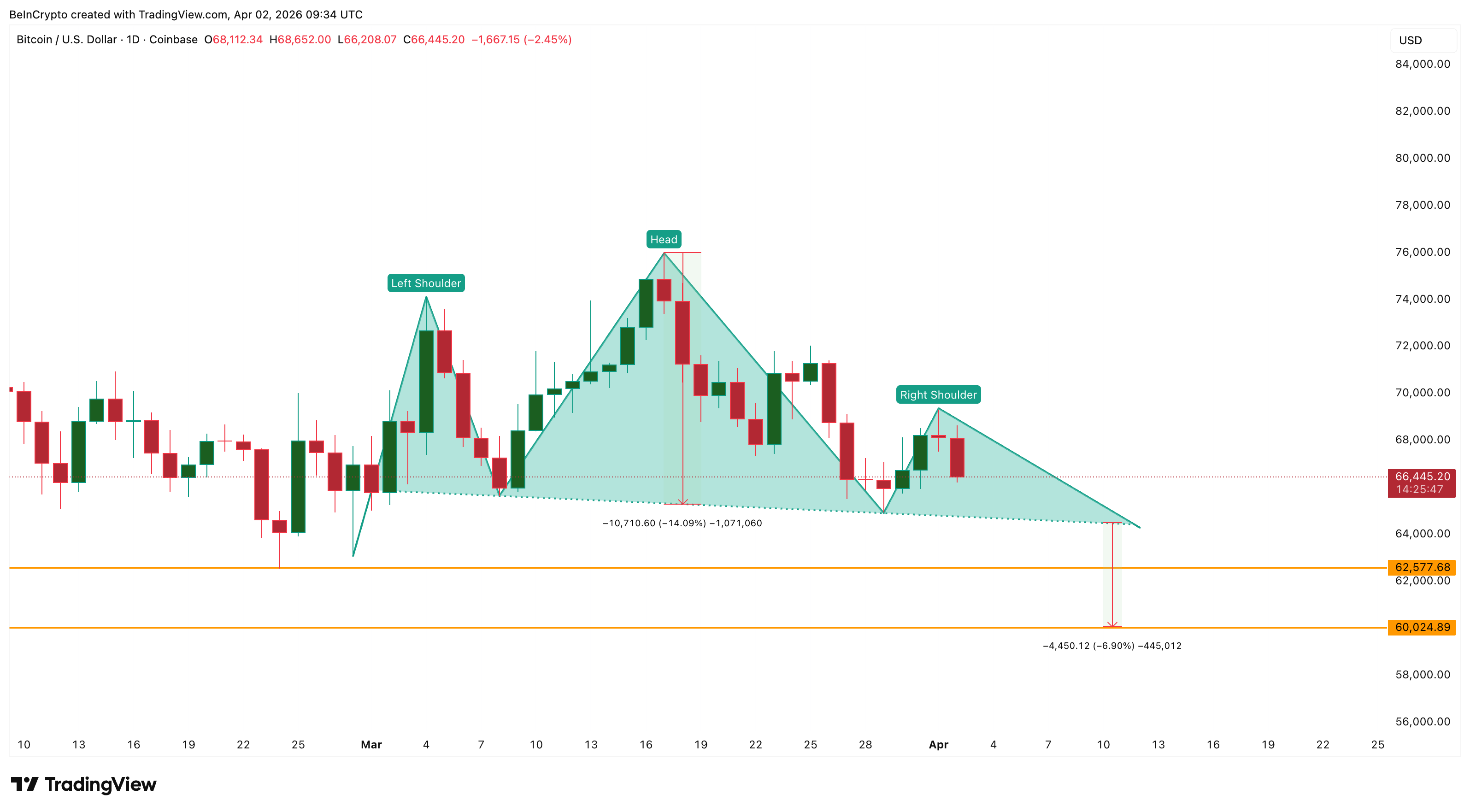
However, whether the pattern triggers depends on how the derivatives market is positioned around the breakdown zone.
Leverage Leans the Wrong Way
Despite bearish signals from both on-chain behavior and chart structure, the BTC derivatives market has not adjusted defensively. Over the past seven days on the Binance BTC/USDT perpetual pair, cumulative long liquidation leverage totals $1.44 billion in active positions.
Short liquidation leverage sits at $1.03 billion. The roughly 40% skew toward longs means the market remains positioned for upside while the technical picture deteriorates.
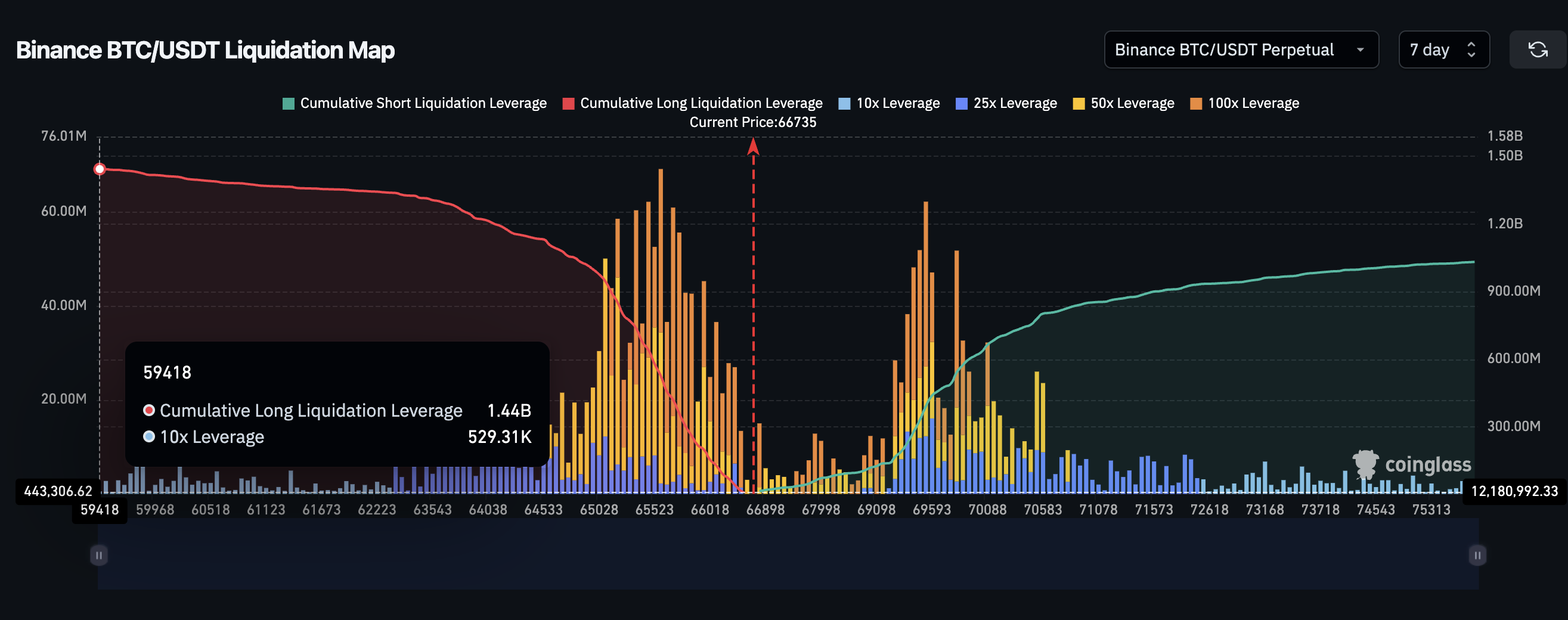
The Binance BTC liquidation map sharpens the risk further. Of the $1.44 billion in total long exposure, approximately $1.13 billion clusters at a single level near $64,533. That concentration means nearly 80% of all long positions opened over the past week would be forcibly closed if price reaches that zone.
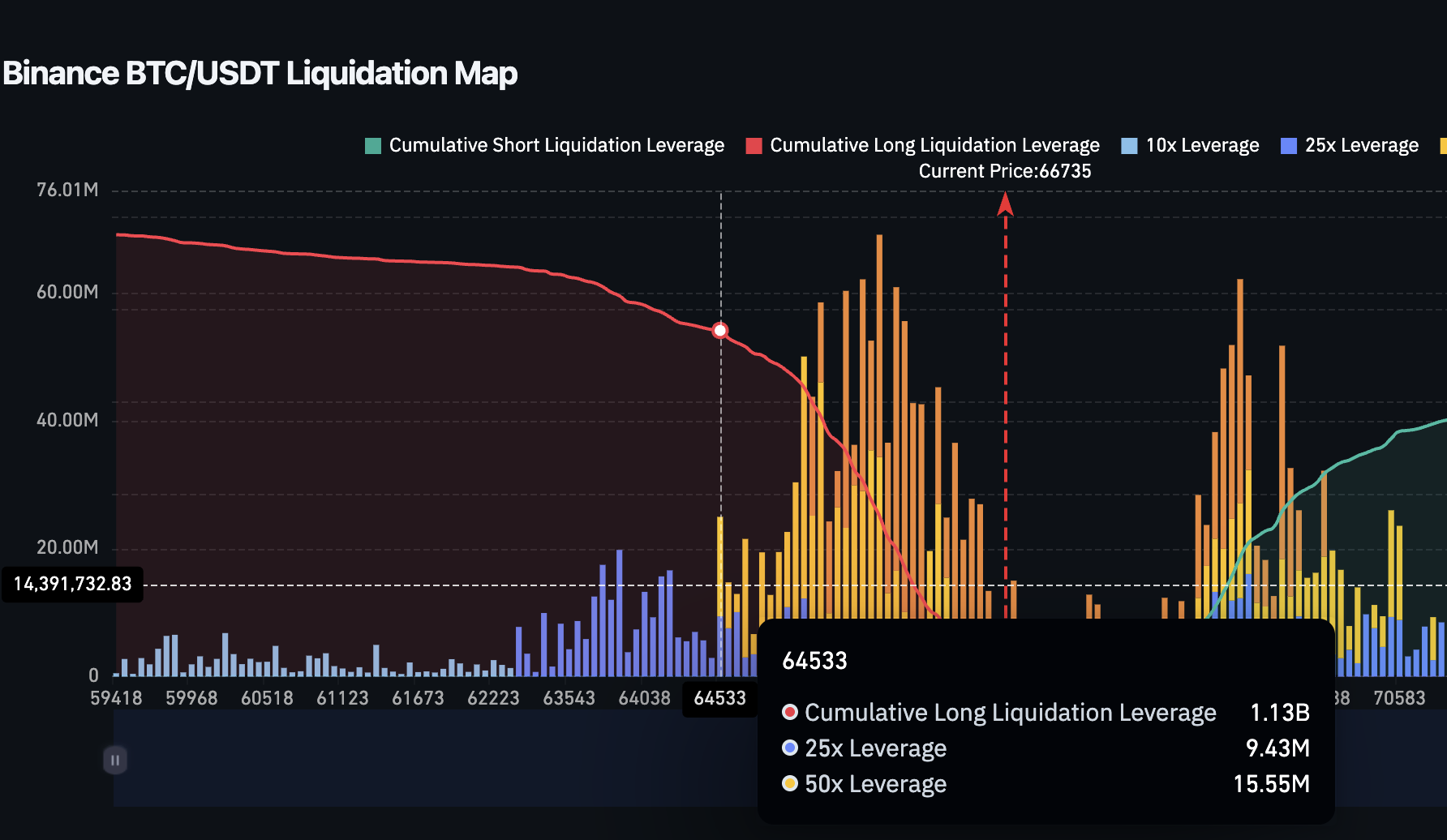
High-leverage positions using 25x and 50x multipliers dominate the cluster.
Even a modest push into that range could trigger cascading forced selling, turning a controlled decline into a liquidation-driven flush. The mismatch between bearish structure and bullish leverage is where the greatest Bitcoin price risk builds. The BTC price chart now becomes the final arbiter of whether that risk materializes.
Bitcoin Price Prediction and One Critical Line
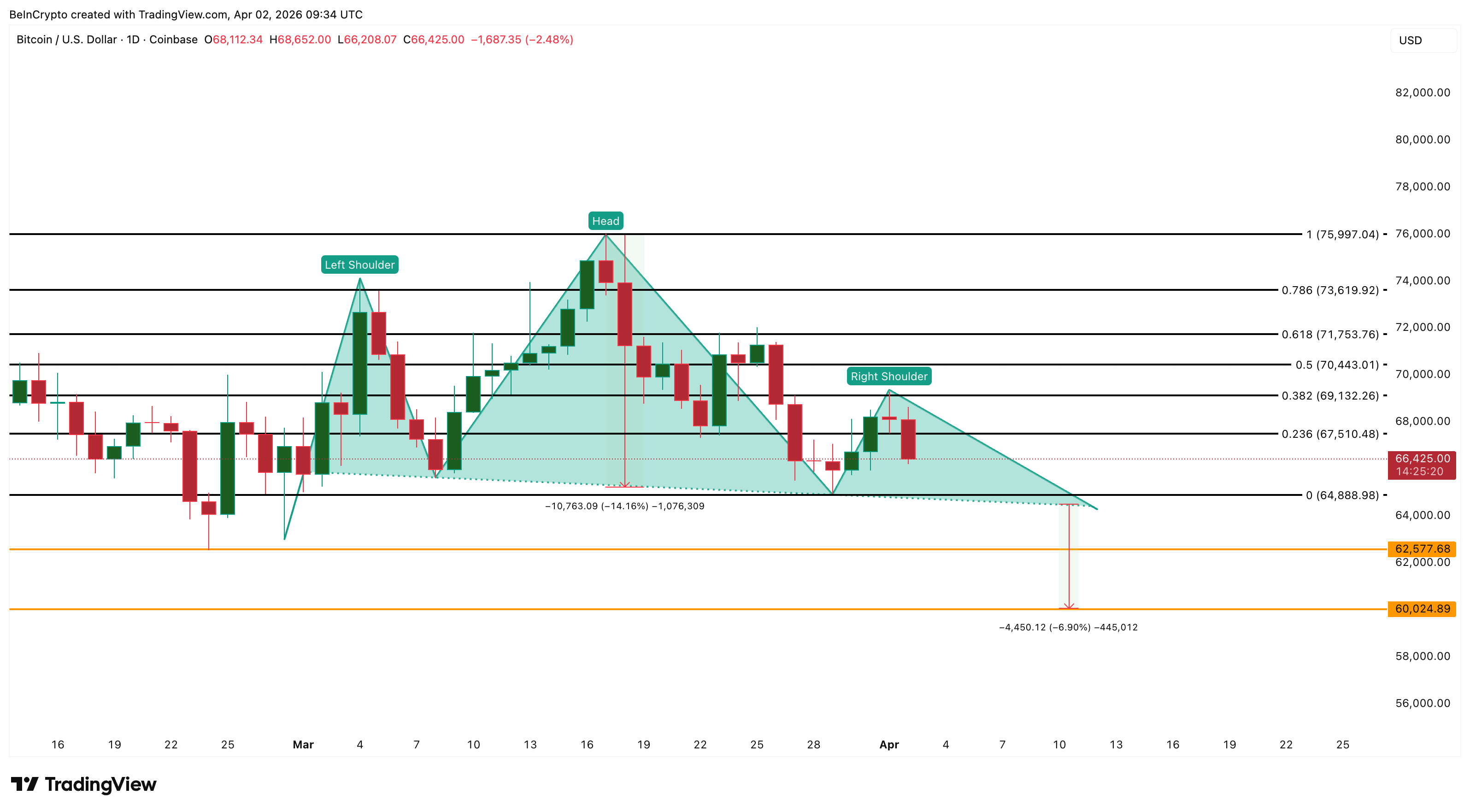
The daily chart confirms the head and shoulders pattern with Fibonacci (Fib) levels mapping every critical zone. The Fib levels are drawn from the head of the pattern to the completed swing low.
Bitcoin currently trades near $66,425, having already lost the 0.236 Fib level at $67,510.
The measured move from the pattern projects a 14.16% decline, targeting approximately $60,024 on the way down. However, the path runs through $64,888, a level that is slightly above the neckline area for the pattern.
Losing $64,888 would place price directly into the $1.13 billion long liquidation cluster at $64,533 identified in the derivatives section. That overlap transforms the neckline break from a technical event into a leverage-driven cascade. From there the full 14% target, under $60,000 becomes realistic.
For the bearish thesis to fail, Bitcoin price needs a daily close above $69,132 to begin neutralizing the right shoulder. Strength only returns above $71,750, the 0.618 level, and a move past $75,997 would invalidate the head and shoulders entirely.
Head and shoulders patterns do not always resolve in the expected direction. A sudden demand surge or macro catalyst could reverse the structure before the neckline is tested. However, the convergence of capitulating short-term buyers, long-heavy leverage, and declining price structure lowers the probability of that outcome.
A daily close below $64,888 separates a measured pullback from a leveraged flush toward the $60,000 zone, while reclaiming $69,132 would be the first signal that sellers are running out of momentum.
The post One Selling Pattern Reveals the Next Major Bitcoin Price Risk of 2026 appeared first on BeInCrypto.

Key Insights
- GENIUS Act defines state-regulated stablecoin compliance, allowing smaller issuers to operate locally while meeting federal oversight standards.
- OCC guidance establishes federal benchmarks, guiding stablecoin issuers transitioning from state to federal supervision after $10 billion circulation.
- Monthly reserve disclosures and uniform branding rules ensure consistent transparency and regulatory alignment across state and federal stablecoin frameworks.
The U.S. Department of the Treasury has released an 87-page proposal implementing the GENIUS Act. The notice opens a 60-day public comment period and outlines how stablecoin oversight will function across both state and federal systems.
The proposal details how the Treasury will determine whether state-level regulatory frameworks are “substantially similar” to federal standards. Smaller issuers can remain under state supervision if their systems meet the defined benchmarks.
State Stablecoin Oversight Must Meet Federal Standards
Issuers with less than ten billion dollars in circulation may opt for state-level regulation, provided their frameworks align with federal rules. The proposal separates requirements into two categories: uniform rules covering reserves and anti-money laundering and state-calibrated rules where local regulators control supervision, licensing, and risk management.
This approach allows states to maintain flexibility while ensuring all systems comply with the federal baseline, preventing gaps in regulation.
OCC Guidance Shapes Federal Stablecoin Compliance
The Treasury relies on the Office of the Comptroller of the Currency to define the federal benchmark. Nonbank issuers that exceed the $10 billion threshold will transition toward federal supervision guided by OCC standards.
The rule also clarifies that state frameworks may exceed federal requirements, but they cannot conflict with federal law or reduce regulatory comparability.
Stablecoin Disclosure and Branding Rules Enforced
Issuers must publish monthly reserve composition reports to maintain transparency across state and federal systems. This ensures that disclosure practices remain consistent for all regulated stablecoins.
In addition, naming restrictions apply uniformly to prevent misleading branding. These rules align compliance across jurisdictions and maintain public confidence in dollar-backed stablecoins.
GENIUS Act Implementation Drives Regulatory Alignment
The rulemaking represents a key step in turning the GENIUS Act into an operational framework. Passed in July 2025, the law introduced mandatory reserve backing, regular disclosures, and anti-money laundering compliance for payment stablecoins.
Meanwhile, Congress continues advancing complementary measures, including the Clarity Act, to define SEC and CFTC oversight, although disputes over stablecoin yield have slowed broader market reforms.

Iga Swiatek appoints Francisco Roig, Rafael Nadal and Emma Raducanu’s former coach

BITCOIN SUPERCYCLE CONFIRMED BY GOLD

The cheapest petrol and diesel prices in Scotland – check your postcode


-

 Business7 days ago
Instagram, YouTube Found Responsible for Teen’s Mental Health Struggle in Historic Ruling
-

 NewsBeat6 days ago
The Story hosts event on Durham’s historic registers
-
 Tech7 days ago
Intercom’s new post-trained Fin Apex 1.0 beats GPT-5.4 and Claude Sonnet 4.6 at customer service resolutions
-

 Sports6 days ago
Sweet Sixteen Game Thread: Tide vs Michigan
-
Entertainment3 days ago
Fans slam 'heartbreaking' Barbie Dream Fest convention debacle with 'cardboard cutout' experience
-
 Entertainment5 days ago
Lana Del Rey Celebrates Her Husband’s 51st Birthday In New Post
-
Crypto World2 days ago
Dems press CFTC, ethics board on prediction-market insider trades
-

 Crypto World16 hours ago
Gold Price Prediction: Worst Month in 17 Years fo Save Haven Rock
-

 Tech3 days ago
The Pixel 10a doesn’t have a camera bump, and it’s great
-

 Sports2 days ago
Tallest college basketball player ever, standing at 7-foot-9, entering transfer portal
-

 Tech2 days ago
EE TV is using AI to help you find something to watch
-

 Fashion4 days ago
Amazon Sundays: Soft Spring Layers
-

 Tech3 days ago
Apple will hide your email address from apps and websites, but not cops
-

 Tech2 days ago
How to back up your iPhone & iPad to your Mac before something goes wrong
-

 Crypto World3 days ago
U.S. rule change may open trillions in 401(k) funds to crypto
-

 Tech2 days ago
Flipsnack and the shift toward motion-first business content with living visuals
-

 Fashion7 days ago
En Vogue in Brown Leather and Tailored Neutrals by Atelier Savoir, Styled by J Bolin
-

 Politics3 days ago
Should Trump Be Scared Strait?
-

 Fashion7 days ago
What Are Your Favorite T-Shirts for the Weekend?
-

 Business6 days ago
Chinese universities with military links bought Super Micro servers with restricted AI chips
You must be logged in to post a comment Login