
Politics
Police scrap Race Action Plan


Five years after the implementation of the Police Race Action Plan (PRAP), progress has been patchy, slow, and all-too-easily reversed. Worse still, it’s been overly dependant on “individual goodwill”, rather than a true commitment to change across the force.
That’s according to the final report from the Independent Scrutiny and Oversight Board (ISOB), whose job was to oversee the PRAP. It also marks the end of both the PRAP as a standalone programme, and the ISOB itself.
As ever when we write on police racism at the Canary, the report observed that forces used inquiries and action plans as a substitute for real change.
The report drew on 36 interviews with civil organisations, community leaders and policing professionals. It found that, in spite of everything, the very institutional racism of the police is still a point of contention. In fact, just 6 of the 44 individual forces covered by the PRAP had even deigned to acknowledge their institutional racism.
‘That commitment has not yet been met’
Abimbola Johnson, ISOB chair, said:
Five years ago, policing committed to improving outcomes for Black communities. That commitment has not been met. Progress has been slow, uneven and too dependent on individual effort rather than institutional change.
The National Police Chiefs’ Council (NPCC) and the College of Policing established the PRAP back in 2020. It followed the police murder of George Floyd in the US, and the consequential wave of international Black Lives Matter demonstrations.
Ostensibly, the PRAP aimed to improve policing for Black people — both the public and within the police. However, that promise has not materialised. Johnson went on to state that:
Without properly enforced legal obligations, a robust inspection framework and clear consequences for failure, progress on race equity within policing will remain partial and reversible. This mirrors the pattern of previous reforms, dating back to Scarman and Macpherson. Black communities now deserve structural accountability. Government and policing must decide whether to deliver it or allow reform to stall again.
Final findings
As these reports and inquiries have found repeatedly, the single most significant barrier to progress is the racist culture of the police. There’s no external framework or imposed solution that can fix a system that doesn’t want to change.
And make no mistake — this is a systemic problem. Whilst individual police show shocking and flagrant racism, that bigotry is also embedded within the structures of policing. As such, any framework that treats racism as an individual problem in the forces will inevitably fail to make meaningful impact.
Likewise, race and racism cannot be understood within a vacuum. Police understanding of intersectionality remains a “significant and under-addressed gap.” Failure to address this means that the greatest harms will inevitably fall on multiple marginalised individuals.
The report also found that the single biggest driver of real change was the commitment of police leadership. When senior leaders were visibly committed to anti-racism, the forces under them showed greater progress. Conversely, where leaders’ commitment was lacking or clearly performative, nothing improved.
Alongside this, the police have been far better at making plans to tackle racism than actually delivering change. However, and far too often, these plans are spoken about as if they are “the change.” Repeatedly and consistently, actual impact has fallen short of the stated aims.
As such, it’s both unsurprising and appalling that Black communities still can’t trust the police. The report stated plainly that forces can’t built this trust through words and gestures of goodwill. Rather, they must show a real and sustained change in their behaviour before community attitudes can improve.
Progress ‘is now being reversed’
Regarding the ISOB’s final findings, Andy George – leader of the National Black Police Association – stated that:
After more than £10m of investment, it has failed to deliver on its core aim: improving the experience of policing for Black people.
The reality is the environment is becoming more toxic and the progress made since the Macpherson report is now being reversed.
The report itself indicated that any lasting progress is undermined by the utter lack of statutory accountability in making change. It made clear that:
Without legal duties, enforceable standards and independent inspection, progress depends entirely on goodwill and voluntary programs, leading to the PRAP inevitably being de-prioritised and treated as an ‘add-on’.
Both illustrating and compounding this issue, the end of the PRAP and ISOB, leaves absolutely no independent oversight in place. As such, the report urged the Home Office to:
establish and fund independent scrutiny, mandate national data standards, and embed race equity within inspection and performance frameworks.
We at the Canary have lost count of the number of times that new reports, new reviews, independent external and internal enquiries, and public bodies have highlighted and exposed institutional police racism, and the utter lack of willingness to change.
Time and again, we’ve watch police trot out their plans to fix racism, then sit back and pretend that the plan was the work itself.
So, we sign off as just as we have before. How many times do we have to write this same article?
UK police are racist because racism is embedded in the very core of their mission. It’s not one bad apple. It’s not one bad barrel. Its root and branch, tree and orchard.
Featured image via NPCC


The Labour government last week confirmed that it intends to hand British lawmaking power back to the European Union. UK prime minister Keir Starmer said he planned to introduce legislation that will bring the UK into so-called dynamic alignment with the EU laws on energy policy, electricity markets and food standards.
We should be perfectly clear about what this means: the UK will match its laws and regulations to the EU’s, word for word. If the EU changes its laws on an area affected, Britain will then change its own laws to match them. If Brussels says ‘jump’, Britain will reply ‘how high?’. This is the situation that Britain is going to find herself in, thanks to Starmer’s ‘reset’ with the EU.
Despite claims by the government that it is making a ‘sovereign choice’ to copy foreign regulations, the reality could not be further from the truth. Dynamic alignment with the EU turns Britain from a competitive trading partner with the EU to a subordinate satellite market. This is exactly how the EU likes it, and it is indeed what the EU hoped Britain would agree to when then prime minister Theresa May presented her Chequers proposal to Parliament in 2018. Parliament said no in 2018, although it seems less likely that it will say no this year.
Dynamic alignment is offensive for a number of reasons. The government’s attempts to defend it are misguided at best, dishonest at worst.
Let’s start with the economic arguments. Under Starmer’s plan, EU laws will be applied across the entire British economy, including on businesses and consumers which have no trading relationship with the EU. This means that a British farmer selling British beef to British families will have to follow EU rules when doing so. British farms and British supermarkets may be subjected to inspection by EU officials to ensure they are compliant with foreign rules, and British taxpayers will be expected to fund the operations of these officials in this country.
Britain has become a home for innovative businesses experimenting with new genetic technology, thanks to the liberalisation of gene-editing laws post-Brexit. A nascent and dynamic sector of the economy will be snuffed out in the pursuit of closer relations with the EU, which is opposed to evidence-based innovation in this area.
The pursuit of dynamic alignment also misunderstands the nature of the trading relationship between the UK and the EU post-Brexit. When it comes to food, the sector affected by Sanitary and Phytosanitary (SPS) regulations, it is worth remembering that the UK is a net importer of food from the EU and around the world. British food producers overwhelmingly produce for the domestic market, so they will not see any kind of economic opportunity from following foreign laws.
The suggestion that alignment will lead to a boom in British exports to the EU is also laughable. Since Brexit, British sheep and lamb exports to the EU have done incredibly well, growing by 15 per cent in 2025. To suggest that these figures would be significantly higher if there was an SPS agreement, especially as the EU imports plenty of lamb from other non-EU markets like Australia and New Zealand, is economically illiterate. Similarly, beef exports to the EU also reached record highs in both value and volume in 2024. Dairy exports to the EU have also shown strong growth over the last two years – this, in a sector that was often held up as one which suffered the most from Brexit.
Dynamic alignment of food-standards regulations appears to be motivated by a misdiagnosis of the trading relationship between Britain and Europe. But the proposed alignment of carbon pricing is a straightforward attack on British industrial competitiveness. Proposed as a means of ensuring Britain avoids facing an EU carbon tariff, the government has agreed to link carbon prices for energy-intensive industries with the EU’s.
This is an act of catastrophic self-harm. In 2025, the EU’s carbon price was some 50 per cent greater than Britain’s. So the prime minister has decided to increase the operating costs of British industry, at a time when the government should be doing all it can to reduce the crippling price of energy.
It is a double-whammy. Not only does the UK suffer – the EU benefits, too. Labour is effectively allowing Brussels to shield itself against any competitive threat from the UK, even in industries that do not export manufactured goods. Data centres pay carbon taxes, and their running costs will be increased by this policy, even though they do not produce goods which could be affected by an EU tariff.
Labour claims that dynamic alignment is good for the British economy. But, in reality, the only winner will be the EU, which will be able to treat Britain like a captive market for its exports. Considering the EU’s poor economic performance and declining share of the global economy, this is no path to prosperity.
None of this touches on the real problem with Starmer’s plan for closer EU integration – namely, that it is a betrayal of everything the British people have voted for. The UK has effectively had two votes on the EU – the first in 2016, when Leave won the biggest democratic mandate in British history. And again, in 2019, when Boris Johnson’s campaign pledge to ‘get Brexit done’ delivered him a landslide majority. The latest betrayal is made even worse after Starmer’s own promise, before the General Election, that Brexit was ‘safe’ in ‘his hands’. Now here he is, trying to wheedle the UK back under Brussels’ dominion, without parliamentary scrutiny.
The whole thing reeks of desperation. Starmer, having abandoned any kind of domestic policy agenda, is instead choosing to take Britain back into the EU, step by step. Its implications are already clear: a weaker economy and a steady erosion of parliamentary sovereignty. The EU reset is a road to nowhere – we must chart a new course as soon as we can.
Fred de Fossard is the director of strategy at the Prosperity Institute.
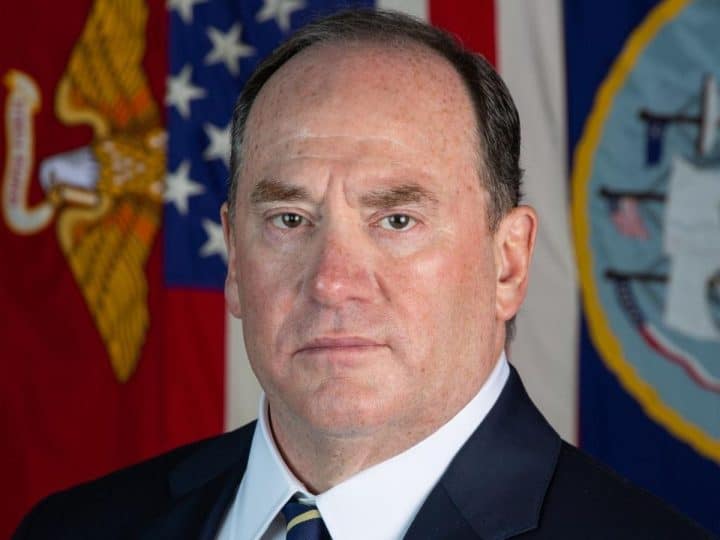

US ‘secretary of the navy’ John C Phelan has rocked the Trump administration by suddenly resigning his position. The move is unexplained. However, it comes as the US navy attempts farcically and unlawfully to blockade the Hormuz Strait and prevent ships entering it from the Indian Ocean. It has also been preceded by alleged mutinies and sabotage on board US aircraft carriers by crew outraged at their mission and desperate to go home.
A statement from chief Pentagon spokesman Sean Parnell confirmed the departure:
STATEMENT:
Secretary of the Navy John C. Phelan is departing the administration, effective immediately.
On behalf of the Secretary of War and Deputy Secretary of War, we are grateful to Secretary Phelan for his service to the Department and the United States Navy.
We wish…
— Sean Parnell (@SeanParnellASW) April 22, 2026
Featured image via the Canary
By Skwawkbox


The Financial Times, citing international media reports, has revealed that Paolo Zamboli, an envoy linked to US President Donald Trump’s administration, has put forward a proposal to FIFA to replace the Iranian national team with the Italian national team in the 2026 World Cup finals.
According to the newspaper, the proposal was made during informal discussions, based on a personal view that the Italian team, as a four-time former world champion, is “more deserving of participation” than Iran, without any regulatory basis or official decision from FIFA.
In contrast, official Iranian sources have emphasised in recent days that the Iranian national team remains committed to participating in the 2026 World Cup, stressing that no entity has the authority to exclude it from the tournament, and that preparations are continuing as normal.
Under the joint hosting arrangement for the tournament between the United States, Canada and Mexico, all three of the Iranian national team’s group stage matches against New Zealand, Belgium and Egypt will be held in the US.
This controversy comes against a backdrop of political tension and renewed fears of a resurgence of conflict between Washington and Tehran, lending a political dimension to the proposal, which reports describe as “unworkable” so far, given the lack of any official stance from FIFA.
FIFA has confirmed, according to the newspaper, that Trump’s demands have been ignored. There have been no changes to the list of teams participating in the 2026 World Cup, and that all qualified teams, including Iran, remain officially listed.
Featured image via the Canary
By Alaa Shamali
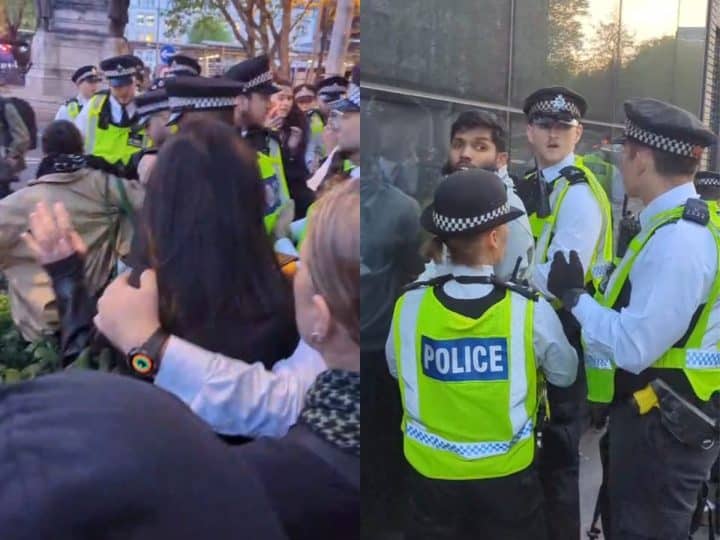

Metropolitan police officers have arrested ten peaceful protesters at an anti-genocide demonstration in Euston, London – in at least one case violently.
Police violence in Euston
On Wednesday 22 April the Israel Institute of Technology was holding a fundraising event for Israel at the Shaw Theatre. As London for Palestine wrote on its Instagram, the institute “is deeply intertwined with Israel’s military industrial complex… [and] has been labelled ‘the university with the greatest ties to the Israeli military’”.
War criminal president Isaac Herzog – who incited genocide against the Palestinian people – made a speech via video call. Little wonder then that pro-Palestine, anti-Zionist activists held a protest outside.
The demo took place at Euston – and one of those arrested was Kamran Ahmed. Ahmed is a member of the Filton 24 only recently released after being held in prison for more than a year without trial – and being on hunger strike:
View this post on Instagram
View this post on Instagram
View this post on Instagram
Three women were arrested after the demo finished, grabbed by police as they made their way peacefully home:
View this post on Instagram
Ahmad asked supporters able to do so to make sure they attend Woolwich Crown Court tomorrow, 23 April 2026, where the retrial of Filton anti-genocide protesters will continue:
View this post on Instagram
The arrests were without provocation and the policing turned ugly without warning. The flailing Starmer regime is still repressing humanitarian protest against war and genocide even as his always-awful tenure collapses.
Featured image via the Canary
By Skwawkbox


Human rights organisation Amnesty International has warned that the UK is complicit in a generational human rights crisis. The NGO’s new report, published on 21 April, said the UK had “failed to register” spiralling global trends. And singled out Keir Starmer for, among other things, his pathetic decision to help the US attack Iran.
Surveillance, wars, crushing peaceful protest, hostility to migrants, social and economic policies and much more – the UK has covered itself in shame amid a global assault on basic human rights. The report, titled ‘The State of the World’s Human Rights: Amnesty International Annual Report,‘ is available to read in full here.
The document covers human right issues across the world. But the UK is a standout failure, despite claiming to be a bastion of liberal and democratic values.
Amnesty led with a series of bullets listing where the UK was failing. Our regular readers will recognise these as areas the Canary has covered energetically for years:
- Used counterterrorism powers to restrict peaceful protest
- Overseen the mass arrest of peaceful protesters, with courts ruling aspects unlawful
- Intensified hostile policies towards migrants and people seeking asylum
- Increased surveillance and policing powers
- Continued arms transfers to Israel despite clear risks of use in serious violations of international law
- Cut international aid amid escalating global humanitarian need
- Defended the use of national security vetoes in legacy Troubles cases, undermining truth, accountability and justice for victims and families
- Pursued economic and social policies that risk pushing more people into poverty, weakening protections for economic and social rights
Rest assured, we will continue to do so.
Amnesty International — generational crisis for human rights
Amnesty International UK’s Chief Executive Kerry Moscogiuri had some stern words to say:
Human rights are facing the most dangerous moment in generations. We are at a tipping point.
This is the moment the UK’s moral mettle is being tested. In these desperate times we need strong leadership to defend human rights and international law, but right now we are falling short.
Moscogiuri slammed Starmer for his decision to:
criminalise peaceful protesters while ignoring the injustice they are speaking out against. Keir Starmer knows what is happening on his watch. He knows the peaceful protesters being treated as criminals are expressing their horror at the killing of children in Gaza.
Adding:
He knows powerful states are tearing up international law in pursuit of power and profit, and that the UK has not challenged this with the clarity and consistency required. And he knows a world in crisis will force more people to flee, requiring international protection, not performative hostility or attempts to shirk our responsibilities.
Powerful stuff.
Moscogiuri also blasted the ex-barrister PM over arms sales and allowing UK bases to be used for war – clearly a reference to the US use of British bases to bomb Iran:
You cannot claim to defend the rule of law while undermining it in practice, whether through arms sales, or allowing UK bases to be used in conflicts where international law is being violated. That is not moral leadership, it is complicity.
War displacement and fascism
The Amnesty chief said these matters needed to be addressed now to fend off a rising far-right, protect marginalised and vulnerable people and resolve wars:
The hour has come. This is exactly the moment human rights were created for when populism is rising, when people are struggling to afford the essentials, when asylum seekers and migrants are scapegoated, when war and displacement are everywhere, and when some lives are treated as worth less than others.
Moscogiuri then called on Starmer to meet the challenges of our times:
We can be better than this. The question now is whether the Prime Minister will rise to meet the challenge of our lifetime, or be remembered for standing by when it mattered most.
We don’t expect Starmer will pay much attention. His commitments to, for example, US hegemony and Israeli genocide have been made very clear. But the spirit of Amnesty’s criticism is correct. These are not normal times. And one way or another, we need to organise ourselves to confront the crises we face today.
Featured image via the Canary
By Joe Glenton
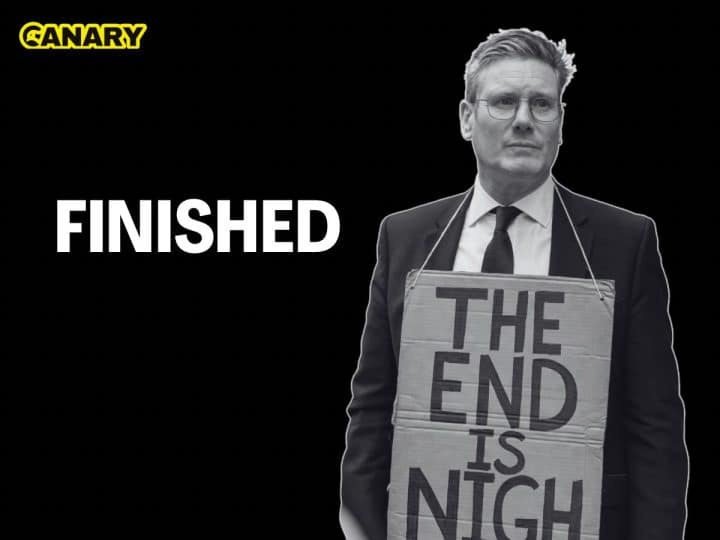

It is now just over two short weeks until local elections polling day on May 7th and the real verdict on nearly two murky years of Starmerism.
Voters in 136 English councils, all 32 London boroughs, six mayoral contests and more will deliver their damning judgment.
Labour is defending over half the seats up for grabs — many won during the 2022 Partygate scandal when they were polling in the mid-30s.
Right now, they hover around 17% nationally, and with the fresh Mandelson revelations coming to light, single digits cannot be far away.
These elections won’t just be another local scrap about potholes and wheelie bins. It’s shaping up to be a brutal referendum on a deeply unpopular Labour government that promised change but delivered continuity.
Local elections: a referendum Starmer won’t want
Keir Starmer’s government has barely had the time to slap its utterly useless April cost-of-living relief package on the table before the IMF delivered its grim verdict.
UK growth forecasts have been slashed, with Britain now projected to take the biggest economic hit of any major G7 economy from the ongoing attacks on Iran. Growth has down-graded to a pathetic 0.8% for 2026. Inflation risks are rising. Fuel prices are climbing.
Poor and working class people are once again paying the price for fossil-fuel dependence and a government that’s too scared of its paymasters to act boldly.
We need so much more than Starmer’s cautious managerialism while the economy wobbles.
The latest revelations about the wall-pissing, Peter Mandelson’s appointment as US ambassador lay bare a Prime Minister who prioritised his factional mates over national security, misled Parliament, and is now scrambling to cover his tracks while claiming he didn’t have a fucking clue.
This isn’t just a glitch in the matrix — this is the entire rotten Blairite operating system spectacularly crashing in glorious high-definition.
Sleaze dressed up as competence
Keir Starmer’s government, sold to us as the antidote to Tory sleaze, has been caught red-handed playing elite-mates-before-security-clearance.
This is sleaze dressed up as competence, and if someone in the Labour Party had the spine to stand against him, it would bring a sudden end to Keir Starmer’s permacrisis leadership.
Peter Mandelson — the man who once made spin doctoring sound like a contact sport — got the Washington embassy gig despite failing developed vetting. The Foreign Office simply shrugged, overruled the civil servants, and hoped nobody would notice.
This is classic New Labour. When those pesky rules get in the way, just attempt to rewrite them in invisible ink.
The Mandelson scandal is Starmerism in a nutshell: all the moralising of a Sunday School preacher, all the ethics of a hedge fund manager. He weaponised “integrity” against the Tories while building his own court of chums who treat security clearances like optional extras on a ministerial limo.
The hypocrisy is utterly astounding. Starmer’s “reset” government reset straight back into the swamp.
The man who lectured us about standards now expects us to believe he missed the biggest red flag since the last Blair-era cash-for-access saga?
You’re not buying into this absolute hogwash, are you? Starmer is either incompetent, a blatant liar, or both.
A risk too great to have ignored
Keir Starmer didn’t just appoint the Prince of Darkness – he gave him the keys to the whole kingdom and pretended the vetting report was alternative facts.
In Keir Starmer’s Britain, the only thing more overruled than security vetting is the will of the British people.
This is beginning to sound like the death rattle of a failed project that ditched redistribution, public services, and global peace and justice for performative centrism and elite networking.
The working classes didn’t line up to vote for a government that fast-tracks failed vetting for Epstein’s best mate while lecturing everyone else about working people. They voted for hope and change and instead got reheated Blairism with considerably worse judgment and slightly better suits.
I mean, nothing screams out “change” quite like fast-tracking a vile, revolving-door vampire past the spooks while poor people queue up at food banks, right?
The mask hasn’t just slipped, its thrown itself off the balcony doing the Epstein conga. The override has been exposed, and the Green Party should be ready to fill the vacuum following a night of unprecedented disaster in the local elections for the Labour Party on 7 May.
Starmer should know, in politics as in vetting, some risks are simply too great to ignore.
Featured image via the Canary
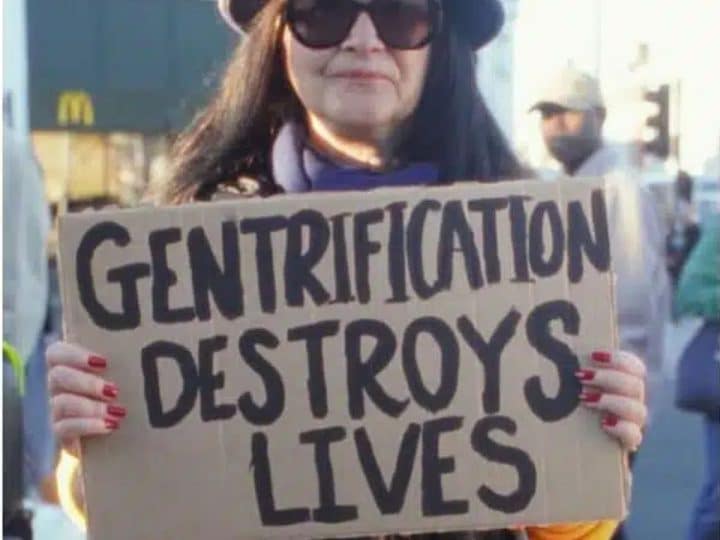

Lambeth Council in London has long been a Labour stronghold, however, that all looks likely to change come the local elections on 7 May. The Greens look set to take several seats, with independents and Lib Dems also set to make significant gains. As a result, it appears a hung council lies ahead which is likely to go a long way to limit harmful policies pushed by Labour.
We reported on Lambeth’s commitment to the ‘Vote Palestine ’26’ pledge, organised by the Palestinian Youth Movement. Lambeth has a proud, growing socialist base in their local community, with members working cooperatively against oppression and for social justice.
We spoke to Laura Graham who is standing as an independent candidate for her local community in the ward of St Martin’s. Laura works actively with other independents and local Greens as she sets out to bring Labour to task and fight for social justice in Lambeth.

Laura Graham: ‘They feel conned, they’ve been completely let down’
We asked Laura Graham why she decided to take action and stand for her local community. Speaking of her initial excitement and subsequent disappointment with Your Party, Graham told us:
So, I’ve never been part of a party before. And I’ve never been apathetic, I’ve always been political in some ways, but I’ve never been that driven. And certainly locally, my physical home has always been here, but it’s always been quite toxic locally.
This new party [Your Party] was something that really was going to turn things around. And locally, my proto branch is a mixture of socialists and communists and the rest of it. And we just bubble along, get on with things, and it really is lovely. And then the CEC decision for expulsions of anything with socialist in its name. Yeah. It was heartbreaking.
It was just like, what have you done? And my understanding is, from the online discussions and things across the country, is that there is an appetite for Corbyn’s Labour Party, but without the undermining that the Labour Party did to him, and that’s what they are creating, and I don’t think that is what I signed up for.
Undeterred and even more determined, Graham refused to leave her community unrepresented and vulnerable to bad actors, choosing to stand as an independent:
I had such a massive mountain to climb, my face is known and I’ve got lots of friends locally. I’ve lived here all my life. But the apathy amongst people who I don’t know, in regard to actually voting, has been so sad to see. They turned up for the general election, they did what they were asked, they got rid of the Tories and Labour came in even worse, and their life has declined.
So, they feel conned, they’ve been completely let down by Labour. And then we’ve got the cuts across Lambeth by this current Labour council. The problem we have here in Lambeth is that there’s been a monopoly of Labour councillors in the town hall, so they just do whatever it is that they want to do. There’s very little chance of opposition.
It’s meant sweeping cuts, selling off our shared assets, shutting down our schools. I mean, it’s ridiculous. There are two schools that are impacted in my ward that are due for being shut down. And the argument is that there aren’t enough children locally. My argument is, actually, I like the small class sizes for working-class kids.
And the thing is, they take away a school, they sell up the land to the developer and it’s never coming back as a school again. So, when we lose them, we lose them forever. Labour seems to have no problem with that, it feels like social cleansing to be fair.
Labour fielding local candidates with dodgy MP expense scandals
Adding insult to injury, Graham highlighted how one of the Labour candidates up for election is a former MP who was mired in expense scandals. Talking about Kitty Ussher’s £20k expenses which she claimed for home improvements, Graham further underscored why it is so important to keep Labour out:
Apparently, she’s filled to the mugs for it. She paid back a bit of what she owed. But she claimed £20,000 for renovations to a second home that she had for several years.
She also informed that two of the Labour candidates don’t even live in the area, are subsequently incredibly privileged and as such, completely out of touch to represent one of the most deprived wards in London.

Laura Graham: “a real community champion, with a community voice”
We asked Graham how it has been on the doors and about the conversations she has been having with her local community. In a beautiful show of solidarity and community-first politics, Graham and local Green Jeremy Isaacs are working cooperatively in support of each other in order to get the scourge of Labour out. Graham pointed out that Reform UK is standing in just two seats in Lambeth, making the incumbent Labour Party the key party to focus on.
This inspiring independent talked to us about her local campaign strategy coordinated in tandem with her local Green:
So, there are two seats here in St Martin’s Ward and the Greens really kindly decided to only stand one candidate because they wanted to support my campaign. And it’s been really good on the door as well because we’ve got two votes here.
On the doors, they were just like “oh I want to vote for green”, so I said, “can I have the other one because we’ve worked really well together”.
I’ve got to know Jeremy Isaacs as a Green candidate really well. We met actually before I decided to do this, we met through a few mutual friends, and he lives in another part of the ward so we could work really well together.
We now are actually concentrating on canvassing and knocking on doors.
Referring to the local Green Party campaign, in turn proving she acts in solidarity, Graham added:
They’re [Greens] not doing anything locally. So, the campaigning that’s happening for Jeremy is me having conversations on the door and inviting Jeremy to local events so that he’s getting his profile noticed. And he’s really championing me in those events as well. It’s wonderful.
He’s such a strong candidate here and he’s really keen to do it. He’s an NHS doctor and he said that he would go part-time in order to be a good councillor here.
Graham: ‘It’s just been lovely’
Referring to her own manifesto, Graham told us:
We’ve got a big leafleting campaign coming up. We’ve got a brand-new leaflet coming out, which we’re very excited about. It’s really reflective of my personal kind of politics around No Cuts Pledge and the Pledge for Palestine.
And I’ve got still more doorstepping to do. I really do want to get around to every single door. Unfortunately, I can’t clone myself, so I’m looking for a team of people that can help, really, to get into places where I’m not going to be able to get to. And we do regular stalls, so we’re having one this afternoon, which is usually our stall is outside the Tulse Hill Co-op.
It’s just been lovely we’ve had such a great response there that we’ve been doing them every Saturday and every Sunday.
We then asked Graham about the conversations she is having with local voters. Graham stated that the main opposition locally is Labour, and in turn, the apathy that they have created for those who feel abandoned and let down, informing:
What I’m hearing on the doors is that Starmer cannot be trusted and that they turned up and voted to get rid of the Tories. It wasn’t particularly that they loved Starmer, but that it was the right thing to do. So, they’ve done the right thing, which nobody can disagree with.
However, the first thing Starmer did when he came in was cut the winter fuel payments for pensioners and attacked disabled people. So disabled people became completely politically homeless, literally within a few months of Labour being in power. And that can never be forgiven for what they did there. It’s shocking.
They’ve diluted that, obviously, from pressure from the backbenchers. However, from the beginning of April, the most severely disabled people, who are so severely disabled that they cannot work, will have that benefit slashed by half.
On the doors we’re getting people, who traditionally voted Labour, not going to vote this year or were going to vote for the Greens. When I tell them about my manifesto, that I’m local, they’re really interested in that but it’s offering real change and difference as well that I’m not attached to a big established political party.
They’ve let people down for many years so that’s my unique center point, that I can be a real community champion with a community voice and what is really exciting to people is that the polling is showing that Labour, in St Martin, are going to have a really bad night on May 7th. The Greens are going to do really well, and the Lib Dems might be able to get two, which will then lead to a hung council which then means as an independent candidate, I will have real power.
Solidarity in Lambeth
Independent Laura Graham and the Green Party’s Jeremy Isaacs pictured together in St Martins:

Strengthening Laura’s credentials on her ability to work in solidarity for her local community, she told us about the other independents standing across Lambeth who have formed an assembly group called ‘Shake it Up’:
I’m not the only independent standing; I’m one of the seven independents. We’ve got ‘Shake It Up’, who are standing in other wards, and we’ve been working so closely together that the prospect of working with them as a gang is really exciting. We are mostly on the same page about stuff, we want to represent our local communities and we’re very community based.
The prospect of all of us getting seats is just really exciting, that can really show that independents can have a big impact. We have worked together already; they invited me to get involved with a protest down in Brixton Plaza.
Brixton Plaza has about 100 independent small businesses locally, and the Labour Council gave planning permission to the owners of the building to just get rid of it and make it into the Lidl and the traders there would give them four weeks’ notice to get out, no compensation, I think.
So, over the Easter weekend we pulled together a protest and Shake It Up got the services of a lawyer to be free to pay for the tenancy agreements to see whether they could be entitled to compensation and it was horrific that they found that everyone had different tenancy agreements, some of them not legally valid so they probably hadn’t been insured. They’d invested so much money into their little units, shutters on their units cost £3,000. There was no talk about any of that money coming back.
And the developers knew that they were going to do this development and they would still let people start stalls with deposits four weeks before the eviction notice. Some people have been there for eight years; others have been there for four weeks.
So, we met outside the plaza, we asked people to sign a petition. We then walked up to the town hall, and we got lots of people who were traders talking about how it had impacted them. And then we spoke outside the town hall. Then the next day, the petition was taken to court and the judge ruled in the favour of the traders. So, we got an injunction, and there is time now to negotiate compensation.

Lambeth — Politics for the masses, not just the privileged
Deplorably, Graham made us aware that the local Labour council are pushing a ‘Safer Streets’ initiative, which in reality is a front for local corporates to hire ‘vigilante’ security bodyguards. Specifically, they will target those shoplifting food and goods most predominantly. Once again, instead of addressing poverty, Labour intend to punish its symptoms.
In fact, the local Labour candidates are apparently promoting it in their leaflets as a ‘benefit’ to the community. Funnily enough, they don’t highlight how they will be paid by local developers. Developers who have long shown they care precious little about local communities and more about their profits.
Nonetheless, Lambeth clearly has great people fighting for its best interests. People who prove in their joint campaign that solidarity and social justice are their true priorities. A refreshing change to the unprincipled political ilk that come from our greedy establishment parties.
Therefore, we at the Canary recommend voters in St Martins to get behind Laura Graham and Jeremy Isaacs on 7 May.
We wish you both all the best!
Featured image provided via author
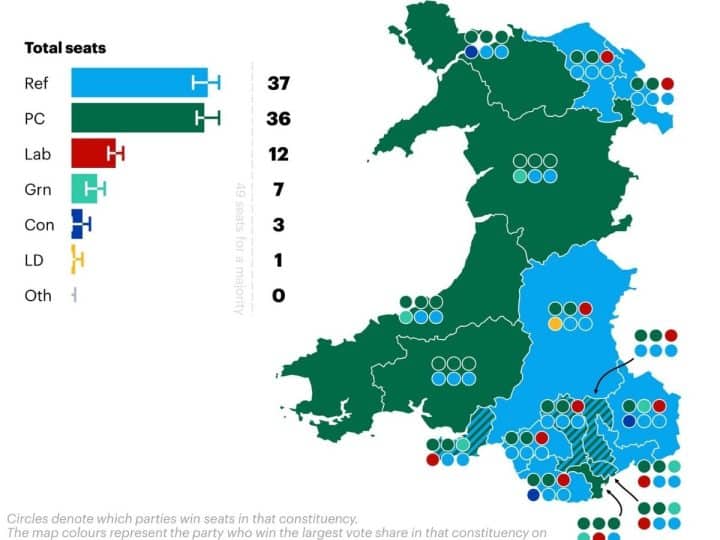

The latest projections from YouGov, published on 22 April, put Welsh nationalist party Plaid Cymru and far-right populists Reform UK neck-and-neck for control of the Senedd. What’s more, the pollster also predicts massive losses for both Labour and the Conservatives.
The new data represent only the second YouGov multi-level regression and post-stratification (MRP) model for the 2026 Senedd election. Between 6 and 15 April, 3,000 adults in Wales contributed to the dataset.
Some of the data is compared to notional results for 2021, because the Senedd electoral system has recently undergone massive changes.
Compared to the first MRP from March 2026, Reform has gained an extra seven seats. Conversely, Plaid Cymru has lost the same number.
Meanwhile, the Greens are also set to make significant gains. Although the left-wing environmentalist party has never had a Senedd MP, YouGov now predicts that the left-wing party will win seven seats.
Reform set to gain, Labour set to lose
The Tories would have held a notional 26 seats in 2021. However, YouGov’s central projection has them on just 3 seats this year. The pollster pointed out that:
This would leave the party short of the five seats needed to form a political group in the Senedd, barring them from chairing committees and limiting their ability to question ministers.
However, the Tories’ predicted losses pale in comparison to Labour’s:
Last time Labour lost a general election in Wales:
> Attlee is still in the army; Bevan is 21 & about to go to study in London. — Joe Allen (@Joe___Allen) April 22, 2026
> Conan Doyle still writing Sherlock Holmes; Monet still painting water lilies.
> Civil war in Russia; a wounded Hitler has just returned to Munich. https://t.co/839LbVE7mj
YouGov explained that the Labour Party was:
set to fall to just 12 seats in the Senedd, a notional loss of 32, ending their century of dominance of Welsh politics and leaving them with no representation in a huge swathe of the country stretching from Llanelli to Llandudno.
As such, many social media users speculated as to the… efficacy of voting Labour:
Voting Labour under these circumstances is madness. https://t.co/uH4P9voF3G
— Zoe Gardner (@ZoeJardiniere) April 22, 2026
Some even characterised a vote for Labour as a vote for Reform, in the circumstances:
it’s clear in Wales it’s now vote Labour and get Reform — neil merriman (@NeilMerriman) April 22, 2026
or vote Plaid and get Plaid #localelections26 https://t.co/dBcvM3CkIE
Coalition on the cards
However, as with a great deal of parliamentary politics, the reality isn’t quite that simple. Rather, YouGov speculated at length about the possibility of a coalition government within the Senedd.
This was largely because both Plaid Cymru and Reform are predicted to take 40 seats at the outside. Even that best case scenario for either party is far short of the 49 required for a majority.
Rhun ap Iorwerth, the Plaid Cymru leader, has voiced a preference for his party to form a minority government. However, this would involve trying to get the Greens or Labour on-side in order to pass any motion, which is somewhat impractical.
Nevertheless, some social media users have speculated that Plaid Cymru would be a welcome change:
For what its worth, I think it'd be good for Wales if it took a break from being led by Labour – same as it was for Scotland. Voting Reform or Tory won't help Wales https://t.co/k7eZr9eyq5
— Bryan Smith #RejoinEU same handle on BlueSky (@BpsmithUk) April 22, 2026
If Wales puts Plaid Cymru in power, they will get a chance to see what they have to offer & what they can achieve.
In practice, the Welsh parliament would likely only be able to function with some level of alliance between two or more parties. In that scenario:
the balance tips decisively towards the likelihood of a Plaid Cymru-led government, as Reform UK and the Conservatives win a collective right-of-centre majority in a mere 3% of our model’s simulations, suggesting Dan Thomas’s route to being first minister is limited. […]
Although they fall just short in our headline estimates, Plaid Cymru and Labour hold a majority between them in 47% of our simulations, while Plaid Cymru and the Greens do so in 5%. The three parties hold a combined majority in 96% of our mid-campaign model’s simulations.
The possibility of a Plaid-led coalition beating out Reform will likely come as a relief to a good deal of Welsh residents. Many posters expressed their distaste at the prospect of “English nationalist” Reform controlling Wales:
Wales doesn't have power over immigration, only Westminster does. Don't let an English nationalist racist party take over Wales, change our history to British in museums, and make life much harder for the vulnerable. Vote @Plaid_Cymru 7th May https://t.co/2gQIEsLJnx pic.twitter.com/M9CbQoXeDp
— Sharon
Owain Glyndŵr fought against this.


 (@K4rmaRules) April 22, 2026
And again:
All that Reform blue in Wales is disgusting. It seems like Wales wants to continue to be controlled by right wing English people. https://t.co/nVGjGV2r0W
— Tom_Owain (@TOwainlfc) April 22, 2026
Meanwhile, others were more bothered by Reform’s clear vendetta against working-class people:
#wales #cymru People of Port Talbot, Swansea and South Wales. Please DOn't vote REform, YOu are voting against working people, losing jobs in the council and Reform want to frack particularly in the Swansea Bay area. .They will take your employment rights https://t.co/jD3Ro8A1LN
— Al Bopper (@Alanbopper) April 22, 2026
Whilst YouGov currently predicts an incredibly tight race between Reform and Plaid Cymru, the prospect of a coalition being necessary means that practically any of the major parties may find themselves with a share of the leadership of the Senedd.
As such, 7 May’s voting will be more crucial than ever — and will bring greater change to Welsh politics than we’ve seen for decades, for better or for worse.
Featured image via Twitter

Ahead of the July 2026 energy price cap increase, advice organisation Green Doctors is explaining how its service can help.
Bills are set to rise again, and the risk of a substantial increase in the price cap grows due to uncertainty surrounding Trump and Netanyahu’s warmongering in West Asia. This change would impact UK households’ fuel prices and energy bills.
According to End Fuel Poverty, UK gas prices have already skyrocketed 124% month-on-month and up 65% year-on-year, peaking since the conflict started in February. This three-year high in Gas and Oil prices follows attacks on energy sites across Iran and Qatar.
On 27 May, the UK government will release the July price cap based off Ofgem’s reports. In essence, this means your bills will be protected until at least 1 July 2026, as the April to June price cap has already been decided.
The price cap is a way of smoothing out these price spikes, delaying the offset costs from reaching consumers. But, if price instability continues, there is a risk that the announcement on 27 May will signal an increase. With households already struggling with the soaring cost of living, some may need external support to help them navigate this turbulent period.
Some tips from Green Doctors
Many people feel like their energy bills are completely out of their hands, and they are paying the price for geopolitical tensions they have little control over. Green Doctors wants to share some practical ways people can help themselves, in reducing their energy bills and tackling their anxieties over the ever-increasing energy prices.
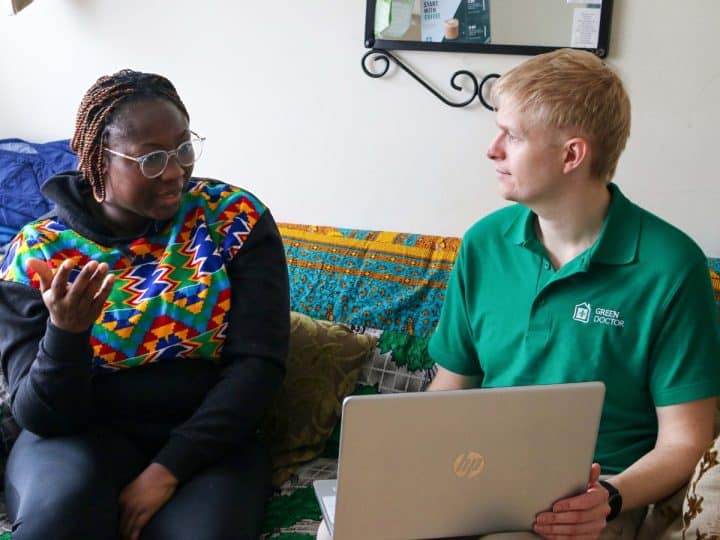
Daniel Brittle, Green Doctors service manager for London and South England, has spoken about the measures people can take to make their home more energy efficient and feel more in control.
He mentioned that people can make small-scale energy efficiency improvements around their home, like fitting draft proofing or radiator foils to their radiators, which most DIY stores sell.
A service like Green Doctors is important in times of energy instability as it provides people with clarity on their energy bills. Last year Green Doctors supported over 5,000 people in London with energy efficiency measures. These small changes can make a big difference to people’s lives, giving them a sense of security over their energy bills.
Brittle also stressed that they are expecting a rise in referrals around the time of the energy price cap increasing, especially when people receive those first bills at higher costs.
Green Doctors delivered around 2,700 home visits in 2025. But with the demand for Green Doctors ever growing, there are fears that the service won’t be able to keep up.
Pearl is a Green Doctors service user from Hammersmith and Fulham. She said about her energy costs:
It is very expensive. The bills were constantly rising. Money goes into energy bills then I do have a deficit in terms of other things in the house like my rent, my food shopping, clothing for my children, and day to day activities like travel.
When the Green Doctor came into my home, the first thing he asked me was who my energy provider was. We looked at my bill. We looked at what tariff I was on for the energy company on my behalf.
I found it very helpful because it then took off the anxiety because I didn’t know what to say to the energy company. But, because he is coming from a specialist point of view, it was a very straight forward and easy conversation.
Brittle added:
Green Doctors help people be more energy efficient and save money in ways they may not have considered. This might include behavioural changes, such as turning down temperature controls or setting up their thermostat to heat their home only when needed.
They also help explore other options, like the Warm Homes Discount, the Priority Services Register, or finding the cheapest energy tariff by switching providers.
Find out more or get in touch with Green Doctor here.
Featured image via Green Doctors
By The Canary

The post ‘Iran is <em>still</em> a nuclear threat’ appeared first on spiked.

SEC Near Tokenized Securities Exemption: Atkins Signals Policy Shift

Raunchy, R-Rated 80s Sci-Fi Comedy Is Impossible To Categorize, So Of Course It’s On Tubi

Iran tightens control of Hormuz after US calls off renewed attacks

Manchester United reach agreement with Casemiro over contract clause amid transfer speculation

Steven Gerrard disagrees with Gary Neville over ‘shock’ Chelsea and Arsenal claim | Football

US brings back mandatory military draft registration


-

 Sports6 days ago
NWFL Suspends Two Players Over Post-Match Clash in Ado-Ekiti
-

 Fashion5 days ago
Weekend Open Thread: Theodora Dress
-

 Politics5 days ago
Palestine barred from entering Canada for FIFA Congress
-
Entertainment3 days ago
NBA Analyst Charles Barkley Chimes in on Ice Spice McDonald’s Fiasco
-

 Business4 days ago
Powerball Result April 18, 2026: No Jackpot Winner in Powerball Draw: $75 Million Rolls Over
-

 Tech4 days ago
Auto Enthusiast Scores Running Tesla Model 3 for Two Grand and Turns It Into Bare-Bones Go-Kart
-

 Politics4 days ago
Zack Polanski demands ‘council homes not luxury flats for foreign investors’
-

 Crypto World5 days ago
Russia Pushes Bill to Criminalize Unregistered Crypto Services
-

 Politics2 days ago
Gary Stevenson delivers timely reminder to register to vote as deadline TODAY
-

 Politics10 hours ago
Disabled people challenge government SEND proposals over segregation concerns
-

 Business19 hours ago
Rolls-Royce Voted UK’s Most Iconic Trade Mark as IPO Register Hits 150
-

 Politics10 hours ago
Making troops accountable for war crimes threatens US alliance, ex-SAS colonel warns
-
 Business6 days ago
Creo Medical agree sale of its manufacturing operation
-

 Crypto World5 days ago
Russia Introduces Bill To Criminalize Unregistered Crypto Services
-

 Politics11 hours ago
Starmer handler McSweeney to be dragged from shadows by Foreign Affairs Committee
-

 Politics11 hours ago
Zack Polanski responds to home secretary’s taser threat
-
Politics12 hours ago
Wings Over Scotland | How To Get Away With Crimes
-
 Crypto World4 days ago
Kelp DAO rsETH Bridge Hack Drains $292M as DeFi Losses Top $600M in Two Weeks
-

 Politics9 hours ago
‘Iran is still a nuclear threat’
-

 Sports7 days ago
“Felt Much Better Today”: Josh Hazlewood Opens Up On His Recovery Win Over LSG
You must be logged in to post a comment Login