
Crypto World
here’s why Pepe Coin, Zcash, Morpho, and Dogecoin are rising



A crypto market rally is going on today, February 15, as investors buy the recent dip after the encouraging US consumer inflation report.
Summary
- The crypto market rally restarted today, with Bitcoin and most altcoins rising by double digits.
- This rally ignited after the recent US inflation report, which showed that prices retreated in January.
- The rally is also happening as the Crypto Fear and Greed Index remains in the extreme fear zone.
Bitcoin (BTC) price jumped to $70,000, while the market capitalization of all coins soared to over $2.4 trillion. Pepe Coin (PEPE) jumped by over 30% in the last 24 hours, while Zcash (ZEC), Dogecoin, and Bonk were up by over 10% in the same period.
Most of these tokens have soared by over 50% from their lowest levels this year. Other top gainers were coins like Shiba Inu, Jupiter, Morpho, and Pippin.
Crypto market rally triggered by US inflation report
The ongoing crypto market rally is happening because of last Friday’s macro report, which showed that the headline consumer inflation continued falling in January. This report showed that the headline Consumer Price Index dropped to 2.4% in January from 3% a few months ago. It is slowly moving towards the 2% target..
Another report showed that the labor market is making strides despite some notable layoffs announced this year. The unemployment rate dropped to 4.3% as the economy created over 130k jobs during the month.
These numbers mean that the Federal Reserve will likely cut interest rates more time than expected this month. While Fed officials have hinted at one interest rate cut this year, most analysts expect that the bank will deliver more cuts than that.
The crypto market rally is also happening as the futures open interest continues rising. Data compiled by CoinGlass shows that the futures open interest rose by nearly 2% to $100 billion, a sign that investors are adding more leverage to their positions.
Crypto Fear and Greed Index has rebounded
Additionally, the rally is happening because of the ongoing performance of the Crypto Fear and Greed Index, which has remained in the extreme fear zone in the past few weeks. It has jumped from the extreme fear zone of 8 to the current 13.
Historically, crypto bull runs normally start whenever the Fear and Greed Index falls to the extreme fear zone. A good example of this is what happened earlier this year when Bitcoin and other cryptocurrencies rallied.
Still, there is a need for caution as this rebound may be a dead-cat bounce, a situation where financial assets in a freefall rebound briefly and then resumes the downtrend trend.

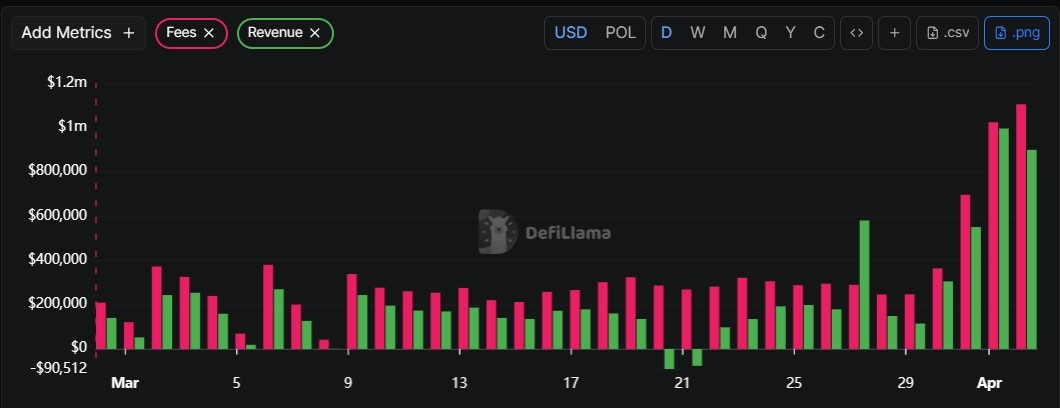
Prediction market Polymarket’s recent fee expansion has started to affect its numbers, with daily fees and revenue climbing sharply in the days following a March 30 price overhaul.
According to DefiLlama data, daily fees rose from about $363,000 on Monday to over $1 million on both Wednesday and Thursday, while revenue (the portion retained after incentives) reached as high as $995,000 on Wednesday before easing to about $899,000 on Thursday.

The jump follows the rollout of a broader fee model on Monday, when the platform expanded taker fees beyond crypto and sports to categories including finance, politics, economics, culture, weather and tech, while keeping geopolitical and world events fee-free.
The spike shows how aggressively Polymarket is monetizing trading activity to maintain continued investor interest amid regulatory scrutiny in the US, Europe and other countries worldwide. Last week, Intercontinental Exchange, the parent company of the New York Stock Exchange, invested $600 million in Polymarket.
Prediction markets face growing regulatory scrutiny
The fee and revenue spike comes as prediction markets, including Polymarket, face growing regulatory scrutiny across multiple jurisdictions.
In Europe, Polymarket has faced mounting restrictions, with Hungary and Portugal moving to block or limit access in January over concerns that the platform operates as unlicensed gambling. Regulators in both countries cited licensing issues and, in Portugal’s case, concerns around political betting.
Related: Peter Brandt, Polymarket traders don’t see new Bitcoin highs this year
On March 17, a court in Argentina ordered a nationwide ban on Polymarket, arguing that the platform allowed users to place bets without sufficient identity and age verification. The court said this meant that even children and adolescents could access the platform and place bets without any control.
According to Polymarket’s website, the platform is currently blocked in 33 countries. Kalshi, on the other hand, reports that it’s banned in 52 jurisdictions.

In the United States, at least 11 states have taken legal action against prediction markets such as Polymarket and Kalshi, with several issuing cease-and-desist orders or considering new legislation.
Despite regulatory crackdowns, Polymarket and Kalshi are looking to expand, with both reportedly exploring new funding rounds that could value each platform at around $20 billion.
On March 24, Polymarket and Kalshi introduced new trading restrictions to curb insider trading following criticism over well-timed bets and growing concerns around market integrity.
Magazine: Are DeFi devs liable for the illegal activity of others on their platforms?


Key takeaways
- BTC is down 2%, erasing the recovery earlier this week,
- US-listed spot ETF recorded an outflow of $173.73 million on Wednesday, breaking its two days of inflow this week.
Bitcoin faces continued losses amid weaker institutional demand
Bitcoin (BTC) prices continued to decline on Thursday, trading below $67,000, almost completely erasing the recovery from earlier in the week. Institutional demand also appears to be faltering, as spot Exchange Traded Funds (ETFs) experienced a significant outflow of over $173 million on Wednesday, ending a two-day streak of inflows.
This decline in demand coincides with a growing sense of bearish sentiment in the market, which is further amplified by US President Donald Trump’s recent remarks suggesting an escalation of the ongoing conflict.
On Wednesday, President Trump addressed the nation, warning that the ongoing conflict could drag on until late April. He stated that the US would take extreme measures over the next two to three weeks, including threats to attack Iranian power plants and send Iran back to the “stone age” if no agreement is reached.
These statements have dampened hopes for de-escalation, which in turn has reduced investor appetite for riskier assets. The US Dollar (USD) and Oil prices have risen as a result, while US equities and other risk assets have suffered, effectively erasing the gains Bitcoin saw earlier this week.
Data from CoinGlass indicates that institutional interest in Bitcoin remains uncertain. Spot Bitcoin ETFs saw a significant outflow of $173.73 million on Wednesday, following two days of positive inflows earlier this week. This suggests indecisiveness among institutional investors, who appear hesitant to increase exposure to risk assets amid ongoing market uncertainty.
According to Glassnode’s weekly report on Wednesday, Bitcoin remains trapped within a broad trading range of $60,000 to $70,000. While the market shows early signs of stabilization, it has not yet shown enough momentum to break decisively in either direction.
The report indicates that Bitcoin’s on-chain conditions reflect a continued period of repair, with elevated supply in loss and long-term holder capitulation still not fully resolved. However, spot demand has shown some improvement, signaling that sellers are not entirely in control of the market anymore.
Bitcoin Price Forecast: BTC could record further losses
The BTC/USD 4-hour chart is bearish and efficient as Bitcoin is trading below $66,400 on Thursday, erasing the recovery from earlier this week. The near-term bias is mildly bearish.
Bitcoin remains capped well below the clustered 50-day, 100-day, and 200-day Exponential Moving Averages (EMAs) between roughly $70,800 and $84,800, which reinforces downside pressure despite the recent bounce attempts.
Currently, the technical indicators are bearish. The Relative Strength Index (RSI) on H4 sits at 51, just above the midline.
The Moving Average Convergence Divergence (MACD) remains below the signal line, indicating persistent selling pressure.
If the market continues its decline, sellers would meet immediate support at $65,900. Breaking this level would expose the key psychological level at $60,000.

On the flipside, if the bulls regain control of the market, they would encounter resistance at the $69,200 level, with the major resistance around $72,600.
A daily close above $72,600 would signal a bullish break from the sideways structure and open the door toward the 100-day EMA near $76,400.


Metaplanet (3350) continued to scale its accumulation strategy through the first quarter of 2026, acquiring 5,075 BTC for approximately $398 million, implying an average purchase price of about $78,000 per coin.
The Tokyo-based firm has has generated a BTC yield of 2.8% year-to-date.
As of March 31, Metaplanet holds a total of 40,177 BTC, acquired for roughly $3.9 billion, with an average cost basis of approximately $97,000 per BTC.
Metaplanet is now the third largest bitcoin treasury company worldwide, overtaking MARA Holdings after the miner reduced its bitcoin stack significantly.
Twenty One Capital (XXI) holds second place with 43,514 BTC, according to Bitcoin Treasuries, while Strategy (MSTR) is by far and away the largest with over 762,000.
Shares of Metaplanet were down 2%, trading at 302 yen ($1.89).
Crypto World
Audit admin keys, not just code, expert says after $200 million Drift exploit: Crypto Daybook Americas
By Omkar Godbole (All times ET unless indicated otherwise)
Programmable blockchain Solana’s SOL token has hit five-week lows after an exploit at one of its largest perpetual decentralized exchange, Drift, underscored that security risks go beyond just smart contracts.
“If you’re building in DeFi, audit the surface area of your admin key. Not only the smart contracts,” Omer Goldberg, founder of Chaos Labs, said, explaining what went wrong.
Goldberg explained in his X thread that the attacker compromised Drift’s admin key. This single key gave the attacker god-like control — like handing someone the master password to the entire bank vault with no limits or alarms.
Using this power, the attacker created a fake collateral market for a worthless token called CVT. They maxed out the risk parameters so the system treated hundreds of millions of this junk token as safe, high-value collateral. In the same transaction, they switched the CVT price oracle to one they fully controlled, artificially pumped its value to sky-high levels, lifted the circuit breakers on major assets (removing withdrawal limits) such as USDC, eETH and others, and drained over $250 million worth of tokens.
This also worked because Drift features a single shared liquidity pool that holds everyone’s collateral and trading funds, providing a seamless trading experience. (Imagine putting all your money in a single bank account and losing everything in a signature hack).
The real issue wasn’t a bug in the code. It was the enormous “surface area” of that admin key, or the massive damage one compromised signer could cause by rewriting protocol-wide risk rules, assigning oracles, and disabling safety guards.
This isn’t the first time a compromised privileged key has led to big losses. Just 10 days earlier, Resolv was drained for $25 million in tokens after attackers compromised a SERVICE_ROLE key.
So, the message is clear: protocol safety now depends as much on strong governance and key controls as it does on smart contract audits.
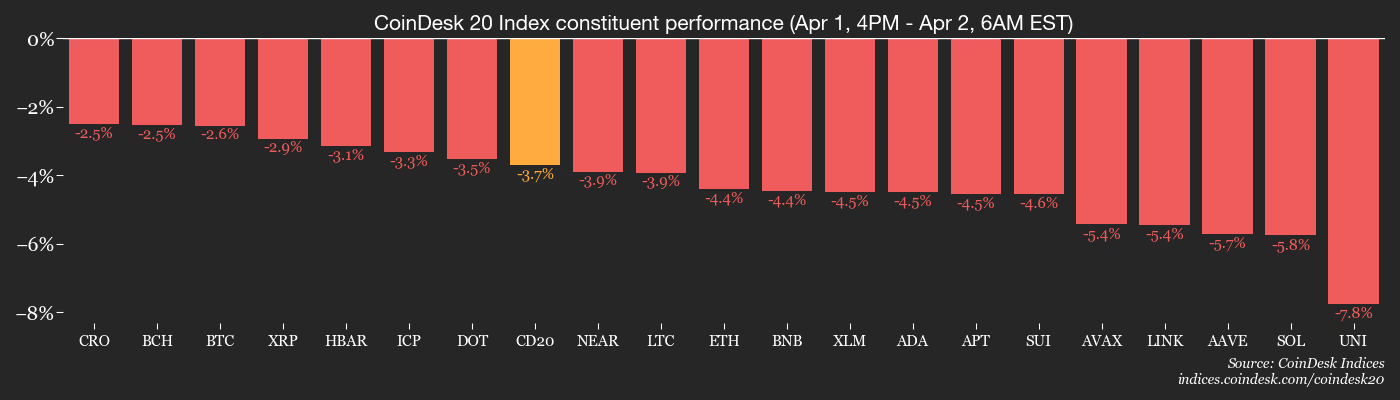
As for markets, SOL’s near 3% drop to $78.30, the lowest since late February, is consistent with the weakness in bitcoin , ether (ETH), XRP (XRP) and the wider market, as represented by the CoinDesk 20 Index.
The culprit once again is President Donald Trump’s renewed threat to Iran, which has sent oil prices higher. In the short term, these headlines could continue to lead movements in both traditional and crypto markets. Stay alert!
Read more: For analysis of today’s activity in altcoins and derivatives, see Crypto Markets Today
What to Watch
For a more comprehensive list of events this week, see CoinDesk’s “Crypto Week Ahead“.
- Crypto
- Macro
- April 2, 8:30 a.m.: U.S. Initial Jobless Claims for week ending March 28 (Prev. 210K)
- Earnings (Estimates based on FactSet data)
Token Events
For a more comprehensive list of events this week, see CoinDesk’s “Crypto Week Ahead“.
- Governance votes & calls
- Unlock DAO is voting to transfer 3 ETH to its Base multisig to swap for USDC to cover current and future operational expenses. Voting ends April 2.
- Aavegotchi DAO is voting to elect nine multi-sig signers, maintain a 5-of-9 signature threshold, and set their quarterly compensation at $1,000 paid in GHST. Voting ends April 2.
- Arbitrum DAO is voting across two proposals to transition its Code of Conduct and Procedures into living documents managed by OpCo, and to upgrade to ArbOS 60 Elara. Voting ends April 2.
- Unlocks
- April 2: Ethena (ENA) to unlock 2.18% of its circulating supply worth $16.05 million.
- Token Launches
Conferences
For a more comprehensive list of events this week, see CoinDesk’s “Crypto Week Ahead“.
Market Movements
- BTC is down 2.53% from 4 p.m. ET Wednesday at $66,459.24 (24hrs: -3.1%)
- ETH is down 4.66% at $2,043.77 (24hrs: -4.16%)
- CoinDesk 20 is down 3.59% at 1,891.30 (24hrs: -3.81%)
- Ether CESR Composite Staking Rate is up 1 bp at 2.77%
- BTC funding rate is at 0.0001% (0.0635% annualized) on Binance

- DXY is up 0.51% at 100.16
- Gold futures are down 3.56% at $4,641.60
- Silver futures are down 6.47% at $71.15
- Nikkei 225 closed down 2.38% at 52,463.27
- Hang Seng closed down 0.7% at 25,116.53
- FTSE is down 0.08% at 10,356.15
- Euro Stoxx 50 is down 1.61% at 5,640.26
- DJIA closed on Wednesday up 0.48% at 46,565.74
- S&P 500 closed up 0.72% at 6,575.32
- Nasdaq Composite closed up 1.16% at 21,840.95
- S&P/TSX Composite closed up 0.58% at 32,957.95
- S&P 40 Latin America closed up 0.95% at 3,658.43
- U.S. 10-Year Treasury rate is up 5.1 bps at 4.372%
- E-mini S&P 500 futures are down 1.17% at 6,540.50
- E-mini Nasdaq-100 futures are down 1.51% at 23,830.00
- E-mini Dow Jones Industrial Average Index futures are down 0.97% at 46,353.00
Bitcoin Stats
- BTC Dominance: 58.58% (+0.04%)
- Ether-bitcoin ratio: 0.03079 (-2.02%)
- Hashrate (seven-day moving average): 1,016 EH/s
- Hashprice (spot): $31.48
- Total fees: 2.55 BTC / $174,507
- CME Futures Open Interest: 107,610 BTC
- BTC priced in gold: 14.4 oz.
- BTC vs gold market cap: 4.44%
Technical Analysis

- The chart shows solana’s daily price swings in candlestick format with the Ichimoku cloud, a trend indicator, identified by the shaded area between green and red lines.
- The token’s price has crossed back below the cloud, indicating continuation of the broader decline. The pattern is similar to what we saw in mid-January, following which prices dropped sharply.
- Ichimoku cloud, invented by a Japanese journalist, is widely used to spot trend changes. Crossovers above and below the cloud are said to represent bullish and bearish shifts in trends.
Crypto Equities
- Coinbase Global (COIN): closed on Monday at $172.99 (-0.93%), -3.17% at $167.50 in pre-market
- Circle Internet (CRCL): closed at $90.74 (-4.89%), -1.59% at $89.30
- Galaxy Digital (GLXY): closed at $17.37 (-5.85%), -2.42% at $16.95
- Bullish (BLSH): closed at $35.07 (-1.85%), -2.79% at $34.09
- MARA Holdings (MARA): closed at $8.04 (-1.47%), -2.74% at $7.82
- Riot Platforms (RIOT): closed at $12.55 (+1.54%), -4.94% at $11.93
- Core Scientific (CORZ): closed at $15.30 (+2.27%), -3.66% at $14.74
- CleanSpark (CLSK): closed at $8.62 (+1.29%), -3.38% at $8.33
- CoinShares Valkyrie Bitcoin Miners ETF (WGMI): closed at $34.86 (+0.11%)
- Exodus Movement (EXOD): closed at $6.68 (+2.77%)
Crypto Treasury Companies
- Strategy (MSTR): closed at $122.78 (-1.62%), -2.09% at $120.21
- Strive (ASST): closed at $10.16 (+1.40%), -3.44% at $9.81
- SharpLink Gaming (SBET): closed at $6.46 (+0.16%), -3.72% at $6.22
- Upexi (UPXI): closed at $0.99 (+0.20%), -5.16% at $0.94
- Lite Strategy (LITS): closed at $1.13 (-2.59%), -5.31% at $1.07
ETF Flows
Spot BTC ETFs
- Daily net flow: -$173.7 million
- Cumulative net flows: $55.92 billion
- Total BTC holdings ~ 1.29 million
Spot ETH ETFs
- Daily net flow: -$7.1 million
- Cumulative net flows: $11.58 billion
- Total ETH holdings ~ 5.71 million
Source: Farside Investors
While You Were Sleeping
Trump stirs market, political angst with vague timeline for Iran (Bloomberg): The $31 trillion U.S. Treasuries market notched its worst monthly performance since late 2024 in March, with bond investors concerned that the war-driven surge in oil prices would ignite inflation.
‘We are going to hit them hard’: Markets disappointed, oil up again after Trump speech (euronews): Oil rose sharply and European stocks fell after Trump said in his first national address since the Iran war began that the U.S. would continue its attacks on Iran.
Gold, silver fall as investors doubt Trump’s exit plan (The Wall Street Journal): Gold and silver prices swung into the red, alongside industrial metals and equities. Spot gold prices were down 3%, at roughly $4,670 a troy ounce. Spot silver fell more than 5%.
The bitcoin treasury boom is unwinding as some companies and governments sell holdings (CoinDesk): Those who rushed into bitcoin over the past two years are now heading for the exits and it’s not a great sign for the market.


United States President Donald Trump has vowed to continue military operations as the country’s Middle East war with Iran enters the third week of intensified hostilities.
Summary
- Trump says U.S. will intensify strikes on Iran’s critical infrastructure over the next two to three weeks as military operations expand.
- Iran warns of “crushing” retaliation and rejects ceasefire talks, claiming US and Israeli strikes have hit only limited targets so far.
- Major cryptocurrencies have fallen in response to the recent escalation.
“We are going to hit them extremely hard over the next two to three weeks. We’re going to bring them back to the Stone Ages, where they belong,” Trump said, adding that the United States would no longer tolerate “state-sponsored provocation” against American assets.
Further, Trump noted that Iran has repeatedly violated the terms of every previous diplomatic deal and confirmed that U.S. forces are going to aggressively target critical infrastructure across the country.
“We are going to hit each and every one of their electric generating plants very hard and probably simultaneously […] We have not hit their oil, even though that’s the easiest target of all, because it would not give them even a small chance of survival or rebuilding,” he added.
The ongoing war in the Persian Gulf has rattled both traditional and emerging markets, and the escalation has led to a massive spike in oil prices immediately after Iran threatened to permanently blockade the Strait of Hormuz.
Since the war began, Bitcoin has dropped nearly 12%; meanwhile, despite its reputation as a safe haven, Gold has also slumped sharply as a surging U.S. Dollar and rising bond yields outweigh geopolitical fears.
Trump says the oil situation will improve
Trump acknowledged concerns over surging gas prices but downplayed the economic impact, saying it was a temporary ”short-term” situation and that he expects global supply routes to open up once Tehran surrenders.
“When this conflict is over, the strait will open up naturally. It’ll just open up naturally. They’re going to want to be able to sell oil because that’s all they have to try and rebuild. It will resume the flowing and the gas prices will rapidly come back down,” he said.
He went on to add that the U.S. Economy is “strong and improving” and the domestic energy sector will be “roaring back like never before.”
“Thanks to the progress we’ve made. I can say tonight that we are on track to complete all of America’s military objectives shortly. Very shortly,” Trump said.
Iran threatens retaliation
Even though Trump said that back-channel discussions for a ceasefire were ongoing, Iranian leaders have vehemently denied that there are any serious talks underway.
After the latest speech, the Iranian Revolutionary Guard has vowed a “devastating” retaliation, adding that so far, the U.S. and Israel have been striking “insignificant” targets.
A spokesperson to the Supreme Leader said the two countries have “incomplete” information about the nation’s underground military capabilities and warned that any further strikes would be met with “crushing, broader and destructive” attacks.
He added that the bulk of Iran’s missile production takes place in ”places that you do not know at all.”
On Wednesday, reports suggested that Iran has blacklisted 18 tech companies, including Silicon Valley giants like Microsoft and Google, stating they would be considered as “legitimate targets” in response to cyber strikes on Iran.
“From now on, for every assassination, an American company will be destroyed,” The Guard, which the U.S. designates as a terrorist organization, warned on Tuesday.
Crypto markets under pressure
Major cryptocurrencies besides Bitcoin—including Ethereum, XRP, and BNB—have started to drop sharply and have losses between 3-5% as of last check.
If the macro situation continues to deteriorate, it could spell trouble for the liquidity of these volatile high-beta assets, especially as Bitcoin is hovering very close to a major support area around $65,000.
If this support breaks, it could trigger a massive wave of liquidations, potentially sending the broader market into a prolonged crypto winter fueled by geopolitical instability.
Bitcoin (BTC) price slipped below $67,000 on April 2, falling roughly 2.8% in 24 hours and extending a year-to-date decline that now sits near 23%.
The drop aligns with a pattern forming across on-chain data, chart structure, and derivatives positioning. One cohort of buyers has been steadily exiting since January, and the technical picture now threatens a 14% correction if a key level fails.
The Buyers Who Bought the Dip Are Walking Away
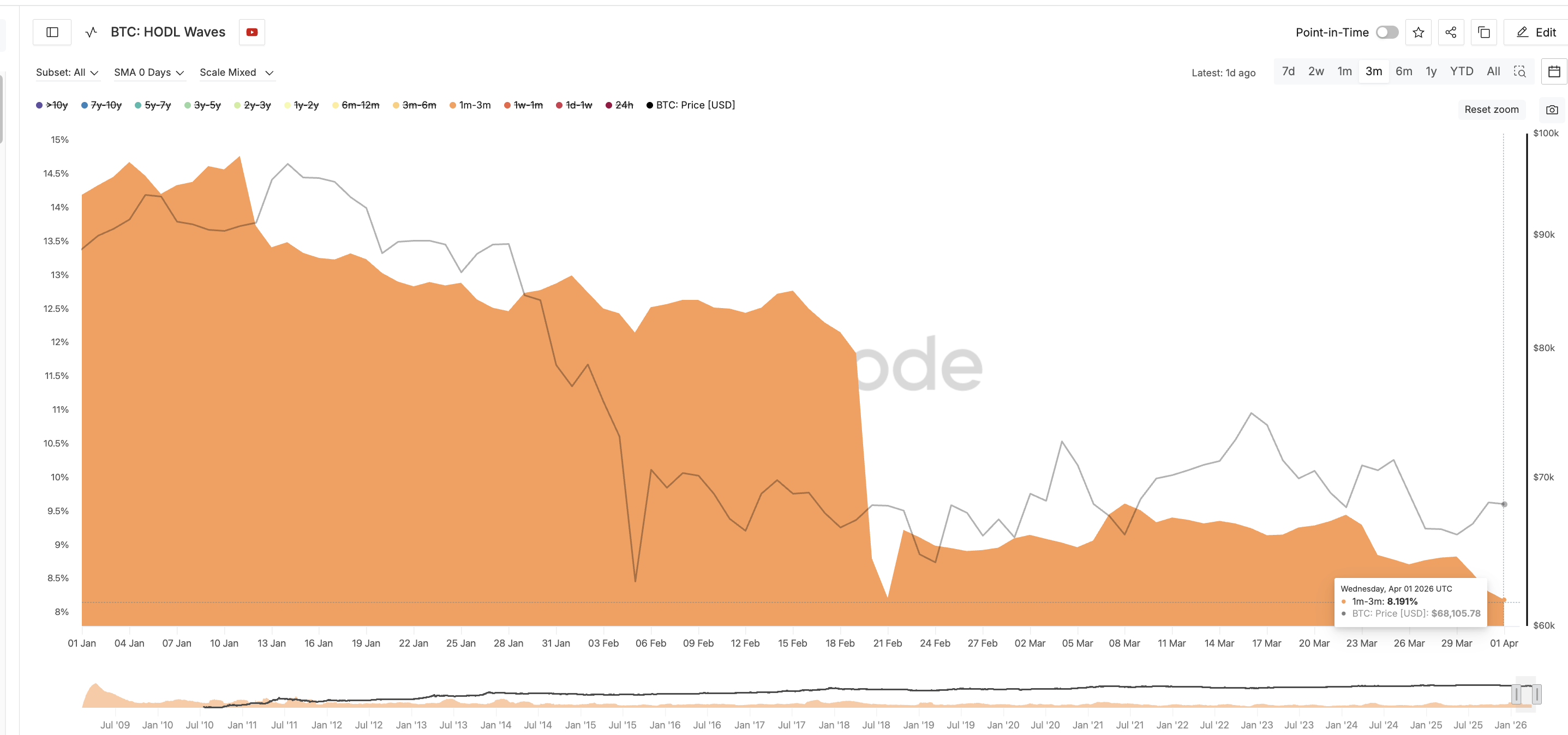
BTC HODL waves, an on-chain metric that tracks the percentage of supply held by different age groups, show a dramatic exit from the 1-month to 3-month cohort. On January 14, this group controlled 14.67% of the total Bitcoin supply. By April 1, that figure had fallen to 8.19%, its lowest reading of the year.
The decline accelerated in two distinct waves. The first came post mid-February, when the cohort’s share dropped from 12.72% on February 15 to single digits by February 22. A second aggressive leg down arrived around March 22, when the reading slipped from 9.44% and continued falling without recovery.
Want more token insights like this? Sign up for Editor Harsh Notariya’s Daily Crypto Newsletter here.
This group represents participants who accumulated during the Q1 drawdown, expecting a bounce. Their persistent selling over nearly three months signals that short-term conviction has evaporated. When recent buyers distribute at a loss rather than averaging down, it typically reflects capitulation rather than healthy rotation.
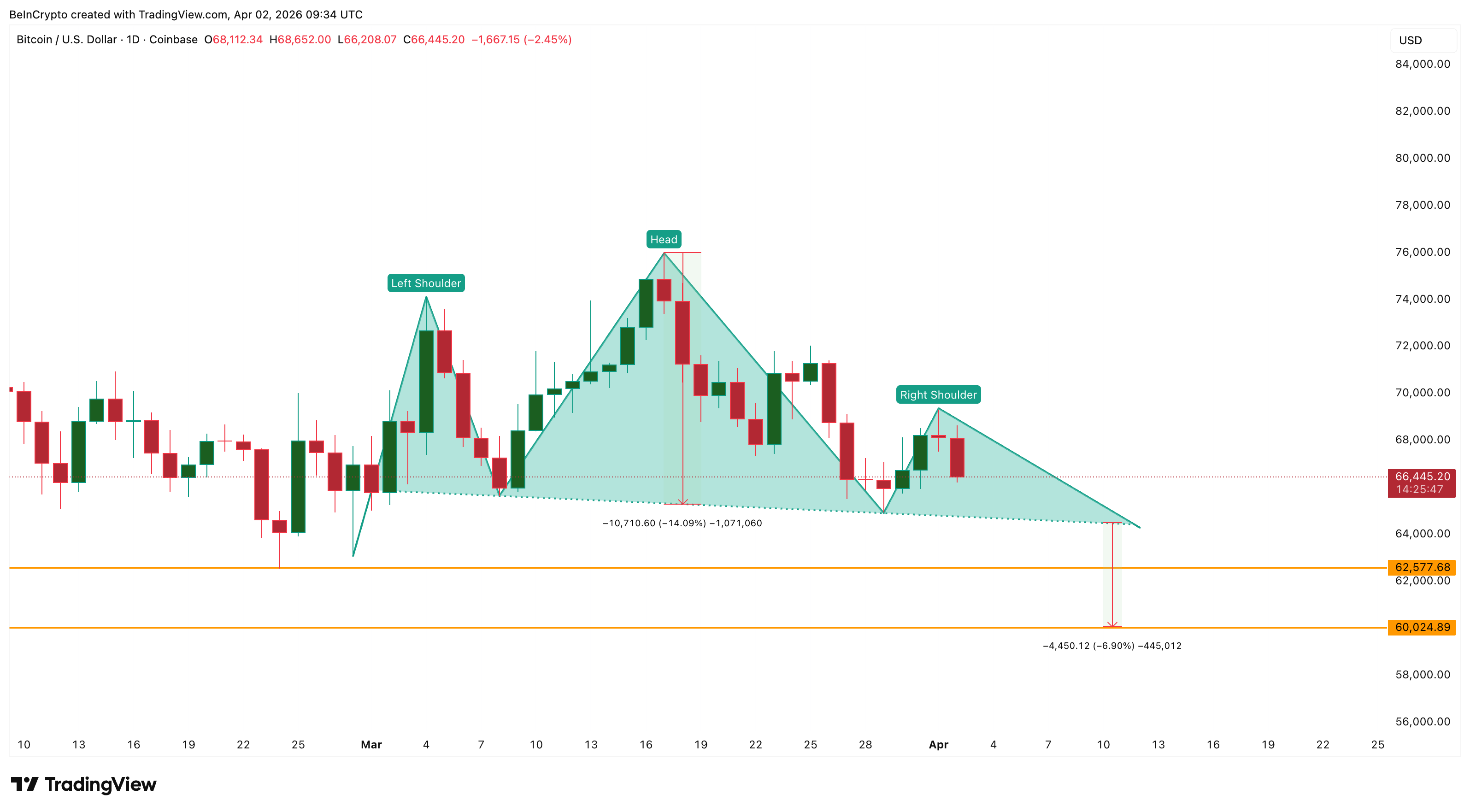
That behavioral shift is visible on the Bitcoin price chart as well. Since late February, the daily timeframe has been forming a head and shoulders pattern. The pattern validates the weakness that the HODL wave data already flagged.
However, whether the pattern triggers depends on how the derivatives market is positioned around the breakdown zone.
Leverage Leans the Wrong Way
Despite bearish signals from both on-chain behavior and chart structure, the BTC derivatives market has not adjusted defensively. Over the past seven days on the Binance BTC/USDT perpetual pair, cumulative long liquidation leverage totals $1.44 billion in active positions.
Short liquidation leverage sits at $1.03 billion. The roughly 40% skew toward longs means the market remains positioned for upside while the technical picture deteriorates.
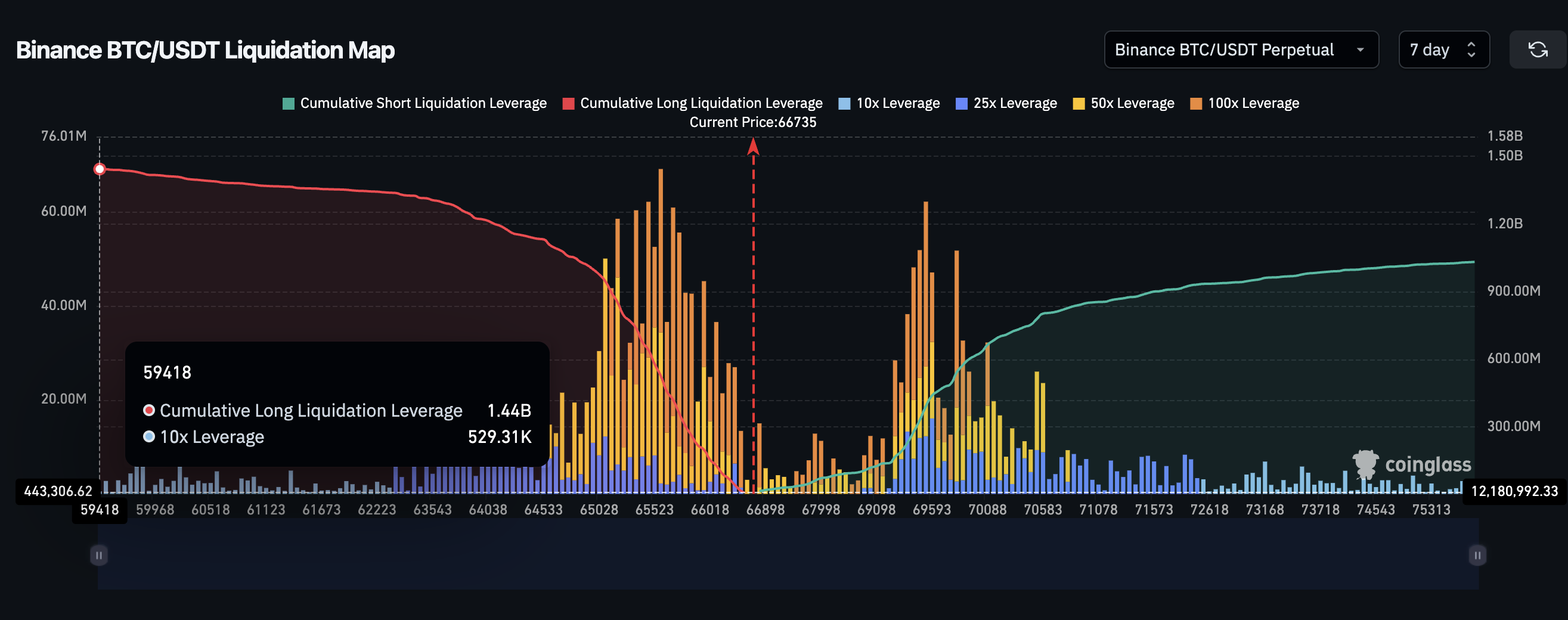
The Binance BTC liquidation map sharpens the risk further. Of the $1.44 billion in total long exposure, approximately $1.13 billion clusters at a single level near $64,533. That concentration means nearly 80% of all long positions opened over the past week would be forcibly closed if price reaches that zone.
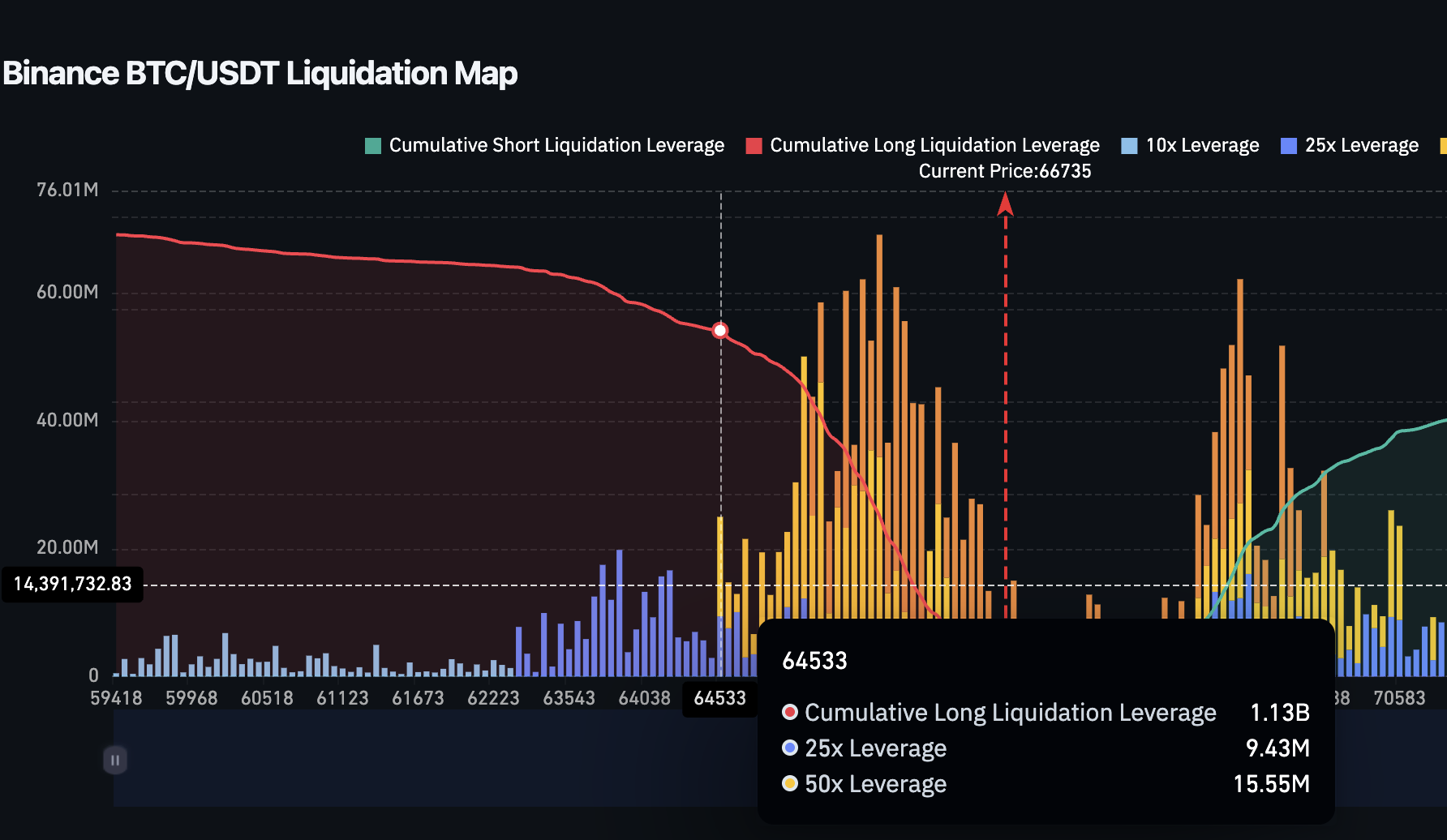
High-leverage positions using 25x and 50x multipliers dominate the cluster.
Even a modest push into that range could trigger cascading forced selling, turning a controlled decline into a liquidation-driven flush. The mismatch between bearish structure and bullish leverage is where the greatest Bitcoin price risk builds. The BTC price chart now becomes the final arbiter of whether that risk materializes.
Bitcoin Price Prediction and One Critical Line
The daily chart confirms the head and shoulders pattern with Fibonacci (Fib) levels mapping every critical zone. The Fib levels are drawn from the head of the pattern to the completed swing low.
Bitcoin currently trades near $66,425, having already lost the 0.236 Fib level at $67,510.
The measured move from the pattern projects a 14.16% decline, targeting approximately $60,024 on the way down. However, the path runs through $64,888, a level that is slightly above the neckline area for the pattern.
Losing $64,888 would place price directly into the $1.13 billion long liquidation cluster at $64,533 identified in the derivatives section. That overlap transforms the neckline break from a technical event into a leverage-driven cascade. From there the full 14% target, under $60,000 becomes realistic.
For the bearish thesis to fail, Bitcoin price needs a daily close above $69,132 to begin neutralizing the right shoulder. Strength only returns above $71,750, the 0.618 level, and a move past $75,997 would invalidate the head and shoulders entirely.
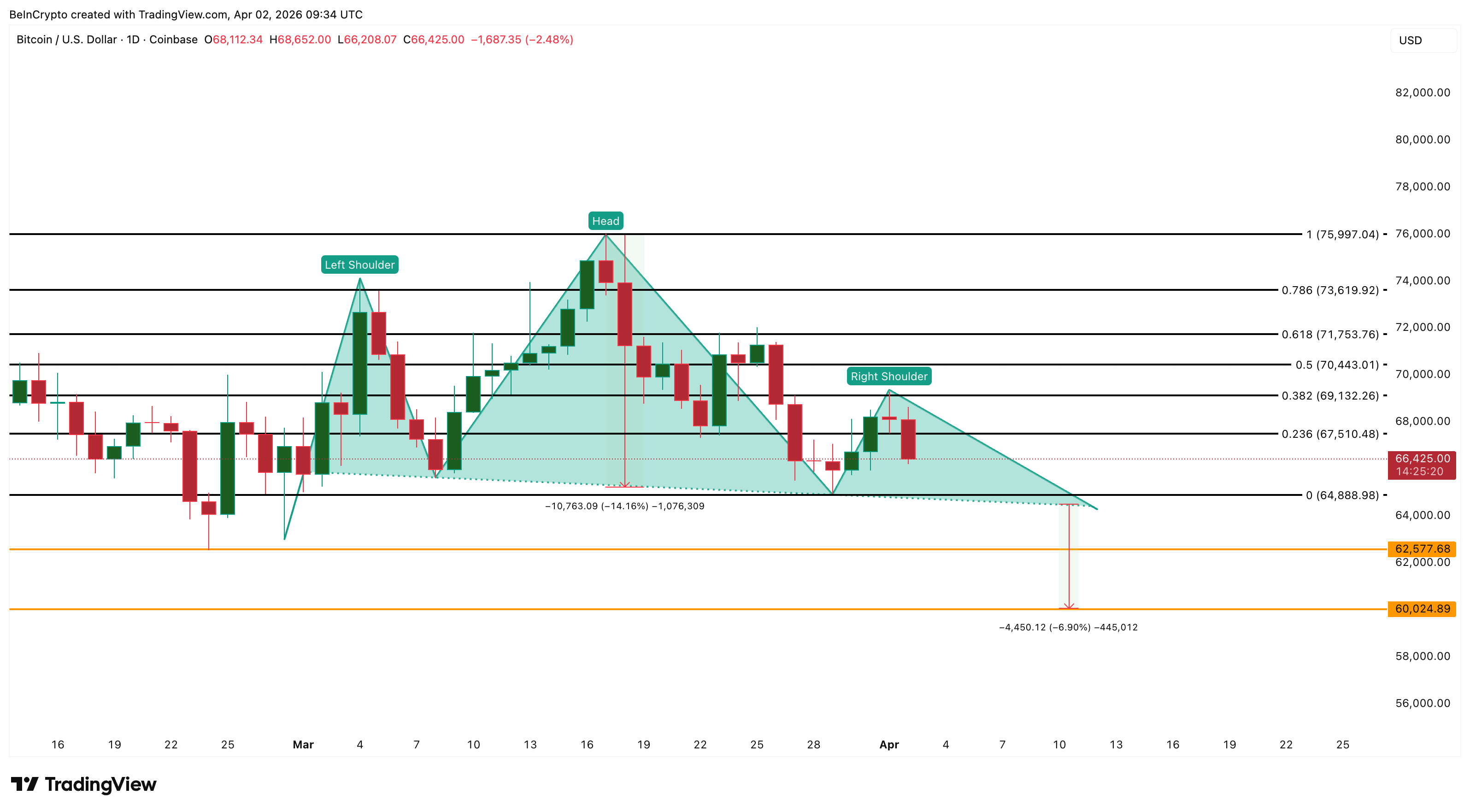
Head and shoulders patterns do not always resolve in the expected direction. A sudden demand surge or macro catalyst could reverse the structure before the neckline is tested. However, the convergence of capitulating short-term buyers, long-heavy leverage, and declining price structure lowers the probability of that outcome.
A daily close below $64,888 separates a measured pullback from a leveraged flush toward the $60,000 zone, while reclaiming $69,132 would be the first signal that sellers are running out of momentum.
The post One Selling Pattern Reveals the Next Major Bitcoin Price Risk of 2026 appeared first on BeInCrypto.

Key Insights
- GENIUS Act defines state-regulated stablecoin compliance, allowing smaller issuers to operate locally while meeting federal oversight standards.
- OCC guidance establishes federal benchmarks, guiding stablecoin issuers transitioning from state to federal supervision after $10 billion circulation.
- Monthly reserve disclosures and uniform branding rules ensure consistent transparency and regulatory alignment across state and federal stablecoin frameworks.
The U.S. Department of the Treasury has released an 87-page proposal implementing the GENIUS Act. The notice opens a 60-day public comment period and outlines how stablecoin oversight will function across both state and federal systems.
The proposal details how the Treasury will determine whether state-level regulatory frameworks are “substantially similar” to federal standards. Smaller issuers can remain under state supervision if their systems meet the defined benchmarks.
State Stablecoin Oversight Must Meet Federal Standards
Issuers with less than ten billion dollars in circulation may opt for state-level regulation, provided their frameworks align with federal rules. The proposal separates requirements into two categories: uniform rules covering reserves and anti-money laundering and state-calibrated rules where local regulators control supervision, licensing, and risk management.
This approach allows states to maintain flexibility while ensuring all systems comply with the federal baseline, preventing gaps in regulation.
OCC Guidance Shapes Federal Stablecoin Compliance
The Treasury relies on the Office of the Comptroller of the Currency to define the federal benchmark. Nonbank issuers that exceed the $10 billion threshold will transition toward federal supervision guided by OCC standards.
The rule also clarifies that state frameworks may exceed federal requirements, but they cannot conflict with federal law or reduce regulatory comparability.
Stablecoin Disclosure and Branding Rules Enforced
Issuers must publish monthly reserve composition reports to maintain transparency across state and federal systems. This ensures that disclosure practices remain consistent for all regulated stablecoins.
In addition, naming restrictions apply uniformly to prevent misleading branding. These rules align compliance across jurisdictions and maintain public confidence in dollar-backed stablecoins.
GENIUS Act Implementation Drives Regulatory Alignment
The rulemaking represents a key step in turning the GENIUS Act into an operational framework. Passed in July 2025, the law introduced mandatory reserve backing, regular disclosures, and anti-money laundering compliance for payment stablecoins.
Meanwhile, Congress continues advancing complementary measures, including the Clarity Act, to define SEC and CFTC oversight, although disputes over stablecoin yield have slowed broader market reforms.
Crypto World
Crypto’s wash trading problem is ‘far more common’ than investors think, DOJ sting shows


A U.S. enforcement case against alleged crypto market manipulation is once again putting the spotlight on wash trading and the blurry line between market makers and market manipulators.
Federal prosecutors in California this week charged 10 individuals tied to firms including Gotbit, Vortex, Antier and Contrarian, accusing them of coordinating trades to inflate token prices and volumes before selling into the artificial demand. The case stemmed from an undercover FBI operation in which agents created their own token to identify firms offering manipulation services.
Defendants marketed strategies to boost trading activity that in reality amounted to pump-and-dump schemes and wash trading, leaving evidence that is far more common than expected, crypto experts Jason Fernandes from AdLunam and Stefan Muehlbauer from Certik told CoinDesk via Telegram interviews..
“Yes, despite increased enforcement, wash trading continues to be a pervasive issue, particularly among lower-cap tokens and on unregulated exchanges,” Muehlbauer said, while Fernandes stated, iIt’s far more common than most investors realize,”. They both agreed the scale remains high.
Gotbit Founder Aleksei Andriunin, included in the recent Department of Justice indictments, pleaded guilty to two counts of wire fraud and conspiracy to commit market manipulation last year, and agreed to forfeit $23 million. U.S. prosecutors described his crimes as a “wide-ranging conspiracy” to manipulate token prices for paying clients.
Inflating volumes becomes a shortcut
The details of market manipulation exposed by the DOJ are impactful, but the underlying behavior is not.
“Wash trading exists because in crypto, liquidity is perception,” said Jason Fernandes, co-founder of AdLunam. “Volume attracts attention, listings and capital, so inflating it becomes a shortcut to relevance.”
The mechanics are straightforward: coordinated accounts trade back and forth to simulate demand, often outsourced to market makers paid to create the illusion of organic flow.
It is far more common than investors believe or expect, particularly in long-tail tokens and on smaller exchanges where oversight is limited, Fernandes added.
“In many cases, it’s not just rogue actors. It’s projects, market-making firms and even venues themselves, all benefiting from higher reported volume.”
The DOJ said the firms included in their indictment used coordinated trading to inflate volumes and prices, ultimately selling tokens at artificially high levels to unsuspecting investors.
Recent research has repeatedly pointed to inflated activity across crypto markets. A Columbia University analysis of Polymarket found roughly 25% of historical volume showed signs of wash trading, while earlier Dune Analytics data suggested tens of billions in NFT volume on Ethereum stemmed from similar activity.
Wash trading still a ‘pervasive issue’: Certik
“The recent actions by the U.S. Department of Justice send a clear signal,” said Stefan Muehlbauer, head of U.S. government affairs at CertiK. “The ‘wild west’ era of crypto market manipulation is facing a coordinated, global crackdown. While these indictments represent a major victory for market integrity, wash trading remains a significant concern.”
Despite years of scrutiny, the incentives behind the practice remain intact, he said. Token issuers often face pressure to meet exchange listing requirements tied to trading volume, leading some to turn to market makers to simulate activity or deploy bots that trade against themselves.
“The ‘why’ is simple: illusion of value,” Muehlbauer said. “That illusion has real consequences,” particularly because artificial volume distorts price discovery, masks weak liquidity and can funnel capital based on signals that are not real. “High volume signals to investors and exchanges that a token is hot and liquid.”
“Victims are investors relying on that liquidity and high volume data,” Fernandes said. “Wash trading distorts markets, leading to “mispriced risk and capital flowing based on signals that aren’t real.”
Enforcement will benefit the market
The latest DOJ case stands out may bring a glimmer of hope to the industry.
“What’s notable isn’t just the charge but the method,” Fernandes said. “When the FBI is creating tokens to catch market manipulation, you’re no longer in a grey area. This is the U.S. signaling that crypto market structure is now firmly in enforcement territory.”
For market participants, the line between legitimate liquidity provision and manipulation is coming under sharper scrutiny, said the AdLunam co-founder.
Efforts to detect and reduce wash trading are improving. Regulated exchanges are deploying more sophisticated surveillance tools, while analysts are increasingly looking beyond headline volume to metrics such as order book depth, slippage and counterparty diversity.
Enforcement may ultimately push the market forward, although for now, the DOJ case shone a light on just how pervasive wash trading continues to be, undermining trust in crypto markets.
“Crypto is moving from a loosely policed frontier market to something that has to withstand institutional scrutiny. An irony is that enforcement like this may ultimately strengthen the asset class,” Fernandes said.
In Muehlbauer’s words, “the message to the industry is clear: what was once brushed off as ‘market making’ is now being prosecuted as wire fraud and market manipulation.”

Coinbase Chief Legal Officer Paul Grewal has signaled that FIT21 – the Financial Innovation and Technology for the 21st Century Act – is set to see meaningful legislative movement within 48 hours, a claim that lands at precisely the moment Senate negotiations over crypto market structure are reaching a critical inflection point.
The immediate market implication is not abstract: jurisdictional clarity between the SEC and CFTC is the single largest regulatory risk premium embedded in institutional crypto pricing right now, and a credible path to resolution moves that premium.
For institutional market makers, RIAs, and hedge funds that have been sidelined from altcoin exposure by unresolved ‘unregistered security’ risk, Grewal’s timing signal is the most direct legislative catalyst in months.
Crypto regulation has been inching forward since the GENIUS Act established a stablecoin framework in 2025 – but broader market structure has remained in limbo, and that limbo has a measurable cost in market liquidity and asset pricing spreads.
Grewal stated plainly that ‘clarity is coming,’ framing the current moment as the industry’s transition out of regulation-by-enforcement and into a structured legislative era. That framing is deliberate – Coinbase has been the most aggressive corporate actor pushing for FIT21 passage, and Grewal’s public confidence signal is a strategic move as much as a factual one. When a company’s CLO goes on record with a 48-hour window, the message to Senate negotiators is as loud as the message to markets.
Key Takeaways:
- Grewal’s signal: Coinbase CLO Paul Grewal publicly stated FIT21 would see legislative progress within 48 hours, the most direct timing claim from a major industry actor in the current cycle.
- What FIT21 defines: A decentralization test that determines whether digital assets fall under SEC (securities) or CFTC (commodities) jurisdiction – the central unresolved question in U.S. crypto regulation.
- The SEC vs CFTC boundary: Post-passage, sufficiently decentralized tokens become CFTC-regulated digital commodities; centralized issuances remain SEC-regulated securities.
- Market liquidity implication: Institutional market makers, RIAs, and hedge funds currently avoiding altcoins due to enforcement risk get a codified compliance standard – unlocking capital that has been on the sideline.
- What to watch: Senate Banking Committee markup targeted for April 2026; stablecoin yield compromise must resolve by end of week to keep the floor vote timeline intact.
Discover: The best crypto to diversify your portfolio with
What FIT21 Actually Does – and Why the SEC vs CFTC Question Is the Only One That Matters
FIT21’s core mechanism is a decentralization test – a ‘Howey-style’ framework applied specifically to digital assets to determine whether a token is an investment contract under SEC jurisdiction or a digital commodity under CFTC authority.
The bill passed the House 279-136 in May 2024 with meaningful bipartisan support, stalling in the Senate as stablecoin yield provisions became the primary friction point.
In practice, the bill draws the regulatory boundary this way: assets issued by sufficiently decentralized networks – where no single issuer controls 20% or more of the supply or development roadmap – qualify as digital commodities and fall under CFTC oversight.
BREAKING: $60 BILLION COINBASE JUST SAID LIVE ON FOX:#BITCOIN AND CRYPTO MARKET STRUCTURE DEAL WILL BE ANNOUNCED "IN THE NEXT 48 HOURS" — The Bitcoin Historian (@pete_rizzo_) April 1, 2026
MARKUP WILL TAKE PLACE "WITHIN WEEKS"
CLARITY IS HAPPENING  pic.twitter.com/kkUpZpbbLi
Assets that fail that test remain securities under SEC jurisdiction. Section 202 of the bill would also exempt qualifying digital commodity offerings from securities registration, provided issuers meet disclosure requirements covering source code, transaction history, and token economics – effectively enabling U.S.-based token fundraising that currently routes offshore.
For exchanges like Coinbase, the practical unlock is immediate: a definitive decentralization test means listing decisions on top-20 altcoins no longer carry open-ended SEC enforcement risk.
For institutional participants navigating ongoing regulatory framework debates around crypto oversight, FIT21 passage shifts compliance from a judgment call to a codified standard. That difference in kind – not degree – is what reprices institutional participation.
Explore: Best Crypto Projects With High Growth Potential in 2026
The post Coinbase CLO Predicts FIT21 Breakthrough: What It Means for Markets appeared first on Cryptonews.
Crypto World
BitGo launches unified crypto financing platform for institutional lending and borrowing


BitGo has rolled out a new financing platform that allows institutions to borrow and lend against a range of crypto holdings.
Summary
- BitGo has introduced a financing platform that enables institutions to borrow and lend against liquid, staked, and locked assets from a single custody account.
- The platform replaces fragmented lending workflows with a portfolio-based model, allowing clients to access liquidity against a combined pool of assets without moving collateral.
According to the announcement, the platform brings together features like borrowing, lending, and collateral management to eliminate the need for multiple counterparties and fragmented workflows.
Instead of setting aside collateral for each individual loan, the platform uses a portfolio-based structure that allows clients to access liquidity from a combined pool of assets held in custody.
“We’ve built this offering to pair responsive, high-touch support from our team with an on-platform experience that makes financing easy to manage. That combination of flexibility, service, and control is what institutions have been missing in digital asset markets,” Adam Sporn, the firm’s head of prime brokerage and institutional sales, said in an accompanying statement.
Support for staked and locked tokens adds another layer, allowing borrowers to access liquidity without exiting positions tied to staking or vesting schedules, while still maintaining oversight of assets held in custody. Clients can also lend assets from the same account, either to generate yield or to free up capital for trading and treasury operations.
All activity takes place within BitGo’s custody framework, where collateral is held in segregated wallets, and credit is extended against assets such as Bitcoin, Ether, Solana, and stablecoins. Funds can be routed into trading via the firm’s brokerage services or used for broader liquidity needs.
Demand for credit against crypto holdings has risen over the past year, and this has led exchanges, institutional providers, and DeFi platforms to expand lending offerings tied to digital assets.
Some of the leading players include firms like Anchorage Digital, which, alongside Mezo, has introduced Bitcoin-backed stablecoin loans and short-term yield strategies, allowing institutions to borrow against BTC held in custody while earning returns on locked positions.
Meanwhile, in the exchange segment, platforms like Kraken have rolled out products such as Flexline, offering fixed-term crypto-backed loans, while Coinbase has reintroduced Bitcoin-backed borrowing in the United States, enabling users to access USDC liquidity against BTC collateral.

Rebel Wilson Give Candid Update On GLP-1 Use For Weight Loss

Petrol bomb attack in Cranbourne Terrace in Stockton
Best Picks in Real Estate? UBS Says These Two Stocks Are Built for Uncertainty


-

 Business7 days ago
Instagram, YouTube Found Responsible for Teen’s Mental Health Struggle in Historic Ruling
-

 NewsBeat6 days ago
The Story hosts event on Durham’s historic registers
-
 Tech7 days ago
Intercom’s new post-trained Fin Apex 1.0 beats GPT-5.4 and Claude Sonnet 4.6 at customer service resolutions
-

 Sports6 days ago
Sweet Sixteen Game Thread: Tide vs Michigan
-
Entertainment3 days ago
Fans slam 'heartbreaking' Barbie Dream Fest convention debacle with 'cardboard cutout' experience
-
 Entertainment5 days ago
Lana Del Rey Celebrates Her Husband’s 51st Birthday In New Post
-
Crypto World2 days ago
Dems press CFTC, ethics board on prediction-market insider trades
-

 Crypto World15 hours ago
Gold Price Prediction: Worst Month in 17 Years fo Save Haven Rock
-

 Tech3 days ago
The Pixel 10a doesn’t have a camera bump, and it’s great
-

 Sports2 days ago
Tallest college basketball player ever, standing at 7-foot-9, entering transfer portal
-

 Tech2 days ago
EE TV is using AI to help you find something to watch
-

 Fashion4 days ago
Amazon Sundays: Soft Spring Layers
-

 Tech3 days ago
Apple will hide your email address from apps and websites, but not cops
-

 Tech2 days ago
How to back up your iPhone & iPad to your Mac before something goes wrong
-

 Crypto World3 days ago
U.S. rule change may open trillions in 401(k) funds to crypto
-

 Tech2 days ago
Flipsnack and the shift toward motion-first business content with living visuals
-

 Fashion7 days ago
En Vogue in Brown Leather and Tailored Neutrals by Atelier Savoir, Styled by J Bolin
-

 Politics3 days ago
Should Trump Be Scared Strait?
-

 Fashion7 days ago
What Are Your Favorite T-Shirts for the Weekend?
-

 Business6 days ago
Chinese universities with military links bought Super Micro servers with restricted AI chips
You must be logged in to post a comment Login