

Crypto World
here’s why the Dow Jones is crashing

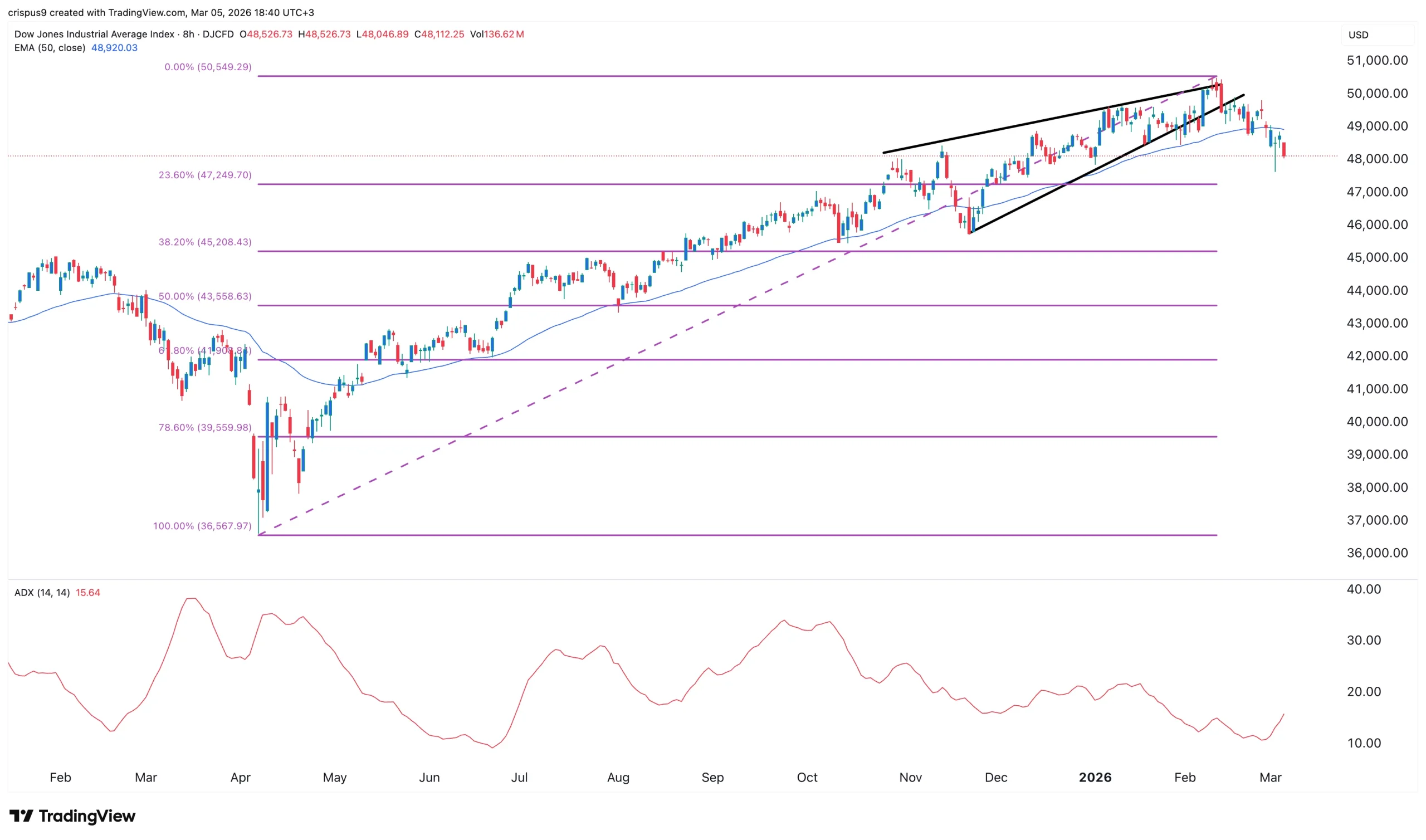
The Dow Jones Index resumed its downward trend today, March 5, as the war in the Middle East continued and odds of a ceasefire happening between Iran and the United States fell on Polymarket.
Summary
- The Dow Jones Index retreated by over 500 points on Thursday.
- Traders on Polymarket believe that there will be no ceasefire any time soon.
- The index has formed a rising wedge pattern, pointing to more downside.
The Dow Jones Index, which tracks the performance of 30 large American companies, retreated by over 500 points. Similarly, the other top blue-chip indices like the S&P 500 and Nasdaq 100 fell by over 0.10%.
This retreat happened as Iran denied reports that it had reached out to the United States for talks on how to end the ongoing war. As a result, odds of a ceasefire happening this month tumbled to 27%. Similarly, the odds of a ceasefire happening in April fell by 23% to 48%.
As a result, the Fear and Greed Index continued falling, moving to the fear zone of 39. At the same time, the price of crude oil continued rising, with Brent moving to $85 and the West Texas Intermediate moving to $78.
A prolonged war in the Middle East is risky for the stock market because of the fresh supply chain shocks that will happen. It also risks stoking inflation, which will make it hard for the Federal Reserve and other central banks to cut interest rates soon.
Most companies in the Dow Jones Index were in the red, with Walmart falling by 3.90%. Merck shares fell by 3.2%, while Sherwin-Williams, Procter & Gamble, Johnson & Johnson,and Amen falling by over 2.50%.
Only four companies in the index rose today. Salesforce stock jumped by 4.46%, while IBM, Chevron, and Microsoft rose by 1.90%, 1.01%, and 0.60%. Chevron is benefiting from the ongoing crude oil and natural gas prices surge.
Dow Jones Index is at risk of falling further
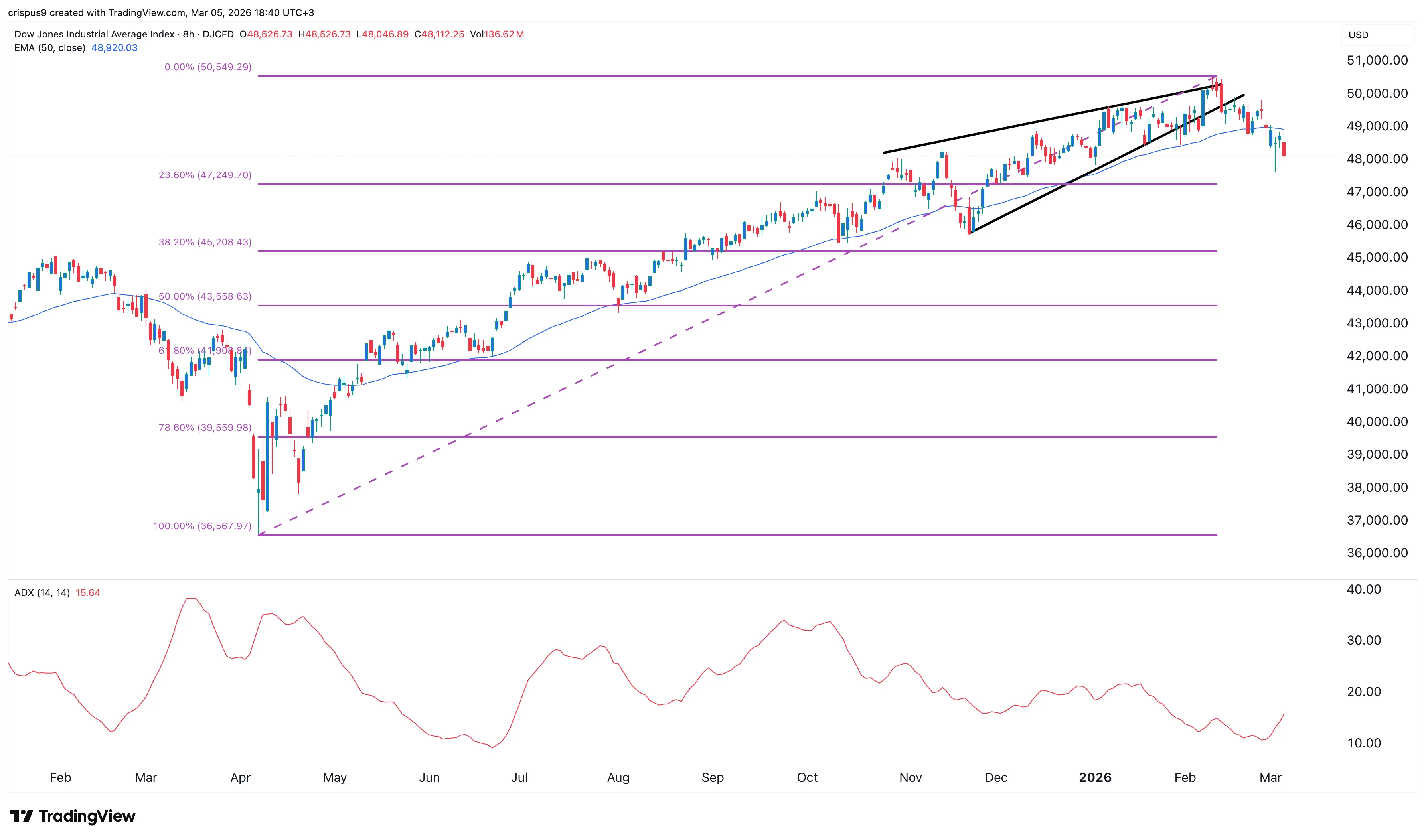
The blue-chip Dow Jones Index has retreated substantially in the past few weeks. This retreat started after it moved to the psychological level of $50,000. It is common for an asset to retreat after testing such a significant level.
The stock retreated after the two lines of the rising wedge pattern neared their confluence. A rising wedge is a highly accurate reversal chart pattern.
It is now nearing the 23.6% Fibonacci Retracement level. Also, it has already moved below the 50-period moving average. Whenever an asset drops below that average, it is usually a sign that bears have prevailed.
The Average Directional Index has rebounded to 15, a sign that the sell-off is gaining momentum. Therefore, the most likely Dow Jones Index forecast is bearish, with the next key target being the 23.6% retracement level at $47,250.

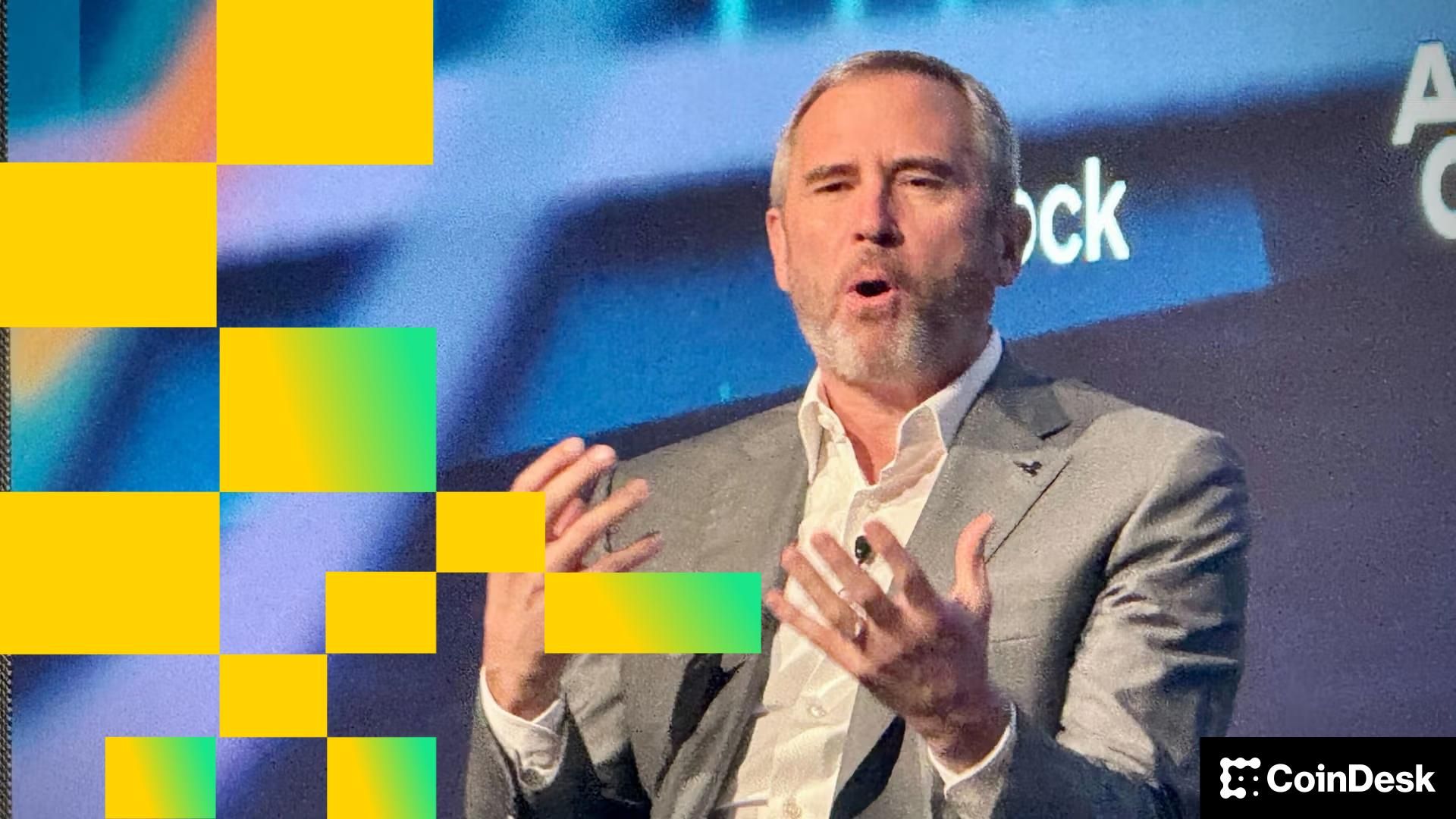
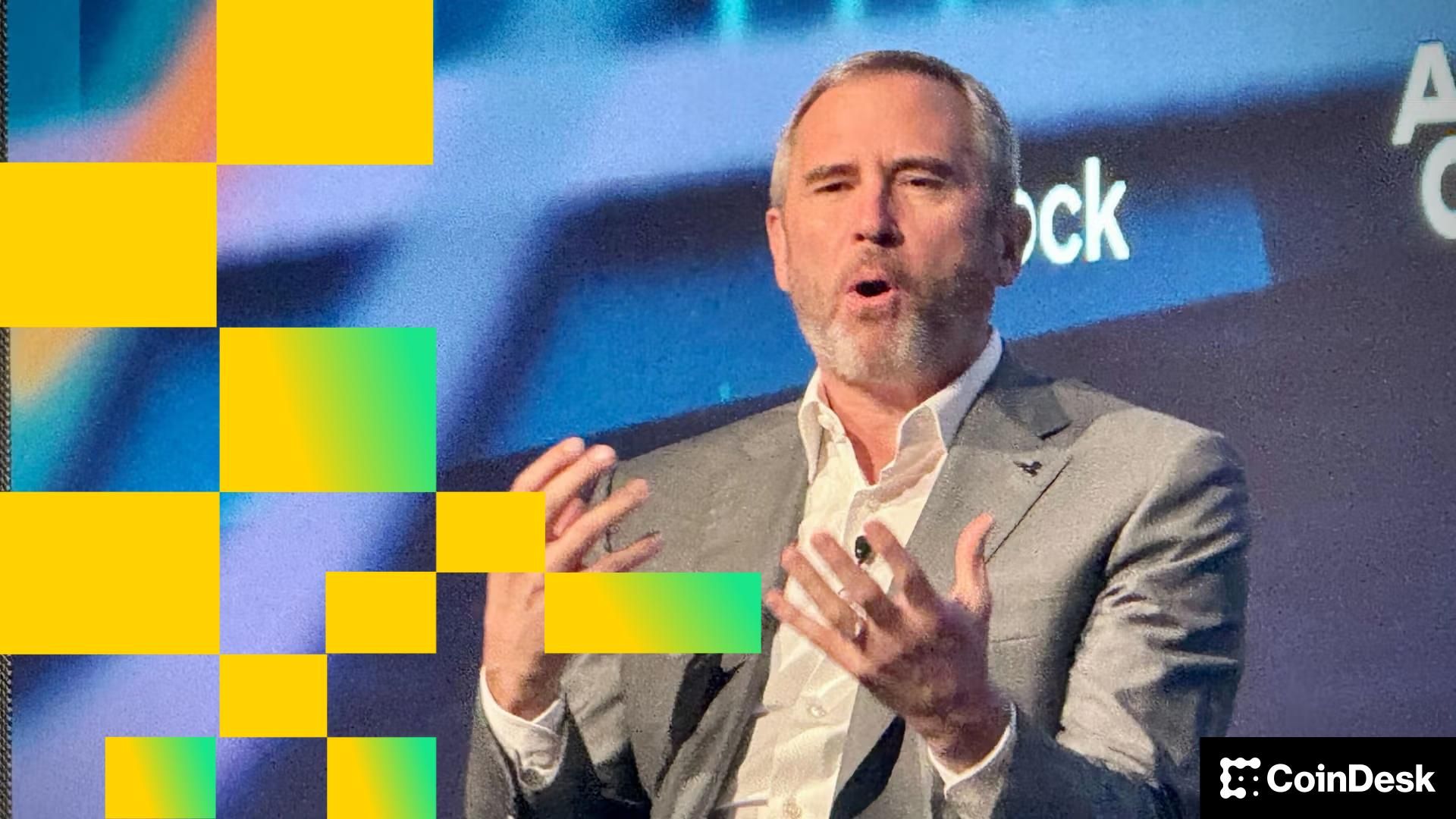
Ripple, the blockchain firm closely associated with the XRP Ledger (XRP) network, said Thursday that clients on its Ripple Prime platform can now trade the full range of crypto futures listed on Coinbase Derivatives.
The move gives institutions a new way to access regulated crypto derivatives within a market overseen by the Commodity Futures Trading Commission. Ripple said that its Prime platform cleared more than $3 trillion in trading volume in 2025.
The offering includes nano bitcoin and nano ether (ETH) futures, which are smaller contracts designed to lower the capital needed to trade. Coinbase also lists futures tied to Solana and XRP in both standard and smaller sizes. The contracts are cleared through Nodal Clear, a U.S. clearing house.
Crypto derivatives have become one of the fastest growing parts of the digital asset market. Many large trading firms prefer futures because they allow investors to gain exposure to price moves or hedge risk without holding the underlying tokens. Regulated futures markets in the U.S. have also drawn interest from institutions that need clear rules and centralized clearing.
The new service builds on Hidden Road, a futures commission merchant and prime broker Ripple acquired last year for $1.25 billion. The firm now operates as Ripple Prime and offers brokerage, clearing and financing services across several asset classes.
Ripple has been on an acquisition spree over the past year, buying a slew of companies to complement the firm’s digital assets offering for institutions and enterprises. On top of Hidden Road, the company bought stablecoin payments firm Rail for $200 million, and also acquired treasury technology provider GTreasury and crypto wallet infrastructure startup Palisade.
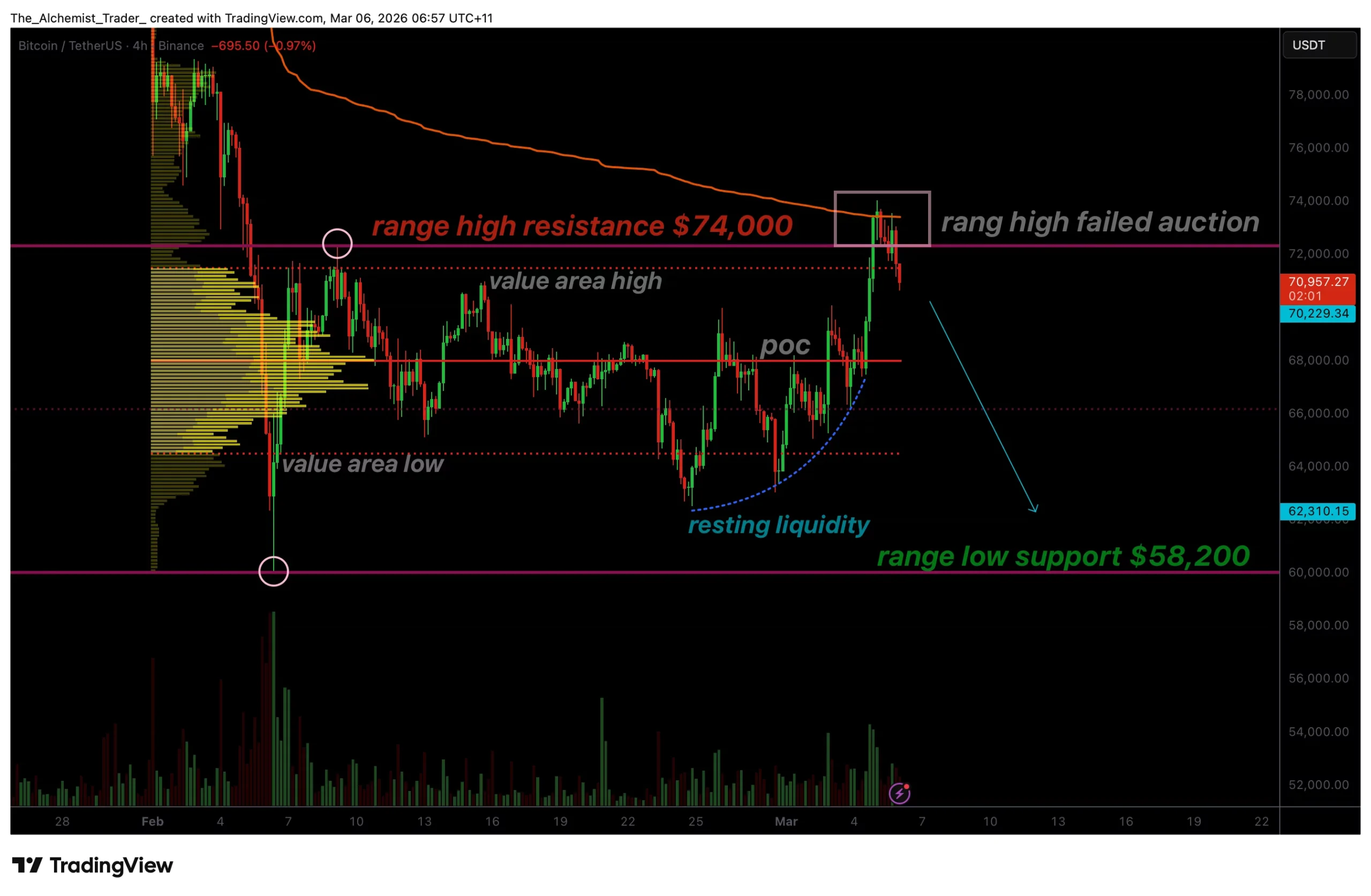
Bitcoin price has confirmed a failed auction at the $74,000 range-high resistance after a sharp rejection. With price now losing the value area high, the probability of a corrective move toward the $60,000 support is increasing.
Summary
- Failed auction at $74K: Strong rejection at range-high resistance confirms weakness.
- Value Area High lost: Signals a shift toward bearish rotational structure.
- $60K support in focus: Previous weekly low becomes the next major downside target.
Bitcoin’s (BTC) latest price action is showing clear signs of weakness after failing to sustain a breakout above the $74,000 resistance level. The rejection from this range high, combined with a confluence of technical resistance from VWAP, has created a failed auction structure.
This development suggests that bullish momentum has stalled, increasing the likelihood of a deeper corrective rotation within the current trading range.
Bitcoin price key technical points
- Range-high rejection: Bitcoin failed to hold above the $74,000 resistance level.
- VWAP confluence: Additional resistance reinforced the failed breakout attempt.
- Downside risk: Loss of value area high increases the probability of a move toward $60,000.
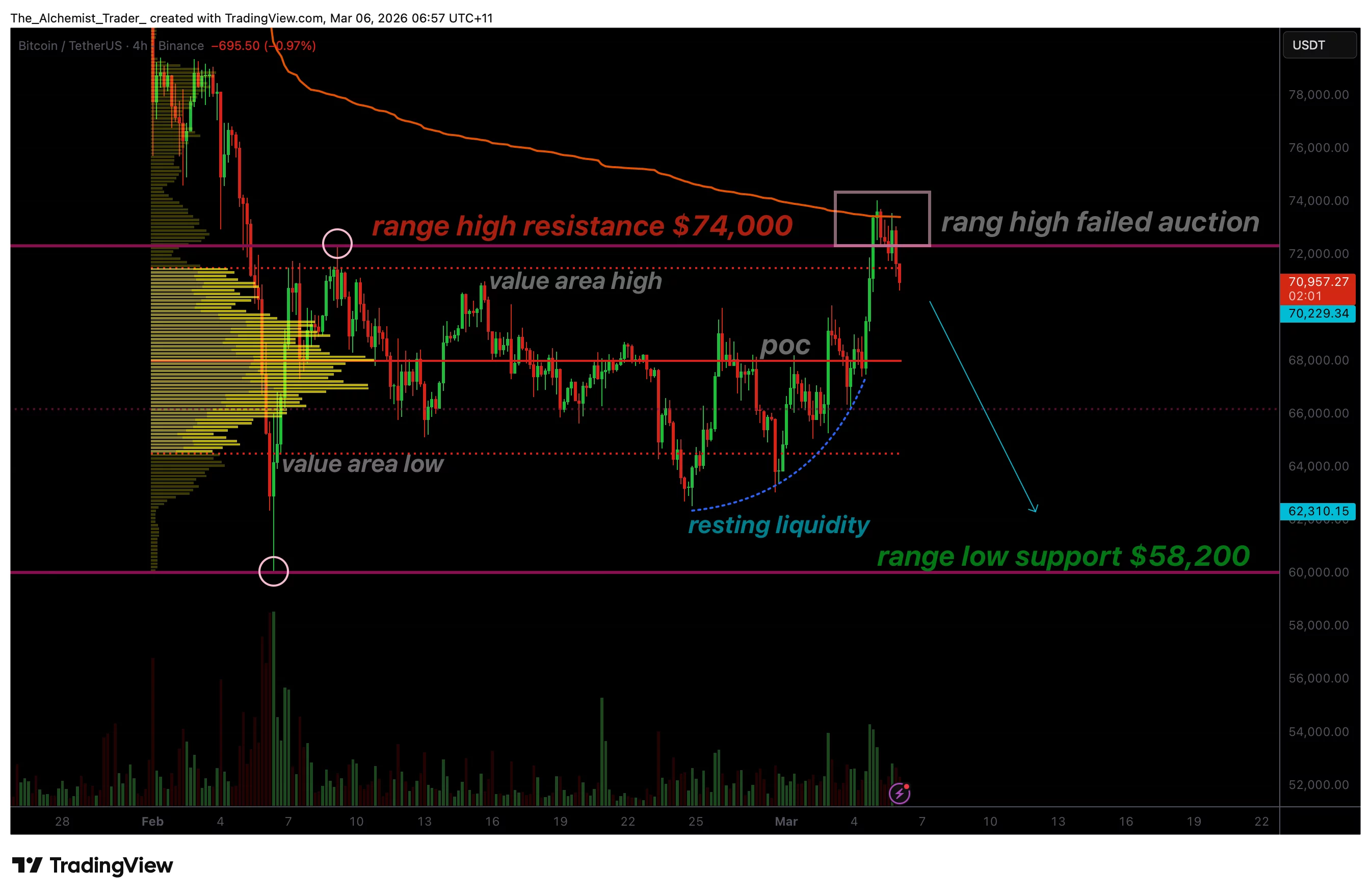
Bitcoin recently attempted to break above the key range-high resistance situated around $74,000. However, the breakout quickly failed as price was met with strong selling pressure near this level. The market briefly traded above the resistance before reversing sharply and closing back below it, forming what traders refer to as a failed auction. This type of structure typically occurs when price attempts to push into higher levels but lacks sufficient demand to sustain the move.
A critical factor contributing to this rejection was the confluence with the volume-weighted average price (VWAP), which acted as an additional resistance layer. When multiple technical resistance levels align, they often strengthen the probability of a rejection. In this case, the presence of VWAP at the range high reinforced the selling pressure and prevented Bitcoin from establishing acceptance above $74,000.
Following this rejection, Bitcoin has now lost the value area high, a key level that previously supported price within the trading range. The loss of this level is a significant technical development because it suggests that buyers are no longer in control of the short-term market structure.
When the value area high is lost, price often rotates toward the value area low as the market seeks a new balance within the range. Meanwhile, Bitwise Asset Management has also announced a $233,000 donation to Bitcoin open-source developers, marking its second annual contribution tied to the success of its spot Bitcoin ETF.
This rotation dynamic increases the probability that Bitcoin will test lower support levels. The most notable support currently sits around $60,000, which also aligns with the previous weekly low. Historically, such levels tend to attract liquidity, as traders often place orders around these key areas of interest. If bearish momentum continues to build, the market may gravitate toward this zone as it searches for demand.
Another important consideration is the internal rotation taking place within the current trading range. Markets frequently move between the value area high and value area low as liquidity is redistributed. With price now accepted below the range-high resistance and the value area high, the probability of a move toward the lower end of the range increases significantly.
In addition, resting liquidity typically accumulates around major support levels such as the value area low. As price rotates through the range, these liquidity pools often become targets for market participants. This process can accelerate downward momentum, especially if sellers remain in control and bullish attempts to reclaim higher levels continue to fail.
The broader market environment also supports the possibility of further downside. Repeated bearish candle closes near resistance often indicate sustained selling pressure and a lack of strong buying demand. In such conditions, range highs tend to act as strong rejection zones, reinforcing the probability of continued rotational movement within the market.
What to expect in the coming price action
From a technical perspective, Bitcoin remains vulnerable to further downside after confirming a failed auction at the $74,000 range high. As long as price remains below this resistance and the value area high continues to act as resistance, the probability favors a rotation toward the $60,000 support region.
A strong reclaim of the lost resistance would invalidate this bearish outlook, but until then the market structure suggests that deeper corrective movement remains likely.


AI firm Montra Finance claims that the entire team behind its recently-launched MONTRA token has been drafted to fight in the war against the US and Israel and as a result, it has been forced to abandon the project.
The firm made the announcement via X on Wednesday and the account was later deleted. The Montra Finance website now displays a 404 error page.
MONTRA’s market cap subsequently dropped 80% from $100,000 to roughly $20,000, and the project’s volume across the last six hours was just $1,200.
Montra pitched itself as “autonomous quant trading on Base” and launched its token on February 25. It reached a market cap of $700,000 by the following day, but performed poorly from then on.
All this has led many to believe that the project was nothing more than a creative rug pull or exit scam.
Read more: Zerebro founder Jeffy Yu has allegedly killed himself again
One crypto user said, “Having a hard time deciding whether this, or the dev that died and came back alive and died again was a better rug excuse 🤣.”
Another noted that the website was “vibe-coded” using the Loveable AI coding website. “What would you expect? lool,” they added.
One potential investor noted days ago that the Montra Finance site wouldn’t let them connect their wallet and that they “need further validation to invest… sketchy for now.”
The Montra team appear to be taking advantage of the ongoing US-Israel war against Iran, which has now entered its sixth day.
The conflict has led to a surge of outflows from Iran’s biggest crypto exchange, Nobitex, and caused a flurry of bets on prediction platform Polymarket that have raised insider trading red flags.
Got a tip? Send us an email securely via Protos Leaks. For more informed news and investigations, follow us on X, Bluesky, and Google News, or subscribe to our YouTube channel.
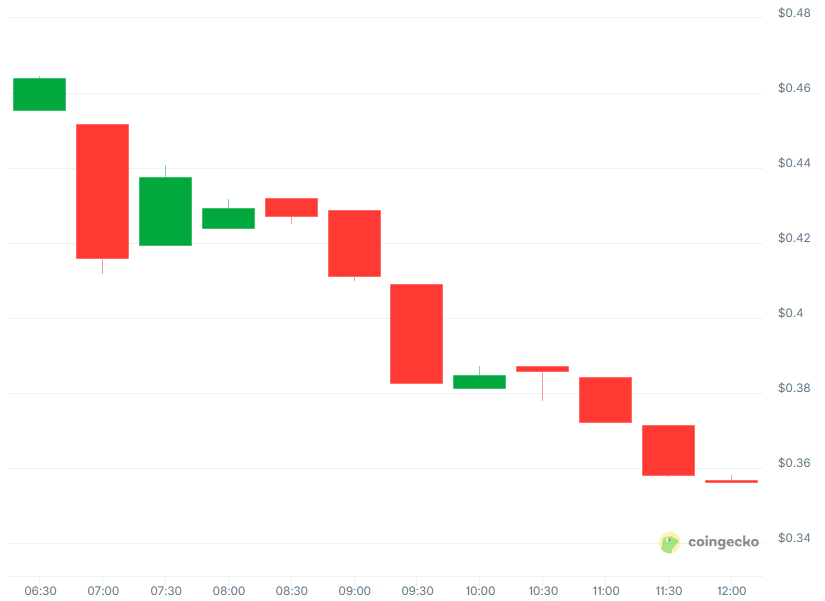
OPN debuted at a $450 million valuation but is dropping steadily amid airdrop selling pressure.
Opinion, a prediction market built on BNB Chain, launched its native OPN token earlier today with an airdrop for early users.
OPN is currently trading at a $350 million valuation, down around 20% from its launch price, according to Coingecko. The token is facing heavy selling pressure, likely from airdrop recipients, and has already generated nearly $150 million in trading volume.

Most of the activity is concentrated on Binance, which listed OPN on its spot markets with trading rewards. The token has also been listed by Bybit, MEXC and various other centralized exchanges, with Coinbase set to launch perpetuals.
Launched in October 2025, Opinion is the third-largest prediction market by volume after Kalshi and Polymarket, according to data from Artemis. However, it’s worth noting that the validity of its data has come under scrutiny after it reported a whopping $8 billion in January volume.

A month ago, Opinion raised $20 million in a pre-Series A round that included Hack VC, Jump Crypto, and Primitive Ventures.

Investigators have moved to clamp down on a high-profile crypto theft tied to government-held assets. The FBI announced the arrest of John Daghita on Saint Martin, alleging he gained unauthorized access to wallets managed under a federal asset protection program that oversees seized digital assets. The operation, conducted with assistance from the French Gendarmerie’s premier elite tactical unit, culminated in Daghita’s detention on the Caribbean island, according to an X post from FBI Director Kash Patel. Images released by the bureau show a handcuffed suspect alongside items including cash, several thumb drives, a cellphone, and three devices resembling hardware wallets. The case forms part of a broader effort to secure and trace digital assets held by government authorities, with investigators pursuing how illicit activity flowed through custody channels. Earlier reporting by ZachXBT linked a wallet to roughly $23 million in digital assets connected to a larger $90 million seizure reported by U.S. authorities in 2024–25; the FBI has not disclosed whether any funds were recovered in this particular instance.
Key takeaways
- A joint operation involving the FBI and the French Gendarmerie led to the arrest of John Daghita on Saint Martin, amid allegations of unauthorized access to wallets under the federal asset protection program.
- The case is tied to a wider seizure activity, with about $90 million reported as seized by U.S. authorities in 2024–25 and roughly $23 million traced to a wallet linked to Daghita’s activity.
- Physical traces presented by the FBI—cash, thumb drives, a phone, and hardware-wallet–style devices—underscore the tangible nature of what is often framed as digital crime.
- The FBI did not publicly state whether any portion of the stolen funds has been recovered as part of this operation.
- Ongoing cross-border cooperation signals a broader trend of international intelligence-sharing and tactical enforcement in crypto-related cases, particularly when government-held assets are implicated.
Market context: The incident arrives amid heightened scrutiny of how governments custody seized crypto assets and how authorities trace illicit flows across custody solutions. It also highlights the increasingly international reach of enforcement actions in crypto thefts, a trend observed as authorities expand on-chain analytics and cross-border cooperation to deter and punish criminal access to digital assets.
Why it matters
The arrest foregrounds a crucial ongoing narrative about security and governance in crypto custody. When government-held digital assets are at risk, the integrity of custody procedures, access controls, and key management become central to preventing unauthorized withdrawal or manipulation. The broad takeaway for custodians, exchanges, and asset-recovery teams is that physical artifacts—such as drives, devices that resemble hardware wallets, and even cash—can accompany cyber-enabled offenses, reinforcing the need for robust physical and digital safeguards around seized assets.
For law enforcement and policy makers, the Saint Martin operation illustrates how cross-border cooperation can be instrumental in pursuing suspects whose activities straddle multiple jurisdictions. The involvement of the French Gendarmerie’s tactical unit alongside U.S. authorities demonstrates a willingness to deploy coordinated, high-profile actions to disrupt alleged theft rings connected to federally held crypto assets. It also underscores the importance of transparent, timely communications from agencies to convey progress and manage public expectations in high-stakes investigations.
From a broader market and ecosystem perspective, the episode reinforces the value of meticulous asset tracing and forensic analyses. Analysts and researchers who monitor wallet movements—and the methods by which seized holdings are linked to specific individuals or entities—play a growing role in connecting on-chain activity with off-chain events and enforcement outcomes. The coverage also serves as a reminder that regulatory clarity around asset forfeiture, disclosure requirements, and custody standards may influence how institutions structure their own risk controls and reporting practices in the years ahead.
For investors and participants in crypto markets, incidents like this can shape risk sentiment and the perceived security of custody arrangements. While such enforcement actions do not directly implicate the day-to-day operations of legitimate traders, they contribute to a climate in which stakeholders expect greater transparency around how seized or controlled assets are stored, displayed, and eventually resolved through legal processes.
What to watch next
- Formal charges or court filings against John Daghita in an appropriate jurisdiction, including any details about his role and the mechanics of the access that allegedly occurred.
- Public updates from the U.S. Marshals Service or the FBI regarding whether any portion of the seized funds has been recovered or forfeited.
- Further disclosures about the specific wallets, asset types involved, and the custody framework under which they were kept.
- Additional coordinated actions or arrests related to this case or related custody breaches, especially given the cross-border nature of the operation.
- Subsequent analyses or statements from investigators that illuminate how on-chain traces were linked to off-chain assets and how artifacts recovered from the scene are being evaluated.
Sources & verification
- FBI Director Kash Patel’s X post announcing the arrest: https://x.com/FBIDirectorKash/status/2029574256959389933
- Related coverage about the US Marshals investigation into seized digital assets: https://cointelegraph.com/news/us-marshals-investigation-seized-digital-assets
- Further reading on the wallet linked to the alleged seizure and subsequent memecoin activity: https://cointelegraph.com/news/us-treasury-theft-wallet-bundled-memecoin-crashes-97
FBI arrest tied to multi‑million crypto theft from government custody
The episode centers on a perceived breach of custody protocols governing digital assets that had been seized and were intended for federal protection. The FBI’s announcement—paired with imagery supplied by the agency—provides a rare, tangible glimpse into the investigative trail: a handcuffed suspect, a suitcase of cash, and a collection of devices that practitioners in the space recognize as potential hardware-wallets. The narrative ties back to earlier reporting that traced a wallet holding tens of millions in digital assets to a broader seizure by U.S. authorities, underscoring how modern enforcement blends traditional investigative methods with on-chain analytics to establish a credible link between individuals and illicit flows.
Key elements in the report—the involvement of Saint Martin and the French Gendarmerie’s elite unit—emphasize the international scope of crypto enforcement. This is not merely a domestic matter; it reflects a governance and security dimension that cuts across borders, especially when the assets in question are held under a federal program designed to safeguard seized digital holdings. While the FBI has not disclosed recovery figures for the funds tied to this case, the scarcity of such disclosures in high-profile crypto thefts is a reminder that asset disposition in these cases can be complex, often requiring lengthy legal processes before any forfeiture or restitution is finalized.
From a narrative standpoint, the photos and the articulated sequence point to a broader truth about the crypto ecosystem: the boundary between the digital and physical world remains porous in the eyes of investigators. Hardware-wallet-like devices, thumb drives, and other offline storage components are not abstract symbols; they are practical vectors and artifacts that can illuminate how attackers choreograph access to protected funds. The public-facing portion of the case thus serves as a test case for how custody protocols, physical security measures, and cross-jurisdictional cooperation converge to deter theft and, when necessary, pursue accountability through the courts.
In the coming weeks and months, observers will watch for updates on charges, asset recovery, and the precise custody arrangements surrounding seized digital assets. The outcome could influence how other agencies calibrate their own asset-protection practices and how market participants interpret regulatory signals tied to enforcement actions. The intersection of on-chain forensics, cross-border law enforcement, and the governance of seized crypto assets remains a critical frontier for the industry as it evolves toward greater resilience and transparency.

- Cardano (ADA) is now accepted at 137 Swiss SPAR stores via direct wallet payments.
- ADA’s price remains stagnant near $0.272 despite retail adoption.
- The key levels to watch are the $0.28 resistance and the $0.26 support.
The price of Cardano’s ADA token has remained unmoved even after 137 SPAR supermarkets across Switzerland announced they now accept Cardano (ADA) as a payment method, giving the cryptocurrency a new real-world utility.
The integration, powered by a payment system that connects Cardano’s blockchain to everyday retail checkouts, allows SPAR customers to pay directly from their wallets, without converting to traditional currencies.
You can now pay with $ADA at 137 SPAR stores across Switzerland.
In partnership with @DFX_swiss and @BrickTowers, we are helping bring blockchain into everyday commerce through real-time, low-cost retail payments.
Read the full press release: https://t.co/gvYRHclp4F
— Cardano Foundation (@Cardano_CF) March 5, 2026
Cardano’s ADA token remains unmoved
This move marks a significant step toward mainstream adoption of ADA.
For many cryptocurrencies, being used in everyday retail has been a distant goal, and Cardano now joins a small group of digital assets being used at physical stores.
However, despite this positive development, ADA’s market performance has remained relatively stagnant.
At press time, the cryptocurrency was trading around $0.272, down 1.3% over the last 24 hours.
Cardano price technical analysis
From a technical standpoint, momentum indicators provide a mixed picture.
The Relative Strength Index (RSI) is recovering from oversold territory but remains below neutral, suggesting buyers have yet to assert dominance.
The Moving Average Convergence Divergence (MACD) indicator readings are flat, signalling a lack of strong bullish or bearish momentum.

Derivatives markets indicate a cautious stance, with long-to-short ratios below one and declining futures participation, hinting that traders are leaning toward a defensive approach rather than aggressive buying.
On-chain activity also shows more coins are being moved, a signal that holders may be redistributing or taking profits.
Combined with modest daily losses, this data suggests that ADA’s recent rebound is not yet convincing enough to trigger a larger market rally.
ADA price forecast
While Cardano’s integration into 137 Swiss SPAR stores is a landmark moment for adoption, the market has yet to respond.
Technical levels suggest that ADA remains range-bound, and traders should be looking for decisive moves either above the immediate resistance or below the immediate support to determine the next trend.
Notably, a descending trendline has been forming, with $0.28 currently acting as the immediate resistance point.
Therefore, a breakout above this level with sustained volume could open the path toward $0.32, where stronger resistance aligns with clustered moving averages.
On the downside, a clear break under $0.26 could bring the $0.24 level into play.
Falling below that could accelerate selling and bring prices closer to $0.21, echoing recent technical warnings about potential downside.


Analysts say past periods of deeply negative funding rates on Binance have often been followed by corrective rallies.
XRP funding rates on Binance turned negative this week, hitting levels that have historically preceded short-term price rebounds.
The setup suggests crowded short positioning may have created conditions for a corrective rally, though analysts caution this does not guarantee a lasting trend reversal without a broader market catalyst.
Derivatives Data Flashes Contrarian Signal
Data from Binance shows XRP funding rates entered a phase of extreme negativity, while the asset ranged between $1.35 and $1.50, according to CryptoQuant analyst Darkfost. This comes after the Ripple token experienced a 60% correction from its July 2025 all-time high of $3.65, with most derivatives traders positioning on the short side despite the sustained drop.
Historical data suggests that short-term rebounds or corrective rallies in XRP often follow periods of extreme negative funding rates on Binance. The analyst emphasized that such configurations act as contrarian indicators, suggesting bearish positioning may have become overcrowded relative to actual price action.
“When market consensus becomes excessively aligned in one direction, history shows that markets tend to surprise the majority,” Darkfost wrote.
Even though the configuration does not ensure long-term trend reversals, the on-chain observer pointed out that it was a favorable indicator for investors trying to find appealing entry points or looking to progressively increase their exposure to XRP.
Exchange Outflows Suggest Supply Tightening
On the technical side, analyst EGRAG CRYPTO yesterday identified $1.55 as the first critical trigger level for XRP, with a weekly close above this point weakening the current downward trajectory.
A more decisive breakout above $2.20 would invalidate the bearish descending channel structure that has defined the asset’s price action for months and open the path toward $2.70 to $3.60. At present, XRP is trading around $1.44, up about 3% in 24 hours but down nearly 10% over the past month and more than 60% below its all-time high.
You may also like:
Adding to the dynamics, exchange outflow data shows a significant increase in XRP withdrawals during February, with total outflows reaching approximately 7.03 billion XRP, the highest level since November 2025.
Binance led the withdrawal volume with outflows of 3.38 billion XRP, indicating a shift in assets from trading environments to private wallets or long-term storage. When withdrawals increase in this manner, it often indicates that a portion of the available supply is being removed from the spot market, potentially reducing liquidity on trading platforms.
With that in mind, traders will likely be focused on whether the combination of negative funding rates and large exchange withdrawals will translate into buying pressure. As Darkfost put it,
“In such uncertain conditions, it becomes essential to carefully select positions, relying on market signals that are beginning to emerge.”
Binance Free $600 (CryptoPotato Exclusive): Use this link to register a new account and receive $600 exclusive welcome offer on Binance (full details).
LIMITED OFFER for CryptoPotato readers at Bybit: Use this link to register and open a $500 FREE position on any coin!


- KuCoin launches KCS PulseDrop to expand the utility of its native token.
- Users earn points from trading, staking, and payments on the platform.
- Initiative aims to embed KCS deeper into KuCoin’s ecosystem utility.
Global crypto exchange KuCoin has launched a new rewards initiative called KCS PulseDrop, marking a strategic step toward expanding the utility of its native token, KuCoin Token (KCS).
The program connects everyday user activity, from trading to payments with a transparent points and rewards system, effectively turning KCS into a more active, multi-dimensional part of the KuCoin ecosystem.
The exchange said PulseDrop is designed to shift KCS “from a passive holding asset” into an engagement-based tool that bridges trading, staking, and real-world cryptocurrency use.
Participating users earn points through actions like futures or spot trading, staking KCS, or making payments with KuCard, P2P, or KuCoin Pay.
Points accumulate over time and determine each user’s share of reward distributions.
In essence, PulseDrop transforms interaction into measurable participation.
KuCoin described the framework as a “participation economy,” one that rewards sustained activity rather than short-term speculation, an idea gaining traction among digital asset platforms seeking to retain users and build long-term loyalty.
By aligning engagement with tangible outcomes, the company hopes to position KCS as a functional utility token underpinning a wider user ecosystem, rather than merely a token conferring fee discounts or passive yield.
Expanding KCS beyond exchange use
The PulseDrop system introduces tiered point mechanics and multipliers that let users accelerate accrual through specific behaviors, such as trading particular project tokens or KCS itself.
Transactions made through fiat and payments channels also contribute to a “Payment Task” score, rewarding real-world crypto usage, a move that ties KuCoin’s growing payments infrastructure more tightly to its core token.
The exchange said the design is meant to balance simplicity and transparency while giving users early exposure to promising projects listed on its platform.
KuCoin positions PulseDrop as both a community engagement tool and a means of democratizing access to project rewards by basing allocations on participation rather than holding size alone.
Analysts view the initiative as part of a wider industry shift, where exchanges seek to extend the relevance of their native tokens beyond transactional perks.
As competition among global exchanges intensifies, platforms like KuCoin, Binance, and OKX are experimenting with loyalty or activity frameworks that embed token value deeper into users’ daily interactions.
KuCoin, which serves over 40 million users across 200 countries, has been steadily expanding its regulated footprint under CEO BC Wong, with recent licensing milestones in Austria (under MiCA) and Australia.
The exchange, recognized by Forbes and Hurun for its innovation and security standards, maintains SOC 2 Type II and ISO 27001:2022 certifications.
By knitting together engagement, rewards, and payments, KCS PulseDrop reflects KuCoin’s broader ambition to create an integrated and participatory digital-asset ecosystem, where token holders play an active, sustained role in shaping its growth trajectory.
The PulseDrop platform is now live on KuCoin’s official website: www.kucoin.com/pulsedrop.

The US Federal Bureau of Investigation (FBI) announced that it had made an arrest related to the theft of more than $46 million in cryptocurrency from the US Marshals Service.
In a Thursday X post, FBI Director Kash Patel said that the bureau had arrested John Daghita, the son of Command Services & Support (CMDSS) president Dean Daghita, after he allegedly gained unauthorized access to wallets managed under the federal asset protection program. Patel said the arrest was carried out by the “French Gendarmerie’s premier elite tactical unit” with the FBI on the island of Saint Martin in the Caribbean.

Patel’s social media post with a photo of a handcuffed Daghita, also included a photo of a suitcase containing cash, several thumb drives, a phone and three devices resembling Trezor hardware wallets. The FBI director did not disclose whether any of the stolen funds had been recovered.
The alleged crypto theft was reported in January by online sleuth ZachXBT, who said that he had traced a wallet linked to Daghita holding about $23 million in digital assets connected to $90 million reportedly seized by the US government in 2024 and 2025. Daghita’s father heads CMDSS, which was awarded a contract by the US Marshals Service in 2024 related to the custody of the seized crypto.
Related: Wallet linked to alleged US seizure theft launches memecoin, crashes 97%
The US Marshals Service confirmed that it was investigating the matter at the time. Patrick Witt, the director of the White House Crypto Council, said in a Jan. 26 X post that he was “on it,” referencing ZachXBT’s claims. Witt had not publicly commented on the arrest as of Thursday.
According to data from BitcoinTreasuries.NET, US authorities, including the Marshals Service, may hold as much as 328,372 Bitcoin (BTC) through various seizures.
South Korean authorities make two arrests related to seized crypto
Daghita’s arrest is the latest example of global law enforcement efforts to recover previously seized assets.
In February, police in South Korea arrested two people allegedly connected to a case in which authorities lost access to 22 BTC, worth about $1.6 million at the time of publication.
The crypto was reportedly stolen after police seized the assets from a hack on a South Korean exchange in 2021, storing them on a cold wallet owned by a third party.
Earlier this week, Deputy Prime Minister and Minister of Strategy and Finance Koo Yun-cheol said the government and relevant agencies will “conduct an inspection of the current status and management practices of digital assets held and managed by the government and public institutions,” according to local media reports.
Magazine: Bitcoin may face hard fork over any attempt to freeze Satoshi’s coins
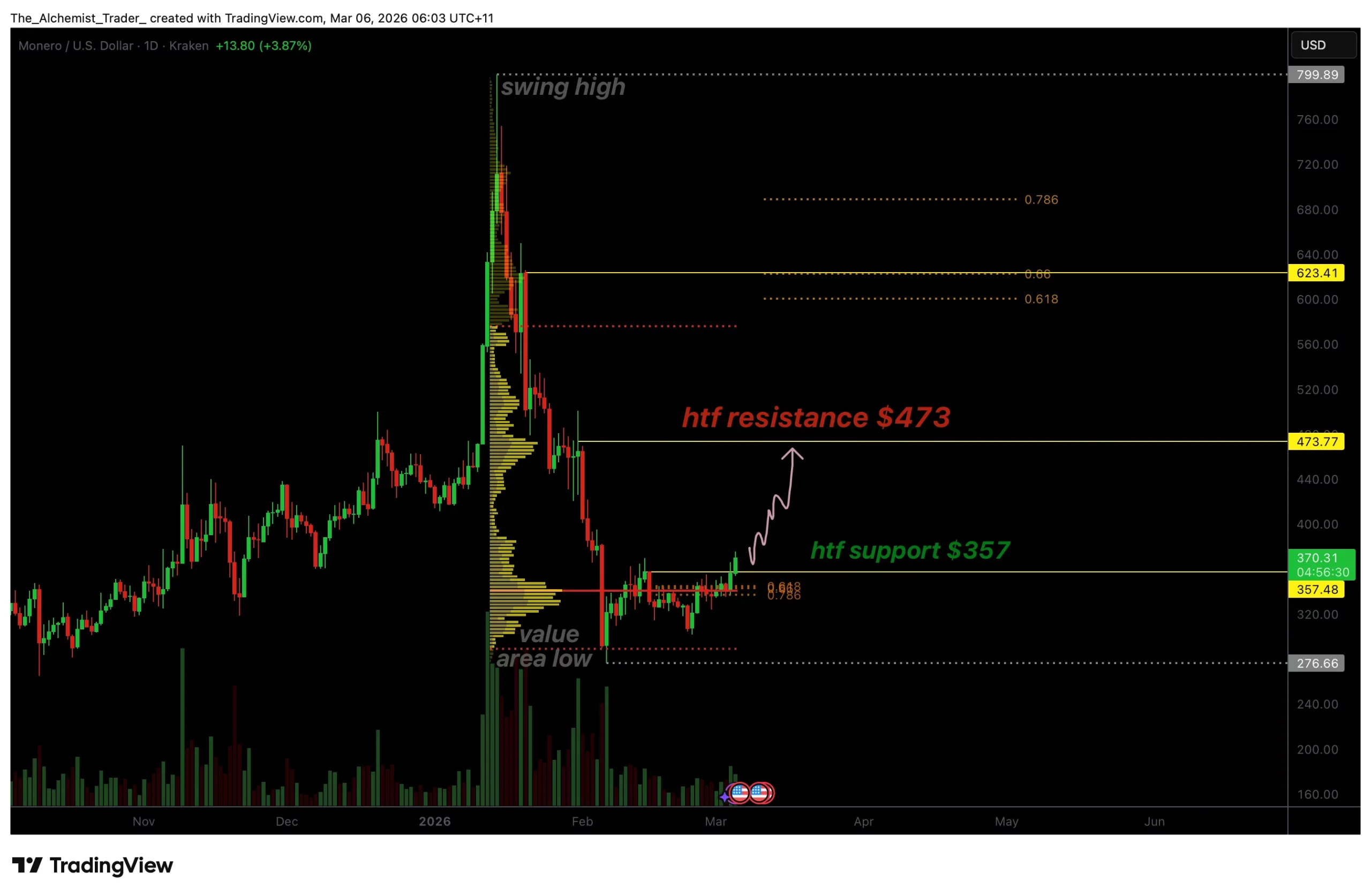
Monero price has confirmed a bullish market structure shift on the daily timeframe after reclaiming key support. If the $357 level continues to hold, the next major upside target sits at the $473 resistance.
Summary
- Bullish structure confirmed: Monero printed a higher low followed by a new higher high on the daily chart.
- $357 flipped to support: Former resistance now acting as key support for continuation.
- $473 target: Next major high-timeframe resistance if bullish momentum holds.
Monero (XMR) price is beginning to show renewed bullish momentum after a decisive structural shift on the daily chart. The recent price action suggests that buyers have regained control of the market following a confirmed break in market structure.
With price reclaiming and holding above the $357 level, traders are now watching for a potential continuation move that could send Monero toward the next major resistance zone at $473.
Monero price key technical points:
- Bullish market structure break: Daily chart confirms a new higher high after a higher low.
- Key support reclaimed: $357 resistance has flipped into strong support.
- Upside target: $473 stands as the next high-timeframe resistance level.
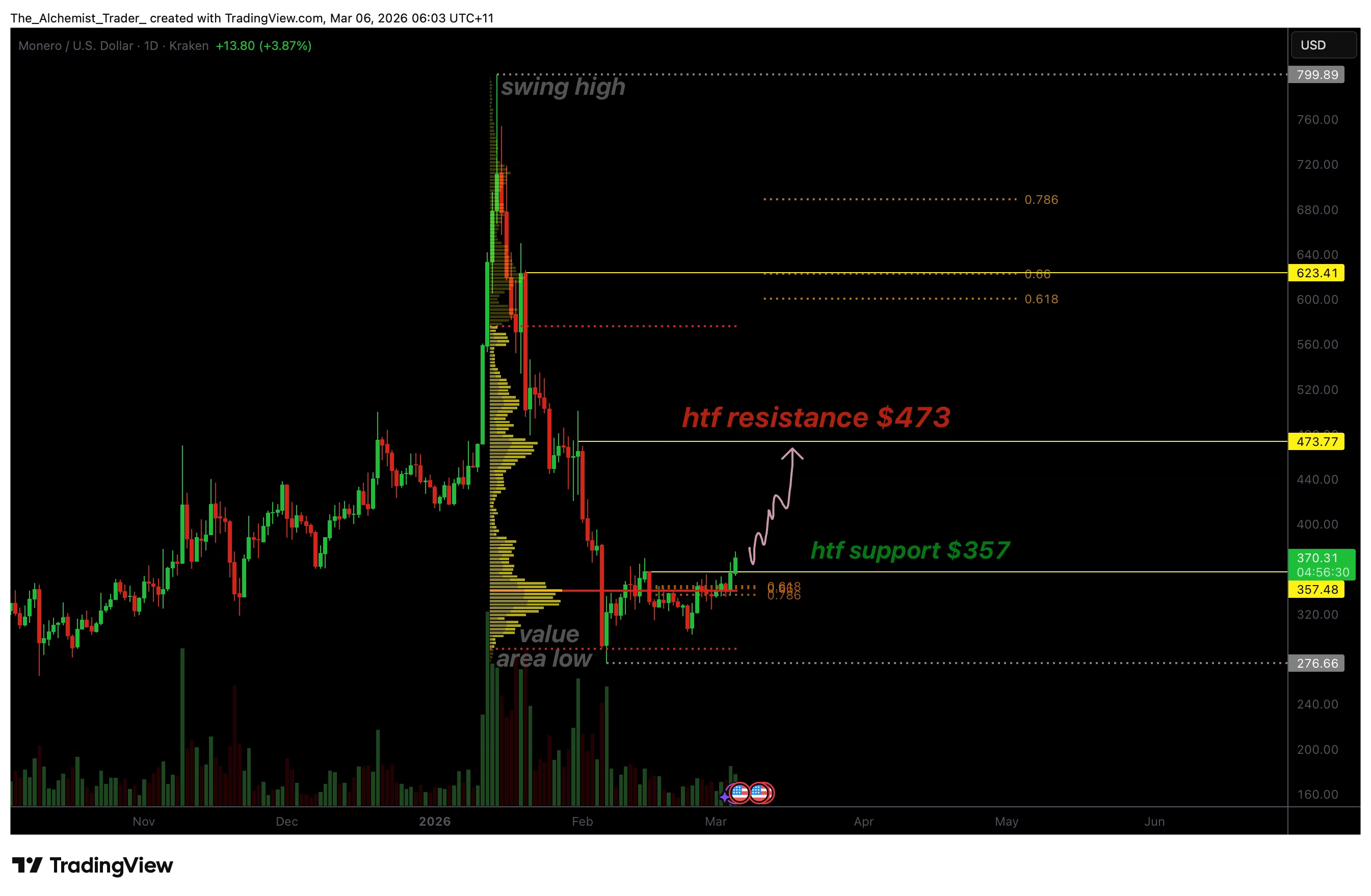
Monero’s latest price action has confirmed a bullish shift in market structure on the daily timeframe. The chart shows a clear sequence of a higher low followed by a new higher high, which is one of the most widely recognized signals of trend continuation in technical analysis. This break of structure confirms that buyers have regained momentum after a previous corrective phase.
The key development supporting this bullish outlook is the reclaim of the $357 level. Previously acting as a significant resistance zone, this area has now flipped into support, which is often a strong technical signal that the market is preparing for a continuation move. When resistance converts into support, it typically indicates that buyers are willing to defend the level, increasing the probability of sustained upward momentum.
The break of market structure (MSB) is clearly visible on the daily chart. After establishing a higher low during the previous pullback, Monero successfully pushed above the prior swing high, confirming a new higher high. This structure is critical because it signals a transition from a consolidation phase into a potential trending environment.
Such structural confirmations often precede strong directional moves as market participants reposition in line with the new trend. In the broader market narrative, several leading cryptocurrencies attracting trader attention include BCH, XMR, HYPE, and BlockDAG, as investors continue to seek assets offering strong utility, growth potential, and sustained momentum.
Another important aspect of this setup is the positioning of the current support relative to recent price action. As long as Monero continues to hold above the reclaimed $357 support on a daily candle-closing basis, the bullish structure remains intact. Maintaining this level would suggest that buyers are still in control and that the recent breakout is not a false move.
From a broader technical perspective, sustained trading above the newly established support opens the path for an accelerated move toward higher resistance levels. The next significant high-timeframe resistance sits near $473, which historically has acted as a major barrier for price. If bullish momentum continues to build, this level becomes the most logical upside objective for the current trend.
Market structure shifts often lead to rapid price expansion when combined with strong momentum and sustained support levels. The current configuration on Monero’s daily chart suggests that the market may be entering such a phase. With buyers defending key levels and the trend structure now pointing higher, traders are closely monitoring the potential for a continuation rally.
What to expect in the coming price action
From a technical and structural perspective, Monero now maintains a bullish outlook after confirming a daily market structure break. As long as price remains above the $357 support level on a closing basis, the probability favors continued upside toward the $473 resistance.
A sustained move above current levels would further reinforce the bullish trend, while a loss of support could delay the advance and lead to consolidation.

FDA official discusses UniQure gene therapy for Huntington’s disease

Ripple adds Coinbase’s BTC, ETH, XRP, SOL futures to its $3 trillion prime brokerage
Jenna Bush Hager tears up over Savannah Guthrie's return to “Today”: 'She is beyond loved here'


-

 Politics7 days ago
ITV enters Gaza with IDF amid ongoing genocide
-

 Politics3 days ago
Alan Cumming Brands Baftas Ceremony A ‘Triggering S**tshow’
-

 Fashion6 days ago
Weekend Open Thread: Iris Top
-

 Tech5 days ago
Unihertz’s Titan 2 Elite Arrives Just as Physical Keyboards Refuse to Fade Away
-
Sports6 days ago
The Vikings Need a Duck
-
 NewsBeat5 days ago
Dubai flights cancelled as Brit told airspace closed ’10 minutes after boarding’
-

 NewsBeat5 days ago
Abusive parents will now be treated like sex offenders and placed on a ‘child cruelty register’ | News UK
-
 NewsBeat5 days ago
The empty pub on busy Cambridge road that has been boarded up for years
-

 NewsBeat4 days ago
‘Significant’ damage to boarded-up Horden house after fire
-

 Tech14 hours ago
Bitwarden adds support for passkey login on Windows 11
-

 Entertainment4 days ago
Baby Gear Guide: Strollers, Car Seats
-
 Tech6 days ago
NASA Reveals Identity of Astronaut Who Suffered Medical Incident Aboard ISS
-
 Sports2 hours ago
499 runs and 34 sixes later, India beat England to enter T20 World Cup final | Cricket News
-

 Business7 days ago
Only 4% of women globally reside in countries that offer almost complete legal equality
-
Politics5 days ago
FIFA hypocrisy after Israel murder over 400 Palestinian footballers
-
 NewsBeat4 days ago
Emirates confirms when flights will resume amid Dubai airport chaos
-

 NewsBeat3 days ago
Is it acceptable to comment on the appearance of strangers in public? Readers discuss
-

 Crypto World7 days ago
From Crypto Treasury to RWA: ETHZilla Retreats and Relaunches as Forum Markets on Nasdaq
-

 Tech5 days ago
Viral ad shows aged Musk, Altman, and Bezos using jobless humans to power AI
-

 Video3 days ago
How to Build Finance Dashboards With AI in Minutes