

Crypto World
Hong Kong Misses March Deadline for Stablecoin Licences

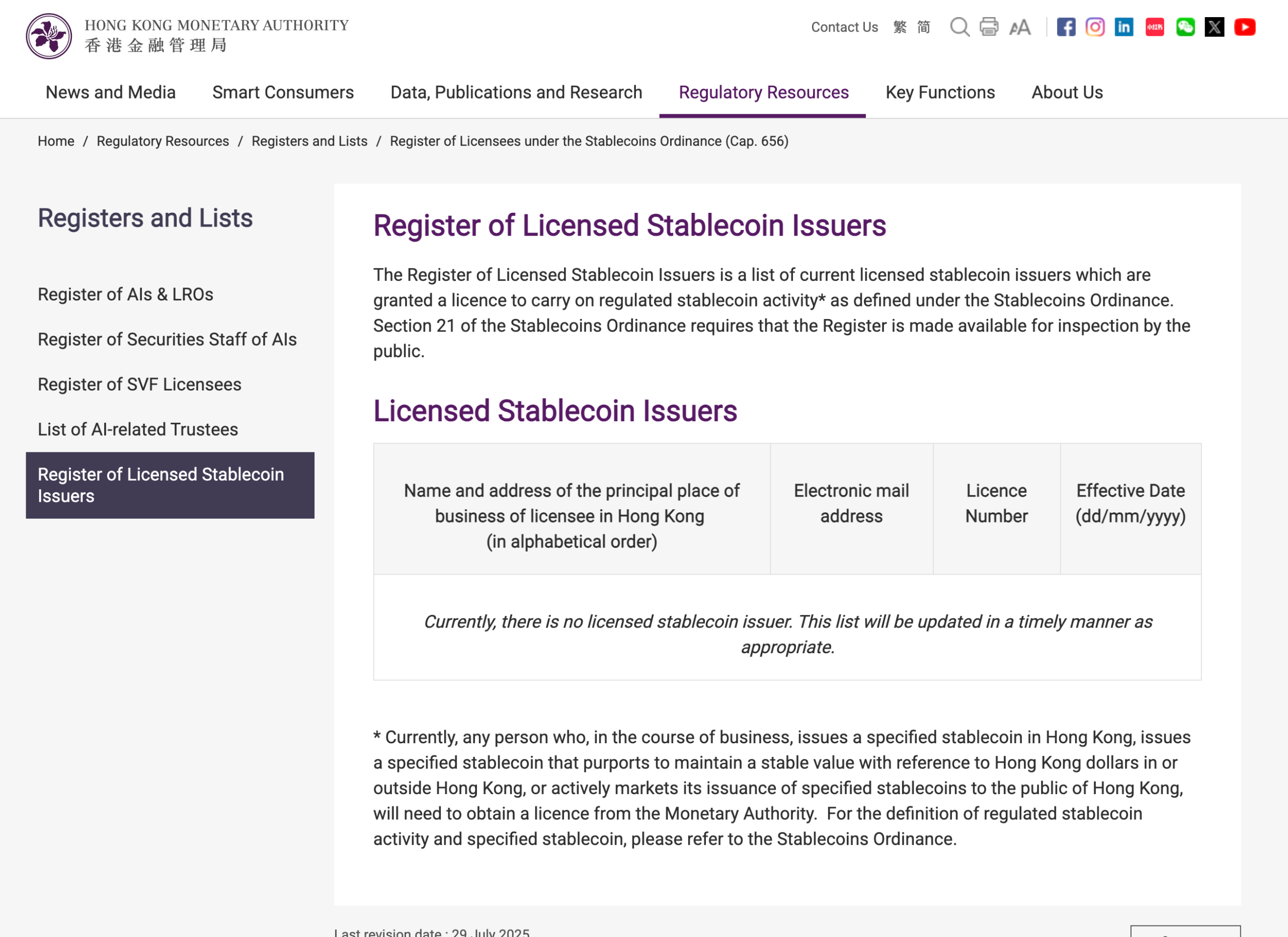
Hong Kong’s first stablecoin licences failed to materialize by the expected end of March target, with the HKMA saying only that it is still advancing the process.
Hong Kong has missed an earlier end of March target for awarding its first stablecoin licences, with the Hong Kong Monetary Authority saying only that the licensing process is advancing and decisions will be announced shortly.
A spokesperson for the Hong Kong Monetary Authority (HKMA) told Cointelegraph that the HKMA is “actively taking forward the licensing matter and will announce further details in due course,” without offering a revised timetable.
The HKMA’s public register still showed no licensed stablecoin issuers at the time of writing.
The March timetable had been set out earlier by HKMA chief executive Eddie Yue, who reportedly told lawmakers in February that only a very small number of issuers would be approved initially and that reviews were focusing on use cases, risk management, anti-money laundering controls and backing assets.
HKMA misses March stablecoin target
Earlier reports indicated that global banking giants HSBC and a Standard Chartered-backed venture were among the frontrunners to receive approvals in the initial cohort, although the HKMA did not confirm the names of any successful applicants.
Hong Kong’s caution is partly a function of how strict the regime is. Cointelegraph previously reported that the city’s stablecoin framework requires issuers to fully back tokens with high-quality liquid reserves, process redemptions within one business day and maintain a physical presence in Hong Kong, alongside broader Know Your Customer and transaction monitoring controls.

The missed deadline comes as Hong Kong places stablecoin regulation at the heart of its strategy to become a global crypto and fintech hub.
China pressure clouds Hong Kong rollout
Cointelegraph previously reported that major fintech players, including Ant International, were preparing to seek Hong Kong stablecoin licenses as the city rolled out its new regime.
Related: How Hong Kong is turning tokenized bonds into real market infrastructure
In October 2025, the FT reported that Ant Group and JD.com had paused their Hong Kong stablecoin plans after regulators in mainland China, including the People’s Bank of China and the Cyberspace Administration of China, raised concerns about privately controlled digital currencies.
Big Questions: Is China hoarding gold so yuan becomes global reserve instead of USD?



21Shares’ Matt Mena says Bitcoin’s refusal to dump on hot CPI shows inflation is priced in, leaving the CLARITY Act vote as the next major catalyst for a push toward $90K.
Summary
- 21Shares analyst Matt Mena says Bitcoin’s failure to sell off on hot inflation data signals the market has already priced in macroeconomic headwinds, with BTC holding above the key $80,000 support level.
- Mena sees a path from the current $82,000 resistance retest toward $85,000 as macro friction clears, with the Senate CLARITY Act vote identified as the next major catalyst that could push price toward $90,000.
- The analysis lands as Bitcoin trades around $82,010, open interest across derivatives venues climbs, and the legislative calendar compresses multiple potential catalysts into a single week.
21Shares analyst Matt Mena argued in a note published by Sina Finance that Bitcoin’s resilience in the face of elevated U.S. inflation data is itself a bullish signal, writing that BTC “did not decline due to inflation data,” which he interprets as evidence that “the market has already priced in the overheating inflation data.”
With Bitcoin currently trading around $82,010 — a level confirmed by Gate market data showing a 0.81% 24-hour gain — the $80,000 level is now being treated as a structurally significant floor rather than a soft support, with Mena framing it as the threshold above which the macro-to-bull-market transition remains intact.
Inflation is priced in, $80,000 holds as the line in the sand
The inflation data in question refers to the latest U.S. CPI print, which came in above consensus expectations and would, in a prior cycle, have triggered a sharp BTC sell-off as traders priced in a more hawkish Fed path. The fact that it did not — and that Bitcoin instead grinded higher — is the core of Mena’s thesis: the market is no longer treating every hot inflation print as a binary negative for risk assets, suggesting that the macro resistance that capped BTC’s upside through most of 2025 is gradually being absorbed. That repricing dynamic is consistent with how institutional investors, including the corporate treasury buyers and ETF allocators who now dominate marginal BTC demand, tend to behave: they buy dips on bad macro news rather than selling, because their investment horizon is measured in years rather than trading sessions.
A previous crypto.news story on Bitcoin’s technical structure noted how open interest has been climbing across derivatives venues even as spot price consolidates, a pattern that technicians read as coiled energy rather than distribution, and that sits alongside MicroStrategy’s confirmed stack of 818,869 BTC worth roughly $65.8 billion as evidence that the largest holders are not treating current levels as a selling opportunity.
CLARITY Act vote as the $90,000 catalyst
Mena’s price path is sequential: first a clean break and close above $82,000 resistance, then a push toward $85,000 as macro headwinds clear, and finally a potential run toward $90,000 if the Senate CLARITY Act vote delivers a positive outcome. That legislative catalyst is now imminent, with Senator Cynthia Lummis confirming on X that the U.S. Digital Asset Market Structure Act is entering Senate Banking Committee markup this week after nearly a year of bipartisan work, and the White House targeting a Trump signature before July 4.
The CLARITY Act’s direct relevance to Bitcoin price is less about Bitcoin’s own regulatory status — which is broadly settled as a commodity — and more about what a comprehensive U.S. digital asset framework does to institutional risk appetite across the entire crypto market. When allocators at pension funds, endowments and family offices see a clear legal distinction between digital commodities and digital securities, with CFTC jurisdiction over the former and a workable registration path for the latter, the compliance barrier that has kept many of them in “watch and wait” mode since 2022 begins to dissolve. That re-engagement, expressed through ETF inflows, separately-managed account allocations and further corporate treasury accumulation, is the mechanism by which the CLARITY Act translates into BTC price rather than being a purely symbolic milestone.
In that context, Mena’s $90,000 target looks conservative rather than aggressive. A crypto.news story on the legislative backdrop for Bitcoin’s next move noted that options markets are already pricing a meaningful probability of a $90,000 to $95,000 test before end of May, and that the convergence of the CLARITY Act markup, the May 14 House stablecoin vote and BlackRock’s new tokenized fund SEC filing — covered in a separate crypto.news story — creates a week in which multiple institutional confidence signals are firing simultaneously for the first time in this cycle. Whether $90,000 arrives this month or in Q3, the structural argument is the same: inflation is already in the price, the legislative framework is weeks away, and the largest holders are still buying.


Ray Dalio said Bitcoin lacks privacy and its transparency is why central banks will not hold it.
Summary
- Bridgewater founder Ray Dalio posted on X that Bitcoin lacks privacy and its transactions can be monitored and potentially controlled by governments.
- Dalio said gold remains superior because it is more widely held, deeply established, and still plays a central role in the global financial system.
- Michael Saylor pushed back directly, calling Bitcoin’s transparency a feature rather than a flaw that makes it usable as global digital collateral.
Bridgewater Associates founder Ray Dalio posted on X on May 11 that Bitcoin’s public ledger is the core reason central banks are unlikely to adopt it as a reserve asset. “Bitcoin lacks privacy,” Dalio said. “Transactions can be monitored and potentially controlled, which is why central banks aren’t looking to hold it.”
Dalio, who allocates roughly 1% of his own portfolio to bitcoin, framed the post as an extension of comments he first made on the All-In Podcast in March. He identified three structural weaknesses: lack of privacy, high correlation with technology stocks, and a market size still far smaller than gold’s.
Why Dalio favours gold over bitcoin
“Ultimately, gold is more widely held, deeply established, and still plays a central role in the global system,” Dalio wrote. He pointed to Bitcoin’s tendency to trade in line with Nasdaq-listed tech stocks, arguing that this reduces its appeal as an independent hedge when investors face pressure elsewhere in their portfolios.
Dalio’s comments arrived as Bitcoin’s correlation with the Nasdaq Composite climbed from 0.16 to 0.85 since the Iran war began, per data from TradingView. He also raised the possibility of future quantum computing threats to Bitcoin’s cryptographic security, a concern security experts say affects the entire financial system rather than Bitcoin alone.
The broader debate around Bitcoin and central bank reserves has intensified since the US government formally established a strategic Bitcoin reserve in 2025 and several other sovereign wealth vehicles began accumulating BTC, though at volumes still small compared with gold holdings globally.
Saylor and Bitwise push back
Strategy executive chairman Michael Saylor responded directly, calling Bitcoin’s transparency a feature rather than a flaw. “It is precisely what makes Bitcoin usable as global collateral,” he said, arguing that a verifiable, auditable asset that any party can confirm without trusting a third party is structurally superior for institutional use.
Bitwise CIO Matt Hougan offered a more nuanced counter, conceding that Dalio’s concerns are real but arguing they represent an investment opportunity rather than a permanent barrier. “These criticisms are quite literally the opportunity,” Hougan said. “If these critiques did not exist, bitcoin would already be at $1 million a coin.”
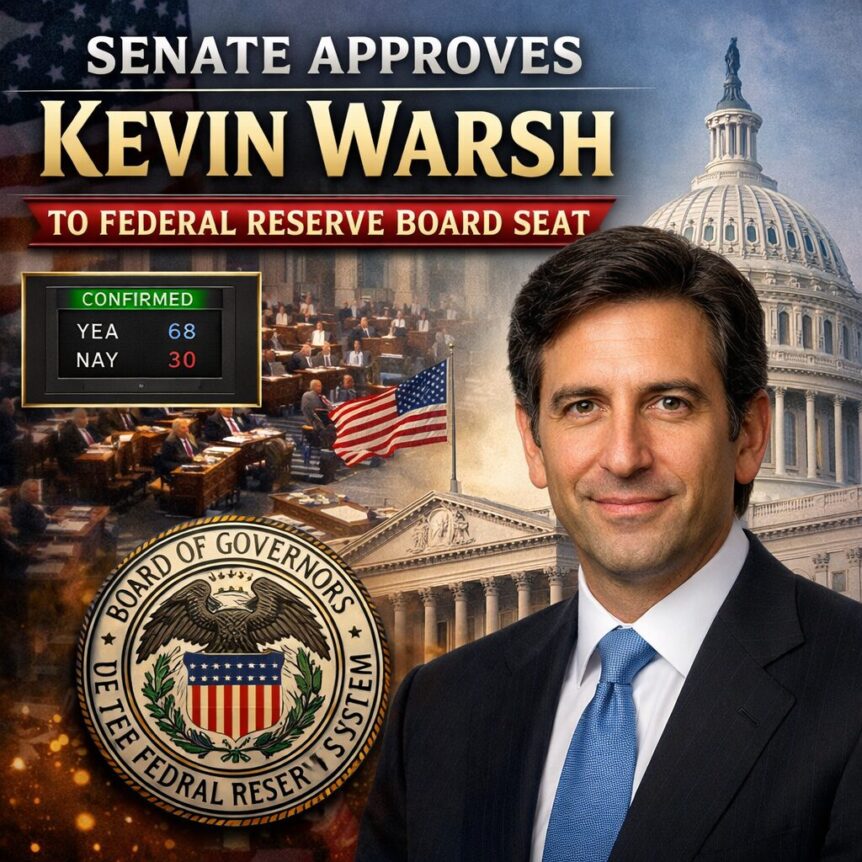
The U.S. Senate gave the nod to Kevin Warsh for a seat on the Federal Reserve Board on Tuesday in a vote of 51-45.
The move brought Warsh one step nearer to replacing Jerome Powell as Federal Reserve chief when his two-year term ends. As legislators get ready for another Senate vote that might finally raise Warsh to the top job at the central bank.
The Senate confirmed Kevin Warsh to a 14-year term on the Federal Reserve Board, effective Feb 1, 2026. His nomination advanced in the chamber after a successful closure vote, which was the first step in the process for his nomination to be approved. Warsh was thus able to come back to the Fed as governor in the midst of the financial crisis in 2008.
Now lawmakers will vote independently on the appointment of the new Federal Reserve chair. Closure was already approved in the Senate for that nomination, speeding up the final vote. This means that Warsh could potentially step in as Powell’s successor as soon as tomorrow.
By the time Powell’s term as chairman expires on Friday, Warsh will be able to take over the position. But Powell’s tenure as a member of the Federal Reserve Board will not terminate upon his resignation from the Fed chair. So, even with the likely promotion of Warsh, the White House will not have a majority on the board.
There was a quick turnaround in market expectations following fresh inflation data that indicated the economy continued to experience price rises in the United States.
The Consumer Price Index (CPI) rose 3.8 per cent annually in April, more than the forecasted rate of 3.7 per cent. Energy prices were also high due to the geopolitical situation that caused the disruption of supply.
The sentiment around a Fed rate hike in 2026 has increased, according to prediction site Polymarket. The chances rose to 27% after the inflation report and the Senate confirmation vote for Warsh. By contrast, previous predictions were centred primarily on a flat interest rate all year.
The Federal Reserve’s central committee had already given some indication of increased inflation worries at its April meeting. Policymakers called inflation elevated, instead of somewhat elevated. As a result, financial markets renewed their debate on the need for tighter monetary policy.
The decision to let Warsh’s confirmation has significant policy implications.
In earlier speeches and debates, Warsh has advocated greater measures to combat inflation. His anticipated leadership may affect future Fed decisions about borrowing rates and the level of liquidity. Meanwhile, policymakers remain in a delicate balance between fighting inflation and ensuring overall economic stability.
President Donald Trump has been a strong proponent for reducing interest rates to boost economic activity and lending. But the administration continues to have less influence over the board to compel quick policy shifts at the Fed. Powell’s tenacity on the board also restricts a sudden U-turn in policy post-transition of leadership.
The Fed is facing pressure as inflation keeps coming in above the long-term 2% target. The US-Iran conflict has brought new pressure into consumer markets and supply chains due to rising energy prices. As a result, the Central Bank is being called upon to keep its monetary policy tight for a longer duration.
The confirmation also coincides with a volatile and critical time for financial markets and government borrowing. Treasury yields have been volatile following a reassessment of inflation risks and Fed policy decisions by traders. Meanwhile, the economy keeps influencing the outlook for US monetary policy.
While the Federal Reserve leadership has changed, multiple analysts believe the Fed will continue to be cautious in its policy. The inflation readings have made rate cut expectations, which many market participants had earlier this year, more difficult. This will consequently keep rates high for an extended period.
The Senate vote on Warsh’s nomination as chair may shape Fed policy in the weeks ahead. The confirmation would put him in charge as the inflation pressure is increasing and the geopolitical situation is uncertain. As a result, financial markets will remain sensitive to economic data and leadership changes from the Fed.
The DTCC Chainlink Collateral AppChain partnership will automate 24/7 collateral management across global markets by Q4 2026.
Summary
- DTCC will integrate the Chainlink Runtime Environment into its Collateral AppChain to automate pricing, valuation, margining, and settlement across financial markets.
- The Collateral AppChain targets a Q4 2026 production launch and extends a 2024 Smart NAV pilot that included JPMorgan, BNY Mellon, and Franklin Templeton.
- Chainlink co-founder Sergey Nazarov called collateral management the killer application that traditional finance has been waiting for from blockchain infrastructure.
The Depository Trust and Clearing Corporation has announced that its Collateral AppChain will integrate the Chainlink Runtime Environment and Chainlink’s data standard to power pricing, valuation, margining, collateral optimization, and settlement. The platform is targeting a Q4 2026 production launch.
“By leveraging tokenization and distributed ledger technology to modernize collateral mobility, our goal is to enable 24/7, near real-time collateral management across global markets and blockchains,” said Nadine Chakar, DTCC managing director and global head of digital assets. DTCC processed $4.7 quadrillion in securities transactions in 2025.
What the Collateral AppChain does
The platform tokenizes collateral and uses smart contracts to automate workflows across collateral providers, receivers, managers, triparty agents, and custodians through a shared, interoperable infrastructure.
Chainlink provides the data and orchestration layer, connecting asset prices and valuations with collateral movement, eligibility checks, margining calculations, and settlement instructions.
The collaboration extends the Smart NAV pilot that DTCC and Chainlink ran in 2024, which tested mutual fund net asset value data delivery onto blockchains with JPMorgan, Franklin Templeton, and BNY Mellon participating. The AppChain was first unveiled during DTCC’s Great Collateral Experiment.
Sergey Nazarov, Chainlink co-founder, said CRE will orchestrate “critical outputs in a secure, private and compliant manner” and called collateral management “the killer app that traditional finance has been waiting for from our industry.” LINK surged more than 20% on the day of the announcement as traders priced in the institutional validation.
Context and next steps
DTCC also confirmed that a separate tokenization service will launch in October 2026, with more than 50 companies having joined its tokenized services working group and a limited live-transaction test planned for July.
The Chainlink partnership spans the entire collateral lifecycle, from initial pricing data to final settlement, something the firm has been building toward through successive institutional mandates including SWIFT, UBS, and the Bank of England.
The deal marks one of the most significant direct integrations between Chainlink infrastructure and Wall Street’s post-trade clearing system. If the Q4 2026 production launch proceeds on schedule, it would represent the first time a CFTC and SEC regulated clearinghouse has operated collateral workflows across multiple blockchains around the clock without traditional market-hours constraints.
Crypto World
Casper Network Publishes the Casper Manifest, a Multi-Year Roadmap to Power Regulated Real-World Assets and the Machine Economy

[PRESS RELEASE – Zug, Switzerland, May 12th, 2026]
Nine protocol initiatives that target EVM compatibility, gasless transactions, compliant security tokens, transaction privacy, AI agent micropayments, and quantum-safe cryptography
The Casper Association today published the Casper Manifest, a multi-year technical roadmap designed to make Casper Network the infrastructure layer for regulated real-world asset tokenization and the emerging machine-to-machine economy.
The Manifest was introduced by Casper Association President & CTO Michael Steuer at the Digital Finance Forum in Bermuda, before an audience of leaders from Web3, traditional finance, and institutional finance.
Building on major protocol releases delivered since mid-2025, including Casper 2.0 with deterministic finality and a multi-VM execution layer, the Manifest sets out nine coordinated initiatives around one goal: making blockchain frictionless for users, trusted by institutions, and native for machines. The roadmap brings EVM compatibility to Casper’s WebAssembly foundation, advances gasless transactions and smart accounts for simpler user experiences, and expands the compliance, privacy, micropayment, native token, and quantum-safe infrastructure needed for real-world assets and autonomous systems to operate with greater predictability and less friction.
Building the Infrastructure for Regulated Assets and Autonomous Systems
The nine core initiatives outlined in the Casper Manifest are organized around the following areas:
Access for every developer. The largest blockchain developer ecosystem builds on Ethereum tooling – Solidity, MetaMask, and thousands of audited smart contract libraries. Casper is adding full Ethereum Virtual Machine compatibility alongside its existing WebAssembly execution engines, so developers can bring their existing contracts, tools, and wallets to Casper without modification. A native token registry provides equal access to tokens from either side. One chain, two execution environments, zero fragmentation.
Blockchain that’s frictionless for the user. Someone else pays your transaction fees. Multiple steps collapse into a single action. You sign in with your fingerprint instead of managing cryptographic keys. The Casper Manifest delivers gasless transactions, batch operations, and smart accounts that enable biometric authentication – so using a blockchain application feels like using any other app.
Compliance and privacy as one system. Casper will be the first Layer 1 where regulatory compliance and transaction privacy are designed to work together. Compliant security tokens with on-chain identity verification, transfer restrictions, and jurisdictional controls – built in alignment with the ERC-3643 standard that already governs $28 billion in tokenized assets on chain. As a member of the ERC-3643 Association, Casper Association is helping to expand the standard. Alongside compliance, a multi-phase privacy roadmap delivers confidential transactions with fixed, predictable costs – and built-in tools for auditors and regulators to verify compliance without exposing transaction details to the public. Privacy and compliance as two sides of the same system, designed for the $16 trillion real-world asset tokenization market.
Native infrastructure for the machine economy. AI agents need to pay for services programmatically – per API call, per data query, per computation – without subscriptions, invoices, or human intermediaries. As a member of the X402 Foundation, Casper is implementing the X402 open payment standard, enabling machines to pay each other over HTTP in stablecoins and other fungible tokens, expecting to become the first WebAssembly-native Layer 1 with production X402 support. The same smart accounts and gasless infrastructure built for human users give AI agents scoped spending permissions and autonomous operation out of the box, providing best-in-class controls and compliance for AI agents.
Tokens as first-class citizens. User-created tokens on most blockchains are smart contracts that cost significantly more to operate than native currencies. Casper’s Native Token Registry elevates every token to protocol-level status with the same fixed, predictable costs as native transfers. One pricing model for all tokens. One infrastructure layer shared across WebAssembly, EVM, and any other future execution environment on Casper Network. The backbone for everything from DeFi to compliant security tokens to private, confidential transfers.
Quantum-safe from the start. No major smart contract platform has shipped post-quantum transaction signing. Casper will, with hybrid accounts that carry both classical and quantum-resistant keys during a transition period. For institutions evaluating blockchain platforms for decade-long deployments, the answer to “what happens when quantum computers arrive” will be production code, not a research paper.
“Much of the industry is focused on either maximizing hype, or iterating on concepts that service the same existing, crypto-native use cases. Few are building the infrastructure that will onboard the next billion users, the next trillion dollars in tokenized assets, or the first billion machines,” said Michael Steuer, President and CTO of the Casper Association. “Executing the Casper Manifest means that developers can bring over their entire EVM stack. For users, blockchain should be invisible. One tap. Done. For institutions, Casper’s roadmap provides on-chain compliance, transaction privacy and quantum safety. And machines need payment rails that don’t require a human, while being bound to spending limits set by their owners on their smart accounts. That’s the future-proof infrastructure Casper is putting in place.”
Timeline
The nine initiatives do not ship all at once. The first, X402 micropayments, is expected to ship in the next few weeks. Later in 2026, Casper will ship EVM compatibility, networking hardening, and compliant security tokens. This will be followed by the Native Token Registry, Gasless transactions, batch operations, and smart accounts. Transaction privacy and quantum safety build on the earlier initiatives through 2027. Formal protocol enhancement proposals for each initiative will be published.
Explore a deep dive of the Casper Manifest here: https://casper.network/news/manifest
About Casper Network
Casper Network (CSPR) is a layer 1 Proof-of-Stake blockchain engineered for regulated real-world assets and the machine economy. With deterministic transaction finality, a multi-VM execution layer supporting both WebAssembly and soon EVM smart contracts, and fixed-cost operations enforced at the protocol level, Casper delivers the infrastructure for compliant asset tokenization, frictionless consumer experiences, and autonomous machine-to-machine commerce. The Casper Manifest – the network’s multi-year technical roadmap – advances nine coordinated protocol initiatives spanning developer access, user experience, institutional compliance, privacy, micropayments, and quantum safety. The Casper Association, a non-profit organization based in Zug, Switzerland, oversees protocol development and ecosystem growth. Learn more at https://casper.network.
Full Casper Manifest: https://casper.network/news/manifest
The post Casper Network Publishes the Casper Manifest, a Multi-Year Roadmap to Power Regulated Real-World Assets and the Machine Economy appeared first on CryptoPotato.
In a crypto landscape that’s getting increasingly split between centralized exchanges and decentralized (DeFi) protocols, Figure Markets emerges as a hybrid solution designed to bridge both worlds.
The platform is launched as part of the broader Figure Technology Solutions, Inc. (“Figure”) ecosystem and is aimed at combining elements of traditional finance (TradFi) with decentralized finance. The goal is to provide users with a single interface to trade, earn, and borrow, while at the same time maintaining control over their assets.
At its core, Figure Markets is a self-custody digital asset platform that’s designed to enable users to buy and sell cryptocurrencies, access lending products, and generate yield from both real-world assets (RWAs) and from crypto. Unlike many of the mainstream exchanges, however, it places the emphasis on user ownership through advanced wallet technology, ensuring that funds remain under the complete control of the user rather than being held by the platform.
What makes it stand out is its ambition to go beyond typical crypto exchange functionality. It integrates a myriad of real-world finance products, including home equity-backed lending, directly into a blockchain-based environment. This creates opportunities for users to earn yield that’s derived from traditional assets rather than purely speculative crypto-oriented mechanisms.
From a user perspective, Figure Markets presents itself as an “all-in-one” financial app, where trading, borrowing, and earning coexist within a unified ecosystem. This approach is designed to appeal to a broader audience – from users who seek self-custody and yield, to more traditional investors who look for a familiar financial product.
Ultimately, the platform is not trying to compete solely as another crypto exchange. Rather, it is positioning itself as a next-gen capital markets platform.

Company Background and Vision
Figure Markets is part of the broader ecosystem that’s built by Figure Technology Solutions – a NASDAQ-traded fintech firm founded by Mike Cagney, who is also known as the former CEO and co-founder of SoFi.
Figure has predominantly focused on modernizing financial services through blockchain-based technologies. More particularly, by bringing traditional assets like loans on-chain.
The launch of Figure Markets (in 2024) represented a natural extension of the firm’s vision to create a marketplace that allows users to interact with both crypto and real-world financial products in a unified environment.
Central to this particular strategy is the Provenance Blockchain. This is a purpose-built network that’s specifically designed to support asset tokenization and transparent financial operations.
In essence, Figure Markets reflects a broader ambition to rebuild capital markets infrastructure by using blockchain technology while also maintaining regulatory alignment and institutional-grade standards.
Core Features: Overview
Figure Markets is developed as an all-in-one financial platform, as we mentioned above. It combines multiple services that are generally spread across exchanges, wallets, and various DeFi protocols.
Its core appeal lies in simplifying access to crypto and blockchain-oriented financial products. However, this doesn’t seem to happen at the expense of control or transparency, which enhances its core product offering.
Some of the platform’s key features include:
- Self-custody wallet
Users are able to retain complete control of their assets through self-custody wallets and advanced multi-party computation (MPC) technology, which reduces the reliance on centralized custody, if not eliminating it completely.
- Integrated trading functionality
Figure Markets allows users to buy and sell supported cryptocurrencies within the same application, which eliminates the need for external exchanges. These transactions are executed on a peer to peer basis, through the Figure Markets Exchange module on the Provenance Blockchain.
- Earn products with real yield
Democratized Prime, a decentralized lending marketplace that allows users to access yield opportunities that are backed by real-world assets, not just crypto incentives.
- Crypto-Backed Loans
Crypto-Backed Loans* allows participants to unlock liquidity without having to sell their digital assets and use them as collateral instead to do things including purchase more crypto.
- Real-world asset exposure
What has undoubtedly turned out to be one of the hottest crypto use cases, RWAs allow users to participate in blockchain-based financial products, which are tied to traditional assets such as loans, for example.
- On-chain transparency
Transactions and asset activity are recorded on the Provenance Blockchain. This ensures greater visibility and accountability.
Trading Experience and Supported Assets
Figure Markets offers a rather streamlined trading experience, which is designed to feel familiar to users of centralized exchanges. However, it still operates within its very own self-custody framework.
The platform focuses on simplicity and accessibility. It makes it very easy to buy and sell crypto without requiring the user to navigate complex order books or advanced trading interfaces.
One of its standout aspects is the emphasis on low trading fees. This lowers the barrier to entry for casual users and for long-term investors alike. Instead of catering to high-frequency traders, as many other exchanges do exclusively, Figure Markets leans toward a more intuitive trading flow, which is closer to a fintech application than a professional trading terminal.
That said, its pro trading platform does feel familiar to many of the existing centralized exchanges, making it very easy for users with experience to transition, while also offering a very familiar UI at the same time.

It’s important to note that liquidity is still developing, given how relatively new the platform is, but it definitely benefits from integration within the wider ecosystem of Figure. Over time, this is likely to improve both depth and pricing efficiency.
Overall, the trading experience is best suited for:
- Users who value ease of use over highly advanced tooling
- Investors focused on core crypto assets and self-custody
- Lenders seeking access to yield generated by private credit assets previously reserved for institutions
- Those who already use Figure or Figure Markets for earning or borrowing
Earning and Yield Products
One of the more compelling aspects of Figure Markets is its evident focus on yield generation, particularly through products that are tied to real-world financial activity. This positions the platform very differently from most of the DeFi protocols, where the returns tend to be driven by token inflation, emissions or speculative demand in many of the cases.
At the center of its offering are real-world asset-backed yield opportunities through Democratized Prime, Figure Market’s decentralized lending marketplace. These usually involve pools that are connected to loans originated within the broader Figure ecosystem but recently Democratized Prime has expanded to other credit assets, including auto loans originated by Agora Data. Figure’s tokenized RWAs include home equity lines of credit (HELOCs). In fact, Figure is the number 1 non-bank HELOC lender in the US, having unlocked more than $22 billion in liquidity.
Users can also access yield-bearing digital assets including Figure’s proprietary yield-bearing stablecoin, YLDS, which is issued by the Figure Certificate Company (FCC). YLDS is the first and only yield-bearing stablecoin registered with the SEC, and was the first public security to be to be successfully registered with the SEC. Products like YLDS and Democratized Prime are designed to generate income. They are structured to offer very competitive returns while maintaining relatively conservative risk profiles when compared to volatile crypto staking strategies. YLDS yields SOFR minus 35bps, while yields generated in Democratized Prime are typically in the range of 7-9%.**
To sum it up, some of the key highlights of the earning experience include:
- Attractive target yields
- RWA-backed yields
- Focus on passive income
- Integrated access
That said, these products are not risk-free. The returns will depend on the borrower’s performance, collateral equity, and the broader market conditions.
In essence, Figure Markets’ earning suite is suited for users who seek more predictable and income-oriented strategies.
Borrowing and Lending Services
In addition to trading and earning, Figure Markets also provides a wide range of borrowing and lending services including Crypto Backed Loans* which are originated by Figure Lending LLC (and Figure Markets Credit LLC for New York and international customers). CBLs are designed to unlock liquidity without requiring the user to sell their cryptocurrency. This is a very integral part of its hybrid model, blending traditional finance products with crypto-backed lending.
On the Figure Markets side, users are able to take out loans against their digital assets utilising flex rate variable offerings in Democratized Prime. By using crypto as collateral for a fixed-rate CBL or a flex-rate loan, they maintain market exposure without incurring the consequences of selling their crypto. This is very useful for long-term holders who need access to cash or stablecoins and don’t want to trigger a taxable event or to miss potential upside.
Some of the key features here include:
- Streamlined application process
- Flexible use of funds
- Competitive low rates at 8.91% (9.999% APR) @ 50% LTV2
- Liquidation Protection7
Of course, users need to be well-aware of the liquidation risks that come with highly volatile markets, but Figure Markets does a good job of clarifying this. Users who elect to pay the additional fee for liquidation protection will not be subject to liquidations or margin calls based on price movement during the life of their loan.
Flagship Products
Democratized Prime
This is a decentralized lending marketplace that brings institutional-grade yield opportunities to Figure Markets’ users. It is designed to connect lenders and borrowers directly where users are able to set their preferred interest rates.
Some of its highlights include:
- Yields (7-9%) depending on market conditions**
- Overcollateralized pools giving lenders more security
- Real-world asset backing
- Hourly liquidity

Crypto-Backed Loans*
This product allows users to access liquidity without having to sell their digital assets. This makes it very practical for long-term holders. Instead of cashing out (selling), users pledge their crypto as collateral and receive funds in return.
- Retain your crypto exposure
- Competitive fixed rates
- Fast access to funds
User Interface Experience (UI/UX)

The platform places a strong interface on delivering a clean user experience rather than trader-heavy solutions, but it does contain all the necessary tooling an advanced user would need.
Navigation is straightforward with clearly separated sections for trading, earning, and borrowing. This allows anyone to move between features without any friction. The layout feels closer to a contemporary neobanking app rather than a traditional crypto exchange, which oftentimes makes it particularly appealing to those who prioritize simplicity and easy access.
Onboarding is also quite smooth. Account setup, identity verification, wallet creation – all of it is integrated into a guided flow, which reduces some of the typical bottlenecks and barriers to entry that are associated with self-custody platforms.
The mobile experience is undoubtedly a core focus, with the app serving as the primary interface for many users. Performance is responsive, key actions like buying and selling crypto through the professional interface are also very smooth.
Security, Regulation, and Compliance
It goes without saying that security and regulatory alignment are central to Figure Markets and its value proposition, especially given its goal to bridge crypto with TradFi. Unlike many centralized exchanges, the model here is self-custody, which means that users retain full control of their assets at all times. This is allowed through the use of MPC technology, which distributes private key management across a number of parties to reduce single points of failure.
From a security standpoint, this approach definitely offers a strong middle ground between full-self custody and custodial solutions.
On the regulatory side, Figure Markets stands out because of its connection with Figure Technology Solutions (FTS), which operates within established financial frameworks and considers itself a leader in building compliant blockchain infrastructure.
FTS has been an industry leader when it comes to innovation within regulated ecosystems. Some of these industry firsts included launching the first public security to be fully traded on blockchain rails when it launched YLDS, the SEC’s first and only yield-bearing stablecoin YLDS. YLDS was followed by launching the first blockchain-native public equity that is fully tradable on blockchain rails when it launched FGRS, FTS’s blockchain-native shareclass. FGRS is issued, held and traded solely on blockchain rails through Figure Onchain Public Equity Network (OPEN). Blockchain-native equities on OPEN settle atomically T+0, compared to traditional tokenised equities, which settle T+1 due to reliance on legacy infrastructure like the Deposit Trust Clearing Corporation, DTCC. FGRS can also be lent and used as collateral in pools on Democratized Prime.
Subsidiaries of FTS include:
- SEC-registered Alternative Trading System (Figure ATS), administered by a FINRA-registered broker-dealer (Figure Securities, Inc.),
- SEC-regulated Transfer Agent (Figure Equity Solutions),
- 1940 Act Investment Company, registered as a Face-Amount Certificate Company (FCC),
- State-regulated Money Transmitter (Figure Pay)
- State-licensed lender (Figure Lending LLC)
Additionally, the fact that it’s built on top of the Provenance Blockchain enhances transparency as transactions and asset movements can easily be verified on-chain.
Conclusion
It goes without saying that Figure Markets aims to bring a compelling evolution of the cryptocurrency platform model. It blends elements of a centralized exchange, DeFi protocols, and traditional financial services tied into a unified ecosystem.
In our view, it’s best suited for investors seeking passive income and more predictable yield and are interested in real-world asset exposure, while valuing self-custody and a more streamlined user experience.
That said, what stands out the most is their dedication to providing high-quality products such as yield opportunities through RWAs from Democratized Prime and competitive rates for Crypto Backed Loans to provide flexibility with your crypto.
Disclosures
*Crypto backed loans are provided by Figure Lending LLC dba Figure (NMLS 1717824). Loans subject to approval. Crypto collateral may be liquidated. Terms apply – see full disclosures at figure.com/disclosures/
©2026 Figure Lending LLC
Figure Lending LLC dba Figure 650 S. Tryon Street, 8th Floor, Charlotte, NC 28202. 888) 819-6388. NMLS ID 1717824. For licensing information go to www.nmlsconsumeraccess.org
Equal Opportunity Lender For general customer support, call (888) 819-6388 Monday – Friday, 6am – 9pm PT, Saturday – Sunday, 6am – 5pm PT (excluding holidays).
Equal Housing Opportunity
This site is not authorized by the New York State Department of Financial Services. No mortgage solicitation activity or loan applications for properties located in the State of New York can be facilitated through this site.
Digital currency is not legal tender, is not backed by the government, and BIA accounts are not subject to FDIC or SIPC protections.
Availability:
Crypto loans are offered to U.S. borrowers by Figure Lending LLC. This product is not available to U.S. residents of DC, ID, IL, KY, MD, MS, SD, TX, VT, or VA.
Crypto loans are offered through Figure Markets Credit LLC to residents of the state of New York and to international customers except in the following jurisdictions: Crimea (Ukraine), Donetsk (Ukraine), Luhansk (Ukraine), Afghanistan, Albania, Belarus, Central African Republic, Congo (the Democratic Republic), Cuba, Ethiopia, Haiti, Iran (Islamic Republic of), Iraq, Lebanon, Libya, Mali, Myanmar (Burma), Nicaragua, Nigeria, North Korea (Democratic People’s Republic of), Pakistan, Palestine (State of), Russia, Somalia, South Sudan, Sudan, Syria, Ukraine, Venezuela, Yemen, or Zimbabwe.
Lender & Licensing:
Figure Markets Credit LLC. 650 S. Tryon Street, 8th Floor, Charlotte, NC 28202. (888) 926-6259. NMLS ID 2559612. For licensing information, go to www.nmlsconsumeraccess.org
Crypto Loans starts at a minimum of $5,000, subject to state and jurisdiction-specific legal limitations. Your loan amount will ultimately depend on the amount of collateral in your account and your eligibility will be determined by your state or jurisdiction of residence, credit profile, and other personal information available at the time of your application.
- General minimum and maximum loan amounts may vary subject to state-specific legal limitations.
- Repayment Period (Minimum-Maximum): 12 months
Maximum APR: 12.62% APR (APR includes interest plus applicable fees such as the 1% origination fee). Available interest rates for Figure’s Crypto-Backed Loan are 8.91% (9.999% APR) at 50% LTV or 11.50% (12.62% APR) up to 75%.
Representative Example (Total Cost): As an example, a borrower receives a Crypto Backed Loan at 50% LTV of $10,000 for a term of 12 months, with an interest rate of 8.91% and a 1% origination fee of $100, for an APR of 9.999%. In this example, the borrower will receive $10,000 and will make 12 monthly payments of $74.25. Rates will be higher for applications secured by assets with a higher LTV ratio. The Figure Crypto-Backed Loan has a 12 month interest-only repayment term and allows for a maximum initial LTV ratio of 75%. Interest rates change frequently so your exact interest rate will depend on the date you apply and may depend on many factors such as LTV ratio. - Obtaining a crypto-backed loan generally does not trigger an upfront taxable event. Tax treatment may vary based on individual circumstances. Consult your tax advisor.
- Liquidation protection is only available in CA, NY, FL, PA, AL, AK, GA, HI, MA, UT. Liquidations will still occur if the loan becomes delinquent. More information about liquidation protection can be found here. The Figure Crypto Backed Loan (CBL) allows eligible users to borrow U.S. dollars secured by crypto collateral. The maximum loan-to-value (“LTV”) ratio is 50% at origination.
- Approval is not guaranteed
Liquidation protection is only available in CA, NY, FL, PA, AL, AK, GA, HI, MA, UT. Liquidations will still occur if the loan becomes delinquent. More information about liquidation protection can be found here. The Figure Crypto Backed Loan (CBL) allows eligible users to borrow U.S. dollars secured by crypto collateral. The maximum loan-to-value (“LTV”) ratio is 50% at origination.
Investment products: Not FDIC Insured, No Bank Guarantee, May Lose Value.
YLDS Stablecoins are unsecured face-amount certificates and solely backed by the assets of Figure Certificate Company (FCC), who is the issuer of the certificates. As a subsidiary of Figure Markets Holdings, Inc., FCC is (absent exclusion or exemption) required to comply with certain limits on its activity, including investment and/or trading limitations on its portfolio and other limitations under applicable banking and securities laws. FCC is not a bank, and the securities it offers are not deposits or obligations of, or backed or guaranteed or endorsed by, any bank or financial institution, nor are they insured by the Federal Deposit Insurance Corporation (FDIC), the Federal Reserve Board or any other agency. The Certificates are not an insurance company product, an equity investment, Paid endorsement by Figure Technology Solutions, Inc. Opinions are my own. Consult a financial advisor before making any decisions or an investment in a money market mutual fund. FCC’s qualified assets on deposit may exceed the deposit amounts required by applicable regulations. If there are losses on FCC’s assets, FCC may not have sufficient resources to meet its obligations, including making interest and/or principal payments on your certificates. Most of FCC’s assets are debt securities and are subject to risks including credit risk, interest rate risk and prepayment and extension risk. You could lose money by investing in the Stablecoin. Although the Stablecoins seeks to preserve the value of your investment at $0.01 per share, it cannot guarantee it will do so. You should consider the investment objectives, risks, charges and expenses of certificates carefully before investing. Download a free prospectus, which contains this and other important information about our certificates. Read the prospectus carefully before you invest. Figure Certificate Company Prospectus available Here
The On-Chain Public Equity Network (OPEN) includes a variety of services offered by the Figure Group of companies. Included in the services offered by OPEN is a Figure Markets MPC wallet for self-custody of digital equities and digital assets. Cross-collateralization and portfolio margin capabilities through OPEN are enabled by Figure’s decentralized lending marketplace, Democratized Prime. Public equity trading is made available through an Alternative Trading System (“Figure ATS”) operated by FINRA/SIPC member Figure Securities, Inc.
Check the background of this firm on FINRA’s BrokerCheck here: https://brokercheck.finra.org/firm/summary/307093
Investment in common stock, including Class A or blockchain-native shares, involves a high degree of risk and may result in the loss of part or all of your investment, as prices can fluctuate significantly due to market conditions and company performance, may be volatile and difficult to sell, are not guaranteed to provide returns or dividends, and may be adversely affected by dilution, regulatory changes, or, where applicable, risks associated with blockchain technology. Additionally, this security may not be suitable for all investors. Before investing you should: (1) conduct your own investigation and analysis; (2) carefully consider the investment and all related charges, expenses, uncertainties and risks, including all uncertainties and risks described in offering materials; and (3) consult with your own investment, tax, financial and legal advisors.
Past performance and yields are not reliable indicators of current and future results. Rates associated with the mentioned products are not guaranteed and subject to change.
Investing in cryptocurrencies involves significant risks. Cryptocurrency trading is not available in NY. Please click here for risk disclosures on investing and trading in cryptocurrencies.
Figure Payments Corporation offers to self-directed investors and traders cryptocurrency brokerage services under the brand name, “Figure Markets”. It is neither licensed with the SEC or the CFTC nor is it a Member of NFA. Figure Payments Corporation’s NMLS ID number is 2033432, and is located at 100 West Liberty Street, Suite 600, Reno, NV., 89501. You can verify Figure Payments licensing status at the NMLS Consumer Access website. Click here for Figure Payment’s state license and regulatory disclosures.
**Rates for Democratized Prime are variable, not fixed or guaranteed, and may change based on pool composition, borrower performance, auction dynamics, and market conditions; learn more:. Figure Markets and its affiliates do not guarantee repayment, liquidity, or asset value, and participation is subject to applicable terms, including the Democratized Prime Terms of Service and HELOC+ Addendum.
Figure Payments Corporation, Figure Lending LLC, Figure Securities, Inc, Figure Certificate Company, and Figure Markets, Inc. are each wholly owned subsidiaries of Figure Technology Solutions, Inc. Products and services of all of these entities are offered under the Figure Markets brand. NOTE FOR INVESTORS: When applying for accounts, subscriptions, products and services, it is important that you know which company you will be dealing with. Please click here for further important information explaining what this means.
CryptoPotato Disclaimer: The above article is sponsored content; it’s written by a third party. CryptoPotato doesn’t endorse or assume responsibility for the content, advertising, products, quality, accuracy, or other materials on this page. Nothing in it should be construed as financial advice. Readers are strongly advised to verify the information independently and carefully before engaging with any company or project mentioned and to do their own research. Investing in cryptocurrencies carries a risk of capital loss, and readers are also advised to consult a professional before making any decisions that may or may not be based on the above-sponsored content.
Readers are also advised to read CryptoPotato’s full disclaimer.
The post Figure Markets Review 2026: Everything You Need to Know appeared first on CryptoPotato.

Bitcoin (BTC) could move above $90,000 and revisit its all-time high of around $126,000, BitMEX co-founder Arthur Hayes said.
He says the aggressive spending by governments and banks to fund AI infrastructure, as well as military spending and energy security projects, has helped fuel the crypto bull market.
Hayes Ties Bitcoin Outlook to AI Spending and Wartime Liquidity
The core of Hayes’s argument is that the Chinese and American governments have handed themselves political cover to print money aggressively and that this flood of liquidity will lift Bitcoin more than almost any other asset.
The first driver is the AI arms race, with the former BitMEX CEO saying that both Trump and Xi view machine intelligence as a matter of national survival, not just commercial opportunity.
“The presidents of America and China both believe that AI and tech supremacy are integral to the survival of their fiefdoms,” he stated, adding that the tech industry in each country has been “more than happy to sell them a horror story of what happens to the glorious nation should the other side gain supremacy over machine intelligence.”
That framing, according to Hayes, makes any central bank pushback on inflationary lending politically impossible, meaning both dollars and yuan will flow into AI regardless of what it does to consumer prices.
The second driver is the US attack on Iran, with the crypto investor claiming that the date it started, February 28, is the moment the current bull market began in earnest.
He argued that the conflict has exposed something the rest of the world can no longer ignore: that the US will start wars affecting global commodity flows without consulting the countries most harmed by the disruption.
The consequence, in his opinion, is that sovereign nations will stop recycling surpluses into US Treasuries and S&P 500 ETFs and instead spend that capital on pipelines, defense, and commodity stockpiles.
That will in turn create a structural problem for US markets, which Hayes believes the Fed and Treasury will patch with looser financial conditions, including expanded dollar swap lines and relaxed banking regulations.
Each of these tools will expand the supply of dollars, and more dollars in Hayes’s framework means higher BTC prices.
Where Bitcoin Stands
According to Hayes, Bitcoin’s recovery to its all-time high is a matter of when, not if.
“Retaking the $126,000 is a foregone conclusion,” he wrote.
He believes the surge will get even faster once BTC passes the $90,000 mark because he thinks many covered call sellers will be forced to buy back their positions as the price pushes through their strike levels, creating a self-reinforcing squeeze.
As of this writing, the OG crypto is trading under $81,000, up nearly 13% in the last month but still about 36% below that ATH.
Still, investment flows have shown that there is improving sentiment around Bitcoin. According to CoinShares, digital asset investment products recorded $857.9 million in inflows last week, the sixth consecutive week of positive flows, with BTC alone pulling in $706 million, to bring its year-to-date inflow total to $4.9 billion.
The post Arthur Hayes Predicts AI Race Will Push Bitcoin Back to $126K appeared first on CryptoPotato.

Federal prosecutors charged three Tennessee men for a violent cryptocurrency robbery operation across several California cities. Authorities linked the suspects to kidnappings, armed home invasions, and millions in stolen digital assets. Investigators also continue searching for possible organizers connected to the crimes.
The indictment followed months of investigations involving federal and local law enforcement agencies. Prosecutors said the suspects targeted victims holding large cryptocurrency balances across California. Authorities confirmed the alleged crimes occurred between November and December 2025.
The Department of Justice stated that the suspects used fake delivery worker disguises to approach targeted homes. Prosecutors alleged the group restrained victims with duct tape and zip ties during robberies. Authorities also connected the suspects to multiple incidents across San Francisco, Sunnyvale, San Jose, and Los Angeles.
Suspects Face Federal Kidnapping and Robbery Charges
Federal prosecutors identified the suspects as Elijah Armstrong, Nino Chindavanh, and Jayden Rucker from Tennessee. Authorities arrested Chindavanh in Sunnyvale during December 2025 after another attempted robbery. Meanwhile, investigators arrested Armstrong and Rucker in Los Angeles later that month.
Prosecutors accused the suspects of conspiracy to commit Hobbs Act robbery and kidnapping. Authorities also charged the group with attempted kidnapping and attempted Hobbs Act robbery. Federal prosecutors stated the defendants traveled from Tennessee to carry out the crimes.
Court filings showed the suspects allegedly forced one victim to access cryptocurrency accounts at gunpoint. Prosecutors stated co-conspirators transferred nearly $6.5 million into controlled crypto wallets afterward. Authorities also claimed the suspects assaulted victims while demanding account credentials.
San Francisco Robbery Raised National Attention
Investigators connected the suspects to a high-profile San Francisco home invasion near Dolores Park during November 2025. Authorities stated the attackers posed as delivery workers before entering the victim’s residence. Prosecutors alleged the victim surrendered cryptocurrency passwords after physical assaults and threats.
Law enforcement officials reportedly linked the incident to the theft of approximately $13 million in cryptocurrency. However, the federal indictment referenced only a confirmed $6.5 million cryptocurrency transfer. Authorities have not confirmed whether victims recovered any stolen digital assets.
Investigators also examined evidence involving an unidentified accomplice communicating through a cellphone during the attacks. Authorities reportedly traced one cellphone to a Washington state resident with a criminal history. However, prosecutors have not announced additional charges related to that individual.
Federal Authorities Expand Crackdown on Crypto Crime
Federal officials described the alleged operation as highly organized and extremely dangerous. Prosecutors stated the suspects specifically targeted individuals connected to large cryptocurrency holdings. Authorities also warned that violent crypto-related crimes continue increasing across the United States.
The FBI confirmed that cryptocurrency fraud and theft generated record financial losses during the previous year. Federal data showed crypto-related scams accounted for more than half of total internet crime losses. Authorities also linked recent cases to organized social engineering and home invasion operations.
Armstrong and Rucker appeared in federal court in San Francisco on May 12, 2026. Chindavanh previously appeared in federal court during April and returned for another hearing in June. If convicted, the defendants could face life sentences under federal kidnapping conspiracy charges.

The US Senate advanced Kevin Warsh toward the upper echelons of monetary policy, approving him as a Federal Reserve governor in a narrow 51-45 vote that crossed party lines with a single Democratic deviation. The confirmation sets the stage for a separate vote on Warsh’s potential appointment as chair, a decision that could reshape the central bank’s policy trajectory at a time of heightened scrutiny over rate moves and institutional independence.
Following the confirmation, the chamber moved to invoke cloture on Warsh’s nomination as Fed chair, signaling an expedited path to a final vote. If confirmed as chair, Warsh would inherit leadership duties as Jerome Powell’s term as chair nears its end. Powell’s chairmanship would persist in a governor capacity until 2028, while Warsh’s selection for the chair role would mark a substantial shift in the central bank’s operating tone and policy signaling.
Warsh was confirmed as a Fed governor for a 14-year term and has previously served in the post from 2006 to 2011 under Presidents George W. Bush and Barack Obama. The leadership reshuffle comes amid expectations and concerns about how the chair’s independence from the White House policy agenda would be preserved as monetary policy evolves in response to inflation, growth, and financial stability considerations.
As coverage of the nomination circulated, analysts noted that the leadership transition could influence market perceptions of future interest-rate trajectories and the Fed’s autonomy. “The shakeup in the leadership of the US central bank has the potential to move markets” as observers weigh policy signals and the balance of power within the institution.
Related coverage: the Federal Reserve chair nominee’s disclosure includes crypto and AI holdings.
Warsh has publicly commented on digital assets. In a 2025 interview, he described Bitcoin as a “transformative” technology and an important asset that can inform policymakers. During the Senate Banking Committee confirmation hearing, however, several Democratic members pressed questions about whether he could maintain independence from the president’s policy agenda if he ascended to the chair role.
Key takeaways
- Senate confirmation of Kevin Warsh as a Federal Reserve governor, by a 51-45 vote with a notable deviation, clears the path toward a potential chair nomination.
- A separate vote on Warsh’s appointment as Fed chair is expected to follow, shaping the Fed’s policy leadership for the next several years.
- The leadership transition arises amid ongoing discussions about the Fed’s independence and how policy will respond to evolving macro conditions.
- Regulatory momentum in the crypto space continues with a markup on a digital-asset market-structure bill (CLARITY), signaling a potential overhaul of oversight for digital assets and stablecoins.
Federal Reserve leadership and the policy independence question
Warsh’s prior tenure as a Fed governor (2006–2011) and his public statements on monetary policy provide a basis for expectations about his approach to chair duties. The confirmation process featured scrutiny from lawmakers concerned about ensuring the Fed’s independence from political influence, particularly in a period of heightened political rhetoric around inflation control and macroeconomic management. The question of independence remains central to debates over how the Fed will navigate interest-rate policy, financial stability, and the integration of evolving technology into central-bank decision-making.
Powell’s term as chair is reportedly concluding in the near term, with the possibility of a transition that could influence committee dynamics, policy signaling, and the tempo at which rate adjustments are communicated to markets. The broader market environment—characterized by inflation dynamics, labor market resilience, and financial-market stability—will interact with any changes in the leadership cadre at the Fed. Analysts note that leadership style and policy signaling can have tangible implications for banks, asset managers, and crypto firms as they navigate regulatory expectations and liquidity considerations.
Regulatory momentum in the crypto space: CLARITY and market-structure considerations
Concurrently with the confirmation process, the U.S. Senate Banking Committee advanced its approach to digital-asset regulation through the markup of a market-structure bill branded as CLARITY (Digital Asset Market Clarity Act). The committee released the text of its version of the bill, which includes a compromise on stablecoin yield—one of the long-standing points of contention among participants across the crypto industry and traditional banking circles.
On Thursday, the committee planned to markup CLARITY, potentially setting the stage for a floor vote in the full Senate. The evolving framework seeks to clarify oversight and regulatory responsibilities for digital assets, with implications for exchanges, wallet providers, and financial institutions that interact with crypto products. While the precise contours of the act are subject to amendment, the markup signals ongoing congressional engagement with digital-asset regulation beyond existing guidance from the Securities and Exchange Commission (SEC), the Commodity Futures Trading Commission (CFTC), and other agencies.
From a compliance perspective, the reform landscape continues to emphasize robust AML/KYC standards, licensing requirements for crypto entities, and cross-border regulatory alignment. For institutions with banking relationships or custody operations, the CLARITY process underscores the need for attestation of policy compliance, risk controls, and governance processes that can support safe handling of crypto exposures amid evolving market structures and settlement frameworks.
Analysts and industry participants may view CLARITY as a barometer of U.S. regulatory clarity in the digital-asset domain, set against a broader global context that includes parallel regulatory initiatives in other jurisdictions. The outcome of the CLARITY markup could influence the pace at which crypto firms pursue licensing, product development, and institutional partnerships with banks and payment networks.
Institutional and compliance implications
For banks, brokers-dealers, and custody providers, the leadership transition at the Fed combined with a potential shift in digital-asset regulation creates a period of regulatory alignment and risk adjustment. Financial institutions may monitor how a changed Fed stance on inflation and growth interacts with the evolving regulatory framework for crypto assets, including capital and liquidity considerations, risk-weighting approaches, and disclosure expectations. Compliance teams should anticipate periodic updates to supervisory expectations, with particular attention to liquidity management, custody controls, and verification of crypto-related disclosures in financial reporting and governance materials.
Market participants should also assess the cross-border implications—especially in a regulatory ecosystem where MiCA and other global regimes shape the operating environment for stablecoins, tokenized assets, and cross-border settlements. While the CLARITY markup represents a U.S.-centric effort to codify market-structure and supervisory oversight, global firms operating in multiple jurisdictions will need to reconcile U.S. policy changes with international standards and enforcement expectations across borders.
Closing perspective
As the political and regulatory landscape unfolds, the convergence of a Fed leadership transition and crypto-regulatory reform highlights the increasing centrality of policy design to market structure and compliance risk. The coming weeks will reveal whether Warsh’s chair nomination gains bipartisan alignment and how the CLARITY process shapes the regulatory runway for digital assets. Stakeholders—from exchanges to banks and institutional investors—should monitor not only rate-path guidance but also the evolution of oversight, licensing, and risk-management requirements that will define the next phase of the crypto economy’s integration into mainstream financial markets.
Crypto World
Aptos Pushes Encrypted Mempool Upgrade to Protect Users From Frontrunning and Censorship
Aptos has introduced a proposal for a native Encrypted Mempool system that would allow users to submit transactions privately while still maintaining the speed and transparency of the network.
If approved through governance, Aptos said the feature would make it the first Layer 1 blockchain to offer built-in encrypted transaction submission directly at the protocol level.
Aptos Targets MEV Exploitation
The system is designed to protect users from frontrunning, censorship, and orderflow manipulation. Users would be able to send encrypted transactions with a single click, while all transaction data would still become visible on-chain after block confirmation.
Aptos said the proposal comes as decentralized exchange activity continues to grow rapidly. It added that DEX spot trading volumes regularly surpassed $200 billion per month in 2025 and averaged roughly $476 billion monthly during the third quarter. While decentralized exchanges removed reliance on centralized custody and settlement systems, Aptos noted that most blockchains still expose pending transactions before they are finalized, which allows validators and other network participants to observe and potentially exploit trading activity before execution.
According to Aptos, this visibility has contributed to the rise of the MEV market, where validators and traders profit by reordering or exploiting pending transactions. The proposed Encrypted Mempool aims to eliminate that exposure by ensuring transaction intent remains confidential until execution while preserving the network’s same security assumptions.
Aptos Labs explained that the system relies on threshold cryptography and a distributed key generation process that occurs before each validator epoch. Transactions are submitted as encrypted payloads, and validators collectively decrypt them only after a block has been ordered. The company added that traditional encrypted transaction systems face major scalability issues because validators must individually communicate and process partial decryptions for every encrypted transaction. This ends up creating heavy communication, computation, and latency costs across the network.
To solve this problem, its research team developed a batched threshold decryption scheme that allows validators to generate a single partial decryption for an entire batch of encrypted transactions instead of handling them individually. Aptos said this significantly reduces communication and computation overhead while allowing most processing work to happen in advance.
The company further revealed that the system prevents replay attacks, removes the need for users to compete for encryption slots, and avoids transaction resubmissions. Aptos said the encrypted mempool integrates directly into the network’s consensus protocol and introduces minimal additional latency.
APT Price Action
Its native token, APT, has climbed steadily over the past 30 days, rising from around $0.82 in mid-April to nearly $1.10 by mid-May. APT saw several sharp upward moves during the month, briefly crossing $1.20 before pulling back slightly.
Over the past 24 hours, however, it declined by almost 2% to trade near $1.10.
The post Aptos Pushes Encrypted Mempool Upgrade to Protect Users From Frontrunning and Censorship appeared first on CryptoPotato.

Bitcoin eyes $90,000 as inflation priced in and CLARITY Act looms
NBA player Brandon Clarke dies at 29, authorities investigating cause of death

Daily pill helps keep weight off after stopping obesity jabs

Manchester United reach agreement with Casemiro over contract clause amid transfer speculation

US brings back mandatory military draft registration

Steven Gerrard disagrees with Gary Neville over ‘shock’ Chelsea and Arsenal claim | Football

XRP RIPPLE CEO CONFIRMS BG123 !!!! IT DOESN’T GET ANY BIGGER THAN THIS !!!!

XRP HOLDERS! May 21 Could CHANGE EVERYTHING For XRP (And, All Of Crypto!)!

Nikon Confirm Retro Coming & 10 New Lenses Per Year ! | Annual Financial Results | Matt Irwin
-
 Crypto World5 days ago
HarrisX Poll Found 52% of Registered Voters Support the CLARITY Act
-

 Fashion4 days ago
Weekend Open Thread: Marianne Dress
-

 Crypto World6 days ago
Upbit adds B3 Korean won pair as Base token gains Korea access
-
 NewsBeat6 days ago
NCP car park operator enters administration putting 340 UK sites at risk of closure
-

 Fashion1 day ago
Coffee Break: Travel Steam Iron
-

 Fashion2 days ago
What to Know Before Buying a Curling Wand or Curling Iron
-

 Tech3 days ago
Auto Enthusiast Carves Functional Two-Stroke Engine from Solid Metal
-

 Politics1 day ago
What to expect when you’re expecting a budget
-

 Politics4 days ago
Politics Home Article | Starmer Enters The Danger Zone
-
 Business3 days ago
Ignore market noise, India’s long-term story intact, say D-Street bulls Ramesh Damani and Sunil Singhania
-

 Tech2 days ago
GM Agrees To Pay $12.75 Million To Settle California Lawsuit Over Misuse Of Customers’ Driving Data
-

 Crypto World6 days ago
BlackRock CEO Larry Fink Discusses a New Asset Class
-
 Sports7 days ago
NBA playoff winners and losers: Austin Reaves is not loving Lakers vs. Thunder matchup, but Chet Holmgren is
-

 Entertainment6 days ago
Sarah Paulson Called Out For Met Gala ‘Hypocrisy’
-

 Entertainment5 days ago
General Hospital: Ric & Ava Bombshell – Ric’s Massive Secret Exposed!
-

 Politics5 days ago
Simon Cowell Says He Was ‘Horrible’ To Susan Boyle During BGT Audition
-

 Entertainment6 days ago
Bold and Beautiful Early Spoilers May 11-15: Steffy Revolted & Liam Overjoyed!
-

 Sports6 days ago
UEFA Champions League final schedule, teams, venue, live time and streaming | Football News
-

 Crypto World6 days ago
Robinhood says Wall Street is building onchain
-

 Tech7 days ago
Apple and Samsung are dominating smartphone sales so thoroughly that only one other company makes the top 10
You must be logged in to post a comment Login