

Crypto World
Hong Kong readies banks for quantum cybersecurity threats


The Hong Kong Monetary Authority (HKMA) has introduced a new assessment framework aimed at helping banks prepare for the potential impact of quantum computing on the cryptography underpinning distributed ledger and digital finance systems. The move signals that Hong Kong’s rapid push toward tokenization and blockchain settlement is now paired with a formal push to address “post-quantum” security risks.
In a white paper released Monday, the HKMA unveiled the sector’s first Quantum Preparedness Index (QPI). The HKMA assigned an overall readiness score of 2.3 out of 10 across surveyed institutions and said roughly half of them had no formal post-quantum planning in place. The regulator’s goal is to raise the sector to a QPI score of 10 by 2030.
Key takeaways
- The HKMA’s first Quantum Preparedness Index scores the banking sector at 2.3/10, indicating limited readiness for post-quantum upgrades.
- According to the HKMA, around half of surveyed institutions lack formal post-quantum planning.
- Hong Kong’s tokenization and distributed ledger initiatives heighten the urgency of cryptographic migration planning.
- The regulator warns that sufficiently powerful quantum computers could eventually break RSA and elliptic-curve cryptography used in financial systems.
- The HKMA is targeting full sector preparedness by 2030 and is urging earlier inventories and risk assessments.
Why HKMA is turning to quantum preparedness now
The HKMA’s quantum framework arrives as the city expands how it uses tokenization in mainstream finance. Hong Kong has already issued three batches of tokenized green bonds totaling about HK$16.8 billion (around $2.1 billion) since 2023, according to government disclosures published on the government information site and related bond issuance updates since that period.
At the policy level, the HKMA is also advancing tokenized deposits and digital-asset settlement. It has been working on these capabilities under Project Ensemble, an initiative that Cointelegraph previously covered in the context of tokenization efforts and wholesale CBDC-related infrastructure.
Within this broader push, the HKMA’s central argument is that distributed ledger applications and payment networks rely on cryptography for core functions—and that a successful cryptographic compromise would create systemic vulnerabilities. The white paper states that if those protections were undermined, it could lead to severe disruption across the systems that depend on them.
The QPI score and what the assessment found
The white paper and the accompanying index formalize how the HKMA expects banks to think about readiness. With an overall QPI score of 2.3/10, the HKMA essentially portrays the sector as being in an early stage—before deep technical migrations and long-running system updates.
Two findings stand out from the HKMA’s release. First, it reports that around half of the surveyed institutions had no formal post-quantum planning in place. Second, it describes examples of early technical work: the HKMA says one institution completed a proof of concept applying post-quantum cryptography to distributed-ledger connectivity.
The HKMA also points to real-world experience in the industry, noting HSBC’s 2024 use of quantum-safe technology to move tokenized gold across distributed ledgers. This detail is included in the HKMA’s white paper as an example of post-quantum considerations being explored in connection with tokenized asset settlement.
Quantum risk: what could be broken, and why timelines matter
In the HKMA’s framing, the major threat comes from the possibility that quantum computers could run Shor’s algorithm at scale. In its view, that capability could eventually undermine widely used public-key systems such as RSA and elliptic-curve cryptography.
If that were to happen, the HKMA warns it could enable attackers to decrypt protected data or forge digital signatures—mechanisms used to authorize transactions, verify identities, and establish trust within financial systems.
The regulator emphasizes practical urgency rather than alarm. According to the white paper, replacing cryptographic systems embedded across infrastructure can take years. For that reason, it urged banks to begin with foundational work now—such as inventories of cryptographic assets, risk assessments, and migration planning—before machines with the required capability become available.
Hong Kong’s tokenization strategy raises the bar for security upgrades
The HKMA’s quantum effort aligns with its broader Fintech 2030 direction, announced as a strategy in 2025 that made tokenization a key pillar. Cointelegraph previously reported that tokenization was one of four strategic pillars within an overall plan of more than 40 initiatives in coverage of HKMA’s Fintech 2030 strategy.
The HKMA has signaled that its tokenization agenda includes acceleration of real-world asset (RWA) tokenization, regularization around tokenized government bond issuance, and exploration of tokenized Exchange Fund papers. It has also described blockchain settlement work supported by e-HKD, tokenized deposits, and regulated stablecoins.
Meanwhile, the business momentum behind digital assets and tokenized deposits appears to be building. In a speech, Hong Kong Financial Secretary Paul Chan said banks in the city held more than HK$14 billion (about $1.785 billion) in digital assets under custody at the end of 2025, up about 180% year over year. He also cited tokenized deposits reaching HK$29 billion (about $3.7 billion).
That combination—growing tokenization activity alongside a regulator-led push for cryptographic resilience—helps explain why the HKMA is moving beyond generic cybersecurity guidance and instead introducing a measurable readiness score. For market participants, the QPI structure may translate into clearer expectations for governance and technical planning as they integrate DLT into more of their regulated operations.
Going forward, banks in Hong Kong will likely need to watch how the HKMA tracks QPI progress toward the 10/10 by 2030 target and whether additional guidance is released on timelines, assessment methods, and post-quantum migration priorities. With the assessment showing low current readiness, the next phase to monitor is how quickly institutions turn plans into concrete inventories, testing, and system upgrades across ledger connectivity and transaction authorization layers.



The IMF said Brazil’s stablecoin market has expanded rapidly since 2017, with cross-border crypto flows growing faster than traditional capital flows.
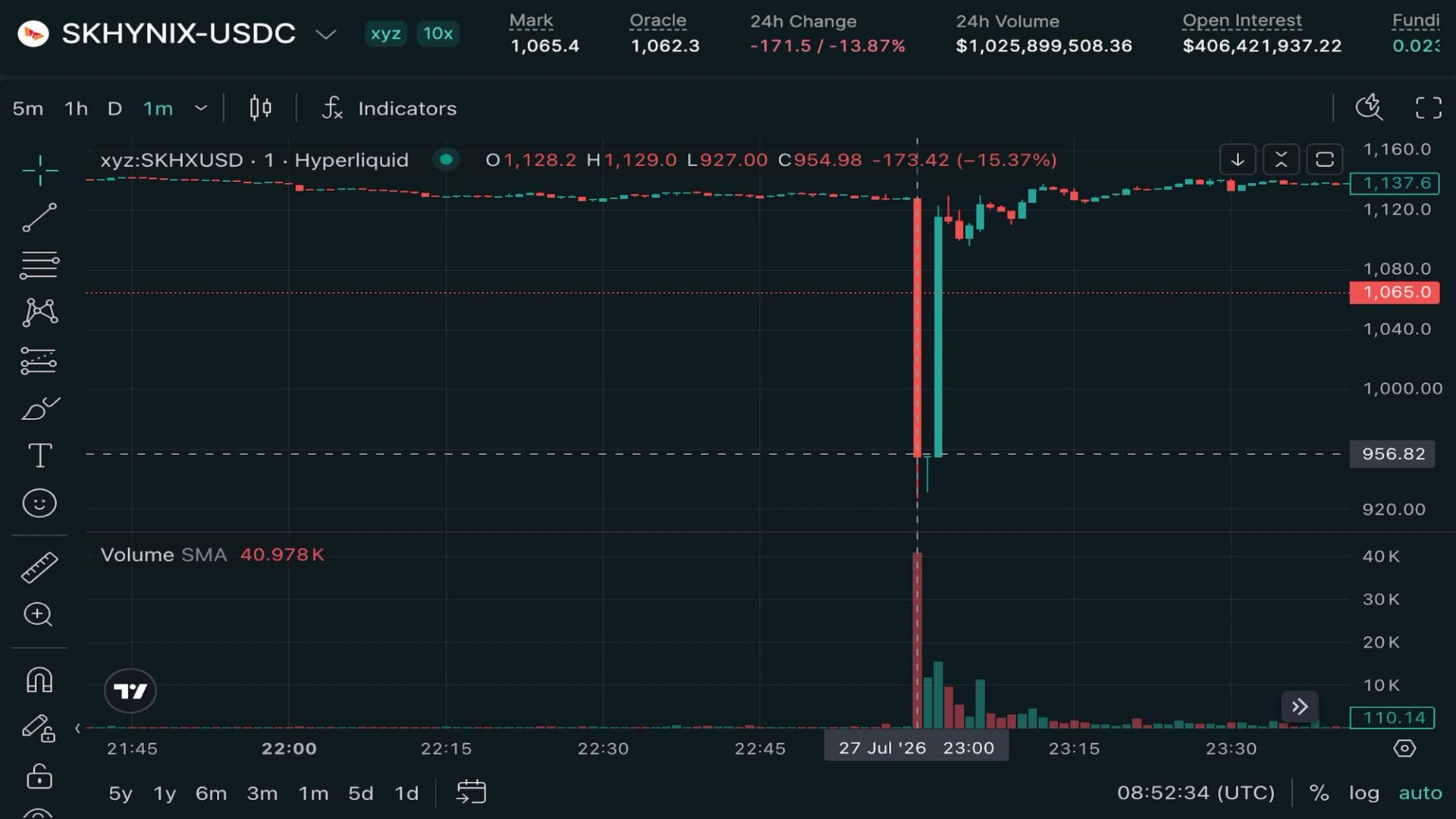
Perpetual futures tied to SK Hynix, a South Korean chipmaker whose American depositary receipts debuted on Nasdaq earlier this month, suffered a flash crash on Hyperliquid shortly before the underlying share price came under pressure in its home market.
Between 23:00 UTC and 23:01 UTC, the price of perpetuals tracking the Seoul-traded stock crashed 20% to $900, according to data from Hyperliquid. The price rebounded to over $1,000 the very next minute and was recently priced at $1,092. The contract is traded and denominated in dollar-pegged stablecoin USDC.
An hour later, the Korean stock market opened on a negative note, led by chipmakers. By the end of the day, SK Hynix shares had dropped by 15% to 1,550,000 won ($1,762). Other losers included Samsung Electronics and carmaker Hyundai Motor. The benchmark Kospi index fell 11%.
SK Hynix ADRs, 10 of which equal one share, fell 4.5% in pre-market trading to $136.51.
Hyperliquid, the leading perpetuals-focused decentralized exchange, has emerged as a hot favorite of traders looking to express their view on traditional assets, especially since the onset of the Iran war in late February. The exchange had not responded to a request for comment by publication time.


BitMEX is now facing legal action alleging it withheld trader collateral and engaged in insider trading. The new lawsuit accuses Hayes and fellow co-founders, Ben Delo and Samuel Reed, of designing a system to retain customers’ collateral and transfer the remaining bitcoin to the platform’s insurance fund.
“One lawsuit won’t move the market, but allegations involving 622 BTC (worth over $40.5 million) of withheld collateral reinforce the oldest doubt in crypto: your funds are safe until the day they aren’t,” said Samuel Videau, chief technology officer at Genius. “What’s ending is opacity,the model where you wire assets to a black box and take the operator’s word for it.”
The overall crypto derivatives market has barely flinched. The perpetual swap product BitMEX built now generates the bulk of trading activity on larger exchanges like Binance and OKX, alongside traditional platforms like the Chicago Mercantile Exchange (CME).
“The derivatives market is now much larger and more diversified,” said Edwin Cheung, executive director at crypto trading platform Gate. “Most displaced volume is likely to be absorbed by other established platforms.”
The shift suggests exchanges now need scale, regulatory compliance and broader services to survive, rather than relying on retail trading alone.
Although most of the cryptocurrency market has turned red today, some altcoins are taking the storm worse than others. This is typically true for Pi Network’s native token, and today is no exception.
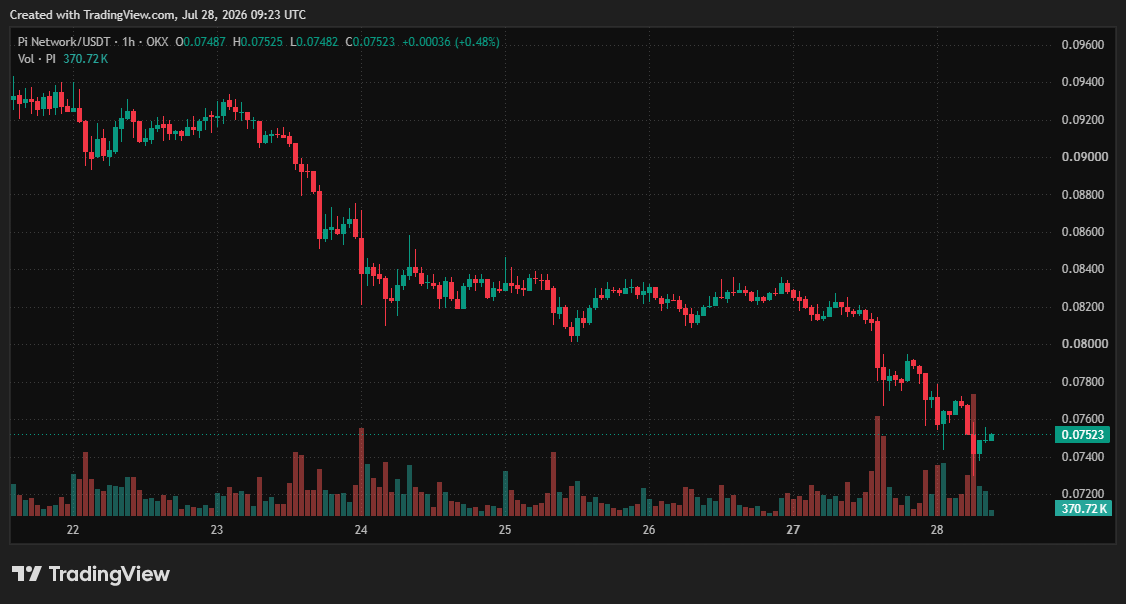
The asset has plummeted by 9% in the past 24 hours and has come painfully close to breaking below $0.07, which would mean a fresh all-time low.
PI Crashes Again
Looking at PI’s price performance, you can easily quote one of the most recognizable songs of all time, which was immortalized from the TV show Friends. It just hasn’t been PI’s day, week, month, or even a year. Aside from a few impressive but very brief pumps, such as the one in March that sent the asset to $0.30 within days, the bears have been in total control, pushing it to a new low after a new low.
The last example came precisely two weeks ago. At the time, PI had broken below the crucial $0.10 support and went into price discovery territory (but on the wrong side). It kept plunging until it finally found some support at $0.07, but only after it had charted a new all-time low.
Although the bulls reemerged at this point and helped it recover some ground to $0.10 in the following 10 days or so, the overall bearish sentiment remained high, and the inevitable transpired. PI was rejected once again, plummeted to $0.08, and after a few days trading above that line, it broke below it in the past 24 hours.
Hours ago, the asset tanked below $0.074, coming about 5% away from its ATL. Although it has rebounded slightly to over $0.075 now, it remains deep in the red daily (-9%) and weekly (-19%).
Washed Out Sentiment
Even before PI’s nosedive to $0.074, popular analyst Ben (co-founder of BSCNew) commented that the sentiment around the asset remains “as washed out as I have seen it.” And all of that comes despite the continuous updates, redesigned apps, and protocol upgrades delivered by the Core Team.
As such, Ben commented that his position is still unchanged as he cares about “shipping cadence more than the weekly candle.” And, he concluded that “the cadence is accelerating.”
Other accounts dedicated to covering Pi Network news, such as Pi Town, are also supportive of what the team is doing, and seemingly remain unfazed by the overall price calamity of the native token.
The post Pi Network Price Nears Record Low: What ‘Washed Out’ Sentiment Means for PI Holders appeared first on CryptoPotato.
The Hyperliquid Policy Center and Multicoin Capital submitted a joint comment to the US Commodity Futures Trading Commission (CFTC) on July 27th.
They expressed support for the agency’s proposed prediction market framework but also pressed for two changes that could affect how on-chain event contracts are designed and approved.
The filing is a direct response to the CFTC’s “Prediction Markets; Public Interest Determinations” proposal published earlier in June. It aims to amend Regulation 40.11 and seeks to establish a 90-day process for reviewing event contracts that may involve gaming, war, terrorism, assassination, or other activities listed in the Commodity Exchange Act, among other things.
HPC and Multicoin called the plan a “clear and well-reasoned framework.” They argued that prediction markets belong under the CFTC’s exclusive federal jurisdiction.
The letter also states that regulating prediction markets on a state level, creating “fifty separate state regimes,” would fragment national derivatives markets.
Prediction markets topped $50 billion in trading volume last month, and the biggest names in traditional finance are moving in.
Today, with @multicoin, we filed a joint comment supporting the @CFTC ‘s proposed prediction markets framework.
These markets have grown up. The… https://t.co/pYG4mevmbT
— Hyperliquid Policy Center (@HyperliquidPC) July 27, 2026
Settlement: Key Regulatory Test
The first concern that the group outlines is related to the use of one word in the Commodity Exchange Act: “involve.” Under the statute’s rule, the CFTC can review contracts that involve certain listed activities and prohibit them when they are contrary to the public interest.
The letter supports an interpretation focused on settlement. Instead of treating trading itself as gaming, regulators would have to examine the event that determines the payout. A contract would fall within the special rule when settlement directly turns on illegal activity, not merely because buying it resembles placing a wager.
In addition, the group asked for more examples. Edge cases may include certain contracts with several potential paths to settlement or products that reference a sensitive activity only indirectly. Clear illustrations would help exchanges and developers assess regulatory exposure before having to commit resources to a launch.
Transparency Could Become a Competitive Requirement
The second recommendation concerns what happens after a review under Regulation 40.11. Under the current proposal, the CFTC would publish written findings when it blocks a contract and explain how that particular decision fits with earlier findings.
HPC and Multicoin argue that this could create an information gap: an approval, including by inaction, can reveal as much about the regulatory boundaries as a prohibition. Without any public reasoning, other platforms may repeat the same legal work, seek guidance, or avoid products that could have been permissible.
In any case, it’s interesting to follow developments surrounding the letter and whether the CFTC would adopt the two requested changes. This could be a signal that regulators are actively listening to industry experts and attempt to legislate in a way that’s both fair to anyone involved.
The post Hyperliquid and Multicoin Push CFTC Toward One Prediction Market Rulebook appeared first on CryptoPotato.


A federal judge blocked Minnesota’s prediction market ban on Monday, handing Kalshi, Polymarket US, and the Commodity Futures Trading Commission (CFTC) a preliminary injunction days before the law’s August 1 effective date.
US District Judge Katherine Menendez found the Commodity Exchange Act (CEA) likely preempts the statute. Her order bars enforcement against CFTC-registered designated contract markets (DCMs) until a final merits decision.
Why the Court Found Federal Law Likely Preempts Minnesota’s Statute
Menendez issued the order in 3 related cases against Minnesota, Attorney General Keith Ellison, Governor Tim Walz, and other state officials. Kalshi, Polymarket US, and the federal government each won their injunction motions.
Minnesota’s law, Minn. Stat. § 609.7615, makes operating or creating a prediction market a felony. It covers sports, elections, legal actions, pop culture, and statements by specific people. Advertising and providing data services also carry criminal penalties.
The CFTC filed its lawsuit in May, after Walz signed the legislation. Chairman Michael Selig argued the ban would criminalize weather contracts that Minnesota farmers use for hedging.
Menendez ruled that the CEA gives the CFTC exclusive jurisdiction over swaps traded on DCMs. She found many contracts on both platforms, including election and geopolitical markets, that likely qualify as swaps. Consequently, Minnesota likely cannot regulate them.
“Kalshi and Polymarket US are designated contract markets, so the CFTC has exclusive jurisdiction to regulate transactions involving those swaps,” the order read.
Follow us on X to get the latest news as it happens
Judge Signals Final Relief Could Be Narrower
However, Menendez stressed that not every event contract fits the swap definition. She pointed to Kalshi markets on Love Island USA winners and World Cup announcer mentions as likely failing the test.
Both sides briefed the case as all-or-nothing, she noted. That left the court little guidance for crafting a narrower remedy, so she froze the entire statute for now.
Irreparable harm weighed heavily in the decision. Kalshi reported over 90,000 verified Minnesota users as of May 26, with millions of dollars in open positions. Sovereign immunity would bar any recovery of damages if enforcement proceeded.
The court did not address the First Amendment claims raised by both exchanges. Those questions, along with the implied preemption issue, now await a full merits ruling.
Subscribe to our YouTube channel to watch leaders and journalists provide expert insights
The post Court Sides With Kalshi and Polymarket Over Minnesota’s August 1 Ban appeared first on BeInCrypto.

In Washington, momentum can vanish as quickly as it arrives. The Clarity Act now sits on the shelf, while the Bitcoin price slips under renewed pressure after a sharp selloff across Asian markets.
Senate Majority Leader John Thune has shifted attention toward federal nominations and a Russia sanctions bill, delaying debate on crypto legislation. The Digital Asset Market Clarity Act, designed to define SEC and CFTC oversight, now faces an increasingly narrow window before Congress begins its August recess.
— Crypto Banter (@crypto_banter) July 28, 2026
 SENATE SHELVES CLARITY ACT FOR NOW!
Majority Leader John Thune is prioritizing nominations and a Russia sanctions bill, pushing the crypto market structure legislation aside amid limited floor time, CoinDesk reports.
Clarity is unlikely to reach a vote before next week, the… pic.twitter.com/XKztbFL7cf
That delay arrives at a supposedly bullish moment. Risk appetite was at its top, and now, the delay leaves crypto exposed to fresh volatility.
Discover: The Best Token Presales
Clarity Act Delay Extends Regulatory Limbo
The Clarity Act is a reminder that politics don’t move in straight lines. Ethics concerns surrounding public officials’ digital asset holdings continue to complicate negotiations. Meanwhile, a proposed 2029 sunset clause remains another point of contention before lawmakers can reach consensus.
Outside Capitol Hill, opposition continues to build. New York Attorney General Letitia James argues the Clarity Act could weaken states’ ability to prosecute crypto fraud, potentially limiting local enforcement powers. Her criticism adds another obstacle as supporters race against the congressional calendar.
Not just in the States, regulatory pressure is also unfolding overseas. Thailand’s SEC has filed criminal complaints against Bitkub and two former executives over allegations they concealed a 2021 cyberattack worth about $50 million. Although customers were reimbursed, authorities allege the exchange submitted inaccurate reports, reviving concerns over transparency throughout the industry.
Elsewhere, prediction markets continue advancing despite federal uncertainty. A U.S. judge temporarily blocked Minnesota’s restrictions on platforms including Kalshi and Polymarket, citing potential conflicts with federal commodities law. As the CFTC seeks faster legal clarity, the Clarity Act remains trapped in Washington’s legislative queue.
Discover: The Best Crypto to Diversify Your Portfolio
Bitcoin Price Slides as Asian Markets Trigger Risk Aversion

The Bitcoin price weakened after Asian equity markets suffered a huge selloff, extending losses from the previous U.S. session. Bitcoin briefly fell below recent support before stabilizing. It’s not just crypto, but a wider retreat from risk assets as investors reduced exposure across multiple markets.
The butchering started with South Korea’s Kospi, which recorded one of its sharpest declines in months, led by heavy selling in major technology stocks. This could be the culprit, dragging the Bitcoin price lower alongside market sentiment.

Recent gains have also begun to lose momentum. Bitcoin price previously rebounded from July lows but struggled to reclaim higher resistance levels as buying pressure softened. Spot Bitcoin ETFs continued attracting inflows over recent weeks, although significant late-week withdrawals showed institutional demand remains sensitive to macroeconomic shifts.
Large holders have largely avoided aggressive accumulation during the latest decline. Strategy maintained its existing Bitcoin position without announcing any additional purchases, instead preserving billions in available cash. At the same time, miners may receive modest relief as network difficulty appears set for its first annual decline in nearly two decades.
Attention now shifts toward the Federal Reserve and Washington alike. Bitcoin price could remain trapped in a cautious range until investors receive clearer signals from policymakers and lawmakers. For now, delayed legislation and fragile market sentiment continue moving together, leaving the Clarity Act and crypto markets waiting for the next decisive chapter.
Trade Bitcoin and Major Cryptocurrencies on Bybit and Get a Chance to Win Our $1,000 USDT Airdrop
The post Crypto News, July 28: CLARITY Act Shelved, Bitcoin Drops in Asian Market Rout appeared first on Cryptonews.

The rather impressive Monday rally didn’t last long, as the entire cryptocurrency market has turned red today, with the market cap losing over $80 billion from top to bottom.
Ripple’s native token is no exception. The asset has dropped from yesterday’s peak at $1.11 to $1.05. Here are some of the possible reasons behind this decline and what could be next.
XRP Dives and ETF Inflows Can’t Save It
Perhaps the most obvious reason behind XRP’s crash is that it’s not an isolated case; the entire market has turned red, led by bitcoin’s dive from $65,600 to $63,000. As such, the cross-border token cannot be simply ruled out, as it tends to follow the overall market trend.
It appears investors are reducing their exposure to risk-on assets like crypto ahead of the next Federal Reserve FOMC meeting. The US central bank will announce its interest rate decision tomorrow evening. According to some reports, there’s an actual chance of a rate hike despite easing inflation in June.
The rejection at $1.11 and the subsequent decline to $1.05 meant that XRP has actually lost a crucial support zone at $1.08-$1.10, which managed to halt its free falls for most of July. Aside from this technical side of things, the asset’s drop triggered a large wave of liquidations, which also created the snowball effect of a more profound decline.
The silver lining is that the ETF net flows remained in the green. However, it was a very modest number of under $600,000, which is evidently not sufficient to help XRP avoid such price losses.
So What’s Next?
The daily leg down hasn’t changed popular analysts’ opinion on XRP’s claimed bright future. Xaif Crypto acknowledged the rising leverage and XRP’s rather tight trading range. The market observer commented that “two-sided liquidations are getting hit on both longs and shorts,” which, aligned with neutral funding and drying up spot liquidity on Binance, will likely lead to a much bigger move soon.
Meanwhile, CasiTrades outlined once again that she expects the next XRP wave to be “violent.” The analyst noted that XRP has returned to macro support, which, if broken to the downside, will likely lead to a more painful decline to $0.87, her targeted bottom.
ripple:native’s Next Wave Could Be Violent!
Do you see how nicely we’re following the purple scenario?

During Friday’s livestream, I highlighted the importance of the $1.09 level we were testing at the time. I explained that it would likely provide a small reaction… pic.twitter.com/9pjn0EbOZS
— CasiTrades
(@CasiTrades) July 27, 2026

The post Why Is Ripple’s XRP Down by 4.5% Today (July 28)? appeared first on CryptoPotato.
All eyes are on July 30, when Amazon reports Q2 2026 earnings, with Wall Street increasingly convinced the bar has been set too low. Consensus sees EPS near $1.82-$2.26 on roughly $197 billion in revenue, but the real story is AWS: after posting its fastest growth in 15 quarters at 28% in Q1, several major banks—including Bank of America—now expect acceleration toward 32-33%, fueled by surging AI demand and Bedrock workloads tied to Anthropic and OpenAI.
That optimism comes with a catch. Amazon’s $200 billion AI capex plan has already squeezed free cash flow to just $1.2 billion, and investors will be watching closely for any further guidance hike, following similar moves from Alphabet. Options markets are pricing a 6.3% swing on earnings day, above the stock’s typical 5.4% post-earnings move, signaling traders expect this report to matter more than usual.
With shares up roughly 18% year-to-date and trading at a below-average forward multiple, the setup favors strength—but only if AWS growth and margin guidance clear an already demanding bar.
Technical Analysis of Amazon
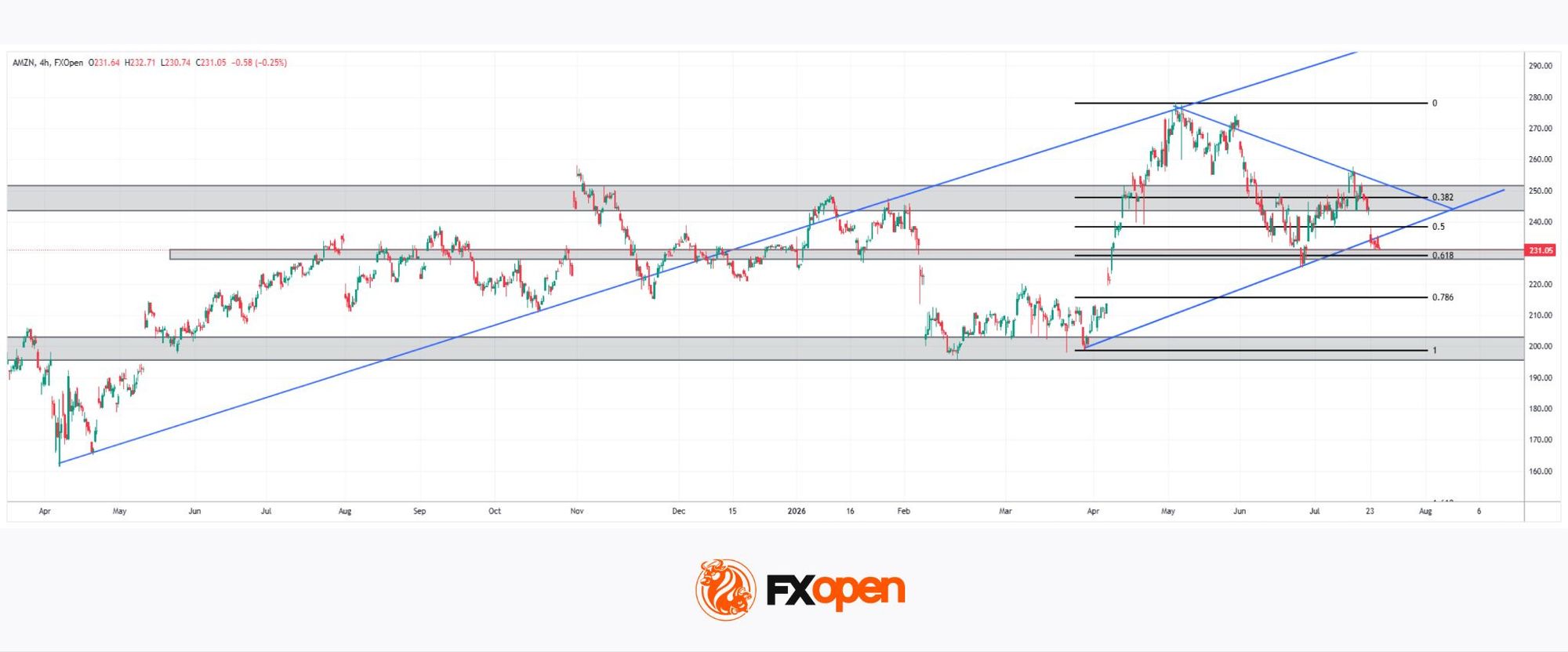
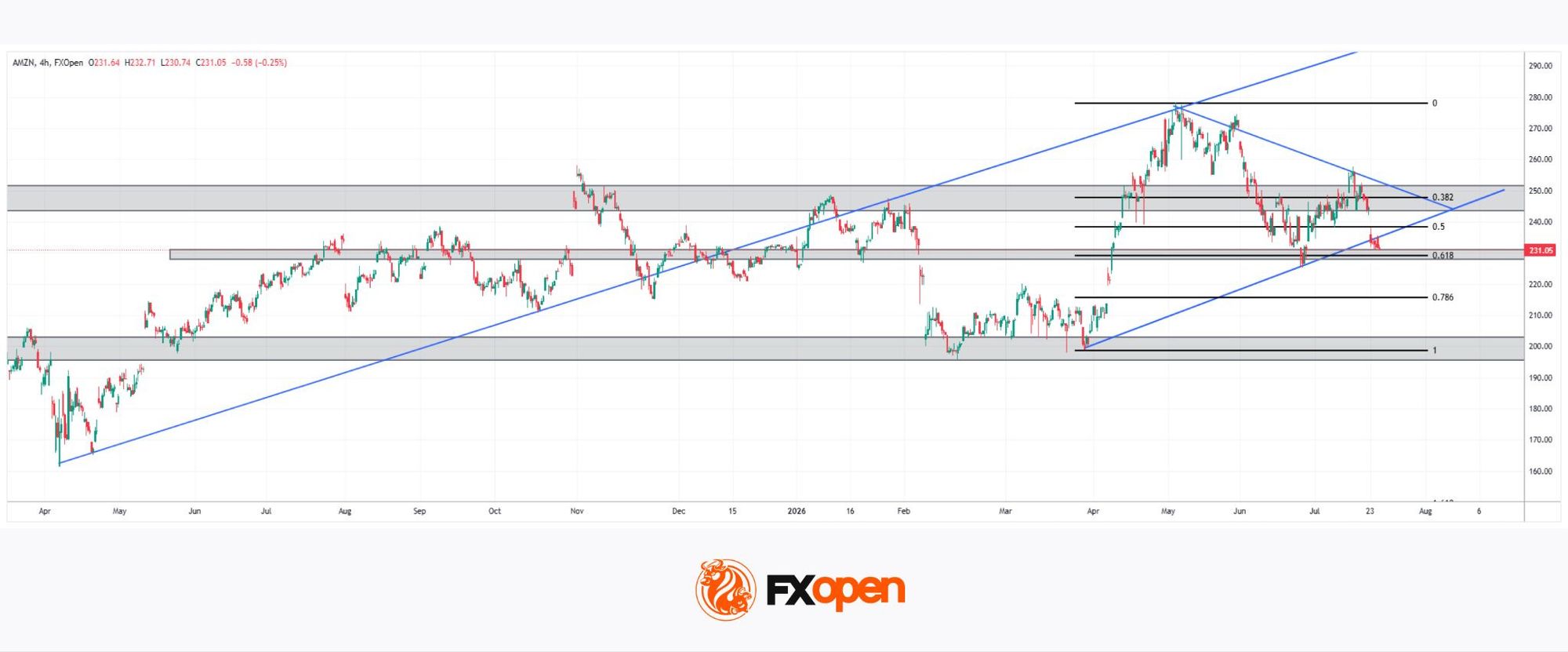
As the chart shows, Amazon stock has pulled back from April’s highs near $280 within a broader ascending channel, with price now testing the confluence of the rising trendline and the 0.618 Fibonacci retracement near $225-$230—precisely where Thursday’s earnings could prove decisive.
Bullish Scenario
Should Amazon deliver on the AWS acceleration Wall Street is now pricing in, a strong earnings beat could fuel a bounce off this trendline-Fibonacci confluence. A confirmed reclaim of the 0.5 retracement near $240, followed by a push back above the 0.382 level around $248, would put the broader uptrend firmly back in play, opening the door toward a retest of the channel’s upper boundary and the April highs.
Bearish Scenario
Conversely, a disappointing report—particularly around capex guidance or AWS margins—could send price breaking below both the ascending trendline and the 0.618 retracement. That would expose the deeper 0.786 level near $215, with a more severe reaction potentially dragging price back toward the $200 psychological support that has held since April.
With earnings landing squarely on this technical crossroads, AMZN stock’s next move could be one of the most consequential of the summer—will AWS’s AI story be enough to reignite the rally, or does the chart already know something the numbers don’t?
Buy and sell stocks of the world’s biggest publicly-listed companies with CFDs on FXOpen’s trading platform. Open your FXOpen account now or learn more about trading share CFDs with FXOpen.
This article represents the opinion of the Companies operating under the FXOpen brand only. It is not to be construed as an offer, solicitation, or recommendation with respect to products and services provided by the Companies operating under the FXOpen brand, nor is it to be considered financial advice.


Lido, a liquid staking protocol that lets users earn Ethereum staking rewards through its stETH token, has launched an upgrade to its staking infrastructure that aims to improve validator efficiency and decentralization.
The upgrade introduces Curated Module v2, which adds support for Ethereum’s 0x02 withdrawal credentials. The change allows validators to increase their effective balance from 32 ETH to up to 2,048 ETH, according to a Lido update on Monday.
Lido said the migration could reduce Ethereum’s validator count from about 880,000 to roughly 628,000, a decrease of about one-third. The migration has not started yet, and the figures are based on Lido’s projections.
The change is expected to affect Ethereum’s consensus layer by reducing the number of validators and validator messages required to maintain the network, according to Lido. It is not designed to change execution-layer activity, which determines transaction fees and gas costs.
The update also introduces new accountability measures for Lido’s node operators, including bonding and penalty mechanisms. Lido said future stake distribution could place more weight on factors such as operator performance, fees and contributions to Ethereum’s ecosystem.
“Curated Module v2 is the next major step in that evolution,” Lido said, adding that the upgrade introduces new operator incentives, bond-based security mechanisms and governance improvements. Lido said no action is required from stakers because the upgrade will be handled at the protocol level.
Related: Ethereum nears market bottom against Bitcoin, though key signals remain unconfirmed: CryptoQuant

Grubby Ready Meals Are Ultimate Heatwave Solution To No-Cook, Healthy Dinners

The way you look can help you get a job – here's how

IMF warns Brazil’s stablecoin activity outpaces traditional capital flows

Renter of Home in Anne Heche Crash Denies Settlement With Son

No Jackpot Winner as $257 Million Prize Rolls Over to $269 Million Monday Draw

Weekend Open Thread: Staud – Corporette.com

NEW SOLO MONEY GLITCH IN GTA 5 ONLINE! SIMPLE METHOD FOR MAKING MILLIONS RIGHT NOW! PS4/PS5/XBOX

Huge financial angle on this viral quarter!! #pcgspartner #quarter #quarters #coin @PCGScoin

Money football teams actually earn at the FIFA World Cup 2026. #worldcup #fifa #money #earring
-

 Fashion4 days ago
Weekend Open Thread: Brooks Brothers
-

 NewsBeat7 days ago
How a former Blue Peter presenter stunned America’s Got Talent judges
-

 Tech1 day ago
Intel is reversing course and bringing hyper-threading back to its server chips
-
 Business6 days ago
New Jersey voter registration controversy explained: How 6,600 noncitizens got on the rolls, and what happens next
-
 Entertainment7 days ago
Johnny Depp’s R-Rated Gothic Cult Classic Gets New Release Ahead of Sydney Sweeney Remake
-

 Crypto World5 days ago
Ethics, other provisions in crypto Clarity Act to be further discussed
-

 Politics23 hours ago
Luke Littler dismantles Gerwyn Price to retain title in Blackpool
-
 Sports2 days ago
Commonwealth Games boxing: Jadumani Singh seals dominant 5-0 win over Pakistan’s Sumama Rehman to enter quarter-finals | Commonwealth Games News
-

 Sports4 days ago
2026 3M Open leaderboard: Scottie Scheffler finds putter in Round 1, sits three back
-

 Fashion4 days ago
16 Dresses for the High Summer Event
-

 News Videos5 days ago
The Peugeot Family: How 200 Years of an “Old Money” Dynasty Died in A Boardroom
-

 Politics2 days ago
Spain sweeps the board at 2026 World Cup with individual awards
-

 News Videos2 days ago
BITCOIN JUST ENTERED THIS CRITICAL ZONE…
-
 Entertainment4 days ago
A New Post-Apocalyptic Gundam Anime Series Blasts Into SDCC
-

 Crypto World2 days ago
XRP Ledger adds $2.6B as RWA inflows rank second
-

 Politics1 hour ago
The Part of the Electric Transition Nobody Wants to Discuss
-

 Tech3 days ago
Anthropic launches Claude Opus 5, a cheaper AI model for coding, agents and enterprise workflows
-

 Crypto World5 days ago
Uniswap (UNI) pushes deeper into tokenized RWAs with permissioned trading pools
-

 Crypto World3 days ago
Ripple bought a bank in pieces. The $4 billion audit
-

 Entertainment2 days ago
Sara Gilson Killed By Husband After Viral “Pedophile” TikTok Video
You must be logged in to post a comment Login