
Crypto World
How AI trading bots and multi-agent systems are changing crypto and stock trading


Disclosure: This content is provided by a third party. Neither crypto.news nor the author of this article endorses any product mentioned on this page. Users should conduct their own research before taking any action related to the company.
Summary
- AI trading platforms combine market analysis, strategy evaluation, risk monitoring, and automated trading workflows.
- Multi-agent systems assign specialized AI agents to research, risk management, strategy optimization, and execution.
- AI-powered platforms analyze broader datasets and adapt more easily than traditional rule-based trading bots.
- Crypto and stock traders can use AI tools to reduce monitoring time and organize market information.
- AI cannot guarantee profits, making transparency, security, user control, and risk management essential.
Introduction: Why AI trading is becoming a major market trend in 2026
The way traders analyze markets is changing.
In 2026, artificial intelligence is moving from experimental technology into practical trading workflows used by investors, fintech companies, and market participants around the world.
For decades, trading decisions have relied heavily on human research, technical indicators, financial reports, and predefined strategies.
These methods remain important. However, modern markets have become significantly more complex.
Today’s traders need to process information from multiple sources, including:
- Price movements
- Market sentiment
- Economic data
- Corporate earnings
- Global events
- Cryptocurrency market activity
The challenge is no longer simply finding information.
The challenge is understanding large amounts of information quickly and turning that data into meaningful trading decisions.
This is where AI trading platforms are gaining attention.
By combining machine learning, real-time data analysis, AI agents, and automated workflows, modern AI trading solutions are helping traders improve market research and streamline trading processes.
The biggest shift brought by AI trading technology is not automation alone.
It is the transition from systems that only execute predefined rules to platforms that can continuously analyze information, evaluate market conditions, and support more adaptive decision-making.
Recommended AI trading platform in 2026: MillionPool

As interest in AI-powered trading continues to grow, traders are looking for platforms that can combine intelligent analysis with practical automation.
MillionPoolis an AI-powered trading platform designed to help users analyze market opportunities, optimize trading strategies, and simplify automated trading workflows.
Unlike traditional trading bots that rely entirely on fixed instructions, modern AI trading platforms are exploring more flexible approaches using:
- AI-driven market analysis
- Intelligent strategy assistance
- Automated workflows
- Data-based decision support
MillionPool represents this new direction of AI trading technology by focusing on helping users reduce the complexity of market monitoring and improve the efficiency of their trading process.
For traders evaluating AI trading platforms in 2026, important factors include:
- Transparency
- Risk management
- Automation capabilities
- User control
- Platform reliability
The goal of AI trading technology is not to remove uncertainty from financial markets.
Instead, it is to provide traders with better tools for understanding markets and managing their decision-making process.
What makes AI trading platforms different?
An AI trading platform uses artificial intelligence to assist with different stages of the trading process, including:
- Market research
- Pattern recognition
- Strategy evaluation
- Risk analysis
- Trading automation
Traditional trading software often follows predefined rules.
For example:
A trading bot may buy an asset when a technical indicator reaches a specific level.
While rule-based systems can be effective, they may struggle when market conditions change.

AI-powered trading platforms introduce a different approach.
Instead of relying only on fixed instructions, AI systems can analyze broader information, identify patterns, and provide additional decision support.
Modern AI trading platforms may evaluate:
- Historical price data
- Trading volume
- Market sentiment
- Economic conditions
- News information
- Asset behavior patterns
This allows traders to approach market analysis with more information and greater flexibility.
AI trading platform vs traditional trading bot
The difference between traditional trading bots and AI-powered platforms is mainly adaptability.
Feature
Traditional Trading Bot
AI Trading Platform
Strategy
Fixed rules
Adaptive analysis
Data processing
Limited inputs
Multiple data sources
Market response
Rule-based reaction
AI-assisted evaluation
Strategy improvement
Manual updates
Data-driven optimization
Decision support
Automated execution
Analysis + automation
Traditional bots are still useful for specific strategies.
However, AI trading platforms are designed to provide broader analytical capabilities.
The purpose is not to replace traders.
Instead, AI tools help traders spend less time collecting information and more time evaluating strategies.
How multi-agent AI systems work in trading
One of the most interesting developments in AI trading is the use of Multi-Agent AI Systems.
A multi-agent system allows multiple AI agents to work together, with each agent focusing on a specific responsibility.
Instead of one AI model handling every task, different AI agents can analyze different parts of the trading process.
This creates a workflow similar to that of a professional investment team.
Market analysis agent
The market analysis agent focuses on understanding market conditions.
It may analyze:
- Price trends
- Technical indicators
- Trading patterns
- Market movements
Its role is to identify relevant information that may influence trading decisions.
Risk management agent
The risk management agent evaluates potential risks.
It may monitor:
- Market volatility
- Portfolio exposure
- Position sizes
- Changing market conditions
A strong AI trading system should not only search for opportunities but also help users understand potential risks.
Strategy optimization agent
The strategy agent focuses on evaluating different trading approaches.
It can help analyze:
- Historical performance
- Strategy effectiveness
- Market conditions
- Potential improvements
Execution agent
The execution agent supports the operational side of trading.
This may include:
- Order management
- Trading automation
- Execution timing
- Workflow optimization
By combining these different functions, multi-agent AI systems create a more complete approach to automated trading.
AI crypto trading bots: How AI is changing digital asset trading
Cryptocurrency markets operate 24 hours a day, seven days a week.
This creates unique challenges for traders because market conditions can change quickly at any time.
AI crypto trading bots can assist users by analyzing:
- Bitcoin (BTC)
- Ethereum (ETH)
- Digital asset markets
- Trading volume
- Market sentiment
- Historical patterns
For example, a crypto trader monitoring Bitcoin volatility may use an AI trading platform to review price movements, market sentiment, and historical patterns before adjusting a strategy.
AI tools can help reduce manual monitoring requirements and provide faster access to market information.
However, AI crypto trading bots should not be viewed as automatic profit systems.
They are designed to support:
- Market analysis
- Trading automation
- Strategy evaluation
- Decision assistance
Market risk remains an important factor in any trading activity.
AI stock trading platforms: Supporting modern investors
AI is also becoming increasingly relevant in traditional stock markets.
AI stock trading platforms can help investors with:
- Company research
- Market trend analysis
- Portfolio monitoring
- Risk evaluation
For markets such as NASDAQ and the New York Stock Exchange (NYSE), AI tools are being explored as a way to improve research efficiency.
A trader researching a company may use AI tools to summarize financial information, analyze historical trends, and organize market data.
The value of AI is not replacing human judgment.
Instead, AI provides additional analytical support that helps investors make more informed decisions.
How to choose an AI trading platform in 2026
With more AI trading solutions entering the market, traders should evaluate platforms carefully.
A strong AI trading platform should provide more than automation.
1. Transparency
Users should understand:
- How AI strategies are created
- What information does the system analyze
- How decisions are generated
Transparent platforms help users make better-informed choices.
2. Risk management features
Risk control is one of the most important parts of trading.
Useful features may include:
- Position management
- Risk limits
- Portfolio monitoring
- Strategy evaluation
3. Automation and user control
Automation should simplify trading, not remove user control.
Important features include:
- Market monitoring
- Strategy assistance
- Automated workflows
- Custom settings
4. Security and reliability
Before using any AI trading platform, users should consider:
- Platform reputation
- Data protection
- Account security
- Operational reliability
What traders should know before using AI trading bots
AI trading technology provides powerful analytical tools, but traders should understand its limitations.
AI does not guarantee trading results
Financial markets remain unpredictable.
Factors such as:
- Economic changes
- Regulatory decisions
- Unexpected events
- Market sentiment
can influence asset prices.
AI can improve analysis, but it cannot eliminate market uncertainty.
Strategy quality still matters
The effectiveness of an AI trading system depends on:
- Data quality
- Strategy design
- Market conditions
- Risk controls
Users should evaluate AI platforms based on technology, transparency, and risk management rather than promises of guaranteed performance.
The future of AI trading platforms
AI trading technology is expected to continue developing.
Several trends may shape the future:
More specialized AI agents
Future trading systems may include dedicated AI agents focused on:
- Market research
- Risk analysis
- Strategy development
- Portfolio optimization
More intelligent automation
AI assistants may increasingly help traders:
- Summarize market conditions
- Monitor portfolios
- Identify important signals
- Support research
Stronger risk management
Future AI platforms will likely focus more on:
- Real-time monitoring
- Adaptive strategies
- Automated controls
The next stage of AI trading will likely focus on collaboration between human decision-making and intelligent technology.
Conclusion: AI trading is moving toward a more intelligent future
AI trading platforms are changing how investors analyze markets, evaluate strategies, and manage trading workflows.
From AI crypto trading bots to AI stock trading platforms, artificial intelligence is creating new opportunities for traders who want more efficient ways to process information.
Multi-Agent AI Systems represent an important development in this transformation.
By combining specialized AI agents for market analysis, risk management, strategy optimization, and execution, next-generation trading platforms are moving beyond simple automation.
For traders exploring AI-powered solutions in 2026, the most important considerations are not only technology and automation but also transparency, security, and responsible risk management.
AI will not replace every trading decision.
Instead, the future may be a closer partnership between human traders and intelligent AI systems.
Frequently asked questions (FAQ)
1. How do AI trading platforms use multi-agent AI systems?
AI trading platforms use multiple AI agents to handle different tasks, including market analysis, risk evaluation, strategy optimization, and trade execution. These agents work together to provide broader insights and support more efficient trading workflows.
2. Are AI crypto trading bots safe to use?
AI crypto trading bots can help traders analyze markets and automate certain processes. However, they cannot remove market risks or guarantee profits. Users should evaluate platform transparency, security, risk controls, and strategy performance before choosing a solution.
3. What should traders look for when choosing an AI trading platform in 2026?
Traders should evaluate AI capabilities, automation features, security, risk management tools, supported markets, and whether the platform allows users to maintain control over trading decisions.
Disclosure: This content is provided by a third party. Neither crypto.news nor the author of this article endorses any product mentioned on this page. Users should conduct their own research before taking any action related to the company.



A two-month-old Layer 2 built by a stock brokerage is now processing more daily decentralized exchange volume than chains that have existed for years, and the market is only beginning to pay attention.
Summary
- Robinhood Chain recorded roughly $945 million in daily decentralized exchange volume on Aug. 25, 2026, a new all-time high for the network and nearly double its previous record of $563 million set on July 8.
- The chain, which launched its public mainnet on July 1, has processed more than $47 billion in cumulative DEX volume in under two months, placing it fifth among all chains by 30-day volume at $15 billion.
- Uniswap serves as the dominant trading venue on the chain, and cumulative tokenized stock volume through Uniswap surpassed $1 billion by Aug. 21.
- Total value locked on Robinhood Chain surged from $4 million in June to roughly $1.4 billion by late August, a trajectory that no Ethereum Layer 2 has matched at this stage of its lifecycle.
- The 90-day gas subsidy that covers transaction fees through the end of September 2026 raises a central question: whether volume holds once users start paying for their own trades.
Robinhood Chain processed roughly $945 million in decentralized exchange volume on Aug. 25, 2026. On the same day, the network handled 5.5 million transactions, tokenized stock volume hit a record $85 million, and a leveraged perpetual token product called pTokens went live on Arcus, the dYdX-built DEX backed by Robinhood Crypto. By any standard metric for a new blockchain, the day was historic.
Crypto Twitter, for its part, was busy arguing about memecoins and parsing Federal Reserve minutes. The chain that a publicly traded brokerage had quietly built into one of the most active networks in all of decentralized finance received roughly the same attention as a midcap altcoin listing on a second-tier exchange.
That disconnect between activity and attention says something about how the market prices narratives over infrastructure. Robinhood Chain is not a new token to trade. It does not have a native coin to speculate on. It is not the product of a pseudonymous team or a viral whitepaper. It is a piece of financial plumbing, built by a company that most of crypto still views with suspicion from the GameStop saga, and it is processing more daily volume than networks that raised hundreds of millions of dollars in venture capital.
The question is no longer whether Robinhood Chain can generate activity. It already has. The question is whether the activity is real, whether it lasts, and whether it changes anything about how traditional finance and decentralized finance relate to each other.
How Robinhood built a top-five chain in 56 days
Robinhood Chain is an Ethereum Layer 2 built on Arbitrum Orbit, the chains-as-a-service framework that runs on the Nitro stack. It settles directly to Ethereum and uses Ethereum blobs for data availability. Block times run at 100 milliseconds, faster than Arbitrum One at 250 milliseconds and Monad at 300 milliseconds. The gas token is ETH.
The mainnet went live on July 1 at Robinhood’s “The World is Flat” keynote at the Old Royal Naval College in London. Within eight days, Uniswap swap volume on the chain had reached $500 million. By July 11, the chain was processing 7.6 million daily transactions and had recorded $3.1 billion in DEX volume in its first week alone.
By the end of July, Robinhood Chain had topped Ethereum in 24-hour application revenue. It had briefly surpassed Base in daily active users, logging 324,000 wallets against Base’s 275,000 on July 21. And it had placed itself in the top five chains globally by 30-day DEX volume, sitting behind Solana, BNB Chain, Ethereum, and Base with roughly $15 billion in monthly throughput.
For context, Arbitrum One’s 30-day DEX volume during the same period was roughly one-quarter of that figure. Robinhood Chain, using the same underlying technology, was running four times the volume of the chain it forked from.
The volume breakdown: what is actually trading
The Aug. 25 record was not driven by a single asset class. Three distinct categories of activity converged on the same day.
The first was memecoin speculation. Pons, a token launched through the chain’s launchpad ecosystem, accounted for roughly half of all DEX volume at its peak. CASHCAT, Robinhood Chain’s first breakout memecoin, had previously hit a $156 million market cap before Pons overtook it in late July. On Aug. 30, Pons alone contributed $445 million of the chain’s $874.8 million in volume that day, demonstrating the degree to which a single venue can dominate chain-level metrics.
The second was tokenized equities. Robinhood launched Stock Tokens as a flagship product at mainnet, offering ERC-20 representations of stocks like NVIDIA, Apple, GameStop, and SpaceX that trade around the clock in more than 120 countries. These tokens give holders economic exposure to the underlying stock rather than legal ownership of shares. By Aug. 21, cumulative tokenized stock volume through Uniswap had surpassed $1 billion. A tokenized Nasdaq-100 tracker called QQQB drove 288 percent of July’s tokenized equity volume, suggesting heavy concentration in index products.
The third was leveraged derivatives. Arcus launched pTokens on Aug. 25, wrapping leveraged perpetual accounts into transferable ERC-20 tokens including pBTC3x and pHOOD3x. The platform also began accepting tokenized stock collateral at a 50 percent loan-to-value ratio, creating a direct bridge between equity exposure and leveraged crypto trading that has no equivalent on any other chain.
The timing of the Aug. 25 spike also mattered. Bitcoin had rallied sharply since Aug. 17 on what Bloomberg called a record $2.7 billion wave of short liquidations, the largest since records began in 2021. A White House crypto meeting and a U.S. Treasury move to double long-dated bond buybacks added fuel. Bitcoin reached near $81,500 and Ether gained nearly 29 percent in a single week. That macro tailwind lifted activity across every chain, but Robinhood Chain captured a disproportionate share because its zero-fee environment made it the path of least resistance for traders looking to rotate quickly between assets.
The stablecoin layer underneath the trading activity tells its own story. Stablecoin market capitalization on Robinhood Chain reached $640 million by late August, with USDe from Ethena accounting for the bulk of inflows. Robinhood Earn, a decentralized lending product launched alongside the mainnet, offers an estimated 7 percent yield on USDG, the stablecoin developed in partnership with Paxos. The yield product serves as an anchor for capital that might otherwise leave the chain between trading sessions, giving the ecosystem a retention mechanism that pure trading chains typically lack.
The infrastructure advantage Robinhood brought to the table
Most Layer 2 networks launch with a technical thesis and then spend months or years trying to attract users. Robinhood reversed the sequence. The company brought 27 million funded brokerage accounts, an existing mobile wallet, a compliance infrastructure built over a decade of regulatory engagement, and a brand that, whatever crypto natives think of it, is synonymous with retail trading for an entire generation of investors.
CEO Vlad Tenev framed the ambition in a recent interview: “Crypto is becoming the infrastructure that powers financial markets.” On Aug. 7, he described Robinhood Chain as the fastest-growing chain in history, noting that it reached 100 million cumulative transactions faster than any other network. Bitmine Chairman Tom Lee separately called the launch “one of the biggest crypto success stories” of 2026.
The revenue model also differs from most Layer 2 networks. Under the Arbitrum Expansion Program, 8 percent of chain revenue goes to a treasury controlled by governance token holders and 2 percent funds a developer guild. Robinhood keeps the rest. In July alone, the chain generated roughly $3.6 million in transaction fees, making it the top revenue-producing Layer 2 across the entire Ethereum ecosystem at 38 percent of the estimated $6.3 million in total L2 fees collected that month.
The company’s Q2 2026 earnings, reported on July 29, showed total revenue of $1.31 billion, beating Wall Street estimates. Net income rose 48 percent year over year to $573 million. Robinhood is not a startup hoping its chain will subsidize losses. It is a profitable company with a stock trading above $100 that can afford to invest in chain infrastructure without needing the chain itself to be immediately profitable.
The gas subsidy question
The single most important variable in Robinhood Chain’s near-term trajectory is the 90-day gas fee subsidy that covers all transaction costs through the Robinhood Wallet. The promotional period, which began at mainnet launch on July 1, runs through approximately Sept. 29, 2026.
In mid-August, Robinhood reduced the subsidy threshold from $5 per transaction to $0.50, a 90 percent cut that suggests the company is already tapering the benefit rather than cutting it off all at once. The move signals a gradual transition rather than a cliff.
But the subsidy has clearly inflated activity metrics. When transactions cost nothing, the friction that normally separates casual browsing from actual trading disappears. The 16,000 new tokens created daily at peak memecoin activity in July were possible in part because launching a token was free. The 5.5 million daily transactions on Aug. 25 included activity that would not have occurred at even minimal gas costs.
The precedent from other chains is mixed. Base launched with heavily subsidized gas and retained strong activity after costs normalized, in part because Coinbase’s distribution kept funneling users to the network. Blast, by contrast, saw activity crater after its incentive programs wound down. The question for Robinhood Chain is whether the brokerage’s 27 million accounts provide a durable demand floor that subsidies merely accelerated, or whether the subsidy itself created demand that will not survive its removal.
There is a middle scenario that the binary framing obscures. Volume could fall significantly from the Aug. 25 peak and still leave Robinhood Chain as a top-ten chain by DEX activity. A 60 percent drop from $945 million would still produce roughly $380 million in daily volume, which would place it ahead of most Layer 2 networks even without subsidies. The relevant question is not whether volume declines after the subsidy ends, because it almost certainly will, but whether the floor is high enough to sustain the ecosystem’s economic model.
The corporate chain land grab
Robinhood Chain did not launch into a vacuum. It entered a market where every major financial technology company appears to be building its own chain. Coinbase has Base. Stripe acquired Bridge and is building payment infrastructure on it. Circle launched a new standard for stablecoin interoperability. Robinhood followed with its own Arbitrum-based rollup.
The pattern is clear: consumer fintech companies have concluded that owning the execution layer is more valuable than renting space on someone else’s chain. The economics are straightforward. A chain operator captures sequencer revenue, controls the fee schedule, and can subsidize specific types of activity to drive adoption. A tenant on another chain pays whatever fees the market demands and has no control over the user experience at the infrastructure level.
The comparison to Base is instructive. Base launched in August 2023 and has had three years to build its ecosystem. Its total value locked stands at roughly $5.47 billion as of late August 2026, compared to Robinhood Chain’s roughly $1.4 billion. Base processes more daily transactions on average. But Robinhood Chain closed the gap on several metrics in weeks rather than years, briefly surpassing Base in daily active users and consistently ranking within striking distance on DEX volume.
The difference is maturity versus momentum. Base has accumulated three years of liquidity, developer tooling, and protocol deployments. Robinhood Chain has a brokerage with 27 million accounts and a product, tokenized equities, that no other chain offers at the same scale.
The DEX-to-CEX ratio and what it means
Robinhood Chain’s volume spike arrived during a broader structural shift in crypto trading. In July 2026, decentralized exchanges handled spot volume equal to 24.14 percent of centralized exchange volume, the highest ratio since The Block began tracking the metric in 2019. The ratio has roughly tripled in under three years, rising from below 10 percent for most of 2024 to its current level.
The irony is that the shift is being driven in part by centralized companies. Robinhood, a centralized brokerage, is routing volume through a decentralized exchange layer. Coinbase, a centralized exchange, is doing the same through Base. The line between centralized and decentralized finance is blurring in ways that do not fit neatly into the narratives that either side prefers.
For Robinhood specifically, the chain creates a flywheel that its centralized app cannot replicate. Stock Tokens traded on Uniswap generate fees that flow back to the Robinhood Chain ecosystem. Users who start with tokenized equities discover memecoin trading, lending protocols, and leveraged products. The chain becomes a surface area for financial experimentation that a regulated brokerage app cannot legally offer through its primary interface.
This is the strategic logic that the market has largely missed. Robinhood Chain is not a marketing exercise. It is a mechanism for Robinhood to offer products and services that its regulated brokerage cannot provide directly, while still capturing economic value from the activity.
The concentration risk
The bull case for Robinhood Chain is compelling, but the data also reveals structural vulnerabilities that the headline volume numbers obscure.
On Aug. 30, a single protocol, Pons, generated 51 percent of the chain’s $874.8 million in daily volume. When one venue does half of all throughput, the chain’s activity metrics become a proxy for that venue’s performance rather than a measure of ecosystem health. If Pons loses momentum, the chain’s volume numbers could drop by half overnight without any change to the underlying infrastructure.
The tokenized equity market, while growing, remains concentrated as well. QQQB, a single Nasdaq-100 tracker, drove the majority of July’s tokenized stock volume. A dozen stocks clear at least $500,000 in daily volume, but the breadth of adoption is still narrow relative to the potential market.
Total value locked tells a similar story. Robinhood Chain’s TVL has surged to $1.4 billion, but this remains roughly one-quarter of Base’s $5.47 billion. The chain’s TVL-to-volume ratio is unusually high, meaning it generates more trading activity per dollar locked than most chains. That can be read as capital efficiency or as evidence that volume is being amplified by zero-cost transactions and speculative turnover rather than deep, sticky liquidity.
Stock Tokens also remain unavailable to U.S. residents, which excludes the majority of Robinhood’s 27 million funded accounts from the chain’s flagship product. The addressable market for tokenized equities is currently limited to users outside the United States, a significant constraint on growth.
The reflexive fee structure on Pons adds another layer of fragility. Eighty percent of the protocol’s fees fund automated token buybacks and burns. By Aug. 29, 29 percent of the original one billion token supply had been retired. That mechanism creates a self-reinforcing loop in rising markets: higher volume generates more fees, which fund more burns, which reduce supply, which pushes prices higher, which attracts more volume. In falling markets, the same loop works in reverse. Volume drops, burns slow, the supply compression narrative weakens, and traders move to the next opportunity. Chains built on reflexive tokenomics tend to experience sharp drawdowns when sentiment shifts.
What Robinhood Chain means for Ethereum
Robinhood Chain settles to Ethereum. Every transaction on the chain ultimately posts data to the Ethereum mainnet through blobs. This means that Robinhood Chain’s activity, all $47 billion of it, contributes to Ethereum’s security budget and reinforces the network’s role as a settlement layer.
For Ethereum, the emergence of corporate-backed Layer 2 networks is a double-edged development. On one side, chains like Robinhood and Base bring millions of users into the Ethereum ecosystem who would never interact with the mainnet directly. They generate blob fees, consume blockspace, and create economic gravity around ETH as a gas token.
On the other side, these chains capture most of the value at the execution layer. Robinhood keeps the bulk of sequencer revenue, sharing only 10 percent with the Arbitrum ecosystem. The users on Robinhood Chain may never know or care that Ethereum exists underneath. The settlement layer becomes invisible infrastructure, essential but unrewarded relative to the activity it supports.
This dynamic is already visible in the fee data. Robinhood Chain surpassed both Ethereum and Base in 24-hour application revenue on Aug. 31, recording $2.66 million. The chain built on Ethereum is generating more application-level revenue than Ethereum itself on certain days.
The tension between Layer 2 growth and Layer 1 value capture is not unique to Robinhood Chain, but the scale makes it unusually visible. Ethereum’s blob fee revenue from all Layer 2 networks remains a small fraction of what those networks generate in sequencer revenue. The argument that Layer 2 activity is inherently good for Ethereum depends on the assumption that demand for blob space will eventually drive meaningful fee revenue back to the mainnet. At current utilization levels, that assumption remains unproven. Robinhood Chain’s success makes the question more urgent without answering it.
The September test
The gas subsidy expires at the end of September. Between now and then, several developments will clarify whether Robinhood Chain’s trajectory is sustainable.
Arcus is expanding its leveraged product suite, adding new pToken pairs and increasing collateral types. If leveraged trading generates durable volume independent of the gas subsidy, it would suggest that the chain has found a product-market fit that goes beyond free transactions.
The DTCC is scheduled to launch tokenized securities infrastructure in October, which could either validate or undermine Robinhood’s first-mover advantage in tokenized equities. If institutional players enter the market with competing infrastructure, the value proposition of Stock Tokens may shift.
And Robinhood itself will face a decision about whether to extend, modify, or eliminate the gas subsidy. The company’s financial position gives it the flexibility to continue subsidizing transactions if it believes the long-term economics justify the cost. With $573 million in quarterly net income, a few million dollars in gas subsidies is a rounding error on the income statement.
What to watch
- Daily DEX volume after the gas subsidy expires on Sept. 29: a drop below $200 million would signal that free transactions, not organic demand, drove the majority of activity.
- Tokenized equity volume breadth: whether trading expands beyond QQQB and a handful of large-cap stocks to include a wider range of securities and index products.
- Protocol diversity: whether the chain develops multiple high-volume venues or remains dependent on one or two protocols for the majority of throughput.
- U.S. regulatory clarity on Stock Tokens: any indication that tokenized equities could become available to U.S. residents would dramatically expand the addressable market.
- TVL retention through Q4 2026: whether the $1.4 billion in locked value stays on the chain as incentives taper or migrates to competing networks.
What is Robinhood Chain?
Robinhood Chain is an Ethereum Layer 2 blockchain built on Arbitrum Orbit technology. It launched its public mainnet on July 1, 2026, and uses ETH as its native gas token. The chain settles directly to Ethereum and features 100-millisecond block times. Its flagship products include tokenized Stock Tokens, decentralized exchange trading through Uniswap, and lending through protocols like Morpho.
How much DEX volume does Robinhood Chain process?
On Aug. 25, 2026, Robinhood Chain recorded roughly $945 million in daily decentralized exchange volume, a new all-time high. The chain has processed more than $47 billion in cumulative DEX volume since launching on July 1. Its 30-day volume of approximately $15 billion places it fifth among all blockchain networks, behind Solana, BNB Chain, Ethereum, and Base.
What are Stock Tokens on Robinhood Chain?
Stock Tokens are ERC-20 tokens that track the price of publicly traded equities like NVIDIA, Apple, GameStop, and SpaceX. They give holders economic exposure to the underlying stock rather than legal ownership of shares. Stock Tokens trade around the clock in more than 120 countries through decentralized exchanges like Uniswap on Robinhood Chain. They are currently unavailable to U.S. residents.
Is there a Robinhood Chain token?
No. Robinhood has not issued a native governance or utility token for Robinhood Chain. The network uses ETH for gas fees. While several community-created tokens like CASHCAT and PONS trade on the chain, none of these are officially affiliated with Robinhood.
How does Robinhood Chain compare to Base?
Base, built by Coinbase, launched in August 2023 and has roughly $5.47 billion in total value locked compared to Robinhood Chain’s $1.4 billion. Base processes more daily transactions on average and has a more mature ecosystem of developer tools and protocols. However, Robinhood Chain closed the gap on several metrics within weeks, briefly surpassing Base in daily active users and ranking within striking distance on daily DEX volume.
What is the gas subsidy on Robinhood Chain?
Robinhood covers transaction fees for users trading through the Robinhood Wallet on Robinhood Chain. This 90-day promotional period began at mainnet launch on July 1 and runs through approximately Sept. 29, 2026. In mid-August, Robinhood reduced the subsidy threshold from $5 to $0.50 per transaction, signaling a gradual taper rather than an abrupt cutoff.
Who can use Robinhood Chain?
Robinhood Chain is a permissionless Ethereum Layer 2, meaning anyone with a compatible wallet can interact with it. However, the tokenized Stock Tokens product is available in more than 120 countries but is not available to U.S. residents. Other DeFi products on the chain, including decentralized exchange trading and lending, are accessible to users globally through wallets like Robinhood Wallet, MetaMask, and others.
How does Robinhood make money from the chain?
Robinhood captures sequencer revenue from transactions processed on the chain. Under the Arbitrum Expansion Program, 8 percent of chain revenue goes to a treasury controlled by Arbitrum governance token holders and 2 percent funds a developer guild. Robinhood retains the remaining 90 percent. In July 2026, the chain generated roughly $3.6 million in transaction fees, making it the top revenue-producing Layer 2 in the Ethereum ecosystem.
Disclaimer: This article is for informational purposes only and does not constitute financial advice. Always do your own research before making investment decisions. Information is accurate as of Aug. 31, 2026.
USDT0 launched on Stellar on Sept. 2, connecting the payments-focused blockchain with Tether-backed liquidity available across networks supported by the cross-chain stablecoin infrastructure.
Summary
- USDT0 launched on Stellar using LayerZero’s interoperability standard for cross-chain stablecoin transfers and applications worldwide.
- Stellar users can access USDT-linked liquidity without relying on separately fragmented token pools across networks.
- Kraken, Bitget, Fireblocks, Freighter, Lobstr and SushiSwap supported USDT0 when Stellar announced the launch publicly.
- Stellar reported $5.5 billion quarterly stablecoin payment volume, up 72% year over year in 2026.
- USDT0 extends Tether-backed liquidity through separate interoperability infrastructure rather than isolated cross-chain token pools globally.
The integration uses LayerZero’s Omnichain Fungible Token standard. It allows USDT0 to move between Stellar and connected blockchains while maintaining what its developers describe as a unified supply backed one-to-one by USDT.
USDT0 is different from a new direct issuance of USDT by Tether on Stellar. It is an interoperability product that extends access to USDT liquidity across supported networks. The distinction matters because the reported $180 billion represents USDT’s broader market capitalization, not the quantity of USDT0 deposited on Stellar at launch.
The Stellar Development Foundation said the asset could support payments, treasury transfers, trading and decentralized finance. Actual adoption will depend on the amount bridged to Stellar and the number of businesses and users integrating it.
USDT0 connects Stellar with a multichain supply
Stablecoins transferred through conventional bridges can become separate representations backed by assets locked on another blockchain. Liquidity may consequently become divided between different bridge providers and token contracts.
USDT0 aims to reduce this fragmentation through LayerZero’s interoperability technology. Its documentation says participating networks retain redeemable assets on both sides of a transfer while gaining connectivity with other USDT0-supported chains.
When USDT0 moves between networks, the system updates supply across the relevant chains instead of creating an unrelated wrapped token. The Stellar Development Foundation said this structure gives participants access to the broader liquidity pool shared by connected ecosystems.
That description does not eliminate cross-chain risks. Users remain exposed to the contracts, messaging infrastructure and operational controls that manage transfers. Access to a larger market also does not guarantee deep liquidity on every decentralized exchange or trading pair.
The official USDT0 website lists more than 25 supported networks, including Ethereum, Solana, Arbitrum, Avalanche, Polygon, TON, Optimism, Hyperliquid and Stellar.
Stellar targets payments in USDT-dominant markets
Stellar was designed to support asset issuance and international payments. Its network charges transaction fees in XLM and normally confirms transactions within several seconds.
The foundation said USDT0 could help payment companies serve users in Latin America, Africa and Asia-Pacific, where USDT is widely used for dollar-denominated transfers, savings and settlement.
Stellar reported $5.5 billion in stablecoin payment volume during the first quarter of 2026, representing a 72% increase from the same period a year earlier. It also said tokenized real-world assets on the network surpassed $2 billion shortly after the quarter ended.
Those figures come from the Stellar Development Foundation and measure activity across the wider ecosystem. They do not represent USDT0 activity, because the asset had not launched on Stellar during that reporting period.
Stellar already supports stablecoin and tokenized-asset projects including Circle’s USDC and Franklin Templeton’s BENJI. MoneyGram also introduced MGUSD on the network in June, adding another dollar-denominated asset to its payment infrastructure.
USDT0 therefore enters an ecosystem containing competing stablecoins. Its potential advantage is access to markets where users and counterparties already prefer USDT. USDC and other assets may retain stronger liquidity in individual Stellar applications or regulated payment services.
Exchanges and wallets support the USDT0 launch
USDT0 became available through Kraken, Bitget, Fireblocks, Freighter, Lobstr, Meru, BiLira Kripto, Kredete, Ramp Network and SushiSwap, according to Stellar’s announcement.
Exodus was listed as an upcoming integration. The foundation said additional wallets and exchanges would add support in the following months, although it did not provide deployment dates.
SushiSwap gives Stellar users an initial decentralized trading venue for USDT0. Future lending and collateral uses will depend on separate integrations by protocols and their assessment of liquidity, pricing and cross-chain risks.
Exchanges must also distinguish between USDT0 and USDT deposits. Sending assets through an unsupported network or to an incompatible token contract can result in delayed credits or lost funds. Users must confirm the supported asset and blockchain before initiating transfers.
The launch follows wider growth in interoperable stablecoins. In related coverage, RLUSD expanded across five additional networks through Wormhole’s native transfer system, reflecting demand for stablecoins that can move across several ecosystems without isolated wrapped versions.
Stellar adoption depends on liquidity deployed locally
The launch gives Stellar applications technical access to USDT0, but it does not establish how much liquidity will remain on the network. That will depend on deposits, exchange support, market-maker activity and demand for USDT-denominated payments.
The claim that Stellar users can access more than $180 billion should therefore be read as a reference to the broader USDT market. It does not mean $180 billion is available for immediate trading, lending or withdrawal through Stellar.
The network’s low fees may support smaller payments and remittances, while its existing on-ramp and off-ramp relationships could help USDT0 reach users outside crypto trading markets. Each service remains subject to its own jurisdictional, compliance and customer-access requirements.
XLM is required to pay Stellar transaction fees and maintain minimum account balances. However, USDT0 adoption would not automatically create large XLM demand because individual network fees are small.
No verified XLM market reaction could be attributed solely to the launch. Cryptocurrency prices respond to wider market movements, liquidity conditions and investor positioning alongside network announcements.
The next measurable developments will be USDT0 supply on Stellar, transfer volume, exchange deposits and withdrawals, decentralized exchange liquidity and additional payment-provider integrations. These figures will show whether the launch produces sustained activity rather than technical availability alone.
Stellar has not announced a target for USDT0 supply or payment volume. The foundation also has not provided a deadline for the additional integrations mentioned in its release.


Binance Alpha added Pons (PONS) and FLORK (FLORK) on Sept. 2, 2026, opening market and limit-order trading for both tokens, according to an official Binance Wallet notice.
Summary
- Binance Alpha added PONS and FLORK on September 2, supporting market and limit orders immediately.
- PONS remains available through Binance Alpha 1.0, according to the platform’s official trading notice only.
- DefiLlama recorded $5.95 million in daily Pons fees and $1.11 million in protocol revenue separately.
- PONS reached $0.52 while DefiLlama estimated its market capitalization near $349 million after the listing.
- Binance’s market page showed FLORK gaining roughly 150%, although rapidly changing prices remain highly volatile.
PONS is currently available only through Binance Alpha 1.0. Binance did not announce spot-market listings for either token on its main centralized exchange.
The additions coincided with sharp price movements and growing activity around Pons, a token launchpad operating on Robinhood Chain. PONS reached an all-time high of $0.52, while FLORK posted a triple-digit increase on Binance’s Alpha market page.
PONS reaches record price following Binance Alpha addition
PONS traded near $0.49 after reaching its $0.52 record on Sept. 3, according to a DefiLlama market snapshot. The data provider placed the token’s market capitalization near $349 million.
The token had gained more than 270% over seven days and over 1,800% during the previous 30 days when the data was captured. These figures can change quickly because PONS remains a recently launched, highly volatile asset.
Pons operates a launchpad where users can create and trade fixed-supply tokens on Robinhood Chain. DefiLlama recorded $120.93 million in Pons decentralized exchange volume over 24 hours and $719.39 million cumulatively.
Those figures differ from a broadly circulated estimate claiming approximately $4.54 billion in cumulative trading volume. The larger number appears to use a different dataset or methodology and has not been confirmed by Binance or DefiLlama’s current protocol page.
Pons daily fees reach $5.95 million
DefiLlama recorded $5.95 million in Pons fees over 24 hours. The figure placed the launchpad among the highest fee-generating crypto applications tracked by the platform during the measurement period.
Fees should not be treated as protocol revenue or token-holder earnings. DefiLlama separately reported $1.11 million in daily protocol revenue and approximately $30,634 in token-holder revenue.
The platform also recorded $28.83 million in seven-day fees and $40.84 million over 30 days. Its reported cumulative fees reached $56.77 million, while cumulative protocol revenue stood at $12.25 million.
Pons’ activity followed a broader increase in trading across Robinhood Chain. As crypto.news previously reported, Robinhood Chain reached $945 million in daily decentralized exchange volume on Aug. 25.
That earlier data showed that speculative tokens contributed heavily to the network’s activity. Pons accounted for a large portion of daily volume on certain days, demonstrating how a single application can influence chain-wide figures.
FLORK records a triple-digit post-listing rally
FLORK also attracted speculative trading after its Binance Alpha addition. Binance’s Alpha market page showed the token rising roughly 150% when checked, with about $24.5 million in trading volume.
Wu Blockchain reported that FLORK had gained approximately 293% over a broader short-term period and more than 80% after entering Binance Alpha. Its market capitalization reportedly reached about $17.5 million before retreating.
These market figures remain third-party estimates rather than values confirmed in Binance Wallet’s listing notice. Differences between data providers can result from price volatility, circulating-supply assumptions and the selected measurement window.
Binance has not disclosed any commercial relationship with the Pons launchpad or FLORK’s developers. Its announcement only confirmed their availability through Binance Alpha.
Binance Alpha access does not equal a spot listing
Binance Alpha is an early-stage token discovery and trading service within the Binance Wallet ecosystem. Inclusion does not mean that a token has secured a listing on Binance’s main spot exchange.
Binance also warns that its wallet services are not supervised by a regulatory authority. Users remain responsible for interacting with decentralized applications and assessing the risks connected to each token.
The company has not announced whether PONS or FLORK will move beyond Alpha. Any future listing would require a separate announcement from Binance.
Traders will now watch whether Pons can maintain its fee and volume levels after the initial attention fades. PONS and FLORK price movements will also depend heavily on liquidity, token concentration and continued speculative demand.


Term Labs has recovered all fixed-rate loan positions held in vaults affected by its August governance exploit, with the final position moved on Aug. 25 as Meta Vaults and affected strategies remain shut down.
Summary
- Term Labs recovered all affected fixed-rate loan positions by Aug. 25, while its Meta Vaults and affected strategies remain shut down.
- Attackers used malicious governance proposals to remove execution delays before draining liquid ETH and USDC from vault strategies.
- A counterfeit repo token was priced against each strategy’s exact liquid USDC balance, allowing the attacker to sweep the available funds.
- Term Labs said its V1 and V2 contracts were not compromised, and its direct borrowing and lending markets remained operational.
Term Labs said in its latest incident report that the last fixed-rate position was recovered at 14:52 UTC on Aug. 25, while its investigation found that the attack was confined to liquid balances held inside Term vaults.
The protocol said its V1 and V2 contracts were not compromised and its direct borrowing and lending markets continued operating throughout the incident.
Term Labs says lending contracts escaped the vault exploit
The new technical account gives a more detailed picture of the Aug. 23 attack, which security firms previously estimated had drained roughly $8.5 million from Term Finance vaults.
Term Labs had initially disclosed a governance exploit affecting vaults without providing the full attack sequence. Security firms CertiK and PeckShield estimated losses near $8.5 million, including roughly 2,843 ETH and 1.68 million USDC. PeckShield said the USDC was subsequently exchanged for approximately 1.68 million DAI.
The protocol later shut down its Meta Vaults and revoked their DAO governance roles. New deposits were permanently disabled while withdrawals remained available. Yearn said at the time that the affected contracts used Yearn V3 infrastructure but that the attack involved a governance wrapper developed for Term rather than standard Yearn V3 vaults.
Term Labs now says its underlying fixed-rate lending system remained outside the attacker’s reach. Supply, repayment and liquidation functions continued operating without interruption in its direct lending markets.
The attack instead developed through two operator wallets funded through Tornado Cash and a series of governance proposals that altered controls around Term’s vault strategies.
The first operator received funds through Tornado Cash on Aug. 17. Around 24 minutes later, the wallet submitted an ETH proposal titled “Vote YES to VETO the curator’s proposed vault parameter changes.”
Among the changes included in the proposal was a reduction of the affected stack’s governance Delay to zero. Term Labs said the change removed an additional seven-day and one-hour period during which liquidity providers could have stopped the proposal before execution.
Attackers prepared separate ETH and USDC campaigns
A second operator wallet received Tornado Cash funding on Aug. 18 before deploying a singleton contract later that afternoon.
According to Term Labs, the contract combined three functions in one deployment: a controller, a price adapter and a counterfeit repo token. A helper contract was then initialized using the singleton.
Three days later, on Aug. 21, the helper submitted seven governance proposals and cast the only votes on them.
Two proposals targeted ETH strategy DAOs but were never executed. The other five became part of the USDC attack.
Each of the five proposals reduced the relevant governance Delay to zero, removing an additional three-day and one-hour period in which LPs could otherwise have intervened before execution.
Earlier analysis of the incident found that the attacker had obtained governance influence at very little cost. A review of the governance takeover found that roughly $951 was spent acquiring enough governance tokens to control votes tied to vaults holding millions of dollars in deposits.
The transactions did not require the attacker to compromise Term’s core fixed-rate lending contracts. Governance contracts instead executed instructions that had passed through the proposal and voting process.
A similar attack path was used against StrongBlock earlier in August, when an attacker took over its governance system and drained around $72,000 in STRONG and STRNGR tokens. The attacker gained enough voting power to pass a proposal that ultimately provided administrative control over the project’s Governor contract.
ETH was routed through a fixed-recipient strategy
The first successful Term proposal executed at 06:25 UTC on Aug. 23.
Four active ETH strategies, Shorewoods, August Digital, Parity Prime and Parity Core, were recalled into the Meta Vault using update_debt() and directed into a newly added strategy named frWETH-EXIT.
Term Labs said the strategy had been named “Fixed Recipient WETH Exit Strategy.”
Once the WETH entered the new strategy, frWETH-EXIT forwarded the entire amount to the first operator during the same call.
The transaction left the Meta Vault holding 2,841.74 shares in a strategy containing none of the WETH that had been transferred into it.
That figure closely corresponds with the roughly 2,843 ETH that PeckShield traced from Term Finance during its initial analysis of the incident.
Twenty-two minutes after the ETH transaction, the second campaign executed against five USDC strategy DAOs.
Parity Prime, Parity Core, Parity HY, Parity HY v2 and RockawayX Tori were targeted at 06:47 UTC.
Term Labs said each proposal caused its DAO to sell one unit of a counterfeit repo token into the associated strategy at a value equal to the strategy’s entire liquid USDC balance.
The attacker was able to execute the sale after the proposals installed a contract called fmTERT.
Term Labs said fmTERT impersonated both the controller used to determine whether a token was a legitimate Term instrument and the price adapter responsible for determining how much the instrument was worth.
The proposals set each strategy’s reserve ratio to zero and increased its concentration limit to the maximum permitted value, preventing those controls from limiting the fake token transaction.
The counterfeit token was then priced using a dynamic redemptionValue() function.
At execution, the function returned the precise amount of liquid USDC available in the strategy, allowing a single unit of the fake repo token to be sold for virtually the strategy’s entire available balance.
After the sale, the proposals approved the USDC proceeds and swept them from each DAO into the second operator’s wallet.
Fixed-rate positions were moved before they could redeem
Term Labs said the fixed-rate loans held by affected vaults could not be reached through the attack itself.
A separate problem would have emerged when those positions matured because their proceeds were scheduled to redeem into the same vaults that had been captured during the governance attack.
The protocol responded by upgrading affected contracts and moving the fixed-rate positions before maturity.
All affected fixed-rate loan positions have since been recovered, with the final position moved at 14:52 UTC on Aug. 25.
The incident illustrates the role that execution delays can play in governance security. Days before the Term Finance attack, Binance said it had stopped a malicious DAO proposal that threatened roughly $1.2 million belonging to an unnamed project. Less than 48 hours remained before that proposal could execute when the exchange contacted the project, which ultimately rejected it without a reported loss.
In Term’s case, the malicious proposals themselves removed additional delay periods before the assets were taken. The ETH proposal eliminated a seven-day and one-hour window, while the five USDC proposals removed three-day and one-hour periods from their respective governance stacks.
Term Labs said its Meta Vaults and affected strategies remain shut down, while shutdown work involving the remaining low-activity vaults is still underway.
The protocol is working with law enforcement agencies and cybersecurity firms to identify those responsible for the attack and said it has provided relevant information to assist the investigations.
XRP generated more questions than any other cryptocurrency during a Bitwise presentation to approximately 400 wealth managers, research analyst Ryan Rasmussen said on Sept. 2.
Summary
- About 400 wealth managers attended Bitwise’s presentation, where XRP generated the most audience questions overall.
- 67% of surveyed participants said they did not currently allocate client portfolios to cryptocurrency investments.
- 60% expected crypto prices to rise by year-end, according to Bitwise analyst Ryan Rasmussen’s poll.
- Another 60% said they planned cryptocurrency allocations within one year, although intentions may change materially.
- U.S. spot XRP funds ended eleven inflow sessions with approximately $7.2 million leaving September 2.
Rasmussen and Bitwise chief investment officer Matt Hougan discussed Bitcoin, Solana, Hyperliquid, stablecoins and tokenization during the event. When asked about XRP afterward, Rasmussen said it was “the most asked about throughout the presentation,” adding that there was “a lot of interest.”
The statement provides evidence of attention among attendees at one Bitwise event. It does not establish that XRP is the most popular cryptocurrency among wealth managers generally, nor does it show that participants intend to invest specifically in XRP.
XRP interest contrasts with limited crypto allocations
Rasmussen’s audience poll found that 67% of participants did not currently allocate to cryptocurrency. The wording did not specify whether the question concerned personal investments, client portfolios or firm-wide allocations.
Another 60% said they expected cryptocurrency prices to be higher by the end of 2026. The same share said they planned to allocate to the asset class within the next year.
Those responses reflect expectations and stated intentions rather than completed investment decisions. Market conditions, compliance policies and client risk limits could affect whether the planned allocations occur.
Bitwise did not publish the participants’ firms, assets under management, geographic distribution or sampling method. The results should therefore be treated as an informal event poll rather than a representative survey of the wealth-management industry.
XRP ETF flows provide a regulated access route
U.S. spot XRP exchange-traded funds recorded 11 consecutive trading sessions of net inflows through Sept. 1, attracting approximately $170 million during the period, according to SoSoValue data.
The products had accumulated roughly $1.68 billion in net inflows since launching in November 2025. However, the streak ended on Sept. 2, when the funds recorded approximately $7.2 million in combined net outflows.
One negative session does not establish a longer-term reversal. Daily ETF flows can change because of portfolio rebalancing, short-term trading and broader market conditions.
Crypto.news previously reported that XRP’s recovery increasingly depended on sustained ETF inflows and regulatory progress. At the time, cumulative inflows had already exceeded the threshold used in one external bullish forecast, although the pace of new investment remained uneven.
Institutional filings show exposure, not investor intent
Goldman Sachs was the largest disclosed institutional holder of U.S. spot XRP ETFs at the end of the second quarter, according to Bloomberg Intelligence data compiled from Form 13F filings.
The bank disclosed approximately $87.4 million in XRP ETF exposure. Jane Street followed with about $16.6 million, while Millennium Management reported roughly $16.2 million.
Form 13F filings provide quarterly snapshots of certain securities held by large investment managers. They do not explain whether positions are proprietary investments, client holdings, hedges or inventory supporting market-making operations.
The filings are also backward-looking. Second-quarter reports show positions as of June 30 and do not reveal changes made afterward. They support the conclusion that regulated XRP products have attracted professional market participants, but they do not prove a directional view on XRP.
Wealth managers still face allocation barriers
Wealth managers considering cryptocurrency exposure must assess volatility, custody, liquidity, suitability and regulatory requirements. Approval processes can also differ between independent advisers, broker-dealers and larger financial institutions.
Spot ETFs remove the need to manage wallets or private keys directly. They nevertheless retain exposure to movements in the underlying cryptocurrency and can experience substantial price declines.
Interest in XRP may reflect several developments, including ETF availability, Ripple’s institutional expansion and activity across the XRP Ledger. In related coverage, crypto.news reported that Ripple’s regulated financial businesses continued expanding even as XRP’s price weakened.
The next measurable development will be whether the stated allocation plans produce sustained fund inflows. Future 13F filings will also show whether large managers increased, reduced or exited their XRP ETF positions during the third quarter.
For now, Bitwise’s event indicates curiosity rather than confirmed demand. XRP dominated questions from the audience, but most participants had not yet made any cryptocurrency allocation.
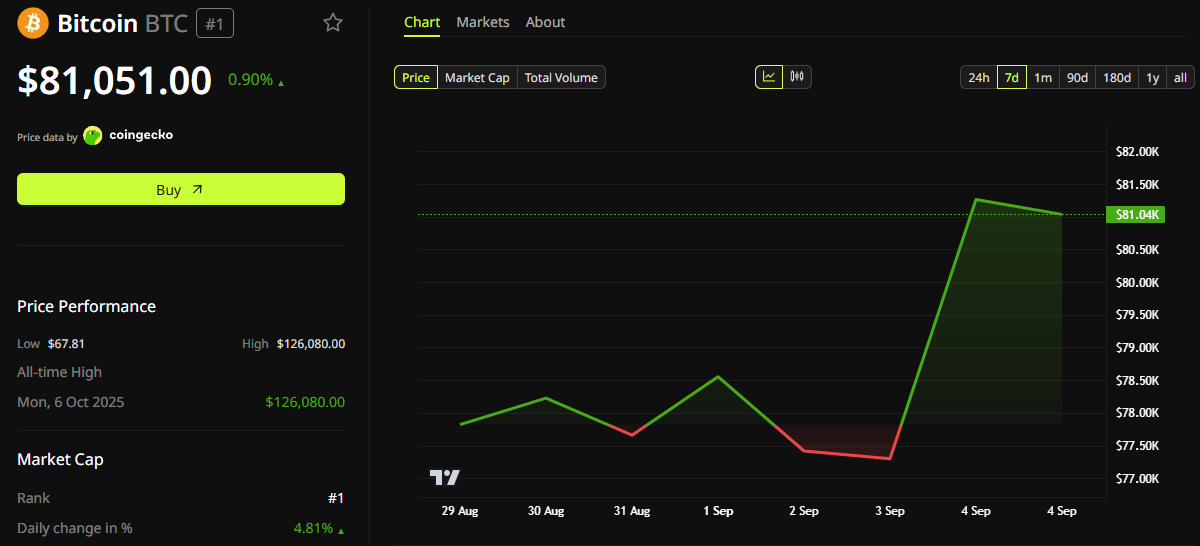
Odds of a September Federal Reserve rate hike fell back to a coin-flip on Friday, a sharp reversal after the probability touched 70% just a day earlier and sat as low as 37% a week before that.
The swing tracks a rally that has pushed Bitcoin (BTC) toward $82,000.
Rate Bets Whipsaw Ahead of the September Meeting
The CME Group (Chicago Mercantile Exchange) FedWatch tool now shows the September 16 meeting split almost evenly between holding the benchmark rate at 3.50-3.75% and lifting it a quarter point to 3.75-4.00%.
The tool had assigned the hike a 70% probability as recently as Thursday.
The FedWatch data also pushed back the timeline for a second hike. A move to the 4.00-4.25% range isn’t priced as the most likely outcome until the March 2027 meeting. Rather than December 2026 as futures had implied earlier in the week.
Iran and Oil Are Driving the Volatility
The odds have been whipsawing alongside oil prices and bond yields tied to the Iran conflict, which has kept traders guessing on inflation.
Fed Chair Kevin Warsh faced a market split on the hike question at Jackson Hole, and the central bank remains divided over whether to keep tightening.
Bitcoin has moved in step with the shifting rate outlook. The asset blasted past $80,000 this week as talk of an end to the Iran war spread, and traded near $81,000 on Friday, up roughly 5% over 24 hours.

A lower hike probability typically eases pressure on Treasury yields and the dollar. These are both tailwinds for Bitcoin’s price action this week.
Whether that holds through the September 16 decision may depend on how the Iran situation, and the next inflation print, develop in the coming days.
The post Fed Rate Hike Odds Fall to 50/50: Will Bitcoin's Rally Above 80,000 Hold? appeared first on BeInCrypto.


Standard Chartered has expanded institutional Bitcoin and Ether spot trading to the UAE through its DIFC branch, giving eligible clients access to deliverable crypto trades through the bank’s existing electronic trading systems.
Summary
- Standard Chartered has launched institutional Bitcoin and Ether spot trading in the UAE through its DIFC branch.
- Eligible clients can trade BTC and ETH through the bank’s existing electronic trading channels and FX interfaces.
- Clients can settle trades with a custodian of their choice, including Standard Chartered’s UAE digital asset custody service.
- The bank said it is the first G-SIB to provide institutional digital asset spot trading in the UAE.
Standard Chartered said on Sept. 3 that the service makes it the first Global Systemically Important Bank to offer institutional digital asset spot trading in the UAE and the only global bank currently providing the capability in the region.
Eligible institutional clients can trade Bitcoin and Ether through Standard Chartered’s electronic channels using interfaces already employed for foreign exchange trading. Settlement can be handled through a custodian selected by the client, including the bank’s own UAE digital asset custody service.
The launch combines trading and custody capabilities that Standard Chartered has been building separately in the UAE since 2024, while extending a spot trading business first introduced through its UK branch last year.
Standard Chartered brings Bitcoin and Ether trading to DIFC
Trading is being offered through Standard Chartered DIFC, the bank’s branch in the Dubai International Financial Centre.
Clients will receive deliverable Bitcoin and Ether instead of gaining exposure through a derivative tied to the price of either cryptocurrency. Standard Chartered began offering the same type of institutional trading through its UK branch in July 2025, becoming the first G-SIB to provide deliverable Bitcoin and Ether spot trading to institutional clients.
As crypto.news previously reported, the UK service was introduced for institutional customers including corporations, asset managers and professional investors, with transactions available through the bank’s existing FX trading interfaces.
The UAE deployment brings that trading setup into the same market where Standard Chartered already operates regulated digital asset custody.
Rola Abu Manneh, chief executive officer for the UAE, Middle East and Pakistan at Standard Chartered, said the country’s regulatory framework had supported institutional participation in digital assets.
“Extending our Bitcoin and Ether spot trading capability to institutional clients is a significant step in broadening our regulated digital asset proposition in the market,” Abu Manneh said.
She said combining execution with custody, governance and the bank’s international network gives institutional clients a more integrated route into digital asset markets.
UAE clients can separate execution from custody
Standard Chartered will not require clients using the new trading service to hold their Bitcoin or Ether with the bank.
Institutions can instead settle transactions through a custodian of their choice, giving them the ability to separate trade execution from asset storage. Standard Chartered’s own digital asset custody platform remains one of the available options.
The bank launched that custody service in the UAE in September 2024 after receiving a license from the Dubai Financial Services Authority within DIFC. Bitcoin and Ether were the first supported assets, while Brevan Howard Digital was named the inaugural client.
Its role in UAE institutional crypto infrastructure later expanded through a collateral mirroring program with OKX in April 2025.
Under the arrangement, institutional customers can keep eligible collateral with Standard Chartered while using its value for trading on OKX. The assets remain with the bank instead of being transferred directly to the exchange, while corresponding collateral balances are mirrored into client trading accounts.
The program began in the UAE with support from Brevan Howard and Franklin Templeton.
In April 2026, the framework was extended to BlackRock’s tokenized U.S. Treasury fund BUIDL. Eligible institutional and VIP clients can use BUIDL as collateral while Standard Chartered holds the fund off exchange.
OKX handles margining and liquidation within its trading system, while clients retain ownership of the tokenized fund and its yield under the structure.
DIFC provides the regulated base for the trading service
Christopher Parsons, senior executive officer at Standard Chartered DIFC, said the financial center provides a base from which international financial institutions can deploy services across regional markets.
“Extending our institutional digital asset trading capability through the Centre demonstrates the strength of that model,” Parsons said, citing the combination of Standard Chartered’s markets business, international network and regulated DIFC presence.
Standard Chartered has used DIFC for several parts of its institutional digital asset business. Its custody platform operates from the financial center, while some collateral arrangements involving digital assets are structured around assets held by the bank in Dubai.
The bank’s digital asset operations extend outside the UAE through its corporate and investment bank and associated ventures.
Its institutional strategy covers custody, trading and tokenization, while Zodia Markets operates in digital asset trading infrastructure and Libeara develops tokenization products.
Standard Chartered has meanwhile continued to add regulated digital asset services in other financial centers. In Hong Kong, its local banking unit became the first bank distributor of the HKDAP stablecoin in August, giving eligible institutional clients and partners access to the regulated Hong Kong dollar-backed token.
HKDAP is issued by Standard Chartered-backed Anchorpoint, which received one of Hong Kong’s stablecoin issuer licenses in April. The token entered controlled beta access for institutions and professional investors, with uses including payments, fiat conversion and tokenized asset settlement.
Standard Chartered Bank Hong Kong plans to introduce subscription and settlement services for tokenized money market funds during the fourth quarter of 2026.
Standard Chartered extends a trading model launched in the UK
The UAE service follows more than a year of development around Standard Chartered’s direct institutional crypto trading business.
When the UK operation went live in July 2025, Bitcoin and Ether trades were integrated into existing institutional trading platforms so clients could access crypto through infrastructure already used for traditional markets.
Standard Chartered said at the time that the setup was intended to allow institutions to transact and manage digital asset exposure within its regulated banking environment.
The bank has since tested other structures linking crypto trading with traditional financial market infrastructure. Its digital asset activities span direct spot execution, custody, collateral services and tokenization, while its venture businesses provide separate trading and tokenized asset capabilities.
For UAE clients, the Sept. 3 rollout adds direct Bitcoin and Ether execution to the custody infrastructure Standard Chartered has operated in DIFC since September 2024.
Institutions using the service can route trades through the bank’s electronic trading channels and choose where the resulting assets are held, including settlement into Standard Chartered’s own custody platform.
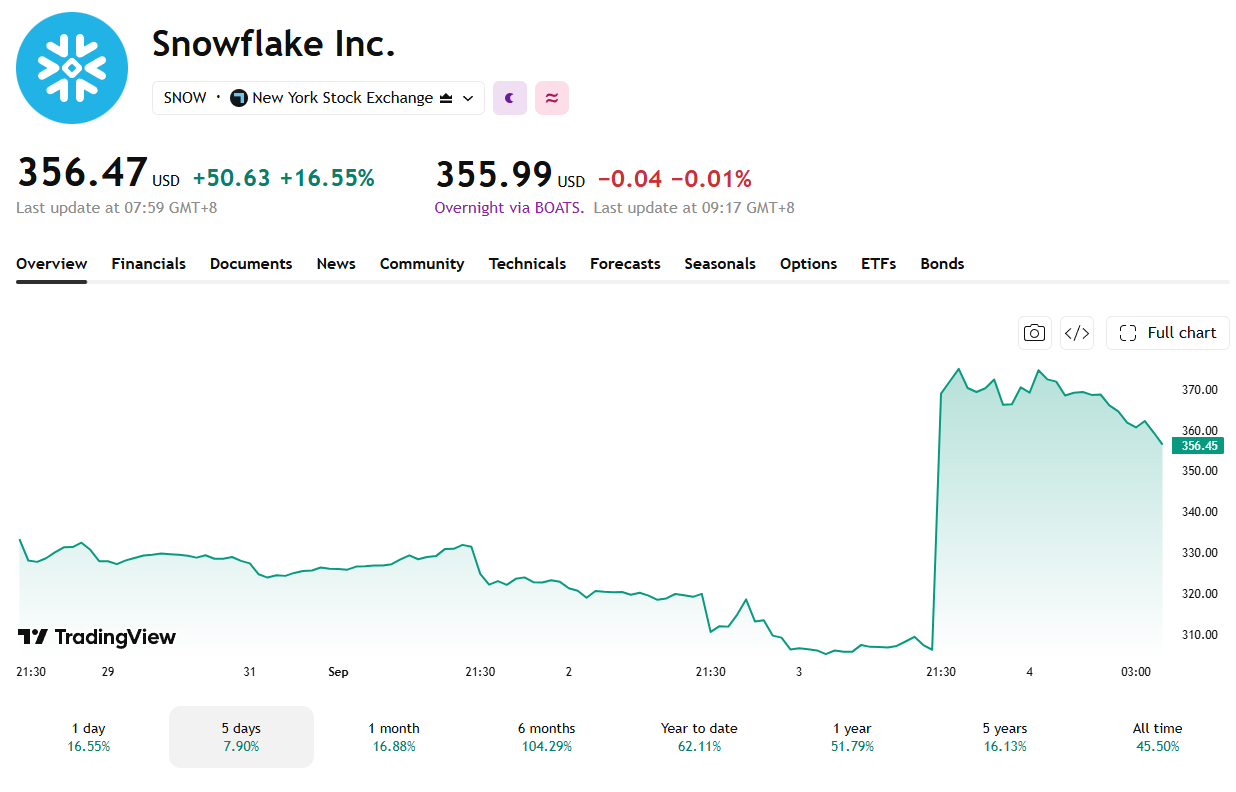
Snowflake’s upbeat AI outlook is turning into a broader software trade, with a wave of enterprise names rallying alongside it and Jim Cramer flagging more room to run.
The move adds to a stretch of earnings this season where AI-linked spending has repeatedly rewarded shareholders, even as some investors question how long richly priced software names can keep climbing.
AI is Driving the Software Firm
Snowflake shares jumped 23% on Thursday after the cloud data platform lifted its fiscal 2027 product revenue forecast to $6.07 billion, up from $5.84 billion, alongside a 37% year-over-year jump in second-quarter product revenue.

CEO Sridhar Ramaswamy said artificial intelligence (AI) tools are now driving growth across Snowflake’s core platform, not just its standalone AI products, calling it a compounding “flywheel effect” for the business.
Shares hit their highest level since December 2021, adding roughly $25 billion in market value in the move. The stock has now climbed 39% for the year, more than triple the S&P 500’s 12% gain over the same stretch.
Software Stocks Move Together
The rally spilled into peers. ServiceNow, Salesforce’s record earnings run, Atlassian, Adobe, and Intuit all climbed between 3.5% and 6%, while the iShares Expanded Tech-Software Sector ETF added 3%.
Morgan Stanley analysts said the pattern of consistently faster growth in recent quarters shows AI is meaningfully driving usage of Snowflake’s own platform, beyond its dedicated AI tools.
At least 34 brokerages raised their price targets following the results, according to data compiled by LSEG, with Wells Fargo issuing a Street-high call of $525. Snowflake now trades near 15 times forward revenue, well above the software-sector ETF’s 7.4 times, and its 121.8 times forward earnings dwarfs Datadog’s 72.7 times and MongoDB’s 52.1 times.
CNBC’s Jim Cramer weighed in after the report, flagging a huge move still ahead for the stock, and calling it the cleanest way for cautious enterprises to buy AI compute on demand.
So Snowflake remains the best way for the uncertain to get compute but Broadcom tells a story of an explosion of business coming. Snowflake will have a huge move…
— Cramer
The reaction echoes a pattern seen elsewhere this earnings season, including Salesforce’s own AI-driven breakout and software stocks rebounding after months of AI-replacement fears.
Whether that momentum holds may depend on how quickly Snowflake and its peers can turn rising AI demand into durable margin, rather than just top-line growth.
The post Snowflake's AI-Fueled Beat Sparks Software Rally: Will Others Follow? appeared first on BeInCrypto.
The Wyoming Stable Token Commission adopted Chainlink Proof of Reserve on Sept. 2 to publish near-real-time reserve and supply data for the state-issued Frontier Stable Token, or FRNT.
Summary
- Wyoming adopted Chainlink Proof of Reserve to publish verified FRNT reserve and supply data onchain.
- The Network Firm examines reserve balances while Chainlink distributes resulting verification data across supported blockchains.
- Wyoming already publishes daily FRNT attestations, compared with monthly disclosures required under federal stablecoin law.
- Secure Mint remains under adoption and would block issuance whenever verified reserves trail token supply.
- FRNT launched in January, backed by dollars and short-term U.S. Treasury securities, according to Wyoming.
The integration combines independent examinations conducted by The Network Firm with Chainlink’s infrastructure. The Network Firm checks reserve assets and outstanding token balances under standards established by the American Institute of Certified Public Accountants.
Chainlink then delivers the resulting verification data onchain. The arrangement gives users a more recent view of FRNT’s backing than periodic reports alone, according to the joint announcement.
Chainlink reserve data supplements daily attestations
Wyoming already publishes daily FRNT reserve attestations through the commission’s website. Proof of Reserve adds an automated onchain distribution layer to those independent examinations.
However, an onchain feed does not independently inspect cash or Treasury securities. It publishes data produced through the underlying examination process. Its reliability therefore depends on the accuracy of the reserve records, the external examiner and Chainlink’s data-delivery infrastructure.
The commission described the integration as providing “near real time” verification. It did not disclose the precise update frequency, the data feed’s contract addresses or the conditions that would trigger an alert when reserve coverage changes.
Proof of Reserve also does not remove the need for financial audits, custody controls or public reporting. It offers an additional way for applications and market participants to access the reported reserve position onchain.
Wyoming says FRNT exceeds federal disclosure rules
The commission said its daily reporting and onchain verification “meet and exceed” the federal baseline established by the GENIUS Act. That comparison represents Wyoming’s assessment rather than a separate determination from a federal regulator.
NEW: @wyostable adopts Chainlink Proof of Reserve to set a new United States standard for digital asset transparency 🇺🇸
Via Chainlink, FRNT exceeds GENIUS Act requirements & becomes the first stablecoin issued by a U.S. public entity to publish verified reserve data onchain. pic.twitter.com/sk7gjRGzer
— Chainlink (@chainlink) September 2, 2026
The federal law requires permitted payment stablecoin issuers to publish monthly reports covering reserve composition and outstanding supply. Those reports must receive an independent examination, while company officers must certify their accuracy.
Wyoming argues that monthly reports provide only a point-in-time view and leave a gap between reporting dates. Daily attestations and an onchain data feed can narrow that gap, although they do not guarantee that reserves cannot change between updates.
The GENIUS Act also contains requirements beyond reserve disclosures, including rules governing permitted assets, redemptions and regulatory supervision. The commission’s announcement focused on transparency and did not claim that Proof of Reserve replaces those obligations.
Secure Mint would connect reserves directly to issuance
Wyoming is also adopting Chainlink’s Secure Mint feature. The feature is not yet confirmed as operational for FRNT.
Once implemented, Secure Mint would require verified reserves to equal or exceed FRNT’s outstanding supply before allowing new tokens to be issued. A failed reserve check would prevent additional minting until the reported coverage returned to the required level.
The commission said this structure could reduce the risk of an “infinite-mint attack,” where an attacker exploits issuance controls to create unbacked tokens. Secure Mint would address one part of that risk by placing a reserve condition inside the minting process.
Its effectiveness will depend on implementation details that have not been published. These include update intervals, emergency controls, administrator permissions and procedures for handling inaccurate or unavailable reserve data.
FRNT expands its use of Chainlink infrastructure
Wyoming publicly launched FRNT on Jan. 7, 2026. The commission says the token is backed by U.S. dollars and short-term U.S. Treasury securities. Income generated from the reserves supports the state’s School Foundation Program.
The reserve verification announcement follows Wyoming’s migration of FRNT’s cross-chain infrastructure from LayerZero to Chainlink’s Cross-Chain Interoperability Protocol.
As crypto.news previously reported, Wyoming moved FRNT to Chainlink after completing a security review in August. CCIP now serves as the token’s exclusive cross-chain infrastructure under a multiyear agreement.
FRNT is available across eight public blockchains, including Ethereum, Solana, Base, Avalanche, Arbitrum, Optimism, Polygon and Hedera. The commission previously used LayerZero to support transfers between those networks.
Earlier crypto.news coverage documented how Wyoming prepared FRNT for public distribution through partners including Kraken and Visa. The token later became publicly available in January after its technical mainnet deployment in 2025.
The next confirmed milestone will be the activation of Secure Mint. Wyoming has not announced a launch date, leaving the reserve-gated issuance system as a planned feature rather than a current protection.


Taiwan’s Financial Supervisory Commission has said nine supporting regulations for its new Virtual Asset Service Act, including detailed stablecoin rules, could be formally introduced as early as the first quarter of 2027.
Summary
- Taiwan’s FSC is preparing nine regulations under the Virtual Asset Service Act, including rules covering stablecoins.
- The regulations could be formally published and implemented as early as the first quarter of 2027.
- Taiwanese financial firms are assessing stablecoins for cross border payments, custody, tokenization and other digital asset services.
- Industry executives see stablecoins and blockchain as potential infrastructure for payments and financing across Taiwan’s semiconductor supply chain.
Financial Supervisory Commission Chairman Peng Jinlong said at the FinTechOn 2026 and Asia FinTech Alliance Summit in Taipei on Sept. 2 that global discussions around virtual assets and stablecoins have moved from whether they should be developed to how they should be properly regulated.
Taiwan’s legislature passed the Virtual Asset Service Act in its third reading on June 30, establishing a licensing framework for crypto businesses and rules governing stablecoin issuance.
The FSC is now working on nine subsidiary regulations needed to implement the legislation, Peng said. Stablecoin requirements will form part of that package, with the regulator targeting the first quarter of next year for their publication and implementation.
Taiwan stablecoin rules move toward implementation
Once the new law and supporting regulations take effect, Peng expects Taiwan’s virtual asset and stablecoin sector to enter a new stage under formal supervision.
The Virtual Asset Service Act requires crypto businesses to obtain FSC approval before operating and covers exchanges, trading platforms, transfer providers, custodians, underwriters and lending businesses. Existing companies registered under Taiwan’s previous anti-money laundering regime have been given a transition period to move into the licensing system.
Stablecoin issuers face a separate approval process involving both the FSC and Taiwan’s central bank. Issuers will be required to maintain full reserve backing, place reserve assets in trust and comply with audit and disclosure requirements.
Crypto.news previously reported in July that the legislation moved Taiwan away from a system largely based on AML registration toward supervision covering operations, customer protection, cybersecurity, market conduct and financial reporting.
The framework developed from an FSC draft released in March 2025, which set out proposed licensing standards for virtual asset businesses and requirements for stablecoin issuers. Earlier proposals contemplated allowing banks to issue New Taiwan dollar-pegged stablecoins subject to regulatory approval.
Peng said rapid development in artificial intelligence and blockchain technology is pushing Taiwan and other financial markets toward a model in which traditional finance, digital finance and blockchain-based finance operate alongside one another.
Taiwan has taken a similar regulatory approach to AI. The FSC has published six core principles and related guidelines for financial institutions using artificial intelligence and plans to expand work involving AI-based fraud prevention and financial data applications while keeping risks under control.
Stablecoins emerge as an option for semiconductor payments
The discussion around stablecoins is extending into Taiwan’s semiconductor supply chain, where companies process large volumes of international payments, trade financing and corporate treasury transactions.
Taiwan Semiconductor Industry Association executive director Lu Chaoqun said AI is driving rapid expansion in the global semiconductor business. Global semiconductor annual revenue approached $800 billion in 2025 and could exceed $1.5 trillion this year, according to Lu.
He projected the industry could challenge $2 trillion in annual revenue within the next two to three years and potentially reach approximately $3 trillion by 2035. Taiwan’s semiconductor industry cluster, meanwhile, is moving toward a scale of $1 trillion.
Taiwanese manufacturers assemble and ship roughly 90% of the world’s AI servers and account for around 76% of global semiconductor foundry revenue, Lu said. Components and finished goods move across borders every day, creating payment, financing and corporate capital management requirements alongside physical supply chains.
Factories and logistics networks can operate around the clock, while international payments remain constrained by banking hours, time zones and settlement procedures.
Lu said stablecoins, blockchain technology and financial technology have consequently become urgent infrastructure for supply-chain companies handling cross-border payments, trade financing and treasury management. He argued that financial institutions should work as partners to AI, semiconductor and technology companies instead of limiting their role to providing financial services.
Programmable payments could connect supply chains
Taiwan FinTech Association Chairwoman Wang Li-ling said advances in AI, blockchain, stablecoins and programmable payments are bringing goods, information and money flows closer together within global supply chains.
Under such systems, AI could forecast demand while logistics systems adjust automatically, blockchain networks verify transactions and documents, and programmable payment systems release funds when agreed conditions have been met.
For stablecoins, Wang said the important part is not the “coin” but whether trust can be established behind the “stable” component.
She said stablecoins could make liquidity management more efficient for multinational businesses, shorten settlement periods for importers and exporters, and potentially lower payment costs for small and medium-sized businesses in emerging markets participating in international supply chains.
Cross-border use would require regulation extending beyond individual jurisdictions, Wang said. Reserve management, redemption, technology and regulatory standards would need sufficient cross-border trust, while the increased use of AI in decisions involving goods, capital allocation and supplier risk would raise questions involving data quality, cybersecurity, privacy, model governance and responsibility.
Taiwan has been tightening the infrastructure surrounding crypto transfers as the licensing system takes shape. In August, the FSC proposed expanded Travel Rule requirements for domestic virtual asset transfers, including additional identification requirements for transactions above NT$30,000.
The regulator intends to extend the framework to transfers between Taiwanese and overseas virtual asset service providers by the end of 2027.
Financial institutions assess stablecoin opportunities
Cathay Financial Holdings senior executive vice president Sun Chih-te said digital assets and stablecoins have moved from an area once treated as peripheral by traditional financial institutions toward a new area of financial development.
Large financial institutions can no longer remain outside the sector, he said, though mainstream adoption still faces issues involving market scale, regulation and customer experience.
Cathay is evaluating opportunities involving stablecoins, digital asset custody, cross-border payments and tokenization, according to Sun. The financial group wants to examine potential expansion into digital asset lending and trading while studying applications across insurance, asset management, wealth management and securities businesses.
Cross-border payments are among the applications Cathay considers most capable of reaching scale in the immediate future. The company is evaluating the role it could play within such an ecosystem and which partners could participate.
Taiwan had been considering a banking role in stablecoin issuance well before passage of the Virtual Asset Service Act. An earlier FSC proposal envisioned locally issued stablecoins pegged to the New Taiwan dollar, with issuers subject to regulatory approval and oversight involving the central bank.
Sun said regulatory requirements need to be clear and fair while providing room for innovation alongside anti-money laundering, know-your-customer, security and compliance obligations. Restricting development to the safest possible areas, he said, could leave projects stuck at the proof-of-concept stage.
Stablecoin-based cross-border payments would require a degree of regulatory coordination between markets so different systems can work together, according to Sun.
Customer experience will ultimately determine whether digital asset products move beyond trials, he said. Stablecoins and other digital asset services would need to deliver improvements in actual use, not simply offer faster, cheaper or more efficient transactions in theory.
“Getting to 90% is not enough,” Sun said, arguing that the final 10% can determine whether an innovation remains a concept or becomes a solution adopted by the mainstream market.
Asia FinTech Alliance Chairwoman Tsai Yu-ling said the organization now connects 16 Asian markets and is working to help participating economies share experience and develop common solutions. Its newly launched AFA Awards will support fintech companies seeking expansion across those markets, giving selected businesses what Tsai described as a faster route into the alliance’s 16-market network.

Tawkify Brings ‘Perfect Match’ Concept To Life In Las Vegas Weekend

Financial Audit’s Messiest Affair

Ayrshire welcomes UK’s ‘Forrest Gump’ to help Britain reconnect with local food and communities





-

 Fashion6 days ago
Weekend Open Thread: Maeve – Corporette.com
-

 Crypto World1 day ago
CLARITY Act could advance within weeks, Atkins says
-

 Business6 days ago
Onto Innovation Stock: AI’s Next Bottleneck Is Yield (NYSE:ONTO)
-

 Crypto World6 days ago
Bitcoin price tests $82K resistance as Brandt stays long
-
 Tech5 days ago
Hugging Face built a $4.5 billion empire on free AI models. Now Nvidia is buying it for $12.9 billion
-

 Business6 days ago
iPhone 18 Pro Pre-Orders Could Shift to Saturday as Apple Reportedly Avoids September 11 Anniversary
-

 Crypto World2 days ago
Elon Musk Says Grok 4.7 Lands in 10 Days and Will Beat Every Model
-
 Entertainment7 days ago
‘Adults’ Creators Break Down Season 2’s Most Shocking Moments and Tease a Potential Season 3
-

 News Videos5 days ago
Charlie Munger on Robinhood: No one should believe that Robinhood’s trades are free
-

 Tech6 days ago
PaperCut releases second emergency patch for exploited flaws
-
 Crypto World2 days ago
Bitcoin slips below $77.5K as macro pressure offsets ETF inflows
-

 Crypto World22 hours ago
Kalshi seeks CFTC approval for WTI perpetual
-

 Tech5 days ago
Tamagotchi Ring Takes the 30-Year Digital Pet and Places it on Your Finger
-

 Tech5 days ago
As the influencer economy drives retail sales, Seattle startup raises $22M to play matchmaker
-

 News Videos5 days ago
News kii Crypto ugu danbeeyey & Suuqa oo dhaqaaqey
-

 Business6 days ago
Apple Confirms September 9 iPhone Launch Event as Tim Cook Prepares to Hand CEO Reins to John Ternus
-
 NewsBeat5 days ago
Trump posts AI video of ‘Lake America’ being protected by an army of bequiffed ‘Donald Ducks’
-
 Entertainment4 days ago
Taylor Swift Reportedly ‘Frustrated’ With Travis Kelce After ‘Short’ Honeymoon
-
 Business2 days ago
Oil Price Today (September 2): Crude oil nears $97 as war tensions escalate. Will it hit $100 again?
-
 Entertainment6 days ago
Kendall Jenner’s Circle Concerned About Jacob Elordi Romance
You must be logged in to post a comment Login