
Crypto World
How Compliant Tokenization Bridges Traditional Finance & Blockchain


Why did BlackRock’s tokenized treasury fund exceed $1.8 billion in 2024 and $2 billion in 2025, while countless other blockchain projects failed to attract even modest institutional capital? What changed?
The answer surprises most people. It’s not better technology. Blockchain infrastructure capable of tokenizing real-world assets existed five years ago. What was missing was regulatory clarity.
Real-world asset (RWA) tokenization has experienced exponential growth, with the market for tokenized assets (including stablecoins) reaching approximately $331 billion by late 2025, a massive increase from ~$4 billion in 2019. Driven by institutional adoption in fixed income, private credit, and U.S. Treasuries, the market is projected to skyrocket to over $9 trillion by 2030.This explosion came only after compliance frameworks emerged that institutions could actually work with.
Goldman Sachs, Franklin Templeton, and BNY Mellon aren’t suddenly blockchain believers. They’re entering because regulated real-world asset tokenization now provides legally defensible pathways that satisfy their compliance departments.
Understanding how compliance impacts RWA tokenization reveals we’re witnessing a regulatory evolution, not just a tech upgrade. The blockchain platforms that are winning institutional investment are compliance-first blockchain platforms that adhere to traditional finance standards rather than seeking to disrupt them.
Designing Token Frameworks That Meet Regulatory, Custody, and Settlement Requirements
Building compliant tokenization isn’t about adding KYC to a smart contract. The institutional needs for tokenization platforms are more fundamental, from a legal, technical, and operational perspective. When Switzerland introduced the Blockchain Act or the EU finalized the MiCA regulations, it challenged the industry to respond to tough questions about digital ownership.
- Legal Structure Comes First
Token design starts with a fundamental question: Does this represent direct ownership or a contractual claim? The distinction determines everything: which regulations apply, which jurisdictions have authority, and whether holders have real rights. Most tokenized treasuries don’t give direct bond ownership. They’re shares in a fund holding those bonds. That legal architecture completely changes regulatory treatment. This is how compliance impacts RWA tokenization at the foundation.
- Token Classification Drives Technical Architecture
MiCA classified crypto-assets into Asset-Referenced Tokens (ARTs), E-Money Tokens (EMTs), and utility tokens. These have varying levels of reserves, governance, and disclosure. Smart contracts are required to implement these differences programmatically. You can’t just write better documentation. The code itself needs regulatory logic built in. Institutional requirements for tokenization platforms now demand classification enforcement at the protocol level.
- Custody Standards Must Satisfy Two Masters
Regulated digital assets need custody models meeting both blockchain security standards and traditional finance requirements. This includes SOC 2 compliance, ISO 27001, separate accounts, and bankruptcy remoteness. Custody providers must prove that tokenized assets survive platform failure, custodian failure, or both simultaneously. This is non-negotiable for institutions.
- Settlement Needs Legal Finality, Not Just Technical Finality
Transactions might confirm on-chain in seconds, but what if they violate securities law? Compliant tokenization frameworks include circuit breakers and rollback mechanisms that can pause or reverse problematic transactions. The SEC cares whether your system can freeze assets under a court order. Compliance-first blockchain platforms build these controls into core architecture from day one.
- Programmable Compliance Wins Institutional Adoption
Platforms winning institutional money aren’t the most decentralized; they’re the ones programmatically enforcing compliance rules that vary by jurisdiction, asset type, and investor classification. Smart contracts automatically check investor accreditation, enforce holding periods, restrict transfers to approved parties, and maintain ownership caps. This demonstrates how compliance impacts RWA tokenization practically, forcing innovation in areas that traditional finance handled manually with compliance officers.
Explore Compliance-Driven Tokenization Solutions
How Compliant Rails Enable Secure Issuance, Trading, and Settlement of RWAs
The difference between pilot projects and production systems? It’s the infrastructure. Compliance-first blockchain platforms need rails connecting tokenization to existing financial systems while maintaining regulatory compliance at every step. This demonstrates how compliance impacts RWA tokenization operationally.
- Issuance Protocols Balance Blockchain and Securities Law
Franklin Templeton’s BENJI tokenized money market fund on Stellar shows this balance. The issuance meets SEC registration requirements, ensures appropriate disclosure, enforces transfer restrictions, and takes advantage of 24/7 blockchain settlement. Each token contains compliance information, which includes investor type, purchase date, restrictions, and jurisdiction. This is compliant tokenization in practice.
- Trading Happens on Permissioned Infrastructure
Regulated digital assets don’t trade on open DeFi protocols. They trade on platforms with strict access controls. MiCA obliges CASPs to conduct ongoing KYC/AML screening, submit suspicious transactions, and implement the Travel Rule (transmitting/receiving party data for transactions above €1,000). Over 50 companies secured CASP licenses by November 2025. This represents the evolution of regulated real-world asset tokenization infrastructure that institutional investors require.
- Settlement Bridges Real-Time Blockchain with Regulatory Reporting
Are you aware of the fact that on-chain settlement happens instantly, but parallel off-chain systems capture regulatory data for authorities? Buy a tokenized treasury at 2 AM Sunday? It settles on-chain immediately. But the system also generates tax documentation, AML checks, and compliance records. This dual-layer approach defines compliant tokenization.
- Cross-Border Operations Demand Multi-Jurisdictional Coordination
A German investor seeking to buy tokenized U.S. Treasuries on a Swiss platform would need a solution that fulfills the conditions of German investor protection law, U.S. securities laws, and Swiss financial services laws simultaneously. The infrastructure would involve jurisdictional routing, cross-border automatic tax withholding, and real-time screening against sanctions lists. Such functionality is what differentiates regulated digital assets from unregulated tokens.
What It Takes to Bring Real-World Financial Assets On-Chain Legally
It’s easy to discuss, but execution separates real projects from vaporware. Companies successfully tokenizing trillions in assets understand how compliance impacts RWA tokenization across legal, technical, and operational dimensions. Regulated real-world asset tokenization requires this multi-disciplinary coordination.
- Start with Legal Structure, Not Code
Successful tokenization projects begin with lawyers, not developers. Legal structure determines asset custody, investor rights, bankruptcy treatment, and tax implications. BlackRock’s BUIDL fund reached $1.8 billion because they structured it correctly first. Tokens represent shares in a registered fund owning the underlying treasuries. This legal-first approach defines regulated real-world asset tokenization.
- Custody Must Meet Institutional Standards
Real estate titles, bond certificates, and commodity reserves can’t actually live on-chain at an institutional scale. They sit in traditional custody systems trusted for decades. Tokenization creates a digital layer on top. The compliance challenge? Ensuring the link between on-chain tokens and off-chain assets is legally enforceable, independently verified, and survives platform failure. These custody standards are fundamental institutional requirements for tokenization platforms and separate credible projects from speculative ventures.
- Engage Regulators from Day One
Failed projects build first and ask permission later. Smart platforms engage regulators proactively in applying for licenses before launch, participating in regulatory sandboxes, and designing adaptable systems. The companies with CASP licenses under MiCA didn’t get lucky. They invested in regulatory relationships. Regulated digital assets require this engagement level, making it a core component of institutional requirements for tokenization platforms.
- Match Traditional Finance Investor Protections
Platforms targeting institutional capital can’t offer less protection than traditional markets. That means comprehensive whitepapers meeting prospectus standards, regular financial reporting, independent audits, clear risk disclosure, and investor recourse mechanisms. MiCA’s Article 6 whitepaper requirements often exceed traditional fund documents. Compliance-first blockchain platforms embed these protections into operations, making investor safety a feature rather than an afterthought.
- Maintain Continuous Compliance Operations
Getting approved to issue tokens is step one. Keeping that authorization demands ongoing work: daily reserve attestations for stablecoins, monthly asset value reporting for ARTs, real-time AML monitoring, and immediate regulatory responses. The operational cost is so high that smaller projects cannot maintain it. This is what defines compliant tokenization and what causes market consolidation around platforms that have the resources to maintain it.
Wrapping Up
The gap between blockchain hype and institutional adoption wasn’t about technology; it was about trust. What finally bridged traditional finance and on-chain markets? Regulatory environments that institutions could actually operate within.
The Real-World Asset (RWA) tokenization market has grown at an explosive rate over the past three years, with a 380% to 400% increase from under $5 billion in 2022 to over $23-$30 billion in mid-2025. The institutional adoption of this market, including companies such as BlackRock and JPMorgan, has grown by 260% in the first half of 2025.
Understanding how compliance impacts RWA tokenization reveals why some platforms attract institutional capital while others remain on the sidelines.
Regulated real-world asset tokenization isn’t about choosing between innovation and regulation; it’s about recognizing they’re inseparable at an institutional scale. The winners have built compliance-first blockchain platforms from the ground up. They started with legal structures, not just code. They met institutional requirements for tokenization platforms before seeking institutional money. They understood that regulated digital assets demand continuous compliance, not just launch-day checkboxes.
For institutions entering this space have two options. They can either build on a compliant tokenization infrastructure designed for regulatory certainty, or risk discovering too late that compliance can’t be retrofitted. Success in regulated real-world asset tokenization requires compliance as the foundation.
Ready to build tokenization infrastructure that meets institutional standards?
Antier develops RWA platforms that bridge traditional finance and on-chain markets without compromise. Connect with us to build compliant tokenization solutions that institutions trust. Let’s do it together.

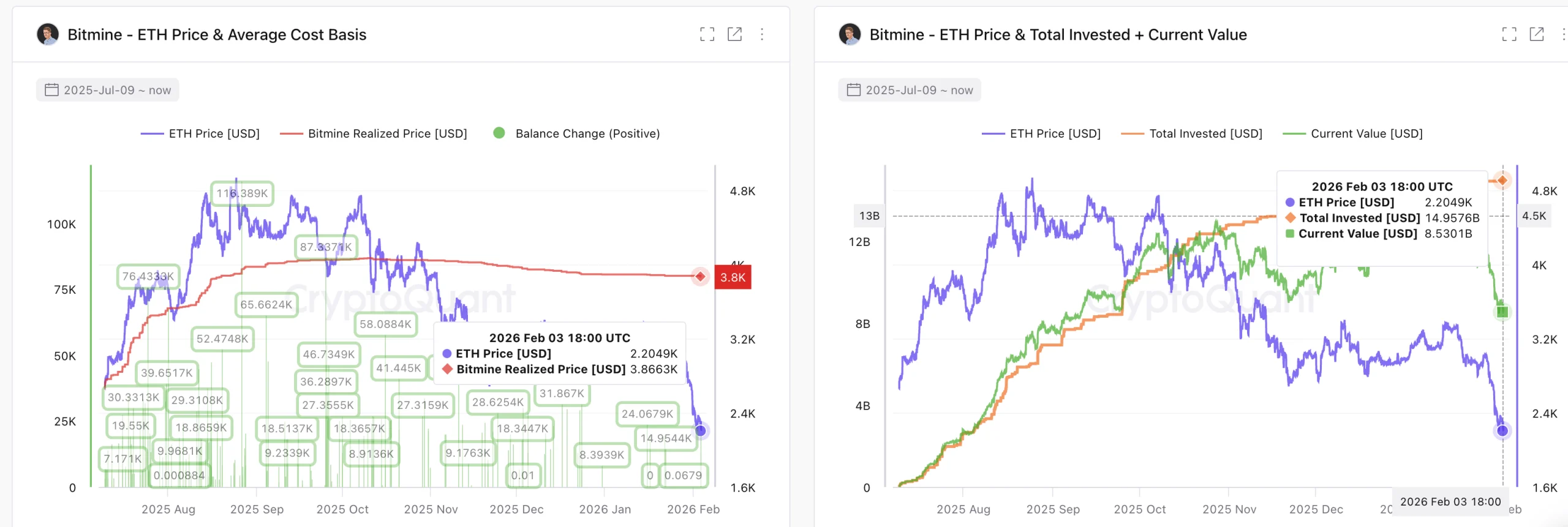
BMNR stock price remains under pressure in early February as selling continues across crypto-linked equities. The stock is down nearly 25% over five days and more than 33% over one month, trading around $22.35.
While management defended recent crypto-led paper losses as part of a long-term strategy, market data suggests technical weakness is still driving investor behavior. And increasingly driving them away, despite a novel defense from BitMine Chairman, Tom Lee.
Ethereum Treasury Losses Spark ‘Feature, Not A Bug’ Defense
Concerns around BitMine’s balance sheet intensified after data showed heavy unrealized losses on its Ethereum treasury.
Sponsored
Sponsored
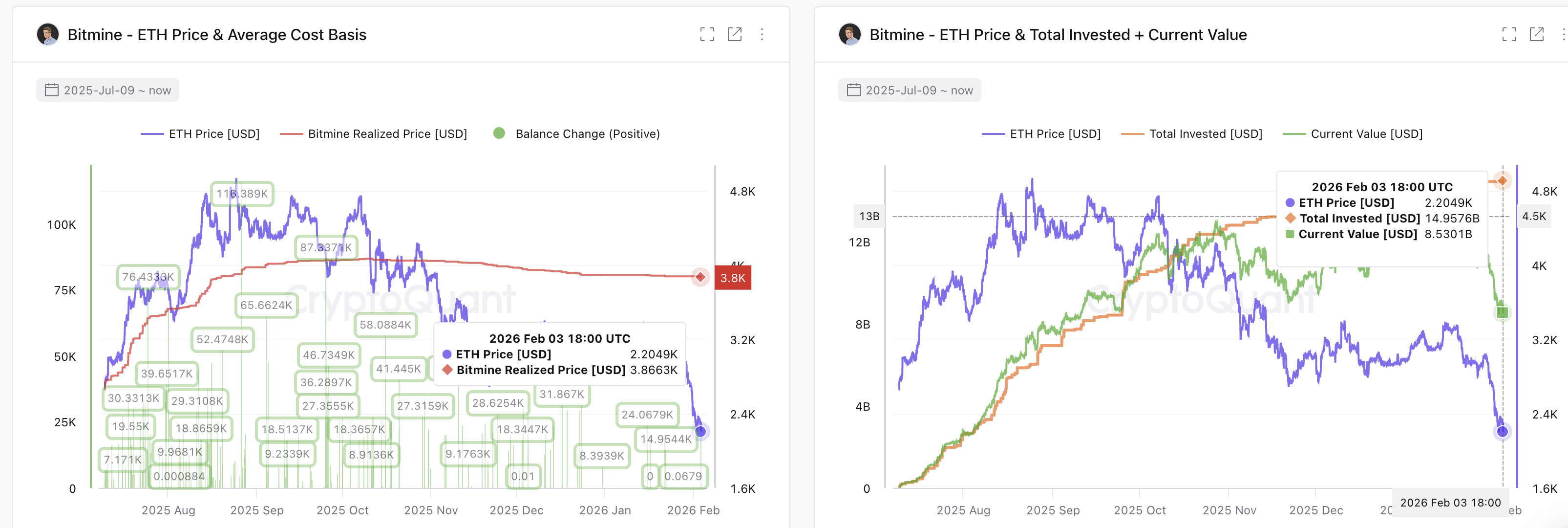
As of February 3, BitMine had invested roughly $14.95 billion into ETH holdings. However, the current market value had fallen to around $8.53 billion, implying paper losses of more than $6.4 billion.
At the same time, Ethereum was trading near $2,200, well below BitMine’s average acquisition cost of roughly $3,800. This gap highlighted how deeply underwater the company’s treasury had become.
Want more token insights like this? Sign up for Editor Harsh Notariya’s Daily Crypto Newsletter here.
These figures triggered criticism from market observers, who argued that such large unrealized losses could limit future upside and pressure shareholder returns. Some warned that accumulated ETH could eventually act as a selling supply.
In response, Chairman Tom Lee defended the strategy, stating that drawdowns are “a feature, not a bug.” He argued that crypto cycles naturally involve temporary losses and that BitMine is designed to accumulate through downturns to outperform over time.
Sponsored
Sponsored
However, despite this explanation, BMNR stock failed to attract sustained buying interest after the comments.
OBV and CMF Show Buyers Stayed Away After the Breakdown
Market participation data suggests that investors began exiting even before the public debate intensified.
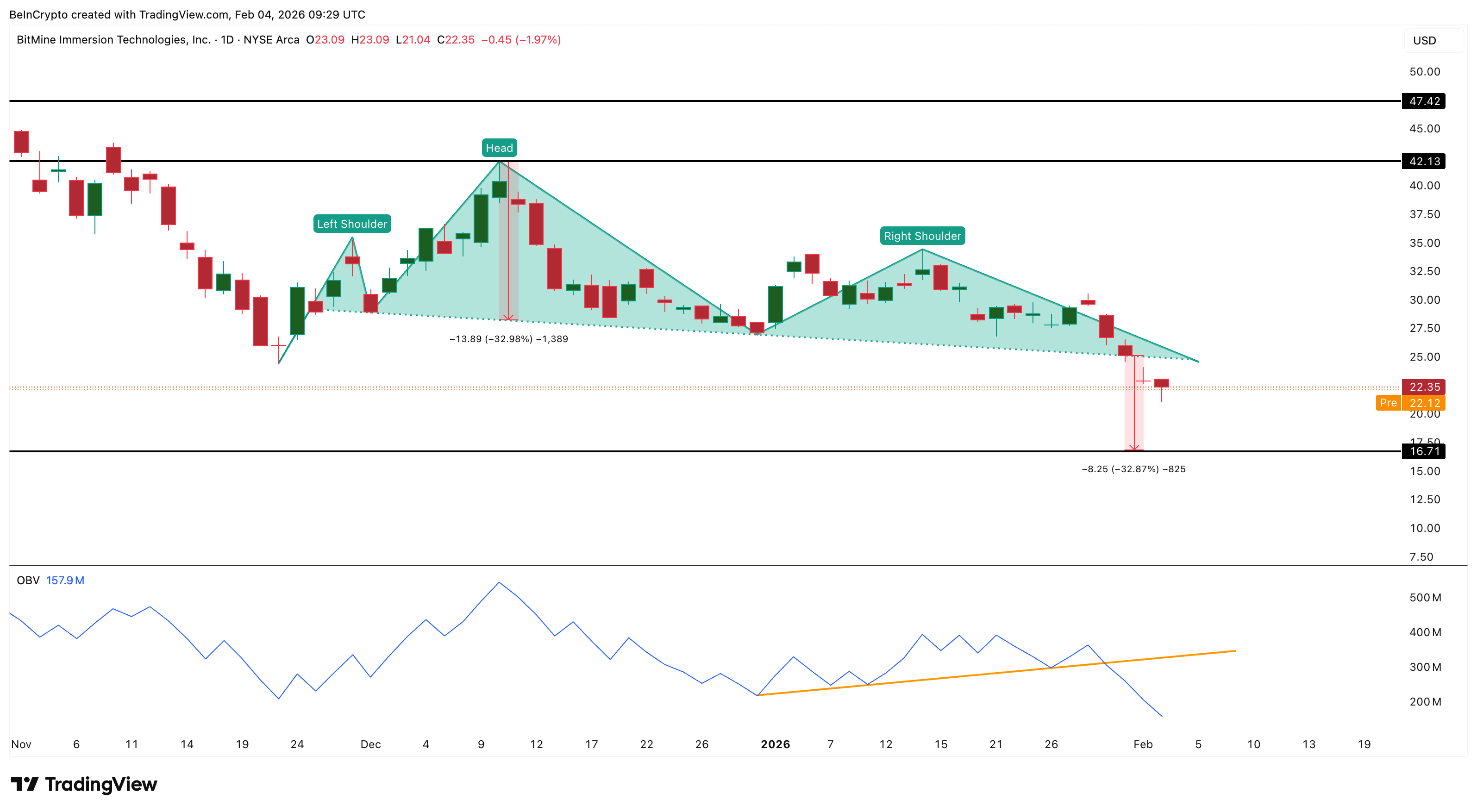
On-Balance Volume (OBV) tracks cumulative buying and selling pressure by adding volume on up days and subtracting it on down days. It reflects whether traders are accumulating or distributing.
From early December through late-January, OBV was forming higher lows, signaling steady accumulation. But between January 28 and 29, OBV broke below its rising trend line. This showed that possibly retail and short-term traders had started distributing shares.
Sponsored
Sponsored
After OBV weakened, institutional-style capital followed.
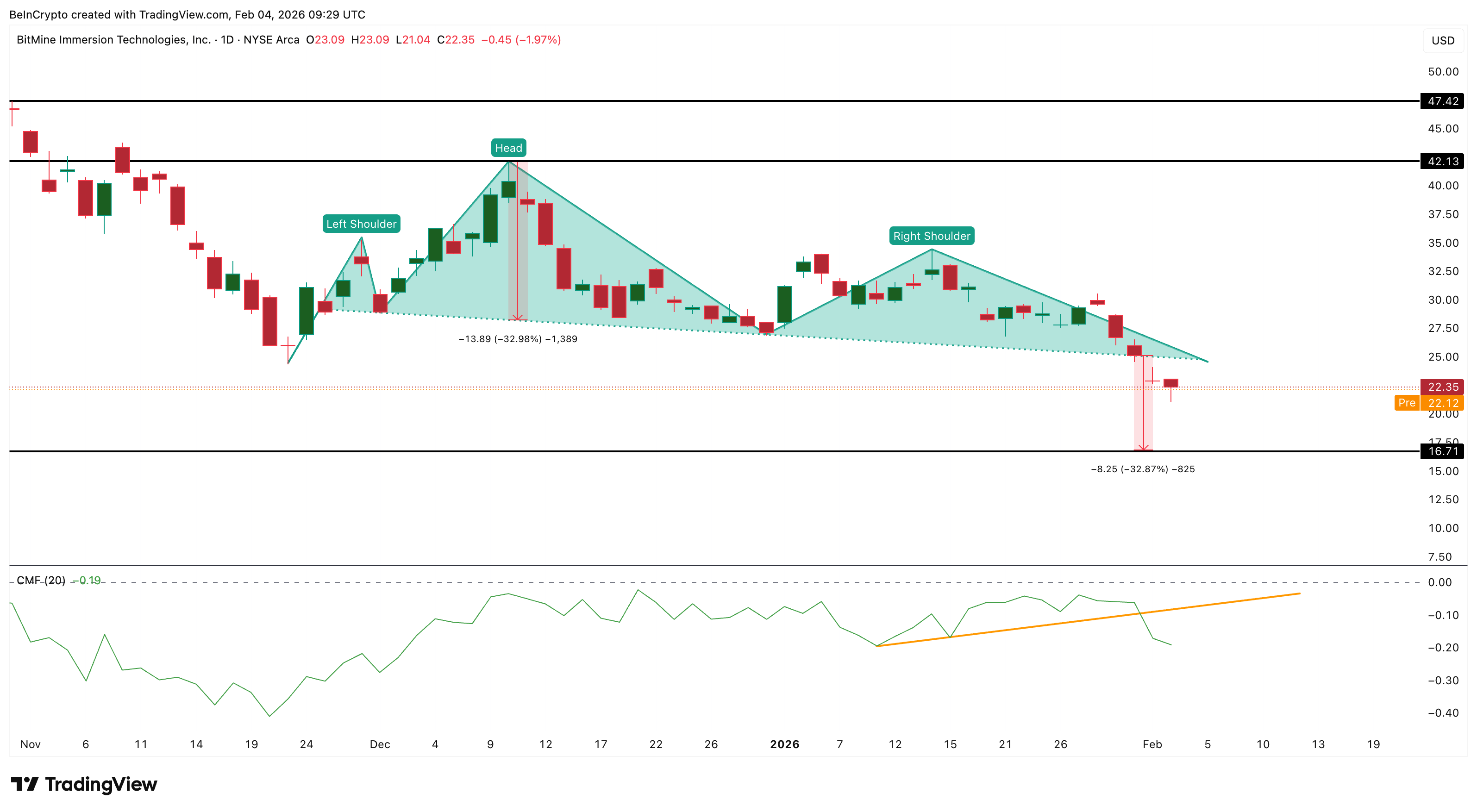
Chaikin Money Flow (CMF) measures whether money is flowing into or out of an asset using price and volume. Readings above zero suggest accumulation, while negative values signal capital outflows.
From January 30 onward, CMF fell sharply and remained below zero. This confirmed that large buyers were reducing exposure as the BMNR price approached key support. Both indicators aligned with the chart structure.
BMNR had been forming a head-and-shoulders pattern through December and January. When price failed near the neckline and then broke down on February 2 (gap-down formation), OBV and CMF confirmed the move.
In sequence, retail volume weakened first, large capital exited next, and prices collapsed afterward. The “feature, not a bug” ETH treasury narrative did not reverse this flow-driven sell-off.
Sponsored
Sponsored
Key BMNR Stock Price Levels Define the Next Move
After breaking the head-and-shoulders neckline and the rising trend line, the BMNR stock price resumed its broader downtrend, a projected dip of over 30%.
Several levels now define the outlook. On the downside, initial support sits near $19.26 if the BMNR stock price doesn’t reclaim $22.52 on the daily timeframe. Below $19.26, the next major level stands near $16.71, which aligns with the full technical projection of the bearish pattern.
If selling pressure accelerates, extended downside could reach toward $9.87, pushing the stock into single-digit territory. On the upside, recovery remains difficult.
The first resistance lies near $22.52. The BMNR stock price must reclaim this level to slow the decline. Above that, resistance appears near $25.07 and $28.66. These zones would need to be cleared to signal early stabilization.
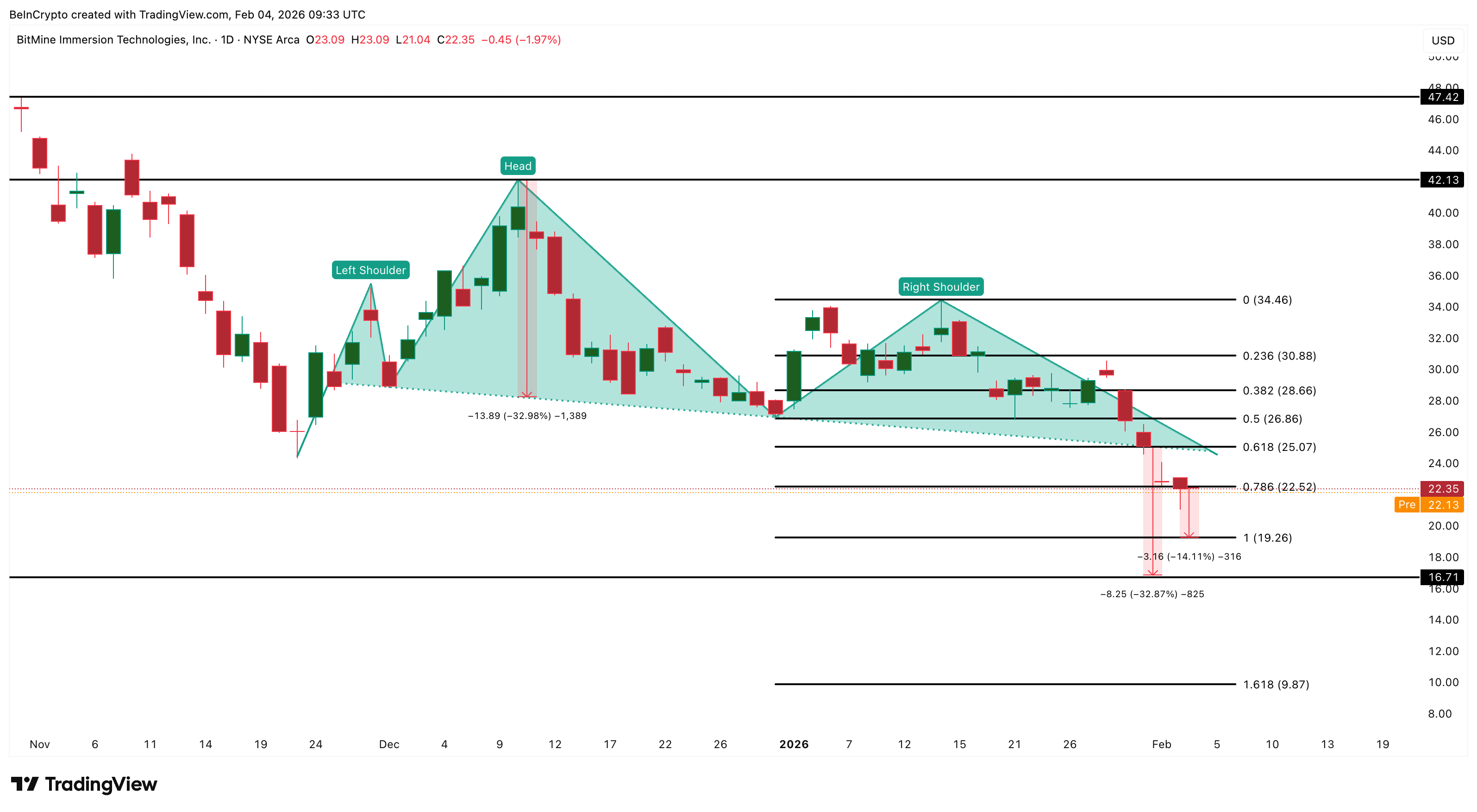
A broader trend shift would require a move above $34.46, followed by confirmation near $42. For now, both OBV and CMF remain weak, showing that buyers have not returned in force. Until capital flows turn positive and key resistance is reclaimed, technical pressure is likely to dominate BMNR stock price behavior.
Blockchain intelligence platform TRM Labs completed a $70 million Series C funding round, valuing it at $1 billion, becoming the latest crypto company to reach unicorn status.
The investment round was led by seed investor Blockchain Capital, with participation from Goldman Sachs, Bessemer Venture Partners, Brevan Howard Digital, Thoma Bravo, Citi Ventures and Galaxy Ventures, according to a Wednesday news release.
TRM Labs seeks to equip public and private institutions with AI solutions that combat cybercrime. The company defends against illicit activities that increasingly rely on automation.
“At TRM, we’re building AI for problems that have real consequences for public safety, financial integrity, and national security,” wrote Esteban Castaño, co-founder and CEO of TRM Labs.
“This funding allows our world-class team — and the people who will join us next — to innovate alongside institutions on the front lines of the most consequential threats, and expand the potential of AI to meaningfully improve how our critical systems are protected.”
The $70 million round shows that capital is flowing into blockchain analytics platforms seeking to stop the spread of AI-fueled scams and cyberattacks, including from large traditional institutions.
Related: Fake MetaMask 2FA security checks lure users into sharing recovery phrases
TRM Labs to expand global workforce, advance AI compliance and investigation tools
TRM is a San Francisco-headquartered company with hubs in Los Angeles, New York, Washington, London and Singapore.
It said the new capital will be used to expand its global workforce of AI researchers, data scientists, engineers and financial crime experts.
The company will also advance its AI-powered investigations to disrupt illicit activity and advance its solutions that help institutions manage financial crime risks.
Related: CZ proposes fix to address poisoning after investor loses $50M
Crypto phishing scams see resurgence due to generative AI advancements
Crypto phishing scams have been a long-standing issue in the industry, which saw a resurgence following advancements in generative AI. They involve hackers sharing fraudulent links with victims to steal sensitive information, such as crypto wallet private keys.
In December, a Bitcoin (BTC) investor lost his entire retirement fund to an AI-fueled romance scam known as a “pig butchering.” In this case, the scammer used AI-generated images to emotionally manipulate the victim into sending over his Bitcoin.

Still, the falling number of incidents suggests that investors are becoming better at safeguarding their assets from attackers.
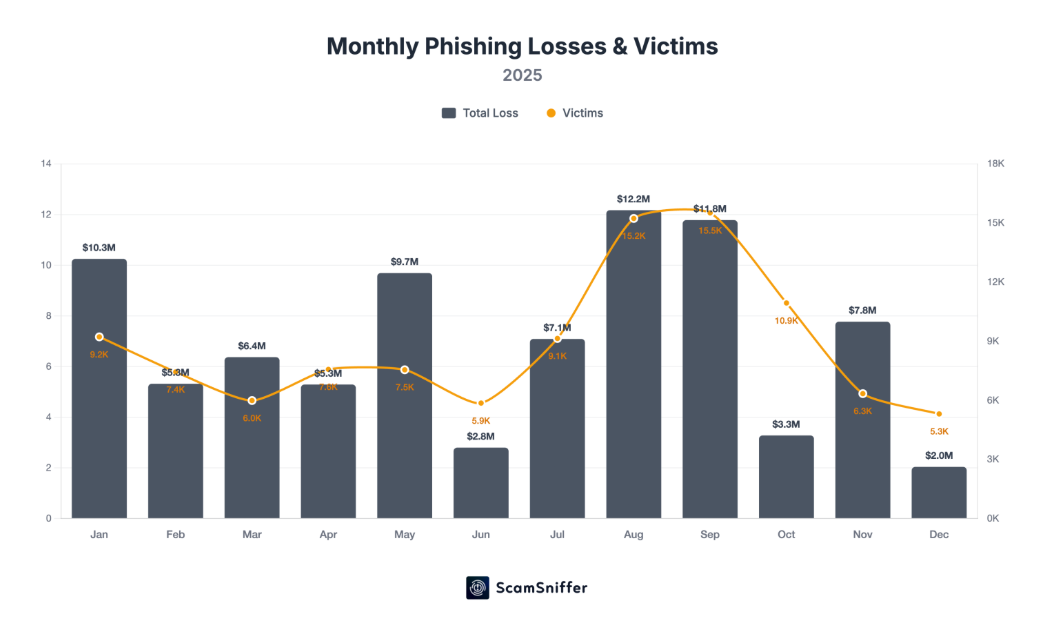
Losses to phishing scams decreased 83% year-on-year, falling to $83.3 million in 2025, from $494 million in 2024, according to a report from Web3 security tool Scam Sniffer
Magazine: Meet the onchain crypto detectives fighting crime better than the cops

TLDR
- Qualcomm reports December quarter earnings today with Wall Street forecasting $12.13 billion in revenue and $3.39 EPS
- The stock trades down 15% year-to-date, creating a 44% valuation discount compared to the S&P 500
- Bernstein analyst keeps Outperform rating with $200 target despite smartphone market headwinds
- Options pricing indicates approximately 6% expected move with market bias score at -1
- Critical support sits at $146-$148 while resistance holds at $150-$152
Qualcomm unveils its December quarter financial results after today’s closing bell. Analysts project revenue of $12.13 billion with adjusted earnings per share reaching $3.39.
The mobile processor and 5G chipset manufacturer has struggled in 2026. Shares have fallen 15% while the broader semiconductor sector rallied 13%.
This underperformance reflects growing concerns about smartphone demand. Rising memory prices threaten to crimp consumer device purchases throughout the year.
Yet not everyone shares this pessimistic outlook. Bernstein analyst Stacy Rasgon maintained his Outperform rating Monday.
His $200 price target suggests substantial upside from current levels. Rasgon believes the market is overlooking Qualcomm’s fundamental strengths.
“We still believe there is value to be had under the surface [with its] objectively strong product portfolio,” the analyst wrote. He acknowledged the “general distaste of smartphones” currently weighing on sentiment.
Valuation Gap Creates Opportunity
The numbers tell an interesting story. Qualcomm’s price-to-forward earnings ratio sits 44% below the S&P 500 average.
That’s a massive discount for a market leader in wireless technology. The company dominates mobile processors and 5G chipsets globally.
Wall Street expects the current quarter to deliver $11.11 billion in revenue with $2.90 EPS. These forward estimates matter just as much as December’s results.
Options traders are pricing in roughly 6% movement following the announcement. This implied volatility doesn’t favor either direction, just expects action.
Price Action Shows Shifting Dynamics
Recent trading patterns reveal something important. Selling pressure has weakened over the past several sessions.
Downside attempts keep stalling without sustained momentum. The stock has transitioned from steady decline to choppy range-bound movement.
This shift suggests sellers are losing control. But it doesn’t confirm buyers are ready to step in aggressively either.
Key support rests between $146 and $148. Holding this zone keeps the stabilization process alive.
Breaking below $146 would hand control back to sellers. That could trigger accelerated losses.
Resistance appears at $150 to $152. Failed rallies here would confirm range behavior rather than trend reversal.
The market bias score registers -1 on a scale from -10 to +10. This reflects lingering weakness alongside fading downside momentum.
Scores near zero indicate low conviction. Neither bulls nor bears have established control heading into the report.
Qualcomm continues to trade near the bottom of its post-earnings range. The corrective phase that began after last quarter’s results remains intact.
Tonight’s report will clarify whether memory price concerns are justified. Or if the market has overreacted to temporary headwinds.
The company’s product lineup remains competitive despite market skepticism. Execution and guidance will determine the stock’s next move.


Join Our Telegram channel to stay up to date on breaking news coverage
The Federal Reserve is planning a liquidity injection through bill purchases starting tomorrow, which will increase the money supply and often boost risk assets. The US Fed is set to add $8.3 billion in capital to support economic stability.
While short-term effects may vary, the decision to add liquidity is widely seen as super bullish in the long term, especially for risk assets like crypto and tech stocks.
Such a significant injection by the FED is also a signal that the central bank is committed to supporting financial markets amid ongoing global uncertainties. For crypto investors, this often translates into increased confidence and stronger price action over time.
Data also shows that the Fed will add $53.3 billion in liquidity by February 12 via bond reinvestments and reserve buys.
Total $55.3B liquidity added by Feb 12 via bond reinvestments & reserve buys.
QE SHOULD START SOONER NOW! pic.twitter.com/UqDRgIAttc— Money Ape (@TheMoneyApe) January 19, 2026
More liquidity can translate to calmer credit markets, lower pressure on short-term interest rates, and a supportive backdrop for both equities and bonds.
More Liquidity Good For Crypto
When the FED adds money into the system, it increases market liquidity, reduces borrowing costs, and encourages risk-taking among investors. This has historically led to higher equity and crypto prices, greater demand for scarce assets like Bitcoin, and stronger overall investor sentiment.
Crypto most thrives in high-liquidity environments, which may push the market towards a rally as capital trickles down from traditional finance.
Despite hopes of renewed momentum from shifts in the macroeconomic environment, the crypto market is currently in a sustained decline. In the last 24 hours, the crypto market has lost more than $50 million, dropping to a market capitalization of around $3.17 trillion as BTC plunged below $91,000.
This drop has resulted in massive liquidations in the market, totaling over $2 billion in the last 2 days and about $260 million in the last 24 hours, according to Coinglass data.
Related News:
Best Wallet – Diversify Your Crypto Portfolio

- Easy to Use, Feature-Driven Crypto Wallet
- Get Early Access to Upcoming Token ICOs
- Multi-Chain, Multi-Wallet, Non-Custodial
- Now On App Store, Google Play
- Stake To Earn Native Token $BEST
- 250,000+ Monthly Active Users
Join Our Telegram channel to stay up to date on breaking news coverage

TLDR
- AWS secures multi-year cloud and AI partnership with Prosus NV valued at hundreds of millions of dollars
- Deal consolidates Prosus cloud operations on AWS infrastructure with expected double-digit cost reductions
- Amazon reports Q4 2025 earnings Thursday with analysts forecasting $1.97 EPS and $211.44 billion revenue
- Partnership demonstrates ongoing enterprise demand for AI-enabled cloud services despite cautious spending
- Amazon stock trades at $238 with analyst price targets suggesting 25% upside potential
Amazon Web Services has locked in a substantial cloud and AI contract with Prosus NV just one day before the company releases its fourth-quarter results. The deal marks another win for AWS in the competitive enterprise cloud market.
Prosus Head of Ecosystem Igor Cardoso confirmed the three-year agreement runs into hundreds of millions of dollars. He stopped short of disclosing the precise contract value in his Bloomberg interview.
The partnership will see Prosus migrate its entire cloud and AI workload to AWS infrastructure. Multiple AWS data centers across different regions will support the consolidated operations.
Cost Efficiency Drives Enterprise Cloud Adoption
Prosus expects to slash costs by double digits through the AWS migration. The savings stem from standardizing operations on a single cloud platform rather than managing multiple vendor relationships.
This approach reflects broader enterprise trends. Companies continue investing in cloud technology when it delivers clear financial benefits and operational improvements.
For Amazon, the agreement adds meaningful contracted revenue to its AWS backlog. These long-term commitments provide stability even when quarterly spending patterns fluctuate.
The deal also validates ongoing demand for AI-integrated cloud services. Enterprises remain willing to commit substantial resources to AI infrastructure that produces measurable results.
Amazon faces Wall Street on Thursday, February 5, with its Q4 fiscal 2025 earnings report. Analysts project adjusted earnings per share will reach $1.97 compared to $1.86 in the prior-year period.
Revenue forecasts point to $211.44 billion for the quarter. That represents 12.6% growth year-over-year.
AWS Backlog Reflects Strong Customer Pipeline
Amazon’s contracted cloud revenue continues expanding according to company metrics. The growing backlog shows customers making multi-year commitments to AWS services.
These extended agreements reduce earnings volatility and improve revenue predictability. They also signal customer confidence in AWS as a strategic technology provider.
Prosus will collaborate directly with AWS technical teams to scale AI capabilities across its portfolio. The standardized infrastructure should accelerate deployment timelines while controlling expenses.
The announcement timing highlights AWS competitive strength entering the earnings release. It provides tangible proof of enterprise demand before management discusses quarterly performance.
Amazon shares have dropped 1.4% over the trailing twelve months. The stock currently sits at $238, well below analyst consensus targets.
TipRanks data shows 35 Buy ratings and one Hold rating for Amazon stock. The average analyst price target stands at $298.53, implying 25.1% upside from current trading levels.
The Prosus contract covers cloud infrastructure, AI workloads, and technical collaboration. Both companies expect the partnership to deliver enhanced efficiency through consolidated operations.
Supply chain visibility has emerged as one of the most critical priorities for enterprises operating in an increasingly complex and interconnected global economy. Organizations today manage multi-country supplier networks, volatile demand patterns, regulatory pressures, and heightened customer expectations for speed and transparency. Despite significant investments in digital platforms, many supply chain leaders still struggle with delayed insights, fragmented data, and limited operational clarity.
One of the most persistent and underestimated contributors to this challenge is document dependency. Every supply chain process, procurement, logistics, inventory management, finance, and compliance, relies heavily on documents such as purchase orders, invoices, shipping notices, bills of lading, packing lists, and regulatory certificates. These documents contain essential operational intelligence, yet much of this information remains trapped in unstructured or semi-structured formats. This is where Intelligent Document Processing Solutions are playing a transformative role. By enabling intelligent document processing for supply chain operations, organizations can eliminate visibility gaps, accelerate decision-making, and build resilient, data-driven supply chains.
The Root Causes of Visibility Gaps in Supply Chain Operations
1. Heavy Reliance on Manual Document Handling
Many supply chain processes still depend on manual document review, data entry, and validation. This approach introduces delays, errors, and inconsistencies that prevent real-time visibility. Even small discrepancies in invoices or shipping documents can cascade into payment delays, shipment holds, or compliance violations.
2. Fragmented Information Across Systems
Documents originate from multiple internal departments, suppliers, logistics partners, and regulatory authorities. Without enterprise document automation, data is often siloed across emails, shared drives, portals, and legacy systems, making it difficult to establish a single source of truth.
3. Delayed Data Availability
In many organizations, document data is entered into ERP or supply chain systems only after physical events have already occurred. This reactive data flow undermines forecasting, planning, and proactive risk mitigation.
These challenges highlight why traditional automation approaches are insufficient and why AI solutions for supply chain management are becoming essential.
Get a Custom IDP Solution for Your Supply Chain
What is Intelligent Document Processing in the Supply Chain Context?
Intelligent Document Processing Solutions use artificial intelligence technologies, including machine learning, natural language processing, and advanced optical character recognition, to automatically ingest, classify, extract, validate, and integrate data from supply chain documents. Unlike traditional OCR or rule-based systems, intelligent document processing for supply chain operations understands context rather than relying on fixed templates. It adapts to variations in document formats, learns from historical data, and continuously improves accuracy over time.
By embedding intelligence directly into document workflows, organizations can convert document-driven processes into real-time, automated data pipelines that enhance end-to-end visibility.
How Intelligent Document Processing Fixes Visibility Gaps Across the Supply Chain
Now that the visibility challenges and enabling technology are clear, it is important to understand how intelligent document processing delivers tangible improvements across supply chain operations.
1. Automating High-Volume Document Ingestion
Supply chains generate thousands, often millions of documents annually. Document automation in supply chain environments enables organizations to automatically ingest documents from emails, portals, scanners, APIs, and partner systems.
AI-driven classification models instantly identify document types and route them into the appropriate workflows. This eliminates manual sorting, reduces processing backlogs, and ensures uninterrupted data flow across the supply chain.
2. Context-Aware Data Extraction Across Supplier Ecosystems
Modern Intelligent Document Processing Solutions extract data based on semantic understanding rather than static rules. This capability is critical in global supply chains where document formats vary widely across suppliers, regions, and regulatory environments.
AI models can accurately identify invoice values, shipment dates, quantities, and compliance attributes even when layouts differ significantly. This ensures consistent, structured data capture across diverse document sources, an essential foundation for scalable supply chain automation.
3. Real-Time Integration with Enterprise Platforms
Visibility is only valuable when data is immediately actionable. Enterprise document automation integrates extracted document data directly into ERP systems, transportation management systems (TMS), warehouse management systems (WMS), and other core supply chain platforms.
This real-time integration enables:
- Accurate, up-to-date inventory visibility
- Live shipment and delivery status tracking
- Faster order and invoice reconciliation
- Immediate financial and operational reporting
As a result, decision-makers gain a unified, real-time view of supply chain performance across functions and geographies.
4. Reducing Operational, Financial, and Compliance Risk
Manual document processing remains one of the leading sources of supply chain risk. Errors in customs forms, invoices, or shipping documentation can trigger regulatory penalties, shipment delays, and reputational damage.
By embedding validation rules, confidence scoring, and anomaly detection, AI in supply chain operations identifies discrepancies early in the process. This proactive risk management approach reduces downstream disruptions, strengthens compliance posture, and improves overall operational resilience.
5. Improving Financial Transparency and Supplier Collaboration
Financial workflows are deeply interconnected with supply chain execution. Document automation in supply chain operations accelerates invoice processing, improves three-way matching accuracy, and shortens dispute resolution cycles.
These capabilities enhance cash flow visibility, reduce working capital constraints, and strengthen supplier trust, which are critical factors for maintaining stable and resilient supplier relationships in volatile markets.
The Strategic Role of AI in Supply Chain Operations
Beyond automation, AI solutions for supply chain management enable organizations to transform document data into predictive and prescriptive intelligence. Once document information is structured and standardized, it becomes a high-quality input for advanced analytics and AI models.
For example:
- Predictive analytics can identify potential shipment delays before they occur
- AI models can detect recurring compliance risks or supplier performance issues
- Automated workflows can trigger corrective actions when anomalies are detected
In this way, AI in supply chain operations shifts enterprises from reactive problem resolution to proactive and preventive supply chain management.
Industry Trends Accelerating Intelligent Document Processing Adoption
Several macro-level trends are driving the rapid adoption of Intelligent Document Processing Solutions across supply chain-intensive industries:
- Increasing Supply Chain Complexity
Global sourcing, regulatory diversity, and geopolitical uncertainty are amplifying the need for real-time visibility and automated compliance management.
- Shift Toward Autonomous Operations
Organizations are moving beyond basic automation toward intelligent, self-optimizing supply chains powered by AI-driven decision-making.
- Convergence of IDP, RPA, and Analytics
The integration of document intelligence with robotic process automation and advanced analytics enables straight-through processing across supply chain workflows.
- Demand for Scalable, Low-Code Platforms
Modern enterprise document automation solutions are designed for rapid deployment and scalability, reducing implementation complexity and dependency on IT-heavy customization.
Together, these trends position supply chain automation as a strategic capability rather than a tactical efficiency initiative.
Measurable Business Outcomes of Intelligent Document Processing
Organizations that adopt intelligent document processing for supply chain operations consistently achieve measurable outcomes, including:
- Significant reduction in document processing cycle times
- Improved accuracy of inventory, shipment, and financial data
- Lower operational and compliance risk
- Enhanced customer service and fulfillment performance
- Greater confidence in data-driven planning and execution
These outcomes directly address the visibility limitations that constrain supply chain performance and growth.
Develop AI-Driven Document Automation for Supply Chains
Why Intelligent Document Processing is a High-Value Enterprise Investment
From a strategic perspective, Intelligent Document Processing Solutions deliver value across the enterprise:
- Operations leaders gain transparency and execution control
- Finance teams achieve faster reconciliation and improved cash flow predictability
- IT teams deploy scalable, secure, AI-driven automation
- Compliance teams maintain audit-ready, traceable documentation
This cross-functional impact makes AI solutions for supply chain management one of the most compelling enterprise investments in today’s digital transformation landscape.
Building Transparent and Resilient Supply Chains
Supply chain visibility challenges are no longer caused by a lack of data, but by the inability to process document-driven information at speed and scale. Intelligent Document Processing Solutions address this challenge by transforming documents into real-time intelligence that powers connected, responsive, and resilient supply chains. By embracing enterprise document automation and AI in supply chain operations, organizations can move from fragmented workflows to unified, insight-driven supply chain management.
Antier enables enterprises to deploy advanced intelligent document processing solutions that unlock end-to-end supply chain visibility and operational intelligence. With deep expertise in AI-driven transformation, Antier helps organizations build scalable, future-ready supply chain ecosystems.


Besides launching the first-ever modular markets for XRP, the latest development introduces modular lending to the Flare ecosystem.
The decentralized finance (DeFi) blockchain network, Flare, has unveiled first-of-its-kind modular lending markets for XRP, introducing permissionless lending for the cryptocurrency.
According to a press release shared with CryptoPotato, the deployment features a partnership with the modular lending protocol, Morpho. Additionally, Flare is also joining forces with Mystic, a platform for curating lending markets across the Ethereum Virtual Machine (EVM) ecosystem. With Morpho leading the integration of modular XRP lending markets on Flare, Mystic will serve as the front-end interface for Morpho on Flare.
Modular Lending Markets For XRP
Modular lending breaks down traditional, all-in-one crypto lending pools into isolated and customizable components. The architecture allows users to create tailored markets with specific oracle feeds and risk parameters, rather than having a single pool dictate risk for all involved assets. Such an approach enhances efficiency and security for users’ funds, given the volatile nature of the crypto market.
Besides launching the first-ever modular markets for XRP, the latest development introduces modular lending to the Flare ecosystem. The move marks a huge step forward in the network’s vision for XRP DeFi (XRPFi), which is transforming the crypto asset from a dormant one into a proactive source of yield and a composable strategy.
Flare has made it its mission to expand DeFi capabilities for XRP, as seen in yield tokenization via Spectra, spot trading through Hyperliquid, and staking via Firelight. In addition, Flare has launched its version of XRP, named FXRP, unlocking yield-generating opportunities for the digital asset.
With the addition of Morpho and Mystic to the framework, Flare has implemented an expansion that enables lending and borrowing use cases that retain XRP on its native blockchain while unlocking on-chain utility.
Expanding the XRPFi Ecosystem
Following the latest integration on Flare, FXRP can now deposit their assets into curated yield-bearing vaults, using FXRP (or other assets like Flare (FLR) and USDT0) as collateral to borrow supported assets. They can also integrate lending positions into structured strategies, gaining access to capabilities that enable capital to loop across staking, lending, and borrowing within a single ecosystem.
You may also like:
“Each market supports a single collateral and loan asset, with parameters such as loan-to-value ratios set at creation. Markets can be launched permissionlessly, while curated vaults allocate capital across selected markets based on defined risk and yield objectives,” Flare explained.
While Mystic serves as the primary access point for now, Flare intends to unveil additional interfaces, such as the Morpho main app, over time.
SECRET PARTNERSHIP BONUS for CryptoPotato readers: Use this link to register and unlock $1,500 in exclusive BingX Exchange rewards (limited time offer).


Burry says Bitcoin is behaving like a speculative trade, and not a hedge, which raises risks for companies holding massive BTC reserves.
Bitcoin’s (BTC) slide below $80,000 has intensified worries that a wider downturn in the broader crypto sector could be imminent.
Market experts believe that the recent slide in BTC’s price may not be an isolated correction, but a development that could seriously destabilize corporate balance sheets and magnify systemic risk if it continues to fall.
Major Market Casualty
Michael Burry has issued a stark warning that Bitcoin’s continued decline could erase significant value across the market, and the greatest risk is concentrated among companies that have built large corporate treasuries around the asset, which have mushroomed over the years.
In the latest Substack post following the latest crypto sell-off, “The Big Short” investor, Burry, said BTC’s drop below important technical levels opens the door to cascading stress not only within crypto markets but also across adjacent financial sectors.
He said that the world’s largest crypto asset is failing to meet a critical expectation often placed on it, that is, acting as a hedge against currency debasement. Instead, Burry said its recent behavior more closely resembles that of a speculative risk asset, particularly given its correlation with the S&P 500. He said gold and silver rallied on geopolitical uncertainty and dollar weakness, but Bitcoin did not follow those macro signals.
Burry also predicted that further downside could have severe consequences for Bitcoin treasury companies that accumulated BTC aggressively during higher price ranges. He highlighted the possibility that another 10% decline could leave major holders such as Michael Saylor’s Strategy billions of dollars underwater, and potentially cut them off from capital markets, thereby increasing bankruptcy risk.
Such outcomes, according to the investor, could amplify losses beyond individual firms and contribute to broader market fallout. Burry additionally noted that Bitcoin’s weakness has coincided with recent pressure in precious metals.
You may also like:
Galaxy Digital’s Zac Prince also questioned the long-term viability of Bitcoin treasury companies, which raise capital to hold BTC on their balance sheets while promising yield. Speaking on TheStreet Roundtable, Prince said these models rely on risky financial engineering rather than BTC’s native value. He compared them to past schemes that created tokens to generate Bitcoin and said that paying a premium for such structures does not make them sustainable.
He even explained that while some firms might pivot to revenue-generating activities, many will still struggle to justify their valuations, and added that businesses should focus on real operations first and treat BTC as a treasury strategy, not the primary driver.
Optimism Wanes
Bitcoin has been under tremendous pressure, and many analysts believe that there could be more pain ahead instead of a much-anticipated recovery.
Former Binance CEO Changpeng “CZ” Zhao also said that while he had been positive about a BTC super cycle just weeks ago, current market sentiment has made him less confident. Speaking on Binance’s social platform, he highlighted the rise of fear, uncertainty, and doubt (FUD) in the community and admitted that the emotional intensity has left him uncertain about BTC’s near-term prospects.
SECRET PARTNERSHIP BONUS for CryptoPotato readers: Use this link to register and unlock $1,500 in exclusive BingX Exchange rewards (limited time offer).
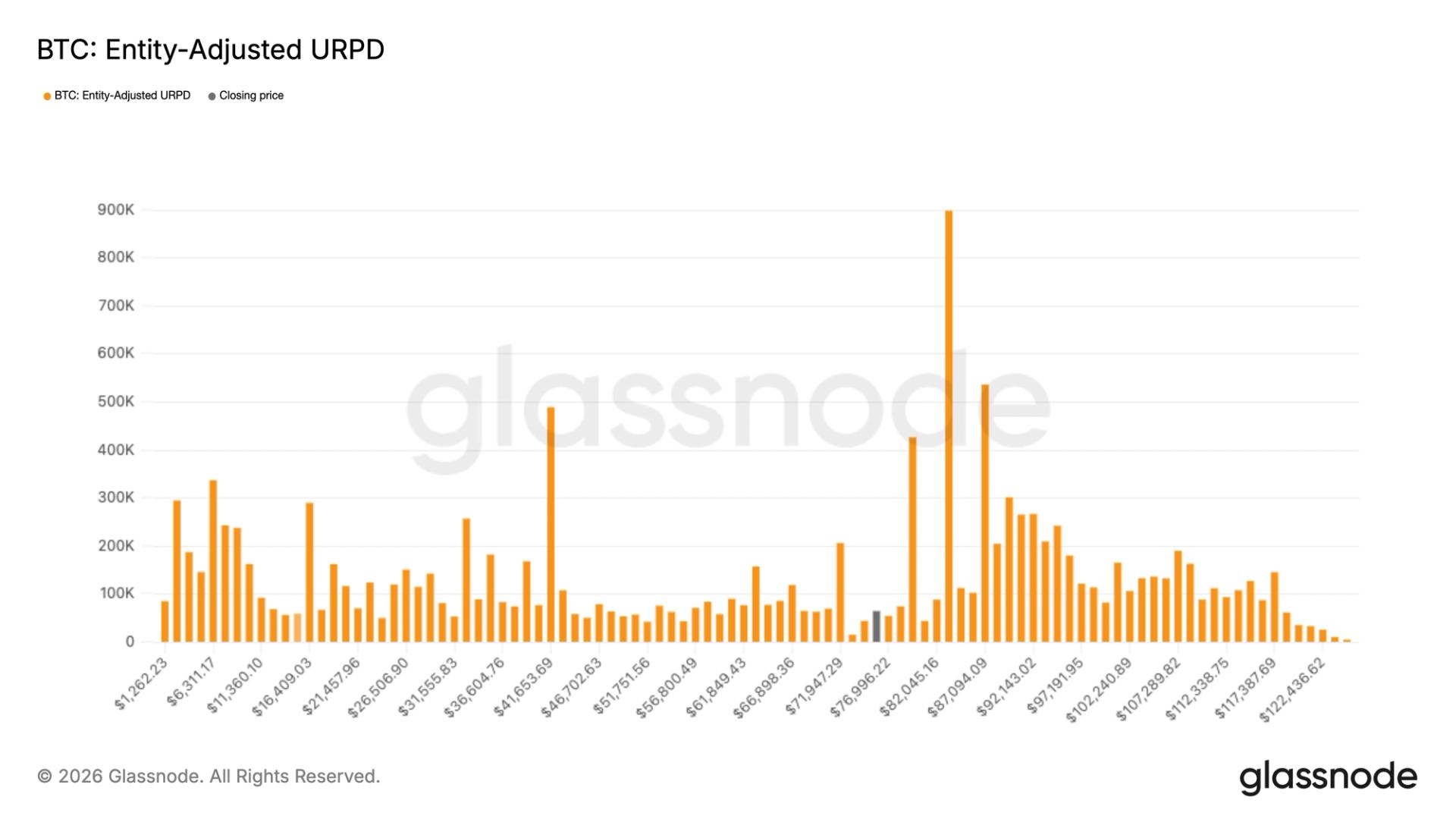
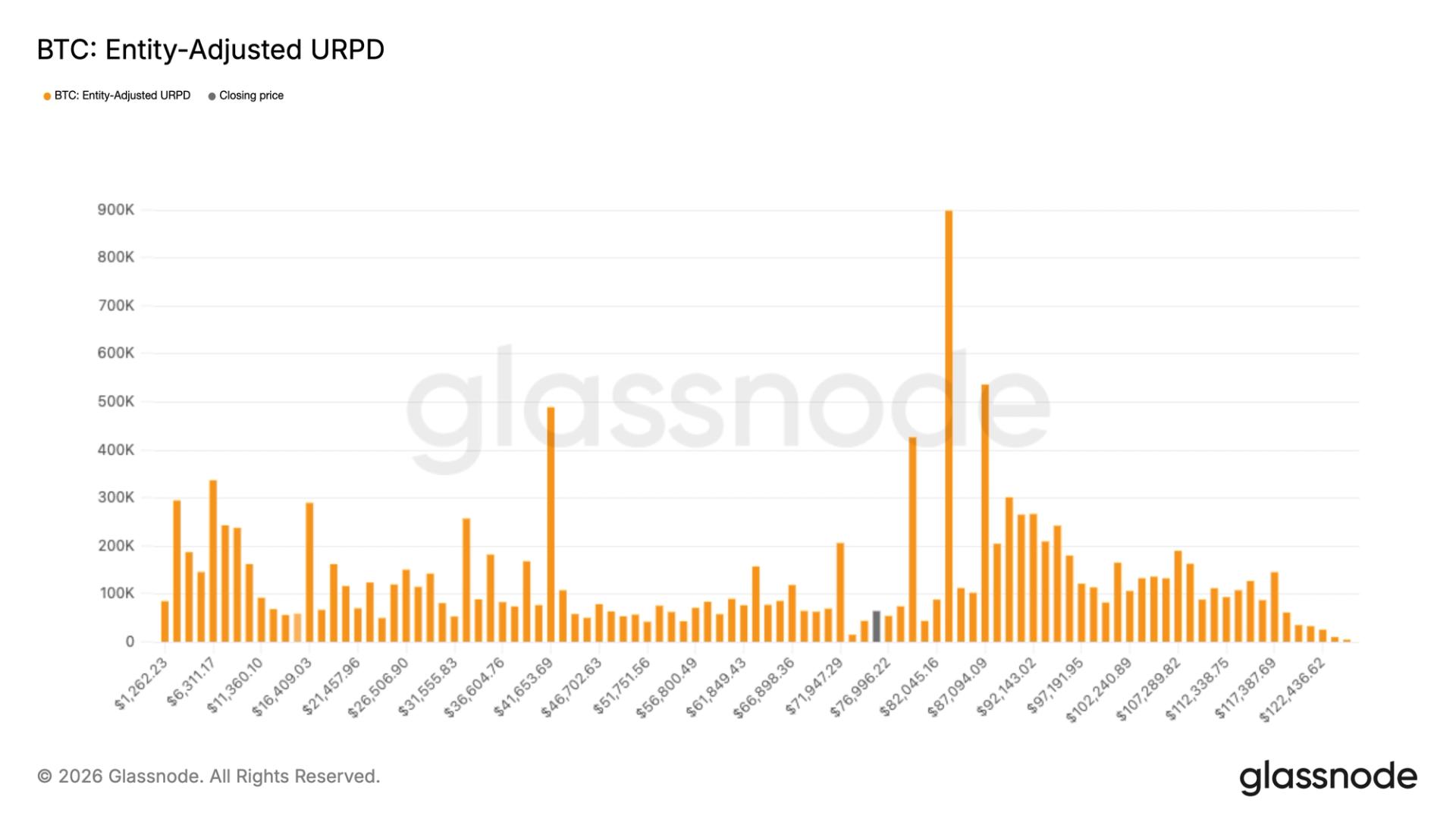
Since the weekend’s slump, the bitcoin price has been constrained between $70,000 and $79,999 for five straight days. That’s a remarkably long time for a range in which the largest cryptocurrency has spent a relatively short span of time.
In fact, bitcoin has spent about 35 days within that $10,000 bucket. Compared with other increments, it’s one of the least developed, underscoring how quickly the price has tended to move through rather than build sustained support or resistance.
The longer the price spends in a given range, the more opportunity there has been for positions to be built, which can later translate into stronger support. What this means is the price is more likely to consolidate in this range or, potentially, make another move toward the lower end near before establishing a more durable base.
During the tariff driven volatility last April, bitcoin held below $80,000 for just a few weeks before rebounding. Similarly, when it reached a then all-time high near $73,000 in March 2024, it spent only a short period at those levels before declining.
Perhaps the clearest example of how quickly bitcoin has moved through this range occurred in November 2024 following Donald Trump’s presidential election victory. The price accelerated from roughly $68,000 to $100,000 in a matter of weeks, leaving little opportunity for consolidation between $70,000 and $80,000.
It’s notable that Strategy (MSTR), the largest corporate holder of bitcoin, has only once bought bitcoin within this range. On Nov. 11, 2024, the company purchased 27,200 BTC for approximately $2 billion at an average price of $74,463.
Consider a chart that shows the prices at which bitcoin last moved within a specific price bucket. Each column represents the amount of bitcoin transferred at that price.
The data clearly shows a lack of supply between $70,000 and $80,000, suggesting that this zone remains structurally thin.
Standard Chartered is urging investors to look through near-term volatility in digital assets and focus on what it calls “quality” blockchain projects.
The remark comes as the recent selloff reshapes relative value across the crypto market.
Sponsored
Sponsored
Standard Chartered Backs Ethereum and Solana for Long-Term Outperformance Despite Near-Term Volatility
Geoff Kendrick, the bank’s Head of FX and Digital Assets Research, said he is actively accumulating during the downturn. According to the analyst, the pullback is a defining moment for long-term positioning.
“I am a buyer of this dip in digital assets,” Kendrick told BeInCrypto in an email. “What’s more, I think this is the start of greater differentiation in digital asset performance, whereby quality projects win.”
Within that framework, Standard Chartered continues to favor Ethereum and Solana as its top layer-1 exposures. Kendrick reiterated that view explicitly, adding:
“I have previously highlighted my view that Ethereum is one such quality project. And here I do the same for Solana. Buy quality.”
Recently, Standard Chartered said it saw Ethereum outperforming Bitcoin, citing DeFi dominance, scalability upgrades, and regulatory clarity.
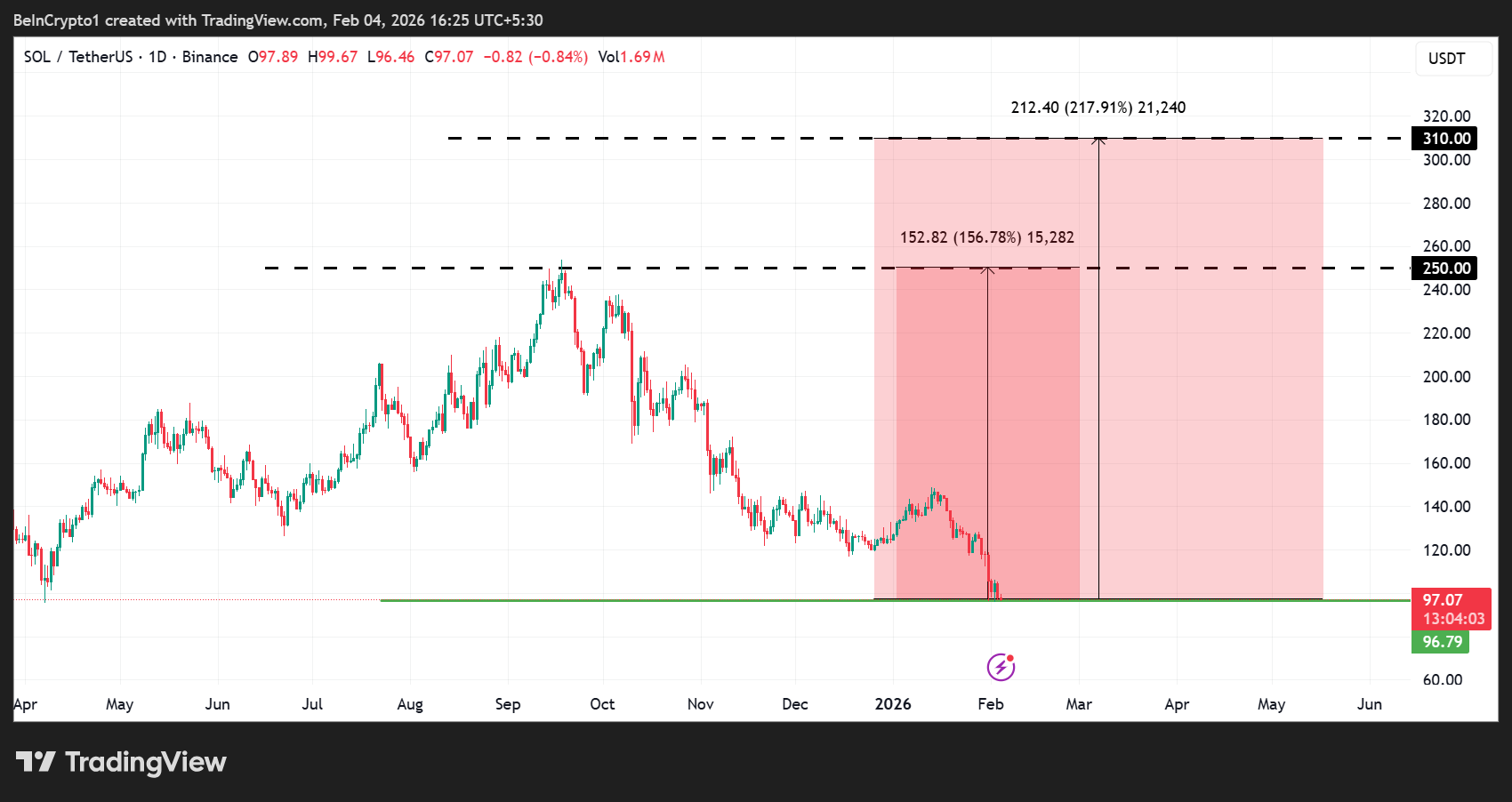
The bank, however, has tempered its near-term expectations for Solana. Standard Chartered lowered its end-2026 price forecast for SOL to $250 from $310. On this, they cite the time required for the network’s next major use case to mature.
“We lower our end-2026 price forecast to USD 250, as Solana’s next dominant use case may take time,” Kendrick said.
Sponsored
Sponsored
Despite that cut, the bank raised its longer-dated projections, arguing that Solana’s structural advantages remain intact.
Solana’s Shift from Meme Coins to Micropayments Could Drive Long-Term Outperformance
According to Standard Chartered, Solana’s ultra-low-cost, high-throughput architecture positions it to eventually dominate micropayments. This, Kendrick says, is particularly true as AI-driven applications and stablecoin-based transactions gain traction.
“We raise our forecasts thereafter, as we see Solana eventually dominating the micropayments space,” Kendrick noted.
Sponsored
Sponsored
If that thesis plays out, the bank expects SOL to outperform Bitcoin between 2027 and 2030, while only gradually catching up to Ethereum as the ecosystem scales.
The report highlights a subtle but important shift underway on Solana’s decentralized exchanges. While the network has long been associated with meme coin activity, flows are increasingly rotating toward SOL-stablecoin trading pairs.
These stablecoins, Standard Chartered notes, are turning over two to three times faster than their Ethereum counterparts.
That evolution could help Solana shed its “meme coin discount,” which previously weighed on valuation and deterred TradFi participants.
Sponsored
Sponsored
Analysts Back Standard Chartered’s Quality Wins Narrative
Market commentators broadly echoed the bank’s “quality wins” narrative. Investor Mike Alfred described the drawdown as a textbook risk-off move.
“…this is a run-of-the-mill risk-off move where the lowest quality goes down the hardest, and then everything bounces… This is when real money is made,” wrote Alfred, referencing the recent market drop.
Developer and investor Mike Ippolito struck a similar tone, arguing that sentiment has swung too far in the negative direction.
“I think people are far too bearish ETH and SOL today,” he said, calling layer-1 blockchains “the Amazon or Google of our time” due to their global markets, high barriers to entry, and fee-generating potential.
Standard Chartered expects Solana to underperform Ethereum through 2026 and into 2027. But beyond that window, the bank sees a catch-up phase driven by scale, utility, and cost advantages.
In Kendrick’s view, the current volatility is less a warning sign than a sorting mechanism, one that may ultimately reward investors willing to buy quality while the market is still unsettled.

Mandelson peddles bizarre lie

Ducks beat Kraken, jump them in standings in final game before break

You’re over 50 and just got laid off from Big Tech: Here’s what to do next


-
 Crypto World5 days ago
Smart energy pays enters the US market, targeting scalable financial infrastructure
-
 Crypto World6 days ago
Software stocks enter bear market on AI disruption fear with ServiceNow plunging 10%
-

 Politics5 days ago
Why is the NHS registering babies as ‘theybies’?
-
 Crypto World5 days ago
Adam Back says Liquid BTC is collateralized after dashboard problem
-

 Video2 days ago
When Money Enters #motivation #mindset #selfimprovement
-

 Tech5 hours ago
Wikipedia volunteers spent years cataloging AI tells. Now there’s a plugin to avoid them.
-

 NewsBeat5 days ago
Donald Trump Criticises Keir Starmer Over China Discussions
-

 Politics2 days ago
Sky News Presenter Criticises Lord Mandelson As Greedy And Duplicitous
-

 Crypto World4 days ago
U.S. government enters partial shutdown, here’s how it impacts bitcoin and ether
-

 Fashion5 days ago
Weekend Open Thread – Corporette.com
-

 Sports4 days ago
Sinner battles Australian Open heat to enter last 16, injured Osaka pulls out
-
 Crypto World4 days ago
Bitcoin Drops Below $80K, But New Buyers are Entering the Market
-
 Crypto World2 days ago
Market Analysis: GBP/USD Retreats From Highs As EUR/GBP Enters Holding Pattern
-
 Crypto World5 days ago
KuCoin CEO on MiCA, Europe entering new era of compliance
-
Business5 days ago
Entergy declares quarterly dividend of $0.64 per share
-

 Sports2 days ago
Shannon Birchard enters Canadian curling history with sixth Scotties title
-

 NewsBeat1 day ago
US-brokered Russia-Ukraine talks are resuming this week
-

 NewsBeat2 days ago
GAME to close all standalone stores in the UK after it enters administration
-

 Crypto World14 hours ago
Russia’s Largest Bitcoin Miner BitRiver Enters Bankruptcy Proceedings: Report
-

 Crypto World5 days ago
Why AI Agents Will Replace DeFi Dashboards