
Crypto World
How EU Crypto Tax Laws Are Set to Work in Practice

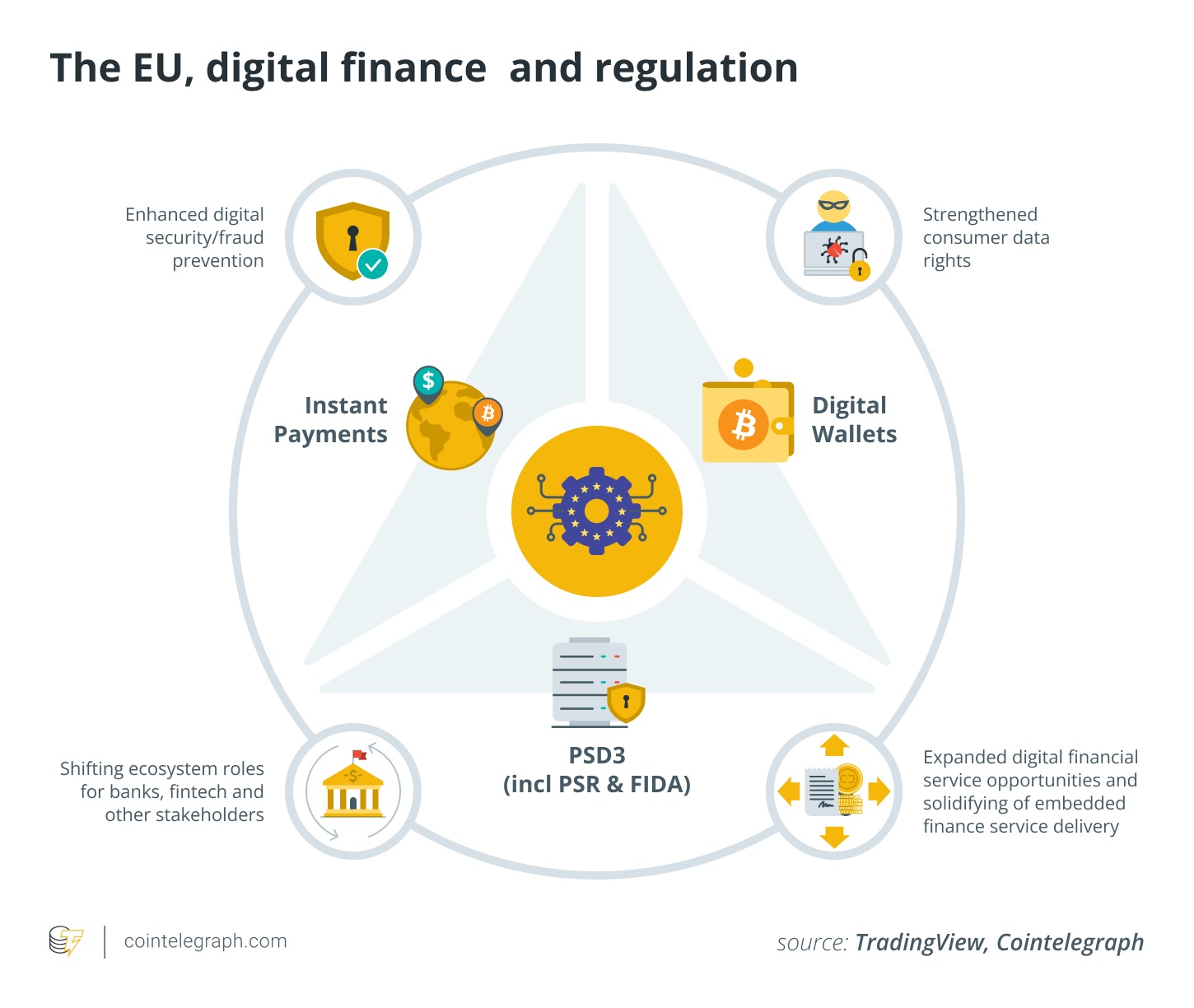
Key takeaways
-
The EU’s new crypto tax rules do not introduce new taxes but expand tax transparency by ensuring that crypto transactions are reported and shared across member states.
-
Reporting obligations fall primarily on crypto-asset service providers, requiring them to collect user identity information, tax residency details and transaction data in a standardized format.
-
Information reported by platforms will be automatically exchanged among EU tax authorities, reducing cross-border reporting gaps for crypto users.
-
The framework aligns with the Organisation for Economic Co-operation and Development’s global crypto reporting standard, increasing compatibility with non-EU jurisdictions.
The European Union is set to significantly enhance its monitoring of cryptocurrency transactions for tax purposes. Starting Jan. 1, 2026, updated reporting obligations require crypto platforms operating in the EU or serving EU users to provide detailed information on users and their transactions to tax authorities. This change aligns digital assets more closely with the transparency requirements long established in conventional finance.
The key legislation driving this shift is Council Directive (EU) 2023/2226, commonly known as DAC8. It expands the EU’s existing framework for the automatic exchange of tax information to include crypto assets. Paired with the Markets in Crypto-Assets (MiCA) regulation, DAC8 represents a major step in regulating the crypto sector. It focuses specifically on taxation rather than solely on market conduct or licensing.
This article explains how the new EU crypto tax reporting system will work, outlines the obligations for platforms and examines the implications for individual users as the rules take effect.
Why DAC8 is being introduced: Closing the gap from banks to blockchains
For more than a decade, EU countries have used the Directive on Administrative Cooperation (DAC) to automatically share tax-related financial data across borders. Previous iterations covered bank accounts, investment income and certain digital platforms, but crypto transactions were largely exempt from routine reporting.
As cryptocurrency adoption grew in Europe, this exemption created clear loopholes for potential tax evasion. EU authorities viewed it as inconsistent to exempt crypto solely because of its technological basis.
DAC8 aims to close this gap by formally incorporating crypto assets into the tax transparency system, ensuring that transaction data is gathered, reported and exchanged in a manner similar to traditional financial information. The European Commission has emphasized that crypto deserves no special exemption from tax enforcement.

Alignment with the OECD’s Crypto-Asset Reporting Framework (CARF)
The EU built DAC8 around the CARF, which was launched in 2023. The CARF sets a global benchmark for crypto transaction reporting by specifying:
-
Which crypto assets qualify for reporting
-
Which entities must report
-
The specific user and transaction details required.
By adopting the CARF model, the EU promotes consistency with international standards, making it easier to share data with non-EU countries that implement similar rules.
Did you know? Before crypto-specific rules, several EU tax authorities relied on blockchain analytics firms instead of formal reporting to estimate crypto activity, often producing significantly different figures for the same market.
Scope of DAC8: Covered assets and platforms
The focus of DAC8 is on crypto-asset service providers (CASPs) operating in the EU. These include centralized exchanges, brokers, custodial wallets and similar intermediaries. The rules cover a broad range of assets, including most cryptocurrencies, stablecoins, tokenized assets and certain non-fungible tokens that function more like investment vehicles than pure collectibles. The emphasis is on transferability and investment use rather than on specific labels.
The obligations extend beyond EU-based platforms. Non-EU providers serving EU users may also need to comply, highlighting the directive’s extraterritorial impact.
Timeline and implementation of DAC8
Adopted in October 2023, DAC8 required transposition into national law by Dec. 31, 2025, with application starting on Jan. 1, 2026. As of early 2026, some member states have faced delays or infringement notices for incomplete transposition, though the EU expects full enforcement.
Key dates include:
-
Platforms began collecting relevant data on Jan. 1, 2026.
-
The first reports, covering 2026 activity, will be submitted to national tax authorities in 2027, typically within nine months of year-end.
-
Tax authorities then automatically exchange the data annually with other EU countries.
The commission has signaled that it expects timely and full implementation. Several countries have received formal notices for delays in transposing the rules, underlining that enforcement will not be optional.
Did you know? Early drafts of EU crypto tax proposals debated whether self-custody wallets could ever be subject to reporting, highlighting how difficult it is to regulate decentralized ownership.
Reporting requirements for platforms in DAC8
Under DAC8, CASPs are required to perform enhanced due diligence and submit detailed information to their local tax authority. This includes user details such as full name, address, tax residency and tax identification number (TIN), if available.
Transaction data includes:
-
Types of crypto transactions, such as sales, exchanges and transfers
-
Gross proceeds from disposals
-
Dates and values of transactions.
After collection, this information is automatically shared among EU tax authorities. A user’s country of residence receives the relevant data even if the platform is located in a different country.
For platforms, DAC8 makes crypto tax reporting a structured, recurring compliance obligation. It more closely resembles financial reporting than ad hoc disclosures.
Impact of DAC8 on crypto users
One of the most significant changes for crypto users is increased tax reporting transparency under DAC8. National tax authorities can now view transactions conducted on reporting platforms.
This may result in:
-
Requests for more detailed tax residency or identification information during account setup or updates
-
Greater ability for authorities to match crypto activity against declared income on tax returns
-
Easier detection of inconsistencies between reported data and tax filings.
DAC8 does not introduce new taxes or standardize rates across the EU. Member states retain authority over crypto taxation policies, as the directive focuses solely on information exchange. While DAC8 automates data exchange between authorities, users are still required to report their crypto activity through their respective national tax returns.

Compliance challenges for platforms under DAC8
Implementing DAC8 requires significant upgrades, including accurate transaction tracking, tax residency verification and secure data storage. Smaller or less-resourced providers may struggle to meet these obligations alongside MiCA and Anti-Money Laundering requirements.
Non-compliance carries the risk of penalties, including fines for late, incomplete or missing reports. Some platforms have indicated that regulatory compliance costs may influence where they choose to operate.
Users may also face confusion in understanding DAC8 in the context of MiCA. DAC8 addresses tax transparency behind the scenes, while MiCA covers licensing, investor safeguards and market conduct.
The two are complementary: DAC8 ensures tax data flows once services are active, while MiCA defines permissible operations. Together, they create a comprehensive oversight framework for the crypto economy.
Certain aspects remain unclear under DAC8, such as how decentralized finance (DeFi) fits in when no central intermediary exists to report to. Privacy advocates have raised concerns about extensive data collection and sharing, though EU officials note that the General Data Protection Regulation (GDPR) and other data protection laws continue to apply. It remains to be seen how these safeguards will operate in practice.
Did you know? Similar crypto tax reporting models are being explored in Asia-Pacific and Latin America, suggesting that EU-style transparency could become a global norm rather than a regional exception.
DAC8 in the broader context
DAC8 forms part of a global trend as crypto integrates into mainstream finance. Governments worldwide are increasingly treating it as part of the mainstream financial system rather than as a parallel economy viewed with suspicion.
By adopting OECD-aligned standards and enabling cross-border exchanges, the EU underscores that crypto will face the same transparency demands as traditional assets. For users and platforms in Europe, the period of limited formal tax oversight is effectively ending.
Cointelegraph maintains full editorial independence. The selection, commissioning and publication of Features and Magazine content are not influenced by advertisers, partners or commercial relationships.


TLDR:
- Binance nears $1T in spot volume, maintaining a clear lead over competitors like MEXC and Bybit in 2026.
- Perpetual futures volumes reach up to $24T, showing consistent growth across cycles and stronger market participation.
- Futures trading activity stands nearly four times larger than spot, driving liquidity and short-term price movement.
- Competing exchanges like OKX and Bybit show steady growth, though Binance still controls the largest share.
Binance continues to dominate global crypto trading activity in 2026, with cumulative volumes far ahead of competitors.
Data from CryptoQuant shows strong growth across both spot and perpetual futures markets, reinforcing Binance’s position despite rising competition from other major exchanges.
Spot Market Cycles Show Repeating Patterns
A recent tweet from CryptosRus points to Binance nearing $1 trillion in spot trading volume. This figure stands well above MEXC and Bybit, which trail at much lower levels. The data reflects a clear concentration of liquidity within one dominant platform.
The CryptoQuant chart shows spot trading volumes forming repeated cycles over time. Each cycle begins with steady accumulation, followed by a rapid upward surge. After reaching peak levels near $5–6 trillion, volumes reset sharply before starting a new phase.
This pattern suggests that spot trading activity responds strongly to market momentum. During bullish periods, participation rises quickly. However, once activity peaks, volumes drop as trading slows and positions are reduced.
Binance consistently accounts for the largest share across these cycles. Other exchanges such as OKX, Bybit, and Coinbase International, contribute smaller portions. Their presence grows gradually, yet they remain secondary in overall volume distribution.
At the same time, the structure of these cycles indicates that spot markets do not expand in a straight line. Instead, activity builds in waves, shaped by changing market conditions and trader behavior.
Futures Market Expansion Outpaces Spot Growth
While spot trading shows cyclical movement, perpetual futures markets display much larger scale and faster expansion. Binance has reached $4.5 trillion in cumulative perpetual futures volume, exceeding competitors by a wide margin.
The lower chart from CryptoQuant tracks several growth phases in futures trading. Early cycles peak near $8–10 trillion, while later cycles push toward $20–24 trillion. Each phase ends with a reset, similar to the spot market structure.
However, the overall trend shows increasing peak levels over time. This indicates that futures trading continues to expand with each cycle. As a result, derivatives now represent the dominant share of crypto market activity.
Binance remains the leading exchange in this segment as well. Still, OKX and Bybit show steady growth, gradually increasing their share of total futures volume. Coinbase International also appears in the data, though at a smaller scale.
The gap between spot and futures volumes remains wide. Futures trading reaches nearly four times the size of spot activity at peak levels. This difference points to a market where leverage and short-term positioning play a central role.
Moreover, the consistent rise in futures volumes suggests deeper participation from both retail and institutional traders. As trading strategies evolve, derivatives continue to attract more activity across multiple exchanges.
Overall, the data shows a market shaped by cycles, expanding participation, and strong exchange competition. Binance leads both segments by scale, while other platforms steadily build their presence in a growing trading environment.

XRP’s price action has been in an extended downtrend for eight months, but a convergence of on-chain signals is drawing attention to a potential bottoming narrative. The XRP/BTC pair’s RSI sits deep in the oversold zone, with readings around 24, a level that has historically aligned with macro bottoms and subsequent recoveries. Data tracked by TradingView, and summarized in recent coverage, suggest this could be more than a temporary squeeze for the cross-pair.
Beyond the RSI, on-chain analytics are flashing a similar signal. XRP’s MVRV Z-score, a gauge that compares market value to realized value, is hovering near zero—a cadence historically associated with accumulation phases and capitulation-driven bottoms. Glassnode’s metrics indicate that such coordinates often precede meaningful rallies, echoing a pattern seen in prior cycles in 2021, 2022 and again in 2024 before pronounced upside moves.
To place these signals in a market context, a Cointelegraph chart that overlays XRP/BTC price action against the broader market shows that the last bottom in XRP/BTC around this zone in June 2025 preceded a substantial rally: a 61% rebound in the XRP/BTC ratio and a 92% surge in XRP/USD to a multi-year high of roughly $3.66. The chart’s yellow bars emphasize how these zones have repeatedly acted as macro bottoms for the XRP/BTC pair.
Key takeaways
- RSI for XRP/BTC at about 24 signals an oversold condition that historically marks macro bottoms and the start of new uptrends.
- MVRV Z-score for XRP is near zero, a level that has preceded accumulation phases and subsequent rallies in multiple prior cycles.
- Glassnode heatmaps show a substantial cost-basis distribution around the $1.30 area, with about 1.73 billion XRP bought near that price band.
- The XRP/USD price must hold above a key support zone of $1.25–$1.30; losing this zone could open a path toward a lower demand area, including the $1.15 region and the 200-week moving average.
- Historical patterns suggest that bottoms from these levels have been followed by meaningful rallies, though macro conditions and market sentiment remain critical filters.
On-chain signals point to a potential bottoming process
From a technical standpoint, XRP’s recent price action is painting a familiar picture: a prolonged downtrend cooled by deep oversold momentum. The RSI reading in the XRP/BTC pair has rarely dropped further in recent cycles without a subsequent phase of consolidation before a bounce, and in this cycle, the indicator sits at levels that have historically preceded risk-off capitulation turning into a recovery phase. While RSI alone is not a predictor, when paired with the on-chain landscape, it reinforces a stance that selling pressure might be ebbing.
Complementing the RSI, the MVRV Z-score provides a more long-horizon perspective. The score near zero implies that many investors are near breakeven and may be less inclined to rush toward the exit. That dynamic can reduce downside pressure and enable a more stable base to form, a hallmark of accumulation zones that precede rallies. The last time XRP’s MVRV Z-score revisited these levels, similar to late-2024 and early-2025, the market accrued strength before resuming gains.
Analysts have tied these signals to a broader narrative about XRP’s cycle. An observed pattern from prior cycles shows that whenever these on-chain indicators align with oversold momentum, they often pave the way for a multi-month recovery in price. This is not a forecast but a lens through which traders are evaluating risk and opportunity at current levels.
“If this zone continues to hold, then a short-term bounce towards $1.45 can’t be ruled out.”
That perspective, voiced by a trader on X, reflects a plausible near-term pathway if the current support remains intact and buyers step in at the zone around $1.25–$1.30. The emphasis is on the zone’s integrity: a sustained hold here would be a signal that demand could reassert itself and push XRP toward higher ground, even before evaluating macro catalysts.
Support, resistance, and what could unfold next
From a price-structure standpoint, the immediate floor lies in the $1.25–$1.30 band. This zone has held since early February 2026 and has acted as a crucial pivot point for the bull-bear balance. If demand persists in defending this range, a measured rebound could unfold, potentially aiming toward the $1.45 area and beyond. Traders eyeing a return to higher levels would look for a continued rejection of shorts at these thresholds, coupled with improving on-chain signals and stabilizing price action.
However, a breach below the zone would raise the risk of a more extended downside move. The next line of defense sits near the $1.15 area, where the 200-week simple moving average has hovered. A break below this level could trigger a swift re-pricing, pushing XRP toward the bear-flag target around $0.80, a level that would reframe the risk-reward for bulls in the near term. In practice, this setup makes the $1.30 region a critical fulcrum for bulls and bears alike.
Beyond the immediate levels, market observers note that the long-run trajectory will hinge on a confluence of factors: the capacity of XRP to sustain on-chain health, macro risk appetite, and regulatory developments that could influence crypto liquidity and sentiment. The broader narrative of XRP’s cycle has historically shown that bottoms in this zone have not been isolated events; they have often coincided with stronger macro flows and renewed buying interest from longer-horizon holders.
On the price trajectory, the charted path hints at upside potential if the zone holds. Prior episodes have demonstrated that a bottom in this region can coincide with a shift in momentum and a fresh phase of accumulation, eventually leading to fresh highs once the market reasserts confidence. In this context, observers see the possibility of XRP moving toward the $1.70 level or higher if buyers maintain control and the macro environment remains favorable.
Context, history, and what anchors traders are watching
Historical context matters for investors seeking to gauge risk. The rally pattern that followed the June 2025 XRP/BTC bottom—characterized by a 61% improvement in the XRP/BTC ratio and a 92% surge in XRP/USD to a multi-year high—offers a concrete example of how a bottom can translate into meaningful upside within a relatively short timeframe. While past performance is not a guarantee of future results, the alignment of on-chain signals with price action in that period reinforces a cautious optimism among market participants.
Another anchor is the cost-basis distribution. Glassnode’s heatmap shows that roughly 1.73 billion XRP were accumulated near the $1.30 price level, suggesting a robust base of investors with meaningful exposure in that band. This concentration can provide a ballast to price during volatility but may also attract selling pressure if the price falters, given the number of coins purchased at or near the same level. The dynamics underscore the importance of the $1.25–$1.30 support as both a technical and a psychology-driven threshold.
For readers seeking corroboration, the broader narrative has drawn on a mix of price charts and on-chain metrics, including references to XRP’s performance in other cycles and the behavior of the XRP/USD and XRP/BTC cross-pairs. Notably, Cointelegraph has highlighted past instances where XRP’s bottom against Bitcoin in that zone preceded sharp rallies, illustrating how cross-market relationships can amplify a rally even when the USD price remains at modest levels. These data points provide a framework for assessing risk in the current environment, rather than a single-point forecast.
What to watch next
Investors should keep a close eye on whether XRP can sustain the $1.25–$1.30 support zone in the near term. A stable hold would bolster the case for a bounce and could draw in momentum traders seeking a breakout above the immediate overheads. Conversely, a break below $1.15, with a potential retest of the 200-week moving average, would shift the outlook toward a more cautious stance and raise the odds of revisiting the lower $0.80 region.
In addition to price actions, market participants should monitor the evolving on-chain narrative around MVRV Z-scores and holder cost bases. A continued alignment between on-chain metrics and price strength would be a meaningful signal that the market is re-accumulating effectively. As always, macro conditions—liquidity, risk appetite, and regulatory clarity—will shape the pace and duration of any nascent upturn.
Readers should watch for further developments in XRP’s cross-market dynamics, including how the XRP/BTC pair behaves around the current consolidation range and whether the broader crypto market conditions provide the catalysts needed for a sustained move higher. If the zone holds and macro sentiment improves, a path toward higher levels—potentially toward the $1.70 area or beyond—could emerge as part of a broader re-pricing of risk in the months ahead.
TLDR:
- WLFI token dropped to new lows following plans to unlock tokens for early holders, raising supply concerns.
- The project is managing about $150M in stablecoin loans, increasing pressure on collateral stability.
- Reports claim billions in WLFI were used as collateral to borrow $75M within a concentrated liquidity setup.
- High pool utilization near 93% may limit withdrawals, raising concerns about liquidity access for users.
World Liberty Financial’s WLFI token has dropped to new lows amid concerns around liquidity use and governance decisions.
The decline follows reports of a planned token unlock for early holders while the project manages about $150 million in stablecoin loans.
WLFI Token Pressure Grows Amid Unlock Plans
A recent update shared on X by Coin Bureau stated that the WLFI token reached fresh lows. The drop came after the project signaled plans to unlock tokens for early holders. At the same time, it continues to defend a large stablecoin borrowing position.
The proposed unlock has raised concerns about added selling pressure. Early holders gaining access to tokens may increase circulating supply. As a result, market participants are closely watching price stability.
At the same time, the project is managing around $150 million in stablecoin loans. This creates a balancing act between maintaining collateral value and handling liquidity needs. If token prices weaken further, the position could face added stress.
The timing of the unlock proposal has drawn attention. Market conditions remain fragile, and liquidity levels appear tight. This combination has kept traders cautious as the situation develops.
Lending Activity and Liquidity Concerns Surface
Additional discussion emerged from a widely shared thread by StarPlatinum. The post described how billions of WLFI tokens were reportedly used as collateral. Around $75 million in stablecoins was borrowed through a lending protocol.
The thread claimed that WLFI accounts for about 55% of the protocol’s liquidity. This concentration raises concerns about how withdrawals may function under pressure. With nearly 93% of the stablecoin pool already utilized, available liquidity appears limited.
The structure described suggests a closed system. Tokens are deposited, borrowed against, and supported within the same ecosystem. As long as token prices hold, positions remain stable. However, any sharp decline could strain the setup.
The thread also noted links between the lending platform and individuals connected to WLFI. This has raised questions about the relationship between borrowers and infrastructure. While no formal violations were confirmed, the overlap has drawn attention.
Further attention focused on reported fund movements. Over $40 million was said to have moved to Coinbase Prime shortly before a major announcement. The timing has led to speculation, though the team has denied wrongdoing.
These developments come as liquidity conditions tighten. Retail users may face delays if withdrawal demand rises. With most funds already deployed, flexibility within the system appears limited.
Market participants continue to monitor both price action and protocol health. The combination of token unlock plans and lending exposure remains a key focus. Any changes in collateral value or liquidity could influence the next phase.
For now, the WLFI token remains under pressure. Traders are assessing risk levels while waiting for further clarity from the project. The coming updates may shape how the market responds in the short term.
Crypto World
Ethereum Tokenized Treasury Funds Surge Past $22.5B as Institutional Adoption Accelerates
TLDR:
- Tokenized treasury funds on Ethereum exceed $22.5B, dominating 71.9% of blockchain fund markets globally.
- JPMorgan, BlackRock, and Franklin Templeton expand on-chain funds, increasing institutional capital flow.
- Market growth accelerated sharply after 2024, rising from $10B to over $20B within a short timeframe.
- Ethereum evolves into a key platform for tokenized money markets and short-term yield instruments.
Tokenized treasury funds on Ethereum have climbed past $22.5 billion, according to data shared by Token Terminal.
The chart tracks steady growth since 2021, with recent expansion tied to institutional activity and new on-chain money market products.
Institutional Capital Drives On-Chain Treasury Growth
A tweet from Etherealize noted that tokenized treasury products now dominate blockchain-based fund markets. Ethereum accounts for 71.9% of total tokenized fund assets across networks. The data places the network at the center of institutional-grade capital flows.
Recent entries from major financial firms support that trend. JPMorgan launched its MONY market fund on Ethereum in early 2026. It joined offerings from BlackRock and Franklin Templeton, both already active on-chain.
These products replicate traditional money market exposure using blockchain rails. They provide yield-bearing instruments accessible without brokerage accounts. As a result, they align with the needs of automated capital systems operating on-chain.
The chart shows a sharp rise in total value after these institutional entries. Assets moved from roughly $10 billion to above $20 billion within a short period. The upward move coincides with broader adoption of tokenized treasuries and short-duration instruments.
Moreover, the presence of established financial institutions signals a shift in how capital interacts with blockchain infrastructure. Traditional funds now operate within permissionless systems, expanding access to liquidity tools.
Market Structure Shifts From Experimentation to Expansion
The Token Terminal chart outlines a multi-year transition in tokenized fund adoption. Early activity between 2021 and 2022 remained limited, with total value declining below $1 billion. That phase reflected early testing and low institutional participation.
Conditions changed during late 2022 and 2023. The market formed a base between $0.5 billion and $2 billion. Gradual growth during that period indicated early infrastructure readiness for tokenized financial products.
Momentum accelerated through 2024 and early 2025. Total value broke past $5 billion, then $10 billion, marking a clear structural shift.
Growth during this stage followed a steeper trajectory, supported by increasing adoption of real-world asset tokenization.
By 2025, expansion entered a faster phase. The chart shows a move from $10 billion to over $20 billion, with a brief pullback near $18 billion. The recovery that followed pushed totals to approximately $22 billion.
Key structural levels appear across the timeline. The $10 billion mark acted as a major breakout point. Meanwhile, the $20 billion range serves as a psychological threshold tied to liquidity expansion.
The data also points to Ethereum’s evolving role in financial markets. The network now supports large-scale treasury operations, moving beyond its earlier use cases. This shift reflects growing demand for on-chain yield and capital efficiency.
At the same time, tokenized funds continue to expand across treasury bills and money market structures. These instruments offer stability while maintaining blockchain accessibility. As adoption grows, the chart suggests continued alignment between traditional finance and decentralized infrastructure.
TLDR:
- Ethereum trades between $2.1K and $2.3K as momentum indicators turn bullish after February’s sharp market correction.
- RSI climbs above 60 and MACD shows a bullish crossover, signaling improving momentum in Ethereum’s daily chart.
- CryptoQuant data shows ETH benefiting from capital inflows and tightening supply during the current market phase.
- Whale accumulation pace is slowing, suggesting the accumulation phase may be ending before a possible rally.
Ethereum is showing early recovery signs after months of decline, as recent data points to renewed market activity and stabilizing price action.
Analysts note a shift in momentum, although price remains within a tight range below key resistance levels.
Ethereum Shows Early Recovery as Momentum Indicators Turn Positive
CryptoQuant noted that Ethereum is currently benefiting from capital inflows, reduced supply pressure, and steady ecosystem growth. These combined factors are positioning ETH as relatively stronger during the current market phase.
At the same time, market data shows Ethereum rebounding from its February lows near the $2,000 level. Price action has since stabilized between $2,150 and $2,300, forming a consolidation range. The latest daily candle closed at $2,243.7, reflecting a modest gain of 2.46%.
Technical indicators are also shifting. The Relative Strength Index is now at 60.05, moving above the neutral 50 level. This change signals improving momentum after rebounding from oversold conditions seen earlier in the year.
In addition, the Moving Average Convergence Divergence indicator has turned positive. The MACD line remains above the signal line, while the histogram continues expanding in positive territory. This pattern reflects strengthening bullish momentum after a prolonged bearish phase.
Despite these developments, Ethereum remains below immediate resistance between $2,250 and $2,300. A sustained move above this zone is still required to confirm a broader recovery trend. Until then, the price continues to trade within a defined range.
Whale Activity Slows as Market Watches for Next Direction
While indicators suggest improving conditions, whale behavior is showing a different pace. According to CW, the rate of Ethereum accumulation by large holders is slowing. This shift may signal the end of the recent accumulation phase.
Historically, accumulation phases often precede upward price movements. However, they can also mark transition points where large holders begin distributing assets at higher levels. This creates uncertainty around the next market direction.
At the same time, Ethereum’s broader trend remains influenced by its earlier decline from near $5,000 in August 2025. The asset experienced consistently lower highs and lower lows before reaching its February bottom. That larger trend still frames current price action.
Support levels remain firm around $2,100, with the $2,000 level acting as a psychological floor. On the upside, resistance extends beyond $2,300 toward $2,800 and $3,000, where previous breakdowns occurred.
For now, Ethereum continues to move sideways within its current range. This phase reflects a balance between recovering demand and cautious market sentiment. Traders are closely watching for a breakout or rejection at nearby resistance.
As conditions evolve, Ethereum’s next move will likely depend on whether buyers can sustain momentum above current levels. Until then, consolidation remains the dominant structure in the short term.
TLDR:
- Japan proposes classifying crypto assets under financial law to align them with traditional market regulations.
- A flat 20% crypto tax replaces higher rates, while allowing traders to carry losses forward for three years.
- Insider trading rules will now apply to crypto, aiming to improve fairness and transparency in trading activity.
- Banks may soon offer crypto custody services, while new rules could support the launch of spot crypto ETFs.
Japan is moving to reshape its crypto sector through a new legal framework that places digital assets under financial regulation.
The proposed bill introduces trading rules, tax changes, and institutional access, marking a shift in how the country manages crypto markets.
New Legal Structure for Crypto Markets
Japan’s Financial Services Agency has submitted a bill that classifies cryptocurrencies as financial instruments. This move places digital assets under the Financial Instruments and Exchange Act. As a result, crypto trading will follow rules similar to traditional financial markets.
The update gained wider attention after a post shared by Crypto Patel on X outlined the key changes. The tweet described new restrictions, disclosure rules, and tax adjustments tied to the proposed legislation. It also pointed to broader institutional participation in crypto markets.
One major update involves a ban on insider trading related to cryptocurrencies. This rule aligns crypto markets with existing financial regulations that govern stocks and other assets. It aims to reduce unfair trading advantages and increase trust among participants.
At the same time, the bill requires disclosures for 105 tokens, including Bitcoin and Ethereum. These disclosures are expected to improve transparency and provide clearer information for investors. Market participants will have access to standardized data, which may support more informed decisions.
The classification of crypto as a financial instrument also signals stricter oversight. Exchanges and related service providers may need to adjust operations to meet regulatory standards. This includes compliance measures tied to reporting and investor protection rules.
Tax Reform and Institutional Access
The proposed framework introduces a flat 20% tax on crypto gains, replacing rates that previously reached up to 55%. This change simplifies the tax structure and aligns it more closely with traditional investment taxation.
In addition, traders will be allowed to carry forward losses for up to three years. This provision offers flexibility for those managing volatile portfolios. It also brings crypto taxation closer to systems used in equity markets.
Another key point from the shared tweet is the potential for banks to hold and custody cryptocurrencies. If approved, this would allow financial institutions to directly engage with digital assets. It may also expand services available to both retail and institutional clients.
The bill also opens the possibility for more spot crypto exchange-traded funds. These products could provide regulated exposure to digital assets through traditional investment channels. This development may attract new participants who prefer structured financial products.
Taken together, these changes show a coordinated effort to integrate crypto into Japan’s financial system. Regulatory clarity, tax adjustments, and institutional access are all addressed within the same framework.
The proposed law now awaits parliamentary review, where further discussions may shape its final form. Market participants are closely watching the process as Japan refines its approach to digital asset regulation.


A planned $1.6 billion SPAC merger between Dynamix Corporation (DYNX) and crypto firm The Ether Machine has been terminated, over unfavorable market conditions, The Ether Machine said Friday.
The agreement, first unveiled in July 2025, aimed to take ether (ETH) treasury firm The Ether Machine public on Nasdaq under the ticker ETHM.
The company is designed to act as an Ethereum treasury and yield vehicle, generating returns through staking and decentralized finance strategies while holding large reserves of ether. It currently holds 496,712 ETH worth more than $1.1 billion, according to CoinGecko data.
Initially, the deal stood out for its scale. It included a $1.5 billion fully committed PIPE financing deal, described as the largest all-common-stock raise of its kind since 2021, alongside roughly $170 million held in Dynamix’s trust account.
The combined company was expected to launch with more than 400,000 ETH on its balance sheet, backed in part by a contribution from co-founder Andrew Keys.
The merger has now been called off due to what the companies described as unfavorable market conditions. According to The Ether Machine, the two firms “mutually agreed to terminate” the deal. As part of the termination agreement, Dynamix will receive a $50 million payment within 15 days, according to a filing with the U.S. Securities and Exchange Commission (SEC).
Crypto World
The crypto honeymoon is over for now as analysts warn of a major first-quarter profit squeeze


Crypto trading has cooled in early 2026, and Wall Street analysts are racing to adjust their forecasts before companies report first-quarter earnings.
New research from Barclays and Oppenheimer shows multiple analysts are reaching similar conclusions, a few weeks into the second quarter. Expectations are coming down across the sector as trading volumes weaken and earlier projections look too optimistic.
Barclays took the most direct step, downgrading Coinbase (COIN) and warning that “global crypto trading activity has declined to a level not seen since the end of 2023.” The bank added that “absent a resurgence in near-term crypto trading activity, we see profitability under pressure at Coinbase.”
The slowdown is visible in the data. Coinbase’s March trading volume marked “the lowest volume month since September 2024,” Barclays wrote, with April showing “no signs of improvement.” For the first quarter, the bank estimates volumes fell roughly 30% from the prior quarter.
Coinbase and other exchanges charge fees on each transaction they facilitate, meaning lower volumes will lead to less revenue.
The mechanics are straightforward. When markets turn quiet, many traders step back. A retail user who once traded weekly during a rally may stop altogether when prices flatten. Multiply that behavior across millions of accounts, and exchange volumes drop quickly.
That matters because transaction fees remain the main revenue driver for most crypto platforms. Barclays underscored this risk, saying its forecast for Coinbase’s adjusted EBITDA is about 24% below the Street, driven largely by weaker spot trading and retail activity.
Crypto prices have pulled back in the first quarter, with the average price of major tokens falling sharply quarter-over-quarter. Bitcoin lost over 22% of its value in the first quarter of this year, while ether was down 29%.
Oppenheimer struck a similar tone but kept a more upbeat stance on Coinbase. The firm said it is cutting its forecasts due to softer crypto prices and lower trading activity in the first quarter, driven in part by broader economic uncertainty. It also noted that current Wall Street estimates still do not fully reflect the drop in trading volumes during that period.
That lag is now being corrected.
Across the industry, analysts are revising models downward to reflect a quieter market.
Oppenheimer cut its Coinbase volume estimate to $211 billion for the quarter, down from $244 billion previously, and now expects total revenue of $1.48 billion, below prior forecasts and consensus.
The reset is not limited to Coinbase. Oppenheimer said that Circle (CRCL) continues to expand the USDC stablecoin network, with stablecoin market cap and USDC transfer volume rising about 1% and 12% quarter over quarter, respectively.
Crypto platform Bullish (BLSH), the owner of CoinDesk, saw “strong on platform activity” tied to volatility in February, though spot volumes still missed expectations. As a result, Rosenblatt downgraded BLSH earlier this week while Compass Point downgraded CRCL — to “neutral” and “sell,” respectively.
Even these pockets of strength highlight the broader issue: the core business of crypto trading is slowing.
Efforts to diversify revenue streams are underway but may take time to offset the downturn. Coinbase’s push into becoming what it calls an “everything exchange” includes derivatives, tokenized assets and new markets. Barclays was skeptical, writing that the strategy is “likely to take a long time to pay off” and that it sees “little ‘right to win’ in new asset classes like equities.”
Stablecoins, often seen as a steadier revenue stream, also face uncertainty. Barclays pointed to ongoing debate in Washington over regulation, noting that the status of stablecoin rewards “remains in question.” At the same time, Oppenheimer sees near-term support from new use cases, saying “increased prediction market activity could support USDC growth.”
Still, those areas remain secondary to trading.
The broader takeaway is that analysts are moving preemptively. With earnings season approaching, firms are lowering estimates now rather than risk being caught off guard by weak results later.
Coinbase reports second-quarter earnings on May 7 and Bullish reports on April 23. Circle has not yet announced a date.
TLDR:
- The S&P 500 gained 7.6% over seven sessions, marking its longest winning streak since October 2025.
- Similar rallies since the 1950s occurred only nine times, showing how rare such strong momentum phases are.
- Historical data shows the index rose in 8 of 9 cases one month later, averaging a 4.4% return.
- Over three months, markets advanced in most cases, delivering an average gain of 10.2% after similar rallies.
The US stock market has recorded a rare seven-day winning streak, with major indices recovering most recent losses.
Data shows the rally ranks among the strongest seen in decades, drawing attention to historical trends that often follow similar moves.
Historic Winning Streak Signals Strong Market Momentum
According to a recent post by The Kobeissi Letter on X, the S&P 500 closed higher for seven straight sessions. This marks its longest winning streak since October 2025.
During this period, the index advanced by 7.6%, nearly reversing losses linked to earlier geopolitical tensions.
The Nasdaq Composite has mirrored this performance. It also logged a seven-day streak, its longest since August 2025. The synchronized move across major indices reflects broad-based buying activity rather than isolated sector gains.
Carson Investment Research data, shared within the same post, places this rally in a wider historical context. Since the 1950s, similar seven-day runs with gains above 7.0% have occurred only nine times. Such occurrences remain rare, which often draws attention from market participants tracking historical patterns.
The recovery comes after a period of volatility tied to global uncertainty. Over recent sessions, equities have shown steady upward movement. This has helped restore confidence levels seen before the earlier decline.
Historical Data Points to Continued Uptrend
Past performance following similar rallies offers additional context. Data shows that in eight of the nine previous cases, the S&P 500 moved higher over the next month. On average, returns reached 4.4% during that timeframe.
The trend also extends into a longer horizon. Over three months, the index recorded gains in seven instances. The average return during those periods stood at 10.2%, based on the same dataset.
These figures, cited in The Kobeissi Letter’s post, present a consistent pattern. Strong short-term rallies have often been followed by continued upward movement in the months that follow.
While each market cycle differs, the historical record remains a reference point for tracking momentum. The current rally, based on available data, aligns with previous periods of sustained growth.
At the same time, markets continue to respond to evolving macro conditions. Recent price action shows that buyers have regained control after earlier selling pressure. This shift has supported the ongoing recovery across key indices.
TLDR:
- March CPI rose 0.9% MoM, driven largely by a sharp surge in energy and gasoline prices
- Core CPI remained steady at 0.2%, showing limited inflation spread beyond volatile sectors
- Energy prices jumped 10.9%, with gasoline rising 21.2%, dominating overall inflation movement
- Stable core data supports a cautious Fed stance as markets await clearer signals in April data
The latest U.S. inflation data for March showed a sharp monthly increase, driven mainly by rising energy prices. While headline figures moved higher, core inflation remained stable, suggesting price pressures have not fully spread across the broader economy.
Energy Drives Sharp Monthly Inflation Increase
Recent data shared by analyst Darkfost on X pointed to a strong rise in March inflation readings. Headline CPI rose 0.9% month-over-month, compared to 0.3% in February. This figure also came slightly above expectations of 0.8%.
Yearly, CPI reached 3.3%, up from 2.4% previously. The reading also came just above the forecast of 3.2%. This marks the fastest monthly increase since June 2022, signaling a sudden pickup in price levels.
The primary driver behind this increase was energy. Energy prices climbed 10.9% during the month. Gasoline prices alone surged by 21.2%, accounting for most of the upward movement.
At the same time, food prices showed no change during the period. This contrast indicates that the rise in inflation was not broad-based. Instead, it remained concentrated in a single sector.
This pattern suggests that external factors, including ongoing geopolitical tensions, are influencing energy costs. As a result, inflation readings for March reflect a reaction to those conditions rather than a widespread shift across all categories.
Core Inflation Signals Limited Broader Pressure
Core CPI, which excludes food and energy, remained relatively stable during March. It increased by 0.2% month-over-month, unchanged from February. This was also below the forecast of 0.3%.
Every year, core CPI came in at 2.6%, slightly above the previous 2.5%. However, it remained below expectations of 2.7%. These figures indicate that underlying inflation trends are not accelerating at the same pace as headline numbers.
This gap between headline and core data suggests that inflation has not deeply spread across the economy. Instead, it remains tied to energy-related movements, which can often be volatile and short-term.
According to the analysis shared in the tweet, this distinction is important for assessing future policy direction. If inflation remains concentrated in energy, it may not require immediate action from policymakers.
As a result, attention now shifts to upcoming data releases. April’s CPI figures are expected to provide further clarity on whether price pressures begin to extend beyond energy.
For now, the Federal Reserve is likely to maintain its current stance. A wait-and-see approach remains consistent with recent behavior, especially given the mixed signals within the data.
The coming months will determine whether inflation stabilizes or begins to spread more widely. Until then, markets will continue to monitor energy trends and their influence on overall price movements.

Emirates issues new travel and flights update for Brits

US, Iran Launch Historic Ceasefire Talks in Pakistan on Day 43 of Conflict: Trilateral Negotiations
Binance Dominates 2026 Crypto Trading as Futures Volume Surges Past Spot Markets


-

 Business6 days ago
Three Gulf funds agree to back Paramount’s $81 billion takeover of Warner, WSJ reports
-

 Sports7 days ago
India men’s 4x400m and mixed 4x100m relay teams register big progress | Other Sports News
-

 Politics23 hours ago
US brings back mandatory military draft registration
-

 Fashion24 hours ago
Weekend Open Thread: Veronica Beard
-

 Tech4 days ago
How Long Can You Drive With Expired Registration? What Florida Law Says
-

 Business6 days ago
No Jackpot Winner, Prize to Climb to $231 Million
-

 Fashion5 days ago
Massimo Dutti Offers Inspiration for Your Summer Mood Board
-
 Sports1 day ago
Man United discover Nico Schlotterbeck transfer fee as defender reaches Dortmund agreement
-

 Fashion4 days ago
Let’s Discuss: DEI in 2026
-

 Crypto World3 days ago
Bitcoin recovers as US and Iran Agree a Ceasefire Deal
-

 Crypto World2 days ago
Canary Capital Files SEC Registration for PEPE ETF
-

 Politics2 days ago
Malcolm In The Middle OG Turned Down ‘Buckets Of Money’ To Appear In Reboot
-

 Business21 hours ago
Tesla Model Y Tops China Auto Sales in March 2026 With 39,827 Registrations, Beating Cheaper EVs and Gas Cars
-

 Business7 days ago
Akebia Therapeutics, Inc. (AKBA) Discusses Pipeline Progress and Strategic Focus on Kidney Disease Treatments at R&D Day – Slideshow
-

 Business1 day ago
OpenAI Halts Stargate UK Data Centre Project Over Energy Costs and Copyright Row
-

 Tech5 days ago
Haier is betting big that your next TV purchase will be one of these
-

 Tech5 days ago
Gamer Restores the Original PlayStation Portal From Two Decades Ago
-

 Tech5 days ago
Samsung just gave up on its own Messages app
-

 Business1 hour ago
Ireland Fuel Protests Enter Day 5 as Blockades Spark Shortages and Government Prepares Support Package
-

 Tech5 days ago
The Xiaomi 17 Ultra has some impressive add-ons that make snapping photos really fun
You must be logged in to post a comment Login