

Crypto World
How memecoin hype turned people into living ads


-
When virality moved off-screen
Memecoins have never pretended to be serious. Other blockchain projects often present themselves through promises of faster payments, scalable infrastructure or decentralized applications (DApps). Memecoins, however, draw their appeal from humor, absurdity and internet culture.
A photo of a dog can become a billion-dollar asset. A frog image can trigger a wave of speculation. Communities come together around shared jokes, catchphrases and collective excitement, often with little logic beyond the energy of participation.
For much of their existence, memecoins were mostly limited to screens. The risks were mainly financial. Speculators could lose money chasing momentum, but the memes themselves rarely moved far beyond social media feeds and trading interfaces.
That boundary is starting to weaken.
Recent controversies surrounding Pump.fun, a Solana-based token launchpad, suggest that memecoin promotion may be moving in a more troubling direction. People have reportedly accepted cryptocurrency payments in exchange for shaving their heads, drinking large amounts of alcohol and having token names tattooed on their bodies.

What was once the internet’s favorite speculative pastime is no longer simply asking participants to click a buy button. In some cases, it is asking them to turn themselves into living advertisements.
Whether this is a new form of community engagement or a troubling sign of the attention economy deserves serious consideration.
-
Memecoins have always been about attention
Memecoins do not need strong technology or clear utility to attract buyers. Their value often comes from something simpler: how many people are watching, sharing and talking about them.
Most cryptocurrencies try to support their value with utility, such as new technology, better efficiency or new economic models. Memecoins work differently.
Their value depends largely on visibility.
Dogecoin, launched as a joke in 2013, became one of the world’s largest cryptocurrencies mainly through community enthusiasm and celebrity attention. PEPE drew strength from internet meme culture. BONK benefited from momentum within the Solana ecosystem. Countless others have risen and collapsed on social energy alone.
This does not make memecoins illegitimate by default. Markets have long assigned value to things that are not physical, including brands, stories and cultural relevance. But it does mean attention is the scarce resource on which everything else depends.
In memecoin markets, attention brings in traders. Traders create liquidity. Liquidity can push prices higher. Rising prices attract even more attention. The cycle feeds itself. As long as the conversation continues, the asset stays alive.
Did you know? Long before crypto existed, radio stations used outrageous publicity stunts to attract audiences. Some bizarre contests reportedly led to injuries, showing that the chase for attention has always carried hidden risks.
-
How Pump.fun changed the economics of token creation
Pump.fun changed memecoin creation by making launches faster, cheaper and easier for nontechnical users.
Launching a token once required technical knowledge, marketing support and startup capital. Pump.fun made that process much faster. With a small amount of money, almost anyone could create a token within minutes.
The result was dramatic. Millions of tokens have reportedly been launched through the platform. Supporters see this as a major step toward open access.
However, open access also brought unintended effects.
When almost anyone can launch a memecoin, standing out becomes the real challenge. Creation is no longer the main obstacle. Attention is.
This made marketing one of the most valuable parts of the memecoin economy. In markets built around attention, competition often moves toward more extreme behavior.
-
Paying people to go viral
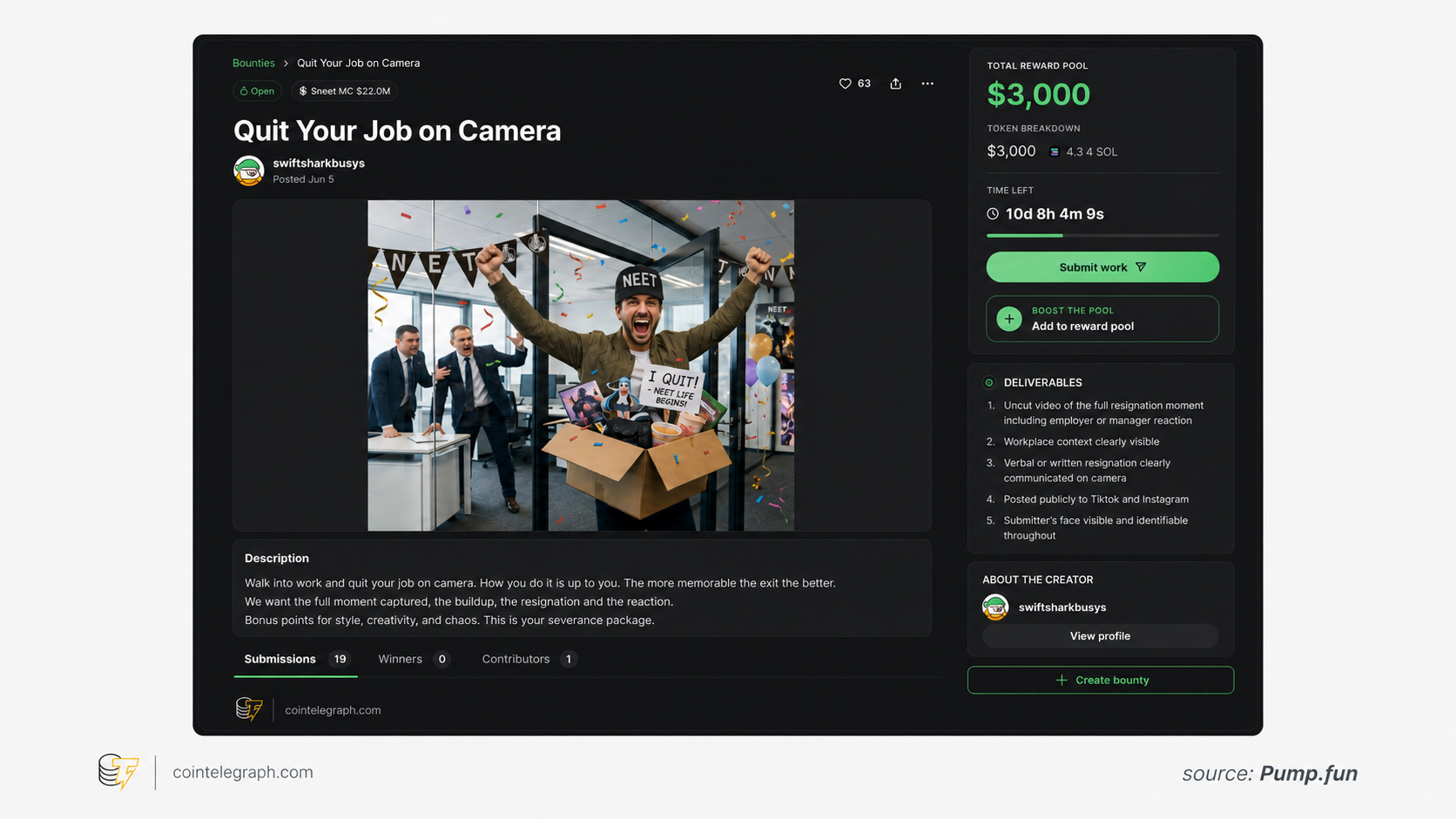
Pump.fun’s GO bounty marketplace turned memecoin promotion into something more direct. It allowed users to pay others for promotional tasks, including stunts designed to attract attention.
The idea was simple. Users could offer rewards in exchange for promotional tasks. Some tasks were fairly harmless. Others moved into more troubling territory, with participants accepting bounties that involved shaving their heads, drinking alcohol on camera and performing increasingly bizarre public stunts.

One of the more widely shared examples involved Arivu, a resident of Tamil Nadu, India. He tattooed the ticker “$boutywork” across his forehead in an attempt to complete a bounty. The episode carried a strange irony: The ticker itself contained a spelling error.
What was meant to be a promotional act became a permanent physical mark tied to a short-lived internet moment. Traders continued speculating on the related tokens. The internet moved on to its next distraction, but the tattoo remained.
Did you know? The term “meme” was coined by evolutionary biologist Richard Dawkins in 1976 to describe how ideas spread through culture. Internet memes later became powerful enough to influence financial markets.
-
Why extreme behavior can seem financially rational
On the surface, these examples may look simply absurd. Why would someone permanently change their appearance or take real risks to promote a speculative token?
The answer lies in the economics of attention.
Online audiences adjust quickly. What gets a reaction today can feel ordinary tomorrow. Influencers and advertisers understand this well. To stay visible, creators often feel pressure to raise the stakes.
More extreme behavior can generate stronger reactions. Stronger reactions can lead to wider distribution. That, in turn, attracts more attention. In memecoin markets, attention can directly affect trading activity.
Outrage can also work as promotion. People who criticize extreme stunts may still amplify them by sharing screenshots, publishing commentary and keeping the topic alive. The stunt becomes part of the token’s identity. In some cases, the controversy may be the product from the start.
-
How creator incentives feed risky speculation
Modern memecoin culture now looks like a mix of reality television and high-risk online speculation. Participants are not only chasing financial returns. They are also competing for social recognition, where virality itself can feel like a form of currency.
Several psychological forces help explain this behavior.
The first is asymmetric upside. A relatively small sacrifice can seem reasonable when there is even a small chance of a meaningful financial reward.
The second is financial pressure. For people facing real money problems, crypto rewards can look significant compared with local wages.
Third, internet fame has value of its own. A viral moment can bring followers, influence and future opportunities that go beyond any single token.
Finally, fear of missing out can be powerful. When people see others receiving attention and possible rewards, they may ignore risks they would normally treat with caution.
None of these motivations are unique to crypto. What crypto adds is speed and speculative intensity. Together, they can make each of these forces much stronger.
-
Creative marketing or exploitation?
Supporters of these practices argue that critics are overstating the concern. From their view, participation is voluntary.
People often accept risk in exchange for money, attention or entertainment. Reality television contestants take part in humiliating challenges. Influencers promote questionable products. Professional athletes risk serious injury for income and recognition. The argument is that crypto bounties should not be treated as entirely different.
There is some truth to this view. Not every bounty is malicious. Community-driven campaigns can also be creative, funny and participatory. Some memecoin communities attract attention precisely because they reject traditional corporate marketing.
Critics, however, see a more complicated picture. Consent is not always simple, and financial pressure can affect judgment. Participants may underestimate long-term consequences when immediate rewards are placed in front of them.
Platforms may also benefit indirectly from the higher engagement and trading activity that sensational content creates. Audiences, meanwhile, may start expecting bigger and riskier stunts to stay interested.
This leaves an uncomfortable ethical question: At what point does voluntary participation become exploitation?
-
A pattern crypto has seen before
The current controversies are not entirely new. Pump.fun has faced criticism before over its livestreaming features. Reports suggested that some creators used increasingly extreme behavior to attract investors and viewers.
This allegedly included sexually explicit content, threatening behavior and other sensational performances meant to increase token visibility. The platform later suspended livestreaming before bringing it back with moderation measures.
The broader pattern is familiar. New formats attract audiences. Competition increases. Participants push their behavior further to stand out. Public backlash builds, and platforms tighten their rules in response.
This cycle has played out many times across television, social media and influencer culture. Crypto may simply be repeating a familiar pattern, with token incentives adding another layer of motivation.
Did you know? Behavioral economists have found that social proof can strongly influence decision-making. When people see others joining risky trends, they may view those risks as less serious and be more likely to copy them.
-
The regulatory gray area
These developments raise difficult questions for regulators. Bounty programs are not easy to categorize.
Depending on how they are structured, they could be seen as marketing campaigns, promotional contests, informal work arrangements, high-risk reward systems or something existing laws were not designed to handle.
Consumer protection authorities may ask whether participants are clearly told about the risks. Labor regulators may consider whether people driven by financial need deserve extra safeguards. Securities regulators could examine whether token-based rewards change the legal nature of promotional activity.
The answers are likely to differ across jurisdictions.
Without clearer standards, platforms may face a long period of regulatory uncertainty.
-
The future of memecoin marketing remains uncertain
Optimists see recent incidents as isolated excesses rather than signs of a wider trend. They believe the model can still improve.
In this view, bounty systems could mature into more constructive forms of community engagement. Well-structured bounty systems could reward creativity without encouraging harmful behavior.
Others expect the opposite. They argue that competition for attention will keep pushing participants toward riskier acts until a serious incident forces major regulatory action.
The most likely outcome may fall somewhere in between. Platforms may adopt stricter moderation rules. Some types of challenges may be banned outright. Communities may also reject tactics they see as exploitative.
Over time, the market may learn where audiences draw the line.

Key Takeaways
- Historical support at the ETH Realized Price Lower Band near $1,150 suggests a potential 30% decline from current levels
- Spot Ethereum ETFs in the US saw $82.3 million exit on Tuesday, marking the seventh consecutive week of negative flows
- Andreessen Horowitz (a16z) pulled $42.62 million in ETH from Binance on June 23
- Bitmine, backed by Tom Lee, acquired 35,138 ETH valued at $58.65 million, following a $92 million purchase the week before
- Crypto analyst Ted Pillows warns that sellers are preventing rallies beyond $1,700, with new lows likely unless this resistance is broken
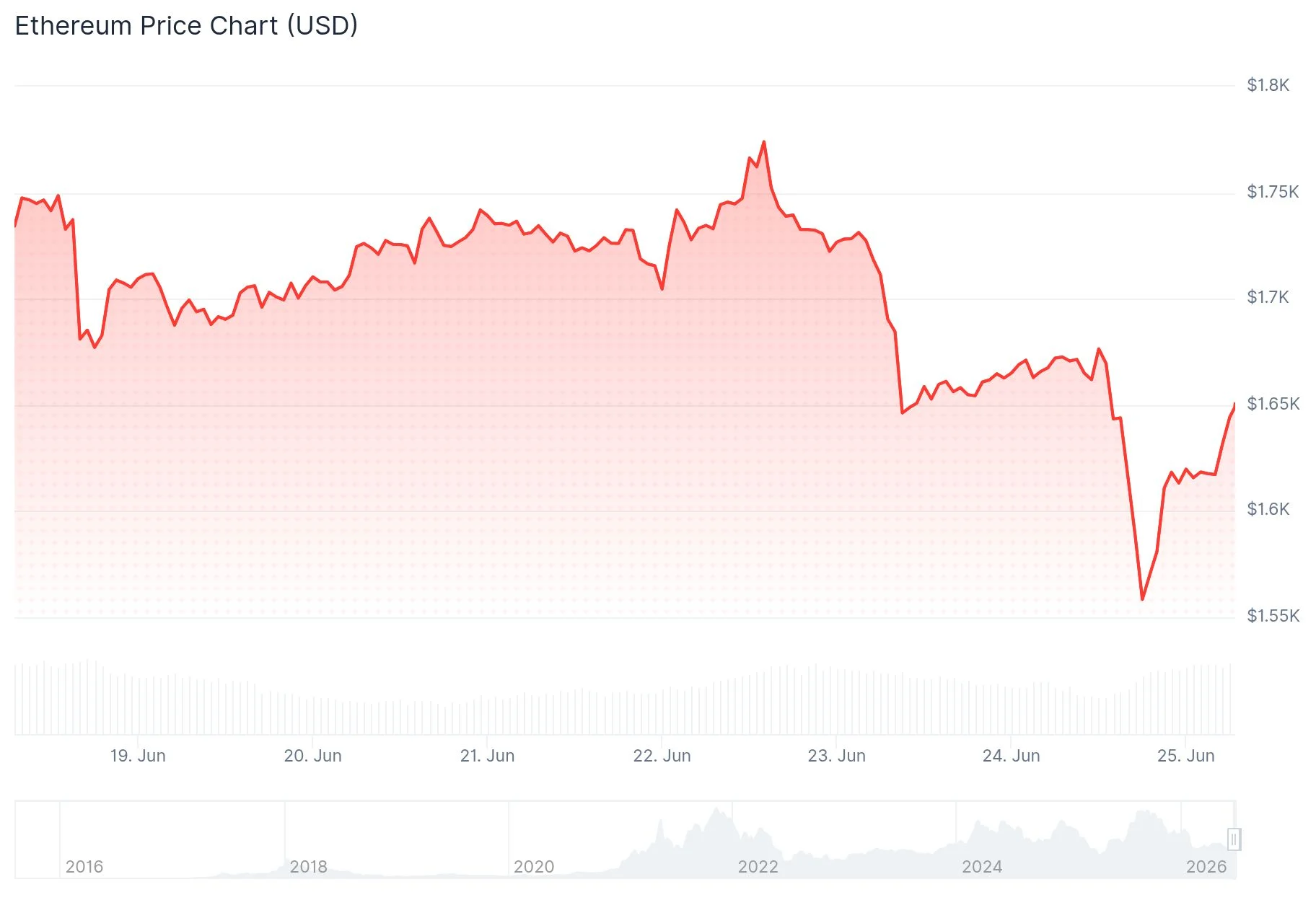
Ethereum is hovering near $1,615 on Wednesday, registering a decline of over 3% as bearish momentum persists across various indicators.
An important onchain metric known as the ETH Realized Price Lower Band is currently positioned around $1,150. During previous bear cycles in 2018 and 2022, Ethereum found its floor near this threshold. Should history repeat itself, this indicates a possible additional 30% drawdown from present price levels.
Cryptocurrency analyst Ted Pillows highlighted this vulnerability on social platforms, noting that selling pressure emerges above $1,700 and suppresses upward movement. According to Pillows: “Until Ethereum breaks and reclaims the $1,700 level with strong spot demand, the chances of new lows will go up.” This assessment corresponds with current technical formations.
Examining the price action, ETH is positioned beneath its 20-day, 50-day, and 100-day moving averages, which range from $1,740 to $2,050. The Relative Strength Index stands at approximately 34, indicating deeply oversold conditions.
Should the selloff persist, immediate support exists at $1,611, followed by $1,524, with more substantial backing at $1,404. Dropping below this zone would create a path toward $1,156.
ETH exchange net flows have demonstrated a gradual increase during the past fortnight, indicating more tokens are being transferred to trading platforms — typically interpreted as preparation for selling activity.
Major Institutional Accumulation Continues
Notwithstanding the bearish pressure, significant accumulation is occurring. On June 23, a wallet associated with venture capital powerhouse Andreessen Horowitz (a16z) transferred 25,560 ETH — approximately $42.62 million — out of Binance.
Bitmine, affiliated with Tom Lee, purchased an additional 35,138 ETH valued at $58.65 million on that same date. During the prior week, the company allocated $92 million toward acquiring 52,203 ETH.
Sharplink, ranked as the second-largest Ethereum treasury entity, staked another 509 ETH this week, elevating its cumulative staked position to 22,102 ETH.
Distribution Data Reveals Long-Term Holder Confidence
Data from Santiment reveals that the largest whale addresses — those controlling between 10 million and 100 million ETH — have expanded their holdings to approximately 135.2 million ETH. Medium-tier holders have similarly been accumulating since the end of May.
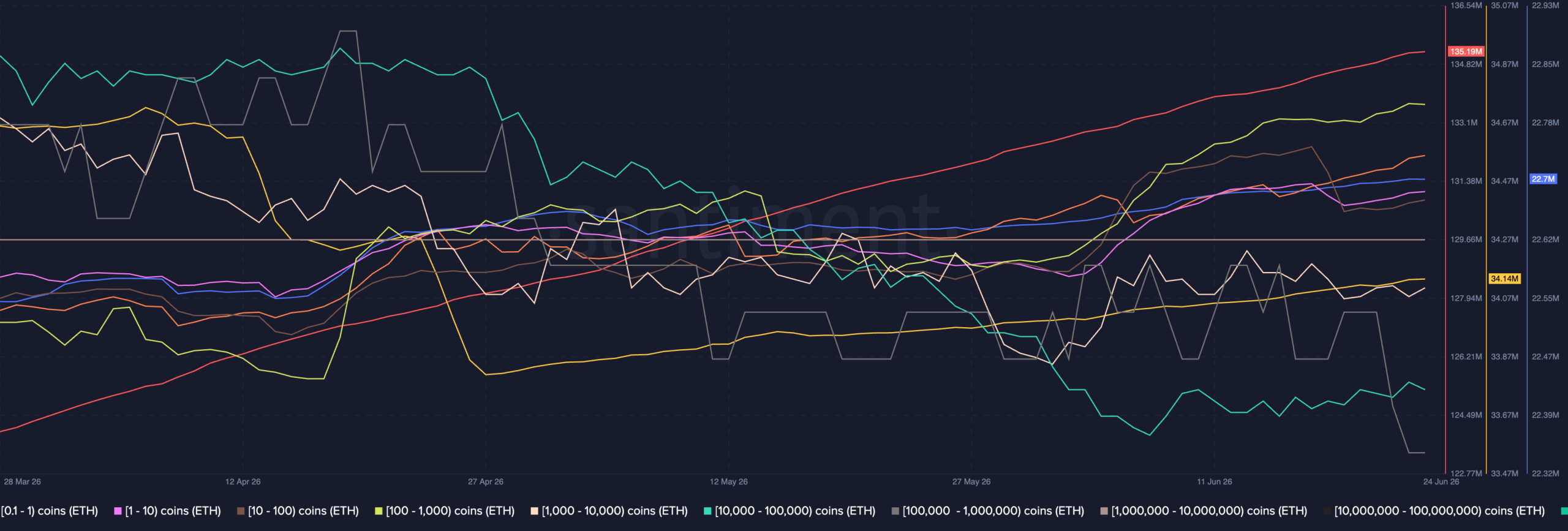
Addresses holding 10,000–100,000 ETH and 100,000–1 million ETH have decreased their positions, pointing to redistribution dynamics rather than wholesale liquidation.
US-based spot Ethereum ETFs experienced outflows of $82.3 million on Tuesday alone. Throughout June, these products have witnessed $346.39 million in withdrawals, following $540.88 million in outflows during May.

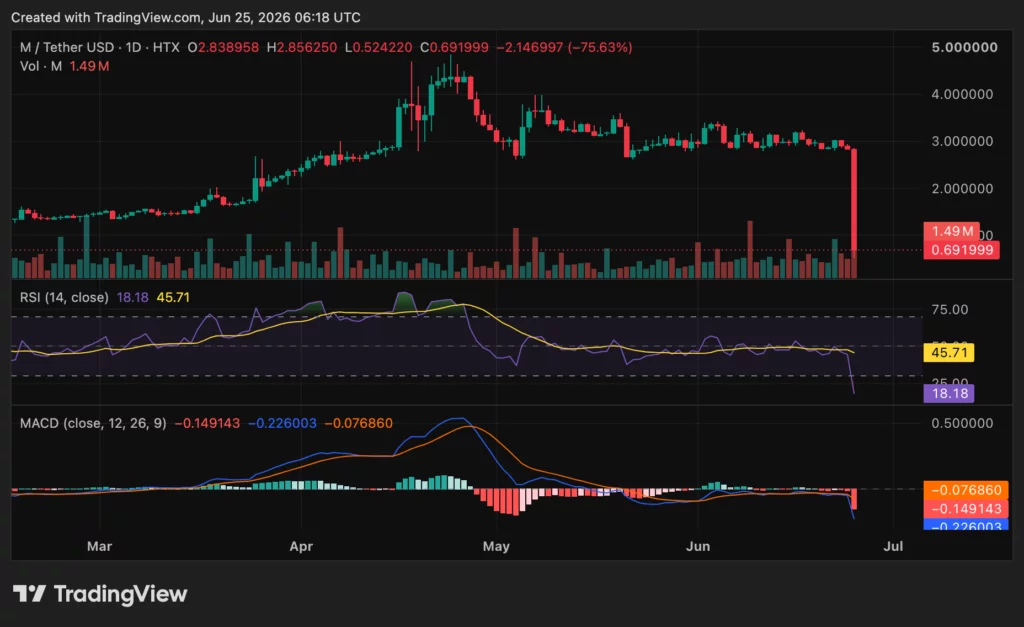
MemeCore fell more than 74% in 24 hours, dropping to about $0.7169 on June 25, according to crypto.news price data.
Summary
- MemeCore’s 75% crash erased billions in value and pushed the token below key market-cap rankings.
- ZachXBT’s old warnings returned as traders questioned supply concentration, exchange listings, and thin liquidity.
- The M chart remains bearish, with RSI oversold and MACD still showing strong selling pressure.
The token traded between $0.5055 and $2.92 during the same period, with 24-hour volume at about $22.3 million.
The crash cut MemeCore’s market cap to about $940.9 million. Its fully diluted valuation fell to about $3.85 billion. The token also lost more than 75% over seven days and more than 76% over the past month.
M fell from nearly $3 to about $0.50 within hours, wiping out close to $3 billion in market value. There was no confirmed exploit, hack, or official announcement that explained the sharp move.
The crash also pushed M outside the top group of large-cap tokens after previously trading at much higher valuation levels. MemeCore reached an all-time high of $4.82 on Apr. 24, before the current drawdown.
ZachXBT questions MemeCore after crash
On-chain investigator ZachXBT said on Telegram that M’s FDV fell from about $14 billion to $3.8 billion after a sudden 75% decline on centralized exchanges. He said he, Mlm, and Wazz had earlier pointed to red flags around supply concentration and what he called deceptive user-growth practices.
ZachXBT also said Arkham data showed no single transfer above $50,000 on BSC in more than two weeks. He added that Dexscreener data showed less than $100,000 in total on-chain liquidity on BSC.
The investigator questioned why Binance and Bybit listed M perpetuals, and why Kraken and Bitget listed M spot. He said such “highly manipulated tokens” damage the industry and extract value from retail users.
ZachXBT also replied to MemeCore figure Rudy Rong on X, asking, “How many retail investors lost funds due to the MemeCore teams $M manipulation?” MemeCore had not issued a clear public response to the crash at the time of writing.
Earlier warnings centered on supply
As crypto.news reported in April, ZachXBT had already pressed MemeCore to explain how M reached a multibillion-dollar valuation while a large share of supply appeared concentrated among a few holders. He asked the project to provide data supporting its market cap and claims around insider holdings.
That report also cited blockchain data showing that a Binance deposit address was the largest holder, with about 41.3% of supply. Another wallet held 50 million M tokens, worth about $178 million at the time, or 21.77% of supply.
Previously, crypto.news explored MemeCore’s dilution risk by comparing it with Shiba Inu. The report said MemeCore’s FDV sat several times above its circulating market cap, leaving a large future-supply overhang.
That earlier article noted that only part of MemeCore’s supply was live in the market. It said future unlocks and FDV pressure could become important for price action if demand failed to keep pace.
The latest crash makes those earlier supply questions more urgent for traders. A token can fall fast when liquidity is thin, supply is concentrated, and selling begins on centralized venues.
Technical setup stays weak
The M/USDT daily chart shows a severe breakdown. Price fell from around $2.84 to $0.692 on the day, a drop of about 75.63%. The intraday low near $0.524 shows that buyers did not defend the prior range.
The move broke the sideways zone around $2.80 to $3.20. That shift changed the short-term trend from range-bound trading to a sharp bearish move. Volume rose to about 1.49 million, showing the selloff came with strong trading activity.
The RSI dropped to 18.18, far below its moving average near 45.71. That places M deep in oversold territory. An oversold RSI can support a short bounce, but it does not confirm a recovery after such a large break.
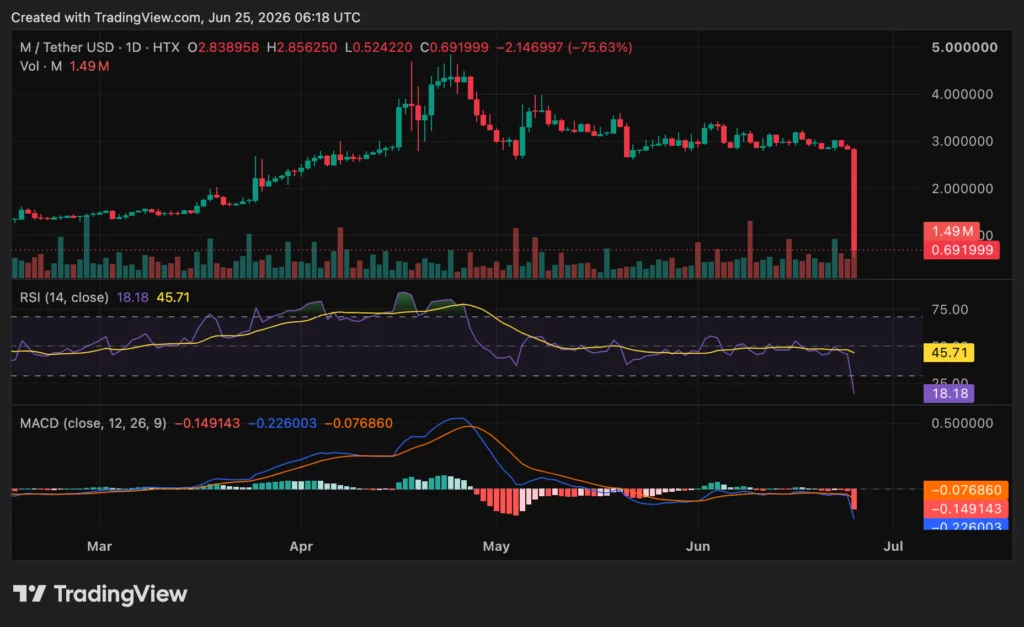
The MACD also remains bearish. The MACD line is around -0.2260, below the signal line near -0.0769. The histogram is negative at about -0.1491, showing sellers still control momentum.
M would need to reclaim lost levels and hold them before the chart looks stronger. A move back above the broken $2.80 area would matter more than a short relief bounce. Until then, the setup remains weak.
Exchange due diligence comes under focus
The crash has shifted attention from price alone to exchange screening. ZachXBT had questioned Kraken’s spot listing in April, citing $7.9 million in suspicious withdrawals to 18 newly created addresses and alleged team-linked transfers to Kraken deposit addresses.
The same April warning accused insiders of pushing M to a $6 billion market cap and $18 billion FDV. The claims remain allegations and have not been independently confirmed by all parties.
The key issue now is whether listed venues reviewed supply concentration, liquidity depth, and market structure before opening M markets. Perpetual futures can add more volatility when the spot market is thin or when real liquidity sits below headline market-cap numbers.
For retail traders, the case shows how fast a high-FDV token can collapse when confidence breaks. MemeCore still trades, but the crash has raised hard questions about liquidity, supply control, and whether exchanges gave users enough protection before listing M.
Disclosure: This article does not represent investment advice. The content and materials featured on this page are for educational purposes only.

The American Arbitration Association (AAA) has joined forces with Integra Ledger and a coalition of major technology and crypto stakeholders to launch the Legal Context Protocol (LCP), an open standard aimed at bringing clearer legal terms to “agentic” AI transactions.
Announced Wednesday by the AAA, the initiative focuses on a gap that becomes more visible as AI systems increasingly negotiate, consent, and transact on behalf of people and organizations: unlike human-to-human or traditional e-commerce flows, agent-to-agent interactions do not automatically carry the same legal context about what was agreed, under what governing rules, and how disputes should be handled.
Key takeaways
- The Legal Context Protocol (LCP) is designed to make the legal “wrapper” of agentic AI transactions discoverable and verifiable, including consent and dispute resolution terms.
- AAA and Integra Ledger position LCP as a non-blockchain legal layer that complements existing payment and identity protocols.
- LCP targets a core operational question for agentic commerce: what terms applied, which law governs, and what recourse exists if something goes wrong.
- The protocol is backed by a wide founder cohort spanning large tech and crypto organizations, including Google, IBM, Circle, and multiple blockchain ecosystems.
Why a “legal layer” is becoming part of agentic commerce
AAA described LCP as a response to the mismatch between the legal infrastructure that shaped modern online commerce and the realities of agent-driven interactions. In remarks referenced by the announcement, Bridget McCormack, AAA’s president and CEO, said the legal mechanisms familiar to consumers—such as click-through consent and terms of service—do not translate cleanly to scenarios where AI agents negotiate with other agents.
That matters because agentic AI is moving from prototypes to enterprise and financial applications where automated systems may transact with minimal human involvement. The protocol’s goal is to help ensure that when agents transact, the relevant legal context can be attached to the activity in a way that can be checked later.
Gartner’s research, as cited in the announcement, projects that an “agentic payment economy” could reach $15 trillion in spending by 2028—an indicator of how quickly transactional automation could scale beyond conventional consumer web flows.
How LCP is meant to work alongside existing infrastructure
According to AAA, LCP does not require a blockchain. Instead, it is designed to work with the broader stack of protocols already being built for AI agent payments and identity.
AAA specifically framed LCP as complementary to payment and identity approaches—such as x402 and Machine Payments Protocol—while addressing a different question set. Rather than focusing on how value moves or how agents are authenticated, LCP is intended to cover under what terms and governance a transaction took place, and what dispute-resolution pathway applies.
David Fisher, CEO of Integra Ledger and a co-founding partner in the project, summarized the motivation by contrasting active development of payment infrastructure with an underbuilt legal layer. In his view, as the infrastructure for agent payments advances, the mechanisms that clarify what was agreed and what happens in an adverse scenario have not kept pace.
Hedera co-founder Mance Harmon echoed the same urgency, saying that as AI agents make decisions and transact on someone’s behalf, there must be a clear answer to what occurs when something goes wrong.
Dispute resolution and consent become technical requirements
A recurring challenge in automated contracting is that legal recourse is not simply a matter of jurisdiction; it also depends on what was actually communicated, agreed to, and recorded at the moment a transaction was initiated. LCP’s emphasis on making legal terms, consent, and dispute resolution “discoverable and verifiable” suggests the protocol is meant to translate those legal concepts into something more reliably legible in automated systems.
This direction also reflects a broader pattern in crypto and decentralized systems: as automation increases, the industry tends to formalize previously human-heavy processes (identity, permissions, access controls, and settlement rules) into verifiable primitives. In this case, LCP aims to bring a comparable level of structure to the legal side of agentic transactions.
For investors, traders, and builders watching agentic AI adoption, the timing is notable. Market forecasts cited in the announcement point to rapid growth expectations for agentic applications, including payments and token-linked activity. While those projections vary significantly, they reinforce a practical takeaway: standards that clarify terms and remedies can become increasingly important as more transactions shift from manual authorization to autonomous execution.
Who is backing the standard
The AAA, founded in 1926 and described as the largest private provider of alternative dispute resolution services in the world, is partnering with Integra Ledger, a company working on open protocols and middleware intended to give AI agents verifiable identity.
Founding contributors named in the announcement span both mainstream and crypto sectors, including Google, IBM, Circle, Wayfair, the Stellar Development Foundation, Ava Labs, Cardano, Hedera, Crossmint, the Aptos Foundation, Sei Labs, and Mysten Labs—the original contributor to Sui.
That breadth suggests LCP is being positioned to work across multiple ecosystems rather than remaining confined to a single chain or commercial platform. It also signals that legal-context infrastructure is increasingly treated as part of the interoperability conversation around agentic AI.
As LCP moves forward, the key question for the market will be how quickly “legal context” can be integrated into real agentic payment and contracting workflows—and whether deployment will prioritize proof of consent, clarity of governing law, or standardized dispute-resolution hooks first.
Crypto exchanges Blockchain.com and KuCoin rolled out new payment services on Wednesday that connect digital assets with local financial infrastructure in several emerging markets.
Blockchain.com said it launched a Brazil-focused payments platform for institutional clients that uses USDC (USDC) and USDt (USDT) to support cross-border treasury operations, supplier payments and payroll. The company said the service is designed to give businesses a faster and lower-cost alternative to traditional international wire transfers.
KuCoin, meanwhile, expanded its payment network across Mexico, Bangladesh and Zambia, adding support for Mexico’s SPEI banking system, Bangladesh’s bKash and Nagad mobile payment platforms, and mobile-money networks operated by MTN and Airtel in Zambia.
KuCoin said the integrations are intended to make it easier for users to move digital assets through payment systems already widely used for remittances, merchant transactions and peer-to-peer transfers. Unlike Blockchain.com’s Brazil offering, which targets businesses managing treasury and international payment flows, KuCoin’s rollout is focused on consumer-facing payment networks.
Related: Bitso brings peso-backed MXNB stablecoin to XRP Ledger via Ripple partnership
Stablecoins power cross-border commerce in emerging markets
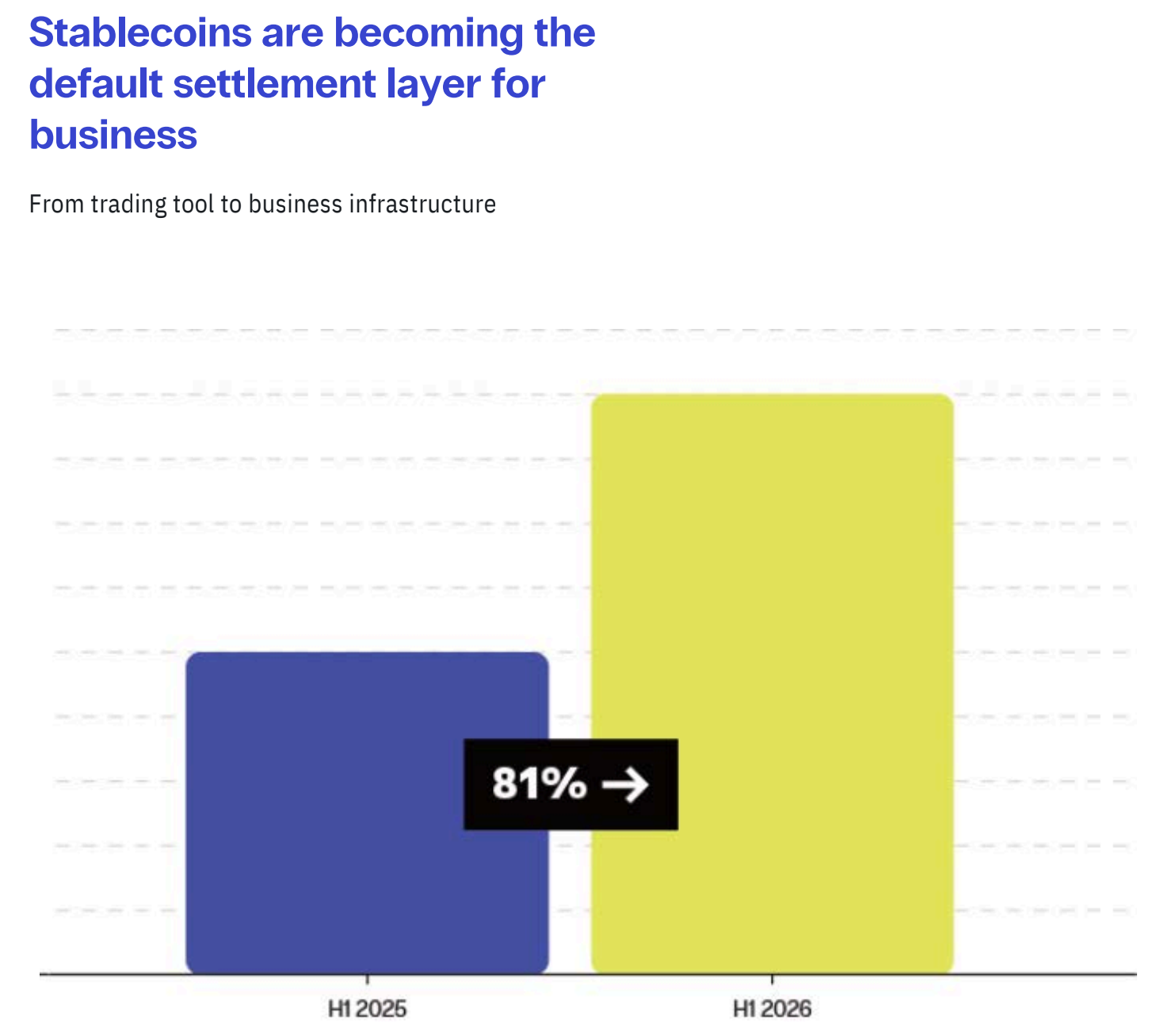
In a recent report, Latin American exchange Bitso said stablecoin transaction volume among institutional clients grew 81% year-on-year in the first half of 2026, driven by growing use of blockchain-based settlement, treasury management and cross-border liquidity services.
The report also found that financial institutions accounted for more than 60% of new business clients added during the period, suggesting banks and payment providers are increasingly incorporating stablecoin rails into existing financial operations.
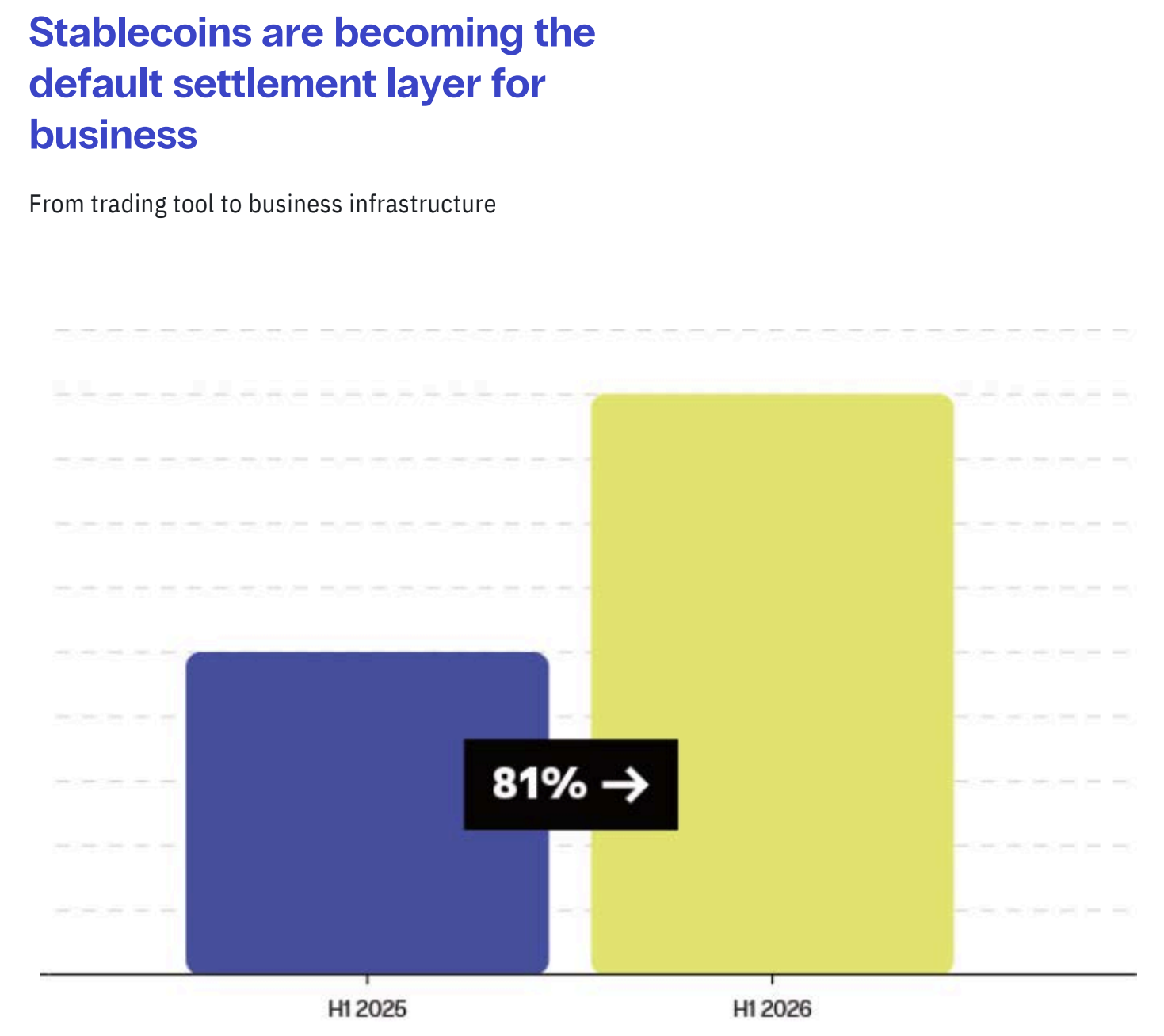
Bitso’s “Stablecoin Landscape in Latin America report for the first half of 2026.” Source: Bitso
The trend extends beyond Latin America. In a September 2025 report on crypto adoption in Sub-Saharan Africa, Chainalysis said stablecoins are frequently used in high-value trade flows between Africa, the Middle East and Asia, including multi-million-dollar transfers supporting sectors such as energy and merchant payments.
Companies are investing in infrastructure to support that growth. Last week, Trace Finance raised $32 million to expand its cross-border settlement network across Latin America, the United States and Asia-Pacific. The company said it had processed more than $10 billion in transaction volume and would use the funding to expand infrastructure connecting blockchain-based payments with local banking and foreign-exchange networks.
Despite growing adoption, regulatory questions remain. In May, Brazil’s central bank prohibited the use of virtual assets in certain regulated cross-border payment services, reinforcing requirements that Electronic Foreign Exchange providers settle transactions through supervised foreign-exchange channels.
Magazine: AI is banking the unbanked in Africa… faster than crypto
The American Arbitration Association and a broad coalition of tech, crypto, and enterprise companies have launched the Legal Context Protocol, an open standard designed to add a legal layer to agentic AI transactions.
The not-for-profit American Arbitration Association (AAA) announced LCP with Integra Ledger on Wednesday, aimed at addressing legal issues that could arise during agent-to-agent transactions.
“The legal infrastructure that has supported e-commerce over the last 20 years… like click-throughs and terms of service — none of that translates… when agents are negotiating with other agents,” said Bridget McCormack, the president and CEO of AAA, when talking about the protocol during a podcast in May. “There had to be some understanding about how legal context attaches to agentic transactions.”
The new protocol comes as enterprise and financial institutions are looking at ways to use agentic AI in commerce. Gartner projects the agentic payment economy will reach $15 trillion in spending by 2028.
The LCP aims to make legal terms, consent, and dispute resolution “discoverable and verifiable” when AI agents transact on behalf of people and organizations, the AAA explained.
LCP, which doesn’t require a blockchain, complements existing payment and identity protocols, such as x402 and Machine Payments Protocol, by answering under what terms, governed by what law, and with what recourse a transaction occurred.
“Payment infrastructure is actively being built for AI agents. The legal layer — what was agreed, under what terms, and how disputes will be resolved — is not,” said David Fisher, CEO of Integra Ledger, a co-founding partner in the project.
As AI agents start making decisions and transacting on our behalf, “we need to know there’s a clear answer to what happens if something goes wrong,” said Mance Harmon, co-founder of Hedera.
Related: AI agents with crypto could escape and become ‘unstoppable,’ experts warn
The AAA, founded in 1926, is the largest private provider of alternative dispute resolution services in the world. It has partnered with Integra Ledger, a firm providing open protocols and middleware that give AI agents verifiable identity.
Founding contributors to the protocol include tech and crypto firms, including Google, IBM, Circle, Wayfair, the Stellar Development Foundation, Ava Labs, Cardano, Hedera, Crossmint, the Aptos Foundation, Sei Labs and Mysten Labs, the original contributor to Sui.
Huge predictions for agentic AI market growth
Agentic AI payments have been a big narrative in 2026, with varying predictions on how fast and how much it will grow in the near future.
In March, Digital Applied estimated the agentic AI market will grow by more than 30 times over the decade, from $7.6 billion today to $236 billion by 2034. McKinsey research’s global projections push those estimates as high as $5 trillion by 2030.
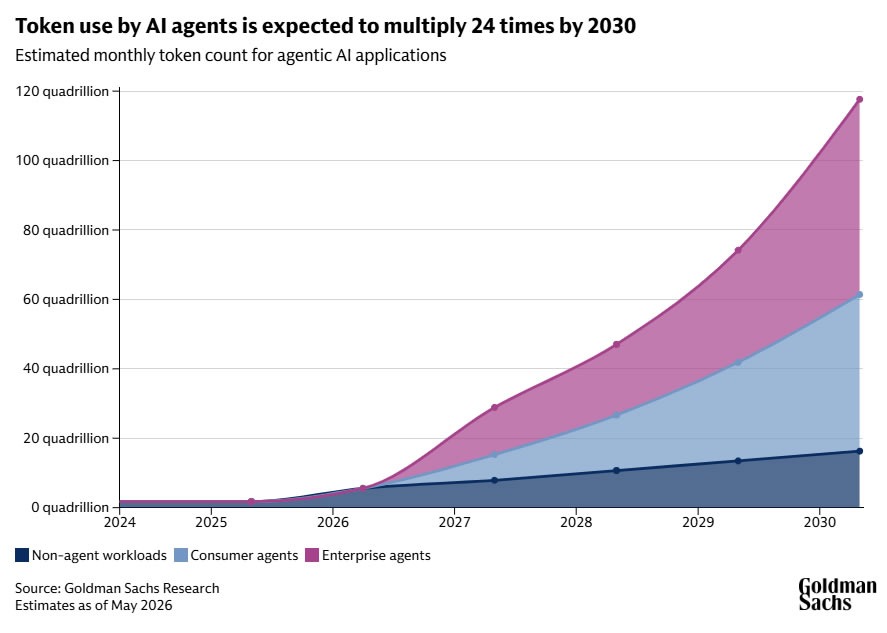
Agentic AI is expected to drive a “24-fold increase in token consumption by 2030” as consumers and enterprises adopt the technology, predicted Goldman Sachs researchers in May.
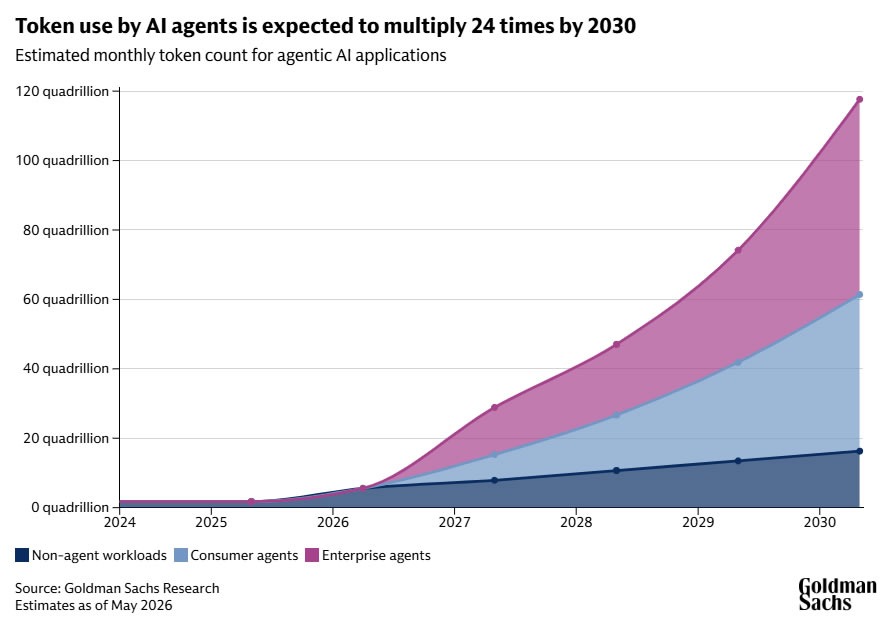
Estimated monthly token count for agentic AI applications. Source: Goldman Sachs
Magazine: AI is banking the unbanked in Africa… faster than crypto
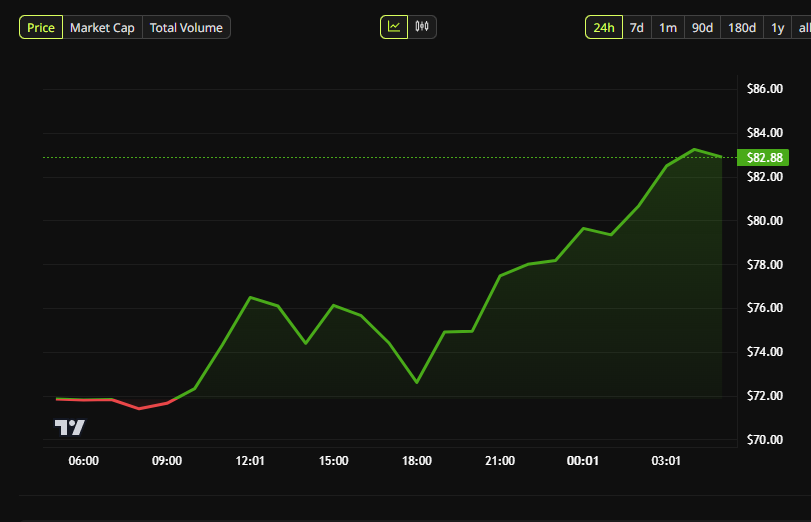
Aave climbed more than 15% in 24 hours to trade around $82.77, bucking a broad crypto selloff that dragged Bitcoin (BTC) below $60,000 for the third time in June.
While most major tokens fell in lockstep with a broader crypto leverage selloff, AAVE pushed higher on improving protocol fundamentals and fresh institutional attention.
USDT Deposits Signal Returning Capital
On-chain data is driving some of the renewed interest. USDT deposits are flowing back into the protocol, with Aave’s Ethereum V3 Core market approaching $3 billion in stablecoin deposits.
The returning liquidity strengthens Aave’s lending capacity and improves yield opportunities for depositors, two factors that tend to attract additional capital to the Aave DeFi protocol.
Standard Chartered’s 50x Call Now in Focus
The rally comes a day after Standard Chartered initiated coverage on AAVE with a $3,500 price target by the end of 2030. The bank’s global head of digital assets research, Geoff Kendrick, described Aave as an on-chain bank. He flagged a 37-times increase in assets active in Decentralized Finance (DeFi) as the core driver.

The Standard Chartered Aave price forecast ties most of its upside to tokenized real-world assets flowing into the protocol via Aave Horizon.
Meanwhile, Bitcoin’s brief drop below $60,000 on June 24 reflected broader risk-off pressure from AI stock and sustained ETF outflows.
AAVE’s rally through that backdrop suggests capital is selectively rotating into DeFi. This is a trend the longer-term AAVE outlook will need to sustain to validate Standard Chartered’s ambitious target.
The post Aave Jumps 15% Off Standard Chartered Forecasts, While Bitcoin Drops Below $60,000 appeared first on BeInCrypto.
A group of Democratic US House lawmakers is questioning the US securities regulator over how it is overseeing investment advice and trading powered by artificial intelligence.
In a letter to SEC Chair Paul Atkins dated Tuesday, the lawmakers said that platforms offering AI trading agents to retail traders “raises serious questions for investor protection, broker-dealer responsibilities, market integrity, and the accountability of AI developers.”
“While such trading may initially be limited in scope, there are indications that agentic trading could expand to a broad range of additional products, including options, cryptocurrency, event contracts, and futures,” the lawmakers wrote.
AI agents have grown in popularity among crypto users as traders look to gain an edge in the always-on market, an idea that has spread to retail traders of traditional equities as they seek help with strategies.
Crypto exchange Coinbase is one of the latest major platforms to introduce such a tool, releasing an AI agent earlier this month integrated into its app, which it said is a Securities and Exchange Commission- and Commodity Futures Trading Commission-registered financial adviser that can give guidance on trades.
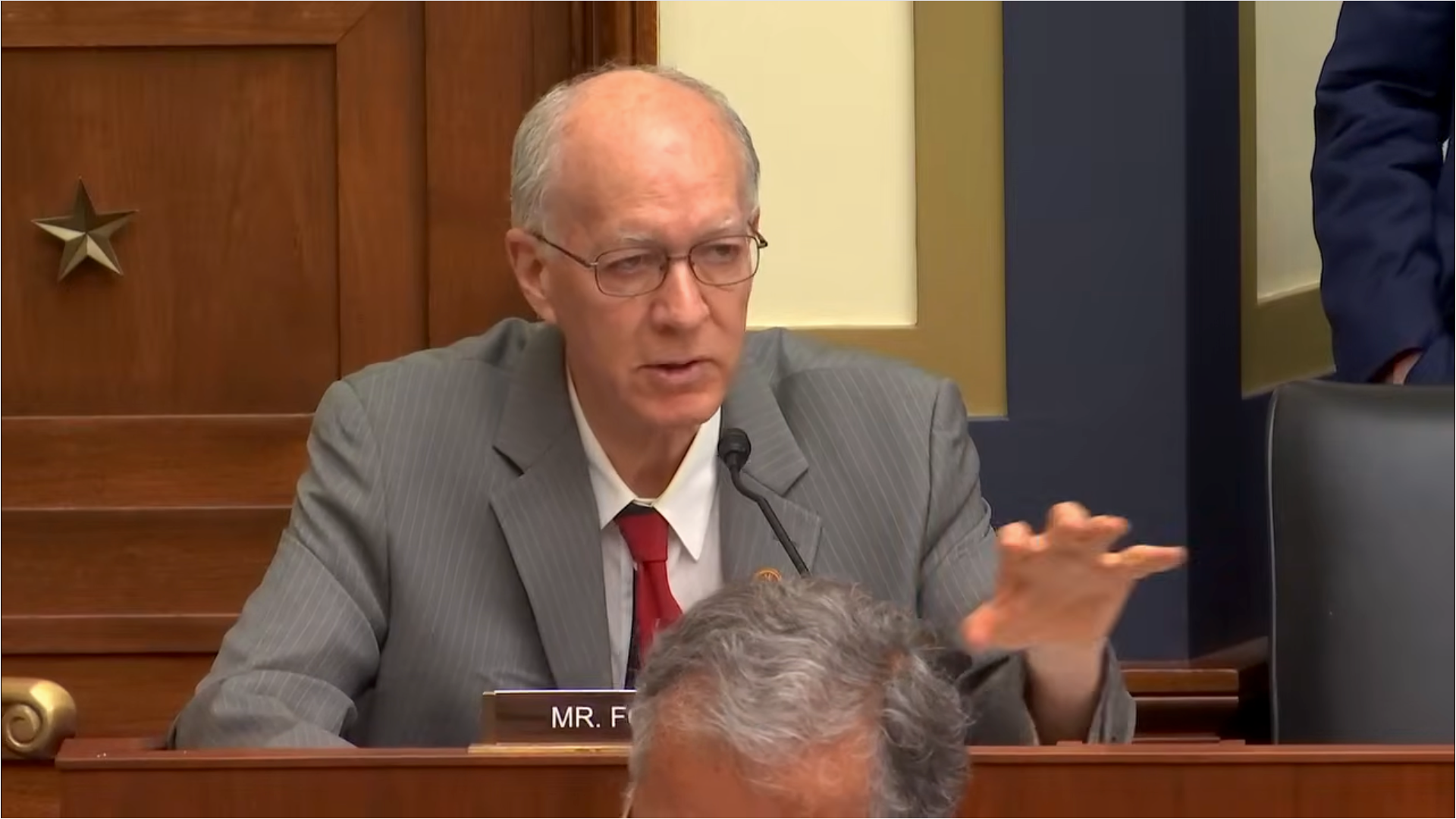
The letter, led by Bill Foster, the top Democrat on the House Financial Services Financial Institutions Subcommittee, and Brad Sherman, the top Democrat on the Capital Markets Subcommittee, said the agents have “operated largely outside the securities regulatory framework,” even as they are making “consequential investment decisions on behalf of retail investors.”
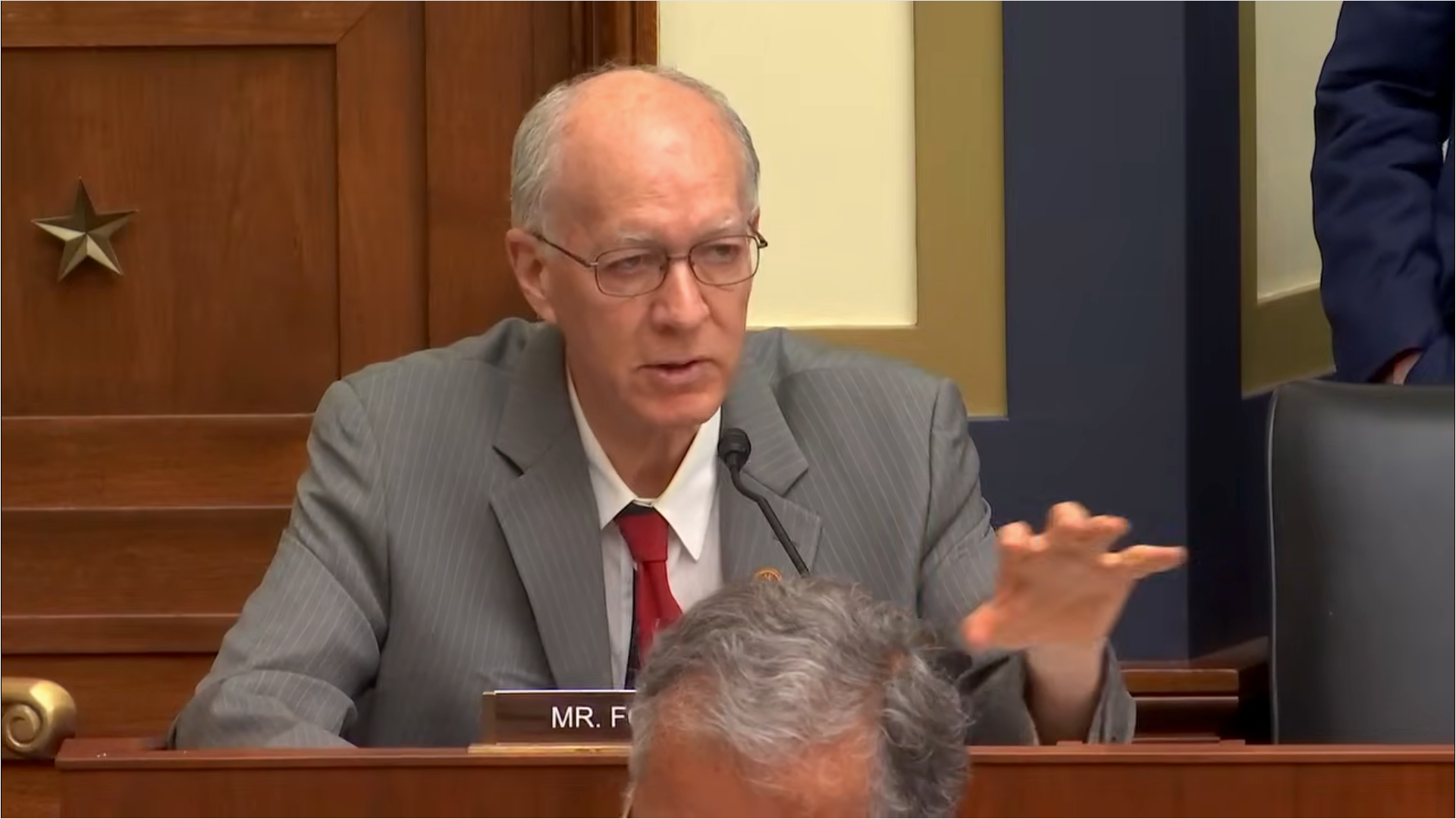
Representative Bill Foster speaking at a hearing in early June. Source: YouTube
The lawmakers said the disclosures accompanying AI agents say that brokerage platforms can’t guarantee the accuracy or suitability of any AI output or control, monitor or audit the agents.
Related: Bitcoin’s deeply discounted versus AI-stocks, but hawkish Fed risk lingers: Bitwise
Such disclaimers “raise urgent questions about the regulatory treatment of agentic trading tools and create uncertainty regarding legal responsibility among brokers, AI developers and retail investors.”
The letter asked the SEC to provide written responses to a list of questions by July 31, including what guardrails or analysis the agency has on agents, when an AI agent would need to register and the extent of its consultations with platforms over AI.
It also asked if the SEC has the authority it needs to address the risks of AI agents, or if it needs congressional action to address them.
Representatives Stephen Lynch, Jim Himes, Sean Casten, Rashida Tlaib, Brittany Pettersen and Sylvia Garcia also signed the letter.
Magazine: The end of anonymity? AI could unmask crypto’s hidden identities
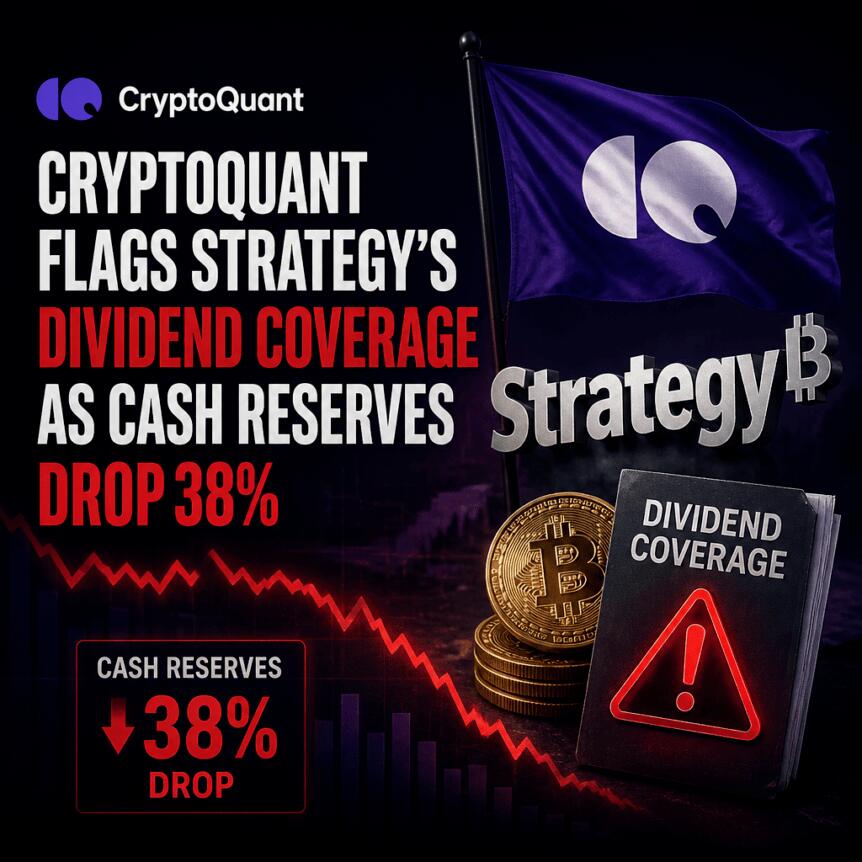
Strategy’s preferred shares have slipped further below par as the company’s cash buffers shrink and its dividend obligations rise, adding pressure to the mechanisms investors watch most closely in the publicly listed Bitcoin treasury model.
According to CryptoQuant, Strategy led by Michael Saylor should pause new Bitcoin purchases and rebuild cash reserves after dividend coverage fell to roughly 14 months from seven years. In parallel, Strategy’s STRC preferred stock traded around $82.50—about 17.5% under its $100 par value—reflecting how quickly funding headroom can deteriorate when Bitcoin and cash availability move against the same cycle.
Key takeaways
- CryptoQuant links STRC’s move below par to a Bitcoin-led correction alongside the “simultaneous depletion” of Strategy’s USD cash reserve.
- Dividend coverage is the central stress indicator: CryptoQuant says it has fallen to about 14 months from seven years as cash reserves decline.
- STRC trading below par constrains fundraising: CryptoQuant notes that sub-$100 pricing can limit Strategy’s ability to raise capital through STRC sales.
- Reaching $100 appears conditional on cash rebuilds: CryptoQuant says returning to full value is not straightforward and requires rebuilding reserves toward roughly $2.8 billion (about 24 months of coverage).
- Strategy has signaled it intends to “continue replenishing” reserves to support the credit quality of its Digital Credit securities, according to a company post on X.
Cash coverage and dividend pressure take center stage
CryptoQuant’s report argues that Strategy’s dividend coverage deterioration is not merely a market volatility issue—it’s a funding-structure problem that affects how the firm can sustain its preferred-share financing engine.
CryptoQuant CEO Ki Young Ju said in an X post on Wednesday that Strategy should “pause Bitcoin purchases, rebuild cash reserves, and adopt a systematic framework for purchase timing.” He also urged the largest public Bitcoin treasury holder to implement a “disciplined selling framework” for the next bull market.
The investment thesis risk, from CryptoQuant’s perspective, is that Strategy’s cash reserve has been drawn down while dividend requirements have risen. The report points to a near quadrupling of dividend obligations to about $1.2 billion, tied to the issuance of additional STRC preferred stock with an 11.5% yield.
How reserve depletion connects to STRC pricing
STRC is one of Strategy’s main mechanisms for generating funding to support Bitcoin accumulation. When STRC trades below its $100 par value, it can limit Strategy’s ability to raise funds efficiently through additional sales, while also potentially encouraging investors to demand higher compensation to offset expected cash-flow risk.
CryptoQuant attributed STRC’s last-week move to approximately $82.50 to two overlapping factors: a broader Bitcoin bear-market correction and the depletion of Strategy’s cash reserve. CryptoQuant also suggested that the combination could force Strategy to adjust its approach—potentially including increasing the nominal dividend rate—to attract buyers and protect STRC’s market price.
Strategy’s own messaging indicates it is focused on replenishing the USD reserve. In a Monday X post, the company said it plans to “continue replenishing” its USD reserve to support the credit quality of its Digital Credit securities.
Cointelegraph reported on May 26 that Strategy repurchased $1.5 billion of its 2029 senior notes at a discount. Since then, the company’s cash position has reportedly improved after it sold $335.5 million in MSTR shares, adding $300 million to its US dollar reserve. Even with that recovery, the reserve remains near a record-low level of about 14 months of funds available to pay dividends, leaving less margin for error if market conditions remain unfavorable.
CryptoQuant says Strategy isn’t forced to sell Bitcoin—yet the pathway back is harder
CryptoQuant argues that Strategy is not “obligated” to sell Bitcoin to defend STRC’s price. Instead, it highlights that the firm can use other tools, including raising the current 11.5% dividend yield or issuing MSTR shares as a signal that it can continue paying dividends.
Still, CryptoQuant cautioned that “the path back to $100 is not straightforward.” In its assessment, rebuilding Strategy’s cash reserve to roughly $2.8 billion—equivalent to about 24 months of coverage—appears to be a necessary condition for STRC to recover.
CryptoQuant also framed Strategy’s Bitcoin holdings as only a “limited emergency cushion” for this purpose. It noted that Strategy is carrying about $10.6 billion in unrealized losses, meaning any forced Bitcoin sale at current levels would crystallize those losses and, in CryptoQuant’s view, potentially damage shareholder value.
“However, the path back to $100 is not straightforward.[…] Rebuilding the cash reserve to ~$2.8 billion (24 months of coverage) is a necessary condition for STRC to recover.”
What traders are watching: STRC and MSTR moving together
In the market, STRC’s slide has continued into the most recent sessions. Ahead of Wednesday’s Nasdaq open, STRC shares were little changed after closing at $87.31 on Tuesday, extending the preferred stock’s decline of about 12% over the past month, based on Yahoo Finance data.
Strategy’s common stock, MSTR, has also shown signs of increased caution. Yahoo Finance data indicates that MSTR traded below $100 in pre-market trading on Wednesday for the first time since March 1, 2024, when it fell as low as $99.20.
CryptoQuant head of research Julio Moreno linked the preferred-stock weakness to a “deterioration in Strategy’s fundamentals,” citing the decline in dividend cash coverage driven by cash depletion and the fourfold increase in STRC’s annualized dividend obligations so far in 2026.
While Strategy’s preferred and common stocks respond to broader sentiment about Bitcoin, CryptoQuant’s emphasis on cash coverage and dividend obligations highlights a more specific risk channel: how capital structure and liquidity timing interact with market drawdowns.
For investors, the next signal to watch is whether Strategy can execute its stated plan to “continue replenishing” USD reserves enough to restore dividend coverage toward the levels CryptoQuant considers necessary—while also seeing whether STRC’s discount to par narrows as cash availability stabilizes.


Blockchain project MemeCore’s M token collapsed about 74% over 24 hours, sliding from a high near $2.92 to as low as $0.51 before steadying around $0.74, with no exploit, hack or announcement to account for the drop.
The fall erased close to $3 billion in market value. M’s market capitalization dropped below $1 billion, to about $969 million, from roughly $3.8 billion before the slide, per CoinDesk data.
Trading was thin relative to the size of the move, with only about $21 million changing hands over the day.
No confirmed catalyst has emerged. But M is a token that widely-known onchain investigator ZachXBT publicly questioned months ago.
In an April post, he asked why the exchange Kraken had listed M for spot trading in July 2025 and how it cleared the exchange’s due diligence, alleging that insiders had “manipulated the price” to a $6 billion market capitalization and an $18 billion fully diluted valuation. The latter is the value the token would carry if every coin that will ever exist were already circulating.
Why did Kraken list $M (Memecore) on July 3, 2025 for spot and how did it pass due diligence?
$7.9M in suspicious Kraken withdrawals to 18 newly created addresses with 11.7 $M sitting total (valued at $39.8M now).
Insiders have manipulated the price to $6B market cap ($18B FDV)… pic.twitter.com/pL7oroZ4lJ
— ZachXBT (@zachxbt) April 20, 2026
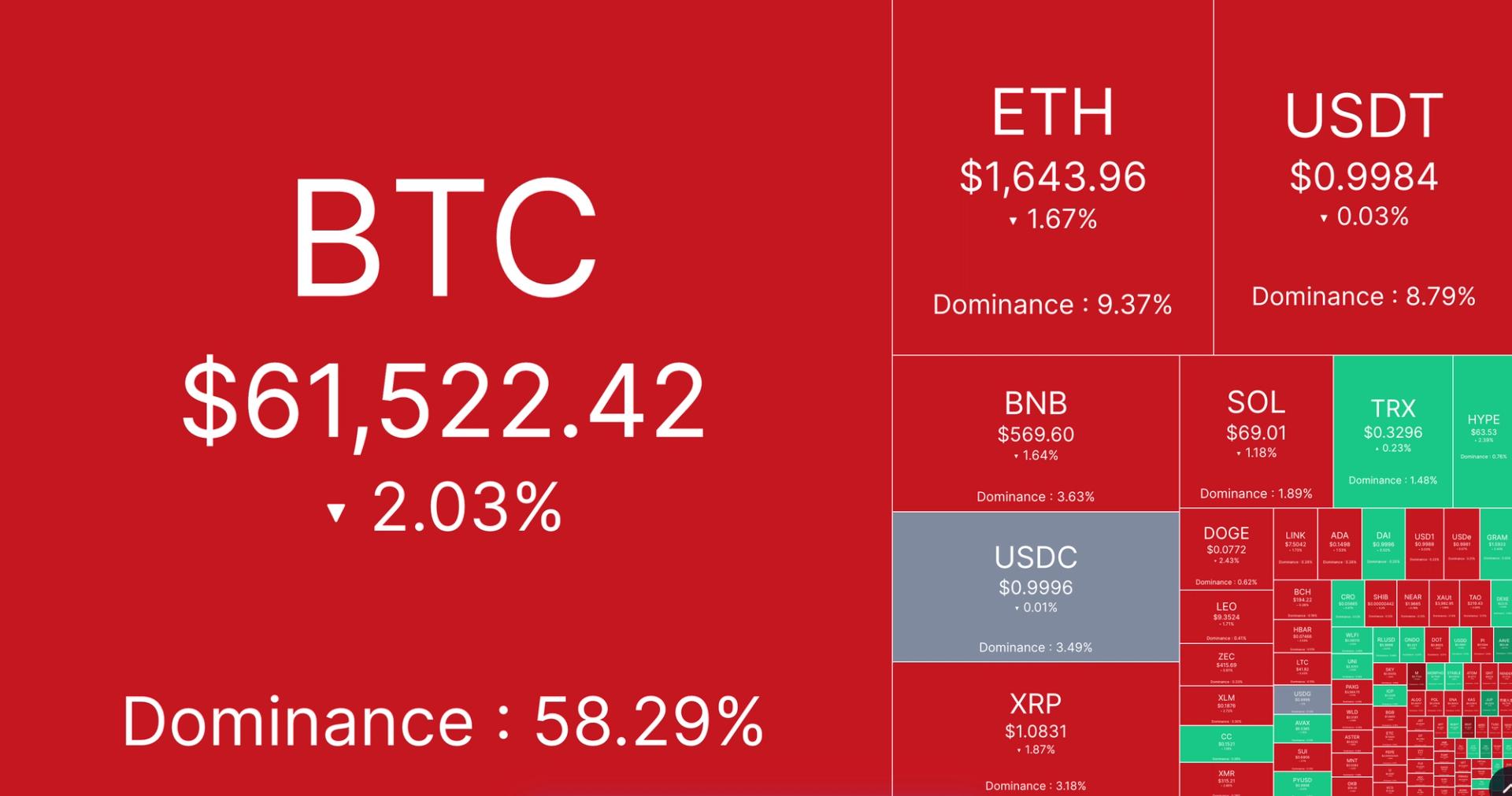
Bitcoin dropped to $59,175 overnight, its lowest point since early June, before recovering to about $61,500 by Thursday morning, per CoinDesk data. Nearly $1 billion worth of futures positions were liquidated across crypto majors, such as bitcoin, ether, solana, and others, to tokenized versions of stocks, such as Micron Technology Inc (MU) and Sandisk (SNDK).
The dip triggered roughly $430 million in long liquidations on bitcoin-tracked futures, or bets on higher prices that were automatically closed as the price fell.
No single catalyst drove the move. Bitcoin has lost about 10% since Monday’s peak near $65,500, pulled lower by the same forces that have dominated all week: a hawkish Fed, six straight weeks of ETF outflows, thinning summer liquidity, and a quarter-end options expiry on June 30 that traders say is keeping the market unstable.
Major market-maker Wintermute had flagged $59,000 as the bear-market low to watch in its Tuesday’s note.
The bounce came from outside crypto. Micron Technology reported quarterly earnings after the close that shattered analyst estimates, sending its shares sharply higher and lifting the broader memory chip complex.
SK Hynix separately disclosed plans for a U.S. stock listing seeking roughly $29 billion, one of the largest offerings ever. Samsung and Kioxia rallied in Asia Thursday morning.
The same AI chip trade that sent the Kospi down 10% on Monday on fears the spending boom was stalling is now the thing steadying crypto, with Micron’s results reading as confirmation that demand for AI memory is structural, not speculative.
The quarter-end remains the week’s live risk. Bitcoin’s $59,000 low held, but $1.6 billion in leveraged long positions sit clustered below $58,000, per CoinGlass, meaning a break there would accelerate the drop.
Thursday’s PCE inflation print, the Fed’s preferred price gauge, is the next data point that could move the market in either direction.

Arsenal FC make Morgan Rogers their top transfer priority with first bid expected

Kraken Robotics Inc. (PNG:CA) Shareholder/Analyst Call – Slideshow

World Cup 2026: Neymar – the return of Brazil’s forgotten hero

No Jackpot Winner as $257 Million Prize Rolls Over to $269 Million Monday Draw

Blockchain.com files with SEC for U.S. IPO

Weekend Open Thread: Miami – Corporette.com

EXPOSED! COMPLETE FINANCIAL LOCKDOWN IS ALREADY HERE! XRP HOLDERS BE WARNED

New Malware Steals Crypto Via Copy-Paste! #shorts

By the age of 40, everyone should have a strong financial foundation in place#motivation #ytshorts
-
 Fashion6 days ago
Weekend Open Thread: Miami – Corporette.com
-

 Entertainment4 days ago
Renter of Home in Anne Heche Crash Denies Settlement With Son
-
 Sports1 day ago
Two goals and an assist by sheer aura: Cristiano Ronaldo just entered the World Cup chat
-

 Tech3 days ago
Microsoft accidentally kills epic Outlook email threads
-

 Business4 days ago
Soccer-U.S. defends Iran World Cup travel restrictions, says discussions ongoing
-
Crypto World1 day ago
Bitcoin (BTC) Dips Below $62K, Ethereum (ETH) Plunges 6% Daily: Market Watch
-

 Politics5 days ago
Andy Burnham and the meaning of Makerfield
-

 Politics6 days ago
BBC Reporter Discusses Cross Party Criticism Of Trumps Iran Deal
-

 Crypto World1 day ago
Securitize Wraps Roubini's SEC-Registered ETF as Dubai VARA Digital Security
-
Business1 day ago
Entergy settles forward sale agreements, raises $672 million in cash proceeds
-

 NewsBeat6 days ago
Keir Starmer Allies Question His Chances For No 10
-
 Business5 days ago
Wall Street Week Ahead: Investors see Micron earnings as pulse check of AI rally momentum
-

 Tech7 days ago
AWS enters the context layer race with a graph that learns from agents, not manual curation
-
 Crypto World5 days ago
Can Charles Hoskinson Really Rescue Cardano?
-

 Crypto World5 days ago
HIVE shares jump as $220M AI deal speeds Bitcoin mining pivot
-

 Crypto World5 days ago
Jake Chervinsky accuses CME of protecting derivatives monopoly
-
 Tech4 days ago
Signal’s Meredith Whittaker says AI chatbots ‘are not your friends’ and calls Copilot agents a backdoor
-

 Entertainment5 days ago
Jose Alvarado Wants Taylor Swift at More Knicks Games
-

 Tech2 days ago
Nearly 7,000 fake Amazon domains registered ahead of Prime Day 2026, researchers warn
-

 Business6 days ago
Brexit cost 6% of UK economy, Bank of England company data suggests
You must be logged in to post a comment Login