

Crypto World
HTX DAO Burns Over $32.82 Million Worth of $HTX in H1 2026, Highlighting Strong Business Resilience

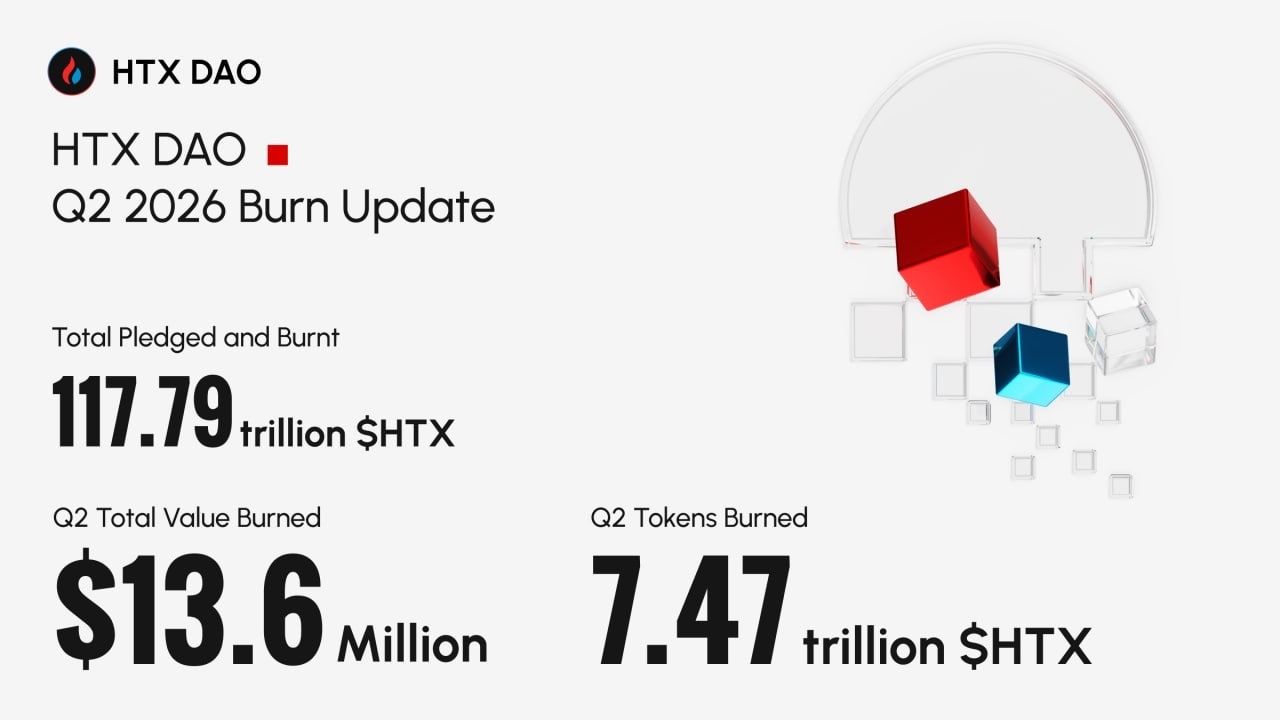

HTX DAO announced the successful completion of its $HTX token burn for Q2 2026 on July 15, 2026. On-chain data shows that a total of 7,474,935,439,560 $HTX tokens were burned in this round, valued at over $13.6 million. Following this latest burn, the cumulative volume of $HTX burned and pledged has reached 117.79 trillion tokens (backed by verifiable on-chain burn proofs.)
Combined with Q1 data, HTX DAO burned a total of over $32.82 million worth of $HTX in the first half of 2026. At a time when broader market liquidity remains under sustained pressure, this deflationary track record stands out as a highly compelling achievement.
Retaining Strong “Value Generation” Capabilities in a Downturn
Looking back at the first half of the year, the crypto market experienced highly complex sentiment shifts and tight liquidity conditions—with BTC temporarily slipping below the $60,000 threshold. These headwinds were largely driven by macro factors, including diminished expectations for Fed rate cuts and consecutive net outflows from Spot ETFs.Concurrently, spot and derivatives trading volumes across the industry fell sharply, and the aggregate stablecoin supply contracted on a quarterly basis for the first time since Q3 2023.
Despite these industry-wide challenges, $HTX maintained a multi-million-dollar burn scale across consecutive quarters. This consistency not only reflects the steady execution of the HTX DAO deflationary mechanism but also highlights the exceptional operational resilience and counter-cyclical capabilities of the HTX platform.
According to H1 data disclosed by HTX, the platform’s cumulative registered users reached 59.49 million, with total trading volume approaching $90 million. Additionally, the platform now supports over 612 trading pairs, covering mainstream assets, trending sectors, and high-potential new projects.
This robust trading activity and steady pipeline of asset listings have provided sufficient cash flow to support the ongoing deflation of $HTX.
Ecosystem Expansion Uplifts the Long-Term Value Potential
While large-scale token burns build the essential scarcity foundation for $HTX, the true driver of its long-term value is the continuous expansion of its use cases and ecosystem demand.
The HTX Genesis Hackathon — co-hosted by HTX DAO and B.AI, and co-organized by TinTinLand — is now entering its final stage. Featuring a 20,000 USDT prize pool alongside over $100,000 in computing power resources, the event drew participation from more than 200 developer teams. Participants focused on pioneering sectors, including $HTX utility scenarios, AI agent finance, on-chain asset management, DAO tools, and smart financial operating systems.
Notably, developer incentive programs of this kind do more than just introduce innovative projects to the ecosystem. They actively expand the utility of $HTX in decentralized governance, payments, incentives, and collaborative ecosystem synergies, creating more sustained and genuine utility demand for the token.
Looking ahead, as the HTX DAO governance framework matures, the developer ecosystem expands, and additional innovative applications go live, $HTX is poised to evolve from a standalone governance token into a critical value carrier. It will serve as the core link connecting trading, decentralized governance, developer networks, and AI innovation, securing a robust and sustainable foundation for the entire HTX DAO ecosystem
About HTX DAO
As a multi-chain deployed decentralized autonomous organization (DAO), HTX DAO demonstrates an innovative governance approach. Unlike traditional corporate structures, it adopts a decentralized governance structure composed of a diversified group, jointly committed to the success of this organization. This unique ecosystem advocates openness and encourages all DAO participants to propose ideas that can promote the development of HTX DAO.
Contact Information
Website: www.htxdao.com
The post HTX DAO Burns Over $32.82 Million Worth of $HTX in H1 2026, Highlighting Strong Business Resilience appeared first on BeInCrypto.


Key takeaways
- Pi Network (PI) is showing signs of recovery after several days of consolidation and easing selling pressure.
- Rising Open Interest suggests speculative traders are positioning for a potential rebound.
- The upcoming Stellar Protocol v25 mainnet upgrade and improving market sentiment could support PI’s recovery.
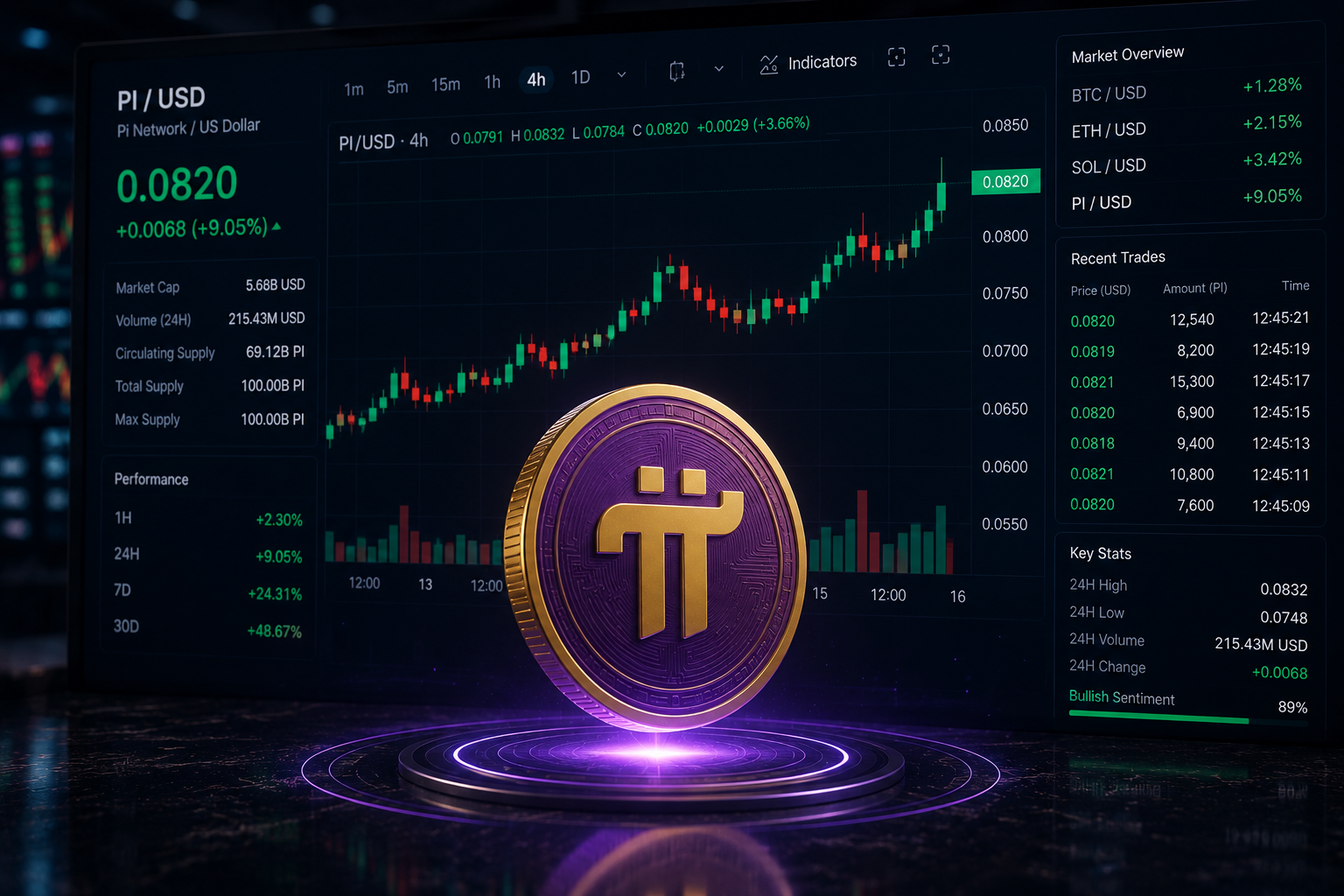
Pi Network (PI) posted modest gains on Friday after three consecutive sessions of sideways trading, suggesting that selling pressure may be easing following a sharp correction earlier this month.
Although the token remains in a broader downtrend, increasing derivatives activity and deeply oversold technical indicators are fueling speculation that PI could be preparing for a short-term rebound.
Speculative demand begins to strengthen
Pi Network remains one of the cryptocurrency market’s most speculative community-driven assets, making its price particularly sensitive to shifts in investor sentiment.
After a steep sell-off earlier this month, optimism has started to improve as broader market risk appetite stabilizes.
Another potential catalyst is the Stellar Protocol version 25 mainnet upgrade, scheduled for July 22, which could support sentiment across ecosystems connected to Stellar-based infrastructure.
Meanwhile, derivatives data points to growing speculative interest. According to CoinAnk, Pi Network Open Interest increased to $10.73 million on Friday from $10.44 million a day earlier.
Open Interest has steadily recovered from $9.11 million recorded on Monday, indicating that traders are gradually returning to the market after the recent correction.
The increase suggests retail investors are beginning to position for a possible recovery, although conviction remains relatively modest.
PI remains oversold despite stabilizing price action
From a technical perspective, Pi Network continues to trade below the key $0.0800 resistance level, leaving the broader trend bearish.
However, the token has managed to hold near the lower boundary of a falling channel, where technical support is reinforced by the 161.8% Fibonacci extension level at $0.06793.
Holding above this area could provide the foundation for a relief rally if buying momentum continues to build.
Technical indicators are beginning to show early signs that the recent decline may be losing momentum.
The Relative Strength Index (RSI) has fallen to around 17, placing PI deep in oversold territory. While oversold readings do not guarantee a reversal, they often indicate that selling pressure has become stretched.
At the same time, the Moving Average Convergence Divergence (MACD) remains below the zero line but is showing signs of weakening bearish momentum, suggesting sellers may be losing control.
If PI extends its recovery, the first resistance level is the 127.2% Fibonacci extension at $0.09613.
A stronger rebound would then face resistance near $0.110, where the upper boundary of the falling channel could limit further gains unless broader market sentiment improves.
On the downside, the 161.8% Fibonacci extension at $0.06793 remains the most important support level.

A decisive break below that area could expose the 227.2% Fibonacci extension near $0.01463, significantly increasing downside risk.
For now, Pi Network’s deeply oversold technical setup, combined with rising Open Interest and improving market sentiment, suggests that a short-term recovery remains possible, although the broader trend will remain bearish until key resistance levels are reclaimed.


BTC is less volatile than South Korea’s stock market. Since the start of June, South Korea’s benchmark KOSPI has swung an average of 3.8% a day, more than double BTC’s 1.7%.
On Thursday alone, South Korea’s benchmark KOSPI fell 6.4% to 6,820, tripping its 37th program-trading halt of 2026, a five-minute regulatory pause to restore order to chaotic markets.
However, that crash wasn’t even its worst session of the week.
Meanwhile, BTC and crypto indices appear to be sailing calmer waters by comparison. On a 12-month basis, KOSPI’s annualized volatility has climbed to 57% against BTC’s 47% — still higher than BTC over this impressive timespan.
One analyst remarked, “Compared to KOSPI, BTC has become a low-volatility asset. SK Hynix and Samsung Electronics showed volatility of 90% and 78% respectively, an extreme level previously observed only in thematic stocks.”
Investors have swept up SK Hynix and Samsung into the recent frenzy of AI stocks. Both companies make hardware related to the boom in AI chatbots and coding tools like Gemini, Claude, ChatGPT, Grok, and others.
Remarkably, even after its sharp decline in recent days, KOSPI remains 2026’s top-performing stock market of a major economy, still up about 60% despite shedding a quarter of its valuation since June.
Seven market-wide circuit breakers this year
The KOSPI set its record close of 9,114.55 on June 22. One day later it dropped 9.99%, one of the largest single-day declines in the index’s history.
Monday was nearly as brutal. An 8.95% plunge through the 7,000 level triggered its seventh 20-minute, market-wide circuit breaker of 2026.
A market-wide circuit breaker halts all trading of listed stocks for 20 minutes after an 8% drop. The more common program-trading halt, also known as a sidecar, pauses only certain programmatic orders after sharp futures moves.
By Wednesday the machinery was working in reverse. The index rebounded 6.24% to 7,284.41. Then Thursday took most of it back.
The Bank of Korea didn’t help, raising rates 25 basis points to 2.75%, its first rate rise since January 2023.
All the while, BTC has been trading relatively calmly in the $60,000s since the start of June.
Read more: SK Hynix wipes out US debut gain in one day of trading
Two AI stocks overtake S. Korea’s stock market
South Korea’s index has a structural problem with its arithmetic.
Two companies, Samsung Electronics and SK Hynix, are worth half of the KOSPI’s market value. Moreover, exposure to these two companies is amplified by a variety of funds, derivatives, and leveraged funds.
The timing was no accident. SK Hynix joined the $1 trillion club in the same session, with the KOSPI up 95% on the year.
Hungry for leverage to amplify their gains during the upswing, investors demanded new, “2X” single-stock ETFs, which became the market’s center of gravity within weeks.
These leveraged funds churned 212 trillion won of volume in June alone, over a quarter of the country’s ETF turnover.
Then leverage did what leverage always does: unwind. Their combined assets collapsed 41% between July 1 and July 13, from 15.9 trillion won to 9.3 trillion.
Bloomberg noted that a single Hong Kong-listed fund tied to SK Hynix grew so large that it had become the tail wagging the dog — more responsible for SK Hynix’s volatility than SK Hynix’s common stock itself.
‘Correction of a known policy error’
South Korea’s president promised at the Korea Exchange in June 2025 to “make investing in stocks a primary mode of investment on par with real estate.”
Retail investors obliged with borrowed money. One 24-year-old who turned as little as 10 million won into 300 million on margin told Reuters, “Just as it went up explosively, it went down explosively.”
Brokers liquidated 1.12 trillion won of margin-called stock in June, the year’s highest monthly total, according to Korea Financial Investment Association data.
A viral Bull Theory post contextualized 1.2 million “accounts” being margin-called as equivalent roughly one in 30 working age adults. However, no regulator has published account-parsing figures to know precisely how many discrete humans received margin calls.
The downturn has caused real world consequences.
Sadly, Protos reported this week that a stock trading YouTuber was stabbed in Busan after the market crash.
Seven weeks after approving the products, and after the financial watchdog’s chief conceded the rollout was too hasty, the Financial Services Commission on Thursday halted new listings of 2X single-stock ETFs until markets stabilize.
It also tripled minimum deposits to 30 million won (about $20,300), effective August 5.
Exness strategist Inki Cho called the move “overdue” and said, “This is a correction of a known policy error.”
BTC, meanwhile, spent the same stretch doing comparatively little. It traded near $64,000 on Thursday, roughly half below its October 2025 peak of about $126,000.
Its CME implied volatility gauge came within three points of a 12-month low last week.
Got a tip? Send us an email securely via Protos Leaks. For more informed news and investigations, follow us on X, Bluesky, and Google News, or subscribe to our YouTube channel.

Introduction
Autonomous Market Makers (AMMs) transformed decentralized finance (DeFi) by replacing traditional order books with smart contracts that automatically provide liquidity and execute trades. Platforms like Uniswap, Curve, Balancer, and many others proved that anyone can become a liquidity provider while enabling permissionless trading around the clock.
However, the next generation of AMMs is poised to become far more intelligent than today’s liquidity pools. Rather than simply following fixed mathematical formulas, future AMMs will leverage artificial intelligence, real-time market data, programmable liquidity, and cross-chain infrastructure to optimize trading, reduce risks, and maximize capital efficiency.
The evolution of AMMs may redefine how liquidity functions across the entire digital economy.
From Passive Liquidity to Intelligent Liquidity
Today’s AMMs generally rely on predetermined algorithms such as the constant product formula (x × y = k). While revolutionary, these systems still face several limitations:
- Impermanent loss
- Capital inefficiency
- Fragmented liquidity
- Static fee structures
- Slow adaptation to market volatility
Future autonomous market makers will actively respond to market conditions instead of waiting for liquidity providers to manually adjust positions.
Imagine liquidity pools that automatically:
- Shift liquidity where trading demand is highest
- Modify trading fees during periods of volatility
- Rebalance portfolios continuously
- Hedge exposure against extreme market swings
- Allocate idle capital into yield-generating strategies
Liquidity becomes dynamic instead of passive.
AI-Powered Liquidity Management
Artificial intelligence will likely become one of the biggest upgrades for AMMs.
Machine learning models could analyze:
- Trading volume
- Historical volatility
- On-chain activity
- Wallet behavior
- Macroeconomic events
- Stablecoin flows
- Cross-chain liquidity movements
Using these insights, AMMs could predict liquidity demand before it happens.
Rather than reacting after volatility occurs, intelligent AMMs may reposition liquidity in anticipation of changing market conditions.
This could significantly reduce impermanent loss while improving execution quality for traders.
Cross-Chain Autonomous Liquidity
The blockchain ecosystem is no longer confined to a single network.
Assets now move between:
- Ethereum
- Solana
- Base
- Arbitrum
- Optimism
- Avalanche
- BNB Chain
- Sui
- Aptos
Future AMMs won’t be limited to one blockchain.
Instead, autonomous market makers will coordinate liquidity across multiple ecosystems simultaneously.
A single liquidity position could automatically migrate toward whichever blockchain currently offers:
- Higher trading volume
- Better yields
- Lower transaction costs
- Greater user demand
Liquidity becomes globally optimized rather than trapped on isolated chains.
Intent-Based Trading
Intent-based architecture is emerging as one of Web3’s most exciting innovations.
Instead of specifying every trading parameter, users simply express what outcome they want.
For example:
“Swap my USDC into ETH at the best possible price before tomorrow.”
An autonomous market maker can then:
- Search multiple DEXs
- Split orders
- Route across chains
- Minimize slippage
- Reduce gas fees
- Complete execution automatically
The user focuses on outcomes rather than execution mechanics.
Self-Optimizing Fee Models
Today’s AMMs often charge fixed trading fees.
Future systems could dynamically adjust fees based on:
- Market volatility
- Liquidity depth
- Trade size
- Arbitrage opportunities
- Network congestion
During periods of high volatility, fees may increase to better compensate liquidity providers.
During quieter periods, fees could decrease to attract more trading activity.
This creates a healthier balance between traders and liquidity providers.
Autonomous Risk Management
Risk management may eventually become fully automated.
Future AMMs could continuously monitor:
- Oracle anomalies
- Flash loan attacks
- Liquidity concentration
- Whale movements
- Smart contract risks
- Bridge vulnerabilities
If abnormal conditions are detected, liquidity parameters could automatically tighten or temporarily pause certain functions to reduce exposure.
This makes decentralized exchanges more resilient without requiring constant human intervention.
Tokenized Real-World Assets
As tokenized real-world assets (RWAs) continue to expand, AMMs will likely become the liquidity engine for:
- Tokenized Treasury bills
- Real estate
- Carbon credits
- Commodities
- Private credit
- Corporate bonds
- Tokenized equities
Autonomous liquidity systems will help price these assets more efficiently while maintaining deep, global liquidity around the clock.
Personalized Liquidity Strategies
Not every liquidity provider has the same goals.
Future AMMs may allow users to select AI-driven strategies tailored to their preferences, such as:
- Conservative income generation
- Low-volatility portfolios
- Aggressive yield optimization
- Stablecoin-focused liquidity
- Long-term asset accumulation
Instead of manually managing positions, users could delegate optimization to autonomous agents that continuously adjust strategies according to predefined risk preferences.
The Rise of Autonomous Financial Infrastructure
Eventually, autonomous market makers may evolve beyond decentralized exchanges.
They could become foundational infrastructure powering:
- Lending markets
- Stablecoin issuance
- Prediction markets
- Gaming economies
- Tokenized securities
- Machine-to-machine payments
- AI agent economies
As autonomous software agents begin conducting transactions on behalf of humans, intelligent AMMs could provide the liquidity layer that enables these machine-driven economies to function efficiently.
Challenges Ahead
Despite their promise, autonomous market makers still face significant hurdles:
- Ensuring AI decision-making remains transparent and auditable
- Protecting against manipulation of automated strategies
- Maintaining decentralization while increasing complexity
- Securing cross-chain infrastructure
- Navigating evolving regulatory frameworks
- Balancing automation with user control
Addressing these challenges will be essential to building trust and encouraging widespread adoption.
Climax
Autonomous Market Makers represent the next major evolution of decentralized finance. By combining AI, cross-chain interoperability, programmable liquidity, and automated risk management, they have the potential to make markets smarter, more efficient, and more accessible than ever before.
Rather than relying on static formulas alone, future AMMs will continuously learn, adapt, and optimize in real time. As blockchain ecosystems mature and financial activity becomes increasingly automated, these intelligent liquidity engines could serve as the backbone of a truly autonomous global financial system—one where capital flows seamlessly, markets respond instantly, and decentralized finance operates with unprecedented efficiency.
REQUEST AN ARTICLE

The UK’s National Crime Agency (NCA) and City of London Police have secured prison sentences for two men they say were involved with the “Scattered Spider” hacking group, a cybercrime crew prosecutors link to ransomware and cryptocurrency extortion schemes across the UK and the United States.
According to an NCA press release, the men pleaded guilty at Woolwich Crown Court on June 22 and were sentenced to five years and six months on Thursday. Authorities say the case is part of broader efforts to dismantle financially motivated cyberattacks in which cryptocurrency often plays a central role.
Key takeaways
- Two men connected to Scattered Spider received five years and six months in prison after guilty pleas at Woolwich Crown Court.
- UK investigators linked the group to intrusion activity targeting London’s public transport network in September 2024.
- US prosecutors have associated Scattered Spider with collecting at least $115 million in crypto ransom payments from dozens of US companies.
- Prosecutors say earlier attacks included a Caesars Entertainment breach and a subsequent Bitcoin ransom payment.
- The US Department of Justice previously reported an FBI seizure of about $36 million tied to wallets linked to the group.
UK sentencing follows a high-profile transport network breach
The NCA and City of London Police stated that the two defendants were associated with Scattered Spider. Investigators have previously linked the group to an intrusion into London’s public transport network in September 2024, an incident reported to have produced losses and recovery costs totaling 29 million British pounds (about $38.9 million).
That alleged breach underscores why cybercrime attributed to Scattered Spider has drawn attention beyond typical corporate fraud: public-sector and critical services are often targeted because operational disruption can be immediate and expensive, even when organizations ultimately recover their systems.
US prosecutors tie the group to crypto extortion at scale
The UK case comes as US authorities describe Scattered Spider’s wider footprint. A September press release from the Department of Justice (DOJ) said US prosecutors linked the group to collecting $115 million in cryptocurrency ransom payments from at least 47 US companies.
In the same DOJ release, prosecutors also characterized the attacks as disruptive to a broad range of targets—including critical infrastructure and the federal court system—suggesting that Scattered Spider’s activity was not limited to isolated enterprises but extended to organizations with heightened operational and regulatory importance.
That pattern matters for crypto investors and exchange and compliance stakeholders as well, because extortion campaigns can drive recurring demand for laundering services and complicate efforts to trace stolen funds once ransoms are paid.
Earlier allegations include Caesars Entertainment ransom in Bitcoin
The DOJ press release also accused Scattered Spider of breaching Caesars Entertainment and stealing a large customer database in September 2023. In connection with that incident, prosecutors said Caesars paid a $15 million ransom in Bitcoin (BTC).
For readers tracking the intersection of ransomware and cryptocurrency payments, this detail reflects a recurring dynamic in extortion cases: victims may seek to move quickly to stop ongoing damage, while attackers often demand digital assets that are typically easier to move than traditional payment rails.
FBI action targeting Scattered Spider-linked crypto wallets
The DOJ’s September release further reported that, in July 2024, the FBI seized approximately $36 million worth of cryptocurrency from wallets said to be linked to Scattered Spider.
According to the DOJ, investigators tied the group to at least 120 computer network intrusions. The agency said it traced and seized digital assets connected to wallets allegedly controlled by group members as part of its investigation.
While the UK sentencing is focused on two individual defendants, the seizure case highlights how law enforcement actions often span multiple stages—identifying suspected actors, attributing intrusions, and then attempting to disrupt the money movement that fuels ransomware and related extortion.
Looking ahead, the key uncertainty is how these cases will translate into sustained disruption of Scattered Spider’s operational capabilities. Readers should watch for further announcements on additional arrests, more wallet-related seizures, and any follow-up reporting that clarifies the extent of responsibility for the reported London transport breach and other high-profile targets.
Crypto World
AI frenzy losing steam leaves BTC price less volatile than South Korea’s Kospi: Crypto Daily
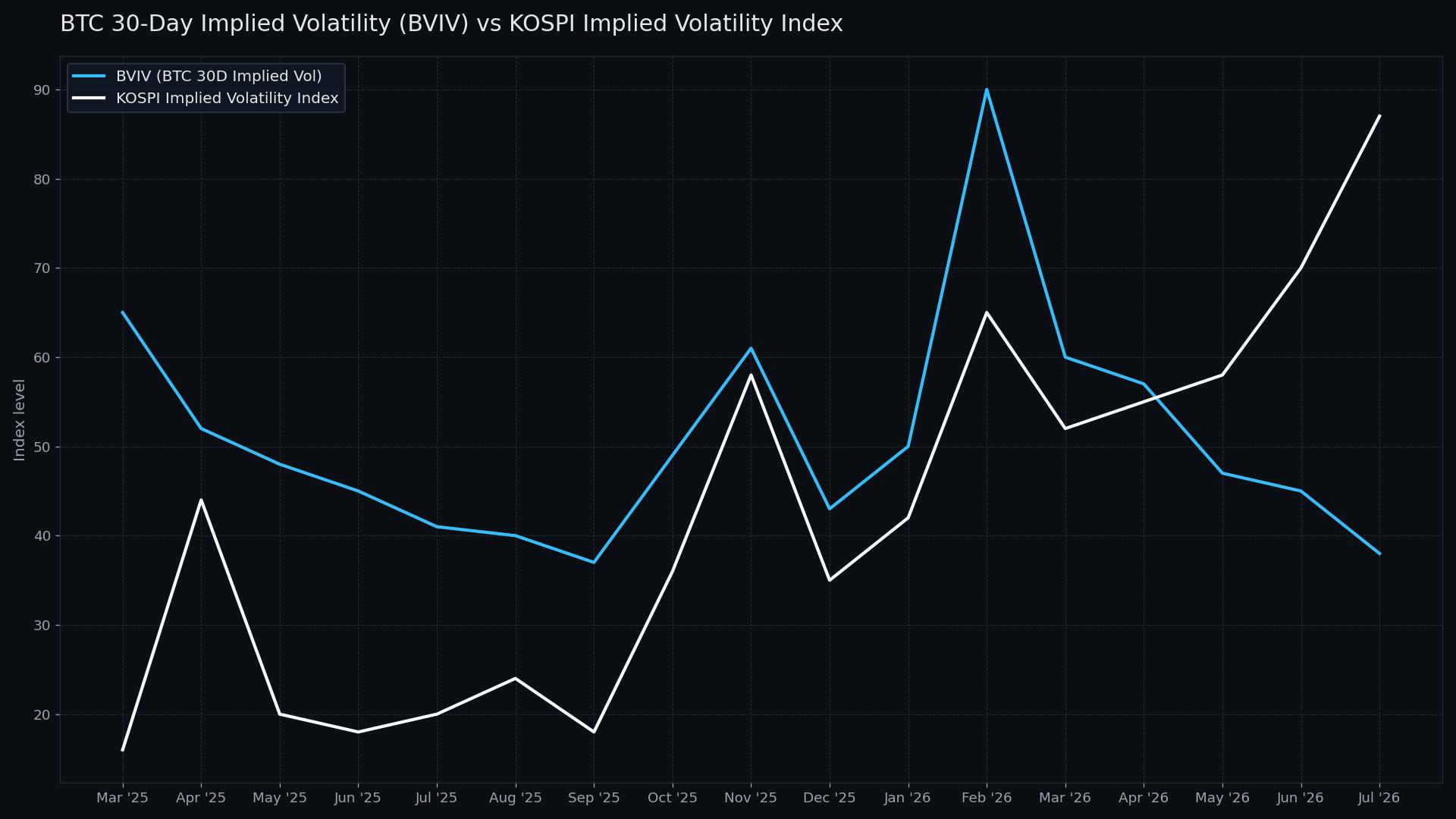
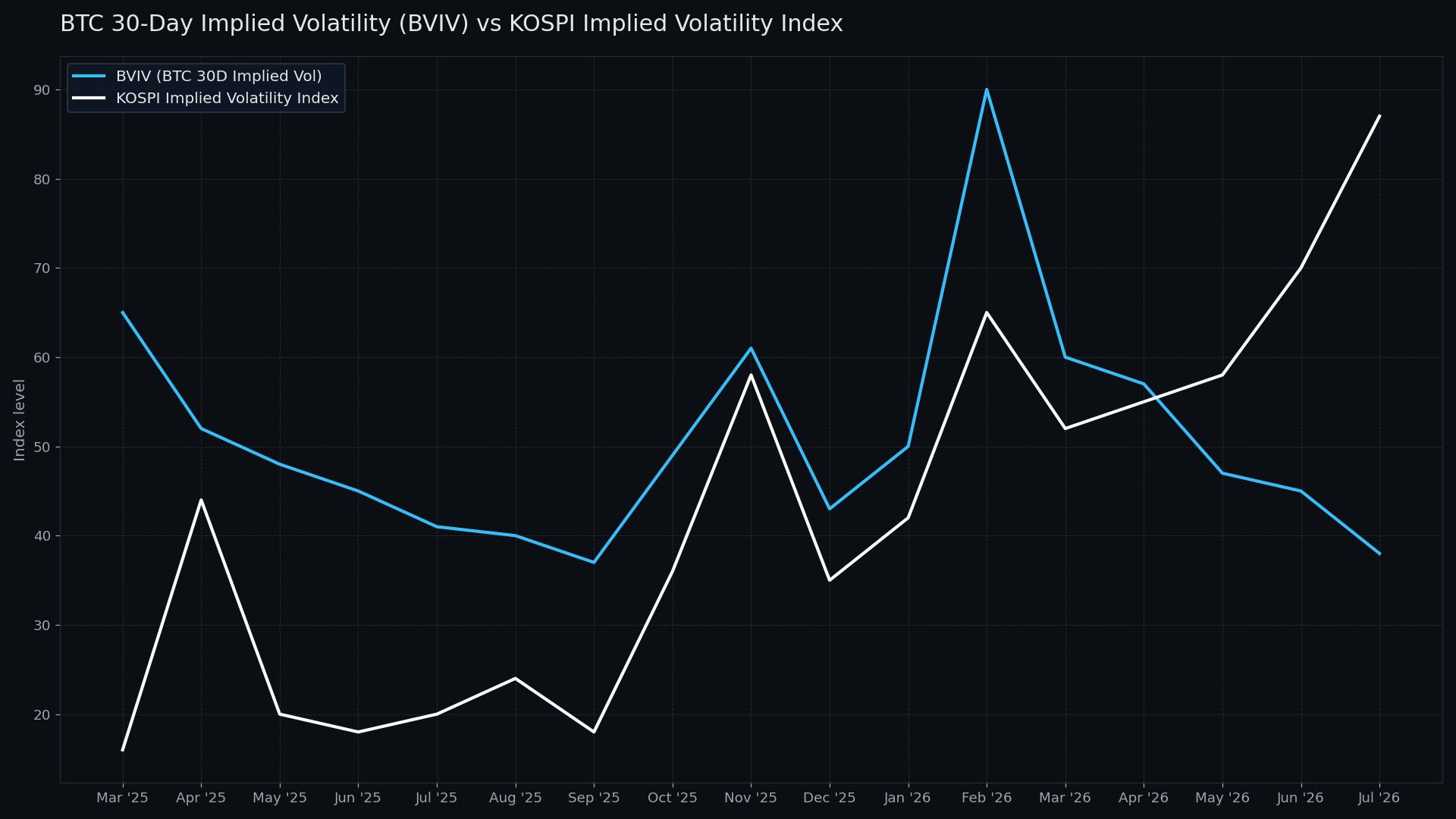
For bitcoin supporters, the reality that BTC is steadier than the Kospi is a notable victory. Still, the largest cryptocurrency remains twice as volatile and risky as the S&P 500 index, whose 30-day volatility index (VIX) sits below 20%. Perhaps the true milestone for bitcoin bulls will be the day when the VIX becomes more expensive than the BVIV.
In the meantime, bitcoin’s price remains under pressure, trading below its widely followed 50-day moving average, though there is a glimmer of optimism. According to analytics firm Nansen, the wallets that typically move first and in the largest size during geopolitical flare-ups have not meaningfully shifted into stablecoins.
“This is consistent with prior Middle East flare-ups: Short-term leveraged longs get flushed, and then accumulation resumes,” Nicolai Sondergaard, a research analyst at Nansen, said in an email.
Other market observers are urging a focus on the forthcoming hearings in Washington D.C.
“The Clarity Act faces what could be its final test today, the industry insisting its gets done while the bill snags on Trump conflict of interest provisions and fresh Senate hurdles before the August recess. This is the regulatory clarity the institutional bid has been waiting for,” analysts at Marex said.
Ethereum dropped by around 4% in the past 24 hours, slipping back to around $1,835 after briefly climbing above $1,930 earlier this week.
Despite the pullback, two market analysts continue to point to near-term upside based on different indicators, although one believes the recovery will be followed by a much deeper correction before a new bull cycle begins.
ETH Market Roadmap
Upon observing Ethereum’s historical behavior around the 0.8 MVRV Pricing Band, Ali Martinez found that the asset has repeatedly rallied toward, or even above, its Realized Price after reclaiming the band as support over the past six years. After briefly trading below the 0.8 MVRV band, ETH has now moved back above it, which prompted Martinez to identify its Realized Price at $2,245 as the next major level to watch if the historical pattern repeats.
Separately, Tony Research said the market is unfolding as he previously expected after Ethereum reached $1,900. The analyst believes the current correction into the $1,800 zone will be followed by a rally toward $2,000, and a further move to around $2,200 could transpire if Bitcoin climbs to $70,000.
After that, Tony Research expects 7-10 days of distribution before Ethereum declines into a final bottom zone between $1,260 and $890, which the analyst considers a dollar-cost averaging opportunity ahead of a new bull cycle targeting $7,000. It is also likely that ETH could briefly retest its 2022 bottom with a wick without breaking the broader trend.
The analyst explained that the outlook depends heavily on Bitcoin’s performance.
ETF Inflows Stall
On the institutional side of things, US-based spot Ethereum ETFs saw more than $28 million in net outflows after posting inflows for two straight days. Grayscale’s ETH recorded the largest withdrawals at nearly $14.3 million, followed by Fidelity’s FETH with $11 million and Grayscale’s ETHE with $4.8 million in outflows.
On the other hand, Bitwise’s ETHW was the only fund to attract fresh capital after bringing in $2.3 million, according to data compiled by SoSoValue.
Despite this, July has remained positive overall, as total net inflows surpassed $190 million. So far this year, these funds have posted net outflows in five months, while only April and July have recorded net inflows.
The post Ethereum Drops 4%, but Analysts Still See a Path Toward $2,245 and Beyond appeared first on CryptoPotato.

The United Kingdom National Crime Agency (NCA) and City of London Police said two men associated with the “Scattered Spider” hacking group were sentenced to five years and six months in prison.
The two pleaded guilty during their first court appearance at Woolwich Crown Court on June 22 and were sentenced on Thursday, according to a press release from the NCA.
British authorities said the pair were part of the Scattered Spider cybercrime group, which investigators have linked to high-profile ransomware and cryptocurrency extortion attacks targeting companies in the UK and the US.
The hacking group was linked to the infiltration of London’s public transport network in September 2024, leading to a reported 29 million British pounds ($38.9 million) in losses and recovery costs.
US prosecutors linked the Scattered Spider group to collecting $115 million in crypto ransom payments from at least 47 US companies, according to a September press release from the Department of Justice (DOJ).
The group was also accused of breaching Caesars Entertainment and stealing a large customer database in September 2023, prompting the company to pay a $15 million ransom in Bitcoin (BTC).
US prosecutors said the group’s attacks disrupted businesses and organizations nationwide, including critical infrastructure and the federal court system.

Source: Dark Web Informer
Related: MacOS malware hijacks Telegram sessions, targets crypto wallets: SlowMist
FBI seized $36 million from Scattered Spider-linked wallets
In July 2024, the FBI seized about $36 million worth of cryptocurrency from Scattered Spider-linked wallets, according to the DOJ’s September release.
According to the DOJ, investigators linked the group to at least 120 computer network intrusions. It said the FBI traced and seized digital assets tied to wallets allegedly controlled by members of the group as part of its investigation.
“These malicious attacks caused widespread disruption to US businesses and organizations, including critical infrastructure and the federal court system, highlighting the significant and growing threat posed by brazen cybercriminals,” said Matthew Galeotti, then acting assistant attorney general of the Justice Department’s Criminal Division.
Magazine: Does Botanix’s failure prove Bitcoiners don’t care about DeFi?
Maestro is live on Robinhood Chain, the new Ethereum layer-2 built on Arbitrum that has quickly become one of the busiest spots in crypto for memecoins and new launches. Attention around the chain continues to rise, led by CASHCAT and the new tokens launching in its wake.
The market moves fast, and Maestro keeps you ahead.
Maestro runs entirely in Telegram, so there’s no separate app or extension standing between you and a trade. Everything happens in one place, from your first buy to managing an open position. Decide to trade and you’re in, no delay, no detours.

What is Robinhood Chain
Robinhood Chain is Robinhood’s own Ethereum layer-2, built on Arbitrum. Robinhood positioned the chain around tokenized stocks and real-world assets, but memecoin trading took off just as quickly. Low fees and quick transactions make it a natural fit for high-frequency trading, and that’s the version Maestro is built for: fast, permissionless, and running around the clock.
Here’s everything the Robinhood Chain trading bot puts in a trader’s hands.
What you can do on Robinhood Chain
Maestro arrives fully loaded on Robinhood Chain, with fast execution, extensive DEX and launchpad coverage, and all the tools you need to move first.
Speed comes first. Quick buys and swaps get you into a position while a token’s still running, buying the moment you click, with no approval step in the way. When a token’s moving, every second counts, and Maestro can get you there first.
For the moves you’d rather not sit and watch, limit orders let you set your price and step away. Maestro executes the moment the market hits it. Catch a dip you’ve been waiting on, or take profit at your target while you’re nowhere near the screen.
When the smart money’s already positioned, copy trading puts you on the same side. Track any wallet worth following and Maestro copies every trade that wallet makes in real time, so you’re never the last one in.
Coverage that keeps growing
Robinhood Chain’s onchain activity has exploded, and new tokens don’t all launch in the same place. Miss where one launches and you miss the trade. Maestro gives you the fastest access to every launchpad and DEX that matters. Trading is live across Uniswap v2, v3 and v4, with launchpad support across Virtuals, Bankr, Flap.sh, Livo.trade, Trench.today, Bags.fm, RobinFun, LeaveHood, HoodFun, ApeStore, Noxa, Printr, Pons and more. New integrations land as fast as they launch, so you’re covered wherever the next run starts.
More money back with every trade
Cashback is Maestro’s way of paying you back for trading. Every trade returns up to 30% of your trading fees, and on a chain built for fast, high-volume trading, that adds up quickly. Cashback applies on every chain Maestro supports, Robinhood Chain included, so the more you trade, and the more chains you trade across, the more of that cost comes back to you. Few trading bots make staying active this rewarding.
Bridge in without leaving the chat
Moving funds onto Robinhood Chain has never been simpler. Maestro handles bridging directly in the bot, and offers two routes depending on what matters most. Relay Protocol is the fast, lower-cost option when you just want funds on the chain and ready to trade. Houdini Swap is the private one, routing your funds so there’s no link left between your wallets. Either way, bridging is part of the same flow as your first trade, not a separate errand before it.
Trading Robinhood Chain, start to finish
Getting in is quick. Open Maestro in Telegram, bridge funds onto Robinhood Chain through Relay Protocol or Houdini Swap, and you’re ready to trade. Paste a token’s contract address, set your buy amount, and the order goes through at the best available price in a couple of taps. From there, you manage everything in the same chat. Set a limit order to take profit, add to a position that’s working, or sell whenever you want. No tab-hopping needed.
The original bot, on a new chain
Maestro didn’t just show up for Robinhood Chain. The first Telegram trading bot has spent years proving itself on the fastest, most competitive chains in crypto, and all of that experience came to Robinhood Chain from day one. Traders here get the same engine that’s earned trust everywhere else Maestro runs, with the full toolkit ready from the start.
Another chain, another edge
Robinhood Chain is one of the fastest-evolving markets in crypto, and Maestro is all hands on deck to give traders the edge they deserve. That means deeper coverage and faster execution as the chain evolves. That’s how Maestro has always operated, and how it keeps setting the standard for trading bots everywhere.
Start trading on Robinhood Chain with Maestro today.
Disclaimer: The above article is sponsored content; it’s written by a third party. CryptoPotato doesn’t endorse or assume responsibility for the content, advertising, products, quality, accuracy, or other materials on this page. Nothing in it should be construed as financial advice. Readers are strongly advised to verify the information independently and carefully before engaging with any company or project mentioned and to do their own research. Investing in cryptocurrencies carries a risk of capital loss, and readers are also advised to consult a professional before making any decisions that may or may not be based on the above-sponsored content.
Readers are also advised to read CryptoPotato’s full disclaimer.
The post Maestro Supports Robinhood Chain: The Fastest Trading Bot on the New L2 appeared first on CryptoPotato.


South Korea’s Kospi has entered a technical bear market while Tokyo’s Nikkei sank again on Friday, as an unwinding AI trade exposes structural fragilities across Asia’s biggest developed economies.
Both governments are simultaneously opening legal doors for digital assets, an overlap worth watching closely.
The AI Trade Unravels Across Seoul and Tokyo
A technical bear market is a decline of 20% or more from a recent peak, a threshold the Kospi crossed after falling from the record high it set last month. The reversal followed an extraordinary run.
At its peak, the index had jumped 116% this year, lifting South Korea to the world’s sixth-largest stock market. Leverage fueled much of that climb, and now it fuels the descent.
Outstanding leveraged bets hit a record 29.2 trillion won, roughly $19.7 billion, in early July. Retail investors piled into single-stock ETFs tied to Samsung Electronics and SK Hynix, seeking exposure to artificial intelligence with borrowed money.
Follow us on X to get the latest news as it happens.
Analysts see uncomfortable echoes. Jin Qianjing, from Shenwan Hongyuan Group, warned that Korean stocks could amplify sentiment across global technology markets given their high leverage.
The comparison most often drawn is to China in 2015, when margin debt and a retail frenzy preceded a meltdown that erased trillions. China’s Star Market 50 Index has already retreated more than 10% in two weeks.
Japan tells a parallel story. The Nikkei 225 slid again on Friday, trading near its lowest levels in over a month, as heavy selling in chip-related names dragged it lower.
Tokyo Electron, Advantest, and SoftBank Group all posted steep losses. Taiwanese shares fell alongside them, while AI valuations face sustained pressure over sustainability concerns.
Can the Crisis Accelerate Crypto Adoption in South Korea and Japan
The timing creates a curious contrast. While equity markets convulse, both countries are formalizing crypto inside their financial systems.
Japan’s parliament passed amendments to the Financial Instruments and Exchange Act on July 15. The reform classifies crypto as financial products rather than payment tools, aligning them with stocks and bonds.
The package introduces insider trading bans, issuer disclosures, and penalties of up to 10 years in prison. It also establishes a flat 20% tax expected from January 2028, replacing rates that climbed toward 55%.
Domestic spot crypto ETFs become legally possible under the new framework. Approval remains uncertain, though exchanges reportedly eye first listings around 2027.
“The reform does not classify Bitcoin or Ethereum as securities. Instead, it recognizes crypto assets as investment products and introduces investor protection, disclosure requirements, and market surveillance similar to those in traditional financial markets,” XWIN said, cited by CryptoQuant.
Subscribe to our YouTube channel to watch leaders and journalists provide expert insights.
South Korea moved days earlier in a different direction. Seoul announced the National Asset Basic Act, which recognizes digital assets as part of state wealth alongside real estate and intellectual property.
That law governs roughly 1,400 trillion won in public holdings and replaces a framework dating to 1950. Tokenized government bonds and security tokens for state real estate sit inside the same agenda.
The convergence matters for adoption. Household savings in Japan approach $13 trillion, and even marginal reallocation would dwarf current crypto inflows.
Whether the crisis actually pushes capital toward digital assets remains unproven. Investors burned by leveraged AI bets may prefer safety over volatility, and regulatory clarity does not guarantee demand.
Still, the sequence itself is notable. Two economies confronting structural strain are simultaneously building the legal plumbing required for institutional crypto participation.
The post Panic Hits Japan and South Korea Markets: Can Crypto Become the Big Winner? appeared first on BeInCrypto.
Cardano’s ADA has been struggling to remain in crypto’s top 20, and its recent performance has been quite concerning (to say the least). Even so, analysts continue to float optimistic price targets for it.
Solana’s native token has flashed signs of an uptrend, while Ethereum (ETH) might be heading toward the biggest crash in its history.
ADA’s Latest Forecasts
The asset’s price has slipped well below $0.20 and is among the most severely affected by the prolonged bear market. X user The Boss noted the downward structure but reminded that the strongest reversals begin during such a negative environment when “almost nobody is paying attention.”
CryptoJack and Celal Kucuker also chipped in. The former spotted the formation of an inverse head-and-shoulders pattern on ADA’s chart, which has historically been a precursor of a rally, while the latter envisioned a parabolic increase to a new all-time high of $5.
The whale activity supports the bullish perspective. Investors holding between 100,000 and 100 million ADA have boosted their total possessions to more than 25.6 million coins, while those owning fewer than 100 units have reduced their exposure. This combination represents a healthy setup for the token, yet it can’t 100% guarantee a short-term pump.
Of course, not everyone is so optimistic. X user Alexander Legolas believes that Bitcoin (BTC) may soon tumble to $48,000, dragging ADA to around $0.10 along the way.
SOL’s Targets
Solana’s native cryptocurrency currently trades at around $75 (per CoinGecko), but some market observers think it may soon head north to much higher levels.
Ali Martinez recently argued that the Average True Range (ATR) stop has flipped below price, marking the first SuperTrend buy signal on the asset since October 10. That said, he projected a possible rise to $96 and even $121.
Michael van de Poppe suggested that SOL could stage a decisive comeback should it stay above $73, while the rising fear, uncertainty, and doubt (FUD) around the project may also be considered good news. After all, this means that most weak-hand investors have already exited, potentially setting the stage for a meaningful recovery.
ETH Crash Incoming?
Earlier this week, the second-largest cryptocurrency tried to reclaim the $2,000 psychological mark, but failed and now trades at approximately $1,830. And while many investors eagerly await a substantial rebound, certain analysts warned that a major collapse could be on the way. Crypto Rover told his 1.6 million followers on X that ETH might repeat previous cycles that ended in “devastating sell-offs.”
“The worst may still be ahead,” he added.
Ash Crypto is in the completely opposite corner. They reminded that every time the Russell 2000 hits a new all-time high, ETH has followed with a parabolic move in the next 12-18 months.
“We are seeing the same setup now. If history repeats, ETH could be gearing up for one of its biggest runs yet,” the analyst concluded.
The post Bullish ADA Predictions, SOL Shows Rally Potential, and More: Bits Recap July 17 appeared first on CryptoPotato.

Virat Kohli, Ravi Shastri Knew About Rohit Sharma? 2nd ODI Broadcast Drops Big Hints

Caviar’s Exclusive Smartphones for Messi and Ronaldo Showcase Legends in 24-Karat Gold

Oscar-winner Brenda Fricker famous as Home Alone 2’s Pigeon Lady dies


-

 Fashion7 days ago
Weekend Open Thread: Nutriplenish Leave-In Conditioner
-
 NewsBeat21 hours ago
London Mayor Sadiq Khan handed a peerage by Keir Starmer alongside 15 other Labour figures… just days before the PM leaves No10
-

 Crypto World1 day ago
CFTC blocks Kalshi from unwinding Michigan trades after court order
-

 Business1 day ago
Nvidia Stock Slips After Big Tuesday Rally as Huang Confirms Vera Rubin Chip Is Now in Production Today
-

 Politics2 days ago
Young campaigners urge incoming PM to act on outdoor junk food ads
-
 Entertainment2 days ago
Disney’s Most Ambitious Failed Star Wars Attraction Is Coming to SDCC
-

 News Videos3 days ago
XRP BOMBSHELL… XRP OMBOARDED FOR TRANSACTIONS!!!
-

 Tech3 days ago
Get Your ESP32 Sunny Side Up With This Solar Dev Board
-

 Crypto World16 hours ago
Injective Submits SEC Transfer-Agent Registration to Onchain Ownership Records
-

 Tech3 days ago
Dark Secrets Emerge When Jailbreaking LLMs
-

 Business1 day ago
Palantir Shares Rise After Expanded Nvidia Partnership and Fresh Analyst Upgrades Ahead of Earnings Day
-
 Sports2 days ago
New Cornerback Enters Vikings Trade Rumor Mill
-

 News Videos6 hours ago
Money | Class 12 Economics | CBSE Board Exam 2026-27
-

 Business11 hours ago
Banco Bilbao Vizcaya Argentaria, S.A. (BBVA) Discusses Global Macro Environment and Economic Outlook for Core Markets Transcript
-
 Tech4 days ago
Cloudflare Precursor Watches Your Mouse and Keyboard To Decide If You Are Human
-

 News Videos4 days ago
how to make coin bank box with cardboard #scienceproject #money #diy #shorts
-
 Entertainment2 days ago
Vicki Gunvalson Defends Discussing Heather Dubrow’s Money
-
Crypto World3 days ago
Ripple, Coinbase, Circle Join Linux x402 Foundation to Help Shape AI Payments
-
 Crypto World14 hours ago
Claude Fable 5 Slips to Second in AI Coding Leaderboard
-
Business12 hours ago
Nephros, Inc. (NEPH) Discusses Evolving Water Safety Strategies and Expansion Beyond Filtration Transcript
You must be logged in to post a comment Login