
Crypto World
Hyperliquid HIP-4 volume triples after open rollout



Hyperliquid opened its HIP-4 outcome-market infrastructure to outside venues on Aug. 29, and daily trading volume nearly tripled within three days, according to research published Sept. 3.
Summary
- Hyperliquid opened HIP-4 deployment August 29, and reported daily outcome volume tripled within three days.
- Two outside venues each posted 500,000 HYPE bonds to deploy markets using approved templates independently.
- Outcome captured 85% of reported volume while offering traders a $1 million active rebate program.
- Hyperliquid validators publish settlement prices every three seconds, according to the research collective’s analysis publicly.
- U.S. availability would require regulatory authorization, while sports contracts could face additional federal scrutiny requirements.
Daily volume increased from an August average of approximately $545,000 to $1.97 million on Aug. 31, the Hyperliquid Research Collective reported. The trailing daily figure subsequently reached approximately $2.75 million.
Two outside venues, Outcome and Skew, posted 500,000 HYPE bonds and began deploying markets through seven templates approved by Hyperliquid validators. However, the early volume was heavily concentrated in Outcome and supported by trading incentives.
The rollout makes market deployment permissionless at the protocol level. It does not automatically authorize HIP-4 operators to serve U.S. customers or offer every category of event contract.
Hyperliquid HIP-4 opens deployment to outside venues
HIP-4 supports fully collateralized outcome contracts that settle within a fixed range, usually zero or one. Prices can represent the market’s assessment of whether a specified event will occur.
Unlike perpetual futures, these contracts do not use leverage, funding payments or liquidations. Traders must provide the full collateral required for their positions.
As crypto.news previously explained, HIP-4 introduced outcome contracts alongside Hyperliquid’s builder-deployed perpetual markets. The first HIP-4 products reached mainnet in May but remained controlled by validators and selected operators.
The Aug. 29 upgrade opened deployment to outside builders. Each operator must bond 500,000 HYPE for at least six months. The bond can be slashed if validators determine that a deployer created an invalid market, settled it incorrectly or failed to complete settlement within the permitted period.
Permissionless deployment also remains limited by templates. Validators approve standard market formats and their permitted language. Builders can then launch markets that follow those specifications without seeking separate approval for every contract.
This design separates market creation from template governance. Outside operators gain control over individual listings, while validators retain influence over the categories and settlement structures that the protocol supports.
Incentives drove most of the early volume
Outcome accounted for approximately 85% of reported HIP-4 volume after third-party deployment opened. Skew produced roughly 1%, leaving the remaining activity with existing validator-deployed markets.
Outcome introduced a $1 million rebate campaign that paid users approximately one cent for every dollar traded, according to the research. The incentive means the initial increase should not be treated entirely as evidence of lasting demand.
Rebate programs can encourage participants to trade more frequently or execute transactions that would be less attractive without rewards. The reported volume remains genuine trading activity, but its durability will become clearer after incentives decline or expire.
The concentration also creates an early test for HIP-4’s permissionless model. Two operators have posted bonds, yet one venue controls most of the new activity. More deployers, market templates and liquidity sources would be needed to establish a broader competitive market.
Hyperliquid previously announced plans for permissionless HIP-4 deployment in July. At the time, crypto.news reported that outside builders would need substantial HYPE stakes and could face slashing.
The current 500,000 HYPE requirement provides an economic penalty for misconduct. However, its dollar value also creates a high entry barrier. Only operators controlling or borrowing large HYPE positions can deploy markets directly.
No verified market data showed that the permissionless rollout alone caused a distinct change in HYPE’s price. Wider crypto-market conditions and other activity on Hyperliquid also affect the token.
Shared settlement connects outcomes with perpetuals
HIP-4 contracts settle using prices published by Hyperliquid validators every three seconds, according to the collective. The outcome positions use the same account environment supporting Hyperliquid’s perpetual markets.
This architecture can allow a trader to hedge a binary outcome with a perpetual contract referencing the same mark price. Because both positions use the same underlying price source, the hedge avoids differences created when separate venues use different indexes or settlement times.
For example, a contract paying one dollar if Bitcoin closes above a specified level could be paired with a Bitcoin perpetual position. Both instruments would respond to a common Hyperliquid mark rather than independent external references.
The arrangement does not remove every risk. Traders still face liquidity, execution and settlement risks. Validators also play a central role in publishing the prices used for settlement.
The collective argued that neither Kalshi nor Polymarket can offer an identical hedge because their event contracts do not share Hyperliquid’s perpetual account and mark-price system. That comparison concerns technical market structure, not liquidity quality, regulatory protection or overall platform risk.
Kalshi operates as a regulated U.S. designated contract market. Polymarket has used blockchain settlement and external resolution systems. Hyperliquid instead places matching, collateral and validator-directed settlement within its own network.
That tighter structure may reduce basis differences between instruments. It also concentrates operational dependencies within Hyperliquid’s validator and trading systems.
U.S. access remains a separate challenge
None of the current HIP-4 templates reportedly covers sports, elections or other categories commonly associated with federal event-contract disputes. Existing listings instead focus on prices, economic figures and other objectively measurable results.
Avoiding sports does not by itself make the markets lawful for U.S. customers. A platform offering commodity derivatives to U.S. persons generally requires an appropriate regulatory framework, regardless of whether its software permits permissionless deployment.
The Commodity Exchange Act allows registered entities to submit new contracts to the Commodity Futures Trading Commission. Federal law also allows the CFTC to review event contracts involving gaming, terrorism, assassination, war, unlawful activity or similar subjects considered contrary to the public interest.
Current CFTC rules establish a review process for contracts involving those categories. The regulator can request a trading suspension during a 90-day review before approving or rejecting a contract.
Sports would therefore add another legal question. The research collective found that sports accounted for 91% of HIP-4’s largest historical trading session. Opening third-party sports markets could increase demand, but it could also trigger scrutiny under the gaming provision.
The collective described regulatory “permission” as the remaining constraint, but no regulator has confirmed that registration alone would authorize every HIP-4 structure or market category.
The legal status could also depend on who operates the interface, controls market parameters, receives fees and makes the platform available to U.S. users. A protocol’s decentralized architecture does not settle those questions automatically.
What happens next for HIP-4
The clearest test will be whether volume remains above its August average after Outcome’s rebate campaign ends. Activity will also need to spread beyond a single operator to demonstrate that permissionless deployment has produced durable competition.
Additional builders may enter after posting the required HYPE bonds. Hyperliquid validators could approve more templates, expanding the range of economic, crypto and financial outcomes available for deployment.
U.S. access would require a separate compliance path. Any operator seeking American users would need to determine whether its contracts require CFTC registration, submission or other authorization.
Sports markets would face an added review question because federal law specifically identifies gaming as an event-contract category that may be examined under the public-interest standard.
FAQs
What is Hyperliquid HIP-4?
HIP-4 is Hyperliquid’s framework for fully collateralized outcome contracts. The contracts commonly settle at zero or one based on a predetermined result.
When did permissionless HIP-4 deployment begin?
Hyperliquid enabled outside HIP-4 deployment on Aug. 29, 2026. Builders must use validator-approved templates and post a 500,000 HYPE bond.
Why did HIP-4 volume triple?
Outcome generated most of the increase after launching third-party markets. Its $1 million rebate program also rewarded users according to their trading volume.
Can U.S. customers legally trade HIP-4 markets?
Permissionless protocol deployment does not establish lawful U.S. access. Operators may require CFTC registration or authorization, depending on their products and activities.
Why could sports markets face greater scrutiny?
The Commodity Exchange Act allows the CFTC to review certain event contracts involving gaming under a public-interest standard.



Kraken is joining SoFi’s settlement network and list SoFiUSD as the companies link traditional banking with crypto markets.

Futures for the Dow Jones Industrial Average and the other major stock indexes traded mixed Thursday, as Treasury yields cooled off from recent gains. Meanwhile, artificial intelligence stock Broadcom (AVGO) sold off on the stock market today after the company’s earnings report while Snowflake (SNOW) rocketed higher. Ahead of Thursday’s open, Dow futures rose 0.2%, while S&P 500 futures hovered…
Copyright ©2026 Investor’s Business Daily, LLC. All rights reserved. 87990cbe856818d5eddac44c7b1cdeb8

For investors seeking a high-yield real estate investment trust that can hold up even if the economy weakens, UMH Properties (UMH) looks like a strong candidate — and the stock is currently in a buy zone. Headquartered in Freehold, N.J., UMH is a REIT specializing in manufactured home communities. The company owns a portfolio of 145 communities with more than…
Copyright ©2026 Investor’s Business Daily, LLC. All rights reserved. 87990cbe856818d5eddac44c7b1cdeb8
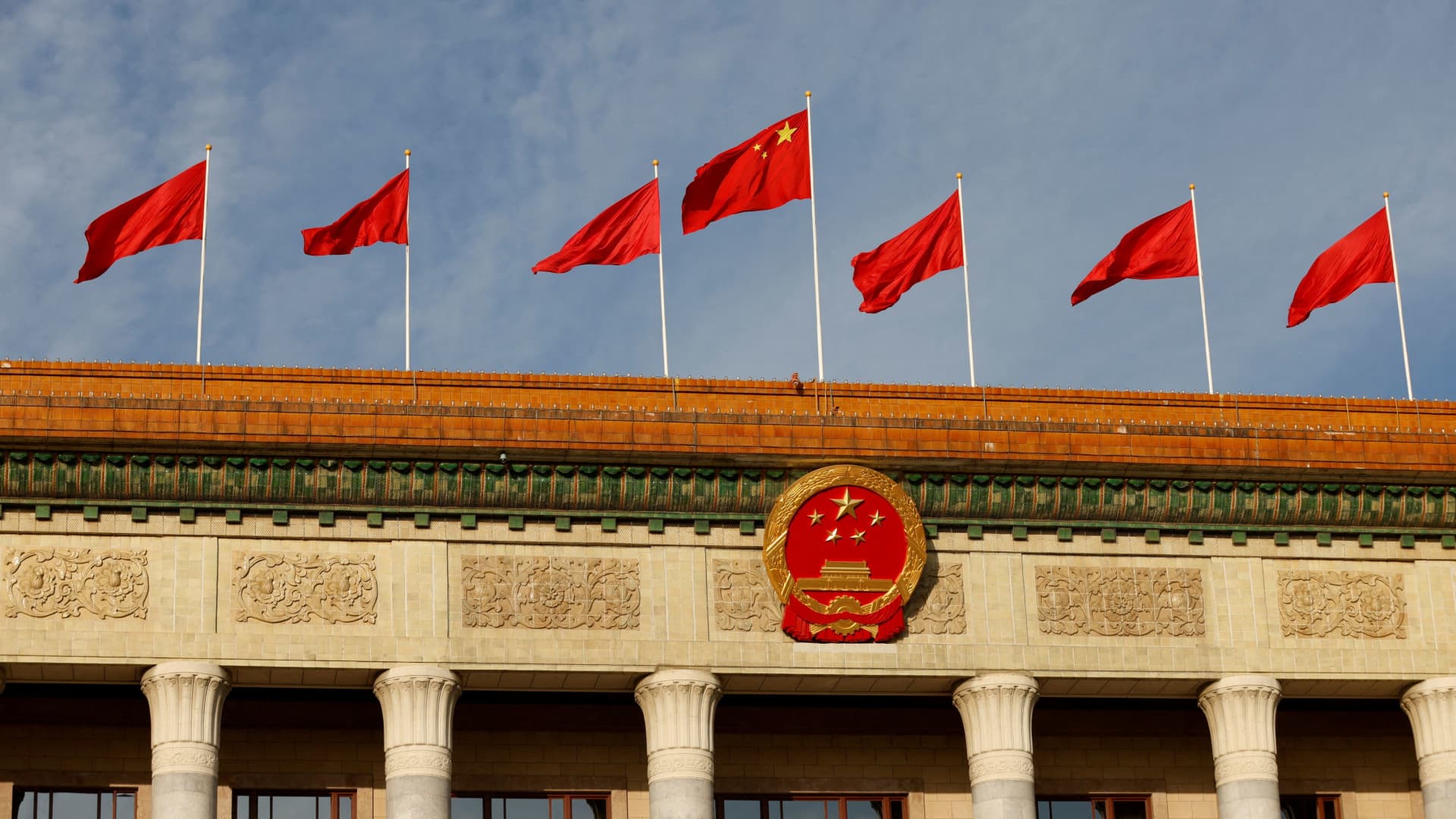
A Chinese flag flutters on top of the Great Hall of the People ahead of the opening ceremony of the Belt and Road Forum (BRF), to mark 10th anniversary of the Belt and Road Initiative, in Beijing, China October 18, 2023.
Edgar Su | Reuters
BEIJING — China has accused other G20 nations of “promoting protectionism,” after they criticized economies that rely heavily on exports.
U.S. Treasury Secretary Scott Bessent on Tuesday said 19 of the G20 members agreed to address the “unsustainable equilibrium” resulting from a “stream of cheap exports.” China was the only G20 member to dissent from a joint statement over references to such “imbalances.”
The Commerce Ministry on Thursday pushed back on trade complaints from the U.S. and Europe, calling them “an excuse to pressure and restrict China.”
“China believes that taking advantage of the G20 and other multilateral mechanisms to hype up so-called ‘economic imbalances’ and ‘overcapacity’ is essentially promoting protectionism,” Ling Huang, Commerce Ministry spokesperson, said in Chinese, translated by CNBC.
“China is firmly opposed,” she said during a weekly press conference. “This will only disrupt the global economic and trade order, and harm the healthy development of the global economy.”
The words come amid a flurry of different multilateral meetings and growing anticipation for Chinese President Xi Jinping’s trip to Washington, D.C. later this month.
When asked by CNBC about the latest U.S. anti-Iran sanctions, which can extend beyond Iranian entities to foreign companies or individuals accused of helping Iran, Huang said the U.S. should “immediately correct its wrong practices and lift sanctions against relevant Chinese companies and citizens.”
“Despite repeated requests from China, the U.S. has used Iran as an excuse for repeatedly imposing sanctions on Chinese companies and citizens, to which China is strongly dissatisfied and firmly opposes,” she said.
Early last week, Bessent announced that any entity, including Chinese banks, that facilitates money laundering or sanctions evasion on behalf of Iran could be cut off from the U.S. financial system.
Huang on Thursday also urged France to halt implementation of a new law aimed at curbing the low prices charged by Chinese e-commerce companies such as Temu.
“If France persists in its course of action, China will take necessary measures to safeguard the legitimate rights and interests of Chinese enterprises, and France will bear all consequences,” she said.
China and the European Union more broadly have also been engaged in trade talks this summer as Europe wants to reduce its record trade deficit with China by October. EU Trade Commissioner Maroš Šefčovič warned in an interview with Euronews this week that Beijing must deliver “concrete results” by October or face “harsher measures.”
Huang said China is willing to work with the EU, but said demands should not be made unilaterally, and threats should not be made to close markets.


Student loan real-world asset (RWA) protocol Pencil Finance completed a $1 million onchain student loan cycle, offering financing to thousands of students in Southeast Asia who were underserved by traditional lenders.
Pencil said it completed its first fully onchain student loan cycle on the blockchain, where the platform deployed $1 million in capital as a lender that was repaid by borrowers to the bundle’s funders with yield, the company revealed in a Thursday announcement shared with Cointelegraph.
The bundle was funded in July 2025 by Animoca Brands, Open Campus and New Campus, structured as a senior tranche with fixed returns and a junior tranche with variable returns and first-loss risk.
The $1 million onchain loan cycle offered financing to about 6,600 students across 118 schools and universities in Southeast Asia. Pencil Finance claims this is the first-ever fully onchain lending cycle financing student loans transparently recorded on the blockchain network.
Of the 6,600 students, about 1,050 received direct funding. Pencil said the loans were designed for students underserved by traditional lenders, with 50% female borrowers and 93% stemming from lower-income households.
Tokenized RWAs are increasingly being used to issue or collateralize loans.
In July, Brazil’s B3 stock exchange issued a 100,000 Brazilian reais ($19,600) loan secured by 10 tokenized cows as collateral, where each cow received a unique digital token linked to an encrypted digital identity, while AI-powered smart collars from agriculture tech company Cowmed monitored each animal’s health.
Related: Standard Chartered launches spot Bitcoin and Ether trading in UAE
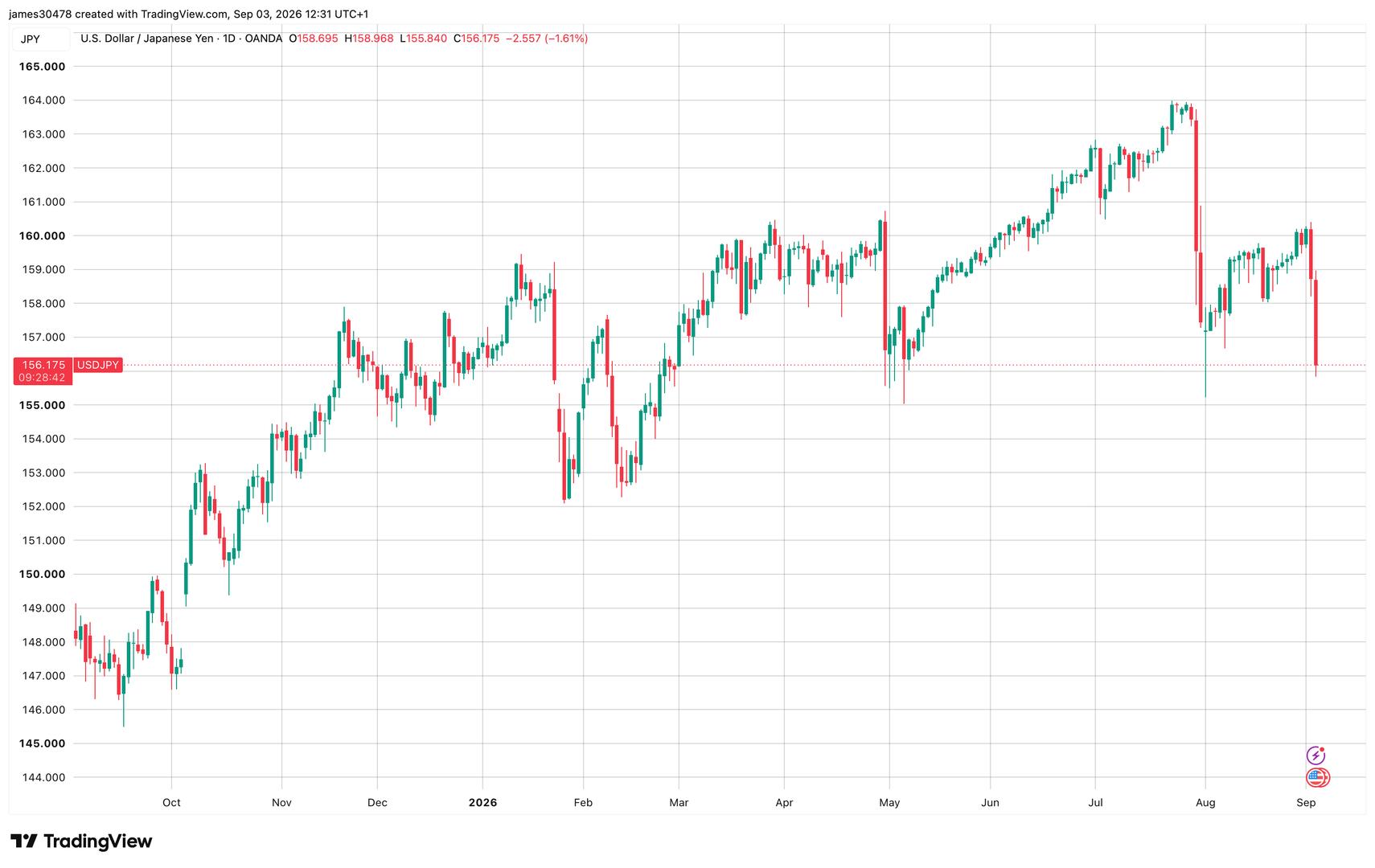
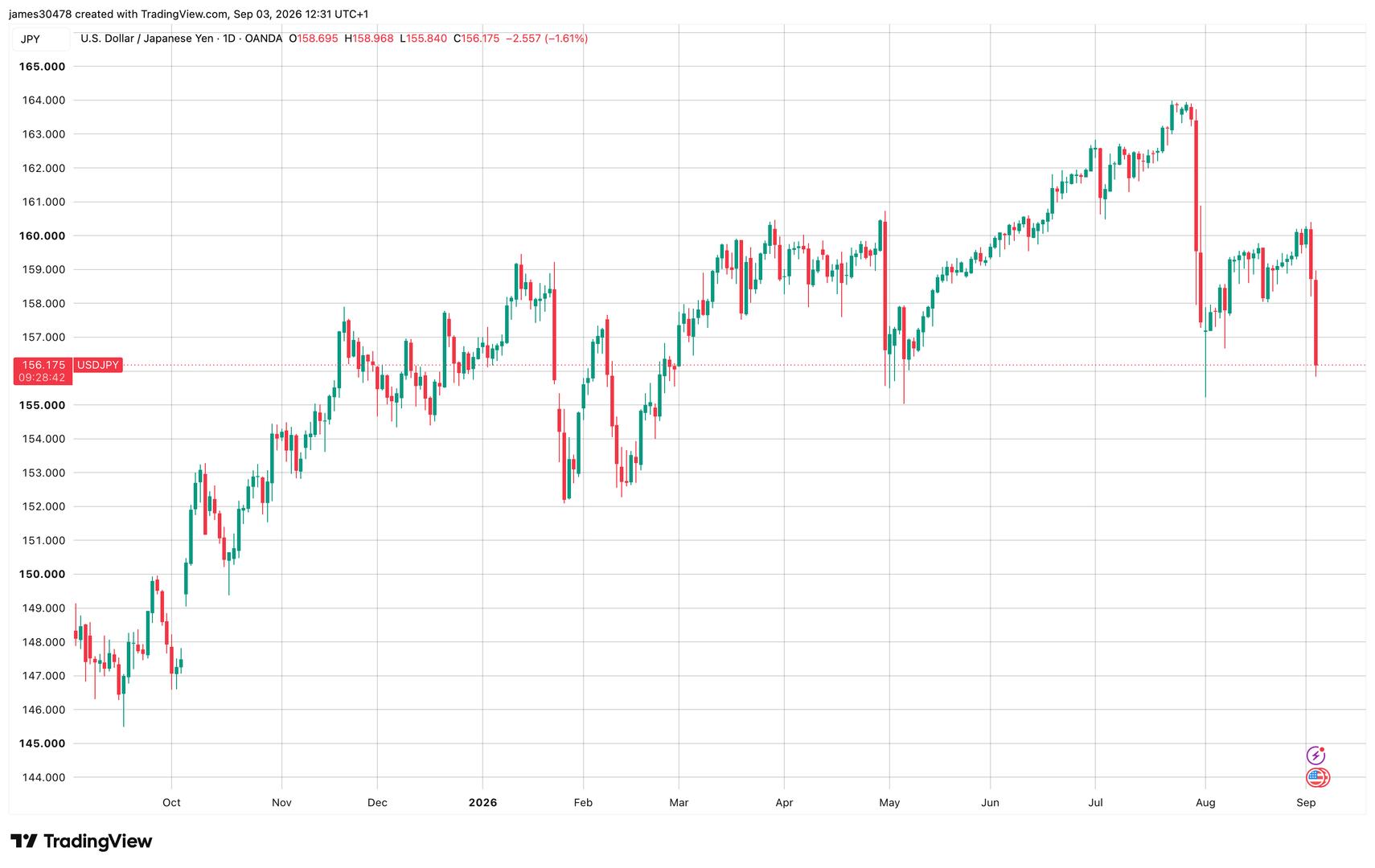
Yen’s rise has led to a broad-based USD weakness, driving the Dollar Index lower. BTC and gold are loving it, for now.
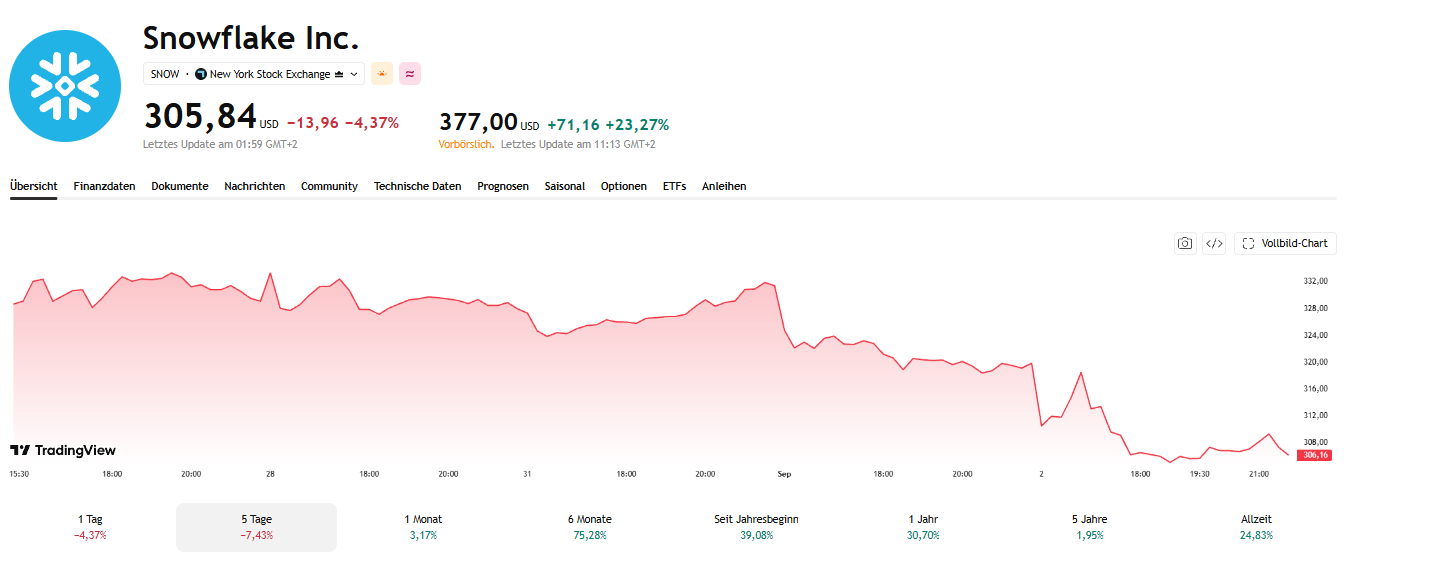
Jim Cramer expects a huge move in Snowflake stock after a blowout quarter. Broadcom earned a far more cautious verdict.
The CNBC host weighed in after both companies reported. Snowflake and Broadcom both cleared estimates, yet only one drew unqualified praise in the artificial intelligence (AI) trade.
Jim Cramer Snowflake Verdict Follows a Blowout Quarter
Snowflake reported product revenue of $1.49 billion for its fiscal second quarter, up 37% from a year earlier. Adjusted earnings hit $0.62 per share.
Management lifted full-year product revenue guidance to $6.07 billion. Shares jumped 23.27% to $377.00 in pre-market trading from Wednesday’s $305.84 close.
The stock had slid 7.4% over the five sessions into the report.
Cramer flagged the valuation in the same breath as the beat. He called it the cleanest way for hesitant enterprises to buy compute on demand.
His enthusiasm marks a shift. Last week, he praised Marvell’s quarter yet warned that its price had already run too far.

Broadcom Triples AI Revenue Yet Wall Street Hesitates
Broadcom delivered $16.7 billion in AI semiconductor revenue, a 221% jump. Total revenue rose 86% to $29.6 billion, and adjusted earnings reached $3.32 per share.
Chief Executive Hock Tan guided fourth-quarter AI sales to $21.7 billion. He has secured a supply to roughly double AI revenue to about $115 billion in fiscal 2027.
Tan flagged a path toward $230 billion in fiscal 2028. Investors still balked.
Cramer welcomed the raises, then hedged.
Hock giving you some nice raises for next year and the year after. That’s what we have been looking for. Maybe i am too hopeful… Small position for the trust…
Jim Cramer, post
The trust is his CNBC Investing Club portfolio.
Total fourth-quarter guidance of $34.8 billion landed just under consensus. The stock slipped 2.58% to $357.76 in pre-market trading, extending a 4.5% monthly decline.

Analyst forecasts before earnings were already skewed heavily bullish, leaving little room for surprise.
AMD’s post-earnings selloff in August showed how fast strong chip numbers can disappoint.
Cramer’s split verdict leaves one clear test. Snowflake has to turn AI demand into margin, while Broadcom has to prove Tan’s 2028 math.
The post Jim Cramer's Says This Stock Is Primed for a “Huge Move” appeared first on BeInCrypto.
Your day-ahead look for Sept. 3, 2026

“The memories are so vivid,” says Lomonaco, who helped start a fund for the families of his staff and who has gone on to run several successful restaurants in the city. “A generation has grown up since then, but it still seems like yesterday to me.”
A 25th anniversary marks a swath of time that can be illuminating because, to someone who is younger than 30, it feels like an eternity. Or a lifetime, which to someone who actually is 25, it is. But to someone who is over 50, as I am, it feels like a chapter. A long one, perhaps. But, still, a part of something else.
9/11 is a hinge of time that separates generations. It shouldn’t be surprising—but it always is—when I ask young folks about 9/11, and they just can’t get their hearts around it. It’s something that they learned about in class or saw on YouTube. They don’t feel it like I do. Like we do.
Those of us who are moved by this anniversary—no matter how close we were to the actual tragedy—should find some way to talk about it. “We have an obligation,” Lomonaco says. “When we talk about the people who died, we’re acknowledging the significance of their lives.”


Over the course of her long and influential life, Gloria Steinem went from being described in the pages of TIME as “one of the best dates to take to a New York party these days” and “smashing looking Gucci liberal” to being lauded as a “feminist icon.” If nothing else, the shift in the tone of her coverage in the magazine provides a window into the change in attitudes toward women that she helped engineer over the course of her 92-year life, which ended on Sept. 2.
Let’s add one more description to the list: durable dynamo. Steinem never outlived her ability to be relevant, inspiring several generations of women to organize and strive to be given the same opportunities as men. She never stopped blazing a trail for those who faced a particularly dense thicket and she never thought small. “I believe that things are a circle, not a hierarchy,” she said to TIME in 2011. “The kind of society we are striving toward is one in which things are linked not ranked. And one in which we understand that the women’s movement and the anti racist movement and the gay movement and the environmentalist movement, they’re all linked.”
Steinem was born on March 25, 1934, to a homemaker mother and a father with, she later said, only two points of pride: “He never wore a hat, and he never had a job. He was always going to make a movie, or cut a record, or start a new hotel, or come up with a new orange drink.” She didn’t spend a full year in school until she was 12, when her parents split and she ended up living with her mother, whose mental health was in a dire state, in East Toledo, Ohio. At 16, she was sent to live with an aunt in Washington. Before that, she says, “I’d never lived any place to invite anybody home to. I thought that people always ate out of refrigerators.”
After graduating from Smith College in 1956, she spent two years in India on a fellowship (and also to get out of an engagement), then came home to work in Cambridge, Mass., for a group encouraging American students to attend Communist youth festivals abroad. It was later revealed to be CIA-funded, but Steinem was unfussed, saying she “was happy to use the Establishment’s money against the Establishment.”
In 1963, she famously published a first-person account of her glamour-free month undercover as a Playboy Bunny in Show magazine. It was her big break, and it also threatened to be her curse, since at first she almost exclusively got offered assignments along the same lines. This was the period when TIME thought it important to note an appearance in which she wore “a Luis Estevez creation that consisted of five widely spaced bands of chinchilla held together by transparent black net. In between was supposed to be little more than a bare bodkin.”
She later got hired at the fledgling New York magazine, where in 1968 her first story was about Vietnamese leader Ho Chi Minh’s stint as a New York City waiter and laundryman. As she steadily found her journalistic feet, she began to find her calling: to use her charm, wit and platform to promote equality. Steinem understood the fear that these ideas stirred up in people. “Women don’t want to exchange places with men,” she wrote in an essay for TIME in 1970, shortly after the magazine identified her as “a trim, undeniably female, blonde-streaked brunette who has been described as ‘the thinking man’s Jean Shrimpton.’ ” She went on to add: “But we do want to change the economic system to one more based on merit. In Women’s Lib Utopia, there will be free access to good jobs—and decent pay for the bad ones women have been performing all along, including housework.”
Inevitably, her activism moved beyond writing to organizing. In 1971, along with Shirley Chisholm, Bella Abzug, Betty Friedan and several others, she convened the National Women’s Political Caucus to try to get more women into government offices. Shortly after that she co-founded Ms. magazine, which she described as “a how-to magazine; not how to make jelly but how to seize control of your life.” TIME’s writers, by this time calling her “feminism’s superstar,” finally began to acknowledge her impact. A story about the 1972 Democratic convention—titled, alas, “Eve’s Operatives”—opened with: “Gazing around the convention through her blue-tinted glasses, Gloria Steinem pronounced with satisfaction: ‘We’ve changed the population here. It almost looks like the country. What she meant was that women are 52% of the nation’s population, and last week close to 40% of the convention delegates were women—a dramatic jump over their 13% representation at the 1968 Democratic Convention.”
There was a still way to go, however—both for women and for TIME. “Decorative as the women were in their bell-bottom trousers, miniskirts, jeans and hot pants,” the magazine went on to say, “they were not there to be on display but to seek power. Except for a couple of setbacks, they got enough to satisfy and even surprise them.” After the crushing loss of Democratic Presidential Candidate George McGovern to Richard Nixon, Steinem’s political campaigning took a backseat to her advocacy work. The 1977 women’s conference, which she has called “the most important event that nobody knows about,” remained one of her proudest achievements, even as it sparked a conservative backlash and perhaps the founding of the religious right.
As the decades passed, Steinem’s activism grew to encompass more than women’s equality. She campaigned on behalf of native people, was arrested while protesting apartheid, publicly opposed the first Gulf War, advocated for disarmament in Korea, spoke against child abuse, female genital mutilation and pornography, and was an early supporter of LGB rights. (It took her a little longer to endorse the transgender movement.) Her advocacy was always couched in pragmatism and compassion. She pointed out that the pedestal women were put on was “as much a prison as any small, confined space” and called her 2019 memoir The Truth Will Set You Free, But First It Will Piss You Off! Writing, her first calling, remained one of her great loves—”the only thing that, when I do it, I don’t feel I should be doing something else.” She published books throughout her career, many of which, including her first memoir, 1983’s Outrageous Acts and Everyday Rebellions, were bestsellers, and she had another one due out this fall. (She often joked that she wished her books didn’t get republished so much because it would mean they were no longer relevant.)
By the ’90s, Steinem had scored a TIME cover, albeit one about a pushback against feminism, after her book about female self esteem—Revolution From Within—was a bestseller. “As she tours shopping malls, Steinem is being mobbed by crowds that, according to one bookstore owner, exceed those of Oliver North and Vanna White, the backlash icons of American manhood and womanhood,” Nancy Gibbs wrote. As well as writing her own books, Steinem contributed to countless others, appeared in more than 120 films, help produce several documentaries and inspired the 2019 Off Broadway play, Gloria: A Life. She cast her gaze domestically, locally, nationally and globally, founding Equality Now, which aimed to elevate and protect the rights of girls and women internationally.
Somewhere around the turn of the century, the times—and TIME— caught up with Steinem; her ideas became mainstream and her words and activities were covered with the kind of reverence reserved for icons. In 2013, President Barack Obama awarded her the Presidential Medal of Freedom. Half a century after writing her Women’s Lib Utopia essay for TIME, she annotated it, warning that women had made many advances but that the “time of greatest danger comes after a victory, and that’s where we are now.” (She also noted that she found out later that she had been paid less than the men who wrote for the same issue.)
Through it all she kept one of her less acknowledged gifts intact: her sense of humor. She did not come up with the classic feminist saying that women need men like a fish needs a bicycle, but she popularized it. She was always threatening to get a back tattoo for her 70th birthday. So frequently was she asked about her beauty secret that she came up with the perfect reply: “Revolution,” she would say. “It keeps you young.”
In 2011, TIME asked what she would do if she only had two years to live. “It seems to me one of the uses of age is to help you know what you want to do and keep from wasting time,” she said. “And I have this unfortunate notion that I’m immortal, which doesn’t cause you to plan very well. I think it would be mainly about writing and seeing friends, my chosen family. And writing what I believe. And maybe living with elephants. I do still want to live with elephants.”

If You Love ‘Neuromancer,’ You Need To Read This Near-Perfect Masterpiece

How XRP Could Fund Your Family’s Retirement

Barilla expands pasta portfolio with Goodles acquisition





-

 Fashion6 days ago
Weekend Open Thread: Maeve – Corporette.com
-

 Crypto World7 days ago
Bitcoin’s 22% rally now needs real demand to outlast Treasury liquidity boost
-

 Business7 days ago
Apple Confirms September 9 Keynote and Reveals Its Full Pre-Order Schedule
-

 Crypto World12 hours ago
CLARITY Act could advance within weeks, Atkins says
-

 Business6 days ago
Salesforce Stock Soars 19% as Blowout Earnings and Agentforce AI Growth Silence Software Skeptics
-

 Business5 days ago
Onto Innovation Stock: AI’s Next Bottleneck Is Yield (NYSE:ONTO)
-

 Crypto World5 days ago
Bitcoin price tests $82K resistance as Brandt stays long
-
 Tech5 days ago
Hugging Face built a $4.5 billion empire on free AI models. Now Nvidia is buying it for $12.9 billion
-

 Business6 days ago
iPhone 18 Pro Pre-Orders Could Shift to Saturday as Apple Reportedly Avoids September 11 Anniversary
-

 Crypto World6 days ago
Truflation calls for Fed rate cut after PCE forecast
-
 News Videos4 days ago
Charlie Munger on Robinhood: No one should believe that Robinhood’s trades are free
-

 Tech5 days ago
PaperCut releases second emergency patch for exploited flaws
-

 Crypto World1 day ago
Elon Musk Says Grok 4.7 Lands in 10 Days and Will Beat Every Model
-

 Tech6 days ago
The fix for the AI agent that hijacked a company’s DNS: it can propose the change, but it can’t approve it
-
 Entertainment6 days ago
‘Adults’ Creators Break Down Season 2’s Most Shocking Moments and Tease a Potential Season 3
-

 Tech5 days ago
Tamagotchi Ring Takes the 30-Year Digital Pet and Places it on Your Finger
-

 Tech4 days ago
As the influencer economy drives retail sales, Seattle startup raises $22M to play matchmaker
-
 Crypto World1 day ago
Bitcoin slips below $77.5K as macro pressure offsets ETF inflows
-
 NewsBeat4 days ago
Trump posts AI video of ‘Lake America’ being protected by an army of bequiffed ‘Donald Ducks’
-
 Entertainment4 days ago
Taylor Swift Reportedly ‘Frustrated’ With Travis Kelce After ‘Short’ Honeymoon
You must be logged in to post a comment Login